Article

Late Paleozoic and Late Jurassic Sedimentation at the Eurasian Continental Margin: Further Constraints from the Metasedimentary Successions of the Circum-Rhodope Belt, Greece


1
Department of Geology, Paleontology and Fossil Fuels, Sofia University “St. Kliment Ohridski”, 15 Tzar Osvoboditel Bd., 1504 Sofia, Bulgaria
2
Bulgarian Academy of Sciences, 1 November 15 Str., 1040 Sofia, Bulgaria
Geosciences 2026, 16(4), 140; https://doi.org/10.3390/geosciences16040140
Submission received: 19 February 2026 / Revised: 24 March 2026 / Accepted: 27 March 2026 / Published: 30 March 2026

Abstract

The Circum-Rhodope Belt fringes the Rhodope and Serbo-Macedonian zones in the Alpine orogen of the northern Aegean region. This belt contains Late Paleozoic and Mesozoic metasedimentary successions that record depositional history along the continental margin of Eurasia. Critical successions of the eastern Circum-Rhodope Belt, such as those exposed in the Fanari and Petrota areas, are studied here, integrating their structure, whole-rock geochemistry and U-Pb LA-ICP-MS zircon geochronological context. The Fanari turbiditic succession contains quartz arenite, while the Petrota succession consists of Fe-rich shale and sandstone, and both successions are distinguished by REE-depleted and REE-enriched characteristics and acidic and intermediate arc-related sedimentary sources, respectively. Detrital U-Pb zircon geochronology reveals a Late Carboniferous–Early Permian maximum depositional age of 301.2 ± 8.4 Ma for Fanari quartz arenite and a Late Jurassic maximum depositional age of 147.0 ± 2.0 Ma for Petrota Fe-shale. The results are interpreted in terms of Late Paleozoic continental slope deposition of the Fanari succession along the Eurasian margin and trench-arc sedimentation of the Petrota succession linked to the development of a Jurassic island arc system pertinent to the eastern Circum-Rhodope Belt. These tectonic settings and depositional environments can be used to restore an overall picture of a Late Paleozoic to Mid-Mesozoic sedimentation at the Rhodope–Serbo-Macedonian continental margin of Eurasia. Structures that developed in greenschist facies conditions and N-directed kinematics of the studied successions unequivocally relate them to other units of the eastern Circum-Rhodope Belt and its Late Jurassic tectonic evolution.

1. Introduction

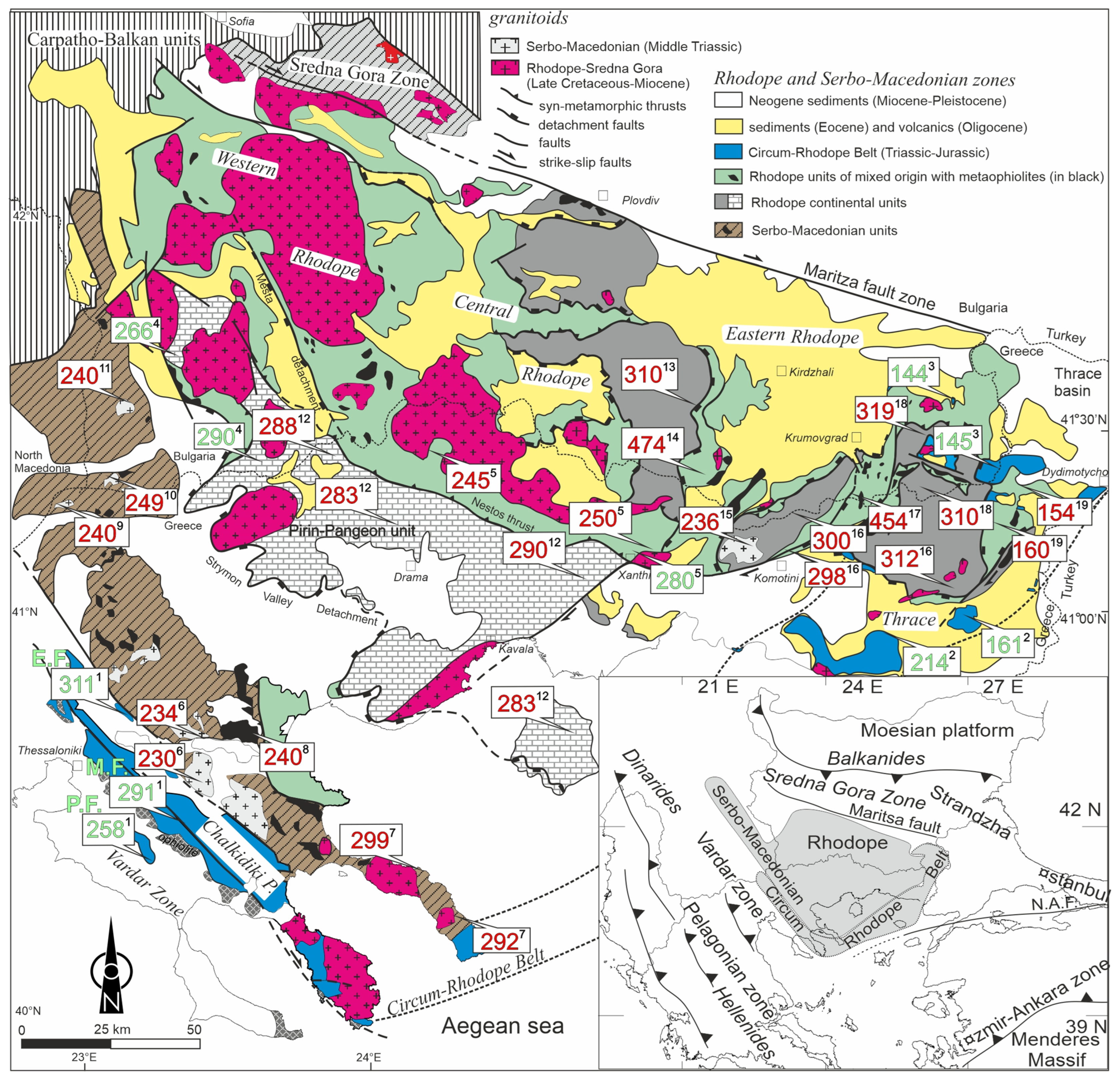
The Circum-Rhodope Belt represents a major tectonic unit that surrounds both the Serbo-Macedonian and the Rhodope tectonic zones in the Alpine orogen of the northern Aegean region (Figure 1). This belt consists of a western part exposed in the Chalkidiki Peninsula of Northern Greece that extends across the Aegean Sea into the eastern part exposed in the eastern Rhodope-Thrace area of Southern Bulgaria and Northern Greece. This regional-scale extent of the Circum-Rhodope Belt has been introduced by Kauffmann et al. [1] based on the biostratigraphically proven Mesozoic (Triassic to Lower Cretaceous) sedimentary and metasedimentary successions using fossil data (foraminifers, conodonts, radiolarians, bivalves, corals and ammonites) [1,2,3,4,5,6,7]. These stratigraphic assignments were subsequently confirmed by detrital zircon maximum depositional ages in the range of 311 ± 11 Ma (Examili Formation)-258 ± 9 Ma (Prinohori Formation) for the western part [8] and same type ages in the range of 214 ± 6 Ma (Makri unit)-144.3 ± 1.9 Ma (Mandritsa unit) for the eastern part of the belt [9,10] (see Figure 1). In addition to these predominantly Triassic–Jurassic metasedimentary rock successions of the Circum-Rhodope Belt, the most important element is the unmetamorphosed Jurassic arc-related Evros ophiolite [11,12,13] in the eastern part that has crystallization ages in the range of 176 Ma–165 Ma [14,15]. In the western part of the Circum-Rhodope Belt, the Kassandra–Sithonia back-arc ophiolites and associated Chortiatis magmatic arc suite both demonstrate crystallization ages between 173 Ma and 149 Ma [16,17].
However, among the metasedimentary successions in the eastern Circum-Rhodope Belt, some of them remain of unknown depositional timing. In this paper, the structural context, composition and timing of deposition are examined for those in two poorly known areas exposed on both extremities of the eastern Circum-Rhodope Belt, namely the Fanari area and Petrota area. The aim of the study is to provide a link of these two areas to the late Paleozoic sedimentation at the Eurasian continental margin (represented by the Serbo-Macedonian and Rhodope zones) and the mid-Mesozoic sedimentary deposition related to the development of the Jurassic Evros ophiolite arc system, respectively.

2. Regional Geology of the Eastern Circum-Rhodope Belt

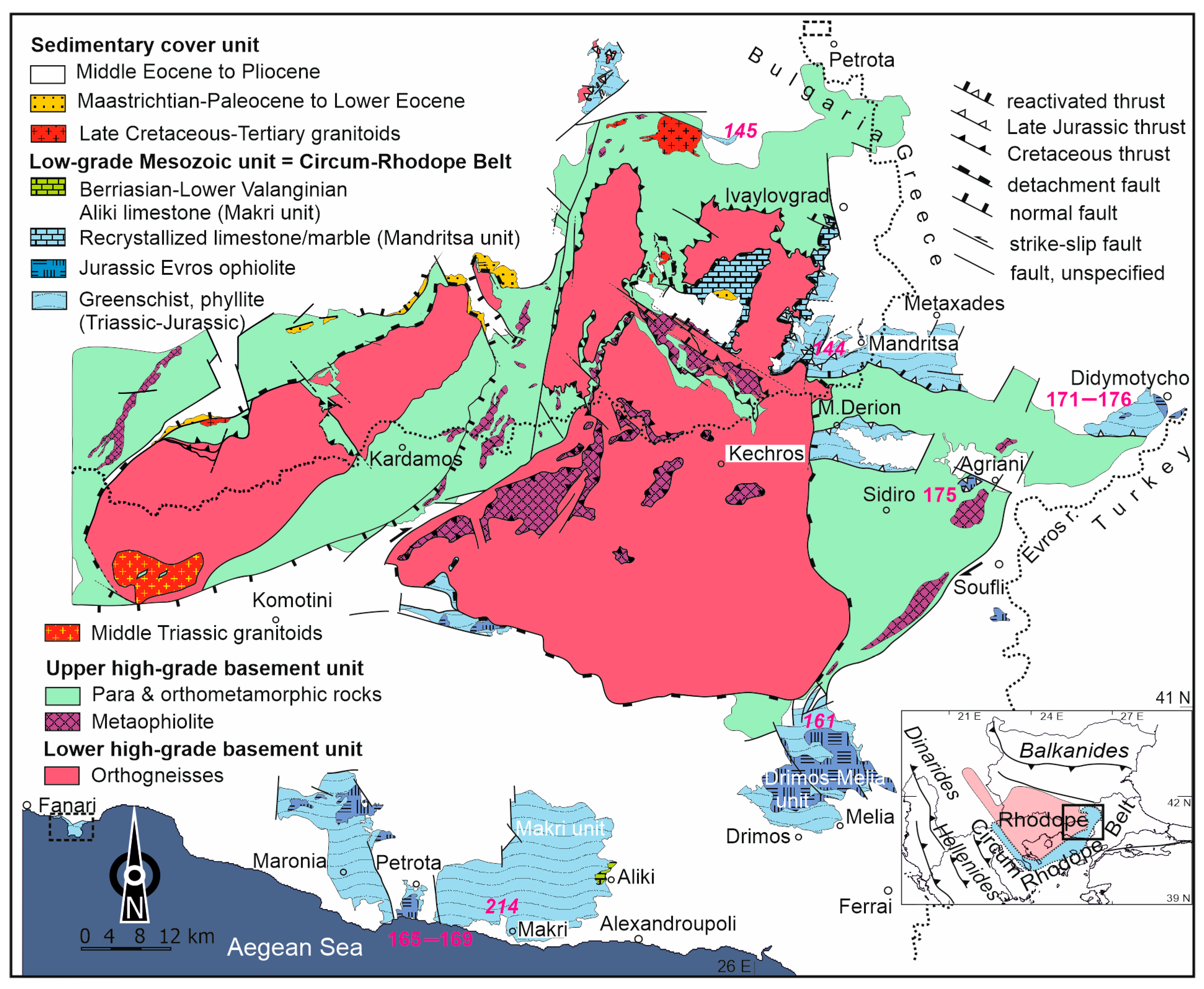
Two main geologic units have been identified within the eastern Circum-Rhodope Belt (Figure 2). These units are the Makri unit and the Drimos-Melia unit [33,34,35].
The largest exposure of the Makri unit occurs north of the Makri village and extends westwards. The Makri unit includes a lower metasedimentary series consisting of shales, phyllites, quartz–chlorite schists, sandstones and recrystallized limestone horizons overlain by an upper greenschist and greenstone series (chlorite–actinolite is common) [33,34], presumably of volcanic and pyroclastic origin. The lower limestone horizon of the lower metasedimentary series yielded Triassic coral [3], whereas the upper greenschist series chlorite schists supplied Tithonian–Berriasian ammonite [6]. The uppermost limestone horizon of the Makri unit, the so-called “Aliki limestones”, supplied Lower-Middle Cretaceous foraminifers [34], which are considered mostly pertaining to the Lower Cretaceous [3]. The undeformed and unmetamorphosed Aliki limestones unconformably overlie the greenschist series of the Makri unit, and these limestones are of Berriasian-Lower Valanginian biostratigraphic age [7]. Detrital zircons in the sandstones of the Makri unit mainly cluster at ca. 310–290 Ma and at ca. 240–214 Ma [8], providing Middle-Late Triassic depositional age.
The Drimos-Melia unit is better exposed in the broader area between the Drimos and Melia villages, where it consists of massive basalt to andesite lava flows lying usually above the basalt pillow lavas intercalated with rare sheeted-like dykes. This extrusive Evros ophiolite suite is interfingering with flysch-type rhythmic shale and sandstone alternation. These relationships imply mutual flysch depositional and ophiolite eruptive history. The flysch supplied Callovian-Oxfordian ammonite [2] and prints of Middle–Upper Triassic bivalve [5]. Detrital zircons in the sandstones cluster mainly at ca. 315–285 Ma, with the youngest zircon at ca. 161 Ma providing the maximum depositional age of the flysch [9]. Easterly, south of Soufli (Figure 2), an isolated basaltic andesite lava flow occurs below the Tertiary sedimentary cover, showing similarity to massive lava flows of the Drimos-Melia unit and lavas exposed at Didymotycho further north, all of them belonging to the section of the Evros ophiolite.
Both main units of the eastern Circum-Rhodope Belt in Greece have been correlated with the lower and upper levels of the Mandritsa unit section in Bulgaria [4,35], respectively (see Figure 2). In the Mandritsa unit, both metasedimentary series of the Makri unit are present with the same metamorphic-grade lithologic assemblage (marbles, calc-schists, mica-schists, quartzites, quartz–chlorite schists and greenschists), intercalated with tholeiitic basalt to andesite lavas that exhibit characteristics analogous to the volcanic rocks of the Drimos-Melia unit [15,34]. Detrital zircons in a sandstone of the Mandritsa unit cluster mainly at ca. 313–253 Ma, with few Jurassic zircons with ages between 175 Ma and 170 Ma and the youngest zircon at ca. 144 Ma providing maximum depositional age of the clastic rocks [10]. This maximum depositional age was also confirmed at 145 Ma further to the north of the Mandritsa unit along the Mareshnitsa river valley in similar clastic rocks [10].

3. Geological Setting of Fanari and Petrota Areas

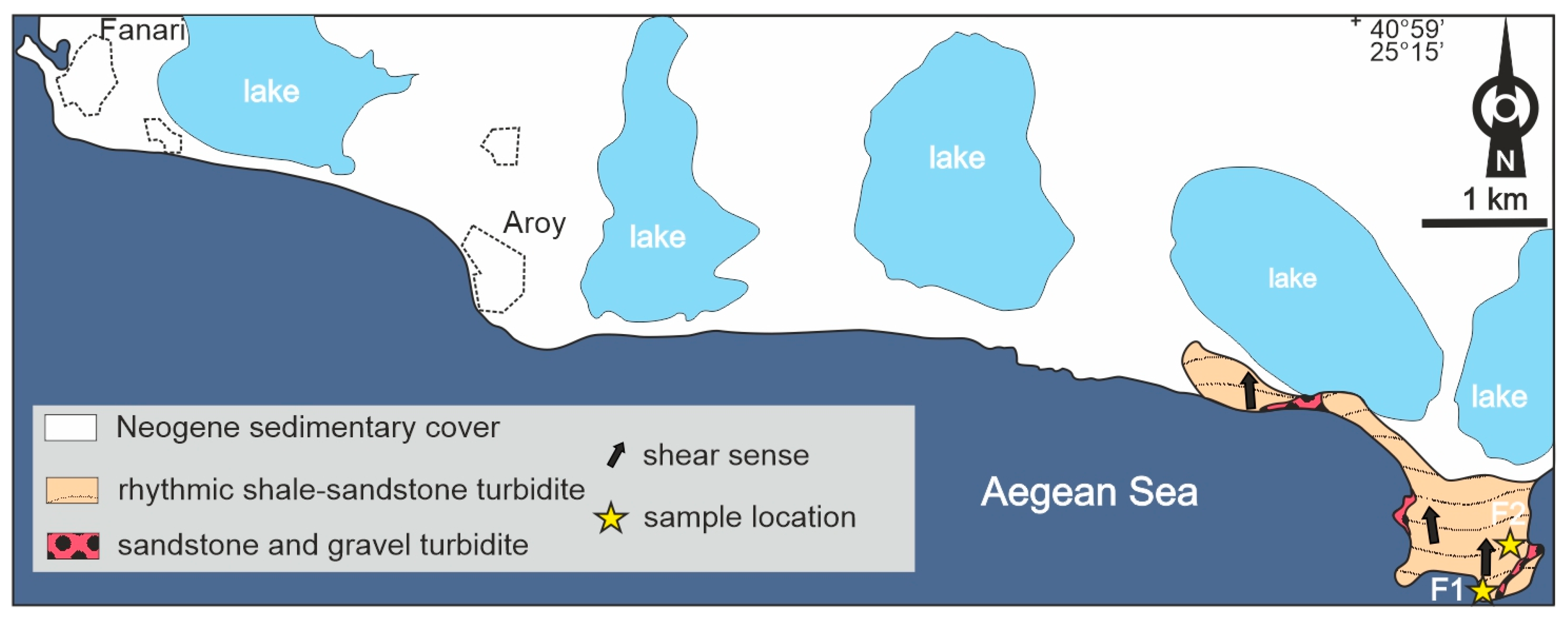
On the geological map of Greece by Bornovas et al. [36], the rocks that crop out in the Fanari area have been regarded as Mesozoic in age and connected to the Circum-Rhodope Belt. An isolated coastal outcrop southeast of the village of Fanari exposes weakly metamorphosed sedimentary rocks covered by Neogene–Quaternary sedimentary rocks (Figure 3).
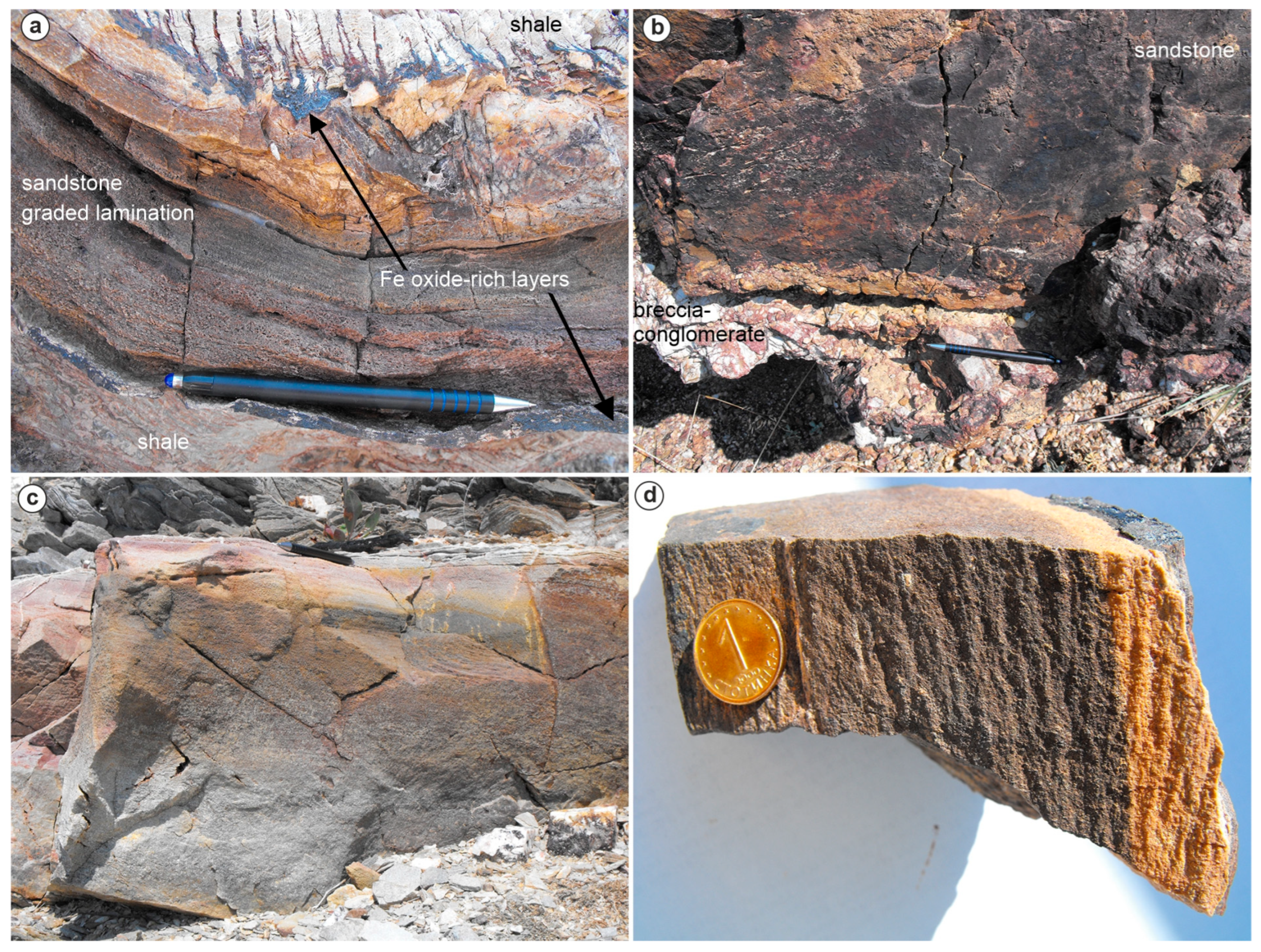
The Fanari area consists of metasedimentary succession that displays sandstone and shale beds in a bulk rhythmic flysch-type alternation, which defines a fragment of a turbidite system (Figure 4a,b). Generally, medium-thick sandstone beds within the succession demonstrate a partial Bouma sequence, with mostly observed graded lamination at the base of stratification and progressively upward parallel lamination and current ripple lamination and dish flow structures (Figure 4c,d), all characteristics pertinent to turbidites. Thin gravel breccia-conglomerate horizons and layers are also observed at the base of sandstone beds, together with Fe oxide-rich layers. Graded bedding and channelized flow provide evidence for a deposition in an outer to middle fan environment from high-density turbidite currents.
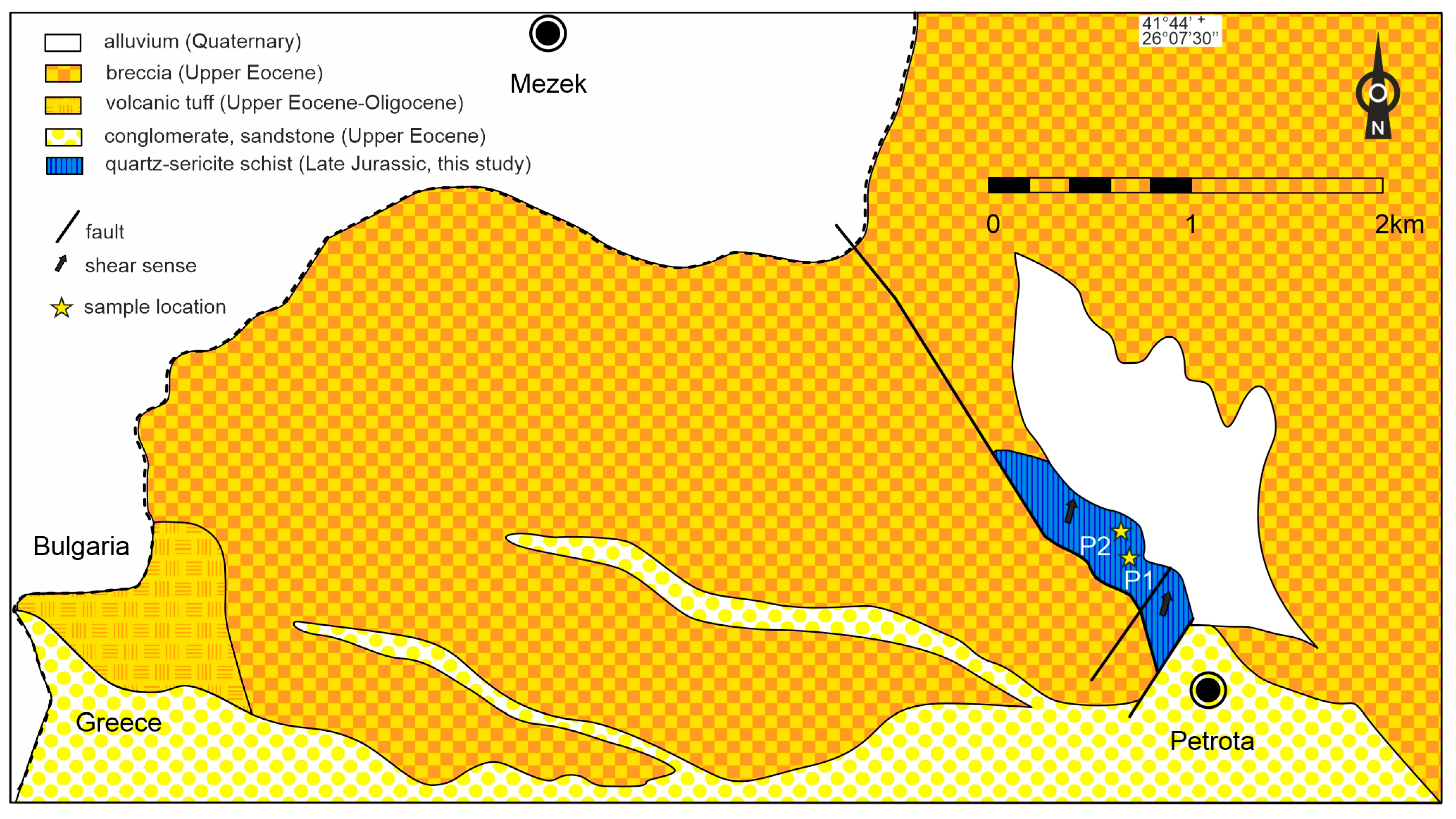
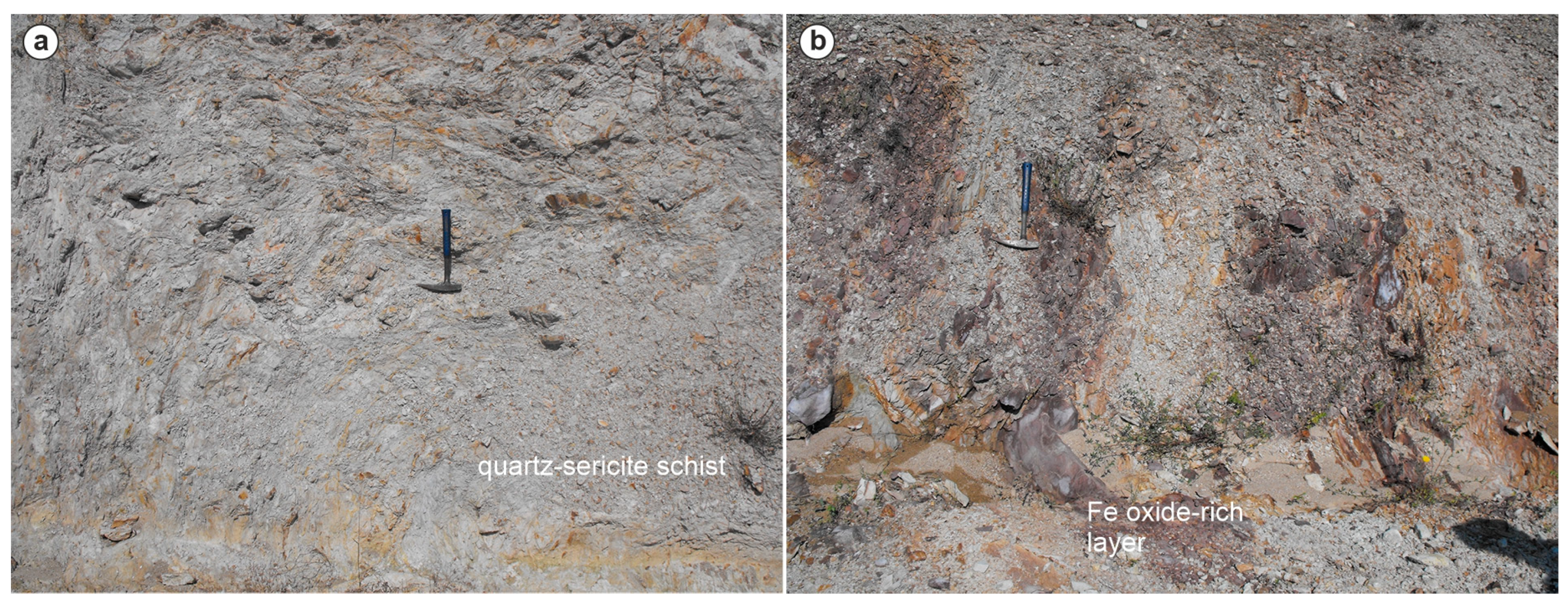
On the geological map of Greece by Andronopoulos [38], north of the Petrota village, an isolated small exposure consisting of phyllites, schists and quartzites occurs below the Upper Eocene–Oligocene sedimentary and volcanic cover rocks that take part of the large-scale Thrace sedimentary basin (Figure 5). Later, these metamorphic rocks were assigned as belonging to the Circum-Rhodope Belt [36]. This fault-bounded low-grade succession mostly consists of quartz–sericite schist with thin interlayers of red-brown Fe oxide (hematite)-rich aleurolite (Figure 6). Therefore, the field appearance of the low-grade succession demonstrates preserved initial sedimentary bedding despite a weak, low greenschist facies metamorphism.

4. Materials and Methods

4.1. Samples

The analytical material in this study includes sandstone samples from the Fanari and Petrota areas complemented by a sandstone sample from the Makri unit. The sample numbers and locations are depicted in Figure 3 and Figure 5. The samples from the Fanari area include Fe-enriched sandstone sample F1 and sandstone sample F2. Both samples were used for whole-rock geochemistry, and only sample F1 was used for U-Pb detrital zircon geochronology. The samples from the Petrota area consist of quartz–sericite schist sample P1 and Fe-rich sandstone/aleurolite sample P2. The same applies to the Petrota samples, both used for whole-rock geochemistry, and only sample P1 was used for U-Pb detrital zircon geochronology. A single sample, M1, comes from sandstone of the Makri unit, which was used only for whole-rock geochemistry with a comparative purpose.

4.2. Analytical Methods

Whole-rock major and trace element analyses were performed using X-ray fluorescence at the University of Geneva, Switzerland. Details on the analytical procedure of the XRF analyses can be found in the study by Bonev et al. [15]. Rare-earth element (REE) analyses were conducted using laser ablation inductively coupled mass spectrometry (LA-ICP-MS) at the Geological Institute of the Bulgarian Academy of Sciences. Details on the REE LA-ICP-MS analytical procedure can be found in the study by Bonev et al. [40]. Analytical procedures of U-Pb zircon geochronology performed using the LA-ICP-MS method at the Geological Institute of Bulgarian Academy of Sciences are also detailed in Bonev et al.’s study [40]. Whole-rock geochemical and geochronological analytical data are given in Tables S1 and S2, respectively.

5. Results

5.1. Structural Data

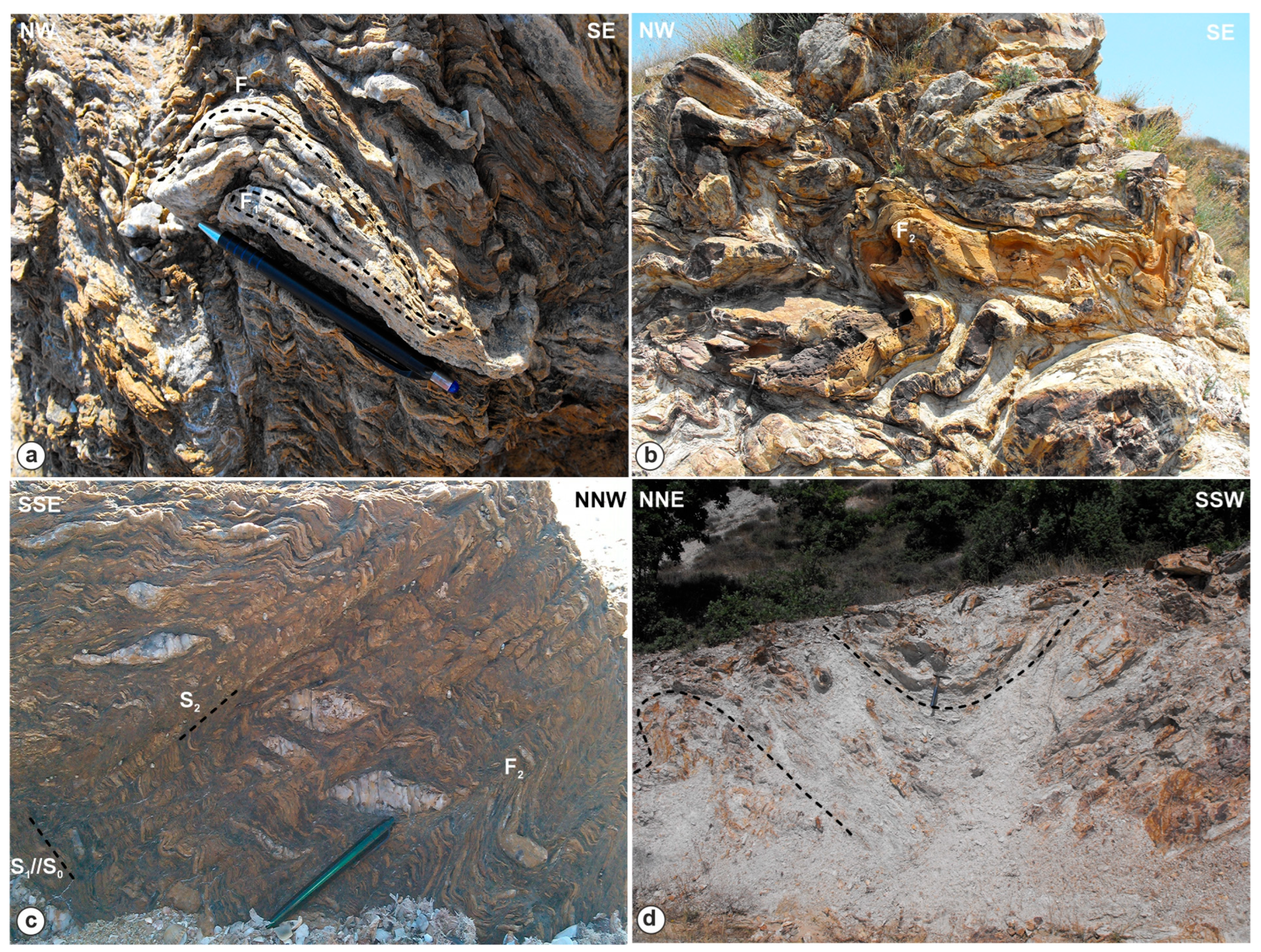
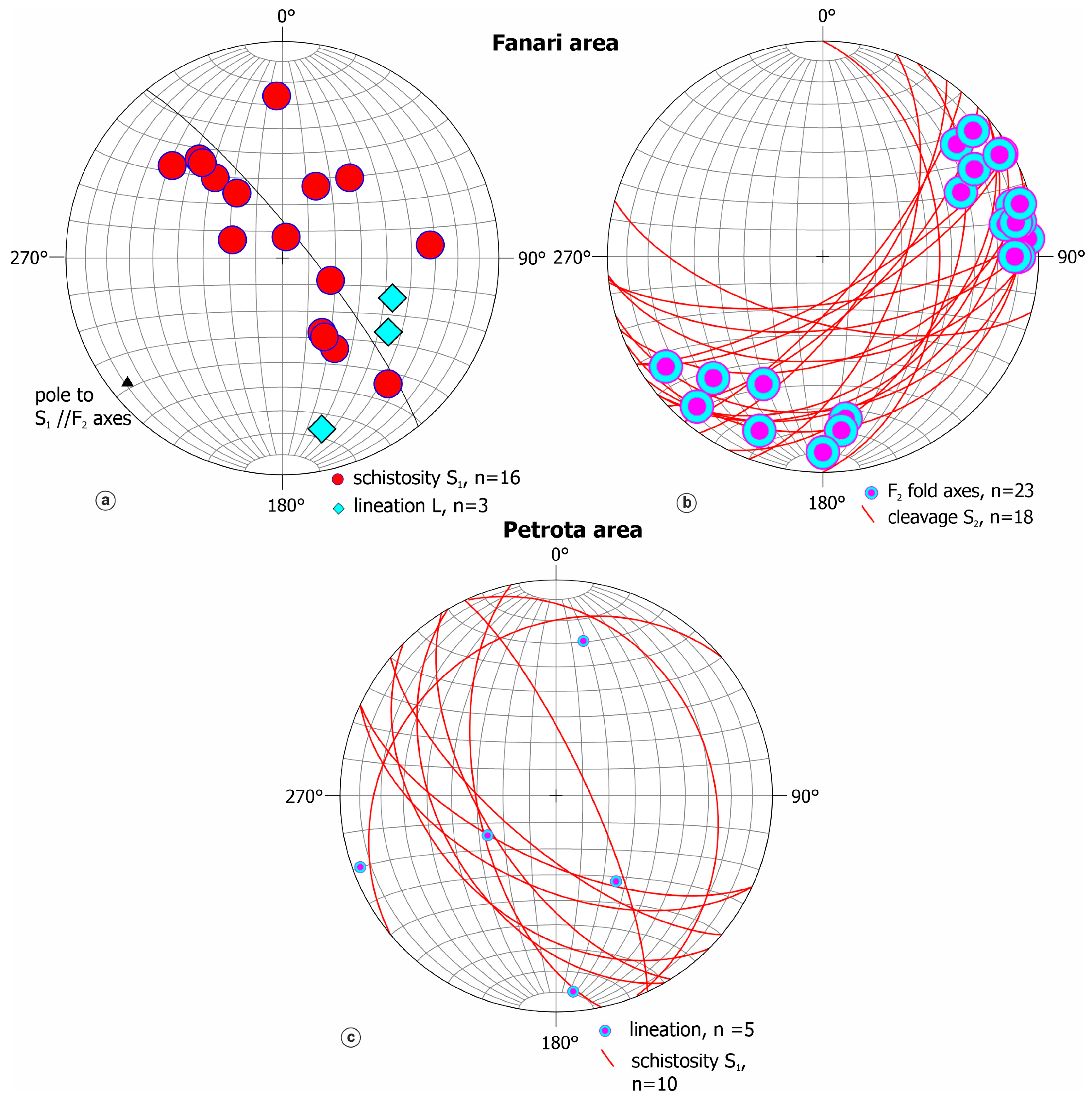
Preliminary structural data of the Fanari area was briefly presented earlier [37], and they are now extended and summarized. The structural grain of the Fanari turbiditic metasedimentary succession is dominated by folds (Figure 7a–c). The rare F1 folds are tight to isoclinal small folds that deform the bedding S0, which is transposed into S1 slaty cleavage and/or domainal schistosity, where F1 folds become intra-folial with typically S0//S1 (Figure 7a). The F1 folds are coaxially refolded by larger folds F2 reaching up to several meters. The F2 folds range from open to tight rounded flexural-slip parallel folds (Figure 7b), subrounded similar folds and angular to chevron folds (Figure 7c). The F2 folds vary from recumbent to steeply inclined, and their axes gently plunge to NE and SW (Figure 8a,b). The F2 folds are associated with moderately to steep SE-dipping axial-planar S2 cleavage that is a white mica (sericite)-defined slaty cleavage and/or crenulation cleavage. Commonly, the S2 cleavage materialized by quartz–calcite vein fillings propagating in the F2 axial planes. The lithological heterogeneity of the turbidite succession has provoked the refraction of the axial-planar cleavage S2 that is penetratively developed only in the shaly layers and is very scarce and/or expressed by the local occurrence of fracture cleavage in the sandy layers. S2 cleavage fans across the profile of the F2 folds where planar structures are typically S0//S1//S2 in the F2 fold limbs. There, mineral (quartz, calcite and detrital grains) fiber lineation tracks flexural slip across the profiles of the F2 folds that in turn show pronounced NW vergence (Figure 7b). The F2 folds have sheared limbs along the meter-scale fold-propagating thrusts and/or shears, which have accommodated N-NW directed displacement and progressive overturning of the F2 folds.
The outcrop observations revealed crystallization of white mica (sericite) and chlorite mineral assemblage along the S1 foliation, indicating lower greenschist facies metamorphic conditions during the deformation of the turbidites. In the sandy layers, the F2 fold hinges also show the development of conjugate brittle fractures locally, which suggests rheologic decoupling of the competent and ductile layers at low-temperature conditions during the folding and bulk deformation of the turbidites. Overall, the asymmetry of folds and related shear structures (e.g., shear bands and asymmetric clasts) in the Fanari area turbidite succession indicate top-to-the-N-NW directed tectonic transport (Figure 3 and Figure 7a–c).
The quartz–sericite schist and intercalated aleurolite succession in the Petrota area is ductilely deformed, with a structural pattern dominated by folds (Figure 7d). Folding includes meter-scale close to tight folds of chlorite and mostly white mica (sericite)-defined schistosity S1 that parallels the sedimentary layering S0. The schistosity S1 is moderately to steeply inclined (60–70°) and dips to SW-WSW. The folds are moderately to slightly inclined, with axes gently plunging to WSW and SSE showing a pronounced NE vergence. Mineral lineation L1 plunge is rarely observed at low to moderate angles (Figure 8c). Field observations indicate only weak greenschist facies metamorphism of the clastic succession as evidenced by common quartz–chlorite–white mica (sericite) mineral assemblage. Overall, the asymmetry of folds in the Petrota area indicate top-to-the-N-NE directed tectonic transport (Figure 5 and Figure 7d).

5.2. Petrography and Geochemistry

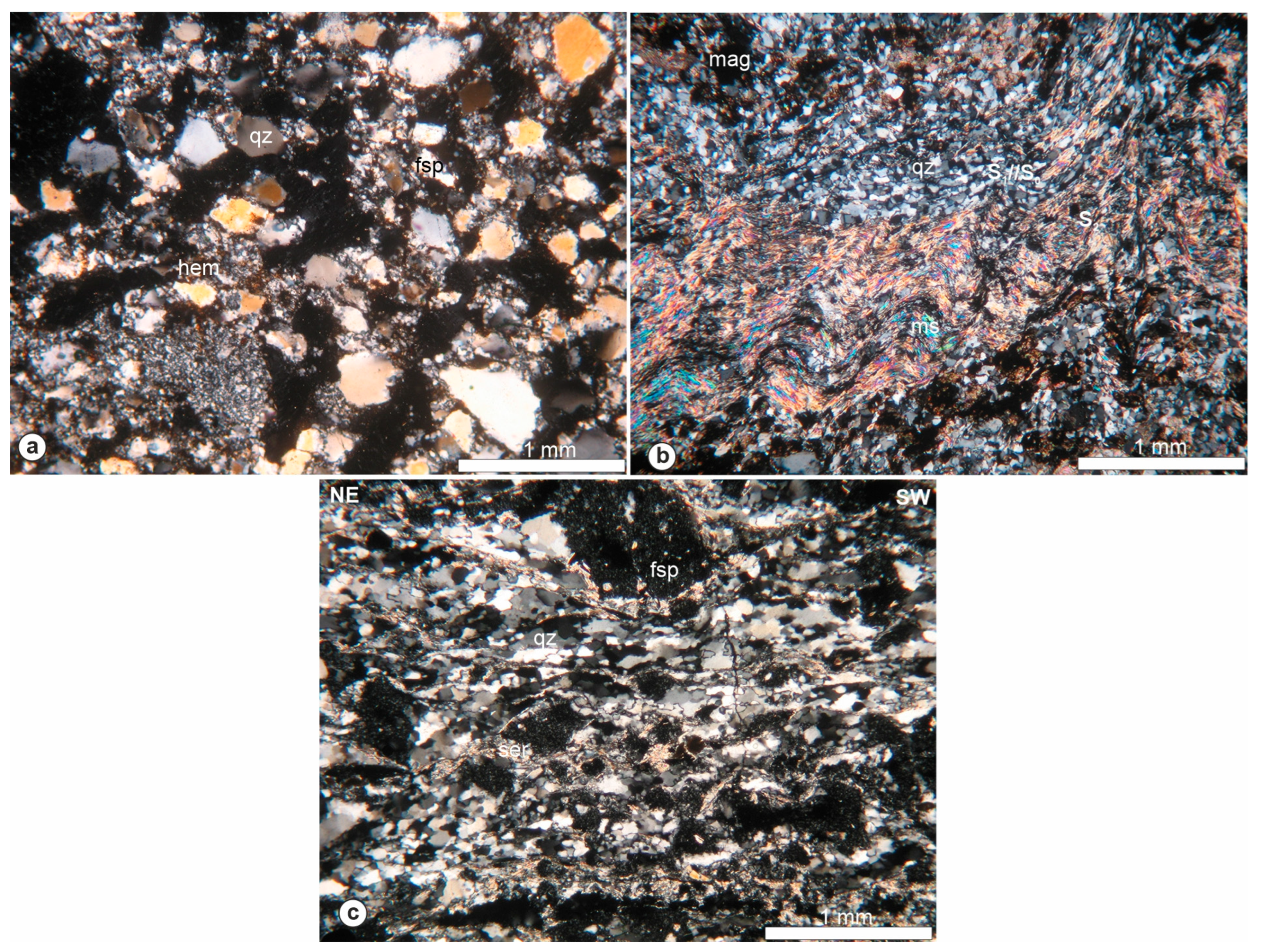
Micropetrographic observations of the Fanari succession sandstone beds have shown that they mainly consist of quartz (90%), subordinate Fe oxide (hematite) (7–8%), feldspar (1–2%) and single muscovite flakes (Figure 9a). Slightly recrystallized cryptocrystalline quartz and Fe oxides built the limited matrix. Accessory mineral phases include zircon and apatite. The micro-texture of sandstone is epiclastic equigranular or sutured when the recrystallization process along the boundaries of quartz grains is more advanced. In the Fanari succession, the shale beds are turned into quartz–muscovite schist because of the experienced deformation and low-grade metamorphism. The mineral assemblage in the quartz–muscovite schist also includes modally decreasing magnetite, chlorite and calcite, and accessory zircon (Figure 9b).
Observations of thin sections of the Petrota succession demonstrated that the quartz–sericite schist mainly consists of microcrystalline quartz grains, fine crystalline white mica (sericite) flakes, and minor feldspar grains. The large isometric quartz grains are recrystallized into fine crystalline chalcedony. Smaller mono- and polycrystalline quartz grains show ductile deformation and sub-grain rotation recrystallization that is characteristic of a temperature interval of 400–450 °C of moderate greenschist facies metamorphism. A weak asymmetry of feldspar clasts defines NE-directed tectonic transport during the ductile deformation (Figure 9c). Sericite aggregates define the schistosity of the rock, together with thin bands of Fe oxide (hematite). Accessory minerals are apatite and rare zircon.
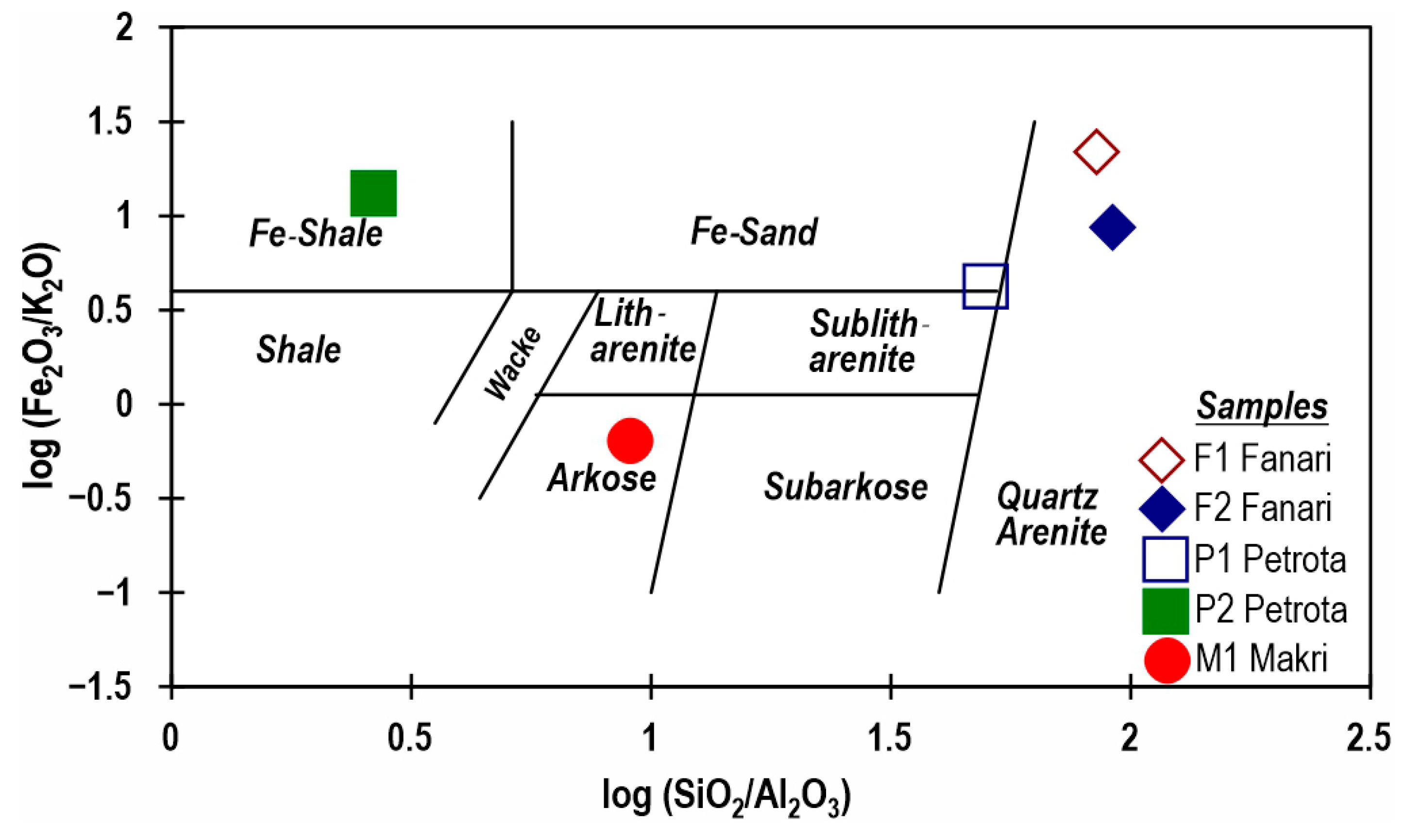
Major oxide (Fe2O3, Al2O3, SiO2, and K2O) compositions classify the Fanari metasandstone samples, F1 and F2, as quartz arenites, whereas the quartz–sericite schist sample, P1, and the Fe-rich sandstone/aleurolite sample, P2, of the Petrota area are classified as Fe-shale and Fe-sand, respectively. The sandstone sample of the Makri unit is arkose (Figure 10). The use of major oxide classification fully corresponds to the petrographic features of the samples studied. This classification further shows a relatively mature character of the studied clastic rocks. In addition, relative to other major oxide concentrations, the Makri unit arkose is characterized by an elevated content of CaO (18.49 wt.%), while the Petrota area Fe-shale and Fe-sandstone samples have relatively elevated contents of TiO2 (~1 wt.%) (see Table S1).
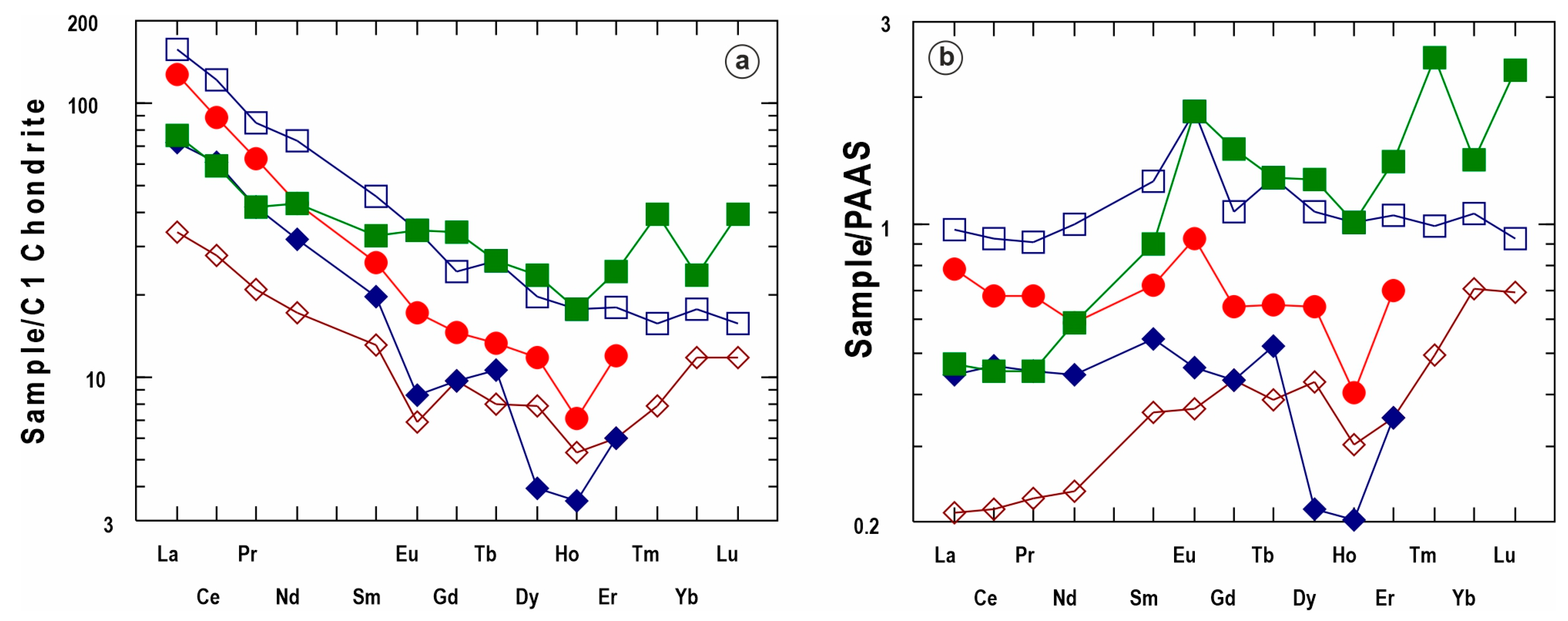
Chondrite-normalized REE concentrations of the samples show higher abundances relative to this reference composition and fractionated profiles, with high light REE/heavy REE ratios (Figure 11a). Most of the profiles of the samples normalized to post-Archean Australian shale (PAAS) fall below this crustal reference composition, while the Petrota Fe-sandstone is close to PAAS composition (Figure 11b). Overall, the REE-normalized patterns allow the geochemical distinction of both the Fanari area and Makri unit samples from the Petrota area samples. The REE profiles also suggest that the sedimentary material is derived from an acid magmatic source.
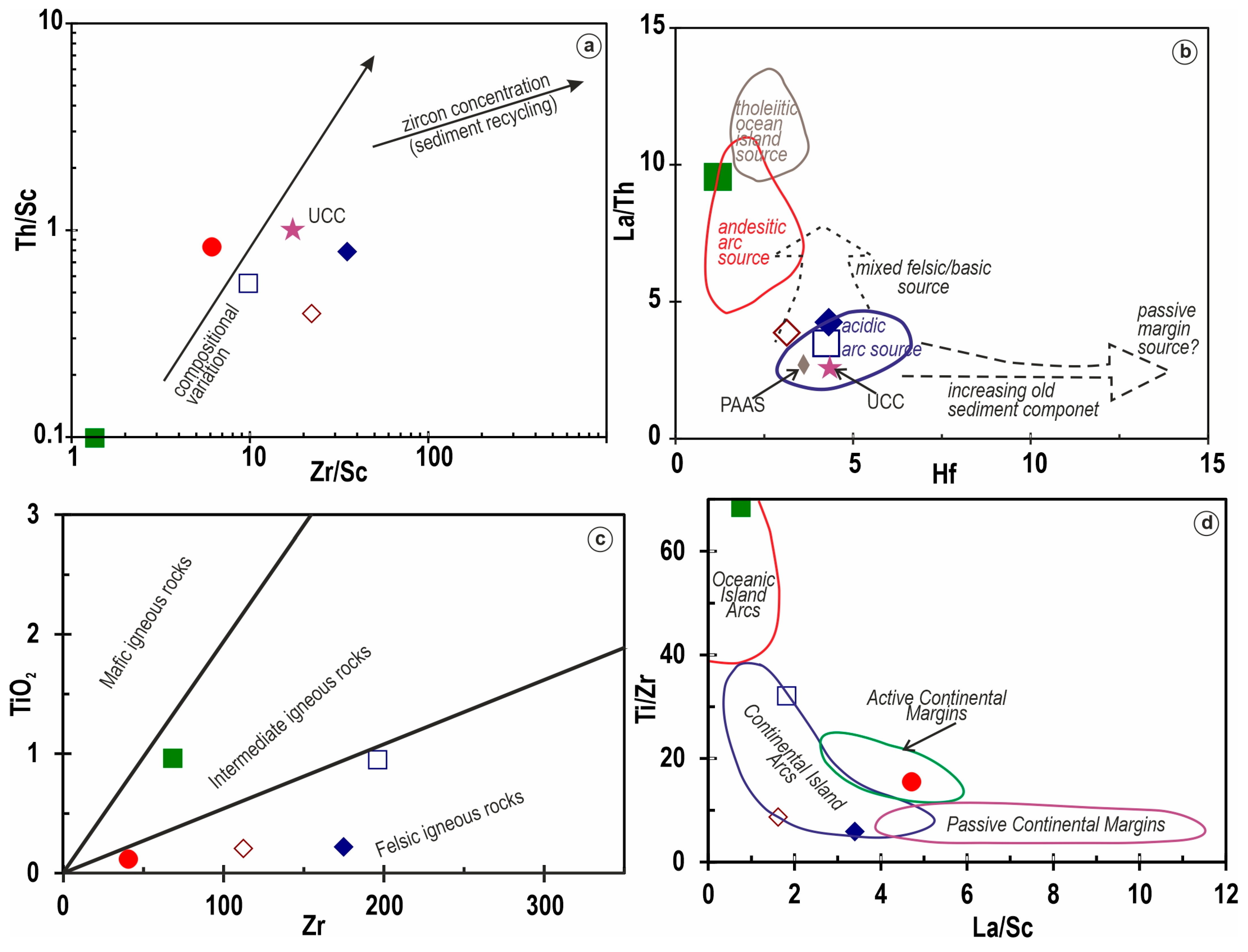
The trace elements, such as some high-field strength elements (e.g., Y, Zr, Ti, Nb, Th, Sc, and Hf) and REE, are regarded with a conservative behavior (i.e., immobile) during the processes of weathering, transport, lithification and metamorphism and are therefore widely used for determination of the origin of sedimentary rocks and their depositional tectonic setting. Th/Sc and Zr/Sc ratios constrain sorting, recycling and the origin of the sedimentary material [45]. In the sedimentary rocks that have experienced significant sorting and recycling, the Zr/Sc ratio generally increases relative to the Th/Sc ratio. The studied metasedimentary rock samples, except strongly Fe-enriched Petrota Fe-shale sample F2, demonstrate an increasing Zr/Sc ratio testifying for significant sorting and recycling of the sedimentary material that approaches upper crust composition (UCC) (Figure 12a). The ratio of La/Th vs. Hf in turn outlines the source area of intermediate-acidic rock composition and arc-related origin for the clastic material in the metasedimentary rocks in a discrimination diagram of Floyd and Leveridge [46] (Figure 12b). The origin from intermediate to acidic igneous rocks of the clastic components in the studied metasedimentary rocks and their deposition in oceanic and continental arc tectonic setting is further demonstrated by the TiO2-Zr diagram [47] and Ti/Zr-La/Sc diagram [48], respectively (Figure 12c,d).

5.3. U-Pb Detrital Zircon Geochronology

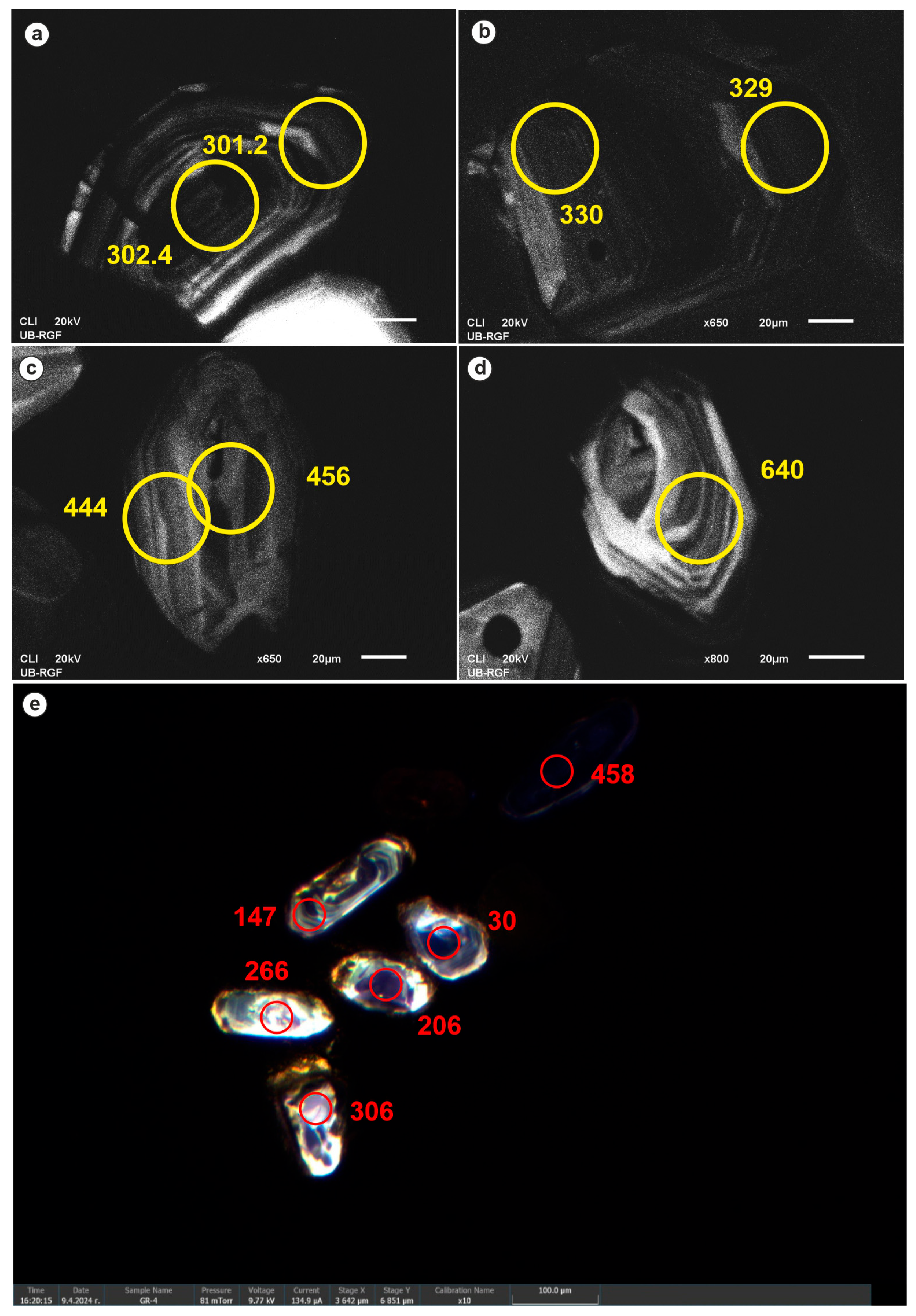
Sample F1 of Fanari sandstone displays zircons that vary in size from 60 µm to 120 µm. Semi-rounded zircons and preserved prismatic zircons both demonstrate oscillatory-zoned patterns that are characteristic for a magmatic origin (Figure 13a–d).
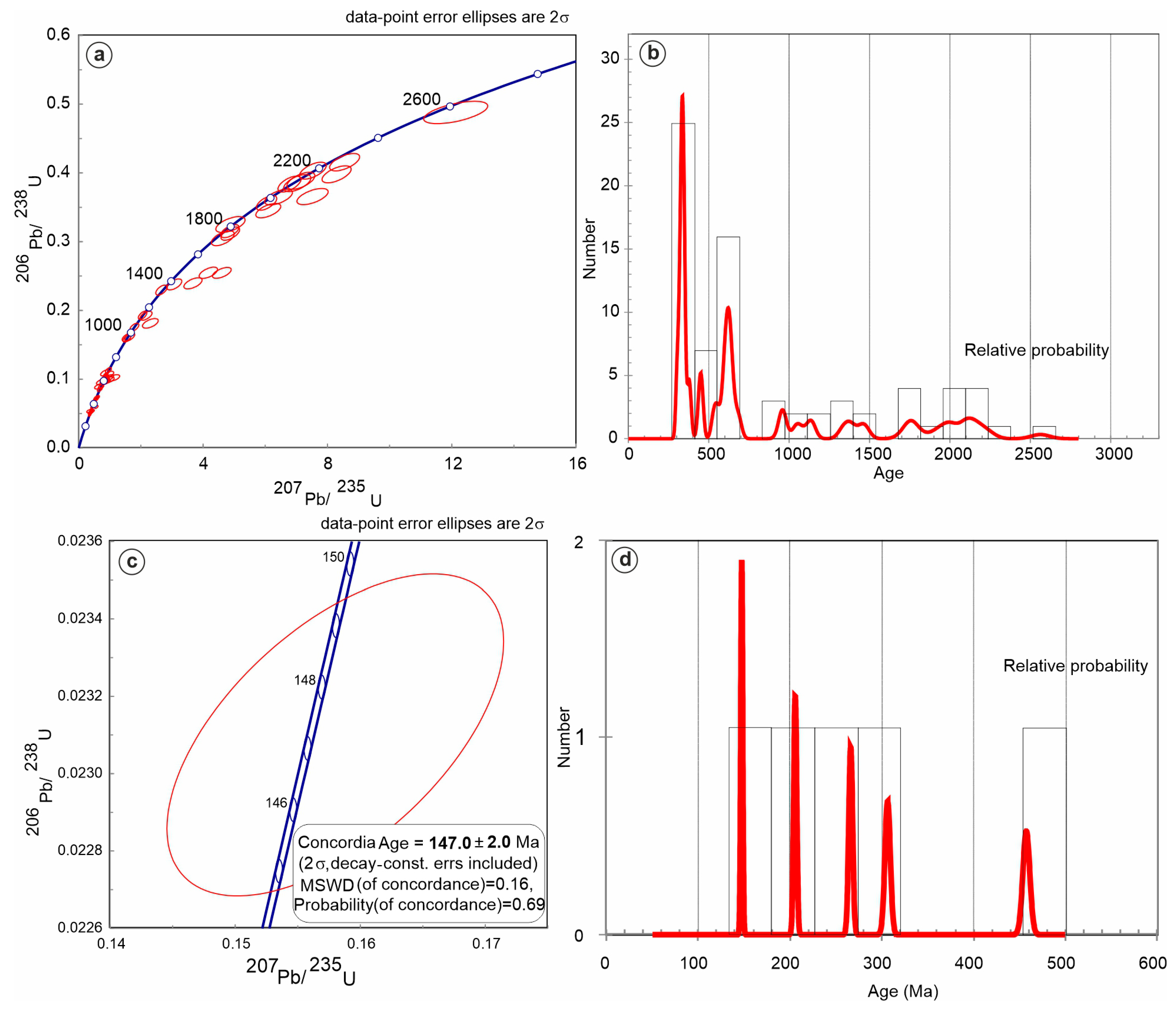
The 206Pb/238U ages obtained from 75 analyses (some core and rim) of 53 concordant zircons range from 2561.9 Ma to 301.2 Ma (Figure 12a, Table S2). A series of zircon clusters of distinct density and various ages were established (Figure 12b). The main zircon age cluster falls in the range from 353 Ma to 302 Ma (Carboniferous), followed by minor zircon clusters around 600 Ma (Neoproterozoic), between 457 Ma and 441 Ma (Ordovician) and in the interval of 386 Ma-371 Ma (Devonian). Four to three zircon clusters, three zircon pairs and three single zircons gave Neoproterozoic–Neoarchean concordant ages in the range from 900 Ma to 2562 Ma. The youngest concordant zircon provided an age of 301.2 ± 8.4 Ma, and hence, it is defined within the error as having a Late Carboniferous to Early Permian maximum depositional age (Figure 14a). The Th/U ratios of dated zircons in sample F1 range from 0.14 to 1.29, which is typical for magmatic zircons (e.g., [49,50]). Exceptions are only three zircons with low Th/U ratios in the range of 0.05–0.13 (Table S2) that might well represent metamorphic zircons.
Sample P1 of Petrota quartz–sericite schist demonstrates zircons that vary in size from 100 µm to 150 µm. Semi-rounded and corroded zircons display oscillatory- and sector-zoned patterns that are characteristic for a magmatic origin (Figure 13e). In sample P1, the 206Pb/238U ages obtained from five analyses of the same number of zircons range from 458 Ma to 147 Ma (Figure 14d, Table S2). Four concordant zircons yielded ages at 457.1 ± 7.6 Ma, 305.3 ± 5.6 Ma, 265.8 ± 4.0 Ma and 205.3 ± 3.1 Ma. A single youngest concordant zircon provided an age of 147.0 ± 2.0 Ma, and hence, a Late Jurassic maximum depositional age is defined (Figure 14c). The dated zircons in sample P1 have Th/U ratios in the range of 0.30–1.07 that are also characteristic for magmatic zircons.

6. Discussion

6.1. Significance of Structural, Geochemical and U-Pb Geochronological Results

Structural data shows that in the Fanari and Petrota areas, the metasedimentary successions have experienced N-directed folding and shear deformation, i.e., NNW to NNE-directed tectonic transport associated with moderate greenschist facies metamorphic conditions (Figure 7c, Figure 8c and Figure 9c). The original sedimentary layering is generally well-preserved, and the metamorphic mineral assemblages contained mainly chlorite and muscovite/sericite in the metasedimentary rocks studied. These deformation–metamorphism relationships of tectonic transport direction and metamorphic grade unequivocally link the Fanari and Petrota metasedimentary successions to other metasedimentary successions of the eastern Circum-Rhodope Belt, in which the units commonly demonstrate the same kinematics in greenschist facies during the Late Jurassic time [15,37]. Therefore, from a structural view point, the Fanari area and the Petrota area metasedimentary successions provide unequivocally structural support to the regional-scale early Alpine deformational pattern from both exposed extremities of the eastern Circum-Rhodope Belt (see Figure 2).
The chemical compositions of the studied metasedimentary rocks reveal the relatively mature nature of the sedimentary precursors that are quartz arenite in the Fanari area, arkose in the Makri unit, and Fe-shale and Fe-sandstone in the Petrota area. The Fe-rich character, elevated TiO2 content and REE-enriched profiles of Petrota area metaclastic rocks clearly distinguish them from those of the Fanari area, which altogether correspondingly reflects intermediate and acidic igneous source rocks for each area, respectively (Figure 11a and Figure 12c,d). However, the arc-related igneous sources for detrital material contribution are quite common for both studied metasedimentary successions, as demonstrated by tectonic setting discrimination (Figure 12b,d).
The age of 301.2 ± 8.4 Ma of the youngest zircon in quartz arenite sample F1 reveals the maximum depositional age of the Fanari turbiditic succession in the latest Late Carboniferous. However, considering the analytical error, this maximum depositional age might well indicate an Early Permian sedimentation (see below). The zircon populations and their Th/U ratios in the quartz arenite allow determination of the source and origin of the detrital sedimentary material for the Fanari turbidites. The source area of the major detrital zircons population of an age range of 353 Ma–302 Ma is quite obviously represented by the high-grade metamorphic basement of the Rhodope and Serbo-Macedonian zones in which metagranitoids with analogous Carboniferous protolith ages, as well as mostly Early–Middle Permian protolith ages, are well-documented (e.g., [21,26,27,30]) (see Figure 1). Detrital zircons Carboniferous in age are also identified in younger successions along the whole length of the Circum-Rhodope Belt from the Chalkidiki Peninsula to the Thrace region in Northern Greece (see Figure 1). The zircon population of Ordovician ages (457 Ma–411 Ma) has clearer identification for detrital sedimentary material input from the presence of metagranitoid and metagabbro bodies of the same ages within the high-grade metamorphic basement (e.g., [28,31]). The latter bodies are emplaced into the metamorphic rocks of pre-Middle Ordovician age, which explains the presence of Cambrian detrital zircons with an age of 527 Ma. The Devonian (386 Ma–371 Ma) population among the analyzed zircons might have been derived either from the metamorphic basement of the Serbo-Macedonian zone because of inherited zircons that are similar in age in adjacent Jurassic ophiolites [17] and the metamorphic basement of the eastern Rhodope in which Devonian metaophiolite is documented [51]. Volumetrically minor group zircons with an age of 2561 Ma–549 Ma have also been derived from the Rhodope high-grade metamorphic basement because they are presented there as inherited zircons [19], intruded Middle Ordovician metagranite [31] and Late Jurassic metagranite [15]. Considering the variations in the Th/U ratios in analyzed detrital zircons in quartz arenite, magmatic rocks apparently predominate over metamorphic rocks as involved suppliers of detrital components from the high-grade metamorphic basement during sedimentation. Overall, the zircon populations demonstrate sedimentary sources proximal to the Fanari turbidite succession that are mainly represented by the adjacent metamorphic basement of the Rhodope zone and to a lesser extent the Serbo-Macedonian zone basement.
The age of 147.0 ± 2.0 Ma of the youngest zircon in quartz–sericite schist sample P1 reveals a maximum depositional age of the Petrota Fe-sandstone–Fe-shale succession in the Late Jurassic. This maximum depositional age is very close or even indistinguishable within the error from the maximum depositional ages of 144 Ma and 145 Ma documented for the adjacent Mandritsa unit and Mareshnitsa river valley from the eastern Circum-Rhodope Belt [10]. Relative to the source of all single zircons of the Late Jurassic, Ordovician, Carboniferous and Permian ages, the same source from the variety of lithologies in the Rhodope high-grade metamorphic basement applies. The single Late Triassic zircon (ca. 205 Ma) is recycled in the Petrota succession apparently from the eastern Circum-Rhodope Belt Makri unit metasedimentary succession, in which detrital zircons similar in age were documented (ca. 233–214 Ma) [9] (see Figure 1).
Finally, it is worth noting that the Neoproterozoic, Paleozoic, Triassic and Jurassic groups of detrital zircon populations that are distinct in age are documented in distinct quantity in all units of the eastern Circum-Rhodope Belt mentioned above.

6.2. A Late Paleozoic to Mid-Mesozoic Sedimentary Record of the Rhodope and Serbo-Macedonian Zones and the Circum-Rhodope Belt at the Eurasian Continental Margin

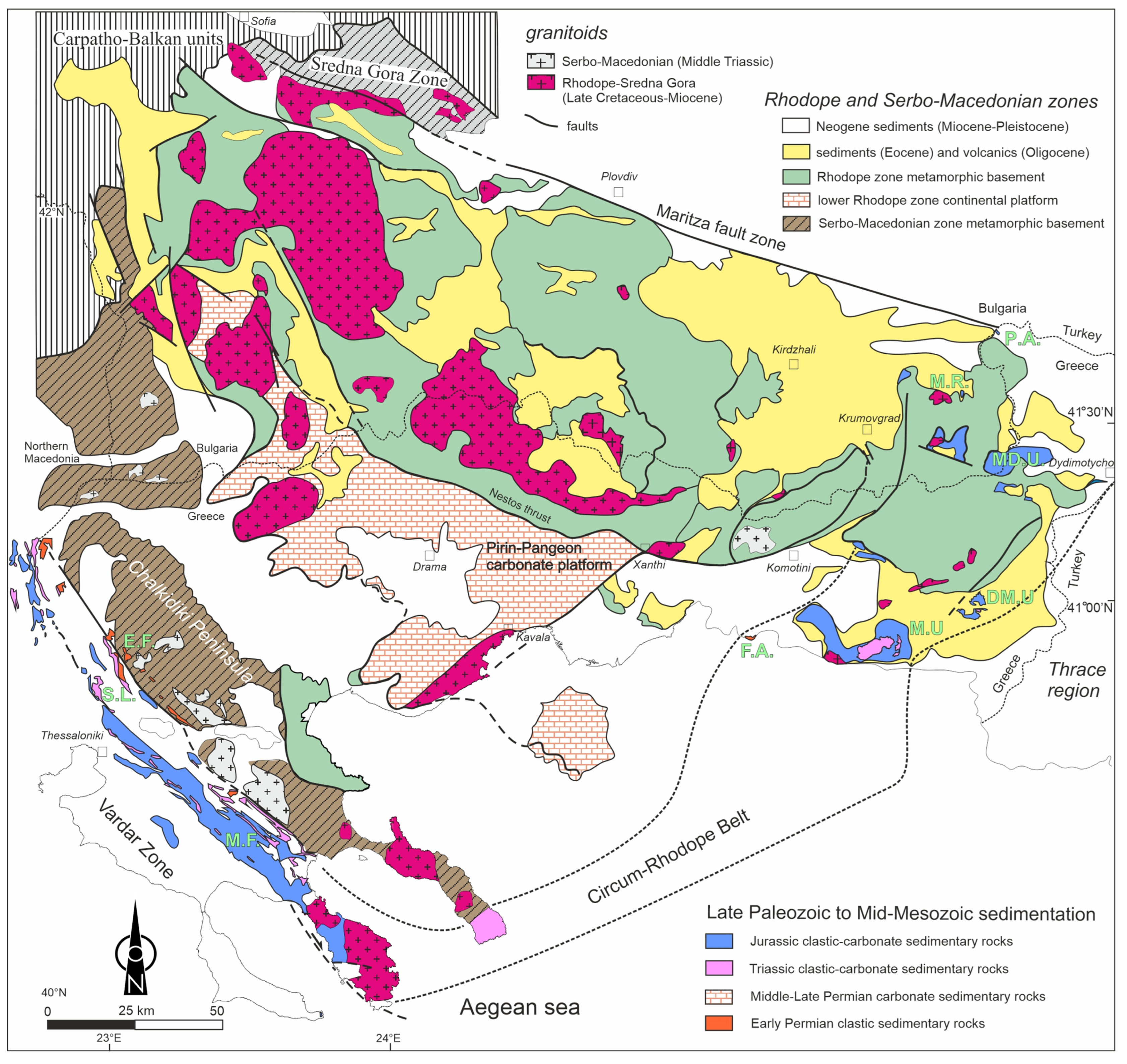
The available published biostratigraphic data and radiometric ages, including the ages from this study, for Paleozoic and Mesozoic sedimentation in the Rhodope and Serbo-Macedonian zones and the Circum-Rhodope Belt at the continental margin of the Eurasian plate are briefly summarized in Figure 15.
The Early Permian clastic sedimentation was started by the deposition of the western Circum-Rhodope Belt lowermost Examili Formation onto the Serbo-Macedonian zone metamorphic basement. The Examili Formation metaconglomerates, metaarkoses and quartzites [1] are considered to represent fluviatile fan-delta deposits related to initial continental rifting (i.e., pre-rift deposits) that received sedimentary material from the Serbo-Macedonian zone basement [8,52]. The latter terrestrial clastic metasedimentary rocks are overlain by Early Triassic rift-related acidic and intermediate volcanic and pyroclastic flows [52,53]. Fanari turbidites also represent an Early Permian sedimentation contemporaneous to the Examili Formation but related to the continental slope deposition along the Rhodope margin at the Eurasian plate. There, a late Middle Permian Pirin-Pangeon carbonate platform demonstrates continental shelf calcareous sedimentation along that margin [18] (see Figure 15).
In the western Circum-Rhodope Belt, the Triassic sedimentation is pelagic in the central part of the belt and neritic in both the eastern and western parts of the belt [1]. The limestone neritic facies has a Middle–Upper Triassic biostratigraphic age, while the pelagic facies marble, calc-schist and phyllite have an Upper Triassic biostratigraphic age. The Triassic sedimentation includes the lower part of the Melissochori Formation (Svoula Limestone) and its lateral equivalent subunits in the western Circum-Rhodope Belt [1,54]. In the eastern Circum-Rhodope Belt, the Middle Triassic clastic sedimentation is limited by scarce sandstone strata in the Drimos-Melia unit [5] and becomes marly-carbonaceous in the lower metasedimentary series of the Makri unit that reaches Upper Triassic biostratigraphic [3] and radiometric [9] ages. The lower metasedimentary series of the Makri unit is equated with the lower part of the Melissochori Formation [1] and regarded to represent shelf to slope deposits at the Rhodope continental margin of the Eurasian plate [35].
The Jurassic sedimentation in the western Circum-Rhodope Belt is represented by the upper part of the Melissochori Formation (Svoula flysch/formation) and lateral facial equivalent called the Aspro-Vrisi-Chortiatis Formation [1,54]. It is demonstrated by rhythmic turbidite alternation of detrital limestone, calcareous sandstone, graded-bedded sandstone and shale of the upper part of the Melissochori Formation, while the Aspro-Vrisi-Chortiatis Formation consists of sandy phyllites, metacherts and greenschists. The Aspro-Vrisi sedimentary series [52] interfingers with the upper part of the Melissochori Formation, while the Chortiatis series is a magmatic suite [54]. The upper part of the Melissochori Formation is interpreted by Dimitriadis and Asvesta [53] as a slope to rise succession related to the passive margin development after the Triassic continental rifting. Alternatively, according to Mussallam [55], the Melissochori Formation deposited as a trench fill in front of the Chortiatis volcanic arc during the Middle–Late Jurassic times. It is worth noting that the Chortiatis magmatic suite arc activity is bracketed between 173 Ma and 160 Ma [17]. The Jurassic sedimentation is ended by Kimmeridgian–Tithonian limestone overlying Jurassic granites (e.g., Petralona limestone) or interlayered with the Kassandra-Sithonia ophiolite [17,54], which are later covered by Berriasian-lower Valanginian platform-type limestone [7].
In the eastern Circum-Rhodope Belt, the Jurassic sedimentation is documented by the upper greenschist series of the Makri unit that contains Late Jurassic (Tithonian) ammonite [6] and Drimos-Melia flysch that interfingers with lavas of the Middle Jurassic arc-related Evros ophiolite [37]. The upper greenschist series of the Makri unit stands for a slope to trench depositional environment in which both sedimentary and pyroclastic material are involved, whereas the Drimos-Melia flysch stands for a trench-arc depositional setting. In Bulgaria, the Mandritsa unit basal marble that hosts metabasic clasts and greywacke blocks with a maximum depositional age of 144.3 ± 1.9 Ma, together with Mareshnitsa river valley metasandstone with a maximum depositional age of 145.3 ± 1.8 Ma that is interlayered with small ultrabasic bodies [10] (see Figure 2), together demonstrate a slope to trench depositional environment. The quartz–sericite schist (Fe-shale) with a maximum depositional age of 147.0 ± 2.0 Ma that is intercalated by Fe-rich sandstone in the Petrota succession also represents a slope to trench depositional environment. This is supported by lithologic context, with its Fe-rich nature influenced by adjacent island arc and having a very similar depositional age to that of the above-mentioned Mandritsa unit and Mareshnitsa river valley succession of the eastern Circum-Rhodope Belt.
Overall, the Permian sedimentation exhibits distinct facies and environment, which is fluviatile terrestrial, as recorded by the Examili Formation, and joined by Pirin-Pangeon carbonate platform and continental slope deposition of the Fanari turbidite succession. All of these sedimentary successions contain recycled crustal material sourced from the metamorphic basement and mostly from Paleotethyan Late Carboniferous–Early Permian felsic magmatic arc along the Rhodope–Serbo-Macedonian continental margin of the Eurasian plate (e.g., [10,18]). The Permian pre-rift deposition followed by Triassic rift sedimentation is related to the opening and widening of the Neotethys Ocean along the Eurasian continental margin. The Triassic carbonate and turbidite sedimentation records continental slope and rise deposition, as witnessed by distinct units in the Circum-Rhodope Belt (i.e., lower Melissochori Formation and lower Makri unit). The Jurassic sedimentation in slope-trench and trench-arc depositional environments is linked to the development of island arc systems adjacent to the Eurasian continental margin. It is represented by clastic and turbiditic successions (i.e., upper Melissochori Formation, upper Makri unit, Drimos-Melia flysch, Mandritsa unit, Mareschintsa river valley and Petrota area) containing sedimentary material recycled from the continental margin and Jurassic volcanic arcs in the western part (Chortiatis arc) and the eastern part (Evros arc) of the Circum-Rhodope Belt.

7. Conclusions

  • The studied sandstones in the Fanari area turbidite succession consists of quartz arenites, while the Petrota quartz–sericite schist succession contains Fe-rich shale and sandstone that are joined by arkose in the Makri unit, altogether belonging to the relatively mature metasedimentary successions in the eastern Circum-Rhodope Belt.
  • Geochemically, the Fanari quartz arenites are lower in REE concentrations compared to the Petrota Fe-rich metasedimentary rocks, which are coupled with a continental acidic versus intermediate oceanic arc, with sedimentary material sources involved for each of them, respectively. Overall, the studied rocks approach the upper crust chemical composition.
  • The U-Pb detrital zircon geochronology reveals an Early Permian sedimentation of the Fanari quartz arenite and Late Jurassic deposition of the Petrota Fe-rich shale. Detrital zircon populations confirm and reflect the ages known for magmatic bodies contained in the metamorphic basement of the Rhodope and Serbo-Macedonian zones that both represent the continental margin of the Eurasian plate, as well as those already known to be recycled in other units of the Circum-Rhodope Belt.
  • Data from this study, together with the available biostratigraphic and radiometric data, allow us to trace a Late Paleozoic to Mid-Mesozoic sedimentation along the Rhodope–Serbo-Macedonian margin and reveal its connection with the Circum-Rhodope Belt. The Early Permian fluvial terrestrial deposition is accompanied by continental slope turbidite sedimentation, followed by Middle–Late Permian carbonate shelf sedimentation. Permian sedimentation along the Rhodope–Serbo-Macedonian margin that can be linked to the Paleotethys Ocean closure is a pre-rift deposition relative to the subsequent Neotethys opening. Triassic carbonate sedimentation connects to the rift history during the opening of the Neotethys Ocean and records deposition of sedimentary successions in the slope environment relative to the Circum-Rhodope Belt. Subsequent Jurassic clastic and turbiditic sedimentation in slope-trench and trench-arc environments is related to the development of the volcanic arc systems at that time that represent an integral part of the Circum-Rhodope Belt.
  • Structurally, the studied metasedimentary successions display the same N-directed kinematics and deformation pattern in greenschist facies metamorphic conditions, and therefore, they provide unequivocal evidence as being an integral part of the Late Jurassic tectonic evolution of the Circum-Rhodope Belt coupled with the other units of that belt.

Supplementary Materials

The following supporting information can be downloaded at https://www.mdpi.com/article/10.3390/geosciences16040140/s1, Table S1: Whole-rock geochemistry data; Table S2: U-Pb LA-ICP-MS analytical data.

Funding

This research received no external funding.

Data Availability Statement

The raw data supporting the conclusions of this article will be made available by the authors on request.

Acknowledgments

The author thanks the reviewers and editors for their efforts.

Conflicts of Interest

The author declares no conflicts of interest.

References

  1. Kauffmann, G.; Kockel, F.; Mollat, H. Notes on the stratigraphic and paleogeographic position of the Svoula Formation in the innermost zone of the Hellenides. Bull. Soc. Géol. France 1976, 18, 225–230. [Google Scholar] [CrossRef]
  2. Trikkalinos, G.K. Über das Alter der vortartiären Schishten des Gebietes von Alexandrupolis-Dydimotichon. Ann. Géol. Pays Hell. 1955, 6, 81–82. [Google Scholar]
  3. Maratos, G.; Andronopoulos, B. Nouvelles données sur l’age de phyllites du Rhodope. Bull. Soc. Géol. Greece 1964, 6, 113–132. [Google Scholar]
  4. Boyanov, I.; Russeva, M.; Toprakchieva, V.; Dimitrova, E. Lithostratigraphy of the Mesozoic rocks from the Eastern Rhodopes. Geol. Balc. 1990, 20, 3–28. [Google Scholar] [CrossRef]
  5. Dimadis, L.; Papadopoulos, P.; Goranov, A.; Encheva, M. First biostratigraphic evidence for the presence of Triassic at Melia (Western Thrace, Greece). Geol. Balc. 1996, 26, 37–40. [Google Scholar]
  6. Dimadis, E.; Nikolov, T. An ammonite find in the Makri unit (Berriasian, southeast Rhodopes, northeast Greece). C. R. Acad. Bulg. Sci. 1997, 50, 71–74. [Google Scholar]
  7. Ivanova, D.; Bonev, N.; Chatalov, A. Biostratigraphy and tectonic significance of lowermost Cretaceous carbonate rocks of the Circum-Rhodope Belt (Chalkidiki Peninsula and Thrace region, NE Greece). Cret. Res. 2015, 52, 25–63. [Google Scholar] [CrossRef]
  8. Meinhold, G.; Kostopoulos, D.; Reischmann, T.; Frei, D.; BouDagher-Fadel, M.K. Geochemistry, provenance and stratigraphic age of metasedimentary rocks from the eastern Vardar suture zone, northern Greece. Paleogeogr. Paleoclimat. Paleoecol. 2009, 277, 199–225. [Google Scholar] [CrossRef]
  9. Meinhold, G.; Reischmann, T.; Kostopoulos, D.; Frei, D.; Larionov, A.N. Mineral chemical and geochronological constraints on the age and provenance of the Circum-Rhodope Belt metasedimentary rocks, NE Greece. Sed. Geol. 2010, 229, 207–223. [Google Scholar] [CrossRef]
  10. Bonev, N.; Filipov, P. Detrital zircon age constraints on low-grade sedimentary successions of the eastern Circum-Rhodope Belt, Bulgaria. Geol. Carp. 2023, 74, 459–468. [Google Scholar] [CrossRef]
  11. Magganas, A.C. Constraints on the petrogenesis of Evros ophiolite extrusives, NE Greece. Lithos 2002, 65, 165–182. [Google Scholar] [CrossRef]
  12. Magganas, A.; Sideris, C.; Kokkinakis, A. Marginal basin-volcanic arc origin of metabasic rocks of the Circum-Rhodope Belt, Thrace, Greece. Mineral. Petrol. 1991, 44, 235–252. [Google Scholar]
  13. Bonev, N.; Stampfli, G. Petrology, geochemistry and geodynamic implications of Jurassic island arc magmatism as revealed by mafic volcanic rocks in the Mesozoic low-grade sequence, eastern Rhodope, Bulgaria. Lithos 2008, 100, 210–233. [Google Scholar] [CrossRef]
  14. Koglin, N.; Reischmann, T.; Kostopoulos, D.; Matukov, D.; Sergeev, S. Zircon SHRIMP ages and the origin of ophiolitic rocks from the NE Aegean region, Greece. Geoph. Res. Abstr. 2007, 9, 06848. [Google Scholar]
  15. Bonev, N.; Marchev, P.; Moritz, R.; Collings, D. Jurassic subduction zone tectonics of the Rhodope Massif in the Thrace region (NE Greece) as revealed by new U-Pb and 40Ar/39Ar geochronology of the Evros ophiolite and high-grade basement rocks. Gond. Res. 2015, 27, 760–775. [Google Scholar] [CrossRef]
  16. Zachariadis, P.T. Ophiolites of the Eastern Vardar Zone, N. Greece. Ph.D. Thesis, Johannes Gutenberg University, Mainz, Germany, July 2007. [Google Scholar]
  17. Bonev, N.; Marchev, P.; Moritz, R.; Filipov, P. Timing of igneous accretion, composition, and temporal relations of the Kassandra-Sithonia rift-spreading center within the eastern Vardar suture zone: Insights into Jurassic arc/back-arc systems evolution at the Eurasian plate margin. Int. J. Earth Sci. 2015, 104, 1837–1864. [Google Scholar]
  18. Bonev, N.; Filipov, P.; Raicheva, R.; Chiaradia, M.; Moritz, R. Detrital zircon and Sr isotopic constraints for a Late Paleozoic carbonate platform in the lower Rhodope thrust system, Pirin, SW Bulgaria. Geol. Mag. 2019, 156, 2117–2124. [Google Scholar] [CrossRef]
  19. Liati, A.; Gebauer, D.; Fanning, C.M. Geochronology of the Alpine UHP Rhodope zone: A review of isotopic ages and constraints on the geodynamic evolution. In Ultrahigh-Pressure Metamorphism 25 Years After the Discovery of Coesite and Diamond; Dobrzhinetskaya, L.F., Faryad, S.W., Wallis, S., Cuthbert, S., Eds.; Elsevier: Amsterdam, The Netherlands, 2011; pp. 295–324. [Google Scholar]
  20. Himmerkus, F.; Reischmann, T.; Kostopoulos, D. Triassic rift-related meta-granites in the Internal Hellenides. Geol. Mag. 2009, 146, 252–265. [Google Scholar] [CrossRef]
  21. Himmerkus, F.; Zachariadis, P.; Reischmann, T.; Kostopoulos, D. The basement of the Mount Athos peninsula, northern Greece: Insights from geochemistry and zircon ages. Int. J. Earth Sci. 2012, 101, 1467–1485. [Google Scholar]
  22. Bonev, N.; Moritz, R.; Borisova, M.; Filipov, P. Therma-Volvi-Gomati complex of the Serbo-Macedonian Massif, Northern Greece: A Middle Triassic continental margin ophiolite of Neotethyan origin. J. Geol. Soc. 2019, 176, 931–944. [Google Scholar]
  23. Christofides, G.; Koroneos, A.; Liati, A.; Kral, J. The a-type Kerkini granitic complex in north Greece: Geochronology and geodynamic implications. Bull. Geol. Soc. Greece 2007, 40, 700–711. [Google Scholar] [CrossRef]
  24. Peytcheva, I.; von Quadt, A.; Titorenkova, R.; Zidarov, N.; Tarassova, E. Skrut granitoids from Belassitsa Mountain, SW Bulgaria: Constraints from isotope-geochronological and geochemical zircon data. In Proceedings of the Annual Conference of the Bulgarian Geological Society “Geosciences 2005”, Sofia, Bulgaria, 17–18 November 2005; pp. 109–112. [Google Scholar]
  25. Peytcheva, I.; von Quadt, A.; Tarassov, M.; Zidarov, N.; Tarassova, E.; Andreichev, V. Timing of Igralishte pluton of Ograzhden Mounatin, SW Bulgaria: Implications for tectono-magmatic evolution of the region. Geol. Balc. 2009, 38, 5–14. [Google Scholar]
  26. Turpaud, P.; Reischmann, T. Characterization of igneous terranes by zircon dating: Implications for UHP occurrences and suture identification in the Central Rhodope, northern Greece. Int. J. Earth Sci. 2010, 99, 567–591. [Google Scholar] [CrossRef]
  27. Peytcheva, I.; von Quadt, A.; Ovtcharova, M.; Handler, R.; Neubauer, F.; Salnikova, E.; Kostitsin, Y.; Sarov, S.; Kolcheva, K. Metagranitoids from the eastern part of the Central Rhodopean Dome (Bulgaria): U-Pb, Rb-Sr and 40Ar/39Ar timing of emplacement and isotopic-geochemical features. Mineral. Petrol. 2004, 82, 1–31. [Google Scholar] [CrossRef]
  28. Ovtcharova, M. Petrology, Geochronology and Isotopic Study of Metagranitoids in the Eastern Part of the Madan-Davidkovo Dome. Ph.D. Thesis, Sofia University “St Kliment Ohridski”, Sofia, Bulgaria, 2005; 282p. [Google Scholar]
  29. Drakoulis, A.; Koroneos, A.; Poli, G.; Soldatos, T.; Papadopoulou, L.; Murata, M.; Eliwa, H. U-Pb zircon dating of the Mt. Papikon pluton (central Rhodope, Greece): New constraints on the evolution of Kesebir-Kardamos dome. Acta Vulcanol. 2013, 25, 83–98. [Google Scholar]
  30. Cornelius, N.K. UHP Metamorphic Rocks of the Eastern Rhodope Massif, NE Greece: New Constraints from Petrology, Geochemistry and Zircon Ages. Ph.D. Thesis, Johannes Gutenberg University, Mainz, Germany, 2008; 173p. [Google Scholar]
  31. Bonev, N.; Ovtcharova-Schaltegger, M.; Moritz, R.; Marchev, P.; Ulianov, A. Peri-Gondwanan Ordovician crustal fragments in the high-grade basement of the Eastern Rhodope Massif, Bulgaria: Evidence from U-Pb LA-ICP-MS zircon geochronology and geochemistry. Geod. Acta 2013, 26, 207–229. [Google Scholar] [CrossRef]
  32. Peytcheva, I.; von Quadt, A. U-Pb zircon dating of metagranites from Byala Reka region in the east Rhodopes, Bulgaria. In Proceedings of XV Congress Carpatho-Balkan Geological Association; Papanikolaou, D., Ed.; Geological Society of Greece Special Publication: Athens, Greece, 1995; Volume 4, pp. 637–642. [Google Scholar]
  33. Papadopoulos, P. Geological Map of Greece, Scale 1:50,000 Sheet Maronia; Institute of Geology and Mineral Exploration: Athens, Greece, 1982. [Google Scholar]
  34. Papadopoulos, P.; Anastasiadis, I. Geological Map of Greece, Scale 1:200,000 Sheet Rhodopi-Thrace; Institute of Geology and Mineral Exploration: Xanthi, Greece, 2002. [Google Scholar]
  35. Papadopoulos, P.; Arvantinidis, N.; Zanas, I. Some preliminary geologic aspects on the Makri unit (Phyllite series), Peri-Rhodope zone. Geol. Rhodopica 1989, 1, 34–42. [Google Scholar]
  36. Bornovas, P.; Bornovas, J.; Rhondogianni-Tsiambaou, T. Geological Map of Greece, Scale 1:500,000; Instutute of Geology and Mineral Exploration: Athens, Greece, 1983. [Google Scholar]
  37. Bonev, N.; Stampfli, G. Alpine tectonic evolution of a Jurassic subduction-accretionary complex: Deformation, kinematics and 40Ar/39Ar age constraints on Mesozoic low-grade schists of the Circum-Rhodope Belt in the eastern Rhodope-Thrace region, Bulgaria-Greece. J. Geodyn. 2011, 52, 143–167. [Google Scholar] [CrossRef]
  38. Andronopoulos, B. Geological Map of Greece, Scale 1:50,000 Sheet Ormenion; Institute of Geology and Mineral Exploration: Athens, Greece, 1978. [Google Scholar]
  39. Michailidou, E.; Vavelidis, M.; Papadopoulou, L.; Kantiranis, N. Mineralogical and geochemical study of the zeolitized volcaniclastic rocks of Petrota region, Evros Prefecture, Northeastern Greece. Bull. Geol. Soc. Greece 2020, 56, 17–38. [Google Scholar] [CrossRef]
  40. Bonev, N.; Filipov, P.; Vladinova, T.; Stoylkova, T.; Georgieva, H.; Georgiev, S.; Kiselinov, H.; Macheva, L. U-Pb zircon age constraints on the Paleozoic sedimentation, magmatism and metamorphism of the Sredogriv metamorphics, Western Balkan Zone, NW Bulgaria. Geosciences 2025, 15, 148. [Google Scholar] [CrossRef]
  41. Whitney, D.L.; Eavans, B.W. Abbreviations for names of rock-forming minerals. Can. Mineral. 2010, 95, 185–187. [Google Scholar] [CrossRef]
  42. Herron, M.M. Geochemical classification of terrigenous sand and shales from core and log data. J. Sed. Petrol. 1988, 58, 820–829. [Google Scholar]
  43. Sun, S.S.; McDonough, W.F. Chemical and isotopic systematics of ocean basalts: Implications for mantle composition and processes. In Magmatism in Ocean Basins; Saunders, A.D., Norry, M.J., Eds.; Blackwell Science Ltd.: Oxford, UK, 1989; Volume 42, pp. 313–345. [Google Scholar]
  44. Taylor, S.R.; McLennan, S.M. The Continental Crust: Its Composition and Evolution; Blackwell: Oxford, UK, 1985; p. 312. [Google Scholar] [CrossRef]
  45. McLennan, S.M.; Hemming, S.R.; McDaniel, D.K.; Hanson, G.N. Geochemical approaches to sedimentation, provenance, and tectonics. Geol. Soc. Am. Sp. Pap. 1993, 284, 21–40. [Google Scholar] [CrossRef]
  46. Floyd, P.A.; Leveridge, B.E. Tectonic environment of the Devonian Gramscatho Basin, South Cornwall: Framework mode and geochemical evidence from turbiditic sandstones. J. Geol. Soc. 1987, 144, 531–542. [Google Scholar] [CrossRef]
  47. Hayashi, K.I.; Fujisawa, H.; Holland, H.D.; Ohmoto, H. Geochemistry of 1.9 Ga sedimentary rocks from northeastern Labrador, Canada. Geochem. Cosmochem. Acta 1997, 61, 4115–4137. [Google Scholar] [CrossRef] [PubMed]
  48. Bhatia, M.R.; Crook, K.A.W. Trace element characteristics of greywackes and tectonic discrimination of sedimentary basins. Contrib. Mineral. Petrol. 1986, 92, 181–193. [Google Scholar] [CrossRef]
  49. Rubatto, D. Zircon trace element geochemistry: Partitioning with garnet and the link between U-Pb ages and metamorphism. Chem. Geol. 2002, 184, 123–138. [Google Scholar] [CrossRef]
  50. Tiepel, U.; Eichhorn, R.; Loth, G.; Rohrmülle, J.; Höll, R.; Kennedy, A. U-Pb SHRIMP and Nd isotopic data from the western Bohemian Massif (Bayerischer Wald, Germany): Implications for Upper Vendian and Lower Ordovician magmatism. Int. J. Earth Sci. 2004, 93, 782–801. [Google Scholar] [CrossRef]
  51. Peytcheva, I.; von Quadt, A.; Macheva, L.; Kolcheva, K.; Sarov, S. Relics of Devonian oceanic lithosphere in Byala reka dome, eastern Rhodopes: Evidence from U-Pb zircon dating and Hf-isotope tracing. C. R. Acad. Bulg. Sci. 2018, 71, 1657–1664. [Google Scholar] [CrossRef]
  52. Asvesta, A. Geochemistry and petrogenesis of Permo-Triassic silicic volcanic rocks from the Circum-Rhodope Belt in the Vardar/Axios zone, northern Greece: An example of a post-collisional extensional tectonic setting in the Tethyan realm. Geosciences 2025, 15, 48. [Google Scholar] [CrossRef]
  53. Dimitriadis, S.; Asvesta, A. Sedimentation and magmatism related to the Triassic rifting and later events in the Vardar-Axios zone. Bull. Geol. Soc. Greece 1993, 28, 149–168. [Google Scholar]
  54. Kockel, F.; Mollat, H.; Walter, H.W. Erlauterungen zur Geologicschen Karte der Chalkidiki und Angrenzender Gebiete 1/100.000 (Nord Griechenland); Bundesanstalt für Geowissenschaften und Rohstoffe: Hanover, Germany, 1977; p. 119. [Google Scholar]
  55. Mussallam, K. Geology, geochemistry, and the evolution of an oceanic crustal rift at Sithonia, NE Greece. In Ophiolite Genesis and Evolution of the Oceanic Lithospher; Petrology and Structural Geology 5; Peters, T.J., Nicolas, A., Coleman, R.G., Eds.; Kluwer: Dordrecht, The Netherlands, 1991; pp. 685–704. [Google Scholar]
Figure 1. Simplified tectonic map of the Rhodope and Serbo-Macedonian zones (after [10]). Inset: Tectonic framework of the northern Aegean region. Numbers refer to U-Pb zircon radiometric ages, where the red numbers correspond to high-grade basement ages and the green numbers represent maximum depositional ages of the high-grade basement and mostly of the Circum-Rhodope Belt metasedimentary successions. Sources: 1, Meinhold et al. [8]; 2, Meinhold [9]; 3, Bonev and Filipov [10]; 4, Bonev et al. [18]; 5, Liati et al. [19]; 6, Himmerkus et al. [20]; 7, Himmerkus et al. [21]; 8, Bonev et al. [22]; 9, Christofides et al. [23]; 10, Peytcheva et al. [24]; 11, Peytcheva et al. [25]; 12, Turpaud and Reischmann [26]; 13, Peytcheva et al. [27]; 14, Ovtcharova [28]; 15, Drakoulis et al. [29]; 16, Cornelius [30]; 17, Bonev et al. [31]; 18, Peytcheva and Quadt [32]; 19, Bonev et al. [15]. Abbreviations: E.F., Examili Formation; M.F., Melissochori Formation; P.F., Prinochori Formation.
Geosciences 16 00140 g001
Figure 2. Simplified geological map of the eastern Rhodope-Thrace region (after [15]) showing the studied areas. Note that there are two distinct villages named Petrota. Plain numbers refer to U-Pb zircon magmatic crystallization ages of the Evros ophiolite, whereas italic numbers correspond to U-Pb detrital zircon maximum depositional ages.
Geosciences 16 00140 g002
Figure 3. Geological map of the area southeast of the village of Fanari (modified after [37]).
Geosciences 16 00140 g003
Figure 4. Photographs of the metasedimentary turbiditic section in the Fanari area: (a) sandstone–shale alternation showing graded lamination and Fe oxide-rich layers; (b) breccia-conglomerate layer at the base of a sandstone bed; (c) graded and ripple lamination in a sandstone; (d) hand specimen of a sandstone showing dish flow structures and a basal Fe oxide-rich layer.
Geosciences 16 00140 g004
Figure 5. Geological map at vicinity of the village of Petrota (adapted from [39]). Location boxed in Figure 2.
Geosciences 16 00140 g005
Figure 6. Field photographs of the metasedimentary section in the Petrota area: (a) quartz–sericite schist; (b) Fe oxide-rich aleourolite intercalations within the quartz–sericite schist.
Geosciences 16 00140 g006
Figure 7. Deformation pattern of the metasedimentary successions in the Fanari and Petrota areas: (a) F1-F2 fold relationships, Fanari area; (b) asymmetry of F2 folds, Fanari area; (c) planar fabric S0-S1-S2 and F2 fold relationships, Fanari area; (d) close folds in quartz–sericite schist, Petrota area.
Geosciences 16 00140 g007
Figure 8. Stereoplots of the planar and linear structural elements in the metasedimentary successions of the Fanari area (a,b) and Petrota area (c). Lower hemisphere, equal-area projection.
Geosciences 16 00140 g008
Figure 9. Micropetrographic features of the metasedimentary rocks studied in crossed polarizers: (a) sandstone sample F1, Fanari area; (b) shale turned into deformed quartz–muscovite schist, Fanari area; (c) quartz–sericite schist sample P1, Petrota area. Mineral abbreviations ([41]): qz, quartz; fsp, feldspar; ser, sericite; ms, muscovite; hem, hematite; mag, magnetite.
Geosciences 16 00140 g009
Figure 10. A log (Fe2O3/K2O)-log (SiO2/Al2O3) classification diagram ([42]) of the samples studied.
Geosciences 16 00140 g010
Figure 11. REE-normalized patterns of the samples studied: (a) chondrite-normalized diagram, normalization factors after [43]; (b) post-Archean Australian shale (PAAS)-normalized diagram, normalization factors after [44]. The symbols of the samples are the same as in Figure 10.
Geosciences 16 00140 g011
Figure 12. Trace elements and REE discrimination diagrams for the metasedimentary rock samples studied: (a) Th/Sc vs. Zr/Sc diagram after [45]; (b) La/Th vs. Hf diagram after [46]; (c) TiO2 vs. Zr diagram after [47]; (d) Ti/Zr vs. La/Sc diagram after [48]. Abbreviations: UCC, upper continental crust; PAAS, post-Archean Australian shale. The symbols of the samples are the same as in Figure 10.
Geosciences 16 00140 g012
Figure 13. Cathodoluminescence images of dated zircons in samples from the Fanari and Petrota areas: (ad) selected cathodoluminescence images of sample F1, Fanari area; (e) cathodoluminescence image of zircons in sample P1, Petrota area. Circles represent the locations of spot analyses with corresponding ages given with 2σ error. Numbers correspond to the obtained ages.
Geosciences 16 00140 g013
Figure 14. U-Pb diagrams of dated zircons in this study: (a) a diagram of concordant zircons in sample F1, Fanari area; (b) a density distribution diagram of the main zircon age clusters in sample F1, Fanari area (c) Concordia diagram of the youngest zircon in sample P1, Petrota area; (d) a diagram of all dated zircons in sample P1, Petrota area.
Geosciences 16 00140 g014
Figure 15. Simplified map showing the distribution of the Late Paleozoic to Mid-Mesozoic sedimentation in distinct tectonic zones/units of the northern Aegean region. Data sources: [1,5,10,20,35,36] and this study. Abbreviations: E.F., Examili Formation; M.F., Melissochori Formation; S.L. Svoula limestone; MU, Makri unit; MD.U, Mandritsa unit; M.R., Mareschnitsa river; DM.U, Drimos-Melia unit; F.A., Fanari area; P.A, Petrota area. See also the text for the discussion.
Geosciences 16 00140 g015
Disclaimer/Publisher’s Note: The statements, opinions and data contained in all publications are solely those of the individual author(s) and contributor(s) and not of MDPI and/or the editor(s). MDPI and/or the editor(s) disclaim responsibility for any injury to people or property resulting from any ideas, methods, instructions or products referred to in the content.