Article

Detecting Anomalies in Radon and Thoron Time Series Data Using Kernel and Wavelet Density Estimation Methods


1
Department of Physics King Abdullah Campus, University of Azad Jammu and Kashmir Muzaffarabad, Azad Kashmir 13100, Pakistan
2
Department of Mechanical Engineering, Wayne State University, Detroit, MI 48202, USA
3
Department of Computer Science and Information Technology, University of Azad Jammu and Kashmir, Muzaffarabad, Azad Kashmir 13100, Pakistan
4
Department of Industrial Design and Production Engineering, University of West Attica, Petrou Ralli & Thivon 250, GR 122 44 Aigaleo, Greece
5
Centre for Earthquake Studies, National Centre for Physics, Shahdra Valley Road, P.O. Box No. 2141, Islamabad 44000, Pakistan
6
Department of Informatics and Computer Engineering, University of West Attica, Agiou Spyridonos 28, GR 122 43 Aigaleo, Greece
7
School of Computing, Engineering and Intelligent Systems, Magee Campus, Ulster University, Derry BT48 7JL, UK
8
Department of Nuclear Engineering and Radiological Sciences, University of Michigan, Ann Arbor, MI 48109-2104, USA
9
Department of Medical Physics, Nuclear Medicine, Oncology and Radiotherapy Institute, Islamabad 44000, Pakistan
*
Author to whom correspondence should be addressed.
Geosciences 2026, 16(2), 64; https://doi.org/10.3390/geosciences16020064
Submission received: 17 December 2025 / Revised: 22 January 2026 / Accepted: 27 January 2026 / Published: 2 February 2026
(This article belongs to the Special Issue Editorial Board Members' Collection Series: Natural Hazards)

Abstract

Long-term monitoring of radon (222Rn) and thoron (220Rn) radioactive gases has been used in earthquake forecasting. Seismic activity before earthquakes raises the levels of these gases, causing abnormalities in the baseline values of radon and thoron time series (RTTS) data. This study reports applications of kernel density estimation (KDE) and wavelet-based density estimation (WBDE) to detect anomalies in radon, thoron, and meteorological time-series data. Anomalies appearing in the RTTS data have been assessed for their potential correlation with seismic events. Using KDE and WBDE, radon anomalies were observed on 12 March, 15 August, 17 September, in the year 2017, and 19 January 2018. Thoron anomalies were recorded on 12 March, 15 August, 17 September 2017, and 28 February 2018. Irregularities in RTTS were observed several days before seismic events. Anomalies in RTTS, detected using KDE, successfully correlated five out of nine seismic events while WBDE identified four anomalies in RTTS which were successfully correlated with the corresponding seismic events. The wavelet transform has been used to reduce noise at higher decomposition levels in radon and thoron time series. Findings of the study reveal the potential of radon and thoron time series that can be used as precursors for earthquake forecasting.

1. Introduction

Many studies in the literature have recognized radon as a potential earthquake precursor. Scientists have studied radon extensively in the context of seismic forecasting. Various other techniques can be found in the literature for earthquake forecasting, such as abnormal animal behavior [1], unusual geochemical activity [2], variations in seismic wave velocity [3,4] and alterations of several types of electromagnetic precursors, e.g., see reviews [5,6]. Radon emission and monitoring have remained a popular technique in earthquake forecasting studies [5,6,7,8,9] and are considered among the precursors with the general model of Lithosphere Atmosphere Ionosphere Coupling (LAIC), e.g., see review [10]. Besides various studies reporting health impacts of elevated levels of radon and thoron, e.g., reports in [11], many studies have reported that anomalous fluctuations in radon time series data have been linked with seismic activity; however, these variations may also stem from additional factors, such as environmental parameters, soil porosity, radionuclide composition, lithological characteristics, and meteorological influences, including rainfall, humidity, atmospheric pressure, and temperature [12,13,14]. Filtering out the effects of these perplexing factors, radon anomalies can serve as a reliable indicator for forecasting impending earthquakes.
Radon time series are analyzed for identification of anomalies within the dataset in order to obtain a better understanding of variations in radon and thoron concentrations and to establish a possible link between anomalies and forecasting of impending earthquakes, e.g., see reviews [5,6,10]. It is very important to explore factors that cause changes in RTTS in order to find a link between these changes and seismic activity. Anomalies in RTTS may arise due to geophysical phenomena and environmental factors. Over the years, many advancements have been witnessed in refining existing and proposing new methods for the detection of anomalies in RTTS. Towards this, investigators have tried to account for large data volumes and the dynamic variability in data patterns. For complex dynamical systems, there is always a need to develop more advanced and intelligent-based anomaly detection techniques to address complicated processes that cause these anomalies [14].
Based upon specific applications, scientists have developed several algorithms, with certain advantages and disadvantages, to detect anomalies in time series. Some of the widely used methods to detect anomalies are clustering-based approaches, Bayesian online change point detection (BOCD), auto-encoders, Statistical Process Control (SPC), moving average, seasonal decomposition of time series, Delegated Regressor Method [15], and Autoregressive Integrated Moving Average (ARIMA). The use of remotely sensed data as proxies for earthquake prediction has drawn the attention of numerous academics. Anomalies in surface temperatures, air and ionosphere precursors, and other physical causes including variations in the geomagnetic field have all been linked to earthquakes [16].
In the present study, an anomaly in RTTS data was identified using the kernel density estimation (KDE) technique by evaluating the probability density function for the normal data points. The technique rests on the foundation that data points deviating significantly from the distribution are taken as anomalies. The non-parametric nature of the KDE technique makes it a good choice to detect anomalies. An additional advantage of KDE is that it generates a density plot that displays a clear graphical representation of data points, thereby identifying potential outliers in original time series. KDE has the ability to handle complex patterns and abrupt changes in time series, making it a robust method for anomaly detection [17].
Kernel density estimation detects anomalies by estimating probability density function (PDE). It is also referred to as Parzen’s window [18]. Kernel density estimation automatically estimates density of the given dataset through automatic data processing. Laxhammar et al. [19] proposed a Gaussian mixture model (GMM) and adaptive kernel density estimation (KDE) for the purpose of anomaly detection. KDE characterizes the normal data accurately through examining the normality modeling. Anomaly detection results using these two methods show that there is no big difference between these two methods. Moreover, the performance of both approaches is deemed to be suboptimal.
Ramanna et al. [20] proposed a zone-free approach for better identification of areas with diffused and spread seismicity. This zone-free approach used the adaptive kernel density estimation (KDE) technique. The main merit behind the adaptive kernel technique outperforming the fixed kernel technique statistically is that the bandwidth of the kernel is spatially variable. This is based on how sparse or clustered the epicenters are. The fixed kernel approach performs poorly with multimodal and long-tail distributions, despite its general success in density estimation scenarios. Because the activity rate probability density surface is multimodal in nature, the adaptive kernel technique is useful in these circumstances and more pertinent to earthquake engineering.
Zhang et al. [21] provided a density-based, unsupervised method for anomaly detection, determining a smooth and efficient anomaly detection method that can be applied to non-linear systems. They used the Gaussian kernel function to attain smoothness in the data. Additionally, adaptive kernel width is used to improve the discriminating power of the model. In high-density regions, wide kernel widths are applied to smooth out the difference between normal samples, and in low-density regions, narrow kernel widths are applied to emphasize the abnormality of potentially anomalous samples.
In order to mitigate noise from the input signal, Kordestani et al. [22] tested and presented a wavelet-based approach. A finite number of independent observations is used to estimate probability densities using a technique called wavelet-based density estimation (WBDE). It is not necessary to choose a global smoothing scale in advance, and the suggested method can adapt locally to the smoothness of the density depending on the provided discrete particle data. It also maintains the moments of the particle distribution function with a high degree of accuracy and has no restrictions on the system’s dimensionality.
García-Treviño and Barria [23] have proposed online wavelet-based density estimation for non-stationary, rapidly changing streaming data (e.g., sensor data, computer network traffic, ATM transactions, web searches). Their methodology was constructed on a recursive formulation of the wavelet-based orthogonal estimator using a sliding window. Computer experimentation demonstrates that their proposed method works well, involving cases for non-stationary applications where the corresponding probability density function is changing with respect to time, and it also works for cases involving running average-based metrics. They have tested their algorithm for simulated and real-world environments and found that their proposed method has good adaptation capabilities and requires a fixed amount of memory.
In the current study, kernel density estimation (KDE) was used to detect anomalies in radon and thoron time series data. Histogram-based density estimation (HBDE) was also employed. Wavelet-based decomposition was applied to the same dataset to discriminate between noise and denoised signals. Following the decomposition, wavelet-based density estimation (WBDE) was performed. The resulting densities were analyzed in relation to identified anomalies. This study spanned over a period of one year, collecting extensive data to support the analysis. This paper also demonstrates the potential of KDE for reliable anomaly detection in environmental radioactivity monitoring. This work is presented in a standard scientific manuscript architecture. The manuscript follows a classical IMRaD (Introduction, Materials and Methods, Results, and Discussion) structure, enhanced with additional formal sections required for publication (e.g., funding, ethical statements, and contributions). The technical narrative is supported by the use of tables, figures, and equations. The simulation plan of the study is portrayed in Figure 1.

2. Materials and Methods

This section first presents the instrumental aspects, namely the underlying geology, the monitoring apparatus, and the related earthquake data. Then, the theoretical aspects are described, namely the background of the KDE and WBDE methods. As previously mentioned, both methods are employed for detecting anomalies in radon and thoron time series. The main objective is to investigate the use of KDE and WBDE to identify patterns and anomalies that precede seismic activity. As will be presented, both methods are promising and not extensively used in this specific subject. Moreover, successful anomaly detection via KDE and WBDE will enhance our tools in forecasting earthquakes. The employed dataset spans over a year, comprising radon, thoron, and atmospheric data, while nine earthquakes are included in this study.
In the following subsections, these will be presented in detail.

2.1. Instrumental Aspects

2.1.1. Geology of the Study Area
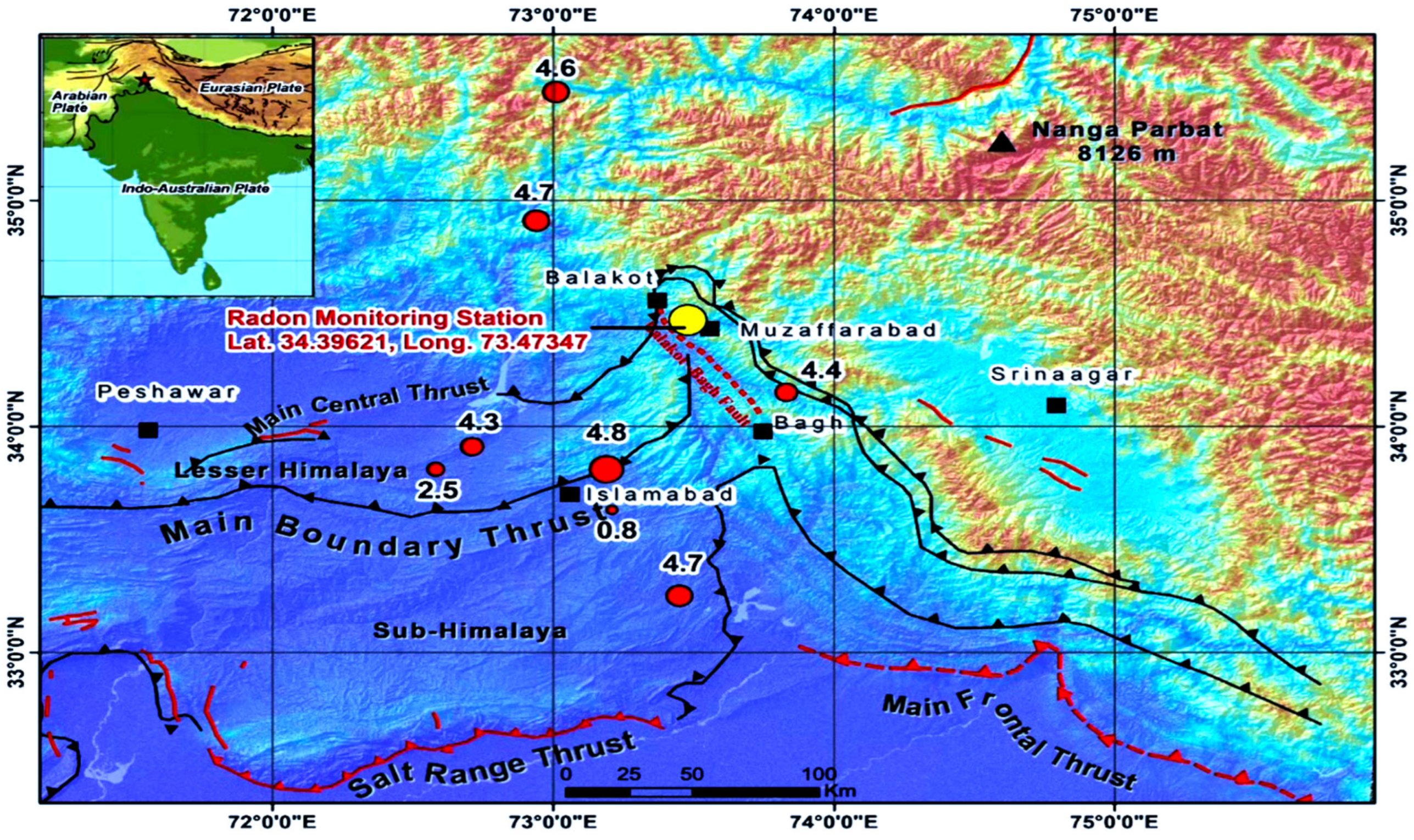
The data of the current study was recorded in Muzaffarabad, the capital of the Pakistan-administered state of the Azad Jammu and Kashmir. Muzaffarabad is located at altitude 34.37002° and longitude 73.47082° at the confluence of two rivers, Neelum and Jhelum. The regional tectonic map of the westernmost part of the frontal Himalaya is shown in Figure 2.
Muzaffarabad district covers a total area of 1642 km2, while Muzaffarabad city itself spans approximately 17 km2 [24]. Tectonically, Muzaffarabad is situated within the Hazara–Kashmir Syntaxis (HKS), a geologically significant and seismically active structure located in the western Himalayas. The HKS is formed by the folding of Himalayan thrust sheets in the northeastern region of Pakistan [25]. Several active faults are associated with the eastern limb of the HKS, including the Muzaffarabad Fault (MF), Riasi Fault (RF), Shahdara Fault (SF), Shaheed Gala Fault (SGF), Godri Badshah-Kotli Fault (GK), Pirgali Fault (PF), and Samwal Fault (SF).
The Muzaffarabad Fault is also known as Himalayan Frontal Thrust (HFT), Tanda Fault (TF), and Balakot-Bagh Fault (BBF) [26]. The Muzaffarabad Fault creates a massive active rupture zone, which ranges from one to three kilometers. Landslides, gouges, fractures, and cracks are all common in this rupture zone. The morphology along the Muzaffarabad Fault is governed by warps or folded scarps, or fault-related fold scarps. The local pop-ups, triangular zones, pressure ridges, and stretching movements are evident across this fault.
Figure 2. Regional tectonic map of the westernmost part of the frontal Himalaya. (Adopted from Kaneda et al. [27]).
Geosciences 16 00064 g002
The Muzaffarabad Fault was recognized to be active prior to the devastating earthquake that struck on 8 October 2005, with a magnitude of Mw = 7.6, which occurred at 8:52 a.m. PST (3:50:40 UTC). The epicenter for this earthquake was situated 18 km north-northeast of Muzaffarabad, the capital of Azad Jammu and Kashmir, with a focal depth of 26 km [28]. The main thrusts are shown as black lines with filled triangles. The red dashed lines show the main salt range formation sliding thrusts. The map shows the radon monitoring station as a yellow circle and the studied earthquakes as red circles according to their moment magnitude (two near events in Mw = 4.7). The black boxes present the main cities and the black triangle the highest peak in the world (Nagna Parbat). The geographical coordinates (E,N) are also shown. The legend in the top left shows the main tectonic plates.
The overall region has a humid to subtropical climate, which features hot summers, a powerful monsoon (~1100 mm annual rainfall), and very cold winters. In terms of hydrology, soil water and groundwaters are found within a permeable quaternary alluvium, whereas rivers and lake supplies dominate the surface’s drainage. The radioactive composition of the underlying lithology varies. Radionuclide mobility is regulated hydrogeologically by the transition from fractured limestone and sandstone in the north to porous alluvial aquifers in the south. The region’s geomorphology includes gravelly plains, undulating terraces, and steeply divided ridges. The types of vegetation vary from subtropical dry forests in uplands to grass–shrub cover in the plains, affecting infiltration and erosion.

2.1.2. Data Acquisition

The radon and thoron radioactive gases were measured using the SARAD RTM 1688-2 active radon thoron monitor [28]. By using the above active monitor, soil radon, soil thoron, and the atmospheric parameters temperature, pressure, and humidity have been continuously monitored from March 2017 up to May 2018. To install the RTM 1688-2 for in situ measurements, a borehole 1 m deep from the soil’s surface was dug. There, the packer probe of RTM 1688-2 was brought down and properly sealed from the surrounding air so that the pumped gas was only from the nearby soil. Measuring period was 40 min. In this manner, RTM 1688-2 collected 36 samples per day, yielding a total of 15,692 data samples taken during the study period. The instrument used a 4 × 200 mm2 Si-detector with HV-chambers to detect radon and thoron with an accuracy below 5%. It had a sensitivity of 3 counts per min at 1000 Bq/m3 [29]. The partial uncertainties of RTM 1688-2 are very low and, as a result, the uncertainty variations are negligible compared to the trends of the overall study period [15,29].

2.1.3. Earthquake Related Data

The earthquake data was obtained from the National Seismic Monitoring Centre of Pakistan [30] and refers to the parallel period of measurements in Section 2.1.2 plus–minus one month to allow for pre- and post-earthquake data. In order to select earthquakes from this period, the earthquake preparation radius of Dobrovolsky et al. [31] was calculated:
R D = 10 0.43 M
The reader should note that Equation (1) is still in extensive use in the related literature. The hypothesis in [31] is that, prior to seismic events, a circle of radius R D exists around the epicenter, within which major elastic crustal deformation occurs. In this consensus, it is essential that radon and thoron monitoring stations are installed within the radius R D in order to ensure (according to [31]) that the station’s measurements are influenced mainly by the seismic activity. This means that to account for (mainly) seismic activity, the distance of the radon–thoron measurement station from the earthquake epicenter R E must be within the earthquake preparation radius, namely, Dobrovolsky’s radius must greater than the epicentral one, i.e., R D R E . Under this criterion, nine earthquakes were identified during the earthquakes’ period. These earthquakes are presented in Table 1 together with the Dobrovolky’s and epenentral radii.

2.2. Theoretical Aspects

2.2.1. Kernel Density Estimation

KDE has been introduced in statistical and geostatistical studies; however, nowadays it is utilized in physics, public health, astronomy, agriculture, social economy [32], and seismic research [33]. It is considered among the most popular non-parametric techniques for the estimation of the probability density function (PDF) of a time series or a variable of a dataset. According to Zhang et al. [21], KDE can be used in anomaly detection in non-linear systems by detecting the density variations in a KDE heatmap, which visualize these anomalies. A low probability density in the KDE heatmap is associated with an anomaly in the data series [21].
Mathematical expression for the kernel density can be estimated by Y ( n × m ) considering it as a matrix y 1 , y 2 , y 3 , y n of identically distributed samples. These samples are taken from a probability kernel density, b ( y ) , from the m-dimensional Euclidean space given as follows [19]:
b y = 1 m i = 1 n a m k y y i a
where k is the density function and a is the width smoothing parameter. The coefficients 1 m and a m are used to normalize the density estimator k . Probability density functions that are frequently for k are the Gauss, Laplace, Uniform, Tricube, and Epanechnikov ones. The following properties are necessary for the generation of a smoothing kernel [34]:
k y d y = 1
y k ( y ) ) d y = 0
y 2 k y d y 0
KDE has been employed in the detection of anomalies in time series. This is because it offers a nuanced understanding of anomaly detection by encoding, decoding, and evaluating post-training events against the estimated density, thus providing a comprehensive notion of normality [35]. This is achieved by comparing the density of each sample with the one neighborhood through calculation of the average density of all nearby samples [36]. Anomaly detection via KDE can be accessed in geochemistry [37], pattern recognition [38], droughts [39], magnetic fields [40], and other disciplines.

2.2.2. Histogram-Based Density Estimation

Estimating the densities of any time series data can also be carried out using histogram-based density estimation. It can be easily set, and its implementation is of low complexity in time. HBDE distribution density, being discontinuous, restricts it to be a good choice for the purpose of anomaly detection [36]. However, HBDE can be effectively used for estimating the distribution of data when the actual distribution is not known. Estimated density due to the HBDE technique is sensitive to the choice of bandwidth. While considering limitations of the histogram-based density estimation technique, other density estimation models are used for the detection of anomalies.

2.2.3. Wavelet-Based Density Estimation

Wavelets are common mathematical tools used for the analysis and computation of non-stationary time series. Wavelets can be locally adjusted so as to follow the smoothness of any function due to their multi-scale nature [41]. Due to this fundamental characteristic, wavelets have been used in a variety of applications. Their most important application is the denoising of non-stationary signals [42]. The key achievement of wavelet thresholding to reduce noise depends upon the fact that the extension of input signals in a wavelet basis is usually sparse, i.e., several features of the input signal are effectively summarized by a small fraction of wavelet coefficients [41,42].
Wavelet-based density estimators are actually orthogonal series estimators that are part of a broad family of non-parametric techniques [43]. The two most widely used orthogonal series are the Fourier and Hermite functions. In comparison to other orthogonal functions for WBDE, the above functions provide greater flexibility in smoothness and convergence [23]. Initially, in the so-called conventional wavelet density estimation, only the preliminary density was approximated. With the evolution of the knowledge in the field, a recursive data modification was achieved which takes into account the data in calculations and also the exponential depreciation of previous data. Through this continuously updating process, the coefficients in orthogonal series estimators are represented by the expected value of each data point which is projected across the orthogonal series [44].
Wavelet-based estimators have not been employed extensively so far and, as a result, related papers are scarce from the last decade. Jiang et al. [39] employed wavelet-based estimators for droughts. WBDE has been utilized to estimate the uncertainty and bias of hydro-climatological changes [45] to quantify anomalies for Mobile Information Carriers [46] and to study precipitation extremes and large-scale climate anomalies [47].

3. Results and Discussion

Time series data of radon, thoron, temperature, pressure, and humidity parameters was collected continuously for 436 days. According to the in situ experience and the publications of the team, e.g., references in [15,42], this time period is adequate for the study of radon and thoron disturbances in association with earthquake occurrence. The region of this study, Muzaffarabad, has a complex tectonic setting and geological formations. Time series data shows some high values of thoron values. The reason for the high values of thoron shows the presence of a source in the soil directly beneath the earth’s surface. There are many other factors involved that can be probable causes of high thoron values viz. active fault lines, tectonics of the area, and geological formation of the area. The active fault line viz. the Muzaffarabad Fault, which was the primary source of devastation in the area due to earthquakes, has created fissures and cracks through which radioactive gases like radon and thoron can be transported with ease. Post-2005, earthquakes were responsible for fracturing the rock strata, thereby significantly increasing the soil’s permeability and permitting higher concentrations of radioactive gases to seep into the atmosphere.
Table 2 shows the values from the KDE and WBDE methods applied to the radon and thoron time series during the period of study. It can be observed that the values of the RTS of the earthquakes 6 and 9 tend to be higher than the values for the other earthquakes. Based on the applied criterion, multiple events exceed the anomaly threshold; however, relative magnitude and temporal persistence were considered for interpretative emphasis. KDE values for the TTS tend to be higher for earthquakes 4 and 5, while values are from WBDE for earthquakes 1 and 2. This differentiation can be attributed to a possible different sensitivity of each method in respect to the studied time series and the earthquake occurrences. To study the density tendencies further, the density values are calculated, and then the statistical cut-off limit of average+2standard deviation is arbitrary set. The reader should note here that numerous papers make use of this statistical cut-off limit to identify anomalies that may be associated with earthquakes; see reviews [5,6] and, importantly, the references therein. All the cut-off limits are given in the last row of Table 2. Based on the WBDE cut-off limit (1.80 × 10²), thoron density values for EQ6, EQ7, and EQ9 exceed the anomaly threshold. It is obvious that the average+2standard deviation approach in Table 2 provides only indicative pre-earthquake estimations. Among these events, EQ7 and EQ9 exhibit comparatively stronger anomaly magnitude and temporal persistence and are therefore emphasized in the subsequent discussion.
Exceedance of the cut-off limit indicates the presence of an anomaly, whereas relative anomaly strength and persistence were considered for interpretative emphasis.
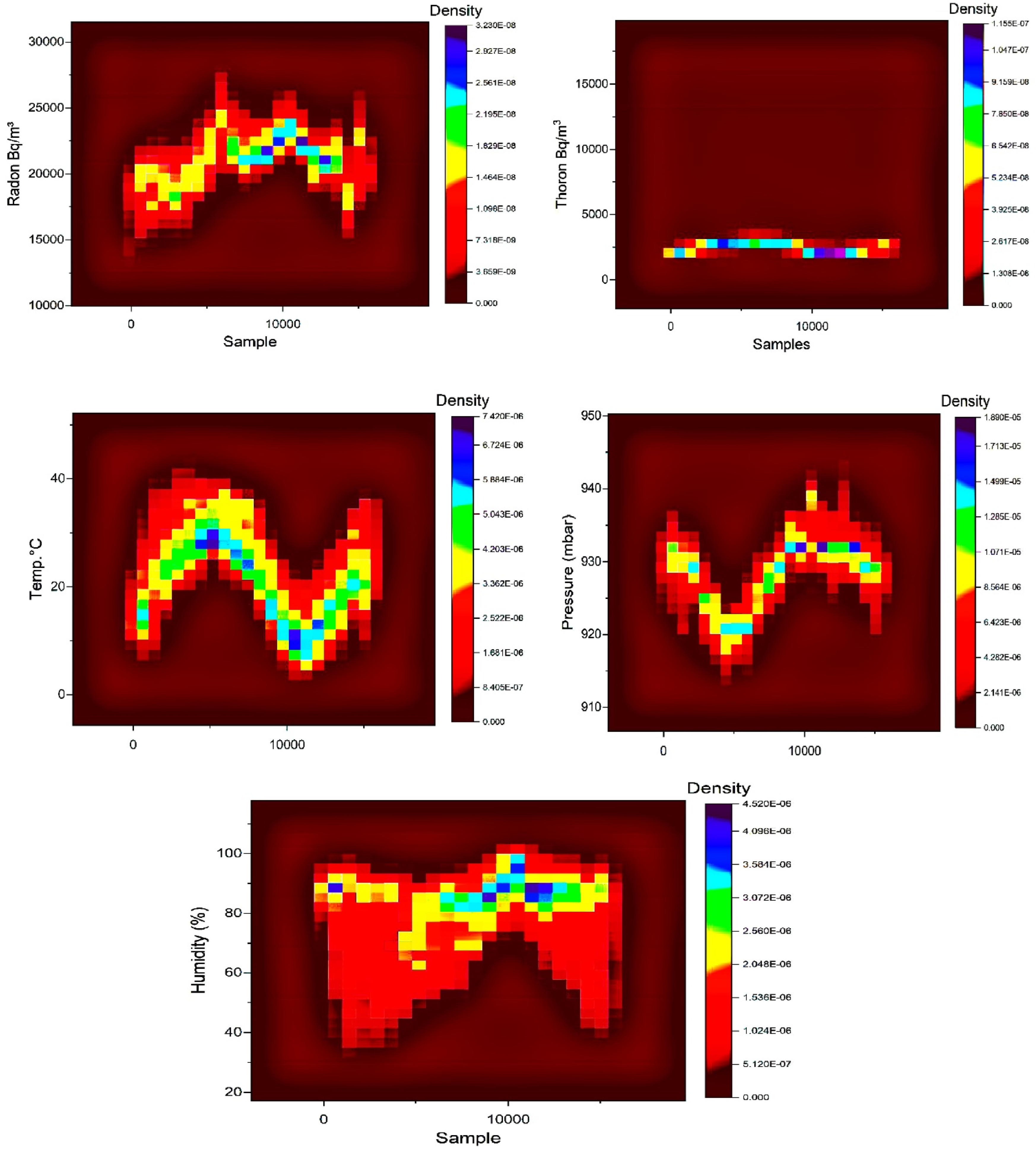
Since the statistical criterion fails to work with the KDE and WBDE method outcomes, other approaches are needed. One approach is the time evolution of the KDE heatmap, which could provide adequate information (Figure 3). The reader should note here the color bar density associations in Figure 3; where the density is low, warm colors are present, such as reds and yellows. In KDE color maps, blue represents the region with high probability density whilst red represents low probability density. These warm density colors correspond, more or less, to profile values, i.e., baseline levels, whereas high density localities are associated with anomalous values and cooler colors such as blues or greens.
Under the above consensus, radon, thoron, and atmospheric time series (Figure 3) show unusual KDE density values at certain time samples. To interpret the time axis, the reader may recall from Section 2.1.2 that each sample corresponds to a 40 min measuring interval. In this view, the radon time series shows anomalous KDE densities on 12 March 2017, i.e., approximately 11 days prior to the occurrence of the MW = 4.3 (21 March 2017, EQ1) earthquake and roughly 13 days prior to the MW = 2.5 (23 March 2017, EQ2) earthquake. Radon also shows anomalous kernel density on 15 August 2017, i.e., approximately 12 days before the occurrence of the earthquake of magnitude MW = 4.8 (27 August 2017, EQ3). The anomaly in KDE density was also observed in radon on 17 September 2017, i.e., around 7 days before the occurrence of the earthquake of magnitude MW = 4.6 (23 September 2017, EQ4). Another KDE density anomaly was observed in the radon time series on 19 January 2018, i.e., almost 15 days before the occurrence of the earthquake of magnitude MW = 0.8 (3 February 2018, EQ6). On the other hand, thoron also shows anomalous KDE density values (Figure 3) on 17 August 2017, i.e., approximately 12 days prior to the occurrence of the earthquake of magnitude MW = 4.8 (27 August 2017, EQ3). KDE increased density was also observed in the thoron heatmap on 17 September 2017, i.e., roughly 7 days before the occurrence of the earthquake of magnitude MW = 4.6 (23 September 2017, EQ4). Another KDE density anomaly was also observed in the thoron time series on 28 February 2018, i.e., around 15 days before the occurrence of the earthquake of magnitude MW = 0.8 (3 February 2018, EQ6). However, the reader should note here that, to the view of several authors—see [5] and references therein—the earthquake precursors are ought to be based on results of long-term observations in order to assess their seismic forecasting effectiveness. Although this might be true in some cases, there are several other cases where the advancement of certain methodologies provide good forecasting success; see reviews [5,6,12] (as KDE methodology here). Moreover, the radon and thoron profiles of the station are well known [see [15] and references therein]; therefore, the identified anomalies above the red basis (profile) are well-established. Despite these facts, the presented results based on the KDE heatmaps are valid only within the logic of what KDE provides and may be subjected to methodology bias if different mathematical approaches are selected.
From the results presented so far, it is evident that the KDE method manages to identify anomalies in radon and thoron time series regarding the earthquakes in Table 1. This gain of the KDE is noteworthy especially if the reader takes into account that according to Frehner et al. [34]. Among the techniques specifically developed for anomaly detection, there is no clear winner. It is evident from the recent review of Nikolopoulos et al. [5] on earthquake precursors that there is no single certain rule to link earthquakes and anomalies, but several papers report such links for even mild earthquakes. In the sense of this review, the present results fall within the tendencies of both recent and old papers. Moreover, in the recent review of Pulinets et al. [10], the Lithosphere Atmosphere Ionosphere Coupling (LAIC) adopts anomalies from all parts of the LAIC. The reader should note that the first author of reference [10] is the main founder of the LAIC model, which is used extensively nowadays for the explanation of pre-earthquake anomalies. The present results referring to anomalies from data in soil, i.e., from the lithosphere, are both within the LAIC model and the international literature. The review of Conti et al. [6] also verifies this aspect. Hence, it can be supported that both radon and thoron anomalies identified through KDE are supported by evidence. Moreover, the fact that KDE has been applied to several types of anomalies (see references of Section 2.2.1)is also evident that this method is indeed robust, modern, and succeeds in delineating anomalies. The method managed to identify five of the nine earthquakes in Table 1.
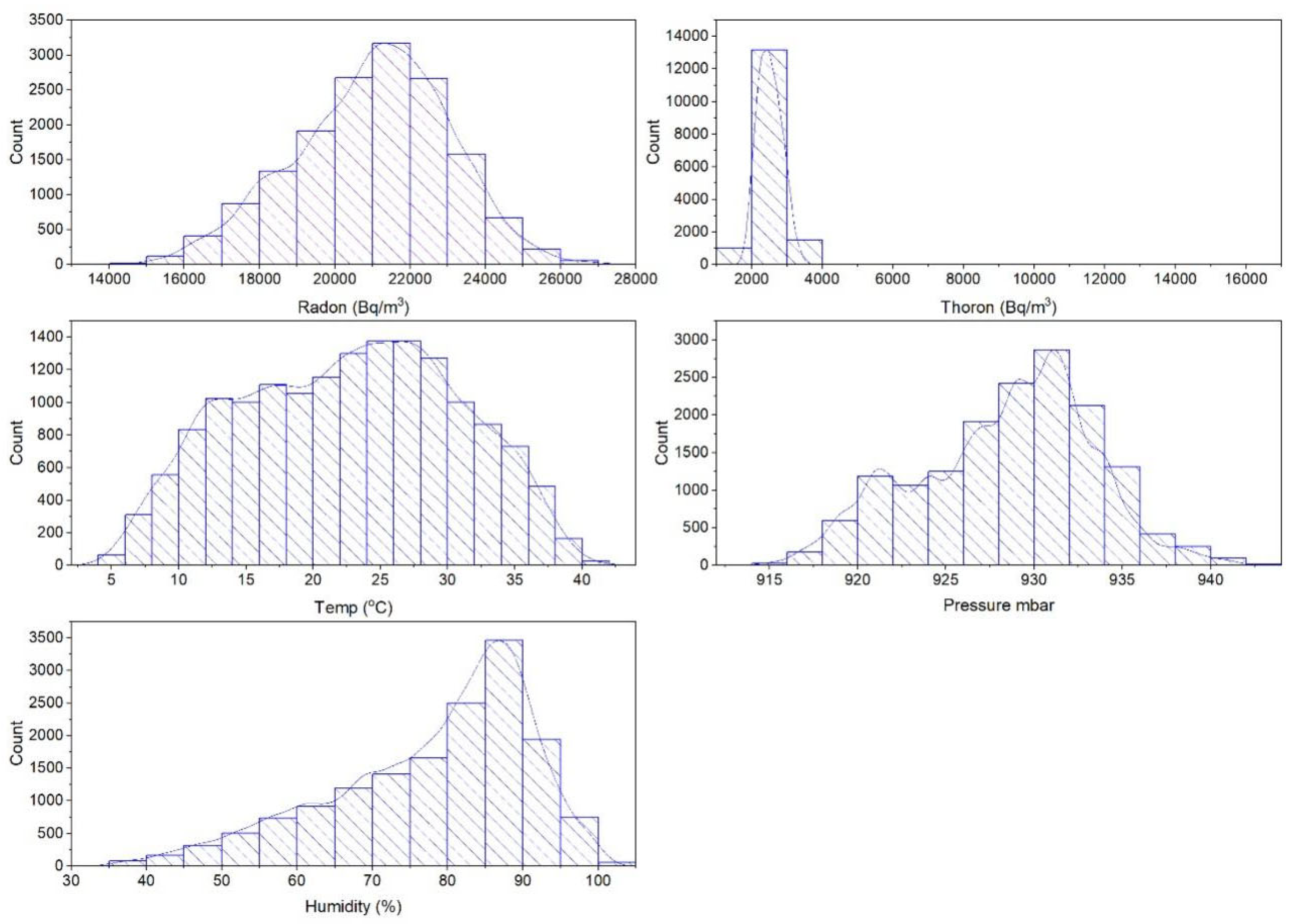
Since the KDE method is successful in finding radon and thoron anomalies as well as time series anomalies in general, it may also be used for the delineation of anomalies of the atmospheric parameters related to radon and thoron data series. According to this sense, Figure 3 presents the variations in the atmospheric parameters with the KDE method. The reader should note here that traditionally, radon and thoron series are presented in parallel to atmospheric data series. This is because the atmospheric parameters may evoke anomalies in radon and thoron due to the physics of the lithosphere (underlying geology). Classical papers explain that, and the reader may find several such references in the references of the reviews [5,6,10]. It should be noted, though, that this condition is not necessary, meaning that it is not obligatory or a priori that some kind radon or thoron anomaly is due to atmospheric parameter disturbances. This further means that even if some associations may co-exist between atmospheric parameters and radon or thoron anomalies, it is by no means obligatory that the identified radon and thoron time series disturbances are linked to variations in the atmospheric parameters and not linked to the seismic events of this paper. There have also been published attempts which link radon anomalies to earth, ocean, and lunar tides, e.g., [48] and references therein, but these report periodicities way milder than the ones of the atmospheric parameters. The advancement, however, of the KDE heatmaps succeed in overcoming all the periodicity problems. Indeed, the reader may observe that no KDE heatmap of the atmospheric parameters is identical or even similar to the one for radon, whereas all parameters are completely different from the KDE heatmap of the thoron time series. According to this consensus, the claims presented regarding the potential links on the earthquakes in Table 1 and the radon time series are rigid, whereas the corresponding claims about the thoron time series are even more strict. The link between the earthquakes in Table 1 and the radon and thoron time series is reinforced by the findings of the HBDE method (Figure 4).
Indeed, the HBDE of radon time series are very different from the ones of temperature and relative humidity (Figure 4). The HBDE of air pressure time series has some similarities with the radon time series, implying some small bias due to atmospheric pressure in the radon time series. Regarding thoron time series, there are, again, no similarities. Therefore, it can be supported that the thoron time series manage to better delineate the link to the earthquakes in Table 1, but the evidence for the links with radon time series are also reliable.
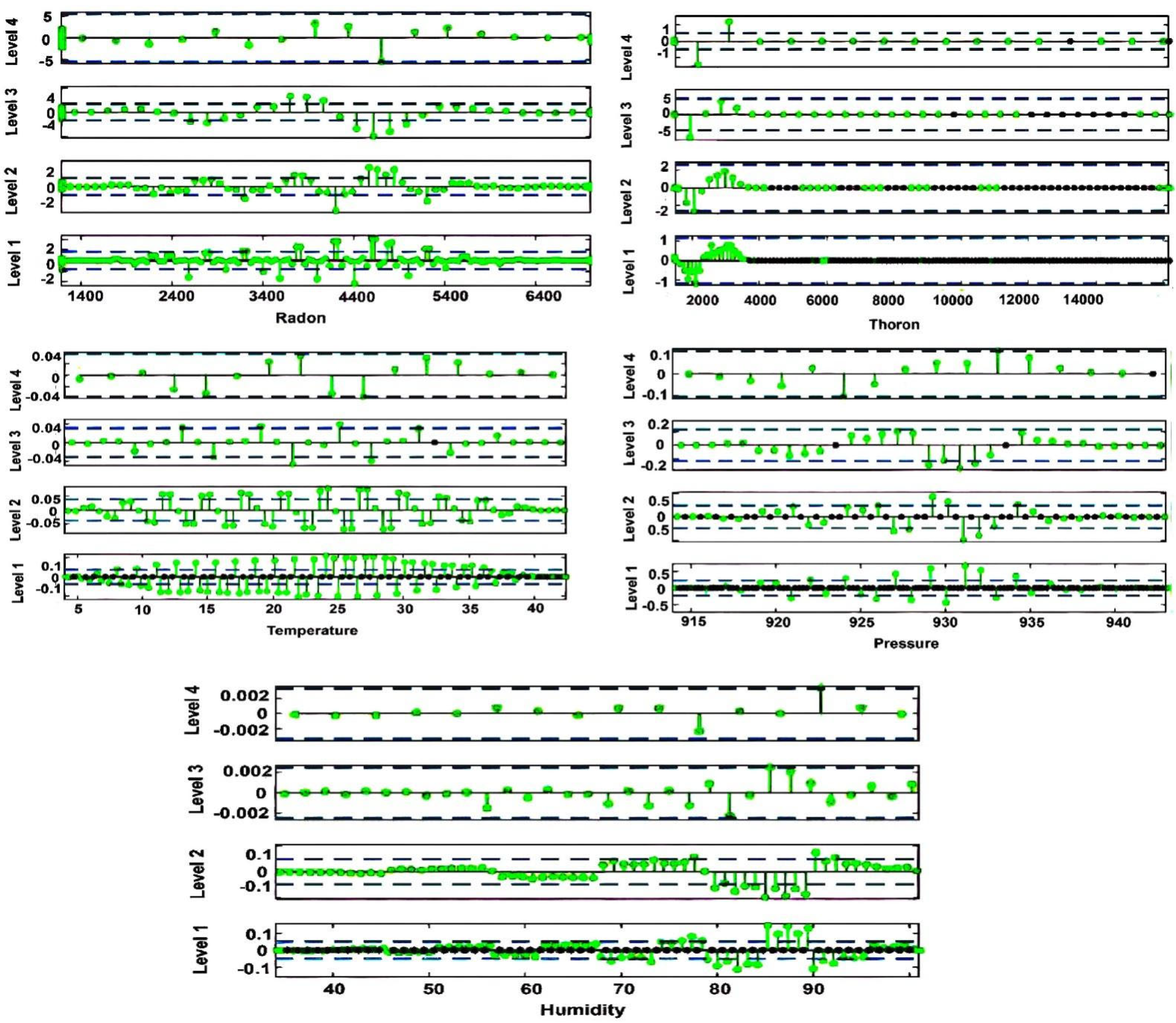
Figure 5 presents the wavelet coefficients of radon, thoron, and meteorological time series using the Bior (Biorthogonal) wavelet. The reader should note here that the black or colored spots indicate wavelet coefficients with higher amplitudes. These spots may represent important information in the data at various scales and locations. Black dots indicate strong coefficients, making them more prominent. A black spot in the wavelet coefficient plot usually denotes areas with substantial amplitudes of the wavelet coefficients. Areas with abrupt changes, discontinuities, or localized features are represented by black dots. They may show whether a feature is present at that specific resolution and location. In this sense, and as can be observed from Figure 5, levels 1–3 show that some noise is present in the radon time series, since some maximum data points for the levels (1–3) are below or above the blue dotted lines, indicating the corresponding thresholds. On the other hand, according to level 4, noise is not present in radon time series. This is an alternative implication that radon is co-affected by other factors (as already mentioned mainly atmospheric pressure), but this bias is not systematic and cannot be separated from the effect of the lithosphere’s disturbances. In other words, the wavelet coefficients with the Bior wavelet imply only some noise present in the radon series; therefore, the reported claims between potential links of radon time series and the five earthquakes of Table 1 are more evident. This is reinforced by the fact that when smaller coefficients are set to zero for the radon time series, the noise and black spots are removed.
Up to now, the combination of the KDE heatmaps, the HBDE histograms, and the four levels of the wavelet coefficients with the Bior wavelet show in a multifaceted way that the thoron time series is, most possibly, not affected by the studied atmospheric factors, whereas the radon time series are surely not strongly affected, and only some small bias may be present due to the atmospheric pressure. To check further if such a bias may affect the radon time series, Pearson’s correlation matrix was calculated and is presented in Table 3. As can be observed, Table 3 shows the main linear correlations between the atmospheric parameters and the radon or thoron time series. Very low to negligible is the (positive) linear correlation of radon with pressure and humidity, (coefficients of 0.121 and 0.432, respectively), whilst negligible (but negative) is the linear correlation of radon with temperature (−0.141). This is an important finding which has to be emphasized. Up to now only some bias or radon time series with air pressure series could hardly be identified. Under the view of Table 3, this bias is completely negligible (0.121). Therefore, under another viewpoint, the radon time series is most possibly related to the earthquakes of Table 1, and the provided evidence for radon time series and earthquakes is more reliable. The correlation matrix also shows small effects of the atmospheric parameters on the thoron time series, which are a bit higher than the corresponding ones for the radon time series. Specifically, the thoron time series is mildly (positively) correlated with temperature, (Pearson’s coefficient of 0.579) and mildly (negatively) correlated with air pressure (Pearson’s coefficient of −0.510). Negligible (negative) is the linear correlation with the percentage air humidity (Pearson’s coefficient of −0.211). Even the mild correlations of the thoron time series are not identified by the other methods, and this fact shows the necessity of utilizing several approaches in order to associate with increased evidence the link between some types of anomalies and earthquakes. Indeed, the radon time series could have a bias from the atmospheric time series which was not supported by the linear correlation matrix. On the other hand, the thoron time series did not exhibit any kind of bias from the atmospheric parameters but showed some mild associations. All this evidence supports the necessity for using several approaches when investigating potential earthquake precursors. The need for a multifaceted approach has been expressed by Eftaxias et al. [49] and other references and has been emphasized strongly in the review of Nikolopoulos et al. [5]. After the above views, it can thus be supported that the links between the radon time series variations and the earthquakes in Table 1 are the most probable. This is also well justified for the thoron time series. Therefore, from all the evidence presented, the link between the variations of radon and thoron time series with the earthquakes in Table 1 are the most probable.
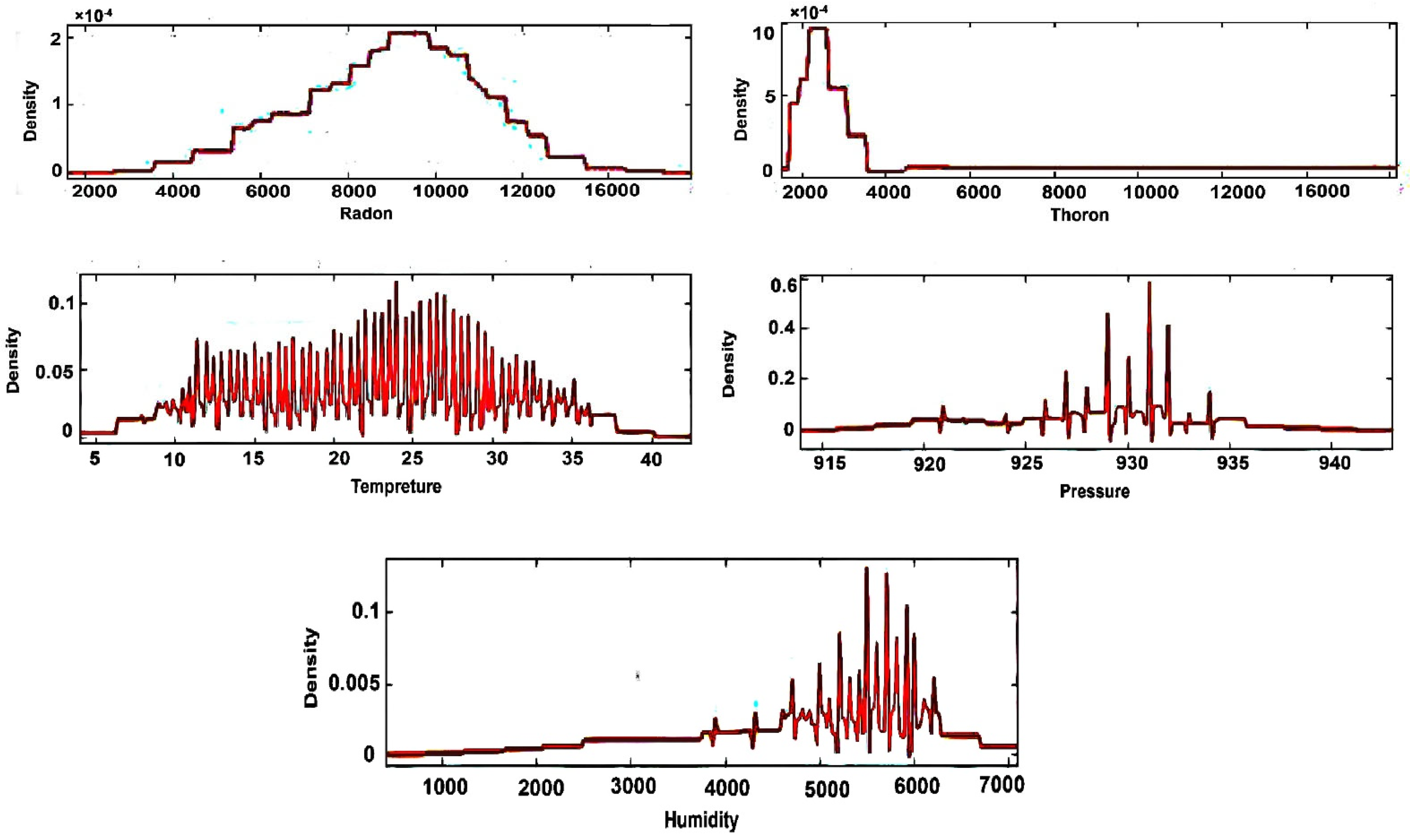
Figure 6 presents the WBDE plots of radon, thoron, and atmospheric time series. As can be observed from Figure 6, low-density areas in radon were observed on 12 March 2017, i.e., approximately 11 days before two earthquakes of magnitudes MW = 4.3 (21 March 2017, EQ1) and MW = 2.5 (23 March 2017, EQ2). Anomalous WBDE are observed in thoron on 12 March 2017, i.e., about 11 days approximately before two earthquakes of magnitudes MW = 4.3 (21 March 2017, EQ1) and MW = 2.5 (23 March 2017, EQ2). Peaks, valleys, and flat areas are observed in the WBDE plots of the atmospheric time series, indicating the anomalies in temperature, pressure, and humidity time series data.

4. Conclusions

This study employed the wavelet transform on radon and thoron time series with biorthogonal wavelets to separate noise and extract meaningful signals. The methodology adopted in the current study is based upon an integrated, multiscale density-based framework. KDE establishes global probabilistic behavior while WBDE reveals localized, scale-dependent deviations. Kernel density estimation and wavelet-based density estimation methods were then applied to detect anomalies in the radon and thoron time series. The outcomes of this study confirm the presence of anomalies in both radon and thoron time series data. Moreover, the links of these anomalies to seismic events that occurred during the study period are also reported. The KDE applied to the radon and thorough time series identified nine significant anomalies. The anomalies in radon time series data were detected on 12 March 2017, 15 August 2017, 17 September 2017, and on 19 January 2018. These anomalies were identified several days before the corresponding seismic events. Anomalies in thoron time series were observed on 12 March 2017, 15 August 2017, 17 September 2017, and on 28 February 2018, all preceding the seismic events by some days. Five out of nine seismic events with anomalies in both radon and thoron time series data were accurately identified by the kernel density estimation technique. WBDE identified four radon anomalies and two thoron anomalies that were associated with the corresponding seismic activities. Although multiple events exceed the statistical threshold, EQ7 and EQ9 demonstrate clearer and more persistent thoron anomaly behavior, supporting their stronger association with seismic activity. In the current study, soil-based measurements were used for detecting radon and thoron trace gas anomalies and linking them with earthquake forecasting. Working with the satellite data presents another good option for detecting Outgoing Longwave Radiation (OLR) and its anomalies. Future studies can explore the connection between geophysical processes and atmospheric responses such as earthquake precursors. A combined soil–satellite approach has the potential to provide more robust and physically meaningful results.

Author Contributions

Conceptualization, M.R. and A.R.; Methodology, A.R., M.O., A.A.M., A.A., G.P. (Georgios Prezerakos), A.J., P.Y., G.P. (Georgios Priniotakis), K.J.K., and S.U.R.; Software, A.R., G.P. (Georgios Prezerakos), P.Y., and C.D.; Validation, M.R., A.J., C.D., G.P. (Georgios Priniotakis), M.P., K.J.K., and S.U.R.; Formal Analysis, M.O., A.A.M., D.N., K.K., A.A., G.P. (Georgios Prezerakos), A.J., P.Y., C.D., G.P. (Georgios Priniotakis), N.G., K.J.K., and S.U.R.; Investigation, M.R., A.R., A.A.M., D.N., K.K., A.A., A.J., C.D., G.P. (Georgios Priniotakis), N.G., M.P., K.J.K., and S.U.R.; Resources, A.A.M.; Data Curation, M.R., A.R., M.O., K.K., A.A., G.P. (Georgios Prezerakos), A.J., C.D., N.G., M.P., and K.J.K.; Writing—Original Draft, M.R., A.R., M.O., D.N., K.K., P.Y., M.P., and K.J.K.; Writing—Review and Editing, M.R., D.N., G.P. (Georgios Priniotakis), and S.U.R.; Visualization, A.R. and G.P. (Georgios Prezerakos); Supervision, M.R. and D.N.; Project Administration, M.R. and D.N.; Funding Acquisition, M.R. All authors have read and agreed to the published version of the manuscript.

Funding

This work was supported by Higher Education Commission (HEC) of Pakistan under Grant No: 6453/AJK/NRPU/R&D/HEC/2016 against the NRPU project executed by one of the authors, M.R.

Institutional Review Board Statement

Not applicable.

Informed Consent Statement

Not applicable.

Data Availability Statement

Data is unavailable due to ethical restrictions.

Acknowledgments

We are thankful to Aleem Dad Khan Tareen for his efforts in data collection. Special thanks are due to Tayyib Riaz from the Institute of Geology, University of Azad Jammu and Kashmir, for his invaluable assistance in drafting the geological map and contributing to the geological aspects of the manuscript. Additionally, one of the authors, M.R., sincerely acknowledges the Higher Education Commission of Pakistan for providing funding that facilitated the completion of the project, of which this study is a part.

Conflicts of Interest

Authors declare that the funders had no role in the design of the study; in the collection, analyses, or interpretation of data; in the writing of the manuscript; or in the decision to publish the results.

References

  1. Woith, H.; Petersen, G.; Hainzl, S.; Dahm, T. Review: Can Animals Predict Earthquakes? Bull. Seismol. Soc. Am. 2018, 108, 1031–1045. [Google Scholar] [CrossRef]
  2. Wuyep, L.C.; Kadiri, U.A.; Monday, I.A.; Nansak, N.E.; Zakka, L.; Thomas, H.Y.; Ogugua, E.P. Geo-Chemical Techniques for Earthquake Forecasting in Nigeria. Asian J. Geogr. Res. 2021, 4, 29–45. [Google Scholar] [CrossRef]
  3. Placinta, A.O.; Borleanu, F.; Moldovan, I.A.; Coman, A. Correlation Between Seismic Waves Velocity Changes and the Occurrence of Moderate Earthquakes at the Bending of the Eastern Carpathians (Vrancea). Acoustics 2022, 4, 934–947. [Google Scholar] [CrossRef]
  4. Cao, B.; Ge, Z. Cascading multi-segment rupture process of the 2023 Turkish earthquake doublet on a complex fault system revealed by teleseismic P wave back projection method. Earthq. Sci. 2024, 37, 158–173. [Google Scholar] [CrossRef]
  5. Nikolopoulos, D.; Cantzos, D.; Alam, A.; Dimopoulos, S.; Petraki, E. Electromagnetic and Radon Earthquake Precursors. Geosciences 2024, 14, 271. [Google Scholar] [CrossRef]
  6. Conti, L.; Picozza, P.; Sotgiu, A. A Critical Review of Ground Based Observations of Earthquake Precursors. Front. Earth Sci. 2021, 9, 676766. [Google Scholar] [CrossRef]
  7. Tsuchiya, M.; Nagahama, H.; Muto, J.; Hirano, M.; Yasuoka, Y. Detection of atmospheric radon concentration anomalies and their potential for earthquake prediction using Random Forest analysis. Sci. Rep. 2024, 14, 11626. [Google Scholar] [CrossRef]
  8. Chetia, T.; Baruah, S.; Dey, C.; Baruah, S.; Sharma, S. Seismic induced soil gas radon anomalies observed at multiparametric geophysical observatory, Tezpur (Eastern Himalaya), India: An appraisal of probable model for earthquake forecasting based on peak of radon anomalies. Nat. Hazards 2022, 111, 3071–3098. [Google Scholar] [CrossRef]
  9. Romano, D.; Sabatino, G.; Magazù, S.; Bella, M.D.; Tripodo, A.; Gattuso, A.; Italiano, F. Distribution of soil gas radon concentration in north-eastern Sicily (Italy): Hazard evaluation and tectonic implications. Environ. Earth Sci. 2023, 82, 273. [Google Scholar] [CrossRef]
  10. Pulinets, S.; Herrera, V.M.V. Earthquake Precursors: The Physics, Identification, and Application. Geosciences 2024, 14, 209. [Google Scholar] [CrossRef]
  11. World Health Organisation (WHO). Radon. 2025. Available online: https://www.who.int/news-room/fact-sheets/detail/radon-and-health (accessed on 23 October 2025).
  12. Kashkinbayev, Y.; Bakhtin, M.; Kazymbet, P.; Lesbek, A.; Kazhiyakhmetova, B.; Hoshi, M.; Altaeva, N.; Omori, Y.; Tokonami, S.; Sato, H.; et al. Influence of Meteorological Parameters on Indoor Radon Concentration Levels in the Aksu School. Atmosphere 2024, 15, 1067. [Google Scholar] [CrossRef]
  13. Huang, P.; Lv, W.; Huang, R.; Feng, Y.; Luo, O.; Yin, C.; Yang, Y. Impact of environmental factors on atmospheric radon variations at China Jinping Underground Laboratory. Sci. Rep. 2024, 14, 31402. [Google Scholar] [CrossRef] [PubMed]
  14. Huang, C. Featured Anomaly Detection Methods and Applications. Ph.D. Thesis, University of Exeter, Computer Science Department, Exeter, UK, 2018. [Google Scholar]
  15. Rafique, M.; Tareen, A.D.K.; Mir, A.A.; Sajjad, M.; Nadeem, A.; Asim, K.M.; Kearfott, K.J. Delegated Regressor, A Robust Approach for Automated Anomaly Detection in the Soil Radon Time Series Data. Sci. Rep. 2020, 10, 3004. [Google Scholar] [CrossRef]
  16. Boudriki Semlali, B.-E.; Molina, C.; Carvajal Librado, M.; Park, H.; Camps, A. Potential Earthquake Proxies from Remote Sensing Data; IntechOpen: London, UK, 2024. [Google Scholar] [CrossRef]
  17. Chen, Y.C. A Tutorial on Kernel Density Estimation and Recent Advances. Biostat. Epidemiol. 2017, 1, 161–187. [Google Scholar] [CrossRef]
  18. Parzen, E. On Estimation of a Probability Density Function and the Mode. Ann. Math. Stat. 1962, 33, 1065–1076. [Google Scholar] [CrossRef]
  19. Laxhammar, R.; Falkman, G.; Sviestins, E. Anomaly detection in sea traffic—A comparison of the Gaussian Mixture Model and the Kernel Density Estimator. In Proceedings of the 2009 12th International Conference on Information Fusion, Seattle, WA, USA, 6–9 July 2009; IEEE: Piscataway, NJ, USA, 2009; pp. 756–763. [Google Scholar]
  20. Ramanna, C.K.; Dodagoudar, G.R. Seismic hazard analysis using the adaptive Kernel density estimation technique for Chennai City. Pure Appl. Geophys. 2012, 169, 55–69. [Google Scholar] [CrossRef]
  21. Zhang, L.; Lin, J.; Karim, R. Adaptive kernel density-based anomaly detection for nonlinear systems. Knowl.-Based Syst. 2018, 139, 50–63. [Google Scholar] [CrossRef]
  22. Kordestani, M.; Alkhateeb, A.; Rezaeian, I.; Rueda, L.; Saif, M. A new clustering method using wavelet based probability density functions for identifying patterns in time-series data. In 2016 IEEE EMBS International Student Conference (ISC), Ottawa, ON, Canada, 29–31 May 2016; IEEE: Piscataway, NJ, USA, 2016; pp. 1–4. [Google Scholar] [CrossRef]
  23. García-Treviño, E.S.; Barria, J.A. Online wavelet-based density estimation for non-stationary streaming data. Comput. Stat. Data Anal. 2012, 56, 327–344. [Google Scholar] [CrossRef]
  24. Ayub, M.; Rahman, A.-U.; Samiullah; Khan, A. Extent and evaluation of flood resilience in Muzaffarabad City, Azad Jammu and Kashmir, Pakistan. J. Himal. Earth Sci. 2021, 54, 14–27. [Google Scholar]
  25. Baig, M.S.; Lawrence, R.D.; Snee, L.W. Precambrian to early Cambrian orogeny in the northwest Himalaya, Pakistan. Geolog. Mag. 1988, 125, 83–86. [Google Scholar] [CrossRef]
  26. Alam, A.; Wang, N.; Zhao, G.; Barkat, A. Implication of Radon Monitoring for Earthquake Surveillance Using Statistical Techniques: A Case Study of Wenchuan Earthquake. Geofluids 2020, 2020, 2429165. [Google Scholar] [CrossRef]
  27. Kaneda, H.; Nakata, T.; Tsutsumi, H.; Kondo, H.; Sugito, N.; Awata, Y.; Kausar, A.B. Surface rupture of the 2005 Kashmir, Pakistan, earthquake and its active tectonic implications. Bull. Seismol. Soc. Am. 2008, 98, 521–557. [Google Scholar] [CrossRef]
  28. USGS (United States Geological Survey). M 7.6—21 km NNE of Muzaffarabad, Pakistan—Pakistan earthquake 2005. Available online: https://earthquake.usgs.gov/earthquakes/eventpage/usp000e12e/executive (accessed on 30 October 2025).
  29. SARAD GmbH. Available online: https://www.sarad.de/product-detail.php?lang=en_US&catID=&p_ID=20 (accessed on 30 October 2025).
  30. National Seismic Monitoring Centre, Islamabad. Available online: https://seismic.pmd.gov.pk/ (accessed on 1 November 2025).
  31. Dobrovolsky, I.P.; Zubkov, S.I.; Miachkin, V.I. Estimation of the size of earthquake preparation zones. Pure Appl. Geophys. 1979, 117, 1025–1044. [Google Scholar] [CrossRef]
  32. Danese, M.; Lazzari, M.; Murgante, B. Kernel Density Estimation Methods for a Geostatistical Approach in Seismic Risk Analysis: The Case Study of Potenza Hilltop Town (Southern Italy). In Lecture Notes in Computer Science Computational Science and Its Application ICCSA 2008; Gervasi, O., Murgante, B., Laganà, A., Taniar, D., Mun, Y., Gavrilova, M.L., Eds.; Springer: Berlin/Heidelberg, Germany, 2008; Volume 5072, pp. 415–429. [Google Scholar] [CrossRef]
  33. Amador Luna, D.; Alonso-Chaves, F.M.; Fernández, C. Kernel Density Estimation for the Interpretation of Seismic Big Data in Tectonics Using QGIS: The Türkiye–Syria Earthquakes (2023). Remote Sens. 2024, 16, 3849. [Google Scholar] [CrossRef]
  34. Murphy, K.P. Machine learning—A probabilistic perspective. In Adaptive Computation and Machine Learning Series; MIT Press: Cambridge, MA, USA, 2012. [Google Scholar]
  35. Frehner, R.; Wu, K.; Sim, A.; Kim, J.; Stockinger, J. Detecting Anomalies in Time Series Using Kernel Density Approaches. IEEE Access 2024, 12, 33420–33439. [Google Scholar] [CrossRef]
  36. Hu, W.; Gao, J.; Li, B.; Wu, O.; Du, J.; Maybank, S. Anomaly Detection Using Local Kernel Density Estimation and Context-Based Regression. IEEE Trans. Knowl. Data Eng. 2020, 32, 218–233. [Google Scholar] [CrossRef]
  37. Torshizian, H.; Afzal, P.; Rahbar, K.; Yasrebi, A.B.; Wetherelt, A.; Fyzollahhi, N. Application of modified wavelet and fractal modeling for detection of geochemical anomaly. Geochemistry 2021, 81, 125800. [Google Scholar] [CrossRef]
  38. Yao, Y.; Ma, J.; Ye, Y. Regularizing autoencoders with wavelet transform for sequence anomaly detection. Pattern Recognit. 2023, 134, 109084. [Google Scholar] [CrossRef]
  39. Jiang, Z.; Rashid, M.M.; Johnson, F.; Sharma, A. A wavelet-based tool to modulate variance in predictors: An application to predicting drought anomalies. Environ. Model. Softw. 2021, 135, 104907. [Google Scholar] [CrossRef]
  40. Miao, C.; Dong, Q.; Hao, M.; Wang, C.; Cao, J. Magnetic anomaly detection based on fast convergence wavelet artificial neural network in the aeromagnetic field. Measurement 2021, 176, 109097. [Google Scholar] [CrossRef]
  41. Halidou, A.; Mohamadou, Y.; Ari, A.A.A.; Zacko, E.J.G. Review of wavelet denoising algorithms. Multimed. Tools Appl. 2023, 82, 41539–41569. [Google Scholar] [CrossRef]
  42. Rasheed, A.; Osama, M.; Rafique, M.; Tareen, A.D.K.; Lone, K.J.; Qureshi, S.A.; Kearfott, K.J.; Aftab, A.; Nikolopoulos, D. Time-frequency analysis of radon and thoron data using continuous wavelet transform. Phys. Scr. 2023, 98, 105008. [Google Scholar] [CrossRef]
  43. Arfaoui, S.; Ben Mabrouk, A.; Cattani, C. Wavelet Analysis: Basic Concepts and Applications, 1st ed.; Chapman and Hall/CRC: New York, NY, USA, 2021; pp. 1–254. ISBN 9781003096924. [Google Scholar] [CrossRef]
  44. Caudle, K.A.; Wegman, E. Nonparametric density estimation of streaming data using orthogonal series. Comput. Stat. Data Anal. 2009, 53, 3980–3986. [Google Scholar] [CrossRef]
  45. Jiang, Z.; Sharma, A.; Johnson, F. Assessing the sensitivity of hydro-climatological change detection methods to model uncertainty and bias. Adv. Water Resour. 2019, 134, 103430. [Google Scholar] [CrossRef]
  46. Scott, N.V.; Barnard, V.O. Optimal Location Estimation and Anomaly Quantification for a Mobile Information Carrier: Prior Feeds for Deep Learning. 8th International Conference on Civil, Structural and Transportation Engineering, Ottawa, ON, Canada, 4–6 June 2023; Avestia Publishing: Orleans, ON, Canada, 2023; p. 111. [Google Scholar] [CrossRef]
  47. Beyene, T.K.; Jain, M.K.; Yadav, B.K.; Agarwal, A. Multiscale investigation of precipitation extremes over Ethiopia and teleconnections to large-scale climate anomalies. Stoch. Environ. Res. Risk Assess. 2022, 36, 1503–1519. [Google Scholar] [CrossRef]
  48. Groves-Kirkby, C.J.; Denman, A.R.; Crockett, R.G.M.; Phillips, P.S.; Gillmore, G.K. Identification of tidal and climatic influences within domestic radon time-series from Northamptonshire, UK. Sci. Total Environ. 2006, 367, 191–202. [Google Scholar] [CrossRef]
  49. Eftaxias, K. Footprints of nonextensive Tsallis statistics, selfaffinity and universality in the preparation of the L’Aquila earthquake hidden in a pre-seismic EM emission. Phys. A Stat. Mech. Appl. 2010, 389, 133–140. [Google Scholar] [CrossRef]
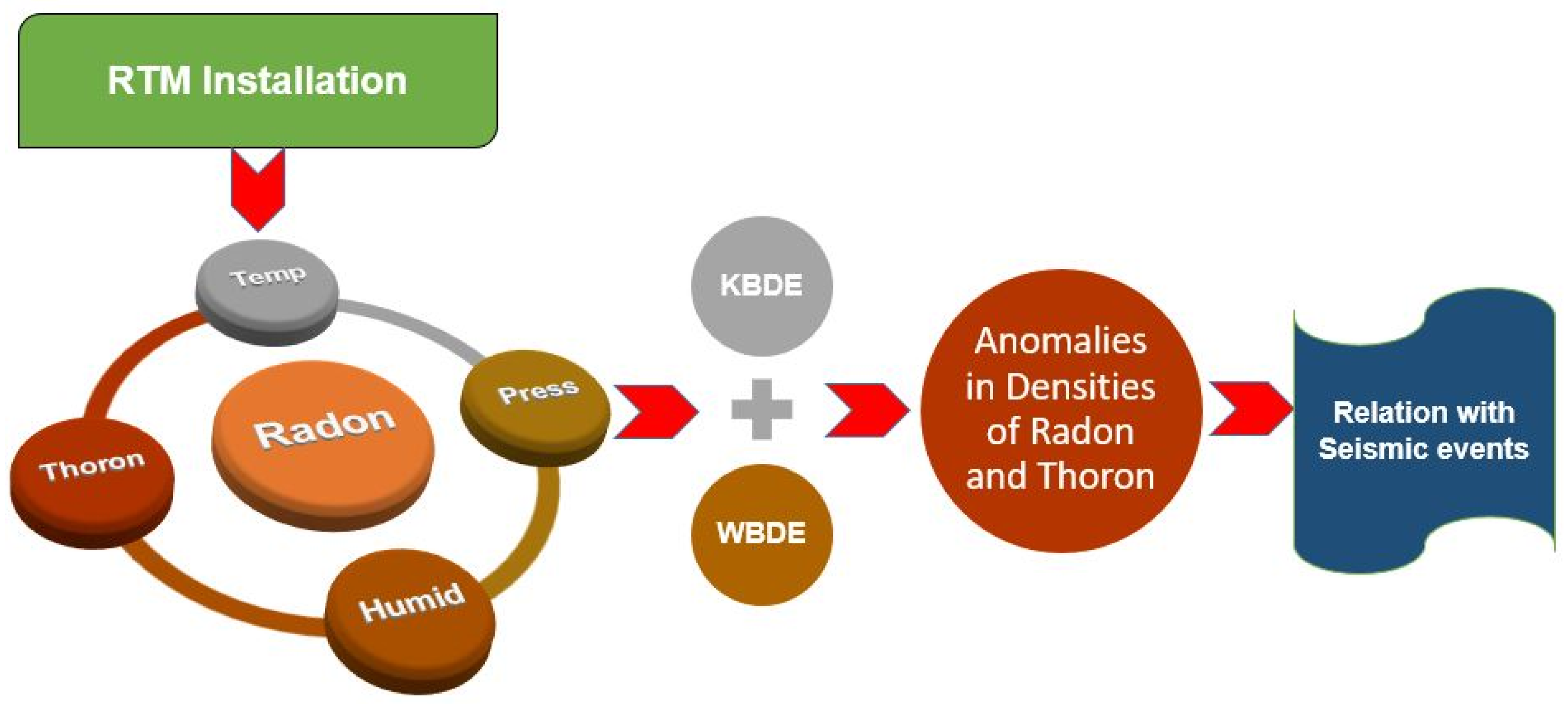
Figure 1. Simulation plan of the study.
Geosciences 16 00064 g001
Figure 3. KDE of the radon, thoron, temperature, pressure, and humidity (blue portrays the region of high probability density whilst red shows low probability density values).
Geosciences 16 00064 g003
Figure 4. HBDE of the radon, thoron, temperature, pressure, and humidity.
Geosciences 16 00064 g004
Figure 5. Wavelet coefficients of the radon, thoron, temperature, pressure, and humidity using the Bior wavelet.
Geosciences 16 00064 g005
Figure 6. Wavelet-based density of radon, thoron, temperature, pressure, and humidity.
Geosciences 16 00064 g006
Table 1. Data for the selected earthquakes. EQ represents the number of earthquakes. R E is the epicentral distance from the radon–thoron station, and R D is the earthquake preparation radius (both in four significant figures). Columns 2–7 were downloaded from the National Seismic Monitoring Centre of Pakistan [30].
EQDateMagnitude
( M w )
Latitude
N
Longitude
E
Depth
(km)
R E
(km)
R D
(km)
EQ121 March 20174.333.91 N72.71 E25 86.0070.60
EQ223 March 20172.533.81 N72.58 E156103.011.89
EQ327 August 20174.833.81 N73.19 E1066.34115.9
EQ423 September 20174.635.48 N73.01 E61135.095.06
EQ59 December 20174.733.25 N76.45 E101300.0104.9
EQ63 February 20180.833.63 N73.21 E157142.92.208
EQ728 February 20184.434.15 N73.83 E13441.7877.98
EQ814 March 20184.933.93 N77.12 E10343.0127.9
EQ915 March 20184.733.1 N76.14 E45284.5105.0
Table 2. Kernel density estimation and wavelet-based density estimation in three significant figures for the earthquakes of Table 1. EQ represents the number of earthquakes in Table 1. Cut-off limits for the density values are also presented.
EQRadon Time SeriesThoron Time Series
KDEWBDEKDEWBDE
EQ11.46 × 10−80.11 × 10−41.30 × 10−84.63 × 10⁻⁴
EQ21.09 × 10−80.26 × 10−42.62 × 10−86.71 × 10⁻⁴
EQ31.83 × 10−80.95 × 10−47.85 × 10−80.12 × 10⁻⁴
EQ41.46 × 10−81.23 × 10−49.16 × 10−80.12 × 10⁻⁴
EQ52.19 × 10−81.12 × 10−49.16 × 10−80.12 × 10⁻⁴
EQ67.32 × 10−91.56 × 10−41.55 × 10−70.12 × 10⁴
EQ72.93 × 10−80.42 × 1041.05 × 10−70.12 × 10⁴
EQ83.65 × 10−90.31 × 1043.93 × 10−80.12 × 10⁴
EQ92.56 × 10−80.11 × 1042.62 × 10−80.12 × 10⁴
Cut-off limit3.14 × 10−84.14 × 1031.63 × 10−71.80 × 10²
Table 3. Pearson’s correlation coefficient between radon and thoron with atmospheric parameters.
Type of VariablesPearson’s Correlation Coefficient
Radon vs. Air Temperature−0.141
Radon vs. Atmospheric Pressure0.121
Radon vs. Percentage Humidity0.432
Thoron vs. Temperature0.579
Thoron vs. Pressure−0.510
Thoron vs. Percentage Humidity−0.211
Disclaimer/Publisher’s Note: The statements, opinions and data contained in all publications are solely those of the individual author(s) and contributor(s) and not of MDPI and/or the editor(s). MDPI and/or the editor(s) disclaim responsibility for any injury to people or property resulting from any ideas, methods, instructions or products referred to in the content.