1. Introduction
Over the past three decades, increasing attention has been devoted to fluid escape processes along continental margins. Methane is the primary gas in seeping fluids [
1,
2]. It can be oxidized by bacteria and thereby provides the base of the food chain for seep communities [
1]. As a potent greenhouse gas, methane and methane-bearing fluid seepage are important factors in considerations of global climate change and the carbon cycle [
3]. In addition, the seepage of methane-rich fluids is closely related to gravitational instabilities [
4,
5]. Because such seepage represents a potential geohazard, it has also been suggested as a factor in the safety assessment of seafloor infrastructures [
6]. It is widely recognized that pockmarks are formed as a result of fluid seepage through the seafloor [
1,
7,
8,
9].
Pockmarks are erosional depressions produced when fluids in subsurface reservoirs escape upward through fine-grained seafloor sediments [
6,
10]. Subsurface gas reservoirs that feed fluid escape systems beneath pockmarks play a critical role in controlling seepage behavior. Reservoir properties such as porosity, saturation, and lithology can significantly influence seepage characteristics [
11,
12,
13]. Pockmarks have been discovered in hydrate-bearing regions, where methane and water combine to form ice-like solid phases under low temperature and high pressure in many parts of the world [
9,
14,
15,
16,
17,
18]. They are typically located above pipe-shaped seismic blanking zones (commonly interpreted as gas chimneys) that develop beneath the seafloor. In hydrate-bearing settings, gas chimneys usually originate from the top of gas pockets located beneath bottom-simulating reflectors (BSRs) on seismic profiles [
19]. Bottom-simulating reflectors (BSRs) are seismic reflections that typically parallel the seafloor and approximate the base of gas hydrate stability due to contrasts in acoustic impedance [
19]. BSRs commonly exhibit reversed polarity relative to the seafloor reflection and may crosscut stratigraphy, reflecting the impedance contrast between hydrate-bearing sediments above and free-gas-bearing sediments below. A fluid-venting system associated with pockmarks thus consists of a gas reservoir below hydrates, gas chimneys acting as focused conduits from the reservoir, and seafloor pockmarks serving as vents. Persistent gas release at many seafloor pockmarks supports seep communities and promotes authigenic carbonate cementation. The resulting hardgrounds can be detected and mapped by sonar surveys and seismic reflection data [
7,
13,
14,
15,
20,
21,
22].
A recent global synthesis of gas-hydrate systems demonstrates that faults and gas chimneys constitute more than 80% of the conduits associated with hydrates, acting as gas-supply pathways that connect free-gas zones to the seafloor [
23]. Along the Norwegian margin, more than 5000 active or relict gas seeps have been mapped within the exclusive economic zone [
24]. Many of these features release mainly methane and are associated with hydrate-bearing strata and carbonate crusts, providing strong evidence for long-lived seepage and hydrate–pockmark coupling. Further north along the Norwegian margin, on the Vestnesa Ridge of the eastern Fram Strait, high-resolution seismic analyses reveal hydrate-related seepage and pockmarks with diameters ranging from tens to a few hundred meters. These features have recurred episodically over the past 1.2 million years, likely driven by climatic oscillations and fluctuations in the base of the hydrate stability zone [
25]. Similar hydrate–pockmark linkages have also been documented in other hydrate provinces, such as the Gulf of Mexico [
18]. Collectively, these examples highlight that hydrate–pockmark systems are ubiquitous features of continental margins, governed by complex interactions among gas accumulation, hydrate stability, and fluid migration processes.
The formation of pockmarks was conceptually described and numerically modeled in previous studies [
6,
26], and more recent laboratory and table-top experiments have provided additional insights into seepage-driven pockmark development [
27]. Those authors proposed that pockmarks form where fluids discharge through seafloor sediments rapidly enough to fluidize them, which is common where gas is present in near-seafloor sediments, and that gas is trapped by a capillary seal. When the entry pressure of the capillary seal is reached, gas may be released into an upward-propagating gas chimney that displaces water like a piston as it rises [
6]. The resulting viscous water flow causes the sediments to become temporarily fluidized near the seafloor. A pockmark is then formed by sediment removal during fluid escape. Cathles et al. suggested that pockmark depth is approximately half of the seal depth below the seafloor plus the thickness of the free-gas zone beneath the seal [
6].
However, gas reservoirs below hydrates generally contain both water and free gas, as demonstrated by field drilling and thermodynamic phase equilibria in nature [
28,
29], rather than being composed entirely of gas as assumed in [
6]. The dynamics of two-phase seepage must therefore differ from those of a single-phase system [
30,
31]. The previous model [
6] cannot fully represent pockmark formation driven by seepage from gas reservoirs containing both water and gas in hydrate-bearing settings, where hydrates act as an effective seal. In some cases warm or focused fluids may bypass the hydrate stability zone and form pockmarks without direct hydrate involvement (e.g., [
32,
33,
34,
35,
36,
37]). However, the single-phase formulation of [
6] does not allow estimation of the gas-phase fraction in such two-phase reservoirs.
Therefore, a two-phase framework is needed to quantify gas saturation and threshold conditions for pockmark initiation beneath hydrate seals. Here, a new model is developed to simulate fluid seepage and pockmark formation in gas-hydrate systems where the reservoirs contain both water and gas phases. First, the processes of gas seepage, pockmark formation, and gas-chimney evolution are conceptually illustrated. Then, a quantitative model is presented as an extended form of the earlier pockmark model proposed by Cathles et al. [
6]. The developed model is used to investigate the dynamics of gas-chimney growth and to estimate gas saturation in gas reservoirs beneath hydrates. Finally, the model is applied to the hydrate field of the Storegga Slide, offshore Norway, as a well-constrained example to estimate the threshold conditions required for pockmark initiation and chimney formation. The Storegga Slide represents one of the best-documented hydrate–pockmark settings, where pockmark geometry, BSR-defined seal depth, and free-gas thickness are well constrained by seismic reflection data [
15,
20,
38,
39,
40,
41,
42,
43,
44]. We emphasize that the model does not aim to reconstruct the present-day seepage rate at Storegga, which may be relict or episodic, but instead provides first-order constraints on pre-venting conditions. Therefore, present-day gas or hydrate saturation values are not used as validation targets; instead, the observed pockmark–chimney geometry is interpreted as evidence of the minimum/threshold gas saturation that must have existed immediately prior to pockmark initiation.
The main objectives of this study are as follows:
- (i)
Development of a two-phase pockmark model that couples gas–water flow processes beneath hydrate-bearing sediments;
- (ii)
Derivation of an analytical relationship between pockmark depth and gas saturation, enabling quantitative estimation of gas content beneath hydrates;
- (iii)
Application of the model to the Storegga Slide region, offshore Norway, providing new insights into the dynamics of gas-chimney formation and hydrate–seep interactions.
2. The Conceptual Model
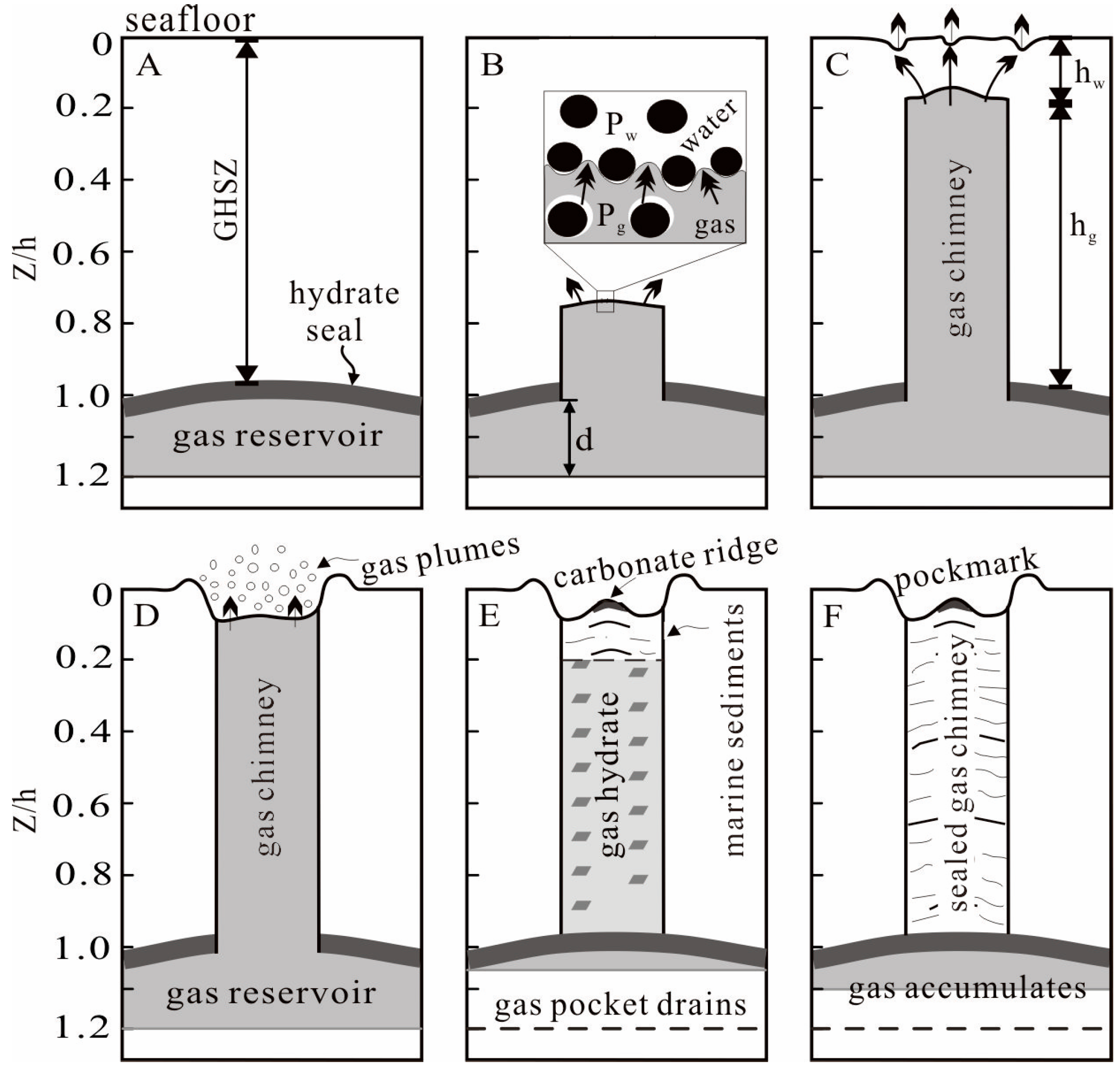
An integrated model for fluid seepage, pockmark formation, and gas-chimney development is illustrated conceptually in
Figure 1. The overall sequence of gas-chimney growth and pockmark excavation follows the physical framework first proposed by Cathles et al. (2010) [
6], but several key differences distinguish the present model. Whereas Cathles et al. (2010) [
6] assumed a single-phase gas reservoir capped by fine-grained sediments, our model explicitly considers a two-phase gas–water system sealed by a hydrate layer whose stability is governed by local pressure–temperature (P–T) conditions. The hydrate layer introduces additional feedback on seepage dynamics: (i) hydrate dissociation or formation modifies permeability and capillary pressure, and (ii) phase coexistence alters the effective fluid density and viscosity, thereby influencing chimney propagation and overpressure evolution. These effects are absent in the earlier single-phase formulation and form the foundation for estimating gas saturation beneath hydrates.
The conceptual sequence in
Figure 1 represents an idealized evolution from gas accumulation to seal failure and pockmark initiation. In the application to Storegga, the model is used to constrain the pre-seepage/near-threshold state implied by the observed pockmark–chimney geometry; it is not intended to imply that the system is currently undergoing continuous chimney growth.
Initially, a hydrate layer acting as a capillary seal traps free gas (gray shading) below, and gas overpressure builds up beneath the hydrates (
Figure 1A). When the excess pressure exceeds the capillary entry pressure of water-filled pores, the seal is breached and the two-phase mixture of gas and water migrates upward under the overpressure gradient (
Figure 1B). We assume that the venting fluids within the pipe have the same saturation and density as those in the underlying gas reservoir. Water in the overlying sediment is expelled from pores by the upward-propagating gas chimney and flows toward the seafloor, forming unit pockmarks at the surface as the chimney advances (
Figure 1C). Because the viscous resistance of the sediment to gas flow is much lower than that to water flow, fluids move faster as the gas chimney grows. As the pipe approaches the surface, water expulsion becomes sufficiently rapid to fluidize the sediment [
35]. A pockmark is formed after the fluidized material near the seafloor is eroded or displaced by upward flowing fluid. Free gas then vents at the seafloor and forms bubble plumes in the water column (
Figure 1D). Some of the methane gas may be converted to hydrate within the gas chimney under hydrate stability zone (HSZ) conditions [
36], while carbonate minerals may precipitate in and around the pockmarks (
Figure 1E; [
33]). Fluid seepage may eventually cease owing to blockage by concentrated hydrate along the chimney and carbonate cementation at the pockmark. Consequently, a remnant chimney marking the former chimney remains and is visible on seismic reflection data (
Figure 1F; [
32,
33]).
3. The Numerical Model
3.1. Governing Equations and Analytical Formulation
As
Figure 1 shows, water flow in the overlying sediment is driven by a pipe of high-pressure mixed fluids. The initial excess pressure at the top of the gas pocket is:
where
is the density of the water–gas mixture,
is water density,
d is thickness of free gas zone, g is the gravitational acceleration. As the pipe of gas-rich fluid grows, the excess pressure at head of the gas chimney increases and can be quantitatively expressed as:
where
is length of gas chimney filled with gas and water. The excess pressure is also equal to the viscous resistance of sediment to water flow. The water flux on the hemispherical surface of the growing pipe was given in [
6]:
This flux is also known as the Darcy (or superficial) velocity of the water.
is sediment porosity and
is upward velocity of pipe. Because the excess water pressure effectively drops to zero at a distance of 2
r [
6], the upward gas chimney is idealized here as a vertical cylindrical pipe of radius
, following the simplified geometry adopted by Cathles et al. (2010) [
6]. The upward propagation velocity of the chimney can be expressed by Darcy’s law as:
where
r is radius of cylindrical gas chimney,
k is intrinsic permeability of sediment medium, and
denotes dynamic viscosity of water. All parameters are defined in
Table 1.
Equation (4) can be integrated to determine time of the chimney growth,
:
The sediments near the surface become fluidized when the non-hydrostatic fluid pressure gradient equals to the buoyant lithostatic gradient and the effective stress goes to zero:
. By substituting
with
as pockmark depth, and after rearranging for
with
~
, we find the pockmark depth expression:
The pockmark depth is a function of the gas-bearing layer thickness, the depth to the hydrate seal, and the average fluid density in the gas reservoir.
By transforming Equation (6), we obtain an equation for computing the thickness of the free-gas-containing zone beneath the hydrate seal. The thickness quantitatively depends on pockmark depth and density of the fluids in the gas reservoir:
The average fluid density in gas zone is related to fluid saturations and systematic pressure and temperature [
37]. By retransforming Equation (7) we get a new correlation as follows for calculating fluid density in the reservoir.
In a specific reservoir, water density is regarded as a constant and gas density can be treated as a function of hydrostatic pressure and temperature. By rearranging Equation (8), an equation is obtained that relates gas saturation to pockmark depth and thickness of free gas zone.
and
are the water and gas saturations in the free-gas zone (
+
= 1) and
and denotes the observed pockmark depth.
This equation is useful for estimating gas saturation from the known pockmark depth (
) and the thickness of the underlying free-gas zone (
), both of which can be constrained from seismic and geomorphological observations [
6,
20,
38,
39,
40].
The present model simplifies the coupled hydromechanical and thermodynamic processes of pockmark formation to permit analytical formulation. Several assumptions should be noted:
- (1)
Mechanical deformation such as sediment compaction, plastic yielding, and fracture propagation is not included; the sediment matrix is treated as rigid and homogeneous.
- (2)
Dynamic coupling between pressure buildup and sediment failure is neglected, and overpressure dissipation is assumed to be vertical and one-dimensional.
- (3)
Two-phase flow is represented by a single effective fluid density and viscosity; saturation-dependent permeability functions are not explicitly solved. Including relative permeability or capillary pressure would mainly reduce effective mobility and could delay chimney growth, but is unlikely to change the first-order scaling between pockmark geometry and the density contrast derived here.
- (4)
Hydrate-phase kinetics—formation, dissociation, latent heat, and salinity effects—are ignored. Hydrates are considered only as a static seal and as potential formation during venting.
- (5)
Heterogeneity in porosity, permeability, and gas saturation is not resolved; parameters (including the chimney permeability) represent effective, spatially averaged properties during the initiation stage.
From Equation (5), the propagation time of the chimney is inversely proportional to the effective permeability (t_pipe ∝ 1/k) and directly proportional to the dynamic viscosity of water. Therefore, an order-of-magnitude uncertainty in permeability would result in a corresponding order-of-magnitude variation in the estimated propagation time.
Similarly, variations in porosity and bulk sediment density affect the pressure-gradient balance controlling the onset of fluidization (Equation (6)), thereby influencing the predicted pockmark depth and threshold overpressure. These dependencies imply that the modeled ~200-year propagation time should be regarded as an order-of-magnitude estimate rather than a precise prediction.
These simplifications inevitably limit the quantitative precision of the model but retain the essential physics governing overpressure generation, chimney growth, and the first-order relation between pockmark geometry and gas saturation.
These assumptions may influence quantitative predictions. In particular, neglecting sediment heterogeneity, multiphase relative permeability/capillary effects, and hydrate kinetics may affect the estimated pipe-growth timescale and the inferred gas saturation. Therefore, the model results should be interpreted as first-order constraints for localized near-threshold (pre-seepage) conditions rather than detailed time-dependent seepage evolution.
The sediment properties listed in
Table 1 (e.g., permeability, porosity, bulk density) are treated as effective, spatially averaged parameters representative of the initiation stage of chimney propagation. In reality, these parameters may vary spatially and temporally during chimney growth due to hydrate dissociation, gas invasion, sediment deformation, and carbonate precipitation.
In particular, the effective permeability of the chimney/conduit (k) is expected to increase during initial gas invasion due to focused flow and potential micro-fracturing, but may subsequently decrease as hydrates form or carbonates precipitate. Therefore, the adopted permeability value should be interpreted as an effective parameter applicable to the initiation phase rather than a constant property throughout the system evolution.
3.2. Seal-Breach Threshold and Physical Consistency
In addition to the fluidization criterion at shallow depth (Equation (6)), chimney initiation requires that the overpressure beneath the hydrate seal exceeds an effective seal-breach threshold. This condition can be expressed as:
where
represents the excess pore-gas pressure at the top of the free-gas zone (Equation (1)), and
denotes the effective pressure required to overcome the capillary entry pressure and/or the tensile strength of the hydrate-cemented sediment.
Reported capillary entry pressures for fine-grained marine sediments typically range from several kPa to several tens of kPa, depending on grain size and pore structure. The tensile strength of unconsolidated slope sediments is commonly on the order of 0.01–0.1 MPa. For the Storegga case, the excess pressure at the top of the free-gas zone (Equation (2)) associated with the inferred gas saturation is approximately 0.044 MPa.
Although the present analytical model does not explicitly resolve fracture mechanics or detailed capillary invasion processes, this comparison demonstrates that the density-driven overpressure required for pockmark initiation is physically consistent with independent estimates of seal strength. Therefore, the derived gas saturation represents a physically constrained threshold condition for chimney initiation, rather than a present-day saturation state.
4. Application to Norwegian Sea
The continental margin off Norway is characterized by the Storegga Slide scar [
16]. Numerous studies have investigated pockmarks, chimneys, and methane hydrates at the Storegga Slide [
15,
16,
38,
39,
44,
45,
46].
Interpretation and scope of the application: Although many Storegga pockmarks are interpreted as relict or episodically active features, the observed pockmark depth and the chimney-like seismic disturbance connecting to a BSR-defined free-gas zone provide strong geometric and stratigraphic constraints on the conditions that must have existed immediately prior to pockmark initiation. In this study, Storegga is therefore used as an illustrative case to estimate the effective gas saturation and the associated initiation overpressure threshold required for seal breach and pockmark formation, rather than to represent present-day seepage flux. In this context, the present-day hydrate or gas distribution is regarded as a potentially modified, post-venting state. The purpose of the present modeling is to back-calculate the effective gas saturation required for chimney initiation and pockmark formation, rather than to reproduce current seepage conditions.
Seismic reflection profiles, side-scan sonar data, and multibeam bathymetry from previously published studies (e.g., [
20,
38,
39,
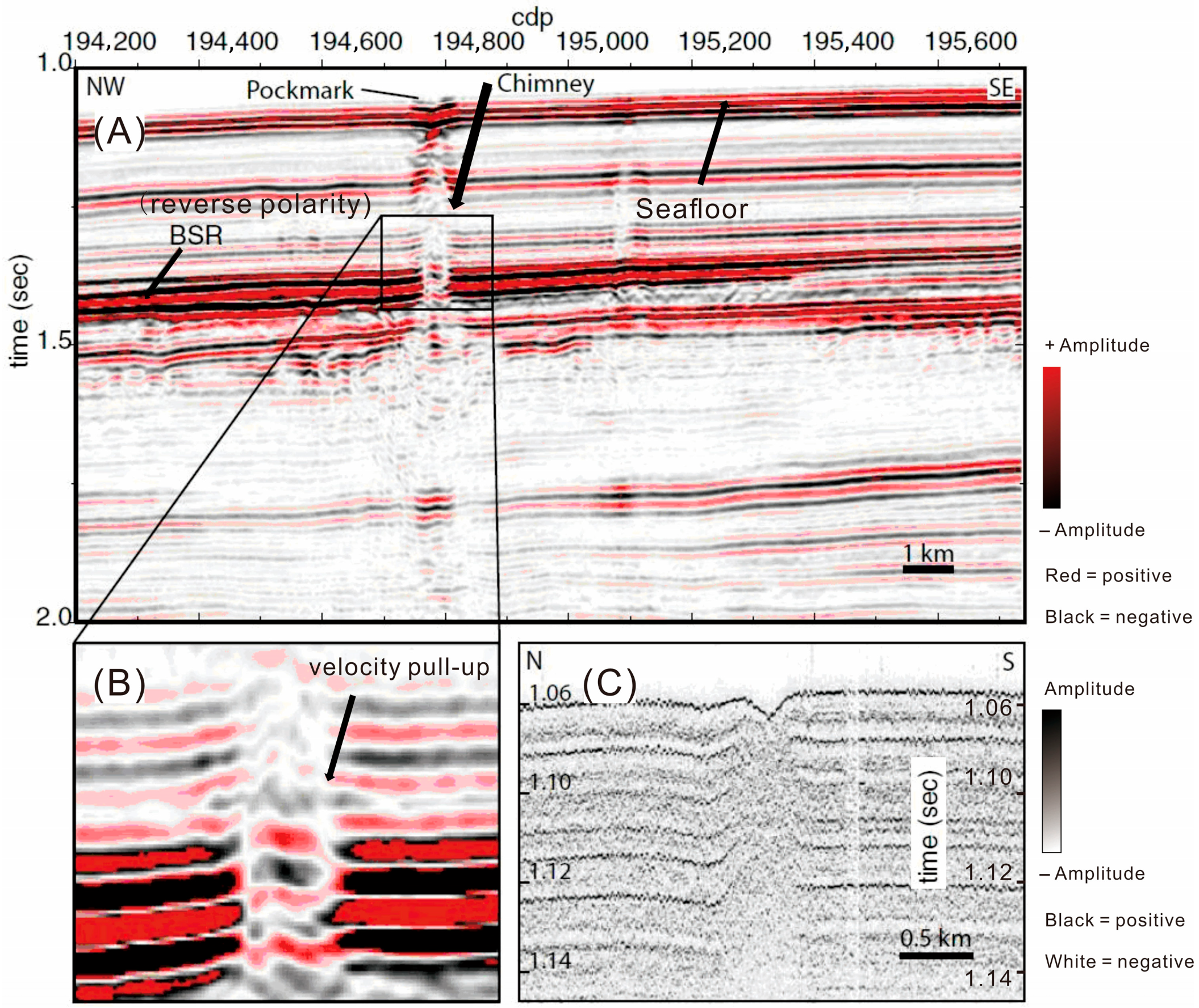
47]) show that the northern flank of the Storegga Slide scar is associated with numerous seafloor pockmarks and subsurface pipe-like disturbances. The representative pockmark illustrated in
Figure 2 is based on a multichannel seismic reflection profile published in [
20], where detailed information on data acquisition and processing is provided. In this study, we use the published geometric constraints (pockmark depth, chimney width, and BSR-defined seal depth) derived from these seismic data as input parameters for the analytical model, rather than introducing new seismic observations. The features described as pipes in [
47] are identified in seismic reflection profiles as local disturbances in the continuity of seismic reflections that are narrower than, but spatially coincident with, the overlying pockmarks. Some chimneys (pipes) connect with the seafloor pockmarks and can be traced downward to their connection with a free-gas zone beneath the hydrates [
20].
The BSR marks the base of the HSZ within the sediment. This indicates that sufficient gas exists beneath the hydrate to saturate the pore water and suggests that conditions are suitable for gas-hydrate occurrence in the overlying sediments [
20]. As proposed in the conceptual model, hydrate accumulation at the base of the HSZ reduces sediment permeability and traps free gas. The underlying pressurized fluids invade the overlying sediment (
Figure 1B,C), forcing water to flow upward and forming a gas chimney after the capillary seal is breached. The gas chimney connects the free-gas zone below the hydrate to the seabed pockmark and indicates the presence of a focused conduit that likely operated during pockmark initiation and may have been episodically reactivated, rather than implying continuous present-day seepage (
Figure 2). Fluid seepage, pockmark formation, and gas fraction in the reservoir can be analyzed using the numerical model and corresponding parameters.
At the Storegga area, the water depth is approximately 800 m [
20,
45], the seafloor temperature is around 0 °C [
15,
45,
46], and the temperature gradient in the sediment is about 0.05 °C/m [
45]. The calculated depth to the base of the HSZ, based on methane-hydrate phase equilibrium, is 255 mbsf, consistent with the positions of BSRs on seismic profiles [
20,
38,
39,
45]. The estimated thickness of the gas zone beneath the hydrate ranges from 50 to 100 m [
38,
39,
44], and the pockmark internal depth at the seafloor is about 8 m [
20]. The effective permeability of the focused conduit is not directly constrained at Storegga. We therefore adopt a representative value of 100 mD as a model assumption to estimate chimney-propagation timescales. Because propagation time scales approximately inversely with permeability, the inferred ~200-year timescale should be regarded as an order-of-magnitude estimate rather than a precisely constrained value. Importantly, the threshold gas saturation derived from the density-based pressure balance is independent of permeability and is therefore unaffected by this assumption.
In the model, pockmark internal depth is a function of fluid density and gas-layer thickness, as shown in Equation (6) for a specific hydrate field. The gas layer is known to be 50–100 m thick at the Storegga Slide, as indicated by seismic profiles [
38,
39,
44]. Thus, fluid dynamics and pockmark formation are primarily controlled by the fluid density. For a given pockmark depth and hydrate-seal position shown in
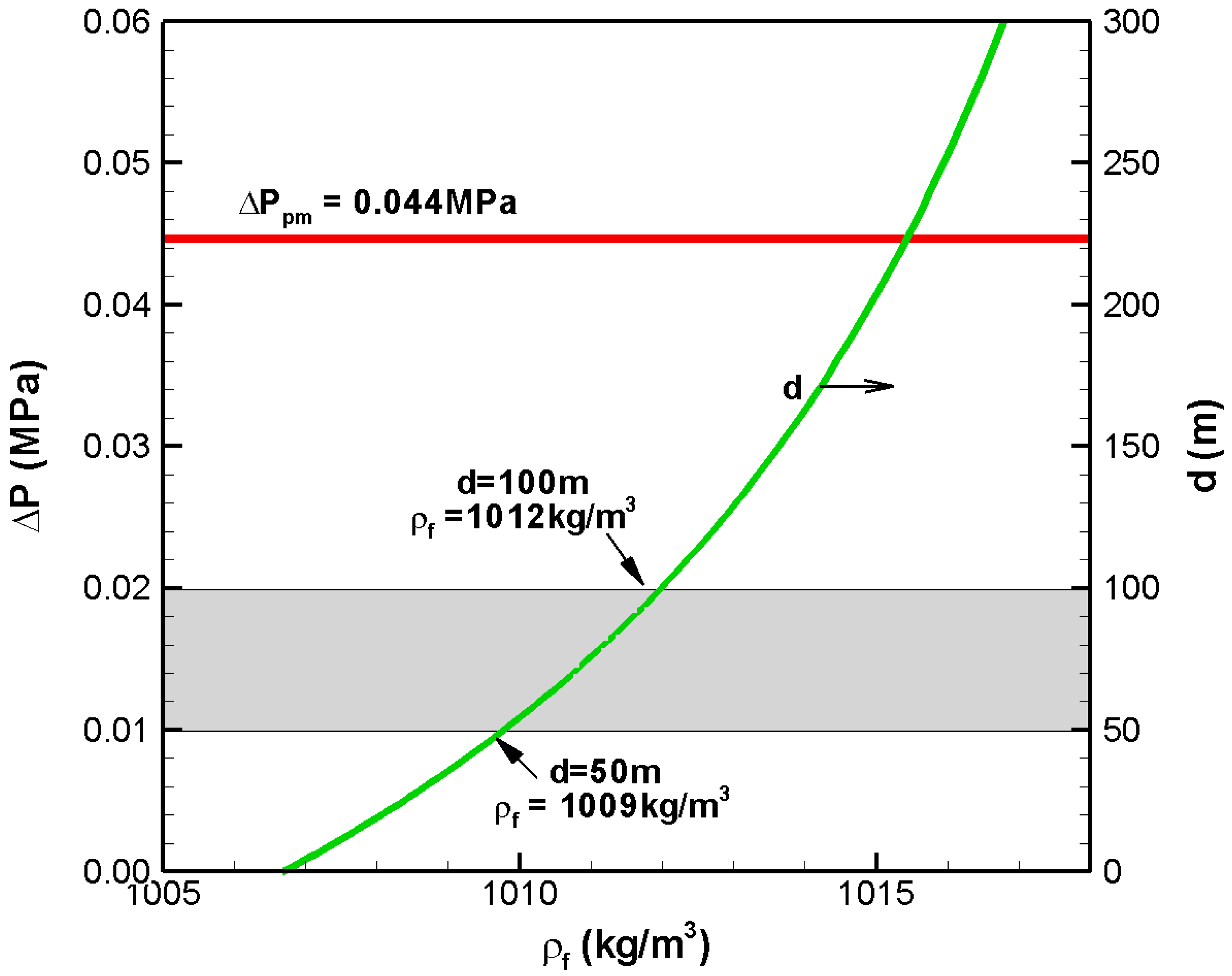
Figure 2, the model provides an estimate of the threshold overpressure required to initiate pockmark formation, which is approximately 0.044 MPa (Equation (2)). Accordingly, the fluid density in both the gas layer and gas chimney can be considered a function of gas-layer thickness according to Equation (8), as illustrated in
Figure 3. The gas-layer thickness required to initiate seepage and form a pockmark increases with fluid density. The modeled fluid density in the sediment pores ranges from 1009 to 1012 kg/m
3 for gas-layer thicknesses of 50–100 m.
The fluid density of the water–gas mixture in the gas-containing zone is a function of gas density and saturation, as shown in Equation (8). The gas density can be estimated as approximately 88 kg/m
3 based on the temperature and pressure conditions at a depth of 255 mbsf (the hydrate-seal depth) using a methane equation of state [
41,
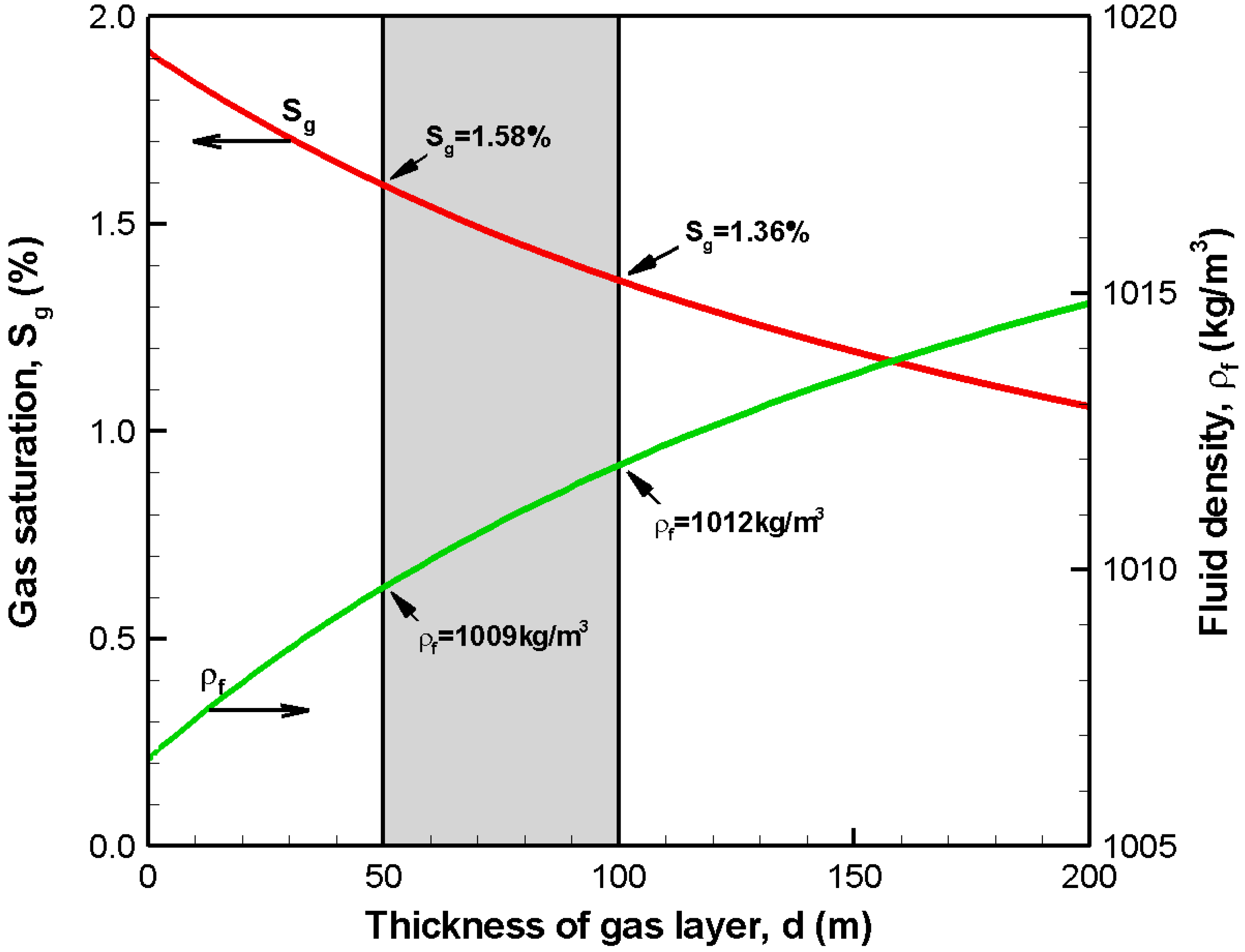
48]. Gas saturation can then be expressed as a single function of gas-layer thickness and calculated using Equation (9). As shown in
Figure 4, gas saturation decreases with increasing gas-layer thickness, displaying an opposite trend to that of fluid density. The predicted localized, near-threshold (pre-seepage) gas saturation is 1.36–1.58% for gas-zone thicknesses of 50–100 m at the Storegga Slide. This prediction is higher than that inferred from P-wave velocity analysis, which indicates an average gas saturation of 0.45% on the northern flank of the Storegga Slide, assuming a homogeneous distribution [
44,
49].
Pockmarks form as upward fluid flux increases, exerting progressively greater forces on seafloor sediments.
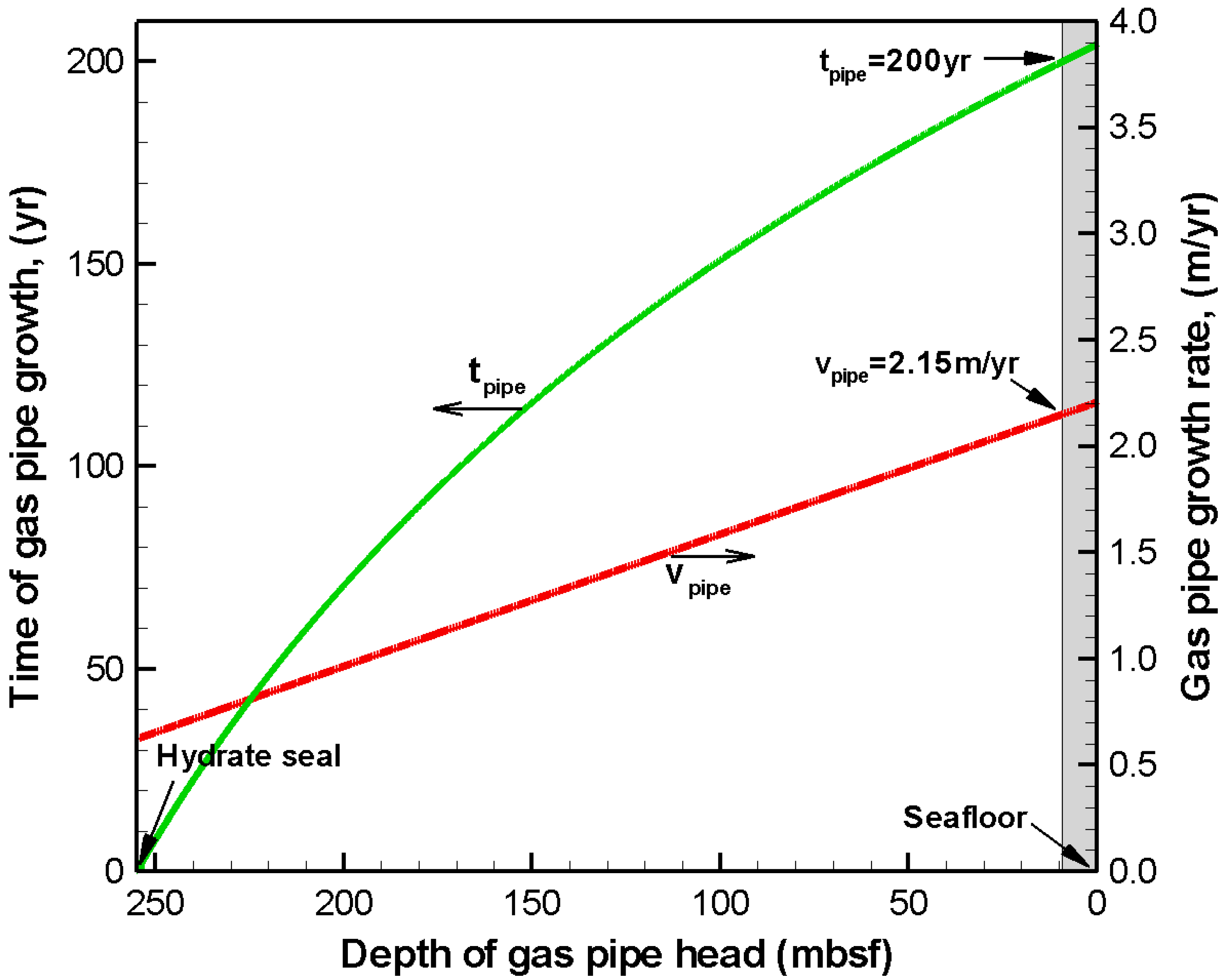
Figure 5 shows the modeled velocity of gas-chimney growth and the time elapsed during the modeled initiation stage. The gas-chimney velocity increases toward the seafloor, from 0.62 m/yr at the onset of seepage to 2.15 m/yr at a depth of 8 mbsf where the pockmark forms (
Figure 5). The total time for gas-chimney growth from the base of the hydrate zone to the pockmark depth is approximately 200 years (
Figure 5). This timescale should be regarded as a first-order estimate, as it is sensitive to the assumed effective permeability of the conduit and may vary by at least a factor of ~2 under plausible parameter ranges.
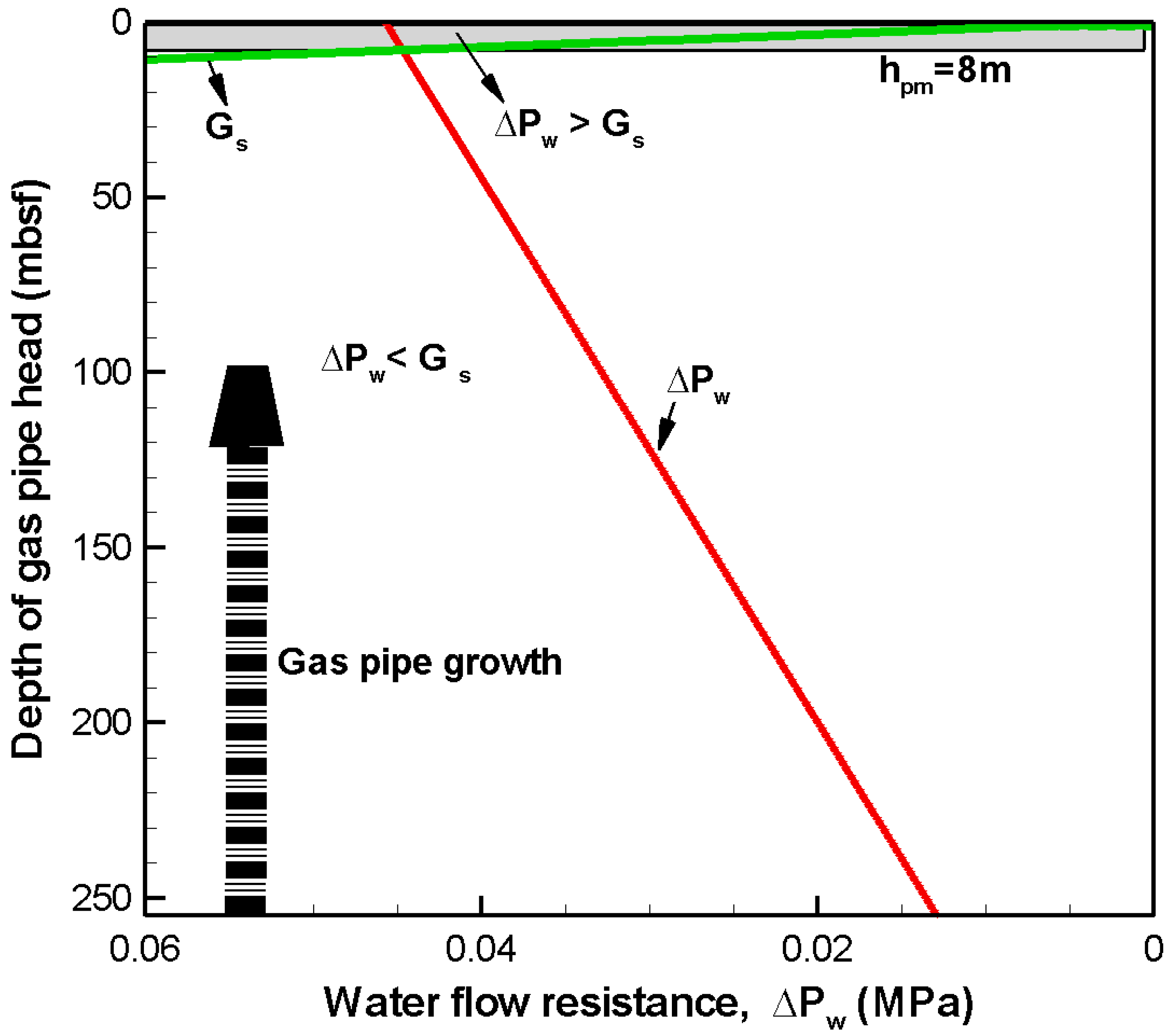
Figure 6 shows the mechanical relationship between the fluid-pressure gradient and buoyant lithostatic gradient. A water flow impedance,
, keeps increasing as the gas chimney grows. The growing gas chimney produces a high excess pressure that pushes and accelerates the water flow. The buoyant lithostatic gradient,
, decreases quickly. The two forces have opposite change trends as the gas chimney grows. As shown in
Figure 6,
at depth of gas chimney head larger than 8 mbsf, whereas
at the depth less than 8 mbsf. The intersection of the two curves indicates the onset of sediment failure and corresponds to the modeled pockmark depth of 8 mbsf. The estimated ~200 yr propagation time is highly sensitive to conduit permeability and overpressure: higher permeability or stronger overpressure gradients would accelerate chimney rise, whereas hydrate/carbonate clogging, lower permeability, or greater sediment strength would prolong propagation timescales substantially [
6].
5. Discussion
The model we have presented is simplified and still incomplete, and several aspects of fluid flow, gas chimney development, and pockmark evolution require further discussion. In particular, the different stages of seepage initiation, chimney propagation, pockmark formation, and post-venting sealing illustrated in
Figure 1 (stages A–F) provide a useful framework for interpreting the analytical results. The analytical formulation is mainly applicable to hydrate-capped, relatively homogeneous slope sediments where pockmark initiation is controlled by overpressure-driven vertical seepage (
Figure 1A–D). It is not intended to capture strongly heterogeneous, fault-dominated systems or fully coupled hydrate dissociation/formation processes.
5.1. Saturation Heterogeneity
In the conceptual model (
Figure 1A,B), seal failure occurs when gas overpressure beneath the hydrate capillary barrier exceeds the entry pressure of water-filled pores. In this framework, breach is envisioned primarily as gas invasion into the overlying sediment rather than large-scale hydrofracturing, although localized fracturing may occur if overpressure approaches the tensile strength of the sediment (e.g., [
6,
33,
50]). Once the capillary threshold is exceeded, a focused two-phase chimney can develop and propagate upward.
Our model assumes uniform gas saturation within the chimney and reservoir, but field observations and seismic inversions commonly show vertical and lateral variability [
51]. Gas saturation may increase upward within chimneys because ascending gas expands as pressure decreases, while secondary hydrate or carbonate precipitation can preferentially reduce water permeability, locally enhancing the gas-phase fraction in the remaining pore space (e.g., [
26]). Such heterogeneity could lead to local variations in overpressure and seepage velocity, thereby influencing pockmark morphology: higher local gas saturation and permeability may promote deeper excavation and sharper crater-like depressions, whereas clogging by hydrate/carbonate may reduce venting and yield more subdued or partially infilled pockmarks [
7,
15,
22]. Consequently, the model’s saturation estimates should be interpreted as depth-averaged values. Similar simplifications have been adopted in previous analytical frameworks of seepage systems [
6,
33], and do not invalidate the first-order relationships derived here.
Practically, the gas saturation in the gas chimney may differ from that in the gas reservoir beneath hydrates, and thus the dynamics of fluid flow and gas-chimney growth should be more complex. In the developed model, the fluids in the gas chimney were assumed to have the same gas saturation as those in the reservoir. This assumption is based on the knowledge that the water phase in the gas reservoir has a much higher volumetric fraction but greater viscosity than the gas phase in the sediment matrix, and that water cannot be completely expelled because of high residual water saturation [
52] (
Figure 1). Pockmarks are envisioned in the model to be formed by the upward water flow driven by the mixed gas–water pipe. The primary pockmark may subsequently be altered by later seepage events [
33]. In more accurate modeling, capillary effects should be explicitly included to describe multiphase flow dynamics [
53]. Such effects would modify quantitative saturation estimates but are not expected to alter the main analytical relationships obtained in this study.
Chimney rise and vertical propagation (
Figure 1B,C) are mainly controlled by the magnitude of reservoir overpressure, the effective permeability of the chimney, sediment mechanical resistance, and the density contrast between the gas–water mixture and surrounding pore water [
6,
30,
31].
5.2. Hydrate Formation Within Chimneys
Under the pressure–temperature conditions of the HSZ, ascending methane can readily form hydrates within gas chimneys. This process has been observed at several North Atlantic and Arctic margins, including the Nyegga pockmark field [
54], the Vestnesa Ridge [
25], and offshore mid-Norway [
55]. Hydrate formation narrows or blocks the gas chimney, reduces permeability, and contributes to chimney dormancy [
56]. The modeled cessation of seepage after pockmark excavation is therefore consistent with field evidence of hydrate and carbonate clogging in many hydrate-bearing systems [
57,
58].
At the Storegga Slide, seismic reflection data shows a clear BSR [
20] and an average gas-hydrate saturation of about 5% of pore space [
42] (
Figure 2). This present-day hydrate saturation is reported here as contextual information and is not used to validate the inferred pre-venting threshold gas saturation, because post-venting hydrate and carbonate formation may have substantially modified the current gas distribution. The temperature and pressure conditions in the HSZ are suitable for hydrate formation, and gas hydrates could form within the gas chimney after seepage, when methane migrated upward into the HSZ. Hydrate precipitation within the chimney reduces permeability [
59] and can eventually suppress upward fluid migration once the driving forces for upward migration—namely reservoir overpressure and the associated pressure-gradient exceeding the buoyant lithostatic gradient—are no longer sufficient. In general, hydrate seal breach and chimney propagation require that (i) reservoir overpressure exceeds the capillary entry pressure (
Figure 1A,B), (ii) focused flow or elevated heat transport locally shifts thermodynamic conditions and destabilizes hydrates, and/or (iii) sufficiently high fluid flux enhances invasion through the seal (e.g., [
6,
28,
33,
59]). When these driving factors decline, hydrate and carbonate accumulation may progressively clog the chimney and reduce seepage activity. Residual gas within the chimney would likely be converted to hydrate under prevailing thermodynamic conditions.
Compared with the single-phase formulation of Cathles et al. [
6], which assumes a gas-filled reservoir beneath a fine-grained seal, the present two-phase model explicitly accounts for coexisting gas and water beneath a hydrate cap. In the Cathles model, pockmark depth is controlled primarily by geometric relationships between seal depth and gas-layer thickness, and gas saturation is not explicitly resolved. In contrast, our formulation links pockmark depth to the effective density of a gas–water mixture and allows estimation of the threshold gas saturation required for chimney initiation. For the Storegga case, this yields a localized pre-venting gas saturation of 1.36–1.58%, which represents the minimum condition for seal breach under hydrate-capped settings.
5.3. Validation and Comparison with Storegga Data
The predicted gas saturation of 1.36–1.58% beneath hydrates at the Storegga Slide exceeds the 0.45% average free-gas saturation inferred from P-wave velocity analyses on the northern flank of the Storegga Slide [
44]. The seismic estimate represents a spatially averaged value derived under the assumption of homogeneous gas distribution, whereas the modeled value corresponds to a localized pre-venting threshold condition required for chimney initiation. This discrepancy may reflect scale dependence and differences between vertical averaging in seismic data and localized high-saturation zones represented by the model [
44,
60]. Comparable hydrate–free-gas systems in the Nyegga and Svalbard margins yield 1–2% gas saturation from multi-physics inversions [
61,
62,
63], supporting the plausibility of the modeled results. Importantly, the seismic estimate reflects a present-day, spatially averaged state, whereas the modeled value represents a localized pre-venting threshold condition required for chimney initiation. The former is therefore not used as a validation target, but rather as a reference illustrating scale dependence.
The estimate of gas saturation at the Storegga Slide remains reasonable for several reasons:
- (i)
the free-gas zone beneath the HSZ on seismic profiles (
Figure 2) likely exceeds 100 m, meaning the predicted saturation could be somewhat overestimated;
- (ii)
gas fraction cannot be precisely determined seismically because of complex lithology and limited resolution;
- (iii)
modeled gas saturation represents pre-seepage conditions and may decrease after venting;
- (iv)
later seepage or re-activation could modify pockmark geometry and enhance apparent gas fraction.
5.4. Carbonate Precipitation and Chimney Dormancy
Free gas is unlikely to remain in the chimneys of the Storegga Slide. The seismic reflection profile shows upward-bending reflectors within chimney structures (
Figure 2), indicating velocity pull-up rather than pull-down. Such velocity pull-ups can occur when high-velocity materials, such as gas hydrates or authigenic carbonates, accumulate within the chimney. Increased seismic velocity shortens the two-way travel time through the chimney zone, producing an apparent upward bending of reflectors on seismic sections [
64]. These processes can also substantially reduce chimney permeability over time, meaning that the permeability adopted in the analytical model should be interpreted as an effective value representative of the initiation stage [
65,
66]. Methane-derived authigenic carbonates cement the sediment in and around pockmarks, inhibiting subsequent fluid escape. Based on previous work at the Storegga Slide, methane flux beneath most pockmarks is lower than in surrounding sediments, suggesting that seepage activity has substantially declined relative to earlier stages [
20]. The coexistence of hydrate and carbonate plugging thus supports the interpretation that the gas chimneys may be dormant.
During chimney evolution, sediment properties are unlikely to remain constant. Gas invasion may locally enhance permeability by reducing effective stress or creating preferential pathways, whereas subsequent hydrate formation and carbonate cementation can reduce permeability and increase sediment stiffness. Such feedback implies that the initiation stage may be characterized by higher effective permeability than the later dormant stage observed in seismic data. Accordingly, the model parameters should be interpreted as effective initiation-stage values rather than steady-state properties of the modern system.
5.5. Sensitivity to Sediment and Geometric Parameters
To evaluate the robustness of the inferred threshold gas saturation, we conducted a first-order sensitivity analysis based on Equation (9), varying key geometric and sediment parameters within plausible ranges (
Table 2). Using the reference Storegga geometry (
hpm = 8 m,
h = 255 m, and representative
d = 75 m) yields a baseline threshold gas saturation of
Sg = 1.525%.
In the one-at-a-time analysis, each parameter was perturbed across the range in
Table 2 while all other parameters were held at baseline values, and
Sg was recomputed from Equation (9). The results indicate that
Sg is most sensitive to pockmark depth
hpm (1.136–1.918% for
hpm = 6–10 m) and bulk sediment density
ρs (1.259–2.055% for
ρs = 1500–1800 kg/m
3). Variations in free-gas thickness d and hydrate-seal depth h exert secondary influences (1.237–1.653% for
d = 50–150 m; 1.415–1.653% for
h = 230–280 m), whereas the dependence on gas density
ρg is comparatively minor (1.496–1.561% for
ρg = 70–110 kg/m
3).
For the full-factorial grid scan, parameters were uniformly sampled within the ranges listed in
Table 2 (Cartesian-product sampling), and
Sg was evaluated for all valid parameter combinations. Percentiles were computed from the resulting ensemble of
Sg values. This yields an uncertainty envelope of 0.991–2.261% (5th–95th percentile; median 1.516%), with extreme combinations spanning 0.704–3.137%. Corner-case scenarios representing conservative low- and high-threshold conditions give 0.735% and 3.006%, respectively.
These results demonstrate that the inferred threshold gas saturation is primarily controlled by the buoyant–lithostatic balance expressed in Equation (6), in which bulk sediment density (ρs) and pockmark geometry (hpm) directly regulate the effective pressure gradient in the overlying sediments. Parameters associated with the hydrate seal depth (h) and gas-layer thickness (d) have secondary effects through geometric scaling, whereas gas density (ρg) exerts only a minor influence under the site-specific pressure–temperature conditions. Overlying-sediment properties primarily influence the propagation timescale (Equation (5)) rather than the density-controlled threshold saturation (Equation (9)). To reflect this, we discuss plausible ranges of porosity (Φ) and k and their evolutionary trends during chimney growth.
Importantly, because Equation (9) is derived from the density–geometry relationship governing the onset of sediment fluidization, the threshold Sg is independent of the assumed conduit permeability. Permeability primarily affects the propagation timescale (Equation (5)), not the density-controlled initiation condition. Therefore, the reference estimate (1.36–1.58% for d = 50–100 m) lies well within the broader uncertainty envelope and represents a physically consistent near-threshold constraint for chimney initiation.
5.6. Model Limitations and Scope of Applicability
The analytical model presented in this study is intentionally simplified to derive tractable, first-order relationships between pockmark geometry, gas-layer thickness, and gas saturation beneath hydrate seals. Two-phase gas–water flow is represented using effective fluid properties, and sediment parameters are treated as homogeneous, such that the inferred gas saturation should be interpreted as a depth-averaged, effective value representative of localized near-threshold (pre-seepage) conditions.
Mechanical deformation processes (e.g., plastic yielding, fracturing, and fault-controlled flow) and hydrate kinetics (formation, dissociation, and associated thermal or salinity effects) are not explicitly resolved. Chimney propagation is idealized as vertical, cylindrical growth driven primarily by overpressure. Within these constraints, the model is best suited to hydrate-capped slope sediments where seal breach and pockmark initiation are governed predominantly by overpressure-driven vertical seepage.
Accordingly, the results provide first-order constraints on pre-venting or near-threshold conditions required for chimney initiation, rather than predictions of present-day seepage fluxes or long-term system evolution.
It is important to reiterate that the gas saturation derived in this study represents an effective threshold value at the onset of chimney propagation. It does not imply that such saturation persists today, as subsequent venting, hydrate formation, and carbonate cementation may substantially modify the present-day gas distribution. Preliminary sensitivity tests indicate that plausible variations in porosity and bulk sediment density have a limited influence on the first-order estimate of threshold gas saturation (Sg) derived here, and do not alter the main conclusions.
5.7. Future Validation and Broader Applicability
Applying the analytical framework to additional gas hydrate-bearing continental margins with active fluid seepage would further test its applicability. The present study focuses on a single well-constrained example (Storegga), where pockmark geometry, BSR-defined seal depth, and free-gas thickness are documented in the literature. Because the model requires only such observable geometric and stratigraphic constraints, it may be extended to other gas hydrate-bearing provinces with active fluid seepage (e.g., the Gulf of Mexico or the Congo deep-sea fan), provided that pockmark geometry, BSR depth, and free-gas thickness are constrained by seismic observations. Broader multi-site applications would help evaluate the robustness of the inferred threshold gas saturation under varying geological conditions.