
Characterization of Hydrogeologic and Lithologic Heterogeneity Along the Southern Shore of the Great Salt Lake, Utah, from Electrical Methods

 , , , , , , and
Abstract
1. Introduction
1.1. GSL Water Levels and Importance
1.2. Previous Geophysical Efforts


1.3. Overview of This Study
2. Data
2.1. ERT Measurements
2.2. TEM Measurements
2.3. Geochemical Measurements
3. Methods
3.1. ERT Modeling
3.2. TEM Modeling
4. Results
4.1. Burmester
4.2. Saltair and Great Salt Lake State Park/Marina
4.3. Lee’s Creek
4.4. Summary
- (1)
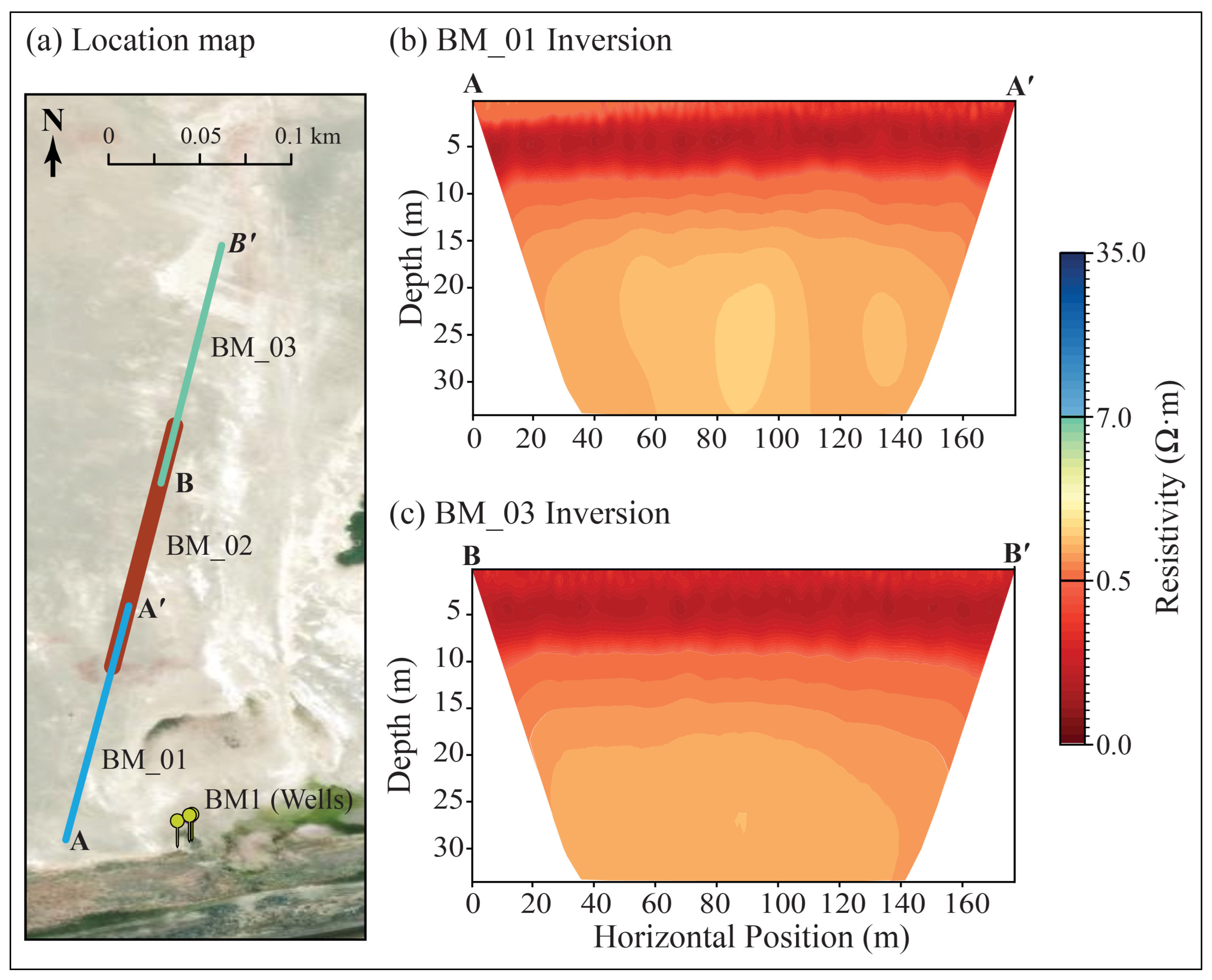
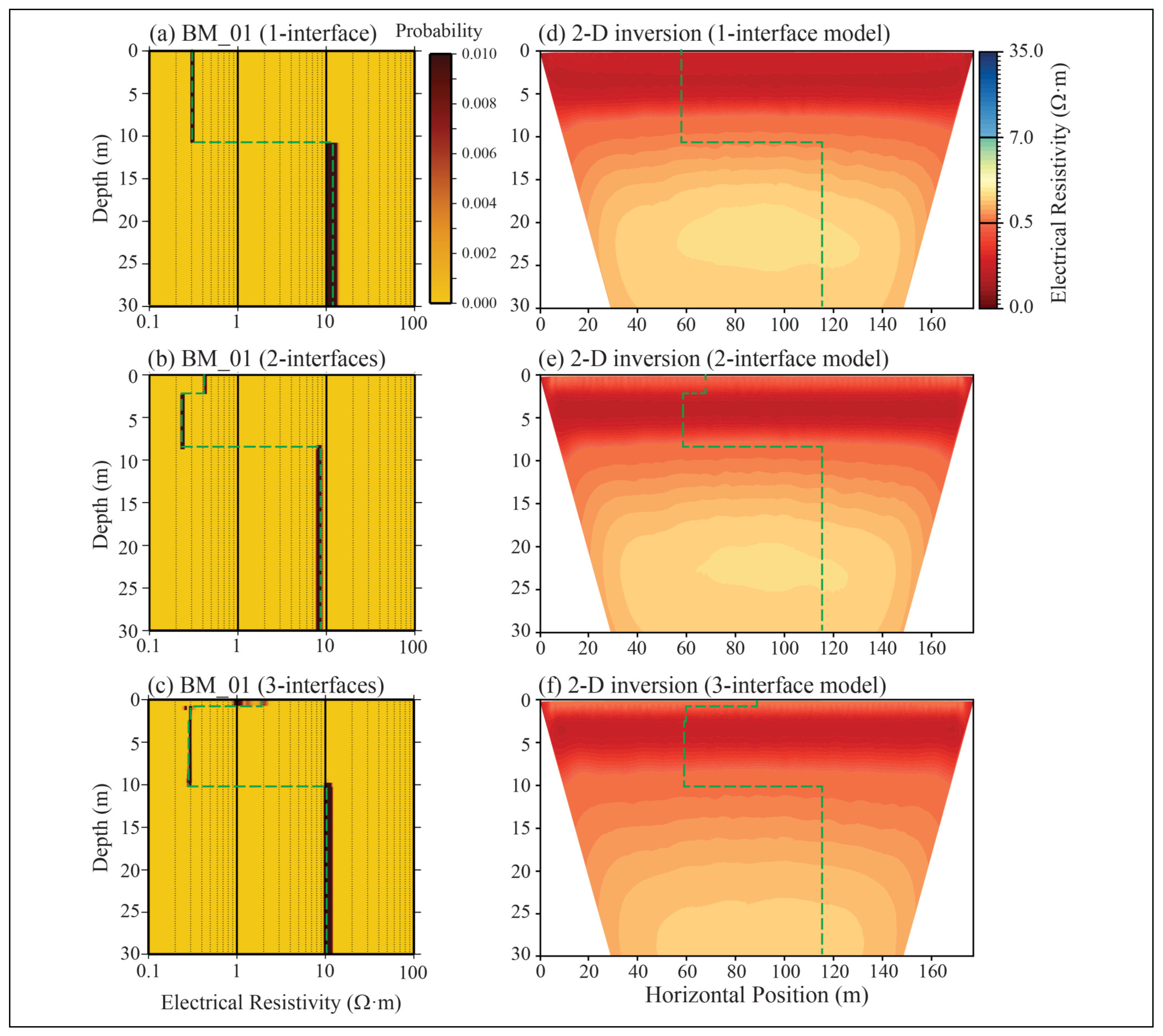
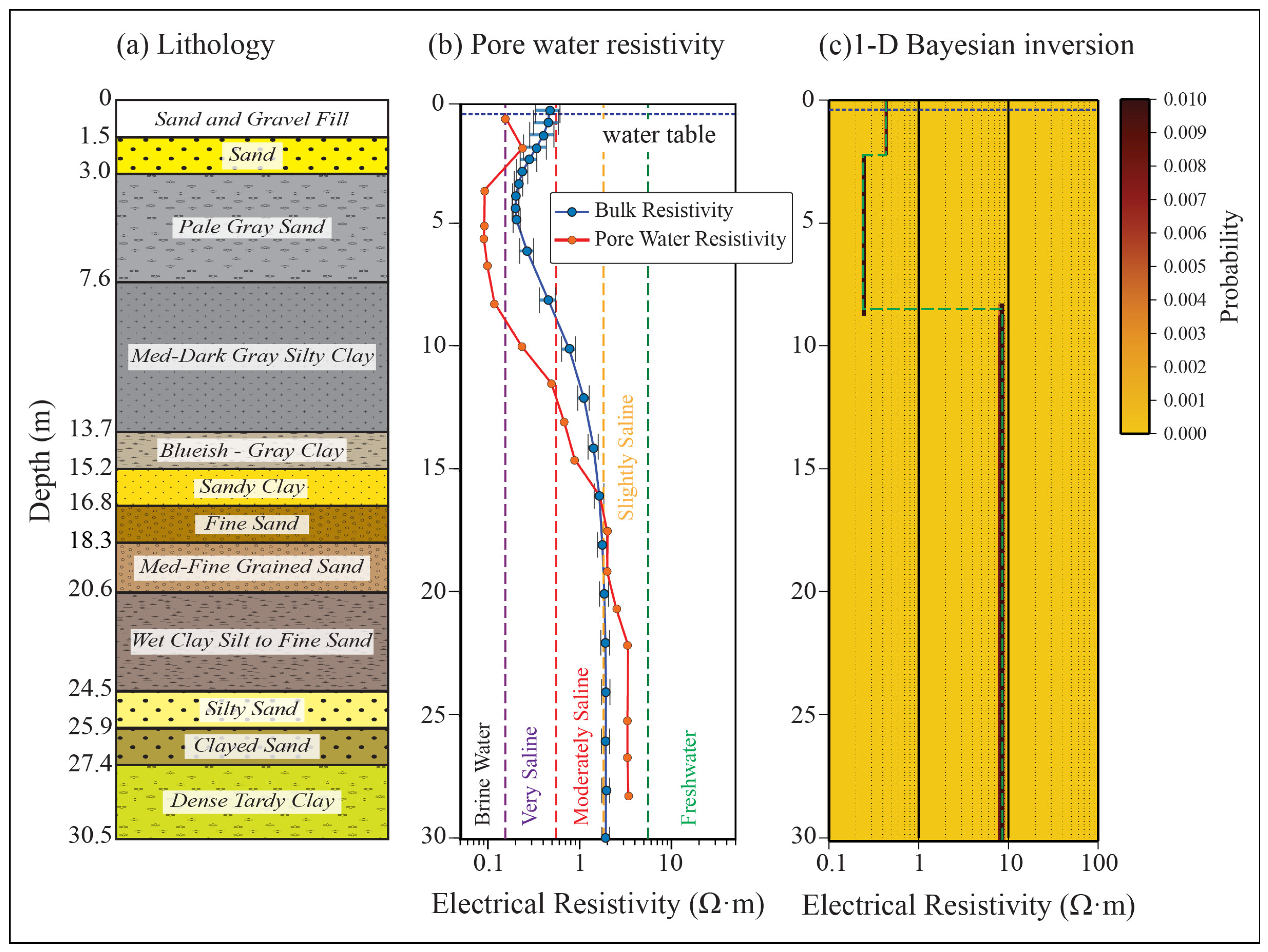
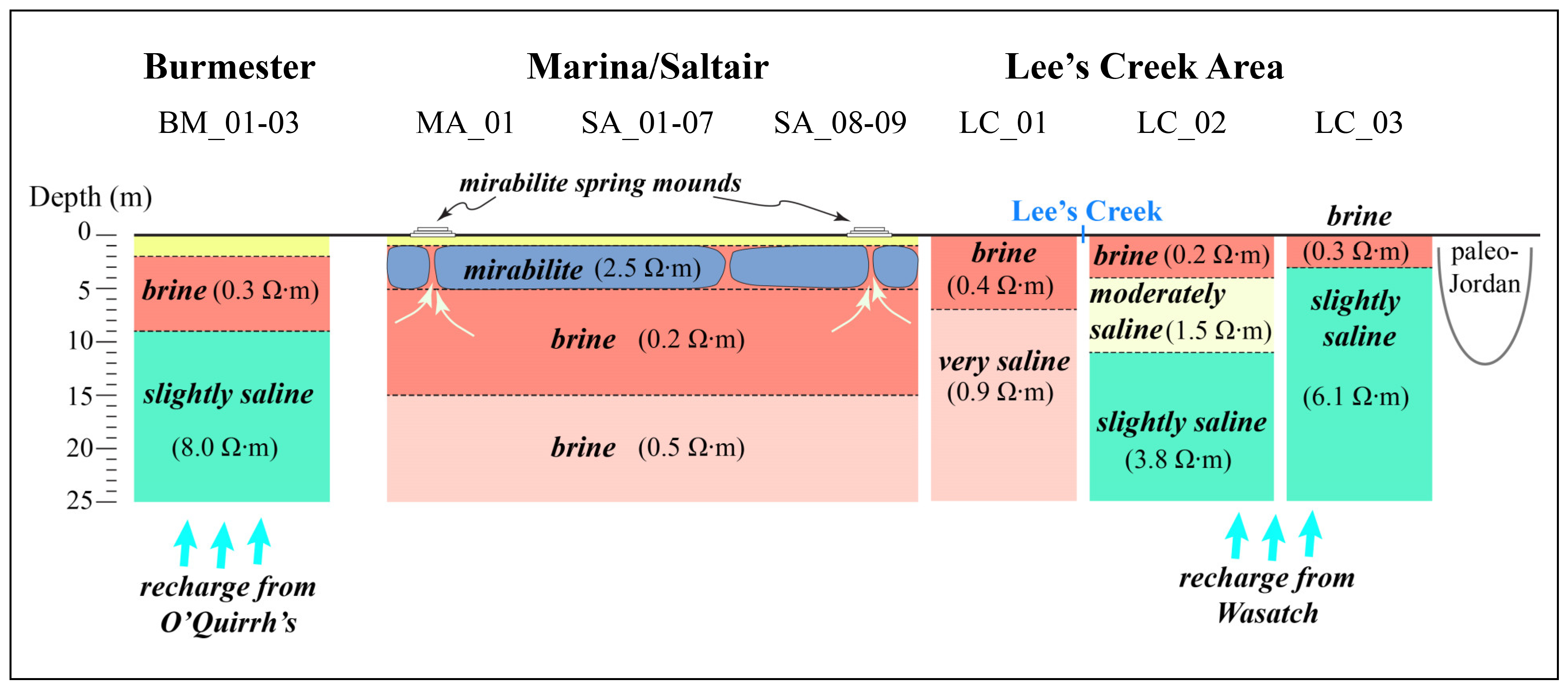
- At Burmester, we observe a shallow low-resistivity layer starting at a depth of 1.7–2.2 m, with a resistivity of 0.34 Ω·m. This layer is consistent with brine pore-water in both resistivity values and measured pore-water salinities. This layer transitions to higher resistivities ranging from ~6.8 to 9.1 Ω·m at depths from 8.5 to 9.5 m. The resistivities in the lower-most layer are consistent with decreased salinity approaching fresh pore-water. No mirabilite layer is observed in this location.
- (2)
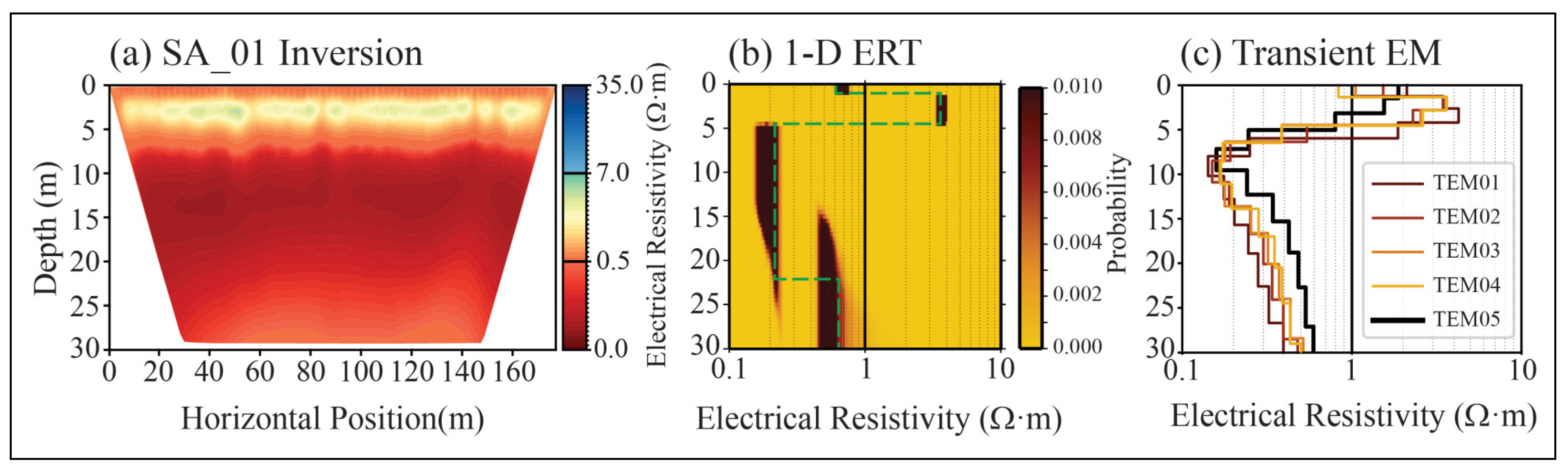
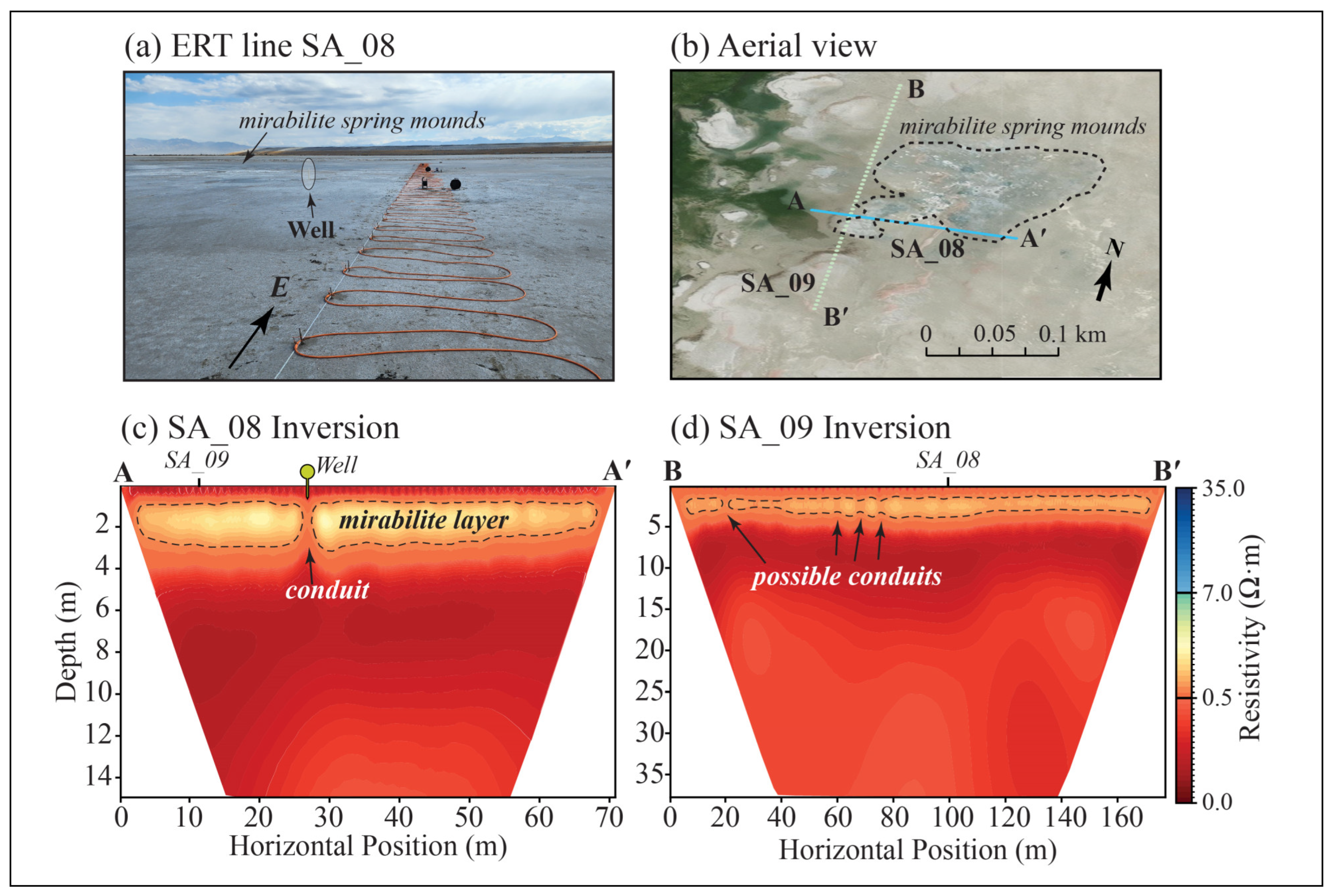
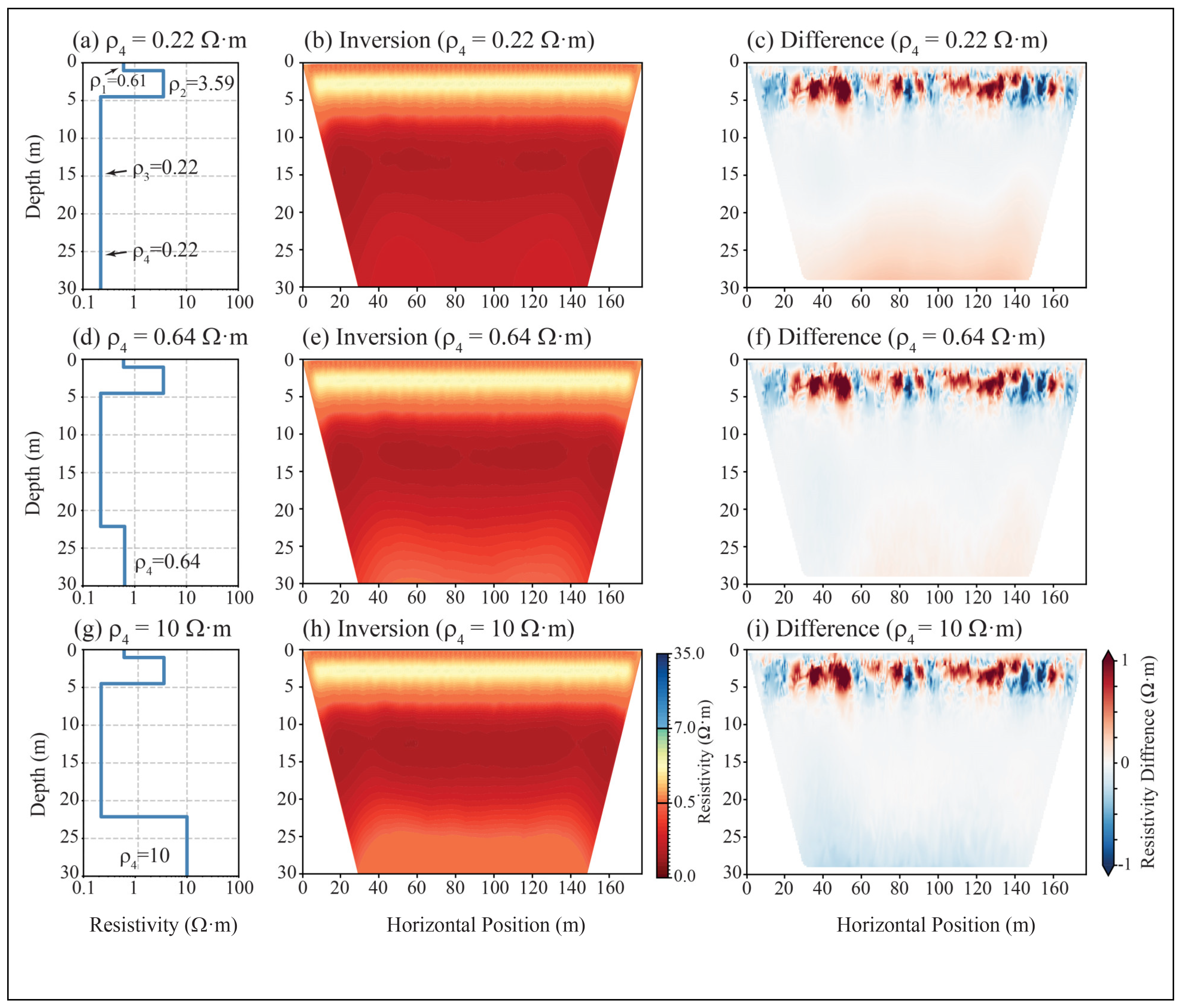
- From the GSL State Park to the Saltair region, we observe a sandy surface layer that overlies a laterally variable mirabilite layer. The top-most sandy surface layer has an average thickness of h1 = 0.82 ± 0.01 m and an average resistivity of . The mirabilite layer has an average thickness of h2 = 4.4 ± 0.05 m and a resistivity of . This is underlain by a low-resistivity layer with and an average thickness of 9.5 ± 0.2 m consistent with brine pore-water. Inversions indicate that a slight increase in higher resistivity () occurs below this but is still consistent with brine pore-water at resolvable depths.
- (3)
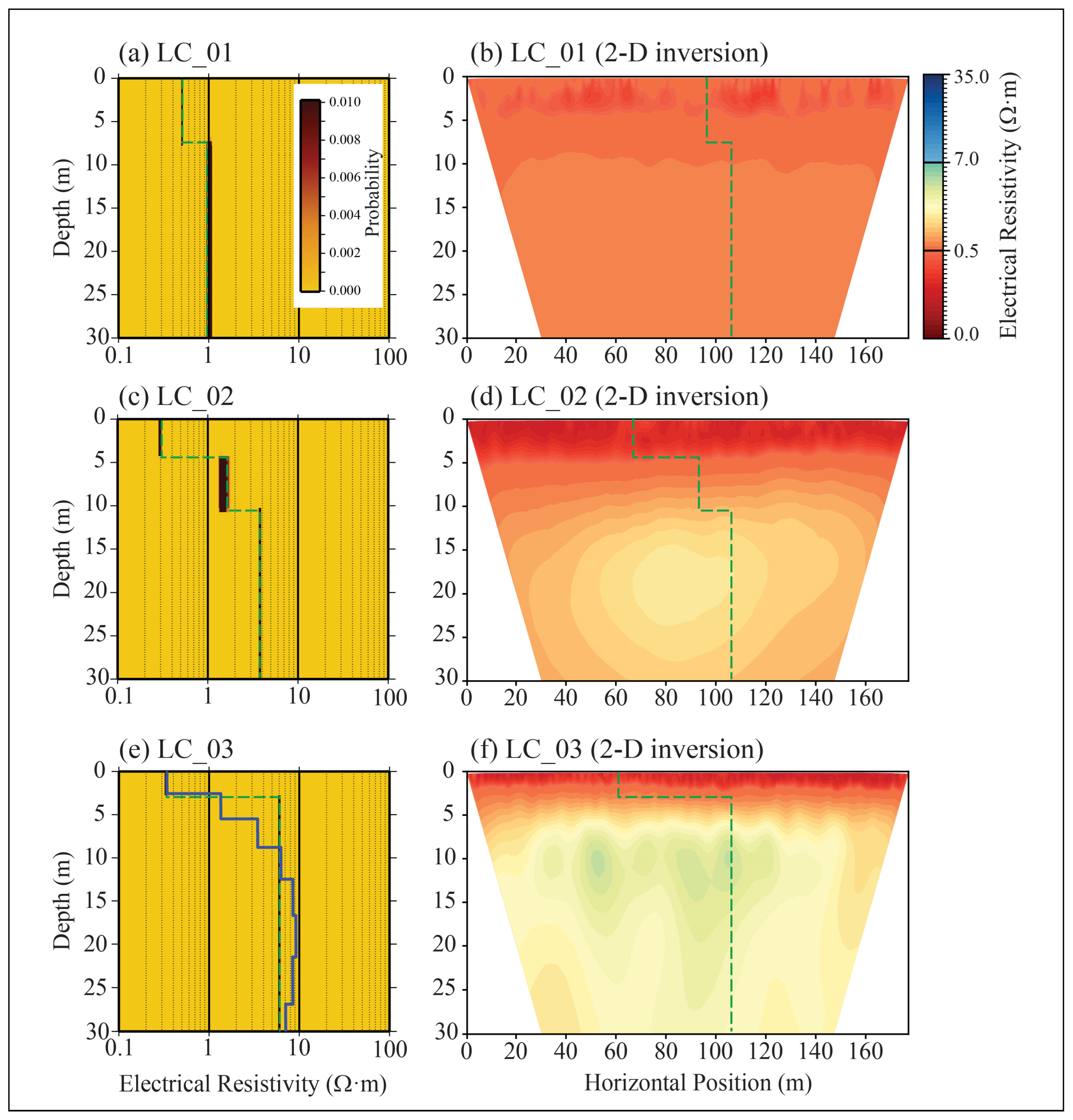
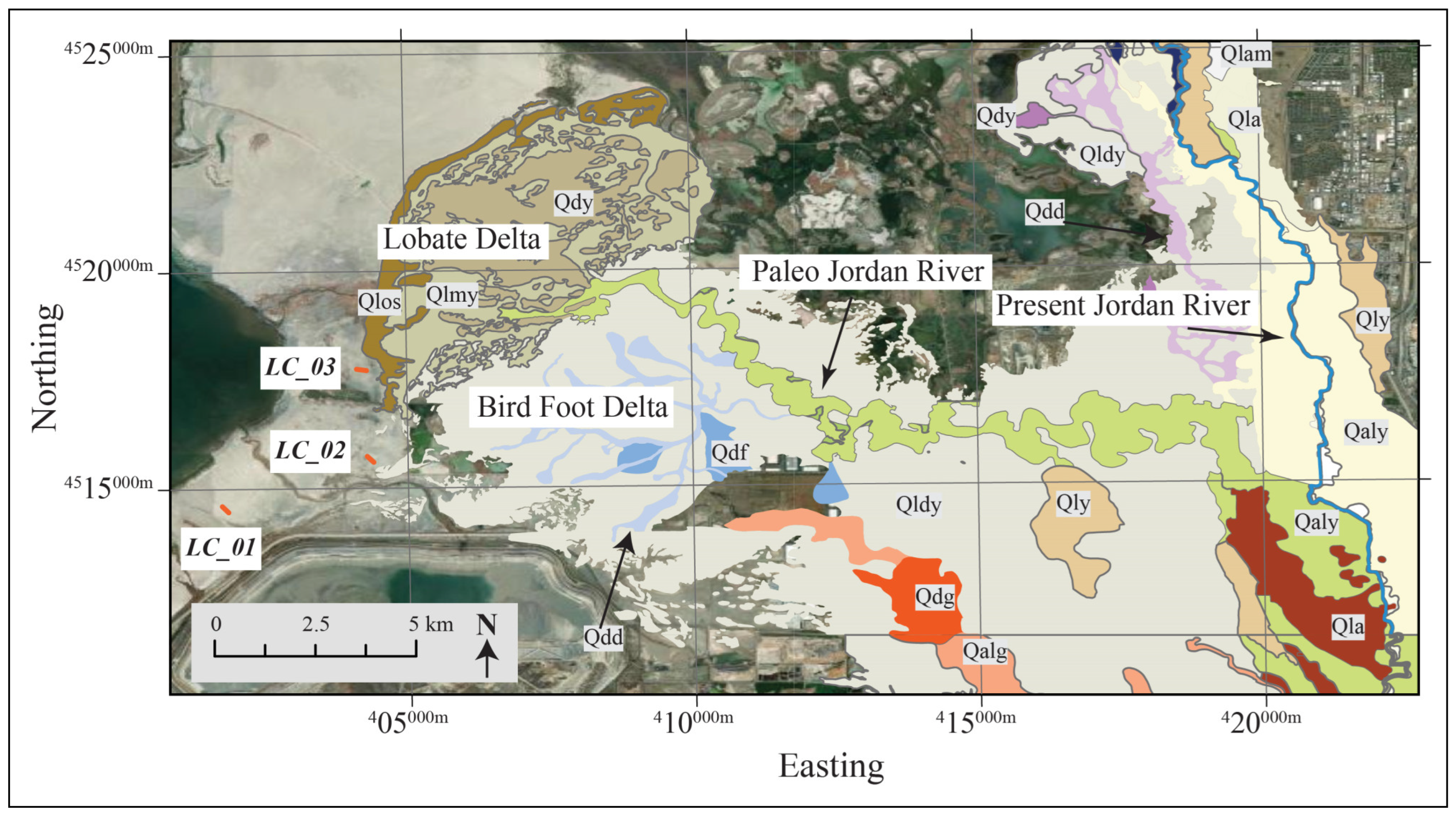
- At the Lee’s Creek Nature Area (LC_01), no mirabilite layer was observed. Rather, we observed a nearly homogeneous layer of low resistivity (<1 Ω·m) down to a depth of ~30 m, the limit of our resolution. This is consistent with brine pore-water over this entire range.
- (4)
- At LC_02 we observe low resistivities (<2 Ω·m) down to a depth of 10.5 ± 0.14 m. At this point, the resistivity increases to 3.8 ± 0.03 Ω·m.
- (5)
- At LC_03, we observe a simple structure with an uppermost resistivity of , which steps up to at a depth of 2.8 ± 0.03 m. The higher resistivity value is on the boundary between salt and freshwater and could indicate that fresh pore-water exists as shallow as 3.0 m.
5. Discussion
6. Conclusions
Supplementary Materials
Author Contributions
Funding
Data Availability Statement
Acknowledgments
Conflicts of Interest
References
- Arnow, T. Water-Level and Water-Quality Changes in Great Salt Lake, Utah, 1847–1983; U.S. Department of the Interior, Geological Survey: Reston, VA, USA, 1984; p. 913. [Google Scholar]
- Wang, S.-Y.; Gillies, R.R.; Reichler, T. Multidecadal drought cycles in the Great Basin recorded by the Great Salt Lake: Modulation from a transition-phase teleconnection. J. Clim. 2012, 25, 1711–1721. [Google Scholar] [CrossRef]
- Bigalke, S.; Loikith, P.; Siler, N. Explaining the 2022 record low Great Salt Lake volume. Geophys. Res. Lett. 2025, 52, e2024GL112154. [Google Scholar] [CrossRef]
- Wurtsbaugh, W.A.; Miller, C.; Null, S.E.; DeRose, J.; Wilcock, P.; Hahnenberger, M.; Howe, F.; Moore, J. Decline of the world’s saline lakes. Nat. Geosci. 2017, 10, 816–823. [Google Scholar] [CrossRef]
- Null, S.E.; Wurtsbaugh, W.A. Water development, consumptive water uses, and Great Salt Lake. In Great Salt Lake Biology; Baxter, B.K., Butler, J.K., Eds.; Springer: Cham, Switzerland, 2020. [Google Scholar] [CrossRef]
- Loving, B.L.; Waddell, K.M.; Miller, C.W. Water and Salt Balance of Great Salt Lake, Utah, and Simulation of Water and Salt Movement Through the Causeway, 1987–98; Water-Resources Investigations Report 2000-4221; USGS: Reston, VA, USA, 2000. [Google Scholar] [CrossRef]
- Waddell, K.M.; Fields, F.K. Model for evaluating the effects of dikes on the water and salt balance of Great Salt Lake, Utah. Utah Geol. Mineral. Surv. Water-Resour. Bull. 1977, 21, 1–54. [Google Scholar]
- Bunce, L.E. Significance of Spring Inflow to Great Salt Lake; Binghampton University: Binghampton, NY, USA, 2022; p. 57. [Google Scholar]
- Mohammed, I.N.; Tarboton, D.G. An examination of the sensitivity of the Great Salt Lake to changes in inputs. Water Resour. Res. 2012, 48, W11511. [Google Scholar] [CrossRef]
- Zamora, H.A.; Inkenbrandt, P. Estimate of groundwater flow and salinity contribution to Great Salt Lake using groundwater levels and spatial analysis. In Great Salt Lake and Bonneville Basin: Geologic History and Anthropocene Issues; Vanden Berg, M.D., Ford, R.L., Frantz, C., Hurlow, H., Gunderson, K., Atwood, G., Eds.; Utah Geological Association: Salt Lake City, UT, USA, 2024. [Google Scholar] [CrossRef]
- Hall, D.K.; O’Leary, D.S., III; DiGirolamo, N.E.; Miller, W.; Kang, D.H. The role of declining snow cover in the desiccation of the Great Salt Lake, Utah, using MODIS data. Remote Sens. Environ. 2021, 252, 112106. [Google Scholar] [CrossRef]
- Parker, E.; Daniels, B.; Allen, A.; Doerner, C. Great Salt Lake, environmental crises, and securities liability. Environ. Law Rep. 2025, 55, 10186. [Google Scholar] [CrossRef]
- Grineski, S.E.; Mallia, D.V.; Collins, T.W.; Araos, M.; Lin, J.C.; Anderegg, W.R.L.; Perry, K. Harmful dust from drying lakes: Preserving Great Salt Lake (USA) water levels decreases ambient dust and racial disparities in population exposure. One Earth 2024, 7, 1056–1067. [Google Scholar] [CrossRef]
- Caplan, A.J.; Go, D.-H. Measuring the bioeconomic impacts of prolonged drought on a lake ecosystem: The case of the Great Salt Lake, Utah. Nat. Resour. Model. 2018, 33, e12251. [Google Scholar] [CrossRef]
- Finnoff, D.; Caplan, A.J. A bioeconomic model of the Great Salt Lake watershed. Econ. Res. Inst. Study Pap. 2004, 14, 1–47. [Google Scholar]
- Rushforth, S.R.; Felix, E.A. Biotic adjustments to changing salinities in the Great Salt Lake, Utah, USA. Microb. Ecol. 1982, 8, 157–161. [Google Scholar] [CrossRef]
- Gliwicz, Z.M.; Wurtsbaugh, W.; Ward, A. Brine Shrimp Ecology in the Great Salt Lake. In Performance Report to the Utah Division of Wildlife Resources; Utah Division of Wildlife Resources: Salt Lake City, UT, USA, 1995. [Google Scholar]
- Conover, M.R.; Bell, M.E. Importance of Great Salt Lake to pelagic birds. In Great Salt Lake Biology; Baxter, B.K., Butler, J., Eds.; Springer: Cham, Switzerland, 2020. [Google Scholar] [CrossRef]
- Frank, M.G. Migratory Waterbird Ecology at a Critical Staging Area, Great Salt Lake, Utah. Ph.D. Thesis, Utah State University, Logan, UT, USA, 2016; p. 181. [Google Scholar]
- Lindsay, M.R.; Anderson, C.; Fox, N.; Scofield, G.; Allen, J.; Anderson, E.; Bueter, L.; Poudel, S.; Sutherland, K.; Munson-McGee, J.H.; et al. Microbialite response to an anthropogenic salinity gradient in Great Salt Lake, Utah. Geobiology 2016, 15, 131–145. [Google Scholar] [CrossRef] [PubMed]
- Lindsay, M.R.; Johnston, R.E.; Baxter, B.K.; Boyd, E.S. Effects of salinity on microbialite-associated production in Great Salt Lake, Utah. Ecology 2019, 100, e02611. [Google Scholar] [CrossRef] [PubMed]
- Vanden Berg, M.D. Domes, rings, ridges, and polygons: Characteristics of microbialites from Utah’s Great Salt Lake. Sediment. Rec. 2019, 17, 4–10. [Google Scholar] [CrossRef]
- Cook, K.L.; Berg, J.W. Regional gravity survey along the central and southern Wasatch Front, Utah. U.S. Geol. Surv. Prof. Pap. 1961, 316-E, 75–89. [Google Scholar]
- Cook, K.L.; Berg, J.W.; Johnson, W.W.; Novotny, R.T. Some Cenozoic structural basins in the Great Salt Lake area, Utah, indicated by regional gravity surveys. Utah Geol. Soc. Guideb. 1966, 20, 57–75. [Google Scholar]
- Arnow, T.; Mattick, R.E. Thickness of valley fill in the Jordan Valley east of the Great Salt Lake, Utah. Geol. Surv. Res. 1968, B79–B82. [Google Scholar]
- Colman, S.M.; Kelts, K.R.; Dinter, D.A. Depositional history and neotectonics in Great Salt Lake, Utah, from high-resolution seismic stratigraphy. Sediment. Geol. 2002, 148, 61–78. [Google Scholar] [CrossRef]
- Mikulich, M.J.; Smith, R.B. Seismic reflection and aeromagnetic surveys of the Great Salt Lake, Utah. Geol. Soc. Am. Bull. 1974, 85, 991–1002. [Google Scholar] [CrossRef]
- Smith, R.B.; Bruhn, R.L. Intraplate extensional tectonics of the eastern Basin-Range: Inferences on structural style from seismic reflection data, regional tectonics, and thermal mechanical models of brittle–ductile deformation. J. Geophys. Res. 1984, 89, 5733–5762. [Google Scholar] [CrossRef]
- Anderson, R.B.; Naftz, D.L.; Day-Lewis, F.D.; Henderson, R.D.; Rosenberry, D.O.; Stolp, B.J.; Jewell, P. Quantity and quality of groundwater discharge in a hypersaline lake environment. J. Hydrol. 2014, 512, 177–194. [Google Scholar] [CrossRef]
- Mabey, D.R.; Tooker, E.W.; Roberts, R.J. Gravity and magnetic anomalies in the northern Oquirrh Mountains, Utah. U.S. Geol. Surv. Prof. Pap. 1963, 450-E, E28–E31. [Google Scholar]
- Zoback, M.L. Structure and Cenozoic tectonism along the Wasatch fault zone, Utah. Geol. Soc. Am. Mem. 1983, 157, 3–28. [Google Scholar]
- Wilson, S.R.; Wideman, F.L. Sodium Sulfate Deposits Along the Southeast Shore of Great Salt Lake, Salt Lake and Tooele Counties, Utah; U.S. Bureau of Mines Information Circulars: Washington, DC, USA, 1957; p. 7773. [Google Scholar]
- Jagniecki, E.A.; Vanden Berg, M.D.; Boyd, E.S.; Johnston, D.T.; Baxter, B.K. Sulfate-rich spring seeps and seasonal formation of terraced, crystalline mirabilite mounds along the shores of Great Salt Lake, Utah: Hydrologic and chemical expression during declining lake elevation. Chem. Geol. 2023, 636, 121650. [Google Scholar] [CrossRef]
- Rings, J.; Hauck, C. Reliability of resistivity quantification for shallow subsurface water processes. J. Appl. Geophys. 2009, 68, 404–416. [Google Scholar] [CrossRef][Green Version]
- Wahab, S.; Saibi, H.; Mizunaga, H. Groundwater aquifer detection using the electrical resistivity method at Ito Campus, Kyushu University (Fukuoka, Japan). Geosci. Lett. 2021, 8, 15. [Google Scholar] [CrossRef]
- Cong-Thi, D.; Dieu, L.P.; Caterina, D.; De Pauw, X.; Thi, H.D.; Ho, H.H.; Nguyen, F.; Hermans, T. Quantifying salinity in heterogeneous coastal aquifers through ERT and IP: Insights from laboratory and field investigations. J. Contam. Hydrol. 2024, 262, 104322. [Google Scholar] [CrossRef] [PubMed]
- Moulds, M.; Gould, I.; Wright, I.; Webster, D.; Magnone, D. Use of electrical resistivity tomography to reveal the shallow freshwater–saline interface in The Fens coastal groundwater, eastern England (UK). Hydrogeol. J. 2023, 31, 335–349. [Google Scholar] [CrossRef]
- Sarker, M.M.R.; Van Camp, M.; Hermans, T.; Hossain, D.; Islam, M.; Uddin, M.Z.; Ahmed, N.; Bhuiyan, M.A.Q.; Karim, M.M.; Walraevens, K. Geophysical delineation of freshwater–saline water interfaces in coastal area of southwest Bangladesh. Water 2021, 13, 2527. [Google Scholar] [CrossRef]
- Abdalla, O.A.E.; Ali, M.; Khalifa, A.-H.; Al-Zidi, H.; El-Hussain, I.; Al-Hinai, S. Rate of seawater intrusion estimated by geophysical methods in an arid area: Al Khabourah, Oman. Hydrogeol. J. 2010, 18, 1437–1445. [Google Scholar] [CrossRef]
- Attwa, M.; Günther, T.; Grinat, M.; Binot, F. Evaluation of DC, FDEM and IP resistivity methods for imaging perched saltwater and a shallow channel within coastal tidal flat sediments. J. Appl. Geophys. 2011, 75, 656–670. [Google Scholar] [CrossRef]
- Martinez-Moreno, F.J.; Monteiro-Santos, F.A.; Bernardo, I.; Farzamian, M.; Nascimento, C.; Fernandes, J.; Casal, B.; Ribeiro, J.A. Identifying seawater intrusion in coastal areas by means of 1D and quasi-2D joint inversion of TDEM and VES data. J. Hydrol. 2017, 552, 609–619. [Google Scholar] [CrossRef]
- Metwaly, M.; El-Qady, G.; Massoud, U.; El-Kenawy, A.; Matsushima, J.; Al-Arifi, N. Integrated geoelectrical survey for groundwater and shallow subsurface evaluation: Case study at Siliyin spring, El-Fayoum, Egypt. Int. J. Earth Sci. 2010, 99, 1427–1436. [Google Scholar] [CrossRef]
- Adomako-Mensah, E.; Johnson, W.P.; Carter, S.C.; Solomon, D.K.; Mace, W.D.; Hynek, S.A.; Hurlow, H. Significance of ancient artesian fresh groundwater below the playa of a hypersaline terminal lake of hemispheric significance. J. Hydrol. 2026, 668, 134813. [Google Scholar] [CrossRef]
- Spies, B. Depth of investigation in electromagnetic sounding methods. Geophysics 1989, 54, 872–888. [Google Scholar] [CrossRef]
- Christiansen, A.V.; Auken, E. A global measure for depth of investigation. Geophysics 2012, 77, WB171–WB177. [Google Scholar] [CrossRef]
- Heath, R.C. Basic ground-water hydrology. U.S. Geol. Surv. Water-Supply Pap. 1983, 2220, 86. [Google Scholar] [CrossRef]
- Blanchy, G.; Saneiyan, S.; Boyd, J.; McLachlan, P.; Binley, A. ResIPy: An intuitive open-source software for complex geoelectrical inversion/modeling. Comput. Geosci. 2020, 137, 104423. [Google Scholar] [CrossRef]
- Binley, A.; Slater, L. Resistivity and Induced Polarization: Theory and Applications to the Near-Surface Earth; Cambridge University Press: Cambridge, UK, 2020. [Google Scholar]
- Pachhai, S.; Tkalčić, H.; Dettmer, J. Bayesian inference for ultralow velocity zones in the Earth’s lowermost mantle: Complex ULVZ beneath the east of the Philippines. J. Geophys. Res. Solid Earth 2014, 119, 8346–8365. [Google Scholar] [CrossRef]
- Pachhai, S.; Dettmer, J.; Tkalčić, H. Ultra-low velocity zones beneath the Philippine and Tasman Seas revealed by a trans-dimensional Bayesian waveform inversion. Geophys. J. Int. 2015, 203, 1302–1318. [Google Scholar] [CrossRef]
- Auken, E.; Christensen, A.V.; Kirkegaard, C.; Fiandaca, G.; Schamper, C.; Behroozmad, A.A.; Binley, A.; Nielsen, E.; Efferso, F.; Christensen, N.B.; et al. An overview of a highly versatile forward and stable inverse algorithm for airborne, ground-based and borehole electromagnetic and electric data. Explor. Geophys. 2015, 46, 223–235. [Google Scholar] [CrossRef]
- Oviatt, C.G.; Atwood, G.; Thompson, R.S. History of Great Salt Lake, Utah, USA: Since the termination of Lake Bonneville. In Limnogeology: Progress, Challenges and Opportunities; Rosen, M.R., Ed.; Springer Nature: Cham, Switzerland, 2021; pp. 233–271. [Google Scholar] [CrossRef]
- McKean, A.P.; Hylland, M.D. Post-Lake Bonneville migration of the Jordan River, Salt Lake Valley, Utah. In Proceedings of the 2018 Lake Bonneville Geologic Conference and Short Course; Lund, W.R., McKean, A.P., Bowman, S.D., Eds.; Utah Geological Survey Miscellaneous Publication: Salt Lake City, UT, USA, 2019; Volume 170. [Google Scholar]
- Tafaghod Khabaz, Z.; Ghanati, R.; Berubé, C.L. Uncertainty quantification in electrical resistivity tomography inversion: Hybridizing block-wise bootstrapping with geostatistics. Geophys. J. Int. 2024, 239, 1–17. [Google Scholar] [CrossRef]
- Loke, M.H.; Barker, R.D. Least-squares deconvolution of apparent resistivity pseudosections. Geophysics 1995, 60, 1682–1690. [Google Scholar] [CrossRef]
- Loke, M.H.; Barker, R.D. Practical techniques for 3D resistivity surveys and data inversion. Geophys. Prospect. 1996, 44, 499–523. [Google Scholar] [CrossRef]
- Loke, M.H.; Barker, R.D. Rapid least-squares inversion of apparent resistivity pseudosections by a quasi-Newton method. Geophys. Prospect. 1996, 44, 131–152. [Google Scholar] [CrossRef]
- Wessel, P.; Luis, J.F.; Uieda, L.; Scharroo, R.; Wobbe, F.; Smith, W.H.F.; Tian, D. The Generic Mapping Tools Version 6. Geochem. Geophys. Geosyst. 2019, 20, 5556–5564. [Google Scholar] [CrossRef]



| Site | Line Code | Date (mm/dd/yyyy) | Electrode Spacing (m) | Number of Electrodes | NR Raw * | NR Clean ** | Line Length (m) |
|---|---|---|---|---|---|---|---|
| Burmester | BM_01 | 09/13/2024 | 2.5 | 72 | 2932 | 2932 | 180 |
| BM_02 | 09/13/2024 | 2.5 | 72 | 2932 | 2903 | 180 | |
| BM_03 | 09/13/2024 | 2.5 | 72 | 2932 | 2926 | 180 | |
| BM_C1 1 | 09/13/2024 | 2.5 | - | 8376 | 8376 | 450 | |
| Lee’s Creek | LC_01 | 06/18/2025 | 2.5 | 72 | 3085 | 3084 | 180 |
| LC_02 | 06/18/2025 | 2.5 | 72 | 3085 | 3085 | 180 | |
| LC_03 | 06/19/2025 | 2.5 | 72 | 3085 | 3085 | 180 | |
| Saltair | SA_01 | 09/05/2024 | 2.5 | 72 | 2352 | 2333 | 180 |
| SA_02 | 09/20/2024 | 5.0 | 72 | 2932 | 2898 | 360 | |
| SA_03 | 09/20/2024 | 5.0 | 72 | 2932 | 2861 | 360 | |
| SA_04 | 09/20/2024 | 5.0 | 72 | 2931 | 2873 | 360 | |
| SA_05 | 09/20/2024 | 5.0 | 72 | 2932 | 2905 | 360 | |
| SA_C1 2 | 09/20/2024 | 5.0 | - | 9121 | 9121 | 900 | |
| SA_06 | 09/25/2024 | 5.0 | 72 | 2932 | 2860 | 360 | |
| SA_07 | 09/25/2024 | 5.0 | 72 | 2932 | 2866 | 360 | |
| SA_C2 3 | 5.0 | - | 4923 | 4923 | 540 | ||
| SA_08 | 10/17/2024 | 1.0 | 72 | 3085 | 3077 | 72 | |
| SA_09 | 10/17/2024 | 2.5 | 72 | 3085 | 3026 | 180 | |
| Marina | MA_01 | 09/25/2024 | 5.0 | 54 | 1805 | 1805 | 270 |
| Site | Line Code | Line Start (0 m) | Line End | ||
|---|---|---|---|---|---|
| lat (°) | lon (°) | lat (°) | lon (°) | ||
| Burmester | BM_01 | 40.66903 | −112.36466 | 40.67060 | −112.36433 |
| BM_02 | 40.67020 | −112.36442 | 40.67180 | −112.36411 | |
| BM_03 | 40.67140 | −112.36417 | 40.67300 | −112.36385 | |
| BM_C1 1 | 40.66903 | −112.36466 | 40.67300 | −112.36385 | |
| Lee’s Creek | LC_01 | 40.77535 | −112.16326 | 40.77659 | −112.16458 |
| LC_02 | 40.78585 | −112.13309 | 40.78706 | −112.13445 | |
| LC_03 | 40.80490 | −112.13463 | 40.80517 | −112.13670 | |
| Saltair | SA_01 | 40.74903 | −112.19131 | 40.75006 | −112.19290 |
| SA_02 | 40.74101 | −112.19161 | 40.74409 | −112.19275 | |
| SA_03 | 40.74257 | −112.19219 | 40.74565 | −112.19332 | |
| SA_04 | 40.74413 | −112.19276 | 40.74725 | −112.19392 | |
| SA_05 | 40.74569 | −112.19333 | 40.74876 | −112.19448 | |
| SA_C1 2 | 40.74101 | −112.19161 | 40.74876 | −112.19448 | |
| SA_06 | 40.74690 | −112.19379 | 40.74991 | −112.19494 | |
| SA_07 | 40.74846 | −112.19438 | 40.75147 | −112.19551 | |
| SA_C2 3 | 40.74690 | −112.19379 | 40.75147 | −112.19551 | |
| SA_08 | 40.76292 | −112.18956 | 40.76272 | −112.18877 | |
| SA_09 | 40.76379 | −112.18922 | 40.76223 | −112.18955 | |
| Marina | MA_01 | 40.73583 | −112.20634 | 40.73791 | −112.20769 |
| Site | Loop Code | Receiver Center Point | Loop Dimensions (m) | ||
|---|---|---|---|---|---|
| Lat (°) | Lon (°) | Transmitter | Receiver | ||
| Lee’s Creek | TEM06 | 40.80518 | −112.13552 | 100 | 10 |
| Saltair | TEM01 | 40.75130 | −112.19539 | 40 | 10 |
| TEM02 | 40.75017 | −112.19508 | 40 | 10 | |
| TEM03 | 40.74911 | −112.19457 | 40 | 10 | |
| TEM04 | 40.74802 | −112.19422 | 40 | 10 | |
| TEM05 | 40.75202 | −112.18781 | 100 | 10 | |
| Water Type | Specific Conductance (μS/cm) | Resistivity (Ω·m) |
|---|---|---|
| Freshwater | 1–1800 | >5.6 |
| Slightly saline | 1800–5500 | 1.8–5.6 |
| Moderately saline | 5500–18,000 | 0.6–1.8 |
| Very saline | 18,000–64,000 | 0.2–0.6 |
| Brine water | >64,000 | <0.2 |
| ERT Line | d1 (m) | d2 (m) | ρ1 (Ω·m) | ρ2 (Ω·m) | ρ3 (Ω·m) |
|---|---|---|---|---|---|
| BM_01 | 2.2 ± 0.06 | 8.5 ± 0.14 | 0.43 ± 0.006 | 0.24 ± 0.001 | 8.3 ± 0.27 |
| BM_02 | 1.7 ± 0.09 | 9.0 ± 0.14 | 0.32 ± 0.004 | 0.25 ± 0.0002 | 9.1 ± 0.18 |
| BM_03 | 1.8 ± 0.24 | 9.5 ± 0.14 | 0.28 ± 0.007 | 0.24 ± 0.001 | 6.8 ± 0.20 |
| ERT Line | d1 (m) | d2 (m) | d3 (m) | ρ1 (Ω·m) | ρ2 (Ω·m) | ρ3 (Ω·m) | ρ4 (Ω·m) |
|---|---|---|---|---|---|---|---|
| SA_01 | 1.2 ± 0.07 | 4.6 ± 0.11 | 18.4 ± 3.6 | 0.68 ± 0.04 | 3.7 ± 0.14 | 0.19 ± 0.02 | 0.62 ± 0.18 |
| SA_02 | 1.3 ± 0.11 | 3.3 ± 0.08 | 10.2 ± 2.5 | 0.66 ± 0.04 | 3.5 ± 0.24 | 0.18 ± 0.02 | 0.27 ± 0.02 |
| SA_03 | 0.85 ± 0.27 | 4.5 ± 0.33 | 26.2 ± 2.0 | 0.77 ± 0.14 | 2.4 ± 0.20 | 0.22 ± 0.01 | 0.60 ± 0.03 |
| SA_04 | 0.76 ± 0.21 | 6.7 ± 0.16 | 15.6 ± 0.83 | 1.2 ± 0.01 | 2.0 ± 0.05 | 0.13 ± 0.01 | 0.68 ± 0.01 |
| SA_05 | 0.56 ± 0.04 | 6.9 ± 0.15 | 16.5 ± 0.23 | 0.51 ± 0.04 | 2.7 ± 0.32 | 0.14 ± 0.04 | 0.69 ± 0.01 |
| SA_06 | 0.58 ± 0.07 | 6.6 ± 0.18 | 19.6 ± 1.1 | 0.88 ± 0.08 | 2.4 ± 0.05 | 0.18 ± 0.01 | 0.67 ± 0.02 |
| SA_07 | 0.64 ± 0.10 | 6.3 ± 0.19 | 10.5 ± 2.5 | 1.6 ± 0.12 | 2.7 ± 0.06 | 0.17 ± 0.16 | 0.25 ± 0.13 |
| SA_08 | 0.76 ± 0.01 | 3.4 ± 0.08 | 6.5 ± 1.2 | 0.32 ± 0.01 | 1.8 ± 0.05 | 0.22 ± 0.02 | 0.33 ± 0.01 |
| SA_09 | 0.71 ± 0.05 | 5.1 ± 0.14 | 10.0 ± 0.28 | 0.49 ± 0.03 | 1.1 ± 0.02 | 0.18 ± 0.01 | 0.39 ± 0.01 |
Disclaimer/Publisher’s Note: The statements, opinions and data contained in all publications are solely those of the individual author(s) and contributor(s) and not of MDPI and/or the editor(s). MDPI and/or the editor(s) disclaim responsibility for any injury to people or property resulting from any ideas, methods, instructions or products referred to in the content. |
© 2026 by the authors. Licensee MDPI, Basel, Switzerland. This article is an open access article distributed under the terms and conditions of the Creative Commons Attribution (CC BY) license.
Share and Cite
Jacketta, M.; Thorne, M.S.; Pachhai, S.; Tochimani-Hernandez, I.; van Dam, T.; Hardwick, C.L.; Adomako-Mensah, E.; Johnson, W.P.; Anderson, L.S. Characterization of Hydrogeologic and Lithologic Heterogeneity Along the Southern Shore of the Great Salt Lake, Utah, from Electrical Methods. Geosciences 2026, 16, 114. https://doi.org/10.3390/geosciences16030114
Jacketta M, Thorne MS, Pachhai S, Tochimani-Hernandez I, van Dam T, Hardwick CL, Adomako-Mensah E, Johnson WP, Anderson LS. Characterization of Hydrogeologic and Lithologic Heterogeneity Along the Southern Shore of the Great Salt Lake, Utah, from Electrical Methods. Geosciences. 2026; 16(3):114. https://doi.org/10.3390/geosciences16030114
Chicago/Turabian StyleJacketta, Mason, Michael S. Thorne, Surya Pachhai, Ivan Tochimani-Hernandez, Tonie van Dam, Christian L. Hardwick, Ebenezer Adomako-Mensah, William P. Johnson, and Leif S. Anderson. 2026. "Characterization of Hydrogeologic and Lithologic Heterogeneity Along the Southern Shore of the Great Salt Lake, Utah, from Electrical Methods" Geosciences 16, no. 3: 114. https://doi.org/10.3390/geosciences16030114
APA StyleJacketta, M., Thorne, M. S., Pachhai, S., Tochimani-Hernandez, I., van Dam, T., Hardwick, C. L., Adomako-Mensah, E., Johnson, W. P., & Anderson, L. S. (2026). Characterization of Hydrogeologic and Lithologic Heterogeneity Along the Southern Shore of the Great Salt Lake, Utah, from Electrical Methods. Geosciences, 16(3), 114. https://doi.org/10.3390/geosciences16030114