

Manifestations of the 2023 Al Haouz Earthquake as Geoheritage: Geological Processes, Landscape Impacts, and Implications for Geoconservation in the Moroccan High Atlas



Abstract
1. Introduction
2. Materials and Methods
3. Geological and Tectonic Context of the High Atlas
4. Results
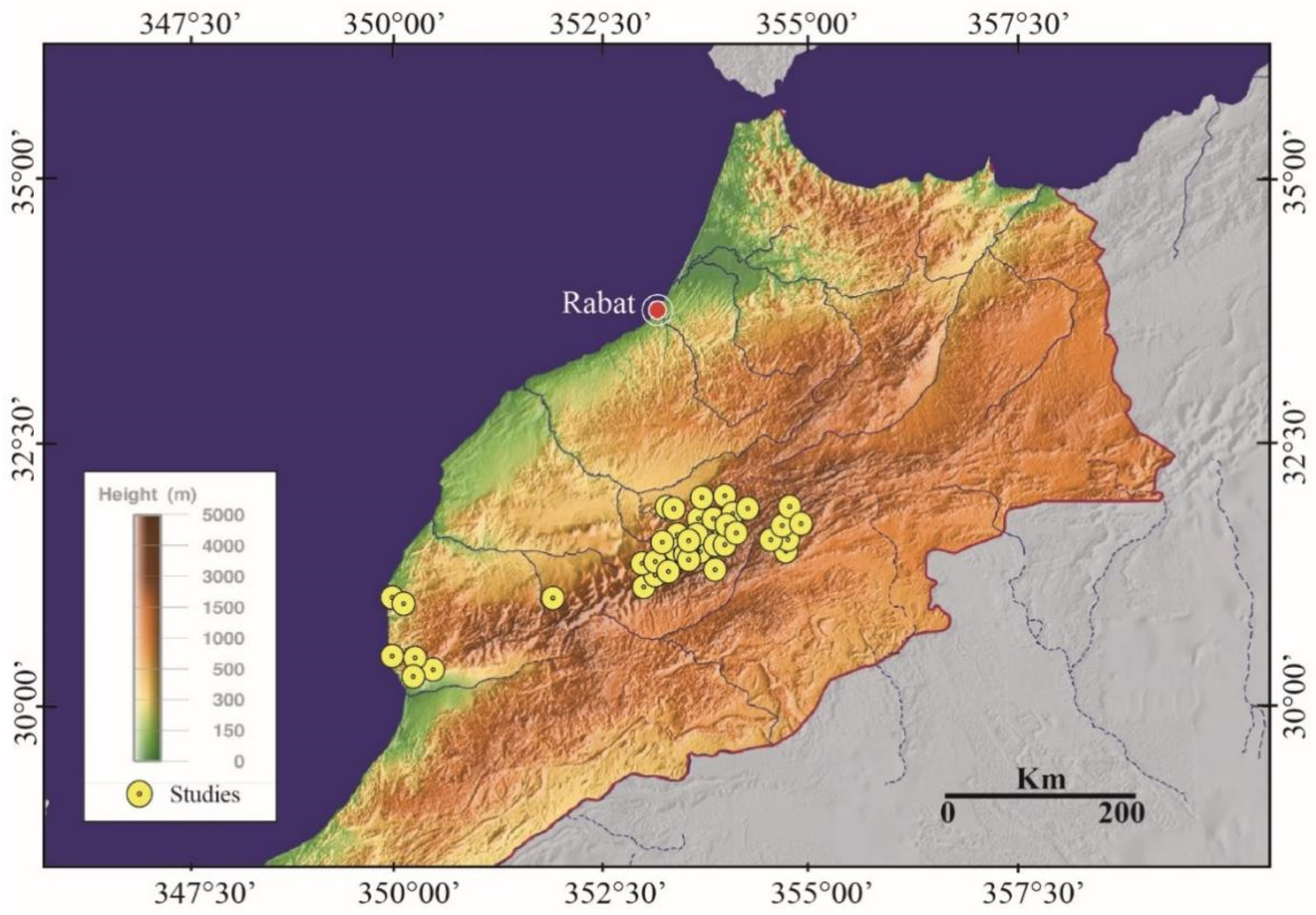
4.1. Research Output Pattern

| Authors (Year) | Title | Major Findings |
|---|---|---|
| Enniouar et al. (2014) [75] | A Middle Jurassic Sauropod Tracksite in the Argana Basin, Western High Atlas, Morocco: An Example of Paleoichnological Heritage for Sustainable Geotourism | The authors highlight the significant scientific and tourist importance of a Middle Jurassic site in the Tafaytour region (Argana Basin, Morocco) that contains tracks of six large sauropod dinosaurs, as well as its potential to enhance local geotourism initiatives. |
| Bourchich et al. (2015) [102] | Geotourism in Ida Outananes, Moroccan Western High Atlas: State of Valuation and Opportunity for Improvement | The assessment of the Ida Outanane area indicates deterioration that jeopardizes its Geosystems, Ecosystems, and tourist appeal. This decline is attributable to the opening of the area to tourism without a management plan that integrates geopreservation efforts with sustainable funding. |
| Bouzekraoui et al. (2018a) [82] | Inventory and Assessment of Geomorphosites for Geotourism Development: A Case Study of Aït Bou Oulli Valley (Central High-Atlas, Morocco) | The project entailed inventorying, selecting, and quantitatively evaluating outstanding geomorphosites to classify them. The findings identify 81 potential sites, of which 24 are appropriate for geotourism. These suitable locations comprise nine fluvial landforms—five offering scenic vantage points and four being karst forms—along with four structural landforms, three glacial landforms, two gravity landforms, one anthropogenic landform, and one lacustrine landform. |
| Bouzekraoui et al. (2018b) [81] | Mapping Geoheritage for Geotourism Management, a Case Study of Aït Bou Oulli Valley in Central High-Atlas (Morocco) | This study focuses on creating a new geotourism map of the Aït Bou Oulli Valley through digital mapping tools and fieldwork. The map features geosites and high-mountain landscapes, providing an overview of the valley’s geoheritage. It also includes information about tourist infrastructures to assist visitors. Additionally, the map emphasizes the valley’s geodiversity and aims to promote geotourism by establishing three new geo-hiking trails. |
| Bouzekraoui et al. (2018c) [80] | Mapping Geosites as Gateways to the Geotourism Management in Central High-Atlas (Morocco) | This article outlines three geotourism routes showcasing the key geosites in the rural Demnate and Upper Tessaout valleys. These itineraries help explain the regions’ significant potential as tourist attractions. |
| Achkir (2018) [103] | An Asset for Integrated Geotourism (Case of Assif Melloul Crossing (Common Territorial of Anergui and Tillouguite) in the Province of Azilal; Béni Mellal-Khénifra-Region/Morocco) | This article reports the initial findings from a survey of geomorphosites in the rural communes of Anergui and Tillouguite. It also seeks to improve strategies for the protection, promotion, and management of these geomorphosites, with the aim of integrating them into sustainable development. This approach offers new incentives and opportunities for sustainable tourism, positioning geo-tourism as a leading frontier. |
| Amine et al. (2018) [76] | Inventory and Management of Dinosaurs Traces: A Case Study of Azilal Region, Morocco | This work contributes to the preservation and promotion of dinosaur-track deposits by detailing the geology and geomorphology of the Azilal area, developing Geographic Information Systems (GIS) maps, and proposing models for their enhancement and protection. |
| Ait Omar et al. (2019) [83] | Nouvelle Méthodologie d’inventaire et D’évaluation des Géomorphosites dans le Contexte du Géoparc M’goun (Maroc) | This article presents a new methodology for inventorying and assessing geomorphosites within the M’goun Regional Geopark. The approach was tested on two geomorphosites—Ain Asserdoune and Canyon Moudj—located within the geopark, specifically south of the town of Béni Mellal in Morocco. |
| Amine et al. (2020) [77] | Dinosaurs Footprints of the High Atlas Morocco by Using Geological Heritage Information System | This work contributes to the preservation and protection of dinosaur track deposits by using geographic information to describe and map the study area and, ultimately, to propose models for the development and conservation of these geosites. |
| Arrad et al. (2020a) [92] | From Geoheritage Inventory to Geoeducation and Geotourism Implications: Insight from Jbel Amsittene (Essaouira Province, Morocco) | This document presents an initial, detailed analysis of Jbel Amsittene’s geoheritage, combining quantitative and qualitative evaluations of its geological and geomorphological sites to highlight their significance and support geoconservation efforts. |
| Arrad et al. (2020b) [91] | Inventory, Evaluation, and Promotion of the Essaouira Province Geoheritage (Morocco): Toward a Local and Socio-Economic Sustainable Development | This work aims to inventory, assess, and promote key geodiversity features in Essaouira that remain unknown or underutilized for conservation and development. |
| Lkebir et al. (2020) [78] | The Anza Tracksite: Ichnological Heritage and Geoeducational Significance of Dinosaur and Pterosaur Tracks in Coastal Morocco | The authors highlight the scientific, geo-educational, and ichnological significance of the Anza site and emphasize the need for a strategy to conserve and safeguard it. |
| Rais et al. (2021) [104] | Geological Heritage in the M’Goun Geopark: A Proposal of Geo-Itineraries Around the Bine El Ouidane Dam (Central High Atlas, Morocco) | This work seeks to identify and select exceptional geosites within the Bine El Ouidane Lake region and to propose itineraries that promote this mountainous area. |
| El Alami et al. (2021) [105] | Biodiversity, An Essential Component for The M’Goun Global Geopark Development (Morocco)—An Overview | This article aimed to assess the inventory and development of geosites, wildlife diversity, biodiversity conservation, human–carnivore conflict, and the management of endangered species in the M’goun Global Geopark within Morocco’s central High Atlas. |
| Elkaichi et al. (2021) [106] | Quantitative Assessment of the Geodiversity of M’Goun UNESCO Geopark, Central High Atlas (Morocco) | This article quantitatively evaluates geodiversity in the M’Goun UNESCO Geopark through two approaches. Both methods reveal the richness and spatial distribution of geodiversity elements within the geopark. Additionally, they identify areas with high geodiversity indices, offering useful insights for geopark managers to develop effective geoconservation strategies. |
| Ait Omar et al. (2021) [84] | Les Géopatrimoines de la Partie Nord-Est du Géoparc Régional du M’Goun (Maroc): Représentations Sociales et Valorisation Géotouristique | This article aims to identify geosites with strong social reputations in the northeastern part of the M’Goun Regional Geopark, based on a questionnaire survey that elicited local stakeholders’ social perceptions. The identified geosites have also been assessed. Additionally, the study examines the role of local associations in promoting geotourism and geoconservation. |
| Ait Barka et al. (2022a) [107] | The Geosite of Travertine Waterfall of El Ksiba (Morocco), A Heritage to Enhancement and Preserve | In this work, the authors outlined strategies to boost and safeguard the El Ksiba travertines as a part of rural socio-economic development, focusing on geotourism and geoeducation initiatives. |
| Ait Barka et al. (2022b) [108] | The Karst Landscapes of Beni Mellal Atlas (Central Morocco): Identification for Promoting Geoconservation and Tourism | The authors detail the study area’s wide variety of karst features and processes, including caves, dolines, underground watercourses, and Karren, along with its biological and cultural diversity. This region has strong potential to develop into an appealing area and a significant economic resource for the local community through sustainable development. |
| Louz et al. (2022) [86] | Geological Heritage of the Taguelft Syncline (M’Goun Geopark): Inventory, Assessment, and Promotion for Geotourism Development (Central High Atlas, Morocco) | This study seeks to document and assess the geological heritage of the Taguelft syncline, located south of Béni Mellal, and to promote geotourism and geodidactic initiatives to support its sustainable geoconservation. |
| Ait Omar et al. (2022a) [85] | A Quantitative method for Inventory and Assessment of Geoheritage in the Mountains of Morocco: A Case Study of the Tagleft Syncline in Beni Mellal Atlas | The paper introduces a quantitative approach for identifying and assessing geological and geomorphological sites, applied specifically to the Tagleft syncline in the Beni Mellal Atlas, Morocco. |
| Ait Omar et al. (2022b) [109] | Contribution of Social Perception for Identifying Geomorphological Potential and Touristic Practices in the North-Eastern part of the M’Goun Regional Geopark, Morocco | The paper introduces a quantitative approach for identifying and assessing geological and geomorphological sites, applied specifically to the Tagleft syncline in the Beni Mellal Atlas, Morocco. |
| Aichi et al. (2022a) [110] | Cultural Heritage in Imghranes Massif (Drâa-Tafilalet Region, Morocco): An Optimist’s Contribution and Opportunity for the Local People and Sustainable Tourism | The authors highlight the rich geological, archaeological, and cultural heritage of the Imghranes massif (Drâa-Tafilalet region, Morocco), emphasizing its potential for geotourism, geoeducation, and cultural tourism. |
| Aichi et al. (2022b) [111] | From Geoheritage to Geoeducation and Geotourism: The Imghranes Massif, Drâa-Tafilalet Region, Morocco | This work presents the first detailed analysis of geoheritage in the Imghranes area of the central High Atlas of Morocco. It includes both quantitative and qualitative evaluations of its geosites and geomorphosites to highlight their significance and support geoconservation efforts. |
| Bussard et al. (2022) [112] | Les Paysages Géomorphologiques du Haut Atlas Central (Maroc): Potentiel Educatif et Eléments pour la Médiation Scientifique | This article explores the educational opportunities offered by the eight geomorphological landscapes within the M’Goun UNESCO Global Geopark in the Central High Atlas, Morocco. |
| Bussard (2022) [93] | Heritage Value and Didactic Potential of Geomorphological Landscapes: the Case of Eight Sites in the Central High Atlas (Morocco) | The authors highlight the educational value of eight geomorphological landscapes within the M’Goun Geopark (Central High Atlas, Morocco). These sites are of significant scientific interest and have the potential to promote geotourism. |
| Bussard (2023) [94] | Geomorphological Landscapes of the M’Goun Geopark (Morocco): Potential for Geotourism and Local Guides’ Perspective | This study explores the potential for geotourism within the geomorphological landscapes of the M’Goun Global Geopark, Morocco. It emphasizes site selection based on educational value and local guides’ perspectives. Eight key landscapes are identified for interpretation, considering their visibility and complexity. Interviews with guides reveal a strong interest in geomorphology and palaeontology, despite limited familiarity with specific geological terms. The findings stress the crucial role of guides in conveying geological information and highlight the need for effective interpretation methods to boost geotourism. |
| Elkaichi et al. (2023) [96] | Evaluation of Geotouristic Station Suitability Using GIS-Based Multi-criteria Decision Analysis: A Case Study of the M’Goun UNESCO Geopark, High Atlas (Morocco) | The study employs a multi-criteria decision-making approach that integrates AHP and GIS to identify suitable sites for geotourism stations within the M’Goun UNESCO Geopark. It assesses natural features, landscape quality, and safety factors, creating a synthesis map that supports local authorities in planning and managing geotourism activities in the geopark. |
| El Khalki et al. (2023) [113] | M’Goun UNESCO Geopark (Central High Atlas, Morocco), a Lever for Sustainable and Integrated Territorial Development: What Approach to Adopt? | This study aims to highlight Morocco’s rich geodiversity and to explore the potential for establishing geoparks to enhance geotourism, environmental awareness, and local socioeconomic development. It highlights the M’Goun UNESCO Geopark as a prime example of sustainable regional development, showing how geoparks can foster economic growth, generate employment, and support traditional crafts. As Africa and the Arab world’s first geopark, M’Goun exemplifies how geopark initiatives can benefit rural and mountain communities through integrated geotourism strategies. |
| Louz et al. (2023) [87] | Inventory and Assessment of Geosites and Geodiversity Sites of the Ait Attab Syncline (M’Goun Unesco Geopark, Morocco) to Stimulate Geoconservation, Geotourism and Sustainable Development | The Ait Attab syncline in the Moroccan Central High Atlas is a region of high geodiversity, with substantial geological, palaeogeographical, and cultural significance. An inventory identified 8 geosites and 11 geodiversity sites, emphasizing their scientific and educational value and potential for geotourism development. Most sites are subject to medium degradation risk, while palaeontological and magmatic sites are at high risk. |
| Si Mhamdi et al. (2023) [95] | Enhancing the Geological Heritage of the Errachidia Area in the High Atlas, Morocco: Inventory and a Proposal for a Pedagogic and Geotouristic Trail | The study introduces a pedagogical and geotouristic trail in Errachidia province, Morocco, renowned for its geological formations and mineral resources. It highlights nine important geosites, encompassing structural, stratigraphic, paleontological, and geomorphological features, each offering considerable scientific, educational, and tourism benefits. The trail’s goal is to boost education and tourism via guided walks and informational signage, while fostering geotourism and supporting local socio-economic growth. |
| Bouzekraoui et al. (2024) [114] | La Carte Géotouristique des Communes de Foum El Ancer et Taghzirt Comme Moyen de Valorisation Géotouristique, Atlas de Béni Mellal, (Maroc) | This study examines the geotourism potential of the communes Foum El Ancer and Taghzirt in Béni Mellal province, situated at the base of the Middle Atlas. It identifies multiple geosites formed through magmatic, sedimentary, structural, and geomorphological processes. The goal is to develop a geotourism map that showcases and promotes these geosites, which hold considerable promise for boosting geotourism and enhancing the region’s geoheritage and tourism development. |
| Elkaichi et al. (2024) [97] | Canyons as Potential Geotourism Attractions of Central High Atlas, Morocco: Comparative Analysis of Aït Bouguemaz Valley and Zaouiat Ahnsal-Taghia valley by Using GAM Model | The study evaluates two popular geo-destinations in the Moroccan Central High Atlas: Aït Bouguemaz and Zaouiat Ahansal-Taghia valleys, using the Geosite Assessment Model (GAM). Aït Bouguemaz shows high principal scores (9.75) and moderate additional scores (8.25), while Ahansal-Taghia has moderate principal scores (8) and lower additional scores (5.25). Despite their strong scientific and aesthetic appeal, both sites require improvements in functional and tourism-related aspects, particularly in management, planning, and infrastructure, to enhance geotourism. |
| Naimi et al. (2024) [98] | Leveraging Machine Learning Algorithms to identify Potential Geosites for Geotourism Promotion in Ziz Upper Watershed in Southeastern Morocco | This study aims to identify the optimal locations for geomorphosites in the Ziz Upper Watershed (ZUW), southeastern Morocco, using machine learning classifiers (MLCs) to enhance geotourism. A detailed inventory of 120 geomorphosites was compiled, and the Bagging algorithm was used to create a predictive model with an AUC of 0.935. The model identified highly suitable areas covering approximately 12% of the region, primarily in the western part, with mountainous terrain and high elevations. These results provide useful insights for decision-makers to enhance the discovery of geomorphosites and promote geotourism development. |
| Ouacha et al. (2024) [115] | Geological Sites of the Anergui Region: Description and Place in the Alpine Geological History of the M’Goun UNESCO Global Geopark (Morocco) | This study details 16 key geosites within the M’Goun UNESCO Global Geopark in Morocco, emphasizing their scientific, educational, and geotourism importance. These sites highlight the region’s geodiversity and provide insights into major geological phases, including the extension of the High Atlas basin, carbonate platform formation, magmatic activity, and uplift during the Tertiary and Quaternary periods. The objective is to enhance the geopark’s collection of geosites and foster greater geological awareness locally. |
| Wakass et al. (2025) [116] | Geosites of High Atlas of Marrakech (Morocco): Geological Characterization, Accessibility, and Potential Interests for Sustainable Tourism | This study reviews four potential geosites in Morocco’s High Atlas, emphasizing their geological features, historical significance, and accessibility. The sites, such as Toubkal National Park and Ifni Lake, are reachable via well-maintained roads and are equipped with tourism amenities. The study suggests additional research to better develop the geosites for sustainable tourism. |
| El Ouali et al. (2025a) [90] | Geosites and Geodiversity Sites of the Tinghir–Dades–Imilchil Area, Morocco: Toward Conservation, Education, and Tourism Development | The research examined 25 geological sites in the Tinghir-Dades-Imilchil region, emphasizing their scientific, educational, and tourism value. The assessment aimed to encourage geotourism and environmental awareness, focusing on preserving and enhancing the area’s geological heritage to support sustainable growth. |
| El Ouali et al. (2025b) [89] | Quantitative Assessment and Enhancement of 12 Sites of Geological Interest South of Midelt City (Tizi N’Talghemt, Central High Atlas, Morocco) | This research highlights twelve geological sites in the Tizi N’Talghemt region of Morocco’s Central High Atlas, focusing on their scientific, educational, and tourism value. It identifies four Geosites with high scientific importance and eight Geodiversity sites with notable potential. The study stresses the importance of safeguarding these sites and aligns with the Moroccan National Program for Geology MNPG-2030 and UNESCO guidelines to conserve the region’s geological heritage and support sustainable development. |
| Louz et al. (2025) [88] | Identification of Potential Areas for the Development of Geotourism in the Northern Part of the M’Goun Geopark (Morocco) Using Multi-Criteria Analysis and Sig | The study evaluates the geotourism potential of the unexplored portion of the M’Goun Regional Geopark in the Moroccan High Atlas using GIS and AHP. It identifies key geosites with high potential, such as the Ouzoud waterfalls and the Ait Attab syncline, thereby emphasizing regions with notable geodiversity. The findings provide a strategic guide for advancing geotourism and effectively managing the geopark. |
| Elfaiz et al. (2025) [117] | Inventory and Assessment of the Geoheritage Potential of the Imilchil District (Central High Atlas, Morocco) | The Imilchil region in the Moroccan Central High Atlas is renowned for its diverse geology, hydrogeology, and geomorphology, and features notable geosites, including dinosaur fossils and magmatic rocks. The study underscores the area’s scientific, educational, and tourism significance and emphasizes the need for a preservation plan to safeguard these geosites from potential deterioration. |
| Kchikach et al. (2025) [100] | Digital Promotion of Geoheritage Along a Tourist Route in M’Goun UNESCO Geopark (Central High Atlas, Morocco) and Visitor Typology Analysis | This study assesses the tourism potential of the M’Goun UNESCO Global Geopark in Morocco’s central High Atlas, employing an experiential approach to evaluate the area’s natural heritage. It highlights five main factors influencing destination choice and categorizes four different visitor groups based on statistical analysis. An interactive map was developed and shared online to showcase the region’s geoheritage. The results are intended to support tourism management by enabling local authorities to more effectively allocate resources and plan land use. |
| Manaouch et al. (2025) [99] | Enhancing Geotourism in Southeastern Morocco Through Machine Learning-Based Geomorphosite Identification | The study assesses three machine learning classifiers—Random Forest, Multi-Layer Perceptron, and M5 Prime—aimed at mapping potential geomorphosites in Ziz, southeast Morocco, to promote geotourism. After cataloging 120 geomorphosites, the Multi-Layer Perceptron outperformed the other models, achieving an area under the curve of 0.91. It identified highly suitable regions, covering 60% of the area, mostly in the western mountainous zone. This research provides a useful tool for decision-makers, facilitating the discovery of geomorphosites while saving time and reducing costs. |
| Ait Haddou et al. (2025) [79] | Late Carboniferous Paleoflora of El Menizla Formation (Argana Corridor, Morocco): Implications for Geotourism and Geoconservation | This research explores the Late Pennsylvanian paleoflora of the El Menizla Formation in Morocco’s Argana Corridor, indicating a warm, humid environment with seasonal dryness. The fossil collection holds significant scientific, educational, and touristic importance, enhancing the site’s prospects for geotourism and geoconservation. The El Menizla area is proposed as a central feature of a geopark, fostering geological heritage and supporting local communities. |
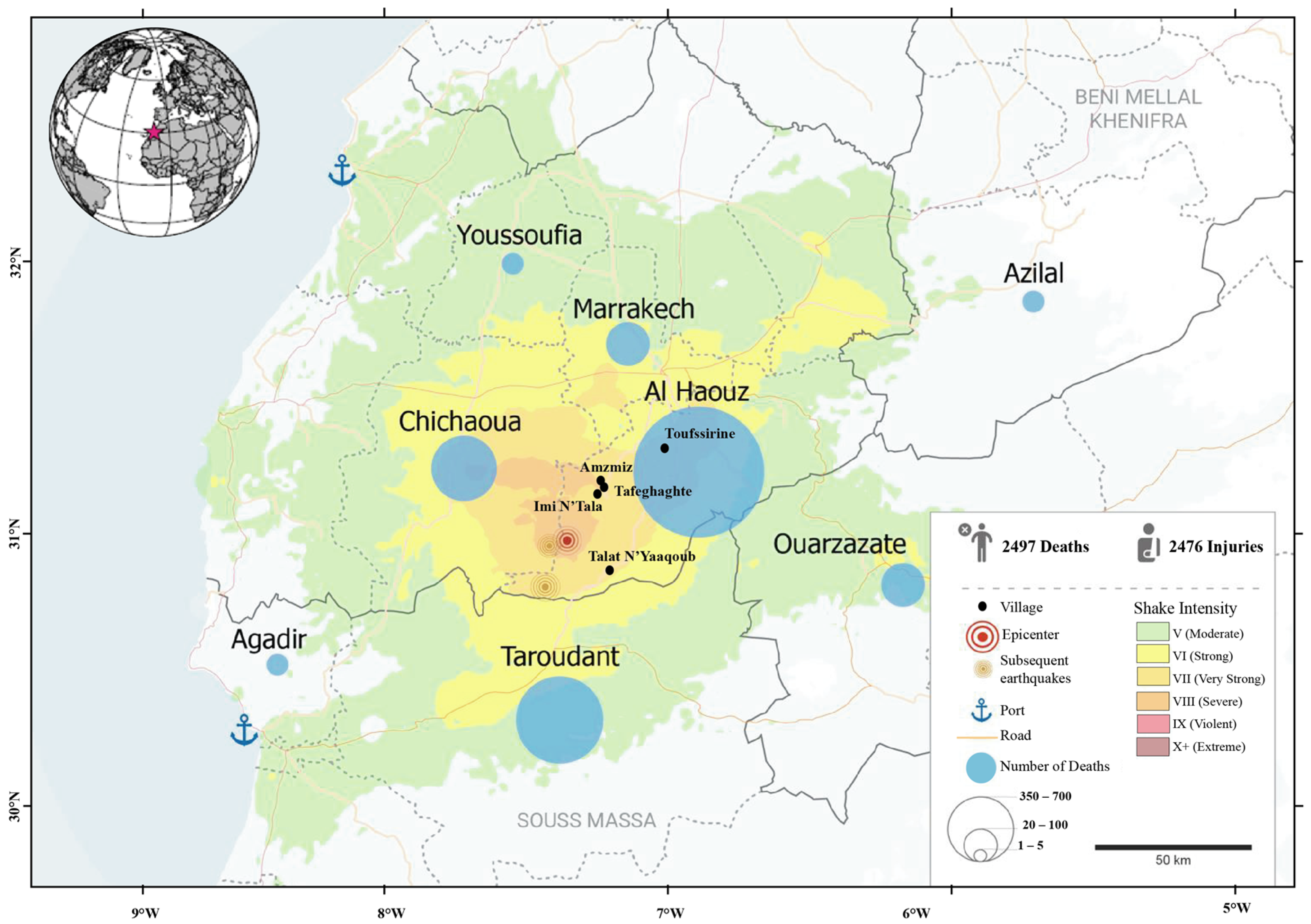
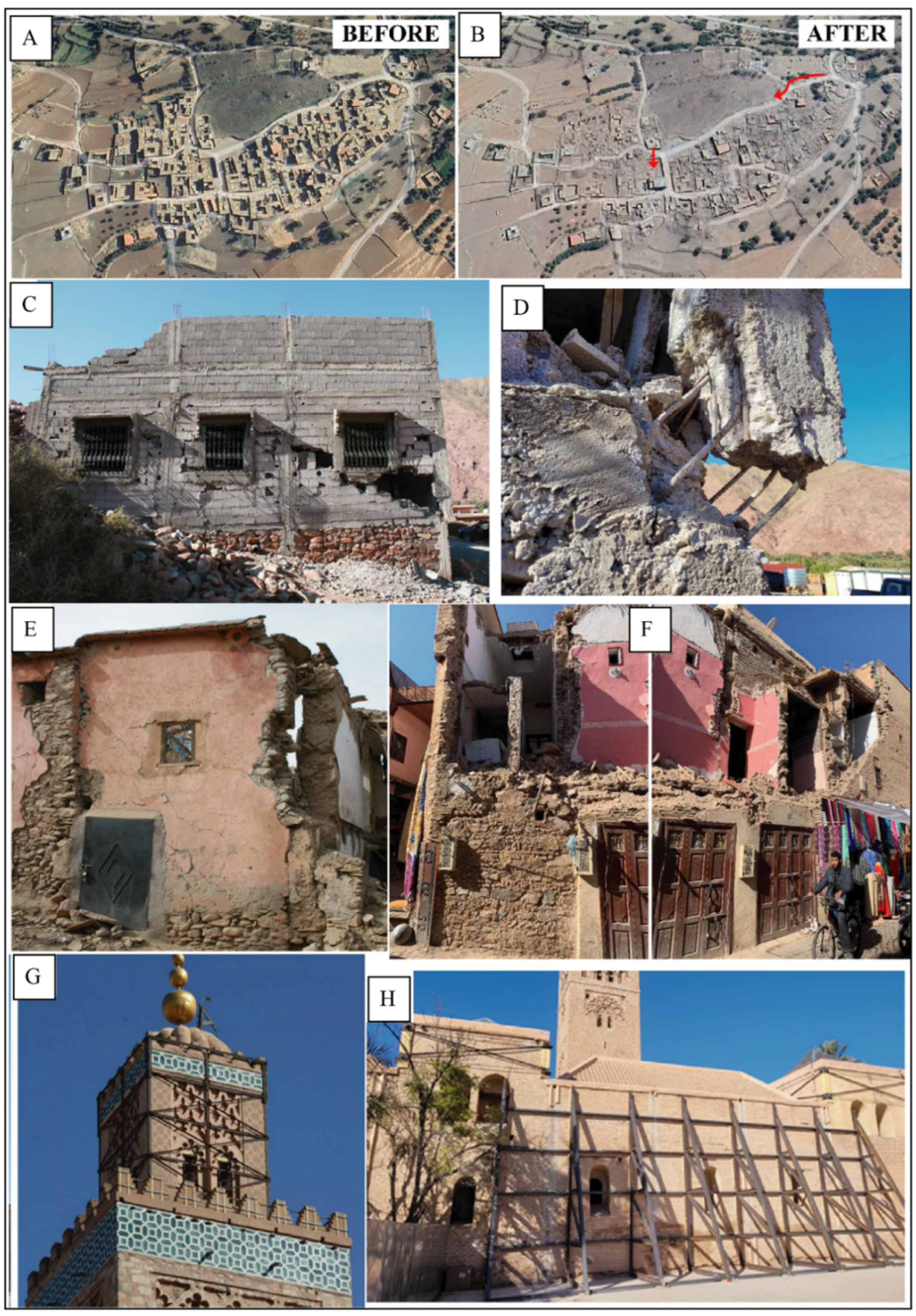
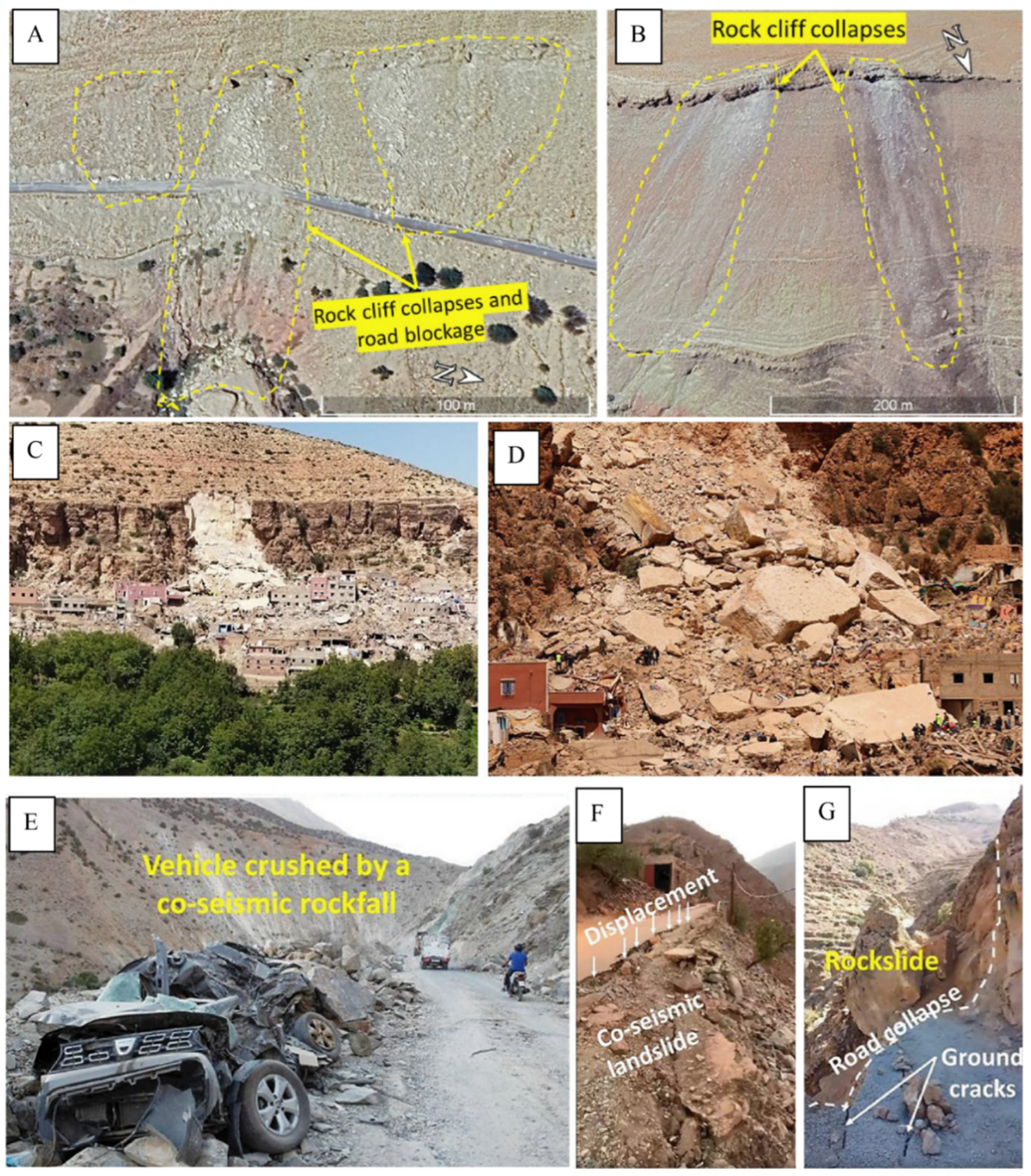
4.2. The 2023 Al Haouz Earthquake: Processes and Impacts
4.3. Geoheritage Significance of the 2023 Al Haouz Earthquake


5. Discussion
5.1. Challenges for Documentation, Access, and Preservation
5.2. Social Memory, Cultural Heritage, and Community Perspective
5.3. Geoeducation, Risk Awareness, and Resilience
5.4. Geoheritage Valorisation and Geoproduct Opportunities
5.5. Turning Dark Geoheritage into Forward-Thinking Geohazard Resilience Development
6. Conclusions
Author Contributions
Funding
Data Availability Statement
Conflicts of Interest
References
- Nichols, J.; Beavers, J. Development and Calibration of an Earthquake Fatality Function. Earthq. Spectra 2003, 19, 605–633. [Google Scholar] [CrossRef]
- Shin, J.Y.; Chen, S.; Kim, T.-W. Application of Bayesian Markov Chain Monte Carlo method with mixed gumbel distribution to estimate extreme magnitude of tsunamigenic earthquake. KSCE J. Civ. Eng. 2015, 19, 366–375. [Google Scholar] [CrossRef]
- Rashid, M.; Ahmad, N. Economic losses due to earthquake—Induced structural damages in RC SMRF structures. Cogent Eng. 2017, 4, 1296529. [Google Scholar] [CrossRef]
- Long, L.; Zheng, S.; Zhang, Y.; Sun, L.; Zhou, Y.; Dong, L. CEDLES: A framework for plugin-based applications for earthquake risk prediction and loss assessment. Nat. Hazards 2020, 103, 531–556. [Google Scholar] [CrossRef]
- Li, S.; Ni, Z.; Zhao, Y.; Hu, W.; Long, Z.; Ma, H.; Zhou, G.; Luo, Y.; Geng, C. Susceptibility Analysis of Geohazards in the Longmen Mountain Region after the Wenchuan Earthquake. Int. J. Environ. Res. Public Health 2022, 19, 3229. [Google Scholar] [CrossRef]
- Chávez-García, F.J.; Monsalve Jaramillo, H.; Gómez Cano, M.; Vila Ortega, J.J. Vulnerability and Site Effects in Earthquake Disasters in Armenia (Colombia). I—Site Effects. Geosciences 2018, 8, 254. [Google Scholar] [CrossRef]
- Godínez-Domínguez, E.A.; Tena-Colunga, A.; Pérez-Rocha, L.E.; Archundia-Aranda, H.I.; Gómez-Bernal, A.; Ruiz-Torres, R.P.; Escamilla-Cruz, J.L. The September 7, 2017 Tehuantepec, Mexico, earthquake: Damage assessment in masonry structures for housing. Int. J. Disaster Risk Reduct. 2021, 56, 102123. [Google Scholar] [CrossRef]
- Tavera, H.; Bernal, I. The Pisco (Peru) Earthquake of 15 August 2007. Seismol. Res. Lett. 2008, 79, 510–515. [Google Scholar] [CrossRef]
- UNDRR. UNDRR. Global Natural Disaster Assessment Report 2019. 2020. Available online: https://www.preventionweb.net/files/73363_2019globalnaturaldisasterassessment.pdf (accessed on 4 January 2026).
- EERI. The MW 8.8 Chile Earthquake of February 27, 2010. Earthquake Engineering Research Institute (EERI) Newsletter, Special Earthquake Report: 20p. 2010. Available online: https://lfestorage.s3.us-east-2.amazonaws.com/images/2010_02_27_chile/pdfs/Chile10_insert.pdf (accessed on 7 February 2026).
- Dollet, C.; Guéguen, P. Global occurrence models for human and economic losses due to earthquakes (1967–2018) considering exposed GDP and population. Nat. Hazards 2022, 110, 349–372. [Google Scholar] [CrossRef]
- Ahmed, S.K.; Chandran, D.; Hussein, S.; Sv, P.; Chakraborty, S.; Islam, M.R.; Dhama, K. Environmental Health Risks After the 2023 Turkey-Syria Earthquake and Salient Mitigating Strategies: A Critical Appraisal. Environ. Health Insights 2023, 17, 11786302231200865. [Google Scholar] [CrossRef]
- Sassa, S.; Takagawa, T. Liquefied gravity flow-induced tsunami: First evidence and comparison from the 2018 Indonesia Sulawesi earthquake and tsunami disasters. Landslides 2019, 16, 195–200. [Google Scholar] [CrossRef]
- Hidayat, R.; Kiyota, T.; Tada, N.; Hayakawa, J.; Nawir, H. Reconnaissance on Liquefaction-induced Flow Failure Caused by the 2018 Mw 7.5 Sulawesi Earthquake, Palu, Indonesia. J. Eng. Technol. Sci. 2020, 52, 51. [Google Scholar] [CrossRef]
- Kiyota, T.; Furuichi, H.; Hidayat, R.F.; Tada, N.; Nawir, H. Overview of long-distance flow-slide caused by the 2018 Sulawesi earthquake, Indonesia. Soils Found. 2020, 60, 722–735. [Google Scholar] [CrossRef]
- Kiyota, T.; Shiga, M.; Mori, K.; Katagiri, T.; Furuichi, H.; Setiawan, H. Triggering mechanism of long-distance flow-type landslides caused by 2018 Sulawesi Earthquake, Indonesia. Soils Found. 2025, 65, 101544. [Google Scholar] [CrossRef]
- Yin, Y. Researches on the geo-hazards triggered by Wenchuan earthquake, Sichuan. J. Eng. Geol. 2008, 16, 433–444. [Google Scholar]
- Li, Y.; Zhang, Z.; Wang, W.; Feng, X. Rapid Estimation of Earthquake Fatalities in Mainland China Based on Physical Simulation and Empirical Statistics-A Case Study of the 2021 Yangbi Earthquake. Int. J. Environ. Res. Public Health 2022, 19, 6820. [Google Scholar] [CrossRef]
- Cui, P.; Chen, X.-Q.; Zhu, Y.-Y.; Su, F.-H.; Wei, F.-Q.; Han, Y.-S.; Liu, H.-J.; Zhuang, J.-Q. The Wenchuan Earthquake (May 12, 2008), Sichuan Province, China, and resulting geohazards. Nat. Hazards 2011, 56, 19–36. [Google Scholar] [CrossRef]
- Migoń, P.; Pijet-Migoń, E. Natural Disasters, Geotourism, and Geo-interpretation. Geoheritage 2019, 11, 629–640. [Google Scholar] [CrossRef]
- Scarlett, J.P.; Riede, F. The Dark Geocultural Heritage of Volcanoes: Combining Cultural and Geoheritage Perspectives for Mutual Benefit. Geoheritage 2019, 11, 1705–1721. [Google Scholar] [CrossRef]
- Németh, K.; Sowaigh, A.; Zakharovskyi, V.; Toni, M.; Ashor, M.; Sokolov, V.; Moqeem, F.; Abdulhafaz, K.; Hablil, T.; Sehli, T.; et al. The Volcanic Geoheritage in the Pristine Natural Environment of Harrat Lunayyir, Saudi Arabia: Opportunities for Geotourism and Geohazard Issues. Heritage 2025, 8, 363. [Google Scholar] [CrossRef]
- Guilbaud, M.N.; Villalba, N.I.; Osnaya, E.R.; del Pilar Ortega-Larrocea, M.; Zeno-Lira, E.; Cram-Heydrich, S. The multiple values of urban geosites: El Arenal and Viaje a la Naturaleza parks in Mexico City. Geofis. Int. 2024, 63, 1067–1085. [Google Scholar] [CrossRef]
- Németh, K.; Moufti, M.R.; Mahmoud, A.; Sowaigh, A.; Hablil, T.; Hassan, K.; Sehli, T. The Vanishing Volcanic Geoheritage of a Key Scoria Cone and its Significance in Volcanic Hazard Resilience of the Active Monogenetic Volcanic Field near Al Madinah, Kingdom of Saudi Arabia. Geoconserv. Res. 2023, 6, 29–52. [Google Scholar] [CrossRef]
- Stix, J.; Heiken, G. Communication when it is needed most—The past, present and future of volcano geoheritage. Bull. Volcanol. 2022, 84, 68. [Google Scholar] [CrossRef]
- Németh, K. Geoheritage and geodiversity aspects of catastrophic volcanic eruptions: Lessons from the 15th of January 2022 Hunga Tonga—Hunga Ha’apai eruption, SW Pacific. Int. J. Geoherit. Parks 2022, 10, 546–568. [Google Scholar] [CrossRef]
- Sotiriou, P.; Nunes, P. Volcanic Landscapes and Geotourism Development: Analysing How Madeira’s Volcanic Origin Shapes its Tourism Industry, with a Focus on Hiking Tours and Scenic Viewpoints. Geoheritage 2025, 17, 54. [Google Scholar] [CrossRef]
- Navasardyan, G.; Meliksetian, K.; Savov, I.P.; Gevorgyan, H.; Bangoyan, M.; Galstyan, A.; Grigoryan, E. Volcanic Geoheritage and Geotouristic Potential of the Gegham Monogenetic Volcanic Upland (Armenia). Geoheritage 2025, 17, 146. [Google Scholar] [CrossRef]
- Kovacs, M.; Szakács, A.; Andrăşanu, A.; Denuț, I. The “Gutâi-Maramureș” UNESCO Geopark Project Development and Heritage Values-Based Sustainable Tourism in the Gutâi Volcanic Zone, East Carpathians (Romania). Land 2025, 14, 726. [Google Scholar] [CrossRef]
- Arias-Díaz, A.; Ibargüen-Angulo, E.; Murcia, H.; Osorio-Ocampo, S.; Bolaños-Cabrera, G.; Botero-Gómez, L.A.; Riascos-Hurtado, A. Geotourism in Monogenetic Volcanoes: The Case of Tapias-Guacaica Monogenetic Volcanic Field in Colombia. Heritage 2025, 8, 185. [Google Scholar] [CrossRef]
- Redouane, M.; Lagnaoui, A.; Haissen, F.; Sadki, O.; Raji, M. Volcanic Geoheritage at the Ne of Morocco: Selected Sites of Oujda and Guercif (Jorf Lakhdar and Guilliz). Geoheritage 2024, 16, 133. [Google Scholar] [CrossRef]
- Szakács, A.; Kovacs, M. Volcanic Landforms and Landscapes of the East Carpathians (Romania) and Their Geoheritage Values. Land 2022, 11, 1064. [Google Scholar] [CrossRef]
- Hernández, W.; Dóniz-Páez, J.; Pérez, N.M. Urban Geotourism in La Palma, Canary Islands, Spain. Land 2022, 11, 1337. [Google Scholar] [CrossRef]
- Erfurt-Cooper, P. Volcano Tourism and Visitor Safety: Still Playing with Fire? A 10-Year Update. Geoheritage 2022, 14, 56. [Google Scholar] [CrossRef]
- Henriques, M.H. Broadening Frontiers in Geoconservation: The Concept of Intangible Geoheritage Represented by the 1755 Lisbon Earthquake. Geoheritage 2023, 15, 57. [Google Scholar] [CrossRef]
- Hassani, M.J.; Hairapetian, V. The Crassostrea Coquina Bed in the Qeshm Geopark (Southern Iran): Paleontology, Paleoecology and Geotourism Potential. Geoconserv. Res. 2025, 81. [Google Scholar] [CrossRef]
- Krishnapriya, V.K.; Amrutha, A.S.; Rajaneesh, A.; Pradeep, G.S.; Sankar, G.; Nandakumar, D.; Muraleedharan, C.; Kanungo, D.P.; Ali, A.P.; Martha, T.R.; et al. From Disaster To Conservation: Geoheritage Potential of the 2024 Wayanad Landslide, India. Geoheritage 2025, 17, 125. [Google Scholar] [CrossRef]
- Aleksova, B.; Milevski, I.; Lukić, T.; Marković, S.B.; Perić, Z.M. Preliminary Assessment of Hydrological Heritage in North Macedonia: A Novel Contribution to Geodiversity Protection. Geoheritage 2025, 17, 47. [Google Scholar] [CrossRef]
- Vandelli, V.; Migoń, P.; Palmgren, Y.; Spyrou, E.; Saitis, G.; Andrikopoulou, M.E.; Coratza, P.; Medjkane, M.; Prieto, C.; Kalovrektis, K.; et al. Towards Enhanced Understanding and Experience of Landforms, Geohazards, and Geoheritage through Virtual Reality Technologies in Education: Lessons from the GeoVT Project. Geosciences 2024, 14, 127. [Google Scholar] [CrossRef]
- Migoń, P. The Kamienne Mountains—Late Palaeozoic Volcanic Terrain Shaped by Late Quaternary Landslides. In World Geomorphological Landscapes; Springer: Cham, Switzerland, 2024; pp. 177–189. [Google Scholar]
- Al’Afif, M.; Sartohadi, J.; Samodra, G. Impact of landslide on geoheritage: Opportunities through integration, geomorphological classification and machine learning. Int. J. Geoherit. Parks 2024, 12, 333–351. [Google Scholar] [CrossRef]
- Tronti, G.; Vergari, F.; Bollati, I.M.; Belisario, F.; Del Monte, M.; Pelfini, M.; Fredi, P. From landslide characterization to nature reserve management: The “Scialimata Grande di Torre Alfina” landslide Geosite (Central Apennines, Italy). J. Mt. Sci. 2023, 20, 585–606. [Google Scholar] [CrossRef]
- Morino, C.; Coratza, P.; Soldati, M. Landslides, a Key Landform in the Global Geological Heritage. Front. Earth Sci. 2022, 10, 864760. [Google Scholar] [CrossRef]
- Fepuleai, A.; Németh, K. Volcanic Geoheritage of Landslides and Rockfalls on a Tropical Ocean Island (Western Samoa, SW Pacific). Geoheritage 2019, 11, 577–596. [Google Scholar] [CrossRef]
- Panizza, M. The geomorphodiversity of the Dolomites (Italy): A Key of geoheritage assessment. Geoheritage 2009, 1, 33–42. [Google Scholar] [CrossRef]
- Baadi, K.; Németh, K. Volcanic Landscape of the Middle Atlas: A Representative Heritage of Moroccan Geological History. In Geoheritage of the Middle Atlas (Morocco); Baadi, K., Ed.; Springer International Publishing: Cham, Switzerland, 2023; pp. 195–218. [Google Scholar]
- Baadi, K.; Tefogoum, G.Z.; Amine, A. The Volcanism of the Plio-Quaternary of Azrou-Timahdite Plateau (Central Middle Atlas, Morocco): Potential for Geotourism Development. In Geoheritage of the Middle Atlas (Morocco); Baadi, K., Ed.; Springer International Publishing: Cham, Switzerland, 2023; pp. 219–232. [Google Scholar]
- Benamrane, M.; Németh, K.; Jadid, M.; Talbi, E.H. Geomorphological Classification of Monogenetic Volcanoes and Its Implication to Tectonic Stress Orientation in the Middle Atlas Volcanic Field (Morocco). Land 2022, 11, 1893. [Google Scholar] [CrossRef]
- El Mrabet, T. Earthquake History of Morocco. Third-Cycle Unpublished Thesis, Humanities and Social Sciences Faculty, Mohammed V University, Rabat, Morocco, 1991; 375p. [Google Scholar]
- El Mrabet, T. The Great Earthquakes in the Maghreb Region and Their Consequences on Man and Environment; Centre National de Recherche Scientifique et Technique: Rabat, Morocco, 2005; Volume 451. [Google Scholar]
- Cherkaoui, T.-E. Seismicity and Seismic Hazard in Morocco 1901–2010. Bull. l’Inst. Sci. 2012, 34, 45–55. [Google Scholar]
- Falconer, B. Agadir, Morocco, reconstruction work six years after the earthquake of February 1960. Bull. N. Z. Soc. Earthq. Eng. 1968, 1, 72–91. [Google Scholar] [CrossRef]
- Paradise, T.R. Perception of earthquake risk in Agadir, Morocco: A case study from a Muslim community. Glob. Environ. Chang. Part B Environ. Hazards 2005, 6, 167–180. [Google Scholar] [CrossRef]
- Tahayt, A.; Feigl, K.L.; Mourabit, T.; Rigo, A.; Reilinger, R.; McClusky, S.; Fadil, A.; Berthier, E.; Dorbath, L.; Serroukh, M.; et al. The Al Hoceima (Morocco) earthquake of 24 February 2004, analysis and interpretation of data from ENVISAT ASAR and SPOT5 validated by ground-based observations. Remote Sens. Environ. 2009, 113, 306–316. [Google Scholar] [CrossRef]
- van der Woerd, J.; Dorbath, C.; Ousadou, F.; Dorbath, L.; Delouis, B.; Jacques, E.; Tapponnier, P.; Hahou, Y.; Menzhi, M.; Frogneux, M.; et al. The Al Hoceima Mw 6.4 earthquake of 24 February 2004 and its aftershocks sequence. J. Geodyn. 2014, 77, 89–109. [Google Scholar] [CrossRef]
- Kariche, J.; Meghraoui, M.; Timoulali, Y.; Cetin, E.; Toussaint, R. The Al Hoceima earthquake sequence of 1994, 2004 and 2016: Stress transfer and poroelasticity in the Rif and Alboran Sea region. Geophys. J. Int. 2018, 212, 42–53. [Google Scholar] [CrossRef]
- Skikra, H.; Amrouch, K.; Soulaimani, A.; Leprêtre, R.; Ouabid, M.; Bodinier, J.-L. The intracontinental High Atlas belt: Geological overview and pending questions. Arab. J. Geosci. 2021, 14, 1071. [Google Scholar] [CrossRef]
- Froitzheim, N.; Stets, J.; Wurster, P. Aspects of Western High Atlas tectonics. In The Atlas System of Morocco: Studies on Its Geodynamic Evolution; Jacobshagen, V.H., Ed.; Springer: Berlin/Heidelberg, Germany, 1988; pp. 219–244. [Google Scholar]
- El Harfi, A.; Lang, J.; Salomon, J.; Chellai, E. Cenozoic sedimentary dynamics of the Ouarzazate foreland basin (Central High Atlas Mountains, Morocco). Int. J. Earth Sci. 2001, 90, 393–411. [Google Scholar] [CrossRef]
- Fraissinet, C.; El Zouine, M.; Morel, J.-L.; Poisson, A.; Andrieux, J.; Faure-Muret, A. Structural evolution of the southern and northern Central High Atlas in paleogene and Mio-Pliocene times. In The Atlas System of Morocco: Studies on its Geodynamic Evolution; Jacobshagen, V.H., Ed.; Springer: Berlin/Heidelberg, Germany, 1988; pp. 273–291. [Google Scholar]
- Leprêtre, R.; Missenard, Y.; Barbarand, J.; Gautheron, C.; Jouvie, I.; Saddiqi, O. Polyphased Inversions of an Intracontinental Rift: Case Study of the Marrakech High Atlas, Morocco. Tectonics 2018, 37, 818–841. [Google Scholar] [CrossRef]
- Proust, F.; Petit, J.-P.; Tapponnier, P. L’accident du Tizi n’Test et le role des decrochements dans la tectonique du Haut Atlas occidental (Maroc). Bull. Soc. Géol. Fr. 1977, 7, 541–551. [Google Scholar] [CrossRef]
- Mustaphi, H.; Medina, F.; Jabour, H.; Hoepffner, C. Le bassin du Souss (Zone de Faille du Tizi n’Test, Haut Atlas occidental, Maroc): Résultat d’une inversion tectonique contrlée par une faille de détachement profonde. J. Afr. Earth Sci. 1997, 24, 153–168. [Google Scholar] [CrossRef]
- Boulton, S.J.; Stokes, M.; Mather, A.E. Transient fluvial incision as an indicator of active faulting and Plio-Quaternary uplift of the Moroccan High Atlas. Tectonophysics 2014, 633, 16–33. [Google Scholar] [CrossRef]
- Hassan, O.; Petit, J.-P. La limite sud de la chaîne hercynienne dans le Haut Atlas (Maroc): Reconstitution d’un saillant non déformé. Bull. Soc. Geol. Fr. 1992, 163, 63–72. [Google Scholar]
- Missenard, Y.; Taki, Z.; Frizon de Lamotte, D.; Benammi, M.; Hafid, M.; Leturmy, P.; Sébrier, M. Tectonic styles in the Marrakesh High Atlas (Morocco): The role of heritage and mechanical stratigraphy. J. Afr. Earth Sci. 2007, 48, 247–266. [Google Scholar] [CrossRef]
- Hafid, M.; Zizi, M.; Bally, A.W.; Ait Salem, A. Structural styles of the western onshore and offshore termi-nation of the High Atlas, Morocco. Comptes Rendus Geosci. 2006, 338, 50–64. [Google Scholar] [CrossRef]
- Beauchamp, W.; Allmendinger, R.W.; Barazangi, M.; Demnati, A.; El Alji, M.; Dahmani, M. Inversion tectonics and the evolution of the High Atlas Mountains, Morocco, based on a geological-geophysical transect. Tectonics 1999, 18, 163–184. [Google Scholar] [CrossRef]
- Teixell, A.; Arboleya, M.-L.; Julivert, M.; Charroud, M. Tectonic shortening and topography in the central High Atlas (Morocco). Tectonics 2003, 22. [Google Scholar] [CrossRef]
- Teixell, A.; Ayarza, P.; Tesón, E.; Babault, J.; Alvarez-Lobato, F.; Mohammed, C.; Julivert, M.; Barbero, L.; Mostafa, A.; Arboleya, M. Geodinámica de las cordilleras del Alto y Medio Atlas: Síntesis de los conocimientos actuales. Rev. Soc. Geol. Esp. 2007, 20, 119–135. [Google Scholar]
- Teixell, A.; Ayarza, P.; Zeyen, H.; Fernàndez, M.; Arboleya, M.-L. Effects of mantle upwelling in a compressional setting: The Atlas Mountains of Morocco. Terra Nova 2005, 17, 456–461. [Google Scholar] [CrossRef]
- Lanari, R.; Faccenna, C.; Fellin, M.G.; Essaifi, A.; Nahid, A.; Medina, F.; Youbi, N. Tectonic Evolution of the Western High Atlas of Morocco: Oblique Convergence, Reactivation, and Transpression. Tectonics 2020, 39, e2019TC005563. [Google Scholar] [CrossRef]
- Saura, E.; Vergés, J.; Martín-Martín Juan, D.; Messager, G.; Moragas, M.; Razin, P.; Grélaud, C.; Joussiaume, R.; Malaval, M.; Homke, S.; et al. Syn- to post-rift diapirism and minibasins of the Central High Atlas (Morocco): The changing face of a mountain belt. J. Geol. Soc. 2014, 171, 97–105. [Google Scholar] [CrossRef]
- Skikra, H.; Amrouch, K.; Soulaimani, A. Paleostress constraints on the tectonic evolution of the Central High Atlas orogen. J. Struct. Geol. 2024, 186, 105198. [Google Scholar] [CrossRef]
- Enniouar, A.; Lagnaoui, A.; Habib, A. A Middle Jurassic sauropod tracksite in the Argana Basin, Western High Atlas, Morocco: An example of paleoichnological heritage for sustainable geotourism. Proc. Geol. Assoc. 2014, 125, 114–119. [Google Scholar] [CrossRef]
- Amine, F.; Berrahma, M.H.; Aarab, A. Inventory and Management of Dinosaurs Traces: A case Study of Azilal Region, Morocco. Int. J. Glob. Sci. Res. 2018, 5, 198687588. [Google Scholar] [CrossRef]
- Amine, F.; Berrahma, M.; Aarab, A. Dinosaurs Footprints of the High Atlas Morocco by using Geological Heritage Information System. Int. J. Adv. Res. Eng. Technol. 2020, 11, 982–993. [Google Scholar] [CrossRef]
- Lkebir, N.; Masrour, M.; Pascual-Arribas, C.; de Ducla, M.; Hernández-Medrano, N.; Pérez-Lorente, F. Short report: The Anza tracksite: Ichnological heritage and geoeducational significance of dinosaur and pterosaur tracks in coastal Morocco. J. Afr. Earth Sci. 2020, 171, 103949. [Google Scholar] [CrossRef]
- Ait Haddou, M.; Bouchriti, Y.; Belkacim, S.; Yazdi, A.; Kabbachi, B. Late Carboniferous Paleoflora of El Menizla Formation (Argana Corridor, Morocco): Implications for Geotourism and Geoconservation. Geoheritage 2025, 17, 151. [Google Scholar] [CrossRef]
- Bouzekraoui, H.; Barakat, A.; El Youssi, M.; Touhami, F.; Mouaddine, A.; Hafid, A. Mapping geosites as gateways to the geotourism management in Central High-Atlas (Morocco). Quaest. Geogr. 2018, 37, 87–102. [Google Scholar] [CrossRef]
- Bouzekraoui, H.; Barakat, A.; Mouaddine, A.; El Youssi, M.; Touhami, F.; Hafid, A. Mapping geoheritage for geotourism management, a case study of Aït Bou Oulli Valley in Central High-Atlas (Morocco). Environ. Earth Sci. 2018, 77, 413. [Google Scholar] [CrossRef]
- Bouzekraoui, H.; Barakat, A.; Touhami, F.; Mouaddine, A.; Youssi, M.E. Inventory and assessment of geomorphosites for geotourism development: A case study of Aït Bou Oulli valley (Central High-Atlas, Morocco). Area 2018, 50, 331–343. [Google Scholar] [CrossRef]
- Ait Omar, T.; Taïbi, A.N.; El Hannani, M.; El Khalki, Y. New methodology for inventory and assessment of geomorphosites in the M’goun geopark (Morocco)—Nouvelle méthodologie d’inventaire et d’évaluation des géomorphosites dans le contexte du géoparc M’goun (Maroc). Geo-Eco-Trop 2019, 43, 569–580. [Google Scholar]
- Ait Omar, T.; Yahia, E.K.; TaÏBi, A.N.; El Hannani, M. Les géopatrimoines de la partie nord-est du géoparc régional du M’Goun (Maroc): Représentations sociales et valorisation géotouristique. Geo-Regards 2022, 14, 157–173. [Google Scholar] [CrossRef]
- Ait Omar, T.; Yahia, E.K.; TaÏBi, A.N.; El Hannani, M.; Haddou, A. A quantitative method for inventory and assessment of geoheritage in the Beni Mellal Atlas Mountains, Morocco. Cinq Cont. 2023, 12, 174–196. [Google Scholar]
- Louz, E.; Rais, J.; Ait Barka, A.; Nadem, S.; Barakat, A. Geological heritage of the Taguelft syncline (M’Goun Geopark): Inventory, assessment, and promotion for geotourism development (Central High Atlas, Morocco). Int. J. Geoherit. Parks 2022, 10, 218–239. [Google Scholar] [CrossRef]
- Louz, E.; Rais, J.; Barakat, A.; Ait Barka, A.; Nadem, S. Inventory and Assessment of Geosites and Geodiversity Sites of the Ait Attab Syncline (M’goun Unesco Geopark, Morocco) to Stimulate Geoconservation, Geotourism and Sustainable Development. Quaest. Geogr. 2023, 42, 115–143. [Google Scholar] [CrossRef]
- Louz, E.; Rais, J.; Barakat, A.; El Baghdadi, M. Identification of Potential Areas for the Development of Geotourism in the Northern Part of the M’goun Geopark (Morocco) Using Multi-Criteria Analysis and Sig. Geoheritage 2024, 17, 11. [Google Scholar] [CrossRef]
- El Ouali, M.; Essafraoui, B.; Kabiri, L.; Messaoudi, B.; Ait Lahssaine, I.; Krencker, F.-N.; Martindale, R.C.; Nutz, A.; Bodin, S. Quantitative Assessment and Enhancement of 12 Sites of Geological Interest South of Midelt City (Tizi N’Talghemt, Central High Atlas, Morocco). Geoheritage 2025, 17, 63. [Google Scholar] [CrossRef]
- El Ouali, M.; Kabiri, L.; Essafraoui, B.; Ben Bammou, M.; Ait Lahssaine, I.; Messaoudi, B.; Martindale, R. Geosites and geodiversity sites of the Tinghir–Dades–Imilchil area, Morocco: Toward conservation, education, and tourism development. Int. J. Geoherit. Parks 2025, 13, 652–670. [Google Scholar] [CrossRef]
- Arrad, T.Y.; Errami, E.; Ennih, N.; Ouajhain, B.; Ettachfini, E.M.; Bouaouda, M.S. Inventory, evaluation and promotion of the Essaouira Province geoheritage (Morocco): Toward a local and socio-economic sustainable development. In Proceedings of the EGU General Assembly 2020, Online, 4–8 May 2020. [Google Scholar] [CrossRef]
- Arrad, T.Y.; Errami, E.; Ennih, N.; Ouajhain, B.; Ettachfini, E.M.; Bouaouda, M.S. From geoheritage inventory to geoeducation and geotourism implications: Insight from Jbel Amsittene (Essaouira province, Morocco). J. Afr. Earth Sci. 2020, 161, 103656. [Google Scholar] [CrossRef]
- Bussard, J. Heritage value and didactic potential of geomorphological landscapes: The case of eight sites in the Central High Atlas (Morocco). In Proceedings of the 10th International Conference on Geomorphology, Coimbra, Portugal, 12–16 September 2022. [Google Scholar] [CrossRef]
- Bussard, J. Geomorphological landscapes of the M’Goun Geopark (Morocco): Potential for geotourism and local guides’ perspective. In EGU General Assembly Conference Abstracts, Proceedings of the EGU General Assembly 2023, Vienna, Austria, 24–28 April 2023; EGU: Vienna, Austria, 2023. [Google Scholar] [CrossRef]
- Si Mhamdi, H.; Ali, C.; Oukassou, M.; Amar, A.; Baidder, L.; Raji, M.; Ijaajaane, A.; Elfaiz, S.; el Ouariti, S. Enhancing the Geological Heritage of the Errachidia Area in the High Atlas, Morocco: Inventory and a Proposal for a Pedagogic and Geotouristic Trail. Geoheritage 2023, 15, 45. [Google Scholar] [CrossRef]
- Elkaichi, A.; Errami, E.; Patel, N. Evaluation of Geotouristic Station Suitability Using GIS-Based Multi-criteria Decision Analysis: A Case Study of the M’Goun UNESCO Geopark, High Atlas (Morocco). Geoheritage 2023, 15, 36. [Google Scholar] [CrossRef]
- Elkaichi, A.; Errami, E.; Patel, N. Canyons as potential geotourism attractions of Central High Atlas, Morocco: Comparative analysis of Aït Bouguemaz Valley and Zaouiat Ahansal-Taghia Valley by using GAM model. Int. J. Geoherit. Parks 2024, 12, 20–36. [Google Scholar] [CrossRef]
- Naimi, L.; Manaouch, M.; Jakimi, A. Leveraging machine learning algorithms to identify potential geosites for geotourism promotion in Ziz upper watershed in southeastern Morocco. Geoj. Tour. Geosites 2024, 57, 2041–2051. [Google Scholar] [CrossRef]
- Manaouch, M.; Naimi, L.; Haynou, M.; Aghad, M.; Sadiki, M.; Pham, Q.B.; Jakimi, A. Enhancing Geotourism in Southeastern Morocco through Machine Learning-Based Geomorphosite Identification. Geoheritage 2025, 17, 34. [Google Scholar] [CrossRef]
- Kchikach, N.; Ibouh, H.; Benali, A.; Charbaoui, A.; El Fels, A.E. Digital Promotion of Geoheritage along a Tourist Route in M’Goun UNESCO Geopark (Central High Atlas, Morocco) and Visitor Typology Analysis. Geosciences 2024, 14, 141. [Google Scholar] [CrossRef]
- El hamidy, M.; Errami, E.; Elkaichi, A. An overview of scientific research on geoheritage in Morocco. Proc. Geol. Assoc. 2024, 135, 162–180. [Google Scholar] [CrossRef]
- Noureddine, B.; Adarab, H.; Abdelkrim, E. Geotourism in Idaoutananes Moroccan Western High Atlas: State of valuation and opportunity of improvement. J. Geogr. Geol. 2015, 7, 35–48. [Google Scholar] [CrossRef]
- Achkir, H. The geological heritage of central High Atlas: An asset for integrated geotourism (case of Assif Melloul crossing (common territorial of Anergui and Tillouguite) in the province of Azilal; Béni Mellal-Khénifra-region/Morocco). Int. J. Sci. Res. 2018, 7, 1541–1552. [Google Scholar]
- Rais, J.; Barakat, A.; Louz, E.; Ait Barka, A. Geological heritage in the M’Goun geopark: A proposal of geo-itineraries around the Bine El Ouidane dam (Central High Atlas, Morocco). Int. J. Geoherit. Parks 2021, 9, 242–263. [Google Scholar] [CrossRef]
- El Alami, A.; Fattah, A.; Bouzekraoui, H. Biodiversity, an essential component for the M’goun global geopark development (Morocco)—An overview. J. Anal. Sci. Appl. Biotechnol. 2021, 3, 103–106. [Google Scholar] [CrossRef]
- Elkaichi, A.; Errami, E.; Patel, N. Quantitative assessment of the geodiversity of M’Goun UNESCO Geopark, Central High Atlas (Morocco). Arab. J. Geosci. 2021, 14, 2829. [Google Scholar] [CrossRef]
- Ait Barka, A.; Rais, J.; Barakat, A.; Louz, E.; Nadem, S. The Geosite of Travertine Waterfall of El Ksiba (Morocco): A Heritage to Enhance and Preserve. Proceedings 2023, 87, 16. [Google Scholar] [CrossRef]
- Ait Barka, A.; Rais, J.; Barakat, A.; Louz, E.; Nadem, S. The Karst Landscapes of Beni Mellal Atlas (Central Morocco): Identification for Promoting Geoconservation and Tourism. Quaest. Geogr. 2022, 41, 87–109. [Google Scholar] [CrossRef]
- Toufik Ait, O.; Yahia El, K.; Haddou, A. Contribution of social perception for identifying geomorphological potential and touristic practices in the North-Eastern part of the M’goun Regional Geopark, Morocco. Afr. Sci. J. 2022, 3, 307. [Google Scholar] [CrossRef]
- Asmae, A.; Sarrah, E.; Mohamed, A.; Abdelkrim, E. Cultural Heritage in Imghranes Massif (Drâa-Tafilalet Region, Morocco): An Optimist’s Contribution and opportunity for the local people and Sustainable Tourism. Int. J. Innov. Appl. Stud. 2022, 37, 387–391. [Google Scholar]
- Aichi, A.; Ezaidi, A.; Abioui, M.; En–Nasiry, M.; Nenad, B.; Jelena, M.; Dalibor, P. From geoheritage to geoeducation and geotourism: The Imghranes Massif, Drâa-Tafilalet region, Morocco. In Proceedings of the International Symposium “Geodiversity and Geoheritage-Status and Perspectives”, Perušić, Croatia, 7–9 October 2022. [Google Scholar]
- Bussard, J.; Martin, S.; Monbaron, M.; Reynard, E.; Yahia, E.K. Les paysages géomorphologiques du Haut Atlas central (Maroc): Potentiel éducatif et éléments pour la médiation scientifique. Géomorphol. Relief Process. Environ. 2023, 28, 173–185. [Google Scholar] [CrossRef]
- El Khalki, Y.; Hobléa, F.; Benzidiya, K.; Driss, A.; Kottabi, S.E. M’Goun UNESCO Geopark (Central High Atlas, Morocco), a lever for sustainable and integrated territorial development: What approach to adopt? In Proceedings of the 10th International Conference on Geoparks, Marrakesh, Morocco, 4–11 September 2023. [Google Scholar]
- Bouzekraoui, H.; Mouaddine, A.; Jaa, F.; Hafid, A. La carte géotouristique des communes de Foum El Ancer et Taghzirt comme moyen de valorisation géotouristique, Atlas de Béni Mellal, (Maroc). In Les Ressources Naturelles Dans la Région de Béni Mellal-Khénifra: Evaluation, Gestion et Valorisation. 2024, pp. 156–162. Available online: https://www.researchgate.net/profile/Hicham-Bouzekraoui/publication/384864600_Les_ressources_naturelles_dans_la_region_de_Beni_Mellal-Khenifra_evaluation_gestion_et_valorisation_La_carte_geotouristique_des_communes_de_Foum_El_Ancer_et_Taghzirt_comme_moyen_de_valorisation_geotou/links/670ab5c8ffe5b72812457c47/Les-ressources-naturelles-dans-la-region-de-Beni-Mellal-Khenifra-evaluation-gestion-et-valorisation-La-carte-geotouristique-des-communes-de-Foum-El-Ancer-et-Taghzirt-comme-moyen-de-valorisation-geot.pdf (accessed on 7 February 2026).
- Ouacha, B.N.; Souhel, A.; El Bchari, F.; Chafiki, H. Geological Sites of the Anergui Region: Description and Place in the Alpine Geological History of the M’goun UNESCO Global Geopark (Morocco). Iraqi Geol. J. 2024, 57, 264–284. [Google Scholar] [CrossRef]
- Wakass, S.; Ezaidi, A.; El Youssi, M.; Mansouri, I.; Achiban, H.; Chellik, S.; El Azzouzi, M.h. Geosites of High Atlas of Marrakech (Morocco): Geological Characterization, Accessibility, and Potential Interests for Sustainable Tourism. Geoheritage 2023, 15, 107. [Google Scholar] [CrossRef]
- Elfaiz, S.; Tayebi, M.; Si Mhamdi, H.; Benammi, M.; Charroud, A. Inventory and Assessment of the Geoheritage Potential of the Imilchil District (Central High Atlas, Morocco). Geoheritage 2025, 17, 105. [Google Scholar] [CrossRef]
- Chalouan, A.; Gil, A.J.; Chabli, A.; Bargach, K.; Liemlahi, H.; El Kadiri, K.; Tendero-Salmerón, V.; Galindo-Zaldívar, J. cGPS Record of Active Extension in Moroccan Meseta and Shortening in Atlasic Chains under the Eurasia-Nubia Convergence. Sensors 2023, 23, 4846. [Google Scholar] [CrossRef] [PubMed]
- Yeck, W.L.; Hatem, A.E.; Goldberg, D.E.; Barnhart, W.D.; Jobe, J.A.T.; Shelly, D.R.; Villaseñor, A.; Benz, H.M.; Earle, P.S. Rapid Source Characterization of the 2023 Mw 6.8 Al Haouz, Morocco, Earthquake. Seism. Rec. 2023, 3, 357–366. [Google Scholar] [CrossRef]
- Boulanouar, A.; Khalil, A.; Sebbani, J.; El Ouali, A.; Rahmouni, A. Geographic Distribution of the b-value in north Morocco and its Surrounding for Seismic Zones Identification. Jordan J. Earth Environ. Sci. 2025, 16, 11–16. [Google Scholar]
- Malusà, M.G.; Ellero, A.; Ottria, G. Tectonics of the Mw 6.8 Al Haouz earthquake (Morocco) reveals minor role of asthenospheric upwelling. Tectonophysics 2024, 891, 230533. [Google Scholar] [CrossRef]
- Huang, K.; Wei, G.; Chen, K.; Zhang, N.; Li, M.; Dal Zilio, L. The 2023 Mw 6.8 Morocco Earthquake: A Lower Crust Event Triggered by Mantle Upwelling? Geophys. Res. Lett. 2024, 51, e2024GL109052. [Google Scholar] [CrossRef]
- Bennis, K.; Benazzi, K. Navigating Natural Disaster Disruption in the Hospitality Sector: Insights From the September 8, 2023 Earthquake in Morocco. IDRiM J. 2024, 14, 209–227. [Google Scholar] [CrossRef]
- El Fellah, B.; Azzouz, O.; Asebriy, L. Sikha Asfalou: Exemple de glissement sur la côte méditerranéenne des Bokoya entre Torrès et Badis, (Rif septentrional, Maroc). Bull.-Réseau Eros. 1996, 16, 222–230. [Google Scholar]
- Azzouz, O.; El Fellah, B.; Chalouan, A. Processus de glissement dans le Massif de Bokoya (Rif interne, Maroc): Exemple de Cala Bonita. Bull. l’Inst. Sci. Rabat Sect. Sci. Terre 2002, 24, 33–40. [Google Scholar]
- Labriki, A.; Zerdeb, M.A.; Majid, I.; Chakiri, S.; Abbach, J.; Bejjaji, Z.; El Hmidi, F. Morphodynamic and Structural Analysis of Tamda Landslide Dam (Middle Atlas, Morocco). Int. J. Civ. Eng. Technol. 2020, 11, 52–65. [Google Scholar] [CrossRef]
- Labriki, A.; Bouchatta, Y.; Labriki, K.; Hassani, A.; Zoraa, S.; Chakiri, S.; Ghazi, A. Co-seismic landslide mapping following the 2023 El Haouz earthquake using differential interferometric synthetic aperture radar and optical imagery (High Atlas, Morocco). Ecol. Eng. Environ. Technol. 2025, 26, 57–72. [Google Scholar] [CrossRef]
- Ajraoui, A.; Chakiri, S.; Mansouri, H.; Haddou, M.; Laassilia, O.; Labriki, A.; Amine, S. Geotechnical Analysis and Stabilization of the Jebha Landslide: A Case Study from Morocco’s Mediterranean Ring Road. Civ. Eng. Archit. 2025, 13, 949–964. [Google Scholar] [CrossRef]
- Bao, M.; Abdelaal, M.I.; Saleh, M.; Chourak, M.; Mohamed, M.; Xing, M. Unlocking the hidden secrets of the 2023 Al Haouz earthquake: Coseismic model reveals intraplate reverse faulting in Morocco derived from SAR and seismic data. Int. J. Appl. Earth Obs. Geoinf. 2025, 137, 104420. [Google Scholar] [CrossRef]
- Cheloni, D.; Famiglietti, N.A.; Tolomei, C.; Caputo, R.; Vicari, A. The 8 September 2023, MW 6.8, Morocco Earthquake: A Deep Transpressive Faulting Along the Active High Atlas Mountain Belt. Geophys. Res. Lett. 2024, 51, e2023GL106992. [Google Scholar] [CrossRef]
- Wu, W.; Zhang, Y.; Hao, X.; Liu, J. The source kinematics and slip distribution of the 2023 Mw 6.8 Morocco earthquake. J. Afr. Earth Sci. 2024, 220, 105451. [Google Scholar] [CrossRef]
- Ait Zamzami, H.; Elaanzouli, M.; Saidi, J.; Boumeaza, T. Resilience and Vulnerability: The Haouz Earthquake’s Effect on Housing In The Western High Atlas of Morocco. Int. J. Disaster Dev. Interface 2024, 4, 27–51. [Google Scholar] [CrossRef]
- Machay, F.; El Moussaoui, S.; El Talibi, H. Landslide susceptibility mapping using the analytical hierarchy process and the Geographic Information System along the Agadir Ida Ou-Tanane province, Morocco. E3S Web Conf. 2024, 502, 03002. [Google Scholar] [CrossRef]
- Imtiaz, A.; Saloustros, S.; Beqiraj, M.; Cortés, G.; Devaux, M.; Lattion, E.; Zhu, Y.; Sehaqui, H. Understanding building damage through the lens of the Swiss post-seismic reconnaissance mission of 2023 Al Haouz, Morocco, earthquake. Sci. Rep. 2025, 15, 16587. [Google Scholar] [CrossRef] [PubMed]
- Allaki, F.-E.; Bargach, K.; Qarbous, A. Assessment of landslide risks in the western High Atlas of Morocco following the El Haouz earthquake, using the analytical hierarchy process and multi-criteria geographic information system. Ecol. Eng. Environ. Technol. 2026, 27, 65–84. [Google Scholar] [CrossRef] [PubMed]
- News, S. SNRT News. (2024, January 9)—Nizar Baraka: De Nouvelles Sources d’Eau Sont Apparues Suite au Séisme d’Al Haouz. SNRT News. 2024. Available online: https://snrtnews.com/fr/article/nizar-baraka-de-nouvelles-sources-deau-sont-apparues-suite-au-seisme-dal-haouz-89976 (accessed on 7 February 2026).
- Rautela, P. Indigenous technical knowledge inputs for effective disaster management in the fragile Himalayan ecosystem. Disaster Prev. Manag. 2005, 14, 233–241. [Google Scholar] [CrossRef]
- Becker, J.; Johnston, D.; Lazrus, H.; Crawford, G.; Nelson, D. Use of traditional knowledge in emergency management for tsunami hazard: A case study from Washington State, USA. Disaster Prev. Manag. 2008, 17, 488–502. [Google Scholar] [CrossRef]
- King, D.N.; Goff, J.R. Benefitting from differences in knowledge, practice and belief: Māori oral traditions and natural hazards science. Nat. Hazards Earth Syst. Sci. 2010, 10, 1927–1940. [Google Scholar] [CrossRef]
- Pareek, A.; Trivedi, P. Cultural values and indigenous knowledge of climate change and disaster prediction in Rajasthan, India. Indian J. Tradit. Knowl. 2011, 10, 183–189. [Google Scholar]
- Lauer, M. Oral Traditions or Situated Practices? Understanding How Indigenous Communities Respond to Environmental Disasters. Hum. Organ. 2012, 71, 176–187. [Google Scholar] [CrossRef]
- Syahputra, H. Indigenous knowledge representation in mitigation process: A study of communities’ understandings of natural disasters in Aceh Province, Indonesia. Collect. Curation 2019, 38, 94–102. [Google Scholar] [CrossRef]
- El Hamidy, M.; Errami, E.; Elkaichi, A. Current Trends and Future Directions for Geoheritage Assessment Methodology in Morocco. Geoconserv. Res. 2024, 7, 89–111. [Google Scholar] [CrossRef]
- El Hamidy, M.; Errami, E.; Ghani, M. Museal Activity to Promote Geotourism and Geosite Protection: The Case of the National Ceramics Museum, Safi, Morocco. Geoconserv. Res. 2024, 7. [Google Scholar] [CrossRef]
- El Hamidy, M.; Errami, E.; Orion, N. Proposed geo-educational activities at the Sidi Bouzid geosite, Safi Province, Marrakech-Safi region, Morocco. Int. J. Geoherit. Parks 2024, 12, 209–222. [Google Scholar] [CrossRef]
- El Hamidy, M.; Errami, E. The geosites of Safi province (Marrakech-Safi region, Morocco): Inventory and assessment for geoconservation, geotourism, geoeducation, geoparks, and local sustainable development. Int. J. Geoherit. Parks 2025, 13, 68–91. [Google Scholar] [CrossRef]
- El Hamidy, M.; Errami, E.; Neto de Carvalho, C.; Rodrigues, J. Innovative Geoproduct Development for Sustainable Tourism: The Case of the Safi Geopark Project (Marrakesh–Safi Region, Morocco). Sustainability 2025, 17, 6478. [Google Scholar] [CrossRef]
- Ottria, G.; Ellero, A.; Frassi, C.; Amorfini, A.; Rosani, I.; Benato Cortecci, M. Human reactions to the 2023 Al Haouz earthquake in Marrakech, Morocco: Findings from a survey within the UNESCO Global Geoparks community. Int. J. Disaster Risk Reduct. 2025, 125, 105597. [Google Scholar] [CrossRef]


Disclaimer/Publisher’s Note: The statements, opinions and data contained in all publications are solely those of the individual author(s) and contributor(s) and not of MDPI and/or the editor(s). MDPI and/or the editor(s) disclaim responsibility for any injury to people or property resulting from any ideas, methods, instructions or products referred to in the content. |
© 2026 by the authors. Licensee MDPI, Basel, Switzerland. This article is an open access article distributed under the terms and conditions of the Creative Commons Attribution (CC BY) license.
Share and Cite
Hamidy, M.E.; Németh, K. Manifestations of the 2023 Al Haouz Earthquake as Geoheritage: Geological Processes, Landscape Impacts, and Implications for Geoconservation in the Moroccan High Atlas. Geosciences 2026, 16, 76. https://doi.org/10.3390/geosciences16020076
Hamidy ME, Németh K. Manifestations of the 2023 Al Haouz Earthquake as Geoheritage: Geological Processes, Landscape Impacts, and Implications for Geoconservation in the Moroccan High Atlas. Geosciences. 2026; 16(2):76. https://doi.org/10.3390/geosciences16020076
Chicago/Turabian StyleHamidy, Mustapha El, and Károly Németh. 2026. "Manifestations of the 2023 Al Haouz Earthquake as Geoheritage: Geological Processes, Landscape Impacts, and Implications for Geoconservation in the Moroccan High Atlas" Geosciences 16, no. 2: 76. https://doi.org/10.3390/geosciences16020076
APA StyleHamidy, M. E., & Németh, K. (2026). Manifestations of the 2023 Al Haouz Earthquake as Geoheritage: Geological Processes, Landscape Impacts, and Implications for Geoconservation in the Moroccan High Atlas. Geosciences, 16(2), 76. https://doi.org/10.3390/geosciences16020076