Article

Uppermost Crustal Anisotropy in the Eastern Cordillera of Colombia: Implications for Geothermal Exploration


by
David Santiago Avellaneda-Jiménez
1,* and
Gaspar Monsalve
2
1
Área de Sistemas Naturales y Sostenibilidad, Escuela de Ciencias Aplicadas e Ingeniería, Universidad EAFIT, Medellín 050021, Colombia
2
Departamento de Geociencias y Medio Ambiente, Universidad Nacional de Colombia, Medellín 050034, Colombia
*
Author to whom correspondence should be addressed.
Geosciences 2026, 16(2), 75; https://doi.org/10.3390/geosciences16020075
Submission received: 30 December 2025 / Revised: 23 January 2026 / Accepted: 4 February 2026 / Published: 10 February 2026
(This article belongs to the Section Geophysics)

Abstract

The Eastern Cordillera of the Colombian Andes is a high-elevation asymmetric plateau subjected to NW–SE shortening. An interesting aspect of this plateau is the presence of high geothermal gradients (up to 52 °C/km), constrained by wells drilled in sedimentary basins. Radial and transverse receiver functions were computed at key sites in the plateau and the adjacent low-elevation foreland region to better understand the controlling factors of these anomalous gradients. Results indicate the presence of tilted anisotropic layers in the uppermost crust of the Cordillera, and nonexistent to weak anisotropy in the foreland region. The estimated SE fast-axis trend of the anisotropy is related to NNE-striking faults and top-to-the-east tectonic transport during deformation. We interpret the SE fast axis as being associated with shearing of NW-dipping faults in the plateau. Compiled thermochronological data point to high deformation and exhumation rates since the middle Miocene, which we use to propose that the rapid rise of deep and hot blocks along major regional faults is perturbing the background geothermal gradient. Regions near major thrust faults in the Eastern Cordillera are potential areas for geothermal energy exploration due to the perturbed geothermal gradient and enhanced fluid infiltration related to deep fault systems.

1. Introduction

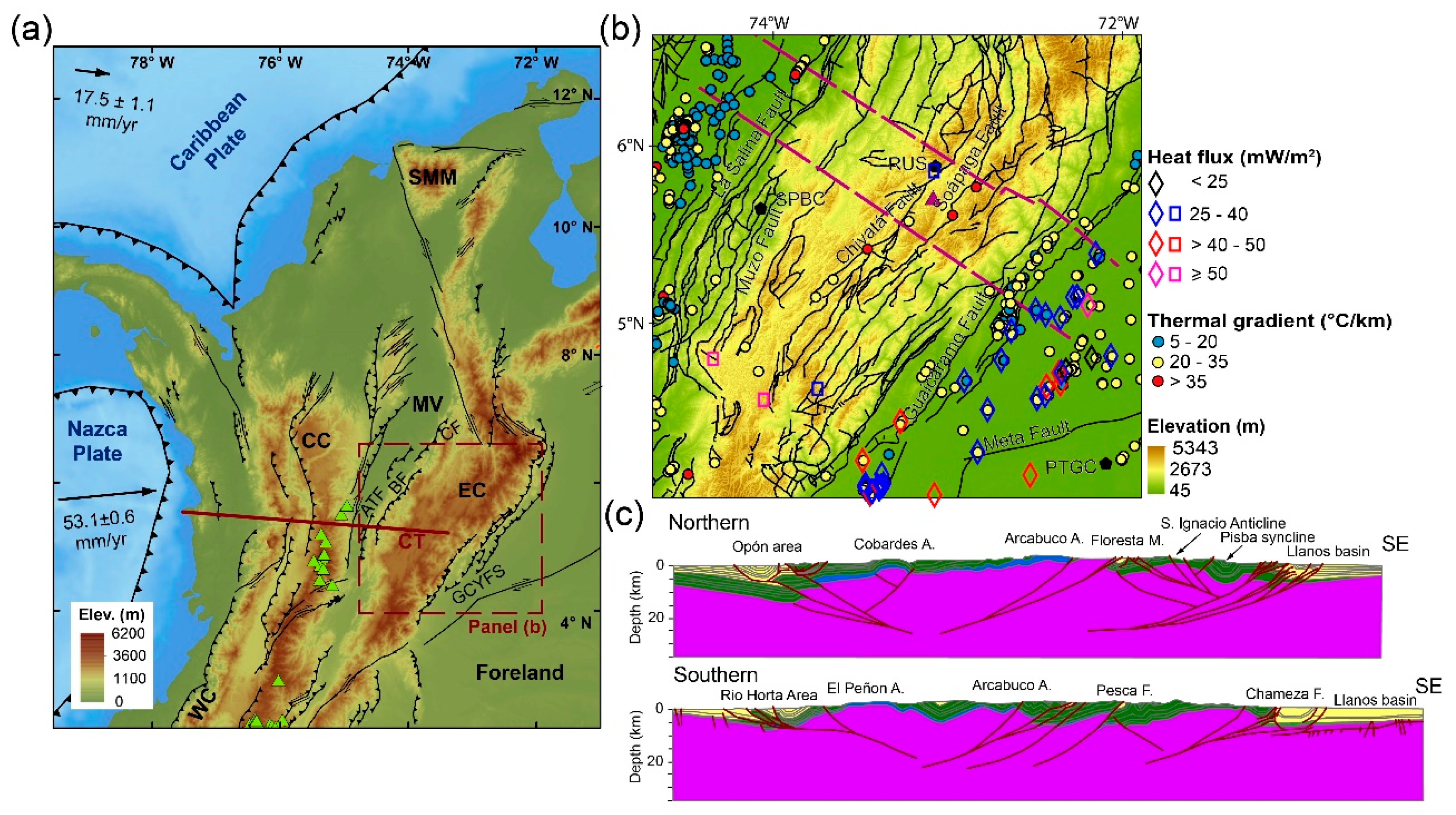
The Eastern Cordillera (EC) in the Colombian Andes is a high-elevation asymmetric orogenic plateau. It shows a mean elevation of ~2.0–2.5 km above mean sea level (a.m.s.l.), with some specific regions above 5.0 km to the NE (e.g., Sierra Nevada del Cocuy) [1,2,3,4]. This topography strongly contrasts with adjacent low-elevation basins, such as the eastern foreland Llanos Basin (LLB), which shows elevations lower than 0.5 km a.m.s.l. (Figure 1). Both regions, the EC and LLB, are characterized by a Precambrian basement covered by a kilometric sedimentary sequence mostly of Meso-Cenozoic age [5,6,7,8].
An interesting aspect of this orogen is the presence of high geothermal gradients in very specific areas of the EC (Figure 1). These gradients have been estimated from available borehole temperature measurements at kilometric wells drilled by the oil and gas industry [12]. It is enigmatic why, at some wells, estimates higher than 35 °C/km are obtained, as one might expect a colder thermal state of the system based on most of the wells drilled in the EC and LLB (Figure 1b; Ref. [12]) and the generally colder geothermal gradient expected for sedimentary basins, given its crustal (>40 km; Refs. [15,16]) and lithospheric thickness (>65 km; Refs. [17,18]), of around 25 °C/km [19]. The purpose of this study is therefore to understand what might be causing the thermal perturbation at those sites in the EC, which might have implications not only for the exploration of fossil fuels but also for cleaner resources such as geothermal energy.
Stratigraphic and structural restoration of the sedimentary cover suggests an evolution in which Cenozoic compression inverted a previous Mesozoic rift [5,6,7,20]. This resulted in the development of a fold-and-thrust belt with a double-vergence, positive flower-type orogen, creating the current EC architecture [3,20,21]. Thermochronological data suggest a strong exhumation history since the middle Miocene, with varying exhumation rates along the Cordilleran system, but with higher rates from the late Miocene to the present. The deformation pattern and thermochronological data exhibit a dominant eastward migration of deformation toward the foreland basin (LLB) [2,22,23,24].
Additionally, seismic constraints on the uppermost crust have shown the presence of dipping and anisotropic layers, which have been interpreted as the result of shearing along NNE-striking regional faults [25] and ESE tectonic vergence [22,26,27], consistent with the Miocene to present tectonic evolution of the EC. Moreover, seismic constraints have also suggested a variation in crustal thickness from south (~60 km) to north (~45 km) [15,16,18], possible magmatic underplating in the northern region at the Paipa–Iza volcanic complex [25,27] (Figure 1b), and deep westward-directed foreland underthrusting beneath the northern EC [27].
Based on the tectonic setting of this orogen, we speculate that the fold-and-thrust configuration of the EC may be related to the thermal anomalies observed at some drilled wells. Our working hypothesis is that the thrusting of deep and hot materials to shallower levels of the uppermost crust causes a local perturbation of the thermal state. If true, regions close to the main regional thrust faults in different parts of the EC should provide supporting evidence. Thus, we selected two key sites where regional thrusting systems are present in the western and central EC and compared them with a site in the LLB, where thrusting is less evident (Figure 1b). The selected regions in the EC are close to available drilled wells showing perturbed geothermal gradients (>35 °C/km), whereas the site in the LLB shows a colder thermal state (<35 °C/km) (Figure 1b).
We explored these sites using receiver functions (RFs) at seismic stations to evaluate the presence of anisotropic layers in the uppermost crust, seeking supporting evidence for our hypothesis. Results indicate strong anisotropy in the uppermost crust beneath the two sites in the EC, whereas weak to nonexistent anisotropy is observed beneath the LLB. We interpret the anisotropic layers in the upper crust as the result of shearing along NNE-striking regional faults related to several thrusting systems affecting the EC since at least the middle Miocene. This thrusting perturbs the thermal state by tectonically uplifting deep and hot blocks toward the surface, allowing regions near major regional thrust faults to become potential areas for geothermal exploration.

2. Materials and Methods

Data were collected from three broadband seismic stations operated by the Colombian Geological Survey, two located in the western (SPBC) and central (RUS) EC, and one in the eastern foreland LLB (PTGC) (Figure 1b). Data were recorded between 2016 and 2025. For RF analysis, we used teleseismic events with a minimum magnitude of 5.0 and epicentral distances between 30° and 90° [Supplementary Material]. Waveforms were clipped 30 s before and 120 s after the theoretical P-wave arrival using the IASP91 velocity model. Data were filtered using a bandpass with frequencies between 0.05 and 4.00 Hz. Instrument responses were removed, obtaining the output in acceleration.
Receiver functions were calculated using the Seispy package v1.3.11 [28], applying the iterative time deconvolution method [29] with a Gaussian parameter of 5.0, equivalent to an approximate corner frequency of 2.4 Hz. For the back-azimuth-sorted RF plots, moveout correction was applied using the IASP91 velocity model [30] and equalized to a ray parameter of 0.06 s/km. To determine crustal anisotropy and fast-axis orientation, we followed the approach discussed by Schulte-Pelkum and Mahan [31,32] and the implementation included in the Seispy package [29,33]. To estimate the delay time of strong anisotropic interfaces, we used the harmonic decomposition method [34]. A first-order estimate of the depth of anisotropic interfaces was obtained using the equation presented by Zhu and Kanamori [35]. In this equation, average crustal seismic velocities of ~6.2 km/s for Vp and ~3.6 km/s for Vs, and a ray parameter of 0.06 s/km, were used. We selected the average velocities based on available seismic tomography for the region [27]. For the shallow structure targeted in this study (interfaces imaged at ~2 s delay time), variations of ±0.1 km/s in Vs, Vp, or both simultaneously translate into depth uncertainties of up to ~1.1 km.

3. Results

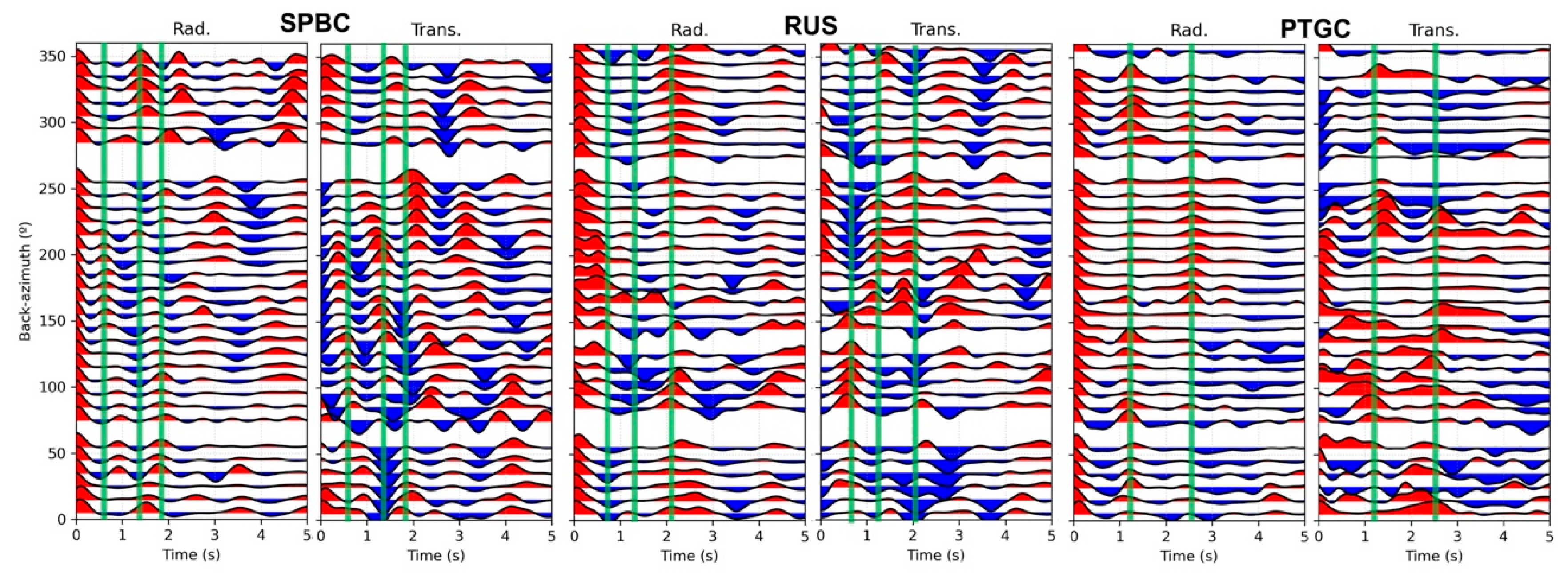
Radial RFs at stations SPBC and RUS, located in the EC, show similar patterns. Three feasible interfaces are interpreted beneath these stations (Figure 2). The interfaces are characterized by changes in polarity (i.e., negative to positive) along the back-azimuths. The first interface has delay times of around 0.6 s and 0.7 s for SPBC and RUS, respectively, showing positive polarity between 140° and 230° back-azimuths at both stations (Figure 2). The second interface occurs at around 1.4 s for SPBC and 1.3 s for RUS, with positive polarity between 290° and 030°, and is much clearer at SPBC. A third interface is observed at around 1.9 s for SPBC and 2.1 s for RUS. At SPBC, positive polarity ranges from 000° to 180°, and a clear polarity flip is observed for the remaining back-azimuths. Conversely, at RUS, this interface is dominated by positive peaks along the entire back-azimuth range. Transverse RFs at these times also show polarity flips at both stations, although at RUS it is clearer that the flip corresponds to a two-lobed pattern.
At PTGC (LLB), the patterns in radial and transverse RFs differ from those at SPBC and RUS (Figure 2). Two clear interfaces are observed in radial RFs at around 1.2 s and 2.6 s. The first interface is characterized by positive peaks across the entire back-azimuth range. The second interface shows a well-defined alignment of positive polarities between 150° and 330° (Figure 2). For the remaining back-azimuths, the polarity is unclear. Transverse RFs also show polarity flips that are more consistent with a two-lobed pattern, although positive peaks cover a larger back-azimuthal range than at the other two stations in the EC.
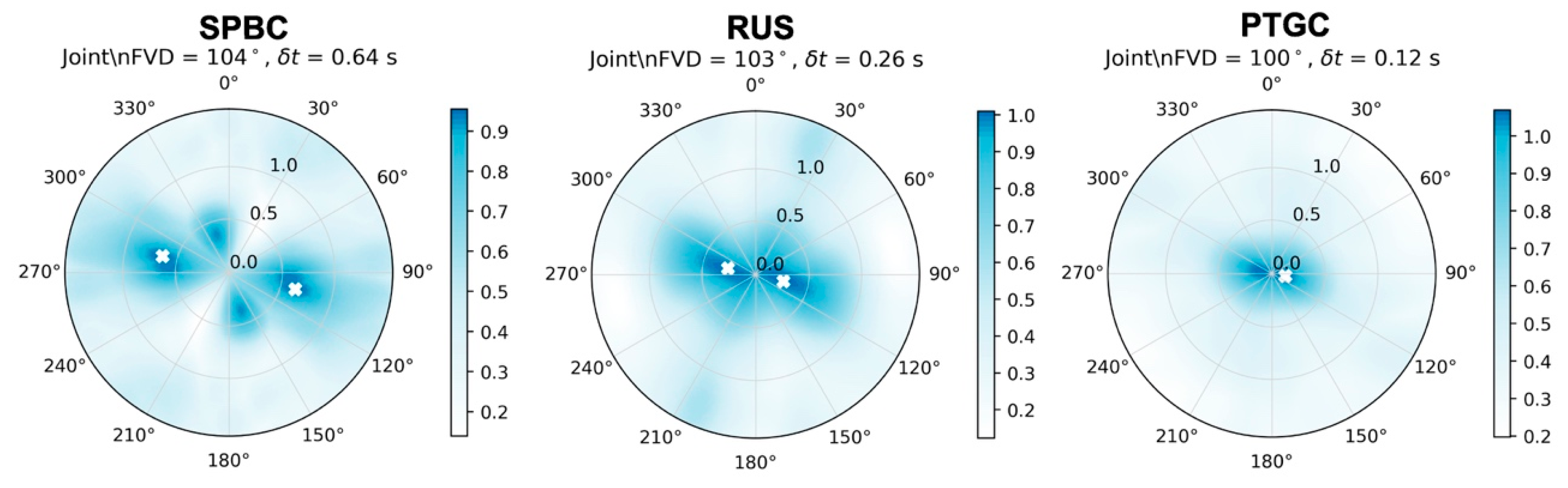
Using the crustal anisotropy method, we found agreement in a SE-trending fast axis at all stations, although with smaller splitting times (dt) at PTGC (Figure 3). The fast-axis trend is estimated at 104° with a dt of 0.64 s at SPBC, 103° with a dt of 0.26 s at RUS, and 100° with a much lower dt of 0.12 s at PTGC (Figure 3).
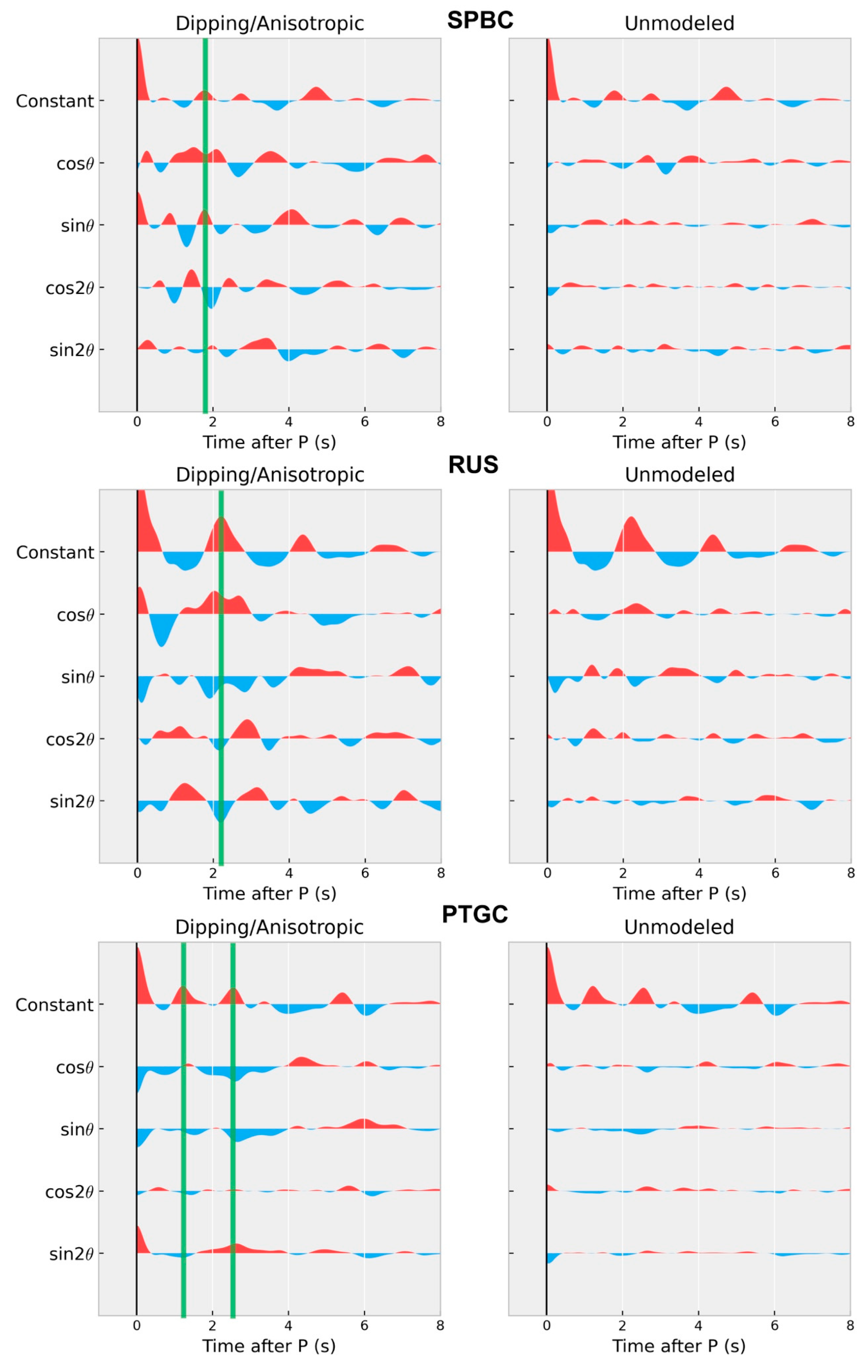
Harmonic decomposition shows a positive peak in the constant radial RF component at around 1.9 s at SPBC, where a high amount of energy with positive polarity is observed, mainly in the cosθ and sinθ components (Figure 4). Similar patterns are observed at RUS, although the positive peak in the constant component is much stronger and occurs at 2.1 s. At RUS, the polarity is positive in the cosθ component and negative in the sinθ component. Some energy with negative polarity is also observed in the cos2θ and sin2θ harmonics, suggesting a more complex structure than at SPBC (Figure 4). Finally, at PTGC, two well-defined positive peaks are observed in the constant component at around 1.6 s and 2.2 s. The first interface shows very low energy in all harmonics, whereas for the second interface, some energy with negative polarity is observed in the cosθ and sinθ components and positive polarity in the sin2θ component (Figure 4).

4. Discussion

There is an evident difference in the RF patterns between the stations in the EC (SPBC, RUS) and the station in the LLB (PTGC). For the EC stations, there is clear evidence for the presence of anisotropic layers at shallow crustal levels beneath these sites. This is supported by: (1) polarity flips observed in back-azimuth-sorted radial and transverse RFs, indicating feasible interfaces within the first 2.1 s (Figure 2); (2) splitting times between 0.64 and 0.26 s with a SE-trending (104–103°) fast axis (Figure 3); and (3) harmonic decomposition showing a positive peak in the constant component around 1.9–2.1 s, associated with high energy mainly in the cosθ and sinθ harmonics (Figure 4). In contrast, at the LLB station: (1) the radial RFs show clear interfaces dominated by positive peaks (Figure 2); (2) although the fast-axis orientation (100°) is consistent with the EC stations, it exhibits a much lower splitting time (0.12 s) (Figure 3); and (3) no major energy is observed in the harmonic components compared with those at the EC stations (Figure 4).
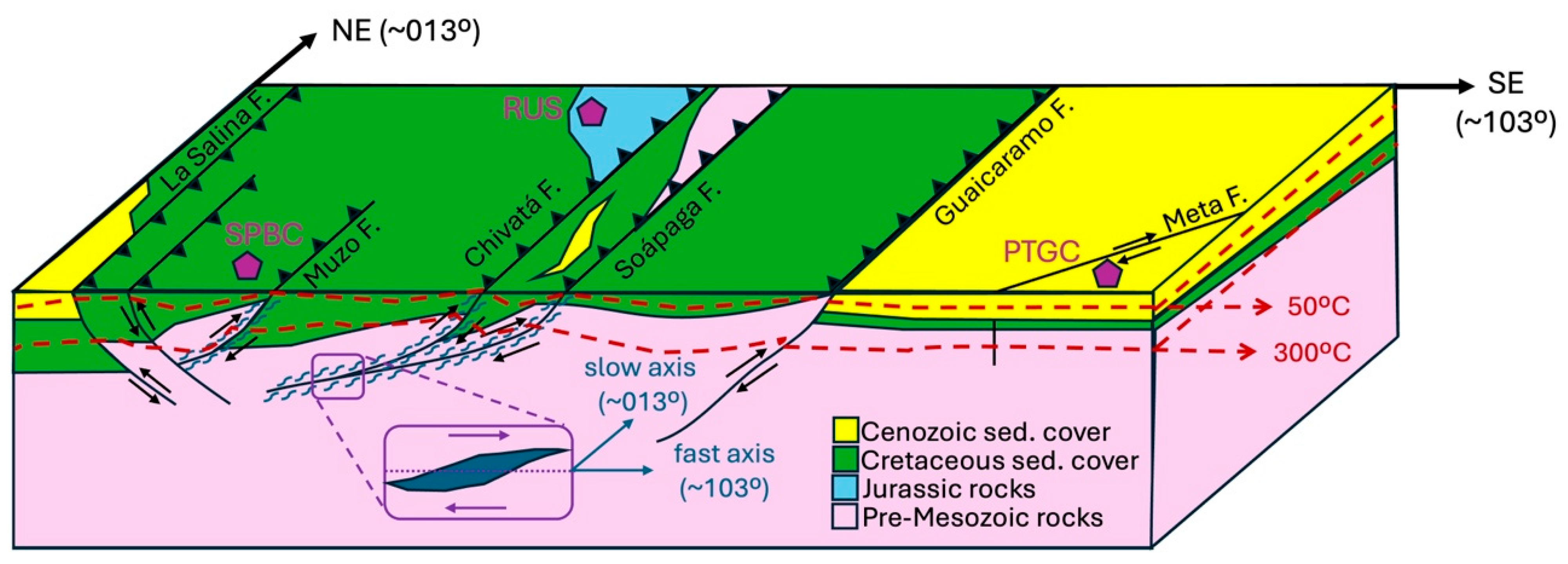
We interpret that, in the EC, the shallow crust contains anisotropic layers with a tilted fast-anisotropy axis trending SE. The tilted nature is inferred because most of the energy is observed in the cosθ and sinθ harmonics [30,32]. A SE-trending fast axis is consistent with NE-striking and NW-dipping regional faults near the SPBC and RUS stations, such as the Muzo, Chivatá, and Soápaga fault systems and related structures (Figure 1b; Refs. [6,11]). Owing to the dominant eastward tectonic transport along these faults, shearing along the fault planes results in mineral lineations parallel to the fault dip [37]. The interpreted anisotropy is the result of accumulated strain at least since the middle Miocene were exhumation rates were increased during the shortening and uplifting of the EC [5,21,24]. In our case, a SE trend, which is opposite to the dip of the faults, implies a negative plunge (Figure 5) that is consistent with positive polarities observed in the eastern back-azimuths at EC stations (Figure 2). We consider that this mineral alignment produces the SE fast axis inferred from the RFs at SPBC and RUS.
It is important to note that near SPBC, stratigraphic and structural restorations show a predominance of east-dipping faults with top-to-the-west deformation, such as the La Salina fault system and related structures [6,7,38]. This deformation direction is opposite to the fast-axis trend obtained at SPBC. Therefore, we interpret the presence of a complex fault geometry in this part of the EC, where both west- and east-dipping structures coexist (Figure 5), as shown by the geological map of Colombia [11] and by stratigraphic and structural restored profiles in the Opón area farther north (Figure 1c; Ref. [6]).
The interplay between west- and east-dipping structures is difficult to determine, yet stratigraphic restorations have shown that the EC deformation pattern activates both verging faults during the plateau uplifting and shortening [6,20,38]. The receiver function technique is used to understand the anisotropy beneath the station, and thus it does not show the generalized anisotropy within the adjacent crust. Especially at delay times lower than 2 s were ray paths of teleseismic events converge to the station. Consequently, we interpret that the anisotropy we are suggesting at the SPBC station is related to the closest major fault, generating a thick enough shear zone to be imaged by the method.
Regarding the depth of the anisotropic layers beneath the stations, this remains uncertain because no accurate velocity models have been derived for these EC sites. However, assuming average crustal velocities of ~6.2 km/s for Vp and ~3.6 km/s for Vs, for a 2 s delay time in radial RFs, the depth is estimated to be ~16.5 km using the equation presented by Zhu and Kanamori [35]. This implies that the interpreted faults are deep enough to deform the overlying sedimentary sequence, which is likely less than 10 km thick [6,20,38], as well as the uppermost part of the metamorphic basement. This observation suggests that deformation in the EC is thick-skinned in nature [37], as previously proposed by stratigraphic restorations [6,7,20]. Given the young thermochronological ages obtained along the EC fold-and-thrust system and the derived high exhumation rates, major tectonic deformation has occurred since the middle Miocene [5,21,23]. We interpret that middle Miocene to present crustal shortening, primarily involving the uppermost layers—including the sedimentary sequence and the uppermost metamorphic basement—allows deep and hot blocks to rise toward the surface. This process, together with frictional heating and erosion, perturbs the background geothermal gradient. Similar scenarios of major shear zones, where substantial shortening has been accommodated by regional faults (e.g., Himalayas, Alps), have been investigated with the receiver function method [39,40], supporting the feasibility of the interpreted model.
Under this setting, a more conventional geothermal gradient of around 25 °C/km [12,19] is locally modified near regional thrust systems. At these sites, geothermal gradients higher than 35 °C/km, and up to 52 °C/km, can be attained in the EC (Figure 1b) due to the combined effects of the ascent of hot blocks to shallower levels, frictional heating, and erosion. As shown in Figure 1b, boreholes have been drilled in different parts of the Meso-Cenozoic sedimentary sequence in the EC, from which one might expect differences in the stratigraphy due to orogenic deformation. Although this difference may account for some variation in the geothermal gradient associated with changes in the rock sequence with depth, and the depth to the top of the crystalline basement, values as high as 52 °C/km are too large to be explained by this effect alone. Thus, we state that the high gradient is due to tectonic uplifting of deeper and hotter materials coupled with shear heating and fluid circulation rather than lateral variation in the stratigraphy.
The effect of perturbed isotherms under tectonic deformation related to thrust faults has been evaluated using numerical modeling. Results presented by Brewer [41] show that, under specific fault-system conditions, temperatures can increase by up to 300 °C above the normal geothermal gradient, implying that thermal gradients of up to ~60–65 °C/km can be achieved. Additional heating can be obtained from shearing along the thrusting faults, as numerical modeling has shown [42,43]. Up to 700–850 °C can be achieved along fault planes using reasonable parameters [42], especially for thin faults, consistent with temperature constraints on mylonitic rocks [43]. Under major shearing, melting can originate [42,43], which might explain some thermal perturbations found within the study region that have been interpreted as local Miocene syn-tectonic magmatism near thrusting faults [2].
Additionally, as these major faults are areas of high permeability, fluid circulation plays an important role in transporting heat, which can yield up to 50 °C perturbation [44]. We propose that, together with hot block uplifting and shear heating, fluid circulation is a contributor to thermal anomaly. This is a reasonable hypothesis, as anisotropic constraints suggest faults reaching depths of ~16.5 km, implying deep, steep structures that could permit the circulation of hot fluids.
Furthermore, compilations of geothermal gradients in fold-and-thrust belts suggest a mean of ~38 °C/km and a median of ~48 °C/km [19], which is consistent with the higher-than-expected geothermal gradients observed in the EC. We interpret these values as the result of perturbed gradients associated with thrust faults. Accordingly, this mechanism is feasible and consistent with the high-thermal-gradient wells drilled in EC regions located close to major thrust faults. Therefore, high geothermal potential can be expected in specific areas of the EC, where perturbed geothermal gradients exceeding 50 °C/km may be reached. With such gradients, temperatures above 90 °C—the lower limit of heat-reservoir mean temperatures for binary geothermal plants [45]—can be attained within the first 2 km of the crust, opening new opportunities for geothermal exploration.

5. Conclusions

Receiver functions at two broadband seismic stations in the Colombian Eastern Cordillera (SPBC and RUS) suggest the presence of tilted anisotropic layers in the uppermost crust related to thrust shearing, affecting both the sedimentary cover and the uppermost metamorphic basement. The SE-trending fast axis indicates top-to-the-east deformation and is interpreted as being associated with west-dipping structures related to fault systems such as the Muzo, Chivatá, and Soápaga systems in the EC. This anisotropic structure contrasts with that observed in the Llanos Basin (station PTGC), where nonexistent to weak anisotropy is identified. Over the last several million years, at least since the middle Miocene as suggested by thermochronology, deep and hot blocks have rapidly risen along thrust faults, accompanied by frictional heating, erosion and fluid circulation, leading to local perturbations of the geothermal gradient in the Eastern Cordillera.
Regions near major thrust faults represent potential targets for geothermal energy exploration due to the perturbed geothermal gradient and enhanced fluid infiltration associated with secondary permeability (i.e., regional fault systems), increasing the likelihood of identifying deeper and hotter, and thus more efficient, geothermal reservoirs. Future work involves expanding this method to other available stations in the EC and adjacent basins coupled with satellite image analysis for surface thermal processing to identify which major faults have the largest potential to be explored and subsequently drilled for geothermal exploration.

Supplementary Materials

The following supporting information can be downloaded at: https://www.mdpi.com/article/10.3390/geosciences16020075/s1.

Author Contributions

Conceptualization, D.S.A.-J. and G.M.; Methodology, D.S.A.-J.; Formal analysis, D.S.A.-J. and G.M.; Validation, D.S.A.-J. and G.M.; Visualization, D.S.A.-J.; Writing—original draft, D.S.A.-J.; Writing—review & editing, D.S.A.-J. and G.M. All authors have read and agreed to the published version of the manuscript.

Funding

This research received no external funding.

Data Availability Statement

The data presented in this study are available within the article. Additional data supporting the findings of this study are available from the corresponding author upon reasonable request.

Acknowledgments

We acknowledge the Colombian Geological Survey for making the data available. We also thank the editor and reviewers for their comments, which substantially improved this work. ChatGPT v5.2 was used solely to correct the grammar, syntax, and word choice of the final version of this manuscript before submission.

Conflicts of Interest

The authors declare no conflicts of interest.

References

  1. Siravo, G.; Molin, P.; Sembroni, A.; Fellin, M.G.; Faccenna, C. Tectonically Driven Drainage Reorganization in the Eastern Cordillera, Colombia. Geomorphology 2021, 389, 107847. [Google Scholar] [CrossRef]
  2. Siravo, G.; Fellin, M.G.; Faccenna, C.; Bayona, G.; Lucci, F.; Molin, P.; Maden, C. Constraints on the Cenozoic Deformation of the Northern Eastern Cordillera, Colombia. Tectonics 2018, 37, 4311–4337. [Google Scholar] [CrossRef]
  3. Mora, A.; Parra, M.; Rodriguez Forero, G.; Blanco, V.; Moreno, N.; Caballero, V.; Stockli, D.; Duddy, I.; Ghorbal, B. What Drives Orogenic Asymmetry in the Northern Andes?: A Case Study from the Apex of the Northern Andean Orocline. AAPG Memoir 2015, 108, 547–586. [Google Scholar] [CrossRef]
  4. Mora, A.; Parra, M.; Strecker, M.R.; Sobel, E.R.; Hooghiemstra, H.; Torres, V.; Jaramillo, J.V. Climatic Forcing of Asymmetric Orogenic Evolution in the Eastern Cordillera of Colombia. Geol. Soc. Am. Bull. 2008, 120, 930–949. [Google Scholar] [CrossRef]
  5. Horton, B.K.; Parra, M.; Mora, A. Construction of the Eastern Cordillera of Colombia: Insights from the Sedimentary Record. In The Geology of Colombia; Gómez, J., Mateus-Zabala, D., Eds.; Publica-ciones Geológicas Especiales 37; Paleogen; Servicio Geológico Colombiano: Bogotá, Colombia, 2020; Volume 3, pp. 67–88. [Google Scholar]
  6. Tesón, E.; Mora, A.; Silva, A.; Namson, J.; Teixell, A.; Castellanos, J.; Casallas, W.; Julivert, M.; Taylor, M.; Ibáñez-Mejía, M.; et al. Relationship of Mesozoic Graben Development, Stress, Shortening Magnitude, and Structural Style in the Eastern Cordillera of the Colombian Andes. Geol. Soc. Spec. Publ. 2013, 377, 257–283. [Google Scholar] [CrossRef]
  7. Parra, M.; Mora, A.; Sobel, E.R.; Strecker, M.R.; González, R. Episodic Orogenic Front Migration in the Northern Andes: Constraints from Low-Temperature Thermochronology in the Eastern Cordillera, Colombia. Tectonics 2009, 28. [Google Scholar] [CrossRef]
  8. Kroonenberg, S.B. The Proterozoic Basement of the Western Guiana Shield and the Northern Andes. In Geology and Tectonics of Northwastern South America, Frontiers in Earth Sciece; Cediel, F., Shaw, R.P., Eds.; Springer Nature: Cham, Switzerland, 2019; pp. 115–192. [Google Scholar] [CrossRef]
  9. Veloza, G.; Styron, R.; Taylor, M. Open-Source Archive of Active Faults for Northwest South America. GSA Today 2012, 22, 4–10. [Google Scholar] [CrossRef]
  10. Mora-Páez, H.; Kellogg, J.N.; Frymueller, J.T.; Mencin, D.; Fernandes, R.M.S.; Diederix, H.; LaFemina, P.; Cardona-Piedrahita, L.; Lizarazo, S.; Peláez-Gaviria, J.R.; et al. Crustal Deformation in the Northern Andes—A New GPS Velocity Field. J. S. Am. Earth Sci. 2019, 89, 76–91. [Google Scholar] [CrossRef]
  11. Gómez, J.; Montes, N.E.; Marín, E. (Compiler) Geological Map of Colombia 2023. Scale 1:1,500,000; Servicio Geológico Colombiano: Bogotá, Colombia, 2023. [Google Scholar]
  12. Alfaro, C.; Alvarado, I.; Quintero, W.; Vargas, C.; Briceño, L.A. Mapa Preliminar de Gradientes Geotérmicos de Colombia; Servicio Geológico Colombiano, Agencia Nacional de Hidrocarburos: Bogotá, Colombia, 2009. [Google Scholar]
  13. Global Heat Flow Data Assessment Group; Sven, F.; Florian, N.; Ben, N.; Elif, B.-P.; Samah, E.; Alexey, P.; Graeme, B.; Robert, H.; Raquel, N.-A.; et al. The Global Heat Flow Database: Release 2024; GFZ Data Services: Potsdam, Germany, 2024. [Google Scholar] [CrossRef]
  14. Vargas, C.A.; Idarraga-García, H.; Salazar, J.M. Curie Point Depths in Northwestern South America and the Southwestern Caribbean Sea. In Petroleum Geology and Potential of the Colombian Caribbean Margin; American Association of Petroleum Geologists: Tulsa, OK, USA, 2015. [Google Scholar] [CrossRef]
  15. Avellaneda-Jiménez, D.S.; Monsalve, G.; León, S.; Gómez-García, A.M. Insights into Moho Depth beneath the Northwestern Andean Region from Gravity Data Inversion. Geophys. J. Int. 2022, 229, 1964–1977. [Google Scholar] [CrossRef]
  16. Poveda, E.; Monsalve, G.; Vargas, C.A. Receiver Functions and Crustal Structure of the Northwestern Andean Region, Colombia. J. Geophys. Res. Solid. Earth 2015, 120, 2408–2425. [Google Scholar] [CrossRef]
  17. Blanco, J.F.; Vargas, C.A.; Monsalve, G. Lithospheric Thickness Estimation beneath Northwestern South America from an S-Wave Receiver Function Analysis. Geochem. Geophys. Geosystems 2017, 18, 1376–1387. [Google Scholar] [CrossRef]
  18. Mojica-Boada, M.J.; Poveda, E.; Tary, J.B. Lithospheric and Slab Configurations From Receiver Function Imaging in Northwestern South America, Colombia. J. Geophys. Res. Solid. Earth 2022, 127, e2022JB024475. [Google Scholar] [CrossRef]
  19. Kolawole, F.; Evenick, J.C. Global Distribution of Geothermal Gradients in Sedimentary Basins. Geosci. Front. 2023, 14, 101685. [Google Scholar] [CrossRef]
  20. Mora, A.; Reyes-Harker, A.; Rodriguez, G.; Tesón, E.; Ramirez-Arias, J.C.; Parra, M.; Caballero, V.; Mora, J.P.; Quintero, I.; Valencia, V.; et al. Inversion Tectonics under Increasing Rates of Shortening and Sedimentation: Cenozoic Example from the Eastern Cordillera of Colombia. Geol. Soc. Spec. Publ. 2013, 377, 411–442. [Google Scholar] [CrossRef]
  21. Mora, A.; Villagómez, D.; Parra, M.; Caballero, V.M.; Spikings, R.; Horton, B.K.; Mora-Bohórquez, J.A.; Ketcham, R.A.; Arias-Martínez, J.P. Late Cretaceous to Cenozoic Uplift of the Northern Andes: Paleogeographic Implications. In The Geology of Colombia, Volume 3 Paleogene-Neogene; Gómez, J., Mateus-Zabala, D., Eds.; Publicaciones Geológias Especiales 37; Servicio Geológico Colombiano: Bogotá, Colombia, 2020; Volume 3, pp. 89–121. [Google Scholar]
  22. Parra, M.; Mora, A.; Lopez, C.; Rojas, L.E.; Horton, B.K. Detecting Earliest Shortening and Deformation Advance in Thrust Belt Hinterlands: Example from the Colombian Andes. Geology 2012, 40, 175–178. [Google Scholar] [CrossRef]
  23. Siravo, G.; Faccenna, C.; Gérault, M.; Becker, T.W.; Fellin, M.G.; Herman, F.; Molin, P. Slab Flattening and the Rise of the Eastern Cordillera, Colombia. Earth Planet. Sci. Lett. 2019, 512, 100–110. [Google Scholar] [CrossRef]
  24. Bayona, G.; Cortés, M.; Jaramillo, C.; Ojeda, G.; Aristizabal, J.J.; Reyes-Harker, A. An Integrated Analysis of an Orogen-Sedimentary Basin Pair: Latest Cretaceous-Cenozoic Evolution of the Linked Eastern Cordillera Orogen and the Llanos Foreland Basin of Colombia. Geol. Soc. Am. Bull. 2008, 120, 1171–1197. [Google Scholar] [CrossRef]
  25. Monsalve, G.; Jaramillo, J.S.; Cardona, A.; Schulte-Pelkum, V.; Posada, G.; Valencia, V.; Poveda, E. Deep Crustal Faults, Shear Zones, and Magmatism in the Eastern Cordillera of Colombia: Growth of a Plateau From Teleseismic Receiver Function and Geochemical Mio-Pliocene Volcanism Constraints. J. Geophys. Res. Solid. Earth 2019, 124, 9833–9851. [Google Scholar] [CrossRef]
  26. Bayona, G.; Cardona, A.; Jaramillo, C.; Mora, A.; Montes, C.; Caballero, V.; Mahecha, H.; Lamus, F.; Montenegro, O.; Jimenez, G.; et al. Onset of Fault Reactivation in the Eastern Cordillera of Colombia and Proximal Llanos Basin; Response to Caribbean-South American Convergence in Early Palaeogene Time. Geol. Soc. Spec. Publ. 2013, 377, 285–314. [Google Scholar] [CrossRef]
  27. Avellaneda-Jiménez, D.S.; Posada, G.; Monsalve, G.; Wagner, L.S. Lithospheric Underthrusting beneath the Northern Eastern Cordillera Plateau, Colombian Andes: Insights from Tomographic Inversion Using Local Earthquake Travel Time and Gravity Data. Tectonophysics 2024, 871, 230196. [Google Scholar] [CrossRef]
  28. Xu, M.; He, J. Seispy: Python Module for Batch Calculation and Postprocessing of Receiver Functions. Seismol. Res. Lett. 2022, 94, 935–943. [Google Scholar] [CrossRef]
  29. Ligorría, J.P.; Ammon, C.J. Iterative Deconvolution and Receiver-Function Estimation. Bull. Seismol. Soc. Am. 1999, 89, 1395–1400. [Google Scholar] [CrossRef]
  30. Kennett, B.L.N.; Engdahl, E.R. Traveltimes for Global Earthquake Location and Phase Identification. Geophys. J. Int. 1991, 105, 429–465. [Google Scholar] [CrossRef]
  31. Schulte-Pelkum, V.; Mahan, K.H. A Method for Mapping Crustal Deformation and Anisotropy with Receiver Functions and First Results from USArray. Earth Planet. Sci. Lett. 2014, 402, 221–233. [Google Scholar] [CrossRef]
  32. Schulte-Pelkum, V.; Mahan, K.H. Imaging Faults and Shear Zones Using Receiver Functions. Pure Appl. Geophys. 2014, 171, 2967–2991. [Google Scholar] [CrossRef]
  33. Liu, H.; Niu, F. Estimating Crustal Seismic Anisotropy with a Joint Analysis of Radial and Transverse Receiver Function Data. Geophys. J. Int. 2012, 188, 144–164. [Google Scholar] [CrossRef]
  34. Bianchi, I.; Park, J.; Piana Agostinetti, N.; Levin, V. Mapping Seismic Anisotropy Using Harmonic Decomposition of Receiver Functions: An Application to Northern Apennines, Italy. J. Geophys. Res. Solid. Earth 2010, 115, 12317. [Google Scholar] [CrossRef]
  35. Zhu, L.; Kanamori, H. Moho Depth Variation in Southern California from Teleseismic Receiver Functions. J. Geophys. Res. Solid. Earth 2000, 105, 2969–2980. [Google Scholar] [CrossRef]
  36. Park, J.; Levin, V. Anisotropic Shear Zones Revealed by Backazimuthal Harmonics of Teleseismic Receiver Functions. Geophys. J. Int. 2016, 207, 1216–1243. [Google Scholar] [CrossRef]
  37. Fossen, H. Structural Geology, 2nd ed.; Cambridge University Press: Cambridge, UK, 2016; ISBN 9781107057647. [Google Scholar]
  38. Sánchez, J.; Horton, B.K.; Tesón, E.; Mora, A.; Ketcham, R.A.; Stockli, D.F. Kinematic Evolution of Andean Fold-Thrust Structures along the Boundary between the Eastern Cordillera and Middle Magdalena Valley Basin, Colombia. Tectonics 2012, 31, TC3008. [Google Scholar] [CrossRef]
  39. Schulte-Pelkum, V.; Monsalve, G.; Sheehan, A.; Pandey, M.R.; Sapkota, S.; Bilham, R.; Wu, F. Imaging the Indian Subcontinent beneath the Himalaya. Nature 2005, 435, 1222–1225. [Google Scholar] [CrossRef] [PubMed]
  40. Mark, H. Refining the Extent and Depth of the Shear Zone Surrounding the Alpine Fault Using Receiver Function Harmonics. Geophys. Res. Lett. 2024, 51, e2024GL112092. [Google Scholar] [CrossRef]
  41. Brewer, J. Thermal Effects of Thrust Faulting. Earth Planet. Sci. Lett. 1981, 56, 233–244. [Google Scholar] [CrossRef]
  42. Ai, Y.; Zhang, J.; Dong, M.; Wang, B.; Fang, G. Heat Generation Effects from Shear Friction along Xianshui River Strike-Slip Fault in Western Sichuan, China. Geothermics 2021, 89, 101936. [Google Scholar] [CrossRef]
  43. Cardwell, R.K.; Chinn, D.S.; Moore, G.F.; Turcotte, D.L. Frictional Heating on a Fault Zone with Finite Thickness. Geophys. J. Int. 1978, 52, 525–530. [Google Scholar] [CrossRef]
  44. Fleming, C.G.; Couples, G.D.; Haszeldine, R.S. Thermal Effects of Fluid Flow in Steep Fault Zones; Special Publications; Geological Society: London, UK, 1998; Volume 147, pp. 217–229. [Google Scholar] [CrossRef]
  45. Glassley, W.E. Geothermal Energy: Renewable Energy and the Environment, 2nd ed.; Ghassemi, A., Ed.; CRC Press: Boca Raton, FL, USA; Taylor & Francis Group, LLC: Abingdon, UK, 2014; ISBN 978-1-4822-2175-6. [Google Scholar]
Figure 1. (a) Tectonic setting of the Colombian Andes, showing the location of the Eastern Cordillera (EC) and active faults [9]. Other features are: Central Cordillera (CC), Western Cordillera (WC), Magdalena Valley (MV), Santa Marta Massif (SMM), Alto del Trigo Fault (ATF), Bituima Fault (BF), Cambao Fault (CF), Guaicáramo–Cusiana–Yopal Fault System (GCYFS), and Caldas Tear (CT). Subduction rates from [10]. (b) Topography in the northern EC showing regional faults and some thrusting systems mentioned in the text. Regional faults from [11]; black polygons are seismic stations; colored circles are thermal gradient estimates from borehole temperature measurements at drilled wells by the oil and gas industry [12]; heat flux is depicted as colored diamonds from measured values [13] and rectangles for estimates using geothermal gradient and crustal thickness [14]; purple triangle depicts the Paipa–Iza volcanic complex; dashed purple lines represent the location of two stratigraphic and structural restoration profiles shown in (c) after [6]. (c) Sedimentary and structural restoration of profiles shown in (b) [6]. Sedimentary and volcano-sedimentary cover is shown in blue for Jurassic, green for Cretaceous, and yellow for Cenozoic units. In purple are shown pre-Mesozoic rocks.
Geosciences 16 00075 g001
Figure 2. Radial and transverse receiver functions at SPBC, RUS, and PTGC stations. Zero time represents the arrival of the main P phase. Green lines represent the interpreted interfaces (arrival times of the Ps phases generated at different discontinuities).
Geosciences 16 00075 g002
Figure 3. Crustal anisotropy showing the fast axis trending and splitting time (dt) at SPBC, RUS, and PTGC stations. Colors represent the variation in the objective function, which is a joint estimate using maximization of radial energy with cosine moveout correction coefficient, correlation radial maximization, and minimization of transverse energy [33]. Fast axis trend (azimuthal coordinate) and splitting time (radial coordinate) are shown with white crosses.
Geosciences 16 00075 g003
Figure 4. Harmonic decomposition at SPBC, RUS, and PTGC stations. Green lines show inspected interfaces guided by positive peaks in the constant (Radial) component. No normalization is applied. In terms of anisotropy, energy displayed in the four-lobed components cos2θ and sin2θ suggests the effect of a horizontal axis of symmetry, whereas energy displayed in the two-lobed components cosθ and sinθ, suggests an effect from a tilted symmetry axis [36].
Geosciences 16 00075 g004
Figure 5. Sketch of the interpreted origin of anisotropic layers as related to the shearing along thrusting systems. Mineral stretching (symbol: ~) parallel to the dip direction of faults is shown in the zoom panel. Red dashed lines (isotherms) represent the perturbed isotherms near the thrusting faults. Notice the orientation of the sketch showing the fast axis trending SE (~103°), which is related to a negative plunge, as the positive plunging angle is toward the NW. This is a schematic figure; the geometry of the geologic units is not precise.
Geosciences 16 00075 g005
Disclaimer/Publisher’s Note: The statements, opinions and data contained in all publications are solely those of the individual author(s) and contributor(s) and not of MDPI and/or the editor(s). MDPI and/or the editor(s) disclaim responsibility for any injury to people or property resulting from any ideas, methods, instructions or products referred to in the content.