Article

Magnesian Calcite and Dolomite in the Krečana Marble (Bukulja–Venčac Area, Central Serbia): A Possible Modification for Geothermometry Application Purposes?


1
Institute of Chemistry, Technology and Metallurgy, Department for Catalysis and Chemical Engineering-National Institute of the Republic of Serbia, University of Belgrade, Njegoševa 12, 11000 Belgrade, Serbia
2
Geological Survey of Serbia, Rovinjska 12, 11000 Belgrade, Serbia
3
Institute for Multidisciplinary Research, University of Belgrade, Kneza Višeslava 1, 11030 Belgrade, Serbia
*
Author to whom correspondence should be addressed.
Geosciences 2026, 16(1), 35; https://doi.org/10.3390/geosciences16010035
Submission received: 6 November 2025 / Revised: 22 December 2025 / Accepted: 6 January 2026 / Published: 8 January 2026

Abstract

The chemical compositions and formation temperatures of magnesian calcite and dolomite were estimated by using the combination of chemical analysis, crystallographic parameters, and a plethora of various diagrams and mathematical calculations. This study presents an example of the calculated crystallo-chemical formula (Ca0.960Mg0.039Fe0.001)CO3, obtained from chemical analysis on a representative marble sample from the Bukulja–Venčac area in central Serbia. Substituting CaCO3 with MgCO3 and FeCO3 in dolomite adds approximately 3–5 mol. %, enhancing the classification and indicating that it is more accurately identified as magnesium-excess dolomite. The estimated formation temperature of magnesian calcite (1) is approximately 528 °C, whereas magnesian calcite (2) forms at about 341 °C. The ~187 °C difference corresponds to ~3.28 mol. % MgCO3 (~7.18% dolomite), reflecting the distinction between magnesian calcite (1) and magnesian calcite (2). Considering the presence of the submicroscopic intergrowth and exsolution of dolomite within magnesian calcite (1), which are further subdivided in magnesian calcite (2), the estimated formation temperature of ~341 °C appears to be more realistic. The synthesis of the results suggests that this combined method could be helpful in the geothermometry of marble samples after the treatment with acetic acid. However, despite the promising results, additional experiments are necessary to validate the proposed modified geothermometry approach.

1. Introduction

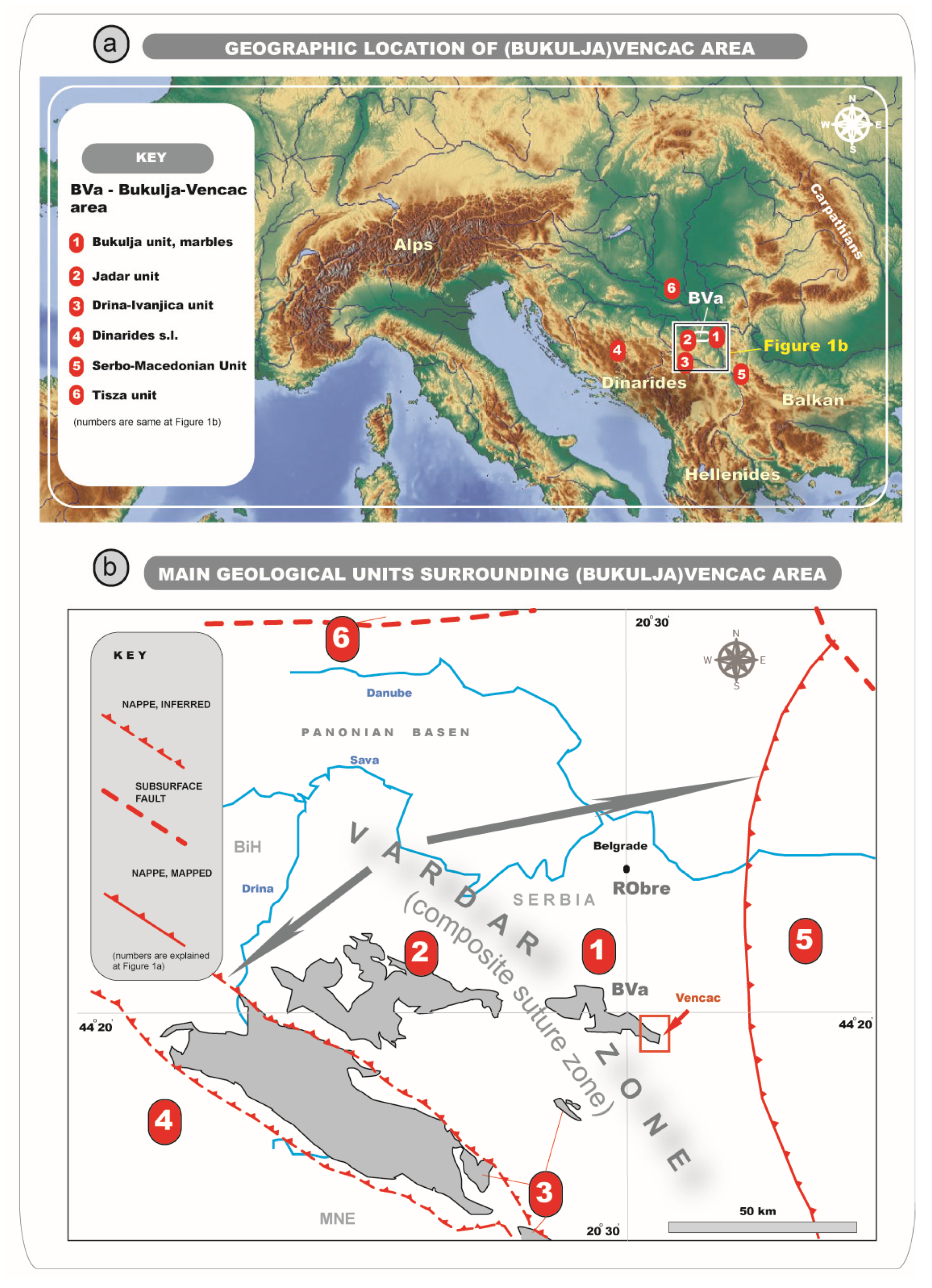
Marble is low- to ultra-high-temperature metamorphic raw material that is often used for decorative purposes and building in the construction industry (see, for example, [1,2,3,4,5,6,7,8,9] and references therein). Besides its application in various construction projects, marble can provide insights into geodynamical frameworks by the reconstruction of paleotemperatures affecting limestone protoliths. Coupled with the age of ancient depositional environment-producing calcareous protoliths, marbles can reveal past subsurface conditions that contributed to metamorphic imprinting (e.g., [10,11]). An example from the central Serbia is tested for paleotemperatures by sampling the Bukulja–Venčac marble-bearing area (Figure 1a,b). This geologically adverse region has a long history of Paleotethyan and Neotethyan geodynamic interferences, including younger Paleogene–Neogene core complex exhumation episodes that eventually contributed to the shallow exposure of Bukulja–Venčac marble-bearing area [10,12,13,14,15,16,17]. The Bukulja–Venčac area records traditional marble extraction spanning over a century. Importantly, the high-quality Venčac marble is a globally famous stone, used widely across many global locations and monuments (e.g., for decorative purposes within the White House in Washington, D.C. (USA) [18]).
The investigated Krečana site exposes a (pure) white marble deposit located at the Venčac Mountain (Serbia), positioned roughly 85 km to the south of the capital city Belgrade (Figure 1a,b). The geological structure of the wider (Bukulja)Venčac area includes several tectono-paleogeographic units distributed at a complex Paleozoic–Mesozoic tectonic junction referred to as the Vardar Zone (Figure 1b). The Vardar Zone is a composite ophiolite-bearing suture zone carrying the (overlapping) segments of Paleotethyan and Neotethyan Vardar paleo-oceanic sutures. The Vardar Zone is further connecting Drina–Ivanjica Block (Adria; Figure 1a,b, #3, 4) with Jadar Block both embedded within the latter suture zone (Figure 1a,b, #2). The eastern interface with Serbo-Macedonian gneiss, forms the European foreland in Jurassic-Cretaceous reference, formerly overriding the Vardar Neotethyan plates ([10,11,12,13,14,15,16,17,19,20,21,22,23,24,25,26,27,28,29]; Figure 1a,b, #5). Because the geodynamic origin of Venčac marble remains debated, questioning whether the marble can be linked to Paleozoic or Mesozoic Alpine episode, another unresolved issue is whether the marble parental rocks were exposed to contact- [11,29] or regional-type [10] metamorphism. Given the importance of these debated issues, this paper aims to enhance understanding of the area’s geological evolution by providing the subsurface formation temperatures using key minerals embedded into the marble.
Initially, we analyzed the crystallographic and mineralogical features of magnesian calcite and dolomite from the Krečana–Venčac marbles [30]. The provided new constraints on formation temperatures and pressure allowed for a better insight into the deposit’s origin supporting a more efficient marble exploitation [31,32,33,34,35]. Building on earlier research, the second part of this composite study (which extends from the first report of Tančić [30]) aims to correlate the chemical analysis results with the calculated mineral compositions and their formation temperatures. The study further compares these chemical data with the findings from the earlier X-ray powder diffraction (XRPD) study [30]. The results obtained by introducing a combination of several methods, allowed further consideration about their applicability for geothermometry purposes by refining a degree of usefulness of the treatment of marble with acetic acid. As the results will show, the lower temperature estimate (~341 °C) has been of geological relevance because of the removal of dolomite intergrowth and exsolution in magnesian calcite.
Although in the published first part of the study a colloquial term “Mg-calcite” was used as a shortcut for magnesium-bearing calcite (see [30]), in this second paper we will use the term “magnesian calcite”. The term is in accordance to the International Mineralogical Association’s (IMA) nomenclature rules describing the adjectival modifiers [36].

2. Approach, Materials and Methods

2.1. Approach

Mathematics, statistics, and computer science are well known for their close links to fields like crystallography, mineralogy, solid solutions, chemistry, geology, geosciences, geothermometry, geobarometry, Earth sciences, etc. ([37,38,39]; see also references cited therein). The multidisciplinary approach is used as in the previous research [40,41,42,43,44,45,46,47,48,49], including our use of geothermometric methods in this study (e.g., [35]). In particular, we used the crystallographic features of examined magnesian calcites to recalculate their MgCO3 contents through various mathematical techniques, then compared these results with earlier findings [30] obtained via different methods [50,51,52,53,54]. The crystallographic and mineralogical properties of dolomite were also analyzed, and its chemical composition—especially the substitutions among Ca2+, Mg2+, and Fe2+ ions—was estimated using multiple diagrams, calculations, and combined approaches. Moreover, the MgCO3 content in magnesian calcite (which coexists with dolomite) was evaluated, and the formation temperature was calculated using various diagrams, equations, and calculations. The diagrams and equations primarily pertain to the binary CaCO3-MgCO3 and ternary CaCO3-MgCO3-FeCO3 systems.
The investigated Venčac site is accommodated at its eastern flanks (for the configurations see [10,11]; Figure 1b). The Oligocene–Early Miocene granitoid was intruded into the Bukulja crystalline [10], likely inducing to some extent the contact metamorphism of the surrounding, mainly Paleozoic rocks. The granite intrusion was followed by volcanic rocks, prevailingly phenoandesites, latites, and their pyroclastics [10] emplaced into mainly crystalline rocks. The age of intrusion is ca. 20–15 Ma (see [10,13], and references cited therein). However, the investigated Krečana deposit is not at the position near the exposed magmatic body (Figure 1b, small red rectangle).

2.2. Materials

Sample-1 is a natural bulk rock marble sample selected and picked up from the surface of the studied Krečana white marble deposit which is located at the Venčac Mountain area. The investigated eastern flank of the Venčac Mt. area contains the following rock assemblages: (i) Paleozoic rocks including phyllites, meta-sandstones, muscovite–biotite schists, small-grain gneisses, slightly metamorphosed limestones, siltstones, and marbles; (ii) Mesozoic rocks such as serpentinites, massive limestones, siltstones, sandstones, flysch, layers of sheet and brecciated limestones, and a pile of red marly limestones and siltstones; (iii) Tertiary formations consisting of Bukulja granitoid, granites, pegmatites, aplites, lamprophyres, hornfels, and skarns; (iv) Neogene deposits including conglomerates, marls, marly limestones, sandstones, and clays; and (v) Quaternary formations represented by deluvial and alluvial deposits [11,26,27,28]. Investigations carried out on the Venčac marbles [55] showed a mineral composition that includes chlorite, quartz, muscovite, and albite, which are typical of regional metamorphism, and an absence of garnet, tremolite, diopside, periclase, and wollastonite, which are typical of contact metamorphism.

2.3. Methods

The analysis of sample-1’s chemical composition was performed by applying the following processes: Si content was measured gravimetrically using a method adapted from [56]. The quantities of Al, Fe, Ti, Ca, Mg, Mn, Na, and K were determined after converting them into a soluble form, using atomic absorption spectrophotometry (AAS) with a Perkin Elmer 4000 instrument (PerkinElmer, Singapore), employing the flame technique. The contents of P and S were measured colorimetrically and turbidimetrically, respectively, with a Perkin Elmer Lambda 15 UV/VIS spectrophotometer. The CO2 content was calculated after treating a precise sample amount (±0.2 mg) with diluted HCl (HCl: H2O; 1:3), then measuring the volume of released CO2. The determination of iron was performed after the accurately weighed sample (with an accuracy of ±0.2 mg) in a Pt vessel was treated with HClO4 and HF-concentrated acids, and heated on hot plate. Sample decomposition took place in an inert CO2 atmosphere. After the sample decomposition, the Pt vessel was put in Erlenmeyer flask with distilled water. Ferrous iron was determined by titration with standard KMnO4 solution. Ferric iron was determined from the difference between total and ferrous iron. The H2O (adsorbed water) and H2O+ (structural or bound water) contents were determined by weighing the sample before and after treatments at 105 °C and 1000 °C for one hour, respectively. All element contents are expressed as oxides.
Sample-2 was obtained by treating sample-1 with diluted acetic acid (CH3COOH: H2O; 1:3), which was heated on hot plate at 50 °C for 48 h at the normal atmospheric pressure (ca. 1 bar). After that, this sample was rinsed with distilled water, and later dried in air. This procedure was mainly accomplished with the intention to eliminate some part of magnesian calcite, but to avoid possible destruction of the other mineral phases.

3. Results and Discussion

3.1. Re-Calculated Compositions of the Magnesian Calcite

First, the results for magnesian calcite (1) and (2), shown in [30], were re-checked by using the following quadratic least-squares regression Equations (1)–(4) from [54]:
a = 4.9906 − 0.50 × XMg + 0.56 × XMg2,
c = 17.069 − 2.27 × XMg + 2.1 × XMg2,
V = 368.1 − 122 × XMg + 131 × XMg2, and
c/a = 3.420 − 0.118 × XMg + 0.05 × XMg2,
where XMg = mol. % MgCO3.
Based on the calculated values (Table 1), it is evident that these are nearly identical to those reported in the previous paper [30]. However, it is also clear that the current calculations correct minor discrepancies found in the previously published data, particularly with regard to the calculated values from Equations (1)–(3).
Because accurately assessing the Mg content in natural calcites is crucial for many research areas, we recalculated the compositions of the studied magnesian calcite (1) and magnesian calcite (2) from Krečana–Venčac [30] by using equations derived from the XRPD measurements analyzed by applying Rietveld refinement, which were published after the initial study [57,58]. The specific Equations (5)–(12) from [57] and (13)–(16) from [58] are employed for the recalculation:
XMg = −254.268064 × a + 1269.083982,
XMg = −55.423796 × c + 945.901576,
XMg = −997.807429 × c/a + 3412.426500,
XMg = −1.047482 × V + 385.628601,
XMg = −266.555258 × a + 1329.120352,
XMg = −51.725661 × c + 882.793319,
XMg = −694.720293 × c/a + 2378.806942,
XMg = −1.072219 × V + 393.759147,
a = −0.4178 × XMg + 4.9896 ⇒ XMg = (a − 4.9896)/(−0.4178),
c = −1.8603 × XMg + 17.061 ⇒ XMg = (c − 17.061)/(−1.8603),
c/a = −0.0877 × XMg + 3.4193 ⇒ XMg = (c/a − 3.4193)/(−0.0877), and
V = −100.97 × XMg + 367.93 ⇒ XMg = (V − 367.93)/(−100.97),
where XMg = mol. % MgCO3. The values of the used unit cell parameters (a, c, c/a, and V) for the XMg calculations are the same as for Equations (1)–(4), shown in Table 1.
According to the resulting values (Table 2), the most significant deviations from the previous magnesian calcite compositions [30] are obtained by using Equations (5)–(8), particularly their average value (I). Such an outcome is not very surprising, as these calibrations for Mg quantifications were obtained from biogenic calcites (used in that particular study [57]). It is a well-known fact that biogenic calcites show some significant differences compared to other types of calcites. For example, echinoid skeletal parts may vary by up to 5 mol. % MgCO3, while algae have the neighboring domains reaching up to 10 mol. % MgCO3 [54]. Biogenic magnesian calcites are often also characterized with the structural anisotropic contraction and octahedra distortion (see [30] and references therein).
In contrast, and as expected, a much better agreement with the previous magnesian calcite compositions [30] is achieved by Equations (9)–(12), which can provide the current calibrations [57]. Specifically, 5.14 mol. % of MgCO3, calculated for magnesian calcite (1) [30], falls within the estimated standard deviation (ESD) of the average value 5.48 ± 0.49 (II). Meanwhile, 1.86 mol. % of MgCO3, obtained for magnesian calcite (2) [30], falls within the estimated ESD of the average value 1.98 ± 0.20 (II) (Table 2).
The average values (III) were slightly higher and somewhat similar to the previously described average values (II), measured as 5.62 ± 0.47 and 2.29 ± 0.19, respectively (taking in consideration Equations (13)–(16)). Among these, the best agreement is shown by the c-axis (5.43 ± 0.54 and 1.94 ± 0.27, respectively; Equation (14); Table 2). This feature is also expected, because this equation was derived from the quantitative phase analyses of carbonate rocks that contain Mg-rich calcite and non-stoichiometric dolomite [58]. In other words, the resulting value is expected because the mineral composition is very similar to that of the investigated sample [30].
Furthermore, Merlini et al. [59] investigated how the unit cell parameters in the ternary CaCO3-MgCO3-FeCO3 carbonate system can vary. The authors show that the unit cell axes and volume change nearly linearly across the four binary systems: calcite–magnesite, calcite–Fe-magnesite, dolomite–ankerite, and magnesite–siderite. These changes are independent of the sample’s symmetry. To recalculate the magnesian calcites (1) and (2) [30], we additionally use Equations (17)–(19) (taken from Merlini et al. [59]):
a = 4.985 × XCaCO3 + 4.636 × XMgCO3 + 4.696 × XFeCO3,
c = 17.064 × XCaCO3 + 15.033 × XMgCO3 + 15.414 × XFeCO3, and
V = 366.2 × XCaCO3 + 279.2 × XMgCO3 + 294.1 × XFeCO3,
where XCaCO3, XMgCO3, and XFeCO3 are, respectively, the molar fraction of the calcitic, magnesitic, and sideritic components in the considered carbonate.
The resulting values shown in Table 3 indicate that the calculated a and c unit cell axes by using Equations (17) and (18) closely match those from the previous study [30]. The matching is a good indicator showing that these are nearly identical. The calculated volume V from Equation (19) for magnesian calcite (1) falls within the ESD range. However, the calculated volume for magnesian calcite (2) is slightly lower than the values reported by Tančić [30].
Based on the results presented in this sub-chapter, the composition of magnesian calcites (1) and (2) determined with the XRPD method [30] are obviously in alignment with a few more recent studies [57,58,59]. Accordingly, the results are highly accurate, being helpful for further research shown in this paper.

3.2. Chemical Investigations

The chemical composition of sample-1 is shown in Table 4. Oxides, which may theoretically be part of the calcite group of minerals (such as calcite–CaCO3, magnesite–MgCO3, rhodochrosite–MnCO3, and/or siderite–FeCO3), were initially recalculated to 100% with a purpose to excluding the presence of minor minerals (such as quartz, feldspars and clay minerals–micas [30]; see later in the text). Subsequently, by using the corrected results, the number of ions per formula unit (apfu) containing three oxygen atoms was calculated.
Accordingly, the crystallo-chemical formula of sample-1 was calculated as (Ca0.960Mg0.039Fe0.001)CO3, showing an ideal stoichiometry for this group of carbonates (i.e., cations:carbon:oxygen ratio is 1:1:3 within three decimal places; Table 4). By using this formula, the preliminary data show 4 mol. % of CaCO3 substituted with 3.9 mol. % of MgCO3 and 0.1 mol. % of FeCO3. On the other hand, if this sample can hypothetically contain exclusively pure calcite (with no substituted Ca2+ by other cations) and dolomite [CaMg(CO3)2], then by using the magnesium content, the sample would amount to 7.28% dolomite. Nevertheless, it is well known that in calcite some content of Ca2+ has usually been substituted with other cations (in this case mostly with Mg2+ and very little Fe2+). Therefore, such substitution implies that the dolomite content should be lower, which is confirmed by the XRPD study [30], indicating the following content: magnesian calcite (1) (~95%), dolomite (~4%), and quartz (~1%). Sample-2 consists of magnesian calcite (2) (~79%), quartz, feldspars and clay minerals–micas (each ~6–7%), with insignificant quantities of dolomite (~1.5%).
By applying the calculated unit cell parameters of calcite and dolomite [30], Ca2+ was partly substituted for Mg2+ and/or Fe2+, both of which have a smaller ionic radii than Ca2+ (i.e., Mg2+ = 0.72 Å; Fe2+ = 0.78 Å; and Ca2+ = 1.00 Å; in coordination VI [60]). As mentioned earlier, the crystallographic analysis shows that in magnesian calcite (1), 5.14 mol. % of CaCO3 was substituted with MgCO3 whereas in magnesian calcite (2), such substitution was 1.86 mol. % [30]. Another argument is that the difference of 3.28 mol. % of CaCO3 between these two is in connection with submicroscopic intergrowth and exsolution of dolomite in magnesian calcite (1). However, latter were most likely destroyed with acetic acid in magnesian calcite (2) [30].
To clarify, exsolution is a process in which a former fairly homogeneous phase separates into the two or more solid solution phases under subsolidus conditions. Exsolution occurs only in minerals with two or more pure end-member compositions that cannot mix together in normal conditions or in metastable minerals with complicated solid solutions by ion substitutions occurring at high temperature or pressure [61]. Additionally, dolomite and/or calcite can form from retrograde reactions, which can be challenging because of the differentiation from exsolved or preexisting grains [62], making this situation even more complex.
Nevertheless, the discrepancy that exists between chemical and powder diffraction results for samples containing magnesian calcite and dolomite occurs mainly due to the intergrowth and exsolution of dolomite within calcite. The discrepancy is well established in the earlier mid-XX century reports [63,64]. More specifically, if the submicroscopic intergrowth and exsolution of dolomite exist in magnesian calcite, then the coherency strain may shift the d-values sufficiently to yield incorrect MgCO3 content in magnesian calcites ([30], and references therein). Consequently, the 3.90 mol. % MgCO3 in sample-1 (obtained from chemical analysis; Table 4), clearly does not correspond to the ca. 7.14 mol. % MgCO3 obtained from X-ray analysis. The latter sums to (i) 5.14 mol. % from magnesian calcite (1) and (ii) approximately 2 mol. % from dolomite [30]. In contrast, 1.86 mol. % MgCO3, replacing CaCO3 in magnesian calcite (2) reflects the true value. As a result, from sample-1, the dolomite content is approximately 4%, equivalent to about 2 mol. % MgCO3. From sample-2, the MgCO3 in magnesian calcite (2) is 1.86 mol. %. Overall, the total MgCO3 content obtained by the X-ray analysis reaches ca. 3.86 mol. %. The latter resulting value obviously aligns with the chemical analysis and the calculated crystallo-chemical formula of the 3.90 mol. % MgCO3 (Table 4).
The exact mechanism behind the influence of the diluted acetic acid to the submicroscopic intergrowth and exsolution of dolomite in magnesian calcite (1) is beyond the scope of this paper (therefore, it was not constrained in more detail). Nevertheless, the following is evident:
(i)
ca. 16% of magnesian calcite (1) and ca. 2.5% of dolomite within sample-1 were destroyed by this treatment;
(ii)
Such a destruction process undoubtedly resulted in the afore-described significant crystallographic differences between magnesian calcite (1) and magnesian calcite (2);
(iii)
The calculated MgCO3 content of 1.86 mol. % in magnesian calcite (2) represents the afore-explained true value. Consequently, the presumed coherency strain between magnesian calcite (2) and dolomite in sample-2 sufficiently decreased to the level capable of preventing the shift in the crystallographic inter-planar (d) values (which was obviously occurred between magnesian calcite (1) and dolomite in sample-1).

3.3. Calculated Dolomite Composition

The following section introduces multiple methods for calculating dolomite composition. Prior to the computations, a few important prerequisites must be noted. It is essential to highlight that the studied dolomite from the Krečana–Venčac marble deposits [30] exhibits clearly visible super-lattice XRPD reflections with Miller’s indices (101), (015), and (021). The visibility of super-lattice XRPD reflections unmistakably allows it to be distinguished from calcite and high-Mg calcite [65], as well as from other Mg–carbonate phases [66]. Another key point is that the unit cell parameters and selected inter-planar spacings of this dolomite (a = 4.791 (3) Å; c = 15.95 (2) Å; V = 317.1 (4) Å3; c/a = 3.329; and d(104) = 2.8702 Å [30]) are significantly smaller compared to the reference crystallographic standard [67]. This situation is most likely due to a partial substitution of Ca2+ with Mg2+ and/or Fe2+, since both have smaller ionic radii than Ca2+ [60]. Thirdly, to examine the mutually related correlations between the calculated unit cell parameters (i.e., a and c axes) and the measured d(104) inter-planar spacing of dolomite, the following Equations (20)–(22) [68] can be used:
c = 7.3097 × a − 19.135,
a = 1.0306 × d(104) + 1.8337, and
c = 7.6284 × d(104) − 6.0059.
Equations (20)–(22) demonstrate a considerably strong correlativity, with the values closely matching those computed within their ESDs, thus enabling further analysis. Specifically, Equation (20) yields c = 15.89 (3) Å; Equation (21) gives a = 4.792 Å; and, again, from Equation (21), c is confirmed as 15.89 Å. To further accurately identify the composition of this dolomite, various diagrams, equations, and calculations have been used. We believe that such a composite approach is necessary allowing accurate constraints on the (non-?)stoichiometric composition of the dolomite, and additionally could be helpful for similar cases in the future research.
(1) The variation diagrams include the following: (i) the unit cell axes a and c, and inter-planar spacing d(104), as shown by the composition of Ca-Mg carbonates [51]; (ii) the unit cell axes a and c across the full composition yield the range from CaCO3 to CaMg(CO3)2 [52]; (iii) the unit cell volume V versus composition of both ordered and disordered Ca-Mg carbonates [53]; and (iv) parameters a, c, and V of the unit cell, together with c/a ratio changes as the functions of CaCO3 content in low-iron sedimentary dolomites [69]. The CaCO3 content (mol. %) in the Krečana–Venčac dolomite, calculated from these variation diagrams based on a, c, V, c/a, and d(104) parameters [51,52,53,69], are listed in Table 5.
Table 5 clearly shows that the CaCO3 content in the studied dolomite is mostly under 50 mol. % in most of the diagrams. These values generally range from 45 to 47 mol. %, with an average of 46.5 mol. % CaCO3. Such a difference indicates that the dolomite is non-stoichiometric, and that smaller Mg2+ and/or Fe2+ ions replaced larger Ca2+ ions; similarly to the magnesian calcites studied.
To support this statement, we use the variation diagram of CaFe(CO3)2 by Δ2θ°(2θD(211) − 2θCdF2) for dolomites which were synthesized from composition CaMg(CO3)2-CaFe(CO3)2 at 450 °C (as shown by Rosenberg [70]). Comparing this diagram with the studied dolomite (Δ2θ° = 2.473) and the standard conventional value (Δ2θ° = 2.435; [71]) shows that smaller Mg2+ was not replaced by larger Fe2+. Another diagram for dolomites which were synthesized from the composition CaMg(CO3)2-CaMn(CO3)2 at 450 °C [72], depicting CaMn(CO3)2 by Δ2θ°(2θD(211) − 2θCdF2), has also been used for support. For this diagram and the studied dolomite, which also has Δ2θ° = 2.435, it indicates that smaller Mg2+ was not substituted by larger Mn2+ (Mn2+ = 0.83 Å in coordination VI [60]).
(2) Since it was established that some Ca2+ ions were replaced by Mg2+ and Fe2+, Equations (23) and (24), presented by Goldsmith et al. [73] are utilized to calculate the unit cell axes in the CaCO3-MgCO3-FeCO3 system:
a = 4.92954 × X(CaCO3) + 4.69290 × X(MgCO3) + 4.73269 × X(FeCO3) + 4.71879 × X(MnCO3), and
c = 16.5368 × X(CaCO3) + 15.5004 × X(MgCO3) + 15.8589 × X(FeCO3) + 16.0111 × X(MnCO3),
where X(MCO3) is mole fraction of the respective carbonate component and M = Ca, Mg, Fe, and Mn.
By assuming that the dolomite sample contains various solid solution compositions (as shown in columns 1–9 of Table 6), which are used in Equations (23) and (24), the resulting unit cell axes are listed also in Table 6. For example, adding 0.1 mol. % of FeCO3 (Table 4) to the dolomite structure, which represents about 4%, gives roughly 2.5 mol. %. Given the smaller unit cell parameters of the studied dolomite [30], such a size suggests that MgCO3 partially substitutes CaCO3 fraction, because dolomite—serving as a standard—has the unit cell axes of a = 4.809 Å and c = 16.02 Å [67]. Consequently, it appears that the presumed dolomite composition in this instance [73] is closest to the ideal stoichiometry of 50 mol. % CaCO3 and 50 mol. % MgCO3 (as the calculated unit cell axes most closely resemble those in column 1; Table 6).
Conversely, the substitution of 2.5 mol. % of FeCO3 with MgCO3 results in larger unit cell parameters than the reference standard (Table 6, column 2). The resulting larger unit cell parameters occur because Fe2+ has larger ionic radii than Mg2+ [60]. Such a relationship confirms that FeCO3 is substituting CaCO3 because this type of replacement leads to smaller unit cell axes (Table 6, column 3). Additionally, as the substitution of CaCO3 with MgCO3 increases, the calculated unit cell axes continue to have with a decrease (Table 6, columns 4–9), as expected. For instance, column 5 displays the dolomite composition with 3.28 mol. % MgCO3, representing the exact difference between magnesian calcite (1) and magnesian calcite (2). Lastly, the unit cell axes of dolomite from Krečana–Venčac [30] align closely with the values derived from the compositions (I) shown in columns 7 and 8 (Table 6):
(Dolomite composition I): CaCO3 = 42.00–42.50 mol. %; MgCO3 = 55.00–55.50 mol. %; and FeCO3 = 2.50 mol. %.
However, dolomite composition (II) adjusts the values from composition (I) to match the theoretical dolomite stoichiometric ratio of 54.35 mol. % CaCO3: 45.65 mol. % MgCO3 [74]. According to this ratio, the previous composition (I) should be corrected with the following more appropriate values:
(Dolomite composition II): CaCO3 = 46.35–46.85 mol. %; MgCO3 = 50.65–51.15 mol. %; and FeCO3 = 2.50 mol. %,
which are in a very good agreement with the results in Table 5.
(3) On the other hand, we believe that by using the combination of the results from the chemical analysis (Table 4) with those from the X-ray investigations [30], compositional calculations should be at least equally reliable. Namely, in sample-1, 95% of magnesian calcite-1 and 4% of dolomite, after recalculations to the total of 100% (with the purpose to avoid minor quartz with quantity of 1% [30]), give 96% of magnesian calcite and 4% of dolomite. Since it was established that magnesian calcite contains 98.14 mol. % CaCO3 and 1.86 mol. % MgCO3 [30], the total CaCO3 and MgCO3 content in magnesian calcite and dolomite (at the basis ratio of CaCO3:MgCO3 = 54.35:45.65) was initially calculated as follows:
(i)
For CaCO3: 0.96 × 98.14 = 94.21 mol. %; 0.04 × 54.35 = 2.17 mol. %; Σ1 = 96.38 mol. %;
(ii)
For MgCO3: 0.96 × 1.86 = 1.79 mol. %; 0.04 × 45.65 = 1.83 mol. %; Σ2 = 3.62 mol. %.
The content of CaCO31) is 0.38 mol.% higher, while MgCO3, along with FeCO32), has a 0.38 mol.% lower value than the number obtained from the chemical analysis (i.e., 4.00 mol. %; Table 4). The relationship indicates that 0.38 mol. % of CaCO3 in dolomite was replaced by 0.38 mol. % of MgCO3 and FeCO3, corresponding to 9.5 mol. % of CaCO3 being substituted in 4% dolomite. Based on these calculations, dolomite has the following composition (III):
(Dolomite composition III): CaCO3 = 44.85 mol. %, MgCO3 = 52.65 mol. %, and FeCO3 = 2.50 mol. %.
Secondly, the same calculations for dolomite with ratio of CaCO3:MgCO3 = 50:50 are as follows:
(iii)
For CaCO3: 0.96 × 98.14 = 94.21 mol. %; 0.04 × 50.00 = 2.00 mol. %; Σ3 = 96.21 mol. %;
(iv)
For MgCO3: 0.96 × 1.86 = 1.79 mol. %; 0.04 × 50.00 = 2.00 mol. %; Σ4 = 3.79 mol. %.
The content of CaCO33) is 0.21 mol. % higher in this case, while the content of MgCO34) (together with FeCO3) is 0.21 mol. % lower than the values obtained from chemical analysis (i.e., 4.00 mol. %; Table 4). The relationship suggests that 0.21 mol. % of CaCO3 in dolomite was replaced with 0.21 mol. % of MgCO3 and FeCO3. This difference corresponds to 5.25 mol. % of CaCO3 being substituted in 4% dolomite. From these calculations, it results that dolomite has the following composition (IV):
(Dolomite composition IV): CaCO3 = 44.75 mol. %, MgCO3 = 52.75 mol. %, and FeCO3 = 2.50 mol. %.
As shown, the latter two calculations yielded nearly identical results for the dolomite (III) and (IV) compositions. The nearly identical results further indicate that, as a starting points for such analyses, both CaCO3:MgCO3 ratios (i.e., 54.35:45.65; and 50:50) could be used.
(4) Other calculations of the dolomite unit cell parameters could also be achieved with the already presented Equations (17)–(19), further applying its various afore-calculated compositions (I-IV).
The results presented at Table 7 show that the calculated unit cell axes (a and c) of dolomites from Equations (17)–(19) closely match those in Tančić [30], whereas the volumes (V) are slightly elevated relative to the dolomite compositions (III) and (IV). In contrast, the compositions (I) and (II) exhibit significantly larger deviations of all of these parameters. The presence of deviations suggests that calculations for the compositions (III) and (IV) are more reliable than those for (I) and (II). This relationship also further approves the proposed combination of the results from the chemical analysis (Table 4) coupled with those from the earlier XRPD study.
(5) Lastly, the Ca content in dolomite (nCa) is calculated from the unit cell parameters (i.e., a and c axes; and c/a ratio) and the measured d(104) inter-planar spacing of dolomite, using the following Equations (25)–(28) proposed by McCarty et al. [68]:
c = 0.8632 × nCa + 15.14 ⇒ nCa = (c − 15.14)/0.8632,
a = 0.1168 × nCa + 4.6903 ⇒ nCa = (a − 4.6903)/0.1168,
c/a = 0.0981 × nCa + 3.2309 ⇒ nCa = (c/a − 3.2309)/0.0981, and
d(104) = 0.119 × nCa + 2.7658 ⇒ nCa = (d(104) − 2.7658)/0.119.
In addition, the excess of Ca (ΔnCa) in its B site could be calculated from the c axis by using the following Equation (29) [58]:
c = 16.0032 + 0.8632 × ΔnCa ⇒ ΔnCa = (c − 16.0032)/0.8632.
Based on Equations (25)–(28), the calculated nCa values are as follows: 93.84 ± 2.31% along the c axis; 86.22 ± 2.56% along the a axis; 100% along the c/a ratio; and 87.73% along the d(104) inter-planar spacing. These results show a notable deviation from earlier computations, except for the c axis. Conversely, using Equation (29), the excess Ca (ΔnCa) appears to be −6.16 ± 2.32 apfu, indicating Mg-rich/Ca-deficient dolomite, consistent with the determined negative value, which closely matches previously reported data.
In conclusion, the smaller d-values and unit cell parameters observed in dolomite from Krečana–Venčac [30] are caused by the substitution of CaCO3 with MgCO3 and FeCO3 of about 3–5 mol. %. This is in agreement with the available literature data, which show that such a substitution can reach up to 6 mol. % [75], and with documented composition ranging from Ca1.16Mg0.84(CO3)2 to Ca0.96Mg1.04(CO3)2, covering calcian (i.e., calcium-excess) to magnesian (i.e., magnesium-excess) dolomites [76]. Therefore, the studied dolomite sample should be classified as magnesian.
Although the results in this Chapter appear promising, some preliminary caution is, however, necessary because (i) potential errors may arise in the inter-planar spacing measurement obtained from XRPD analysis—and the subsequent unit cell parameters calculations—due to a small dolomite content (about 4%; [30]), and (ii) the smaller unit cell parameters observed in dolomite, along with the mentioned chemical composition, could also stem from increased pressure conditions [59,77,78,79]. However, (i) the measured inter-planar spacing of the two strongest peaks of quartz (i.e., d(101) = 3.3453 Å and d(100) = 4.2658 Å; [30]), which could be treated as the internal standard, indicate that the XRPD measurement was adequate and very reliable, whilst (ii) pressure conditions could be described as “normal” for this kind of facies (see later in the text).

3.4. Calculated Formation Temperatures

According to Essene’s [80] report, “calcite–dolomite thermometry is a useful method for determining metamorphic conditions because: (1) calcite and dolomite in marbles are close to the CaCO3-CaMg(CO3)2 binary system in metamorphic terranes; (2) it is minimally affected by pressure and only requires rough pressure estimates for adjustments; (3) unlike most silicate isograds, it does not depend on fluid composition. Its main limitation is rapid re-equilibration, which restricts it to providing minimum temperature estimates in many rocks.”
By using the MgCO3 content (in mol. %) in magnesian calcite (1) and (2), which occur alongside dolomite, the formation temperatures of these minerals were estimated by using several reliable reference datasets presented in Table 8. Specifically, the diagrams created by [63,81,82,83,84] served as the primary tool for these estimations. The average value (I) was then derived from these data. The average value (II) was calculated using different equations reported in [64,85,86]. In contrast, the average value (III) was obtained from the two figures reported by Bickle and Powell [87]. Finally, the average value (IV) was calculated from all of the results presented in Table 8.
The following Equation (30) was used by [64] and (31) by [85]:
LogMgCO3 = [1.727 × 10⁻³ × t (°C)] − 0.223 ⇒ t (°C) = [(LogMgCO3 + 0.223)/1.727] × 103, and
Log10XMgCO3 = [−1690/t (°C)] + 0.795.
It is important to highlight that one minor (printing?) error was found in Equation (31), which can be verified by the temperatures listed in the report of Rice [85], and our own calculations which are presented in Table S1. Namely, from the presented calculations it is obvious that these temperatures should be expressed in Kelvin (K) rather than degrees Celsius (°C). Based on our research, the corrected version of the equation should be as follows:
T (K) = (−1690)/(Log10XMgCO3 − 0.795) ⇒ t (°C) = [(−1690)/(Log10XMgCO3 − 0.795)] − 273.15.
Additionally, we used the quite complex Equations (33) and (35) presented by Anovitz and Essene [86]:
TMg (K) = (−2360) × (XCalMgCO3) + (−0.01345)/(XCalMgCO3)2 + 2620 × (XCalMgCO3)2 + 2608 × (XCalMgCO3)0.5 + 334,
i.e., t (°C) = TMg (K) − 273.15,
where XCalMgCO3 is the mole fraction of MgCO3 in calcite; and
TFeMg (K) = TMg + 1718 × (XCalFeCO3) + (−20610) × (XCalFeCO3)2 + 22.49 × (XCalFeCO3/XCalMgCO3) + (−26260) × (XCalFeCO3 × XCalMgCO3) + 1.333 × (XCalFeCO3/XCalMgCO3)2 + 0.32837 × 10⁷ × (XCalFeCO3 × XCalMgCO3)2,
i.e., t (°C) = TFeMg (K) − 273.15,
where XCalFeCO3 and XCalMgCO3 are the mole fractions of FeCO3 and MgCO3 in calcite, respectively; and TMg is the temperature for the pure CaCO3-MgCO3 system calculated from Equation (33).
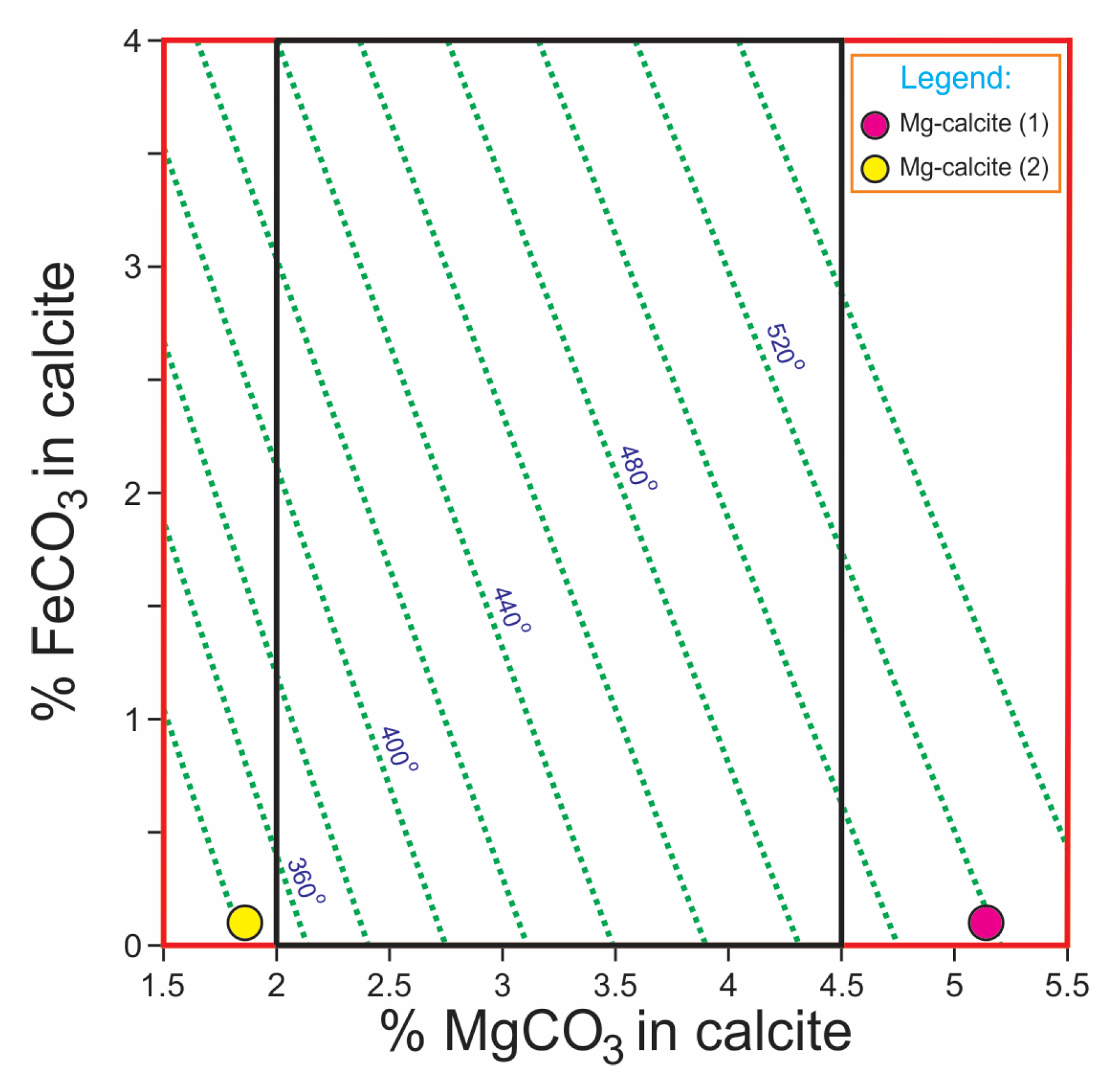
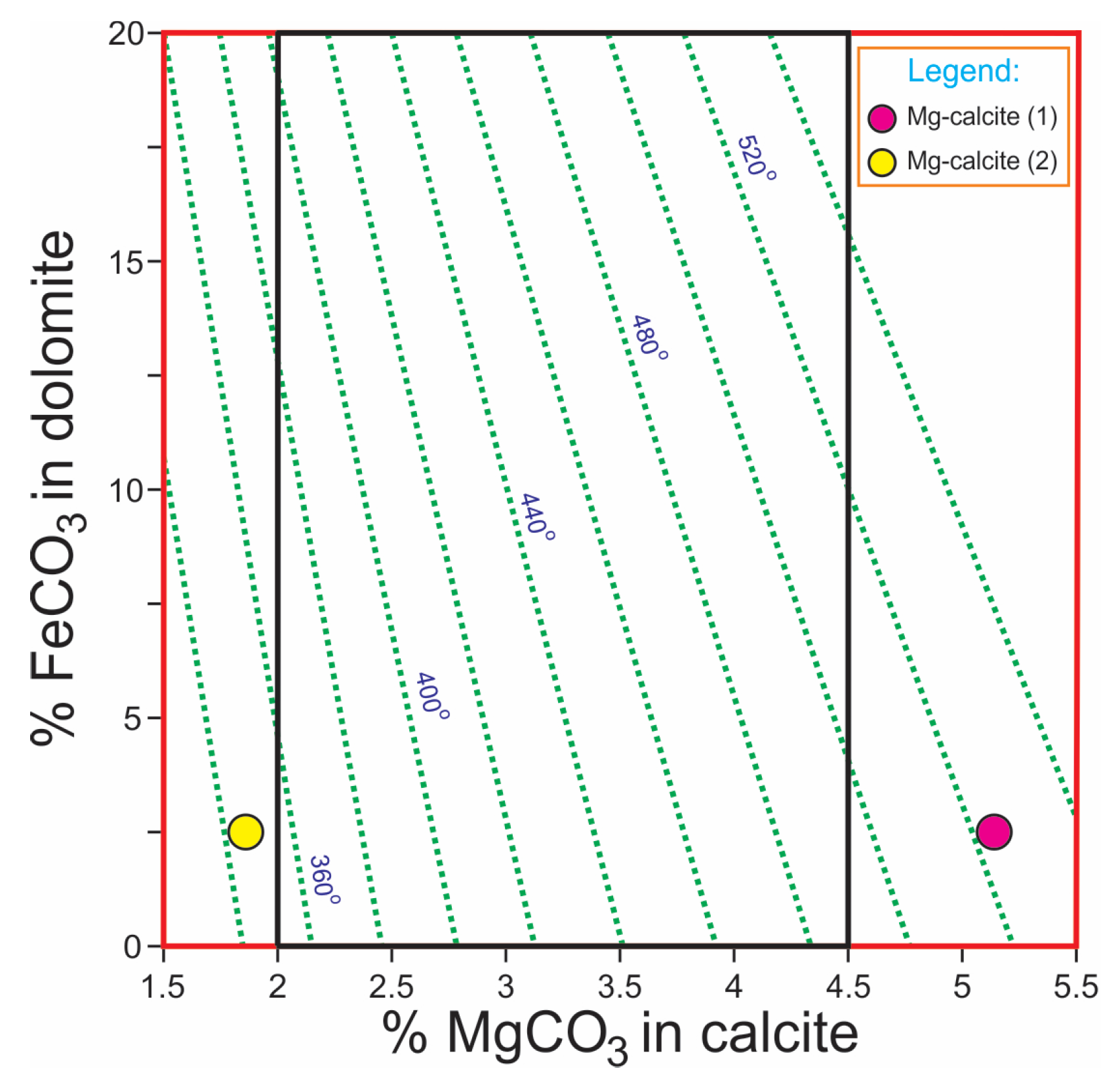
In the following assessment of paleotemperatures, Equations (30), (32), (34), and (36) were used, and from these, the average value (II) was calculated. Furthermore, the effect of the additional Fe on the calcite–dolomite solvus was investigated by [87]. Within that study, Bickle and Powell [87] created temperature diagrams illustrating the variation of MgCO3 contents in calcite with FeCO3 in calcite and the variation of MgCO3 contents in calcite with FeCO3 in dolomite. As previously discussed, an estimated FeCO3 content of about 0.1 mol. % was used for the investigated calcite (Figure 2) and in investigated dolomite of about 2.5 mol. % (Figure 3). From these values, the average value (III) was calculated.
Table 8 shows that the temperature values obtained more or less vary because they were derived from different diagrams and equations used, including the diagrams with additional Fe. The notably average values (I) and (III) are more similar to each other than to the average value (II). This difference can be partly explained by considering that Equation (30), given by Sheppard and Schwarcz [64], criticized by Rice [85], relies on data reported by Graf and Goldsmith, and Goldsmith and Newton [81,83] regarding the linear vs. non-linear data dependence. As a result, it tends to underestimate temperatures at low ranges (i.e., <500 °C) and overestimate them at a higher range. Indeed, in the samples studied (Table 8), the magnesian calcite (1) temperatures are nearly identical because they exceed 500 °C. However, for magnesian calcite (2), there is a significant difference of about 110 °C compared to Equation (31) [85], which gives higher temperature estimate at lower ranges. Finally, the average values (IV) are calculated from all of the results presented. These are about 528 °C for Mg calcite (1), and ~341 °C for magnesian calcite (2), while calculated difference between them is approximately 187 °C.
As previously discussed, earlier studies [30] and the chemical analysis in this paper (Table 4) clearly clarified the compositional differences between magnesian calcite (1) and magnesian calcite (2). These differences account for the variation in calculated formation temperatures, which is 187 °C (see Table 8). It was identified that 2% dolomite impurities in calcite increase the solvus temperature by 50 °C [64]. This 2% dolomite equates to 0.913 mol. % MgCO3, indicating that 3.28 mol. % MgCO3—representing the difference between magnesian calcite (1) and magnesian calcite (2)—corresponds to 7.18% dolomite. This highlights the difference which could be calculated as follows:
2%:50 °C = 7.18%:X ⇒ X = 179.5 °C.
Based on this evidence, it can be concluded that the difference (Δ1 = 187 °C) between the average estimated formation temperatures for magnesian calcite (1) and (2) are very consistent with the difference (Δ2 = 179.5 °C) calculated from dolomite impurities in calcite (i.e., Δ1 − Δ2 = 7.5 °C). This difference is even smaller if we take into account average values (III) (Δ3 = 177 °C; Table 8; Figure 2 and Figure 3) of only Δ1 − Δ3 = 2.5 °C.
Therefore, in magnesian calcite (1), the presence of dolomite submicroscopic intergrowth and exsolution led to a much higher MgCO3 content than the actual amount, in concordance with previous discussion. Consequently, it also approved that treatment with diluted acetic acid was very useful, because it successfully removed the high-temperature exsolution phases present in magnesian calcite (1) and that the formation temperature of 341 °C estimated from the magnesian calcite (2) composition should be treated as the “true” one. The constraints on temperature for magnesian calcite (1) of ~528 °C could likely be a suitable illustration showing the peak metamorphic conditions.
Furthermore, according to the calcite–aragonite–dolomite curve constructed by Goldsmith and Newton [83], it seems that the formation pressure should be less than 7–8 kbars (as a maximum possible value which is adequate to the ~341 °C), because of the absence of aragonite [55].
For the initial discussion about the origin of the Venčac marble metamorphic deposit, specifically whether it results from the already mentioned contact or regional metamorphism [10,11,29], it is essential to consider its mineral composition, listed in Chapter 2.2. The presence or absence of certain key minerals, which are essential and relevant, could be very helpful. Therefore, the metamorphic processes in this area were driven solely by temperature, without direct contact with magma.
The study shows that the preliminary evidence corroborates earlier suggestions that the marbles originate from regional metamorphism, formed at temperatures up to 410 °C and pressures near 3 kbar, within the quartz–albite–muscovite–chlorite subfacies of the greenschist facies [10,88]. The suggested subsurface conditions are confirmed and align well with the estimated formation temperature of ~341 °C for the magnesian calcite–dolomite association at the Krečana–Venčac marbles. These findings are also quite similar to those of marble sequences studied in the Biharia Nappe System (Apuseni Mountains, Romania; 316–370 °C) [89], as well as much closer parental carbonate unique sequence referred to as the “Ropočevo breccia” (slightly recrystallized breccia cropping out within the (northern) East Vardar Zone Upper Cretaceous turbidites of former European foreland, vicinity of Belgrade; Figure 1b, “RObre”) [19,90]. Nonetheless, the possibility remains that marbles in contact zones with magmatic formations could be of contact metamorphic origin. Consequently, further detailed research is needed to determine whether the metamorphism in this area was mainly regional or contact in nature.

4. Conclusions

The chemical analysis of marble (sample-1) revealed the crystallo-chemical formula (Ca0.960Mg0.039Fe0.001)CO3. The formula indicates that 4 mol. % of CaCO3 is replaced by 3.9 mol. % MgCO3 and 0.1 mol. % FeCO3, which is not in agreement with the XRPD results for determined magnesian calcite (1) in this sample, because of the dolomite intergrowth and exsolution. On the contrary, the chemical analysis aligns closely with the XRPD results of 3.86 mol. % for magnesian calcite (2) [30] within sample-2.
Using various diagrams, equations, and calculations, an estimated magnesium dolomite composition is provided, indicating substitutions of approximately 3–5 mol. % of CaCO3 by MgCO3 and FeCO3. Accordingly, it is more accurately identified as magnesium-excess dolomite.
The reference data and MgCO3 contents in magnesian calcite associated with dolomite show that the calculated average formation temperature for magnesian calcite (1) is ~528 °C, whereas for magnesian calcite (2) it is ~341 °C. The ~187 °C difference between these temperatures is attributed to the submicroscopic intergrowth and exsolution of dolomite within magnesian calcite (1), which obviously elevate the temperature of equilibration. Consequently, the estimated formation temperature of this mineral is approximately 341 °C, and it should be treated as the “true” one. The temperature range fits to the proposed greenschist facies level of subsurface pressure–temperature conditions further outlining shallow depths during geodynamic interaction with other lithospheric scale entities.
Ultimately, the study demonstrates that integration of XRPD and chemical methods with suitable mathematical calculations can provide highly accurate and reliable mineral definitions, including past geothermo(baro)metric conditions, quite similarly to the recently introduced celestine geothermometry method presented by Tančić et al. [35]. We believe that the presented methodology could be applicable for geothermometry computation purposes on marble specimens (but only after their treatment with diluted acetic acid described in this paper). Despite quite a promising outcome, additional experiments are necessary to further examine the proposed modified geothermometry computation approach.

Supplementary Materials

The following supporting information can be downloaded at: https://www.mdpi.com/article/10.3390/geosciences16010035/s1. Table S1: Comparison of the presented temperatures (in °C) given by [85] (i.e., Rice, 1977; Table 4 at page 248; marked here as “presented”) with those calculated in present paper (marked here as “calculated”) using the following equation: Log10XMgCO3 = [−1690/t (°C)] + 0.795 [85]. Note: XMgCO3 is MgCO3 content in calcite in equilibrium with dolomite, whereas Δ is calculated difference between “calculated” and “presented” values. According to the calculated difference Δ which is in the range from 270.03 to <280.93, it is obvious that in the presented equation should be Kelvin (K) rather than degrees Celsius (°C).

Author Contributions

Conceptualization, methodology, crystallographic study, mineralogical study, mathematical calculations, writing—original draft preparation, writing—review and editing, P.T.; field sampling, mineralogical study, validation, Ž.C.; chemical analysis, investigation, I.J.; regional geology, writing—review and editing, D.S. All authors have read and agreed to the published version of the manuscript.

Funding

This study was financially supported by the Ministry of Science, Technological Development and Innovation of the Republic of Serbia (Contract No. 451-03-136/2025-03/200026).

Data Availability Statement

All data are available in the paper.

Acknowledgments

This paper is dedicated to the memory of our dear friends, colleagues, and teachers: Nataša Čaluković †(1955–2023), Professor of Physics at the Mathematical Grammar School (MGS), Belgrade, Serbia; Radmila Milojković †(1926–2024), Professor at the Laboratory of Chemistry, Department of Mineralogy, Crystallography, Petrology and Geochemistry, Faculty of Mining and Geology, University of Belgrade, Serbia; and Stevan Đurić †(1931–2021), Professor at the Laboratory of Crystallography, Department of Mineralogy, Crystallography, Petrology and Geochemistry, Faculty of Mining and Geology, University of Belgrade, Serbia. The authors would like to thank two anonymous reviewers for their helpful comments and feedback, which greatly strengthened the overall manuscript.

Conflicts of Interest

The authors declare no conflicts of interest.

Abbreviations

The following abbreviations are used in this manuscript:
XRPDX-ray powder diffraction
ESDEstimated standard deviations
apfuNumber of atoms (ions) per formula unit

References

  1. Bucher-Nurminen, K. Mechanism of mineral reactions inferred from textures of impure dolomitic marbles from East Greenland. J. Petrol. 1982, 23, 325–343. [Google Scholar] [CrossRef][Green Version]
  2. Lieberman, J.E.; Rice, J.M. Petrology of marble and peridotite in the Seiad ultramafic complex, northern California, USA. J. Metamorph. Geol. 1986, 4, 179–199. [Google Scholar] [CrossRef]
  3. Letargo, C.M.R.; Lamb, W.M.; Park, J.-S. Comparison of calcite + dolomite thermometry and carbonate + silicate equilibria: Constraints on the conditions of metamorphism of the Llano uplift, central Texas, U.S.A. Am. Mineral. 1995, 80, 131–143. [Google Scholar] [CrossRef]
  4. Bestmann, M.; Kunze, K.; Matthews, A. Evolution of a calcite marble shear zone complex on Thassos Island, Greece: Microstructural and textural fabrics and their kinematic significance. J. Struct. Geol. 2000, 22, 1789–1807. [Google Scholar] [CrossRef]
  5. Mposkos, E.; Baziotis, I.; Proyer, A.; Hoinkes, G. Dolomitic marbles from the ultrahigh-pressure metamorphic Kimi complex in Rhodope, N.E. Greece. Mineral. Petrol. 2006, 88, 341–362. [Google Scholar] [CrossRef]
  6. Fahad, M.; Iqbal, Y.; Riaz, M.; Ubic, R.; Redfern, S.A.T. Metamorphic temperature investigation of coexisting calcite and dolomite marble–examples from Nikani Ghar marble and Nowshera Formation, Peshawar Basin, Pakistan. J. Earth Sci. 2016, 27, 989–997. [Google Scholar] [CrossRef][Green Version]
  7. Chen, X.; Zhang, L.; Zhang, G.; Lü, Z. The Calcite-Dolomite Solvus Temperature and T-X(CO2) Evolution in High-Grade Impure Marble from Thongmön Area, Central Himalaya: Implications for Carbon Cycling in Orogenic Belts. Minerals 2022, 12, 724. [Google Scholar] [CrossRef]
  8. Martin, R.F.; Schumann, D.; Dharmapriya, P.L. Dolomitic marble in a context of UHT metamorphism: Possible signs of melting, Lenadora Quarry, Sri Lanka. J. Petrol. 2022, 63, egac057. [Google Scholar] [CrossRef]
  9. Bukhari, S.A.A.; Basharat, M.; Janjuhah, H.T.; Mughal, M.S.; Goher, A.; Kontakiotis, G.; Vasilatos, C. Petrography and Geochemistry of Gahirat Marble in Relation to Geotechnical Investigation: Implications for Dimension Stone, Chitral, Northwest Pakistan. Appl. Sci. 2023, 13, 1755. [Google Scholar] [CrossRef]
  10. Marović, M.; Djoković, I.; Toljić, M.; Milivojević, J.; Spahić, D. Paleogene–early Miocene deformations of Bukulja–Venčac crystalline (Vardar zone, Serbia). Geol. An. Balk. Poluos. 2007, 68, 9–20. [Google Scholar] [CrossRef]
  11. Trivić, B.; Cvetković, V.; Smiljanić, B.; Gajić, R. Deformation pattern of the Palaeozoic units of the Tethyan suture in the Central Balkan Peninsula: A new insight from study of the Bukulja-Lazarevac Palaeozoic unit (Serbia). Ofioliti 2010, 35, 21–32. [Google Scholar]
  12. Karamata, S. The geological development of the Balkan Peninsula related to the approach, collision and compression of Gondwanan and Eurasian units. In Tectonic Development of the Eastern Mediterranean Region; Robertson, A.H.F., Mountrakis, D., Eds.; Geological Society of London Special Publications: Bath, UK, 2006; Volume 260, pp. 155–178. [Google Scholar]
  13. Stojadinovic, U.; Matenco, L.; Andriessen, P.A.M.; Toljić, M.; Foeken, J.P.T. The balance between orogenic building and subsequent extension during the Tertiary evolution of the NE Dinarides: Constraints from low-temperature thermochronology. Glob. Planet. Change 2013, 103, 19–38. [Google Scholar] [CrossRef]
  14. Spahić, D.; Gaudenyi, T. Reconsidering Paleozoic differences between the Jadar block and the Drina-Ivanjica unit. Geol. An. Balk. Poluos. 2021, 81, 1–9. [Google Scholar] [CrossRef]
  15. Spahić, D. Elusive Permian–Triassic Western Paleotethyan paleogeography: Towards the Early Cimmerian pre-Vardar configuration (Dinarides-Carpathian Balkan Belt). Earth-Sci. Rev. 2024, 256, 104857. [Google Scholar] [CrossRef]
  16. Marinković, G.; Papić, P.; Spahić, D.; Andrijašević, J.; Poznanović Spahić, M. Case study of mountainous geothermal reservoirs (Kopaonik Mt., southwestern Serbia): Fault-controlled fluid compartmentalization within a late Paleogene-Neogene core-complex. Geothermics 2023, 114, 102799. [Google Scholar] [CrossRef]
  17. Poznanović Spahić, M.; Marinković, G.; Spahić, D.; Sakan, S.; Jovanić, I.; Magazinović, M.; Obradović, N. Water–Rock Interactions across Volcanic Aquifers of the Lece Andesite Complex (Southern Serbia): Geochemistry and Environmental Impact. Water 2023, 15, 3653. [Google Scholar] [CrossRef]
  18. BILI SMO NA JEZERU I KAMENOLOMU PLANINE VENČAC: Od Njegovog Mermera Sagrađen je deo Bele Kuće u Vašingtonu!—Come To Serbia. Available online: https://cometoserbia.com/2020/06/23/bili-smo-na-jezeru-i-kamenolomu-planine-vencac-od-njegovog-mermera-sagraden-je-deo-bele-kuce-u-vasingtonu/ (accessed on 5 November 2025).
  19. Spahić, D.; Kurešević, L.; Cvetković, Ž. The paleokarst origin of the carbonate “Ropočevo breccia” and a closing Neotethys: Regional geological constraints on the Vardar zone s.s. (Belgrade area, Central Serbia). Carbonates Evaporites 2023, 38, 51. [Google Scholar] [CrossRef]
  20. Đoković, I. The use of structural analysis in determining the fabric of Paleozoic formations in the Drina–Ivanjica region. Geol. An. Balk. Poluos. 1985, 49, 143–160, (In Serbian, English Summary). [Google Scholar]
  21. Filipović, I.; Jovanović, D.; Sudar, M.; Pelikán, P.; Kovács, S.; Less, G.; Hips, K. Comparison of the Variscan–Early Alpine evolution of the Jadar Block (NW Serbia) and “Bükkium” (NE Hungary) terranes; some paleogeographic implications. Slovak Geol. Mag. 2003, 9, 23–40. [Google Scholar]
  22. Spahić, D.; Gaudenyi, T. The role of the ‘Zvornik suture’ for assessing the number of Neotethyan oceans: Surface-subsurface constraints on the fossil plate margin (Vardar Zone vs. Inner Dinarides). Geol. an. Balk. Poluos. 2021, 81, 63–86. [Google Scholar] [CrossRef]
  23. Spahić, D.; Gaudenyi, T. 60 years of the Serbo-Macedonian Unit concept: From Cadomian towards Alpine tectonic frameworks. Geol. An. Balk. Poluos. 2021, 81, 41–66. [Google Scholar] [CrossRef]
  24. Spahić, D. Towards the Triassic configuration of western Paleotethys. J. Earth Sci. 2022, 33, 1494–1512. [Google Scholar] [CrossRef]
  25. Spahić, D.; Barjaktarović, M.; Mukherjee, S.; Bojić, Z. Tithonian limestone as a marker of early contraction of NeoTethyan Vardar Ocean: Structural constraints on the latest Jurassic–earliest Cretaceous “docking” (Dobroljupci, Kuršumlija, Jastrebac Mt., Serbia). Carbonates Evaporites 2024, 39, 75. [Google Scholar] [CrossRef]
  26. Mladenović, A.; Löwe, G.; Trivić, B.; Cvetkov, V.; Ustaszewski, K.; Xie, J.C.; Sokol, K.; Prelević, D. Tectonic control on magmatism at a continental junction: The Bukulja Mountains Pluton, Internal Dinarides, SE Europe. Tectonophysics 2025, 917, 230945. [Google Scholar] [CrossRef]
  27. Filipović, I.; Pavlović, Z.; Marković, B. Explanatory Booklet for the Sheet Gornji Milanovac; Zavod za Geološka i Geofizička Istraživanja: Belgrade, Serbia, 1971. [Google Scholar]
  28. Brković, T.; Radović, Z.; Pavlović, Z. Explanatory Booklet for the Sheet Kragujevac; Zavod za Geološka i Geofizička Istraživanja: Belgrade, Serbia, 1978. [Google Scholar]
  29. Pejanović, S. A Study of Research Carried Out in the Area of Bukulja; Fund of Expert Documentation of Geozavod: Belgrade, Serbia, 1964. (In Serbian) [Google Scholar]
  30. Tančić, P. Mg-calcite and dolomite from the white marble Krečana-Venčac ore deposit, Part I: X-ray investigations. Bull. Geoinst. 2005, 40, 201–224. [Google Scholar]
  31. Borghini, G.; Fumagalli, P.; Rampone, E. The geobarometric significance of plagioclase in mantle peridotites: A link between nature and experiments. Lithos 2011, 126, 42–53. [Google Scholar] [CrossRef]
  32. Genzel, P.T.; Pamato, M.G.; Novella, D.; Santello, L.; Lorenzon, S.; Shirey, S.B.; Pearson, D.; Nestola, F.; Brenker, F.E. Geobarometric evidence for a LM/TZ origin of CaSiO3 in a sublithospheric diamond. Geochem. Perspect. Lett. 2023, 25, 41–45. [Google Scholar] [CrossRef]
  33. Nimis, P.; Ulmer, P. Clinopyroxene geobarometry of magmatic rocks Part 1: An expanded structural geobarometer for anhydrous and hydrous, basic and ultrabasic systems. Contrib. Mineral. Petrol. 1998, 133, 122–135. [Google Scholar] [CrossRef]
  34. Powell, R. Geothermometry and geobarometry: A discussion. J. Geol. Soc. 1985, 142, 29–38. [Google Scholar] [CrossRef]
  35. Tančić, P.; Milošević, M.; Spahić, D.; Kostić, B.; Kremenović, A.; Poznanović-Spahić, M.; Kovačević, J. Characterisation, axial anisotropy, and formation conditions of celestine minerals from the Jabal Eghei (Nuqay) late Neogene—Pleistocene volcanic province, southeastern edge of the Sirt Basin, southern Libya: Constraints on the mineralogical geothermometer. Miner. Mag. 2024, 88, 1–18. [Google Scholar] [CrossRef]
  36. Nickel, E.H.; Grice, J.D. The IMA Commission on New Minerals And Mineral Names: Procedures and guidelines on mineral nomenclature, 1998. Can. Mineral. 1998, 36, 913–926. [Google Scholar] [CrossRef]
  37. Chetverikov, L.I. Directions and possibilities of mathematical geology. Math. Geol. 1991, 23, 33–40. [Google Scholar] [CrossRef]
  38. Fowler, A. Mathematical Geoscience. In Interdisciplinary Applied Mathematics (IAM, Volume 36), 1st ed.; Springer: Durham, NC, USA, 2011; pp. 463–616. [Google Scholar] [CrossRef]
  39. Daya Sagar, B.S.; Cheng, Q.; Agterberg, F. (Eds.) Handbook of Mathematical Geosciences: Fifty Years of IAMG, 1st ed.; Springer Nature: Cham, Switzerland, 2018; pp. 3–740. [Google Scholar] [CrossRef]
  40. Tančić, P.; Vulić, P.; Kaindl, R.; Sartory, B.; Dimitrijević, R. Macroscopically-zoned grandite from the garnetite skarn of Meka Presedla (Kopaonik Mountain, Serbia). Acta Geol. Sin.-Engl. 2012, 86, 393–406. [Google Scholar] [CrossRef]
  41. Tančić, P.; Dimitrijević, R.; Poznanović, M.; Pačevski, A.; Sudar, S. Crystal structure and chemical composition of ludwigite from Vranovac ore deposit (Boranja Mountain, Serbia). Acta Geol. Sin.-Engl. 2012, 86, 1524–1538. [Google Scholar] [CrossRef]
  42. Tančić, P.; Kremenović, A.; Vulić, P. Structural dissymmetrization of optically anisotropic Grs64±1Adr36±1Sps2 grandite from Meka Presedla (Kopaonik Mt., Serbia). Powder Diffr. 2020, 35, 7–16. [Google Scholar] [CrossRef]
  43. Cvetković, Ž.; Tančić, P. Mineralogical and crystallographic characteristics of bauxites from some Grebnik’s (Metohija, Serbia) ore deposits. Geol. An. Balk. Poluos. 2019, 80, 45–61. [Google Scholar] [CrossRef]
  44. Tančić, P.; Spahić, D.; Jovanović, D.; Ćirić, A.; Poznanović-Spahić, M.; Vasić, N. Occurrences and characterization of alunite group minerals from the Lece-Radan Oligo-Miocene volcanic complex (Serbia). Geol. Quart. 2021, 65, 1587. [Google Scholar]
  45. Tančić, P.; Kremenović, A. Rietveld crystal structure refinement of a natural rhombohedral grossular-andradite garnet from Serbia. Geol. Quart. 2022, 66, 1639. [Google Scholar] [CrossRef]
  46. Maksimović, T.; Tančić, P.; Maksimović, J.; Mara, D.; Ilić, M.; Van Deun, R.; Joksović, L.; Pagnacco, M. Novel cerium and praseodymium doped phosphate tungsten bronzes: Synthesis, characterization, the behavior in the Briggs-Rauscher reaction and photoluminescence properties. Opt. Mater. 2023, 143, 114125. [Google Scholar] [CrossRef]
  47. Burazer, N.; Šajnović, A.; Spahić, D.; Tančić, P.; Grba, N.; Jovančićević, B. Unveiling the paleosalinity constraints on southern peri-Pannonian lower Miocene lacustrine systems in Serbia and Bosnia and Herzegovina: Lopare (Dinaride Lake System) versus Toplica basin (Serbian Lake System). Chem. Geol. 2025, 671, 122475. [Google Scholar] [CrossRef]
  48. Spahić, D.; Tančić, P.; Kurešević, L.; Cvetković, Ž.; Poznanović Spahić, M. The intra-Mesozoic bauxite-bearing truncations of the peri-Neotethyan realm (Dinarides/Vardar Zone): A multidisciplinary approach shedding new light on the Neocimmerian event. Earth-Sci. Rev. 2025, 262, 105040. [Google Scholar] [CrossRef]
  49. Spahić, D.; Milovanović, D.; Kostić, B.; Kurešević, L.; Tančić, P. Reconstruction of the enigmatic pre-Variscan paleogeographic configuration of the western peri-Moesian realm (Carpathian-Balkans, eastern Serbia): An insight into Devonian small-scale continental and paleo-oceanic units. Earth-Sci. Rev. 2025, 270, 105227. [Google Scholar] [CrossRef]
  50. Goldsmith, J.R.; Graf, D.L.; Joensu, O.I. The occurence of magnesian calcites in nature. Geochim. Cosmochim. Acta 1955, 7, 212–230. [Google Scholar] [CrossRef]
  51. Goldsmith, J.R.; Graf, D.L. Relations between lattice constants and composition of the Ca-Mg carbonates. Am. Mineral. 1958, 43, 84–101. [Google Scholar]
  52. Goldsmith, J.R.; Graf, D.L.; Heard, H.C. Lattice constants of the calcium-magnesium carbonates. Am. Mineral. 1961, 46, 453–457. [Google Scholar]
  53. Althoff, P.L. Structural refinements of dolomite and a magnesian calcite and implications for dolomite formation in the marine environment. Am. Mineral. 1977, 62, 772–783. [Google Scholar]
  54. Bischoff, W.D.; Bishop, F.C.; Mackenzie, F.T. Biogenically produced magnesian calcite: Inhomogeneities in chemical and physical properties; comparison with synthetic phases. Am. Mineral. 1983, 68, 1183–1188. [Google Scholar]
  55. Cvetković, Ž. Mineralogical Characteristics and Color Origin of the Venčac Marbles. Master’s Thesis, Faculty of Mining and Geology, Belgrade, Serbia, 2005. (In Serbian with English Abstract). [Google Scholar]
  56. Kolthoff, I.M.; Sandell, E.B. Textbook of Quantitative Inorganic Analysis; The Macmillan Company: New York, NY, USA, 1952; p. 759. [Google Scholar] [CrossRef]
  57. Titschack, J.; Goetz-Neunhoeffer, F.; Neubauer, J. Magnesium quantification in calcites [(Ca, Mg)CO3] by Rietveld-based XRD analysis: Revisiting a well-established method. Am. Mineral. 2011, 96, 1028–1038. [Google Scholar] [CrossRef]
  58. Dos Santos, H.N.; Neumann, R.; Ávila, C.A. Mineral Quantification with Simultaneous Refinement of Ca-Mg Carbonates Non-Stoichiometry by X-ray Diffraction, Rietveld Method. Minerals 2017, 7, 164. [Google Scholar] [CrossRef]
  59. Merlini, M.; Sapelli, F.; Fumagalli, P.; Diego Gatta, G.; Lotti, P.; Tumiati, S.; Abdellatief, M.; Lausi, A.; Plaisier, J.; Hanfland, M.; et al. High-temperature and high-pressure behavior of carbonates in the ternary diagram CaCO3-MgCO3-FeCO3. Am. Mineral. 2016, 101, 1423–1430. [Google Scholar] [CrossRef]
  60. Shannon, R.D. Revised effective ionic radii and systematic studies of interatomic distances in halides and chalcogenides. Acta Crystallogr. 1976, A32, 751–767. [Google Scholar] [CrossRef]
  61. Song, S.; Cao, Y. Textures and structures of metamorphic rocks. In Encyclopedia of Geology, 2nd ed.; Alderton, D., Elias, S.A., Eds.; Academic Press: Cambridge, MA, USA, 2021; pp. 375–388. [Google Scholar] [CrossRef]
  62. Mizuochi, H.; Satish-Kumar, M.; Motoyoshi, Y.; Michibayashi, K. Exsolution of dolomite and application of calcite–dolomite solvus geo-thermometry in high-grade marbles: An example from Skallevikshalsen, East Antarctica. J. Metamorph. Geol. 2010, 28, 509–526. [Google Scholar] [CrossRef]
  63. Harker, R.I.; Tuttle, O.F. Studies in the system CaO-MgO-CO2, II, Limits of solid solutions along the binary join CaCO3-MgCO3. Am. J. Sci. 1955, 253, 274–282. [Google Scholar] [CrossRef]
  64. Sheppard, S.M.F.; Schwarcz, H.P. Fractionation of carbon and oxygen isotopes and magnesium between metamorphic calcite and dolomite. Contrib. Mineral. Petrol. 1970, 26, 161–198. [Google Scholar] [CrossRef]
  65. Chen, C.; Zhong, H.; Wang, X.; Ning, M.; Wang, X.; Ge, Y.; Wang, H.; Tang, R.; Hou, M. Thermodynamic and Kinetic Studies of Dolomite Formation: A Review. Minerals 2023, 13, 1479. [Google Scholar] [CrossRef]
  66. Stanienda-Pilecki, K.J.; Jendruś, R. Geochemical and Mineralogical Characteristics of Triassic Dolomites from Upper Silesia, Poland. Minerals 2024, 14, 371. [Google Scholar] [CrossRef]
  67. Keller, L.; McCarthy, G. ICDD-PDF 36-0426; Dolomite ICDD Grant-In-Aid; North Dakota State University: Fargo, ND, USA, 1985. [Google Scholar]
  68. McCarty, D.K.; Drits, V.A.; Sakharov, B. Relationship between composition and lattice parameters of some sedimentary dolomite varieties. Eur. J. Mineral. 2006, 18, 611–627. [Google Scholar] [CrossRef]
  69. Reeder, R.J.; Sheppard, C.E. Variation of lattice parameters in some sedimentary dolomites. Am. Mineral. 1984, 69, 520–527. [Google Scholar]
  70. Rosenberg, P.E. Subsolidus relations in the system CaCO3-MgCO3-FeCO3 between 350o and 550 °C. Am. Mineral. 1967, 52, 787–796. [Google Scholar]
  71. ICDD-PDF 23-0864; CdF2. National Bureau of Standards (NBS): Gaithersburg, MD, USA, 1972; Volume 25, pp. 10–15.
  72. Rosenberg, P.E. Subsolidus relations on the dolomite join, CaMg(CO3)2-CaFe(CO3)2-CaMn(CO3)2. Am. Mineral. 1968, 53, 880–889. [Google Scholar]
  73. Goldsmith, J.R.; Graf, D.L.; Witters, J.; Northrop, D.A. Studies in the system CaCO3-MgCO3-FeCO3: 1. Phase relations; 2. A method for major-element spectrochemical analysis 3. Compositions of some ferroan dolomites. J. Geol. 1962, 70, 659–688. [Google Scholar] [CrossRef]
  74. Palache, C.; Berman, H.; Frondel, C. Dana’s System of Mineralogy, 7th ed.; John Wiley & Sons: New York, NY, USA, 1951; Volume 2, p. 834. [Google Scholar]
  75. Ilić, M.; Karamata, S. Special Mineralogy; Part 1; ICS: Belgrade, Serbia, 1978; p. 154. (In Serbian) [Google Scholar]
  76. Warren, J. Dolomite: Occurrence, evolution and economically important associations. Earth-Sci. Rev. 2000, 52, 1–81. [Google Scholar] [CrossRef]
  77. Ross, N.L.; Reeder, R.J. High-pressure structural study of dolomite and ankerite. Am. Mineral. 1992, 77, 412–421. [Google Scholar]
  78. Antao, S.M.; Mulder, W.H.; Hassan, I.; Crichton, W.A.; Parise, J.B. Cation disorder in dolomite, CaMg(CO3)2, and its influence on the aragonite + magnesite ↔ dolomite reaction boundary. Am. Mineral. 2004, 89, 1142–1147. [Google Scholar] [CrossRef]
  79. Zucchini, A.; Comodi, P.; Nazzareni, S.; Hanfland, M. The effect of cation ordering and temperature on the high-pressure behaviour of dolomite. Phys. Chem. Minerals 2014, 41, 783–793. [Google Scholar] [CrossRef]
  80. Essene, E.J. Solid solutions and solvi among metamorphic carbonates with applications to geologic thermobarometry. In Carbonates: Mineralogy and Chemistry; Reeder, R.J., Ed.; Reviews in Mineralogy; Mineralogical Society of America: Blacksburg, VA, USA, 1983; Volume 11, pp. 77–96. [Google Scholar]
  81. Graf, D.L.; Goldsmith, J.R. Dolomite-magnesian calcite relations at elevated temperatures and CO2 pressures. Geochim. Cosmochim. Acta 1955, 7, 109–128. [Google Scholar] [CrossRef]
  82. Goldsmith, J.R.; Heard, H.C. Subsolidus phase relations in the system CaCO3-MgCO3. J. Geol. 1961, 69, 45–74. [Google Scholar] [CrossRef]
  83. Goldsmith, J.R.; Newton, R.C. P-T-X relations in the system CaCO3-MgCO3 at high temperatures and pressures. Am. J. Sci. 1969, 267, 160–190. [Google Scholar] [CrossRef]
  84. Goldsmith, J.R. Phase relations of rhombohedral carbonates. In Carbonates: Mineralogy and Chemistry; Reeder, R.J., Ed.; Reviews in Mineralogy; Mineralogical Society of America: Blacksburg, VA, USA, 1983; Volume 11, pp. 49–76. [Google Scholar]
  85. Rice, J.M. Contact metamorphism of impure dolomitic limestone in the Boulder aurole, Montana. Contrib. Mineral. Petrol. 1977, 59, 237–259. [Google Scholar] [CrossRef]
  86. Anovitz, L.M.; Essene, E.J. Phase Equilibria in the System CaCO3-MgCO3-FeCO3. J. Petrol. 1987, 28, 389–414. [Google Scholar] [CrossRef]
  87. Bickle, M.J.; Powell, R. Calcite-dolomite geothermometry for iron-bearing carbonates: The Glockner Area of the Tauern Window, Austria. Contrib. Mineral. Petrol. 1977, 59, 281–292. [Google Scholar] [CrossRef]
  88. Winkler, H.G.F. Petrogenesis of Metamorphic Rocks, 1st ed.; Springer: Berlin, Germany; New York, NY, USA, 1967; p. 95. [Google Scholar]
  89. Reiser, M.K.; Schuster, R.; Tropper, P.; Fügenschuh, B. Constraints on the depositional age and tectonometamorphic evolution of marbles from the Biharia Nappe System (Apuseni Mountains, Romania). Geol. Carpath. 2017, 68, 147–166. [Google Scholar] [CrossRef]
  90. Kurešević, L.; Septfontaine, M.; Vušović, O.; Delić-Nikolić, I. Contribution to geology and genetic pathway of the Ropočevo breccia–an “orphan” olistolithic body within the Upper Cretaceous flysch near Sopot (central Serbia). Geol. Maced. 2022, 36, 5–18. [Google Scholar] [CrossRef]
Figure 1. (a) Geographic map including Bukulja–Venčac area and surrounding tectonics units (numbers in red ellipses); (b) position of Bukulja–Venčac area within the large Vardar Zone (#1), and surrounding tectonic units and their crystalline basements (#2, 3, and 4) (inset from [10,11], modified). Width of the Vardar Zone shown with grey arrows, while surface-exposed areas with grey color designate tectonic units within or adjoining the Vardar Zone itself. BVa—Approximate position of the marbles in Bukulja–Venčac area; small red rectangle with “Vencac” designate the position of Venčac Mt. segment; and “RObre”—Position of recrystallized “Ropočevo breccia”, East Vardar Zone [19]).
Geosciences 16 00035 g001
Figure 2. The mol. % of FeCO3 in calcite plotted against mol. % of MgCO3 in calcite for the assemblage calcite + dolomite contoured for temperature in °C at 5 kbars (after [87]—black rectangle area; modified—red rectangle area).
Geosciences 16 00035 g002
Figure 3. The mol. % of FeCO3 in dolomite plotted against mol. % of MgCO3 in calcite for the assemblage calcite + dolomite contoured for temperature in °C at 5 kbars (after [87]—black rectangle area; modified—red rectangle area).
Geosciences 16 00035 g003
Table 1. Calculated contents of MgCO3 (in mol. %) in magnesian calcite (1) and (2) from Equations (1)–(4). Used unit cell parameters (a, c, V, and c/a) for the XMg calculations are taken from [30].
Reference Magnesian
Calcite (1):
[30]
Magnesian
Calcite (1):
This Paper
Magnesian
Calcite (2):
[30]
Magnesian
Calcite (2):
This Paper
Equation (1) [54]a4.966 (2) *5.215.22a4.9791 (9)2.182.36
Equation (2) [54]c16.96 (1)5.235.04c17.025 (5)2.361.97
Equation (3) [54]V362.1 (4)5.045.21V365.5 (1)1.972.18
Equation (4) [54]c/a3.4154.324.32c/a3.4190.850.85
* Numbers in parentheses are the estimated standard deviations (ESDs) and refer to the last presented number (it is also valid throughout the text and other Tables).
Table 2. Calculated contents of MgCO3 (in mol. %) in magnesian calcite (1) and (2) by using Equations (5)–(16).
Reference Magnesian Calcite (1)Magnesian Calcite (2)
Equation (5) [57]a6.39 ± 0.513.06 ± 0.23
Equation (6) [57]c5.91 ± 0.552.31 ± 0.28
Equation (7) [57]c/a *4.910.92
Equation (8) [57]V6.34 ± 0.422.77 ± 0.10
Average value (I) 6.21 ± 0.492.71 ± 0.21
Equation (9) [57]a5.41 ± 0.541.92 ± 0.24
Equation (10) [57]c5.53 ± 0.522.16 ± 0.26
Equation (11) [57]c/a *6.343.56
Equation (12) [57]V5.51 ± 0.431.86 ± 0.10
Average value (II) 5.48 ± 0.491.98 ± 0.20
Equation (13) [58]a5.65 ± 0.482.51 ± 0.21
Equation (14) [58]c5.43 ± 0.541.94 ± 0.27
Equation (15) [58]c/a *4.900.34
Equation (16) [58]V5.77 ± 0.392.41 ± 0.10
Average value (III) 5.62 ± 0.472.29 ± 0.19
* Rejected from the calculations, because of the largest deviations observed by [57,58], including this study.
Table 3. Calculated unit cell parameters from Equations (17)–(19) of magnesian calcite (1) and (2) using contents of determined CaCO3 and MgCO3 from [30]*.
Reference Magnesian
Calcite (1):
[30]
Magnesian
Calcite (1):
This Paper
Magnesian
Calcite (2):
[30]
Magnesian
Calcite (2):
This Paper
XCaCO30.94860.94860.98140.9814
XMgCO30.05140.05140.01860.0186
Equation (17) [59]a4.966 (2) Å4.967 Å4.9791 (9) Å4.9785 Å
Equation (18) [59]c16.96(1) Å16.960 Å17.025 (5) Å17.026 Å
Equation (19) [59]V362.1 (4) Å3361.7 Å3365.5 (1) Å3364.6 Å3
* According to the used methods and derived data from [30], the XFeCO3 contents in this case are exclusively considered as “not detected”; therefore, these are not presented in this table.
Table 4. Chemical composition of sample-1, recalculated chemical composition and calculated number of ions at the basis of three oxygen apfu.
Oxideswt. %Recalculated
to 100%
Calculated at
Three O apfu
SiO20.67n.c.n.c.
Al2O30.09n.c.n.c.
Fe2O30.00n.c.n.c.
TiO20.14n.c.n.c.
CaO53.1554.120.960 Ca
MgO1.551.580.039 Mg
MnO0.000.000.000 Mn
FeO0.080.080.001 Fe
Na2O0.05n.c.n.c.
K2O0.04n.c.n.c.
P2O50.00n.c.n.c.
SO30.10n.c.n.c.
CO243.4244.221.000 C
H2O0.42n.c.n.c.
H2O+0.19n.c.n.c.
Σ99.90100.003.000 O
n.c.—not calculated.
Table 5. Contents of CaCO3 (in mol. %) in dolomite obtained from variation diagrams by a, c, V, c/a and d(104) parameters [51,52,53,69].
ReferenceacVc/ad(104)
[51]45.047.0//45.0
[52]45.545.5///
[53]//47.0//
[69]45.547.546.550.2/
Table 6. Calculated unit cell axes (a and c; in Å) of dolomite with Equations (23) and (24), at basis of its different presumed compositions (CaCO3, MgCO3 and FeCO3; in mol. %).
123456789
CaCO350.0050.0047.5045.0044.2244.0042.5042.0041.50
MgCO350.0047.5050.0052.5053.2853.5055.0055.5056.00
FeCO30.002.502.502.502.502.502.502.502.50
a4.81124.81224.80634.80044.79854.79804.79444.79334.7921
c16.018616.027616.001615.975715.967715.965415.949815.944615.9395
Table 7. Calculated unit cell parameters (a, c, and V) of dolomites from Equations (17)–(19) using their various calculated compositions (I-IV), i.e., CaCO3, MgCO3, and FeCO3 contents.
Reference Dolomite Composition
(I)
Dolomite Composition
(II)
Dolomite Composition
(III)
Dolomite Composition
(IV)
XCaCO30.42250.46600.44850.4475
XMgCO30.55250.50900.52650.5275
XFeCO30.02500.02500.02500.0250
Equation (17) [59]a4.785 Å4.800 Å4.794 Å4.794 Å
Equation (18) [59]c15.901 Å15.989 Å15.953 Å15.951 Å
Equation (19) [59]V316.3 Å3320.1 Å3318.6 Å3318.5 Å3
Table 8. Estimated temperatures for magnesian calcite (1) and (2) on the basis of the reference data [63,64,81,82,83,84,85,86,87], including the derived differences (Δ) between them.
Magnesian Calcite (1)Magnesian Calcite (2)Δ
MgCO3 (mol. %)5.141.863.28
Referencetemperature (°C)
[81]≈480≈320≈160
[63]≈500≈300≈200
[82]≈530≈350≈180
[83]; their Figure 6≈535≈385≈150
[83]; their Figure 8≈530≈360≈170
[84]≈560≈340≈220
Average value (I)≈522.50≈342.50≈180
Equation (30) [64]540.80285.18255.62
Equation (31) [85]; modified to Equation (32)537.78396.03141.75
Equation (34) [86]542.83334.67208.16
Equation (36) [86]543.63337.10206.53
Average value (II)541.26338.24203.02
[87] FeCO3(calcite) = 0.1 mol. % (Figure 2)≈518≈342≈176
[87] FeCO3(dolomite) = 2.5 mol. % (Figure 3)≈522≈344≈178
Average value (III)≈520.00≈343.00≈177
Average value (IV)≈528≈341≈187
Disclaimer/Publisher’s Note: The statements, opinions and data contained in all publications are solely those of the individual author(s) and contributor(s) and not of MDPI and/or the editor(s). MDPI and/or the editor(s) disclaim responsibility for any injury to people or property resulting from any ideas, methods, instructions or products referred to in the content.