

Geochemical Characteristics and U–Pb Dating of Granites in the Western Granitoid Belt of Thailand


Abstract
1. Introduction
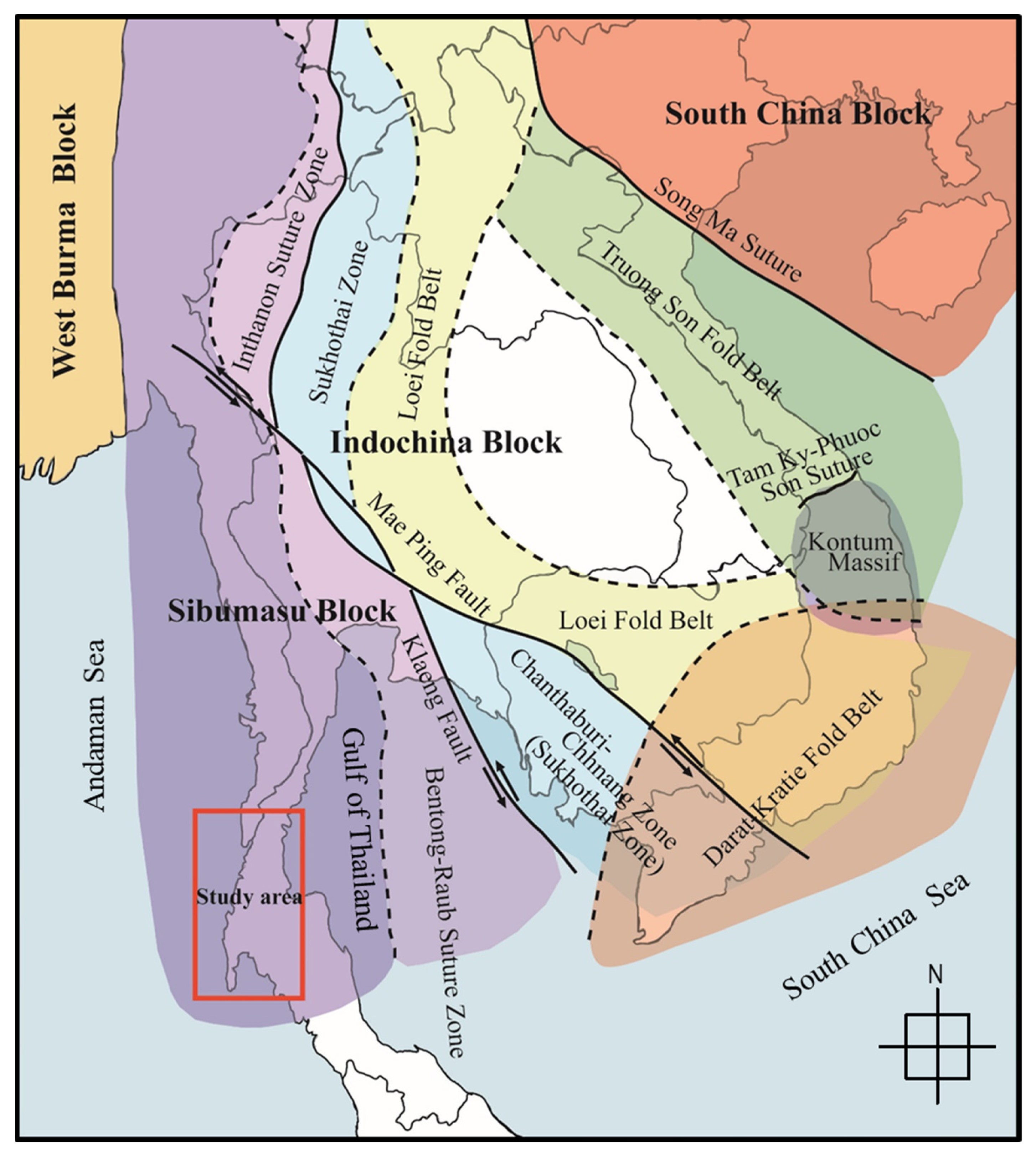
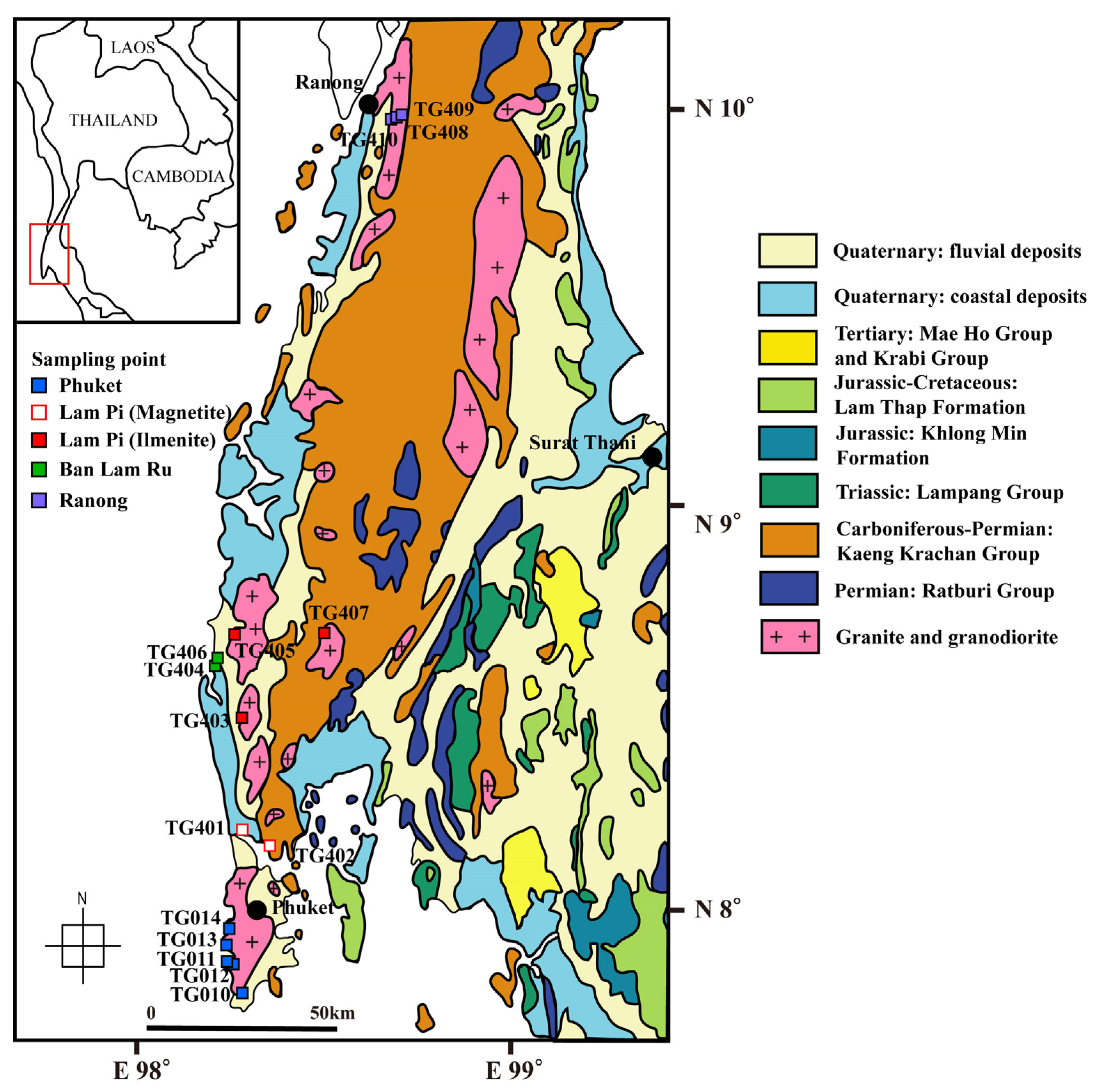
2. Materials and Methods
3. Results
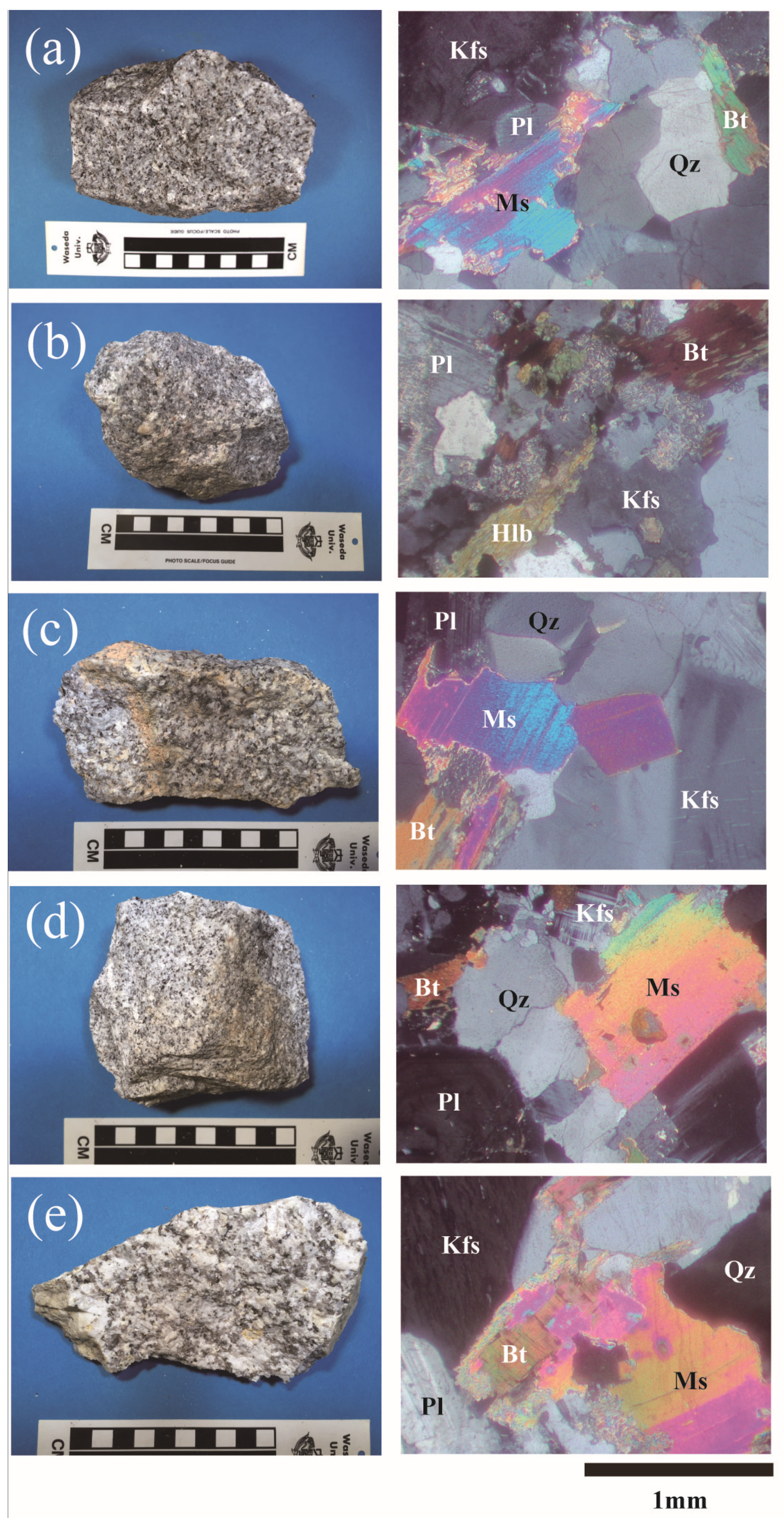
3.1. Sample Descriptions
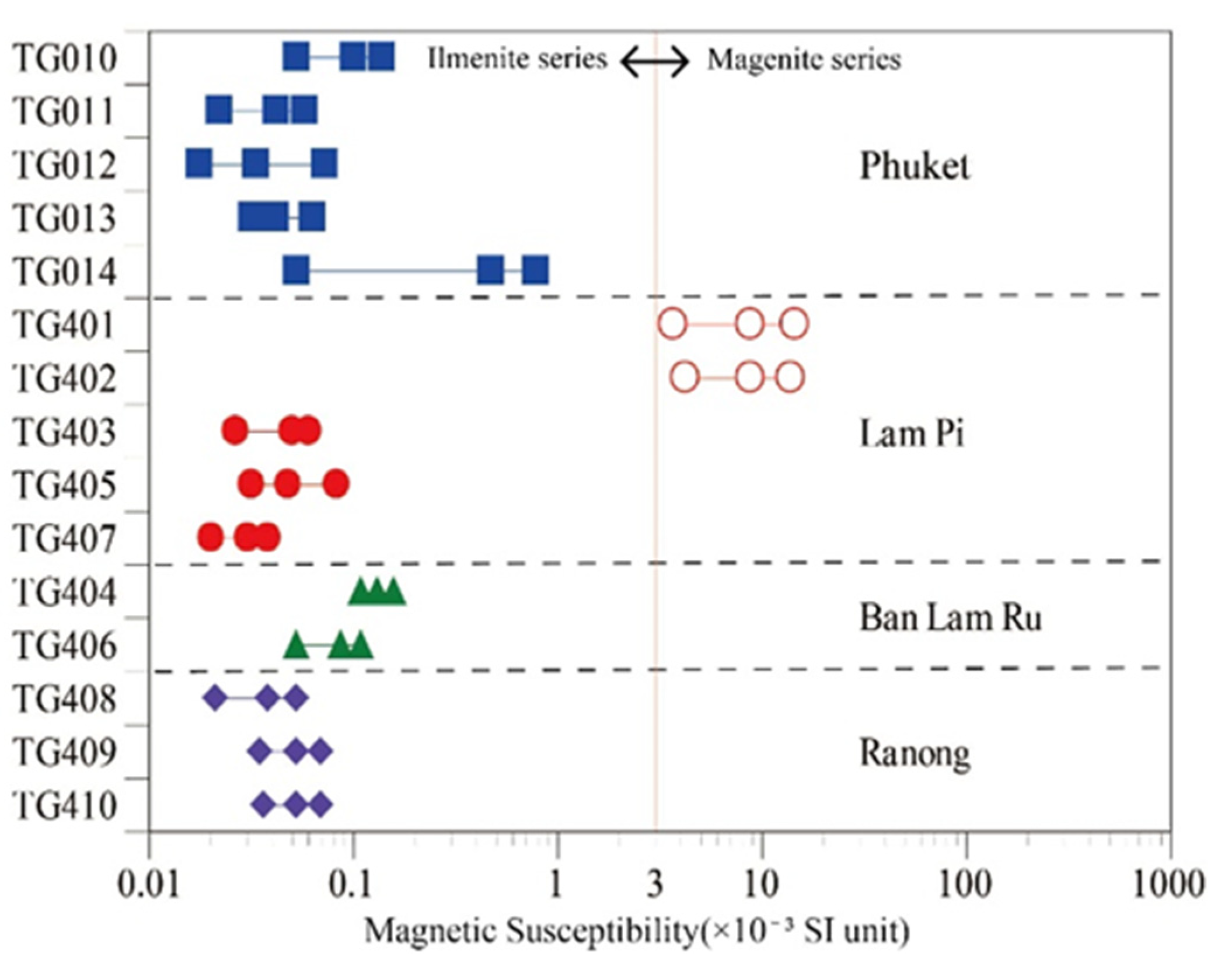
3.2. Magnetic Susceptibility
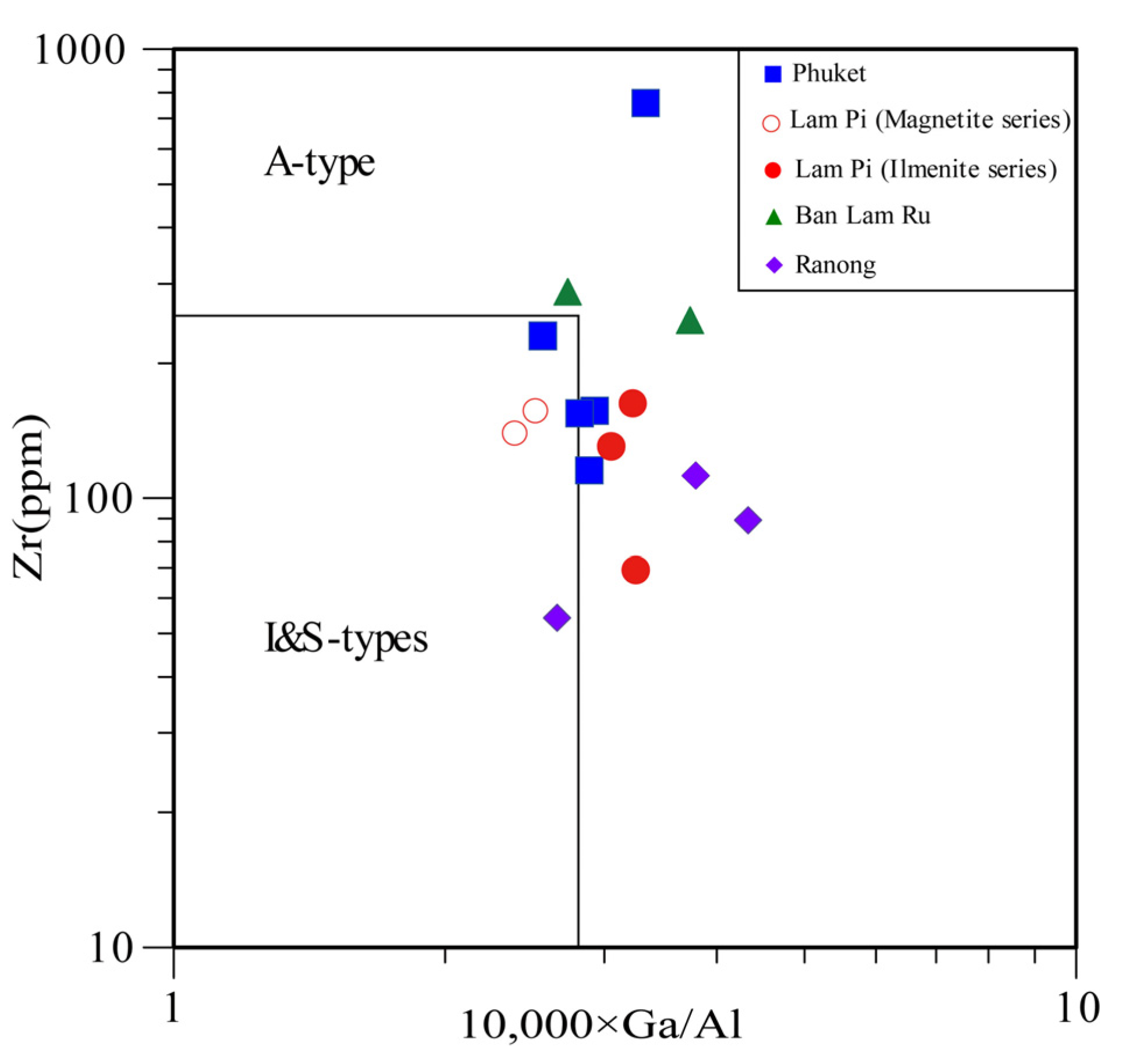
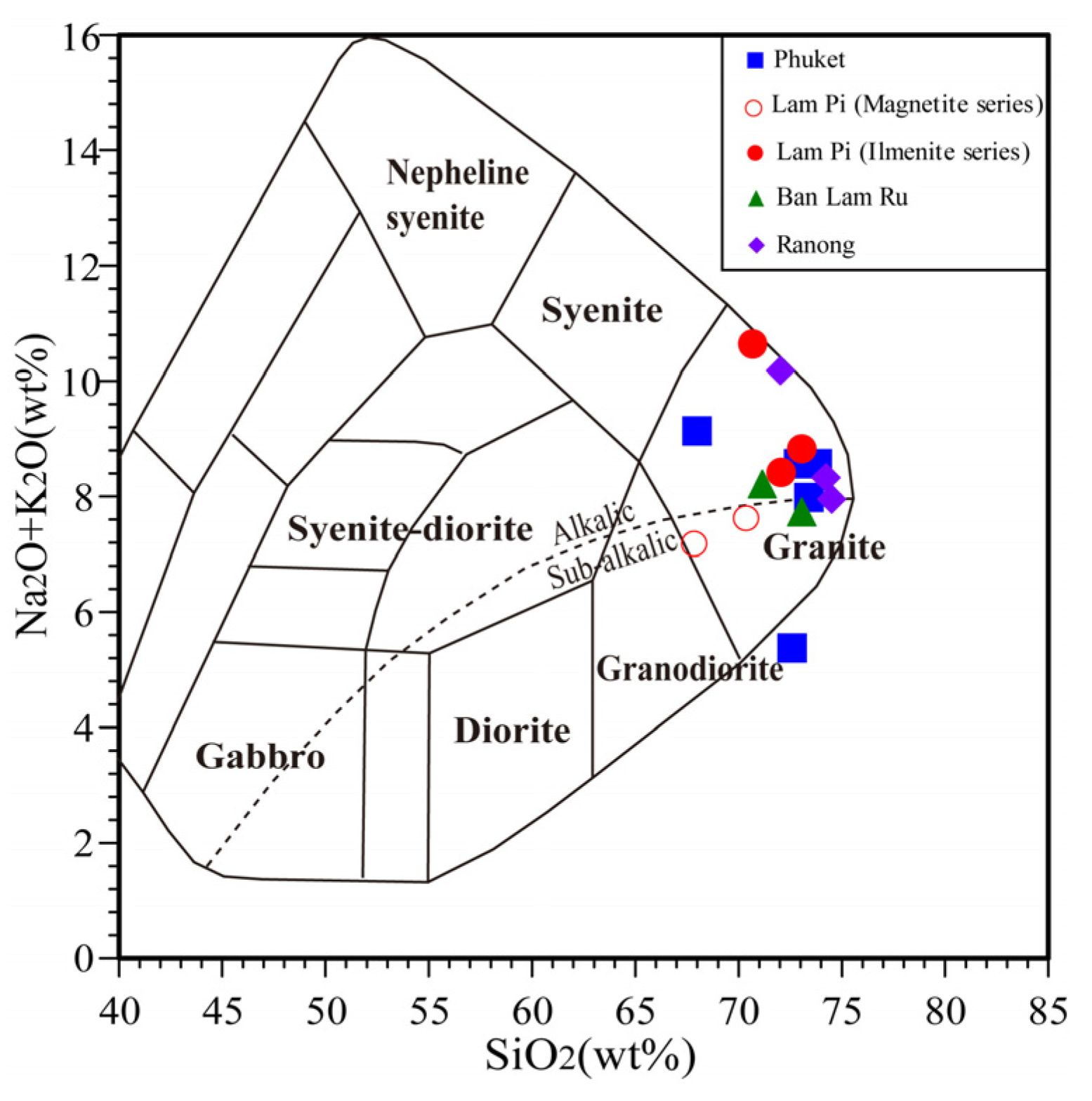
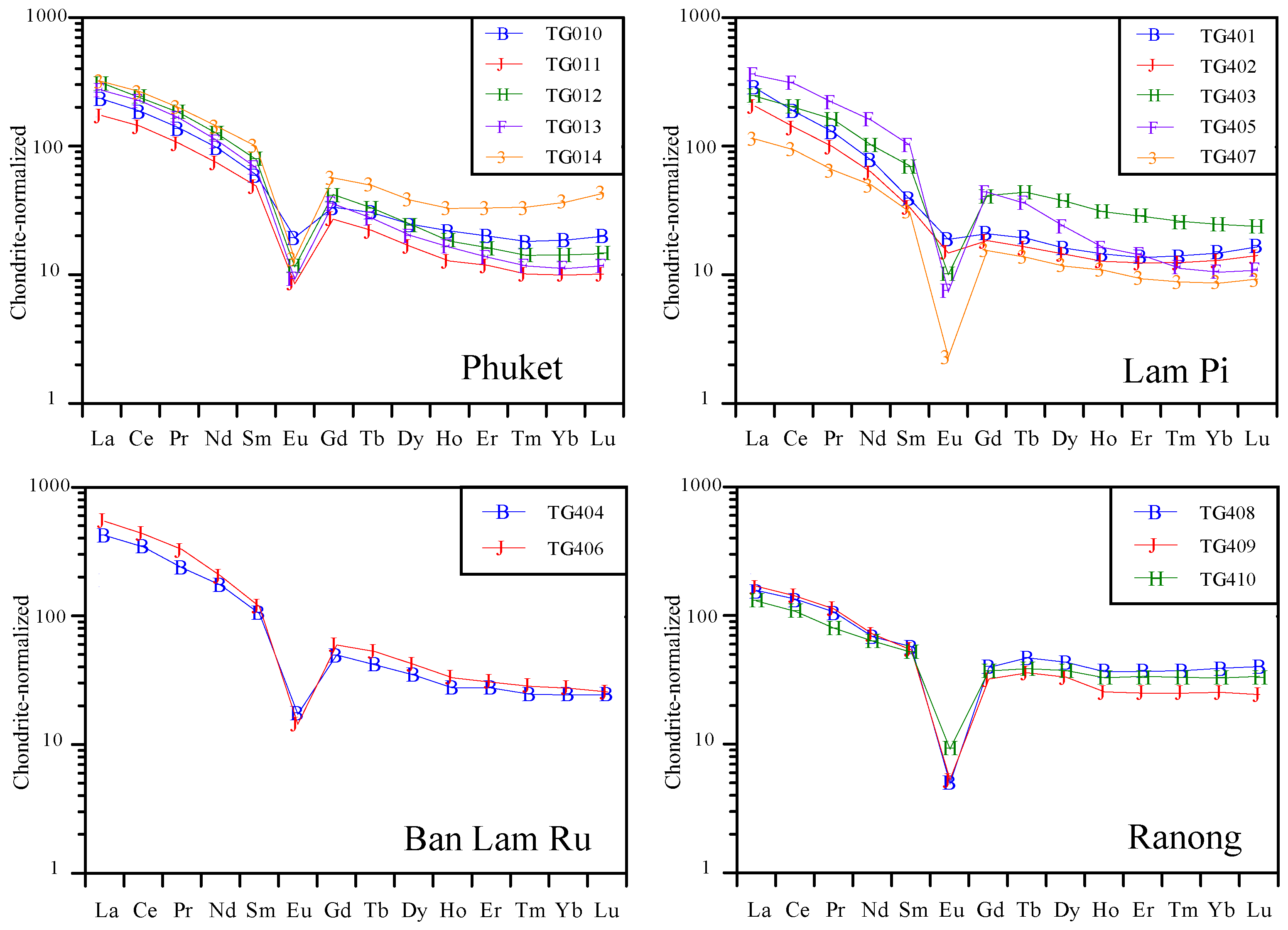
3.3. Whole-Rock Geochemical Compositions
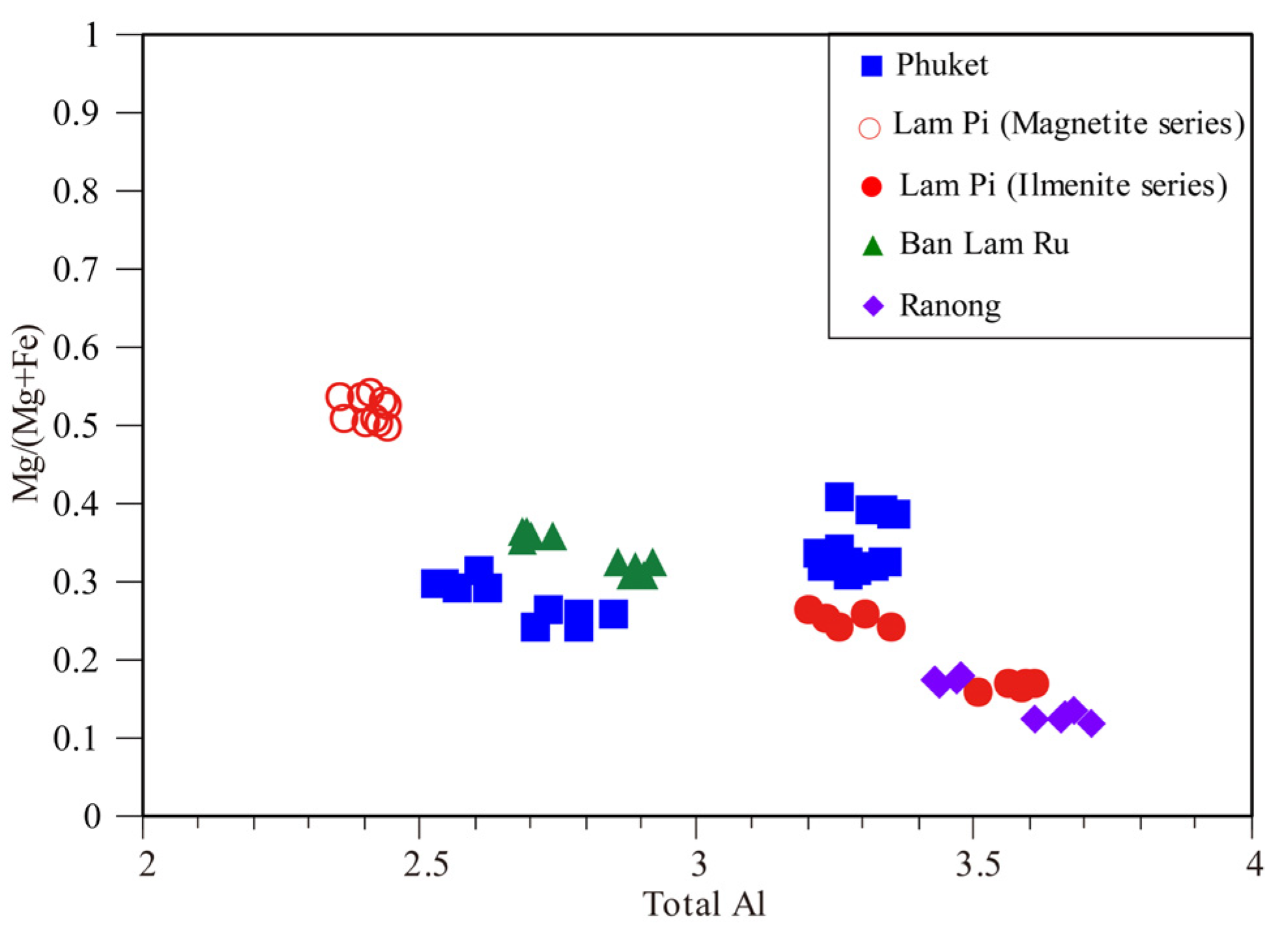
3.4. Chemistry of Biotite
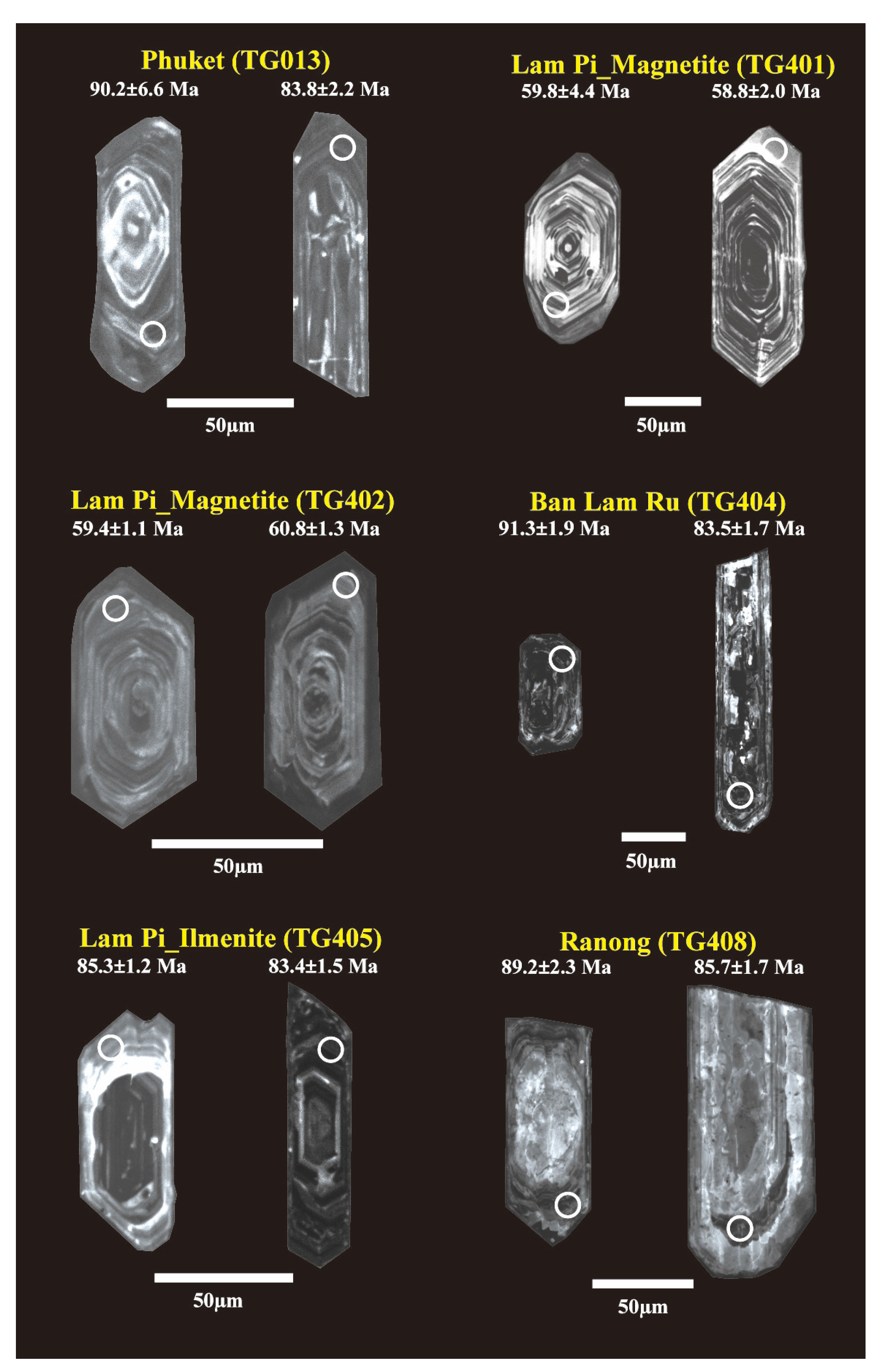
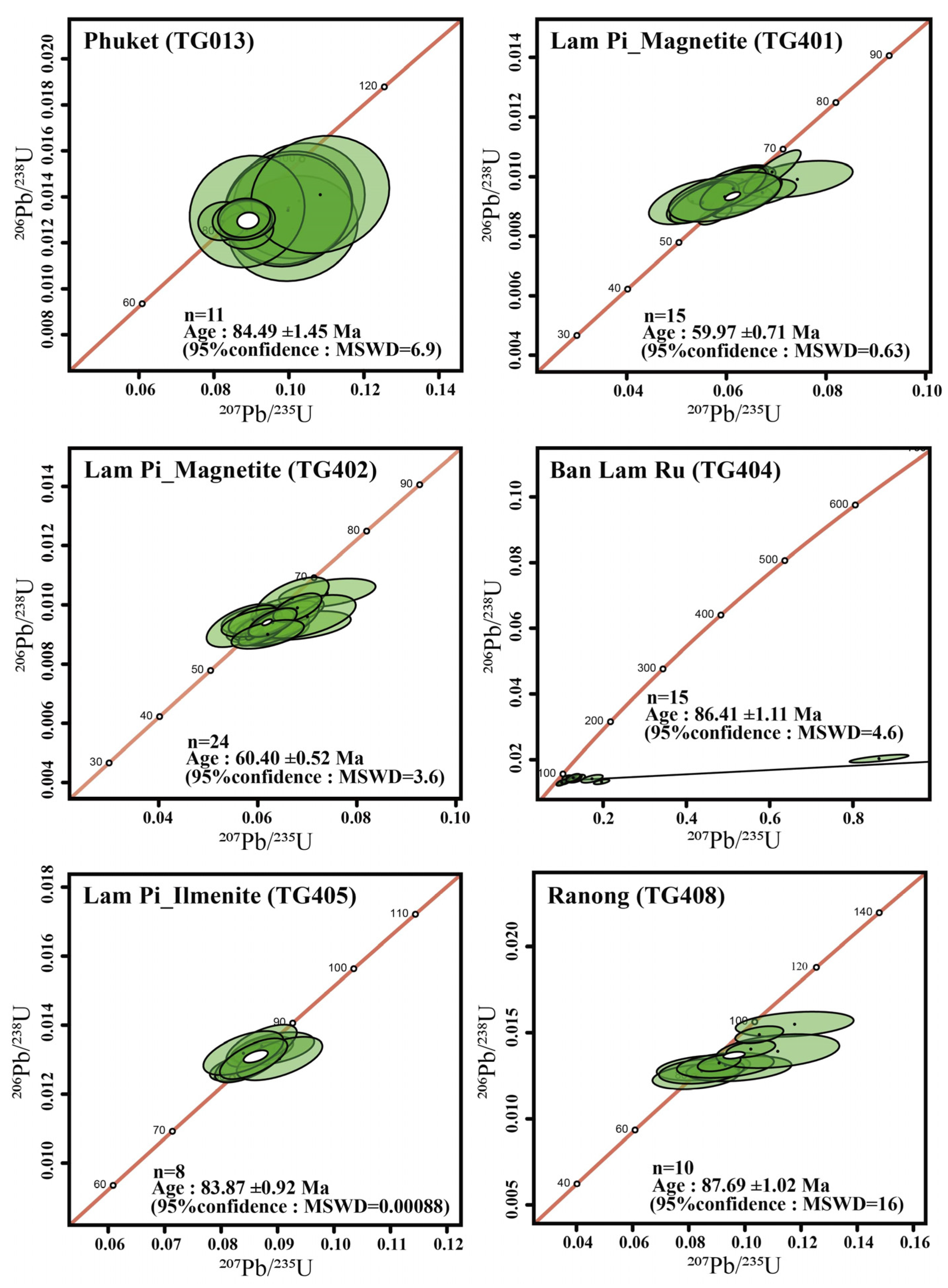
3.5. Zircon U–Pb Dating
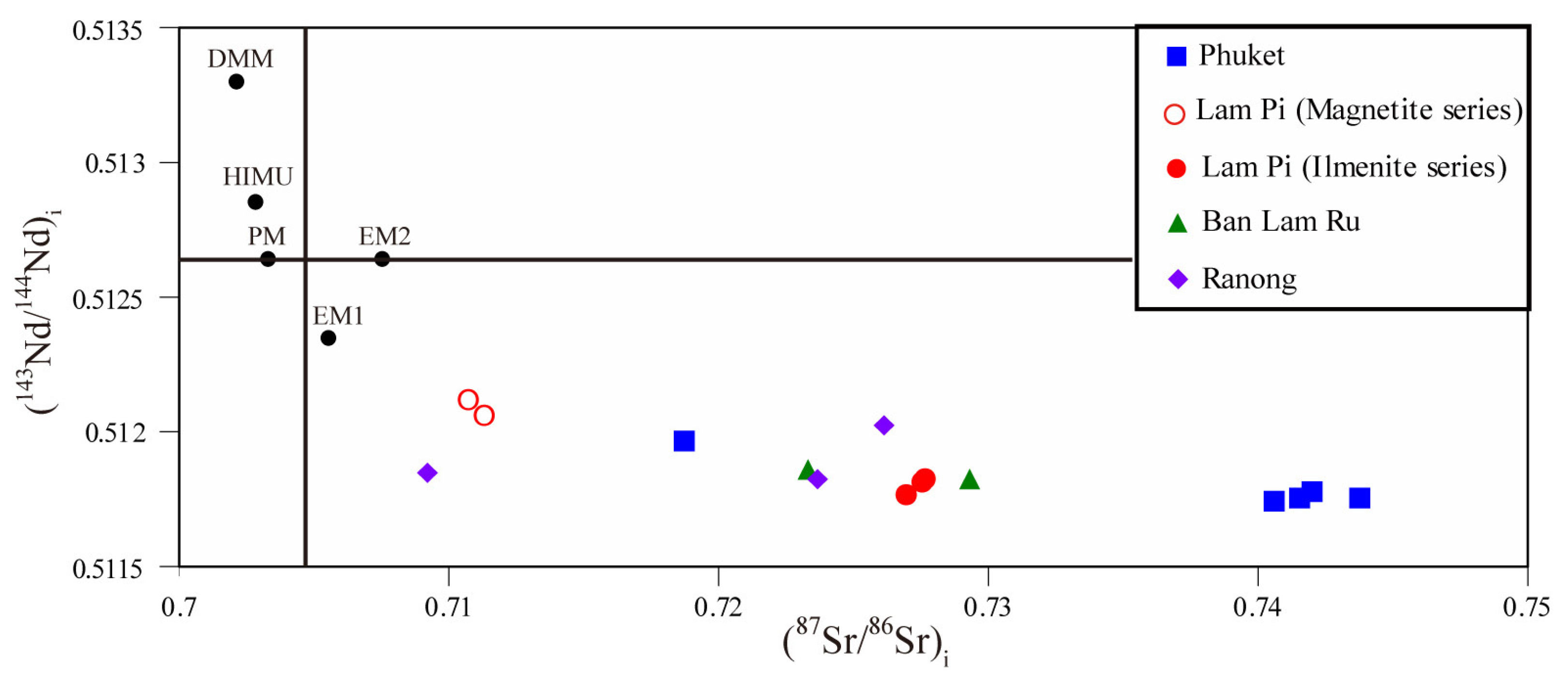
3.6. Initial Nd and Sr Isotopic Ratios
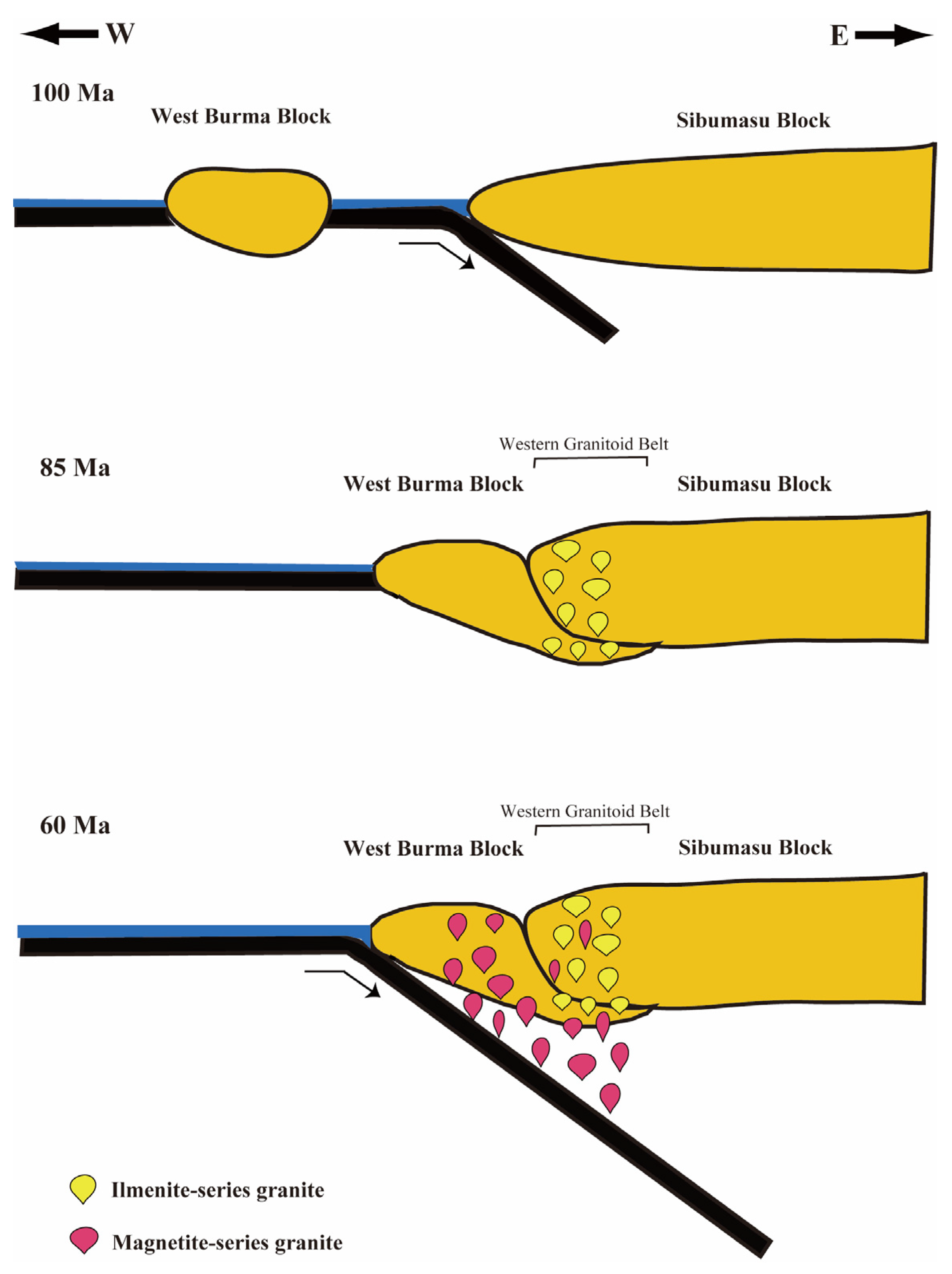
4. Discussion
5. Conclusions
- (1)
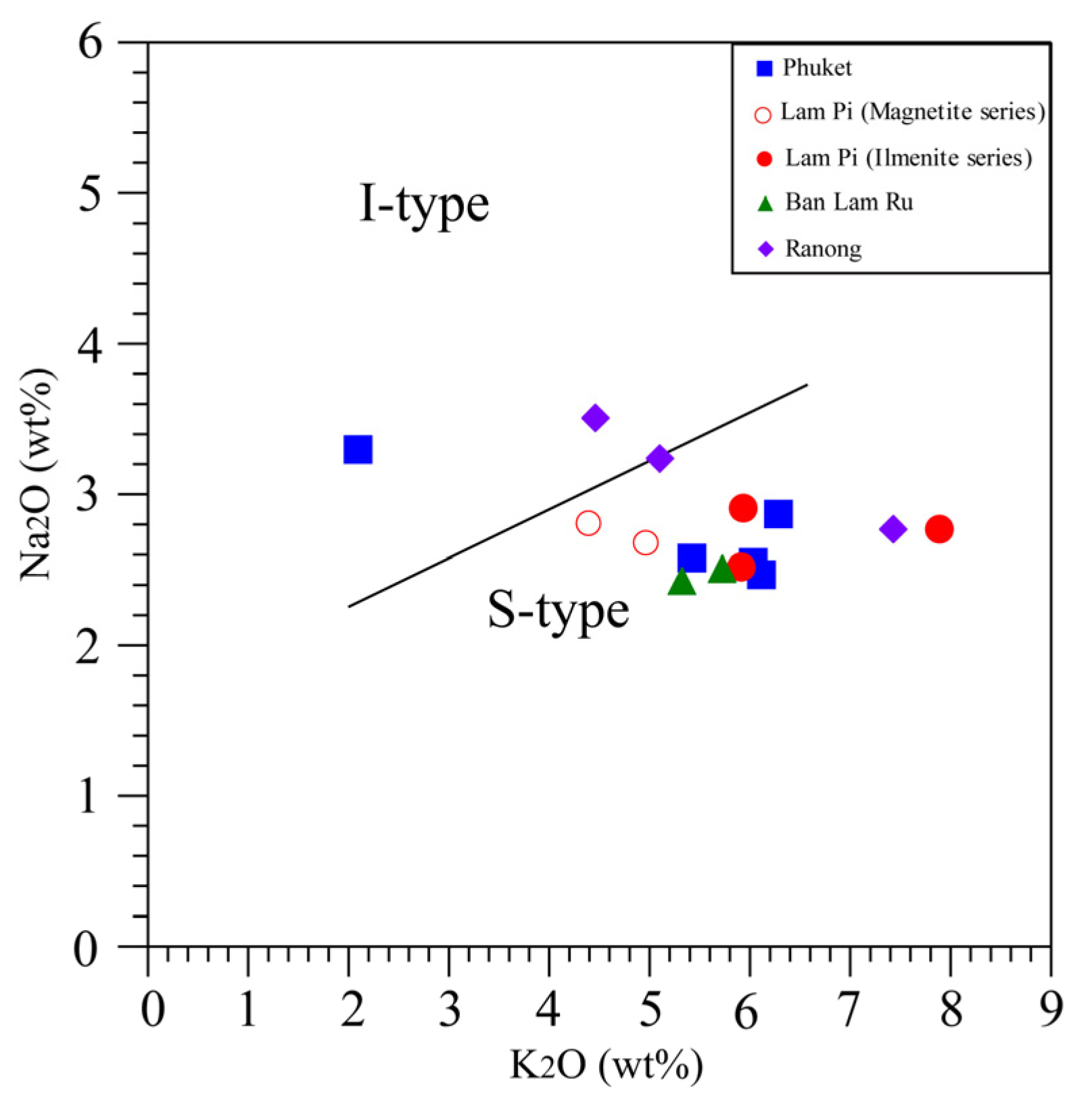
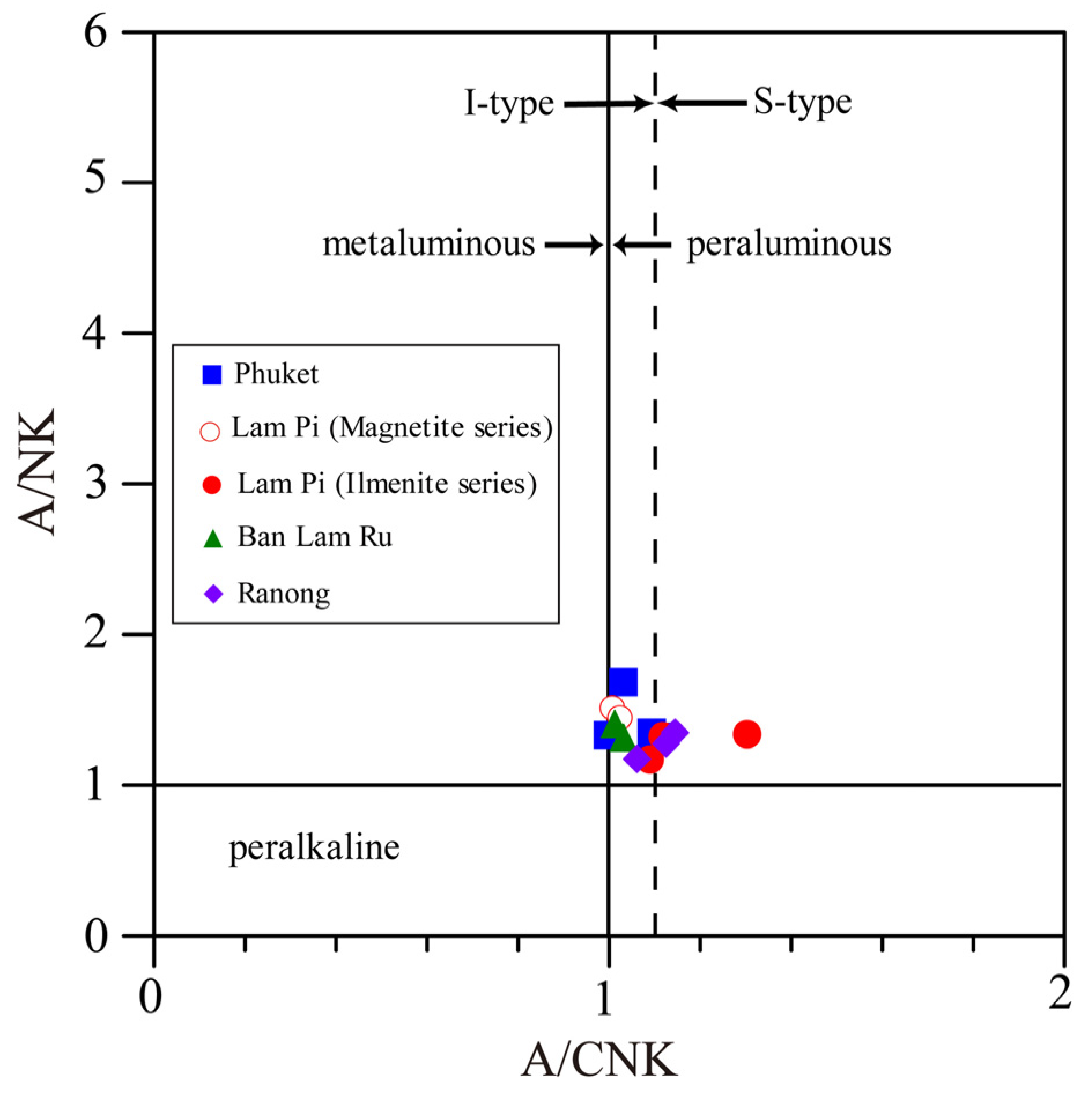
- Based on mineralogical and geochemical characteristics, granitic rock samples collected from the Ranong, Lam Pi, Ban Lam Ru, and Phuket granitic bodies of the Western Granitoid Belt, Thailand, can all be classified strictly as granites. Two samples collected from the Lam Pi granite body are magnetite-series and I-type, whereas the rest of the samples are ilmenite-series and S- or A-type.
- (2)
- Initial Sr isotopic ratios suggest that the magnetite-series granites from the Lam Pi granite body contain a significant contribution from mantle material, whereas the other granites predominantly reflect derivation from continental crust.
- (3)
- The granite bodies, except for the magnetite-series granite of the Lam Pi granite body, yield ages of 88–84 Ma, indicating that they formed during the thickening of the continental crust that occurred in response to the collision between the Sibumasu and West Burma blocks.
- (4)
- The magnetite-series granite of the Lam Pi granite body yields an age of ca. 60 Ma and is believed to have formed in response to the subduction of the Neo-Tethyan oceanic crust beneath the West Burma and Sibumasu blocks.
- (5)
- It is speculated that during the collision between the Sibumasu and West Burma blocks, advanced crystal differentiation of the granite magma led to the formation of granites enriched in incompatible elements such as Sn.
Supplementary Materials
Author Contributions
Funding
Data Availability Statement
Acknowledgments
Conflicts of Interest
References
- Metcalfe, I. Gondwana dispersion and Asian accretion: Tectonic and palaeogeographic evolution of eastern Tethys. J. Asian Earth Sci. 2013, 66, 1–33. [Google Scholar] [CrossRef]
- Wang, Y.; He, H.; Cawood, P.A.; Srithai, B.; Feng, Q.; Fan, W.; Zhang, Y.; Qiana, X. Geochronological, elemental and Sr-Nd-Hf-O isotopic constrains on the petrogenesis of the Triassic post-collisional granitic rocks in NW Thailand and its Paleotethyan implications. Lithos 2016, 266, 264–286. [Google Scholar] [CrossRef]
- Charusiri, P.; Clark, A.H.; Farrad, E.; Archibald, D.; Charusiri, B. Granite belts in Thailand: Evidence from the 40Ar/39Ar geochronological and geological syntheses. J. SE Asian Earth Sci. 1993, 8, 127–136. [Google Scholar] [CrossRef]
- Hutchison, C.S.; Taylor, D. Metallogenesis in SE Asia. J. Geol. Soc. Lond. 1978, 135, 407–428. [Google Scholar] [CrossRef]
- Ishihara, S.; Sawata, H.; Shibata, K.; Terashima, S.; Arrykul, S.; Sato, K. Granites and Sn-W deposits of Peninsular Thailand. In Granitic Magma and Related Mineralization; Ishihara, S., Takenouchi, S., Eds.; Min. Geol. Spec. Issue; Society of Mining Geologists of Japan: Tokyo, Japan, 1980; Volume 8, pp. 223–241. [Google Scholar]
- Cobbing, E.J.; Mallick, D.I.J.; Pitfield, P.E.J.; Teoh, L.H. The granites of the Southeast Asia Tin Belt. J. Geol. Soc. Lond. 1986, 143, 537–550. [Google Scholar] [CrossRef]
- Zaw, K. Geological, petrological and geochemical characteristics of granitoid rocks in Burma: With special reference to the associated W–Sn mineralization and their tectonic setting. J. SE Asian Earth Sci. 1990, 4, 293–335. [Google Scholar] [CrossRef]
- Gardiner, N.J.; Searle, M.P.; Robb, L.J.; Morley, C.K. Neo-Tethyan magmatism and metallogeny in Myanmar—An Andean analogue? J. Asian Earth Sci. 2015, 106, 197–215. [Google Scholar] [CrossRef]
- Searle, M.P.; Whitehouse, M.J.; Robb, L.J.; Ghani, A.A.; Hutchison, C.S.; Sone, M.; Ng, S.W.P.; Roselee, M.H.; Chung, S.L.; Oliver, G.J.H. Tectonic evolution of the Sibumasu Indochina terrane collision zone in Thailand and Malaysia: Constraints from new U-Pb zircon chronology of SE Asian tin granitoids. J. Geol. Soc. 2012, 169, 489–500. [Google Scholar] [CrossRef]
- Pollard, P.J.; Nakapadungrat, S.; Taylor, R.G. The Phuket Supersuite, Southwest Thailand: Fractionated I-type granites associated with tin-tantalum mineralization. Econ. Geol. 1995, 90, 586–602. [Google Scholar] [CrossRef]
- Hara, H.; Wakkita, K.; Ueno, K.; Kamata, Y.; Hisada, K.; Charusiri, P.; Charoentitirat, T.; Chaodumrong, P. Nature of accretion related to Paleo-Tethys subduction recorded in northern Thailand: Constrains from mélange kinematics and illite crystallinity. Gondowana Res. 2009, 16, 310–320. [Google Scholar] [CrossRef]
- Burrett, C.; Zaw, K.; Meffre, S.; Lai, C.K.; Khositanont, S.; Chaodumrong, P.; Udchachon, M.; Ekins, S.; Halpin, J. The configuration of Greater Gondwana evidence from LA ICPMS, U Pb geochronology of detrital zircons from the Palaeozoic and Mesozoic of Southeast Asia and China. Gondwana Res. 2014, 26, 31–51. [Google Scholar] [CrossRef]
- Zaw, K.; Meffre, S.; Lai, C.K.; Burrett, C.; Santosh, M.; Graham, I.; Manaka, T.; Salam, A.; Kamvong, T.; Cromie, P. Tectonics and metallogeny of mainland Southeast Asia—A review and contribution. Gondwana Res. 2014, 26, 5–30. [Google Scholar]
- Shi, M.; Zaw, K.; Liu, S.; Xu, B.; Meffre, S.; Cong, F.; Nie, F.; Peng, Z. Geochronology and petrogenesis of Carboniferous and Triassic volcanic rocks in NW Laos: Implications for the tectonic evolution of the Loei Fold Belt. J. Asian Earth Sci. 2021, 208, 104661. [Google Scholar] [CrossRef]
- Hutchison, C.S. Ophiolites in Southeast Asia. Geol. Soc. Am. Bull. 1975, 86, 797–806. [Google Scholar] [CrossRef]
- Hutchison, C.S. Geological Evolution of South-East Asia; Geol. Soc. Malaysia; Oxford University Press: Kuala Lumpur, Malaysia, 2007; 406p. [Google Scholar]
- Mitchell, A.H.G. Cretaceous-Cenozoic tectonic events in the Western Myammar (Burma)-Assam region. J. Geol. Soc. Lond. 1993, 150, 1089–1102. [Google Scholar] [CrossRef]
- Lee, T.Y.; Lawver, L.A. Cenozoic plate reconstructions of Southeast Asia. Tectonophysics 1995, 251, 85–138. [Google Scholar] [CrossRef]
- Cheng, R.; Uchida, E.; Katayose, K.; Yarimizu, K.; Shin, K.C.; Kong, S.; Nakano, T. Petrogenesis and tectonic setting of Late Paleozoic to Late Mesozoic igneous rocks in Cambodia. J. Asian Earth Sci. 2019, 185, 104046. [Google Scholar] [CrossRef]
- Kasahara, N.; Niki, S.; Uchida, E.; Yarimizu, K.; Cheng, R.; Hirata, T. Zircon U–Pb chronology on plutonic rocks from northeastern Cambodia. Heliyon 2021, 7, e06752. [Google Scholar] [CrossRef]
- Uchida, E.; Nagano, S.; Niki, S.; Yonezu, K.; Saitoh, Y.; Shin, K.C.; Hirata, T. Geochemical and radiogenic isotopic signatures of granitic rocks in Chanthaburi and Chachoengsao provinces, southeastern Thailand: Implications for origin and evolution. J. Asian Earth Sci. X 2022, 8, 100111. [Google Scholar] [CrossRef]
- Hung, D.D.; Tsutsumi, Y.; Hieu, P.T.; Minh, N.T.; Minh, P.; Dung, N.T.; Hung, N.B.; Komatsu, T.; Hoang, N.; Kawaguchi, K. Van Canh Triassic granite in the Kontum Massif, central Vietnam: Geochemistry, geochronology, and tectonic implications. J. Asain Earth Sci. X 2022, 7, 100075. [Google Scholar] [CrossRef]
- Uchida, E.; Yokokura, T. Differences in geochemical characteristics and tectonic settings between Hai Van granitic rocks in Da Nang Province and Van Canh plutonic rocks in Quang Nam Province, Central Vietnam. Geosciences 2024, 14, 13. [Google Scholar] [CrossRef]
- Mantajit, N.; Hintong, C. Geological map of Thailand: Scale 1: 2,500,000; Geological Survey Division, Department of Mineral Resources: Bangkok, Thailand, 1999. [Google Scholar]
- Jaffey, A.H.; Flynn, K.F.; Glendenin, L.E.; Bentley, W.T.; Essling, A.M. Precision measurement of half-lives and specific activities of 235U and 238U. Phys. Rev. 1971, C4, 1889–1906. [Google Scholar]
- Jochum, K.P.; Brueckner, S.M. Reference materials in geoanalytical and environmental research—Review for 2006 and 2007. Geostand. Geoanal. Res. 2008, 32, 405–452. [Google Scholar] [CrossRef]
- Sakata, S.; Hirakawa, S.; Iwao, H.; Danhara, T.; Guillong, M.; Hirata, T. A new approach for constraining the magnitude of initial disequilibrium in Quaternary zircon by coupled uranium and thorium decay series dating. Quat. Geochronol. 2017, 38, 1–12. [Google Scholar] [CrossRef]
- Jackson, S.E.; Pearson, N.J.; Griffin, W.L.; Belousova, E.A. The application of laser ablation-inductively coupled plasma-mass spectrometry to in situ U-Pb zircon geochronology. Chem. Geol. 2004, 211, 47–69. [Google Scholar] [CrossRef]
- Iwano, H.; Orihashi, Y.; Hirata, T.; Ogasawara, M.; Danhara, T.; Horie, K.; Hasebe, N.; Sueoka, S.; Tamura, A.; Hayasaka, Y.; et al. An inter-laboratory evaluation of OD-3 zircon for use as a secondary U–Pb dating standard. Island Arc 2013, 22, 382–394. [Google Scholar] [CrossRef]
- Vermeesch, P. IsoplotR: A free and open toolbox for geochronology. Geosci. Front. 2018, 9, 1479–1493. [Google Scholar] [CrossRef]
- Ludwig, K.R. On the treatment of concordant uranium-lead ages. Geochem. Cosmochim. Acta 1998, 62, 665–676. [Google Scholar] [CrossRef]
- Tanaka, T.; Togashi, S.; Kamioka, H.; Amakawa, H.; Kagami, H.; Hamamoto, T.; Yuhara, M.; Orihashi, Y.; Yoneda, S.; Shimizu, H. JNdi 1: A neodymium isotopic reference in consistency with LaJolla neodymium. Chem. Geol. 2000, 168, 279–281. [Google Scholar] [CrossRef]
- Faure, G.; Mensing, T.M. Isotopes—Principles and Applications, 3rd ed.; John Wiley & Sons: Hoboken, NJ, USA, 2005; pp. 347–411. [Google Scholar]
- Uchida, E.; Yonezu, K.; Yokokura, T.; Mori, N. Diffeences in geochemical signatures and petrogenesis between the Van Canh and Ben Giang-Que Son granitic rocks in the southern Kontum Masif, Vietnam. Geosciences 2023, 13, 341. [Google Scholar] [CrossRef]
- Ishihara, S. The magnetite series and ilmenite series granitic rocks. Min. Geol. 1977, 27, 293–305. [Google Scholar]
- Ishihara, S. The Granitoid Series and Mineralization. In Economic Geology Seventy Fifth Anniversary Volume; Skinner, B.J., Ed.; Economic Geology Publishing Company: Littleton, CO, USA, 1981; pp. 458–484. [Google Scholar]
- Cox, K.G.; Bell, J.D.; Pankhurst, R.J. The Interpretation of Igneous Rocks; Allen and Unwin: London, UK, 1979; p. 450. [Google Scholar]
- Wilson, M. Igneous Petrogenesis. In A Global Tectonic Approach; Unwin Hyman: London, UK, 1989; p. 466. [Google Scholar]
- Irvine, T.L.I.; Baragar, W.R.A. A guide to chemical classification of common volcanic rocks. Can. J. Earth Sci. 1971, 8, 523–548. [Google Scholar] [CrossRef]
- Chappell, B.W.; White, A.J.R. Two contrasting granite types. Pac. Geol. 1974, 8, 173–174. [Google Scholar]
- Middlemost, E.A.K. Naming materials in the magma/igneous rock system. Earth Sci. Rev. 1994, 37, 215–224. [Google Scholar] [CrossRef]
- Whalen, J.B.; Currie, K.L.; Chappell, B.W. A-type granites: Geochemical characteristics, discrimination and petrogenesis. Contrib. Miner. Petrol. 1987, 95, 407–419. [Google Scholar] [CrossRef]
- Pearce, J.A.; Harris, N.B.W.; Tindle, A.G. Trace element distribution diagrams for the tectonic interpretation of granitic rocks. J. Petrol. 1984, 25, 956–983. [Google Scholar] [CrossRef]
- Defant, M.J.; Drummond, M.S. A model for Trondhje Tonalite Dacite Genesis and crustal growth via slab melting: Archean to modern comparisons. J. Geophys. Res. Solid Earth Banner 1990, 95, 21503–21521. [Google Scholar]
- McDonough, W.F.; Sun, S.S. The composition of the Earth. Chem. Geol. 1995, 120, 223–253. [Google Scholar] [CrossRef]
- Masuda, A.; Nakamura, N.; Tanaka, T. Fine structures of mutually normalized rare earth patterns of chondrites. Geochim. Cosmochim. Acta 1973, 37, 239–248. [Google Scholar] [CrossRef]
- Schaefer, B.F. Radiogenic Isotope Geochemistry; Oxford University Press: Oxford, UK, 2016; pp. 40–56, 145–176. [Google Scholar]
- Uchida, E.; Endo, S.; Makino, M. Relationship between solidification depth of granitic rocks and formation of hydrothermal ore deposits. Resour. Geol. 2007, 57, 47–56. [Google Scholar] [CrossRef]
- Uchida, E.; Choi, S.G.; Baba, D.; Wakisaka, Y. Petrogenesis and solidification depth of the Jurassic Daebo and Cretaceous Bulguksa granitic rocks in South Korea. Resour. Geol. 2012, 62, 281–295. [Google Scholar] [CrossRef]
- Mitchell, A.H.G. Guides to metal provinces in the central Himalaya collision belt; the value of regional stratigraphic correlations and tectonic analogies. Mem. Geol. Soc. China 1979, 3, 167–194. [Google Scholar]
- Morley, C.K. Nested strike–slip duplexes and other evidence for late Cretaceous–Palaeogene transpressional tectonics before and during the India-Eurasia collision, in Thailand, Burma and Malaysia. J. Geol. Soc. Lond. 2004, 161, 799–812. [Google Scholar] [CrossRef]
- Mitchell, A.H.G.; Htay, M.T.; Htun, K.M. The medial Myanmar suture zone and the Western Myanmar-Mogok foreland. J. Myanmar Geosci. Soc. 2015, 6, 73–88. [Google Scholar]
- Cobbing, E.J.; Pitfield, P.E.J.; Darbyshire, D.P.F.; Mallick, D.I.J. The Granites of the South-East Asian Tin Belt. Available online: https://webapps.bgs.ac.uk/data/publications/pubs.cfc?method=viewRecord&publnId=19864782&series=OG&subseries=RP (accessed on 9 April 2024).
- Dunning, G.R.; MacDonald, A.S.; Barr, S.M. Zircon and monazite U-Pb dating of the Doi Inthannon core complex, northern Thailand: Implications for extension within the Indosinian Orogen. Tectonophysics 1995, 251, 197–213. [Google Scholar] [CrossRef]





| Granite Body | Sample No. | Rock Type | Qz | Pl | Kfs | Bt | Hlb | Zrn | Ap | Ms | Ttn | Op | Cpx | Tur | Remarks |
|---|---|---|---|---|---|---|---|---|---|---|---|---|---|---|---|
| Phuket | TG010 | Hornblende-biotite granite | ○ | ○ | ○ | ○ | ○ | - | - | △ | - | ||||
| TG011 | Biotite granite | ◎ | ○ | ○ | ○ | - | |||||||||
| TG012 | Biotite granite | ◎ | ○ | ○ | ○ | - | - | - | △ | Plagioclase is partly altered. | |||||
| TG013 | Biotite granite | ◎ | ○ | ○ | ○ | - | ○ | - | - | ||||||
| TG014 | Biotite granite | ◎ | ○ | ○ | ○ | - | - | - | Biotite is partly altered. | ||||||
| Lam Pi (Magnetite) | TG401 | Hornblende-biotite granite | ◎ | ◎ | ◎ | ○ | ○ | △ | △ | Biotite and plagioclase are partly altered. | |||||
| TG402 | Biotite granite | ◎ | ◎ | ◎ | ○ | - | - | Biotite and plagioclase are partly altered. | |||||||
| Lam Pi (Ilmenite) | TG403 | Biotite granite | ◎ | ○ | ◎ | ○ | - | - | ○ | Biotite and K-feldspar is partly altered. | |||||
| TG405 | Biotite granite | ◎ | ○ | ◎ | - | ○ | △ | Plagioclase is partly altered. | |||||||
| TG407 | Biotite granite | ◎ | ○ | ◎ | - | ○ | △ | Plagioclase is partly altered. | |||||||
| Ban Lam Ru | TG404 | Biotite granite | ◎ | ○ | ◎ | ◎ | - | - | - | Biotite is partly altered. | |||||
| TG406 | Biotite granite | ◎ | ○ | ◎ | ◎ | - | - | - | - | Biotite is partly altered. | |||||
| Ranong | TG408 | Biotite granite | ◎ | ○ | ◎ | ○ | - | - | ○ | △ | |||||
| TG409 | Biotite granite | ○ | ○ | ○ | - | - | ○ | Biotite is altered. | |||||||
| TG410 | Biotite granite | ○ | ○ | ◎ | ○ | - | - | △ | - | - | Biotite is partly altered. |
| Location | Phuket | Lam Pi | Ban Lam Ru | Ranong | ||||||||||||
|---|---|---|---|---|---|---|---|---|---|---|---|---|---|---|---|---|
| Sample No. | TG010 | TG011 | TG012 | TG013 | TG014 | TG401 | TG402 | TG403 | TG405 | TG407 | TG404 | TG406 | TG408 | TG409 | TG410 | |
| SiO2 | wt% | 67.96 | 73.38 | 72.88 | 73.79 | 72.56 | 67.81 | 70.33 | 70.65 | 72.03 | 73.03 | 71.12 | 72.05 | 74.48 | 74.21 | 72.00 |
| Al2O3 | wt% | 15.45 | 13.72 | 14.18 | 14.07 | 13.02 | 14.25 | 14.23 | 15.45 | 14.04 | 15.09 | 13.81 | 13.65 | 14.39 | 13.95 | 14.90 |
| Fe2O3 (T *) | wt% | 3.33 | 1.73 | 1.51 | 1.68 | 3.55 | 3.44 | 2.38 | 1.19 | 1.59 | 0.96 | 3.09 | 2.73 | 1.06 | 1.51 | 1.05 |
| MnO | wt% | 0.052 | 0.031 | 0.018 | 0.026 | 0.078 | 0.081 | 0.057 | 0.034 | 0.037 | 0.047 | 0.048 | 0.049 | 0.037 | 0.047 | 0.035 |
| MgO | wt% | 0.68 | 0.58 | 0.35 | 0.38 | 0.92 | 1.24 | 0.72 | 0.14 | 0.30 | 0.13 | 0.82 | 0.61 | 0.14 | 0.20 | 0.13 |
| CaO | wt% | 2.20 | 1.35 | 1.16 | 1.17 | 2.72 | 2.64 | 2.28 | 0.61 | 1.12 | 0.21 | 2.15 | 1.61 | 1.09 | 0.86 | 0.81 |
| Na2O | wt% | 2.87 | 2.58 | 2.47 | 2.55 | 3.30 | 2.81 | 2.68 | 2.77 | 2.52 | 2.91 | 2.43 | 2.51 | 3.51 | 3.24 | 2.77 |
| K2O | wt% | 6.27 | 5.41 | 6.10 | 6.02 | 2.09 | 4.38 | 4.95 | 7.87 | 5.90 | 5.92 | 5.31 | 5.71 | 4.45 | 5.09 | 7.41 |
| TiO2 | wt% | 0.507 | 0.208 | 0.251 | 0.249 | 0.663 | 0.509 | 0.351 | 0.142 | 0.250 | 0.111 | 0.523 | 0.383 | 0.117 | 0.166 | 0.121 |
| P2O5 | wt% | 0.13 | 0.11 | 0.08 | 0.09 | 0.15 | 0.13 | 0.08 | 0.07 | 0.09 | 0.08 | 0.13 | 0.10 | 0.05 | 0.09 | 0.04 |
| LOI | wt% | 1.26 | 0.61 | 0.56 | 0.77 | 0.97 | 2.01 | 2.75 | 0.91 | 0.85 | 1.87 | 0.69 | 0.67 | 1.12 | 1.16 | 0.78 |
| Total | wt% | 100.7 | 99.71 | 99.57 | 100.8 | 100 | 99.29 | 100.8 | 99.83 | 98.75 | 100.4 | 100.1 | 100.1 | 100.5 | 100.5 | 100.1 |
| Sc | ppm | 5 | 4 | 4 | 4 | 10 | 7 | 5 | 3 | 3 | 2 | 7 | 6 | 5 | 4 | 3 |
| Be | ppm | 7 | 13 | 11 | 7 | 15 | 4 | 6 | 8 | 8 | 10 | 8 | 11 | 11 | 9 | 9 |
| V | ppm | 24 | 18 | 15 | 13 | 36 | 65 | 40 | 6 | 10 | 6 | 27 | 20 | 6 | 6 | 6 |
| Ba | ppm | 586 | 219 | 258 | 224 | 170 | 566 | 458 | 226 | 192 | 78 | 347 | 257 | 57 | 98 | 300 |
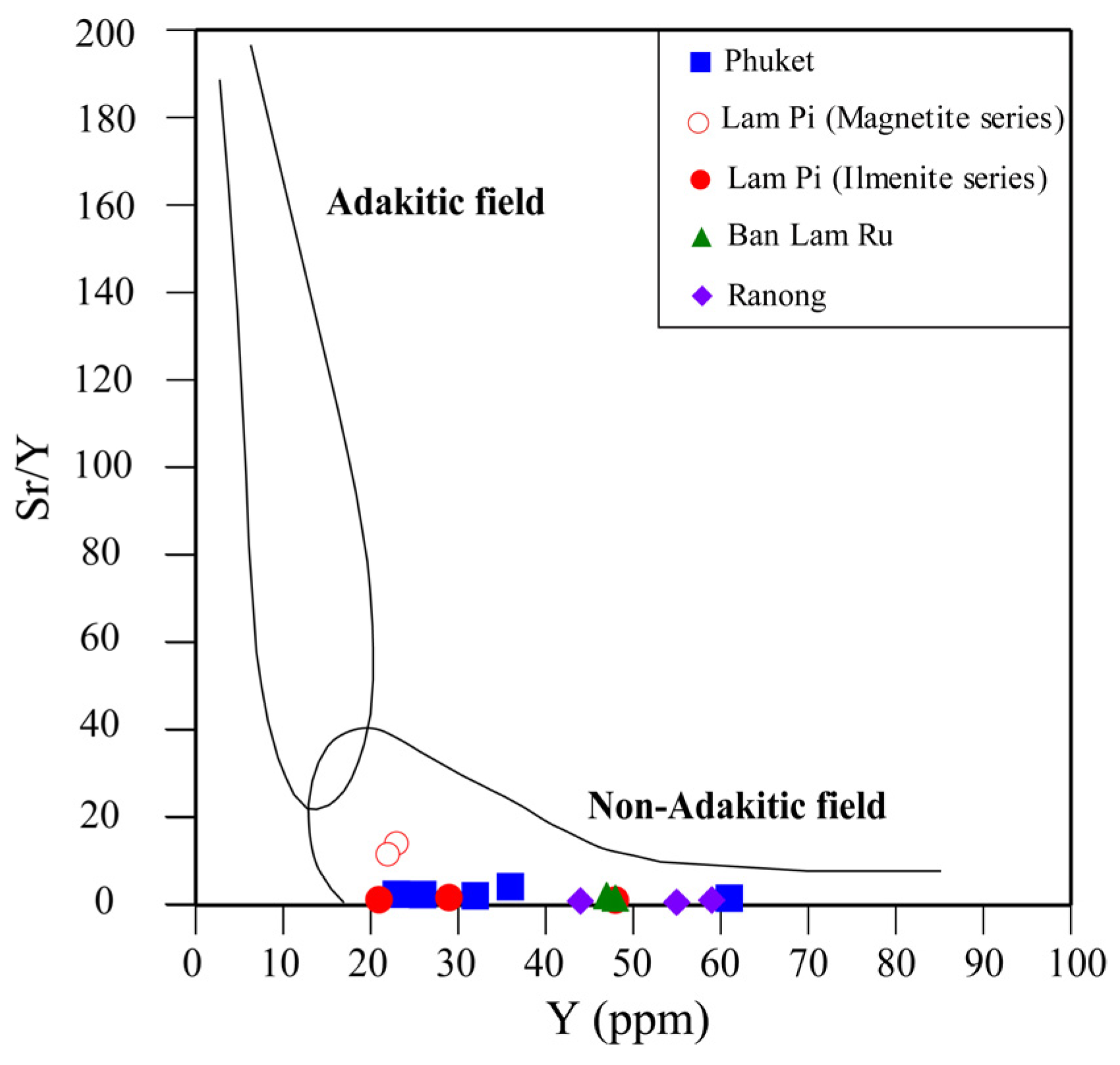
| Sr | ppm | 145 | 53 | 62 | 57 | 85 | 320 | 251 | 46 | 44 | 22 | 95 | 68 | 24 | 33 | 56 |
| Y | ppm | 36 | 23 | 32 | 26 | 61 | 23 | 22 | 48 | 29 | 21 | 47 | 48 | 55 | 44 | 59 |
| Zr | ppm | 229 | 115 | 156 | 154 | 753 | 156 | 139 | 130 | 162 | 69 | 287 | 248 | 89 | 112 | 54 |
| Cr | ppm | <20 | <20 | <20 | <20 | <20 | <20 | <20 | <20 | <20 | <20 | 30 | <20 | <20 | <20 | <20 |
| Ni | ppm | <20 | <20 | <20 | <20 | <20 | <20 | <20 | <20 | <20 | <20 | <20 | <20 | 50 | <20 | <20 |
| Cu | ppm | <10 | <10 | <10 | <10 | 20 | <10 | <10 | <10 | 280 | 280 | 280 | <10 | <10 | 120 | 280 |
| Zn | ppm | 60 | 50 | 50 | 40 | 80 | 60 | 50 | 40 | 120 | 110 | 120 | 60 | 50 | 50 | 110 |
| Ga | ppm | 21 | 21 | 22 | 21 | 23 | 19 | 18 | 25 | 24 | 26 | 20 | 27 | 33 | 28 | 21 |
| Ge | ppm | 2 | 2 | 2 | 2 | 3 | 2 | 2 | 2 | 1 | 2 | 1 | 2 | 3 | 2 | 2 |
| As | ppm | <5 | <5 | <5 | <5 | 6 | <5 | <5 | <5 | <5 | <5 | <5 | <5 | 37 | <5 | <5 |
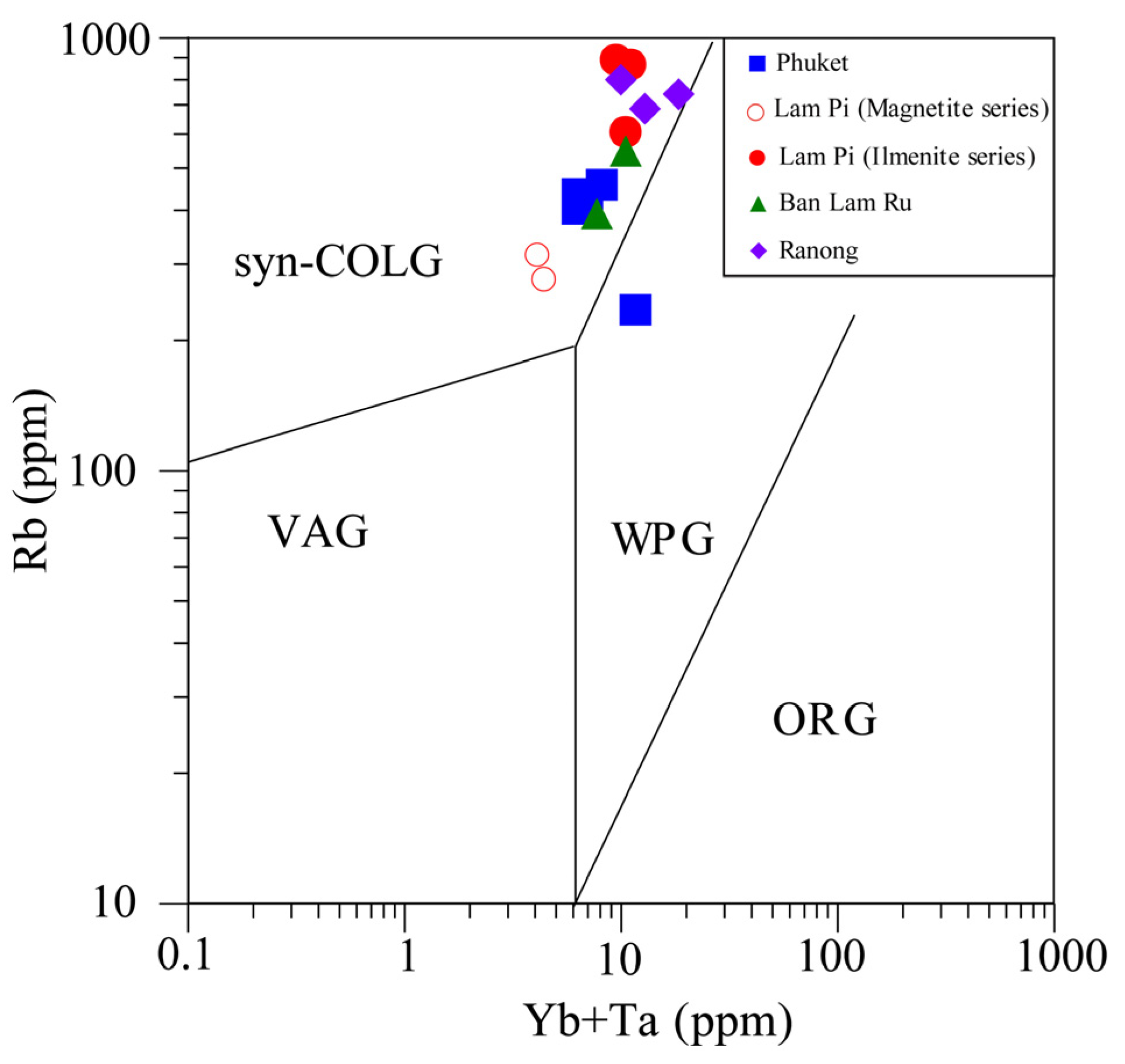
| Rb | ppm | 399 | 418 | 452 | 429 | 236 | 276 | 314 | 872 | 607 | 881 | 395 | 540 | 741 | 684 | 796 |
| Nb | ppm | 22 | 24 | 29 | 26 | 42 | 13 | 11 | 24 | 27 | 28 | 26 | 31 | 30 | 29 | 19 |
| Mo | ppm | <2 | <2 | <2 | <2 | <2 | <2 | <2 | <2 | <2 | <2 | <2 | <2 | <2 | <2 | <2 |
| Ag | ppm | 0.8 | <0.5 | 0.5 | <0.5 | 2.5 | <0.5 | <0.5 | <0.5 | 0.5 | <0.5 | 0.8 | 0.6 | <0.5 | <0.5 | <0.5 |
| In | ppm | <0.2 | <0.2 | <0.2 | <0.2 | <0.2 | <0.2 | <0.2 | 0.2 | 1.1 | 1.2 | 1 | 0.2 | 0.4 | 0.4 | 1.1 |
| Sn | ppm | 22 | 37 | 45 | 35 | 57 | 14 | 13 | 20 | 22 | 43 | 14 | 23 | 43 | 46 | 16 |
| Sb | ppm | <0.5 | <0.5 | <0.5 | <0.5 | <0.5 | <0.5 | <0.5 | <0.5 | 0.6 | 0.6 | 0.7 | <0.5 | <0.5 | <0.5 | <0.5 |
| Cs | ppm | 27.1 | 49.5 | 64 | 30.6 | 39.7 | 7.6 | 8.4 | 50.5 | 24.9 | 72.5 | 26.1 | 48.5 | 92.4 | 66.3 | 45.0 |
| La | ppm | 55.4 | 41.1 | 73.7 | 65 | 75.8 | 67.8 | 48.8 | 58.5 | 85.1 | 27.2 | 100 | 129 | 37.2 | 40.1 | 30.8 |
| Ce | ppm | 115 | 88.3 | 147 | 139 | 163 | 116 | 87.3 | 124 | 190 | 58.0 | 210 | 266 | 82.2 | 87.3 | 66.2 |
| Pr | ppm | 12.9 | 9.81 | 17.1 | 15.5 | 18.6 | 12.1 | 9.27 | 15.2 | 20.5 | 6.10 | 21.9 | 30.3 | 9.88 | 10.5 | 7.42 |
| Nd | ppm | 44.4 | 33.8 | 57.2 | 50.6 | 65.2 | 35.8 | 28.9 | 47.1 | 73.4 | 23.1 | 79.1 | 93.1 | 31.4 | 33.0 | 29.0 |
| Sm | ppm | 8.9 | 7.3 | 11.7 | 10.1 | 14.8 | 5.8 | 5.0 | 10.5 | 15.2 | 4.6 | 15.4 | 17.5 | 8.5 | 8.0 | 7.7 |
| Eu | ppm | 1.10 | 0.48 | 0.65 | 0.52 | 0.75 | 1.07 | 0.84 | 0.57 | 0.42 | 0.13 | 0.97 | 0.81 | 0.28 | 0.30 | 0.52 |
| Gd | ppm | 6.7 | 5.4 | 8.4 | 7.1 | 11.3 | 4.2 | 3.7 | 8.3 | 8.8 | 3.1 | 9.9 | 11.8 | 7.9 | 6.4 | 7.4 |
| Tb | ppm | 1.1 | 0.8 | 1.2 | 1.0 | 1.8 | 0.7 | 0.6 | 1.6 | 1.3 | 0.5 | 1.5 | 1.9 | 1.7 | 1.3 | 1.4 |
| Dy | ppm | 6.1 | 4.1 | 6.1 | 5.0 | 9.4 | 4.0 | 3.6 | 9.3 | 5.9 | 2.9 | 8.5 | 10.3 | 10.7 | 8.2 | 9.2 |
| Ho | ppm | 1.2 | 0.7 | 1.0 | 0.9 | 1.8 | 0.8 | 0.7 | 1.7 | 0.9 | 0.6 | 1.5 | 1.8 | 2.0 | 1.4 | 1.8 |
| Er | ppm | 3.2 | 1.9 | 2.6 | 2.2 | 5.3 | 2.2 | 2.0 | 4.6 | 2.3 | 1.5 | 4.4 | 4.9 | 5.9 | 4.0 | 5.4 |
| Tm | ppm | 0.45 | 0.25 | 0.35 | 0.29 | 0.83 | 0.35 | 0.31 | 0.65 | 0.28 | 0.22 | 0.61 | 0.70 | 0.92 | 0.62 | 0.82 |
| Yb | ppm | 3.0 | 1.6 | 2.3 | 1.8 | 5.9 | 2.4 | 2.1 | 4.0 | 1.7 | 1.4 | 3.9 | 4.4 | 6.3 | 4.1 | 5.3 |
| Lu | ppm | 0.49 | 0.25 | 0.36 | 0.29 | 1.06 | 0.41 | 0.35 | 0.59 | 0.27 | 0.23 | 0.60 | 0.63 | 0.99 | 0.6 | 0.83 |
| Hf | ppm | 5.8 | 3.3 | 4.4 | 4.3 | 21.8 | 4.7 | 4.1 | 4.3 | 4.8 | 2.1 | 7.5 | 8.4 | 4.1 | 4.3 | 3.4 |
| Ta | ppm | 3.4 | 5.5 | 5.8 | 4.4 | 6.0 | 2.0 | 2.0 | 7.2 | 8.9 | 8.2 | 3.7 | 6.2 | 12.2 | 9.0 | 4.8 |
| Tl | ppm | 2.4 | 2.3 | 2.7 | 2.3 | 1.6 | 1.3 | 1.6 | 5.1 | 2.4 | 4.3 | 1.2 | 3.1 | 4.3 | 4.3 | 4.0 |
| Pb | ppm | 72 | 55 | 69 | 51 | 32 | 27 | 30 | 104 | 86 | 71 | 76 | 81 | 79 | 64 | 139 |
| Bi | ppm | 2.6 | 2.1 | 1.1 | 2.4 | 2.4 | <0.4 | <0.4 | 2.5 | 1.6 | 3.1 | 1.2 | 2.3 | 2.8 | 4.5 | 3.1 |
| Th | ppm | 62.0 | 39.5 | 64.5 | 64.0 | 229 | 44.3 | 39.5 | 75.8 | 90.9 | 28.6 | 83.0 | 134 | 50.9 | 59.7 | 49.7 |
| U | ppm | 15.1 | 24.0 | 17.2 | 12.5 | 146 | 11.8 | 11.6 | 32.0 | 11.5 | 16.5 | 11.7 | 35.1 | 32.1 | 34.6 | 26.2 |
| Location | Sample No. | Age (Ma) | 87Sr/86Sr | Std. Err. | (87Sr/86Sr)i | 143Nd/144Nd | Std. Err. | (143Nd/144Nd)i |
|---|---|---|---|---|---|---|---|---|
| Phuket | TG010 | 84 | 0.727991 | 0.000006 | 0.718703453 | 0.512032 | 0.000008 | 0.511962877 |
| TG011 | 0.770492 | 0.000006 | 0.743761515 | 0.511826 | 0.000009 | 0.511751607 | ||
| TG012 | 0.766172 | 0.000010 | 0.741473653 | 0.511828 | 0.000007 | 0.511757048 | ||
| TG013 | 0.767556 | 0.000006 | 0.742054949 | 0.511849 | 0.000007 | 0.511779572 | ||
| TG014 | 0.750010 | 0.000005 | 0.740618899 | 0.511820 | 0.000006 | 0.511741243 | ||
| Lam Pi (Magnetite) | TG401 | 60 | 0.713640 | 0.000007 | 0.71156355 | 0.512158 | 0.000008 | 0.512118283 |
| TG402 | 0.715502 | 0.000005 | 0.712489884 | 0.512107 | 0.000009 | 0.512064296 | ||
| Lam Pi (Ilmenite) | TG403 | 84 | 0.791899 | 0.000007 | 0.727515323 | 0.511888 | 0.000013 | 0.511810696 |
| TG405 | 0.774418 | 0.000006 | 0.727643868 | 0.511898 | 0.000008 | 0.511830054 | ||
| TG407 | 0.863871 | 0.000006 | 0.726903984 | 0.511902 | 0.000007 | 0.511769613 | ||
| Ban Lam Ru | TG404 | 86 | 0.743643 | 0.000008 | 0.729252537 | 0.511929 | 0.000009 | 0.511828501 |
| TG406 | 0.750828 | 0.000009 | 0.723325131 | 0.511839 | 0.000006 | 0.511862118 | ||
| Ranong | TG408 | 88 | 0.819298 | 0.000006 | 0.709143712 | 0.511942 | 0.000009 | 0.511843251 |
| TG409 | 0.799913 | 0.000006 | 0.726103382 | 0.512113 | 0.000011 | 0.5120252 | ||
| TG410 | 0.774152 | 0.000005 | 0.723662595 | 0.511926 | 0.000008 | 0.511829181 |
Disclaimer/Publisher’s Note: The statements, opinions and data contained in all publications are solely those of the individual author(s) and contributor(s) and not of MDPI and/or the editor(s). MDPI and/or the editor(s) disclaim responsibility for any injury to people or property resulting from any ideas, methods, instructions or products referred to in the content. |
© 2024 by the authors. Licensee MDPI, Basel, Switzerland. This article is an open access article distributed under the terms and conditions of the Creative Commons Attribution (CC BY) license (https://creativecommons.org/licenses/by/4.0/).
Share and Cite
Uchida, E.; Yokokura, T.; Niki, S.; Hirata, T. Geochemical Characteristics and U–Pb Dating of Granites in the Western Granitoid Belt of Thailand. Geosciences 2024, 14, 135. https://doi.org/10.3390/geosciences14050135
Uchida E, Yokokura T, Niki S, Hirata T. Geochemical Characteristics and U–Pb Dating of Granites in the Western Granitoid Belt of Thailand. Geosciences. 2024; 14(5):135. https://doi.org/10.3390/geosciences14050135
Chicago/Turabian StyleUchida, Etsuo, Takumi Yokokura, Sota Niki, and Takafumi Hirata. 2024. "Geochemical Characteristics and U–Pb Dating of Granites in the Western Granitoid Belt of Thailand" Geosciences 14, no. 5: 135. https://doi.org/10.3390/geosciences14050135
APA StyleUchida, E., Yokokura, T., Niki, S., & Hirata, T. (2024). Geochemical Characteristics and U–Pb Dating of Granites in the Western Granitoid Belt of Thailand. Geosciences, 14(5), 135. https://doi.org/10.3390/geosciences14050135