Review

Deterministic Physically Based Distributed Models for Rainfall-Induced Shallow Landslides

by
Giada Sannino
1,2,*,
Massimiliano Bordoni
3,
Marco Bittelli
4,
Claudia Meisina
3,
Fausto Tomei
2 and
Roberto Valentino
1
1
Department of Chemistry, Life Sciences and Environmental Sustainability, University of Parma, 43121 Parma, Italy
2
Regional Agency for Environmental Protection and Energy, Emilia-Romagna Region, 40122 Bologna, Italy
3
Department of Earth and Environmental Sciences, University of Pavia, 27100 Pavia, Italy
4
Department of Agricultural and Food Sciences, University of Bologna, 40126 Bologna, Italy
*
Author to whom correspondence should be addressed.
Geosciences 2024, 14(10), 255; https://doi.org/10.3390/geosciences14100255

Submission received: 9 August 2024 / Revised: 14 September 2024 / Accepted: 24 September 2024 / Published: 27 September 2024
(This article belongs to the Section Natural Hazards)

Abstract

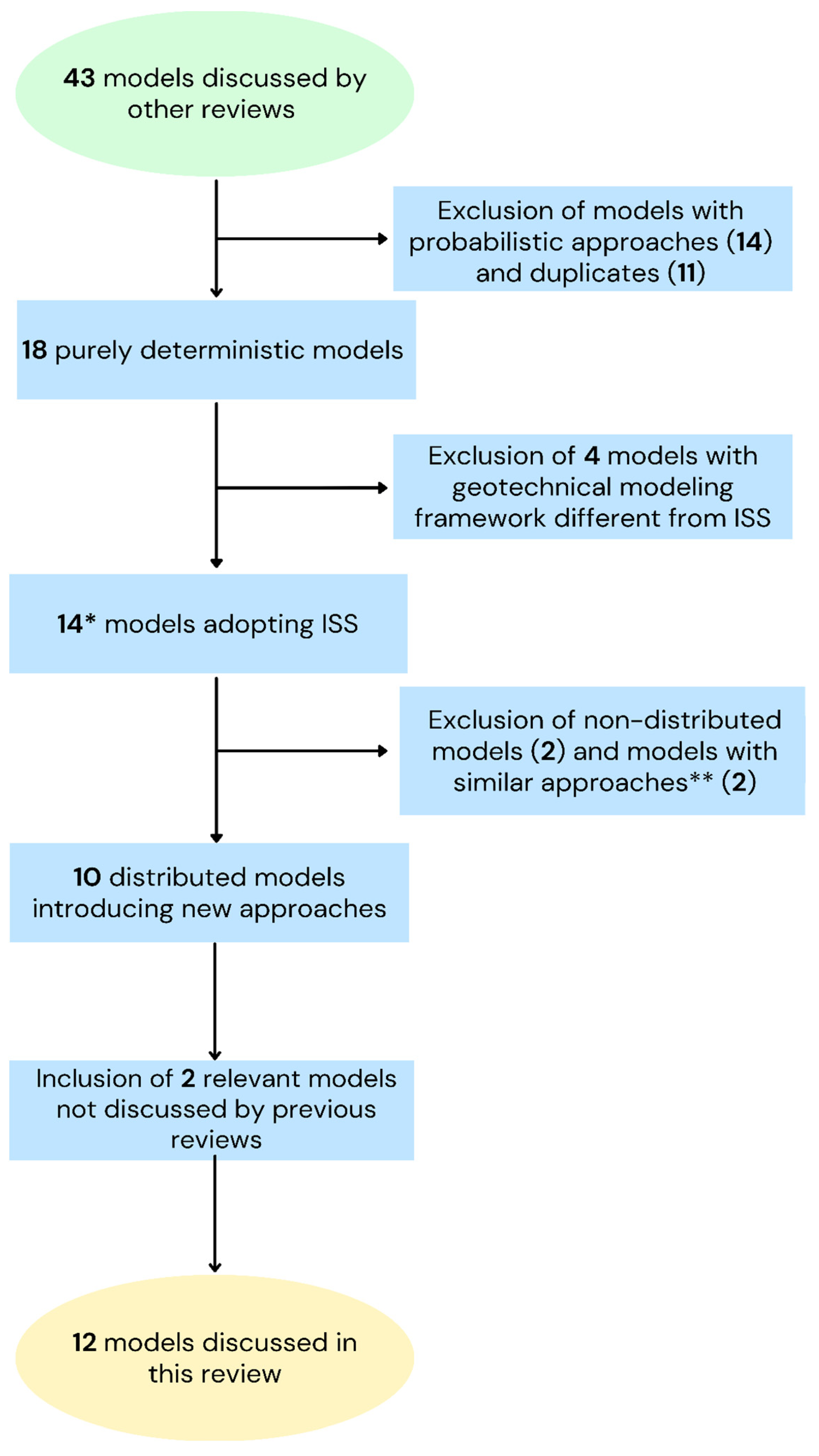
Facing global warming’s consequences is a major issue in the present times. Regarding the climate, projections say that heavy rainfalls are going to increase with high probability together with temperature rise; thus, the hazard related to rainfall-induced shallow landslides will likely increase in density over susceptible territories. Different modeling approaches exist, and many of them are forced to make simplifications in order to reproduce landslide occurrences over space and time. Process-based models can help in quantifying the consequences of heavy rainfall in terms of slope instability at a territory scale. In this study, a narrative review of physically based deterministic distributed models (PBDDMs) is presented. Models were selected based on the adoption of the infinite slope scheme (ISS), the use of a deterministic approach (i.e., input and output are treated as absolute values), and the inclusion of new approaches in modeling slope stability through the ISS. The models are presented in chronological order with the aim of drawing a timeline of the evolution of PBDDMs and providing researchers and practitioners with basic knowledge of what scholars have proposed so far. The results indicate that including vegetation’s effects on slope stability has raised in importance over time but that there is still a need to find an efficient way to include them. In recent years, the literature production seems to be more focused on probabilistic approaches.
Keywords: physical modeling; shallow landslides; infinite slope scheme; slope stability physical modeling; shallow landslides; infinite slope scheme; slope stability