Effects of Marine Protein Hydrolysates as Squid-Liver Powder Replacements on Growth Performance, Digestive Capacity and Health Status of Pacific White Shrimp (Litopenaeus vannamei)

Simple Summary
Abstract
1. Introduction
2. Materials and Methods
2.1. Experimental Diets
2.2. Experimental Animals and Conditions and Feeding Procedure
2.3. Sample Collection
2.4. Analytical Methods
2.4.1. Growth Performance, Feed Utilization and Survival Rate
2.4.2. Hematological and Non-Specific Immunity Assay
2.4.3. Hemolymph Metabolic Markers Assay
2.4.4. Digestive Enzyme Assay
2.4.5. Histological of Hepatopancreas and Intestine Assay
2.5. Digestibility Analysis
2.5.1. In Vitro Protein Digestibility of Ingredients and Diets
2.5.2. Apparent Digestibility Coefficients (ADCs)
2.6. Statistical Analysis
3. Results
3.1. Growth Performance, Feed Utilization and Survival Rate
3.2. Hematological and Non-Specific Immunity
3.3. Serum Metabolic Markers
3.4. Digestive Enzymes Activity
3.5. Histological of Hepatopancreas and Intestine
3.6. Nutrient Digestibility
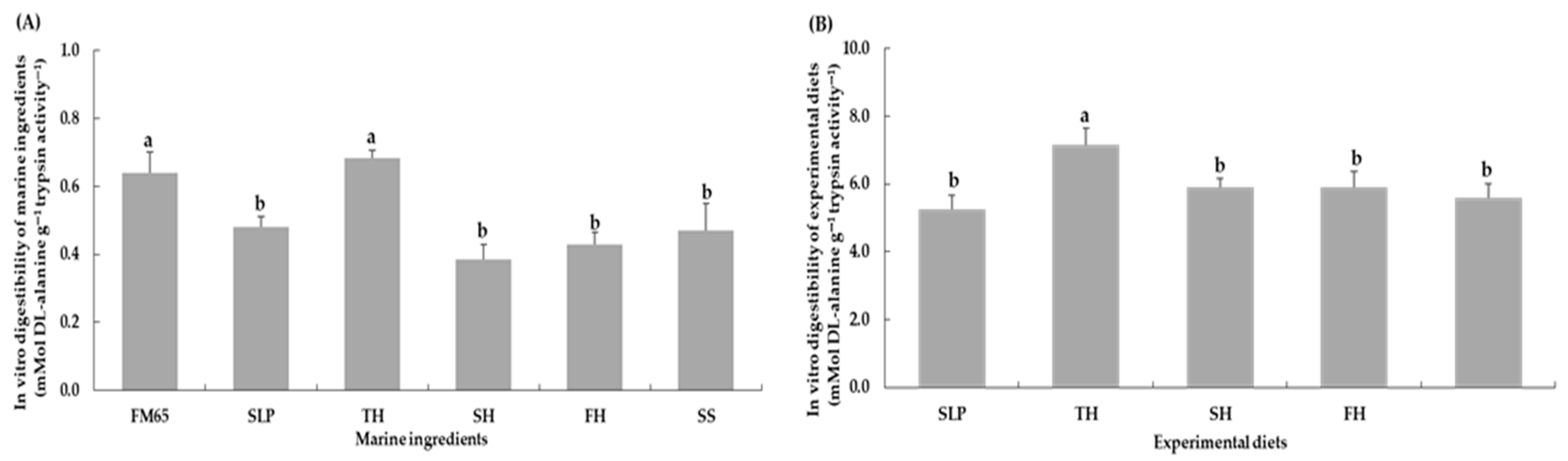
3.6.1. In Vitro Protein Digestibility of Ingredients and Diets
3.6.2. Apparent Digestibility Coefficients (ADCs)
4. Discussion
5. Conclusions
Author Contributions
Funding
Institutional Review Board Statement
Informed Consent Statement
Data Availability Statement
Acknowledgments
Conflicts of Interest
References
- FAO. The State of World Fisheries and Aquaculture 2024: Blue Transformation in Action; FAO: Rome, Italy, 2024. [Google Scholar]
- Bauer, W.; Prentice-Hernandez, C.; Tesser, M.B.; Wasielesky, W., Jr.; Poersch, L.H.S. Substitution of fishmeal with microbial floc meal and soy protein concentrate in diets for the Pacific white shrimp Litopenaeus vannamei. Aquaculture 2012, 342–343, 112–116.3. [Google Scholar] [CrossRef]
- Navarro, C.; Civera, R.; Arjona, O.; Rivera-Perez, C.; García, H.S.; Hurtado-Oliva, M.Á.; Palacio, E. Stress response and lipid composition in shrimp (Litopenaeus vannamei) fed diets enriched with squid or scallop viscera meal. Aquac. Res. 2020, 51, 1602–1622. [Google Scholar] [CrossRef]
- Nunes, A.J.P.; Dalen, L.L.; Leonardi, G.; Burri, L. Developing sustainable, cost-effective and high-performance shrimp feed formulations containing low fish meal levels. Aquac. Rep. 2022, 27, 101422. [Google Scholar] [CrossRef]
- Suárez, J.A.; Gaxiola, G.; Mendoza, R.; Cadavid, S.; Garcia, G.; Alanis, G.; Cuzon, G. Substitution of fish meal with plant protein sources and energy budget for white shrimp (Litopenaeus vannamei) (Boone, 1931). Aquaculture 2009, 289, 118–123. [Google Scholar] [CrossRef]
- Moss, A.S.; Koshio, S.; Ishikawa, M.; Yokoyama, S.; Nhu, T.H.; Dawood, M.A.O.; Ang, W. Replacement of squid and krill meal by snail meal (Buccinum triatissimum) in practical diets for juvenile of kuruma shrimp (Marsupenaeus japonicus). Aquac. Res. 2018, 49, 3097–3106. [Google Scholar] [CrossRef]
- Smith, D.M.; Tabrett, S.J.; Barclay, M.C.; Irvin, S.J. The efficacy of ingredients included in shrimp feeds to stimulate intake. Aquac. Nutr. 2005, 11, 263–272. [Google Scholar] [CrossRef]
- Mai, K.; Li, H.; Ai, Q.; Duan, Q.; Xu, W.; Zhang, C.; Liufu, Z. Effects of dietary squid viscera meal on growth and cadmium accumulation in tissues of Japanese seabass, Lateolabrax japonicus (Cuvier 1828). Aquac. Res. 2006, 37, 1063–1069. [Google Scholar] [CrossRef]
- Liang, M.Q.; Hong, Y.U.; Chang, Q.; Chao, C.H.E.N. Feeding attraction activities of food attractants for 3 species of fishes. J. Fish. Sci. China 2000, 7, 60–63. [Google Scholar]
- Jang, J.-W.; Kim, K.-D.; Kim, K.-W.; Lee, B.-J.; Hur, H.W.; Han, S.-H. Effects of dietary squid liver powder content on the growth performance, cadmium accumulation and nonspecific immune response of juvenile olive flounder Paralichthys olivaceus. Aquac. Rep. 2021, 21, 100826. [Google Scholar] [CrossRef]
- Córdova-Murueta, J.H.; García-Carreño, F.L. Nutritive value of squid and hydrolyzed protein supplement in shrimp feed. Aquaculture 2002, 210, 371–384. [Google Scholar] [CrossRef]
- Wang, W.X.; Onsanit, S.; Dang, F. Dietary bioavailability of cadmium, inorganic mercury, and zinc to a marine fish: Effects of food composition and type. Aquaculture 2012, 356, 98–104. [Google Scholar] [CrossRef]
- Waalkes, M.P. Cadmium carcinogenesis in review. J. Inorg. Biochem. 2000, 79, 241–244. [Google Scholar] [CrossRef]
- Cao, L.; Huang, W.; Liu, J.; Yin, X.; Dou, S. Accumulation and oxidative stress biomarkers in Japanese flounder larvae and juveniles under chronic cadmium exposure. Comp. Biochem. Physiol. C Toxicol. Pharmacol. 2010, 151, 386–392. [Google Scholar] [CrossRef]
- Liu, K.; Chi, S.; Liu, H.; Dong, X.; Yang, Q.; Zhang, S.; Tan, B. Toxic effects of two sources of diet borne cadmium on the juvenile cobia, Rachycentron canadum L. and tissue-specific accumulation of related minerals. Aquat. Toxicol. 2015, 165, 120–128. [Google Scholar]
- Chalamaiah, M.; Dinesh Kumar, B.; Hemalatha, R.; Jyothirmayi, T. Fish protein hydrolysates: Proximate composition, amino acid composition, antioxidant activities and applications: A review. Food Chem. 2012, 135, 3020–3038. [Google Scholar] [CrossRef] [PubMed]
- Zamora-Sillero, J.; Gharsallaoui, A.; Prentice, C. Peptides from fish by-product protein hydrolysates and its functional properties: An overview. Mar. Biotechnol. 2018, 20, 118–130. [Google Scholar] [CrossRef] [PubMed]
- Siddik, M.A.B.; Howieson, J.; Fotedar, R.; Partridge, G.J. Enzymatic fish protein hydrolysates in finfish aquaculture: A review. Rev. Aquac. 2021, 13, 406–430. [Google Scholar] [CrossRef]
- Chotikachinda, R.; Tantikitti, C.; Benjakul, S.; Rustad, T.; Kumarnsit, E. Production of protein hydrolysates from skipjack tuna (Katsuwonus pelamis) viscera as feeding attractants for Asian seabass (Lates calcarifer). Aquac. Nutr. 2013, 19, 773–784. [Google Scholar] [CrossRef]
- Siddik, M.A.B.; Howieson, J.; Fotedar, R.; Gholipourkanani, H.; Partridge, G.J. Dietary tuna hydrolysate modulates growth performance, immune response, intestinal morphology, and resistance to Streptococcus iniae in juvenile barramundi (Lates calcarifer). Sci. Rep. 2018, 8, 15942. [Google Scholar] [CrossRef]
- Siddik, M.A.B.; Chungu, P.; Fotedar, R.; Howieson, J. Bioprocessed poultry by-product meal on growth, gut health and fatty acid synthesis of juvenile barramundi (Lates calcarifer). PLoS ONE 2019, 14, e0215025. [Google Scholar] [CrossRef]
- Siddik, M.A.B.; Howieson, J.; Fotedar, R. Beneficial effects of tuna hydrolysate in poultry by-product meal diets on growth, immune response, intestinal health, and resistance to Vibrio harveyi in juvenile barramundi (Lates calcarifer). Fish Shellfish Immunol. 2019, 89, 61–70. [Google Scholar] [CrossRef]
- Tola, S.; Sommit, N.; Seel-audom, M.; Khamtavee, P.; Waiho, K.; Boonmee, T.; Yuangsoi, B.; Munpholsri, N. Effects of dietary tuna hydrolysate supplementation on feed intake, growth performance, feed utilization, and health status of Asian seabass (Lates calcarifer) fed a low-fish-meal soybean meal-based diet. Aquac. Res. 2022, 53, 3898–3912. [Google Scholar] [CrossRef]
- Poonnual, D.; Tola, S.; Yuangsoi, B. Evaluation of functional marine protein hydrolysates as fish meal replacements in low-fish-meal diets: Effects on growth performance, feed utilization and health status of Asian seabass (Lates calcarifer). Animals 2025, 15, 3285. [Google Scholar] [CrossRef]
- Leduc, A.; Hervy, M.; Rangama, J.; Delépée, R.; Fournier, V.; Henry, J. Shrimp by-product hydrolysate induces intestinal myotropic activity in European seabass (Dicentrarchus labrax). Aquaculture 2018, 497, 380–388. [Google Scholar] [CrossRef]
- Khosravi, S.; Bui, D.T.H.; Rahimnejad, S.; Herault, M.; Fournier, V.; Kim, S.; Jeong, J.; Lee, K. Dietary supplementation of marine protein hydrolysates in fish-meal based diets for red seabream (Pagrus major) and olive flounder (Paralichthys olivaceus). Aquaculture 2015, 435, 371–376. [Google Scholar] [CrossRef]
- Kim, H.S.; Jung, W.G.; Myung, S.H.; Cho, S.H.; Kim, D.S. Substitution effects of fishmeal with tuna by-product meal in the diet on growth, body composition, plasma chemistry, and amino acid profiles of juvenile olive flounder (Paralichthys olivaceus). Aquaculture 2014, 431, 92–98. [Google Scholar] [CrossRef]
- Khosravi, S.; Bui, D.T.H.; Fournier, V.; Kim, K.W.; Lee, K. Supplementation of protein hydrolysates to a low-fishmeal diet improves growth and health status of juvenile olive flounder (Paralichthys olivaceus). J. World Aquac. Soc. 2018, 49, 897–911. [Google Scholar] [CrossRef]
- Gunathilaka, B.E.; Khosravi, S.; Herault, M.; Fournier, V.; Lee, C.; Jeong, J.; Lee, K. Evaluation of shrimp or tilapia protein hydrolysate at graded dosages in low-fish-meal diet for olive flounder (Paralichthys olivaceus). Aquac. Nutr. 2020, 26, 1592–1603. [Google Scholar] [CrossRef]
- Swanepoel, J.C.; Goosen, N.J. Evaluation of fish protein hydrolysates in juvenile African catfish (Clarias gariepinus) diets. Aquaculture 2018, 496, 262–269. [Google Scholar] [CrossRef]
- Leal, A.L.G.; Fernandes de Castro, P.; de Lima, J.P.V.; de Souza Correia, E.; de Souza Bezerra, R. Use of shrimp protein hydrolysate in Nile tilapia (Oreochromis niloticus) feeds. Aquac. Int. 2010, 18, 635–646. [Google Scholar] [CrossRef]
- Suratip, N.; Charoenwattanasak, S.; Klahan, R.; Herault, M.; Yuangsoi, B. Effects of protein hydrolysate in low-fish-meal diets on growth performance, feed utilization, and health status of snakehead fish (Channa striata) fingerlings. Aquac. Rep. 2023, 30, 101623. [Google Scholar] [CrossRef]
- Gunathilaka, B.E.; Kim, S.; Herault, M.; Fournier, V.; Lee, K. Marine protein hydrolysates as a substitute of squid-liver powder in diets for Pacific white shrimp (Litopenaeus vannamei). Aquac. Res. 2022, 53, 5193–5202. [Google Scholar] [CrossRef]
- Hlordzi, V.; Wang, J.; Kuebutornye, F.K.A.; Yang, X.; Tan, B.; Li, T.; Cui, Z.; Lv, S.; Lao, T.; Chi, S. Hydrolysed fish protein powder improves growth performance, hepatopancreas, and intestinal development of Pacific white shrimp (Litopenaeus vannamei). Aquac. Rep. 2022, 23, 101025. [Google Scholar] [CrossRef]
- National Research Council (NRC). Nutrient Requirements of Fish and Shrimp; National Academies Press: Washington, DC, USA, 2011.
- ISO13903; Animal Feeding Stuffs—Determination of Amino Acids Content. International Organization for Standardization: Geneva, Switzerland, 2005.
- Parry, R.M.; Chandau, R.C.; Shahani, R.M. A rapid and sensitive assay of muramidase. Proc. Soc. Exp. Biol. Med. 1965, 119, 384–386. [Google Scholar] [CrossRef]
- Söderhäll, K.; Häll, L. Lipopolysaccharide-induced activation of the prophenoloxidase-activating system in crayfish haemocyte lysate. Biochim. Biophys. Acta 1984, 797, 99–104. [Google Scholar] [CrossRef]
- Hernández-López, J.; Gollas-Galván, T.; Vargas-Albores, F. Activation of the prophenoloxidase system of the brown shrimp (Penaeus californiensis Holmes). Comp. Biochem. Physiol. 1996, 113, 61–66. [Google Scholar] [CrossRef]
- Song, Y.L.; Hsieh, Y.T. Immunostimulation of tiger shrimp (Penaeus monodon) hemocytes for generation of microbicidal substances: Analysis of reactive oxygen species. Dev. Comp. Immunol. 1994, 18, 201–209. [Google Scholar] [CrossRef]
- Kewcharoen, W.; Srisapoome, P. Probiotic effects of Bacillus spp. From Pacific white shrimp (Litopenaeus vannamei) on water quality and shrimp growth, immune responses, and resistance to Vibrio parahaemolyticus (AHPND strains). Fish Shellfish Immunol. 2018, 94, 175–189. [Google Scholar] [CrossRef]
- Rungruangsak-Torrissen, K.; Moss, R.; Andresen, L.H.; Berg, A.; Waagbø, R. Different expressions of trypsin and chymotrypsin in relation to growth in Atlantic salmon (Salmo salar L.). Fish Physiol. Biochem. 2006, 32, 7–23. [Google Scholar] [CrossRef]
- Rungruangsak-Torrissen, K. Digestive efficiency, growth and qualities of muscle and oocyte in Atlantic salmon (Salmo salar L.) fed on diets with krill meal as an alternative protein source. J. Food Biochem. 2007, 31, 509–540. [Google Scholar] [CrossRef]
- Areekijseree, M.; Engkagul, A.; Kovitvadhi, U.; Thongpan, A.; Mingmuang, M.; Pakkong, P.; Rungruangsak-Torrissen, K. Temperature and pH characteristics of amylase and proteinase of adult freshwater pearl mussel, Hyriopsis (Hyriopsis) bialatus Simpson, 1900. Aquaculture 2004, 234, 575–587. [Google Scholar] [CrossRef]
- Gupta, N.; Rathi, P. Simplified para-nitrophenyl palmitate assay for lipases and esterases. Analyt. Biochem. 2002, 311, 98–99. [Google Scholar] [CrossRef]
- Lowry, O.H.; Rosebrough, N.J.; Farr, A.L.; Randall, R.J. Protein measurement with the Folin phenol reagent. J. Biol. Chem. 1951, 193, 265–275. [Google Scholar] [CrossRef]
- Bell, T.A.; Lightner, D.V. IHHN virus: Infectivity and pathogenicity studies in Penaeus stylirostris and Penaeus vannamei. Aquaculture 1984, 38, 185–194. [Google Scholar] [CrossRef]
- Rungruangsak-Torrissen, K.; Rustad, A.; Sunde, J.; Eiane, S.A.; Jensen, H.B.; Opstvedt, J.; Nygard, E.; Samuelsen, T.A.; Mundheim, H.; Luzzana, U.; et al. In vitro digestibility based on fish crude enzyme extract for prediction of feed quality in growth trials. J. Sci. Food Agric. 2002, 82, 644–654. [Google Scholar] [CrossRef]
- Austreng, E. Digestibility determination in fish using chromic oxide marking and analysis of contents from different segments of the gastrointestinal tract. Aquaculture 1978, 13, 265–272. [Google Scholar] [CrossRef]
- Cho, C.Y.; Slinger, S.J.; Bayley, H.S. Bioenergetics of salmonid fishes: Energy intake, expenditure and productivity. Comp. Biochem. Physiol. B Biochem. Mol. Biol. 1982, 73, 25–41. [Google Scholar] [CrossRef]
- AOAC. Official Methods of Analysis, 18th ed.; Association of Official Analytical Chemists International: Rockville, MD, USA, 2005. [Google Scholar]
- Ovissipour, M.; Abedian Kenari, A.; Nazari, R.; Motamedzadegan, A.; Rasco, B. Tuna viscera protein hydrolysate: Nutritive and disease resistance properties for Persian sturgeon (Acipenser persicus L.) larvae. Aquac. Res. 2014, 45, 591–601. [Google Scholar] [CrossRef]
- Pham, H.D.; Siddik, M.A.B.; Le, H.M.; Ngo, M.V.; Nguyen, M.V.; Francis, D. Effects of dietary tuna viscera hydrolysate supplementation on growth, intestinal mucosal response, and resistance to Streptococcus iniae infection in pompano (Trachinotus blochii). Aquac. Nutr. 2022, 2022, 3645868. [Google Scholar] [CrossRef]
- Nunes, A.J.; Sá, M.V.; Andriola-Neto, F.F.; Lemos, D. Behavioral response to selected feed attractants and stimulants in Pacific white shrimp, Litopenaeus vannamei. Aquaculture 2006, 260, 244–254. [Google Scholar] [CrossRef]
- Grey, M.; Forster, I.; Dominy, W.; Ako, H.; Giesen, A.F. Validation of a feeding stimulant bioassay using fish hydrolysates for the Pacific white shrimp Litopenaeus vannamei. J. World Aquac. Soc. 2009, 40, 547–555. [Google Scholar] [CrossRef]
- Daniel, H. Molecular and Integrative Physiology of Intestinal Peptide Transport. Annu. Rev. Physiol. 2004, 66, 361–384. [Google Scholar] [CrossRef]
- Rønnestad, I.; Conceic, L.E.C.; Aragã, C.; Dinis, M.T. Free Amino Acids Are Absorbed Faster and Assimilated More Efficiently than Protein in Postlarval Senegal Sole (Solea senegalensis). J. Nutr. 2000, 130, 2809–2812. [Google Scholar] [CrossRef]
- Espe, M.; Sveier, H.; Høgøy, I.; Lied, E. Nutrient absorption and growth of Atlantic salmon (Salmo salar L.) fed fish protein concentrate. Aquaculture 1999, 174, 119–137. [Google Scholar] [CrossRef]
- Hevrøy, E.M.; Espe, M.; Waagbø, R.; Sandnes, K.; Ruud, M.; Hemre, G.-I. Nutrient utilization in Atlantic salmon (Salmo salar L.) fed increased levels of fish protein hydrolysate during a period of fast growth. Aquac. Nutr. 2005, 11, 301–313. [Google Scholar] [CrossRef]
- Murashita, K.; Fukada, H.; Hosokawa, H.; Masumoto, T. Changes in cholecystokinin and peptide Y gene expression with feeding in yellowtail (Seriola quinqueradiata): Relation to pancreatic exocrine regulation. Comp. Biochem. Physiol. Part B Biochem. Mol. Biol. 2007, 146, 318–325. [Google Scholar] [CrossRef] [PubMed]
- Christie, A.E.; Stemmler, E.A.; Dickinson, P.S. Crustacean neuropeptides. Cell. Mol. Life Sci. 2010, 67, 4135–4169. [Google Scholar] [CrossRef] [PubMed]
- Ray, G.W.; Liang, D.; Yang, Q.; Tan, B.; Dong, X.; Chi, S.; Liu, H.; Zhang, S.; Rimei, L. Effects of replacing fishmeal with dietary soybean protein concentrate on growth, serum biochemical indices and antioxidative functions of juvenile shrimp Litopenaeus vannamei. Aquaculture 2020, 516, 734630. [Google Scholar] [CrossRef]
- Sreeram, M.P.; Menon, N.R. Histopathological changes in the hepatopancreas of the penaeid shrimp Metapenaeus dobsoni exposed to petroleum hydrocarbons. J. Mar. Biol. Assoc. India 2005, 47, 160–168. [Google Scholar]
- Liang, Z.; Chen, T.; Yang, F.; Li, S.; Zhang, S.; Guo, H. Toxicity of chronic waterborne zinc exposure in the hepatopancreas of white shrimp Litopenaeus vannamei. Chemosphere 2022, 309, 136553. [Google Scholar] [CrossRef]
- Ostaszewska, T.; Dabrowski, K.; Kamaszewski, M.; Grochowski, P.; Verri, T.; Rzepkowska, M.; Wolnicki, J. The effect of plant protein-based diet supplemented with dipeptide or free amino acids on digestive tract morphology and PepT1 and PepT2 expressions in common carp (Cyprinus carpio L.). Comp. Biochem. Physiol. A 2010, 157, 158–169. [Google Scholar] [CrossRef]
- Kotzamanis, Y.P.; Gisbert, E.; Gatesoupe, F.J.; Zambonino Infante, J.; Cahu, C. Effects of different dietary levels of fish protein hydrolysates on growth, digestive enzymes, gut microbiota, and resistance to Vibrio anguillarum in European sea bass (Dicentrarchus labrax) larvae. Comp. Biochem. Physiol. Part A Mol. Integr. Physiol. 2007, 147, 205–214. [Google Scholar] [CrossRef]
- Wang, Y.; Ni, J.; Nie, Z.; Gao, J.; Sun, Y.; Shao, N.; Li, Q.; Hu, J.; Xu, P.; Xu, G. Effects of stocking density on growth, serum parameters, antioxidant status, liver and intestine histology and gene expression of largemouth bass (Micropterus salmoides) farmed in the in-pond raceway system. Aquac. Res. 2020, 51, 5228–5240. [Google Scholar] [CrossRef]
- Antony, S.P.; Bright Singh, I.S.; Sudheer, N.S.; Vrinda, S.; Priyaja, P.; Philip, R. Molecular characterization of a crustin-like antimicrobial peptide in the giant tiger shrimp, Penaeus monodon, and its expression profile in response to various immunostimulants and challenge with WSSV. Immunobiology 2011, 216, 184–194. [Google Scholar] [CrossRef] [PubMed]
- Rodrigues, T.; Guardiola, F.A.; Almeida, D.; Antunes, A. Aquatic Invertebrate Antimicrobial Peptides in the Fight Against Aquaculture Pathogens. Microorganisms 2025, 13, 156. [Google Scholar] [CrossRef]
- Chaklader, M.R.; Fotedar, R.; Howieson, J.; Siddik, M.A.B.; Foysal, M.J. The ameliorative effects of various fish protein hydrolysates in poultry by-product meal-based diets on muscle quality, serum biochemistry and immunity in juvenile barramundi (Lates calcarifer). Fish Shellfish Immunol. 2020, 104, 567–578. [Google Scholar] [CrossRef] [PubMed]
- Siddik, M.A.B.; Pham, H.D.; Francis, D.S.; Vo, B.V.; Shahjahan, M. Dietary supplementation of fish protein hydrolysate in high plant protein diets modulates growth, liver and kidney health and immunity of barramundi (Lates calcarifer). Aquac. Nutr. 2021, 27, 86–98. [Google Scholar] [CrossRef]
- Tran, H.T.Q.; Ho, T.H.; Nan, F.; Liu, C.; Hu, Y.; Chong, C.M.; Cruz, C.R.; Karim, M.; Liu, T.; Kuo, I.; et al. Assessment of fish protein hydrolysate as a substitute for fish meal in white shrimp diets: Impact on growth, immune response and resistance against Vibrio parahaemolyticus infection. Fish Shellfish Immunol. 2024, 150, 109597. [Google Scholar] [CrossRef]
- Yong, A.S.K.; Mok, W.Y.; Tamrin, M.L.M.; Shapawi, R.; Kim, Y.S. Effects of dietary nucleotides on growth, survival and metabolic response in whiteleg shrimp Litopenaeus vannamei against ammonia stress condition. Aquac. Res. 2020, 51, 2252–2260. [Google Scholar] [CrossRef]
- Yildiz, H.Y.; Benli, A.C.K. Nitrite toxicity to crayfish Astacus leptodactylus: The effects of sublethal nitrite exposure on hemolymph nitrite, total hemocyte counts and hemolymph glucose. Ecotoxicol. Environ. Saf. 2004, 59, 370–375. [Google Scholar] [CrossRef]
- Briffa, M.; Elwood, R.W. Decision rules, energy metabolism and vigour of hermit-crab fights. Proc. R. Soc. B 2001, 268, 1841–1848. [Google Scholar] [CrossRef] [PubMed]
- Jung, H.; Lyons, R.E.; Hurwood, D.A.; Mather, P.B. Genes and growth performance in crustacean species: A review of relevant genomic studies in crustaceans and other taxa. Rev. Aquac. 2013, 5, 77–110. [Google Scholar] [CrossRef]



| Ingredients | |||||
|---|---|---|---|---|---|
| SLP | TH | SH | FH | SS | |
| Chemical composition (% wet basis) | |||||
| Moisture | 7.8 | 50.4 | 4.4 | 5.8 | 54.9 |
| Crude protein | 44.7 | 32.5 | 68.1 | 82.4 | 31.0 |
| Crud lipid | 17.1 | 2.1 | 8.9 | 7.75 | 8.6 |
| Ash | 7.2 | 11.4 | 11.8 | 3.9 | 3.0 |
| Energy (MJ kg−1) | 22.42 | 14.10 | 20.88 | 22.81 | 24.22 |
| Soluble protein | n.d. * | >90 | >90 | >90 | n.d. * |
| Molecular weight (Dalton, % total protein) | |||||
| >10,000 | n.d. * | 2 | 0 | 1 | 0 |
| 5000–10,000 | n.d. * | 7 | 1 | 1 | 1 |
| 1000–5000 | n.d. * | 26 | 10 | 11 | 9 |
| 500–1000 | n.d. * | 9 | 10 | 14 | 7 |
| <500 | n.d. * | 54 | 79 | 73 | 82 |
| Essential amino acids (% wet basis) | |||||
| Arginine | 2.05 | 1.66 | 4.19 | 4.04 | 1.97 |
| Histidine | 2.43 | 1.59 | 1.30 | 1.73 | 0.46 |
| Isoleucine | 2.43 | 0.54 | 2.70 | 3.05 | 1.20 |
| Leucine | 3.16 | 1.11 | 4.40 | 5.27 | 2.31 |
| Lysine | 2.04 | 1.36 | 4.30 | 5.07 | 2.40 |
| Methionine | 0.80 | 0.44 | 1.30 | 1.92 | 0.95 |
| Phenylalanine | 2.06 | 0.60 | 2.90 | 2.84 | 1.17 |
| Threonine | 1.34 | 0.86 | 2.50 | 3.54 | 1.17 |
| Tryptophan | 0.65 | 0.01 | 0.80 | 0.65 | 0.37 |
| Valine | 2.19 | 0.75 | 3.20 | 3.47 | 1.51 |
| Total essential amino acids | 19.14 | 8.92 | 27.59 | 31.58 | 13.52 |
| Non-essential amino acids (% wet basis) | |||||
| Alanine | 1.35 | 2.04 | 4.30 | 5.40 | 1.85 |
| Aspartic acid | 1.94 | 1.60 | 5.70 | 6.48 | 2.86 |
| Glutamic acid | 2.69 | 2.88 | 9.00 | 10.35 | 4.31 |
| Glycine | 1.37 | 3.62 | 4.90 | 6.78 | 1.85 |
| Tyrosine | 1.53 | 0.37 | 2.30 | 2.05 | 1.05 |
| Serine | 0.83 | 0.91 | 2.40 | 3.08 | 1.85 |
| Total non-essential amino acids | 15.29 | 13.56 | 32.21 | 39.11 | 13.98 |
| Total amino acids | 34.43 | 22.48 | 59.80 | 70.69 | 27.50 |
| Ingredients | Dietary Treatment | ||||
|---|---|---|---|---|---|
| SLP | TH | SH | FH | SS | |
| Fish meal, 65% CP | 10.00 | 10.00 | 10.00 | 10.00 | 10.00 |
| Poultry by-product meal | 8.00 | 8.00 | 8.00 | 8.00 | 8.00 |
| Soybean meal, 48%CP | 27.52 | 30.05 | 30.75 | 30.11 | 30.00 |
| Soy protein concentrate | 10.00 | 10.00 | 10.00 | 10.00 | 10.00 |
| Wheat gluten meal, 78% CP | 5.00 | 5.00 | 5.00 | 5.00 | 5.00 |
| Wheat flour | 24.60 | 24.24 | 24.34 | 25.16 | 24.11 |
| Tuna crude oil | 1.81 | 1.80 | 1.81 | 1.81 | 1.79 |
| Soybean oil | 1.20 | 1.76 | 1.76 | 1.76 | 1.61 |
| Lecithin | 0.82 | 1.00 | 1.00 | 1.00 | 1.00 |
| Choline chloride, 60% choline | 0.50 | 0.50 | 0.50 | 0.50 | 0.50 |
| Cholesterol | 0.12 | 0.12 | 0.12 | 0.12 | 0.12 |
| MCP 1 | 1.63 | 1.52 | 1.70 | 1.52 | 1.70 |
| Stay C-35 2 | 0.50 | 0.50 | 0.50 | 0.50 | 0.50 |
| DL-Methionine | 0.00 | 0.06 | 0.06 | 0.04 | 0.05 |
| L-Lysine | 0.00 | 0.13 | 0.11 | 0.12 | 0.10 |
| Salt, NaCl | 0.60 | 0.60 | 0.60 | 0.60 | 0.60 |
| Vitamin premix 3 | 0.50 | 0.50 | 0.50 | 0.50 | 0.50 |
| Mineral premix 4 | 0.50 | 0.50 | 0.50 | 0.50 | 0.50 |
| Guar gum | 1.50 | 1.50 | 1.50 | 1.50 | 1.50 |
| Antioxidant agents 5 | 0.10 | 0.10 | 0.10 | 0.10 | 0.10 |
| Antimicrobial agents 6 | 0.10 | 0.10 | 0.10 | 0.10 | 0.10 |
| Squid-liver Powder | 5.00 | ||||
| Tuna hydrolysate liquid | 2.02 | ||||
| Shrimp hydrolysate powder | 1.05 | ||||
| Fish hydrolysate powder | 1.06 | ||||
| Salmon silage liquid | 2.22 | ||||
| Analyzed chemical composition (% dry matter) 7 | |||||
| Dry matter | 92.29 | 91.67 | 92.04 | 93.27 | 93.17 |
| Crude protein | 44.31 | 44.10 | 44.31 | 44.18 | 44.06 |
| Crude lipid | 9.40 | 9.71 | 9.78 | 9.43 | 9.55 |
| Crude fiber | 2.75 | 2.36 | 2.54 | 2.49 | 2.21 |
| Ash | 11.56 | 11.61 | 11.47 | 11.35 | 11.45 |
| NFE | 23.27 | 23.89 | 23.94 | 25.82 | 25.90 |
| Gross energy (MJ kg−1) | 19.75 | 19.70 | 19.85 | 19.82 | 19.66 |
| Parameters | Dietary Treatments | ||||
|---|---|---|---|---|---|
| SLP | TH | SH | FH | SS | |
| Molecular-weight (Dalton, area % of detected peptides) 1 | |||||
| >20,000 | 21.1 | 20.1 | 18.3 | 17.7 | 18.6 |
| 10,000–20,000 | 7.6 | 8.2 | 6.7 | 7.2 | 6.8 |
| 5000–10,000 | 3.2 | 3.8 | 2.8 | 3.1 | 2.7 |
| 1000–5000 | 4.9 | 5.9 | 4.8 | 5.9 | 4.5 |
| 500–1000 | 2.5 | 2.6 | 2.9 | 3.3 | 2.7 |
| <500 | 60.7 | 59.4 | 64.5 | 62.8 | 64.7 |
| Essential amino acid (% dry matter) 2 | |||||
| Arginine | 2.61 | 2.70 | 2.61 | 2.48 | 2.47 |
| Histidine | 1.08 | 1.19 | 1.14 | 1.07 | 1.09 |
| Isoleucine | 1.81 | 1.89 | 1.85 | 1.77 | 1.77 |
| Leucine | 2.87 | 2.97 | 2.89 | 2.80 | 2.80 |
| Lysine | 2.42 | 2.52 | 2.44 | 2.39 | 2.41 |
| Methionine | 0.68 | 0.73 | 0.71 | 0.64 | 0.65 |
| Phenylalanine | 1.87 | 1.97 | 1.94 | 1.90 | 1.90 |
| Threonine | 1.50 | 1.54 | 1.53 | 1.45 | 1.44 |
| Tryptophan | 0.36 | 0.45 | 0.38 | 0.35 | 0.34 |
| Valine | 2.40 | 2.47 | 2.40 | 2.41 | 2.42 |
| Non-essential amino acid (%, dry matter) 2 | |||||
| Alanine | 1.82 | 1.90 | 1.91 | 1.79 | 1.79 |
| Aspartic acid | 4.07 | 3.78 | 3.80 | 3.73 | 3.68 |
| Cystine + Cysteine | 0.56 | 0.57 | 0.68 | 0.61 | 0.61 |
| Glutamic acid | 8.84 | 7.73 | 8.09 | 8.00 | 8.08 |
| Glycine | 2.15 | 2.28 | 2.16 | 1.99 | 2.10 |
| Proline | 2.60 | 2.73 | 2.59 | 2.38 | 2.59 |
| Taurine | 0.05 | 0.07 | 0.06 | 0.04 | 0.04 |
| Tyrosine | 1.35 | 1.45 | 1.44 | 1.40 | 1.38 |
| Serine | 1.83 | 1.84 | 1.84 | 1.71 | 1.71 |
| Total essential amino acids | 17.74 | 18.54 | 18.00 | 17.43 | 17.45 |
| Total non-essential amino acids | 23.29 | 22.35 | 22.56 | 21.65 | 21.98 |
| Total amino acids | 41.02 | 40.89 | 40.55 | 39.08 | 39.42 |
| Parameters | Dietary Treatments | p-Value | ||||
|---|---|---|---|---|---|---|
| SLP | TH | SH | FH | SS | ||
| IBW (g shrimp−1) 1 | 2.66 ± 0.01 | 2.66 ± 0.01 | 2.66 ± 0.01 | 2.66 ± 0.01 | 2.66 ± 0.01 | 0.921 |
| FBW (g shrimp−1) 2 | 14.69 ± 0.46 b | 15.76 ± 0.24 a | 15.05 ± 0.40 b | 14.79 ± 0.56 b | 14.57 ± 0.37 b | 0.002 |
| SGR (% day−1) 3 | 3.05 ± 0.06 b | 3.18 ± 0.02 a | 3.10 ± 0.05 b | 3.06 ± 0.07 b | 3.04 ± 0.05 b | 0.003 |
| FI (g shrimp−1) 4 | 19.49 ± 1.45 b | 20.96 ± 0.49 a | 19.93 ± 0.71 ab | 19.11 ± 0.69 b | 20.07 ± 0.43 ab | 0.026 |
| FCR 5 | 1.58 ± 0.15 | 1.51 ± 0.05 | 1.53 ± 0.06 | 1.53 ± 0.03 | 1.61 ± 0.05 | 0.311 |
| HSI (%) 6 | 4.35 ± 0.32 | 4.84 ± 0.84 | 4.69 ± 0.82 | 4.47 ± 0.78 | 4.79 ± 0.90 | 0.819 |
| Survival rate (%) | 86.8 ± 3.6 a | 90.0 ± 2.8 a | 87.2 ± 1.1 a | 81.6 ± 3.0 b | 83.2 ± 1.1 b | <0.001 |
| Parameters | Dietary Treatment | |||||
|---|---|---|---|---|---|---|
| SLP | TH | SH | FH | SS | p-Value | |
| Cholesterol (mg dL−1) | 1.1 ± 0.2 | 1.1 ± 0.2 | 1.8 ± 1.5 | 1.2 ± 0.4 | 1.2 ± 0.3 | 0.536 |
| Triglyceride (mg dL−1) | 56.6 ± 13.8 | 65.5 ± 15.7 | 60.4 ± 13.8 | 57.5 ± 11.5 | 66.0 ± 11.2 | 0.705 |
| Albumin (g dL−1) | 1.2 ± 0.2 | 1.3 ± 0.1 | 1.4 ± 0.2 | 1.3 ± 0.2 | 1.3 ± 0.1 | 0.579 |
| Total protein (g dL−1) | 5.5 ± 1.3 | 6.2 ± 0.8 | 6.7 ± 0.6 | 6.0 ± 1.1 | 6.0 ± 0.7 | 0.393 |
| Glucose (mg dL−1) | 8.3 ± 1.4 b | 10.2 ± 1.8 b | 8.5 ± 4.2 b | 14.9 ± 3.9 a | 10.5 ± 0.9 b | 0.009 |
| Creatinine (mg dL−1) | 0.5 ± 0.2 | 0.7 ± 0.1 | 0.6 ± 0.2 | 0.5 ± 0.3 | 0.8 ± 0.2 | 0.101 |
| Aspartate transaminase (U L−1) | 28.1 ± 12.2 | 31.1 ± 5.6 | 30.8 ± 4.6 | 53.0 ± 23.5 | 34.9 ± 11.7 | 0.052 |
| Alkaline phosphatase (U L−1) | 107.9 ± 142.3 | 69.3 ± 31.3 | 55.4 ± 26.7 | 131.9 ± 29.0 | 85.6 ± 31.0 | 0.441 |
| Digestive Enzyme Activity (unit h−1 mg protein−1) | Dietary Treatment | p-Value | ||||
|---|---|---|---|---|---|---|
| SLP | TH | SH | FH | SS | ||
| Trypsin activity | 2343 ± 525 b | 3236 ± 226 a | 2702 ± 332 ab | 2503 ± 605 b | 2494 ± 387 b | 0.035 |
| Chymotrypsin activity | 1090 ± 257 | 1308 ± 209 | 1060 ± 151 | 1018 ± 113 | 998 ± 127 | 0.085 |
| Protease activity | 468 ± 54 | 461 ± 138 | 439 ± 63 | 484 ± 99 | 461 ± 35 | 0.947 |
| Amylase activity | 1440 ± 306 | 1395 ± 274 | 1394 ± 238 | 1330 ± 258 | 1350 ± 104 | 0.960 |
| Lipase activity | 477 ± 152 | 469 ± 136 | 475 ± 135 | 395 ± 127 | 352 ± 86 | 0.451 |
| Parameters | Dietary Treatments | |||||
|---|---|---|---|---|---|---|
| SLP | TH | SH | FH | SS | p-Value | |
| ADCd 1 | 82.3 ± 2.1 | 83.7 ± 0.5 | 83.3 ± 1.6 | 82.7 ± 2.7 | 80.4 ± 1.6 | 0.261 |
| ADCp 2 | 87.4 ± 0.4 d | 91.4 ± 0.4 a | 90.5 ± 0.5 b | 88.5 ± 0.1 c | 87.6 ± 0.2 d | <0.001 |
| ADCl 3 | 94.6 ± 0.6 | 94.4 ± 0.2 | 93.6 ± 0.7 | 94.3 ± 0.9 | 94.0 ± 0.2 | 0.350 |
Disclaimer/Publisher’s Note: The statements, opinions and data contained in all publications are solely those of the individual author(s) and contributor(s) and not of MDPI and/or the editor(s). MDPI and/or the editor(s) disclaim responsibility for any injury to people or property resulting from any ideas, methods, instructions or products referred to in the content. |
© 2026 by the authors. Licensee MDPI, Basel, Switzerland. This article is an open access article distributed under the terms and conditions of the Creative Commons Attribution (CC BY) license.
Share and Cite
Poonnual, D.; Tola, S.; Yuangsoi, B. Effects of Marine Protein Hydrolysates as Squid-Liver Powder Replacements on Growth Performance, Digestive Capacity and Health Status of Pacific White Shrimp (Litopenaeus vannamei). Animals 2026, 16, 1415. https://doi.org/10.3390/ani16091415
Poonnual D, Tola S, Yuangsoi B. Effects of Marine Protein Hydrolysates as Squid-Liver Powder Replacements on Growth Performance, Digestive Capacity and Health Status of Pacific White Shrimp (Litopenaeus vannamei). Animals. 2026; 16(9):1415. https://doi.org/10.3390/ani16091415
Chicago/Turabian StylePoonnual, Dachawat, Siriporn Tola, and Bundit Yuangsoi. 2026. "Effects of Marine Protein Hydrolysates as Squid-Liver Powder Replacements on Growth Performance, Digestive Capacity and Health Status of Pacific White Shrimp (Litopenaeus vannamei)" Animals 16, no. 9: 1415. https://doi.org/10.3390/ani16091415
APA StylePoonnual, D., Tola, S., & Yuangsoi, B. (2026). Effects of Marine Protein Hydrolysates as Squid-Liver Powder Replacements on Growth Performance, Digestive Capacity and Health Status of Pacific White Shrimp (Litopenaeus vannamei). Animals, 16(9), 1415. https://doi.org/10.3390/ani16091415