1. Introduction
The demand for animal products, especially milk, is increasing. It is estimated that food production will need to increase by 58% by 2050 compared to 2010 [
1], which will require intensification and improvement of dairy production systems. However, in addition to the increasing demand for food, the need to reduce the environmental impact caused by these systems has also gained increasing importance in recent decades [
2]. Therefore, dairy production must strive for efficiency and environmental sustainability [
3,
4].
At present, climate change caused by increased greenhouse gas emissions has attracted a great deal of attention in the global debate. These changes, especially global warming, are caused by the high concentration of mainly carbon dioxide (CO
2), nitrous oxide (N
2O), and methane (CH
4) in the atmosphere [
5]. The CH
4 is the second most important greenhouse gas, with a global warming potential that is 28 times greater than that of CO
2 over a 100-year period [
6]. Nevertheless, its atmospheric lifetime is 8.6 years, while CO
2 is 120 years [
7].
According to Climate Watch [
6], agriculture was responsible for the emission of 5.87 gigatons (Gt) of greenhouse gases in 2020, which corresponds to 12.35% of total emissions. Most of these emissions from agriculture are attributed to CH
4, which is responsible for 3.54 Gt of CO
2 equivalents, accounting for 60% of total emissions. According to the same platform, enteric fermentation accounted for the emission of 2.8 Gt of CO
2 equivalents in 2019. This scenario explains the global focus on CH
4 mitigation, which aims to reduce the impact caused by the emission of CH
4 in agriculture.
The breakdown of dietary carbohydrates in the rumen is responsible for the production of volatile fatty acids (VFA), CO
2 and H
2. Hydrogen is present in the rumen in two forms: gaseous H
2 and dissolved H
2, which is available for utilization by microorganisms. Typically, H
2 does not accumulate in the rumen because it is rapidly used by methanogenic archaea to produce CH
4. This process is crucial, as the accumulation of H
2 in the rumen could limit rumen fermentation [
1,
8].
Emissions from ruminants represent a major environmental concern due to their contribution to global greenhouse gas emissions and climate change [
5,
7]. Reducing enteric CH
4 is therefore a priority in efforts to improve the sustainability of dairy production systems.
Beyond environmental concerns, energy losses due to methanogenesis may account for 2–12% of the gross energy intake in ruminants, energy that could otherwise be used for physiological processes [
5,
8,
9]. This energetic inefficiency underscores the need for nutritional strategies aimed at mitigating CH
4 emissions in dairy production systems while improving feed utilization, including the use of feed additives.
The main feed additive used in animal husbandry is sodium monensin, a carboxylic polyether produced by the fermentation of the bacterium
Streptomyces cinnamonensis, which is classified as antimicrobial and can indirectly contribute to CH
4 mitigation [
10,
11]. Monensin inhibits Gram-positive bacteria due to its ability to bind the lipid bilayer of the cell membrane, translocate protons (H+) and ions across the membrane, leading to cell death and stimulating the proliferation of Gram-negative bacteria [
12]. According to the results of recent meta-analyses, the average reduction in CH
4 emissions is around 5%, as reported by Marumo et al. [
13], and ranges from 4 to 10%, as stated by Ahvanooei et al. [
14]. However, the European Union has banned the use of antimicrobials for non-therapeutic purposes since 2006 [
15]. In light of this situation, research into alternative feed additives such as tannins and yeast compounds is increasing [
16,
17,
18,
19].
Tannins are described as polyphenolic plant compounds with a complex structure and affinity for proteins and other compounds, which can be classified as condensed or hydrolyzable tannins [
1,
20].
Polyphenols are bioactive components that have a strong ability to scavenge free radicals, acting as antioxidants and improving health, gut development and other production traits in different types of animals [
21].
The mechanism of action of tannins in CH
4 reduction is not yet well understood, but it is likely that these factors are associated with a reduction in fiber digestibility and, consequently, a reduction in H
2 formation. This reduction may occur through the direct inhibition of methanogenic archaea or indirectly by affecting protozoa that have a symbiotic relationship with archaea [
8,
22,
23]. In addition, tannins can form a complex with proteins and carbohydrates that makes them inaccessible for degradation in the rumen, resulting in reduced nutrient availability for the growth of methanogenic archaea [
24].
Yeast is a probiotic used to improve feed efficiency and rumen fermentation, by stabilizing ruminal pH and stimulating the proliferation and activity of fiber-digesting microorganisms [
25]. Live yeast and yeast-derived products promote a more favorable rumen environment by scavenging oxygen, stimulating the growth of anaerobic cellulolytic microorganisms, and increasing the population and activity of key fibrolytic species such as
Ruminococcus spp. and
Fibrobacter succinogenes. These effects contribute to improved fiber degradation, volatile fatty acid production, and overall feed utilization.
Yeast products include live yeast, yeast cultures, yeast cell wall and purified cell wall components such as mannan-oligosaccharides and β-glucans [
26]. These yeast-derived cell wall compounds can bind tannins and other anti-nutritional factors, reducing their inhibitory effects on rumen microbes and digestive enzymes, helping to preserve fermentation efficiency in diets that contain tannins.
The aim of this study was to investigate the effects of a blend of tannins and yeast products or sodium monensin on intake, digestibility, productive performance, and CH4 emissions in lactating Holstein cows. We hypothesized that the combination of tannins and yeast products would exert complementary effects on rumen fermentation, leading to reduced CH4 emissions while maintaining or improving productive performance compared to sodium monensin.
4. Discussion
The results of our study showed no differences in DMI among treatments. Reductions in DMI have been observed when the animals are fed high doses of monensin, with the magnitude of the reduction increasing as the dose increases [
14]. Significant decreases in DMI, milk protein, milk fat content, and milk fat yield have been observed when the doses used were of 18 to 50 mg/kg [
13,
40]. Since the dose of monensin offered in the present study was 12 mg/kg DM, this could explain the lack of reduction in intake. The meta-analysis conducted by Berça et al. [
24] observed no reduction in DMI in response to tannin supplementation at doses below 124 g/kg DM, which supports our findings. The decrease in intake associated with tannin supplementation is related to palatability; however, this effect usually occurs when high doses of tannins are used [
41]. Moreover, the effect of tannins depends not only on the amount ingested, but also on the type of tannins, their chemical structure and molecular weight [
42].
The results for OM and CP intakes differed from those reported by Silva et al. [
43], where the OM and CP intakes were higher in the control treatment (OM = 11.5 kg/d; CP = 1.84 kg/d) compared with the monensin treatment (OM = 9.63 kg/d; CP = 1.52 kg/d). In the present study, they did not differ among treatments. Additionally, the apparent total tract digestibility, rumen degradability and intestinal digestibility of CP did not differ. Nevertheless, the rumen pool of CP was lower in the SUP treatment.
These results may be associated with differences in intake and digestion rates, which tended to be higher, although not significantly. Therefore, the responses should be interpreted with caution. Tannins have the ability to form insoluble complexes with proteins in the rumen, increasing their passage rate to the intestine [
12,
44]. However, this mechanism was not sufficient to affect nitrogen balance and microbial protein synthesis.
The NDF intake was higher in the SUP treatment compared to the MON treatment. Costa et al. [
45] observed an increase in NDF intake in lambs supplemented with condensed tannins, which supports the results of our study. However, Nascimento et al. [
46] observed no effect on NDF intake in goats supplemented with tannins. The ruminal degradability of NDF and pdNDF was lower in the MON treatment, which was likely due to the inhibitory effect on Gram-positive bacteria that degrade dietary fiber [
47]. Similarly, reductions in NDF and pdNDF’s ruminal degradability observed in the SUP treatment may be associated with the presence of tannins, as they can reduce the digestion of dietary fiber by inhibiting cellulolytic bacteria or fibrolytic enzymes [
42].
On the other hand, yeasts can stimulate the growth of cellulolytic bacteria [
25]. In the present study, the higher NDF ingestion rate observed in the SUP treatment was associated with a tendency for an increased iNDF passage rate. In addition, the NDF digestion rate tended to be higher, with a significantly higher digestion rate observed for pdNDF. This could therefore explain the fact that the rumen pool was smaller in the SUP treatment, suggesting a dynamic balance between the intake, passage, and digestion rates.
In terms of milk yield, Ahvanooei et al. [
14] observed an increase when animals were supplemented with up to 23 ppm of monensin, with no significant effect for supplementation from 24 ppm to 38 ppm, and a decrease when animals received doses above 38 ppm. These results differ from those found in our study. Aguerre et al. [
48] and Menci et al. [
44] observed no effect on milk production in animals supplemented with chestnut (
Castanea sativa) and quebracho (
Schinopsis lorentzi) tannins. In contrast, Abdelli et al. [
49] reported in a multilevel meta-analysis and meta-regression increased milk yield associated with the supplementation of yeast products.
Regarding tannins, in a meta-analysis, Herremans et al. [
50] reported a significant 1.7% increase in milk yield, whereas in our study, the milk yield increased by 3.8% in the SUP treatment compared to the CON treatment, although this difference was not statistically significant. The statistical significance observed in the meta-analysis likely reflects its greater statistical power due to the inclusion of a larger number of observations across studies. In contrast, the relatively small sample size in the present experiment may have limited the statistical power to detect treatment effects, even when numerical differences were observed. Therefore, the results should be interpreted with caution, and future studies with a greater number of experimental units are needed to confirm these responses.
According to Ahvanooei et al. [
14], the increase in milk yield as well as lactose is due to higher glucose availability resulting from increased propionate production and decreased amino acid deamination in the rumen. In the present study, no difference was found in propionate production and glucose levels. However, in our study, tannins were supplemented together with yeast products. According to Petri et al. [
51], yeast extracts may stimulate the expression of transporters in the rumen epithelium, enhancing VFA absorption and increasing the postruminal supply of energy, which might explain the higher yield of the SUP treatment.
Ahvanooei et al. [
14] observed a decrease in the milk fat percentage when animals were supplemented with up to 51 ppm of monensin with no effects observed outside the range of 21 ppm to 31 ppm. In the present study, monensin was provided at 12 ppm, which is below this range. Monensin can reduce milk fat synthesis by inhibiting the bacteria involved in ruminal biohydrogenation pathways and decreasing acetate production, thereby limiting the availability of key precursors for de novo milk fat synthesis [
52]. In contrast, the absence of a reduction in milk fat can be attributed to propionate as a carbon source for fatty acids elongation, and an increase in intestinal AA flux, possibly stimulating de novo synthesis via mTOR signaling [
52]. Moreover, Piantoni et al. [
53], Aguerre et al. [
48], Herremans et al. [
50] and Menci et al. [
54] found no effects of tannins on the milk fat content, which is consistent with the results of our study.
Overall, our findings align with the majority of studies reporting limited or inconsistent effects of monensin and tannins on milk protein and lactose content. Despite previous reports of reduced milk protein at monensin doses ranging from 12 to 36 ppm [
14], in the MON treatment that consisted of 12 ppm of monensin, no reduction was observed. This result may be related to the similar milk yield across treatments [
52,
53]. Regarding tannins, Herremans et al. [
50] and Menci et al. [
54] observed no effect on the milk protein, while Aguerre et al. [
48] and Grazziotin et al. [
41] observed an increase. As for lactose, the addition of monensin at doses of 16 to 96 ppm increases the amount of lactose in milk [
14], a result that differs from those observed in this study. Similarly, Horst et al. [
52] and Aguerre et al. [
48] reported no effect of tannin intake on the lactose content, which is consistent with the results of our study.
Energy-corrected milk (ECM) did not differ among treatments, which is consistent with the results of Piantoni et al. [
53] for monensin supplementation and Herremans et al. [
50] for tannin supplementation. In contrast, Grazziotin et al. [
41] observed an increase in ECM in animals supplemented with tannins, due to increased milk production. Horst et al. [
52] also found a higher ECM in animals supplemented with monensin.
Regarding MUN, an increase was observed when the animals were fed doses of monensin between 13 and 30 ppm, while the other doses showed no effect [
14]. This result is attributed to lower microbial degradation and an increased flow of undegradable protein from the rumen to the intestine. This results in a greater contribution of absorbed AA from the intestine to the AA profile of the milk, which is confirmed by the lower ammonia levels observed in the rumen [
14]. Similarly to the present study, Horst et al. [
52] and Piantoni et al. [
53] observed no effects on monensin supplementation. Regarding tannins, Herremans et al. [
50] observed an 8% reduction in MUN due to lower protein degradability in the rumen and reduced ammonia formation, as did Menci et al. [
54], which differ from the results of our study.
Although some positive (non-significant) responses were observed in milk and in methane-related variables, as will be discussed in further sections, the use of both additives did not translate into improvements in feed efficiency. Specifically, no statistical differences were detected for feed efficiency when expressed as milk yield per unit of DMI or as energy-corrected milk per unit of DMI. Therefore, the treatments did not significantly improve the efficiency of converting the feed intake into the milk output.
From an applied perspective, these results suggest that the potential benefits of the additive in terms of methane mitigation and ruminal responses should be interpreted cautiously, as they were not accompanied by improvements in productive efficiency. Since the feed efficiency is a key determinant of economic returns in dairy systems, the absence of significant changes in milk output relative to feed intake indicates that the economic viability of the additive may be limited under the conditions evaluated. Consequently, further studies are needed to assess whether the observed responses could translate into consistent productive or economic benefits under different production scenarios.
As for emission variables, the total CH
4 emission (g/d) did not differ among treatments, as also observed in the meta-analysis by Ahvanooei et al. [
14] for monensin, Brutti et al. [
55] for tannins, and Darabighane et al. [
56] for yeasts. However, it differed from the findings of Xue et al. [
57], Roca-Fernández et al. [
16] and Muñoz et al. [
58] for monensin, tannins and yeast, respectively.
CH
4 emission per kg DMI tended to be lower in the treatments receiving additives, with an 8.54% decrease for MON and 17.25% decrease for SUP when both are compared to the CON treatment. Similarly to our study, Battelli et al. [
17] reported a 17.8% statistically significant decrease in CH
4 emission per kg DMI when goats were supplemented with quebracho condensed tannin. Such responses in emissions per Kg of DMI could be related to the lower DMI rate in the SUP treatment. In our study, CH
4 emission per kg OMId also tended to be lower, a 16.8% of reduction for SUP and 7.9% for MON, a decrease also reported by Battelli et al. [
17] (7.6%). Finally, CH
4 emission per kg OMI also tended to be lower in the SUP treatment than in the MON and CON treatment (8.8% and 17.6% of difference, respectively), with the results being consistent with those from the literature about additive-fed animals [
16]. Despite the decrease in CH
4 emission per kg DMI, OMI and OMId, in a similar manner to that reported in the literature when animals are fed tannins, the results found in our study are tendencies towards significance and are not statistically significant.
Lower CH
4 production was expected in animals fed with additives (MON or SUP) due to the lower apparent ruminal degradability of NDF and pdNDF observed for these treatments, which would reduce the formation of H
2, acetate and methanogenic microorganisms [
24]. This lower degradability could also explain the tendency to a lower CH
4 production per kg of digestible OM in the SUP treatment compared to the CON treatment, as observed by Roca-Fernández et al. [
16] and Battelli et al. [
17]. Across studies, bioactive compounds derived from plants are reported to modulate rumen fermentation pathways and host immune responses, thereby altering microbial activity and metabolic hydrogen utilization [
59]. Such effects may help to explain the variability in CH
4 emissions and animal performance responses when these additives are included in the diet.
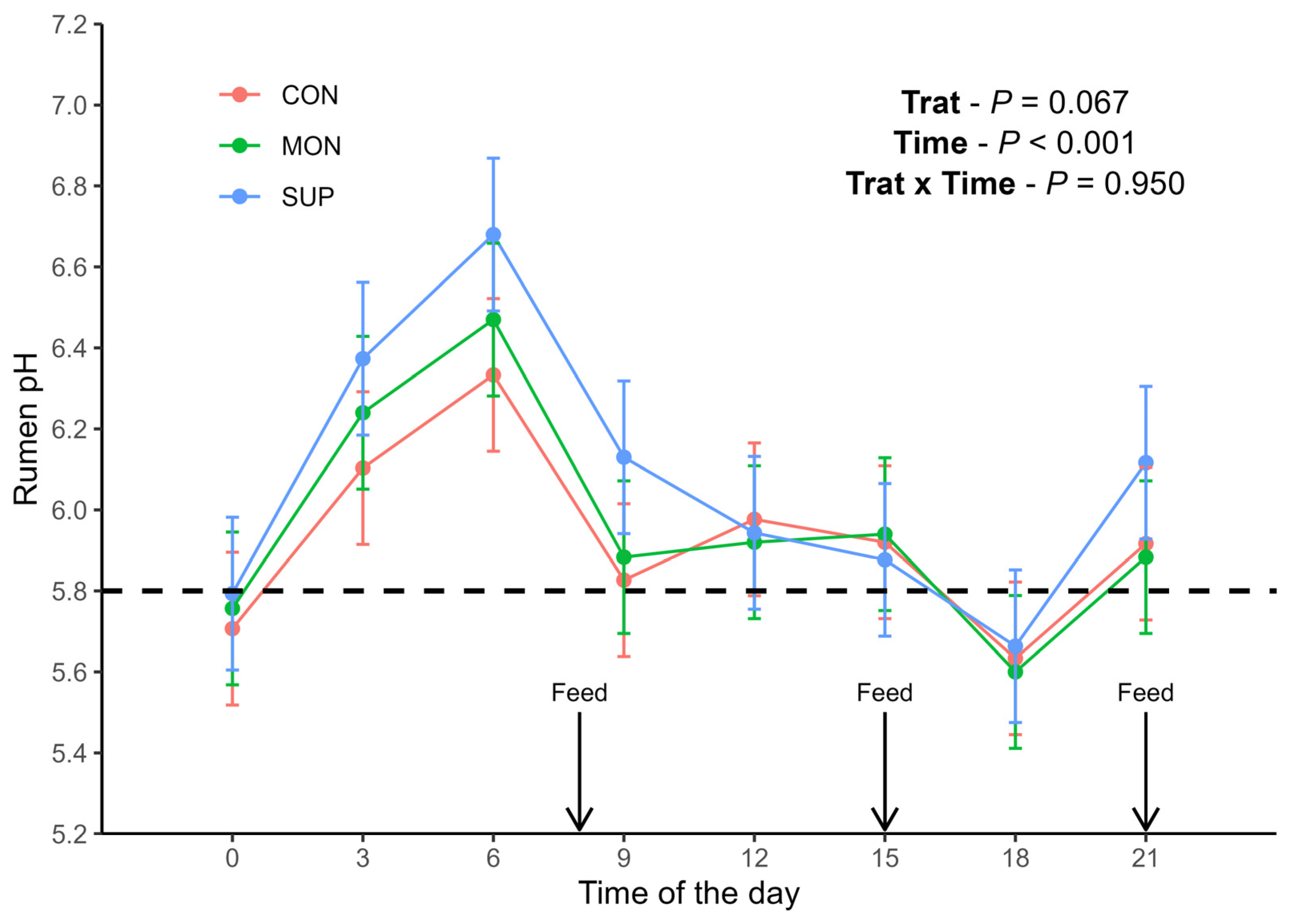
The rumen pH was similar between the treatments receiving any type of feed supplement and the CON treatment. However, the animals in the SUP treatment exhibited a higher rumen pH than those in the CON treatment. Higher pH values can be expected when animals receive condensed tannins due to their buffering capacity [
16] or to a influence they may play on chewing and rumination, increasing salivation and controlling rumen pH [
42]. In addition, yeasts may contribute to rumen pH stabilization by stimulating the proliferation of bacteria that utilize lactate and by reducing the activities of lactate-producing microbes [
25]. Nevertheless, a limitation of the present study is that the rumen microbiota composition was not evaluated, which precludes firm conclusions regarding microbial shifts underlying the observed differences in rumen pH. Thus, future studies evaluating the rumen microbiota in response to these treatments could provide further answers to the mechanisms involved and to explain the results found.
Regarding the total production of VFA, similarly to a study by Piantoni et al. [
53], we observed no difference in the total VFA. However, the same study [
53] reported a decrease in acetate and butyrate production and an increase in propionate production in animals supplemented with monensin. This result is expected because of monensin in inhibiting Gram-positive bacteria and the resulting proliferation of Gram-negative bacteria. However, these findings diverge from those found in our study, as the percentage of propionate, acetate and butyrate in relation to the total VFA did not differ among treatments.
Berça et al. [
24] observed an increase in the total VFA as well as propionate and butyrate and found no effect on acetate when tannins were used. Tannins stimulate the synthesis of propionate, a H
2 sink, while butyrate and acetate form H
2. In addition, protozoa and methanogenic archaea have a synergistic interaction that facilitates the transfer of H
2 to the methanogens. Therefore, increased propionate production can lead to lower CH
4 production, using H
2 that would otherwise be used for methanogenesis [
24]. On the other hand, Battelli et al. [
17] found no difference in the total production of VFA in goats fed with quebracho (
Schinopsis balansae) tannins.
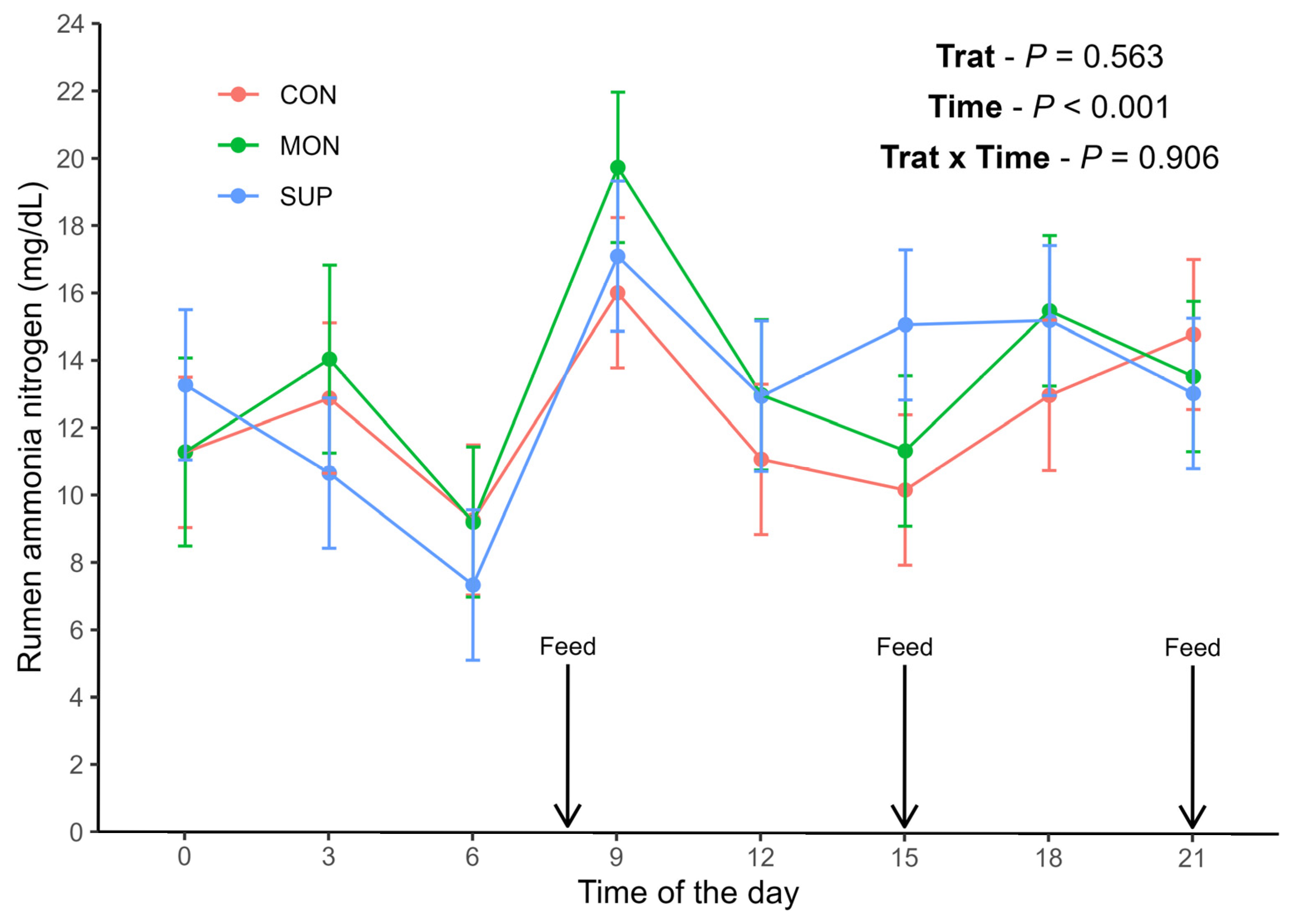
The concentration of RAN observed in our study was similar among treatments, which is consistent with the meta-analysis by Ahvanooei et al. [
14]. According to Ahvanooei et al. [
14], factors such as DMI, the nutrient composition of the feed, monensin dosage and the duration of supplementation may influence the results. This could explain the different results in the literature regarding RAN concentration. Piantoni et al. [
53] observed that monensin reduced the RAN compared to the control treatment, while Silva et al. [
43] found an increase in the RAN concentration.
Regarding tannins, Herremans et al. [
50] observed a reduction in RAN when the animals were supplemented with tannins, which was attributed to lower protein digestibility in the rumen and increased protein passage into the intestine. As no change in protein digestibility was observed in their study, this could explain the similar concentrations of RAN found. Similarly, Chung et al. [
60] compared active dried
Saccharomyces cerevisiae strains and reported that RAN was similar among treatments. This result diverges from those reported by Takiya et al. [
61] and Hirstov et al. [
62], in which yeast supplements decreased the RAN concentrations.
As for the blood parameters, the glucose levels were similar among the treatments assessed, which is consistent with the meta-analysis by Ahvanooei et al. [
14] for monensin supplementation, Grazziotin et al. [
41] for the use of tannins and Takiya et al. [
61] for the use of yeasts. Approximately 27% to 54% of glucose synthesized in the liver comes from propionate [
63]. As propionate production did not differ among treatments, this could explain the similar results for the glucose levels.
Blood urea nitrogen was also similar among treatments, in agreement with Ahvanooei et al. [
14] for monensin supplementation, which is consistent with the results found in our study. Results are also consistent with the study by Takya et al. [
61] that did not observe differences when using yeasts. However, it differs from Grazziotin et al. [
41], who observed a trend towards increased BUN, and Herremans et al. [
50], who observed a 9% reduction in BUN with tannin supplementation. The breakdown of CP in the rumen produces peptides, AA and RAN. Excess ammonia from the rumen is absorbed into the bloodstream and converted to urea in the liver. This urea is then excreted in the urine, milk or blood or returned to the rumen through urea recycling [
41]. As no significant effects on CP degradation and RAN were observed, this could explain the lack of an effect on BUN. Additionally, the total blood protein did not differ among the treatments evaluated, which is consistent with the result found by Silva et al. [
43] for monensin supplementation and Battelli et al. [
17] for dairy goats with
Schinopsis balansae tannins supplementation.
Condensed tannins can form complexes with proteins, potentially reducing the availability of nutrients for microbial protein synthesis in the rumen, and increasing the availability of postruminal protein [
44,
64]. However, consistent with the literature, the microbial protein synthesis, microbial protein synthesis efficiency and RUP flow did not differ among treatments [
19,
42,
43,
44,
65,
66].
The nitrogen intake did not differ among treatments, which is consistent with the findings of Ahvanooei et al. [
14] in a meta-analysis that found no association between nitrogen intake and monensin supplementation. Aguerre et al. [
48] observed an increase in the nitrogen intake when animals were supplemented with tannins, but this increase is related to the increase in DMI, which was not the case in our study.
Urinary nitrogen excretion also did not differ among treatments, similar to the observations of Ahvanooei et al. [
14] in animals supplemented with monensin and Renno et al. [
66] for low levels of
Acacia mearnsii tannins. However, it differed from the results of Herremans et al. [
50] and Tseu et al. [
42], in which urinary nitrogen excretion was lower when animals were supplemented with tannins, due to lower protein degradability, lower ammonia nitrogen production in the rumen and lower urea formation in the liver.
Fecal nitrogen was reduced by the addition of monensin at a dosage of 14 to 22 mg/kg, as reported by Ahvanooei et al. [
14] and by Tseu et al. [
42]. In the present study, monensin was supplied at 12 mg/kg, which is slightly below this range, and no differences were observed. However, it was not affected by the addition of tannins [
65] and yeasts [
61] which is consistent with the results of our study. Nitrogen balance did not differ between treatments, as the nitrogen intake and excretion in urine, feces and milk were similar. These results can be explained by the lack of differences in crude protein digestibility between the treatments studied [
43].
From a broader perspective, these findings suggest that the evaluated additives maintained nitrogen utilization efficiency without increasing nitrogen losses to the environment. Future research should explore a wider range of inclusion rates and longer supplementation periods to determine whether more pronounced shifts in nitrogen partitioning can be achieved.
In addition, integrating rumen microbial profiling and isotopic or metabolomic approaches could help to clarify the mechanisms regulating ruminal dynamics, nutrient transformations, absorption, and excretion pathways. Such evaluations would contribute to the development and use of plant-derived compounds in feeding strategies that lower CH4 emissions and optimize production efficiency while minimizing environmental nitrogen losses in dairy systems. The economic feasibility, cost benefit ratio, and significantly long-term sustainability of using such additives under commercial conditions remain uncertain and were beyond the scope of the present study, while also being an interesting point to be investigated.



 ,
,