Dietary Modulation of Gut Microbiota and Metabolome Shapes Growth Performance in Thamnaconus septentrionalis

 ,
,
Simple Summary
Abstract
1. Introduction
2. Materials and Methods
2.1. Ethics Statement
2.2. Experimental Animals and Acclimation
2.3. Experimental Design and Culture Management
2.4. Sample Collection Strategy
2.5. Growth Performance and Morphometric Measurements
2.6. Muscle Nutritional Composition Analysis
2.7. Intestinal Microbiota 16S rRNA Gene Sequencing
2.8. Untargeted Metabolomics Analysis of Intestinal Contents
2.9. Multi-Omics Integration and Machine Learning Analysis
2.10. Statistical Analysis
3. Results and Discussion
3.1. Effects of Feed Types on Growth Performance and Morphology of T. septentrionalis
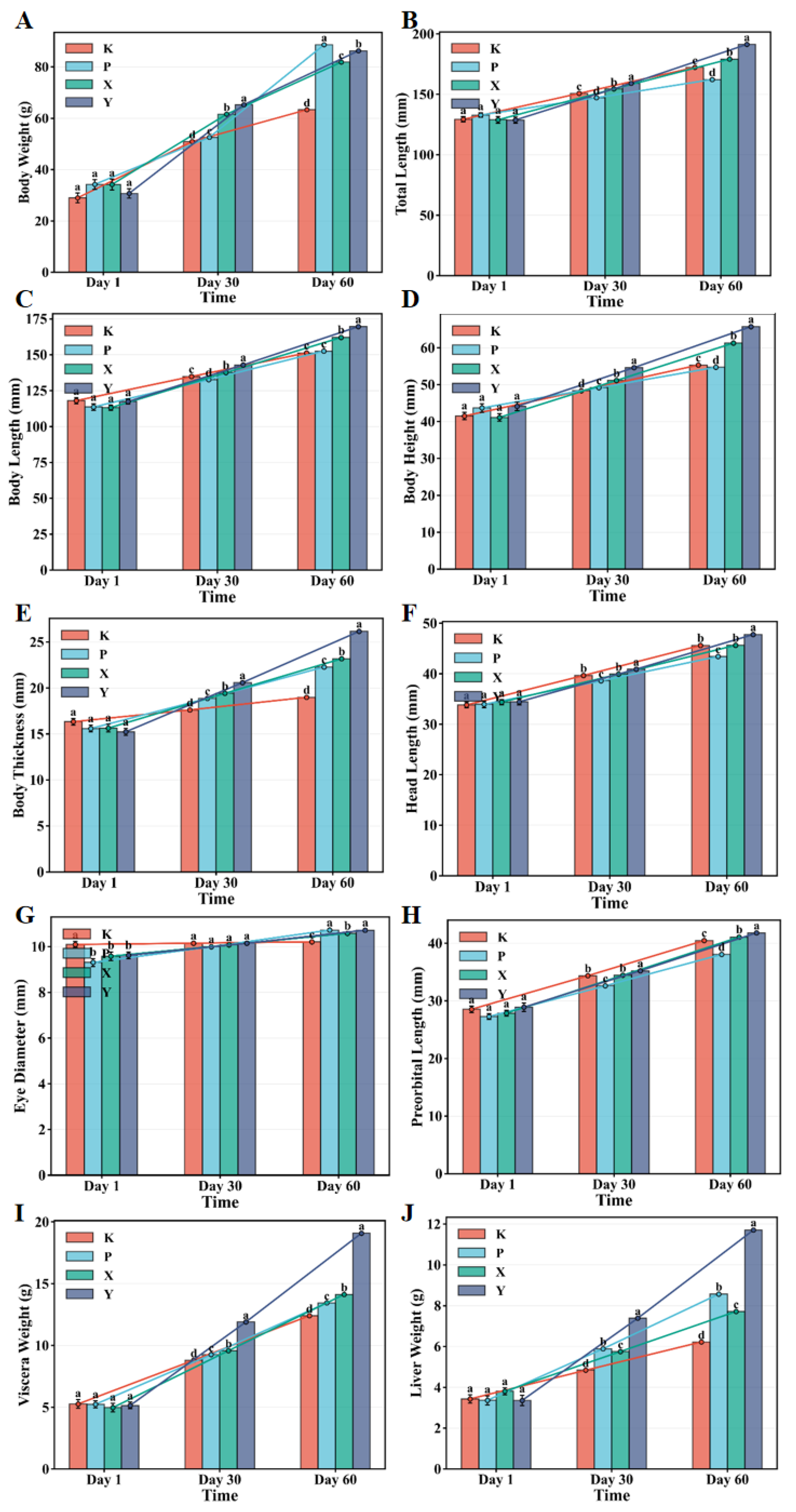
3.1.1. Temporal Dynamics of Growth Indices
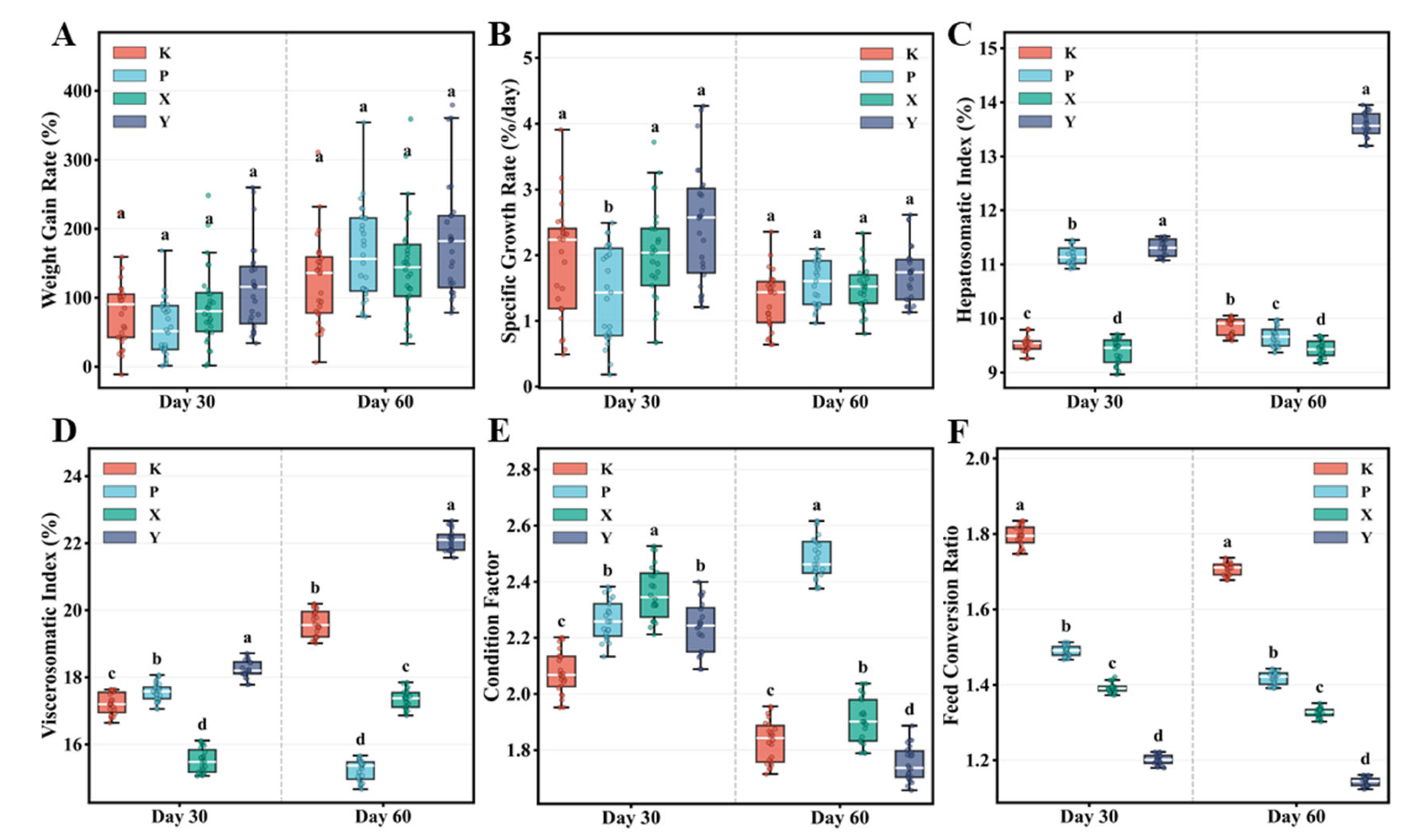
3.1.2. Growth Performance Parameter Evaluation
3.2. Effects of Feed Types on Muscle Nutritional Quality
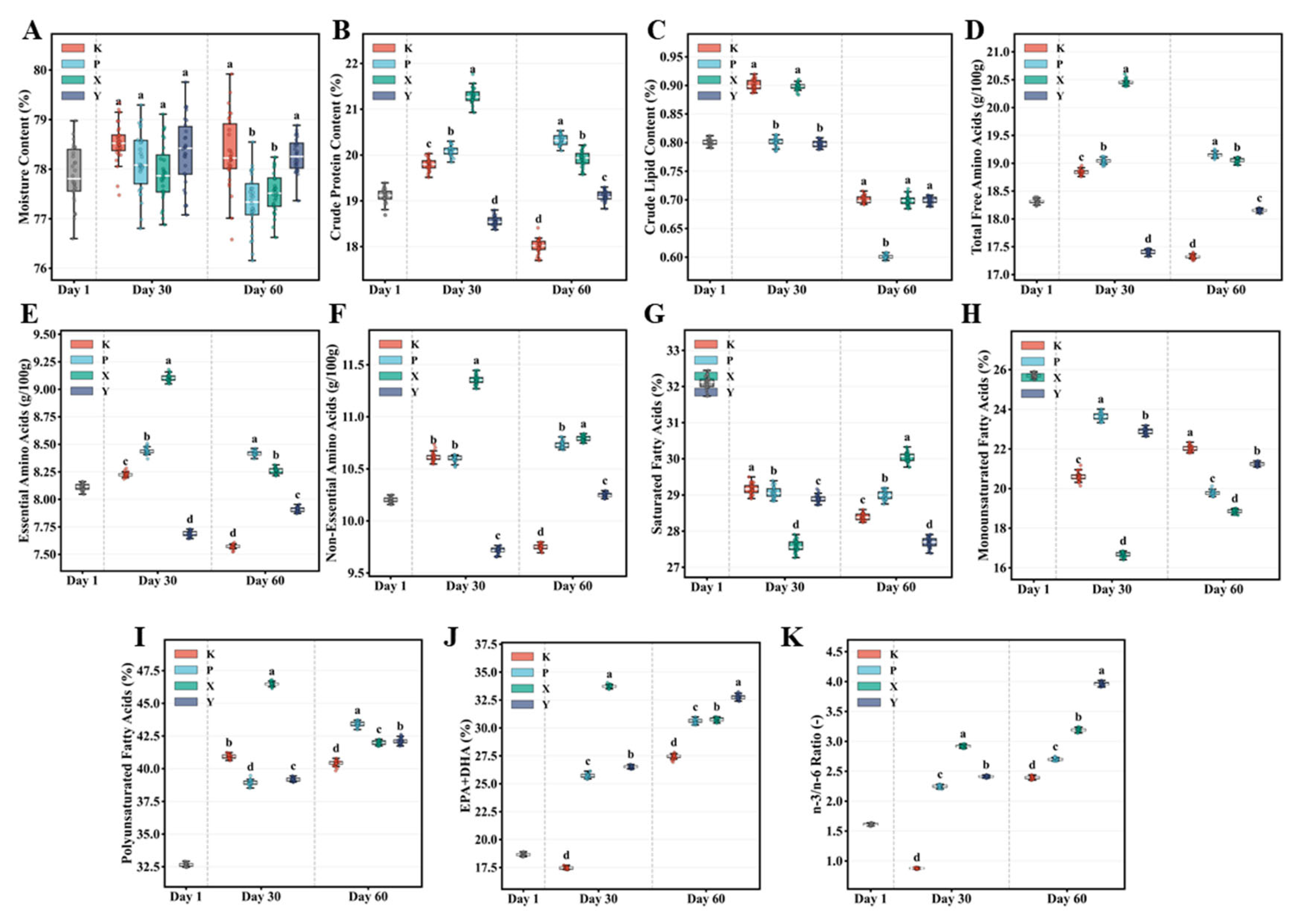
3.2.1. Muscle Proximate Composition
3.2.2. Muscle Free Amino Acid Composition
3.2.3. Muscle Fatty Acid Composition
3.3. Effects of Feed Types on Gut Microbial Community Structure
3.3.1. Gut Microbiota Diversity
3.3.2. Gut Microbial Community Composition
3.3.3. Differential Microbiota Identification
3.3.4. Gut Microbial Functional Potential
3.4. Effects of Feed Types on Gut Metabolic Profiles
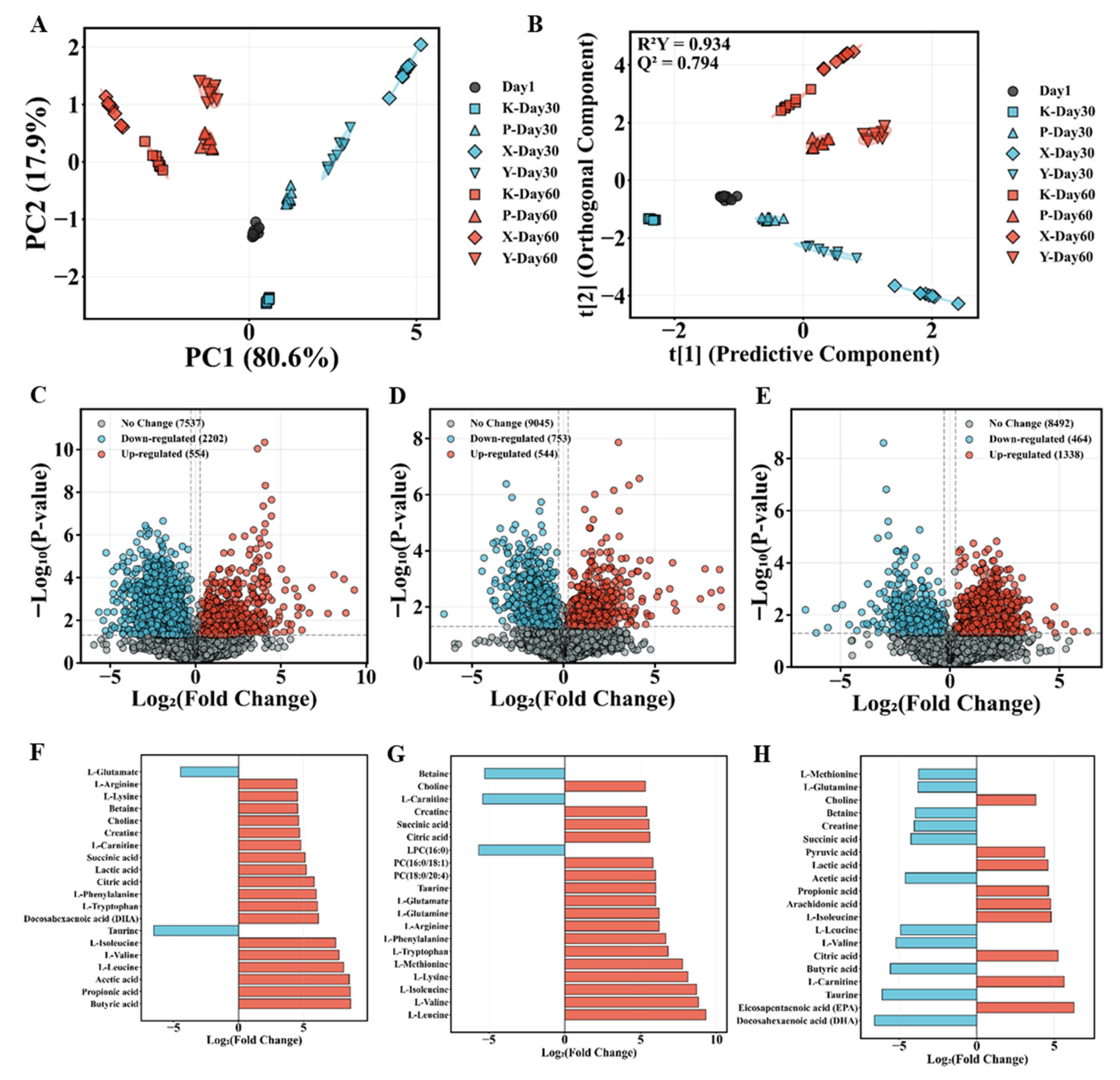
3.4.1. Overall Separation of Gut Metabolomes
3.4.2. Differential Metabolite Identification
3.4.3. Functional Pathway Enrichment of Differential Metabolites
3.5. Multi-Omics Correlation Network
3.6. Growth Performance Prediction Models Based on Multi-Omics Features
4. Discussion
4.1. Differential Effects of Feed Types on Growth Performance and Nutritional Basis
4.2. Patterns and Potential Implications of Muscle Nutritional Quality Differences
4.3. Feed-Associated Differences in Gut Microbiota Composition
4.4. Intestinal Metabolic Profiles and Potential Regulatory Pathways
4.5. Multi-Omics Integration: Associations Between Gut Microbiota, Metabolites, and Host Growth
4.6. Study Limitations, Application Insights, and Future Perspectives
5. Conclusions
Supplementary Materials
Author Contributions
Funding
Institutional Review Board Statement
Informed Consent Statement
Data Availability Statement
Conflicts of Interest
References
- Food and Agriculture Organization of the United Nations (FAO). The State of World Fisheries and Aquaculture 2024; FAO: Rome, Italy, 2024; pp. 1–10. [Google Scholar] [CrossRef]
- Tacon, A.G.J.; Metian, M. Global overview on the use of fish meal and fish oil in industrially compounded aquafeeds: Trends and future prospects. Aquaculture 2008, 285, 146–158. [Google Scholar] [CrossRef]
- Rana, K.J.; Siriwardena, S.; Hasan, M.R. Impact of Rising Feed Ingredient Prices on Aquafeeds and Aquaculture Production; FAO Fisheries and Aquaculture Technical Paper No. 541; Food and Agriculture Organization of the United Nations: Rome, Italy, 2009; pp. 1–10. [Google Scholar]
- Gatlin, D.M., III; Barrows, F.T.; Brown, P.; Dabrowski, K.; Gaylord, T.G.; Hardy, R.W.; Herman, E.; Hu, G.; Krogdahl, Å.; Nelson, R.; et al. Expanding the utilization of sustainable plant products in aquafeeds—A review. Aquac. Res. 2007, 38, 551–579. [Google Scholar] [CrossRef]
- Vadstein, O.; Bergh, Ø.; Gatesoupe, F.-J.; Galindo-Villegas, J.; Mulero, V.; Picchietti, S.; Scapigliati, G.; Makridis, P.; Olsen, Y.; Dierckens, K.; et al. Microbiology and immunology of fish larvae. Rev. Aquac. 2013, 5, S1–S25. [Google Scholar] [CrossRef]
- Bian, L.; Li, F.; Ge, J.; Wang, P.; Chang, Q.; Zhang, S.; Li, J.; Liu, C.; Liu, K.; Liu, X.; et al. Chromosome-level genome assembly of the greenfin horse-faced filefish (Thamnaconus septentrionalis) using Oxford Nanopore PromethION sequencing and Hi-C technology. Mol. Ecol. Resour. 2020, 20, 1069–1079. [Google Scholar] [CrossRef]
- Pilmer, L.W.; Woolley, L.D.; Lymbery, A.J.; Salini, M.; Partridge, G.J. Using dietary additives to improve palatability of diets containing single-cell protein from methanotrophic bacteria in yellowtail kingfish (Seriola lalandi) diets. Aquac. Res. 2022, 53, 5006–5017. [Google Scholar] [CrossRef]
- Naylor, R.L.; Hardy, R.W.; Bureau, D.P.; Chiu, A.; Elliott, M.; Farrell, A.P.; Forster, I.; Gatlin, D.M.; Goldburg, R.J.; Hua, K.; et al. Feeding aquaculture in an era of finite resources. Proc. Natl. Acad. Sci. USA 2009, 106, 15103–15110. [Google Scholar] [CrossRef]
- Tacon, A.G.J.; Hasan, M.R.; Metian, M. Demand and Supply of Feed Ingredients for Farmed Fish and Crustaceans: Trends and Prospects; FAO Fisheries and Aquaculture Technical Paper No. 520/2; FAO: Rome, Italy, 2011; pp. 1–10. [Google Scholar]
- National Research Council (NRC). Nutrient Requirements of Fish and Shrimp 2011; National Academies Press: Washington, DC, USA, 2011. [Google Scholar] [CrossRef]
- Sargent, J.R.; Bell, J.G.; McEvoy, L.A.; Tocher, D.R.; Estevez, A. Recent developments in the essential fatty acid nutrition of fish. Aquaculture 1999, 177, 191–199. [Google Scholar] [CrossRef]
- Nayak, S.K. Role of gastrointestinal microbiota in fish. Aquac. Res. 2010, 41, 1553–1573. [Google Scholar] [CrossRef]
- Nicholson, J.K.; Holmes, E.; Kinross, J.; Burcelin, R.; Gibson, G.; Jia, W.; Pettersson, S. Host–gut microbiota metabolic interactions. Science 2012, 336, 1262–1267. [Google Scholar] [CrossRef]
- Egerton, S.; Culloty, S.; Whooley, J.; Stanton, C.; Ross, R.P. The gut microbiota of marine fish. Front. Microbiol. 2018, 9, 873. [Google Scholar] [CrossRef]
- Gajardo, K.; Jaramillo-Torres, A.; Kortner, T.M.; Merrifield, D.L.; Tinsley, J.; Bakke, A.M.; Krogdahl, Å. Alternative protein sources in the diet modulate microbiota and functionality in the distal intestine of Atlantic salmon (Salmo salar). Appl. Environ. Microbiol. 2017, 83, e02615-16. [Google Scholar] [CrossRef] [PubMed]
- Zheng, L.; Wang, Z.; Zhang, B.; Yan, L.; Wang, P.; Zhao, C.; Lin, H.; Qiu, L.; Zhou, C. Effects of high dietary carbohydrate levels on growth performance, enzyme activities, expression of genes related to liver glucose metabolism, and the intestinal microbiota of Lateolabrax maculatus juveniles. Fishes 2023, 8, 431. [Google Scholar] [CrossRef]
- Marcobal, A.; Kashyap, P.C.; Nelson, T.A.; Aronov, P.A.; Donia, M.S.; Spormann, A.M.; Fischbach, M.A.; Sonnenburg, J.L. A metabolomic view of how the human gut microbiota impacts the host metabolome using humanized and gnotobiotic mice. ISME J. 2013, 7, 1933–1943. [Google Scholar] [CrossRef] [PubMed]
- Koh, A.; De Vadder, F.; Kovatcheva-Datchary, P.; Bäckhed, F. From dietary fiber to host physiology: Short-chain fatty acids as key bacterial metabolites. Cell 2016, 165, 1332–1345. [Google Scholar] [CrossRef]
- Palma, M.; Bledsoe, J.W.; Tavares, L.C.; Romano, N.; Small, B.C.; Viegas, I.; Overturf, K. Digesta and plasma metabolomics of rainbow trout strains with varied tolerance of plant-based diets highlights potential for non-lethal assessments of enteritis development. Metabolites 2021, 11, 590. [Google Scholar] [CrossRef]
- Leeper, A.; Sauphar, C.; Berlizot, B.; Ladurée, G.; Koppe, W.; Knobloch, S.; Skírnisdóttir, S.; Björnsdóttir, R.; Øverland, M.; Benhaïm, D. Enhancement of soybean meal alters gut microbiome and influences behavior of farmed Atlantic salmon (Salmo salar). Animals 2023, 13, 2591. [Google Scholar] [CrossRef]
- Acharjee, A.; Larkman, J.; Xu, Y.; Cardoso, V.R.; Gkoutos, G.V. A random forest based biomarker discovery and power analysis framework for diagnostics research. BMC Med. Genom. 2020, 13, 178. [Google Scholar] [CrossRef]
- Marcos-Zambrano, L.J.; Karaduzović-Hadžibegović, K.; Lončar Turukalo, T.; Przymus, P.; Trajkovik, V.; Aasmets, O.; Berland, M.; Gruca, A.; Hasic, J.; Hron, K.; et al. Applications of machine learning in human microbiome studies: A review on feature selection, biomarker identification, disease prediction and treatment. Front. Microbiol. 2021, 12, 634511. [Google Scholar] [CrossRef]
- Gou, W.; Ling, C.-W.; He, Y.; Jiang, Z.; Fu, Y.; Xu, F.; Miao, Z.; Sun, T.-Y.; Lin, J.-S.; Zhu, H.-L.; et al. Interpretable machine learning framework reveals robust gut microbiome features associated with type 2 diabetes. Diabetes Care 2021, 44, 358–366. [Google Scholar] [CrossRef]
- GB/T 35892-2018; Guidelines for Ethical Review of Laboratory Animal Welfare. Standardization Administration of China: Beijing, China, 2018.
- Horwitz, W.; Latimer, G.W., Jr. (Eds.) Official Methods of Analysis of AOAC International, 18th ed.; AOAC International: Gaithersburg, MD, USA, 2005; pp. 1–10. [Google Scholar]
- Ricker, W.E. Computation and Interpretation of Biological Statistics of Fish Populations; Bulletin of the Fisheries Research Board of Canada: Ottawa, ON, Canada, 1975; Volume 191, pp. 1–382. [Google Scholar]
- Tocher, D.R. Metabolism and functions of lipids and fatty acids in teleost fish. Rev. Fish. Sci. 2003, 11, 107–184. [Google Scholar] [CrossRef]
- Mori, H.; Maruyama, F.; Kato, H.; Toyoda, A.; Dozono, A.; Ohtsubo, Y.; Nagata, Y.; Fujiyama, A.; Tsuda, M.; Kurokawa, K. Design and experimental application of a novel non-degenerate universal primer set that amplifies prokaryotic 16S rRNA genes with a low possibility to amplify eukaryotic rRNA genes. DNA Res. 2014, 21, 217–227. [Google Scholar] [CrossRef] [PubMed]
- Douglas, G.M.; Maffei, V.J.; Zaneveld, J.R.; Yurgel, S.N.; Brown, J.R.; Taylor, C.M.; Huttenhower, C.; Langille, M.G.I. PICRUSt2 for prediction of metagenome functions. Nat. Biotechnol. 2020, 38, 685–688. [Google Scholar] [CrossRef] [PubMed]
- Dunn, W.B.; Broadhurst, D.; Begley, P.; Zelena, E.; Francis-McIntyre, S.; Anderson, N.; Brown, M.; Knowles, J.D.; Halsall, A.; Haselden, J.N.; et al. Procedures for large-scale metabolic profiling of serum and plasma by GC/LC–MS. Nat. Protoc. 2011, 6, 1060–1083. [Google Scholar] [CrossRef] [PubMed]
- Trygg, J.; Wold, S. Orthogonal projections to latent structures (O-PLS). J. Chemom. 2002, 16, 119–128. [Google Scholar] [CrossRef]
- Benjamini, Y.; Hochberg, Y. Controlling the false discovery rate: A practical and powerful approach to multiple testing. J. R. Stat. Soc. Ser. B Methodol. 1995, 57, 289–300. [Google Scholar] [CrossRef]
- Pedregosa, F.; Varoquaux, G.; Gramfort, A.; Michel, V.; Thirion, B.; Grisel, O.; Blondel, M.; Prettenhofer, P.; Weiss, R.; Dubourg, V.; et al. Scikit-learn: Machine learning in Python. J. Mach. Learn. Res. 2011, 12, 2825–2830. [Google Scholar]
- Roediger, W.E.W. Utilization of Nutrients by Isolated Epithelial Cells of the Rat Colon. Gastroenterology 1982, 83, 424–429. [Google Scholar] [CrossRef]
- Calder, P.C. Marine omega-3 fatty acids and inflammatory processes: Effects, mechanisms and clinical relevance. Biochim. Biophys. Acta Mol. Cell Biol. Lipids 2015, 1851, 469–484. [Google Scholar] [CrossRef]
- Davie, J.R. Inhibition of Histone Deacetylase Activity by Butyrate. J. Nutr. 2003, 133, 2485S–2493S. [Google Scholar] [CrossRef]
- Krogdahl, Å.; Penn, M.; Thorsen, J.; Refstie, S.; Bakke, A.M. Important antinutrients in plant feedstuffs for aquaculture: An update on recent findings regarding responses in salmonids. Aquac. Res. 2010, 41, 333–344. [Google Scholar] [CrossRef]
- Tocher, D.R. Omega-3 long-chain polyunsaturated fatty acids and aquaculture in perspective. Rev. Fish. Sci. Aquac. 2015, 23, 324–390. [Google Scholar] [CrossRef]
- Ringø, E.; Li, X.; Doan, H.V.; Ghosh, K. Interesting Probiotic Bacteria Other Than the More Widely Used Lactic Acid Bacteria and Bacilli in Finfish. Front. Mar. Sci. 2022, 9, 848037. [Google Scholar] [CrossRef]
- Saxton, R.A.; Sabatini, D.M. mTOR signaling in growth, metabolism, and disease. Cell 2017, 168, 960–976. [Google Scholar] [CrossRef]
- Wolfson, R.L.; Sabatini, D.M. The dawn of the age of amino acid sensors for the mTORC1 pathway. Cell Metab. 2017, 26, 301–309. [Google Scholar] [CrossRef]
- Sancak, Y.; Peterson, T.R.; Shaul, Y.D.; Lindquist, R.A.; Thoreen, C.C.; Bar-Peled, L.; Sabatini, D.M. The Rag GTPases Bind Raptor and Mediate Amino Acid Signaling to mTORC1. Science 2008, 320, 1496–1501. [Google Scholar] [CrossRef]
- Seiliez, I.; Gabillard, J.-C.; Skiba-Cassy, S.; Garcia-Serrana, D.; Gutiérrez, J.; Kaushik, S.; Panserat, S.; Tesseraud, S. An in vivo and in vitro assessment of TOR signaling cascade in rainbow trout. Am. J. Physiol.—Regul. Integr. Comp. Physiol. 2008, 295, R329–R335. [Google Scholar] [CrossRef]
- Chelakkot, C.; Choi, Y.; Kim, D.K.; Park, H.T.; Ghim, J.; Kwon, Y.; Jeon, J.; Kim, M.S.; Jee, Y.K.; Gho, Y.S.; et al. Akkermansia muciniphila-derived extracellular vesicles influence gut permeability through the regulation of tight junctions. Exp. Mol. Med. 2018, 50, e450. [Google Scholar] [CrossRef]




Disclaimer/Publisher’s Note: The statements, opinions and data contained in all publications are solely those of the individual author(s) and contributor(s) and not of MDPI and/or the editor(s). MDPI and/or the editor(s) disclaim responsibility for any injury to people or property resulting from any ideas, methods, instructions or products referred to in the content. |
© 2026 by the authors. Licensee MDPI, Basel, Switzerland. This article is an open access article distributed under the terms and conditions of the Creative Commons Attribution (CC BY) license.
Share and Cite
Fang, Q.; Ke, L.; Bian, L.; Li, S.; Chi, H.; Chen, Y.; Qiu, X.; Shi, S.; Chen, S. Dietary Modulation of Gut Microbiota and Metabolome Shapes Growth Performance in Thamnaconus septentrionalis. Animals 2026, 16, 1312. https://doi.org/10.3390/ani16091312
Fang Q, Ke L, Bian L, Li S, Chi H, Chen Y, Qiu X, Shi S, Chen S. Dietary Modulation of Gut Microbiota and Metabolome Shapes Growth Performance in Thamnaconus septentrionalis. Animals. 2026; 16(9):1312. https://doi.org/10.3390/ani16091312
Chicago/Turabian StyleFang, Qinmei, Ling Ke, Li Bian, Shuigen Li, Hongshu Chi, Yongcong Chen, Ximin Qiu, Shaohua Shi, and Siqing Chen. 2026. "Dietary Modulation of Gut Microbiota and Metabolome Shapes Growth Performance in Thamnaconus septentrionalis" Animals 16, no. 9: 1312. https://doi.org/10.3390/ani16091312
APA StyleFang, Q., Ke, L., Bian, L., Li, S., Chi, H., Chen, Y., Qiu, X., Shi, S., & Chen, S. (2026). Dietary Modulation of Gut Microbiota and Metabolome Shapes Growth Performance in Thamnaconus septentrionalis. Animals, 16(9), 1312. https://doi.org/10.3390/ani16091312