Optimization of Sanitation Process Parameters of Slightly Acidic Electrolyzed Water for Automated Milk Feeders Using Response Surface Methodology

 , ,
, ,  ,
, 
Simple Summary
Abstract
1. Introduction
2. Materials and Methods
2.1. Preparation of Cleaning Agents
2.2. Field Experiment Design
2.2.1. Experimental Site and AMF Equipment
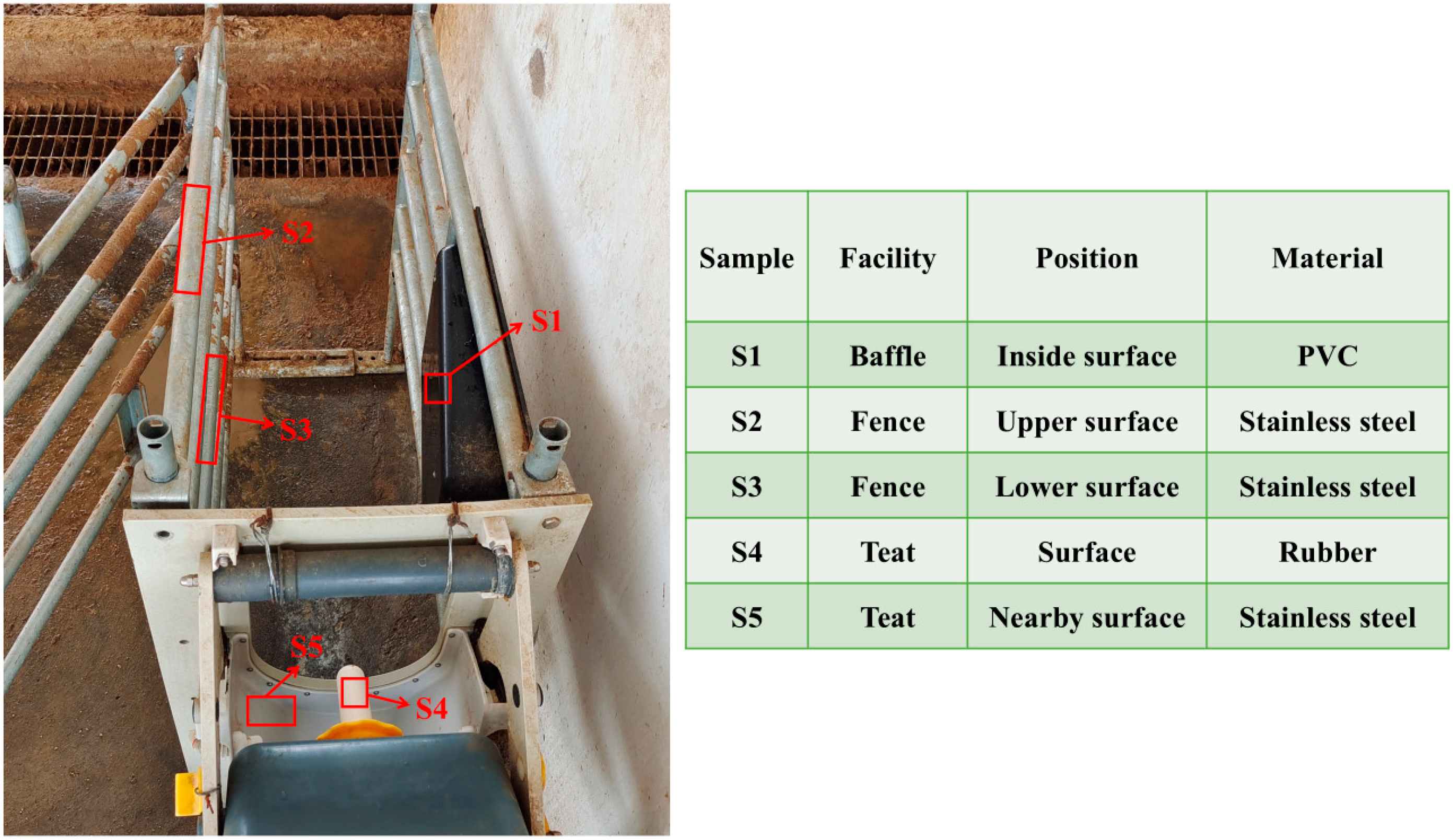
2.2.2. Sampling Sites
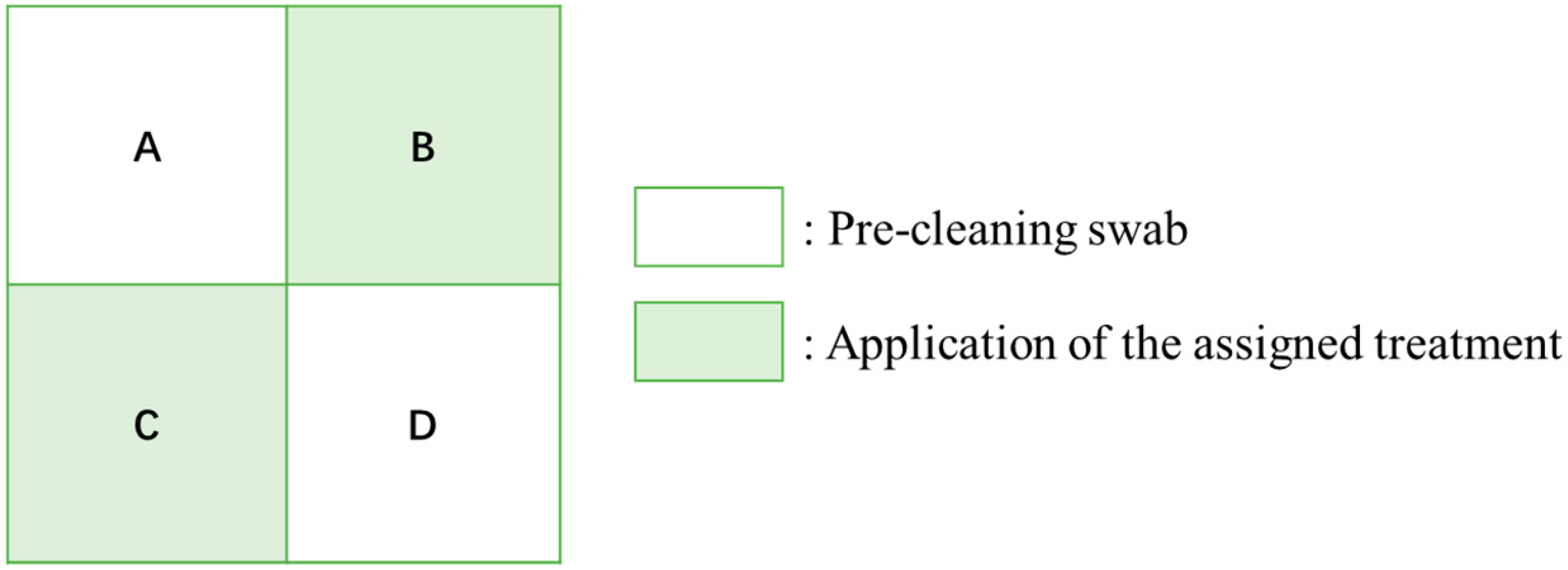
2.2.3. Cleaning Treatments
2.2.4. Sample Collection
2.3. Laboratory Optimization Experiment
2.3.1. Experimental Setup and Bacterial Inoculation
2.3.2. Single-Factor Experiments
2.3.3. Box–Behnken Response Surface Design
2.4. Evaluation Methods
2.4.1. Aerobic Plate Count
2.4.2. ATP Bioluminescence Assay
2.4.3. Calculation of Removal Rates
2.5. Response Surface Modeling and Optimization
2.6. Statistical Analysis
2.6.1. Statistical Analysis for the Field Experiment
2.6.2. Statistical Analysis for the Laboratory Optimization Experiment
3. Results and Discussion
3.1. Microbial Contamination and Cleaning Efficacy in the Field Experiment
3.1.1. Baseline Contamination Levels on AMF Surfaces
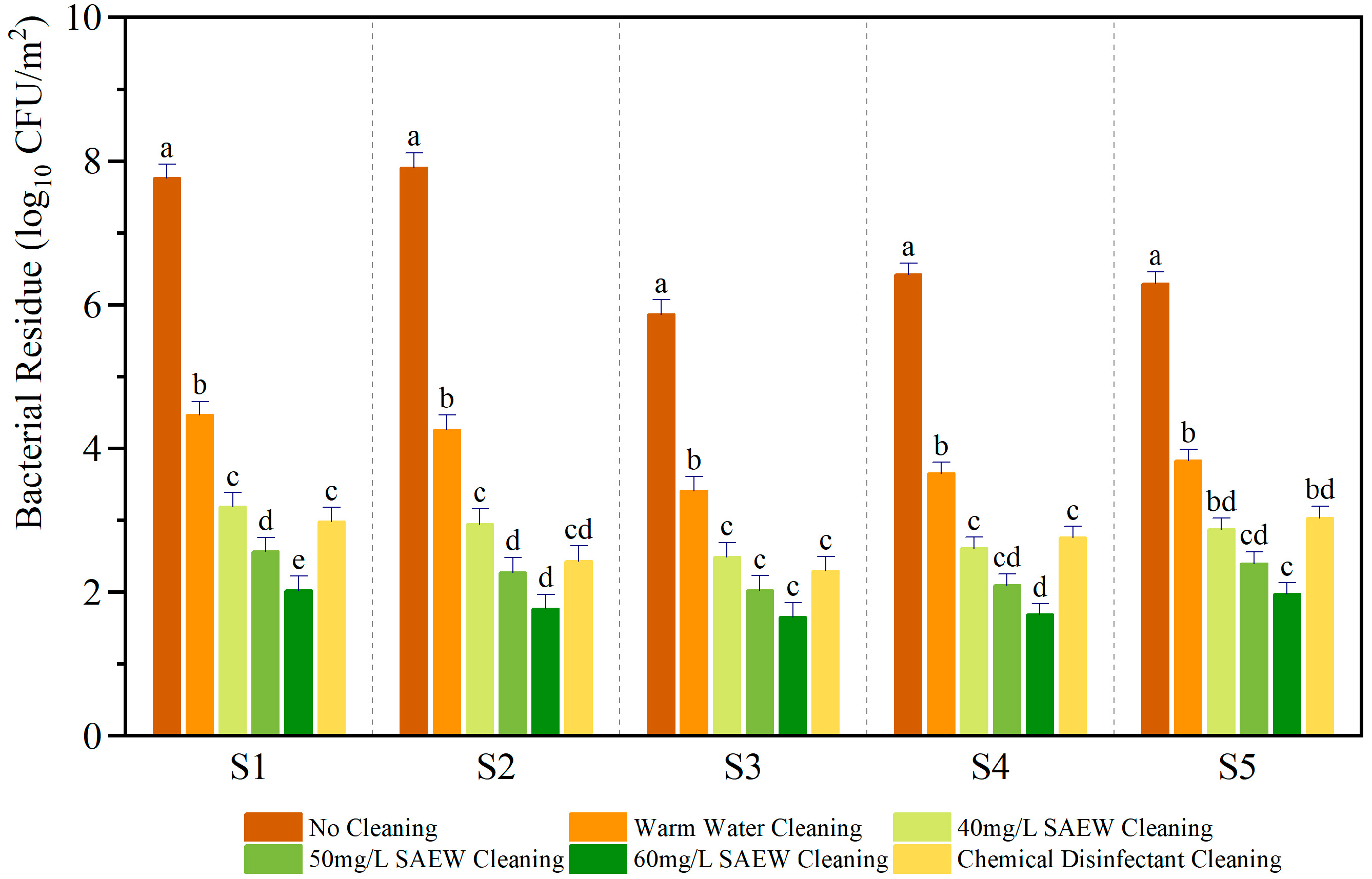
3.1.2. Comparative Efficacy of Different Cleaning Agents
3.1.3. Effect of Surface Characteristics and Materials on AMFs
3.2. Response Surface Optimization of SAEW Parameters
3.2.1. Experimental Results and Data Overview
3.2.2. Model Fitting and Adequacy Evaluation
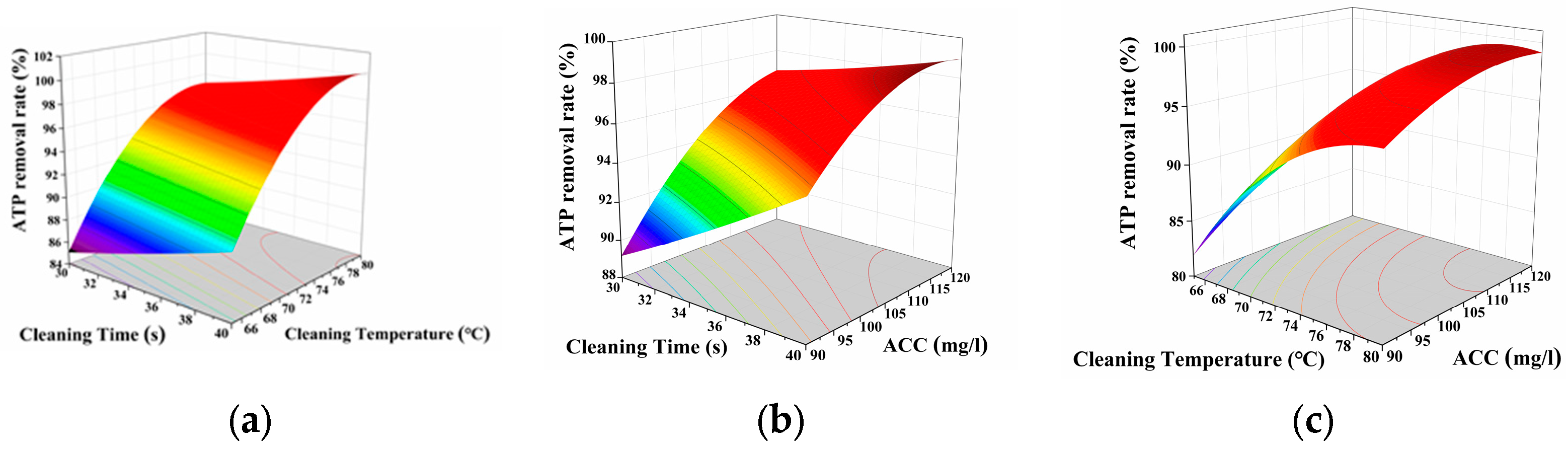
3.2.3. Response Surface Plots and Factor Interactions
3.2.4. Experimental Validation of the Model
3.3. Optimization of SAEW Cleaning Parameters
3.4. Practical Considerations and Study Limitations
4. Conclusions
Supplementary Materials
Author Contributions
Funding
Institutional Review Board Statement
Data Availability Statement
Acknowledgments
Conflicts of Interest
Abbreviations
| ACC | Available chlorine concentration |
| AMF | Automated milk feeder |
| AMFs | Automated milk feeders |
| APC | Aerobic plate count |
| ATP | Adenosine triphosphate |
| BPW | Buffered peptone water |
| CCE | Comprehensive cleaning efficiency |
| CIO− | Hypochlorite ions |
| CIP | Clean-in-place |
| R2 | Coefficient of determination |
| HCIO | Hypochlorous acid |
| LMM | Linear mixed model |
| RSM | Response surface methodology |
| PCA | Plate count agar |
| PVC | Polyvinyl chloride |
| SAEW | Slightly acidic electrolyzed water |
| TVC | Total viable count |
References
- Windeyer, M.C.; Leslie, K.E.; Godden, S.M.; Hodgins, D.C.; Lissemore, K.D.; LeBlanc, S.J. Factors Associated with Morbidity, Mortality, and Growth of Dairy Heifer Calves up to 3 Months of Age. Prev. Vet. Med. 2014, 113, 231–240. [Google Scholar] [CrossRef]
- Zhao, W.; Choi, C.Y.; Li, G.; Li, H.; Shi, Z. Pre-Weaned Dairy Calf Management Practices, Morbidity and Mortality of Bovine Respiratory Disease and Diarrhea in China. Livest. Sci. 2021, 251, 104608. [Google Scholar] [CrossRef]
- Borderas, T.F.; de Passillé, A.M.B.; Rushen, J. Feeding Behavior of Calves Fed Small or Large Amounts of Milk. J. Dairy Sci. 2009, 92, 2843–2852. [Google Scholar] [CrossRef] [PubMed]
- Medrano-Galarza, C.; LeBlanc, S.J.; DeVries, T.J.; Jones-Bitton, A.; Rushen, J.; De Passillé, A.M.; Haley, D.B. A Survey of Dairy Calf Management Practices among Farms Using Manual and Automated Milk Feeding Systems in Canada. J. Dairy Sci. 2017, 100, 6872–6884. [Google Scholar] [CrossRef] [PubMed]
- Jorgensen, M.W.; Adams-Progar, A.; De Passillé, A.M.; Rushen, J.; Salfer, J.A.; Endres, M.I. Mortality and Health Treatment Rates of Dairy Calves in Automated Milk Feeding Systems in the Upper Midwest of the United States. J. Dairy Sci. 2017, 100, 9186–9193. [Google Scholar] [CrossRef]
- Renaud, D.L.; Kelton, D.F.; LeBlanc, S.J.; Haley, D.B.; Jalbert, A.B.; Duffield, T.F. Validation of Commercial Luminometry Swabs for Total Bacteria and Coliform Counts in Colostrum-Feeding Equipment. J. Dairy Sci. 2017, 100, 9459–9465. [Google Scholar] [CrossRef]
- Cavallaro, A.; Rhoads, W.J.; Huwiler, S.G.; Stachler, E.; Hammes, F. Potential Probiotic Approaches to Control Legionella in Engineered Aquatic Ecosystems. FEMS Microbiol. Ecol. 2022, 98, fiac071. [Google Scholar] [CrossRef]
- Elizondo-Salazar, J.A.; Jones, C.M.; Heinrichs, A.J. Evaluation of Calf Milk Pasteurization Systems on 6 Pennsylvania Dairy Farms. J. Dairy Sci. 2010, 93, 5509–5513. [Google Scholar] [CrossRef]
- Morrison, J.; Renaud, D.L.; Churchill, K.J.; Costa, J.H.C.; Steele, M.A.; Winder, C.B. Predicting Morbidity and Mortality Using Automated Milk Feeders: A Scoping Review. J. Dairy Sci. 2021, 104, 7177–7194. [Google Scholar] [CrossRef]
- Heinemann, C.; Leubner, C.D.; Hayer, J.J.; Steinhoff-Wagner, J. Hygiene Management in Newborn Individually Housed Dairy Calves Focusing on Housing and Feeding Practices. J. Anim. Sci. 2021, 99, skaa391. [Google Scholar] [CrossRef]
- Jorgensen, M.W.; Janni, K.; Adams-Progar, A.; Chester-Jones, H.; Salfer, J.A.; Endres, M.I. Housing and Management Characteristics of Calf Automated Feeding Systems in the Upper Midwest of the United States. J. Dairy Sci. 2017, 100, 9881–9891. [Google Scholar] [CrossRef] [PubMed]
- Medrano-Galarza, C.; LeBlanc, S.J.; Jones-Bitton, A.; DeVries, T.J.; Rushen, J.; De Passillé, A.M.; Endres, M.I.; Haley, D.B. Associations between Management Practices and Within-Pen Prevalence of Calf Diarrhea and Respiratory Disease on Dairy Farms Using Automated Milk Feeders. J. Dairy Sci. 2018, 101, 2293–2308. [Google Scholar] [CrossRef] [PubMed]
- Gruse, J.; Kanitz, E.; Weitzel, J.M.; Tuchscherer, A.; Stefaniak, T.; Jawor, P.; Wolffram, S.; Hammon, H.M. Quercetin Feeding in Newborn Dairy Calves Cannot Compensate Colostrum Deprivation: Study on Metabolic, Antioxidative and Inflammatory Traits. PLoS ONE 2016, 11, e0146932. [Google Scholar] [CrossRef] [PubMed]
- Schild, C.O.; Caffarena, R.D.; Gil, A.; Sánchez, J.; Riet-Correa, F.; Giannitti, F. A Survey of Management Practices That Influence Calf Welfare and an Estimation of the Annual Calf Mortality Risk in Pastured Dairy Herds in Uruguay. J. Dairy Sci. 2020, 103, 9418–9429. [Google Scholar] [CrossRef]
- Zhao, X.; Qi, F.; Li, H.; Shi, Z. The Activation of Carbon Materials to Control Airborne Pathogenic Bacteria in the Pig House by Efficient Adsorption. Biosyst. Eng. 2023, 236, 71–78. [Google Scholar] [CrossRef]
- Srivastav, A.L.; Patel, N.; Chaudhary, V.K. Disinfection By-Products in Drinking Water: Occurrence, Toxicity and Abatement. Environ. Pollut. 2020, 267, 115474. [Google Scholar] [CrossRef]
- Jiménez-Pichardo, R.; Regalado, C.; Castaño-Tostado, E.; Meas-Vong, Y.; Santos-Cruz, J.; García-Almendárez, B.E. Evaluation of Electrolyzed Water as Cleaning and Disinfection Agent on Stainless Steel as a Model Surface in the Dairy Industry. Food Control 2016, 60, 320–328. [Google Scholar] [CrossRef]
- Huang, Y.-R.; Hung, Y.-C.; Hsu, S.-Y.; Huang, Y.-W.; Hwang, D.-F. Application of Electrolyzed Water in the Food Industry. Food Control 2008, 19, 329–345. [Google Scholar] [CrossRef]
- Li, Z.; Wang, X.; Li, X.; Guo, S.; Li, S.; Chen, B.; Cheng, Y.; Xu, H.; Yan, W. Optimization of Electrolysis Process, Storage Conditions and Sterilization Effect of Slightly Acidic Electrolytic Water Prepared by Titanium Suboxide Electrode. J. Environ. Chem. Eng. 2023, 11, 109679. [Google Scholar] [CrossRef]
- Walker, S.P.; Demirci, A.; Graves, R.E.; Spencer, S.B.; Roberts, R.F. Response Surface Modelling for Cleaning and Disinfecting Materials Used in Milking Systems with Electrolysed Oxidizing Water. Int. J. Dairy Technol. 2005, 58, 65–73. [Google Scholar] [CrossRef]
- Li, J.; Wang, Y.; Zheng, W.; Xia, T.; Kong, X.; Yuan, Z.; Niu, B.; Wei, G.; Li, B. Comprehensive Evaluation of Treating Drinking Water for Laying Hens Using Slightly Acidic Electrolyzed Water. Poult. Sci. 2024, 103, 103176. [Google Scholar] [CrossRef] [PubMed]
- Zang, Y.; Li, B.; Bing, S.; Cao, W. Modeling Disinfection of Plastic Poultry Transport Cages Inoculated with Salmonella enteritids by Slightly Acidic Electrolyzed Water Using Response Surface Methodology. Poult. Sci. 2015, 94, 2059–2065. [Google Scholar] [CrossRef] [PubMed]
- Hao, X.; Cao, W.; Li, B.; Zhang, Q.; Wang, C.; Ge, L. Slightly Acidic Electrolyzed Water for Reducing Airborne Microorganisms in a Layer Breeding House. J. Air Waste Manag. Assoc. 2014, 64, 494–500. [Google Scholar] [CrossRef] [PubMed]
- Hao, X.; Li, B.; Wang, C.; Zhang, Q.; Cao, W. Application of Slightly Acidic Electrolyzed Water for Inactivating Microbes in a Layer Breeding House. Poult. Sci. 2013, 92, 2560–2566. [Google Scholar] [CrossRef]
- Zheng, W.; Li, B.; Cao, W.; Zhang, G.; Yang, Z. Application of Neutral Electrolyzed Water Spray for Reducing Dust Levels in a Layer Breeding House. J. Air Waste Manag. Assoc. 2012, 62, 1329–1334. [Google Scholar] [CrossRef]
- Liu, Y.; Xie, Q.; Cui, D.; Ren, J.; Zhao, W.; Xu, X. Research on Aseptic Milk Extraction Technology and Mechanism of Slightly Acidic Electrolytic Water Coupled with Ultrasound Treatment. Foods 2025, 14, 1711. [Google Scholar] [CrossRef]
- Liu, Y.; Wang, C.; Shi, Z.; Li, B. Optimization and Modeling of Slightly Acidic Electrolyzed Water for the Clean-in-Place Process in Milking Systems. Foods 2020, 9, 1685. [Google Scholar] [CrossRef]
- Dev, S.R.S.; Demirci, A.; Graves, R.E.; Puri, V.M. Optimization and Modeling of an Electrolyzed Oxidizing Water Based Clean-In-Place Technique for Farm Milking Systems Using a Pilot-Scale Milking System. J. Food Eng. 2014, 135, 1–10. [Google Scholar] [CrossRef]
- Davidson, C.A.; Griffith, C.J.; Peters, A.C.; Fielding, L.M. Evaluation of Two Methods for Monitoring Surface Cleanliness—ATP Bioluminescence and Traditional Hygiene Swabbing. Luminescence 1999, 14, 33–38. [Google Scholar] [CrossRef]
- Vilar, M.J.; Dieguez, F.J.; Sanjuan, M.L.; Yus, E. Application of ATP Bioluminescence for Evaluation of Surface Cleanliness of Milking Equipment. Int. J. Food Microbiol. 2008, 125, 357–361. [Google Scholar] [CrossRef]
- Böhm, R. Disinfection and Hygiene in the Veterinary Field and Disinfection of Animal Houses and Transport Vehicles. Int. Biodeterior. Biodegrad. 1998, 41, 217–224. [Google Scholar] [CrossRef]
- Fukuzaki, S. Mechanisms of Actions of Sodium Hypochlorite in Cleaning and Disinfection Processes. Biocontrol Sci. 2006, 11, 147–157. [Google Scholar] [CrossRef] [PubMed]
- Hawkins, C.L. Hypochlorous Acid-Mediated Modification of Proteins and Its Consequences. In Essays in Biochemistry; Hooper, N., Ed.; Portland Press Ltd.: London, UK, 2020; Volume 64, pp. 75–86. [Google Scholar]
- Rahman, S.M.E.; Khan, I.; Oh, D.-H. Electrolyzed Water as a Novel Sanitizer in the Food Industry: Current Trends and Future Perspectives. Compr. Rev. Food. Sci. Food Saf. 2016, 15, 471–490. [Google Scholar] [CrossRef] [PubMed]
- Hao, X.; Xie, D.; Jiang, D.; Zhu, L.; Shen, L.; Gan, M.; Bai, L. Effect of Slightly Acidic Electrolyzed Water on Growth, Diarrhea and Intestinal Bacteria of Newly Weaned Piglets. Genes 2023, 14, 1398. [Google Scholar] [CrossRef]
- Ospina Rios, S.L.; Lee, C.; Andrewartha, S.J.; Verdon, M. A Pilot Study on the Feasibility of an Extended Suckling System for Pasture-Based Dairies. Animals 2023, 13, 2571. [Google Scholar] [CrossRef]
- Epstein, J.B.; Emerton, S.; Le, N.D.; Stevenson-Moore, P. A Double-Blind Crossover Trial of Oral Balance Gel and Biotene® Toothpaste versus Placebo in Patients with Xerostomia Following Radiation Therapy. Oral Oncol. 1999, 35, 132–137. [Google Scholar] [CrossRef]
- Hahnel, S.; Ettl, T.; Gosau, M.; Rosentritt, M.; Handel, G.; Buergers, R. Influence of Saliva Substitute Films on the Initial Adhesion of Candida Albicans to Dental Substrata Prior to and after Artificial Ageing. Arch. Oral Biol. 2010, 55, 391–396. [Google Scholar] [CrossRef]
- Holman, D.B.; Timsit, E.; Alexander, T.W. The Nasopharyngeal Microbiota of Feedlot Cattle. Sci. Rep. 2015, 5, 15557. [Google Scholar] [CrossRef]
- Rodríguez-Habibe, I.; Celis-Giraldo, C.; Patarroyo, M.E.; Avendaño, C.; Patarroyo, M.A. A Comprehensive Review of the Immunological Response against Foot-and-Mouth Disease Virus Infection and Its Evasion Mechanisms. Vaccines 2020, 8, 764. [Google Scholar] [CrossRef]
- Costerton, J.; Lewandowski, Z.; Caldwell, D.; Korber, D.; Lappinscott, H. Microbial Biofilms. Annu. Rev. Microbiol. 1995, 49, 711–745. [Google Scholar] [CrossRef]
- Simões, M.; Simões, L.C.; Vieira, M.J. A Review of Current and Emergent Biofilm Control Strategies. LWT—Food Sci. Technol. 2010, 43, 573–583. [Google Scholar] [CrossRef]
- Flemming, H.-C.; Wingender, J. The Biofilm Matrix. Nat. Rev. Microbiol. 2010, 8, 623–633. [Google Scholar] [CrossRef] [PubMed]
- Zang, Y.; Baoming, L.; Xiaowei, S.; Hongxiang, W.; Dengqun, S. Inactivation Efficiency of Slightly Acidic Electrolyzed Water against Microbes on Facility Surfaces in a Disinfection Channel. Int. J. Agric. Biol. Eng. 2017, 10, 23–30. [Google Scholar] [CrossRef]
- Latorre, A.A.; Van Kessel, J.S.; Karns, J.S.; Zurakowski, M.J.; Pradhan, A.K.; Boor, K.J.; Jayarao, B.M.; Houser, B.A.; Daugherty, C.S.; Schukken, Y.H. Biofilm in Milking Equipment on a Dairy Farm as a Potential Source of Bulk Tank Milk Contamination with Listeria monocytogenes. J. Dairy Sci. 2010, 93, 2792–2802. [Google Scholar] [CrossRef]
- Allen, V.M.; Burton, C.H.; Wilkinson, D.J.; Whyte, R.T.; Harris, J.A.; Howell, M.; Tinker, D.B. Evaluation of the Performance of Different Cleaning Treatments in Reducing Microbial Contamination of Poultry Transport Crates. Br. Poult. Sci. 2008, 49, 233–240. [Google Scholar] [CrossRef][Green Version]
- Frank, J.F.; Chmielewski, R. Influence of Surface Finish on the Cleanability of Stainless Steel. J. Food Prot. 2001, 64, 1178–1182. [Google Scholar] [CrossRef]
- Wirtanen, G.; Nissinen, V.; Tikkanen, L.; MattilaSandholm, T. Use of Photobacterium Leiognathi in Studies of Process Equipment Cleanability. Int. J. Food Sci. Technol. 1995, 30, 523–533. [Google Scholar] [CrossRef]
- Aycicek, H.; Oguz, U.; Karci, K. Comparison of Results of ATP Bioluminescence and Traditional Hygiene Swabbing Methods for the Determination of Surface Cleanliness at a Hospital Kitchen. Int. J. Hyg. Environ. Health 2006, 209, 203–206. [Google Scholar] [CrossRef]
- Myers, R.; Khuri, A.; Carter, W. Response-Surface Methodology—1966–1988. Technometrics 1989, 31, 137–157. [Google Scholar] [CrossRef]
- Quan, Y.; Choi, K.-D.; Chung, D.; Shin, I.-S. Evaluation of Bactericidal Activity of Weakly Acidic Electrolyzed Water (WAEW) against Vibrio vulnificus and Vibrio parahaemolyticus. Int. J. Food Microbiol. 2010, 136, 255–260. [Google Scholar] [CrossRef]
- Zhang, J.; Wang, J.; Zhao, D.; Hao, J. Efficacy of the Two-Step Disinfection with Slightly Acidic Electrolyzed Water for Reduction of Listeria monocytogenes Contamination on Food Raw Materials. LWT 2021, 140, 110699. [Google Scholar] [CrossRef]
- Chang, G.; Liu, Y.; Luo, Z.; Ni, K.; Zhang, P.; Zhou, T.; Bai, L.; Zhang, C.; Wang, X. Response Surface Methodology to Optimize the Sterilization Process of Slightly Acidic Electrolyzed Water for Chinese Shrimp (Fenneropenaeus chinensis) and to Investigate Its Effect on Shrimp Quality. Food Chem. X 2024, 21, 101180. [Google Scholar] [CrossRef] [PubMed]
- Chmielewski, R.A.N.; Frank, J.F. Biofilm Formation and Control in Food Processing Facilities. Compr. Rev. Food Sci. Food Saf. 2003, 2, 22–32. [Google Scholar] [CrossRef]
- Ni, L.; Zheng, W.; Zhang, Q.; Cao, W.; Li, B. Application of Slightly Acidic Electrolyzed Water for Decontamination of Stainless Steel Surfaces in Animal Transport Vehicles. Prev. Vet. Med. 2016, 133, 42–51. [Google Scholar] [CrossRef] [PubMed]
- Liu, C.; Zheng, W.; Li, Z.; Zhou, L.; Sun, Y.; Han, S. Slightly Acidic Electrolyzed Water as an Alternative Disinfection Technique for Hatching Eggs. Poult. Sci. 2022, 101, 101643. [Google Scholar] [CrossRef]
- Ni, L.; Cao, W.; Zheng, W.C.; Zhang, Q.; Li, B.M. Reduction of Microbial Contamination on the Surfaces of Layer Houses Using Slightly Acidic Electrolyzed Water. Poult. Sci. 2015, 94, 2838–2848. [Google Scholar] [CrossRef]
- Hricova, D.; Stephan, R.; Zweifel, C. Electrolyzed Water and Its Application in the Food Industry. J. Food Prot. 2008, 71, 1934–1947. [Google Scholar] [CrossRef]
- Oikawa, T.; Akinaga, K.; Yanagida, M.; Yamazaki, W.; Sato, T.; Mukoda, Y.; Terada, K.; Fujii, Y.; Higashiya, M.; Yamasaki, S.; et al. Effective and Safe: Long-Term Aerosol Disinfection of Slightly Acidic Electrolyzed Water Causes No Harm in Rats. PLoS ONE 2026, 21, e0341050. [Google Scholar] [CrossRef]
- Al-Haq, M.M.; Sugiyama, J.; Isobe, S. Applications of Electrolyzed Water in Agriculture & Food Industries. Food Sci. Technol. Res. 2005, 11, 135–150. [Google Scholar] [CrossRef]



| Factor | Test Parameter | ||||
|---|---|---|---|---|---|
| Time (s) | 10 | 20 | 30 | 40 | 50 |
| Temperature (°C) | 20 | 35 | 50 | 65 | 80 |
| ACC (mg/L) | 30 | 60 | 90 | 120 | 150 |
| Group | Time (s) | Temperature (°C) | ACC (mg/L) |
|---|---|---|---|
| 1 | 35 | 80 | 120 |
| 2 | 30 | 65 | 105 |
| 3 | 35 | 65 | 120 |
| 4 | 40 | 72.5 | 120 |
| 5 | 35 | 72.5 | 105 |
| 6 | 40 | 72.5 | 90 |
| 7 | 40 | 65 | 105 |
| 8 | 35 | 65 | 90 |
| 9 | 30 | 80 | 105 |
| 10 | 35 | 80 | 90 |
| 11 | 35 | 72.5 | 105 |
| 12 | 30 | 72.5 | 120 |
| 13 | 35 | 72.5 | 105 |
| 14 | 30 | 72.5 | 90 |
| 15 | 40 | 80 | 105 |
| Chemical disinfectant | 35 | 75 | / |
| Solution | Group | Bacterial Removal Rate (%) | ATP Removal Rate (%) | ||
|---|---|---|---|---|---|
| PVC | Stainless Steel | PVC | Stainless Steel | ||
| SAEW | 1 | 100.0 ± 0.2 1 | 100.0 ± 0.2 1 | 99.8 ± 0.5 | 99.6 ± 0.4 |
| 2 | 85.8 ± 0.4 | 88.6 ± 0.3 | 85.0 ± 0.4 | 87.4 ± 0.6 | |
| 3 | 91.1 ± 0.1 | 91.5 ± 0.7 | 88.5 ± 0.9 | 90.9 ± 0.3 | |
| 4 | 100.0 ± 0.1 1 | 100.0 ± 0.3 1 | 100.0 ± 0.2 1 | 100.0 ± 0.1 1 | |
| 5 | 98.2 ± 0.2 | 97.4 ± 0.6 | 97.7 ± 0.6 | 95.5 ± 0.1 | |
| 6 | 94.3 ± 0.0 | 95.3 ± 0.3 | 95.0 ± 0.1 | 96.0 ± 0.4 | |
| 7 | 88.8 ± 0.5 | 90.4 ± 0.8 | 90.0 ± 0.6 | 89.8 ± 0.4 | |
| 8 | 81.1 ± 0.4 | 84.5 ± 0.5 | 80.5 ± 0.6 | 83.7 ± 0.5 | |
| 9 | 97.9 ± 0.6 | 97.5 ± 0.2 | 97.9 ± 0.3 | 97.6 ± 0.4 | |
| 10 | 97.5 ± 0.7 | 96.7 ± 0.4 | 95.8 ± 0.5 | 96.2 ± 0.2 | |
| 11 | 97.8 ± 0.2 | 97.1 ± 0.3 | 95.2 ± 0.3 | 97.4 ± 0.4 | |
| 12 | 97.3 ± 0.4 | 96.5 ± 0.6 | 97.2 ± 0.8 | 96.8 ± 0.6 | |
| 13 | 98.5 ± 0.2 | 97.8 ± 0.5 | 95.8 ± 0.2 | 98.0 ± 0.6 | |
| 14 | 88.1 ± 0.4 | 89.9 ± 0.7 | 89.2 ± 0.6 | 88.5 ± 0.3 | |
| 15 | 100.0 ± 0.2 1 | 100.0 ± 0.1 1 | 100.0 ± 0.2 1 | 100.0 ± 0.1 1 | |
| Chemical disinfectant | 76.0 ± 0.7 | 72.0 ± 0.6 | |||
| No cleaning | 0 | 0 | 0 | 0 | |
| Parameter | Bacterial Removal Rate | ATP Removal Rate | ||
|---|---|---|---|---|
| F-Value | p-Value | F-Value | p-Value | |
| 64.06 | 0.000 | 85.40 | 0.000 | |
| x1 | 33.58 | 0.002 | 55.75 | 0.000 |
| x2 | 349.37 | 0.000 | 481.90 | 0.001 |
| x3 | 108.58 | 0.000 | 130.53 | 0.000 |
| x12 | 4.26 | 0.094 | 0.13 | 0.738 |
| x22 | 57.51 | 0.001 | 75.39 | 0.000 |
| x32 | 16.09 | 0.010 | 13.93 | 0.014 |
| x1x2 | 0.00 | 0.961 | 1.05 | 0.353 |
| x1x3 | 2.75 | 0.158 | 5.92 | 0.059 |
| x2x3 | 11.36 | 0.020 | 7.10 | 0.045 |
| R2 | 99.14% | / | 99.35% | / |
| R2 (adjusted) | 97.59% | / | 98.19% | / |
| Lack of fit | / | 0.094 | / | 0.101 |
| Time (s) | Temperature (°C) | ACC (mg/L) | Bacterial Removal Rate (%) | ATP Removal Rate (%) | ||
|---|---|---|---|---|---|---|
| Observed Value | Predicted Value | Observed Value | Predicted Value | |||
| 30 | 65 | 90 | 78.0 | 79.5 | 81.4 | 78.8 |
| 30 | 75 | 120 | 96.5 | 98.2 | 96.1 | 98.2 |
| 30 | 80 | 110 | 98.5 | 98.0 | 99.9 | 98.0 |
| 35 | 65 | 100 | 85.7 | 87.3 | 83.4 | 85.8 |
| 35 | 80 | 110 | 100.0 1 | 100.0 1 | 99.5 | 99.1 |
| 40 | 70 | 90 | 93.9 | 91.8 | 91.6 | 92.4 |
| 40 | 75 | 110 | 100.0 1 | 100.0 1 | 100.0 1 | 100.0 1 |
| 40 | 80 | 95 | 97.2 | 99.3 | 99.1 | 98.9 |
Disclaimer/Publisher’s Note: The statements, opinions and data contained in all publications are solely those of the individual author(s) and contributor(s) and not of MDPI and/or the editor(s). MDPI and/or the editor(s) disclaim responsibility for any injury to people or property resulting from any ideas, methods, instructions or products referred to in the content. |
© 2026 by the authors. Licensee MDPI, Basel, Switzerland. This article is an open access article distributed under the terms and conditions of the Creative Commons Attribution (CC BY) license.
Share and Cite
Liu, Y.; Zhang, Y.; Du, X.; Shi, Z.; Wang, C.; Li, H.; Yasheng, A. Optimization of Sanitation Process Parameters of Slightly Acidic Electrolyzed Water for Automated Milk Feeders Using Response Surface Methodology. Animals 2026, 16, 1225. https://doi.org/10.3390/ani16081225
Liu Y, Zhang Y, Du X, Shi Z, Wang C, Li H, Yasheng A. Optimization of Sanitation Process Parameters of Slightly Acidic Electrolyzed Water for Automated Milk Feeders Using Response Surface Methodology. Animals. 2026; 16(8):1225. https://doi.org/10.3390/ani16081225
Chicago/Turabian StyleLiu, Yunying, Yu Zhang, Xinyi Du, Zhengxiang Shi, Chaoyuan Wang, Hao Li, and Amingguli Yasheng. 2026. "Optimization of Sanitation Process Parameters of Slightly Acidic Electrolyzed Water for Automated Milk Feeders Using Response Surface Methodology" Animals 16, no. 8: 1225. https://doi.org/10.3390/ani16081225
APA StyleLiu, Y., Zhang, Y., Du, X., Shi, Z., Wang, C., Li, H., & Yasheng, A. (2026). Optimization of Sanitation Process Parameters of Slightly Acidic Electrolyzed Water for Automated Milk Feeders Using Response Surface Methodology. Animals, 16(8), 1225. https://doi.org/10.3390/ani16081225