Article

Morphometric Characterization and Preliminary Heritability Estimates of Body Measurements in the Polish Konik Populations


by
Edyta Pasicka
1,*,
Zbigniew Sobek
2,
Heliodor Wierzbicki
3,
Jolanta Różańska-Zawieja
2 and
Anna Nienartowicz-Zdrojewska
2
1
Department of Biostructure and Animal Physiology, Faculty of Veterinary Medicine, Wrocław University of Environmental and Life Sciences, Kożuchowska 1/3, 51-631 Wroclaw, Poland
2
Department of Genetics and Animal Breeding, Poznań University of Life Sciences, Wołyńska 33, 60-637 Poznan, Poland
3
Department of Genetics, Wrocław University of Environmental and Life Sciences, Kożuchowska 7, 51-631 Wroclaw, Poland
*
Author to whom correspondence should be addressed.
Animals 2026, 16(8), 1190; https://doi.org/10.3390/ani16081190
Submission received: 25 November 2025 / Revised: 7 April 2026 / Accepted: 10 April 2026 / Published: 14 April 2026

Simple Summary

This paper examined 172 Polish Konik horses to understand their physical diversity and genetic background. The objective was to identify differences in their body shapes and assess how these traits are inherited, especially as these animals are increasingly used for riding and recreation. The findings established that distinct morphometric types exist within the population, which are characterized by specific limb segments and the high heritability of traits like height. Some traits, like longer limb segments, may be intentionally bred to improve the horses’ ability to move effectively. Although the genetic data were specific, the results suggest that selective breeding could help preserve and improve this breed. Overall, the findings are valuable for guiding breeding programs to maintain healthy, functional horses that meet modern use needs. Regularly repeating this type of research over many decades can help track changes in the breed and ensure its conservation and proper use in society.

Abstract

The objective of this paper is to demonstrate the morphometric diversity of 172 Polish Koniks from the largest Polish breeding centers and to assess their genetic diversity by estimating the effective population size (Ne) and heritabilities (h2) of the studied traits. The animals were bred under a stable housing system. Horses of both sexes aged 3 to 24 years were analyzed. Each horse was characterized with 40 metric traits. Multifactorial analyses (PCA, DA) and the REML method were applied to reveal the exterior differentiation and the development of distinct morphometric types. The findings established that the metric traits with high discriminant power include sections constituting segments of limbs. The elongation of segments, especially the pelvic limb—which serves a driving function—may be associated with deliberate breeding efforts aimed at improving the motor abilities of these horses. Estimates of heritability were high for eight traits, including sternal height (h2 = 0.81) and withers height (h2 = 0.75), while the effective population size was Ne = 651. Although estimated with large standard errors due to the limited number of individuals studied, these results indicate the possibility of effectively conducting the genetic part of the conservation program for this breed. Koniks are a conservative breed, which creates an obligation for a comprehensive assessment of their current suitability for various forms of saddle and light draft use. Research using the methodology presented in this paper is worth repeating regularly to provide particularly valuable insights from a long-term perspective.

1. Introduction

Polish Konik horses are a native Polish breed, originating from wild tarpans [1,2]. The first Polish Konik registry was started in 1955. On its basis, the first volume of the studbook for this breed was created in 1962, and since 1984, the registry has maintained closed studbooks. This entails running these operations exclusively in purity of breed, which is in accordance with the rules for stud book keeping [1,2,3,4,5,6,7,8,9,10]. In closed breeding programs, the inability to bring in a foreign bloodline also necessitates mating related individuals, which may lead to an increase in the inbreeding coefficient [10,11,12,13,14]. The numbers of the domestic population of this breed are small yet with a growing trend (according to data for 2021: approx. 2500 mares and 200 stallions, of which approx. 1700 mares and 180 stallions are active breeders) [15], which classifies this breed as endangered (in accordance with the FAO Programme for the Management of Farm Animal Genetic Resources based on the Convention on Biological Diversity) [16,17]. Distinctive for this breed are two different housing methods, stable housing and preserve housing, as well as low housing requirements, low quality feed conversion, healthiness, longevity, growth compensation, high draught force relative to body weight, and herd behavior strongly pronounced in reserve horses [4,6,8,10,18,19,20]. Partly due to these unique biological characteristics inherited from the tarpans, the Polish Konik breed has been covered since 1999 by a conservation breeding program [15]. The desired primitive horse-type conformation is mouse-dun or grullo color coat with a dark stripe across the back, without varieties, with rich mane and tail, and minimum biometric standards for adult horses: withers height: 130.0–140.0 cm, thorax circumference: 165.0 cm, metacarpal circumference: 16.5 cm (mares) and 17.5 cm (stallions) and since 2000. The genetic resource conservation program [5,7,10,17] ensures the genetic diversity of horses by preserving and increasing the population in size as well as preserving specific phenotypic and genetic characteristics. Polish Koniks are commonly recognized as a breed of uniform morphotype, although some authors draw attention to their progressing differentiation concerning type and conformation [8,19,20,21,22]. One of the main criteria during the selection of various animal species, including horses, is the evaluation of conformation, and the first external studies of Konik horses date back over a century to 1914 [23]. It seems well founded to conduct a detailed analysis based on morphometric measurements to assess morphological changes over this period as well as to estimate the genetic and phenotypic parameters that differentiate them. It is the opinion of the authors of this paper that its results will be a valuable contribution to the available literature in this field. The aims of the paper were to demonstrate the morphometric diversity of 172 Polish Koniks from the largest Polish breeding centers and to assess their genetic diversity by estimating the effective population size (Ne) and heritabilities (h2) of the studied traits.

2. Materials and Methods

2.1. Animals

The study material consisted of stable bred Polish Konik horses from five leading Polish reserve breeding centers: Research Plant of Organic Farming and Preservative Animal Breeding PASc in Popielno (Warmińsko–Mazurskie Voivodship, Popielno, Poland), Roztocze National Park in Zwierzyniec (Lubelskie Voivodship, Zwierzyniec, Poland) (RPN), Stallions Herd Sieraków Wlkp. Ltd. (Wielkopolskie Voivodship, Sieraków, Poland), Horses Stud in Dobrzyniewo Ltd. (Wielkopolskie Voivodship, Dobrzyniewo, Poland) and Poznań Plants Breeding Ltd.–Branch in Kobylniki (Wielkopolskie Voivodship, Kobylniki, Poland).

2.2. Description of the Exterior Metric Traits

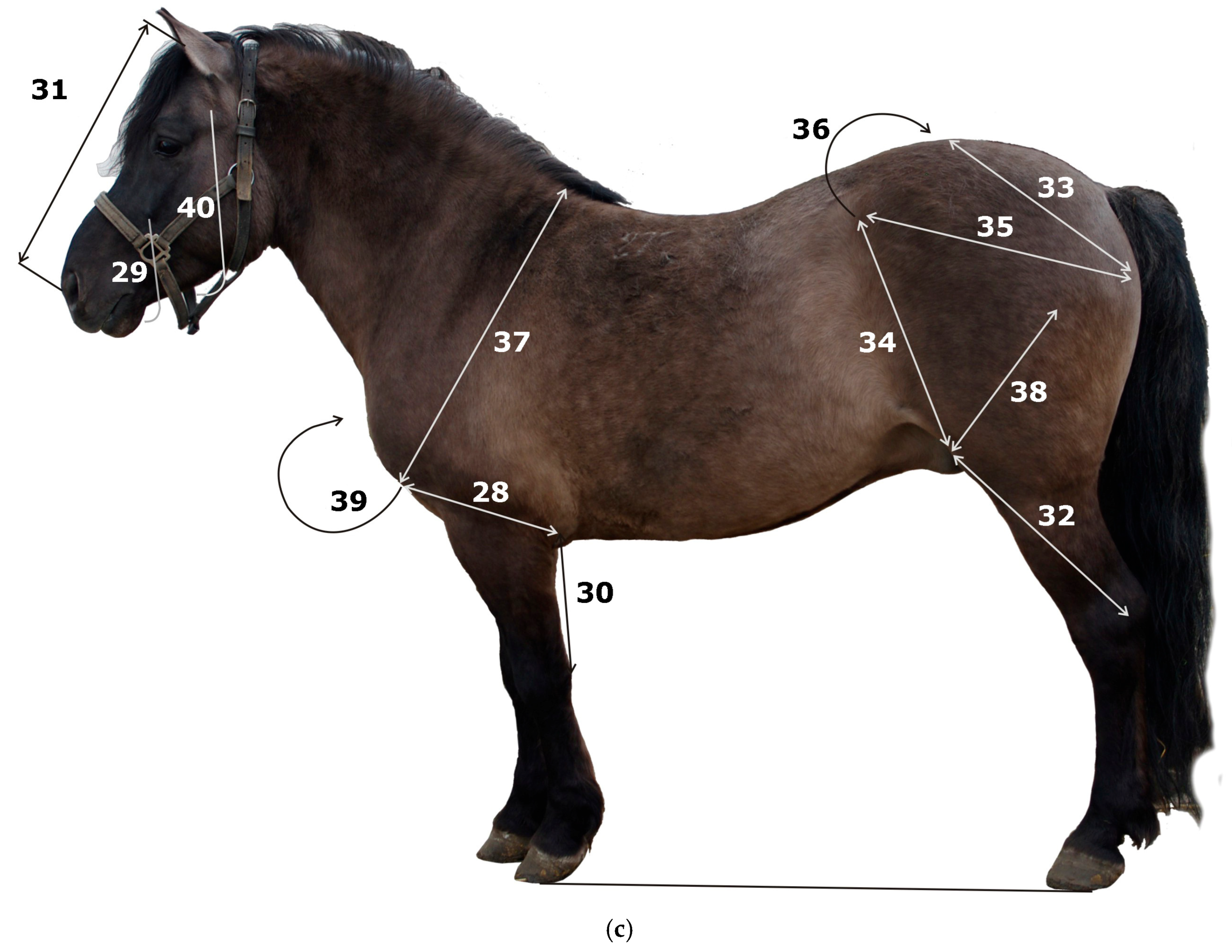
A total of 172 Polish Koniks were measured (46 males and 126 females) aged 3 to 24 years. To describe the exterior of Polish Koniks, for each horse, 40 measurements of metric traits were taken according to the methodologies presented on Figure 1a–c [20]. Anatomical terminology was used in accordance with the guidance of the Committee on Veterinary Gross Anatomical Nomenclature [24]. All measurements were performed by the first author of this paper on plain and stabilized ground. Side measurements were taken on the left side of the animal. The tools used were a Hauptner & Herberholz GmbH, Solingen, Germany zoometric stick, zoometric tape and zoometric caliper.

2.3. Statistical Analysis

Methods of multifactorial analyses have been applied for this investigation [25]. Principal Component Analysis (PCA) is a set of statistical procedures which, by transforming initial variables into new uncorrelated variables (components), produce a theoretical mathematical model in the form of systems of linear equations that describes the relational structure of the studied constituents.
Discriminant Analysis (DA) is a method used to determine whether groups differ based on the means of certain variables. The goal is to identify variables that can be used to predict group membership. In practice, multiple variables are often examined to assess which ones contribute most to distinguishing between the groups. It is a statistical procedure that allows studying differences between two or more groups, simultaneously analyzing several variables.
The statistics applied for this analysis are outlined below:
Wilks’ Lambda—indicates the statistical significance of discriminant power of a chosen model; its value fits between 1 (lack of discriminant power) and 0 (perfect discriminant power).
F-value—a greater value of this statistic indicates a greater discrimination of variables.
Partial Wilks’ Lambda—indicates the share of a chosen variable to discrimination of groups; the lower its value, the higher discriminant power of a given variable.
F-remove—the higher the value of this parameter for a variable, the higher its discriminant power.
p-level—p is the critical probability level.
Numerical data were processed using the statistical–graphical software suite StatSoft Statistica 13 (StatSoft Inc., Tulsa, OK, USA).

2.4. Effective Population Size and Estimates of Heritability

The effective population size (Ne) was estimated using the following formula:
N e = 4 N m N f N m + N f
where Nm is the number of breeding males and Nf is the number of breeding females. This formula was used to account for an uneven sex ratio in a breeding population.
To estimate the heritabilities (h2) of the studied traits, the single-trait animal model and the restricted maximum likelihood (REML) method was used. The DMU 6.4 package [26] and the average information (AI) algorithm were used in the estimation. The following mixed model was employed:
Yijkl = µ + agei + hj + sk + aijkl + eijkl
where Yijkl is the observation, µ is the population mean, agei is the fixed effect of age, hj is the fixed effect of stud, sk is the fixed effect of sex, aijkl is the additive genetic effect of an animal, and eijkl is the residual effect.
The complete pedigree information for all 172 individuals is provided in Table S1.

3. Results

Table 1 presents the mean values and standard deviations of the 40 metric traits analyzed in the entire Polish Konik population, which were divided into the five breeding centers from which the analyzed material originated. To examine the degree of morphometric diversity of the horses analyzed, multifactorial analyses were employed.

3.1. Multifactorial Analyses

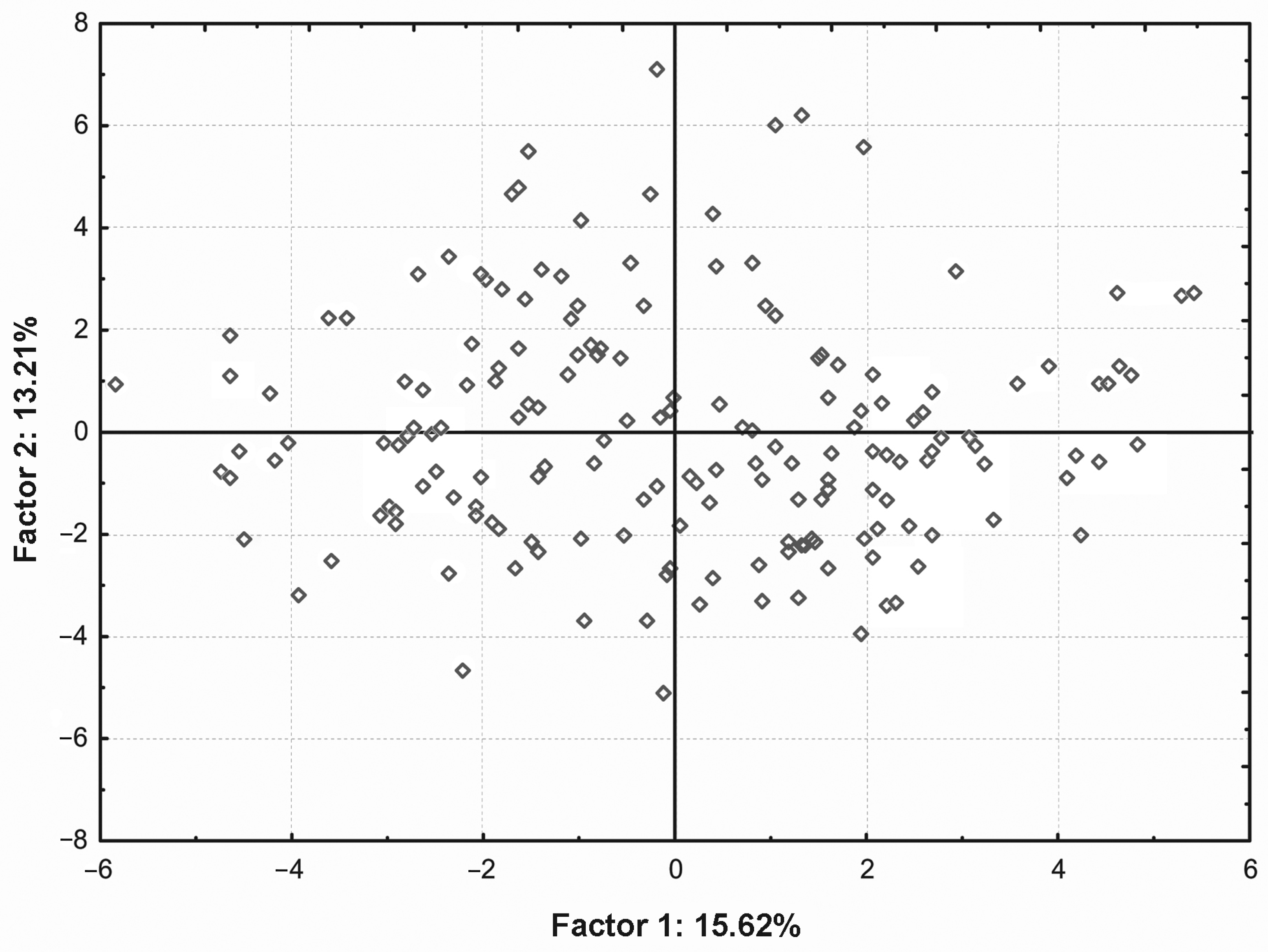
PCA: This method provided a description of the degree of morphometrical differentiation of the studied population of Polish Konik. On its basis, it was possible to examine the similarity of specimens with regard to all 40 metric traits jointly. From the array of 40 traits, the analysis set apart 12 new variables, which are the principal components. Combined, they presented 70.34% of the variability dependent on all variables. The factor 1 (first principal component) explained 15.62% of variability and the next (factor 2) explained 13.21%, as has been shown in a two-dimensional scatter graph (Figure 2), which allowed presenting the diverseness of the studied specimens with regard to the verified metric traits. Regarding factor 1, the investigated population of Polish Koniks was divided into groups, and it can be observed that the population is not homogeneous in terms of the described features.
DA: The objective of this analysis was to identify which of the 40 variables contributed to the greatest discrimination of the studied horses and furthermore to confirm the differentiation of the centers with regard to the studied metric traits. To accomplish this, the variable “center” was defined as grouping variable. Initially as a result of the conducted analysis, it was found—on the basis of the Wilks’ Lambda test statistics values, an approximate F statistic value and its corresponding p value—that the breeding center’s discrimination is highly significant (Wilks’ Lambda = 0.002, F (156.516) = 11.786, p < 0.000). A list of the variables that were identified as the most useful for discriminative analysis (p ≤ 0.05) is presented in Table 2. Eventually, a stepwise progressive analysis extracted 25 metric traits (MinOTL, MDII, ThC, TL, MWI, HL, WH, BH, LgC, PvDII, PvL, AmL, NFcD, NVL, McL, ThUH, NLL, MtC, StH, MtL, ThAuL, PvAuL, MWII, LThPMPh, and PvW) that were most strongly correlated with the morphotype of modern Polish Koniks (Table 3).
Next, we conducted a canonic analysis of discriminant function. The test outcome for discriminative functions established that the discriminative functions applied were statistically highly significant. This was confirmed by the high R canonic correlations of these functions, and the statistical significance of all discriminative functions is proven by the highly significant p values (Table 4).
Then, we specified the standardized coefficients of discriminative function (Table 5). With the help of these, one can compare the amounts and directions of each variables’ share in each canonic function; moreover, the percentage of variation explained by the functions applied in the model may be determined. In the research herein, 100% of the total discriminative power was explained by four functions. Hitherto, the results showed what share the variables had in the discrimination of centers.
To describe the nature of this discrimination, it is important to look at the means of the canonic variables (Table 6). These means enable the defining of groups that were most strongly differentiated by each canonic function. As arose from the data presented, the first discriminant function differentiates Popielno center foremost. Also, the second discriminant function deserves attention because it clearly distinguishes Sieraków and Roztocze National Park from the remaining centers. In addition, the third function distinguishes the Kobylniki and Dobrzyniewo centers from other centers, and the fourth points to the diversity of Roztocze National Park in relation to the other centers.
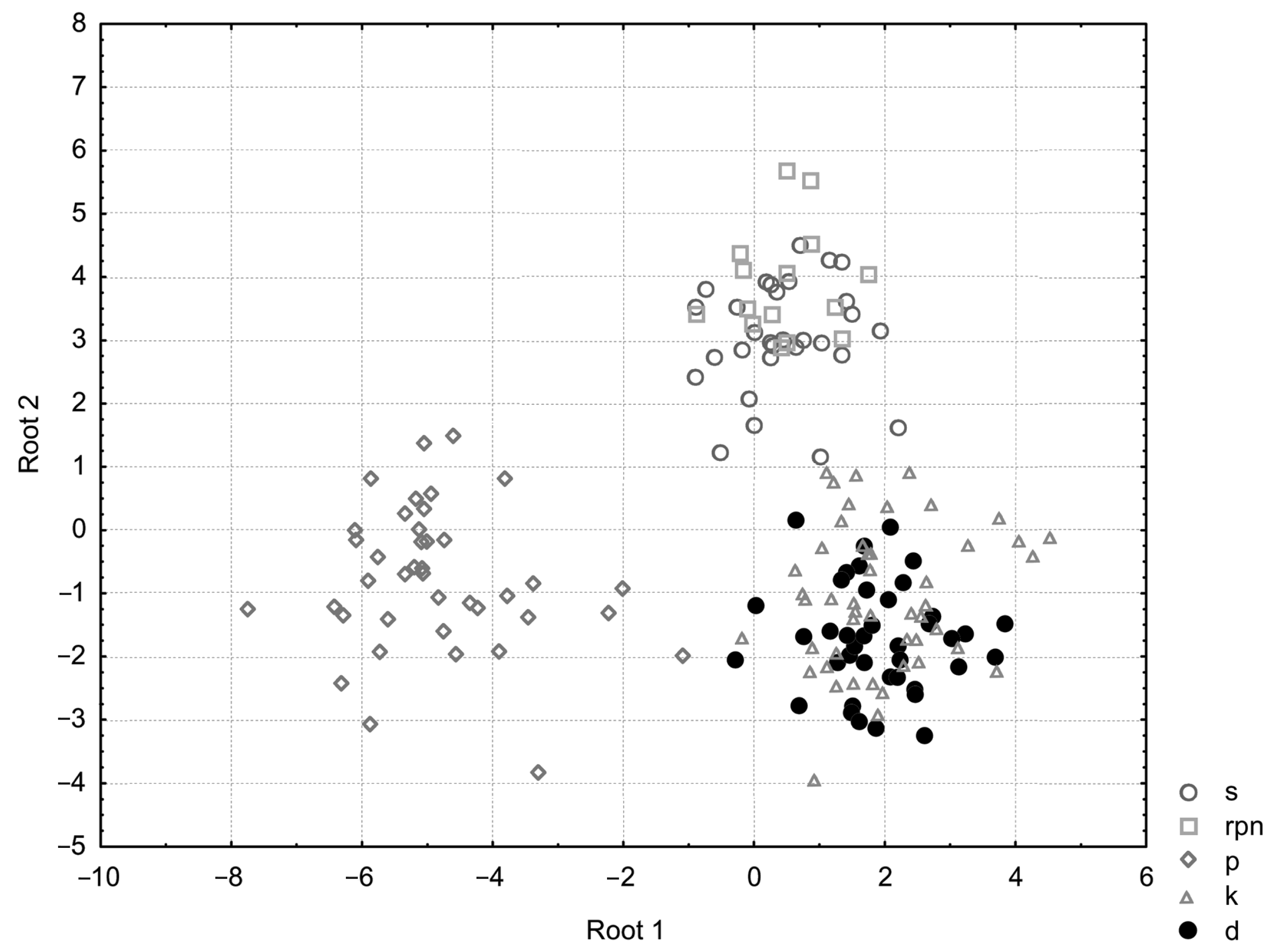
In order to prove differentiation of the Koniks from five centers, canonic values were presented on a scatter plot (Figure 3). This plot confirms the outcomes obtained in the previous multifactorial analyses. A clear differentiation of the studied centers can be seen, and thus it shows discrepancies in the morphotypes of horses from the five largest Polish breeding centers. The analysis of standardized coefficients for canonical variables (Table 5) revealed that the first discriminant function (Root 1), which explains 46% of the total variation, was most strongly defined by three trunk measurements: minimal oblique trunk length (0.85), thorax circumference (−0.83), and back height (0.69). This indicates that these traits are the primary drivers of differentiation between the studied breeding centers. The second function (Root 2) was characterized by maximal oblique trunk length (0.56) and thoracic ungular height (0.46). Interestingly, the third function (Root 3) showed a very high correlation with metacarpal circumference (0.62) and thigh length (0.60). The cumulative proportion of the first three roots reached 93%, demonstrating an almost complete explanation of the morphometric diversity within the studied population.

3.2. Effective Population Size and Estimates of Heritability

The Polish Konik breed included in this paper originated from five leading Polish conservation breeding centers, making them unique and representative material. The conservation program for this breed assumes a limited number of representatives in the herd. The effective population size estimated for the studied population was Ne = 651 (estimated for Nm = 180 and Nf = 1700).
Although the research material encompassed almost all animals kept at these centers (n = 172), their number should be considered very small for the estimation of heritabilities. Aware that a small number of individuals would affect the accuracy of the estimated genetic parameters, we decided to carry out their estimation in order to provide a latest, preliminary insight into the genetic determination of the traits studied. Heritabilities were estimated for 24 of the 40 measured metric traits that are important for maintaining the unique character of this breed. Therefore, despite their low accuracy, they provide valuable information on the effectiveness of the genetic part of the conservation program implemented for this breed as well as complement the first part of our research describing the morphology of the Polish Konik.
The estimated heritabilities (h2) turned out to be high for 8 out of the 24 examined conformation traits. In the group of eight high heritability traits (Table 7), the highest value of this parameter was estimated for StH (h2 = 0.81) and WH (h2 = 0.75), and the lowest was estimated for ZW (h2 = 0.47) and BH (h2 = 0.46). The remaining 16 of the 24 analyzed metric features proved to be moderate or low heritability traits (h2 = 0.02 to 0.38) (Table 7). The lowest value of heritability was estimated for MDI (h2 = 0.03) and for NFcD (h2 = 0.02) (Table 7). The standard errors for all estimated heritability coefficients were high (ranging from 0.25 for NFcD to 0.32 for StH), which is probably due to the very limited number of individuals used to estimate genetic parameters (this is due to the status of this breed—under a conservation program). However, as mentioned earlier, if these estimates are treated as a preliminary insight into the genetic determination of the traits that make the Polish Konik breed unique, they can provide valuable guidance on how to effectively implement a program for the conservation of this breed.
The estimation of heritability (h2) across anatomical regions provided a clear pattern of genetic determination. The highest genetic influence was observed in the trunk region particularly for sternal height (0.81) and withers height (0.75). In contrast, traits within the head and neck region showed extreme polarities: while the neck ventral length (0.62) was highly heritable, mandibular dimension II (0.03) and the naso-facial dimension (0.02) were almost entirely shaped by environmental factors. Furthermore, the stepwise discriminant analysis (Table 3) confirmed that the minimal oblique trunk length (Wilks’ Lambda 0.431) is the most significant trait for group membership prediction.

4. Discussion

Based on metric traits, the size tendencies in the breeding of different breeds of horses can be described, and exterior changes that took place during many years of a given breed’s existence can be assessed as well [20,27,28,29,30,31,32,33,34].
Wrześniowski [18] was conducting research on the conformation and breeding of Polish Konik horses of the Vilnius region, and he concluded that Koniks in the 1930s showed greater alignment with respect to certain dimensions. Mares were more aligned compared to geldings with respect to the trunk length, head length, neck length, thorax depth, width of the hips and cannon circumference. Geldings, however, showed greater uniformity in the withers height, width of the forehead and mouth, and thorax width as compared to mares from the 1930s.
According to the findings of Kownacki [19], the proportions of Polish Koniks build, which were measured in the years 1914 to 1979 (by various authors and in different regions of Poland), underwent quite significant changes, while their growth, strongly determined genetically, in the analyzed period of time was slightly increased only at the end of the 1980s. Kownacki [19], on the basis of means of biometric measurements, concluded that Polish Koniks increased their dimensions first of all in thorax circumference, metacarpal circumference, and in the period analyzed by him that had a beneficial impact on their utilitarian features as draught horses in agriculture.
Studies conducted by Pietrzak et al. [21], which aimed to describe the characteristics of Polish Koniks from the main breeding centers, showed that by the late 1980s, most of the horses in the breed type were kept in reserves. In our own research, horses from reserves were not measured; however, at the Popielno facility, the barn breeding of Polish Koniks is adjacent to reserve breeding, and horses from the reserve are introduced into barn breeding (reverse introduction is not permitted in Polish Konik breeding). This may explain why horses from Popielno differ in exterior from those at the other four studied centers. Also, Pietrzak and Wojciechowski [35] found that at the end of the 1990s, Polish Koniks that were kept in the main centers of stable, out-of-stable and reserve breeding differed with regard to some metric traits. Stable stallions stood out with rump height higher than out-of-stable stallions. Concerning the measurements of the head, thorax and rump, stable mares from Popielno statistically significantly outmatched mares from other facilities. Stable breed mares and stallions differed highly significantly from the out-of-stable specimens with regard to oblique trunk length. Koniks kept in Zwierzyniec reserve presented lower indices than specimens from other facilities where this breed is bred.
Withers height (WH) is one of the more important phenotypic parameters and plays a significant role in allocating animals, including horses, to a specific utilitarian type [30,31,32,33,34]. In this paper, the heritability coefficient for this trait (WH) was high (h2 = 0.75). Similar results (h2 = 0.65) were reported by Wolc and Balińska [11], and it was higher than the value of 0.46 obtained by Kaproń et al. [36]. Higher values of this coefficient for SH were found in the studies of Kaproń and Pluta [37] for Hucul horses (h2 = 0.83), Henk et al. [38] for Shetland ponies (h2 = 0.89), and Hintz et al. [39] for Thoroughbreds (h2 = 0.88).
WH, being a trait strongly determined by genetics in the Polish Konik population, has not undergone significant growth. Since the first documented research carried out by Grabowski and Schuch [23], it remains on a steady level above 130.0 cm. When comparing the mean values of metric traits from our own research to the analogous metric traits from the study by Grabowski and Schuch [23] (WH = 133.8 cm; BH = 127.3 cm; RH = 133.0 cm; MaxOTL = 140.6 cm; ThC = 161.3 cm), an increasing trend is clearly visible. This increasing trend in the mean values of these metric traits is also confirmed by the study by Komosa and Frąckowiak [22] (WH = 135.3 cm; RH = 137.3 cm; MaxOTL = 143.3 cm; McC = 17.9 cm; ThW = 36.8 cm; PvW = 46.6 cm), and the values for these traits are consistent with the values obtained in this paper. Nowadays, the withers height mean value for the investigated horses, similarly to the mean values for thorax circumference and metacarpal circumference—the other two standard measurements—falls within the current biometric template for this breed [9,15,17]. Our findings regarding the core biometric parameters (WH, ThC, McC) are in full alignment with the long-term trends described in previous studies [19,21,22] This confirms that the Polish Konik population maintains a steady, gradual increase in overall body size, which is a phenomenon typical for primitive breeds when housing conditions are optimized. The fact that current means remain within the breed standard reflects the effectiveness of existing phenotypic monitoring within the conservation program. Regarding the characteristic ‘heavy head’ that is often attributed to this breed, our findings provide a nuanced perspective based on the observed gradient of heritability. While the breed standard and literature frequently emphasize a massive head as a hallmark of the primitive morphotype—a view partly supported by the high heritability of structural dimensions like MWII and ZW and the moderate heritability of HL—our estimates for specific mandibular and naso-facial dimensions (MDI and NFcD) were remarkably low (h2 ≤ 0.03). This suggests that while the overall skeletal frame of the head is genetically anchored, certain proportions and the perceived ‘heaviness’ are not fixed genetic traits. Instead, these specific dimensions appear highly plastic and strongly influenced by environmental and developmental factors rather than conscious breeding selection. Consequently, these particular elements of the head morphotype may act more as indicators of rearing conditions or individual ontogeny than stable markers of breed purity.
The high discriminant power of limb segments, such as thigh length and metatarsal length, supports the hypothesis that modern breeding selection—even in conservation programs—is subtly shifting toward horses with improved movement dynamics.
A key novelty of this paper, distinguishing it from earlier descriptive reports, is the identification of specific limb segments (particularly thigh length and metatarsal length) as the primary drivers of internal population differentiation. While previous literature qualitatively suggested a shift toward ‘better movement,’ our multifactorial analysis provides quantitative evidence that these traits are the actual ‘markers’ of the transition from a primitive to a more refined saddle-type morphotype. Furthermore, by linking 40 metric traits with preliminary heritability estimates, we have identified which characteristics are ‘resistant’ to selection (low h2 for head dimensions) versus those that respond most rapidly to current breeding fashions.
Recent studies on the conformation of Polish Koniks [20,22,40] indicate the formation of morphotypes within the population of the analyzed breed, which is indicated by the high differentiation of Polish Koniks with numerous metric traits. Nowicka-Posłuszna and Białkowski [41] believe that the progressive increase in the withers height of this breed is a result of the selection of Koniks toward riding.
In view of the growing interest of saddle use for the breed discussed, especially in recreation, more emphasis is placed on the assessment of motion of these horses, which is reflected in courage tests and exhibitions of stable bred Koniks [20]. According to the observations of Komosa [42], breeders sometimes choose individuals with better gaits dynamics, as evidenced by higher marks on exhibitions awarded to Koniks whose exterior resembles a noble horse. A preference for traits in Koniks that are typical for sport horses, such as gait quality or stride length, diverges from the reserve breeding rules for this breed.
According to the postulates of the breeding program of Polish Konik horses genetic resource conservation from 2009, traits related with recreational use should be perfected, paying attention to motion; however, it must not be at the cost of a major change in the type of Polish Konik, which should remain in its type approximate to primal and Tarpan-like [7].
A solution for those breeders who want to perfect Polish Koniks with regard to increasingly better motion predispositions is a quite new direction—the production of Konik-like ponies, where the ponies inherit traits of vitality after Koniks, and the second parent introduces sport traits [34,42].
In this paper, it was proven that based on analysis of discriminant function—a stepwise progressive method, the metric traits with high discriminative power are, among others, sections which constitute segments of limbs. Thus, it was statistically confirmed that among others, elements of pelvic limb build (thigh length, pelvic dimension II, metatarsal length and pelvic autopodium length) and thoracic extremity (arm length, metacarpal length, thoracic autopodium length and the length of thoracic proximal and middle phalanx) influence statistically significantly the exterior diversity of the horses analyzed as well as the creation of morphotypes within the studied population of animals.
The results of this paper confirm the earlier findings by Komosa and Frąckowiak [22], which showed that thigh length is one of the traits with significant discriminative power for describing the exterior of the horse breed in question. According to these authors, the elongation of this section of the pelvic extremity is also associated with improved movement dynamics.
Interesting observations were made by Kobryń [43] studying the morphometric features of horses dated back from Neolith to Middle Ages. These observations indicate that in the aforementioned period, the middle phalanx in thoracic extremity underwent the biggest changes, which was followed by the third metacarpal bone and radius. Kobryń [43] concluded that there is a fundamental relationship between the regularity for this limb, i.e., the farther a given bone is from the axial skeleton, the greater the changes that affect that bone. Kobryń [43] did not observe an analogous relation in case of pelvic limb, where he established that the middle phalanx underwent the biggest transformations, which was followed by the tibia and third metatarsal bone.
The difference concerning changes, which subsequent segments in both limbs are subject to, may be due to their different biomechanical function. The pelvic limb has primarily a driving function, and therefore it is most probably subject to multidirectional developmental changes; it is also more dependent on environmental morpho-creative factors [42,43]. Komosa and Frąckowiak [22] indicate such morpho-creative factors can include the selection of Polish Koniks toward saddle features.
To summarize this section, which is devoted mainly to discussing the morphology of the Polish Konik breed, it is worth mentioning the genetic parameters of the traits studied. The full picture of the breed in the conservation program consists not only of its phenotype but also of the gene pool that determines it. The knowledge of genetic parameters is crucial for endangered or rare breed conservation programs, as it allows breeders to develop effective breeding strategies that maximize genetic diversity, minimize inbreeding and improve adaptability to environmental changes. The effective population size (Ne) indicates that the census population of 1880 individuals may experience genetic drift and inbreeding at a rate comparable to that of an idealized population of only 651 individuals. Such a markedly reduced effective population size indicates the population’s heightened susceptibility to inbreeding depression and diminished genetic diversity. The genetic parameters provide a roadmap for conservation breeding, enabling data-driven decisions important for the long-term survival and viability of breeds and the preservation of the gene pool of endangered or rare breeds. Therefore, despite their low accuracy, the reported heritabilities may constitute additional valuable information for conservation decision making regarding the Polish Konik breed.
From a practical management perspective, these results offer concrete decision-making tools for breeders. First, the high heritability of withers height (h2 = 0.75) and sternal height (h2 = 0.81) suggests that these traits can be very effectively controlled through mate selection to prevent the breed from becoming too ‘leggy.’ Second, the identified discrepancy between the census population and the effective population size (Ne = 651) serves as a critical warning. It indicates the need for a more active exchange of breeding material between the five main centers to mitigate inbreeding depression. Breeders are thus provided with a clear guideline: selecting for ‘enhanced movement’ or ‘elongated lines’—traits with high discriminant power—will lead to a rapid loss of the unique Tarpan-like phenotype, which should be countered by strict adherence to minimum biometric standards during studbook entry.

5. Conclusions

This paper demonstrates that the Polish Konik population currently exhibits significant morphological diversity with distinct morphotypes emerging across different breeding centers. This differentiation highlights a shift toward a more functional, recreational conformation in some groups, which may pose a risk to the preservation of the breed’s original primitive characteristics. The genetic analysis reveals a clear distinction between highly heritable traits, such as body height, and those more susceptible to environmental influences, like head dimensions. This underlines the potential for effective selective breeding in maintaining the breed’s standard. However, the identified discrepancy between the effective population size and the actual number of horses serves as a critical warning regarding the population’s vulnerability to inbreeding and genetic drift. To ensure the long-term survival of the Polish Konik in its ancestral form, conservation management should prioritize the maintenance of the “Tarpan-type” phenotype over recreational utility. Key recommendations include a strict adherence to closed studbook rules, collaborative mating strategies across centers to maximize genetic diversity, and regular morphometric monitoring to assess the effectiveness of the ongoing conservation program.

Supplementary Materials

The following supporting information can be downloaded at: https://www.mdpi.com/article/10.3390/ani16081190/s1, Table S1: Pedigree and demographic data of Polish Konik horses (ID 1-172).

Author Contributions

Conceptualization, E.P.; methodology, E.P.; software, E.P., Z.S. and H.W.; validation, E.P.; formal analysis, E.P., Z.S., H.W., J.R.-Z. and A.N.-Z.; investigation, E.P.; data curation, E.P.; writing—original draft preparation, E.P. and H.W.; writing—review and editing, E.P. and H.W.; visualization, E.P.; supervision, E.P., Z.S. and H.W.; project administration, E.P.; funding acquisition, E.P. All authors have read and agreed to the published version of the manuscript.

Funding

This paper was financed as research project no. NN 31137013 by Polish Ministry of Science and Higher Education, and it was co-financed with resources from the EU, European Social Fund and the Lower Silesian Voivodeship budget in the framework of the Human Capital Operational Programme no. Grant/I/17/2008.

Institutional Review Board Statement

This paper was approved by the II Local Ethics Committee for Animals at the Wrocław University of Environmental and Life Sciences, Poland (No. 28/2008).

Informed Consent Statement

Written informed consent has been obtained from the owner of the animals involved in this study.

Data Availability Statement

The data presented in this paper are available upon request from the corresponding author (E.P.).

Acknowledgments

We would like to thank the Directors as well as Employees of the breeding centers included in this paper for their kind support and enabling us to carry out measurements on horses.

Conflicts of Interest

The authors declare no conflicts of interest.

Abbreviations

The following abbreviations are used in this manuscript:
FAOFood and Agriculture Organization
PCAPrincipal Component Analysis
DADiscriminant Analysis
PAScPolish Academy of Sciences
RPNRoztocze National Park
WlkpWielkopolskie Voivodship
BHBack height
MaxOTLMaximal oblique trunk length
MinOTLMinimal oblique trunk length
RHRump height
StHSternal height
ThDThorax depth
WHWithers height
FamCForearm circumference
LgCLeg circumference
LPvPMPhLength of pelvic proximal and middle phalanx
LThPMPhLength of thoracic proximal and middle phalanx
MDIMandibular dimension I
MDIIMandibular dimension II
MWIMandibular width I
MWIIMandibular width II
McCMetacarpal circumference
McLMetacarpal length
MtCMetatarsal circumference
MtLMetatarsal length
NFcDNaso-facial dimension
NLLNeck lateral length
NVLNeck ventral length
PvAuLPelvic autopodium length
PvUHPelvic ungular height
ThAuLThoracic autopodium length
ThUHThoracic ungular height
ThCThorax circumference
AmLArm length
FcWFacial width
FamLForearm length
HLHead length
LgLLeg length
PvDIPelvic dimension I
PvDIIPelvic dimension II
PvLPelvis length
PvWPelvis width
ScLScapular length (with withers)
TLThigh length
ThWThorax width
ZWZygomatic width
NeEffective population size
REMLRestricted maximum likelihood
DMUDerivative-free Mixed Unit
AIAverage information
SASStatistical software package
nNumber of horses
SDStandard deviation
Overall mean
FF-value
pp-level
DfDegrees of freedom
sSieraków
pPopielno
dDobrzyniewo
kKobylniki
h2Heritability coefficients
EUEuropean Union

References

  1. Pruski, W. Dzikie konie wschodniej Europy. 1st part. Najdawniejsze źródła i wiadomości o dzikich koniach w Europie. Rocz. Nauk Rol. 1959, D 85, 5–131. (In Polish) [Google Scholar]
  2. Pruski, W.; Jaworowska, M. Prace i Badania Naukowe Prowadzone w Polsce nad Regeneracją Dzikich Koni Zwanych Tarpanami; PWRiL: Warszawa, Poland, 1963; pp. 1–108. (In Polish) [Google Scholar]
  3. Jaworski, Z. Genealogical Tables of the Polish Primitive Horse; Polish Academy of Sciences, Research Station for Ecological Agriculture and Preserve Animal Breeding: Popielno, Poland, 1997. [Google Scholar]
  4. Jaworski, Z. The Polish Primitive Horses in a Nature Reserve—Evaluation of the Ethologic and Breeding Conditions; Dissertations and Monographs 79; Wydawnictwo Uniwersytetu Warmińsko-Mazurskiego: Olsztyn, Poland, 2003; p. 90. (In Polish) [Google Scholar]
  5. Jaworski, Z.; Jaszczyńska, M. Program Hodowlany Ochrony Zasobów Genetycznych Koników Polskich; The Breeding Programme for Protection of Genetic Resources of Polish Konik Horses; PZHK: Warszawa, Poland, 2004. (In Polish) [Google Scholar]
  6. Jezierski, T.; Jaworski, Z. Das Polnische Konik; Die Neue Brehm-Bücherei Bd. 658; Westarp Wissenschaften Verlag GmbH: Hohenwarsleben, Germany, 2008. [Google Scholar]
  7. Jaworski, Z.; Tomczyk-Wrona, I. Program Ochrony Zasobów Genetycznych Koni Rasy Konik Polski; Krajowy Ośrodek Koordynacyjny ds. Zasobów Genetycznych Zwierząt; Instytut Zootechniki-PIB: Krakow, Poland, 2009; pp. 1–11. (In Polish) [Google Scholar]
  8. Pasicka, E. Polish konik horse—Characteristics and historical background of native descendants of tarpan. Acta Sci. Pol. Med. Vet. 2013, 12, 25–38. [Google Scholar]
  9. Jezierski, T.; Jaworski, Z.; Kaproń, M.; Łukomski, S.; Słomiany, J. Polska Księga Stadna Koników Polskich. Program Hodowli Zachowawczej Koników Polskich; PZHK: Warszawa, Poland, 2014. (In Polish) [Google Scholar]
  10. PZHK. Polska Księga Stadna Koników Polskich. Program Hodowli Zachowawczej Koników Polskich. 2016. Available online: https://www.pzhk.pl/wp-content/uploads/pr_hodow_kn-2016_05_17.pdf (accessed on 1 February 2026).
  11. Wolc, A.; Balińska, K. Inbreeding effects on exterior traits in Polish konik horses. Arch. Tierz. 2010, 53, 1–8. [Google Scholar] [CrossRef][Green Version]
  12. Mackowski, M.; Mucha, S.; Cholewiński, G.; Cieślak, J. Genetic diversity in Hucul and Polish primitive horse breeds. Arch. Anim. Breed. 2015, 58, 23–31. [Google Scholar] [CrossRef]
  13. Pluta, M.B.; Osiński, Z.; Cieśla, A.; Kolstrung, R. Genetic and phenotypic characteristics of Polish Konik horses maintained in the reserve and stable system in central-eastern Poland. Acta Sci. Pol. Zootech. 2016, 15, 59–76. [Google Scholar] [CrossRef]
  14. Fornal, A.; Kowalska, K.; Ząbek, T.; Piestrzyńska-Kajtoch, A.; Musiał, A.D.; Ropka-Molik, K. Genetic Variability and Population Structure of Polish Konik Horse Maternal Lines Based on Microsatellite Markers. Genes 2021, 12, 546. [Google Scholar] [CrossRef]
  15. PZHK. Program Hodowlany Koni Rasy Konik Polski. 2022. Available online: https://www.pzhk.pl/wp-content/uploads/2023/04/pr-hodow-kn-2023.pdf (accessed on 1 February 2026).
  16. Instytut Zootechniki-PIB. Liczebność Koni w Polsce. Available online: http://www.bioroznorodnosc.izoo.krakow.pl/konie/liczebnosc (accessed on 1 February 2026).
  17. Instytut Zootechniki-PIB. Program Ochrony Zasobów Genetycznych Koni Rasy Konik Polski. 2022. Available online: https://bioroznorodnosc.izoo.krakow.pl/system/files?file=Program_ochrony_zasobow_genetycznych_koni_rasy_konik_polski_20230221.pdf (accessed on 1 February 2026).
  18. Wrześniowski, Z. Badania nad pokrojem i hodowlą konika polskiego Wileńszczyzny. Rocz. Nauk Rol. Lesn. 1934, 32, 129–154. [Google Scholar]
  19. Kownacki, M. Koniki Polskie; PWN: Warszawa, Poland, 1984. (In Polish) [Google Scholar]
  20. Pasicka, E.; Tarnawski, K.; Chrószcz, A.; Geringer de Oedenberg, H. Morphometric Changes in Polish Konik Mares After Nearly a Hundred Years of the Breed’s Existence. Anat. Histol. Embryol. 2017, 46, 249–257. [Google Scholar] [CrossRef]
  21. Pietrzak, S.; Sasimowski, E.; Jezierski, T.; Kolstrung, R.; Jaworski, Z.; Wojciechowski, J. Descriptive characteristic of Polish Konik horses properties kept in main breeding facilities. Prace Mat. Zootech. 1992, 42, 117–129. (In Polish) [Google Scholar]
  22. Komosa, M.; Frąckowiak, H. Zróżnicowanie morfologiczne koników polskich—Analizy wielowymiarowe. Acta Sci. Pol. Zootech. 2007, 6, 45–58. (In Polish) [Google Scholar]
  23. Grabowski, J.; Schuch, S. Badania nad koniem miejscowym. Gaz. Roln. 1921, 61, 698–699. (In Polish) [Google Scholar]
  24. International Committee on Veterinary Gross Anatomical Nomenclature (I.C.V.G.A.N.). Nomina Anatomica Veterinaria, 6th ed.; Editorial Committee: Hanover, Germany; Ghent, Belgium; Columbia, MO, USA; Rio de Janeiro, Brazil, 2017. [Google Scholar]
  25. Stanisz, A. An Approachable Course in Statistics with the Use of STATISTICA PL on Examples from Medicine. Part 3; StatSoft Polska: Kraków, Poland, 2007; pp. 19–267. (In Polish) [Google Scholar]
  26. Madsen, P.; Jensen, J. A Package for Analysing Multivariate Mixed Models. Version 6, Release 4. A User’s Guide to DMU; Danish Institute of Agricultural Sciences (DIAS): Tjele, Denmark, 2000. [Google Scholar]
  27. Zechner, P.; Zohmann, F.; Sölkner, J.; Bodo, I.; Habe, F.; Marti, E.; Brem, G. Morphological description of the Lipizzan horses population. Livest. Prod. Sci. 2001, 69, 163–177. [Google Scholar] [CrossRef]
  28. Druml, T.; Baumung, R.; Sölkner, J. Pedigree analysis in the Austrian Noriker draught horse: Genetic diversity and the impact of breeding for coat colour on population structure. J. Anim. Breed. Genet. 2005, 126, 348–356. [Google Scholar] [CrossRef]
  29. Druml, T.; Baumung, R.; Sölkner, J. Morphological analysis and effect of selection for conformation in the Noriker draught horse population. Livest. Sci. 2008, 115, 118–128. [Google Scholar] [CrossRef]
  30. Brooks, S.A.; Makvandi-Nejad, S.; Chu, E.; Allen, J.J.; Streeter, C.; McCleery, E.G.; Murphy, B.A.; Bellone, R.; Sutter, N.B. Morphological variation in the horse: Defining complex traits of body size and shape. Anim. Genet. 2010, 41, 159–165. [Google Scholar] [CrossRef]
  31. Jakubec, V.; Schlote, W.; Jelinek, J.; Scholz, A.; Zaliz, N. Linear type trait analysis in the genetic resource of the Old Kladrub Horse. Arch. Tierz. 1999, 43, 215–224. [Google Scholar] [CrossRef]
  32. Sadek, M.H.; Al-Aboud, A.Z.; Ashmawy, A.A. Factor analysis of body measurements in Arabian horses. J. Anim. Breed. Genet. 2006, 123, 369–377. [Google Scholar] [CrossRef]
  33. May-Davis, S.; Brown, W.; Shorter, K.; Vermeulen, Z.; Butler, R.; Koekkoek, M. A Novel Non-Invasive Selection Criterion for the Preservation of Primitive Dutch Konik Horses. Animals 2018, 8, 21. [Google Scholar] [CrossRef]
  34. Komosa, M.; Frąckowiak, H. Morphological distance between Konik horses and Konik cross-bred ponies. Acta Sci. Pol. Zootech. 2008, 7, 45–60. (In Polish) [Google Scholar]
  35. Pietrzak, S.; Wojciechowski, J. Comparative biometric characteristics of Polish primitive horse PPH from the main breeding centres. Anim. Sci. Pap. Rep. 1992, 8, 71–84. [Google Scholar]
  36. Kaproń, M.; Bocian, K.; Słomiany, J. Uwarunkowania genetyczne cech pokrojowych koników polskich. Ann. Univ. Mariae Curie-Sklodowska, Sect. EE Zootech. 1992, 10, 171–174. [Google Scholar]
  37. Kaproń, M.; Pluta, M. Genetyczne uwarunkowania cech pokrojowych koni huculskich. Ann. Univ. Mariae Curie-Sklodowska, Sect. EE Zootech. 1993, 11, 157–161. [Google Scholar]
  38. van Bergen, H.M.J.M.; van Arendonk, J.A.M. Genetic parameters for linear type traits in Shetland Ponies. Livest. Prod. Sci. 1993, 36, 273–284. [Google Scholar] [CrossRef]
  39. Hintz, R.L.; Hintz, H.F.; Van Vleck, L.D. Estimation of Heritabilities for Weight, Height and Front Cannon Bone Circumference of Thoroughbreds. J. Anim. Sci. 1978, 47, 1243–1245. [Google Scholar] [CrossRef]
  40. Pasicka, E. Analiza Parametrów Morfometrycznych Koników Polskich Chowanych Systemem Stajennym w Ośrodkach Hodowli Zachowawczej na Terenie Polski. Ph.D. Thesis, Wrocław University of Environmental and Life Sciences, Wrocław, Poland, 2010. [Google Scholar]
  41. Nowicka-Posłuszna, A.; Białkowski, M. Charakterystyka porównawcza koników polskich ze Stada Ogierów w Sierakowie i Stadniny Koni w Dobrzyniewie. Rocz. Akad. Rol. Pozn. Ser. Zootech. 1997, 49, 77–85. (In Polish) [Google Scholar]
  42. Komosa, M. Czy konik polski wciąż przypomina tarpana? Koń Pol. 2008, 10, 64–67. (In Polish) [Google Scholar]
  43. Kobryń, H. The Changes of Some Morphological Characteristics in the Horse in View of the Osteological Examinations of Archeological Finds from the Territory of Poland; SGGW-AR: Warszawa, Poland, 1984; pp. 7–77. (In Polish) [Google Scholar]
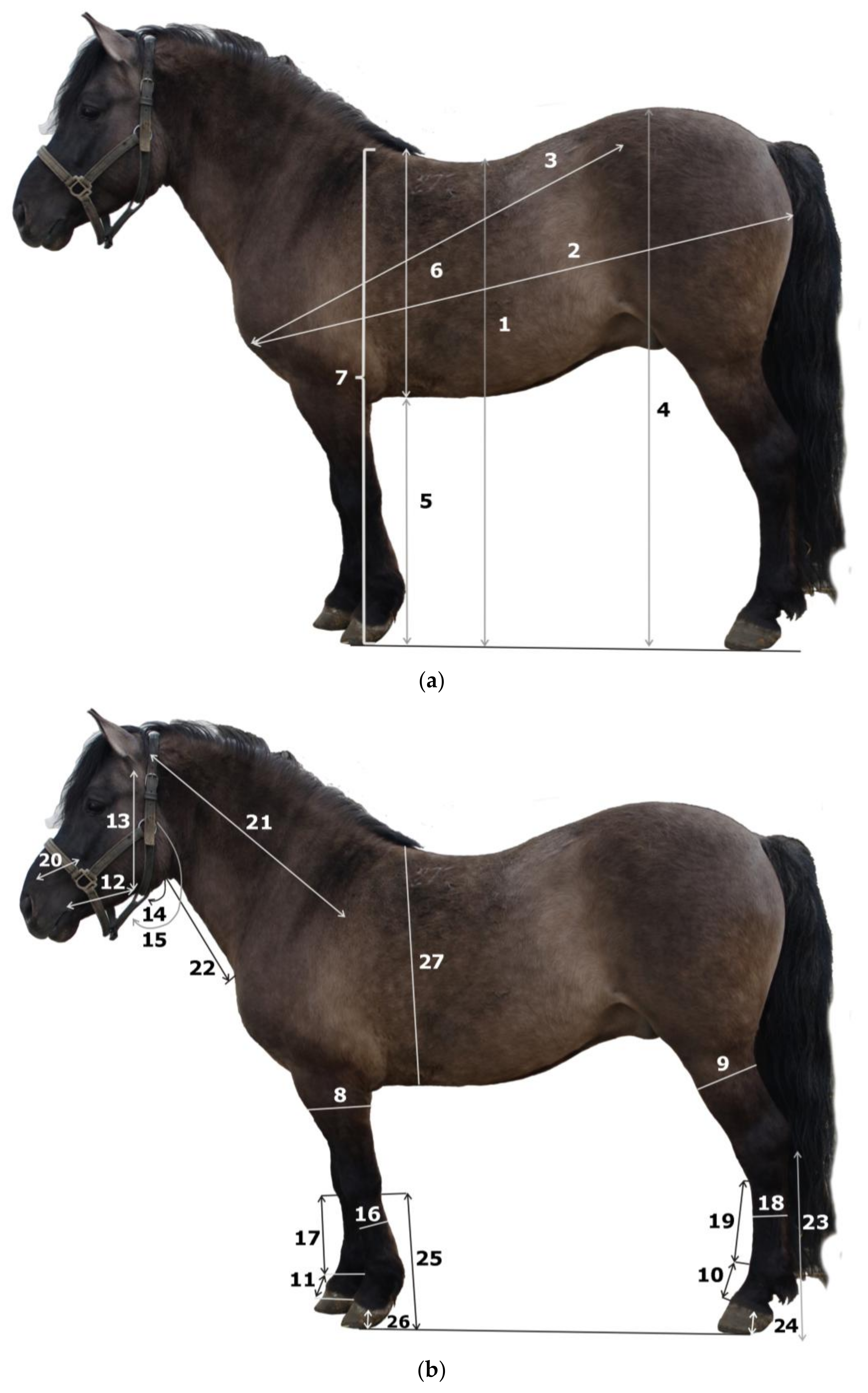
Figure 1. (a). Polish Konik horse, measurements of metric traits using zoometric stick (drawn by E. Pasicka). 1: Back height (BH) (distance between the highest point of back and the ground surface), 2: Maximal oblique trunk length (MaxOTL) (distance between the tuberculum majus ossis humeri and the tuber ischiadicum), 3: Minimal oblique trunk length (MinOTL) (distance between the tuberculum majus ossis humeri and the tuber coxae), 4: Rump height (RH) (distance between the highest point of the rump and the ground surface), 5: Sternal height (StH) (distance between the lowest point of the sternum and the ground surface), 6: Thorax depth (ThD) (distance between the highest point of the withers and the lowest ventral point of the sternum), 7: Withers height (WH) (distance between the highest point of the withers and the ground surface). (b). Polish Konik horse, measurements of metric traits using zoometric tape (drawn by E. Pasicka). 8: Forearm circumference (FamC) (on the half-length level of the forearm), 9: Leg circumference (LgC) (on the half-length level of the leg), 10: Length of pelvic proximal and middle phalanx (LPvPMPh) (distance between the fetlock joint and the margo coronalis ungulae of the pelvic limb), 11: Length of thoracic proximal and middle phalanx (LThPMPh) (distance between the fetlock joint and the margo coronalis ungulae of thoracic limb), 12: Mandibular dimension I (MDI) (distance between the vascular notch (incisura vasorum facialium) and the oral angle (angulus oris)), 13: Mandibular dimension II (MDII) (distance between the temporomandibular joint (articulatio temporomandibularis) and the vascular notch), 14: Mandibular width I (MWI) (distance between the most lateral points of right and left ramus mandibulae), 15: Mandibular width II (MWII) (distance between the most lateral points of right and left ramus mandibulae on the half height level of ramus mandibulae), 16: Metacarpal circumference (McC) (on the distal one-third length of the metacarpal bone), 17: Metacarpal length (McL) (distance between the tuberositas ossis metacarpalis and the fetlock joint (articulatio metacarpophalangea), 18: Metatarsal circumference (MtC) (on the distal one-third length of the metatarsal bone), 19: Metatarsal length (MtL) (distance between the tuberositas ossis metatarsalis and the fetlock joint (articulatio metatarsophalangea), 20: Naso-facial dimension (NFcD) (distance between the rostral end of crista facialis and the incisura nasoincisiva), 21: Neck lateral length (NLL) (distance between the auricular base (basis auriculae) and the half-length of spina scapulae), 22: Neck ventral length (NVL) (distance between the basihyoideum and the apertura thoracis cranialis), 23: Pelvic autopodium length (PvAuL) (distance between the tuber calcanei and the ground surface), 24: Pelvic ungular height (PvUH) (distance between the margo coronalis ungulae and the margo solearis ungulae of the pelvic limb), 25: Thoracic autopodium length (ThAuL) (distance between the os carpi accessorium and the ground surface), 26: Thoracic ungular height (ThUH) (distance between the margo coronalis ungulae and the margo solearis ungulae of the thoracic limb), 27: Thorax circumference (ThC) (along the line from the caudal angle of scapula (angulus caudalis scapulae) to the tuber olecrani). (c). Polish Konik horse, measurements of metric traits using zoometric caliper (drawn by E. Pasicka). 28: Arm length (AmL) (distance between the tuberculum majus ossis humeri and tuber olecrani), 29: Facial width (FcW) (distance between the end point of right and left crista facialis), 30: Forearm length (FamL) (distance between the tuber olecrani and the antebrachiocarpal joint (articulatio antebrachiocarpea)), 31: Head length (HL) (distance between the apex nasi and the crista nuchae), 32: Leg length (LgL) (distance between the basis patellae and the malleolus lateralis), 33: Pelvic dimension I (PvDI) (distance between the processus spinosus vertebrae sacralis primae and the tuber ischiadicum), 34: Pelvic dimension II (PvDII) (distance between the tuber coxae and the basis patellae), 35: Pelvis length (PvL) (distance between the tuber coxae and the tuber ischiadicum), 36: Pelvis width (PvW) (distance between the most lateral points of tuber coxae), 37: Scapular length (with withers) (ScL) (distance between tuberculum majus ossis humeri and the highest point of the withers (interscapular region)), 38: Thigh length (TL) (distance between the trochanter major and the basis patellae), 39: Thorax width (ThW) (distance between the right and left tuberculum majus ossis humeri), 40: Zygomatic width (ZW) (distance between the most lateral points of right and left processus zygomaticus ossis frontalis).
Animals 16 01190 g001aAnimals 16 01190 g001b
Figure 2. Factorial coordinates for 40 metric traits of Polish Koniks in range of Factor 1.
Animals 16 01190 g002
Figure 3. Diagram of canonical variable dispersion. Centers: Stallions Herd Sieraków Wlkp. Ltd. (s), Roztocze National Park in Zwierzyniec (rpn), Research Plant of Organic Farming and Preservative Animal Breeding PASc in Popielno (p), Poznań Plants Breeding Ltd.–Branch in Kobylniki (k), Horses Stud in Dobrzyniewo Ltd. (d).
Animals 16 01190 g003
Table 1. Statistical characteristics (mean ± SD) of 40 metric traits of Polish Koniks (cm).
Anatomical Region/
Trait (Abbr.)
Sieraków
(n = 30)
RPN
(n = 15)
Popielno
(n = 39)
Kobylniki
(n = 48)
Dobrzyniewo
(n = 40)
Total
I. Head and Neck
Head length (HL)48.9 ± 2.5645.2 ± 1.7846.7 ± 3.3947.6 ± 2.5750.6 ± 1.9147.8 ± 1.85
Zygomatic width (ZW)21.1 ± 0.5720.7 ± 0.9621.0 ± 0.9020.5 ± 0.8120.6 ± 0.6220.8 ± 0.23
Facial width (FcW)13.7 ± 0.5013.6 ± 0.3713.9 ± 0.4914.1 ± 0.8213.5 ± 0.5313.8 ± 0.22
Naso-facial dimension (NFcD)11.8 ± 0.6312.2 ± 0.8811.8 ± 0.7213.2 ± 0.9812.8 ± 0.7612.4 ± 0.56
Mandibular dimension I (MDI)18.2 ± 1.2217.8 ± 0.9817.4 ± 0.9518.4 ± 1.2418.5 ± 1.3318.1 ± 0.41
Mandibular dimension II (MDII)27.0 ± 2.0727.2 ± 1.0828.3 ± 1.9331.0 ± 1.2931.0 ± 1.3328.9 ± 1.77
Mandibular width I (MWI)14.7 ± 0.8414.2 ± 1.2413.9 ± 1.0516.5 ± 1.3115.3 ± 0.8514.9 ± 0.92
Mandibular width II (MWII)38.0 ± 2.6835.3 ± 3.1135.8 ± 2.7836.1 ± 2.3535.6 ± 2.2436.2 ± 0.96
Neck lateral length (NLL)70.3 ± 3.3566.6 ± 3.8369.2 ± 2.8771.4 ± 3.7073.1 ± 3.2470.1 ± 2.18
Neck ventral length (NVL)41.1 ± 3.9943.6 ± 4.2440.6 ± 4.2139.3 ± 3.2842.6 ± 1.8241.4 ± 1.51
II. Trunk
Withers height (WH)135.8 ± 1.97136.8 ± 3.83136.8 ± 3.88133.4 ± 2.96134.8 ± 2.88135.5 ± 1.29
Rump height (RH)138.3 ± 2.02139.6 ± 2.75138.6 ± 3.31138.1 ± 2.87137.7 ± 3.06138.5 ± 0.64
Back height (BH)130.5 ± 2.37132.5 ± 3.18130.1 ± 4.05130.7 ± 2.89129.5 ± 3.41130.7 ± 1.01
Sternal height (StH)71.6 ± 1.8671.1 ± 2.7271.5 ± 3.3468.0 ± 2.7167.5 ± 2.8369.9 ± 1.80
Thorax depth (ThD)64.3 ± 2.0365.6 ± 1.9965.4 ± 3.4165.4 ± 2.9267.3 ± 2.7765.6 ± 0.97
Thorax width (ThW)35.2 ± 2.2936.6 ± 2.2734.3 ± 4.0835.8 ± 1.8636.8 ± 2.2735.7 ± 0.92
Thorax circumference (ThC)166.4 ± 4.96167.7 ± 5.39182.0 ± 8.01173.5 ± 6.29171.1 ± 6.54172.1 ± 5.53
Min. oblique trunk length (MinOTL)113.6 ± 3.62111.9 ± 2.71102.5 ± 6.91114.8 ± 3.57115.3 ± 3.26111.6 ± 4.71
Max. oblique trunk length (MaxOTL)143.1 ± 4.01141.6 ± 4.47135.2 ± 6.28142.0 ± 4.70143.5 ± 4.10141.1 ± 3.02
III. Pelvis
Pelvis width (PvW)47.2 ± 2.0847.9 ± 1.3346.6 ± 2.5747.4 ± 2.3249.4 ± 1.8047.7 ± 0.95
Pelvis length (PvL)44.7 ± 1.9943.5 ± 2.8241.9 ± 3.6241.1 ± 2.4143.5 ± 1.8542.9 ± 1.28
Pelvic dimension I (PvDI)44.2 ± 1.7743.8 ± 2.2342.7 ± 2.7841.3 ± 2.1243.5 ± 1.7843.1 ± 1.03
Pelvic dimension II (PvDII)41.9 ± 3.1642.2 ± 1.9342.4 ± 3.3340.1 ± 2.2936.7 ± 2.1740.7 ± 2.14
IV. Forelimbs
Scapular length (ScL)56.0 ± 2.0456.3 ± 2.1458.0 ± 1.9256.9 ± 1.7357.8 ± 1.4057.0 ± 0.79
Arm length (AmL)33.2 ± 1.5431.3 ± 1.4233.9 ± 1.8232.5 ± 2.2031.8 ± 1.7932.5 ± 0.94
Forearm length (FamL)37.6 ± 2.1237.4 ± 1.4636.2 ± 2.6736.3 ± 3.0236.0 ± 2.6236.7 ± 0.66
Forearm circumference (FamC)42.2 ± 2.9845.6 ± 4.2042.5 ± 2.5741.3 ± 3.1043.5 ± 3.6743.0 ± 1.47
Metacarpal circumference (McC)18.0 ± 0.6418.5 ± 1.1918.3 ± 0.8919.0 ± 0.9318.4 ± 0.7018.4 ± 0.33
Metacarpal length (McL)22.7 ± 2.0721.5 ± 0.5723.2 ± 2.2623.7 ± 2.3024.2 ± 1.3323.1 ± 0.93
Thoracic autopodium length (ThAuL)41.0 ± 1.0242.0 ± 2.5842.6 ± 1.6740.8 ± 2.1642.5 ± 2.5541.8 ± 0.75
L. of thor. prox. & mid. phalanx
(LThPMPh)
10.6 ± 0.4710.7 ± 0.4611.3 ± 0.8611.1 ± 0.6910.9 ± 0.3410.9 ± 0.26
Thoracic ungular height (ThUH)5.3 ± 0.565.4 ± 0.805.5 ± 0.534.7 ± 0.534.7 ± 0.395.12 ± 0.35
V. Hindlimbs
Thigh length (TL)34.6 ± 2.3737.3 ± 2.1836.4 ± 3.1235.9 ± 1.7132.1 ± 1.5335.3 ± 1.81
Leg length (LgL)46.0 ± 3.3644.3 ± 2.5145.1 ± 4.6646.0 ± 3.7850.3 ± 3.5146.3 ± 2.08
Leg circumference (LgC)41.6 ± 1.8142.4 ± 2.4442.9 ± 3.5542.9 ± 2.8745.9 ± 2.8143.1 ± 1.46
Metatarsal circumference (MtC)20.6 ± 2.2520.4 ± 1.5020.6 ± 0.8521.4 ± 0.9120.8 ± 0.6620.8 ± 0.34
Metatarsal length (MtL)27.5 ± 2.4826.5 ± 1.8929.7 ± 2.6730.2 ± 2.8231.4 ± 1.3729.1 ± 1.80
Pelvic autopodium length (PvAuL)49.9 ± 1.7748.9 ± 2.6952.4 ± 2.7750.2 ± 2.9350.4 ± 2.1450.4 ± 1.14
L. of pelv. prox. and mid. phalanx
(LPvPMPh)
10.8 ± 0.5511.1 ± 0.4311.5 ± 1.0611.4 ± 0.9611.1 ± 0.4611.2 ± 0.25
Pelvic ungular height (PvUH)5.1 ± 0.515.2 ± 0.495.4 ± 0.484.9 ± 0.535.0 ± 0.425.1 ± 0.17
n: number of horses; SD: standard deviation; ∑: overall mean for five centers.
Table 2. Discriminant Function Analysis (grouping variable: center (5 groups) for morphometric traits of Polish Konik horses.
Trait (Abbr.)Full Trait NameAnatomical
Region
Wilks’
Lambda
Partial Wilks’
Lambda
F-Removep-Level
ThCThorax circumferenceII. Trunk0.0030.68115.1040.000
TLThigh lengthV. Hindlimbs0.0030.7769.3110.000
MinOTLMin. oblique trunk lengthII. Trunk0.0030.7948.3680.000
MDIIMandibular dimension III. Head and Neck0.0030.8097.5930.000
HLHead lengthI. Head and Neck0.0030.8376.2860.000
BHBack heightII. Trunk0.0030.8475.8150.000
MWIMandibular width II. Head and Neck0.0030.8565.4440.000
WHWithers heightII. Trunk0.0030.8655.0360.001
NVLNeck ventral lengthI. Head and Neck0.0030.8714.7680.001
NFcDNaso-facial dimensionI. Head and Neck0.0030.8714.7600.001
McCMetacarpal circumferenceIV. Forelimbs0.0030.8814.3710.002
MtLMetatarsal lengthV. Hindlimbs0.0030.8963.7560.006
AmLArm lengthIV. Forelimbs0.0030.8963.7240.007
ScLScapular lengthIV. Forelimbs0.0030.9013.5290.009
ThUHThoracic ungular heightIV. Forelimbs0.0030.9023.5240.009
NLLNeck lateral lengthI. Head and Neck0.0030.9202.8060.028
ThAuLThoracic autopodium lengthIV. Forelimbs0.0030.9212.7620.030
MaxOTLMax. oblique trunk lengthII. Trunk0.0030.9232.6760.035
McLMetacarpal lengthIV. Forelimbs0.0030.9262.5710.041
MWIIMandibular width III. Head and Neck0.0030.9292.4660.048
FamLForearm lengthIV. Forelimbs0.0030.9322.3560.057
ThWThorax widthII. Trunk0.0030.9382.1190.082
StHSternal heightII. Trunk0.0030.9412.0310.094
PvWPelvis widthIII. Pelvis0.0030.9412.0160.096
FamCForearm circumferenceIV. Forelimbs0.0030.9412.0070.097
PvDIIPelvic dimension IIIII. Pelvis0.0030.9441.9080.113
PvAuLPelvic autopodium lengthIII. Pelvis0.0030.9471.7890.135
FcWFacial widthI. Head and Neck0.0030.9481.7640.140
LgCLeg circumferenceV. Hindlimbs0.0030.9481.7610.141
MtCMetatarsal circumferenceV. Hindlimbs0.0020.9541.5390.195
PvLPelvis lengthIII. Pelvis0.0020.9591.3890.241
LThPMPhLength of thoracic phalangesIV. Forelimbs0.0020.9621.2620.288
LPvPMPhLength of pelvic phalangesV. Hindlimbs0.0020.9750.8280.510
ZWZygomatic widthI. Head and Neck0.0020.9760.7780.542
RHRump heightII. Trunk0.0020.9770.7690.548
PvDIPelvic dimension IIII. Pelvis0.0020.9810.6330.640
PvUHPelvic ungular heightIII. Pelvis0.0020.9850.4810.749
LgLLeg lengthV. Hindlimbs0.0020.9870.4210.793
MDIMandibular dimension II. Head and Neck0.0020.9900.3320.856
Significant statistics p ≤ 0.05.
Table 3. Progressive stepwise analysis summary for morphometric traits of Polish Konik horses.
Trait (Abbr.)Full Trait NameAnatomical
Region
Wilks’
Lambda
F-Valuep-Level
MinOTLMin. oblique trunk lengthII. Trunk0.43155.1480.000
MDIIMandibular dimension III. Head and Neck0.21248.6940.000
ThCThorax circumferenceII. Trunk0.11147.1560.000
TLThigh lengthV. Hindlimbs0.07342.6000.000
MWIMandibular width II. Head and Neck0.05338.4940.000
HLHead lengthI. Head and Neck0.03836.4370.000
WHWithers heightII. Trunk0.03034.0700.000
BHBack heightII. Trunk0.02531.8380.000
LgCLeg circumferenceV. Hindlimbs0.02129.9250.000
PvDIIPelvic dimension IIIII. Pelvis0.01828.1700.000
PvLPelvis lengthIII. Pelvis0.01527.0140.000
AmLArm lengthIV. Forelimbs0.01425.7470.000
NFcDNaso-facial dimensionI. Head and Neck0.01224.6290.001
NVLNeck ventral lengthI. Head and Neck0.01123.6340.002
McLMetacarpal lengthIV. Forelimbs0.01022.8040.002
ThUHThoracic ungular heightIV. Forelimbs0.00922.1330.001
NLLNeck lateral lengthI. Head and Neck0.00821.5560.001
McCMetacarpal circumferenceIV. Forelimbs0.00721.1030.001
StHSternal heightII. Trunk0.00620.4390.012
MtLMetatarsal lengthV. Hindlimbs0.00619.8030.019
ThAuLThoracic autopodium lengthIV. Forelimbs0.00519.3210.008
PvAuLPelvic autopodium lengthIII. Pelvis0.00518.7830.025
MWIIMandibular width III. Head and Neck0.00518.2630.036
LThPMPhLength of thoracic phalangesIV. Forelimbs0.00417.7720.044
PvWPelvic widthIII. Pelvis0.00315.7500.037
Significant statistics p ≤ 0.05.
Table 4. Chi-square tests of subsequent roots.
RootsEigenvalueCanonical RWilks’
Lambda
Chi-SquareDfp-Level
07.4620.9390.002900.6781560.000
14.2690.9000.020582.4751140.000
23.4900.8820.106334.865740.000
31.1080.7250.474111.095360.000
Significant statistics p ≤ 0.05; Df—degrees of freedom.
Table 5. Standardized coefficients of discriminant function for morphometric traits of Polish Konik horses.
Trait (Abbr.)Full Trait NameAnatomical RegionRoot 1Root 2Root 3Root 4
NLLNeck lateral lengthI. Head and Neck0.10−0.07−0.140.44
NVLNeck ventral lengthI. Head and Neck0.290.15−0.04−0.47
WHWithers heightII. Trunk−0.570.34−0.55−0.06
StHSternal heightII. Trunk−0.36−0.07−0.050.26
RHRump heightII. Trunk0.01−0.250.150.08
ThCThorax circumferenceII. Trunk−0.83−0.390.200.33
MinOTLMin. oblique trunk lengthII. Trunk0.850.220.070.12
BHBack heightII. Trunk0.690.380.56−0.26
MaxOTLMax. oblique trunk lengthII. Trunk−0.210.56−0.010.00
ThWThorax widthII. Trunk0.27−0.04−0.27−0.03
PvWPelvis widthIII. Pelvis−0.01−0.05−0.14−0.40
PvLPelvis lengthIII. Pelvis0.320.06−0.180.38
PvDIPelvic dimension IIII. Pelvis−0.140.14−0.22−0.19
PvDIIPelvic dimension IIIII. Pelvis−0.210.160.230.00
ScLScapular lengthIV. Forelimbs0.08−0.39−0.21−0.26
AmLArm lengthIV. Forelimbs−0.050.04−0.060.52
FamLForearm lengthIV. Forelimbs−0.150.030.030.43
FamCForearm circumferenceIV. Forelimbs0.030.25−0.01−0.28
ThAuLThoracic autopodium lengthIV. Forelimbs−0.21−0.25−0.25−0.20
McCMetacarpal circumferenceIV. Forelimbs0.11−0.020.62−0.21
McLMetacarpal lengthIV. Forelimbs−0.350.04−0.010.15
LThPMPhLength of thoracic phalangesIV. Forelimbs0.10−0.220.10−0.01
ThUHThoracic ungular heightIV. Forelimbs0.020.46−0.14−0.08
TLThigh lengthV. Hindlimbs−0.030.290.60−0.29
LgLLeg lengthV. Hindlimbs0.13−0.03−0.06−0.06
LgCLeg circumferenceV. Hindlimbs−0.24−0.05−0.20−0.15
PvAuLPelvic autopodium lengthIII. Pelvis−0.18−0.14−0.130.15
MtCMetatarsal circumferenceV. Hindlimbs0.21−0.18−0.100.08
MtLMetatarsal lengthV. Hindlimbs0.03−0.45−0.18−0.09
LPvPMPhLength of pelvic phalangesV. Hindlimbs−0.120.000.18−0.10
PvUHPelvic ungular heightIII. Pelvis−0.09−0.030.15−0.06
Eigenvalue 7.464.273.491.11
Cumulated
proportion
0.460.720.931.00
Table 6. Mean canonical variables.
CenterRoot 1Root 2Root 3Root 4
Sieraków0.4443.084−1.2101.459
Roztocze National Park0.4463.9231.122−2.614
Popielno−4.840−0.8410.145−0.019
Dobrzyniewo1.958−1.0512.3700.375
Kobylniki1.869−1.704−2.498−0.545
Table 7. Heritability (h2) of conformation traits in Polish Koniks across anatomical regions.
Anatomical
Region
High (h2 > 0.40)Moderate (h2 = 0.20–0.40)Low (h2 < 0.20)
I. Head and NeckNVL (0.62)—Neck ventral length
MWII (0.48)—Mandibular width II
ZW (0.47)—Zygomatic width
HL (0.36)—Head lengthMDI (0.03)—Mandibular dimension I
NFcD (0.02)—Naso-facial dimension
II. TrunkStH (0.81)—Sternal height
WH (0.75)—Withers height
ThD (0.52)—Thorax depth
BH (0.46)—Back height
RH (0.32)—Rump heightThW (0.10)—Thorax width
MaxOTL (0.09)—Max. oblique trunk length
III. PelvisPvL (0.33)—Pelvis length
PvDI (0.24)—Pelvic dimension I
IV. ForelimbsScL (0.26)—Scapular length
McC (0.21)—Metacarpal circumference
ThUH (0.38)—Thoracic ungular height
McL (0.18)—Metacarpal length
AmL (0.18)—Arm length
V. HindlimbsLgL (0.67)—Leg lengthLgC (0.37)—Leg circumference
MtL (0.23)—Metatarsal length
PvUH (0.13)—Pelvic ungular height
Standard errors for estimated heritability coefficients: StH: 0.32; WH: 0.31; LgL: 0.30; NVL: 0.30; ThD: 0.30; MWII: 0.29; ZW: 0.29; BH: 0.29; ThUH: 0.28; LgC: 0.28; HL: 0.28; PvL: 0.28; RH: 0.28; ScL: 0.27; PvDI: 0.27; MtL; 0.27; McC: 0.27; McL, AmL, PvUH, ThW: 0.26; MaxOTL, MDI, NFcD: 0.25.
Disclaimer/Publisher’s Note: The statements, opinions and data contained in all publications are solely those of the individual author(s) and contributor(s) and not of MDPI and/or the editor(s). MDPI and/or the editor(s) disclaim responsibility for any injury to people or property resulting from any ideas, methods, instructions or products referred to in the content.