Quantifying Greenhouse Gas Emissions and Carbon Footprint of Sheep Production Using the IPCC Tier 2 Approach

Simple Summary
Abstract
1. Introduction
2. Materials and Methods
2.1. Study Area and Farm Characterization
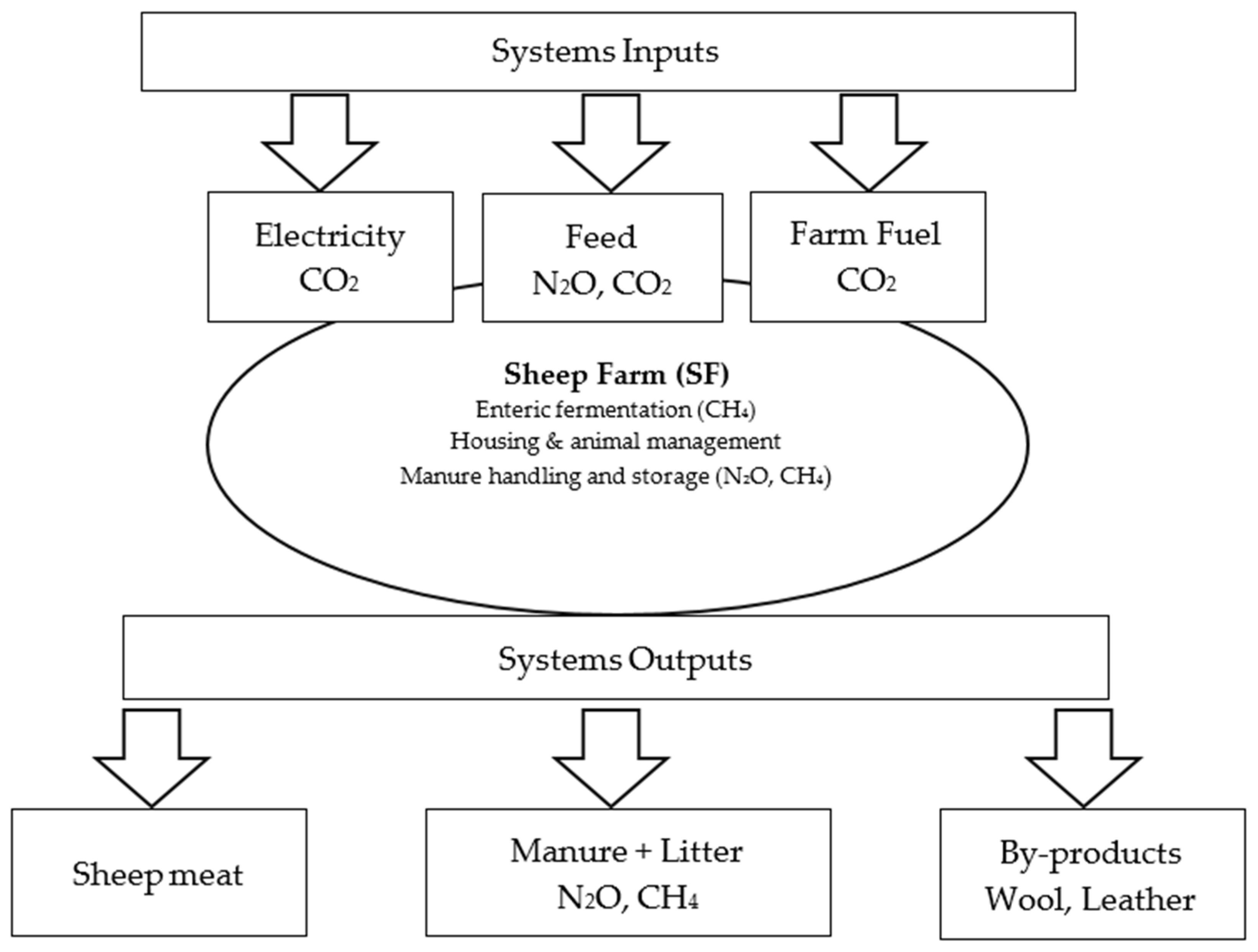
2.2. System Boundaries and Scope of the Analysis
2.2.1. Emissions from Biological Production Processes
2.2.2. Emissions from Feed Production
2.2.3. Emissions from On-Farm Energy Consumption
2.3. Reference Unit for Carbon Footprint Calculation
3. Results
3.1. Gross Energy Requirement and GHG Emissions
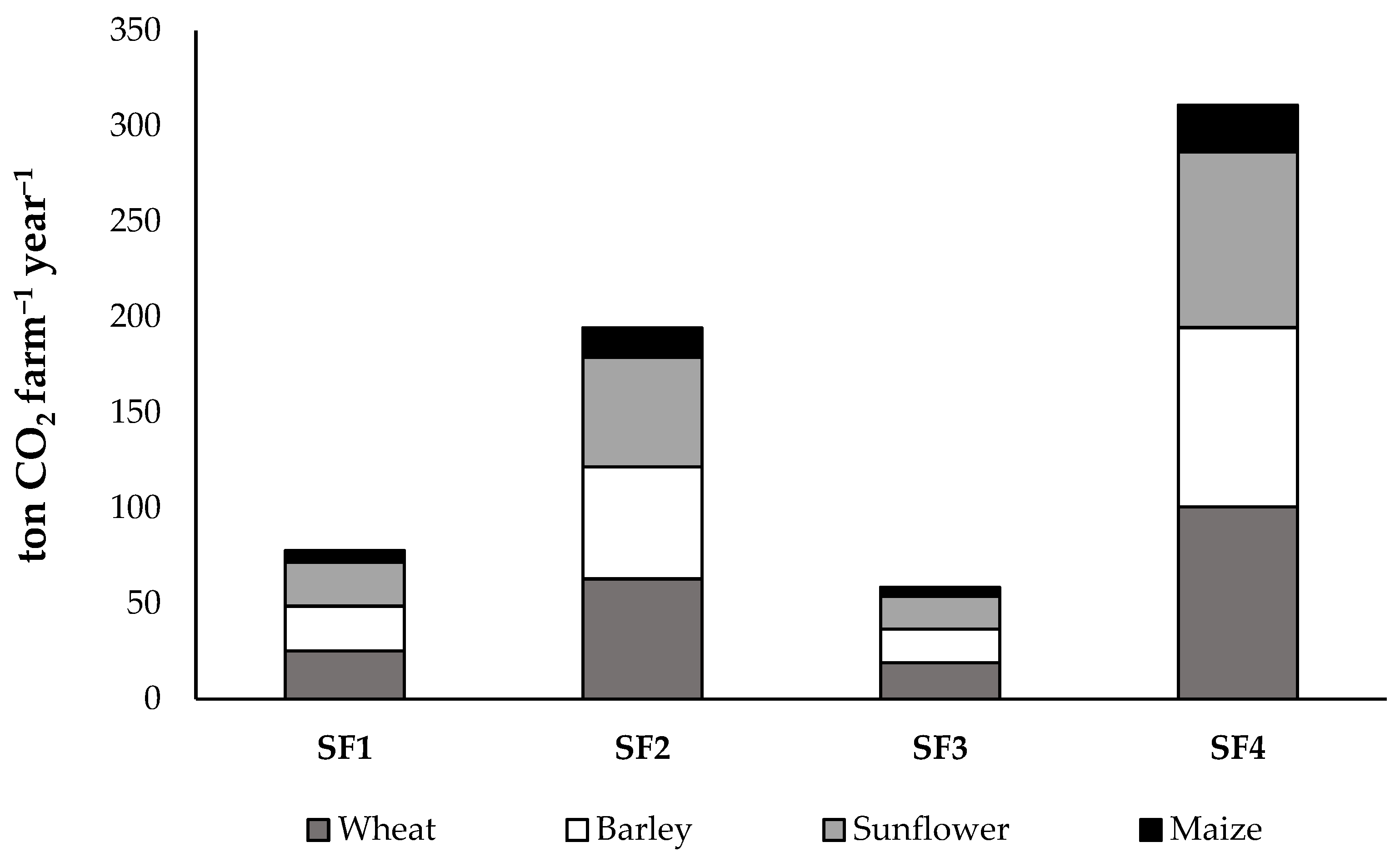
3.2. CO2 Emissions from Feed Production
3.3. CO2 Emissions from Energy Consumption
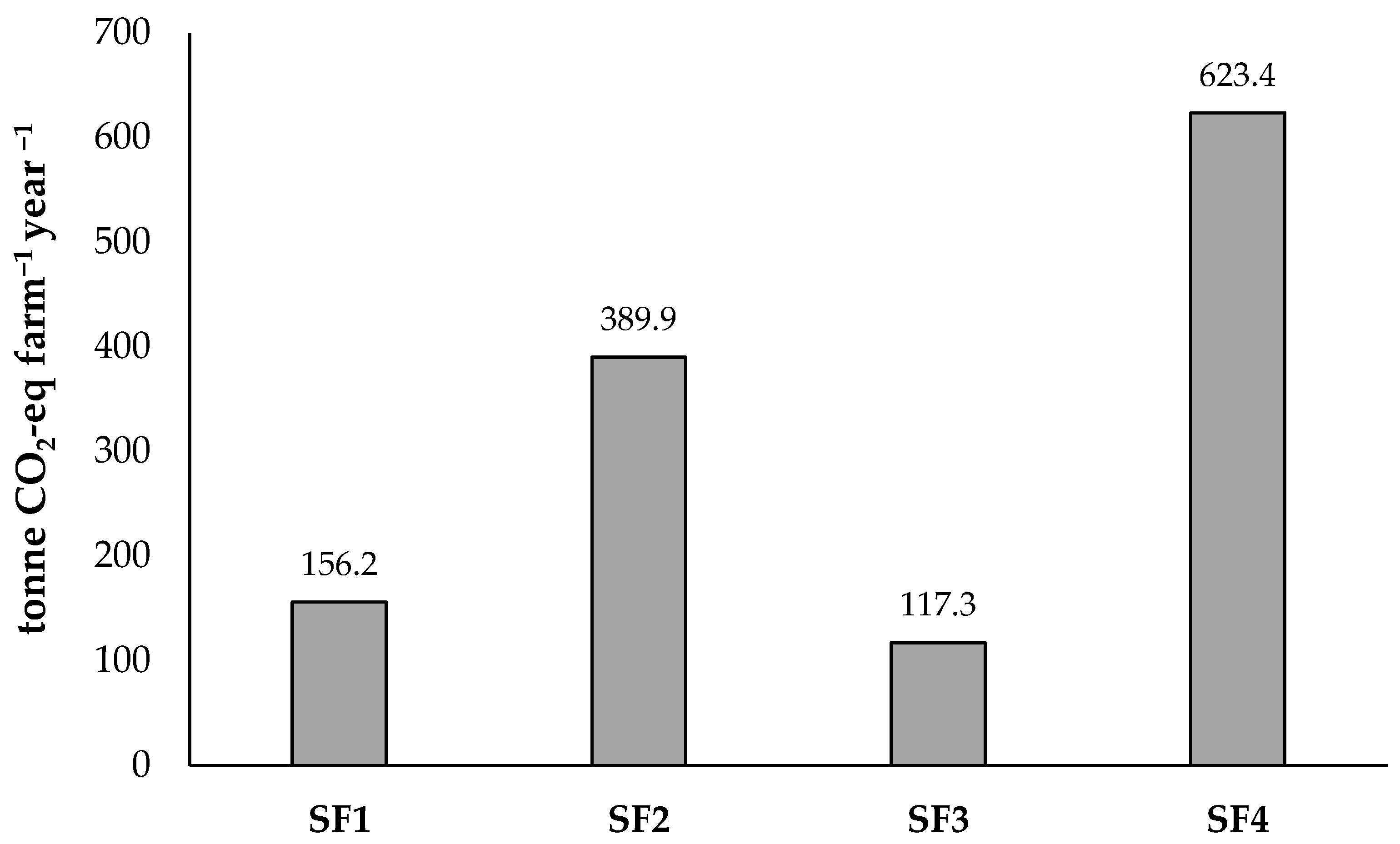
3.4. Total Carbon Footprint Analysis
4. Discussion
5. Conclusions
Supplementary Materials
Author Contributions
Funding
Institutional Review Board Statement
Informed Consent Statement
Data Availability Statement
Conflicts of Interest
References
- Xu, X.; Sharma, P.; Shu, S.; Lin, T.S.; Ciais, P.; Tubiello, F.N.; Smith, P.; Campbell, N.; Jain, A.K. Global greenhouse gas emissions from animal-based foods are twice those of plant-based foods. Nat. Food 2021, 2, 724–732. [Google Scholar] [CrossRef]
- Yalcinkaya, S. Spatiotemporal analysis and mitigation potential of GHG emissions from the livestock sector in Turkey. Environ. Impact Assess. Rev. 2024, 105, 107441. [Google Scholar] [CrossRef]
- Pham-Kieu, M.; Ives, S.; Badgery, W.; Harrison, M.T. Stacking interventions enhances carbon removals and profitability of livestock production systems. Adv. Sci. 2025, 12, e03382. [Google Scholar] [CrossRef]
- Adegbeye, M.J.; Jack, A.; Reddy, P.R.K.; Igirigi, A.; Inyang, U.; Hernández-Ruiz, P.E.; Pacheco, E.B.F.; Ponce-Covarrubias, J.L.; Rivas Caceres, R.R. Adapting Ruminant Production to Changing Climate: Strategies for Smallholders. In Handbook of Climate Change Mitigation and Adaptation; Springer Nature: Cham, Switzerland, 2025; pp. 3707–3750. [Google Scholar]
- Intergovernmental Panel on Climate Change. Working Group I Contribution to the Sixth Assessment Report of the Intergovernmental Panel on Climate Change. Available online: https://www.ipcc.ch/report/ar6/wg1/downloads/report/IPCC_AR6_WGI_SPM_final.pdf (accessed on 10 November 2025).
- Recktenwald, E.B.; Ehrhardt, R.A. Greenhouse gas emissions from a diversity of sheep production systems in the United States. Agric. Syst. 2024, 217, 103915. [Google Scholar] [CrossRef]
- Zhang, L.; Pan, S.; Ouyang, Z.; Canadell, J.G.; Chang, J.; Conchedda, G.; Davidson, E.A.; Lu, F.; Pan, N.; Qin, X.; et al. Global nitrous oxide emissions from livestock manure during 1890–2020: An IPCC tier 2 inventory. Glob. Change Biol. 2024, 30, e17303. [Google Scholar] [CrossRef]
- Pardo, G.; Casas, R.; del Prado, A.; Manzano, P. Carbon footprint of transhumant sheep farms: Accounting for natural baseline emissions in Mediterranean systems. Int. J. Life Cycle Assess. 2024, 29, 2184–2199. [Google Scholar] [CrossRef]
- ISO 14067:2018; Greenhouse Gases: Carbon Footprint of Products—Requirements and Guidelines. International Organization for Standardization: Geneva, Switzerland, 2018. Available online: https://www.iso.org/standard/71206.html (accessed on 13 February 2026).
- Republic of Turkey Ministry of Agriculture and Forestry. Towards Sustainable Food Systems. Available online: https://www.unfoodsystemshub.org/docs/unfoodsystemslibraries/national-pathways/turkey/2021-12-22-en-designed-edition-national-pathway-of-turkiye.pdf?sfvrsn=82454b8b_1 (accessed on 10 February 2026).
- Turkish Statistical Institute. Number of Sheep and Goat by Type and Races. Available online: https://data.tuik.gov.tr/Kategori/GetKategori?p=tarim-111&dil=1 (accessed on 10 January 2026).
- Anadolu Agency. Available online: https://www.aa.com.tr/tr/gundem/turkiye-hayvancilikta-avrupada-oncu-konumda/3158815?utm_source= (accessed on 10 January 2026).
- Tanış, A.N.; Keskin, I. Association between growth hormone gene polymorphism and some growth traits in Akkaraman and Anatolian Merino sheep. Mol. Biol. Rep. 2025, 52, 54. [Google Scholar] [CrossRef]
- Mil-Homens, M.P.; Georges, I.K.F.; Raizman, E.; Beltrán-Alcrudo, D.; Allepuz, A. Biosecurity practices on small-ruminant farms in five Turkish provinces: A cross-sectional survey with multiple correspondence analysis. Front. Vet. Sci. 2025, 12, 1677002. [Google Scholar] [CrossRef]
- Mat, B.; Çevrimli, M.B.; Varalan, A.; Barit, B.; Günlü, A. Determination of Economic Sustainability Factors in Sheep Enterprises in Türkiye. Vet. Med. Sci. 2026, 12, e70761. [Google Scholar] [CrossRef] [PubMed]
- Maldonado-Jáquez, J.A.; Torres-Hernández, G.; Castillo-Hernández, G.; Cruz-Colín, L.D.L.; Jiménez-Penago, G.; González-Luna, S.; Aguilar Marcelino, L.; Arenas-Báez, P.; Granados-Rivera, L.D. Adaptation to Stressful Environments in Sheep and Goats: Key Strategies to Provide Food Security to Vulnerable Communities. Ruminants 2025, 5, 63. [Google Scholar] [CrossRef]
- Sejian, V.; Bhatta, R.; Gaughan, J.; Malik, P.K.; Naqvi, S.M.K.; Lal, R. (Eds.) Sheep Production Adapting to Climate Change; Springer: Singapore, 2017; pp. 1–29. [Google Scholar]
- Manzano-Baena, P.; Salguero-Herrera, C. Mobile Pastoralism in the Mediterranean: Arguments and Evidence for Policy Reform and to Combat Climate Change; Zogib, L., Ed.; Mediterranean Consortium for Nature and Culture: Geneva, Switzerland, 2018. [Google Scholar]
- Ozek, H.Z. Wool production steps and global trade with recent statistics. In The Wool Handbook; Seiko, J., Sabu, T., Gautam, B., Eds.; The Textile Institute Book Series; Woodhead Publishing: Cambridge, MA, USA, 2024; pp. 25–74. Available online: https://linkinghub.elsevier.com/retrieve/pii/B9780323995986000244 (accessed on 15 January 2026).
- Camilli, F.; Focacci, M.; Dal Prà, A.; Bortolu, S.; Ugolini, F.; Vagnoni, E.; Duce, P. Turning Waste Wool into a Circular Resource: A Review of Eco-Innovative Applications in Agriculture. Agronomy 2025, 15, 446. [Google Scholar] [CrossRef]
- Cesoniene, L.; Dapkiene, M.; Sileikiene, D. The impact of livestock farming activity on the quality of surface water. Environ. Sci. Pollut. Res. 2019, 26, 32678–32686. [Google Scholar] [CrossRef] [PubMed]
- Wagner-Riddle, C. Carbon footprint of milk production in intensive dairy production systems. In Proceedings of the 2019 Dairy Research and Innovation Day, Guelph, ON, Canada, 5 December 2019. [Google Scholar]
- Intergovernmental Panel on Climate Change. Guidelines for National Greenhouse Gas Inventories—Chapter 1: Introduction to the 2006 Guidelines. Volume 1. Available online: https://www.ipcc-nggip.iges.or.jp/public/2006gl/pdf/1_Volume1/V1_1_Ch1_Introduction.pdf (accessed on 15 August 2025).
- Turkish State Meteorological Service. Available online: https://mgm.gov.tr/veridegerlendirme/il-ve-ilceler-istatistik.aspx?k=A&m=BURSA (accessed on 9 February 2026).
- ISO 14044:2006; Environmental Management—Life Cycle Assessment—Requirements and Guidelines. International Organization for Standardization: Geneva, Switzerland, 2018. Available online: https://www.iso.org/standard/38498.html (accessed on 13 February 2026).
- Intergovernmental Panel on Climate Change. Emissions from Livestock and Manure Management, 2019 Refinement to the 2006 IPCC Guidelines for National Greenhouse Gas Inventories (Chapter 10). Available online: https://www.ipcc-nggip.iges.or.jp/public/2019rf/pdf/4_Volume4/19R_V4_Ch10_Livestock.pdf (accessed on 15 August 2025).
- Oral, H.H. Changes in the sufficiency of roughage production for animal stock in Balıkesir province over the years. Turk. JAF Sci. Tech. 2024, 12, 1608–1619. [Google Scholar] [CrossRef]
- Jiao, F.; Liu, Z.; Li, H. Carbon and nitrogen footprints of Northern Chinese sheep and goat in the context of “Carbon Neutrality”. Livest. Sci. 2025, 31, 105818. [Google Scholar] [CrossRef]
- Taş, B.; Yeşil, V.; İştipliler, D.; Tatar, Ö. Regional variations in carbon footprints of major crops in Türkiye and assessing the relationship between carbon footprint and input use efficiency. Int. J. Plant Prod. 2026, 20, 9. [Google Scholar] [CrossRef]
- Yousefi, M.; Khoramivafa, M.; Damghani, A.M. Water footprint and carbon footprint of the energy consumption in sunflower agroecosystems. Environ. Sci. Pollut. Res. 2017, 24, 19827–19834. [Google Scholar] [CrossRef]
- Calbay, E. Evaluation of Dewatered and Partially Dried Sewage Sludge Combustion Based on Energy Balance and Carbon Footprint. Master’s Thesis, Middle East Technical University, Ankara, Turkey, 2018. [Google Scholar]
- Turkish Statistical Institute. National Greenhouse Gas Inventory Report 1990–2012: Annual Report Submission under the Framework Convention on Climate Change. Available online: https://webdosya.csb.gov.tr/db/iklim/editordosya/NIR_TUR_2012.pdf (accessed on 5 July 2025).
- Edwards-Jones, G.; Plassmann, K.; Harris, I.M. Carbon footprinting of lamb and beef production systems: Insights from an empirical analysis of farms in Wales, UK. J. Agric. Sci. 2009, 147, 707–719. [Google Scholar] [CrossRef]
- Biswas, W.K.; Graham, J.; Kelly, K.; John, M.B. Global warming contributions from wheat, sheep meat and wool production in Victoria, Australia—Life cycle assessment. J. Clean. Prod. 2010, 18, 1386–1392. [Google Scholar] [CrossRef]
- Vagnoni, E.; Franca, A.; Breedveld, L.; Porqueddu, L.; Ferrara, R.; Duce, P. Environmental performances of Sardinian dairy sheep production systems at different input levels. Sci. Total Environ. 2015, 502, 354–361. [Google Scholar] [CrossRef]
- Wiedemann, S.G.; Ledgard, S.F.; Henry, B.K.; Yan, M.; Mao, N.; Russell, S.J. Application of life cycle assessment to sheep production systems: Investigating co-production of wool and meat using case studies from major global producers. Int. J. Life Cycle Assess. 2015, 20, 463–476. [Google Scholar] [CrossRef]
- Zhou, X.; Fu, S.; Li, G.; Yao, Z.; Du, X.; Zhang, Y.; Gao, T. Enteric methane emissions, rumen fermentation, and milk composition of dairy cows fed 3-nitrooxypropanol and L-malate supplements. Front. Vet. Sci. 2024, 11, 1479535. [Google Scholar] [CrossRef]
- Yıldırır, M.; Ertem, A.; Yıldırım, M.F.; Karmaz, E.; Dinçel, V.; Ünay, E.; Coşkun, M.I.; Beder, S.; Sevgi, R. Estimation of Enteric and Manure-Derived Methane Emissions in Sheep and Goats in Ankara Province. Soil Stud. 2025, 14, 114–120. [Google Scholar] [CrossRef]
- Dyer, J.A.; Vergé, X.P.; Desjardins, R.L.; Worth, D.E. A comparison of the greenhouse gas emissions from the sheep industry with beef production in Canada. Sustain. Agric. Res. 2014, 3, 65–75. [Google Scholar] [CrossRef]
- O’brien, D.; Bohan, A.; Mchugh, N.; Shalloo, L. A life cycle assessment of the effect of intensification on the environmental impacts and resource use of grass-based sheep farming. Agric. Syst. 2016, 148, 95–104. [Google Scholar] [CrossRef]
- Cottle, D.J.; Cowie, A.L. Allocation of greenhouse gas production between wool and meat in the life cycle assessment of Australian sheep production. Int. J. Life Cycle Assess. 2016, 21, 820–830. [Google Scholar] [CrossRef]
- Xia, F.; Mei, K.; Xu, Y.; Zhang, C.; Dahlgren, R.A.; Zhang, M. Response of N2O emission to manure application in field trials of agricultural soils across the globe. Sci. Total Environ. 2020, 733, 139390. [Google Scholar] [CrossRef]
- Chadwick, D.; Sommer, S.; Thorman, R.; Fangueiro, D.; Cardenas, L.; Amon, B.; Misselbrook, T. Manure management: Implications for greenhouse gas emissions. Anim. Feed Sci. Technol. 2011, 166, 514–531. [Google Scholar] [CrossRef]
- Bell, M.J.; Cullen, B.R.; Johnson, I.R.; Eckard, R.J. Modelling Nitrogen Losses from Sheep Grazing Systems with Different Spatial Distributions of Excreta. Agriculture 2012, 2, 282–294. [Google Scholar] [CrossRef]
- Wang, L.; Liu, X.; Wu, S.; Legesse, T.G.; Xu, Z.; Chen, J.; Zhang, Y.; Xin, X.; Dong, X.; Liu, Y.; et al. Greenhouse gas emissions from livestock production tripled those from household consumption in the Eurasian desert steppe. Ecol. Process. 2025, 14, 60. [Google Scholar] [CrossRef]
- Mackie, R.I.; Kim, H.; Kim, N.K.; Cann, I. Hydrogen production and hydrogen utilization in the rumen: Key to mitigating enteric methane production. Anim. Biosci. 2023, 37, 323. [Google Scholar] [CrossRef]


| Mean Temp. (°C) | Mean Max. Temp. (°C) | Mean Min. Temp. (°C) | Total Precipitation (mm) | Mean Rainy Days | Mean Sunshine Duration (h) |
|---|---|---|---|---|---|
| 14.7 | 20.5 | 9.2 | 706.4 | 111.5 | 6.2 |
| Sheep Farm 1 (SF1) | Sheep Farm 2 (SF2) | Sheep Farm 3 (SF3) | Sheep Farm 4 (SF4) | |
|---|---|---|---|---|
| Number of sheep (head) | 200 | 500 | 150 | 800 |
| Production system | Semi-intensive | Intensive | Semi-intensive | Intensive |
| Manure management | Solid storage/range | Solid storage/range | Solid storage/range | Solid storage/range |
| Ingredients (% of DM) | |
| Ingredient | % of DM |
| Wheat Straw | 40.0 |
| Barley | 30.18 |
| Maize | 12.00 |
| Sunflower seed meal | 16.20 |
| Limestone | 0.90 |
| Salt | 0.60 |
| Vitamin-Mineral Premix | 0.12 |
| Chemical Composition of the diet | |
| Parameter | Value |
| Crude Protein (%) | 14.0 |
| Crude Fiber (%) | 8–10 |
| Crude Ash (%) | 10.0 |
| Sodium (%) | 0.25 |
| Crude Fat (%) | 3–4.5 |
| Vitamin A (IU/kg) | 9000 |
| Vitamin D3 (IU/kg) | 3000 |
| Vitamin E (mg/kg) | 25 |
| DM: Dry Matter |
| Type of Metabolic Functions | Equations | IPCC Equation No |
|---|---|---|
| Net energy for maintenance (MJ day−1) | NEm = Cfi · Weight0.75 | Equation 10.3 |
| Net energy for animal activity (MJ day−1) | NEa = Ca · Weight | Equation 10.5 |
| Net energy needed for growth (MJ day−1) | NEg = | Equation 10.7 |
| Net energy for lactation for sheep (MJ day−1) | NEl= ·EVmilk | Equation 10.9 |
| Net energy required to produce wool (MJ day−1) | NEwool = | Equation 10.12 |
| Net energy required for pregnancy (MJ day−1) | NEP = Cpregnancy · NEm | Equation 10.13 |
| Ratio of net energy available in a diet for maintenance to digestible energy | REM = [1.123 − (4.092 · 10−3 · DE) + (1.126 · 10−5 · (DE)2) − (25.4/DE)] | Equation 10.14 |
| Ratio of net energy available for growth in a diet to digestible energy consumed | REG = [1.164 − (5.16 · 10−3 · DE) + (1.308 · 10−5 · (DE)2) − (37.4/DE)] | Equation 10.15 |
| Gross energy for sheep (MJ day−1) | Equation 10.16 |
| Type of Metabolic Functions | Equations | IPCC Equation No | |||
|---|---|---|---|---|---|
| Emission factors from enteric fermentation (kg CH4 head−1 year−1) | EFE = | Equation 10.21 | |||
| Emission factor from manure management (kg CH4 head−1 year−1) | EFM = (VS · 365) | Equation 10.23 | |||
| Volatile solid excretion rates (kg VS day−1) | VS = · | Equation 10.24 | |||
| CH4 emissions from manure management (Gg CH4 year−1) | CH4Manure = | Equation 10.19 | |||
| Ym: CH4 conversion factor, per cent of gross energy in feed converted to CH4 (6.7% ± 0.9); 6.7% was used in the calculations. Bo: maximum CH4-producing capacity for manure produced by the livestock category, m3 CH4 kg−1 of VS excreted (0.19 m3 CH4 kg−1 VS) MCF: CH4 conversion factors for each manure management system by climate region, % | AWMS: fraction of livestock category UE·GE: urinary energy expressed as a fraction of GE, typically 0.04 GE can be considered urinary energy excretion by most ruminants ASH: the ash content of manure calculated as a fraction of the dry matter feed intake | ||||
| Direct N2O Emissions Equation | IPCC Equation No | |
| Direct N2O emissions from manure management (kg N2O year−1) | Equation 10.25 | |
| Indirect N2O Emissions Equations | ||
| The amount of manure nitrogen that is lost due to volatilization of NH3 and NOx, kg N year−1 | Equation 10.26 | |
| The amount of manure nitrogen that is lost due to leaching (kg N year−1) | Equation 10.27 | |
| Indirect N2O emissions due to volatilization of N from Manure Management in the country, kg N2O year−1 | N2OG (mm) = (Nvolatilization-MMS · EF4) · | Equation 10.28 |
| Indirect N2O emissions due to leaching and runoff from manure management (kg N2O year−1) | N2OL (mm) = (Nleaching-MMS · EF5) · | Equation 10.29 |
| Annual N excretion rates (kg N head−1year−1) | Nex = (Nintake − Nretention) · 365 | Equation 10.31A |
| N intake rates (kg N animal−1day−1) | Nintake = | Equation 10.32 |
| Managed manure N available for application to managed soils, feed, fuel, or construction uses (kg N year−1) | Equation 10.34 | |
| Nutrient Composition | Daily Feed Consumption (Ewes) (kg DM head−1) | Daily Feed Consumption (Rams) (kg DM head−1) | Emission Factor (kgCO2-eq kg−1) | References |
|---|---|---|---|---|
| Wheat | 0.60 | 0.80 | 0.38 | Taş et al. [29] |
| Barley | 0.45 | 0.60 | 0.46 | Taş et al. [29] |
| Maize | 0.18 | 0.24 | 0.31 | Taş et al. [29] |
| Sunflower seed meal | 0.24 | 0.32 | 0.875 | Yousefi et al. [30] |
Disclaimer/Publisher’s Note: The statements, opinions and data contained in all publications are solely those of the individual author(s) and contributor(s) and not of MDPI and/or the editor(s). MDPI and/or the editor(s) disclaim responsibility for any injury to people or property resulting from any ideas, methods, instructions or products referred to in the content. |
© 2026 by the authors. Licensee MDPI, Basel, Switzerland. This article is an open access article distributed under the terms and conditions of the Creative Commons Attribution (CC BY) license.
Share and Cite
Yayli, B.; Kilic, I. Quantifying Greenhouse Gas Emissions and Carbon Footprint of Sheep Production Using the IPCC Tier 2 Approach. Animals 2026, 16, 1099. https://doi.org/10.3390/ani16071099
Yayli B, Kilic I. Quantifying Greenhouse Gas Emissions and Carbon Footprint of Sheep Production Using the IPCC Tier 2 Approach. Animals. 2026; 16(7):1099. https://doi.org/10.3390/ani16071099
Chicago/Turabian StyleYayli, Busra, and Ilker Kilic. 2026. "Quantifying Greenhouse Gas Emissions and Carbon Footprint of Sheep Production Using the IPCC Tier 2 Approach" Animals 16, no. 7: 1099. https://doi.org/10.3390/ani16071099
APA StyleYayli, B., & Kilic, I. (2026). Quantifying Greenhouse Gas Emissions and Carbon Footprint of Sheep Production Using the IPCC Tier 2 Approach. Animals, 16(7), 1099. https://doi.org/10.3390/ani16071099