Spatial Patterns of Variation in Climatic Niche Breadths in Agamid Lizards
 , , , , , , and
Simple Summary
Abstract
1. Introduction
2. Materials and Methods
3. Results
4. Discussion
5. Conclusions
Supplementary Materials
Author Contributions
Funding
Institutional Review Board Statement
Informed Consent Statement
Data Availability Statement
Conflicts of Interest
Abbreviations
| TNB | Temperature niche breadth |
| PNB | Precipitation niche breadth |
| TNBWL | Within-locality temperature niche breadth |
| PNBWL | Within-locality precipitation niche breadth |
| TNBRWL-S | The ratios of within-locality niche breadth to species niche breadth for temperature |
| PNBRWL-S | The ratios of within-locality niche breadth to species niche breadth for precipitation |
| TNPV | The niche position variances for temperature |
| PNPV | The niche position variances for precipitation |
References
- Román-Palacios, C.; Wiens, J.J. Recent responses to climate change reveal the drivers of species extinction and survival. Proc. Natl. Acad. Sci. USA 2020, 117, 4211–4217. [Google Scholar] [CrossRef]
- Soberón, J. Grinnellian and Eltonian niches and geographic distributions of species. Ecol. Lett. 2007, 10, 1115–1123. [Google Scholar] [CrossRef] [PubMed]
- Chejanovski, Z.A.; Wiens, J.J. Climatic niche breadth and species richness in temperate treefrogs. J. Biogeogr. 2014, 41, 1936–1946. [Google Scholar] [CrossRef]
- Title, P.O.; Burns, K.J. Rates of climatic niche evolution are correlated with species richness in a large and ecologically diverse radiation of songbirds. Ecol. Lett. 2015, 18, 433–440. [Google Scholar] [CrossRef] [PubMed]
- Velasco, J.A.; Martínez-Meyer, E.; Flores-Villela, O.; García, A.; Algar, A.C.; Kohler, G.; Daza, J.M. Climatic niche attributes and diversification in Anolis lizards. J. Biogeogr. 2016, 43, 134–144. [Google Scholar] [CrossRef]
- Gaston, K.J. Rarity, 1st ed.; Chapman & Hall: Boca Raton, FL, USA, 1994. [Google Scholar]
- Bozinovic, F.; Calosi, P.; Spicer, J.I. Physiological correlates of geographic range in animals. Annu. Rev. Ecol. Evol. Syst. 2011, 42, 155–179. [Google Scholar] [CrossRef]
- Carscadden, K.A.; Emery, N.C.; Arnillas, C.A.; Cadotte, M.W.; Afkhami, M.E.; Gravel, D.; Livingstone, S.W.; Wiens, J.J. Niche breadth: Causes and consequences for ecology, evolution, and conservation. Q. Rev. Biol. 2020, 95, 179–214. [Google Scholar] [CrossRef]
- Lawson, A.M.; Weir, J.T. Latitudinal gradients in climatic-niche evolution accelerate trait evolution at high latitudes. Ecol. Lett. 2014, 17, 1427–1436. [Google Scholar] [CrossRef]
- Jezkova, T.; Wiens, J.J. Rates of change in climatic niches in plant and animal populations are much slower than projected climate change. Proc. R. Soc. B. Biol. Sci. 2016, 283, 20162104. [Google Scholar] [CrossRef]
- Liu, Y.; Wiens, J.J.; Luo, A.; Xu, X.; Dimitrov, D.; Su, X.; Li, Y.; Lyu, T.; Pellissier, L.; Zimmermann, N.E.; et al. Global patterns of climatic niche evolution in Angiosperms. Glob. Ecol. Biogeogr. 2025, 34, e70049. [Google Scholar] [CrossRef]
- Francis, A.P.; Currie, D.J. A globally consistent richness-climate relationship for angiosperms. Am. Nat. 2003, 161, 523–536. [Google Scholar] [CrossRef] [PubMed]
- Bonetti, M.F.; Wiens, J.J. Evolution of climatic niche specialization: A phylogenetic analysis in amphibians. Proc. R. Soc. Lond. B. Biol. Sci. 2014, 281, 20133229. [Google Scholar] [CrossRef] [PubMed]
- Lin, L.H.; Wiens, J.J. Comparing macroecological patterns across continents: Evolution of climatic niche breadth in varanid lizards. Ecography 2017, 40, 960–970. [Google Scholar] [CrossRef]
- Moles, A.T.; Ackerly, D.D.; Tweddle, J.C.; Dickie, J.B.; Smith, R.; Leishman, M.R.; Mayfield, M.M.; Pitman, A.; Wood, J.T.; Westoby, M. Global patterns in seed size. Glob. Ecol. Biogeogr. 2007, 16, 109–116. [Google Scholar] [CrossRef]
- Olson, V.A.; Davies, R.G.; Orme, C.D.L.; Thomas, G.H.; Meiri, S.; Blackburn, T.M.; Gaston, K.J.; Owens, I.P.F.; Bennett, P.M. Global biogeography and ecology of body size in birds. Ecol. Lett. 2009, 12, 249–259. [Google Scholar] [CrossRef]
- Sanders, N.J. Elevational gradients in ant species richness: Area, geometry, and Rapoport’s rule. Ecography 2001, 25, 25–32. [Google Scholar] [CrossRef]
- Sheth, S.N.; Jiménez, I.; Angert, A.L. Identifying the paths leading to variation in geographical range size in western North American monkeyflowers. J. Biogeogr. 2014, 41, 2344–2356. [Google Scholar] [CrossRef]
- Supp, S.R.; Xiao, X.; Ernest, S.K.M.; White, E.P. An experimental test of the response of macroecological patterns to altered species interactions. Ecology 2012, 93, 2505–2511. [Google Scholar] [CrossRef]
- Wiens, J.J.; Kozak, K.H.; Silva, N. Diversity and niche evolution along aridity gradients in North American lizards (Phrynosomatidae). Evolution 2013, 67, 1715–1728. [Google Scholar] [CrossRef]
- Quintero, I.; Wiens, J.J. What determines the climatic niche width of species? The role of spatial and temporal climatic variation in three vertebrate clades. Glob. Ecol. Biogeogr. 2013, 22, 422–432. [Google Scholar] [CrossRef]
- Lin, L.; Zhu, X.; Du, Y.; Fang, M.; Ji, X. Global, regional, and cladistic patterns of variation in climatic niche breadths in terrestrial elapid snakes. Curr. Zool. 2019, 65, 1–9. [Google Scholar] [CrossRef]
- Uetz, P.; Hošek, J. The Reptile Database. Available online: http://www.reptile-database.org (accessed on 6 May 2025).
- Pyron, R.A.; Burbrink, F.T.; Wiens, J.J. A phylogeny and revised classification of Squamata, including 4161 species of lizards and snakes. BMC Evol. Biol. 2013, 13, 93. [Google Scholar] [CrossRef]
- DIVA-GIS. User Manual. Version 5.2. 2005. Available online: https://diva-gis.org/docs/DIVA-5_Tutorial.pdf (accessed on 5 October 2010).
- Chapman, A.D. Principles and Methods of Data Cleaning—Primary Species and Species-Occurrence Data; Version 1.0. Report for the Global Biodiversity Information Facility; GBIF: Copenhagen, Denmark, 2005. [Google Scholar]
- Scheldeman, X.; Van Zonneveld, M. Training Manual on Spatial Analysis of Plant Diversity and Distribution; Bioversity International: Rome, Italy, 2010. [Google Scholar]
- R Development Core Team. R: A Language and Environment for Statistical Computing; R Foundation for Statistical Computing: Vienna, Austria, 2015; Available online: http://www.R-project.org (accessed on 10 May 2015).
- Orme, D.; Freckleton, R.; Thomas, G.; Petzoldt, T.; Fritz, S.; Isaac, N.; Pearse, W. The Caper Package: Comparative Analysis of Phylogenetics and Evolution in R. Available online: https://cran.r-project.org/web/packages/caper/index.html (accessed on 25 May 2013).
- Fang, M.; Zhu, X.; Du, Y.; Zhang, L.; Lin, L. Macroecological patterns of climatic niche breadth variation in lacertid lizards. Asian Herpetol. Res. 2019, 10, 41–47. [Google Scholar]
- Vázquez, D.P.; Stevens, R.D. The latitudinal gradient in niche breadth: Concepts and evidence. Am. Nat. 2004, 164, E1–E19. [Google Scholar] [CrossRef]
- Janzen, D.H. Why mountain passes are higher in the tropics. Am. Nat. 1967, 101, 233–249. [Google Scholar] [CrossRef]
- Stevens, G.C. The latitudinal gradient in geographical range: How so many species coexist in the tropics. Am. Nat. 1989, 133, 240–256. [Google Scholar] [CrossRef]
- Böhme, W.; Wagner, P.; Malonza, P.; Lötters, S.; Köhler, J. A new species of the Agama agama group (Squamata: Agamidae) from western Kenya, East Africa, with comments on Agama lionotus Boulenger, 1896. Russ. J. Herpetol. 2005, 12, 143–150. [Google Scholar]



| N | λ | r2 | p Value | Slope | Intercept | ||
|---|---|---|---|---|---|---|---|
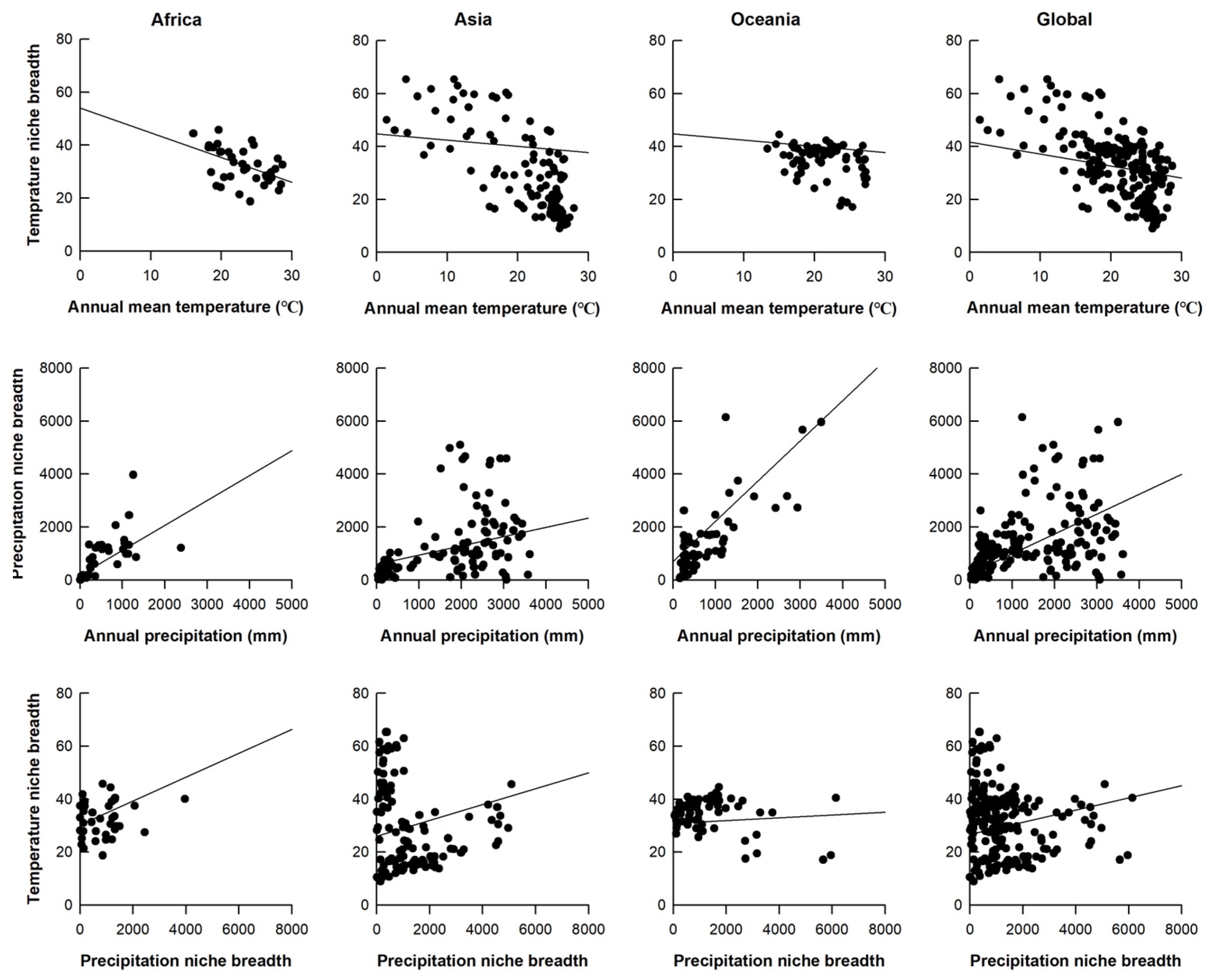
| TNB vs. Bio1 | Africa | 37 | 0 | 0.247 | <0.01 | −0.935 | 54.06 |
| Asia | 117 | 0.810 | 0.083 | <0.01 | −0.661 | 44.79 | |
| Oceania | 66 | 0.598 | 0.098 | 0.010 | −0.452 | 41.68 | |
| Global | 212 | 0.827 | 0.102 | <0.0001 | −0.628 | 44.41 | |
| PNB vs. Bio12 | Africa | 37 | 0.091 | 0.363 | <0.0001 | 0.940 | 190.50 |
| Asia | 117 | 0.333 | 0.043 | 0.024 | 0.350 | 591.73 | |
| Oceania | 66 | 0.924 | 0.417 | <0.0001 | 1.518 | 702.78 | |
| Global | 212 | 0.597 | 0.154 | <0.0001 | 0.750 | 241.28 | |
| TNB vs. PNB | Africa | 37 | 0.880 | 0.207 | <0.01 | 0.0045 | 30.37 |
| Asia | 117 | 0.914 | 0.178 | <0.0001 | 0.0030 | 25.94 | |
| Oceania | 66 | 0.714 | 0.011 | 0.392 | 0.0005 | 30.84 | |
| Global | 212 | 0.934 | 0.123 | <0.0001 | 0.0023 | 26.67 |
| N | TNBRWL-S | PNBRWL-S | |
|---|---|---|---|
| Africa | 37 | 0.719 (0.396–0.983) | 0.462 (0.191–0.938) |
| Asia | 117 | 0.727 (0.415–0.990) | 0.563 (0.137–0.980) |
| Oceania | 66 | 0.733 (0.467–0.939) | 0.350 (0.042–0.793) |
| Global | 212 | 0.722 (0.396–0.990) | 0.478 (0.042–0.980) |
| λ | r2 | p Value | Slope | Intercept | ||
|---|---|---|---|---|---|---|
| TNBWL vs. TNB | Africa | 0.764 | 0.499 | <0.0001 | 0.425 | 11.60 |
| Asia | 0.750 | 0.620 | <0.0001 | 0.486 | 7.52 | |
| Oceania | 0.839 | 0.235 | <0.0001 | 0.354 | 10.23 | |
| Global | 0.842 | 0.492 | <0.0001 | 0.449 | 8.74 | |
| PNBWL vs. PNB | Africa | 0 | 0.694 | <0.0001 | 0.395 | 19.96 |
| Asia | 0.661 | 0.493 | <0.0001 | 0.265 | 259.67 | |
| Oceania | 1.000 | 0.309 | <0.0001 | 0.239 | 103.88 | |
| Global | 0.763 | 0.436 | <0.0001 | 0.265 | 223.79 | |
| TNBRWL-S vs. TNB | Africa | 0.893 | 0.461 | <0.0001 | −0.0108 | 1.14 |
| Asia | 0.611 | 0.203 | <0.0001 | −0.0064 | 0.94 | |
| Oceania | 0.897 | 0.258 | <0.0001 | −0.0106 | 1.01 | |
| Global | 0.803 | 0.212 | <0.0001 | −0.0075 | 0.97 | |
| PNBRWL-S vs. PNB | Africa | 0 | 0.028 | 0.322 | 0.0000 | 0.49 |
| Asia | 0.513 | 0.193 | <0.0001 | −0.0001 | 0.68 | |
| Oceania | 0.568 | 0.040 | 0.108 | −0.0001 | 0.43 | |
| Global | 0.631 | 0.120 | <0.0001 | −0.0001 | 0.62 | |
| TNPV vs. TNB | Africa | 0.115 | 0.142 | 0.022 | 0.258 | −3.98 |
| Asia | 0 | 0.354 | <0.0001 | 0.221 | −1.22 | |
| Oceania | 0.646 | 0.132 | <0.01 | 0.186 | −2.86 | |
| Global | 0.269 | 0.210 | <0.0001 | 0.253 | −3.28 | |
| PNPV vs. PNB | Africa | 0 | 0.752 | <0.0001 | 16.313 | −2443.59 |
| Asia | 0.646 | 0.764 | <0.0001 | 39.080 | −17,111.14 | |
| Oceania | 1.000 | 0.180 | <0.001 | 12.884 | 6526.70 | |
| Global | 0.657 | 0.652 | <0.0001 | 34.030 | −11,696.47 |
Disclaimer/Publisher’s Note: The statements, opinions and data contained in all publications are solely those of the individual author(s) and contributor(s) and not of MDPI and/or the editor(s). MDPI and/or the editor(s) disclaim responsibility for any injury to people or property resulting from any ideas, methods, instructions or products referred to in the content. |
© 2026 by the authors. Licensee MDPI, Basel, Switzerland. This article is an open access article distributed under the terms and conditions of the Creative Commons Attribution (CC BY) license.
Share and Cite
Wang, Z.-W.; Fang, Z.-Y.; Hu, X.; Zhu, P.-P.; Si, K.-X.; Du, Y.; Lin, L.-H.; Zhu, X.-M. Spatial Patterns of Variation in Climatic Niche Breadths in Agamid Lizards. Animals 2026, 16, 1028. https://doi.org/10.3390/ani16071028
Wang Z-W, Fang Z-Y, Hu X, Zhu P-P, Si K-X, Du Y, Lin L-H, Zhu X-M. Spatial Patterns of Variation in Climatic Niche Breadths in Agamid Lizards. Animals. 2026; 16(7):1028. https://doi.org/10.3390/ani16071028
Chicago/Turabian StyleWang, Zhi-Wen, Zheng-Yuan Fang, Xu Hu, Pan-Pan Zhu, Kai-Xu Si, Yu Du, Long-Hui Lin, and Xia-Ming Zhu. 2026. "Spatial Patterns of Variation in Climatic Niche Breadths in Agamid Lizards" Animals 16, no. 7: 1028. https://doi.org/10.3390/ani16071028
APA StyleWang, Z.-W., Fang, Z.-Y., Hu, X., Zhu, P.-P., Si, K.-X., Du, Y., Lin, L.-H., & Zhu, X.-M. (2026). Spatial Patterns of Variation in Climatic Niche Breadths in Agamid Lizards. Animals, 16(7), 1028. https://doi.org/10.3390/ani16071028