The Genomic Landscape of Cattle: Domestication, Dispersal, and Adaptive Evolution
 , , ,
, , ,
Simple Summary
Abstract
1. Introduction
2. The Dual Origins of Cattle: Evidence from Archaeology and Genetics
2.1. The Extinct Progenitor: Aurochs
2.2. The near Eastern Center: Origin of Taurine Cattle
2.3. The South Asian Center: Origin of Zebu Cattle
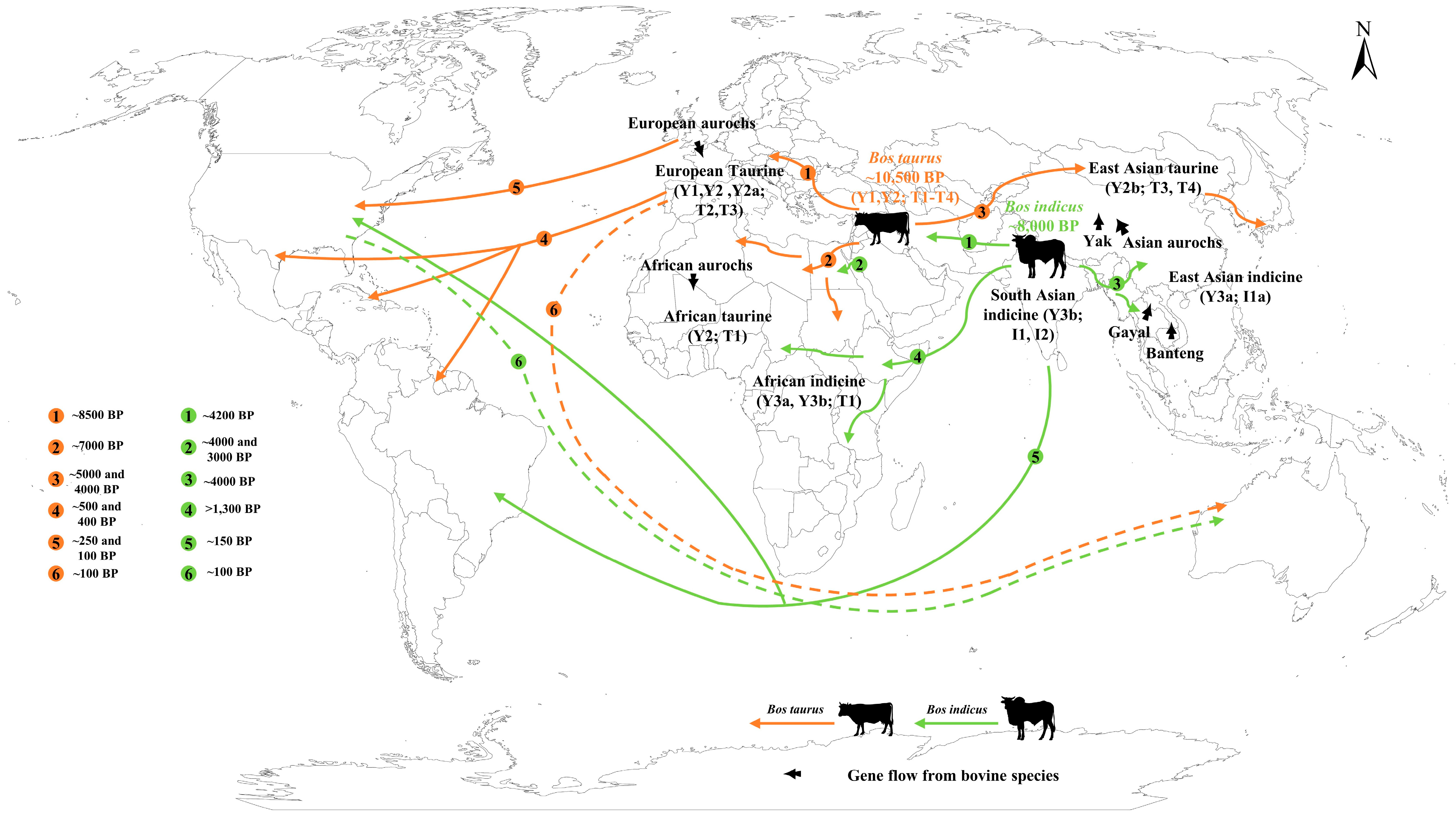
3. Geographic Lineages and Dispersal History of Modern Cattle
3.1. The Colonization of Europe
3.2. The African Mosaic
3.3. The East Asian Melting Pot
3.4. The History of Introduction to the Americas and Oceania
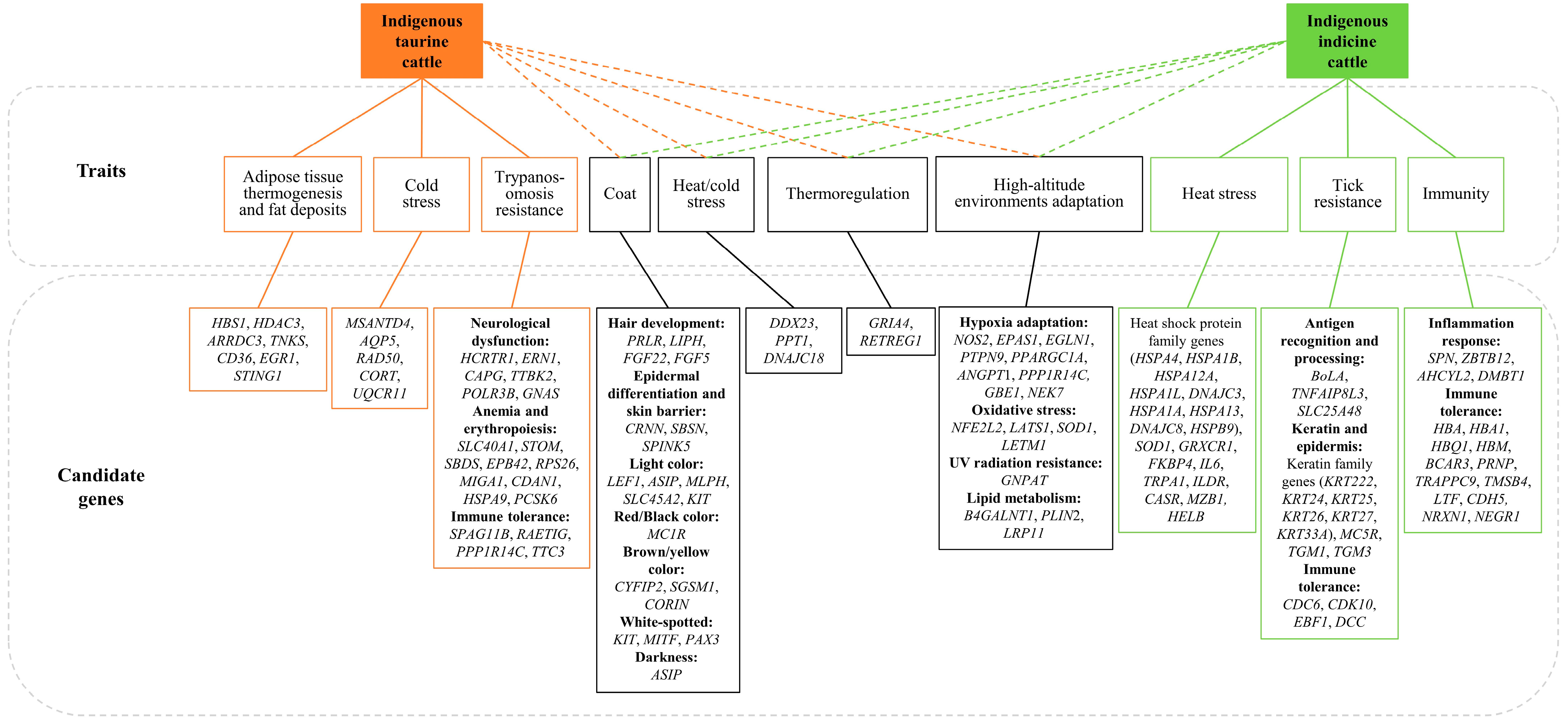
4. Environmental Adaptive Evolution of Cattle
4.1. Thermal Adaptation
4.2. Parasitic Disease Resistance
4.3. High-Altitude Adaptation
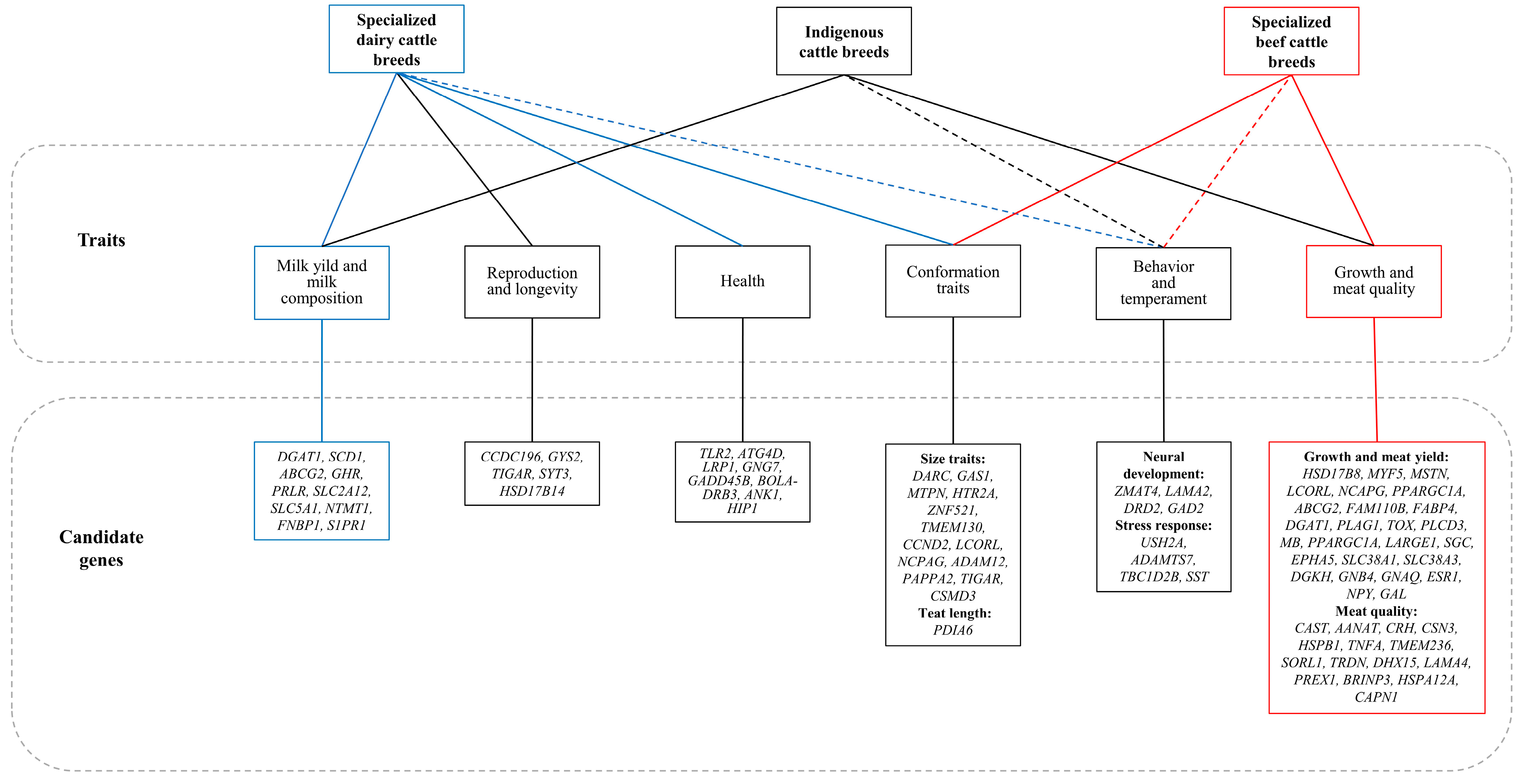
5. Artificial Selection and Breed Diversification
5.1. Temperament Selection
5.2. Coat Color Selection
5.3. Selection for Lactation Traits
5.4. Selection for Meat Traits
6. The Pangenome Era: Unlocking Hidden Diversity and Missing Heritability

| Species | GenBank Accession | Breeds | Assembled Length/Gb | Contig N50 | Sequencing Technology | References |
|---|---|---|---|---|---|---|
| Bos taurus | GCA_002263795.4 | Hereford | 2.8 | 26.4 Mb | PacBio; Illumina NextSeq 500; Illumina HiSeq; Ilumina GAll | USDA ARS |
| GCA_947034695.1 | Charolais | 3.2 | 84.1 Mb | PacBio; Hi-C; 10× Chromium | INRAE | |
| GCA_028973685.2 | Hanwoo | 3.1 | 64.7 Mb | PacBio | [188] | |
| GCA_021234555.1 | Jersey | 2.6 | 50.6 Mb | PacBio | USDA ARS | |
| GCA_034097375.1 | Yunling cattle | 3.1 | 36 Mb | PacBio | Yunnan Agricultural University | |
| GCA_905123885.1 | African N’Dama | 2.9 | 18.7 Mb | PacBio; Illumina | [189] | |
| GCA_905123515.1 | African Ankole | 2.8 | 11.1 Mb | PacBio; Illumina | [189] | |
| GCA_021347905.1 | Holstein-Friesian | 2.7 | 8.7 Mb | PacBio; Illumina | [188] | |
| GCA_000003205.6 | Hereford | 2.7 | 276.3 Mb | Sanger; PacBio RS Il | Cattle Genome Sequencing International Consortium | |
| GCA_000003055.5 | Hereford | 2.7 | 97 Mb | Sanger | [190] | |
| GCA_003369685.2 | Angus | 2.6 | 102.8 Mb | PacBio; Hi-C; Illumina NextSeq; Sequel | [191] | |
| GCA_049634565.1 | Hanwoo | 3.1 | 90.2 Mb | PacBio Revio; AVITI | [192] | |
| GCA_051122635.1 | Yanbian cattle | 2.9 | 86.4 Mb | PacBio HiFi; Hi-C | [193] | |
| Bos indicus | GCA_000247795.2 | Nelore | 2.7 | 28.4 Mb | SOLiD | [194] |
| GCA_030271795.1 | Wenshancattle | 2.7 | 66.8 Mb | PacBio; Illumina HiSeq | [67] | |
| GCA_030269815.1 | Leiqiong cattle | 2.7 | 54.8 Mb | PacBio; Illumina HiSeq | [67] | |
| GCA_030271805.1 | Weizhou cattle | 2.7 | 38.7 Mb | PacBio; Illumina HiSeg | [67] | |
| GCA_030270715.1 | Guanling cattle | 2.7 | 12.8 Mb | PacBio; Illumina HiSeg | [67] | |
| GCA_029378745.1 | SahiwalxTharparkar | 2.7 | 42.1 Mb | PacBio | USDA ARS | |
| GCA_002933975.1 | Gir | 2.7 | 64.5 Mb | 454; IonTorrent; IlluminaNextSeq; Illumina MiSeq | Anand Agricultural University | |
| GCA_963966425.1 | Red sindhi | 2.7 | 199.1 Kb | 10× Genomics Chromium; Illumina HiSeq X | [195] | |
| GCA_963966355.1 | Sahiwal | 2.7 | 178.5 Kb | 10× Genomics Chromium; Illumina HiSeq X | [195] | |
| GCA_963966215.1 | Kankrej | 2.7 | 164.7 Kb | 10× Genomics Chromium; Illumina HiSeq X | [195] | |
| GCA_963966345.1 | Tharparkar | 2.8 | 126.3 Kb | 10× Genomics Chromium; Illumina HiSeq X | [195] | |
| GCA_963966175.1 | Gir | 2.8 | 106.3 Kb | 10× Genomics Chromium; Illumina HiSeq X | [195] | |
| Bos mutus | GCA_027580195.2 | Yak | 2.6 | 38.3 Mb | Nanopore; Hi-C; Illumina | [196] |
| GCA_002968435.1 | Yak | 2.3 | 23.6 Mb | Illumina HiSeq; Illumina GA | Institute of Bioinformatics and Applied Biotechnology | |
| GCA_007646595.3 | Datong Yak | 2.8 | 90.6 Kb | Illumina HiSeq | Lanzhou University | |
| Bos javanicus | GCA_032452875.1 | Banteng | 3 | 47.1 MB | Oxford Nanopore | Oklahoma State University |
| Bos gaurus | GCA_014182915.2 | Gaur | 2.7 | 13.3 Mb | PacBio | USDA, ARS, USMARC |
| GCA_965225615.1 | Gaur | 2.6 | 323.2 Kb | - | The University of Queensland | |
| Bos frontalis | GCA_043643345.1 | Chinese Gayal | 2.6 | 20.2 Mb | PacBio RSII | [197] |
| GCA_007844835.1 | Gayal | 3 | 28.7 Kb | Illumina HiSeq; PacBio | [198] | |
| GCA_017311355.1 | Gayal | 2.8 | 9.6 Kb | - | Bangladesh Livestock Research Institute; Chittagong Veterinary and Animal Sciences University |
7. Search Strategy
8. Conclusions
Author Contributions
Funding
Institutional Review Board Statement
Informed Consent Statement
Data Availability Statement
Conflicts of Interest
References
- Kennedy, U.; Sharma, A.; Phillips, C.J.C. The Sheltering of Unwanted Cattle, Experiences in India and Implications for Cattle Industries Elsewhere. Animals 2018, 8, 64. [Google Scholar] [CrossRef]
- Larson, G.; Fuller, D.Q. The Evolution of Animal Domestication. Annu. Rev. Ecol. Evol. Syst. 2014, 45, 115–136. [Google Scholar] [CrossRef]
- Institute of Animal Production and Fisheries, Siedlce University of Natural Sciences and Humanities, 08-110 Siedlce, ul. Prusa 14; Guliński, P. Cattle Breeds—Contemporary Views on Their Origin and Criteria for Classification: A Review. Acta Sci. Pol. Zootech. 2022, 20, 3–18. [Google Scholar] [CrossRef]
- Felius, M.; Beerling, M.-L.; Buchanan, D.; Theunissen, B.; Koolmees, P.; Lenstra, J. On the History of Cattle Genetic Resources. Diversity 2014, 6, 705–750. [Google Scholar] [CrossRef]
- Achilli, A.; Olivieri, A.; Pellecchia, M.; Uboldi, C.; Colli, L.; Al-Zahery, N.; Accetturo, M.; Pala, M.; Hooshiar Kashani, B.; Perego, U.A.; et al. Mitochondrial Genomes of Extinct Aurochs Survive in Domestic Cattle. Curr. Biol. 2008, 18, R157–R158. [Google Scholar] [CrossRef]
- Chen, S.; Lin, B.-Z.; Baig, M.; Mitra, B.; Lopes, R.J.; Santos, A.M.; Magee, D.A.; Azevedo, M.; Tarroso, P.; Sasazaki, S.; et al. Zebu Cattle Are an Exclusive Legacy of the South Asia Neolithic. Mol. Biol. Evol. 2010, 27, 1–6. [Google Scholar] [CrossRef]
- Sarath Kumar, T.; Singh, S.; Ganguly, I.; Dixit, S.P. Mitogenome Diversity and Evolution of Bos indicus Cattle in India. Gene 2025, 936, 149096. [Google Scholar] [CrossRef] [PubMed]
- Loftus, R.T.; MacHugh, D.E.; Bradley, D.G.; Sharp, P.M.; Cunningham, P. Evidence for Two Independent Domestications of Cattle. Proc. Natl. Acad. Sci. USA 1994, 91, 2757–2761. [Google Scholar] [CrossRef]
- Chen, N.; Cai, Y.; Chen, Q.; Li, R.; Wang, K.; Huang, Y.; Hu, S.; Huang, S.; Zhang, H.; Zheng, Z.; et al. Whole-Genome Resequencing Reveals World-Wide Ancestry and Adaptive Introgression Events of Domesticated Cattle in East Asia. Nat. Commun. 2018, 9, 2337. [Google Scholar] [CrossRef]
- Chen, N.; Xia, X.; Hanif, Q.; Zhang, F.; Dang, R.; Huang, B.; Lyu, Y.; Luo, X.; Zhang, H.; Yan, H.; et al. Global Genetic Diversity, Introgression, and Evolutionary Adaptation of Indicine Cattle Revealed by Whole Genome Sequencing. Nat. Commun. 2023, 14, 7803. [Google Scholar] [CrossRef]
- Fuller, D.Q. Agricultural Origins and Frontiers in South Asia: A Working Synthesis. J. World Prehist. 2006, 20, 1–86. [Google Scholar] [CrossRef]
- Rossi, C.; Sinding, M.-H.S.; Mullin, V.E.; Scheu, A.; Erven, J.A.M.; Verdugo, M.P.; Daly, K.G.; Ciucani, M.M.; Mattiangeli, V.; Teasdale, M.D.; et al. The Genomic Natural History of the Aurochs. Nature 2024, 635, 136–141. [Google Scholar] [CrossRef]
- Mona, S.; Catalano, G.; Lari, M.; Larson, G.; Boscato, P.; Casoli, A.; Sineo, L.; Di Patti, C.; Pecchioli, E.; Caramelli, D.; et al. Population Dynamic of the Extinct European Aurochs: Genetic Evidence of a North-South Differentiation Pattern and No Evidence of Post-Glacial Expansion. BMC Evol. Biol. 2010, 10, 83. [Google Scholar] [CrossRef]
- Edwards, C.J.; Bollongino, R.; Scheu, A.; Chamberlain, A.; Tresset, A.; Vigne, J.-D.; Baird, J.F.; Larson, G.; Ho, S.Y.W.; Heupink, T.H.; et al. Mitochondrial DNA Analysis Shows a Near Eastern Neolithic Origin for Domestic Cattle and No Indication of Domestication of European Aurochs. Proc. Biol. Sci. 2007, 274, 1377–1385. [Google Scholar] [CrossRef]
- Gravlund, P.; Aaris-Sørensen, K.; Hofreiter, M.; Meyer, M.; Bollback, J.P.; Noe-Nygaard, N. Ancient DNA Extracted from Danish Aurochs (Bos Primigenius): Genetic Diversity and Preservation. Ann. Anat. 2012, 194, 103–111. [Google Scholar] [CrossRef]
- Zeyland, J.; Wolko, L.; Bocianowski, J.; Szalata, M.; Słomski, R.; Dzieduszycki, A.M.; Ryba, M.; Przystałowska, H.; Lipiński, D. Complete Mitochondrial Genome of Wild Aurochs (Bos Primigenius) Reconstructed from Ancient DNA. Pol. J. Vet. Sci. 2013, 16, 265–273. [Google Scholar] [CrossRef]
- Cai, D.; Zhang, N.; Zhu, S.; Chen, Q.; Wang, L.; Zhao, X.; Ma, X.; Royle, T.C.A.; Zhou, H.; Yang, D.Y. Ancient DNA Reveals Evidence of Abundant Aurochs (Bos Primigenius) in Neolithic Northeast China. J. Archaeol. Sci. 2018, 98, 72–80. [Google Scholar] [CrossRef]
- Hou, J.; Guan, X.; Xia, X.; Lyu, Y.; Liu, X.; Mazei, Y.; Xie, P.; Chang, F.; Zhang, X.; Chen, J.; et al. Evolution and Legacy of East Asian Aurochs. Sci. Bull. 2024, 69, 3425–3433. [Google Scholar] [CrossRef] [PubMed]
- Zhu, Y.; Hou, X.; Zhao, J.; Xiao, B.; Song, S.; Zou, X.; Liu, S.; Hofreiter, M.; Lai, X. Revisiting Aurochs Haplogroup C: Paleogenomic Perspectives from Northeastern China. Genes 2025, 16, 639. [Google Scholar] [CrossRef]
- Cai, D.; Kim, D.; Zhang, N.; Wang, X.; Li, T.; Li, J.; Li, C.; Lian, S.; Shao, X.; Hu, S.; et al. Ancient Genomes Illuminate the Origins and Dynamic History of East Asian Cattle. Science 2025, 390, eadu9904. [Google Scholar] [CrossRef]
- Bollongino, R.; Burger, J.; Powell, A.; Mashkour, M.; Vigne, J.-D.; Thomas, M.G. Modern Taurine Cattle Descended from Small Number of Near-Eastern Founders. Mol. Biol. Evol. 2012, 29, 2101–2104. [Google Scholar] [CrossRef]
- Vigne, J.-D. The Origins of Animal Domestication and Husbandry: A Major Change in the History of Humanity and the Biosphere. C R. Biol. 2011, 334, 171–181. [Google Scholar] [CrossRef]
- Zhang, K.; Lenstra, J.A.; Zhang, S.; Liu, W.; Liu, J. Evolution and Domestication of the Bovini Species. Anim. Genet. 2020, 51, 637–657. [Google Scholar] [CrossRef]
- Marom, N.; Bar-Oz, G. The Prey Pathway: A Regional History of Cattle (Bos taurus) and Pig (Sus scrofa) Domestication in the Northern Jordan Valley, Israel. PLoS ONE 2013, 8, e55958. [Google Scholar] [CrossRef]
- Evershed, R.P.; Payne, S.; Sherratt, A.G.; Copley, M.S.; Coolidge, J.; Urem-Kotsu, D.; Kotsakis, K.; Ozdoğan, M.; Ozdoğan, A.E.; Nieuwenhuyse, O.; et al. Earliest Date for Milk Use in the Near East and Southeastern Europe Linked to Cattle Herding. Nature 2008, 455, 528–531. [Google Scholar] [CrossRef]
- Beja-Pereira, A.; Caramelli, D.; Lalueza-Fox, C.; Vernesi, C.; Ferrand, N.; Casoli, A.; Goyache, F.; Royo, L.J.; Conti, S.; Lari, M.; et al. The Origin of European Cattle: Evidence from Modern and Ancient DNA. Proc. Natl. Acad. Sci. USA 2006, 103, 8113–8118. [Google Scholar] [CrossRef]
- Troy, C.S.; MacHugh, D.E.; Bailey, J.F.; Magee, D.A.; Loftus, R.T.; Cunningham, P.; Chamberlain, A.T.; Sykes, B.C.; Bradley, D.G. Genetic Evidence for Near-Eastern Origins of European Cattle. Nature 2001, 410, 1088–1091. [Google Scholar] [CrossRef]
- Verdugo, M.P.; Mullin, V.E.; Scheu, A.; Mattiangeli, V.; Daly, K.G.; Maisano Delser, P.; Hare, A.J.; Burger, J.; Collins, M.J.; Kehati, R.; et al. Ancient Cattle Genomics, Origins, and Rapid Turnover in the Fertile Crescent. Science 2019, 365, 173–176. [Google Scholar] [CrossRef] [PubMed]
- Lei, C.Z.; Chen, H.; Zhang, H.C.; Cai, X.; Liu, R.Y.; Luo, L.Y.; Wang, C.F.; Zhang, W.; Ge, Q.L.; Zhang, R.F.; et al. Origin and Phylogeographical Structure of Chinese Cattle. Anim. Genet. 2006, 37, 579–582. [Google Scholar] [CrossRef] [PubMed]
- Lai, S.-J.; Liu, Y.-P.; Liu, Y.-X.; Li, X.-W.; Yao, Y.-G. Genetic Diversity and Origin of Chinese Cattle Revealed by mtDNA D-Loop Sequence Variation. Mol. Phylogenet. Evol. 2006, 38, 146–154. [Google Scholar] [CrossRef] [PubMed]
- Decker, J.E.; McKay, S.D.; Rolf, M.M.; Kim, J.; Molina Alcalá, A.; Sonstegard, T.S.; Hanotte, O.; Götherström, A.; Seabury, C.M.; Praharani, L.; et al. Worldwide Patterns of Ancestry, Divergence, and Admixture in Domesticated Cattle. PLoS Genet. 2014, 10, e1004254. [Google Scholar] [CrossRef]
- Zhou, Y.; Yang, L.; Han, X.; Han, J.; Hu, Y.; Li, F.; Xia, H.; Peng, L.; Boschiero, C.; Rosen, B.D.; et al. Assembly of a Pangenome for Global Cattle Reveals Missing Sequences and Novel Structural Variations, Providing New Insights into Their Diversity and Evolutionary History. Genome Res. 2022, 32, 1585–1601. [Google Scholar] [CrossRef]
- Mannen, H.; Kohno, M.; Nagata, Y.; Tsuji, S.; Bradley, D.G.; Yeo, J.S.; Nyamsamba, D.; Zagdsuren, Y.; Yokohama, M.; Nomura, K.; et al. Independent Mitochondrial Origin and Historical Genetic Differentiation in North Eastern Asian Cattle. Mol. Phylogenet. Evol. 2004, 32, 539–544. [Google Scholar] [CrossRef] [PubMed]
- Götherström, A.; Anderung, C.; Hellborg, L.; Elburg, R.; Smith, C.; Bradley, D.G.; Ellegren, H. Cattle Domestication in the Near East Was Followed by Hybridization with Aurochs Bulls in Europe. Proc. Biol. Sci. 2005, 272, 2345–2350. [Google Scholar] [CrossRef] [PubMed]
- Ganguly, I.; Jeevan, C.; Singh, S.; Dixit, S.P.; Sodhi, M.; Ranjan, A.; Kumar, S.; Sharma, A. Y-Chromosome Genetic Diversity of Bos indicus Cattle in Close Proximity to the Centre of Domestication. Sci. Rep. 2020, 10, 9992. [Google Scholar] [CrossRef]
- Pérez-Pardal, L.; Sánchez-Gracia, A.; Álvarez, I.; Traoré, A.; Ferraz, J.B.S.; Fernández, I.; Costa, V.; Chen, S.; Tapio, M.; Cantet, R.J.C.; et al. Legacies of Domestication, Trade and Herder Mobility Shape Extant Male Zebu Cattle Diversity in South Asia and Africa. Sci. Rep. 2018, 8, 18027. [Google Scholar] [CrossRef]
- Pérez-Pardal, L.; Royo, L.J.; Beja-Pereira, A.; Curik, I.; Traoré, A.; Fernández, I.; Sölkner, J.; Alonso, J.; Alvarez, I.; Bozzi, R.; et al. Y-Specific Microsatellites Reveal an African Subfamily in Taurine (Bos taurus) Cattle. Anim. Genet. 2010, 41, 232–241. [Google Scholar] [CrossRef] [PubMed]
- Bonfiglio, S.; Ginja, C.; De Gaetano, A.; Achilli, A.; Olivieri, A.; Colli, L.; Tesfaye, K.; Agha, S.H.; Gama, L.T.; Cattonaro, F.; et al. Origin and Spread of Bos taurus: New Clues from Mitochondrial Genomes Belonging to Haplogroup T1. PLoS ONE 2012, 7, e38601. [Google Scholar] [CrossRef] [PubMed]
- Bonfiglio, S.; Achilli, A.; Olivieri, A.; Negrini, R.; Colli, L.; Liotta, L.; Ajmone-Marsan, P.; Torroni, A.; Ferretti, L. The Enigmatic Origin of Bovine mtDNA Haplogroup R: Sporadic Interbreeding or an Independent Event of Bos Primigenius Domestication in Italy? PLoS ONE 2010, 5, e15760. [Google Scholar] [CrossRef]
- Achilli, A.; Bonfiglio, S.; Olivieri, A.; Malusà, A.; Pala, M.; Hooshiar Kashani, B.; Perego, U.A.; Ajmone-Marsan, P.; Liotta, L.; Semino, O.; et al. The Multifaceted Origin of Taurine Cattle Reflected by the Mitochondrial Genome. PLoS ONE 2009, 4, e5753. [Google Scholar] [CrossRef]
- Ajmone-Marsan, P.; Garcia, J.F.; Lenstra, J.A. On the Origin of Cattle: How Aurochs Became Cattle and Colonized the World. Evol. Anthropol. 2010, 19, 148–157. [Google Scholar] [CrossRef]
- Cymbron, T.; Freeman, A.R.; Isabel Malheiro, M.; Vigne, J.-D.; Bradley, D.G. Microsatellite Diversity Suggests Different Histories for Mediterranean and Northern European Cattle Populations. Proc. Biol. Sci. 2005, 272, 1837–1843. [Google Scholar] [CrossRef]
- Perisic, P.; Skalicki, Z.; Petrovic, M.M.; Bogdanovic, V.; Ruzic-Muslic, D. Simmental Cattle Breed in Different Production Systems. Bio Anim. Husb. 2009, 25, 315–326. [Google Scholar] [CrossRef]
- Heaton, M.P.; Smith, T.P.L.; Bickhart, D.M.; Vander Ley, B.L.; Kuehn, L.A.; Oppenheimer, J.; Shafer, W.R.; Schuetze, F.T.; Stroud, B.; McClure, J.C.; et al. A Reference Genome Assembly of Simmental Cattle, Bos taurus Taurus. J. Hered. 2021, 112, 184–191. [Google Scholar] [CrossRef]
- Gifford-Gonzalez, D.; Hanotte, O. Domesticating Animals in Africa: Implications of Genetic and Archaeological Findings. J. World Prehist. 2011, 24, 1–23. [Google Scholar] [CrossRef]
- Kim, K.; Kim, D.; Hanotte, O.; Lee, C.; Kim, H.; Jeong, C. Inference of Admixture Origins in Indigenous African Cattle. Mol. Biol. Evol. 2023, 40, msad257. [Google Scholar] [CrossRef] [PubMed]
- Pitt, D.; Sevane, N.; Nicolazzi, E.L.; MacHugh, D.E.; Park, S.D.E.; Colli, L.; Martinez, R.; Bruford, M.W.; Orozco-terWengel, P. Domestication of Cattle: Two or Three Events? Evol. Appl. 2019, 12, 123–136. [Google Scholar] [CrossRef] [PubMed]
- Gebrehiwot, N.Z.; Strucken, E.M.; Aliloo, H.; Marshall, K.; Gibson, J.P. The Patterns of Admixture, Divergence, and Ancestry of African Cattle Populations Determined from Genome-Wide SNP Data. BMC Genom. 2020, 21, 869. [Google Scholar] [CrossRef] [PubMed]
- Hanotte, O.; Tawah, C.L.; Bradley, D.G.; Okomo, M.; Verjee, Y.; Ochieng, J.; Rege, J.E. Geographic Distribution and Frequency of a Taurine Bos taurus and an Indicine Bos indicus Y Specific Allele amongst Sub-Saharan African Cattle Breeds. Mol. Ecol. 2000, 9, 387–396. [Google Scholar] [CrossRef]
- Kim, K.; Kwon, T.; Dessie, T.; Yoo, D.; Mwai, O.A.; Jang, J.; Sung, S.; Lee, S.; Salim, B.; Jung, J.; et al. The Mosaic Genome of Indigenous African Cattle as a Unique Genetic Resource for African Pastoralism. Nat. Genet. 2020, 52, 1099–1110. [Google Scholar] [CrossRef]
- Hanotte, O.; Bradley, D.G.; Ochieng, J.W.; Verjee, Y.; Hill, E.W.; Rege, J.E.O. African Pastoralism: Genetic Imprints of Origins and Migrations. Science 2002, 296, 336–339. [Google Scholar] [CrossRef]
- Cortés, O.; Tupac-Yupanqui, I.; Dunner, S.; García-Atance, M.A.; García, D.; Fernández, J.; Cañón, J. Ancestral Matrilineages and Mitochondrial DNA Diversity of the Lidia Cattle Breed. Anim. Genet. 2008, 39, 649–654. [Google Scholar] [CrossRef]
- Upadhyay, M.; Bortoluzzi, C.; Barbato, M.; Ajmone-Marsan, P.; Colli, L.; Ginja, C.; Sonstegard, T.S.; Bosse, M.; Lenstra, J.A.; Groenen, M.A.M.; et al. Deciphering the Patterns of Genetic Admixture and Diversity in Southern European Cattle Using Genome-Wide SNPs. Evol. Appl. 2019, 12, 951–963. [Google Scholar] [CrossRef] [PubMed]
- McTavish, E.J.; Decker, J.E.; Schnabel, R.D.; Taylor, J.F.; Hillis, D.M. New World Cattle Show Ancestry from Multiple Independent Domestication Events. Proc. Natl. Acad. Sci. USA 2013, 110, E1398-1406. [Google Scholar] [CrossRef] [PubMed]
- Cai, D.; Sun, Y.; Tang, Z.; Hu, S.; Li, W.; Zhao, X.; Xiang, H.; Zhou, H. The Origins of Chinese Domestic Cattle as Revealed by Ancient DNA Analysis. J. Archaeol. Sci. 2014, 41, 423–434. [Google Scholar] [CrossRef]
- Xia, X.; Qu, K.; Zhang, G.; Jia, Y.; Ma, Z.; Zhao, X.; Huang, Y.; Chen, H.; Huang, B.; Lei, C. Comprehensive Analysis of the Mitochondrial DNA Diversity in Chinese Cattle. Anim. Genet. 2019, 50, 70–73. [Google Scholar] [CrossRef]
- Li, R.; Zhang, X.M.; Campana, M.G.; Huang, J.P.; Chang, Z.H.; Qi, X.B.; Shi, H.; Su, B.; Zhang, R.F.; Lan, X.Y.; et al. Paternal Origins of Chinese Cattle. Anim. Genet. 2013, 44, 446–449. [Google Scholar] [CrossRef]
- Zhang, N.; Shao, X.; Guo, Y.; Zhang, X.; Zhou, Y.; Yuan, J.; Tang, Z.; Hu, S.; Minyaev, S.S.; Cai, D. Ancient Mitochondrial Genomes Provide New Clues to the Origin of Domestic Cattle in China. Genes 2023, 14, 1313. [Google Scholar] [CrossRef]
- Utsunomiya, Y.T.; Milanesi, M.; Fortes, M.R.S.; Porto-Neto, L.R.; Utsunomiya, A.T.H.; Silva, M.V.G.B.; Garcia, J.F.; Ajmone-Marsan, P. Genomic Clues of the Evolutionary History of Bos indicus Cattle. Anim. Genet. 2019, 50, 557–568. [Google Scholar] [CrossRef]
- Sudrajad, P.; Subiharta, S.; Adinata, Y.; Lathifah, A.; Lee, J.H.; Lenstra, J.A.; Lee, S.H. An Insight into the Evolutionary History of Indonesian Cattle Assessed by Whole Genome Data Analysis. PLoS ONE 2020, 15, e0241038. [Google Scholar] [CrossRef]
- Wangkumhang, P.; Wilantho, A.; Shaw, P.J.; Flori, L.; Moazami-Goudarzi, K.; Gautier, M.; Duangjinda, M.; Assawamakin, A.; Tongsima, S. Genetic Analysis of Thai Cattle Reveals a Southeast Asian Indicine Ancestry. PeerJ 2015, 3, e1318. [Google Scholar] [CrossRef]
- Zhang, W.; Gao, X.; Zhang, Y.; Zhao, Y.; Zhang, J.; Jia, Y.; Zhu, B.; Xu, L.; Zhang, L.; Gao, H.; et al. Genome-Wide Assessment of Genetic Diversity and Population Structure Insights into Admixture and Introgression in Chinese Indigenous Cattle. BMC Genet. 2018, 19, 114. [Google Scholar] [CrossRef]
- Cai, Y.; Jiao, T.; Lei, Z.; Liu, L.; Zhao, S. Maternal Genetic and Phylogenetic Characteristics of Domesticated Cattle in Northwestern China. PLoS ONE 2018, 13, e0209645. [Google Scholar] [CrossRef]
- Liu, Y.; Wang, T.; Wu, X.; Fan, X.; Wang, W.; Xie, G.; Li, Z.; Yang, Q.; Cao, P.; Yang, R.; et al. Maternal Genetic History of Southern East Asians over the Past 12,000 Years. J. Genet. Genom. 2021, 48, 899–907. [Google Scholar] [CrossRef] [PubMed]
- Gao, Y.; Gautier, M.; Ding, X.; Zhang, H.; Wang, Y.; Wang, X.; Faruque, M.O.; Li, J.; Ye, S.; Gou, X.; et al. Species Composition and Environmental Adaptation of Indigenous Chinese Cattle. Sci. Rep. 2017, 7, 16196. [Google Scholar] [CrossRef]
- Guan, X.; Xiang, W.; Qu, K.; Ahmed, Z.; Liu, J.; Cai, M.; Zhang, J.; Chen, N.; Lei, C.; Huang, B. Whole Genome Insights into Genetic Diversity, Introgression, and Adaptation of Yunnan Indigenous Cattle of Southwestern China. BMC Genom. 2025, 26, 216. [Google Scholar] [CrossRef] [PubMed]
- Dai, X.; Bian, P.; Hu, D.; Luo, F.; Huang, Y.; Jiao, S.; Wang, X.; Gong, M.; Li, R.; Cai, Y.; et al. A Chinese Indicine Pangenome Reveals a Wealth of Novel Structural Variants Introgressed from Other Bos Species. Genome Res. 2023, 33, 1284–1298. [Google Scholar] [CrossRef] [PubMed]
- Crum, T.E.; Schnabel, R.D.; Decker, J.E.; Taylor, J.F. Taurine and Indicine Haplotype Representation in Advanced Generation Individuals From Three American Breeds. Front. Genet. 2021, 12, 758394. [Google Scholar] [CrossRef]
- Ginja, C.; Penedo, M.C.T.; Melucci, L.; Quiroz, J.; Martínez López, O.R.; Revidatti, M.A.; Martínez-Martínez, A.; Delgado, J.V.; Gama, L.T. Origins and Genetic Diversity of New World Creole Cattle: Inferences from Mitochondrial and Y Chromosome Polymorphisms. Anim. Genet. 2010, 41, 128–141. [Google Scholar] [CrossRef]
- Miretti, M.M.; Dunner, S.; Naves, M.; Contel, E.P.; Ferro, J.A. Predominant African-Derived mtDNA in Caribbean and Brazilian Creole Cattle Is Also Found in Spanish Cattle (Bos taurus). J. Hered. 2004, 95, 450–453. [Google Scholar] [CrossRef]
- Lirón, J.P.; Bravi, C.M.; Mirol, P.M.; Peral-García, P.; Giovambattista, G. African Matrilineages in American Creole Cattle: Evidence of Two Independent Continental Sources. Anim. Genet. 2006, 37, 379–382. [Google Scholar] [CrossRef] [PubMed]
- Ginja, C.; Gama, L.T.; Cortés, O.; Burriel, I.M.; Vega-Pla, J.L.; Penedo, C.; Sponenberg, P.; Cañón, J.; Sanz, A.; do Egito, A.A.; et al. The Genetic Ancestry of American Creole Cattle Inferred from Uniparental and Autosomal Genetic Markers. Sci. Rep. 2019, 9, 11486. [Google Scholar] [CrossRef]
- Ward, J.A.; Ng’ang’a, S.I.; Randhawa, I.A.S.; McHugo, G.P.; O’Grady, J.F.; Flórez, J.M.; Browne, J.A.; Pérez O’Brien, A.M.; Landaeta-Hernández, A.J.; Garcia, J.F.; et al. Genomic Insights into the Population History and Adaptive Traits of Latin American Criollo Cattle. R. Soc. Open Sci. 2024, 11, 231388. [Google Scholar] [CrossRef] [PubMed]
- Ben-Jemaa, S.; Adam, G.; Boussaha, M.; Bardou, P.; Klopp, C.; Mandonnet, N.; Naves, M. Whole Genome Sequencing Reveals Signals of Adaptive Admixture in Creole Cattle. Sci. Rep. 2023, 13, 12155. [Google Scholar] [CrossRef] [PubMed]
- Verardo, L.L.; Otto, P.I.; Machado, M.A.; Do Carmo Panetto, J.C.; Faza, D.R.D.L.R.; Alves Do Egito, A.; Vitorino, A.S.M.; Carolino, M.I.C.M.; Carolino, N.P.; Da Silva, M.V.G.B. Exploring the Genetic Origin of Brazilian Locally Adapted Breeds: Admixture, Population History and Relationship with Portuguese and Indicine Cattle. Livest. Sci. 2024, 282, 105455. [Google Scholar] [CrossRef]
- Delsol, N.; Stucky, B.J.; Oswald, J.A.; Cobb, C.R.; Emery, K.F.; Guralnick, R. Ancient DNA Confirms Diverse Origins of Early Post-Columbian Cattle in the Americas. Sci. Rep. 2023, 13, 12444. [Google Scholar] [CrossRef]
- Eugênio Spers, E.; Carvalho Burnier, P.; Lucchese-Cheung, T. Beef Consumption Pattern in Brazil. In Meat and Nutrition; Lal Ranabhat, C., Ed.; IntechOpen: London, UK, 2021; ISBN 978-1-83968-702-0. [Google Scholar]
- Castonguay, A.C.; Polasky, S.; Holden, M.H.; Herrero, M.; Mason-D’Croz, D.; Godde, C.; Chang, J.; Gerber, J.; Witt, G.B.; Game, E.T.; et al. Navigating Sustainability Trade-Offs in Global Beef Production. Nat. Sustain. 2023, 6, 284–294. [Google Scholar] [CrossRef]
- Nunes, C.L.D.C.; Pflanzer, S.B.; Rezende-de-Souza, J.H.; Chizzotti, M.L. Beef Production and Carcass Evaluation in Brazil. Anim. Front. 2024, 14, 15–20. [Google Scholar] [CrossRef]
- Mulim, H.A.; Campos, G.S.; Cardoso, F.F.; Pedrosa, V.B.; Latimer, K.; Upperman, L.R.; Knowles, A.J.; Garcia, A.; Retallick, K.; Miller, S.; et al. Genomic Structure and Selection History across Angus Populations Worldwide: Insights from ROH, Selection Mapping, and Functional Analyses. Mamm. Genome 2026, 37, 19. [Google Scholar] [CrossRef]
- Taye, M.; Lee, W.; Caetano-Anolles, K.; Dessie, T.; Cho, S.; Jong Oh, S.; Lee, H.-K.; Kim, H. Exploring the Genomes of East African Indicine Cattle Breeds Reveals Signature of Selection for Tropical Environmental Adaptation Traits. Cogent Food Agric. 2018, 4, 1552552. [Google Scholar] [CrossRef]
- Kim, J.; Hanotte, O.; Mwai, O.A.; Dessie, T.; Bashir, S.; Diallo, B.; Agaba, M.; Kim, K.; Kwak, W.; Sung, S.; et al. The Genome Landscape of Indigenous African Cattle. Genome Biol. 2017, 18, 34. [Google Scholar] [CrossRef]
- Luo, F.-N.; Chen, S.-J.; Nanaei, H.A.; Wang, X.-Y.; Heller, R.; Hu, D.-X.; Cheng, H.; Li, J.; Ni, S.-H.; Li, M.; et al. Genetic Basis and Origin of Coat Color in Leiqiong Cattle. Zool. Res. 2025, 46, 518–526. [Google Scholar] [CrossRef] [PubMed]
- Hartati, H.; Putra, W.P.B.; Handiwirawan, E.; Ramon, E.; Firison, J.; Zubir, Z.; Suretno, N.D.; Mariyono, M.; Yusriani, Y.; Robba, D.K.; et al. Genome-Wide Association Study of Genetic Markers of Coat Color Patterns in Sumatran Native Cattle. Vet. World 2024, 17, 2537–2543. [Google Scholar] [CrossRef]
- Jiang, L.; Kon, T.; Chen, C.; Ichikawa, R.; Zheng, Q.; Pei, L.; Takemura, I.; Nsobi, L.H.; Tabata, H.; Pan, H.; et al. Whole-Genome Sequencing of Endangered Zhoushan Cattle Suggests Its Origin and the Association of MC1R with Black Coat Colour. Sci. Rep. 2021, 11, 17359. [Google Scholar] [CrossRef]
- Kunene, L.M.; Muchadeyi, F.C.; Hadebe, K.; Mészáros, G.; Sölkner, J.; Dugmore, T.; Dzomba, E.F. Genetics of Base Coat Colour Variations and Coat Colour-Patterns of the South African Nguni Cattle Investigated Using High-Density SNP Genotypes. Front. Genet. 2022, 13, 832702. [Google Scholar] [CrossRef] [PubMed]
- Trigo, B.B.; Utsunomiya, A.T.H.; Fortunato, A.A.A.D.; Milanesi, M.; Torrecilha, R.B.P.; Lamb, H.; Nguyen, L.; Ross, E.M.; Hayes, B.; Padula, R.C.M.; et al. Variants at the ASIP Locus Contribute to Coat Color Darkening in Nellore Cattle. Genet. Sel. Evol. 2021, 53, 40. [Google Scholar] [CrossRef]
- Jivanji, S.; Worth, G.; Lopdell, T.J.; Yeates, A.; Couldrey, C.; Reynolds, E.; Tiplady, K.; McNaughton, L.; Johnson, T.J.J.; Davis, S.R.; et al. Genome-Wide Association Analysis Reveals QTL and Candidate Mutations Involved in White Spotting in Cattle. Genet. Sel. Evol. 2019, 51, 62. [Google Scholar] [CrossRef] [PubMed]
- Xia, X.; Wang, F.; Luo, X.; Li, S.; Lyu, Y.; Zheng, Y.; Ma, Z.; Qu, K.; Song, R.; Liu, J.; et al. Structural Variations Associated with Adaptation and Coat Color in Qinghai-Tibetan Plateau Cattle. Adv. Sci. 2025, 12, e03258. [Google Scholar] [CrossRef]
- Igoshin, A.; Yudin, N.; Aitnazarov, R.; Yurchenko, A.A.; Larkin, D.M. Whole-Genome Resequencing Points to Candidate DNA Loci Affecting Body Temperature under Cold Stress in Siberian Cattle Populations. Life 2021, 11, 959. [Google Scholar] [CrossRef]
- Igoshin, A.V.; Yurchenko, A.A.; Belonogova, N.M.; Petrovsky, D.V.; Aitnazarov, R.B.; Soloshenko, V.A.; Yudin, N.S.; Larkin, D.M. Genome-Wide Association Study and Scan for Signatures of Selection Point to Candidate Genes for Body Temperature Maintenance under the Cold Stress in Siberian Cattle Populations. BMC Genet. 2019, 20, 26. [Google Scholar] [CrossRef]
- Yurchenko, A.A.; Daetwyler, H.D.; Yudin, N.; Schnabel, R.D.; Vander Jagt, C.J.; Soloshenko, V.; Lhasaranov, B.; Popov, R.; Taylor, J.F.; Larkin, D.M. Scans for Signatures of Selection in Russian Cattle Breed Genomes Reveal New Candidate Genes for Environmental Adaptation and Acclimation. Sci. Rep. 2018, 8, 12984. [Google Scholar] [CrossRef] [PubMed]
- Shen, J.; Hanif, Q.; Cao, Y.; Yu, Y.; Lei, C.; Zhang, G.; Zhao, Y. Whole Genome Scan and Selection Signatures for Climate Adaption in Yanbian Cattle. Front. Genet. 2020, 11, 94. [Google Scholar] [CrossRef] [PubMed]
- Huang, N.; Zhao, L.; Wang, J.; Jiang, Q.; Ju, Z.; Wang, X.; Yang, C.; Gao, Y.; Wei, X.; Zhang, Y.; et al. Signatures of Selection in Indigenous Chinese Cattle Genomes Reveal Adaptive Genes and Genetic Variations to Cold Climate. J. Anim. Sci. 2023, 101, skad006. [Google Scholar] [CrossRef]
- Zhang, Y.; Hu, Y.; Wang, X.; Jiang, Q.; Zhao, H.; Wang, J.; Ju, Z.; Yang, L.; Gao, Y.; Wei, X.; et al. Population Structure, and Selection Signatures Underlying High-Altitude Adaptation Inferred From Genome-Wide Copy Number Variations in Chinese Indigenous Cattle. Front. Genet. 2019, 10, 1404. [Google Scholar] [CrossRef]
- Wu, X.; Pei, J.; Xiong, L.; Ge, Q.; Bao, P.; Liang, C.; Yan, P.; Guo, X. Genome-Wide Scan for Selection Signatures Reveals Novel Insights into the Adaptive Capacity Characteristics in Three Chinese Cattle Breeds. BMC Genom. 2025, 26, 206. [Google Scholar] [CrossRef]
- Liu, X.; Li, Z.; Yan, Y.; Li, Y.; Wu, H.; Pei, J.; Yan, P.; Yang, R.; Guo, X.; Lan, X. Selection and Introgression Facilitated the Adaptation of Chinese Native Endangered Cattle in Extreme Environments. Evol. Appl. 2021, 14, 860–873. [Google Scholar] [CrossRef]
- Lyu, Y.; Wang, F.; Cheng, H.; Han, J.; Dang, R.; Xia, X.; Wang, H.; Zhong, J.; Lenstra, J.A.; Zhang, H.; et al. Recent Selection and Introgression Facilitated High-Altitude Adaptation in Cattle. Sci. Bull. 2024, 69, 3415–3424. [Google Scholar] [CrossRef]
- Ayalew, W.; Xiaoyun, W.; Tarekegn, G.M.; Tessema, T.S.; Chu, M.; Liang, C.; Naboulsi, R.; Van Damme, R.; Bongcam-Rudloff, E.; Ping, Y. Whole-Genome Sequencing of Copy Number Variation Analysis in Ethiopian Cattle Reveals Adaptations to Diverse Environments. BMC Genom. 2024, 25, 1088. [Google Scholar] [CrossRef]
- Saravanan, K.A.; Panigrahi, M.; Kumar, H.; Parida, S.; Bhushan, B.; Gaur, G.K.; Dutt, T.; Mishra, B.P.; Singh, R.K. Genomic Scans for Selection Signatures Revealed Candidate Genes for Adaptation and Production Traits in a Variety of Cattle Breeds. Genomics 2021, 113, 955–963. [Google Scholar] [CrossRef]
- Xia, X.; Zhang, F.; Li, S.; Luo, X.; Peng, L.; Dong, Z.; Pausch, H.; Leonard, A.S.; Crysnanto, D.; Wang, S.; et al. Structural Variation and Introgression from Wild Populations in East Asian Cattle Genomes Confer Adaptation to Local Environment. Genome Biol. 2023, 24, 211. [Google Scholar] [CrossRef] [PubMed]
- Wang, L.; Yan, X.; Wu, H.; Wang, F.; Zhong, Z.; Zheng, G.; Xiao, Q.; Wu, K.; Na, W. Selection Signal Analysis Reveals Hainan Yellow Cattle Are Being Selectively Bred for Heat Tolerance. Animals 2024, 14, 775. [Google Scholar] [CrossRef] [PubMed]
- Makina, S.O.; Muchadeyi, F.C.; van Marle-Köster, E.; Taylor, J.F.; Makgahlela, M.L.; Maiwashe, A. Genome-Wide Scan for Selection Signatures in Six Cattle Breeds in South Africa. Genet. Sel. Evol. 2015, 47, 92. [Google Scholar] [CrossRef]
- Mekonnen, Y.A.; Gültas, M.; Effa, K.; Hanotte, O.; Schmitt, A.O. Identification of Candidate Signature Genes and Key Regulators Associated With Trypanotolerance in the Sheko Breed. Front. Genet. 2019, 10, 1095. [Google Scholar] [CrossRef]
- Liu, Y.; Xu, L.; Yang, L.; Zhao, G.; Li, J.; Liu, D.; Li, Y. Discovery of Genomic Characteristics and Selection Signatures in Southern Chinese Local Cattle. Front. Genet. 2020, 11, 533052. [Google Scholar] [CrossRef]
- Cheruiyot, E.K.; Haile-Mariam, M.; Cocks, B.G.; MacLeod, I.M.; Xiang, R.; Pryce, J.E. New Loci and Neuronal Pathways for Resilience to Heat Stress in Cattle. Sci. Rep. 2021, 11, 16619. [Google Scholar] [CrossRef] [PubMed]
- Pokharel, K.; Weldenegodguad, M.; Popov, R.; Honkatukia, M.; Huuki, H.; Lindeberg, H.; Peippo, J.; Reilas, T.; Zarovnyaev, S.; Kantanen, J. Whole Blood Transcriptome Analysis Reveals Footprints of Cattle Adaptation to Sub-Arctic Conditions. Anim. Genet. 2019, 50, 217–227. [Google Scholar] [CrossRef] [PubMed]
- Verma, P.; Sharma, A.; Sodhi, M.; Thakur, K.; Kataria, R.S.; Niranjan, S.K.; Bharti, V.K.; Kumar, P.; Giri, A.; Kalia, S.; et al. Transcriptome Analysis of Circulating PBMCs to Understand Mechanism of High Altitude Adaptation in Native Cattle of Ladakh Region. Sci. Rep. 2018, 8, 7681. [Google Scholar] [CrossRef] [PubMed]
- Pitt, D.; Bruford, M.W.; Barbato, M.; Orozco-terWengel, P.; Martínez, R.; Sevane, N. Demography and Rapid Local Adaptation Shape Creole Cattle Genome Diversity in the Tropics. Evol. Appl. 2019, 12, 105–122. [Google Scholar] [CrossRef]
- Ghoreishifar, S.M.; Eriksson, S.; Johansson, A.M.; Khansefid, M.; Moghaddaszadeh-Ahrabi, S.; Parna, N.; Davoudi, P.; Javanmard, A. Signatures of Selection Reveal Candidate Genes Involved in Economic Traits and Cold Acclimation in Five Swedish Cattle Breeds. Genet. Sel. Evol. 2020, 52, 52. [Google Scholar] [CrossRef]
- Collier, R.J.; Gebremedhin, K.G. Thermal Biology of Domestic Animals. Annu. Rev. Anim. Biosci. 2015, 3, 513–532. [Google Scholar] [CrossRef]
- Naval-Sánchez, M.; Porto-Neto, L.R.; Cardoso, D.F.; Hayes, B.J.; Daetwyler, H.D.; Kijas, J.; Reverter, A. Selection Signatures in Tropical Cattle Are Enriched for Promoter and Coding Regions and Reveal Missense Mutations in the Damage Response Gene HELB. Genet. Sel. Evol. 2020, 52, 27. [Google Scholar] [CrossRef] [PubMed]
- Maiorano, A.M.; Cardoso, D.F.; Carvalheiro, R.; Júnior, G.A.F.; De Albuquerque, L.G.; De Oliveira, H.N. Signatures of Selection in Nelore Cattle Revealed by Whole-Genome Sequencing Data. Genomics 2022, 114, 110304. [Google Scholar] [CrossRef]
- Kumar, A.; Ashraf, S.; Goud, T.S.; Grewal, A.; Singh, S.V.; Yadav, B.R.; Upadhyay, R.C. Expression Profiling of Major Heat Shock Protein Genes during Different Seasons in Cattle (Bos Indicus) and Buffalo (Bubalus Bubalis) under Tropical Climatic Condition. J. Therm. Biol. 2015, 51, 55–64. [Google Scholar] [CrossRef] [PubMed]
- Fariha; Shabbir, M.S.; Anwar, S.; Azmat, H.; Majeed, M.B.B.; Kaul, H. Comparative Analysis of Heat Stress Response in Holstein Friesian and Sahiwal Cattle through HSP70 Gene Expression and Promoter DNA Methylation. Anim. Genet. 2025, 56, e70048. [Google Scholar] [CrossRef]
- Bhat, S.; Kumar, P.; Kashyap, N.; Deshmukh, B.; Dige, M.S.; Bhushan, B.; Chauhan, A.; Kumar, A.; Singh, G. Effect of Heat Shock Protein 70 Polymorphism on Thermotolerance in Tharparkar Cattle. Vet. World 2016, 9, 113–117. [Google Scholar] [CrossRef]
- Bharati, J.; Dangi, S.S.; Mishra, S.R.; Chouhan, V.S.; Verma, V.; Shankar, O.; Bharti, M.K.; Paul, A.; Mahato, D.K.; Rajesh, G.; et al. Expression Analysis of Toll like Receptors and Interleukins in Tharparkar Cattle during Acclimation to Heat Stress Exposure. J. Therm. Biol. 2017, 65, 48–56. [Google Scholar] [CrossRef]
- Gebeyehu, S.; Heins, B.; Sonstegard, T.; Sölkner, J.; Mészáros, G.; Traoré, A.; Soudré, A. Analysis of SLICK Allele in African Taurine and Zebu Cattle Breeds. Anim. Genet. 2025, 56, e13499. [Google Scholar] [CrossRef]
- Kongsuwan, K.; Josh, P.; Colgrave, M.L.; Bagnall, N.H.; Gough, J.; Burns, B.; Pearson, R. Activation of Several Key Components of the Epidermal Differentiation Pathway in Cattle Following Infestation with the Cattle Tick, Rhipicephalus (Boophilus) Microplus. Int. J. Parasitol. 2010, 40, 499–507. [Google Scholar] [CrossRef]
- Meharenet, B.; Desta, T.; Lelisa, K.; Tsegaye, M.; Jula, D. Epidemiology of Bovine Trypanosomosis and Vector Distribution in Didessa River Basin, Ethiopia. Acta Parasitol. 2020, 65, 743–749. [Google Scholar] [CrossRef] [PubMed]
- Gemeda, F.; Endalu, H.; Abafaji, G.; Abdurahman, A. Prevalence and Associated Risk Factors of Bovine Trypanosomosis in Nono District, West Shewa Zone, Ethiopia. COVID Res. Treat. 2023, 2. [Google Scholar] [CrossRef]
- Hart, B.L.; Hart, L.A. How Mammals Stay Healthy in Nature: The Evolution of Behaviours to Avoid Parasites and Pathogens. Philos. Trans. R. Soc. Lond. B Biol. Sci. 2018, 373, 20170205. [Google Scholar] [CrossRef] [PubMed]
- McHugo, G.P.; Ward, J.A.; Browne, J.A.; O’Gorman, G.M.; Meade, K.G.; Hill, E.W.; Hall, T.J.; MacHugh, D.E. Functional Genomics of Trypanotolerant and Trypanosusceptible Cattle Infected with Trypanosoma Congolense across Multiple Time Points and Tissues. PLoS Negl. Trop. Dis. 2025, 19, e0012882. [Google Scholar] [CrossRef] [PubMed]
- Park, S.D.E.; Magee, D.A.; McGettigan, P.A.; Teasdale, M.D.; Edwards, C.J.; Lohan, A.J.; Murphy, A.; Braud, M.; Donoghue, M.T.; Liu, Y.; et al. Genome Sequencing of the Extinct Eurasian Wild Aurochs, Bos primigenius, Illuminates the Phylogeography and Evolution of Cattle. Genome Biol. 2015, 16, 234. [Google Scholar] [CrossRef]
- Braud, M.; Magee, D.A.; Park, S.D.E.; Sonstegard, T.S.; Waters, S.M.; MacHugh, D.E.; Spillane, C. Genome-Wide microRNA Binding Site Variation between Extinct Wild Aurochs and Modern Cattle Identifies Candidate microRNA-Regulated Domestication Genes. Front. Genet. 2017, 8, 3. [Google Scholar] [CrossRef] [PubMed]
- Chen, M.; Pan, D.; Ren, H.; Fu, J.; Li, J.; Su, G.; Wang, A.; Jiang, L.; Zhang, Q.; Liu, J.-F. Identification of Selective Sweeps Reveals Divergent Selection between Chinese Holstein and Simmental Cattle Populations. Genet. Sel. Evol. 2016, 48, 76. [Google Scholar] [CrossRef]
- Cai, J.; Yang, L.; Gao, Y.; Liu, G.E.; Da, Y.; Ma, L. Selection Signature Analysis of Whole-Genome Sequences to Identify Genome Differences Between Selected and Unselected Holstein Cattle. Animals 2025, 15, 2247. [Google Scholar] [CrossRef]
- Balcarcel, A.M.; Veitschegger, K.; Clauss, M.; Sánchez-Villagra, M.R. Intensive Human Contact Correlates with Smaller Brains: Differential Brain Size Reduction in Cattle Types. Proc. Biol. Sci. 2021, 288, 20210813. [Google Scholar] [CrossRef]
- Mincu-Iorga, M.; Mizeranschi, A.E.; Gavojdian, D.; Nicolae, I.; Kusza, S.; Ilie, D.E. Detection of Genetic Variants Associated with Behavioural Response During Milking in Simmental Dual-Purpose Cows. Animals 2025, 15, 1766. [Google Scholar] [CrossRef]
- Ruiz-De-La-Cruz, G.; Welsh, T.H.; Randel, R.D.; Sifuentes-Rincón, A.M. A Comprehensive Systematic Review Coupled with an Interacting Network Analysis Identified Candidate Genes and Biological Pathways Related to Bovine Temperament. Genes 2024, 15, 981. [Google Scholar] [CrossRef]
- Eusebi, P.G.; Sevane, N.; O’Rourke, T.; Pizarro, M.; Boeckx, C.; Dunner, S. Gene Expression Profiles Underlying Aggressive Behavior in the Prefrontal Cortex of Cattle. BMC Genom. 2021, 22, 245. [Google Scholar] [CrossRef]
- Pinto, L.F.B.; Medrado, B.D.; Pedrosa, V.B.; Brito, L.F. A Systematic Review with Meta-Analysis of Heritability Estimates for Temperament-Related Traits in Beef and Dairy Cattle Populations. J. Anim. Breed. Genet. 2025, 142, 1–23. [Google Scholar] [CrossRef] [PubMed]
- Alvarenga, A.B.; Oliveira, H.R.; Turner, S.P.; Garcia, A.; Retallick, K.J.; Miller, S.P.; Brito, L.F. Unraveling the Phenotypic and Genomic Background of Behavioral Plasticity and Temperament in North American Angus Cattle. Genet. Sel. Evol. 2023, 55, 3. [Google Scholar] [CrossRef] [PubMed]
- Haskell, M.J.; Simm, G.; Turner, S.P. Genetic Selection for Temperament Traits in Dairy and Beef Cattle. Front. Genet. 2014, 5, 368. [Google Scholar] [CrossRef] [PubMed]
- Pacheco, H.A.; Hernandez, R.O.; Chen, S.-Y.; Neave, H.W.; Pempek, J.A.; Brito, L.F. Invited Review: Phenotyping Strategies and Genetic Background of Dairy Cattle Behavior in Intensive Production Systems-From Trait Definition to Genomic Selection. J. Dairy Sci. 2025, 108, 6–32. [Google Scholar] [CrossRef]
- Ruiz-De-La-Cruz, G.; Sifuentes-Rincón, A.M.; Paredes-Sánchez, F.A.; Parra-Bracamonte, G.M.; Casas, E.; Riley, D.G.; Perry, G.A.; Welsh, T.H.; Randel, R.D. Analysis of Nonsynonymous SNPs in Candidate Genes That Influence Bovine Temperament and Evaluation of Their Effect in Brahman Cattle. Mol. Biol. Rep. 2024, 51, 285. [Google Scholar] [CrossRef]
- Siwele, T.T.; Mtileni, B.J.; Nephawe, K.A.; Madilindi, M.A.; Dube, B.; Banga, C.B. Phenotypic and Genetic Analysis of Milking Temperament and Its Correlation with Milk Production Traits in South African Holstein Cattle. Trop. Anim. Health Prod. 2025, 57, 200. [Google Scholar] [CrossRef]
- Barendse, W. Climate Adaptation of Tropical Cattle. Annu. Rev. Anim. Biosci. 2017, 5, 133–150. [Google Scholar] [CrossRef]
- Goud, T.S.; Upadhyay, R.C.; Pichili, V.B.R.; Onteru, S.K.; Chadipiralla, K. Molecular Characterization of Coat Color Gene in Sahiwal versus Karan Fries Bovine. J. Genet. Eng. Biotechnol. 2021, 19, 22. [Google Scholar] [CrossRef]
- Hauser, M.; Signer-Hasler, H.; Küttel, L.; Capitan, A.; Guldbrandtsen, B.; Hinrichs, D.; Flury, C.; Seefried, F.R.; Drögemüller, C. Identification of Two New Recessive MC1R Alleles in Red-Coloured Evolèner Cattle and Other Breeds. Anim. Genet. 2022, 53, 427–435. [Google Scholar] [CrossRef]
- Trigo, B.B.; Alves, N.F.; Milanesi, M.; Garcia, J.F.; Terefe, E.; Hanotte, O.; Tijjani, A.; Utsunomiya, Y.T. A Structural Variant at ASIP Associated with the Darkness of Hair Coat Is Found in Multiple Zebu Cattle Populations. Anim. Genet. 2023, 54, 544–548. [Google Scholar] [CrossRef]
- Wang, X.; Xu, L.; Zhou, D.; Lv, Y.; Wu, J.; Zhao, Y.; Ni, M.; Zhou, W.; Zhang, K.; Wang, H.; et al. Skin Transcriptomic and Selection Signature Analyses Identify ASIP as a Key Gene in Cattle Coat Color Determination. Front. Genet. 2025, 16, 1577647. [Google Scholar] [CrossRef] [PubMed]
- Jivanji, S.; Wilkinson, E.; Tang, L.; Tiplady, K.M.; Yeates, A.; Harland, C.; Gray, C.; Couldrey, C.; Worth, G.; Gamache, I.; et al. Structural and Epistatic Regulatory Variants Cause Hallmark White Spotting in Cattle. Sci. Adv. 2025, 11, eadt5913. [Google Scholar] [CrossRef]
- Jakaria, J.; Kholijah, K.; Darwati, S.; Rahman, Q.; Daulay, W.L.; Suhendro, I.; Londra, I.M.; Ulum, M.F.; Noor, R.R. Open AccessLack of Association between Coat Color Abnormalities in Bali Cattle (Bos javanicus) and the Coding Regions of the MC1R and KIT Genes. Vet. World 2023, 16, 1312–1318. [Google Scholar] [CrossRef]
- Rajawat, D.; Panigrahi, M.; Nayak, S.S.; Ghildiyal, K.; Sharma, A.; Kumar, H.; Parida, S.; Bhushan, B.; Gaur, G.K.; Mishra, B.P.; et al. Uncovering Genes Underlying Coat Color Variation in Indigenous Cattle Breeds through Genome-Wide Positive Selection. Anim. Biotechnol. 2023, 34, 3920–3933. [Google Scholar] [CrossRef]
- Brito, L.F.; Bedere, N.; Douhard, F.; Oliveira, H.R.; Arnal, M.; Peñagaricano, F.; Schinckel, A.P.; Baes, C.F.; Miglior, F. Review: Genetic Selection of High-Yielding Dairy Cattle toward Sustainable Farming Systems in a Rapidly Changing World. Animal 2021, 15, 100292. [Google Scholar] [CrossRef]
- Lemay, D.G.; Lynn, D.J.; Martin, W.F.; Neville, M.C.; Casey, T.M.; Rincon, G.; Kriventseva, E.V.; Barris, W.C.; Hinrichs, A.S.; Molenaar, A.J.; et al. The Bovine Lactation Genome: Insights into the Evolution of Mammalian Milk. Genome Biol. 2009, 10, R43. [Google Scholar] [CrossRef]
- Ozdemir, M.; Motmain, Z.; Ekinci, K.; Saygılı, E. Associations Between BLG, CSN3, DGAT1, GH, PIT1, and PRL Gene Polymorphisms and Milk Production Traits in Holstein Dairy Cows: A Meta-Analysis. Biochem. Genet. 2025, 63, 1–21. [Google Scholar] [CrossRef]
- Grisart, B.; Coppieters, W.; Farnir, F.; Karim, L.; Ford, C.; Berzi, P.; Cambisano, N.; Mni, M.; Reid, S.; Simon, P.; et al. Positional Candidate Cloning of a QTL in Dairy Cattle: Identification of a Missense Mutation in the Bovine DGAT1 Gene with Major Effect on Milk Yield and Composition. Genome Res. 2002, 12, 222–231. [Google Scholar] [CrossRef]
- Szyda, J.; Komisarek, J. Statistical Modeling of Candidate Gene Effects on Milk Production Traits in Dairy Cattle. J. Dairy Sci. 2007, 90, 2971–2979. [Google Scholar] [CrossRef] [PubMed]
- Näslund, J.; Fikse, W.F.; Pielberg, G.R.; Lundén, A. Frequency and Effect of the Bovine Acyl-CoA:Diacylglycerol Acyltransferase 1 (DGAT1) K232A Polymorphism in Swedish Dairy Cattle. J. Dairy Sci. 2008, 91, 2127–2134. [Google Scholar] [CrossRef] [PubMed]
- Houaga, I.; Muigai, A.W.T.; Ng’ang’a, F.M.; Ibeagha-Awemu, E.M.; Kyallo, M.; Youssao, I.A.K.; Stomeo, F. Milk Fatty Acid Variability and Association with Polymorphisms in SCD1 and DGAT1 Genes in White Fulani and Borgou Cattle Breeds. Mol. Biol. Rep. 2018, 45, 1849–1862. [Google Scholar] [CrossRef] [PubMed]
- Elzaki, S.; Korkuć, P.; Arends, D.; Reissmann, M.; Brockmann, G.A. Effects of DGAT1 on Milk Performance in Sudanese Butana × Holstein Crossbred Cattle. Trop. Anim. Health Prod. 2022, 54, 142. [Google Scholar] [CrossRef]
- Gothwal, A.; Magotra, A.; Bangar, Y.C.; Malik, B.S.; Yadav, A.S.; Garg, A.R. Candidate K232A Mutation of DGAT1 Gene Associated with Production and Reproduction Traits in Indian Dairy Cattle. Anim. Biotechnol. 2023, 34, 2608–2616. [Google Scholar] [CrossRef]
- Kaupe, B.; Winter, A.; Fries, R.; Erhardt, G. DGAT1 Polymorphism in Bos indicus and Bos taurus Cattle Breeds. J. Dairy Res. 2004, 71, 182–187. [Google Scholar] [CrossRef] [PubMed]
- Iso-Touru, T.; Tapio, M.; Vilkki, J.; Kiseleva, T.; Ammosov, I.; Ivanova, Z.; Popov, R.; Ozerov, M.; Kantanen, J. Genetic Diversity and Genomic Signatures of Selection among Cattle Breeds from Siberia, Eastern and Northern Europe. Anim. Genet. 2016, 47, 647–657. [Google Scholar] [CrossRef]
- Ristanic, M.; Zorc, M.; Glavinic, U.; Stevanovic, J.; Blagojevic, J.; Maletic, M.; Stanimirovic, Z. Genome-Wide Analysis of Milk Production Traits and Selection Signatures in Serbian Holstein-Friesian Cattle. Animals 2024, 14, 669. [Google Scholar] [CrossRef] [PubMed]
- Zhang, H.; Wang, A.; Xiao, W.; Mi, S.; Hu, L.; Brito, L.F.; Guo, G.; Yan, Q.; Chen, S.; Wang, Y. Genetic Parameters and Genome-Wide Association Analyses for Lifetime Productivity in Chinese Holstein Cattle. J. Dairy Sci. 2024, 107, 9638–9655. [Google Scholar] [CrossRef]
- Wu, X.; Fang, M.; Liu, L.; Wang, S.; Liu, J.; Ding, X.; Zhang, S.; Zhang, Q.; Zhang, Y.; Qiao, L.; et al. Genome Wide Association Studies for Body Conformation Traits in the Chinese Holstein Cattle Population. BMC Genom. 2013, 14, 897. [Google Scholar] [CrossRef]
- Van Den Berg, I.; Chamberlain, A.J.; MacLeod, I.M.; Nguyen, T.V.; Goddard, M.E.; Xiang, R.; Mason, B.; Meier, S.; Phyn, C.V.C.; Burke, C.R.; et al. Using Expression Data to Fine Map QTL Associated with Fertility in Dairy Cattle. Genet. Sel. Evol. 2024, 56, 42. [Google Scholar] [CrossRef]
- Bisschop, P.I.H.; Santman-Berends, I.M.G.A.; Nijhoving, G.H.; Muskens, J.; Van Schaik, G. Longevity and the Association with Cattle Health in Dutch Dairy Farms. Prev. Vet. Med. 2023, 210, 105797. [Google Scholar] [CrossRef]
- Steri, R.; Moioli, B.; Catillo, G.; Galli, A.; Buttazzoni, L. Genome-Wide Association Study for Longevity in the Holstein Cattle Population. Animal 2019, 13, 1350–1357. [Google Scholar] [CrossRef]
- Bartens, M.-C.; Gibson, A.J.; Etherington, G.J.; Di Palma, F.; Holder, A.; Werling, D.; Willcocks, S. Single Nucleotide Polymorphisms in the Bovine TLR2 Extracellular Domain Contribute to Breed and Species-Specific Innate Immune Functionality. Front. Immunol. 2021, 12, 764390. [Google Scholar] [CrossRef]
- Sanchez, M.-P.; Tribout, T.; Fritz, S.; Guatteo, R.; Fourichon, C.; Schibler, L.; Delafosse, A.; Boichard, D. New Insights into the Genetic Resistance to Paratuberculosis in Holstein Cattle via Single-Step Genomic Evaluation. Genet. Sel. Evol. 2022, 54, 67. [Google Scholar] [CrossRef]
- Ma, Y.; Chen, N.; Li, F.; Fu, W.; Han, Y.; Chang, Y.; Jiang, X.; Li, J.; Bai, Y.; Tan, X. Bovine HSD17B8 Gene and Its Relationship with Growth and Meat Quality Traits. Sci. Bull. 2015, 60, 1617–1621. [Google Scholar] [CrossRef]
- Gualdrón Duarte, J.L.; Yuan, C.; Gori, A.-S.; Moreira, G.C.M.; Takeda, H.; Coppieters, W.; Charlier, C.; Georges, M.; Druet, T. Sequenced-Based GWAS for Linear Classification Traits in Belgian Blue Beef Cattle Reveals New Coding Variants in Genes Regulating Body Size in Mammals. Genet. Sel. Evol. 2023, 55, 83. [Google Scholar] [CrossRef]
- Fadhil, M.; Zülkadir, U. Association between Polymorphisms of Myf5, MSTN and CAST Genes and Fattening Performance in Brown Swiss and Holstein Cattle Breeds. Anim. Biotechnol. 2021, 32, 121–129. [Google Scholar] [CrossRef] [PubMed]
- Zhao, C.; Raza, S.H.A.; Khan, R.; Sabek, A.; Khan, S.; Ullah, I.; Memon, S.; El-Aziz, A.H.A.; Shah, M.A.; Shijun, L.; et al. Genetic Variants in MYF5 Affected Growth Traits and Beef Quality Traits in Chinese Qinchuan Cattle. Genomics 2020, 112, 2804–2812. [Google Scholar] [CrossRef]
- Kostusiak, P.; Slósarz, J.; Gołębiewski, M.; Grodkowski, G.; Puppel, K. Polymorphism of Genes and Their Impact on Beef Quality. Curr. Issues Mol. Biol. 2023, 45, 4749–4762. [Google Scholar] [CrossRef] [PubMed]
- Naserkheil, M.; Manzari, Z.; Dang, C.G.; Lee, S.S.; Park, M.N. Exploring and Identifying Candidate Genes and Genomic Regions Related to Economically Important Traits in Hanwoo Cattle. Curr. Issues Mol. Biol. 2022, 44, 6075–6092. [Google Scholar] [CrossRef] [PubMed]
- Seo, D.; Lee, D.H.; Jin, S.; Won, J.I.; Lim, D.; Park, M.; Kim, T.H.; Lee, H.K.; Kim, S.; Choi, I.; et al. Long-Term Artificial Selection of Hanwoo (Korean) Cattle Left Genetic Signatures for the Breeding Traits and Has Altered the Genomic Structure. Sci. Rep. 2022, 12, 6438. [Google Scholar] [CrossRef]
- Mei, C.; Wang, H.; Liao, Q.; Khan, R.; Raza, S.H.A.; Zhao, C.; Wang, H.; Cheng, G.; Tian, W.; Li, Y.; et al. Genome-Wide Analysis Reveals the Effects of Artificial Selection on Production and Meat Quality Traits in Qinchuan Cattle. Genomics 2019, 111, 1201–1208. [Google Scholar] [CrossRef]
- Cai, B.; Kang, Y.; Xiong, L.; Pei, J.; Ge, Q.; Wu, X.; Gan, M.; Guo, X. Analysis of Genomic Selection Characteristics of Local Cattle Breeds in Gansu. BMC Genom. 2025, 26, 574. [Google Scholar] [CrossRef]
- Lu, X.; Arbab, A.A.I.; Zhang, Z.; Fan, Y.; Han, Z.; Gao, Q.; Sun, Y.; Yang, Z. Comparative Transcriptomic Analysis of the Pituitary Gland between Cattle Breeds Differing in Growth: Yunling Cattle and Leiqiong Cattle. Animals 2020, 10, 1271. [Google Scholar] [CrossRef]
- Ponnampalam, E.N.; Priyashantha, H.; Vidanarachchi, J.K.; Kiani, A.; Holman, B.W.B. Effects of Nutritional Factors on Fat Content, Fatty Acid Composition, and Sensorial Properties of Meat and Milk from Domesticated Ruminants: An Overview. Animals 2024, 14, 840. [Google Scholar] [CrossRef]
- Sevane, N.; Armstrong, E.; Wiener, P.; Pong Wong, R.; Dunner, S. GemQual Consortium Polymorphisms in Twelve Candidate Genes Are Associated with Growth, Muscle Lipid Profile and Meat Quality Traits in Eleven European Cattle Breeds. Mol. Biol. Rep. 2014, 41, 4721–4731. [Google Scholar] [CrossRef]
- Xia, J.; Qi, X.; Wu, Y.; Zhu, B.; Xu, L.; Zhang, L.; Gao, X.; Chen, Y.; Li, J.; Gao, H. Genome-Wide Association Study Identifies Loci and Candidate Genes for Meat Quality Traits in Simmental Beef Cattle. Mamm. Genome 2016, 27, 246–255. [Google Scholar] [CrossRef]
- Meng, X.; Gao, Z.; Liang, Y.; Zhang, C.; Chen, Z.; Mao, Y.; Huang, B.; Kui, K.; Yang, Z. Longissimus Dorsi Muscle Transcriptomic Analysis of Simmental and Chinese Native Cattle Differing in Meat Quality. Front. Vet. Sci. 2020, 7, 601064. [Google Scholar] [CrossRef] [PubMed]
- Matthews, C.A.; Watson-Haigh, N.S.; Burton, R.A.; Sheppard, A.E. A Gentle Introduction to Pangenomics. Brief. Bioinform. 2024, 25, bbae588. [Google Scholar] [CrossRef]
- Smith, T.P.L.; Bickhart, D.M.; Boichard, D.; Chamberlain, A.J.; Djikeng, A.; Jiang, Y.; Low, W.Y.; Pausch, H.; Demyda-Peyrás, S.; Prendergast, J.; et al. The Bovine Pangenome Consortium: Democratizing Production and Accessibility of Genome Assemblies for Global Cattle Breeds and Other Bovine Species. Genome Biol. 2023, 24, 139. [Google Scholar] [CrossRef]
- Rosen, B.D.; Bickhart, D.M.; Schnabel, R.D.; Koren, S.; Elsik, C.G.; Tseng, E.; Rowan, T.N.; Low, W.Y.; Zimin, A.; Couldrey, C.; et al. De Novo Assembly of the Cattle Reference Genome with Single-Molecule Sequencing. Gigascience 2020, 9, giaa021. [Google Scholar] [CrossRef] [PubMed]
- Boschiero, C.; Neupane, M.; Yang, L.; Schroeder, S.G.; Tuo, W.; Ma, L.; Baldwin, R.L.; Van Tassell, C.P.; Liu, G.E. A Pilot Detection and Associate Study of Gene Presence-Absence Variation in Holstein Cattle. Animals 2024, 14, 1921. [Google Scholar] [CrossRef]
- Liu, G.E. Exploring Cattle Structural Variation in the Era of Long Reads, Pangenome Graphs, and near-Complete Assemblies. J. Anim. Sci. Biotechnol. 2025, 16, 158. [Google Scholar] [CrossRef]
- Crysnanto, D.; Leonard, A.S.; Fang, Z.-H.; Pausch, H. Novel Functional Sequences Uncovered through a Bovine Multiassembly Graph. Proc. Natl. Acad. Sci. USA 2021, 118, e2101056118. [Google Scholar] [CrossRef]
- Azam, S.; Sahu, A.; Pandey, N.K.; Neupane, M.; Van Tassell, C.P.; Rosen, B.D.; Gandham, R.K.; Rath, S.N.; Majumdar, S.S. Constructing a Draft Indian Cattle Pangenome Using Short-Read Sequencing. Commun. Biol. 2025, 8, 605. [Google Scholar] [CrossRef] [PubMed]
- Azam, S.; Sahu, A.; Pandey, N.K.; Neupane, M.; Van Tassell, C.P.; Rosen, B.D.; Gandham, R.K.; Rath, S.N.; Majumdar, S.S. Advancing the Indian Cattle Pangenome: Characterizing Non-Reference Sequences in Bos indicus. J. Anim. Sci. Biotechnol. 2025, 16, 21. [Google Scholar] [CrossRef]
- Milia, S.; Leonard, A.S.; Mapel, X.M.; Bernal Ulloa, S.M.; Drögemüller, C.; Pausch, H. Taurine Pangenome Uncovers a Segmental Duplication Upstream of KIT Associated with Depigmentation in White-Headed Cattle. Genome Res. 2025, 35, 1041–1052. [Google Scholar] [CrossRef] [PubMed]
- Jang, J.; Jung, J.; Lee, Y.H.; Lee, S.; Baik, M.; Kim, H. Chromosome-Level Genome Assembly of Korean Native Cattle and Pangenome Graph of 14 Bos taurus Assemblies. Sci. Data 2023, 10, 560. [Google Scholar] [CrossRef] [PubMed]
- Talenti, A.; Powell, J.; Hemmink, J.D.; Cook, E.A.J.; Wragg, D.; Jayaraman, S.; Paxton, E.; Ezeasor, C.; Obishakin, E.T.; Agusi, E.R.; et al. A Cattle Graph Genome Incorporating Global Breed Diversity. Nat. Commun. 2022, 13, 910. [Google Scholar] [CrossRef]
- Merchant, S.; Wood, D.E.; Salzberg, S.L. Unexpected Cross-Species Contamination in Genome Sequencing Projects. PeerJ 2014, 2, e675. [Google Scholar] [CrossRef]
- Low, W.Y.; Tearle, R.; Liu, R.; Koren, S.; Rhie, A.; Bickhart, D.M.; Rosen, B.D.; Kronenberg, Z.N.; Kingan, S.B.; Tseng, E.; et al. Haplotype-Resolved Genomes Provide Insights into Structural Variation and Gene Content in Angus and Brahman Cattle. Nat. Commun. 2020, 11, 2071. [Google Scholar] [CrossRef]
- Shin, J.W.; Kim, H.J.; Jin, S.; Chung, Y.; Lee, S.H.; Kim, J. High-Quality Phased Genome Assemblies of Line-Bred Korean Hanwoo Cattle. Sci. Data 2025, 12, 1807. [Google Scholar] [CrossRef] [PubMed]
- Fang, W.; Cao, Y.; Liu, Y.; Wu, J.; Miao, L.; Xiao, C.; Li, X.; Lv, A.; Zhao, Y.; Cao, Y. De Novo Genome Assembly of Yanbian Cattle Using PacBio HiFi and Hi-C Combined with RNA-Seq Data. Sci. Data 2025, 12, 1399. [Google Scholar] [CrossRef] [PubMed]
- Canavez, F.C.; Luche, D.D.; Stothard, P.; Leite, K.R.M.; Sousa-Canavez, J.M.; Plastow, G.; Meidanis, J.; Souza, M.A.; Feijao, P.; Moore, S.S.; et al. Genome Sequence and Assembly of Bos indicus. J. Hered. 2012, 103, 342–348. [Google Scholar] [CrossRef] [PubMed]
- Azam, S.; Sahu, A.; Kadivella, M.; Khan, A.W.; Neupane, M.; Van Tassell, C.P.; Rosen, B.D.; Gandham, R.K.; Rath, S.N.; Majumdar, S.S. Genome Assemblies of Indian Desi Cattle Reveal Hotspots of Rearrangements and Immune-Related Genetic Diversity. NAR Genom. Bioinform. 2025, 7, lqaf153. [Google Scholar] [CrossRef]
- Gao, X.; Wang, S.; Wang, Y.-F.; Li, S.; Wu, S.-X.; Yan, R.-G.; Zhang, Y.-W.; Wan, R.-D.; He, Z.; Song, R.-D.; et al. Long Read Genome Assemblies Complemented by Single Cell RNA-Sequencing Reveal Genetic and Cellular Mechanisms Underlying the Adaptive Evolution of Yak. Nat. Commun. 2022, 13, 4887. [Google Scholar] [CrossRef]
- Li, Y.; Wang, S.; Zhang, Z.; Luo, J.; Lin, G.L.; Deng, W.-D.; Guo, Z.; Han, F.M.; Wang, L.-L.; Li, J.; et al. Large-Scale Chromosomal Changes Lead to Genome-Level Expression Alterations, Environmental Adaptation, and Speciation in the Gayal (Bos frontalis). Mol. Biol. Evol. 2023, 40, msad006. [Google Scholar] [CrossRef]
- Mukherjee, S.; Cai, Z.; Mukherjee, A.; Longkumer, I.; Mech, M.; Vupru, K.; Khate, K.; Rajkhowa, C.; Mitra, A.; Guldbrandtsen, B.; et al. Whole Genome Sequence and de Novo Assembly Revealed Genomic Architecture of Indian Mithun (Bos frontalis). BMC Genom. 2019, 20, 617. [Google Scholar] [CrossRef]
- Liu, S.; Gao, Y.; Canela-Xandri, O.; Wang, S.; Yu, Y.; Cai, W.; Li, B.; Xiang, R.; Chamberlain, A.J.; Pairo-Castineira, E.; et al. A Multi-Tissue Atlas of Regulatory Variants in Cattle. Nat. Genet. 2022, 54, 1438–1447. [Google Scholar] [CrossRef]
- Wang, Y.; Cui, X.; Chen, Z. Innovations in Cattle Breeding Technology: Prospects in the Era of Gene Editing. Animals 2025, 15, 1364. [Google Scholar] [CrossRef]
- Ayuti, S.R.; Lamid, M.; Warsito, S.H.; Al-Arif, M.A.; Lokapirnasari, W.P.; Rosyada, Z.N.A.; Sugito, S.; Akmal, M.; Rimayanti, R.; Gangil, R.; et al. A Review of Myostatin Gene Mutations: Enhancing Meat Production and Potential in Livestock Genetic Selection. Open Vet. J. 2024, 14, 3189–3202. [Google Scholar] [CrossRef]


| Major Uniparental Haplogroup and Autosomal Ancestry | Primary Distribution | Evolutionary Significance | |
|---|---|---|---|
| Mitochondrial haplogroups | T (T1–T3) | Ancient Near East, Global | The signature of taurine cattle domestication in the Near East [5] |
| T1 | Africa | Dominant in African cattle [38] | |
| T2, T3 | Europe, Near East | T3 is the ubiquitous European lineage; T2 is common in the Near East [27] | |
| T4 | East Asia | A derived sub-branch of T3, specific to East Asian taurine breeds [33] | |
| I (I1, I2) | South Asia | The signature of zebu cattle domestication in Indus Valley [6] | |
| P, Q, R, C | Ancient Europe and Asia | Rare lineages, representing ancient introgression from wild aurochs [14,39,40] | |
| Y chromosome haplogroups | Y1 | Northern Europe | Represents hybridization with European wild aurochs bulls [34] |
| Y2 (Y2a, Y2b) | Eurasia, Africa | The primary paternal lineage of Near Eastern taurine cattle [9,34] | |
| Y3 (Y3a, Y3b) | South Asia, Africa | The primary paternal lineage of zebu cattle [9,36,37] | |
| Autosomal ancestral groups | Taurine ancestry (European taurine, East Asian taurine, African taurine) | Eurasia, Africa | The taxonomy and distribution of modern taurine cattle [9,31] |
| Indicine ancestry (South Asian indicine, East Asian indicine, African indicine) | South Asia, East Asia, Africa | The taxonomy and distribution of modern indicine cattle [10] | |
| Breed/Population | Trait | Associated Traits or Gene Functions | Candidate Genes | Statistical Test | References |
|---|---|---|---|---|---|
| Boran, Ogaden, Kenana | Coat color | Light coat color | MLPH, SLC45A2 | XP-EHH, XP-CLR | [81] |
| Ankole | Coat color | Red, white-spotted | MC1R, KIT | XP-EHH, XP-CLR | [82] |
| Leiqiong cattle | Coat color | Black, yellow | CORIN | GWAS, FST, π, Tajima’s D | [83] |
| Sumatran native cattle | Coat color | Brown, black, white | CYFIP2, SGSM1 | GWAS | [84] |
| Zhoushan cattle | Coat color | Dark black | MC1R | FST | [85] |
| Nguni | Coat color | Black, red | MC1R | GWAS | [86] |
| Nellore | Coat color | Darker hair on the head, neck, hump and knee regions | ASIP | GWAS | [87] |
| Holstein–Friesian mixed-breed | Coat color | White spotting | KIT, MITF, PAX3 | GWAS | [88] |
| Tibetan cattle | Coat color | Gray | KIT | SNP-FST, SNP-GWAS, SV-FST, SV-GWAS | [89] |
| Hereford, Kazakh Whiteheaded | Cold climate adaptation | Cold-stress, thermoregulation, fat thermogenesis | GRIA4, COX17, MAATS1, UPK1B, IFNGR1, DDX23, PPT1, THBS1, CCL5, ATF1, PLA1A, PRKAG1, NR1I2 | FST | [90] |
| Hereford, Kazakh Whiteheaded | Cold climate adaptation | Cold shock response, thermoregulation | MSANTD4, GRIA4 | GWAS | [91] |
| Russian cattle | Cold climate adaptation | Cold stress, nutrition balance | AQP5, RETREG1, RPL7, TNKS, CERKL, HDAC3, ARRDC3 | DCMS | [92] |
| Yanbian cattle | Cold climate adaptation | Cold stress, hair development, lipid metabolism | CORT, FGF5, CD36 | CLR, θπ, XP-CLR, FST, θπratio | [93] |
| Mongolian cattle, Yanbian cattle | Cold climate adaptation | Lipid metabolism, oxidative phosphorylation | UQCR11, DNAJC18, EGR1, STING1 | FLK, hapFLK | [94] |
| Apeijiaza cattle, Anxi cattle | High-altitude environments adaptation | Hypoxia adaptation, cardiovascular metabolism | NOXA1, RUVBL1, SLC4A3, LETM1, TXNRD2, STUB1 | CNV-FST | [95] |
| Zhangmu cattle, Anxi cattle, Qaidam cattle | High-altitude environments adaptation | Hypoxia adaptation | PPARGC1A, ANGPT1 | FST, Tajima’s D, π-ratio, VST | [96] |
| Zhangmu cattle, Anxi cattle, Qaidam cattle | High-altitude environments adaptation | Hypoxia adaptation, immunity, lipid metabolism | PTPN9, IL6, B4GALNT1, PLIN2, NOS2, EPAS1, EGLN1 | θπ, FST, Tajima’s D, rIBD | [97] |
| Tibetan cattle | High-altitude environments adaptation | Energy metabolism erythropoiesis, angiogenesis, peroxisomal metabolism | EGLN1, PPP1R14C, NFE2L2 | SV-FST | [89] |
| Tibetan cattle | High-altitude environments adaptation | Hypoxia response, cold adaptation | EGLN1, LRP11, LATS1, GNPAT | FST, θπ, Tajimas’ D, TreeMix, D statistic | [98] |
| Gojjam | High-altitude environments adaptation | HIF1 signaling pathway, antioxidant | GBE1, NEK7, SOD1 | CNV-VST | [99] |
| Boran, Kenana, Ogaden | Thermotolerance | Oxidative stress response | HSPA4, SOD1, PRLH | XP-EHH, XP-CLR | [82] |
| Tharparkar, Gir, Ongole | Thermotolerance | Heat stress | HSPA1B, HSPA12A, GRXCR1, FKBP4, HSPA1L, IL6 | iHS, ROH, FST | [100] |
| East Asian indicine cattle, South Asian cattle | Thermotolerance | Heat tolerance, immunity, light-coated coat | DNAJC18, HSPA9, MATR3, MZB1, STING1, LIPH, FGF22, LEF1, ASIP, TRPA1, ILDR, CASR, HBA, HBA1, HBQ1, HBM | FST, π ratio, XP-EHH, CLR, iHS, D and f3 statistics | [10] |
| Hainan cattle | Thermotolerance | Heat tolerance | CRNN, SBSN, SPINK5 | DISV, SV-FST | [101] |
| Hainan cattle | Thermotolerance | Heat tolerance, inflammation | DNAJC3, HSPA1A, CD53, ZBTB12, AHCYL2 | CLR, Tajima’s D, ROHs | [102] |
| Abigar, Fellata | Thermotolerance, tick resistance | Heat stress, heat shock protein, immune response | HSPA13, DNAJC18, DNAJC8, KRT33A, BoLA | CNV-VST | [99] |
| African cattle | Tick resistance | Antigen recognition | BoLA | XP-EHH, XP-CLR | [82] |
| Nguni | Tick resistance | Keratin, heat resistance | KRT222, KRT24, KRT25, KRT26, KRT27, HSPB9, CYM, CDC6, CDK10, KCNBI, TNS4 | FST | [103] |
| Boran, Ogaden, Kenana | Tick resistance, parasite resistance | Antigen recognition and processing, keratin and epidermis, gastrointestinal immunity | BoLA, SLC25A48, KRT33A, MC5R, TGM1, TGM3, DMBT1 | XP-EHH, XP-CLR | [81] |
| N’Dama | Trypanosomosis resistance | Feeding and drinking behaviors, Anemia, iron homeostasis | HCRTR1, SLC40A1, STOM, SBDS, EPB42, RPS26 | XP-EHH, XP-CLR | [82] |
| Sheko | Trypanosomosis resistance | Anemia, immune tolerance, neurological dysfunction | MIGA1, CDAN1, HSPA9, PCSK6, SPAG11B, RAETIG, PPP1R14C, TTC3, ERN1, CAPG, TTBK2, POLR3B, GNAS | iHS, Rsb, CLR | [104] |
| Leiqiong cattle, Lufeng cattle | Parasite resistance | Immunity | BCAR3, PRNP, TRAPPC9, TMSB4, TGM3, LTF | iHS, Rsb, FST | [105] |
Disclaimer/Publisher’s Note: The statements, opinions and data contained in all publications are solely those of the individual author(s) and contributor(s) and not of MDPI and/or the editor(s). MDPI and/or the editor(s) disclaim responsibility for any injury to people or property resulting from any ideas, methods, instructions or products referred to in the content. |
© 2026 by the authors. Licensee MDPI, Basel, Switzerland. This article is an open access article distributed under the terms and conditions of the Creative Commons Attribution (CC BY) license.
Share and Cite
Liu, Y.; Dao, W.; Gao, R.; Fan, X.; Yang, R.; Miao, Y. The Genomic Landscape of Cattle: Domestication, Dispersal, and Adaptive Evolution. Animals 2026, 16, 776. https://doi.org/10.3390/ani16050776
Liu Y, Dao W, Gao R, Fan X, Yang R, Miao Y. The Genomic Landscape of Cattle: Domestication, Dispersal, and Adaptive Evolution. Animals. 2026; 16(5):776. https://doi.org/10.3390/ani16050776
Chicago/Turabian StyleLiu, Yiduan, Wenbin Dao, Ruixia Gao, Xinyang Fan, Ruifei Yang, and Yongwang Miao. 2026. "The Genomic Landscape of Cattle: Domestication, Dispersal, and Adaptive Evolution" Animals 16, no. 5: 776. https://doi.org/10.3390/ani16050776
APA StyleLiu, Y., Dao, W., Gao, R., Fan, X., Yang, R., & Miao, Y. (2026). The Genomic Landscape of Cattle: Domestication, Dispersal, and Adaptive Evolution. Animals, 16(5), 776. https://doi.org/10.3390/ani16050776