Nestling Growth Strategies of Two Sympatric Rosefinch Species in a Tibetan Alpine Habitat

Simple Summary
Abstract
1. Introduction
2. Materials and Methods
2.1. Study Area and Study Species
2.2. Field Work
2.3. Data Analysis
3. Results
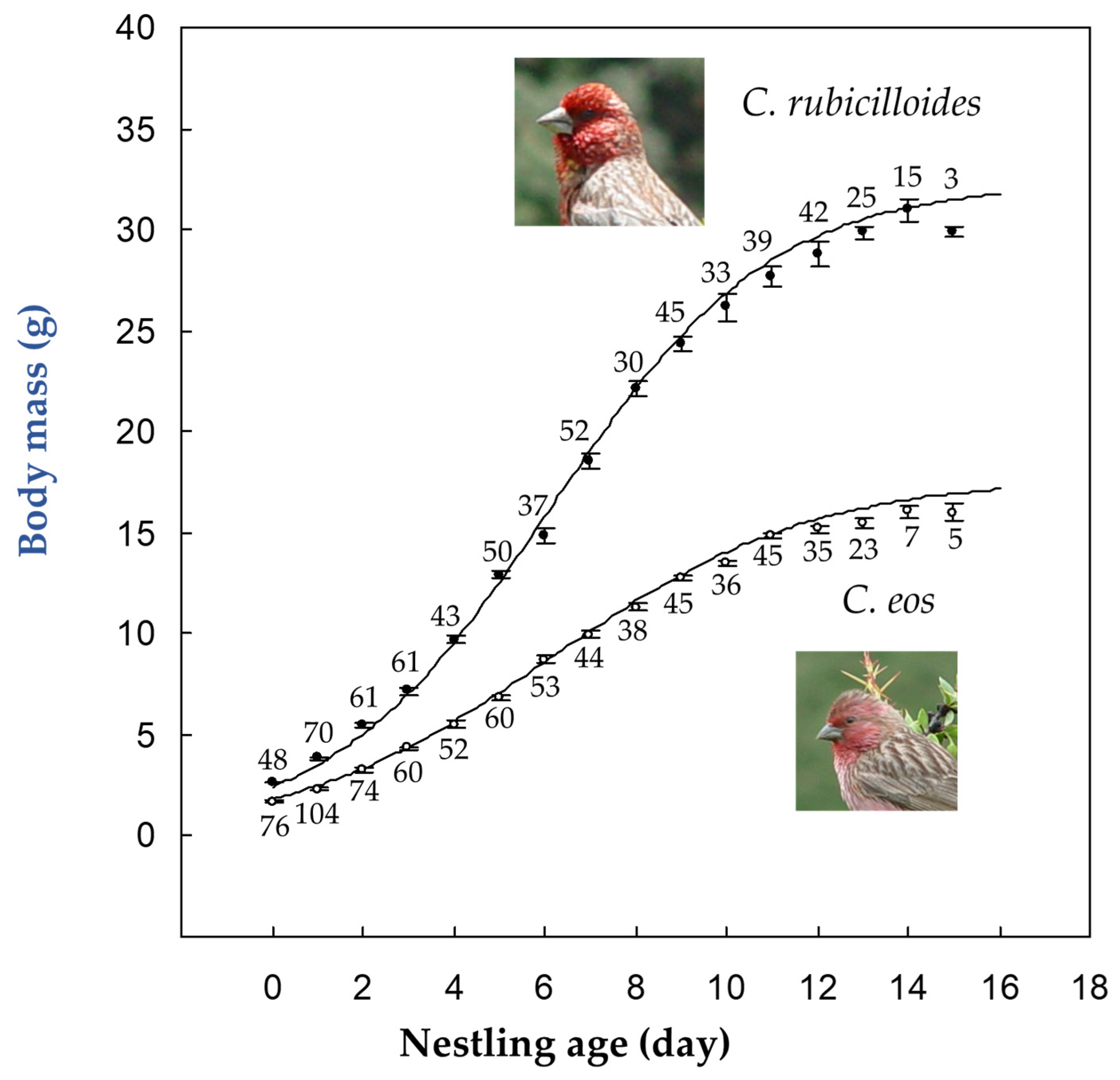
3.1. Interspecific Comparison of Nestling Developmental Patterns Between the Two Alpine Rosefinch Species
3.2. Interspecific Comparison of Growth Parameters Between the Two Alpine Rosefinch Species
3.3. Interspecific Comparison of Growth Parameters Between the Two Alpine and the Two Lowland Rosefinch Species
4. Discussion
5. Conclusions
Author Contributions
Funding
Institutional Review Board Statement
Informed Consent Statement
Data Availability Statement
Acknowledgments
Conflicts of Interest
References
- Clement, P. Streaked Rosefinch (Carpodacus rubicilloides), version 1.0. In Birds of the World; del Hoyo, J., Elliott, A., Sargatal, J., Christie, D.A., de Juana, E., Eds.; Cornell Lab of Ornithology: Ithaca, NY, USA, 2020. [Google Scholar]
- Lu, X.; Gong, G.H.; Ma, X.Y. Niche segregation between two alpine rosefinches: To coexist in extreme environments. Evol. Biol. 2011, 38, 79–87. [Google Scholar] [CrossRef]
- Killpack, T.L.; Karasov, W.H. Growth and development of house sparrows (Passer domesticus) in response to chronic food restriction throughout the nestling period. J. Exp. Biol. 2012, 215, 1806–1815. [Google Scholar] [CrossRef]
- Remeš, V.; Matysioková, B.; Vrána, J. Adaptation and constraint shape the evolution of growth patterns in passerine birds across the globe. Front. Zool. 2020, 17, 29. [Google Scholar] [CrossRef]
- Sauve, D.; Friesen, V.L.; Charmantier, A. The effects of weather on avian growth and implications for adaptation to climate change. Front. Ecol. Evol. 2021, 9, 569741. [Google Scholar] [CrossRef]
- Kapali, G.P.; Callier, V.; Gascoigne, S.J.; Harrison, J.F.; Shingleton, A.W. The steroid hormone ecdysone regulates growth rate in response to oxygen availability. Sci. Rep. 2022, 12, 4730. [Google Scholar] [CrossRef]
- Dmitriew, C.M. The evolution of growth trajectories: What limits growth rate? Biol. Rev. 2011, 86, 97–116. [Google Scholar] [CrossRef]
- Potapov, R.L. Adaptation of birds to life in high mountains in Eurasia. Acta Zool. Sin. 2004, 50, 970–977. [Google Scholar]
- Lu, X. Reproductive ecology of Blackbirds (Turdus merula maximus) in a high-altitude location, Tibet. J. Ornithol. 2005, 146, 72–78. [Google Scholar] [CrossRef]
- Lu, X. Abundance and breeding ecology of Brown Accentors Prunella fulvescens in Lhasa, Tibet. Acta Ornithol. 2006, 41, 121–128. [Google Scholar] [CrossRef][Green Version]
- Lu, X. Breeding ecology of an Old World high-altitude warbler, Phylloscopus affinis. J. Ornithol. 2008, 149, 41–47. [Google Scholar] [CrossRef]
- Lu, X.; Gong, G.H.; Ma, X.Y.; Ke, D.H. Breeding biology of the White-browed Tit-warbler (Leptopoecile sophiae) in alpine shrubs, southern Tibet. Condor 2009, 111, 182–188. [Google Scholar] [CrossRef]
- Gong, G.H. Breeding Ecology of Two Carpodacus rosefinch Species (C. rubicilloides and C. eos) in Alpine Zones Around the Mid-Yalong Zangbo River, Tibet. Master’s Thesis, Wuhan University, Wuhan, China, 2005. [Google Scholar]
- Herrel, A.; Podos, J.; Huber, S.K.; Hendry, A.P. Bite performance and morphology in a population of Darwin’s finches: Implications for the evolution of beak shape. Funct. Ecol. 2005, 19, 43–48. [Google Scholar] [CrossRef]
- Van der Meij, M.A.A.; Bout, R.G. Seed husking time and maximal bite force in finches. J. Exp. Biol. 2006, 209, 3329–3335. [Google Scholar] [CrossRef]
- Gebhart-Henrich, S.G.; Richner, H. Causes of growth variation and its consequences for fitness. In Avian Growth and Development; Starck, J.M., Ricklefs, R.E., Eds.; Oxford University Press: Oxford, UK, 1998; pp. 324–339. [Google Scholar]
- Remeš, V.; Martin, T.E. Environmental influences on the evolution of growth and developmental rates in passerines. Evolution 2002, 56, 2505–2518. [Google Scholar] [CrossRef]
- Eckerström-Liedholm, S.; Sowersby, W.; Gonzalez-Voyer, A.; Rogell, B. Time-limited environments affect the evolution of egg-body size allometry. Evolution 2017, 71, 1900–1910. [Google Scholar] [CrossRef] [PubMed]
- Lu, X.; Zhang, L.Y.; Zeng, X.H. Comparisons of the alpine bird communities across habitats and between autumn and winter in the mid-Yalong Zangbo River valley, Tibet. J. Nat. Hist. 2007, 41, 2511–2527. [Google Scholar] [CrossRef]
- O’Connor, R.J. Growth and metabolism in nesting passerines. In Advances in Avian Physiology; Peaker, M., Ed.; Symposia of the Zoological Society of London: London, UK, 1975; Volume 35, pp. 277–306. [Google Scholar]
- Ricklefs, R.E. Patterns of growth in birds. Ibis 1968, 110, 419–451. [Google Scholar] [CrossRef]
- Stjernberg, T. Breeding biology and population dynamics of the Scarlet Rosefinch Carpodacus erythrinus. In Acta Zoologica Fennica; Societas pro Fauna et Flora Fennica: Helsinki, Finland, 1979; Volume 157, pp. 1–88. [Google Scholar]
- Badyaev, A.V.; Martin, T.E. Individual variation in growth trajectories: Phenotypic and genetic correlations in ontogeny of the House Finch (Carpodacus mexicanus). J. Evol. Biol. 2000, 13, 290–302. [Google Scholar] [CrossRef]
- Ricklefs, R.E.; Starck, J.M. Embryonic growth and development. In Avian Growth and Development; Starck, J.M., Ricklefs, R.E., Eds.; Oxford University Press: Oxford, UK, 1998; pp. 31–58. [Google Scholar]
- Tjørve, K.M.C.; García-Peña, G.E.; Székely, T. Chick growth rates in Charadriiformes: Comparative analyses of breeding climate, development mode and parental care. J. Avian Biol. 2009, 40, 553–558. [Google Scholar] [CrossRef]
- Martin, T.E.; Lloyd, P.; Bosque, C.; Barton, D.C.; Biancucci, A.L.; Cheng, Y.R.; Ton, R. Growth rate variation among passerine species in tropical and temperate sites: An antagonistic interaction between parental food provisioning and nest predation risk. Evolution 2011, 65, 1607–1622. [Google Scholar] [CrossRef]
- Guo, Y.Y.; Gao, H.X.; Lu, X. High-elevation birds grow more slowly but to heavier weights than low-elevation birds. Oecologia 2025, 207, 50. [Google Scholar] [CrossRef] [PubMed]
- West, G.B.; Brown, J.H.; Enquist, B.J. A general model for ontogenetic growth. Nature 2001, 413, 628–631. [Google Scholar] [CrossRef]
- Grant, P.R. Patterns of growth in Darwin’s finches. Proc. R. Soc. B 1981, 212, 403–432. [Google Scholar] [CrossRef]
- Boag, P.T. Growth and allometry of external morphology in Darwin’s finches (Geospiza) on Isla Daphne Major, Galapagos. J. Zool. Lond. 1984, 204, 413–441. [Google Scholar] [CrossRef]
- Burns, K.J. Geographic variation in ontogeny of the fox sparrow. Condor 1993, 95, 652–661. [Google Scholar] [CrossRef]
- Björklund, M. Similarity of growth among great tits (Parus major) and blue tits (P. caeruleus). Biol. J. Linn. Soc. 1996, 58, 343–355. [Google Scholar] [CrossRef]
- Martin, T.E. Food as a limit on breeding birds: A life-history perspective. Ann. Rev. Ecol. Syst. 1987, 18, 453–487. [Google Scholar] [CrossRef]
- Schew, W.A.; Ricklefs, R.E. Developmental plasticity. In Avian Growth and Development; Starck, J.M., Ricklefs, R.E., Eds.; Oxford University Press: Oxford, UK, 1998; pp. 288–304. [Google Scholar]
- Podlesak, D.W.; Blem, C.R. Factors associated with growth of nestling prothonotary warblers. Wilson Bull. 2001, 113, 263–272. [Google Scholar] [CrossRef]
- Nilsson, J.Å.; Gårdmark, A. Sibling competition affects individual growth strategies in marsh tit, Parus palustris, nestlings. Anim. Behav. 2001, 61, 357–365. [Google Scholar] [CrossRef]
- Ricklefs, R.E. Growth rates of birds in the humid New World tropics. Ibis 1976, 118, 179–207. [Google Scholar] [CrossRef]
- Cox, W.A.; Martin, T.E. Breeding biology of the three-Striped warbler in Venezuela: A contrast between tropical and temperate Parulids. Wilson J. Ornithol. 2009, 121, 667–678. [Google Scholar] [CrossRef]
- Landmann, A.; Winding, N. Adaptive radiation and resource partitioning in Himalayan high-altitude finches. Zoology 1995, 99, 8–20. [Google Scholar]
- Landmann, A.; Winding, N. Guild organisation and morphology of high-altitude granivorous and insectivorous birds: Convergent evolution in an extreme environment. Oikos 1995, 73, 237–250. [Google Scholar] [CrossRef]
- Bolnick, D.I.; Fitzpatrick, B. Sympatric speciation: Theory and empirical data. Ann. Rev. Ecol. Evol. Syst. 2007, 38, 459–487. [Google Scholar] [CrossRef]
- Tebbich, S.; Sterelny, K.; Teschke, I. The tale of the finch: Adaptive radiation and behavioural flexibility. Phil. Trans. R Soc. B 2010, 365, 1099–1109. [Google Scholar] [CrossRef] [PubMed]


| Hatchlings | Fledglings | ||||||
|---|---|---|---|---|---|---|---|
| Body Traits | C. rubicilloides | C. eos | C. rubicilloides | C. eos | |||
| Mean ± SD | Mean ± SD | % | Mean ± SD | Mean ± SD | % | % * | |
| Body mass (g) | 2.6 ± 0.3 (29) | 1.6 ± 1.8 (55) | 62.5 | 30.1 ± 1.8 (55) | 15.5 ± 1.2 (40) | 94.2 | 97.0 |
| Bill length (mm) | 3.0 ± 0.4(29) | 2.6 ± 0.1 (55) | 16.6 | 7.9 ± 0.9 (57) | 5.9 ± 0.3 (34) | 33.9 | 49.4 |
| Wing length (mm) | 6.9 ± 0.4 (18) | 5.8 ± 0.5 (55) | 18.6 | 52.9 ± 5.7 (56) | 40.0 ± 5.0 (36) | 32.3 | 38.0 |
| Tarsus length | 6.4 ± 0.5 (29) | 5.2 ± 0.4 (55) | 23.2 | 22.3 ± 0.8 (56) | 17.0 ± 0.8 (38) | 31.2 | 28.7 |
| Tail length (mm) | − | − | − | 25.3 ± 4.1 (55) | 20.0 ± 3.7 (35) | 26.5 | 27.9 |
| Explanatory Variables | Num df | Den df | F | p |
|---|---|---|---|---|
| Intercept | 1 | 36.3 | 1.18 | 0.28 |
| Species | 1 | 36.7 | 8.12 | 0.01 |
| Nesting altitude | 1 | 36.3 | 1.32 | 0.26 |
| Clutch start date | 1 | 41.2 | 0.03 | 0.86 |
| Brood size | 1 | 38.6 | 0.08 | 0.77 |
| Year | 2 | 35.9 | 1.33 | 0.28 |
| Growth Parameters | C. rubicilloides (~40 g) | C. eos (~20 g) | C. erythrinus (~23 g) | C. mexicanus (~20 g) | ||||
|---|---|---|---|---|---|---|---|---|
| Obs. | Pre. | Obs. | Pre. | Obs. | Pre. | Obs. | Pre. | |
| Growth rate constant k (g/day) | 0.41 | 0.45 | 0.35 | 0.49 | 0.55 | 0.48 | 0.63 | 0.49 |
| t10–90 (day) | 11.7 | 9.8 | 12.5 | 9.0 | 8.0 | 9.1 | 7.0 | 9.0 |
| Nestling period (day) | 14.0 | 13.5 | 13.5 | 12.2 | 11.7 | 12.4 | 15.0 | 12.2 |
| Relative fledging mass (%) | 76 | 82 | 77 | 82 | 83 | 82 | 85 | 82 |
Disclaimer/Publisher’s Note: The statements, opinions and data contained in all publications are solely those of the individual author(s) and contributor(s) and not of MDPI and/or the editor(s). MDPI and/or the editor(s) disclaim responsibility for any injury to people or property resulting from any ideas, methods, instructions or products referred to in the content. |
© 2026 by the authors. Licensee MDPI, Basel, Switzerland. This article is an open access article distributed under the terms and conditions of the Creative Commons Attribution (CC BY) license.
Share and Cite
Tan, Y.; Lu, X. Nestling Growth Strategies of Two Sympatric Rosefinch Species in a Tibetan Alpine Habitat. Animals 2026, 16, 761. https://doi.org/10.3390/ani16050761
Tan Y, Lu X. Nestling Growth Strategies of Two Sympatric Rosefinch Species in a Tibetan Alpine Habitat. Animals. 2026; 16(5):761. https://doi.org/10.3390/ani16050761
Chicago/Turabian StyleTan, Yihua, and Xin Lu. 2026. "Nestling Growth Strategies of Two Sympatric Rosefinch Species in a Tibetan Alpine Habitat" Animals 16, no. 5: 761. https://doi.org/10.3390/ani16050761
APA StyleTan, Y., & Lu, X. (2026). Nestling Growth Strategies of Two Sympatric Rosefinch Species in a Tibetan Alpine Habitat. Animals, 16(5), 761. https://doi.org/10.3390/ani16050761