


Fish Welfare in Recirculating Aquaculture Systems (RAS): The Imperative for Environmental Enrichment (EE)


Simple Summary
Abstract
1. Introduction
2. The Importance of Fish Welfare
- (1)
- Feeling-based definitions: These regard farmed animals as sentient beings able to experience feelings and consequently suffer emotionally. Good feeling-based welfare is considered to require a reduction in negative experiences, such as fear or stress, and the substantial presence of positive ones;
- (2)
- Function-based definitions: These consider animal welfare to be a direct function of good health and normal biological growth and functioning, with a focus on the ability of animals to adapt to their current environments. This concept has been criticized for being reductionist, with Ashley [27] (p. 2) claiming physical health to be ‘the most universally accepted measure of welfare and […] undoubtedly required for good welfare’, adding that ‘for many, good welfare goes beyond just physical health and also involves a lack of mental suffering’;
- (3)
- Nature-based definitions: These are based on the inherent biological nature of animals and their expression. In nature-based welfare practices, good welfare is fulfilled if the animals are able to lead natural lives and can engage in natural behaviors.
3. Fish Sentience and Capacity for Pain
The Debate on Pain Perception
4. Fish Welfare Challenges in RAS
- Mechanical devices to filter out solid particles from the water, which include uneaten feed, bacterial flocs, and fish feces;
- Biofilters, which oxidize ammonia excreted by the fish into less toxic nitrate via nitrifying bacteria;
- Gas exchange devices, which remove dissolved CO2 produced by the fish and add the oxygen needed by the fish and the nitrifying bacteria.
- The concentration limits of nitrogenous compounds;
- The concentration limits of dissolved CO2;
- The effects of ozonation;
- The accumulation of recalcitrant compounds.
5. Environmental Enrichment (EE): A New Paradigm
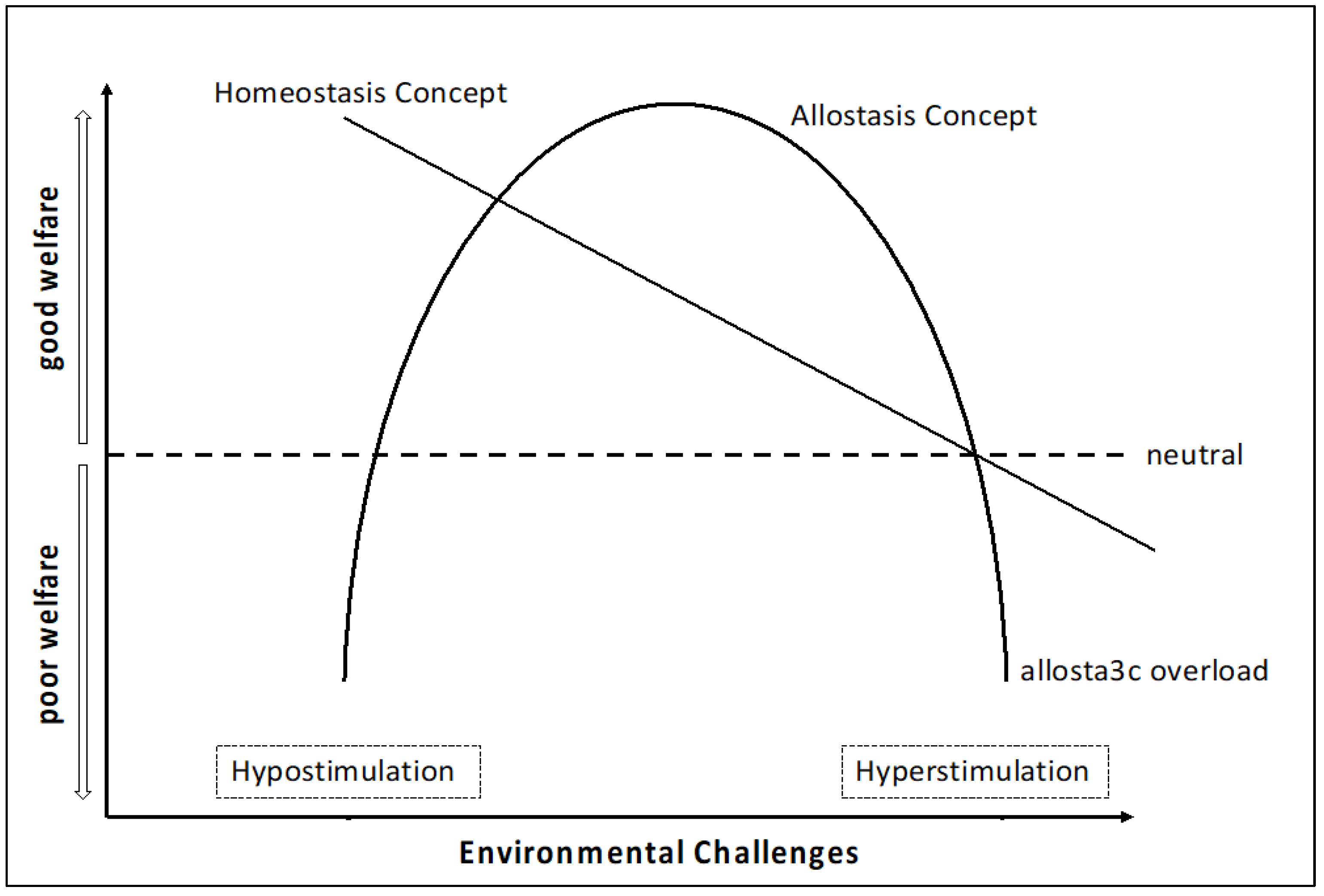
5.1. Beyond the Five Freedoms: The Allostasis Model
5.2. Defining and Implementing Environmental Enrichment (EE)
- Physical enrichment, which includes the addition of structures such as substrates (e.g., gravel, sand), shelters, and tank covers to increase habitat complexity;
- Sensory enrichment, which concerns the brain and sensory organs, including auditory, visual, tactile, taste, or olfactory stimuli;
- Dietary/nutritional enrichment, including variations in feed type and delivery frequency to encourage natural foraging strategies and feeding behaviors [82];
- Social enrichment, which involves adding/removing direct or indirect interactions and contacts with conspecifics as well as with humans to stabilize social hierarchies;
- Occupational enrichment, which involves increasing environmental variation in order to alleviate psychological and physical monotony. This can encompass tools that provide animals with challenges or that encourage exercise [82]. Whilst previously considered secondary for fish [17], recent evidence suggests that occupational tools, such as controlled water currents, significantly enhance growth, flesh quality, and stress resilience [18].
5.3. Challenges in Formulating Species-Specific Environmental Enrichment Guidelines
- Group 1 (Cyprinids): Carps, barbels, and other cyprinids;
- Group 2 (Cichlids): Tilapias and other cichlids;
- Group 3 (Siluriformes): Catfish;
- Group 4 (Salmonids): Salmons, trouts, and smelts
- Diversification of EE modalities: expanding investigation of undertested strategies, specifically dietary, social, and occupational enrichment;
- Broadening the species focus: shifting the research focus from laboratory models (e.g., Danio rerio) to high-output aquaculture species, such as grass carp (Ctenopharyngodon idella) and various pleuronectiforms (flatfish);
- Methodological standardization: establishing consistent trial durations and incorporating ontogenetic variables (e.g., age, sex, developmental stage), as short-term behavioral measures may not reliably predict long-term welfare outcomes [80];
- Commercial integration: assessing the feasibility and efficacy of EE within intensive commercial settings, with a specific focus on establishing welfare criteria tailored for RAS.
6. Conclusions
Author Contributions
Funding
Institutional Review Board Statement
Informed Consent Statement
Data Availability Statement
Conflicts of Interest
References
- FAO. The State of World Fisheries and Aquaculture 2022. Towards Blue Transformation; FAO: Rome, Italy, 2022; p. 1176. Available online: https://openknowledge.fao.org/items/11a4abd8-4e09-4bef-9c12-900fb4605a02 (accessed on 10 January 2026).
- FAO. The State of World Fisheries and Aquaculture: Sustainability in Action; Food and Agriculture Organization of the United Nations: Rome, Italy, 2020; Available online: https://www.fao.org/3/ca9229en/ca9229en.pdf (accessed on 10 January 2026).
- Galparsoro, I.; Murillas, A.; Pinarbasi, K.; Sequeira, A.M.; Stelzenmüller, V.; Borja, Á.; Tett, P. Global stakeholder vision for ecosystem-based marine aquaculture expansion from coastal to offshore areas. Rev. Aquacult. 2020, 12, 2061–2079. [Google Scholar] [CrossRef]
- Billington, T.; King-Nobles, H. Fish Movement Survey Results; Fish Welfare Initiative Report, 2020. Available online: https://www.fishwelfareinitiative.org/fish-movement-survey (accessed on 10 January 2026).
- Hastein, T.; Scarfe, A.D.; Lund, V.L. Science-based assessment of welfare: Aquatic animals. Rev. Sci. Tech. Off. Int. Epiz. 2005, 24, 529–547. [Google Scholar] [CrossRef]
- Teletchea, F.; Fontaine, P. Levels of domestication in fish: Implications for the sustainable future of aquaculture. Fish Fish. 2014, 15, 181–195. [Google Scholar] [CrossRef]
- FAO. The State of World Fisheries and Aquaculture 2018—Meeting the Sustainable Development Goals; Food and Agriculture Organization of the United Nations: Rome, Italy, 2018; Available online: https://openknowledge.fao.org/server/api/core/bitstreams/6fb91ab9-6cb2-4d43-8a34-a680f65e82bd/content (accessed on 10 January 2026).
- Kadri, S. Welfare and aquaculture industry practice. In Aquaculture, Innovation and Social Transformation; Culver, K., Castle, D., Eds.; Springer: Dordrecht, The Netherlands, 2008; pp. 315–326. [Google Scholar]
- Gould, D.; Compagnoni, A.; Lembo, G. Organic Aquaculture: Principles, Standards and Certification. In Organic Aquaculture: Impacts and Future Developments; Lembo, G., Mente, E., Eds.; Springer: Cham, Switzerland, 2019; pp. 1–23. [Google Scholar]
- Ahmed, N.; Thompson, S.; Turchini, G.M. Organic aquaculture productivity, environmental sustainability, and food security: Insights from organic agriculture. In Food Security: The Science, Sociology and Economics of Food Production and Access to Food; Strange, R.N., Ed.; Springer: Cham, Switzerland, 2020; pp. 1253–1267. [Google Scholar]
- European Parliament and Council of the European Union. Regulation (EU) 2018/848 of 30 May 2018 on organic production and labelling of organic products and repealing Council Regulation (EC) No 834/2007; European Parliament and Council of the European Union: Brussels, Belgium, 2018; pp. 1–92. [Google Scholar]
- Kerr, M.; Potthast, T. ‘As close as possible to nature’: Possibilities and constraints for organic aquaculture systems. In Professionals in Food Chains; Springer, S., Grimm, H., Eds.; Wageningen Academic Publishers: Wageningen, The Netherlands, 2018; pp. 450–455. [Google Scholar]
- Bostock, J.; McAndrew, B.; Richards, R.; Jauncey, K.; Telfer, T.; Lorenzen, K.; Little, D.C.; Ross, L.G.; Handisyde, N.; Gatward, I.; et al. Aquaculture: Global status and trends. Philos. Trans. R. Soc. B 2010, 365, 2897–2912. [Google Scholar] [CrossRef]
- EUMOFA. Recirculating Aquaculture Systems; Publications Office of the European Union: Luxembourg, 2020; Available online: https://www.eumofa.eu/documents/20178/84590/RAS+in+the+EU.pdf (accessed on 10 January 2026).
- Ahmed, N.; Turchini, G.M. Recirculating aquaculture systems (RAS): Environmental solution and climate change adaptation. J. Clean. Prod. 2021, 297, 126604. [Google Scholar] [CrossRef]
- Delaide, B.; Monsees, H.; Gross, A.; Goddek, S. Aerobic and anaerobic treatments for aquaponic sludge reduction and mineralisation. In Aquaponics Food Production Systems; Goddek, S., Joyce, A., Kotzen, B., Burnell, G., Eds.; SpringerOpen: Cham, Switzerland, 2019; pp. 247–267. [Google Scholar]
- Gerber, B.; Stamer, A.; Stadtlander, T. Environmental Enrichment and its Effects on Welfare in Fish; FiBL Schweiz/Suisse: Frick, Germany, 2015; Available online: https://orgprints.org/id/eprint/29142/1/Gerber-etal-2015-Environmental-Enrichment-and-its-effects-on-welfare-in-fish-FiBL-Review.pdf (accessed on 10 January 2026).
- Arechavala-Lopez, P.; Cabrera-Álvarez, M.J.; Maia, C.M.; Saraiva, J.L. Environmental enrichment in fish aquaculture: A review of fundamental and practical aspects. Rev. Aquacult. 2022, 14, 704–728. [Google Scholar] [CrossRef]
- Cambridge Dictionary. Definition of ‘Fish’. Available online: https://dictionary.cambridge.org/dictionary/english/fish (accessed on 7 December 2022).
- Eurogroup for Animals. Looking Beneath the Surface: Fish Welfare in European Aquaculture; Eurogroup for Animals: Brussels, Belgium, 2018; Available online: https://www.eurogroupforanimals.org/files/eurogroupforanimals/2021-12/Fish-Welfare-in-European-Aquaculture-2.pdf (accessed on 10 January 2026).
- FishBase. Available online: https://www.fishbase.de/home.htm (accessed on 10 January 2026).
- AHAW. Scientific Opinion of the Panel on Animal Health and Welfare on a request from European Commission on General approach to fish welfare and to the concept of sentience in fish. EFSA J. 2009, 954, 1–26. [Google Scholar]
- Evans, D.H.; Piermarini, P.M.; Choe, K.P. The multifunctional fish gill: Dominant site of gas exchange, osmoregulation, acid-base regulation, and excretion of nitrogenous waste. Physiol. Rev. 2005, 85, 97–177. [Google Scholar] [CrossRef]
- Solgaard, H.S.; Yang, Y.; Nguyen, T.T. An investigation of consumers’ preference and willingness to pay for fish welfare in Denmark: A discrete choice modeling approach. Aquaculture 2023, 574, 739652. [Google Scholar] [CrossRef]
- Turnbull, J.F.; Kadri, S. Safeguarding the many guises of farmed fish welfare. Dis. Aquat. Org. 2007, 75, 173–182. [Google Scholar] [CrossRef] [PubMed]
- Cerqueira, M.; Billington, T. Defining ‘Welfare’ for Fish. Fish Welfare Initiative Report, 2020. Available online: https://www.fishwelfareinitiative.org/fish-welfare-definition (accessed on 10 January 2026).
- Ashley, P.J. Fish welfare: Current issues in aquaculture. Appl. Anim. Behav. Sci. 2007, 104, 199–235. [Google Scholar] [CrossRef]
- Kirkwood, J.K. Quality of life: The heart of the matter. Anim. Welf. 2007, 16, 3–7. [Google Scholar] [CrossRef]
- Brown, C. Fish intelligence, sentience and ethics. Anim. Cogn. 2015, 18, 1–17. [Google Scholar] [CrossRef]
- Appleby, M.C.; Sandøe, P.T. Philosophical debate on the nature of well-being: Implications for animal welfare. Anim. Welf. 2002, 11, 283–294. [Google Scholar] [CrossRef]
- Chandroo, K.P.; Duncan, I.J.H.; Moccia, R.D. Can fish suffer? Perspectives on sentience, pain, fear and stress. Appl. Anim. Behav. Sci. 2004, 86, 225–250. [Google Scholar] [CrossRef]
- Kirkwood, J.K.; Hubrecht, R. Animal consciousness, cognition and welfare. Anim. Welf. 2001, 10, 5–17. [Google Scholar] [CrossRef]
- Huntingford, F.A.; Adams, C.; Braithwaite, V.A.; Kadri, S.; Pottinger, T.G.; Sandøe, P.; Turnbull, J.F. Current issues in fish welfare. J. Fish Biol. 2006, 68, 332–372. [Google Scholar] [CrossRef]
- Ari, C.; D’Agostino, D.P. Contingency checking and self-directed behaviors in giant manta rays: Do elasmobranchs have self-awareness? J. Ethol. 2016, 34, 167–174. [Google Scholar] [CrossRef]
- Kohda, M.; Hotta, T.; Takeyama, T.; Awata, S.; Tanaka, H.; Asai, J.; Jordan, A.L. If a fish can pass the mark test, what are the implications for consciousness and self-awareness testing in animals? PLoS Biol. 2019, 17, e3000021. [Google Scholar] [CrossRef]
- Kittilsen, S. Functional aspects of emotions in fish. Behav. Process. 2013, 100, 153–159. [Google Scholar] [CrossRef]
- Mood, A. Worse Things Happen at Sea: The Welfare of Wild-Caught Fish. Available online: http://www.fishcount.org.uk/published/standard/fishcountfullrptSR.pdf (accessed on 10 January 2026).
- Rose, J.D. The neurobehavioral nature of fishes and the question of awareness and pain. Rev. Fish. Sci. 2002, 10, 1–38. [Google Scholar] [CrossRef]
- Wendelaar Bonga, S.E. The stress response in fish. Physiol. Rev. 1997, 77, 591–625. [Google Scholar] [CrossRef] [PubMed]
- Winberg, S.; Nilsson, G.E. Roles of brain monoamine neurotransmitters in agonistic behavior and stress reactions, with particular reference to fish. Comp. Biochem. Physiol. C Pharmacol. Toxicol. Endocrinol. 1993, 106, 597–614. [Google Scholar] [CrossRef]
- Thompson, R.R.; Walton, J.C. Peptide effects on social behavior: Effects of vasotocin and isotocin on social approach behavior in male goldfish (Carassius auratus). Behav. Neurosci. 2004, 118, 620–626. [Google Scholar] [CrossRef]
- Broom, D.M. Evolution of pain. Vlaams Diergeneeskd. Tijdschr. 2001, 70, 17–21. [Google Scholar] [CrossRef]
- Rose, J.D.; Arlinghaus, R.; Cooke, S.J.; Diggles, B.K.; Sawynok, W.; Stevens, E.D.; Wynne, C.D.L. Can fish really feel pain? Fish Fish. 2014, 15, 97–133. [Google Scholar] [CrossRef]
- Sneddon, L.; Braithwaite, V.; Gentle, M. Do fishes have nociceptors? Evidence for the evolution of a vertebrate sensory system. Proc. R. Soc. B 2003, 270, 1115–1121. [Google Scholar] [CrossRef]
- Dawkins, M.S. Who needs consciousness? Anim. Welf. 2001, 10, 19–29. [Google Scholar] [CrossRef]
- Broom, D.M. Fish brains and behaviour indicate capacity for feeling pain. Anim. Sentience 2016, 1, 4. [Google Scholar] [CrossRef]
- Sneddon, L.U.; Leach, M.C. Anthropomorphic denial of fish pain. Anim. Sentience 2016, 3, 28. [Google Scholar] [CrossRef]
- Brown, C. Fish pain: An inconvenient truth. Commentary II on Key on fish pain. Anim. Sentience 2016, 1, 32. [Google Scholar] [CrossRef]
- Seth, A.K. Why fish pain cannot and should not be ruled out. Anim. Sentience 2016, 1, 14. [Google Scholar] [CrossRef]
- Striedter, G. Lack of neocortex does not imply fish cannot feel pain. Anim. Sentience 2016, 1, 15. [Google Scholar] [CrossRef]
- Barton, R.A.; Venditti, C. Human frontal lobes are not relatively large. Proc. Natl. Acad. Sci. USA 2013, 110, 9001–9006. [Google Scholar] [CrossRef]
- Tononi, G.; Edelman, G. Consciousness and complexity. Science 1998, 282, 1846–1851. [Google Scholar] [CrossRef]
- Key, B. Why fish do not feel pain. Anim. Sentience 2016, 3. [Google Scholar] [CrossRef]
- Braithwaite, V.A.; Droege, P. Why human pain can’t tell us whether fish feel pain: Commentary on Key on fish pain. Anim. Sentience 2016, 1, 3. [Google Scholar] [CrossRef]
- Espinal, C.A.; Matulić, D. Recirculating aquaculture technologies. In Aquaponics Food Production Systems; Goddek, S., Joyce, A., Kotzen, B., Burnell, G., Eds.; SpringerOpen: Cham, Switzerland, 2019; pp. 35–76. [Google Scholar]
- Martins, C.I.M.; Eding, E.H.; Verdegem, M.C.J.; Heinsbroek, L.T.N.; Schneider, O.; Blancheton, J.P.; Roqued’Orbcasteld, E.; Verretha, J.A.J. New developments in recirculating aquaculture systems in Europe: A perspective on environmental sustainability. Aquacult. Eng. 2010, 43, 83–93. [Google Scholar] [CrossRef]
- Fruscella, L.; Kotzen, B.; Milliken, S. Organic aquaponics in the European Union: Towards sustainable farming practices in the framework of the new EU regulation. Rev. Aquacult. 2021, 13, 1661–1682. [Google Scholar] [CrossRef]
- CIWF. The Welfare of Farmed Fish. Compassion in World Farming Briefing, 2009. Available online: https://www.ciwf.org.uk/media/3818654/farmed-fish-briefing.pdf (accessed on 10 January 2026).
- Calabrese, S.; Nilsen, T.O.; Kolarevic, J.; Ebbesson, L.O.E.; Pedrosa, C.; Fivelstad, S.; Hosfelde, C.; Stefanssona, S.O.; Taklefc, H.; Martinsc, C.I.M.; et al. Stocking density limits for post-smolt Atlantic salmon (Salmo salar L.) with emphasis on production performance and welfare. Aquaculture 2017, 468, 363–370. [Google Scholar] [CrossRef]
- Conte, F.S. Stress and the welfare of cultured fish. Appl. Anim. Behav. Sci. 2004, 86, 205–223. [Google Scholar] [CrossRef]
- Ellis, T.; North, B.; Scott, A.P.; Bromage, N.R.; Porter, M.; Gadd, D. The relationships between stocking density and welfare in farmed rainbow trout. J. Fish Biol. 2002, 61, 493–531. [Google Scholar] [CrossRef]
- Vazzana, M.; Cammarata, M.; Cooper, E.L.; Parrinello, N. Confinement stress in sea bass (Dicentrarchus labrax) depresses peritoneal leukocyte cytotoxicity. Aquaculture 2002, 210, 231–243. [Google Scholar] [CrossRef]
- Jørgensen, E.H.; Christiansen, J.S.; Jobling, M. Effects of stocking density on food intake, growth performance and oxygen consumption in Arctic char (Salvelinus alpinus). Aquaculture 1993, 110, 191–204. [Google Scholar] [CrossRef]
- Global Animal Partnership. Animal Welfare Standards for Farmed Atlantic Salmon v1.0; Global Animal Partnership: Austin, TX, USA, 2022; Available online: https://globalanimalpartnership.org/wp-content/uploads/2022/06/G.A.P.Animal-Welfare-Standards-for-Farmed-Atlantic-Salmon-v1.0.20220615.pdf (accessed on 5 February 2026).
- Dellacqua, Z.; Di Biagio, C.; Costa, C.; Pousão-Ferreira, P.; Ribeiro, L.; Barata, M.; Gavaia, P.J.; Mattei, F.; Fabris, A.; Izquierdo, M.; et al. Distinguishing the effects of water volumes versus stocking densities on the skeletal quality during the pre-ongrowing phase of gilthead seabream (Sparus aurata). Animals 2023, 13, 557. [Google Scholar] [CrossRef]
- Duan, S.; Vasconcelos, R.O.; Wu, L.; Li, X.; Sun, W.; Li, X. Managing aquaculture noise: Impacts on fish hearing, welfare, and mitigation strategies. Rev. Aquacult. 2025, 17, e70013. [Google Scholar] [CrossRef]
- Ruchin, A.B. Effect of illumination on fish and amphibians: Development, growth and physiological processes. Rev. Aquacult. 2020, 13, 567–600. [Google Scholar] [CrossRef]
- Stentiford, G.D.; Sritunyalucksana, K.; Flegel, T.W.; Williams, B.A.P.; Withyachumnarnkul, B.; Itsathitphaisarn, O.; Bass, D. New paradigms to help solve the global aquaculture disease crisis. PLoS Pathog. 2017, 13, e1006160. [Google Scholar] [CrossRef]
- OIE. Animal Welfare. Available online: https://www.woah.org/en/what-we-do/animal-health-and-welfare/animal-welfare/#:~:text=According%20to%20the%20Terrestrial%20Code,socio%2Deconomic%20and%20ecological%20systems (accessed on 10 January 2026).
- Mellor, D.J. Updating animal welfare thinking: Moving beyond the “five freedoms” towards “A life worth living”. Animals 2016, 6, 21. [Google Scholar] [CrossRef]
- Raposo de Magalhães, C.S.F.; Cerqueira, M.A.C.; Schrama, D.; Moreira, M.J.V.; Boonanuntanasarn, S.; Rodrigues, P.M.L. A proteomics and other omics approach in the context of farmed fish welfare and biomarker discovery. Rev. Aquacult. 2020, 12, 122–144. [Google Scholar] [CrossRef]
- Mellor, D.J.; Beausoleil, N.J. Extending the ‘Five Domains’ model for animal welfare assessment to incorporate positive welfare states. Anim. Welf. 2015, 24, 315–317. [Google Scholar] [CrossRef]
- McEwen, B.S.; Wingfield, J.C. Allostasis and allostatic load. In Encyclopedia of Stress; Fink, G., Ed.; Academic Press: New York, NY, USA, 2007; pp. 135–141. [Google Scholar]
- Romero, L.M.; Dickens, M.J.; Cyr, N.E. The reactive scope model—A new model integrating homeostasis, allostasis and stress. Horm. Behav. 2009, 55, 375–389. [Google Scholar] [CrossRef] [PubMed]
- FAWC. Farm Animal Welfare in Great Britain: Past, Present and Future; Farm Animal Welfare Council: London, UK, 2009. Available online: https://assets.publishing.service.gov.uk/government/uploads/system/uploads/attachment_data/file/319292/Farm_Animal_Welfare_in_Great_Britain_-_Past__Present_and_Future.pdf (accessed on 10 January 2026).
- Green, T.C.; Mellor, D.J. Extending ideas about animal welfare assessment to include ‘quality of life’ and related concepts. N.Z. Vet. J. 2011, 59, 26–71. [Google Scholar] [CrossRef]
- Spiliopoulos, O.; Brown, C.; Hilder, P.; Tilbrook, A.; Descovich, K. The path to resilience: Improving welfare in aquaculture through physical exercise and stressor predictability training. Rev. Aquacult. 2025, 1, e70051. [Google Scholar] [CrossRef]
- Korte, S.M.; Olivier, B.; Koolhaas, J.M. A new animal welfare concept based on allostasis. Physiol. Behav. 2007, 92, 422–428. [Google Scholar] [CrossRef]
- Shepherdson, D.J. Tracing the path of environmental enrichment in zoos. In Second Nature: Environmental Enrichment for Captive Animals; Shepherdson, D.J., Mellen, J.D., Hutchins, M., Eds.; Smithsonian Institution Press: Washington, DC, USA; University of California: Berkeley, CA, USA, 1998; pp. 1–12. [Google Scholar]
- Näslund, J.; Johnsson, J.I. Environmental enrichment for fish in captive environments: Effects of physical structures and substrates. Fish Fish. 2016, 17, 1–30. [Google Scholar] [CrossRef]
- Young, R.J. Environmental Enrichment for Captive Animals; Blackwell Science Ltd.: Oxford, UK, 2003. [Google Scholar]
- Bloomsmith, M.A.; Brent, L.Y.; Schapiro, S.J. Guidelines for developing and managing an environmental enrichment program for nonhuman primates. Lab. Anim. Sci. 1991, 41, 372–377. [Google Scholar]
- Zhang, Z.; Gao, L.; Zhang, X. Environmental enrichment increases aquatic animal welfare: A systematic review and meta-analysis. Rev. Aquacult. 2022, 14, 1120–1135. [Google Scholar] [CrossRef]
- Näslund, J.; Rosengren, M.; Del Villar, D.; Gansel, L.; Norrgård, J.R.; Persson, L.; Winkowski, J.J.; Kvingedal, E. Hatchery tank enrichment affects cortisol levels and shelter-seeking in Atlantic salmon (Salmo salar). Can. J. Fish. Aquat. Sci. 2013, 70, 585–590. [Google Scholar] [CrossRef]
- Volpato, G.L.; Duarte, C.R.A.; Luchiari, A.C. Environmental color affects Nile tilapia reproduction. Braz. J. Med. Biol. Res. 2004, 37, 479–483. [Google Scholar] [CrossRef]
- Castanheira, M.F.; Conceição, L.E.C.; Millot, S.; Rey, S.; Bégout, M.-L.; Damsgård, B.; Kristiansen, T.; Höglund, E.; Øverli, Ø.; Martins, C.I.M. Coping styles in farmed fish: Consequences for aquaculture. Rev. Aquacult. 2017, 9, 23–41. [Google Scholar] [CrossRef]
- Koene, P. Behavioral ecology of captive species: Using behavioural adaptations to assess and enhance welfare of nonhuman zoo animals. J. Appl. Anim. Welf. Sci. 2013, 16, 360–380. [Google Scholar] [CrossRef] [PubMed]
- Portas, T. Achieving positive animal welfare outcomes in zoos and aquariums. In When Coping Is Not Enough: Promoting Positive Welfare States in Animals; Proceedings of the RSPCA Australia Scientific Seminar, Canberra, ACT, Australia, 26 February 2013; RSPCA Australia: Deakin West, ACT, Australia, 2013; pp. 46–50. [Google Scholar]
- Siegford, J.M. Multidisciplinary approaches and assessment techniques to better understand and enhance zoo nonhuman animal welfare. J. Appl. Anim. Welf. Sci. 2013, 16, 300–318. [Google Scholar] [CrossRef] [PubMed]
- Kagan, R.; Carter, S.; Allard, S. A universal animal welfare framework for zoos. J. Appl. Anim. Welf. Sci. 2015, 18, S1–S10. [Google Scholar] [CrossRef]
- Cai, J.; Zhou, X.; Yan, X.; Lucente, D.; Lagana, C. Top 10 Species Groups in Global Aquaculture 2017; FAO: Rome, Italy, 2017; Available online: https://openknowledge.fao.org/server/api/core/bitstreams/e615939c-75d6-4e99-9282-76379f76d699/content (accessed on 10 January 2026).
- Torrezani, C.S.; Pinho-Neto, C.F.; Miyai, C.A.; Sanches, F.H.C.; Barreto, R.E. Structural enrichment reduces aggression in Tilapia rendalli. Mar. Freshw. Behav. Physiol. 2013, 46, 183–190. [Google Scholar] [CrossRef]
- Barreto, R.E.; Carvalho, G.G.A.; Volpato, G.L. The aggressive behavior of Nile tilapia introduced into novel environments with variation in enrichment. Zoology 2011, 114, 53–57. [Google Scholar] [CrossRef]
- COST Action 867. Welfare of Fish in European Aquaculture. Available online: https://www.cost.eu/actions/867/#tabs (accessed on 10 January 2026).
- Saraiva, J.L.; Castanheira, M.F.; Arechavala-López, P.; Volstorf, J.; Studer, B.H. Domestication and welfare in farmed fish. In Animal Domestication; Saraiva, J.L., Castanheira, M.F., Arechavala-López, P., Volstorf, J., Studer, B.H., Eds.; IntechOpen: London, UK, 2018; pp. 109–135. [Google Scholar]
- Blokhuis, H.J.; Veissier, I.; Miele, M.; Jones, B. The Welfare Quality project and beyond: Safeguarding farm animal well-being. Anim. Sci. 2010, 60, 129–140. [Google Scholar] [CrossRef]
- Pietsch, C. Editorial: Fish welfare in aquaculture and research—Where are we going? Animals 2025, 15, 2367. [Google Scholar] [CrossRef]
- Reiser, S.; Illing, B.; Pohlmann, D.M.; Focken, U. Environmental enrichment during early rearing of salmonids: Practical implementation in commercial hatcheries. Aquaculture 2025, 742995. [Google Scholar] [CrossRef]
- Pulcini, D.; Russo, T.; Reale, P.; Massa-Gallucci, A.; Brennan, G.; Cataudella, S. Rainbow trout (Oncorhynchus mykiss, Walbaum) develop a more robust body shape under organic rearing. Aquacult. Res. 2014, 45, 397–409. [Google Scholar] [CrossRef]
Disclaimer/Publisher’s Note: The statements, opinions and data contained in all publications are solely those of the individual author(s) and contributor(s) and not of MDPI and/or the editor(s). MDPI and/or the editor(s) disclaim responsibility for any injury to people or property resulting from any ideas, methods, instructions or products referred to in the content. |
© 2026 by the authors. Licensee MDPI, Basel, Switzerland. This article is an open access article distributed under the terms and conditions of the Creative Commons Attribution (CC BY) license.
Share and Cite
Fruscella, L.; Passantino, A.; Kotzen, B. Fish Welfare in Recirculating Aquaculture Systems (RAS): The Imperative for Environmental Enrichment (EE). Animals 2026, 16, 635. https://doi.org/10.3390/ani16040635
Fruscella L, Passantino A, Kotzen B. Fish Welfare in Recirculating Aquaculture Systems (RAS): The Imperative for Environmental Enrichment (EE). Animals. 2026; 16(4):635. https://doi.org/10.3390/ani16040635
Chicago/Turabian StyleFruscella, Lorenzo, Annamaria Passantino, and Benz Kotzen. 2026. "Fish Welfare in Recirculating Aquaculture Systems (RAS): The Imperative for Environmental Enrichment (EE)" Animals 16, no. 4: 635. https://doi.org/10.3390/ani16040635
APA StyleFruscella, L., Passantino, A., & Kotzen, B. (2026). Fish Welfare in Recirculating Aquaculture Systems (RAS): The Imperative for Environmental Enrichment (EE). Animals, 16(4), 635. https://doi.org/10.3390/ani16040635

