Determining Minimum Trial Numbers for Reliable Lameness Detection in Canine Kinematic Studies


Simple Summary
Abstract
1. Introduction
2. Materials and Methods
2.1. Animals
2.2. Lameness Induction Model
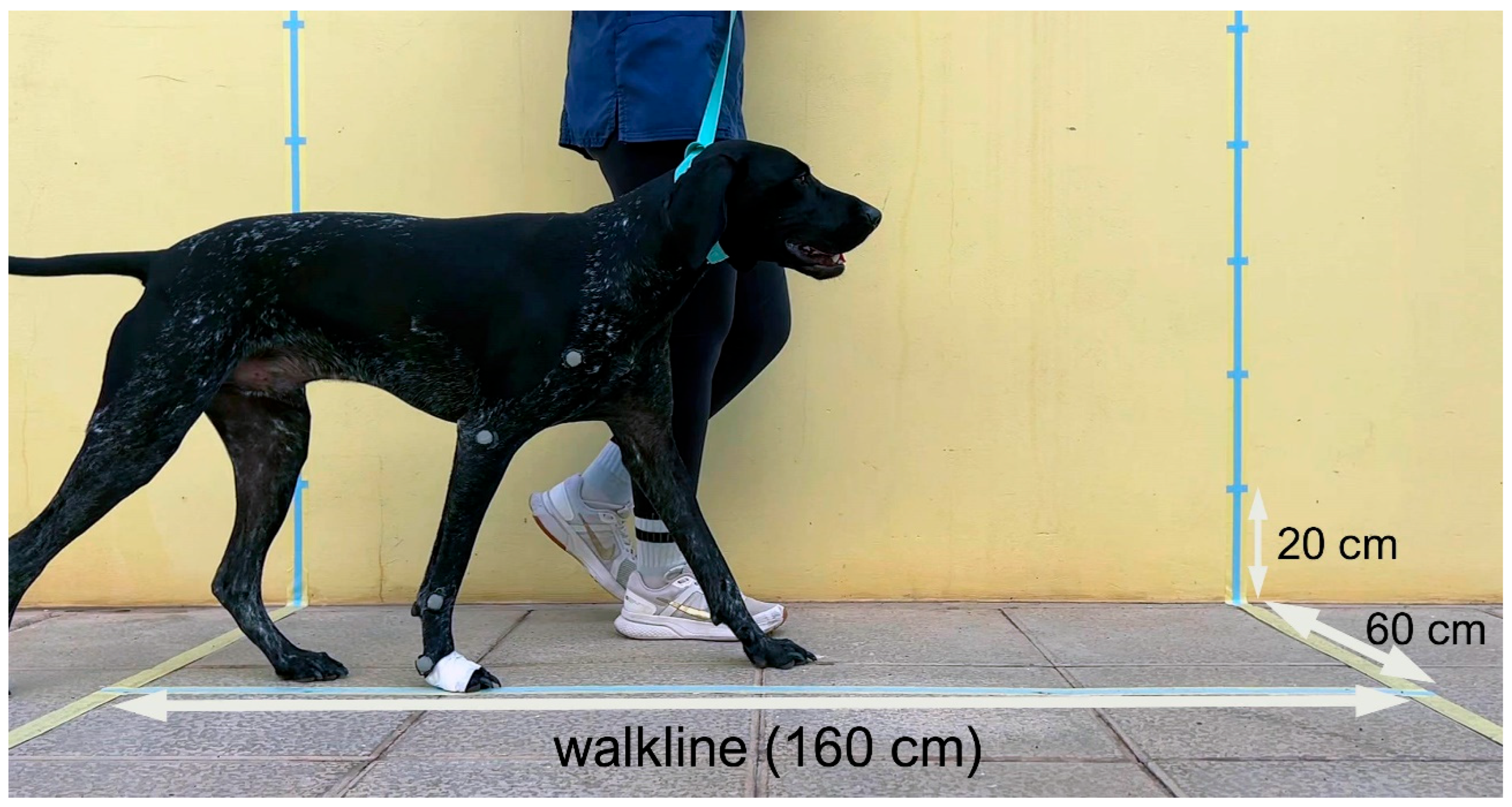
2.3. Data Acquisition
2.4. Data Processing and Outcome Variables
2.5. Statistical Analysis
2.5.1. Statistical Framework and the Delta Method
2.5.2. Application to Symmetry Indices (SI and SA)
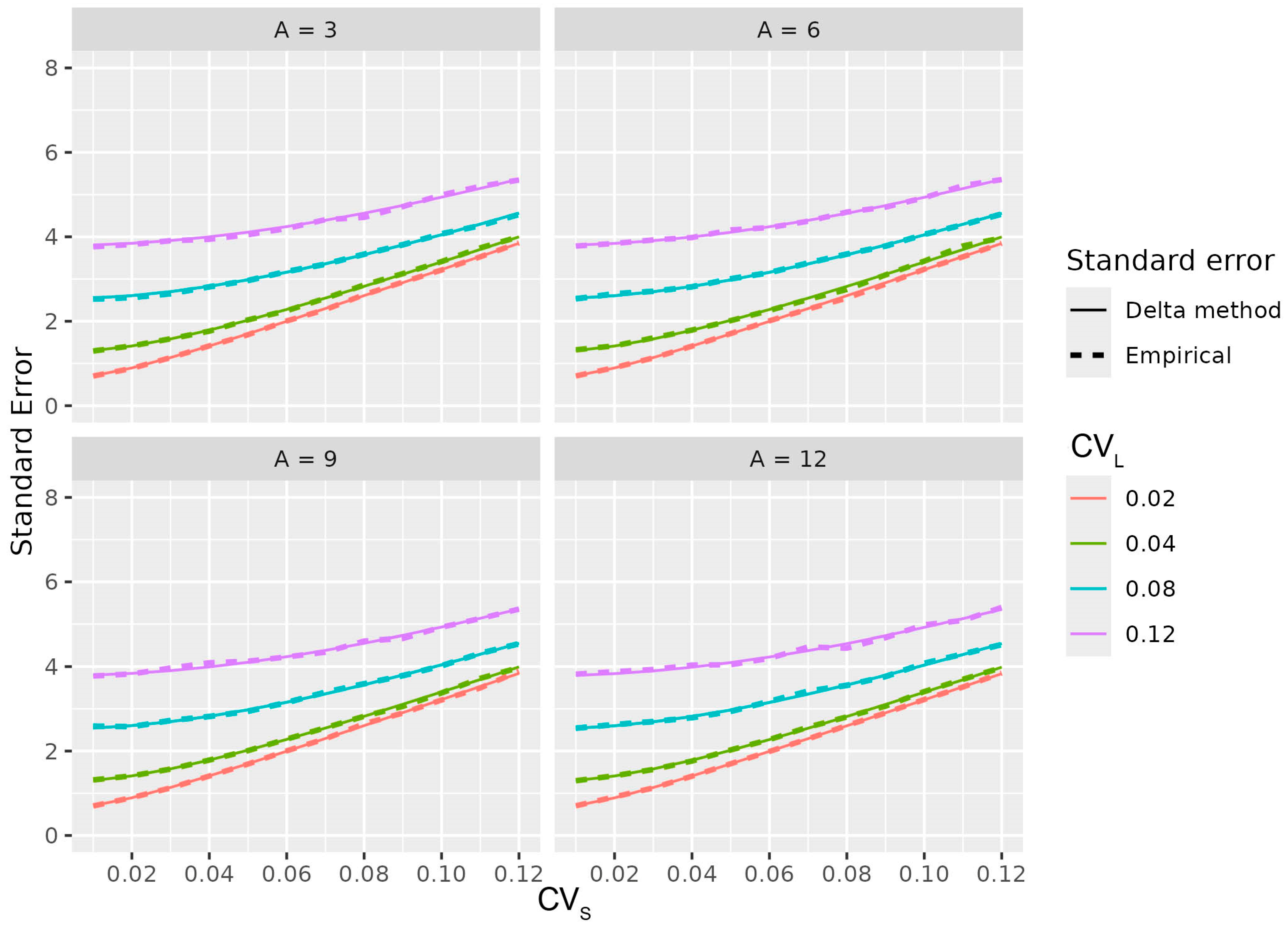
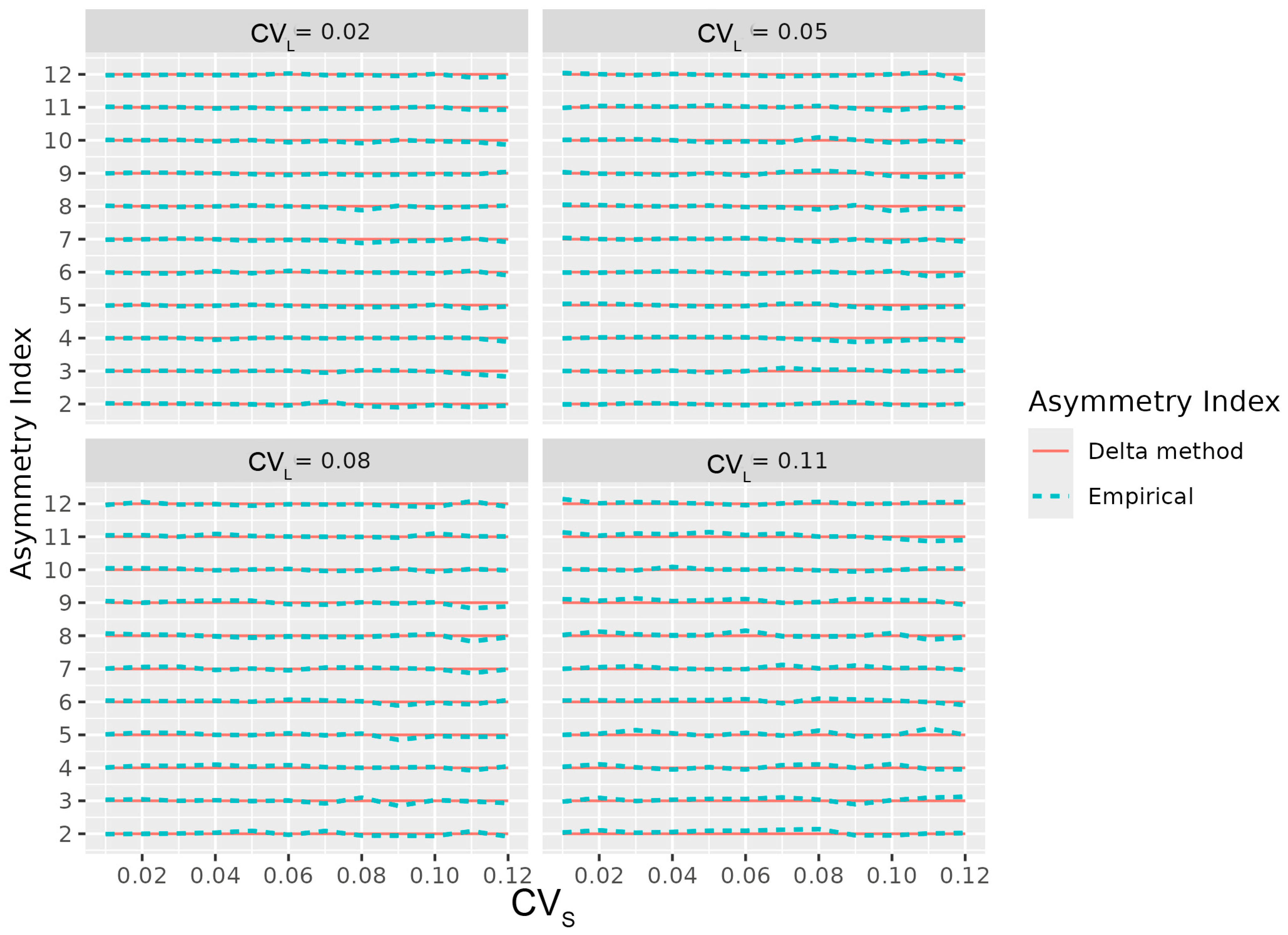
2.5.3. Validation with Simulations
2.5.4. Statistical Inference: CIs and Hypothesis Testing
2.5.5. Power and Sample-Size Calculation
3. Results
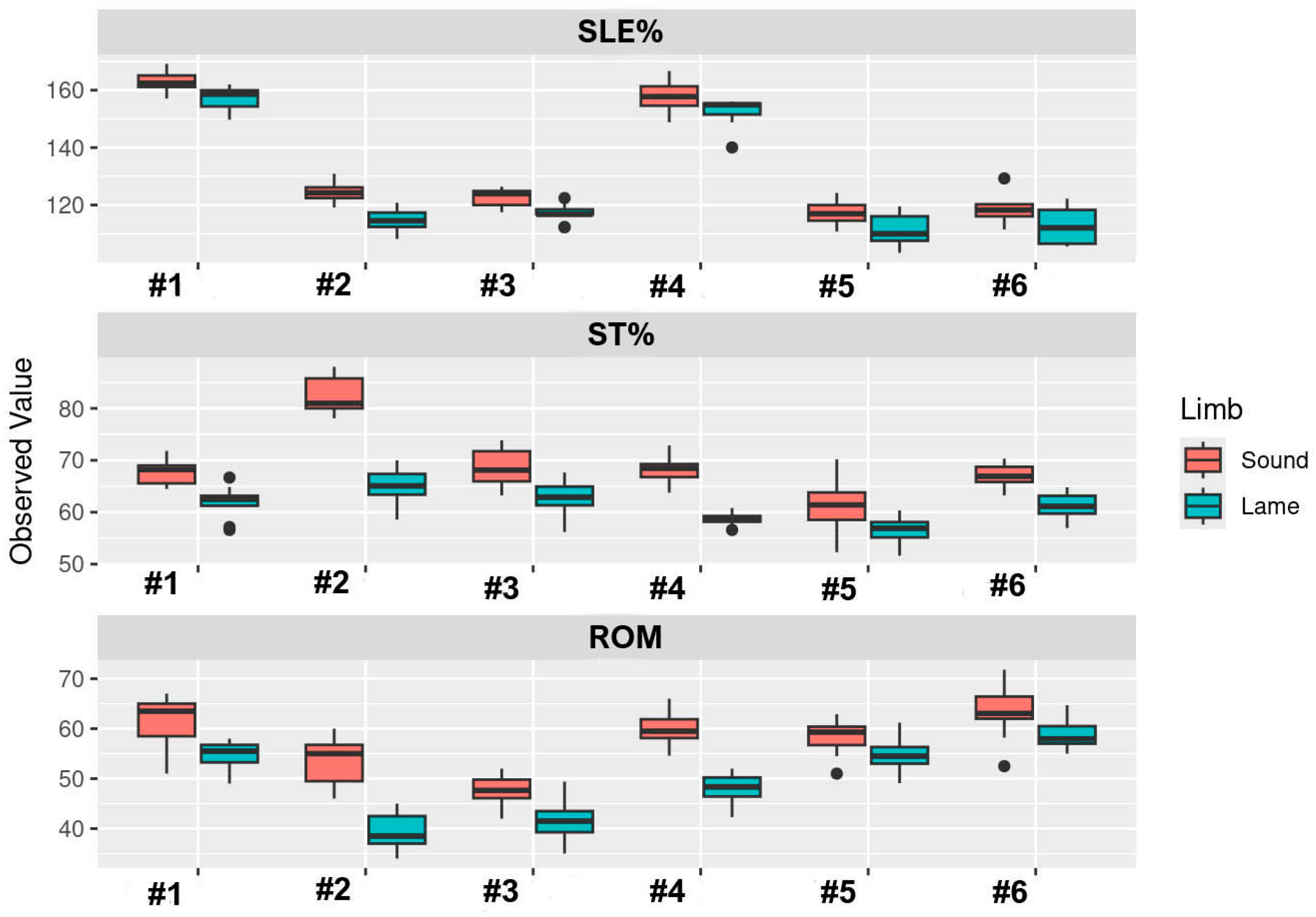
3.1. Kinematic Parameters and Induced Asymmetry
3.2. Data Distribution and Variability
3.3. Symmetry Indices and Inferential Statistics
3.4. Power and Sample-Size Estimation
4. Discussion
5. Conclusions
Author Contributions
Funding
Institutional Review Board Statement
Informed Consent Statement
Data Availability Statement
Acknowledgments
Conflicts of Interest
Abbreviations
| SD | Standard deviation |
| ICC | Intraclass correlation |
| SI | Symmetry index |
| SL | Sound limb |
| LL | Lame limb |
| SA | Symmetry angle |
| ROM | Angular range of motion |
| SLE | Stride length |
| ST | Stance time |
| CV | Coefficient of variation |
| CI | Confidence interval |
References
- Waxman, A.S.; Robinson, D.A.; Evans, R.B.; Hulse, D.A.; Innes, J.F.; Conzemius, M.G. Relationship between objective and subjective assessment of limb function in normal dogs with an experimentally induced lameness. Vet. Surg. 2008, 37, 241–246. [Google Scholar] [CrossRef]
- Evans, R.; Horstman, C.; Conzemius, M. Accuracy and optimization of force platform gait analysis in Labradors with cranial cruciate disease evaluated at a walking gait. Vet. Surg. 2005, 34, 445–449. [Google Scholar] [CrossRef]
- Quinn, M.M.; Keuler, N.S.; Lu, Y.; Faria, M.L.E.; Muir, P.; Markel, M.D. Evaluation of agreement between numerical rating scales, visual analogue scoring scales, and force plate gait analysis in dogs. Vet. Surg. 2007, 36, 360–367. [Google Scholar] [CrossRef]
- Abdelhadi, J.; Wefstaedt, P.; Galindo-Zamora, V.; Anders, A.; Nolte, I.; Schilling, N. Load redistribution in walking and trotting Beagles with induced forelimb lameness. Am. J. Vet. Res. 2013, 74, 34–39. [Google Scholar] [CrossRef]
- Rhodin, M.; Bergh, A.; Gustås, P.; Gómez Álvarez, C.B. Inertial sensor-based system for lameness detection in trotting dogs with induced lameness. Vet. J. 2017, 222, 54–59. [Google Scholar] [CrossRef]
- Gómez Álvarez, C.B.; Gustås, P.; Bergh, A.; Rhodin, M. Vertical head and pelvic movement symmetry at the trot in dogs with induced supporting limb lameness. Vet. J. 2017, 229, 13–18. [Google Scholar] [CrossRef] [PubMed]
- Bockstahler, B.A.; Vobornik, A.; Müller, M.; Peham, C. Compensatory load redistribution in naturally occurring osteoarthritis of the elbow joint and induced weight-bearing lameness of the forelimbs compared with clinically sound dogs. Vet. J. 2009, 180, 202–212. [Google Scholar] [CrossRef] [PubMed]
- Park, C.; Sawyere, D.M.; Pancotto, T.E.; Lanz, O.I.; Were, S.R. Characterization of spatiotemporal and kinetic gait variables in dogs with hindlimb ataxia and bilateral hindlimb lameness. BMC Vet. Res. 2024, 20, 405. [Google Scholar] [CrossRef] [PubMed]
- Colborne, G.R. Are sound dogs mechanically symmetric at trot? No, actually. Vet. Comp. Orthop. Traumatol. 2008, 21, 294–301. [Google Scholar]
- Budsberg, S.C.; Jevens, D.J.; Brown, J.; Foutz, T.L.; DeCamp, C.E.; Reece, L. Evaluation of limb symmetry indices, using ground reaction forces in healthy dogs. Am. J. Vet. Res. 1993, 54, 1569–1574. [Google Scholar] [CrossRef]
- Fanchon, L.; Grandjean, D. Accuracy of asymmetry indices of ground reaction forces for diagnosis of hind limb lameness in dogs. Am. J. Vet. Res. 2007, 68, 1089–1094. [Google Scholar] [CrossRef]
- Hernández-Guerra, Á.M.; Carrillo, J.M.; Sopena, J.J.; Vilar, J.M.; Peláez, P.; Cuervo, B.; Santana, A.; Rubio, M. Platelet-rich plasma for the treatment of degenerative lumbosacral stenosis: A study with retired working dogs. Animals 2021, 11, 2965. [Google Scholar] [CrossRef] [PubMed]
- Robinson, R.O.; Herzog, W.; Nigg, B.M. Use of force platform variables to quantify the effects of chiropractic manipulation on gait symmetry. J. Manip. Physiol. Ther. 1987, 10, 172–176. [Google Scholar]
- Queen, R.; Dickerson, L.; Ranganathan, S.; Schmitt, D. A novel method for measuring asymmetry in kinematic and kinetic variables: The normalized symmetry index. J. Biomech. 2020, 99, 109531. [Google Scholar] [CrossRef] [PubMed]
- Zifchock, R.A.; Davis, I.; Higginson, J.; Royer, T. The symmetry angle: A novel, robust method of quantifying asymmetry. Gait Posture 2008, 27, 622–627. [Google Scholar] [CrossRef]
- Rodano, R.; Squadrone, R. Stability of selected lower limb joint kinetic parameters during vertical jump. J. Appl. Biomech. 2002, 18, 83–89. [Google Scholar] [CrossRef]
- Weir, J.P. Quantifying test-retest reliability using the intraclass correlation coefficient and the SEM. J. Strength Cond. Res. 2005, 19, 231–240. [Google Scholar] [CrossRef]
- Racic, V.; Pavic, A.; Brownjohn, J.M. Number of successive cycles necessary to achieve stability of selected ground reaction force variables during continuous jumping. J. Sports Sci. Med. 2009, 8, 639–647. [Google Scholar]
- Gore, S.J.; Marshall, B.M.; Franklyn-Miller, A.D.; Falvey, E.C.; Moran, K.A. The number of trials required to obtain a representative movement pattern during a hurdle hop exercise. J. Appl. Biomech. 2016, 32, 295–300. [Google Scholar] [CrossRef]
- Voss, K.; Imhof, J.; Kaestner, S.; Montavon, P.M. Force plate gait analysis at the walk and trot in dogs with low-grade hindlimb lameness. Vet. Comp. Orthop. Traumatol. 2007, 20, 299–304. [Google Scholar] [CrossRef]
- Herzog, W.; Nigg, B.M.; Read, L.J.; Olsson, E. Asymmetries in ground reaction force patterns in normal human gait. Med. Sci. Sports Exerc. 1989, 21, 110–114. [Google Scholar] [CrossRef]
- Schaefer, S.L.; DeCamp, C.E.; Hauptman, J.G.; Walton, A. Kinematic gait analysis of hind limb symmetry in dogs at the trot. Am. J. Vet. Res. 1998, 6, 680–685. [Google Scholar] [CrossRef]
- Torres, B.T.; Whitlock, D.; Reynolds, L.R.; Fu, Y.C.; Navik, J.A.; Speas, A.L.; Sornborger, A.; Budsberg, S.C. The effect of marker location variability on noninvasive canine stifle kinematics. Vet. Surg. 2011, 40, 715–719. [Google Scholar] [CrossRef]
- Severin, A.C.; Barnes, S.G.; Tackett, S.A.; Barnes, C.L.; Mannen, E.M. The required number of trials for biomechanical analysis of a golf swing. Sports Biomech. 2021, 20, 238–246. [Google Scholar] [CrossRef]
- Riva, F.; Bisi, M.C.; Stagni, R. Gait variability and stability measures: Minimum number of strides and within-session reliability. Comput. Biol. Med. 2014, 50, 9–13. [Google Scholar] [CrossRef] [PubMed]
- Gogtay, N.J. Principles of sample size calculation. Indian J. Ophthalmol. 2010, 58. [Google Scholar] [CrossRef] [PubMed]
- Kim, H.Y. Statistical Notes for clinical researchers: Sample size calculation 1. comparison of two independent sample means. Restor. Dent. Endod. 2016, 41, 1. [Google Scholar] [CrossRef]
- R Core Team. R: A Language and Environment for Statistical Computing; R Foundation for Statistical Computing: Vienna, Austria, 2025; Available online: https://www.R-project.org/ (accessed on 28 August 2025).
- Rice, J.A. Mathematical Statistics and Data Analysis, 3rd ed.; Cengage Learning: Boston, MA, USA, 2006; pp. 215–218. [Google Scholar]
- van der Vaart, A.W. Asymptotic Statistics; Cambridge University Press: Cambridge, UK; New York, NY, USA, 1998; ISBN 978-0-521-49603-2. [Google Scholar]
- Volstad, N.J.; Sandberg, G.; Robb, S.; Budsberg, S.C. The evaluation of limb symmetry indices using ground reaction forces collected with one or two force plates in healthy dogs. Vet. Comp. Orthop. Traumatol. 2017, 30, 54–58. [Google Scholar] [CrossRef]
- Dowd, B.E.; Greene, W.H.; Norton, E.C. Computation of standard errors. Health Serv. Res. 2014, 49, 731–750. [Google Scholar] [CrossRef] [PubMed]
- Serdar, C.C.; Cihan, M.; Yücel, D.; Serdar, M.A. Sample size, power and effect size revisited: Simplified and practical approaches in pre-clinical, clinical and laboratory studies. Biochem. Med. 2021, 31, 010502. [Google Scholar] [CrossRef]
- Kim, S.Y.; Torres, B.T.; Sandberg, G.S.; Budsberg, S.C. Effect of limb position at the time of skin marker application on sagittal plane kinematics of the dog. Vet. Comp. Orthop. Traumatol. 2017, 30, 438–443. [Google Scholar] [CrossRef]
- Kim, J.; Rietdyk, S.; Breur, G.J. Comparison of two-dimensional and three-dimensional systems for kinematic analysis of the sagittal motion of canine hind limbs during walking. Am. J. Vet. Res. 2008, 69, 1116–1122. [Google Scholar] [CrossRef]
- Feeney, L.C.; Lin, C.F.; Marcellin-Little, D.J.; Tate, A.R.; Queen, R.M.; Yu, B. Validation of two-dimensional kinematic analysis of walk and sit-to-stand motions in dogs. Am. J. Vet. Res. 2007, 68, 277–282. [Google Scholar] [CrossRef]
- Halling Thomsen, M.; Tolver Jensen, A.; Sørensen, H.; Lindegaard, C.; Haubro Andersen, P. Symmetry indices based on accelerometric data in trotting horses. J. Biomech. 2010, 43, 2608–2612. [Google Scholar] [CrossRef] [PubMed]
- Granström, M.K.; Roepstorff, L.; Pettersson, K.; Byström, A.; Eisersjö, L.; Gustås, P. Evaluation of forelimb gait variation overground at a walk in sound and lame dogs using a combination of diagnostic techniques. Acta Vet. Scand. 2024, 66, 25. [Google Scholar] [CrossRef] [PubMed]
- James, C.R.; Herman, J.A.; Dufek, J.S.; Bates, B.T. Number of trials necessary to achieve performance stability of selected ground reaction force variables during landing. J. Sports Sci. Med. 2007, 6, 126–134. [Google Scholar]
- Gustås, P.; Pettersson, K.; Honkavaara, S.; Lagerstedt, A.S.; Byström, A. Kinematic and spatiotemporal assessment of habituation to treadmill walking in labrador retrievers. Acta Vet. Scand. 2016, 58, 87. [Google Scholar] [CrossRef] [PubMed]
- Fanchon, L.; Grandjean, D. Habituation of healthy dogs to treadmill trotting: Repeatability assessment of vertical ground reaction force. Res. Vet. Sci. 2009, 87, 135–139. [Google Scholar] [CrossRef]
- Clayton, H.M. Equine Locomotion: Biomechanics in Lameness; Wiley-Blackwell: Oxford, UK, 2013; ISBN 978-1-118-69306-5. [Google Scholar]



| Dog Number# | Breed | Sex | Age | Body Mass | BCS * |
|---|---|---|---|---|---|
| 1 | German Shorthaired Pointer | Male | 3 | 28 | 4 |
| 2 | Canarian Warren Hound | Male | 7 | 24 | 4 |
| 3 | Canarian Warren Hound | Female | 5 | 22 | 4 |
| 4 | Mixed | Female | 5 | 25 | 5 |
| 5 | English Pointer | Male | 4 | 26 | 5 |
| 6 | Weimaraner | Female | 6 | 27 | 5 |
| Variable | Id | SL N = 10 | LL N = 10 | p-Value |
|---|---|---|---|---|
| SLE% | #1 | 163.03 ± 3.77 | 157.16 ± 4.11 | 0.0038 |
| #2 | 124.48 ± 3.33 | 114.43 ± 4.03 | <0.0001 | |
| #3 | 122.82 ± 3.15 | 117.11 ± 3.16 | 0.0007 | |
| #4 | 158.05 ± 5.29 | 152.52 ± 4.97 | 0.0269 | |
| #5 | 117.20 ± 3.91 | 111.13 ± 5.83 | 0.0148 | |
| #6 | 118.24 ± 5.02 | 112.52 ± 6.33 | 0.0388 | |
| ST% | #1 | 67.88 ± 2.53 | 61.95 ± 3.11 | 0.0002 |
| #2 | 82.38 ± 3.76 | 65.06 ± 3.52 | <0.0001 | |
| #3 | 68.38 ± 3.79 | 62.65 ± 3.89 | 0.0037 | |
| #4 | 67.92 ± 2.71 | 58.62 ± 1.20 | <0.0001 | |
| #5 | 61.71 ± 5.44 | 56.51 ± 2.55 | 0.0172 | |
| #6 | 67.08 ± 2.20 | 61.10 ± 2.48 | <0.0001 | |
| ROM | #1 | 61.30 ± 5.19 | 54.60 ± 3.13 | 0.0033 |
| #2 | 53.70 ± 4.74 | 39.40 ± 3.69 | <0.0001 | |
| #3 | 47.56 ± 3.37 | 42.01 ± 4.54 | 0.0066 | |
| #4 | 59.66 ± 3.49 | 48.16 ± 2.97 | <0.0001 | |
| #5 | 58.41 ± 3.64 | 54.69 ± 3.27 | 0.0274 | |
| #6 | 63.23 ± 5.30 | 58.78 ± 3.10 | 0.0373 |
| Coefficients of Variation | Shapiro–Wilk p-Values | ||||
|---|---|---|---|---|---|
| Variable | id | SL | LL | SL | LL |
| SLE% | #1 | 0.023 | 0.026 | 0.7583 | 0.1649 |
| #2 | 0.027 | 0.035 | 0.8600 | 0.8749 | |
| #3 | 0.026 | 0.027 | 0.1950 | 0.3339 | |
| #4 | 0.033 | 0.033 | 0.9096 | 0.0015 | |
| #5 | 0.033 | 0.052 | 0.8798 | 0.3407 | |
| #6 | 0.042 | 0.056 | 0.2712 | 0.1241 | |
| ST% | #1 | 0.037 | 0.050 | 0.4950 | 0.3636 |
| #2 | 0.046 | 0.054 | 0.1574 | 0.9468 | |
| #3 | 0.055 | 0.062 | 0.4791 | 0.5198 | |
| #4 | 0.040 | 0.020 | 0.6096 | 0.9073 | |
| #5 | 0.088 | 0.045 | 0.6794 | 0.9821 | |
| #6 | 0.033 | 0.041 | 0.9787 | 0.9107 | |
| ROM | #1 | 0.085 | 0.057 | 0.1424 | 0.2408 |
| #2 | 0.088 | 0.094 | 0.2264 | 0.6202 | |
| #3 | 0.071 | 0.108 | 0.5066 | 0.5049 | |
| #4 | 0.058 | 0.062 | 0.7713 | 0.6981 | |
| #5 | 0.062 | 0.060 | 0.5444 | 0.9248 | |
| #6 | 0.084 | 0.053 | 0.7776 | 0.4347 | |
| Variable | id | SI | CI 95% | p |
|---|---|---|---|---|
| SLE% | #1 | 3.67 ± 1.10 | (1.35; 5.98) | 0.2770 |
| #2 | 8.41 ± 1.40 | (5.48; 11.35) | 0.0006 | |
| #3 | 4.76 ± 1.18 | (2.29; 7.24) | 0.0755 | |
| #4 | 3.56 ± 1.48 | (0.46; 6.67) | 0.3535 | |
| #5 | 5.32 ± 1.96 | (1.19; 9.44) | 0.1267 | |
| #6 | 4.96 ± 2.23 | (0.28; 9.64) | 0.1955 | |
| ST% | #1 | 9.14 ± 1.97 | (4.99; 13.28) | 0.0030 |
| #2 | 23.49 ± 2.21 | (18.86; 28.13) | <0.0001 | |
| #3 | 8.74 ± 2.63 | (3.22; 14.25) | 0.0212 | |
| #4 | 14.71 ± 1.41 | (11.74; 17.67) | <0.0001 | |
| #5 | 8.79 ± 3.12 | (2.23; 15.36) | 0.0402 | |
| #6 | 9.33 ± 1.64 | (5.88; 12.79) | 0.0006 | |
| ROM | #1 | 3.68 ± 1.02 | (1.53; 5.82) | 0.2584 |
| #2 | 9.70 ± 1.24 | (7.11; 12.30) | <0.0001 | |
| #3 | 3.94 ± 1.29 | (1.23; 6.65) | 0.2381 | |
| #4 | 6.76 ± 0.84 | (5.01; 8.52) | 0.0001 | |
| #5 | 2.09 ± 0.87 | (0.27; 3.92) | 0.8451 | |
| #6 | 2.32 ± 0.99 | (0.23; 4.41) | 0.7484 |
| Power | |||||||||
|---|---|---|---|---|---|---|---|---|---|
| SI | 0.5 | 0.55 | 0.6 | 0.65 | 0.7 | 0.75 | 0.8 | 0.85 | 0.9 |
| 4 | 110 | 127 | 146 | 167 | 191 | 218 | 251 | 291 | 347 |
| 5 | 28 | 32 | 37 | 42 | 48 | 55 | 63 | 73 | 87 |
| 6 | 13 | 15 | 17 | 19 | 22 | 25 | 28 | 33 | 39 |
| 7 | 7 | 8 | 10 | 11 | 12 | 14 | 16 | 19 | 22 |
| 8 | 5 | 6 | 6 | 7 | 8 | 9 | 10 | 12 | 14 |
| 9 | 4 | 4 | 5 | 5 | 6 | 7 | 7 | 9 | 10 |
| 10 | 3 | 3 | 3 | 4 | 4 | 5 | 6 | 6 | 8 |
| 11 | 2 | 2 | 3 | 3 | 3 | 4 | 4 | 5 | 6 |
| 12 | 2 | 2 | 2 | 3 | 3 | 3 | 4 | 4 | 5 |
| Power | |||||||||
|---|---|---|---|---|---|---|---|---|---|
| SI | 0.5 | 0.55 | 0.6 | 0.65 | 0.7 | 0.75 | 0.8 | 0.85 | 0.9 |
| 4 | 67 | 77 | 89 | 101 | 116 | 132 | 152 | 176 | 210 |
| 5 | 17 | 20 | 23 | 26 | 29 | 33 | 38 | 44 | 53 |
| 6 | 8 | 9 | 10 | 12 | 13 | 15 | 17 | 20 | 24 |
| 7 | 5 | 5 | 6 | 7 | 8 | 9 | 10 | 11 | 14 |
| 8 | 3 | 4 | 4 | 5 | 5 | 6 | 7 | 8 | 9 |
| 9 | 2 | 3 | 3 | 3 | 4 | 4 | 5 | 5 | 6 |
| 10 | 2 | 2 | 2 | 3 | 3 | 3 | 4 | 4 | 5 |
| 11 | 2 | 2 | 2 | 2 | 2 | 3 | 3 | 3 | 4 |
| 12 | 1 | 1 | 2 | 2 | 2 | 2 | 2 | 3 | 3 |
| Power | |||||||||
|---|---|---|---|---|---|---|---|---|---|
| SA | 0.5 | 0.55 | 0.6 | 0.65 | 0.7 | 0.75 | 0.8 | 0.85 | 0.9 |
| 4 | 20 | 23 | 26 | 30 | 34 | 39 | 45 | 52 | 62 |
| 5 | 5 | 6 | 7 | 8 | 9 | 10 | 11 | 13 | 16 |
| 6 | 3 | 3 | 3 | 4 | 4 | 5 | 5 | 6 | 7 |
| 7 | 2 | 2 | 2 | 2 | 3 | 3 | 3 | 4 | 4 |
| 8 | 1 | 1 | 1 | 2 | 2 | 2 | 2 | 2 | 3 |
| 9 | 1 | 1 | 1 | 1 | 1 | 2 | 2 | 2 | 2 |
| 10 | 1 | 1 | 1 | 1 | 1 | 1 | 1 | 1 | 2 |
| 11 | 1 | 1 | 1 | 1 | 1 | 1 | 1 | 1 | 1 |
| 12 | 1 | 1 | 1 | 1 | 1 | 1 | 1 | 1 | 1 |
Disclaimer/Publisher’s Note: The statements, opinions and data contained in all publications are solely those of the individual author(s) and contributor(s) and not of MDPI and/or the editor(s). MDPI and/or the editor(s) disclaim responsibility for any injury to people or property resulting from any ideas, methods, instructions or products referred to in the content. |
© 2026 by the authors. Licensee MDPI, Basel, Switzerland. This article is an open access article distributed under the terms and conditions of the Creative Commons Attribution (CC BY) license.
Share and Cite
Marrero, I.; Santana, A.; Vilar, J.M. Determining Minimum Trial Numbers for Reliable Lameness Detection in Canine Kinematic Studies. Animals 2026, 16, 624. https://doi.org/10.3390/ani16040624
Marrero I, Santana A, Vilar JM. Determining Minimum Trial Numbers for Reliable Lameness Detection in Canine Kinematic Studies. Animals. 2026; 16(4):624. https://doi.org/10.3390/ani16040624
Chicago/Turabian StyleMarrero, Isabel, Angelo Santana, and José Manuel Vilar. 2026. "Determining Minimum Trial Numbers for Reliable Lameness Detection in Canine Kinematic Studies" Animals 16, no. 4: 624. https://doi.org/10.3390/ani16040624
APA StyleMarrero, I., Santana, A., & Vilar, J. M. (2026). Determining Minimum Trial Numbers for Reliable Lameness Detection in Canine Kinematic Studies. Animals, 16(4), 624. https://doi.org/10.3390/ani16040624