Sex and Age Differences in Decision-Making Under Risk by Wild Balinese Long-Tailed Macaques (Macaca fascicularis fascicularis): A Field Experimental Study
by
 , and
, and
Caleb Bunselmeyer
1, 
Noëlle Gunst
1,
I Nengah Wandia
2,
Robert J. Williams
3,
Elsa Addessi
4,* and
and
Jean-Baptiste Leca
1,5,* 
1
Department of Psychology, Faculty of Arts & Science, University of Lethbridge, Lethbridge, AB T1K3M4, Canada
2
Primate Research Center, Faculty of Veterinary Medicine, Udayana University, Denpasar, Bali 80361, Indonesia
3
Faculty of Health Sciences, University of Lethbridge, Lethbridge, AB T1K3M4, Canada
4
CNR, Istituto di Scienze e Tecnologie della Cognizione, 00197 Rome, Italy
5
School of Natural and Engineering Sciences, National Institute of Advanced Studies, Bangalore 560012, India
*
Authors to whom correspondence should be addressed.
Animals 2026, 16(4), 617; https://doi.org/10.3390/ani16040617
Submission received: 30 December 2025
/
Revised: 4 February 2026
/
Accepted: 11 February 2026
/
Published: 15 February 2026
(This article belongs to the Section Human-Animal Interactions, Animal Behaviour and Emotion)
Simple Summary
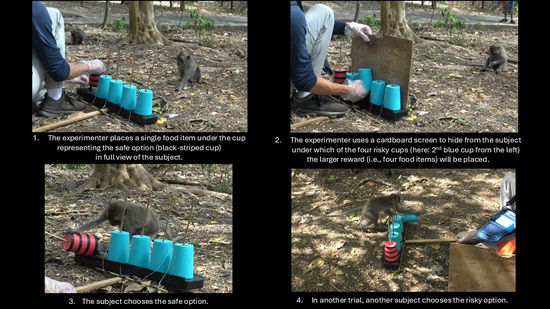
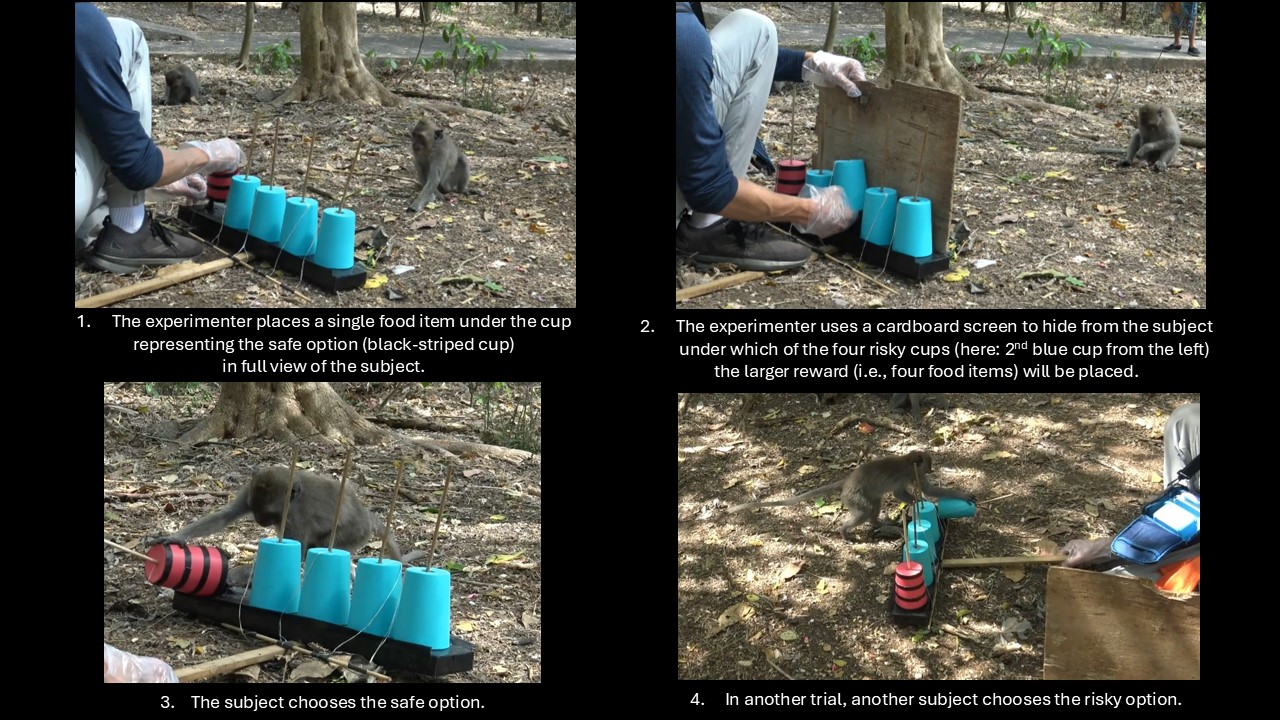
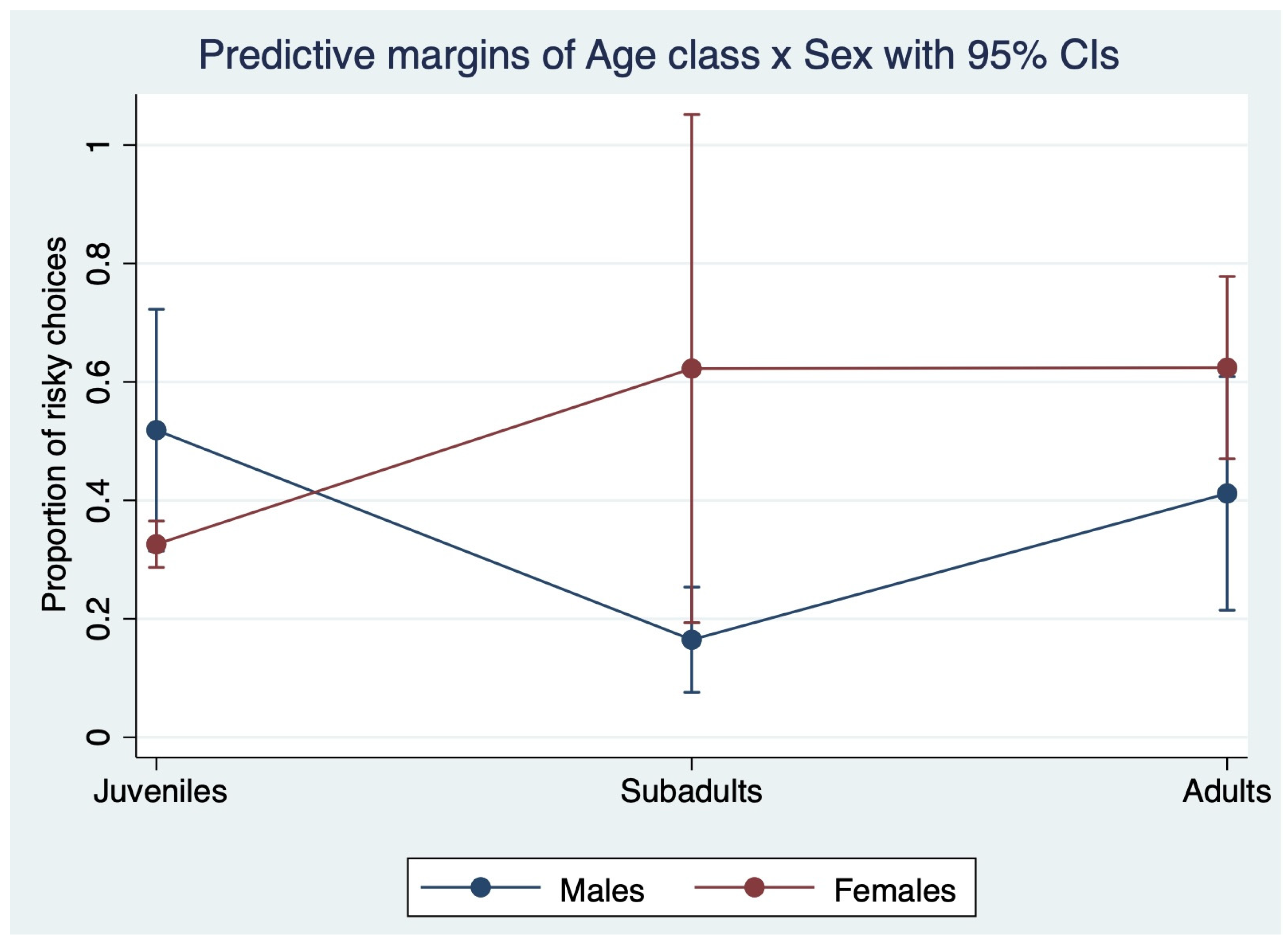
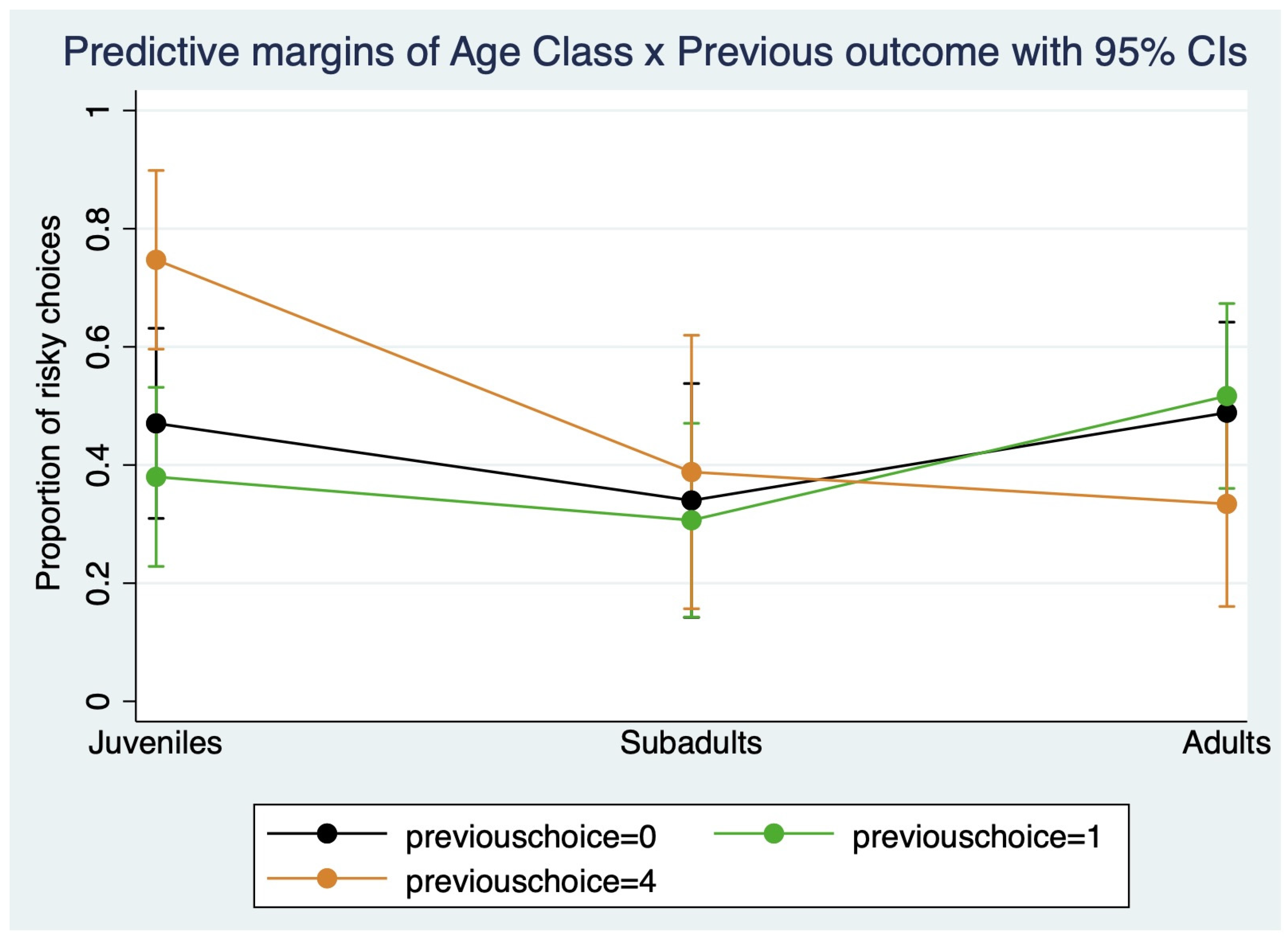
Most past research on risk preferences in primates focused on captive animals and neglected individual differences. We studied how 33 wild Balinese long-tailed macaques of different ages and sexes make risky choices. The animals were given a choice between a small reward they would always get and a larger reward they would get only sometimes. Overall, the macaques did not prefer either the safe or the risky option. However, individuals differed greatly. Some macaques often chose the risky option, others preferred the safe one, and many showed no clear preference. These differences were strongly linked to age, sex, and what happened in previous trials. Age and sex worked together in shaping risk preferences. Among males, juveniles and older adults were more risk-prone than younger adults. Among females, adults were more risk-prone than juveniles. Juveniles were also flexible in their choices, tending to repeat a risky choice after it paid off, a pattern known as “win–stay, lose–shift”. This may help young animals learn during development. Importantly, these differences were not due to confusion, since the macaques made correct choices when outcomes were clearly visible. Our findings highlight strong individual variation in primate risk preferences shaped by demographic factors.
Abstract
This study examines risky decision-making in a free-ranging population of Balinese long-tailed macaques (Macaca fascicularis fascicularis), addressing gaps in research that have largely focused on captive primates and have rarely considered individual differences by age and sex. Thirty-three macaques of different age–sex classes were tested using a choice task contrasting a guaranteed small reward with a probabilistic larger reward. At the group level, macaques showed no preference for safe or risky options. However, substantial individual variation emerged: some individuals were risk-prone, others risk-averse, and many indifferent. Notably, age and sex interacted in shaping risk preferences. Among males, adults and juveniles were more risk-prone than younger adults, whereas among females, adults were more risk-prone than juveniles. Juveniles also displayed outcome-dependent flexibility, choosing the risky option more often after a previous successful risky choice, consistent with a win–stay strategy. Like in rodents, this pattern may reflect adaptive learning during developmental transitions. Importantly, the observed behavioral differences were not due to misunderstanding of the task, as macaques reliably chose the larger option when outcomes were visible. This pronounced individual variability in primate risk preferences underscore the importance of considering demographic factors when characterizing species-typical risk preferences.