


The Role of Olfaction in Dogs: Evolution, Biology, and Human-Oriented Work

Simple Summary
Abstract
1. Introduction
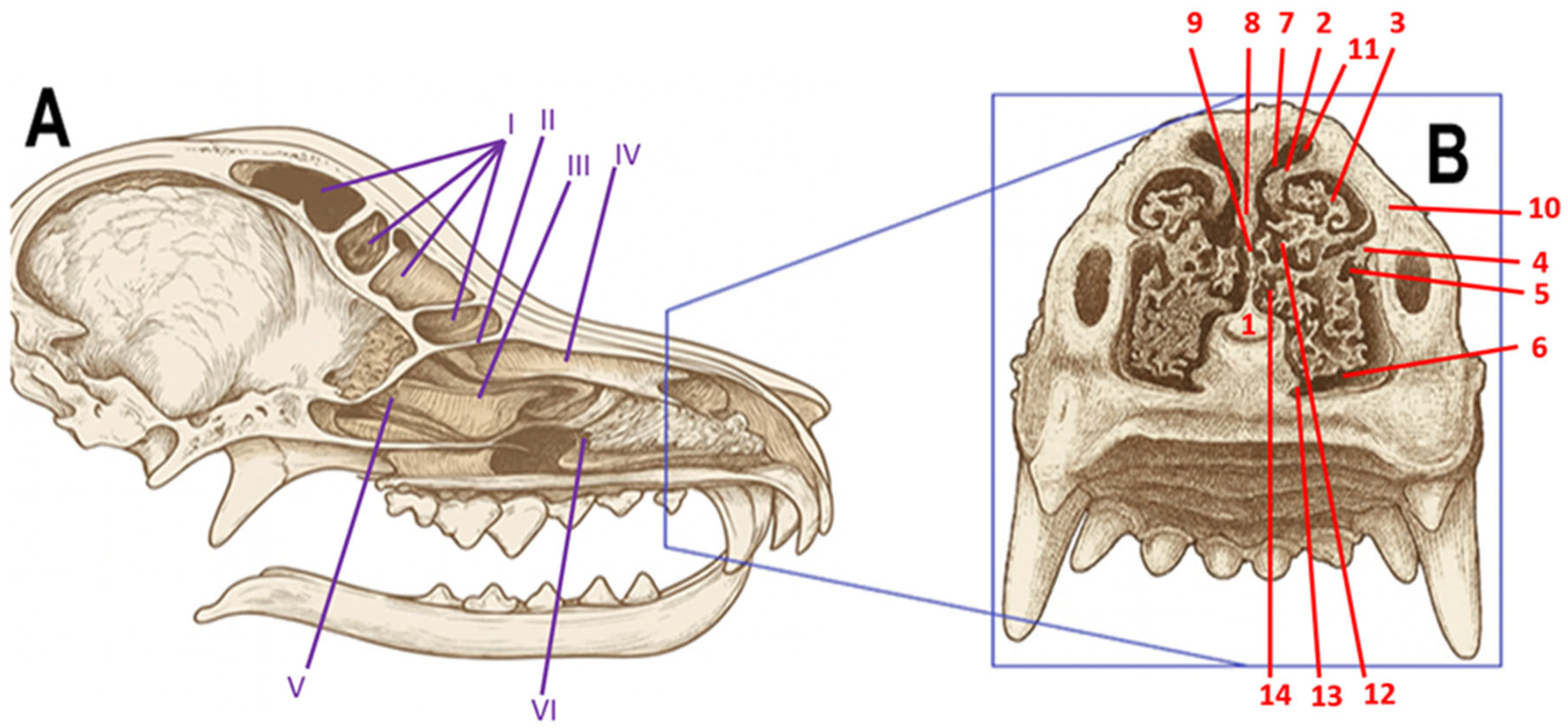
2. Anatomy and Physiology of the Olfactory Organ
Aerodynamic Pathway of Inspired Air During Sniffing in Dogs
3. Neurobiology of Odor Perception
Neuromodulatory and Hormonal Influences on Olfactory Processing in Detection Dogs
4. Integration of Odor with Memory and Emotions
5. Molecular and Genetic Aspects of Olfaction
6. Evolution of the Sense of Smell
7. Evolution and Development of the Olfactory Organ in Canids
8. The Role of Natural and Artificial Selection
Behavioral Phenotypes Shaped by Artificial Selection in Working Dogs
9. Adaptation to Tracking, Hunting, and Cooperation with Humans
10. Domestication and Breeding as Determinants of Olfactory Functions and Traits
11. Differences in Olfactory Predispositions Among Dog Breeds
12. Practical Use of Dogs’ Olfactory Potential in Uniformed Services
13. Classification of Service Dogs According to Their Functional Roles
13.1. Medical Detection Dogs and Assistance Dogs
13.2. Patrol and Tracking Dogs (Patrol–Tracking Dogs)
13.3. Detection Dogs for the Identification of Specific Odors
13.4. Search and Rescue Dogs (SAR Dogs)
13.5. Dogs in Environmental Protection and Biomonitoring
14. Dog Specialization and Their Olfactory Profiles
15. The Microbiome and Living Environment in Relation to Detection Task
Stress, Arousal, and Olfactory Performance in Detection Dogs
16. Conclusions
Author Contributions
Funding
Institutional Review Board Statement
Informed Consent Statement
Data Availability Statement
Acknowledgments
Conflicts of Interest
References
- Horowitz, A.; Franks, B. What smells? Gauging attention to olfaction in canine cognition research. Anim. Cogn. 2020, 23, 11–18. [Google Scholar] [CrossRef] [PubMed]
- Ortiz-Leal, I.; Torres, M.V.; Villamayor, P.R.; Fidalgo, L.E.; López-Beceiro, A.; Sanchez-Quinteiro, P. Candomestication shape Canidae brain morphology? The accessory olfactory bulb of the red fox as a case in point. Ann. Anat. Anat. Anz. 2022, 240, 151881. [Google Scholar] [CrossRef] [PubMed]
- Jezierski, T.; Adamkiewicz, E.; Walczak, M.; Sobczyńska, M.; Górecka-Bruzda, A.; Ensminger, J.; Papet, E. Efficacy of drug detection by fully-trained police dogs varies by breed, training level, type of drug and search environment. Forensic Sci. Int. 2014, 237, 112–118. [Google Scholar] [CrossRef] [PubMed]
- Kokocińska-Kusiak, A.; Woszczyło, M.; Zybala, M.; Maciocha, J.; Barłowska, K.; Dzięcioł, M. Canine Olfaction: Physiology, Behavior, and Possibilities for Practical Applications. Animals 2021, 11, 2463. [Google Scholar] [CrossRef] [PubMed] [PubMed Central]
- Azzouzi, N.; Guillory, A.-S.; Chaudieu, G.; Galibert, F. Dog olfactory receptor gene expression profiling using samples derived from nasal epithelium brushing. Canine Med. Genet. 2022, 9, 7. [Google Scholar] [CrossRef]
- Buzek, A.; Serwańska-Leja, K.; Zaworska-Zakrzewska, A.; Kasprowicz-Potocka, M. The Shape of the Nasal Cavity and Adaptations to Sniffing in the Dog (Canis familiaris) Compared to Other Domesticated Mammals: A Review Article. Animals 2022, 12, 517. [Google Scholar] [CrossRef] [PubMed] [PubMed Central]
- Quignon, P.; Kirkness, E.; Cadieu, E.; Touleimat, N.; Guyon, R.; Renier, C.; Hitte, C.; André, C.; Fraser, C.; Galibert, F. Comparison of the canine and human olfactory receptor gene repertoires. Genome Biol. 2003, 4, R80. [Google Scholar] [CrossRef] [PubMed] [PubMed Central]
- Martínez, E.D.; Espinosa, A.A.; Laguía, M.S.; Florenciano, M.D.A.; Kilroy, D.; García, M.I.G.; Gomariz, F.M.; Collado, C.S.; Gil Cano, F.; Jaber, J.R.; et al. The Bony Nasal Cavity and Paranasal Sinuses of Big Felids and Domestic Cat: A Study Using Anatomical Techniques, Computed Tomographic Images Reconstructed in Maximum-Intensity Projection, Volume Rendering and 3D Printing Models. Animals 2024, 14, 2609. [Google Scholar] [CrossRef]
- Craven, B.A.; Neuberger, T.; Paterson, E.G.; Webb, A.G.; Josephson, E.M.; Morrison, E.E.; Settles, G.S. Reconstruction and morphometric analysis of the nasal airway of the dog (Canis familiaris) and implications regarding olfactory airflow. Anat. Rec. 2007, 290, 1325–1340. [Google Scholar] [CrossRef] [PubMed]
- Craven, B.A.; Paterson, E.G.; Settles, G.S. The fluid dynamics of canine olfaction: Unique nasal airflow patterns as an explanation of macrosmia. J. R. Soc. Interface 2010, 7, 933–943. [Google Scholar] [CrossRef]
- Stitzel, S.E.; Aernecke, M.J.; Walt, D.R. Artificial noses. Annu. Rev. Biomed. Eng. 2011, 13, 1–25. [Google Scholar] [CrossRef] [PubMed]
- Malnic, B.; Hirono, J.; Sato, T.; Buck, L.B. Combinatorial receptor codes for odors. Cell 1999, 96, 713–723. [Google Scholar] [CrossRef] [PubMed]
- Sadowski, B. Biological Mechanisms of Human and Animal Behaviour; PWN Scientific Publishers: Warsaw, Poland, 2012. [Google Scholar]
- Barrios, A.W.; Núñez, G.; Sánchez-Quinteiro, P.; Salazar, I. Anatomy of the olfactory mucosa in the dog. Front. Neuroanat. 2014, 8, 106. [Google Scholar] [CrossRef]
- Moulton, D.G. Spatial patterning of response to odors in the peripheral olfactory system. Physiol. Rev. 1976, 56, 578–593. [Google Scholar] [CrossRef] [PubMed]
- Uemura, E.E. Fundamentals of Canine Neuroanatomy and Neurophysiology; Wiley-Blackwell: Ames, IA, USA, 2015; 432p, ISBN 978-1118771761. [Google Scholar]
- Jenkins, E.K.; DeChant, M.T.; Perry, E.B. When the Nose Doesn’t Know: Canine Olfactory Function Associated with Health, Management, and Potential Links to Microbiota. Front. Vet. Sci. 2018, 5, 56. [Google Scholar] [CrossRef] [PubMed] [PubMed Central]
- Miodoński, R. The morphology of the olfactory bulb in the dog. In Acta Biologica Cracoviensia, Series Zoologia; Państwowe Wydawn Naukowe: Warsaw, Poland, 1968. [Google Scholar]
- Alvites, R.; Caine, A.; Cherubini, G.B.; Prada, J.; Varejão, A.S.P.; Maurício, A.C. The Olfactory Bulb in Companion Animals—Anatomy, Physiology, and Clinical Importance. Brain Sci. 2023, 13, 713. [Google Scholar] [CrossRef]
- Hirai, T.; Kojima, S.; Shimada, A.; Umemura, T.; Sakai, M.; Itakurat, C. Age-related changes in the olfactory system of dogs. Neuropathol. Appl. Neurobiol. 1996, 22, 531–539. [Google Scholar] [CrossRef] [PubMed]
- Nakaimuki, A.; Paska, B.; Cuaya, L.V.; Hernández-Pérez, R.; Czeibert, K.; Szabó, D.; Kubinyi, E.; Andics, A. Dogs’ olfactory resting-state functional connectivity is modulated by age and brain shape. Sci. Rep. 2025, 15, 11438. [Google Scholar] [CrossRef] [PubMed] [PubMed Central]
- Buck, L.; Axel, R. A novel multigene family may encode odorant receptors: A molecular basis for odor recognition. Cell 1991, 65, 175–187. [Google Scholar] [CrossRef]
- Bakalyar, H.A.; Reed, R.R. Identification of a specialized adenylyl cyclase that may mediate odorant detection. Science 1990, 250, 1403–1406. [Google Scholar] [CrossRef]
- Wong, S.T.; Trinh, K.; Hacker, B.; Chan, G.C.K.; Lowe, G.; Gaggar, A.; Xia, Z.; Gold, G.H.; Storm, D.R. Disruption of the Type III Adenylyl Cyclase Gene Leads to Peripheral and Behavioral Anosmia in Transgenic Mice. Neuron 2000, 27, 487–497. [Google Scholar] [CrossRef] [PubMed]
- Stougiannou, T.M.; Christodoulou, K.C.; Karangelis, D. Olfactory Receptors and Aortic Aneurysm: Review of Disease Pathways. J. Clin. Med. 2024, 13, 7778. [Google Scholar] [CrossRef] [PubMed]
- Pifferi, S.; Anna Boccaccio, A.; Anna Menini, A. Cyclic nucleotide-gated ion channels in sensory transduction. FEBS Lett. 2006, 580, 2853–2859. [Google Scholar] [CrossRef] [PubMed]
- Reisert, J.; Matthews, H.R. Response properties of isolated mouse olfactory receptor cells. J. Physiol. 2001, 530, 113–122. [Google Scholar] [CrossRef] [PubMed] [PubMed Central]
- Dolensek, J.; Valentincic, T. Specificities of olfactory receptor neuron responses to amino acids in the black bullhead catfish (Ameiurus melas). Pflug. Arch. 2010, 459, 413–425. [Google Scholar] [CrossRef] [PubMed] [PubMed Central]
- Maresh, A.; Gil, D.R.; Whitman, M.C.; Greer, C.A. Principles of glomerular organization in the human olfactory bulb-implications for odor processing. PLoS ONE 2008, 3, e2640. [Google Scholar] [CrossRef] [PubMed] [PubMed Central]
- Treloar, H.B.; Feinstein, P.; Mombaerts, P.; Greer, C.A. Specificity of glomerular targeting by olfactory sensory axons. J. Neurosci. 2002, 22, 2469–2477. [Google Scholar] [CrossRef] [PubMed] [PubMed Central]
- Wachowiak, M.; Shipley, M.T. Coding and synaptic processing of sensory information in the glomerular layer of the olfactory bulb. Semin. Cell Dev. Biol. 2006, 17, 411–423. [Google Scholar] [CrossRef]
- Zhu, K.W.; Burton, S.D.; Nagai, M.H.; Silverman, J.D.; de March, C.A.; Wachowiak, M.; Matsunami, H. Decoding the olfactory map through targeted transcriptomics links murine olfactory receptors to glomeruli. Nat. Commun. 2022, 13, 5137. [Google Scholar] [CrossRef]
- Mori, K.; Takahashi, Y.K.; Igarashi, K.M.; Yamaguchi, M. Maps of Odorant Molecular Features in the Mammalian Olfactory Bulb. Physiol. Rev. 2006, 86, 409–433. [Google Scholar] [CrossRef]
- Gregory, J.D.; Kunkhyen, T.; Sweat, S.C.; Huang, J.S.; Brechbill, T.R.; Cheetham, C.E.J. New Neurons in the Postnatal Olfactory System: Functions in the Healthy and Regenerating Brain. Brain Sci. 2025, 15, 597. [Google Scholar] [CrossRef]
- Burton, S.D. Inhibitory circuits of the mammalian main olfactory bulb. J. Neurophysiol. 2017, 118, 2034–2051. [Google Scholar] [CrossRef] [PubMed] [PubMed Central]
- Andrews, E.F.; Pascalau, R.; Horowitz, A.; Lawrence, G.M.; Johnson, P.J. Extensive Connections of the Canine Olfactory Pathway Revealed by Tractography and Dissection. J. Neurosci. 2022, 42, 6392–6407. [Google Scholar] [CrossRef] [PubMed] [PubMed Central]
- Quaranta, A.; D’ingeo, S.; Siniscalchi, M. Odour-Evoked Memory in Dogs: Do Odours Help to Retrieve Memories of Food Location? Animals 2020, 10, 1249. [Google Scholar] [CrossRef] [PubMed] [PubMed Central]
- Propp, I.; Beiderman, M.; Agdarov, S.; Beiderman, Y.; Blum, M.; Zalevsky, Z. Sensing Dog Brain Reactions to Smell by AI Speckle Pattern Analysis. J. Biophotonics 2025, 18, e202400501. [Google Scholar] [CrossRef] [PubMed] [PubMed Central]
- Parr-Cortes, Z.; Müller, C.T.; Talas, L.; Mendl, M.; Guest, C.; Rooney, N.J. The odour of an unfamiliar stressed or relaxed person affects dogs’ responses to a cognitive bias test. Sci. Rep. 2024, 14, 15843. [Google Scholar] [CrossRef]
- Collins-Pisano, C.; Krichbaum, S.; Lazarowski, L.; Katz, J.S. The effect of arousal during and post-training on memory consolidation in detection dogs. Sci. Rep. 2025, 15, 25822. [Google Scholar] [CrossRef]
- Berg, P.; Mappes, T.; Kujala, M.V. Olfaction in the canine cognitive and emotional processes: From behavioral and neural viewpoints to measurement possibilities. Neurosci. Biobehav. Rev. 2024, 157, 105527. [Google Scholar] [CrossRef] [PubMed]
- Ramaihgari, B.; Pustovyy, O.M.; Waggoner, P.; Beyers, R.J.; Wildey, C.; Morrison, E.; Salibi, N.; Katz, J.S.; Denney, T.S.; Vodyanoy, V.J.; et al. Zinc Nanoparticles Enhance Brain Connectivity in the Canine Olfactory Network: Evidence From an fMRI Study in Unrestrained Awake Dogs. Front. Vet. Sci. 2018, 5, 127. [Google Scholar] [CrossRef]
- Olender, T.; Fuchs, T.; Linhart, C.; Shamir, R.; Adams, M.; Kalush, F.; Khen, M.; Lancet, D. The canine olfactory subgenome. Genomics 2004, 83, 361–372. [Google Scholar] [CrossRef] [PubMed]
- Niimura, Y.; Nei, M. Extensive gains and losses of olfactory receptor genes in mammalian evolution. PLoS ONE 2007, 2, e708. [Google Scholar] [CrossRef] [PubMed]
- Nei, M.; Niimura, Y.; Nozawa, M. The evolution of animal chemosensory receptor gene repertoires: Roles of chance and necessity. Nat. Rev. Genet. 2008, 9, 951–963. [Google Scholar] [CrossRef] [PubMed]
- Dias, B.G.; Ressler, K.J. Parental olfactory experience influences behavior and neural structure in subsequent generations. Nat. Neurosci. 2014, 17, 89–96. [Google Scholar] [CrossRef] [PubMed]
- Quignon, P.; Giraud, M.; Rimbault, M.; Lavigne, P.; Tacher, S.; Morin, E.; Retout, E.; Valin, A.-S.; Lindblad-Toh, K.; Nicolas, J.; et al. The dog and rat olfactory receptor repertoires. Genome Biol. 2005, 6, R83. [Google Scholar] [CrossRef] [PubMed] [PubMed Central]
- Niimura, Y.; Nei, M. Evolutionary dynamics of olfactory and other chemosensory receptor genes in vertebrates. J. Hum. Genet. 2006, 51, 505–517. [Google Scholar] [CrossRef] [PubMed] [PubMed Central]
- Nguyen, D.T.; Lee, K.; Choi, H.; Choi, M.; Lee, M.T.; Song, N.; Kim, J.H.; Seo, H.G.; Oh, J.W.; Lee, K.; et al. The complete swine olfactory subgenome:expansion of the olfactory gene repertoire in thepig genome. BMC Genom. 2012, 13, 584. [Google Scholar] [CrossRef]
- Bird, D.J.; Jacquemetton, C.; Buelow, S.A.; Evans, A.W.; Van Valkenburgh, B. Domesticating olfaction: Dog breeds, including scent hounds, have reduced cribriform plate morphology relative to wolves. Anat. Rec. 2020, 304, 139–153. [Google Scholar] [CrossRef]
- Lisberg, A.E.; Snowdon, C.T. Effects of sex, social status and gonadectomy on countermarking by domestic dogs, Canis familiaris. Anim. Behav. 2011, 81, 757–764. [Google Scholar] [CrossRef]
- Treloar, H.B.; Miller, A.M.; Ray, A.; Greer, C.A. Development of the Olfactory System. In The Neurobiology of Olfaction; Chapter 5; Menini, A., Ed.; CRC Press: Boca Raton, FL, USA; Taylor & Francis: Boca Raton, FL, USA, 2010. [Google Scholar]
- Suzuki, J.; Osumi, N. Chapter Ten—Neural Crest and Placode Contributions to Olfactory Development. Curr. Top. Dev. Biol. 2015, 111, 351–374. [Google Scholar] [CrossRef]
- Poncelet, G.; Shimeld, S.M. The evolutionary origins of the vertebrate olfactory system. Open Biol. 2020, 10, 200330. [Google Scholar] [CrossRef] [PubMed] [PubMed Central]
- Niimura, Y. On the origin and evolution of vertebrate olfactory receptor genes: Comparative genome analysis among 23 chordate species. Genome Biol. Evol. 2009, 1, 34–44. [Google Scholar] [CrossRef] [PubMed] [PubMed Central]
- Mombaerts, P. How smell develops. Nat. Neurosci. 2001, 4, 1192–1198. [Google Scholar] [CrossRef] [PubMed]
- Dong, D.; He, G.; Zhang, S.; Zhang, Z. Evolution of olfactory receptor genes in primates dominated by birth-and-death process. Genome Biol. Evol. 2009, 1, 258–264. [Google Scholar] [CrossRef] [PubMed] [PubMed Central]
- Salazar, I.; Cifuentes, J.M.; Sánchez-Quinteiro, P. Morphological and immunohistochemical features of the vomeronasal system in dogs. Anat. Rec. 2013, 296, 146–155. [Google Scholar] [CrossRef] [PubMed]
- Policarpo, M.; Besson, M.; Adams, R.H.; Chang, B.S.W.; Naumenko, A.; Rétaux, S.; Casane, D.; Julien, B.; Belkhir, K. Coevolution of the olfactory organ and its receptor repertoire across ray-finned fishes. BMC Biol. 2022, 20, 260. [Google Scholar] [CrossRef] [PubMed] [PubMed Central]
- Young, J.M.; Trask, B.J. V2R gene families degenerated in primates, dog and cow, but expanded in opossum. Trends Genet. 2007, 23, 212–215. [Google Scholar] [CrossRef] [PubMed]
- Grus, W.E.; Shi, P.; Zhang, Y.-P.; Zhang, J. Dramatic variation of the vomeronasal pheromone receptor gene repertoire among five orders of placental and marsupial mammals. Proc. Natl. Acad. Sci. USA 2005, 102, 5767–5772. [Google Scholar] [CrossRef] [PubMed]
- Silva, L.; Antunes, A. Vomeronasal Receptors in Vertebrates and the Evolution of Pheromone Detection. Annu. Rev. Anim. Biosci. 2017, 5, 353–370. [Google Scholar] [CrossRef]
- Brykczynska, U.; Tzika, A.C.; Rodriguez, I.; Milinkovitch, M.C. Contrasted evolution of the vomeronasal receptor repertoires in mammals and squamate reptiles. Genome Biol. Evol. 2013, 5, 389–401. [Google Scholar] [CrossRef] [PubMed] [PubMed Central]
- Hillenius, W.J. The evolution of nasal turbinates and mammalian endothermy. Paleobiology 1992, 18, 17–29. [Google Scholar] [CrossRef]
- Dewan, A. Olfactory signaling via trace amine-associated receptors. Cell Tissue Res. 2021, 383, 395–407. [Google Scholar] [CrossRef] [PubMed] [PubMed Central]
- Angielczyk, K.; Schmitz, L. Nocturnality in synapsids predates the origin of mammals by over 100 million years. Proc. R. Soc. B 2014, 281, 20141642. [Google Scholar] [CrossRef] [PubMed]
- Mouton, A.; Bird, D.J.; Li, G.; Craven, B.A.; Levine, J.M.; Morselli, M.; Pellegrini, M.; Van Valkenburgh, B.; Wayne, R.K.; Murphy, W.J. Genetic and Anatomical Determinants of Olfaction in Dogs and Wild Canids. Mol. Biol. Evol. 2025, 42, msaf035. [Google Scholar] [CrossRef] [PubMed] [PubMed Central]
- Ortiz-Leal, I.; Torres, M.V.; López-Callejo, L.N.; Fidalgo, L.E.; López-Beceiro, A.; Sanchez-Quinteiro, P. Comparative Neuroanatomical Study of the Main Olfactory Bulb in Domestic and Wild Canids: Dog, Wolf and Red Fox. Animals 2022, 12, 1079. [Google Scholar] [CrossRef]
- Walton, R.M.; Wolfe, J.H. In vitro growth and differentiation of canine olfactory bulb-derived neural progenitor cells under variable culture conditions. J. Neurosci. Methods 2008, 169, 158–167. [Google Scholar] [CrossRef] [PubMed]
- Pignatelli, A.; Belluzzi, O. Neurogenesis in the Adult Olfactory Bulb. In The Neurobiology of Olfaction; Chapter 11; Menini, A., Ed.; CRC Press: Boca Raton, FL, USA; Taylor & Francis: Boca Raton, FL, USA, 2010. Available online: https://www.ncbi.nlm.nih.gov/books/NBK55966 (accessed on 26 January 2026).
- Brann, J.H.; Firestein, S.J. A lifetime of neurogenesis in the olfactory system. Front. Neurosci. 2014, 8, 182. [Google Scholar] [CrossRef]
- Moawiah, M.N. Neurogenesis dynamics in the olfactory bulb: Deciphering circuitry organization, function, and adaptive plasticity. Neural Regen. Res. 2025, 20, 1565–1581. [Google Scholar] [CrossRef]
- Freedman, A.H.; Gronau, I.; Schweizer, R.M.; Vecchyo, D.O.-D.; Han, E.; Silva, P.M.; Galaverni, M.; Fan, Z.; Marx, P.; Lorente-Galdos, B.; et al. Genome sequencing highlights the dynamic early history of dogs. PLoS Genet. 2014, 10, e1004631. [Google Scholar] [CrossRef]
- Ekenstedt, K.; Crosse, K.; Risselada, M. Canine Brachycephaly: Anatomy, Pathology, Genetics and Welfare. J. Comp. Pathol. 2020, 176, 109–115. [Google Scholar] [CrossRef] [PubMed] [PubMed Central]
- Oechtering, T.; Oechtering, G.U.; Nöller, C. Structural characteristics of the nose in brachycephalic dog breeds analysed by computed tomography. Tierärztliche Praxis. Ausg. K Kleintiere/Heimtiere 2007, 35, 177–187. [Google Scholar] [CrossRef]
- Hussein, A.; Sullivan, M.; Penderis, J. Effect of brachycephalic, mesaticephalic, and dolichocephalic head conformations on olfactory bulb angle and orientation in dogs as determined by use of in vivo magnetic resonance imaging. Am. J. Vet. Res. 2012, 73, 946–951. [Google Scholar] [CrossRef] [PubMed]
- Bognár, Z.; Szabó, D.; Deés, A.; Kubinyi, E. Shorter headed dogs, visually cooperative breeds, younger and playful dogs form eye contact faster with an unfamiliar human. Sci. Rep. 2021, 11, 9293. [Google Scholar] [CrossRef] [PubMed]
- Spady, T.C.; Ostrander, E.A. Canine behavioral genetics: Pointing out the phenotypes and herding up the genes. Am. J. Hum. Genet. 2008, 82, 10–18. [Google Scholar] [CrossRef] [PubMed] [PubMed Central]
- Broseghini, A.; Lõoke, M.; Guérineau, C.; Marinelli, L.; Mongillo, P. Ethogram of the predatory sequence of dogs (Canis familiaris). Appl. Anim. Behav. Sci. 2024, 279, 106402. [Google Scholar] [CrossRef]
- McLennan, T. Review of literature on interventions aimed at resolving problems caused by predatory behaviour in dogs (Canis familiaris). Appl. Anim. Behav. Sci. 2023, 266, 106037. [Google Scholar] [CrossRef]
- Jeong, H.; Ostrander, E.A.; Kim, J. Genomic evidence for behavioral adaptation of herding dogs. Sci. Adv. 2025, 11, eadp4591. [Google Scholar] [CrossRef] [PubMed] [PubMed Central]
- Mehrkam, L.R.; Wynne, C.D.L. Behavioral differences among breeds of domestic dogs (Canis lupus familiaris): Current status of the science. Appl. Anim. Behav. Sci. 2014, 155, 12–27. [Google Scholar] [CrossRef]
- de Miguel, S.M.; Diéguez, F.J.; da Silva-Monteiro, J.P.; Ferreiro-Mazón, B.P.; González-Martínez, Á. Study of Behavioural Traits in Can de Palleiro (Galician Shepherd Dog). Animals 2021, 11, 3198. [Google Scholar] [CrossRef]
- D’Ingeo, S.; Iarussi, F.; De Monte, V.; Siniscalchi, M.; Minunno, M.; Quaranta, A. Emotions and Dog Bites: Could Predatory Attacks Be Triggered by Emotional States? Animals 2021, 11, 2907. [Google Scholar] [CrossRef] [PubMed] [PubMed Central]
- Beebe, S.C.; Howell, T.J.; Bennett, P.C. Using Scent Detection Dogs in Conservation Settings: A Review of Scientific Literature Regarding Their Selection. Front. Vet. Sci. 2016, 3, 96. [Google Scholar] [CrossRef] [PubMed] [PubMed Central]
- Lazarowski, L.; Waggoner, L.P.; Krichbaum, S.; Singletary, M.; Haney, P.; Rogers, B.; Angle, C. Selecting Dogs for Explosives Detection: Behavioral Characteristics. Front. Vet. Sci. 2020, 7, 597. [Google Scholar] [CrossRef] [PubMed]
- Ortiz-Leal, I.; Torres, M.V.; López-Beceiro, A.; Fidalgo, L.; Shin, T.; Sanchez-Quinteiro, P. First Immunohistochemical Demonstration of the Expression of a Type-2 Vomeronasal Receptor, V2R2, in Wild Canids. Int. J. Mol. Sci. 2024, 25, 7291. [Google Scholar] [CrossRef] [PubMed]
- Chen, R.; Irwin, D.M.; Zhang, Y.-P. Differences in Selection Drive Olfactory Receptor Genes in Different Directions in Dogs and Wolf. Mol. Biol. Evol. 2012, 29, 3475–3484. [Google Scholar] [CrossRef] [PubMed]
- Meadows, J.R.S.; Kidd, J.M.; Wang, G.-D.; Parker, H.G.; Schall, P.Z.; Bianchi, M.; Christmas, M.J.; Bougiouri, K.; Buckley, R.M.; Hitte, C.; et al. Genome sequencing of 2000 canids by the Dog10K consortium advances the understanding of demography, genome function and architecture. Genome Biol. 2023, 24, 187. [Google Scholar] [CrossRef]
- Yang, M.; Zhang, H.-X.; Geng, G.-J.; Wang, F.-J.; Liu, C.-W.; Liu, J.-L. Artificial Selection Drives SNPs of Olfactory Receptor Genes into Different Working Traits in Labrador Retrievers. Genet. Res. 2022, 2022, 8319396. [Google Scholar] [CrossRef] [PubMed] [PubMed Central]
- Eyre, A.W.; Zapata, I.; Hare, E.; Lee, K.M.N.; Bellis, C.; Essler, J.L.; Otto, C.M.; Serpell, J.A.; Alvarez, C.E. Genome scanning of behavioral selection in a canine olfactory detection breeding cohort. Sci. Rep. 2022, 12, 14984. [Google Scholar] [CrossRef]
- Polgár, Z.; Kinnunen, M.; Újváry, D.; Miklósi, Á.; Gácsi, M. A Test of Canine Olfactory Capacity: Comparing Various Dog Breeds and Wolves in a Natural Detection Task. PLoS ONE 2016, 11, e0154087. [Google Scholar] [CrossRef]
- Salamon, A.; Miklósi, Á.; Zsiros, L.R.; Kovács, T.; Kubinyi, E.; Andics, A.; Gácsi, M. Breed differences in olfactory performance of dogs. Sci. Rep. 2025, 15, 2675. [Google Scholar] [CrossRef]
- Boić, N.; Jukić, N.; Mikuška, A.; Bjedov, D.; Kovačić, M.; Šalika-Todorović, T.; Sudarić Bogojević, M. Preliminary Study of Scent Rolling in Captive Wolves (Canis lupus L. 1758) in Response to Olfactory Enrichment. Biology 2024, 13, 422. [Google Scholar] [CrossRef]
- Concha, A.R.; Guest, C.M.; Harris, R.; Pike, T.W.; Feugier, A.; Zulch, H.; Mills, D.S. Canine Olfactory Thresholds to Amyl Acetate in a Biomedical Detection Scenario. Front. Vet. Sci. 2019, 5, 345. [Google Scholar] [CrossRef]
- Guest, C.; Otto, C.M. Editorial: Canine Olfactory Detection. Front. Vet. Sci. 2020, 7, 100. [Google Scholar] [CrossRef] [PubMed] [PubMed Central]
- Hall, N.J.; Wynne, C.D.L. The canid genome: Behavioral geneticists’ best friend? Genes Brain Behav. 2012, 11, 889–902. [Google Scholar] [CrossRef] [PubMed]
- Fischer-Tenhagen, C.; Johnen, D.; Heuwieser, W.; Becker, R.; Schallschmidt, K.; Nehls, I. Odor Perception by Dogs: Evaluating Two Training Approaches for Odor Learning of Sniffer Dogs. Chem. Senses 2017, 42, 435–441. [Google Scholar] [CrossRef] [PubMed]
- Meller, S.; Al Khatri, M.S.A.; Alhammadi, H.K.; Álvarez, G.; Alvergnat, G.; Alves, L.C.; Callewaert, C.; Caraguel, C.G.B.; Carancci, P.; Chaber, A.-L.; et al. Expert considerations and consensus for using dogs to detect human SARS-CoV-2-infections. Front. Med. 2022, 9, 1015620. [Google Scholar] [CrossRef] [PubMed]
- Jendrny, P.; Twele, F.; Meller, S.; Schulz, C.; von Köckritz-Blickwede, M.; Osterhaus, A.D.M.E.; Ebbers, H.; Ebbers, J.; Pilchová, V.; Pink, I.; et al. Scent dog identification of SARS-CoV-2 infections in different body fluids. BMC Infect. Dis. 2021, 21, 707. [Google Scholar] [CrossRef]
- Kantele, A.; Paajanen, J.; Turunen, S.; Pakkanen, S.H.; Patjas, A.; Itkonen, L.; Heiskanen, E.; Lappalainen, M.; Desquilbet, L.; Vapalahti, O.; et al. Scent dogs in detection of COVID-19: Triple-blinded randomised trial and operational real-life screening in airport setting. BMJ Glob. Health 2022, 7, e008024. [Google Scholar] [CrossRef]
- Hagen, N.A.T.; Twele, F.; Meller, S.; Wijnen, L.; Schulz, C.; Schoneberg, C.; Kreienbrock, L.; von Köckritz-Blickwede, M.; Osterhaus, A.; Boeck, A.-L.; et al. Canine real-time detection of SARS-CoV-2 infections in the context of a mass screening event. BMJ Glob. Health 2022, 7, e010276. [Google Scholar] [CrossRef]
- Meller, S.; Caraguel, C.; Twele, F.; Charalambous, M.; Schoneberg, C.; Chaber, A.-L.; Desquilbet, L.; Grandjean, D.; Mardones, F.O.; Kreienbrock, L.; et al. Canine olfactory detection of SARS-CoV-2-infected humans—A systematic review. Ann. Epidemiol. 2023, 85, 68–85. [Google Scholar] [CrossRef]
- McCulloch, M.; Jezierski, T.; Broffman, M.; Hubbard, A.; Turner, K.; Janecki, T. Diagnostic accuracy of canine scent detection in early- and late-stage lung and breast cancers. Integr. Cancer Ther. 2006, 5, 30–39. [Google Scholar] [CrossRef] [PubMed]
- Buszewski, B.; Ligor, T.; Jezierski, T.; Wenda-Piesik, A.; Walczak, M.; Rudnicka, J. Identification of volatile lung cancer markers by gas chromatography-mass spectrometry: Comparison with discrimination by canines. Anal. Bioanal. Chem. 2012, 404, 141–146. [Google Scholar] [CrossRef] [PubMed] [PubMed Central]
- Rudnicka, J.; Walczak, M.; Kowalkowski, T.; Jezierski, T.; Buszewski, B. Determination of volatile organic compounds as potential markers of lung cancer by gas chromatography–mass spectrometry versus trained dogs. Sens. Actuators B Chem. 2014, 202, 615–621. [Google Scholar] [CrossRef]
- Wilson, C.; Campbell, K.; Petzel, Z.; Reeve, C. Dogs can discriminate between human baseline and psychological stress condition odours. PLoS ONE 2022, 17, e0274143. [Google Scholar] [CrossRef] [PubMed] [PubMed Central]
- Rooney, N.J.; Guest, C.M.; Swanson, L.C.M.; Morant, S.V. How effective are trained dogs at alerting their owners to changes in blood glycaemic levels?: Variations in performance of glycaemia alert dogs. PLoS ONE 2019, 14, e0210092. [Google Scholar] [CrossRef] [PubMed] [PubMed Central]
- Wilson, C.; Morant, S.; Kane, S.; Pesterfield, C.; Guest, C.; Rooney, N.J. An Owner-Independent Investigation of Diabetes Alert Dog Performance. Front. Vet. Sci. 2019, 6, 91. [Google Scholar] [CrossRef]
- Los, E.A.; Ramsey, K.L.; Guttmann-Bauman, I.; Ahmann, A.J. Reliability of Trained Dogs to Alert to Hypoglycemia in Patients with Type 1 Diabetes. J. Diabetes Sci. Technol. 2017, 11, 506–512. [Google Scholar] [CrossRef] [PubMed] [PubMed Central]
- Brown, S.W.; Goldstein, L.H. Can Seizure-Alert Dogs predict seizures? Epilepsy Res. 2011, 97, 236–242. [Google Scholar] [CrossRef] [PubMed]
- Luff, G.C.; Belluomo, I.; Lugarà, E.; Walker, M.C. The role of trained and untrained dogs in the detection and warning of seizures. Epilepsy Behav. 2024, 150, 109563. [Google Scholar] [CrossRef]
- Angle, C.; Waggoner, L.P.; Ferrando, A.; Haney, P.; Passler, T. Canine Detection of the Volatilome: A Review of Implications for Pathogen and Disease Detection. Front. Vet. Sci. 2016, 3, 47. [Google Scholar] [CrossRef] [PubMed] [PubMed Central]
- Woidtke, L.; Crispino, F.; Ferry, B.; Gansloßer, U.; Hohlfeld, N.M.; Osterkamp, T. The use of mantrailing dogs in police and judicial context, future directions, limits and possibilities—A law review. Forensic Sci. Int. Synerg. 2023, 7, 100439. [Google Scholar] [CrossRef] [PubMed] [PubMed Central]
- Woidtke, L.; Dreßler, J.; Babian, C. Individual human scent as a forensic identifier using mantrailing. Forensic Sci. Int. 2018, 282, 111–121. [Google Scholar] [CrossRef]
- Jinn, J.; Connor, E.G.; Jacobs, L.F. How Ambient Environment Influences Olfactory Orientation in Search and Rescue Dogs. Chem. Senses 2020, 45, 625–634. [Google Scholar] [CrossRef] [PubMed]
- Brustkern, M.; Thompson, R.; Lawhon, S.; Good, K.; Bunker, P.; Prada-Tiedemann, P.; Hall, N.J. Effect of rapid changes in environmental conditions on canine detection of methyl benzoate. Appl. Anim. Behav. Sci. 2023, 264, 105924. [Google Scholar] [CrossRef]
- Greatbatch, I.; Gosling, R.J.; Allen, S. Quantifying Search Dog Effectiveness in a Terrestrial Search and Rescue Environment. Wilderness Environ. Med. 2015, 26, 327–334. [Google Scholar] [CrossRef] [PubMed]
- Schoon, G.A.A. The use of tracking/man trailing dog results as evidence in courts. J. Vet. Behav. 2022, 52–53, 14–20. [Google Scholar] [CrossRef]
- Chapman, S.G. Police Dogs Versus Crowds. J. Police Sci. Adm. 1980, 8, 316–321. Available online: https://www.ojp.gov/ncjrs/virtual-library/abstracts/police-dogs-versus-crowds (accessed on 17 October 2025).
- Hickey, E.R.; Hoffman, P.B. To bite or not to bite: Canine apprehensions in a large, suburban police department. J. Crim. Justice 2003, 31, 147–154. [Google Scholar] [CrossRef]
- McCauley, R.P.; Barker, W.F.; Boatman, J.; Goel, V.; Short, T.H.; Zhou, F. The Police Canine Bite: Force, Injury, and Liability; Report the Center for Research in criminology Department of Criminology; Center for Research in Criminology at IUP: Indiana, PA, USA, 2008. [Google Scholar]
- Bradley, M.C. Find and Bite Versus Find and Bark Sacramento Police Canine Theory and Training Methodology. Master’s Thesis, EMPA Capstones, Golden Gate University School of Law, San Francisco, CA, USA, 2020. [Google Scholar]
- Ustawa z dnia 24 maja 2013 r. o środkach przymusu bezpośredniego i broni palnej, Dz.U. 2013 poz. 628 (Poland). [In Polish; English Title: Act of 24 May 2013 on Measures of Direct Coercion and Firearms]. Official Text. Available online: https://isap.sejm.gov.pl/isap.nsf/DocDetails.xsp?id=WDU20130000628 (accessed on 26 January 2026).
- Hassler, K.N.; Sylvia, A.L.; Smith, L.M. Trail vs. thicket: Evaluating conservation detection dog performance in varied terrain. Wildl. Soc. Bull. 2024, 48, e15583. [Google Scholar] [CrossRef]
- del Valle, J.D.; Peralta, F.C.; Arjona, M.I.J. Factors affecting carcass detection at wind farms using dogs and human searchers. J. Appl. Ecol. Br. Ecol. Soc. 2020, 57, 1926–1935. [Google Scholar] [CrossRef]
- Jezierski, T.; Ensminger, J.; Papet, L.E. Canine Olfaction Science and Law: Advances in Forensic Science, Medicine, Conservation, and Environmental Remediation, 1st ed.; CRC Press: Boca Raton, FL, USA, 2016. [Google Scholar] [CrossRef]
- Johnen, D.; Heuwieser, W.; Fischer-Tenhagen, C. An approach to identify bias in scent detection dog testing. Appl. Anim. Behav. Sci. 2017, 189, 1–12. [Google Scholar] [CrossRef]
- Paula, J.; Leal, M.C.; Silva, M.J.; Mascarenhas, R.; Costa, H.; Mascarenhas, M. Dogs as a tool to improve bird-strike mortality estimates at wind farms. J. Nat. Conserv. 2011, 19, 202–208. [Google Scholar] [CrossRef]
- Lazarowski, L.; Krichbaum, S.; DeGreeff, L.E.; Simon, A.; Singletary, M.; Angle, C.; Waggoner, L.P. Methodological Considerations in Canine Olfactory Detection Research. Front. Vet. Sci. 2020, 7, 408. [Google Scholar] [CrossRef] [PubMed]
- Moser, A.Y.; Bizo, L.; Brown, W.Y. Olfactory Generalization in Detector Dogs. Animals 2019, 9, 702. [Google Scholar] [CrossRef] [PubMed]
- Caldicott, L.; Pike, T.W.; Zulch, H.E.; Mills, D.S.; Williams, F.J.; Elliker, K.R.; Hutchings, B.; Wilkinson, A. Odour generalisation and detection dog training. Anim. Cogn. 2024, 27, 73, Erratum in Anim. Cogn. 2025, 28, 62. https://doi.org/10.1007/s10071-025-01992-9. PMID: 39485633; PMCID: PMC11530475. [Google Scholar] [CrossRef] [PubMed]
- Aviles-Rosa, E.O.; McGuinness, G.; Hall, N.J. Case Study: An Evaluation of Detection Dog Generalization to a Large Quantity of an Unknown Explosive in the Field. Animals 2021, 11, 1341. [Google Scholar] [CrossRef]
- Lazarowski, L.; Rogers, B.; Collins-Pisano, C.; Krichbaum, S.; Handley, M.; Smith, J.G.; Waggoner, P. Effectiveness of marker training for detection dogs. Front. Vet. Sci. 2025, 12, 1538452. [Google Scholar] [CrossRef] [PubMed] [PubMed Central]
- Maughan, M.N.; Gadberry, J.D.; Sharpes, C.E.; Buckley, P.E.; Miklos, A.E.; Furton, K.G.; DeGreeff, L.E.; Hall, N.J.; Greubel, R.R.; Sloan, K.B. Calibrating canines—A universal detector calibrant for detection dogs. Front. Allergy 2024, 5, 1366596. [Google Scholar] [CrossRef]
- Wohlfahrt, G.; Schmitt, M.; Zeller, L.; Hörand, A.; Spittel-Schnell, K.; Wulms, T.; Schnell, R.; Bültge, M. Air temperature and humidity effects on the performance of conservation detection dogs. Appl. Anim. Behav. Sci. 2023, 262, 105909. [Google Scholar] [CrossRef]
- Fernandez, L.S.; Kane, S.A.; DeChant, M.T.; Prada-Tiedemann, P.A.; Hall, N.J. Environmental effects on explosive detection threshold of domestic dogs. PLoS ONE 2024, 19, e0306817. [Google Scholar] [CrossRef] [PubMed] [PubMed Central]
- Reed, S.E.; Bidlack, A.L.; Hurt, A.; Getz, W.M. Detection distance and environmental factors in conservation detection dog surveys. J. Wildl. Manag. 2011, 75, 243–251. [Google Scholar] [CrossRef]
- Farr, B.D.; Otto, C.M.; Szymczak, J.E. Expert Perspectives on the Performance of Explosive Detection Canines: Performance Degrading Factors. Animals 2021, 11, 1978. [Google Scholar] [CrossRef] [PubMed] [PubMed Central]
- Hall, N.J.; David, W.; Smith, D.W.; Wynne, C.D.L. Training domestic dogs (Canis lupus familiaris) on a novel discrete trials odor-detection task. Learn. Motiv. 2013, 44, 218–228. [Google Scholar] [CrossRef]
- Lit, L.; Schweitzer, J.B.; Oberbauer, A.M. Handler beliefs affect scent detection dog outcomes. Anim. Cogn. 2011, 14, 387–394. [Google Scholar] [CrossRef] [PubMed] [PubMed Central]
- Cobb, M.L.; Otto, C.M.; Fine, A.H. The Animal Welfare Science of Working Dogs: Current Perspectives on Recent Advances and Future Directions. Front. Vet. Sci. 2021, 8, 666898. [Google Scholar] [CrossRef] [PubMed] [PubMed Central]
- Hall, N.J.; Otto, C.M.; Baltzer, W.I. Editorial: Working Dogs: Form and Function, Volume II. Front. Vet. Sci. 2021, 8, 732304. [Google Scholar] [CrossRef] [PubMed]
- Leeflang, M.M.; Bell, K.; Deeks, J.J.; Dinnes, J.; Doust, J.; Korevaar, D.A.; Lord, S.J.; Spijker, R. Electronic and animal noses for detecting SARS-CoV-2 infection. Cochrane Database Syst. Rev. 2021, 2021, CD015013. [Google Scholar] [CrossRef] [PubMed Central]
- Rabehi, A.; Helal, H.; Zappa, D.; Comini, E. Advancements and Prospects of Electronic Nose in Various Applications: A Comprehensive Review. Appl. Sci. 2024, 14, 4506. [Google Scholar] [CrossRef]
- Peters, R.; Veenstra, R.; Heutinck, K.; Baas, A.; Munniks, S.; Knotter, J. Human scent characterization: A review. Forensic Sci. Int. 2023, 349, 111743. [Google Scholar] [CrossRef]
- Curran, A.M.; Prada, P.A.; Furton, K.G. The differentiation of the volatile organic signatures of individuals through SPME-GC/MS of characteristic human scent compounds. J. Forensic Sci. 2010, 55, 50–57. [Google Scholar] [CrossRef] [PubMed]
- DeGreeff, L.E.; Curran, A.M.; Furton, K.G. Evaluation of selected sorbent materials for the collection of volatile organic compounds related to human scent using non-contact sampling mode. Forensic Sci. Int. 2011, 209, 133–142. [Google Scholar] [CrossRef] [PubMed]
- Kowalczyk-Jabłońska, I.; Zieniuk, B.; Pawełkowicz, M. Synthetic Cadaver Odorants and the Sulfur Gap: Linking Chemistry and Canine Olfaction in Human Remains Detection. Molecules 2025, 30, 4066. [Google Scholar] [CrossRef]
- Ouimet, F.; Patel, D.; Tsontakis, M.; Samson, C.; Forbes, S.L. Establishing the volatile organic compound profile and detection capabilities of human remain detection dogs to human bones. Forensic Sci. Int. Synerg. 2024, 10, 100566. [Google Scholar] [CrossRef] [PubMed] [PubMed Central]
- Menchetti, L.; Iaboni, M.; Santoro, M.M.; Guelfi, G.; Diverio, S. How Do Avalanche Dogs (and Their Handlers) Cope with Physical Exercise? Heart Rate Changes during Endurance in a Snowy Environment. Animals 2022, 12, 168. [Google Scholar] [CrossRef] [PubMed] [PubMed Central]
- Diverio, S.; Barbato, O.; Cavallina, R.; Guelfi, G.; Iaboni, M.; Zasso, R.; Di Mari, W.; Santoro, M.M.; Knowles, T.G. A simulated avalanche search and rescue mission induces temporary physiological and behavioural changes in military dogs. Physiol. Behav. 2016, 163, 193–202. [Google Scholar] [CrossRef] [PubMed]
- Osterkamp, T. K9 water searches: Scent and scent transport considerations. J. Forensic Sci. 2011, 56, 907–912. [Google Scholar] [CrossRef] [PubMed]
- Hare, E.; Kelsey, K.M.; Serpell, J.A.; Otto, C.M. Behavior Differences Between Search-and-Rescue and Pet Dogs. Front. Vet. Sci. 2018, 5, 118. [Google Scholar] [CrossRef] [PubMed] [PubMed Central]
- Bray, E.E.; Otto, C.M.; Udell, M.A.R.; Hall, N.J.; Johnston, A.M.; MacLean, E.L. Enhancing the Selection and Performance of Working Dogs. Front. Vet. Sci. 2021, 8, 644431, Erratum in Front. Vet. Sci. 2022, 9, 898698. https://doi.org/10.3389/fvets.2022.898698. PMID: 34055947; PMCID: PMC8149746. [Google Scholar] [CrossRef]
- Lazarowski, L.; Rogers, B.; Krichbaum, S.; Haney, P.; Smith, J.G.; Waggoner, P. Validation of a Behavior Test for Predicting Puppies’ Suitability as Detection Dogs. Animals 2021, 11, 993. [Google Scholar] [CrossRef] [PubMed] [PubMed Central]
- Hare, E.; Kelsey, K.M.; Niedermeyer, G.M.; Otto, C.M. Long-term behavioral resilience in search-and-rescue dogs responding to the September 11, 2001 terrorist attacks. Appl. Anim. Behav. Sci. 2021, 234, 105173. [Google Scholar] [CrossRef]
- Vynne, C.; Skalski, J.R.; Machado, R.B.; Groom, M.J.; Jácomo, A.T.A.; Marinho-Filho, J.; Neto, M.B.R.; Pomilla, C.; Silveira, L.; Smith, H.; et al. Effectiveness of scat-detection dogs in determining species presence in a tropical savanna landscape. Conserv. Biol. 2011, 25, 154–162. [Google Scholar] [CrossRef] [PubMed]
- McKeague, B.; Finlay, C.; Rooney, N. Conservation detection dogs: A critical review of efficacy and methodology. Ecol. Evol. 2024, 14, e10866. [Google Scholar] [CrossRef] [PubMed] [PubMed Central]
- Dogs and Drones: How Scientists Are Saving Washington’s Endangered Orcas. Available online: https://www.theguardian.com/environment/2025/oct/02/endangered-orcas-southern-resident-killer-whales-sniffer-dogs-drones-scientists-washington (accessed on 24 October 2025).
- Meet Tucker, the Ultimate Orca Poop–Detection Dog. Available online: https://www.seattlemet.com/news-and-city-life/2017/08/meet-tucker-the-ultimate-orca-poop-detection-dog (accessed on 24 October 2025).
- Meet the Dogs Sniffing Out Whale Poop for Science. Available online: https://www.smithsonianmag.com/science-nature/meet-dogs-sniffing-out-whale-poop-science-180958050/ (accessed on 24 October 2025).
- Invasive Mussel Detection. Available online: https://www.wd4c.org/invasive-mussel (accessed on 24 October 2025).
- DeShon, D.L.; Wong, W.H.; Farmer, D.; Jensen, A.J. The ability of scent detection canines to detect the presence of quaggamussel (Dreissena rostriformis bugensis) veligers. Manag. Biol. Invasions 2016, 7, 419–428. [Google Scholar] [CrossRef]
- Collins, M.A.; Browne, C.M.; Edwards, T.L.; Ling, N.; Tempero, G.W.; Gleeson, D.M.; Crockett, K.; Quaife, J. How low can they go: A comparison between dog (Canis familiaris) and environmental DNA detection of invasive koi carp (Cyprinus rubrofuscus). Appl. Anim. Behav. Sci. 2022, 255, 105729. [Google Scholar] [CrossRef]
- Grebenkemper, J.; Morris, A.; Byrd, B.F.; Engbring, L. Applying Canine Detection in Support of Collaborative Archaeology. Adv. Archaeol. Pract. 2021, 9, 226–237. [Google Scholar] [CrossRef]
- Laras, A. The Use of Dogs to Detect Subsurface Prehistoric Human Remains in an Archaeological Context, Information Bulletin No. CA-2012-009. 2012. Available online: https://www.blm.gov/policy/ib-ca-2012-009 (accessed on 26 January 2026).
- Salamon, A.; Baranya, E.; Zsiros, L.R.; Miklósi, Á.; Csepregi, M.; Kubinyi, E.; Andics, A.; Gácsi, M. Success in the Natural Detection Task is influenced by only a few factors generally believed to affect dogs’ olfactory performance. Sci. Rep. 2024, 14, 12351. [Google Scholar] [CrossRef]
- Jendrny, P.; Twele, F.; Meller, S.; Osterhaus, A.D.M.E.; Schalke, E.; Volk, H.A. Canine olfactory detection and its relevance to medical detection. BMC Infect. Dis. 2021, 21, 838. [Google Scholar] [CrossRef] [PubMed] [PubMed Central]
- Craddock, H.A.; Godneva, A.; Rothschild, D.; Motro, Y.; Grinstein, D.; Lotem-Michaeli, Y.; Narkiss, T.; Segal, E.; Moran-Gilad, J. Phenotypic correlates of the working dog microbiome. npj Biofilms Microbiomes 2022, 8, 66. [Google Scholar] [CrossRef]
- Isaiah, A.; Hoffmann, A.R.; Kelley, R.; Mundell, P.; Steiner, J.M.; Suchodolski, J.S. Characterization of the nasal and oral microbiota of detection dogs. PLoS ONE 2017, 12, e0184899. [Google Scholar] [CrossRef] [PubMed] [PubMed Central]
- Maidodou, L.; Steyer, D.; Monat, M.-A.; Leemans, M.; Fromantin, I.; Marchioni, E.; Clarot, I. Harnessing the potential of sniffing dogs and GC–MS in analyzing human urine: A comprehensive review of sample preparation and extraction techniques. Microchem. J. 2024, 207, 111907. [Google Scholar] [CrossRef]
- Li, Z.; Sun, Q.; Li, Y.; Guan, Z.; Wei, J.; Li, B.; Liu, K.; Shao, D.; Mi, R.; Liu, H.; et al. Analysis and Comparison of Gut Microbiome in Young Detection Dogs. Front. Microbiol. 2022, 13, 872230. [Google Scholar] [CrossRef] [PubMed] [PubMed Central]
- An, J.-U.; Mun, S.-H.; Kim, W.-H.; Seong, J.K.; Park, K.; Cho, S. Dynamics of the canine gut microbiota of a military dog birth cohort. Front. Microbiol. 2025, 16, 1481567. [Google Scholar] [CrossRef]
- Atuahene, D.; Wolfe, L.; Vanhatalo, O.E.; Veenstra, B.T.; Skarlupka, J.H.; Anderson, K.L.; Suen, G.; Meineri, G.; Pritchard, J.C. Limited day-to-day variation in the canine gut microbiota: Implications for microbiome studies. Front. Vet. Sci. 2025, 12, 1632686. [Google Scholar] [CrossRef]
- Patel, K.V.; Hunt, A.B.G.; Castillo-Fernandez, J.; Abrams, C.; King, T.; Watson, P.; Amos, G.C.A. Impact of acute stress on the canine gut microbiota. Sci. Rep. 2024, 14, 18897. [Google Scholar] [CrossRef]
- Slotta-Bachmayr, L.; Oyugi, A.; Mutoro, N.; Burak, M.; Wykstra, M. Detection Dogs Working in Hot Climates: The Influence on Thermoregulation and Fecal Consistency. Animals 2024, 14, 2456. [Google Scholar] [CrossRef]
- Pellowe, S.D.; Zhang, A.; Bignell, D.R.D.; Peña-Castillo, L.; Walsh, C.J. Gut microbiota composition is related to anxiety and aggression scores in companion dogs. Sci. Rep. 2025, 15, 24336. [Google Scholar] [CrossRef]
- Sun, N.; Xie, L.; Chao, J.; Xiu, F.; Zhai, H.; Zhou, Y.; Yu, X.; Shui, Y. Study on the Correlation Between Aggressive Behavior and Gut Microbiota and Serum Serotonin (5-HT) in Working Dogs. Vet. Sci. 2025, 12, 526. [Google Scholar] [CrossRef]
- Ma, X.; Lazarowski, L.; Zhang, Y.; Krichbaum, S.; Smith, J.G.; Zheng, J.; Cao, W.; Haney, P.S.; Wilborn, R.R.; Price, S.B.; et al. Associations between memory performance and Bifidobacterium pseudolongum abundance in the canine gut microbiome. iScience 2024, 27, 109611. [Google Scholar] [CrossRef]

| English Name | Latin Name | Description |
|---|---|---|
| olfactory nerve layer | stratum nervosum | contains axonal projections of olfactory sensory neurons originating from the nasal epithelium |
| glomerular layer | stratum glomerulosum | the site where axons of olfactory sensory neurons form synapses with the dendrites of mitral and tufted cells |
| external plexiform layer | stratum plexiforme externum | contains the somata and lateral dendrites of tufted cells, lateral processes of mitral cells, as well as amacrine and other interneurons |
| mitral cell layer | stratum cellulosum pyramidale | contains the cell bodies of mitral cells, which constitute the principal output neurons of the olfactory bulb |
| internal plexiform layer | stratum plexiforme internum | less distinct, containing fibers and synapses, including those of granule cells |
| granule cell layer | stratum granulosum | contains numerous interneurons involved in signal modulation |
| olfactory bulb core | centrum fibrosum | contains projection fibers and connecting elements linking the olfactory bulb with other regions of the brain |
| Abbreviation | Full Name | Main Connections | Function |
|---|---|---|---|
| OPT | Olfactory-Piriform Tract | piriform cortex | Odor Recognition and Olfactory Learning |
| OLT | Olfactory-Limbic Tract | amygdala, hippocampus | Emotional Responses and Emotional Memory |
| OET | Olfactory-Entorhinal Tract | entorhinal cortex | Episodic Memory and Spatial Orientation of Odors |
| OFT | Olfactory-Frontal Tract | frontal (prefrontal) cortex | Cognitive Decision-Making, Planning, and Odor Evaluation |
| OOT | Olfactory-Occipital Tract | occipital lobe (visual cortex) | Integrated Processing of Olfactory and Visual Stimuli |
Disclaimer/Publisher’s Note: The statements, opinions and data contained in all publications are solely those of the individual author(s) and contributor(s) and not of MDPI and/or the editor(s). MDPI and/or the editor(s) disclaim responsibility for any injury to people or property resulting from any ideas, methods, instructions or products referred to in the content. |
© 2026 by the authors. Licensee MDPI, Basel, Switzerland. This article is an open access article distributed under the terms and conditions of the Creative Commons Attribution (CC BY) license.
Share and Cite
Kowalczyk-Jabłońska, I.; Jundziłł-Bogusiewicz, P.; Kaleta, T. The Role of Olfaction in Dogs: Evolution, Biology, and Human-Oriented Work. Animals 2026, 16, 427. https://doi.org/10.3390/ani16030427
Kowalczyk-Jabłońska I, Jundziłł-Bogusiewicz P, Kaleta T. The Role of Olfaction in Dogs: Evolution, Biology, and Human-Oriented Work. Animals. 2026; 16(3):427. https://doi.org/10.3390/ani16030427
Chicago/Turabian StyleKowalczyk-Jabłońska, Iwona, Paulina Jundziłł-Bogusiewicz, and Tadeusz Kaleta. 2026. "The Role of Olfaction in Dogs: Evolution, Biology, and Human-Oriented Work" Animals 16, no. 3: 427. https://doi.org/10.3390/ani16030427
APA StyleKowalczyk-Jabłońska, I., Jundziłł-Bogusiewicz, P., & Kaleta, T. (2026). The Role of Olfaction in Dogs: Evolution, Biology, and Human-Oriented Work. Animals, 16(3), 427. https://doi.org/10.3390/ani16030427

