Spatial Associations and Co-Occurrence Networks of Sympatric Species in an Asian Elephant Community

Simple Summary
Abstract
1. Introduction
2. Materials and Methods
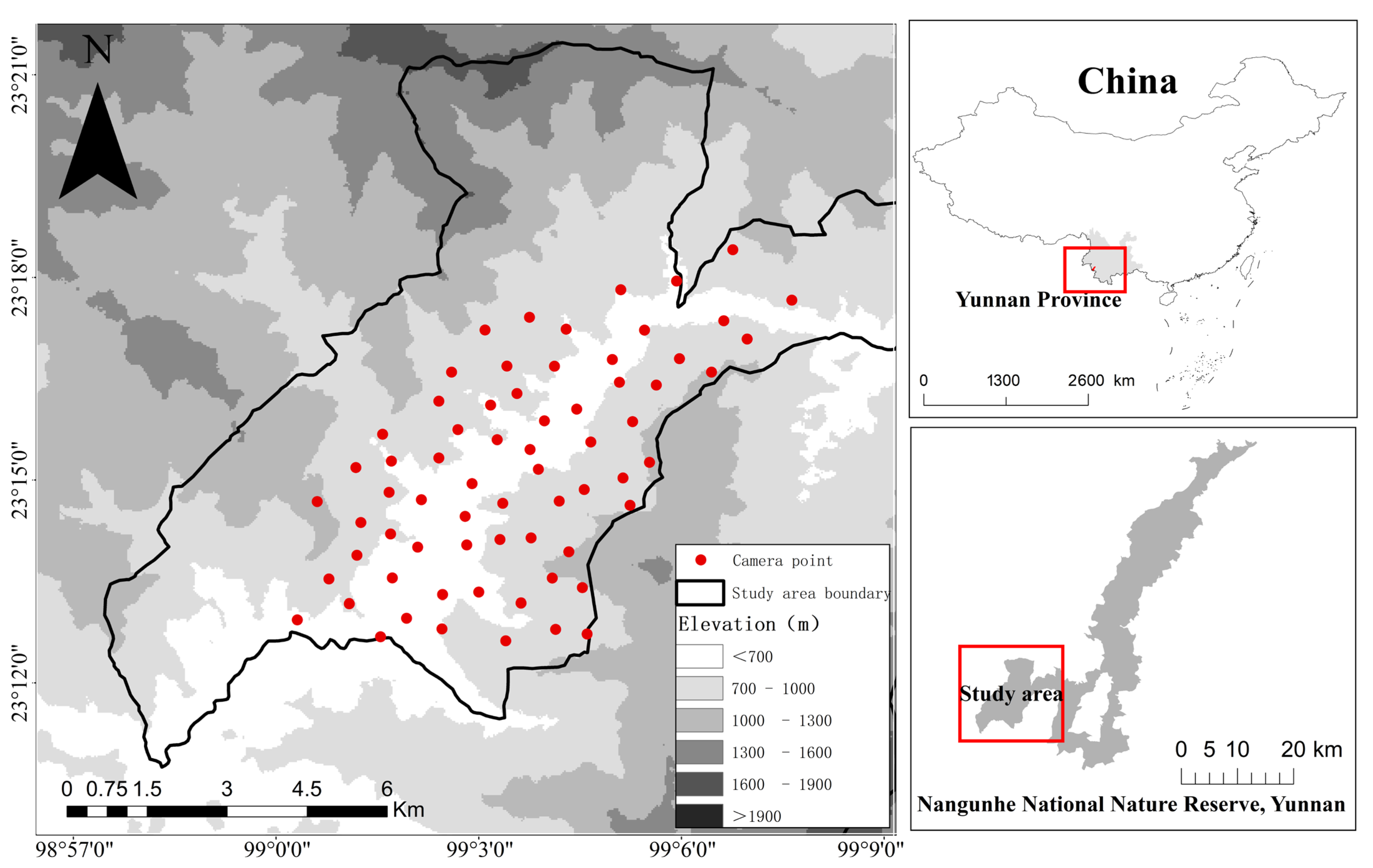
2.1. Study Area
2.2. Field Data Collection
2.3. Data Analysis
2.3.1. Relative Abundance of Species
2.3.2. Distributional Breadth Across Sampling Sites
2.3.3. Overlap in Habitat Site Utilization
2.3.4. Overall Community Association
2.3.5. Calculation of Interspecific Association Indices
2.3.6. Activity Rhythm Analysis
2.3.7. Analysis of Spatial Correlation Attributes of Species
3. Results
3.1. Species Composition of the Captured Community
3.2. Analysis of Niche Characteristics
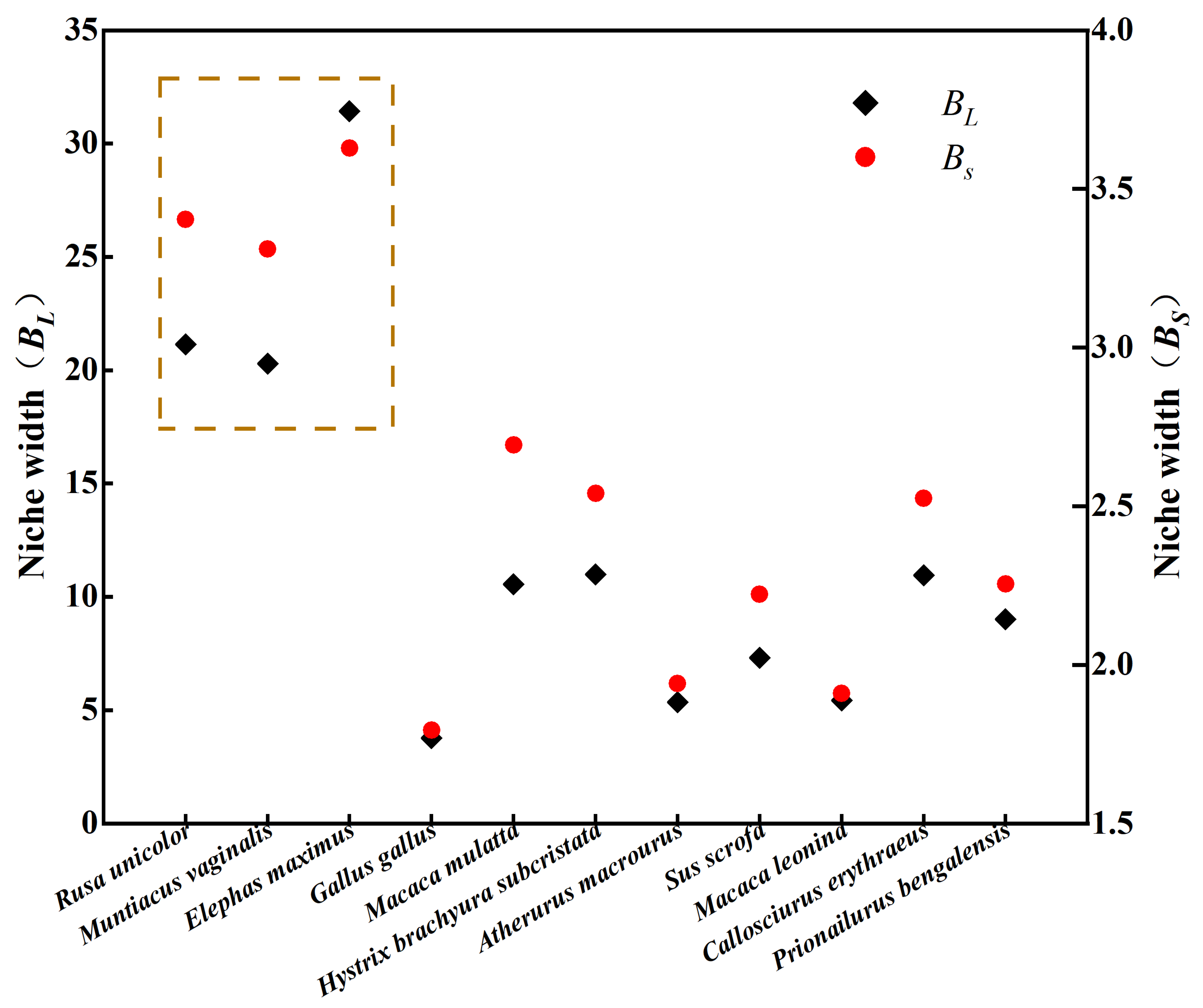
3.2.1. Niche Width
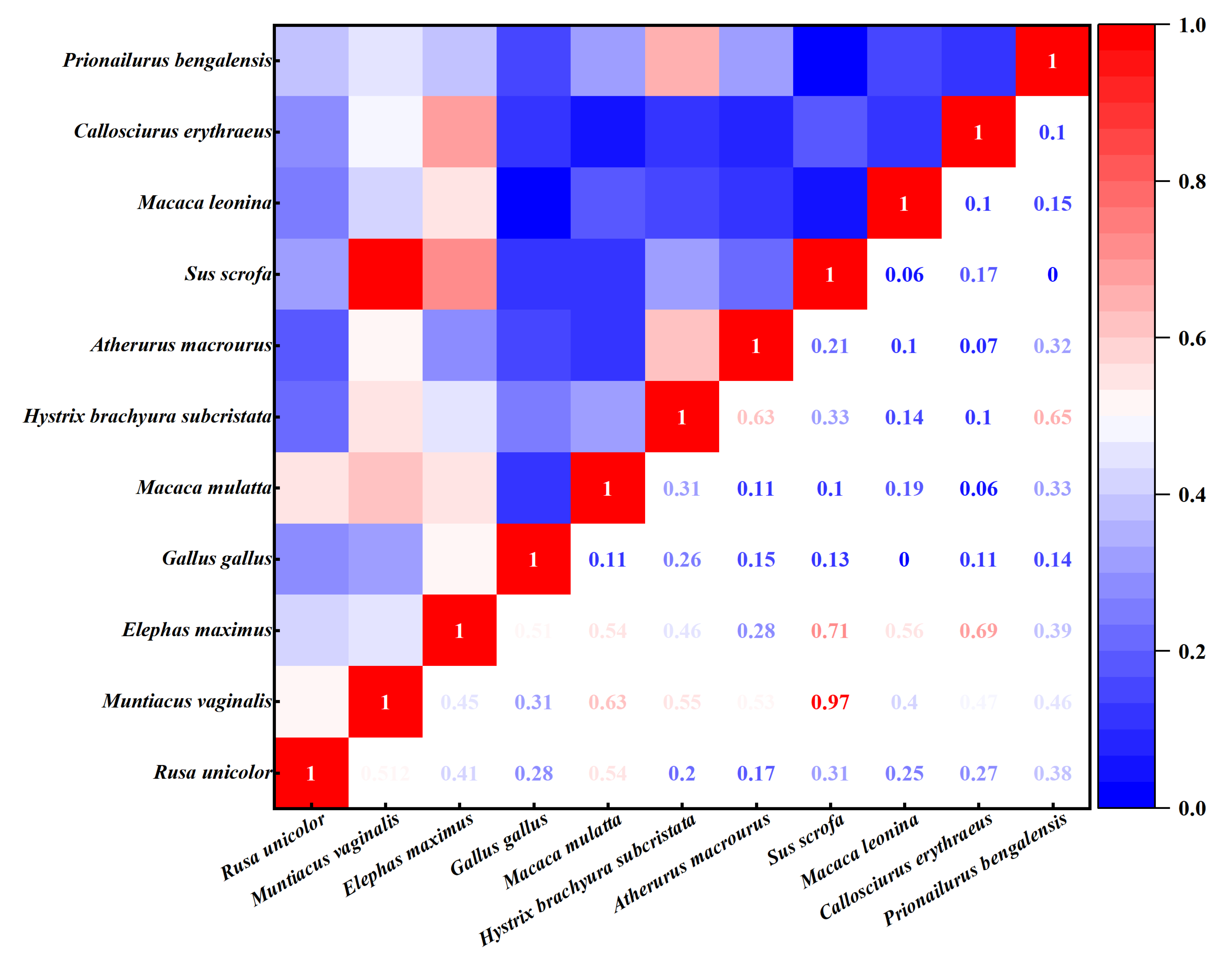
3.2.2. Spatial Co-Occurrence
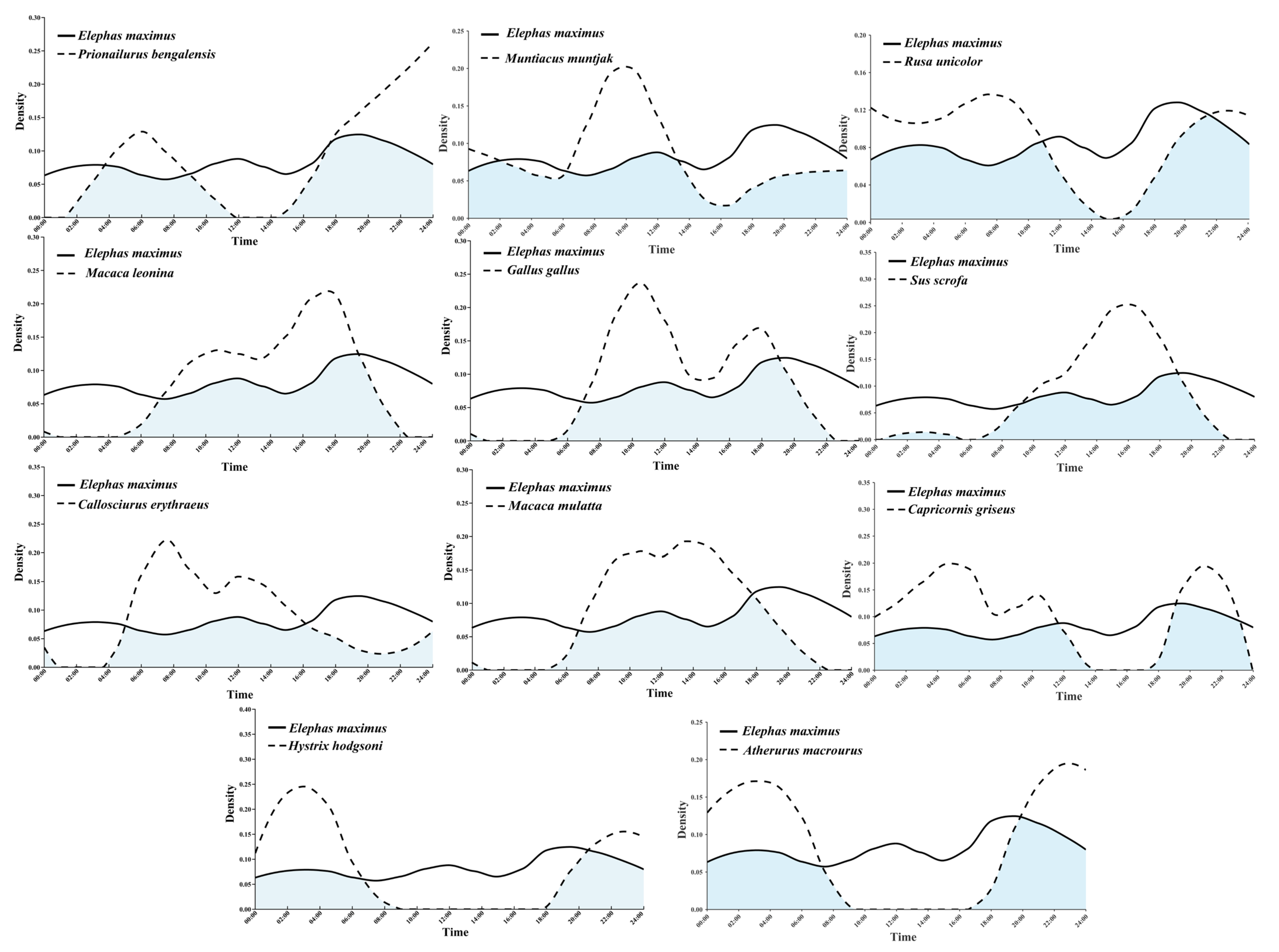
3.2.3. Daily Activity Rhythm
3.3. Interspecific Association
3.3.1. Overall Association
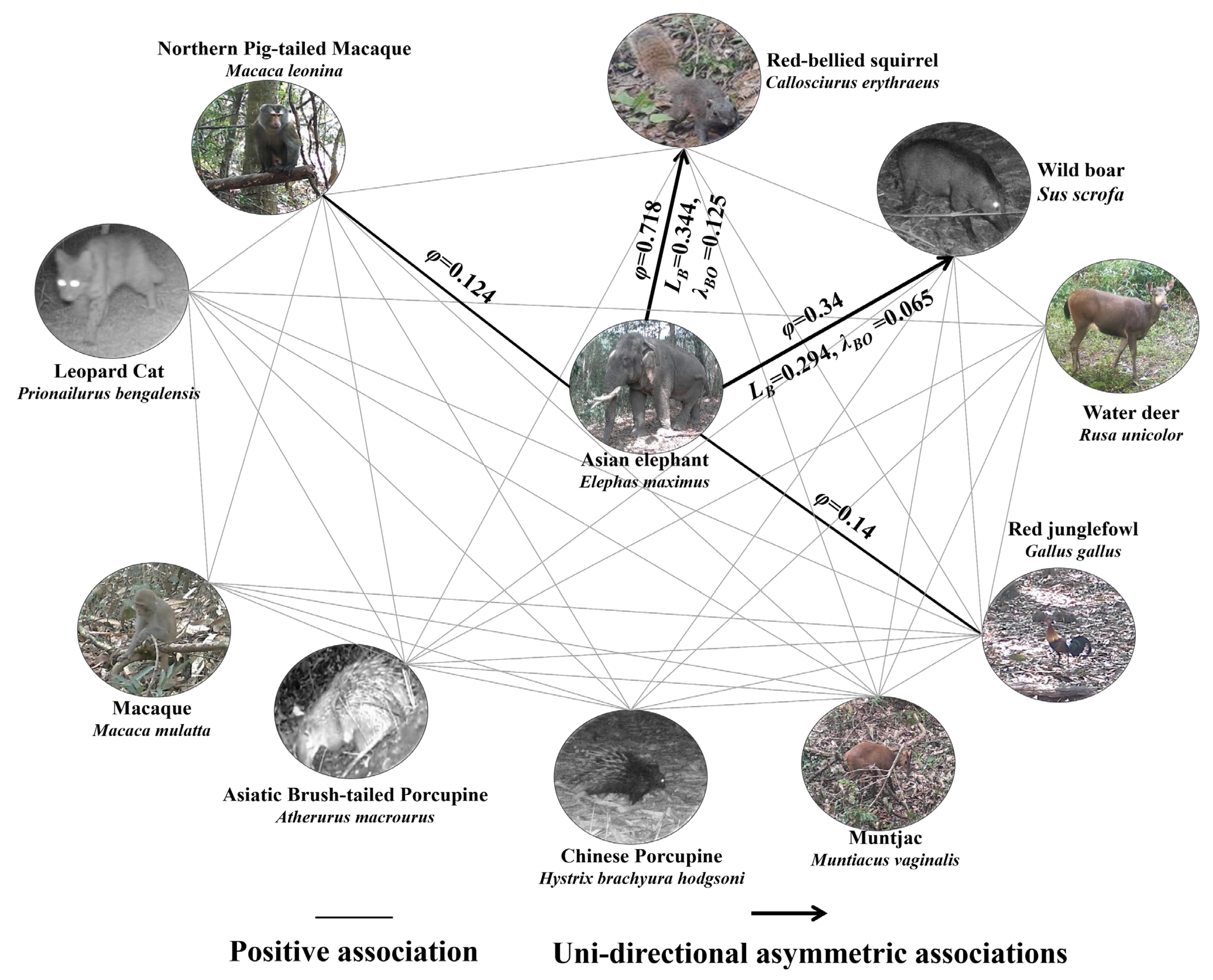
3.3.2. Asian Elephants and Their Spatially Associated Species Networks
4. Discussion
4.1. Spatial Distribution Pattern Differentiation and Resource Allocation Mechanism
4.2. Temporal Niche Partitioning and Multi-Dimensional Coexistence
4.3. Keystone Species Status of Asian Elephants and Ecological Network Construction
4.4. Conservation of Asian Elephants and Ecological Risks Associated with Isolated Populations
4.5. Limitations and Future Directions
5. Conclusions
Supplementary Materials
Author Contributions
Funding
Institutional Review Board Statement
Informed Consent Statement
Data Availability Statement
Conflicts of Interest
References
- Zhang, L.; Wang, N. An initial study on habitat conservation of Asian elephant (Elephas maximus), with a focus on human elephant conflict in Simao, China. Biol. Conserv. 2003, 112, 453–459. [Google Scholar] [CrossRef] [Scilit]
- Sukumar, R. The Living Elephants: Evolutionary Ecology, Behavior, and Conservation; Oxford University Press: Oxford, UK, 2003. [Google Scholar]
- Sukumar, R. A brief review of the status, distribution and biology of wild Asian elephants Elephas maximus. Int. Zoo Yearb. 2006, 40, 1–8. [Google Scholar] [CrossRef] [Scilit]
- Sukumar, R. The Asian Elephant: Ecology and Management. Camb. Stud. Appl. Ecol. Resour. Manag. 2012, 58, 383. [Google Scholar]
- Sukumar, R.; Gadgil, M. Male–Female differences in foraging on crops by Asian elephants. Anim. Behav. 1988, 36, 1233–1235. [Google Scholar] [CrossRef] [Scilit]
- Liu, P.; Wen, H.; Lin, L.; Liu, J.; Zhang, L. Habitat evaluation for Asian elephants (Elephas maximus) in Lincang: Conservation planning for an extremely small population of elephants in China. Biol. Conserv. 2016, 198, 113–121. [Google Scholar] [CrossRef] [Scilit]
- Lang, X.D.; Peng, M.C.; Wang, C.Y.; Li, Y.; Duan, H.; Li, X.; Jiang, W. Assessment of Asian elephant habitat quality status quo in Nangunhe valley, China. J. Yunnan Univ. Nat. Sci. Ed. 2008, 30, 415–423. [Google Scholar]
- Yang, N.; Dai, X.H.; Wang, B.; Wen, M.; Gan, Z.; Li, Z.; Duffy, K.J. Mapping potential human-elephant conflict hotspots with UAV monitoring data. Glob. Ecol. Conserv. 2023, 43, e02451. [Google Scholar] [CrossRef] [Scilit]
- Maicher, V.; Delabye, S.; Murkwe, M.; Doležal, J.; Altman, J.; Kobe, I.N.; Desmist, J.; Fokam, E.B.; Pyrcz, T.; Tropek, R. Effects of disturbances by forest elephants on diversity of trees and insects in tropical rainforests on Mount Cameroon. Sci. Rep. 2020, 10, 21618. [Google Scholar] [CrossRef] [Scilit]
- Greco, I.; Beaudrot, L.; Sutherland, C.; Tenan, S.; Hsieh, C.; Gorczynski, D.; Sheil, D.; Brodie, J.; Ahmed, M.F.; Ahumada, J.; et al. Landscape-level human disturbance results in loss and contraction of mammalian populations in tropical forests. PLoS Biol. 2025, 23, 1. [Google Scholar] [CrossRef] [Scilit] [PubMed]
- Feng, L.M.; Zhang, L. Habitat selection by Asian elephant (Elephas maximus) in Xishuangbanna, Yunnan, China. Acta Theriol. Sin. 2005, 25, 229–236. [Google Scholar]
- Pant, B.; Sharma, H.P.; Dahal, B.R.; Regmi, S.; Belant, J.L. Spatio-temporal patterns of human-wildlife conflicts and effectiveness of mitigation in Shuklaphanta National Park, Nepal. PLoS ONE 2023, 18, e0282654. [Google Scholar] [CrossRef] [Scilit] [PubMed]
- Wang, J.; Chen, Y.; Sun, Y.; Lyu, Z.; Shi, K. Inferring Human-elephant Coexistence Based on Characteristics of Human-elephant Interactions in Nangunhe of Yunnan, China. Chin. Geogr. Sci. 2023, 33, 363–376. [Google Scholar] [CrossRef] [Scilit]
- Liang, X.; Chen, T.Y.; Xiao, H.; Xie, Y. The impact of human-elephant conflicts on farm households’ land lease behavior: The case of Yunnan Province, China. Land Use Policy 2025, 153, 107532. [Google Scholar] [CrossRef] [Scilit]
- Li, W.W.; Liu, P.; Guo, X.M.; Wang, L.; Wang, Q.; Yu, Y.; Dai, Y.; Li, L.; Zhang, L. Human-elephant conflict in Xishuangbanna Prefecture, China: Distribution, diffusion, and mitigation. Glob. Ecol. Conserv. 2018, 16, e00462. [Google Scholar] [CrossRef] [Scilit]
- Jason, M.T.; Laliberté, E.; Nielsen, A.; Bascompte, J. Conservation of species interaction networks. Biol. Conserv. 2010, 143, 2270–2279. [Google Scholar] [CrossRef] [Scilit]
- Dice, L.R. Measures of the Amount of Ecologic Association Between Species. Ecology 1945, 26, 297–302. [Google Scholar] [CrossRef] [Scilit]
- Ma, Y.X.; Wang, Y.L.; Li, G.T.; Liang, T.Y.; Zou, M.; Yan, J.Q.Z.; Ma, H. HunShanDaKe sand east edge of vegetation ecological niche and interspecific association studies. IOP Conf. Ser. Earth Environ. Sci. 2019, 351, 012045. [Google Scholar] [CrossRef] [Scilit]
- Huang, R.Z.; Wang, Q.; Sun, J.Y.; Zhao, Y.; Yang, S.; Xiao, W.; Liu, J. Niche and interspecific association of dominant arbor species in Quercus communities in the Qinling Mountains, China. Glob. Ecol. Conserv. 2025, 57, e03404. [Google Scholar] [CrossRef] [Scilit]
- Mougi, A.; Kondoh, M. Diversity of Interaction Types and Ecological Community Stability. Science 2012, 337, 349–351. [Google Scholar] [CrossRef] [Scilit]
- Bairey, E.; Kelsic, E.D.; Kishony, R. High-order species interactions shape ecosystem diversity. Nat. Commun. 2016, 7, 12285. [Google Scholar] [CrossRef] [Scilit]
- Bascompte, J.; Jordano, P.; Olesen, J.M. Asymmetric Coevolutionary Networks Facilitate Biodiversity Maintenance. Science 2006, 312, 431–433. [Google Scholar] [CrossRef] [Scilit]
- Bastolla, U.; Fortuna, M.A.; Pascual-Garcia, A.; Ferrera, A.; Luque, B.; Bascompte, J. The architecture of mutualistic networks minimizes competition and increases biodiversity. Nature 2009, 458, 1018–1020. [Google Scholar] [CrossRef] [Scilit]
- Angelstam, R.P. Usefulness of the Umbrella Species Concept as a Conservation Tool. Conserv. Biol. 2004, 18, 76–85. [Google Scholar] [CrossRef] [Scilit]
- Valeix, M.; Chamaillé-Jammes, S.; Fritz, H. Interference competition and temporal niche shifts: Elephants and herbivore communities at waterholes. Oecologia 2007, 153, 739–748. [Google Scholar] [CrossRef] [Scilit] [PubMed]
- Farine, D. The dynamics of transmission and the dynamics of networks. J. Anim. Ecol. 2017, 86, 415–418. [Google Scholar] [CrossRef] [Scilit]
- Seddon, P.J.; Leech, T. Conservation short cut, or long and winding road? A critique of umbrella species criteria. Oryx 2008, 42, 240–245. [Google Scholar] [CrossRef] [Scilit]
- Zhang, H.; Chase, J.M.; Liao, J. Habitat amount modulates biodiversity responses to fragmentation. Nat. Ecol. Evol. 2024, 8, 1437–1447. [Google Scholar] [CrossRef] [Scilit]
- Schoener, T.W. Resource partitioning in ecological communities. Science 1974, 185, 27–39. [Google Scholar] [CrossRef] [Scilit]
- Shang, Y.C. Animal Behavior; Peking University Press: Beijing, China, 2005. [Google Scholar]
- Kronfeld-Schor, N.; Dayan, T. Partitioning of Time as an Ecological Resource. Annu. Rev. Ecol. Evol. Syst. 2003, 34, 153–181. [Google Scholar] [CrossRef] [Scilit]
- Tang, F.L.; Du, F.; Sun, G.Z. Comprehensive Scientific Investigation and Study of Nangunhe National Nature Reserve in Yunnan Province, China; China Forestry Publishing House: Beijing, China, 2015. [Google Scholar]
- Jiang, J.F. Current Situation and Evaluation of Forest Resources in the Nangrong River National Nature Reserve in Yunnan Province. Inn. Mong. For. Surv. Des. 2022, 45, 44–46. [Google Scholar]
- Yang, F.; Zhang, L. Genetic diversity and population genetic structure of Chinese Asian elephant based on mitochondrial DNA. Acta Theriol. Sin. 2012, 32, 90–100. [Google Scholar]
- Smith, A.T.; Xie, Y.; Chen, Y.; Hoffmann, R.S.; Lunde, D.; MacKinnon, J. A Guide to the Mammals of China; Hunan Education Publishing House: Changsha, China, 2009. [Google Scholar]
- Mackinnon, J.; Phillipps, K.; He, F. A Field Guide to the Birds of China; Oxford University Press: Oxford, UK, 2000. [Google Scholar]
- Rovero, F.; Marshall, A.R. Camera trapping photographic rate as an index of density in forest ungulates. J. Appl. Ecol. 2009, 46, 1011–1017. [Google Scholar] [CrossRef] [Scilit]
- O’Brien, T.G.; Kinnaird, M.F.; Wibisono, H.T. Crouching tigers, hidden prey: Sumatran tiger and prey populations in a tropical forest landscape. Anim. Conserv. 2003, 6, 131–139. [Google Scholar] [CrossRef] [Scilit]
- Sollmann, R.; Mohamed, A.; Samejima, H.; Wilting, A. Risky business or simple solution—Relative abundance indices from camera-trapping. Biol. Conserv. 2013, 159, 405–412. [Google Scholar]
- Richard, L. Evolution in Changing Environments: Some Theoretical Explorations; Princeton University Press: Princeton, NJ, USA, 1968. [Google Scholar]
- Shannon, C.E.; Weaver, W. The Mathematical Theory of Communications. Philos. Rev. 1949, 60. [Google Scholar] [CrossRef] [Scilit]
- Pianka, E.R. The Structure of Lizard Communities. Annu. Rev. Ecol. Syst. 1973, 4, 53–74. [Google Scholar] [CrossRef] [Scilit]
- Schluter, D. A variance test for detecting species associations, with some example applications. Ecology 1984, 65, 998–1005. [Google Scholar] [CrossRef] [Scilit]
- Udny, Y.G. On the Methods of Measuring Association between Two Attributes. J. R. Stat. Soc. Ser. A Stat. Soc. 2018, 6, 6. [Google Scholar]
- Yates, F.E.; Marsh, D.J.; Iberall, A.S. Integration of the Whole Organism: A Foundation Their Solution for a Theoretical Biology. In Challenging Biological Problems: Directions Towards Their Solution; Oxford University Press: New York, NY, USA, 1972; pp. 110–132. [Google Scholar]
- Ridout, M.S.; Linkie, M. Estimating overlap of daily activity patterns from camera trap data. J. Agric. Biol. Environ. Stat. 2009, 14, 322–337. [Google Scholar] [CrossRef] [Scilit]
- Rowcliffe, M. Activity: Animal Activity Statistics. CRAN: Contributed Packages, 2014. Available online: https://search.r-project.org/CRAN/refmans/activity/html/activity.html (accessed on 12 November 2025).
- Meredith, M.; Ridout, M. Overlap: Estimates of Coefficient of Overlapping for Animal Activity Patterns. 2017. Available online: https://CRAN.R-project.org/package=overlapping (accessed on 12 November 2025).
- Siegel, S.; Castellan, J. Chapter 9: Measures of Association and Their Tests of Significance. In Nonparametric Statistics for the Behavioral Sciences, 2nd ed.; McGraw-Hill International Editions: New York, NY, USA, 1988. [Google Scholar]
- Bengtsson, J.; Fagerström, T.; Rydin, H. Competition and coexistence in plant communities. Trends Ecol. Evol. 1994, 9, 246–250. [Google Scholar] [CrossRef] [Scilit]
- Boulangeat, I.; Lavergne, S.; Es, J.Y.; Garraud, L.; Thuiller, W. Niche breadth, rarity and ecological characteristics within a regional flora spanning large environmental gradients. J. Biogeogr. 2012, 39, 204–214. [Google Scholar] [CrossRef] [Scilit]
- Campos-Arceiz, A.; Blake, S. Megagardeners of the forest-The role of elephants in seed dispersal. Acta Oecologica 2011, 37, 542–553. [Google Scholar] [CrossRef] [Scilit]
- Li, H.; Tang, L.; Jia, C.; Holyoak, M.; Fründ, J.; Huang, X.; Xiao, Z. The functional roles of species in metacommunities, as revealed by metanetwork analyses of bird–plant frugivory networks. Ecol. Lett. 2020, 23, 1252–1262. [Google Scholar] [CrossRef] [Scilit] [PubMed]
- Zhang, L.; Dong, L.; Lin, L.; Feng, L.; Yan, F.; Wang, L.; Guo, X.; Luo, A. Asian elephants in China: Estimating population size and evaluating habitat suitability. PLoS ONE 2015, 10, e0124834. [Google Scholar]
- Feng, L.M.; Wang, Z.S.; Lin, L.; Yang, S.; Zhou, B.; Li, C.; Xiong, Y.; Zhang, L. Habitat selection in dry season of Asian elephant (Elephas maximus) and conservation strategies in Nangunhe. Acta Theriol. Sin. 2010, 30, 1. [Google Scholar]



| Species A | Species B | ||
|---|---|---|---|
| Presence | Absence | Total | |
| Presence | a | b | a + b |
| Absence | c | d | c + d |
| Total | a + c | b + d | N = a + b + c + d |
| Orders | Family | Species | Number of Individual Photographs | Relative Abundance Index | Number of Camera Sites Detected (Occupancy) |
|---|---|---|---|---|---|
| Mammalia | |||||
| Proboscidea | Elephantidae | Elephas maximus Linnaeus, 1758 | 307 | 74.6 * | 50 |
| Artiodactyla | Cervidae | Rusa unicolor Kerr, 1792 | 731 | 91.0 * | 61 |
| Muntiacus vaginalis Zimmermann, 1780 | 381 | 65.7 * | 44 | ||
| Suidae | Sus scrofa Linnaeus, 1758 | 32 | 17.9 * | 12 | |
| Bovidae | Capricornis milneedwardsii Bechstein, 1799 | 21 | 10.4 | 7 | |
| Primates | Cercopithecidae | Macaca mulatta Zimmermann, 1780 | 80 | 32.8 * | 22 |
| Macaca leonina Blyth, 1863 | 21 | 13.4 * | 9 | ||
| Trachypithecus crepusculus Elliot, 1909 | 1 | 1.5 | 1 | ||
| Rodentia | Hystricidae | Atherurus macrourus Linnaeus, 1758 | 33 | 14.9 * | 10 |
| Hystrix brachyura subcristata Swinhoe, 1870 | 58 | 23.9 * | 16 | ||
| Sciuridae | Callosciurus erythraeus Pallas, 1778 | 19 | 20.9 * | 14 | |
| Carnivora | Felidae | Prionailurus bengalensis Kerr, 1792 | 12 | 14.9 * | 10 |
| Mustelidae | Melogale moschata Gray, 1831 | 5 | 4.5 | 3 | |
| Martes flavigula Boddaert, 1785 | 3 | 4.5 | 1 | ||
| Viverridae | Viverricula indica Geoffroy, 1803 | 5 | 3.0 | 2 | |
| Paradoxurus hermaphroditus Pallas, 1777 | 8 | 4.5 | 3 | ||
| Paguma larvata Smith, 1827 | 1 | 1.5 | 1 | ||
| Ursidae | Ursus thibetanus G. Baron Cuvier, 1823 | 2 | 1.5 | 1 | |
| Aves | |||||
| Galliformes | Phasianidae | Gallus gallus Linnaeus, 1758 | 101 | 18.0 * | 12 |
| Lophura nycthemera Linnaeus, 1758 | 11 | 9.0 | 6 | ||
| Arborophila atrogularis Blyth, 1850 | 1 | 1.5 | 1 | ||
| Accipitriformes | Accipitridae | Pernis ptilorhynchus Temminck, 1821 | 1 | 1.5 | 1 |
| Spilornis cheela Latham, 1790 | 3 | 3.0 | 2 | ||
| Passeriformes | Sittidae | Sitta nagaensis Godwin-Austen, 1874 | 1 | 1.5 | 1 |
| Sitta frontalis Swainson, 1820 | 1 | 1.5 | 1 | ||
| Turdidae | Turdus dissimilis Blyth, 1847 | 13 | 10.4 | 1 | |
| Phylloscopidae | Phylloscopus tephrocephalus Anderso, 1871 | 1 | 1.5 | 1 | |
| Pellorneidae | Pellorneum ruficeps Swainson, 1832 | 3 | 4.5 | 3 | |
| Schoeniparus dubius Hume, 1874 | 1 | 1.5 | 1 | ||
| Timaliidae | Pomatorhinus schisticeps Hodgson, 1836 | 1 | 1.5 | 1 | |
| Leiothrichidae | Leiothrix argentauris Hodgson, 1837 | 1 | 1.5 | 1 | |
| Muscicapidae | Copsychus malabaricus Scopoli, 1786 | 1 | 1.5 | 1 | |
| Copsychus saularis Linnaeus, 1758 | 2 | 1.5 | 1 | ||
| Myophonus caeruleus Scopoli, 1786 | 3 | 3.0 | 2 | ||
| Pycnonotidae | Alophoixus flaveolus Gould, 1836 | 1 | 1.5 | 1 | |
| Alcippeidae | Alcippe fratercula Rippon, 1900 | 1 | 1.5 | 1 | |
| Columbiformes | Columbidae | Streptopelia decaocto Frivaldszky, 1838 | 1 | 1.5 | 1 |
| Chalcophaps indica Linnaeus, 1758 | 4 | 6.0 | 4 | ||
| Macropygia unchall Wagler, 1827 | 2 | 1.5 | 1 | ||
| Piciformes | Picidae | Chrysophlegma flavinucha Gould, 1834 | 1 | 1.5 | 1 |
| Coraciiformes | Meropidae | Nyctyornis athertoni Jardine & Selby, 1828 | 1 | 1.5 | 1 |
| Bucerotiformes | Bucerotidae | Anthracoceros albirostris Shaw & Nodder, 1807 | 1 | 1.5 | 1 |
| Strigiformes | Strigidae | Glaucidium cuculoides Vigors, 1831 | 1 | 1.5 | 1 |
| Reptilia | |||||
| Squamata | Varanidae | Varanus salvator Laurenti, 1768 | 1 | 1.5 | 1 |
| Predicting Species | Predicted Species | LB (Upper) | λBO (Lower) | p |
|---|---|---|---|---|
| Asian elephant | Red Junglefowl | 0.162 | −0.093 | p > 0.05 |
| Asian elephant | Wild boar | 0.294 | 0.065 | p ≤ 0.05 |
| Asian elephant | Northern pig-tailed macaque | 0.471 | −0.21 | p > 0.05 |
| Asian elephant | Red-bellied squirrel | 0.344 | 0.125 | p ≤ 0.05 |
| Red Junglefowl | Asian elephant | 0.041 | −0.017 | p > 0.05 |
| Wild boar | Asian elephant | 0.060 | −0.417 | p > 0.05 |
| Northern pig-tailed macaque | Asian elephant | 0.109 | −0.890 | p > 0.05 |
| Red-bellied squirrel | Asian elephant | 0.091 | −0.214 | p > 0.05 |
Disclaimer/Publisher’s Note: The statements, opinions and data contained in all publications are solely those of the individual author(s) and contributor(s) and not of MDPI and/or the editor(s). MDPI and/or the editor(s) disclaim responsibility for any injury to people or property resulting from any ideas, methods, instructions or products referred to in the content. |
© 2026 by the authors. Licensee MDPI, Basel, Switzerland. This article is an open access article distributed under the terms and conditions of the Creative Commons Attribution (CC BY) license.
Share and Cite
Wang, J.; Li, X.; Tian, Y.; Duan, W.; Si, Y.; Wen, D.; Wang, W.; Meng, D. Spatial Associations and Co-Occurrence Networks of Sympatric Species in an Asian Elephant Community. Animals 2026, 16, 351. https://doi.org/10.3390/ani16020351
Wang J, Li X, Tian Y, Duan W, Si Y, Wen D, Wang W, Meng D. Spatial Associations and Co-Occurrence Networks of Sympatric Species in an Asian Elephant Community. Animals. 2026; 16(2):351. https://doi.org/10.3390/ani16020351
Chicago/Turabian StyleWang, Jingshan, Xu Li, Yuan Tian, Wenguan Duan, Yuhui Si, Dusu Wen, Weibin Wang, and Dehuai Meng. 2026. "Spatial Associations and Co-Occurrence Networks of Sympatric Species in an Asian Elephant Community" Animals 16, no. 2: 351. https://doi.org/10.3390/ani16020351
APA StyleWang, J., Li, X., Tian, Y., Duan, W., Si, Y., Wen, D., Wang, W., & Meng, D. (2026). Spatial Associations and Co-Occurrence Networks of Sympatric Species in an Asian Elephant Community. Animals, 16(2), 351. https://doi.org/10.3390/ani16020351