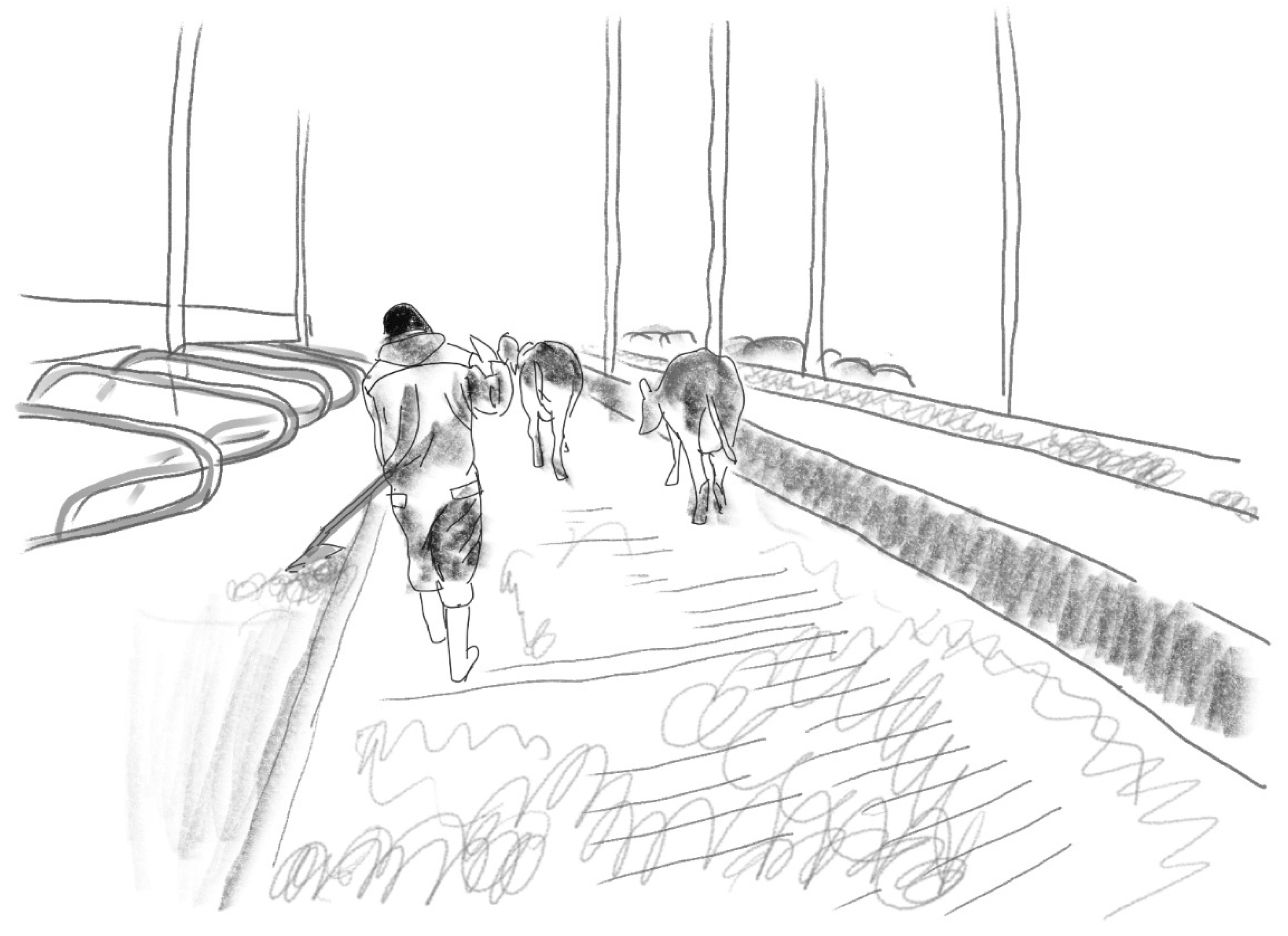
Linguistic and Material Ways of Communicating with Cows—The Dung Pusher as a Semiotic Resource


Simple Summary
Abstract
1. Introduction
1.1. Academic Background and Orientation
1.2. Why Study Talking to Cows
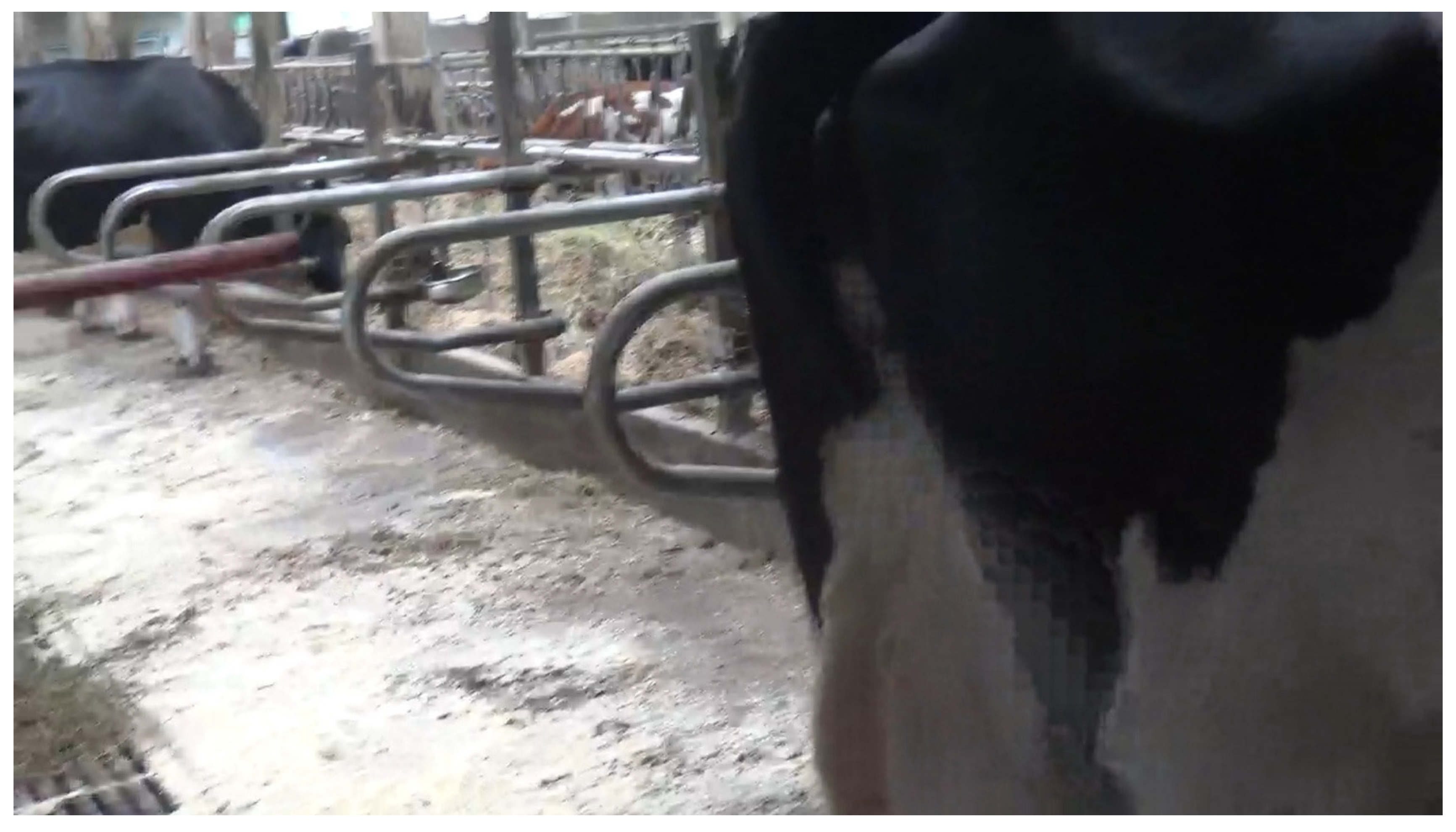
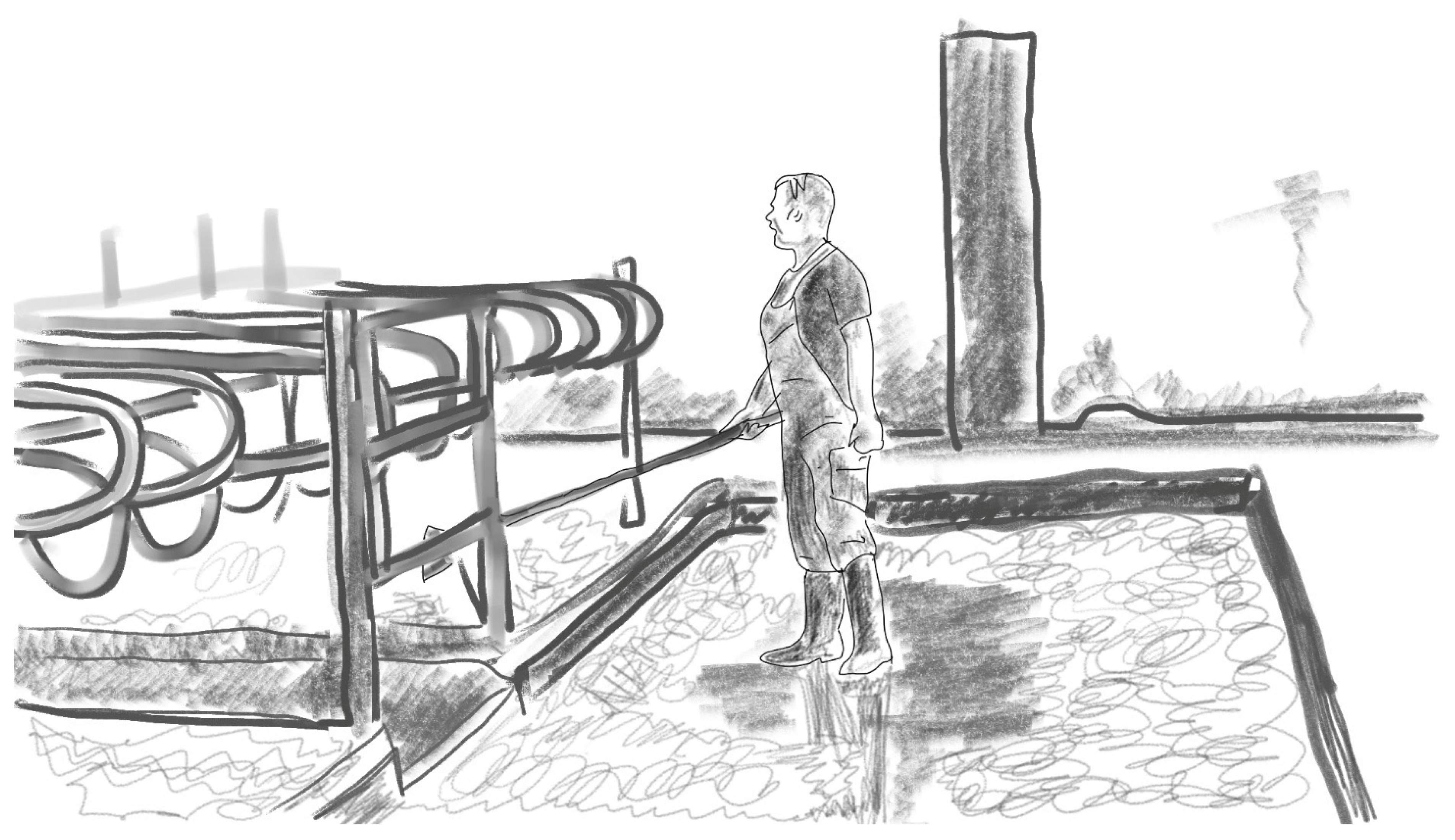
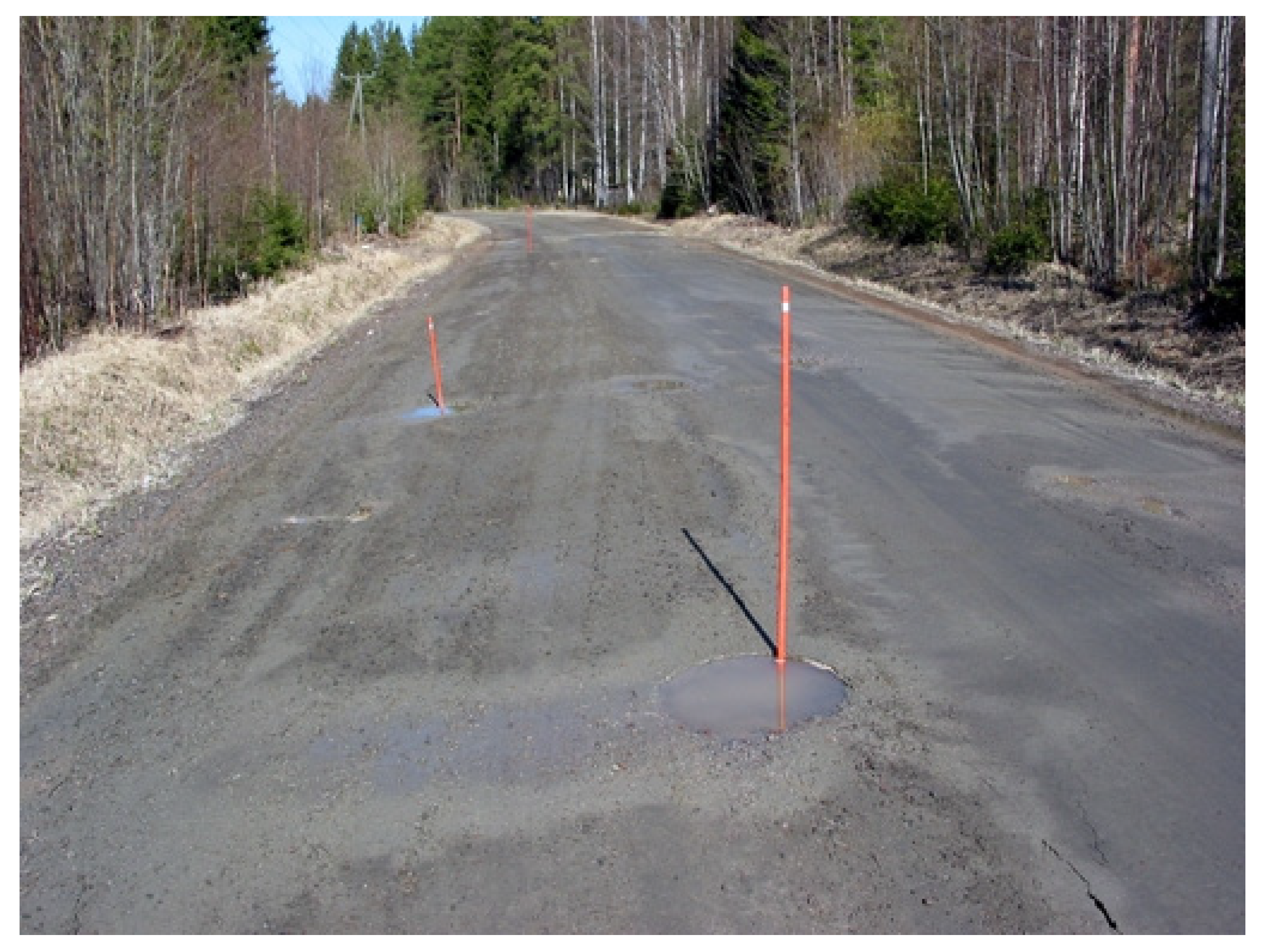
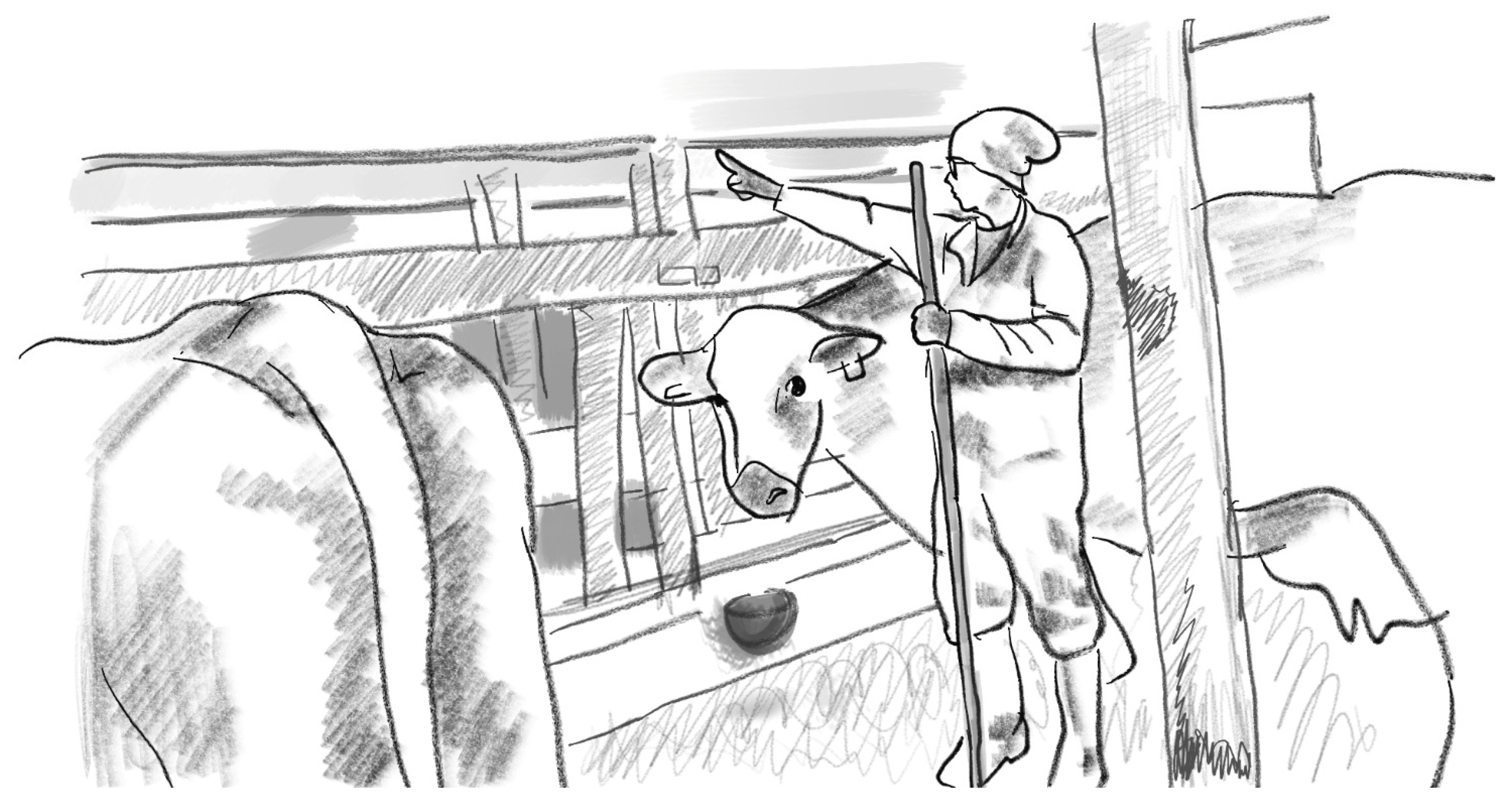
1.3. Tools in This Study: Dung Pusher and Snow Stake
1.4. Materiality of Language
1.5. Researcher’s Body in Intra-Action
2. Materials and Methods
3. Umwelts and Meaning-Carriers—Four Different Types of Living Situations in My Data
4. Examples of Dung Pusher Use
4.1. Directives and Commands in Steering Cows
4.2. Materiality of Language—Examples 1 and 2


4.3. Rhythm and Gesture-like Qualities in Dung Pusher and Snow Stake Use
5. Dung Pushers and Snow Stakes as ‘Meaning-Carriers’
6. Different Methods of Communication
7. Conclusions
Funding
Institutional Review Board Statement
Informed Consent Statement
Data Availability Statement
Conflicts of Interest
Abbreviations
| 2SG | 2nd person singular |
| IMP | imperative |
| PASS | passive |
| PTCL | particle |
| Transcription conventions for speech and movements. Adapted from [42,43]. | |
| (.) | micro-pause |
| (1.5) | measured pause |
| LÄhe | primary pitch accent |
| lÄhe | secondary pitch accent |
| °no jaa° | quiet speech |
| >et lähe< | fast speech |
| ↑/↓ | rise/fall in pitch |
| [ | overlap (start) |
| ] | overlap (finish) |
| (ai) | doubt in transcription |
| level pitch | |
| . | falling pitch |
| >> | an action started before the transcribed excerpt |
| ¿ | hit or touch with a pusher |
| */**/***/ | embodied actions begin in relation to speech (interlocutor 1) |
| +/++/+++ | embodied actions begin in relation to speech (interlocutor 2) |
| %/%% | embodied actions begin in relation to speech (interlocutor 3) |
| -> | embodied action continues until |
| ->> | an action continues beyond the transcribed excerpt |
| # | indicates the exact moment at which a screenshot was taken |
References
- Johnson, M. The Embodiment of Language. In The Oxford Handbook of 4E Cognition; Newen, A., De Bruin, L., Gallagher, S., Eds.; Oxford University Press: Oxford, UK, 2018. [Google Scholar] [CrossRef] [Scilit]
- Haddington, P. Materiality. 2022. Available online: https://osf.io/kc63j/overview (accessed on 1 September 2025).
- Jääskeläinen, A. Eläinten Omat Sanat: Eläimille Suunnatut Interjektiot Ihmisen Ja Eläimen Vuorovaikutuksen Osina. In Kieli ja Eläin: Vuorovaikutusta ja Kielioppia Monilajisissa Yhteisöissä; Peltola, R., Jääskeläinen, A., Harjunpää, K., Eds.; Suomalaisen Kirjallisuuden Seura: Helsinki, Finland, 2021; pp. 133–184. [Google Scholar]
- Jääskeläinen, A. ‘But for Calves We Were Sweeter’. Traditional Finnish Cattle Calling as Trans-Species Pidgin. Lang. Commun. 2025, 103, 50–64. [Google Scholar] [CrossRef] [Scilit]
- Peltola, R.; Simonen, M. Towards Interspecies Pragmatics: Language Use and Embodied Interaction in Human-Animal Activities, Encounters, and Narratives. J. Pragmat. 2024, 220, 15–19. [Google Scholar] [CrossRef] [Scilit]
- Harjunpää, K.; Szczepek Reed, B. Prosodic Matching beyond Humans: On the Interactional Basis of “Cat-Directed” Talk. Lang. Commun. 2025, 103, 65–85. [Google Scholar] [CrossRef] [Scilit]
- Harjunpää, K. Repetition and Prosodic Matching in Responding to Pets’ Vocalizations. Lang. Société 2022, 176, 69–102. [Google Scholar] [CrossRef] [Scilit]
- Maran, T.; Martinelli, D.; Turovski, A. Introduction. In Readings in Zoosemiotics; Maran, T., Martinelli, D., Turovski, A., Eds.; Semiotics, Communication and Cognition; De Gruyter Mouton: Berlin, Germany; Boston, MA, USA, 2011; pp. 1–20. [Google Scholar]
- von Uexküll, J. The Theory of Meaning. Semiotica 1982, 42, 25–80. [Google Scholar] [CrossRef] [Scilit]
- Kohn, E. How Forests Think: Toward an Anthropology Beyond the Human; University of California Press: Berkeley, CA, USA, 2013; ISBN 978-0-520-27610-9. [Google Scholar]
- Fried, M.; Östman, J.-O. Construction Grammar: A Thumbnail Sketch. In Constructional Approaches to Language; Fried, M., Östman, J.-O., Eds.; John Benjamins Publishing Company: Amsterdam, The Netherlands, 2004; Volume 2, pp. 10–85. [Google Scholar]
- Tannen, D. Talking the Dog: Framing Pets as Interactional Resources in Family Discourse. Res. Lang. Soc. Interact. 2004, 37, 399–420. [Google Scholar] [CrossRef] [Scilit]
- Roberts, F. Speaking to and for Animals in a Veterinary Clinic: A Practice for Managing Interpersonal Interaction. Res. Lang. Soc. Interact. 2004, 37, 421–446. [Google Scholar] [CrossRef] [Scilit]
- Kaarlenkaski, T. Communicating with the Cow: Human-Animal Interaction in Written Narratives. In The Semiotics of Animal Representations; Rodopi: Amsterdam, The Netherlands, 2014; pp. 191–216. [Google Scholar]
- Seabrook, M.F. The psychological relationship between dairy cows and dairy cowmen and its implications for animal welfare. Int. J. Study Anim. Probl. 1980, 1, 295–298. [Google Scholar]
- Seabrook, M.F. The psychological interaction between the stockman and his animals and its influence on performance of pigs and dairy cows. Vet. Rec. 1984, 115, 84–87. [Google Scholar] [CrossRef] [Scilit]
- Hanna, D.; Sneddon, I.A.; Beattie, V.E.; Breuer, K. Effects of the stockperson on dairy cow behaviour and milk yield. Anim. Sci. 2006, 82, 791–797. [Google Scholar] [CrossRef] [Scilit]
- Bertenshaw, C.; Rowlinson, P. Exploring Stock Managers’ Perceptions of the Human—Animal Relationship on Dairy Farms and an Association with Milk Production. Anthrozoös 2009, 22, 59–69. [Google Scholar] [CrossRef] [Scilit]
- Vainio, A.; Kauppinen, T.; Raussi, S.; Valros, A.; Vesala, K.M. Väline vai Itseisarvo? Tuotantoeläinten Hyvinvoinnin Edistäminen Tuottajien Asenteiden Kohteena; Julkaisuja/Helsingin Yliopisto, Ruralia-Instituutti: Helsinki, Finland, 2007; ISBN 978-952-10-3359-9. [Google Scholar]
- Kallioniemi, M.K.; Raussi, S.M.; Rautiainen, R.H.; Kymäläinen, H.-R. Safety and Animal Handling Practices among Women Dairy Operators. J. Agric. Saf. Health 2011, 17, 63–78. [Google Scholar] [CrossRef] [Scilit] [PubMed]
- Seabrook, M.F.; Wilkinson, J.M. Stockpersons’ attitudes to the husbandry of dairy cows. Vet. Rec. 2000, 147, 157–160. [Google Scholar] [CrossRef] [Scilit] [PubMed]
- Maaseutukeskusten Liitto. Tuotantoeläinten hyvinvointi. In Tieto Tuottamaan 81, 2nd ed.; Maaseutukeskusten Liitto: Helsinki, Finland, 2000. [Google Scholar]
- Tahkovuori, P.; Pitkänen, B. Rakkaat Eläimet, Joita Syömme; Into Kustannus Oy: Helsinki, Finland, 2024. [Google Scholar]
- Nevile, M.; Haddington, P.; Heinemann, T.; Rauniomaa, M. (Eds.) Interacting with Objects: Language, Materiality, and Social Activity; John Benjamins Publishing Company: Amsterdam, The Netherlands, 2014; ISBN 978-90-272-6983-6. [Google Scholar]
- Nevile, M. The Embodied Turn in Research on Language and Social Interaction. Res. Lang. Soc. Interact. 2015, 48, 121–151. [Google Scholar] [CrossRef] [Scilit]
- Pennycook, A. Translanguaging and Semiotic Assemblages. Int. J. Multiling. 2017, 14, 269–282. [Google Scholar] [CrossRef] [Scilit]
- Kusters, A.; Spotti, M.; Swanwick, R.; Tapio, E. Beyond Languages, beyond Modalities: Transforming the Study of Semiotic Repertoires. Int. J. Multiling. 2017, 14, 219–232. [Google Scholar] [CrossRef] [Scilit]
- Goodwin, C. Action and Embodiment within Situated Human Interaction. J. Pragmat. 2000, 32, 1489–1522. [Google Scholar] [CrossRef] [Scilit]
- Phillips, C. Cattle Behaviour and Welfare, 2nd ed.; John Wiley & Sons: Hoboken, NJ, USA, 2002. [Google Scholar]
- Mondémé, C. Touching and Petting. In Touch in Social Interaction: Touch, Language, and Body; Cekaite, A., Mondada, L., Eds.; Routledge: Abingdon, UK; New York, NY, USA, 2020; pp. 171–196. [Google Scholar]
- Porcher, J.; Schmitt, T. Dairy Cows: Workers in the Shadows? Soc. Anim. 2012, 20, 39–60. [Google Scholar] [CrossRef] [Scilit]
- McNeill, D. Hand and Mind: What Gestures Reveal About Thought; University of Chicago Press: Chicago, IL, USA, 1992; ISBN 978-0-226-56132-5. [Google Scholar]
- Clark, H. Pointing and Placing. In Pointing: Where Language, Culture, and Cognition Meet; Kita, S., Ed.; Psychology Press: London, UK, 2003; pp. 243–268. [Google Scholar]
- Barad, K. Meeting the Universe Halfway: Quantum Physics and the Entanglement of Matter and Meaning; Duke Books Scholarly Collection; Duke University Press: Durham, UK, 2007; ISBN 9786613022387. [Google Scholar]
- Laitinen, L. He-pronominin käyttö eläimistä. In Kieli ja Eläin: Vuorovaikutusta ja Kielioppia Monilajisissa Yhteisöissä; Peltola, R., Jääskeläinen, A., Harjunpää, K., Eds.; Suomalaisen Kirjallisuuden Seura: Helsinki, Finland, 2021; pp. 311–394. [Google Scholar]
- Iovino, S.; Oppermann, S. Introduction: Stories Come to Matter. In Material Ecocriticism; Iovino, S., Oppermann, S., Eds.; Indiana University Press: Bloomington, IL, USA, 2014; pp. 1–18. ISBN 978-0-253-01395-8. [Google Scholar]
- Coole, D.; Frost, S. Introducing the New Materialisms. In New Materialisms: Ontology, Agency, and Politics; Diana Coole, S.F., Bennett, J., Cheah, P., Orlie, M.A., Grosz, E., Eds.; E-Duke Books Scholarly Collection; Duke University Press: Durham, UK, 2010; ISBN 978-0-8223-4753-8. [Google Scholar]
- Natural Resources Institute Finland 2024. Available online: https://www.luke.fi/fi/uutiset/maitoalalla-tuotanto-ja-kulutus-ovat-kokeneet-isoja-muutoksia (accessed on 1 September 2025).
- Selvitys Nautojen Parressa ja Pihatossa Pidon Hyvinvointi- ja Talousvaikutuksista. Eläinten Hyvinvointikeskus. 2014. Available online: https://mmm.fi/documents/1410837/1858027/Parsi-pihattoselvitys/d3c98725-74b6-4d3d-bd6d-e4bbf24b8602/Parsi-pihattoselvitys.pdf (accessed on 1 September 2025).
- Luodonpää-Manni, M.; Ojutkangas, K. Laadullinen aineistopohjainen tutkimus. In Kielentutkimuksen Menetelmiä II; Luodonpää-Manni, M., Hamunen, M., Konstenius, R., Miestamo, M., Nikanne, U., Sinnemäki, K., Eds.; Suomalaisen Kirjallisuuden Seura: Helsinki, Finland, 2020; pp. 412–441. [Google Scholar]
- Harjunpää, K.; Niemi, J.; Sorjonen, M.-L. Keskustelun analyysi ja vuorovaikutuslingvistiikka. In Kielentutkimuksen Menetelmiä IV; Luodonpää-Manni, M., Hamunen, M., Konstenius, R., Miestamo, M., Nikanne, U., Sinnemäki, K., Eds.; Suomalaisen Kirjallisuuden Seura: Helsinki, Finland, 2020; pp. 896–941. [Google Scholar]
- Mondada, L. Multiple Temporalities of Language and Body in Interaction: Challenges for Transcribing Multimodality. Res. Lang. Soc. Interact. 2018, 51, 85–106. [Google Scholar] [CrossRef] [Scilit]
- Harjunpää, K.; Mondada, L.; Svinhufvud, K. Multimodaalinen Litterointi Keskusteluanalyysissä. Puhe Ja Kieli 2020, 3, 195–220. [Google Scholar] [CrossRef] [Scilit]
- Lehtinen, E. Conversation Analysis. In The Routledge Handbook of Research Methods in the Study of Religion, 2nd ed.; Engler, S., Stausberg, M., Eds.; Routledge: London, UK, 2022; pp. 194–204. [Google Scholar] [CrossRef] [Scilit]
- Cornips, L. The Semiotic Repertoire of Dairy Cows. Lang. Soc. 2025, 54, 731–755. [Google Scholar] [CrossRef] [Scilit]
- Cornips, L. The Animal Turn in Postcolonial Linguistics: The Interspecies Greeting of the Dairy Cow. J. Postcolonial Linguist. 2022, 6, 209–231. [Google Scholar]
- Cornips, L. Embodied Variation in the Sequential Greetings of the (Dairy) Cow. Lang. Commun. 2025, 103, 34–49. [Google Scholar] [CrossRef] [Scilit]
- von Uexküll, T. Introduction: Meaning and Science in Jakob von Uexküll’s Concept of Biology. Semiotica 1982, 42, 1–24. [Google Scholar] [CrossRef] [Scilit]
- Ajmone-Marsan, P.; Garcia, J.F.; Lenstra, J.A. On the Origin of Cattle: How Aurochs Became Cattle and Colonized the World. Evol. Anthropol. Issues News Rev. 2010, 19, 148–157. [Google Scholar] [CrossRef] [Scilit]
- Lonkila, A. Making Invisible Cows? Genomic Knowledge and More-than-Human Agency in Finnish Dairy Breeding. Dissertations in Social Sciences and Business Studies. Ph.D. Thesis, University of Eastern Finland, Joensuu, Finland, 2022. [Google Scholar]
- Lonkila, A. Optimoituja Eläimiä: Eläinten Jalostus Teknologisena Ratkaisuna Ruoantuotannon Kriiseihin. In Tunteva Tuote: Kuinka Eläimistä Tuli Osa Teollista Tuotantoa? Vastapaino: Helsinki, Finland, 2022; pp. 185–204. [Google Scholar]
- Mignon-Grasteau, S.; Boissy, A.; Bouix, J.; Faure, J.-M.; Fisher, A.D.; Hinch, G.N.; Jensen, P.; Le Neindre, P.; Mormède, P.; Prunet, P.; et al. Genetics of Adaptation and Domestication in Livestock. Livest. Prod. Sci. 2005, 93, 3–14. [Google Scholar] [CrossRef] [Scilit]
- Hansen, P. Becoming Bovine: Mechanics and Metamorphosis in Hokkaido’s Animal-Human-Machine. J. Rural Stud. 2014, 33, 119–130. [Google Scholar] [CrossRef] [Scilit]
- Goldberg, A. Constructions at Work: The Nature of Generalization in Language; Oxford University Press: Oxford, UK, 2005; ISBN 978-0-19-926851-1. [Google Scholar]
- Croft, W. Radical Construction Grammar: Syntactic Theory in Typological Perspective; Oxford University Press: Oxford, UK, 2001; ISBN 978-0-19-829955-4. [Google Scholar]
- Langacker, R. Cognitive Grammar: A Basic Introduction; Oxford University Press: Oxford, UK, 2008; ISBN 978-0-19-533196-7. [Google Scholar]
- Hakulinen, A.; Vilkuna, M.; Korhonen, R.; Koivisto, V.; Heinonen, T.R.; Alho, I. (Eds.) Iso Suomen Kielioppi; Kotimaisten Kielten tutkimuskeskus: Helsinki, Finland, 2004; ISBN 978-952-5446-35-7. [Google Scholar]
- Aikhenvald, A.Y. Imperatives and Commands: A Cross-Linguistic View. In Commands: A Cross-Linguistic Typology; Aikhenvald, A.Y., Dixon, R.M.W., Eds.; Oxford University Press: Oxford, UK, 2017; pp. 1–45. [Google Scholar]
- Karhu, S. Ecofeminist Critique of the Milk Industry: From Mammal Mothers to Biocapitalist Bovines. In Feminist Animal Studies: Critical Perspectives on Food and Eating; Critical Animal Studies; Brill: Leiden, The Netherlands, 2023; pp. 248–277. [Google Scholar]
- Mitchell, R.W. Americans’ Talk to Dogs: Similarities and Differences with Talk to Infants. Res. Lang. Soc. Interact. 2001, 34, 183–210. [Google Scholar] [CrossRef] [Scilit]
- Savijärvi, M. Yhteisestä Toiminnasta Yhteiseen Kieleen: Keskustelunanalyyttinen Tutkimus Toisen Kielen Oppimisesta Kielikylpypäiväkodin Arkitilanteissa. Doctoral Dissertation, Helsingin Yliopisto, Helsinki, Finland, 2011. [Google Scholar]
- Anward, J. Lexeme Recycled. How Categories Emerge from Interaction. Logos Lang. 2005, 2, 1–38. [Google Scholar]
- Laury, R. Dialogic Syntax and the Emergence of Topics in Interaction–an Initial Exploration. Trav. Neuchâtelois Linguist. 2005, 41, 165–189. [Google Scholar] [CrossRef] [Scilit]
- Peltola, R. Verbalizing Animal Inner Speech. J. Pragmat. 2023, 217, 109–122. [Google Scholar] [CrossRef] [Scilit]
- Levinson, S.C. Action Formation and Ascription. In The Handbook of Conversation Analysis; Sidnell, J., Stivers, T., Eds.; Wiley: Hoboken, NJ, USA, 2012; pp. 101–130. ISBN 978-1-4443-3208-7. [Google Scholar]
- McNeill, D. Catchments and Contexts: Non-Modular Factors in Speech and Gesture Production. In Language and Gesture, 1st ed.; McNeill, D., Ed.; Cambridge University Press: Cambridge, UK, 2000; pp. 312–328. [Google Scholar]
- McNeill, D.; Duncan, S.D. Growth Points in Thinking-for-Speaking. In Language and Gesture; McNeill, D., Ed.; Language Culture and Cognition; Cambridge University Press: Cambridge, UK, 2000; pp. 141–161. [Google Scholar]
- Haviland, J.B. Pointing, Gesture Spaces, and Mental Maps. In Language and Gesture; McNeill, D., Ed.; Language Culture and Cognition; Cambridge University Press: Cambridge, UK, 2000; pp. 13–46. [Google Scholar]
- Goodwin, C. Pointing as Situated Practice. In Pointing: Where Language, Culture, and Cognition Meet; Kita, S., Ed.; Psychology Press: London, UK, 2003; pp. 217–241. [Google Scholar]
- Kita, S. Pointing: A Foundational Building Block of Human Communication. In Pointing: Where Language, Culture, and Cognition Meet; Kita, S., Ed.; Psychology Press: London, UK, 2003; pp. 1–8. [Google Scholar]
- Kallioniemi, M. Luonnovara-Ja Biotalouden Tutkimus. In Opas Turvalliseen Karjanhoitoon; Luonnonvarakeskus (Luke)—Natural Resources Institute Finland: Helsinki, Finland, 2015; p. 34. [Google Scholar]
- Waiblinger, S.; Menke, C.; Fölsch, D.W. Influences on the Avoidance and Approach Behaviour of Dairy Cows towards Humans on 35 Farms. Appl. Anim. Behav. Sci. 2003, 84, 23–39. [Google Scholar] [CrossRef] [Scilit]
- Grandin, T. Safe Handling of Large Animals (Cattle and Horses). Occup. Med. State Art Rev. 1999, 14, 195–212. Available online: https://www.grandin.com/references/safe.html (accessed on 1 September 2025).
- Reber, E.; Couper-Kuhlen, E. On “Whistle” Sound Objects in English Everyday Conversation. Res. Lang. Soc. Interact. 2020, 53, 164–187. [Google Scholar] [CrossRef] [Scilit]
- Peltola, R. Ihmiskieli Ja Eläimyys. In Kieli ja Eläin: Vuorovaikutusta ja Kielioppia Monilajisissa Yhteisöissä; Peltola, R., Jääskeläinen, A., Harjunpää, K., Eds.; Suomalaisen Kirjallisuuden Seura: Helsinki, Finland, 2021; pp. 401–439. [Google Scholar]

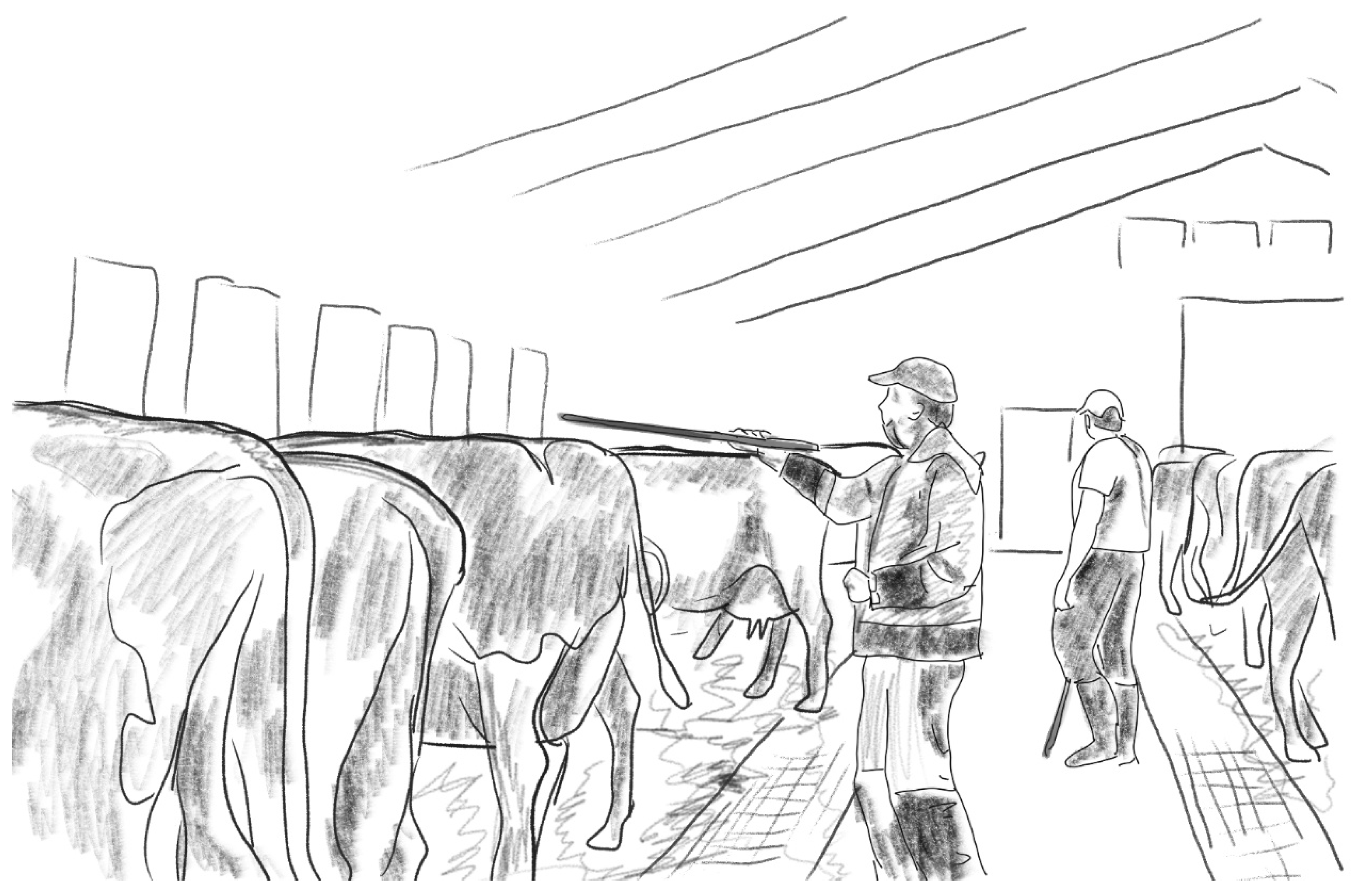



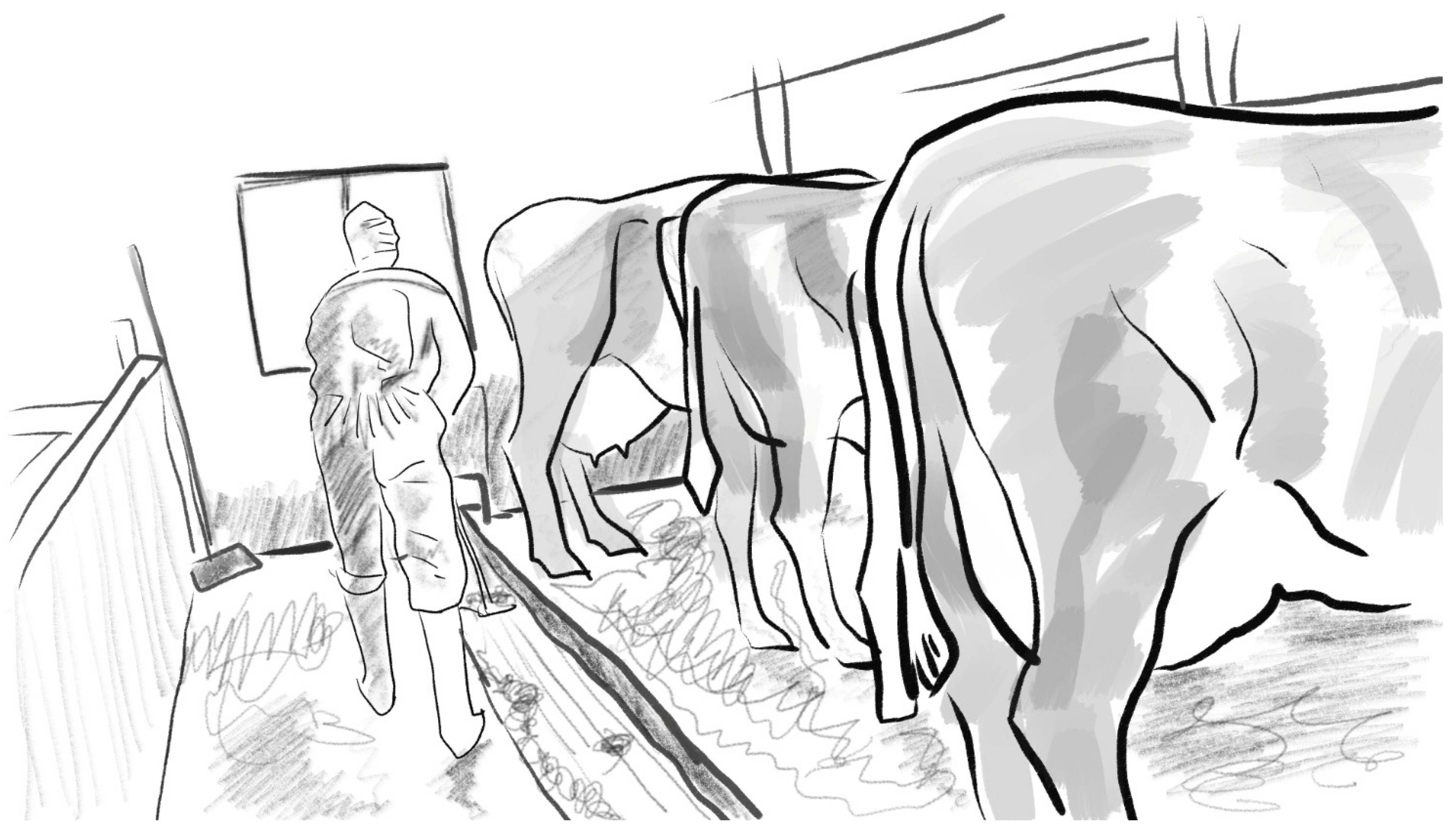
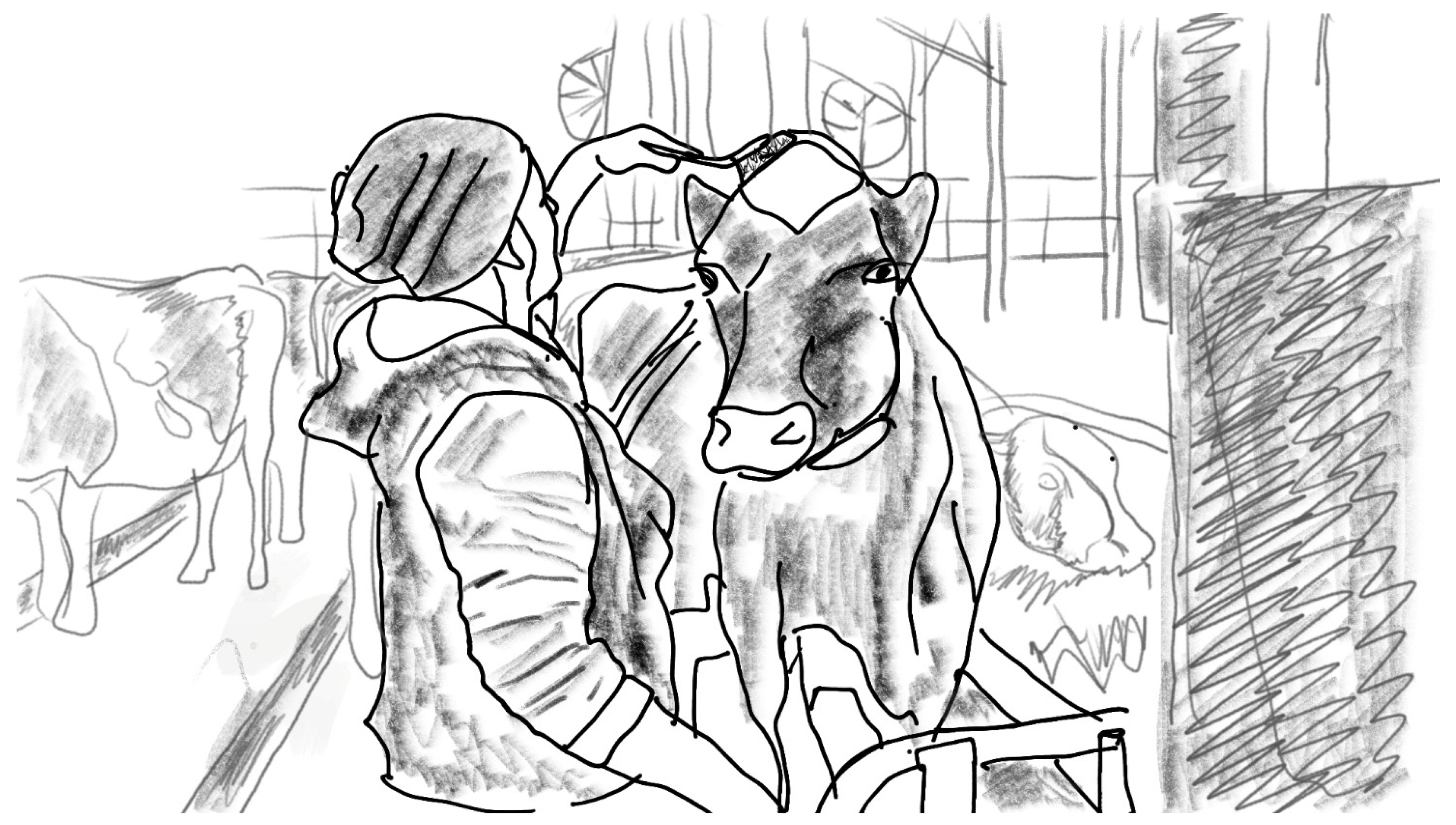
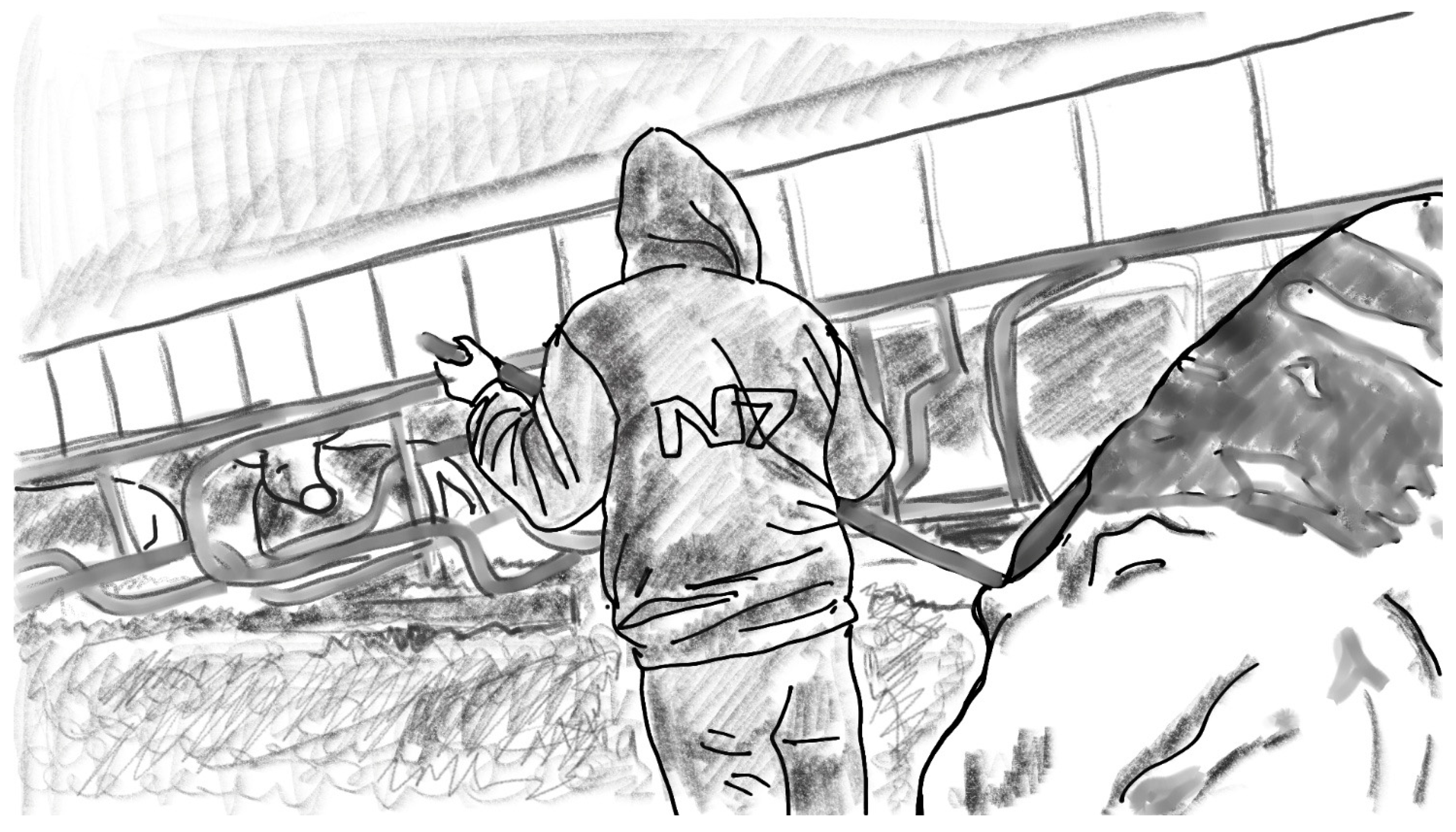
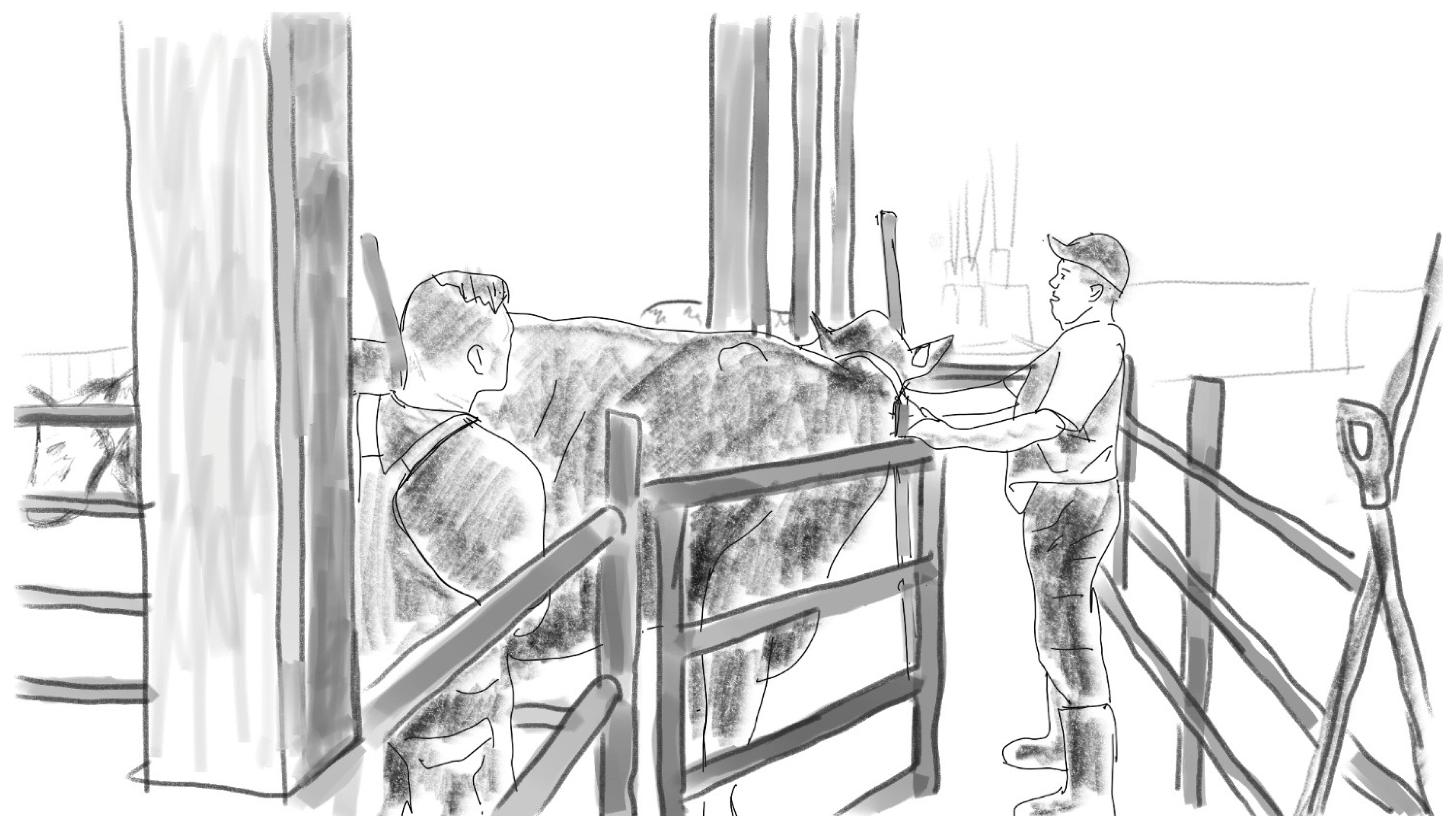
| Condition 1. Free-stall cattle barn, milking performed by robots: Cows move freely in and out, and choose when they are milked. (Farm 1) | Condition 3. Tie-stall cattle barn, cows’ season inside: Cows are all in their separate stalls and not moving freely. (Farm 2) |
| Condition 2. Free-stall cattle barn, milking performed at a milking parlour: Cows move freely inside their barn, but are moved in groups of 50 cows into a different space to be milked. (Farm 3) | Condition 4. Tie-stall barn, cows’ season outside: Cows are out in the pasture and walk into the cattle barn to be milked and are attached to their cubicles while milked. (Farm 4) |
Disclaimer/Publisher’s Note: The statements, opinions and data contained in all publications are solely those of the individual author(s) and contributor(s) and not of MDPI and/or the editor(s). MDPI and/or the editor(s) disclaim responsibility for any injury to people or property resulting from any ideas, methods, instructions or products referred to in the content. |
© 2026 by the author. Licensee MDPI, Basel, Switzerland. This article is an open access article distributed under the terms and conditions of the Creative Commons Attribution (CC BY) license.
Share and Cite
Jääskeläinen, A. Linguistic and Material Ways of Communicating with Cows—The Dung Pusher as a Semiotic Resource. Animals 2026, 16, 201. https://doi.org/10.3390/ani16020201
Jääskeläinen A. Linguistic and Material Ways of Communicating with Cows—The Dung Pusher as a Semiotic Resource. Animals. 2026; 16(2):201. https://doi.org/10.3390/ani16020201
Chicago/Turabian StyleJääskeläinen, Anni. 2026. "Linguistic and Material Ways of Communicating with Cows—The Dung Pusher as a Semiotic Resource" Animals 16, no. 2: 201. https://doi.org/10.3390/ani16020201
APA StyleJääskeläinen, A. (2026). Linguistic and Material Ways of Communicating with Cows—The Dung Pusher as a Semiotic Resource. Animals, 16(2), 201. https://doi.org/10.3390/ani16020201