
Next Article in Journal
Scoping Review of the Socioeconomic Value of Working Equids, and the Impact of Educational Interventions Aimed at Improving Their Welfare
Previous Article in Journal
Investigation of Mechanism of Small Peptide Application in Enhancing Laying Performance of Late-Laying Hens Through Bidirectional Liver–Gut Interactions
error_outline You can access the new MDPI.com website here. Explore and share your feedback with us.
 
 
Article

Morphological, Molecular and Phylogenetic Characterization of Ceratomyxa nemiptera sp. nov. (Myxozoa: Ceratomyxidae) Infecting Nemipterus virgatus Houttuyn, 1782 in the East China Sea

Animal Biology Key Laboratory of Chongqing Education Commission of China, Chongqing Key Laboratory of Conservation and Utilization of Freshwater Fishes, College of Life Sciences, Chongqing Normal University, Chongqing 401331, China
*
Author to whom correspondence should be addressed.
These authors contributed equally to this work.
Animals 2026, 16(2), 166; https://doi.org/10.3390/ani16020166
Submission received: 3 December 2025 / Revised: 2 January 2026 / Accepted: 4 January 2026 / Published: 7 January 2026
(This article belongs to the Section Aquatic Animals)

Simple Summary

Myxosporean parasites are a large group of tiny organisms that infect both marine and freshwater fish, and identifying their species can be tricky due to their small size and variable shapes. Ceratomyxa, a large genus of myxosporeans, mostly infects the gallbladders of marine fish, and scientists now use a combination of morphological characteristics, infection site, host and genetic data to identify species of Ceratomyxa. Nemipterus virgatus, an economically important fish in southeastern Chinese coastal fisheries, is a known myxosporean host, but little is known about these parasites in the East China Sea. In our study, we found a new Ceratomyxa species (Ceratomyxa nemiptera sp. nov.) in the gallbladders of N. virgatus from the East China Sea. This new parasite has a crescent-shaped body with two spherical polar capsules near its front end, and its genetic material is distinct from other known myxosporeans, being most closely related to Ceratomyxa arcuata. This is the first time a Ceratomyxa species has been found infecting N. virgatus, filling a gap in current knowledge of myxosporean diversity in the East China Sea and helping protect this important commercial fish.

Abstract

A newly discovered myxosporean parasite was described from the gallbladder of Nemipterus virgatus Houttuyn, 1782 collected from the East China Sea. Mature myxospores are crescent-shaped with shell valves that taper gradually toward rounded ends. Each myxospore contained two sub-spherical polar capsules located near the anterior end, closely aligned along the suture line. The mature myxospores measured 6.2 ± 0.6 (5.4–6.9) μm in length and 44.8 ± 4.6 (38.5–53.1) μm in thickness. Polar capsules measured 2.8 ± 0.2 (2.4–3.1) μm in length and 2.3 ± 0.2 (1.9–2.6) μm in width, with polar filaments coiled in 2–3 turns. The small subunit ribosomal DNA (SSU rDNA) sequence of Ceratomyxa nemiptera sp. nov. was distinct from all known myxosporeans, showing the highest similarity (93.56%) and the shortest genetic distance (0.0637) with Ceratomyxa arcuata Thélohan, 1892. The phylogenetic analysis revealed that C. nemiptera sp. nov. was positioned within a later-diverging lineage, forming a sister-group relationship with a clade containing C. arcuata and Ceratomyxa cretensis Kalatzis, Kokkari & Katharios, 2013. This is the first report of a Ceratomyxa species infecting N. virgatus.

1. Introduction

Myxosporeans (Myxosporea Bütschli, 1881) are a highly diverse and globally distributed group of microscopic metazoan parasites infecting both marine and freshwater fishes [1,2]. To date, more than 3000 species have been formally described, and new taxa continue to be discovered as molecular tools advance [3,4,5]. These parasites are characterized by complex life cycles, typically involving both vertebrate and invertebrate hosts, and by their relatively simple morphology [1,3]. The small size and limited number of diagnostic features, together with morphological plasticity observed in some species, often obscure interspecific boundaries and make species identification and classification particularly challenging [6,7,8].
Within Myxosporea, the genus Ceratomyxa Thélohan, 1892 represents one of the largest and most morphologically diverse lineages, currently comprising over 300 valid species [9,10,11]. Mature myxospores of Ceratomyxa are elongate, usually crescentic or arcuate, and sometimes ovoid or even sub-spherical. Conical or sub-hemispherical shell valves exceed one-half of the axial diameter of the myxospore in length and are usually pliable. Polar capsules are sub-spherical, positioned close to the suture line at the anterior pole of the myxospore, but exceptionally open laterally from the central suture line. Sporoplasm is generally binucleate; however, the presence of two uninucleated sporoplasms has also been observed in some species [12,13]. Species of Ceratomyxa predominantly infect the gallbladders of marine teleosts, although a few have been recorded in freshwater environments [9,14].
Traditionally, species identification within the genus Ceratomyxa has been based primarily on morphological characteristics and morphometry. However, some members of this genus often exhibit considerable morphological plasticity under different hosts or environmental conditions, making morphology alone insufficient for reliable taxonomic identification [6,15,16]. Consequently, modern taxonomic approaches emphasize an integrative framework that combines morphological characteristics, parasitic traits, and molecular data [7,10,11,14].
Nemipterus virgatus Houttuyn, 1782, belonging to the family Nemipteridae (order Perciformes), is a warm-water, medium-sized demersal fish distributed mainly in tropical and subtropical regions of the western Pacific and Indian Oceans. It is an economically important species along the southeastern coast of China, playing a significant role in regional marine fisheries [17]. Previous studies have reported that N. virgatus serves as a host to two myxosporean parasites, Kudoa megacapsula Yokoyama & Itoh, 2005 (family Kudoidae) and Unicapsula trigona Li, Tamemasa, Zhang & Sato, 2019 (family Trilosporidae), which may influence the physiological condition and commercial value of the host [18,19].
The East China Sea is one of the most fish-rich marine regions in the world, characterized by exceptionally high ichthyofaunal diversity. To date, a total of 442 fish species from this area have been recorded, belonging to more than 300 genera, 152 families, and 29 orders [20,21]. Despite this remarkable diversity, studies on myxosporean parasites of fishes from the East China Sea remain relatively limited. According to currently available reports, only a small number of myxosporean species have been documented from this region, comprising approximately 12 species infecting about 10 marine fish hosts. These parasites predominantly infect the gallbladder, with only occasional records from other organs such as the alimentary tract [7,10,22,23,24,25,26,27,28]. In recent years, we have conducted a series of surveys on myxosporeans from the East China Sea, during which a new Ceratomyxa species was identified and described using an integrative approach.

2. Materials and Methods

2.1. Sample Collection and Morphological Analysis

Eighteen specimens of Golden threadfin bream, Nemipterus virgatus Houttuyn, 1782 were obtained from nearshore fishing vessels operating off the coast of Xiamen, China, in July 2018. All specimens were captured from the East China Sea. Sampling locations are shown in Figure 1. Upon arrival at the laboratory, each specimen was carefully examined for myxosporean infections. A thorough inspection was conducted on various organs and tissues, including the skin, fins, gills, musculature, hepatopancreas, intestine, spleen, heart, gallbladder, and urinary bladder, as well as on body fluids such as bile, blood, and urine [11]. Isolated myxospores were collected for both morphological and molecular analyses. Species identification and specimen processing followed the procedures described by Zhao et al., 2001 [29]. Fresh myxospores were examined and measured under a Leica DM6000B light microscope at ×1000 magnification (Leica, Wetzlar, Germany). All measurements were taken from 30 mature myxospores for the new Ceratomyxa species and are expressed in micrometres (μm) as the mean ± standard deviation, followed by the range in parentheses. Line drawings of the new species were prepared using CorelDRAW 11.0 software.
The morphological comparison between the new species and other ceratomyxids was conducted based on spore morphology, with reference to all valid species of the genus Ceratomyxa. Particular attention was given to species infecting hosts of identical or related taxonomy and occurring in the same or geographically similar regions.

2.2. DNA Extraction and Amplification

Myxospores obtained from host bile and preserved in 95% ethanol were isolated by centrifugation. Genomic DNA was extracted from parasite-rich gallbladder bile using the DNeasy Tissue Kit (QIAGEN, Hilden, Germany) following the manufacturer’s instructions. The small subunit ribosomal DNA (SSU rDNA) fragment was amplified using primers ERIB1 (5′-ACCTGGTTGATCCTGCCAG-3′) and ERIB10 (5′-CTTCCGCAGGTTCACCGCAGG-3′) [30], followed by a nested PCR using the primer pairs CERAss1-F (5′-CGCTCCAAGTGAGTGCCATC-3′)/CERAss1-R (5′-ACCTGTTATTGCCACGCTTCC-3′) and CERAss2-F (5′-GAAGCGTGGCAATAACAGGTC-3′)/CERAss2-R (5′-AGAGGCAGAGACGTATTCAACA-3′) [11]. Each PCR reaction was carried out in a final volume of 25 μL, containing 0.5 μL of each primer, 1.5 μL of DNA template, 12.5 μL of PCR Master mix, and ddH2O to the final volume. The PCR cycling conditions consisted of an initial denaturation at 94 °C for 2 min, followed by 35 cycles of 94 °C for 30 s, 56 °C for 30 s, and 72 °C for 1 min, with a final extension at 72 °C for 10 min. PCR products were visualized by agarose gel electrophoresis and purified amplicons were ligated into the pMD19-T vector (TaKaRa, Otsu, Japan). The recombinant plasmids were then transformed into Escherichia coli strain DH5α. Eight positive transformants were cultured, plasmids were purified, and four clones were selected for sequencing using an ABI Prism 377 DNA Sequencer (Applied Biosystems, Carlsbad, CA, USA). The resulting SSU rDNA sequences of myxospores were assembled using ContigExpress software (Vector NTI Suite 6.0, Invitrogen, Carlsbad, CA, USA), and the consensus sequence was deposited in the National Center for Biotechnology Information (NCBI) GenBank database for public access.

2.3. Molecular and Phylogenetic Analysis

Sequence similarity and genetic distance were calculated between the newly obtained SSU rDNA sequence and those showing the highest identity in the NCBI BLAST 2.8.1 search, as well as with the morphologically similar species. Pairwise sequence similarities were computed using the MAFFT program from the EMBOSS suite [31], and genetic distances (p-distance) were calculated in MEGA 11 [32].
A phylogenetic tree was constructed based on a total of 130 SSU rDNA sequences, including the newly obtained sequence and closely related sequences retrieved from GenBank. Two species from the genus Enteromyxum, E. fugu Tun, Yokoyama, Ogawa & Wakayabashi, 2000 (GenBank accession No. AY520573) and E. scophthalmi Palenzuela, Redondo & Alvarez-Pellitero, 2002 (AF411335), were selected as outgroup taxa to root the tree. All sequences were aligned using MEGA 11 [32], and highly variable, poorly aligned, or rapidly evolving regions were removed using Gblocks 0.91b [33]. Phylogenetic relationships were inferred using both Bayesian Inference (BI) and Maximum Likelihood (ML) methods. The BI was performed in MrBayes 3.1.2 [34] under a general time-reversible (GTR) model with gamma-distributed rate variation. Four Markov chains were run simultaneously for three million generations, sampling every 200 generations, and the first 25% of samples as burn-in. The ML analysis was conducted on the CIPRES portal (https://www.phylo.org/, accessed on 3 January 2026) using RAxML [35] with the GTR+gamma model, and bootstrap support values were calculated from 1000 replicates. The resulting BI and ML phylogenetic trees were visualized and edited using FigTree v1.4.2 and Adobe Photoshop.

3. Results

3.1. Taxonomic Summary

Phylum: Cnidaria Hatschek, 1888
Subphylum: Myxozoa Grassé, 1970
Class: Myxosporea Bütschli, 1881
Order: Bivalvulida Shulman, 1959
Family: Ceratomyxidae Doflein, 1899
Genus: Ceratomyxa Thélohan, 1892
Ceratomyxa nemiptera sp. nov.
ZooBank registration number: urn:lsid:zoobank.org:pub:82CB82BB-AB69-4D63-B4E1-AA44755EC980.
Type host: Nemipterus virgatus Houttuyn, 1782 (Perciformes: Nemipteridae).
Type locality: Coastal waters near Xiamen (118°12′34″ E, 24°21′20″ N), East China Sea (Figure 1).
Infection site: Gallbladder.
Date of sampling: July 2018.
Prevalence: Of 18 N. virgatus specimens examined, two were infected (11.1%).
Deposition of materials: Specimens of N. virgatus (mounted in glycerin-alcohol-formalin; accession number TZ2018070006) were deposited in the collection centre of Animal Biology Key Laboratory of Chongqing Education Commission of China, Chongqing Normal University, Chongqing, PR China.
Etymology: The species epithet nemiptera refers to the genus of the type host, Nemipterus.

3.2. Morphological Description

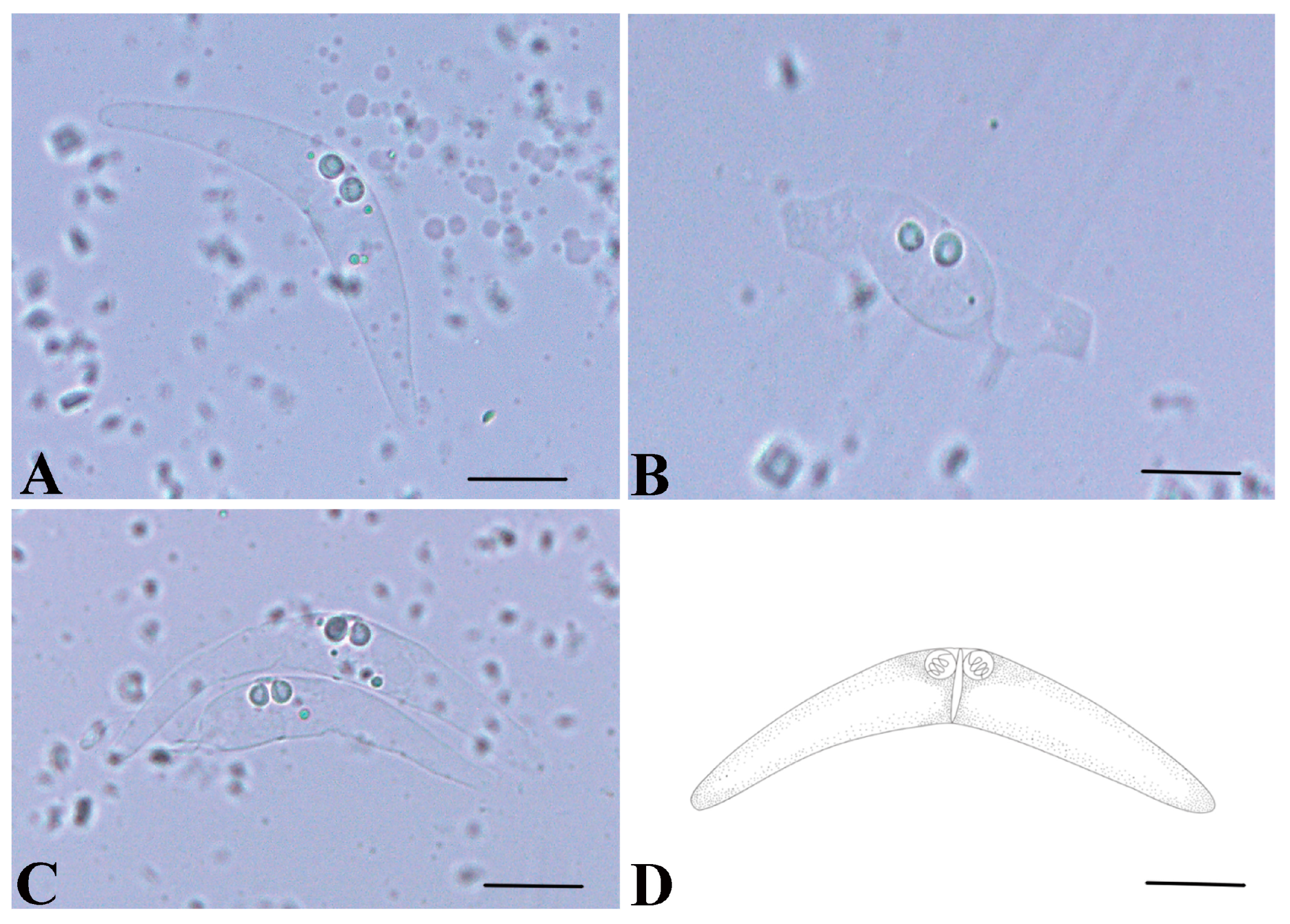
Numerous mature and immature myxospores of C. nemiptera sp. nov. were observed in the bile within the gallbladder of N. virgatus. Immature myxospores exhibited irregular protoplasmic shapes, and the disporic plasmodium possessed four developing polar capsules (Figure 2B,C). Mature myxospores were crescent-shaped, measuring 6.2 ± 0.6 (5.4–6.9) μm in length and 44.8 ± 4.6 (38.5–53.1) μm in thickness (Figure 2A,D; Table 1). The myxospore valves were symmetrical, divided into two equal valves by a vertical suture, gradually tapering laterally with rounded ends, consistent with the typical characteristics of the genus Ceratomyxa. Each myxospore possessed two sub-spherical polar capsules, situated near the anterior end and closely appressed to the suture. The polar capsules measured 2.8 ± 0.2 (2.4–3.1) μm in length and 2.3 ± 0.2 (1.9–2.6) μm in width (Figure 2A,D; Table 1). The polar filaments were coiled in 2–3 turns. The posterior angle of the myxospore measured 131.6° ± 14.6° (103.3–153.0°) (Figure 2A,D; Table 1).

3.3. Remarks

Among all previously described species of Ceratomyxa, the morphology of C. nemiptera sp. nov. most closely resembles that of Ceratomyxa fistulariae Kpatcha, Diebakate, Faye & Toguebaye, 1996, Ceratomyxa anko Freeman, Yokoyama & Ogawa, 2008, Ceratomyxa protopsettae Fujita, 1923, Ceratomyxa draconis Azizi, Yemmen, Rangel, Santos & Bahri, 2020, Ceratomyxa macapaensis Bittencourt, 2022, Ceratomyxa mandii Araújo, 2022.
Ceratomyxa fistulariae can be distinguished from the new species by its markedly greater myxospore length (5.4–6.9 vs. 10–12 μm). In addition, the polar capsules of C. fistulariae are pear-shaped and considerably larger, whereas those of the new species are sub-spherical and smaller (2.4–3.1 vs. 4.5–5.5 μm) (Table 1). The host of C. fistulariae is Fistularia petimba Lacepède, 1803, collected from the Atlantic Ocean off Senegal, while the new species was found in N. virgatus from the East China Sea. C. anko possesses greater myxospore length and larger polar capsules than the new species (myxospore length: 5.4–6.9 vs. 9.7–11.9 μm; polar capsule length: 2.4–3.1 vs. 4.1–5.3 μm). Moreover, the end of valves of C. anko are more rounded compared with those of the new species (Table 1). Additionally, C. anko was described from the host Lophius litulon Jordan, 1902, collected off Fukushima, Japan, which differs from the host of the new species, N. virgatus, from the East China Sea. C. protopsettae differs from the new species in having larger myxospores and polar capsules (myxospore size: 5.4–6.9 × 38.5–53.1 μm vs. 10–12 × 50–65 μm; polar capsule size: 2.8 ± 0.2 (2.4–3.1) μm vs. 4.15 ± 0.34 μm). In addition, C. protopsettae possesses a greater number of polar filament turns (5–6 vs. 2–3) (Table 1). Additionally, C. protopsettae was described from Paralichthys olivaceus Temminck & Schlegel, 1846, collected off the East Sea of Korea, whereas the new species was found in N. virgatus from the East China Sea. Among the six most morphologically similar congeners, C. draconis is the only species showing the highest SSU rDNA sequence similarity (92.49%) to the new species (Table 1). C. draconis differs from the new species in having thinner myxospores (38.5–53.1 μm vs. 28.8–32.8 μm) and larger polar capsules (2.4–3.1 × 1.9–2.6 μm vs. 3.6–4.0 μm), although the range of its posterior angle partially overlaps with that of the new species (103.3–153.0° vs. 120–156°) (Table 1). C. draconis parasitizes Trachinus draco Linnaeus, 1758 from the Gulf of Bizerte, Tunisia, whereas the new species was found in N. virgatus from the East China Sea.
Ceratomyxa macapaensis and C. mandii differ markedly from the new species in their ecological and morphological characteristics. Both species are freshwater taxa, whereas the new species is marine, with distinct host and locality associations (Table 1). In addition, the myxospores and polar capsules of C. macapaensis and C. mandii are distinctly smaller than those of the new species, and C. mandii further differs in having a markedly larger posterior valve angle (Table 1).
Compared with the six morphologically most similar congeners described above, Ceratomyxa species recorded from China are generally less similar to the new species. Among the Chinese taxa, only Ceratomyxa mai Yang, Huang, Atkinson, Bartholomew, Ma & Zhao, 2023, Ceratomyxa saurida Zhao, Al-Farraj, Al-Rasheid & Song, 2015, and Ceratomyxa siganicola Zhang, Zhao, Yang & Yang, 2019 show a certain degree of morphological resemblance.
Ceratomyxa mai can be distinguished from the new species by its markedly greater myxospore length (8.1–9.9 vs. 5.4–6.9 μm) and considerably thinner myxospore (17.3–24.7 vs. 38.5–53.1 μm). In addition, the polar capsules of C. mai are wider than those of the new species (2.4–3.3 vs. 1.9–2.6 μm). Although the range of its posterior angle partially overlaps with that of the new species (125.8–158.2° vs. 103.3–153.0°). The host of C. mai is Saurida elongata Temminck & Schlegel, 1846, whereas the host of the new species is N. virgatus. Ceratomyxa saurida differs from the new species in having greater myxospore length (8.0–10.6 vs. 5.4–6.9 μm) and similar myxospore thickness (38.1–54.6 vs. 38.5–53.1 μm). In addition, the polar capsules of C. saurida are longer than those of the new species (3.0–3.7 vs. 2.4–3.1 μm). Although the range of its posterior angle partially overlaps with that of the new species (138.1–176.3° vs. 103.3–153.0°). The host of C. saurida is Saurida elongata, while the host of the new species is N. virgatus. Ceratomyxa siganicola can be distinguished from the new species by its markedly thinner myxospore (16.0–22.1 vs. 38.5–53.1 μm), although the range of myxospore length partially overlaps (4.8–6.5 vs. 5.4–6.9 μm). In addition, the polar capsules of C. siganicola are smaller than those of the new species (2.1–3.0 vs. 2.4–3.1 μm). Although the range of its posterior angle partially overlaps with that of the new species (175.2–178.4° vs. 103.3–153.0°). The host of C. siganicola is Siganus fuscescens Houttuyn, 1782, while the new species infects N. virgatus.

3.4. Molecular and Phylogenetic Analysis

A partial SSU rDNA sequence of C. nemiptera sp. nov., 1426 bp in length, was successfully amplified and sequenced from the type host and has been deposited in GenBank under accession number PX637768. Molecular analysis revealed that this sequence exhibited the highest similarity (93.56%) and the shortest genetic distance (0.0637) to Ceratomyxa arcuata Thélohan, 1892 (KJ419344), followed by Ceratomyxa cretensis Kalatzis, Kokkari & Katharios, 2013 (JX869942) with 93.38% similarity and 0.0681 genetic distance (Table 2). Among the species that share morphological resemblance with C. nemiptera sp. nov., C. draconis, C. anko, C. mandii and C. macapaensis possess publicly available SSU rDNA sequences. Comparative analysis revealed that the C. nemiptera sp. nov. showed the highest sequence similarity (92.49%) and the smallest genetic distance (0.0751) with C. draconis, while it exhibited the lowest sequence similarity (75.74%) and largest genetic distance (0.2790) with C. mandii (Table 2).
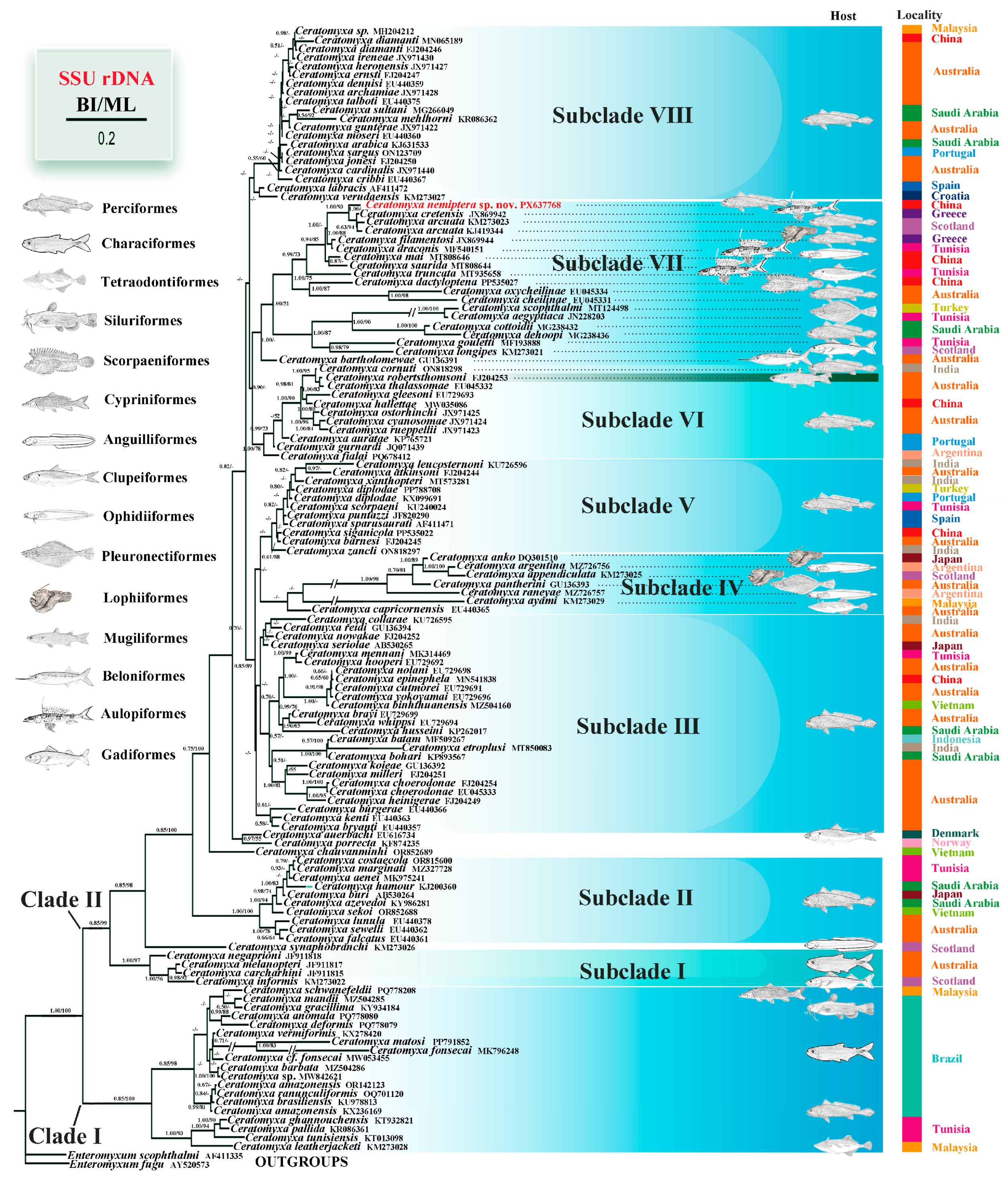
Phylogenetic trees based on the SSU rDNA sequences were reconstructed using both ML and BI approaches, and the resulting topologies were consistent. The phylogenetic tree was resolved into two major clades, Clade I and Clade II (Figure 3). The Clade I represents an early-diverging lineage comprising Ceratomyxa species parasitizing freshwater, brackish, and some marine fish hosts. Clade II was subdivided into eight subclades, encompassing species infecting marine and brackish-water fishes (Figure 3). C. nemiptera sp. nov. was positioned within a later-diverging lineage, Subclade VII, forming a sister-group relationship with a clade containing C. arcuata and C. cretensis (Figure 3).

4. Discussion

Recent studies have demonstrated a correlation between the phylogeny of myxosporeans and the taxonomic affiliation of their hosts, with closely related myxosporean species typically infecting hosts belonging to the same taxonomic groups [42,43,44,45,46]. The results of this study are consistent with this pattern. As shown in the phylogenetic tree, all parasites within Subclades II, III, V, and VIII each infect hosts that clearly belong to the order Perciformes (Figure 3). These derived lineages not only display a relatively narrow host range but also demonstrate a distinct evolutionary tendency toward host specificity. However, not all lineages follow this pattern. For instance, parasites within Subclades IV and VII are phylogenetically closely related (Figure 3), yet their hosts belong to different orders. In particular, within Subclade VII, the new species infects a perciform host (N. virgatus), whereas its close relatives parasitize hosts from the orders Lophiiformes, Aulopiformes, Ophidiiformes, and Clupeiformes.
Within Subclade VI, all species parasitize perciform hosts except Ceratomyxa robertsthomsoni Gunter, Whipps & Adlard, 2009 (FJ204253), which infects a mugiliform host (Figure 3). This observation may suggest the possibility of an adaptive “host-switching” strategy during the evolutionary diversification of Ceratomyxa species [14,47,48,49]. Such host-switching events may represent an adaptive mechanism that enables certain species to expand their host range by overcoming the taxonomic boundaries of their ancestral host groups. It is possible that C. robertsthomsoni has undergone a host shift from Perciformes to Mugiliformes, thereby broadening its potential host spectrum. This hypothesis suggests that host-switching may occur through different evolutionary pathways. Two scenarios could be envisaged: one in which the parasite retains the ancestral host while adapting to a new one, and another in which it abandons the original host and parasitizes only the new host. However, the apparent absence of the “original host” does not necessarily imply its true absence [50].
We also found that, in some clades, closely related Ceratomyxa species were distributed within the same geographical region. For instance, in Subclades III, VI, and VIII, most Ceratomyxa species originated from Australia and exhibited relatively close phylogenetic relationships within their respective subclades, suggesting that their evolutionary relationships may be partly influenced by geographic distribution. However, these subclades also include species from other regions that are phylogenetically close to the Australian taxa (Figure 3). Such a pattern corresponds to what has been observed in free-living organisms, whose genetic and evolutionary relationships often reflect geographic structuring, whereby taxa sharing a common geographic origin tend to be more closely related [51,52,53]. Yet, for parasitic organisms, geographical proximity is not necessarily the sole or dominant determinant of genetic relatedness. The phylogeny of parasites is frequently shaped by the dispersal capacity and lineage affinities of their hosts and can also be affected by host-switching events, complex life cycles involving multiple hosts or vectors, and human-mediated translocation across regions. These processes may weaken or obscure the otherwise direct correspondence between phylogenetic relatedness and geographic distance [54,55,56].
In Clade I (Figure 3), Ceratomyxa species parasitizing freshwater fishes (e.g., C. mandii (MZ504285), Ceratomyxa fonsecai Silva, 2020 (MK796248)); brackish-water fishes (e.g., Ceratomyxa tunisiensis Thabet, Mansour, Al Omar & Tlig-Zouari, 2015 (KT013098)) and marine fishes (e.g., Ceratomyxa ghannouchensis Thabet, Abdel-Baki, Harrath & Mansour, 2019 (KT932821), Ceratomyxa pallida Thélohan, 1895 (KR086361)) clustered together, forming the basal lineage of the Ceratomyxa clade. This group appears to represent an evolutionarily ancient lineage, consistent with previous findings [42,57]. These observations raise an intriguing question regarding the evolutionary origin of Ceratomyxa: did the genus originate in marine or freshwater environments? Earlier studies have suggested that myxosporeans originated in the marine environment [3,49]. A possible explanation is that the ancestral Ceratomyxa lineage arose in the ocean and subsequently colonized freshwater habitats through marine transgression events, during which multiple adaptive radiations occurred, leading to the present phylogenetic pattern [2].
The host species of C. nemiptera sp. nov., N. virgatus, is an economically important demersal fish widely distributed in the East China Sea and along the southeastern coast of China, where it contributes substantially to regional marine fisheries [17]. Although no obvious clinical signs or gross pathological alterations were observed in the infected hosts examined in the present study, previous studies have shown that myxosporean species infecting the gallbladder, including members of the genus Ceratomyxa, are generally characterized by low pathogenicity and often occur without apparent disease symptoms in their natural hosts [12,14,15].
Gallbladder infections by ceratomyxids are commonly reported in marine teleosts and are frequently considered to have limited direct pathological impact; however, such infections may still represent a chronic physiological burden to the host, particularly under environmental stress or high exploitation pressure [12,15]. Importantly, myxozoans, including species of Ceratomyxa, are currently not known to be zoonotic and do not pose a direct risk to human health [1,3]. Nevertheless, parasitic infections in commercially valuable fishes may indirectly influence seafood quality and market perception, as demonstrated for other myxozoans such as Kudoa spp., which are known to affect flesh quality and marketability [58]. Therefore, continued monitoring and accurate identification of myxosporean parasites in economically important marine fishes remain essential for effective fisheries management and the sustainability of marine resources.

5. Conclusions

In summary, Ceratomyxa nemiptera sp. nov. is described as a new myxosporean species infecting the gallbladder of Nemipterus virgatus from the East China Sea, based on an integrative analysis combining morphological characteristics, host and infection-site specificity, and SSU rDNA sequence data. Both morphometric comparisons and molecular evidence clearly distinguish this species from all previously described congeners. Phylogenetic analyses place C. nemiptera sp. nov. within a later-diverging lineage of the genus Ceratomyxa, forming a sister-group relationship with C. arcuata and C. cretensis, suggesting a close evolutionary affinity with marine congeners parasitizing teleost hosts. The discovery of this species expands current knowledge of Ceratomyxa diversity in the East China Sea and contributes to a better understanding of the evolutionary relationships and host associations within this complex genus. This study further highlights the importance of integrative morphological and molecular approaches for accurate species delimitation in myxosporean parasites.

Author Contributions

Conceptualization, C.Y., P.L. and Y.Z. (Yang Zhou); methodology, P.L. and C.Y.; validation, P.L., Y.Z. (Yang Zhou) and C.Y.; formal analysis, P.L., Y.Z. (Yang Zhou) and C.Y.; investigation, Y.Z. (Yang Zhou); writing—original draft preparation, C.Y., P.L. and Y.Z. (Yang Zhou); writing—review and editing, P.L., Y.Z. (Yang Zhou), X.T., Y.Z. (Yunjun Zhao) and C.Y.; supervision, C.Y.; funding acquisition, C.Y. and Y.Z. (Yunjun Zhao) All authors have read and agreed to the published version of the manuscript.

Funding

This work was supported by grants from the National Natural Science Foundation of China (No. 31970409), the Science and Technology Research Key Program of Chongqing Municipal Education Commission (No. KJZD-K202300503) and the Chongqing Natural Science Foundation of China (No. CSTB2022NSCQ-MSX0994).

Institutional Review Board Statement

Ethical approval was obtained from the Animal Care and Use Committee of Chongqing Key Laboratory of Animal Biology (No. CKLAB2018–006, approval date is 6 June 2018).

Informed Consent Statement

Not applicable.

Data Availability Statement

All the datasets generated or analyzed during this study are included in this article.

Conflicts of Interest

The authors declare no competing interests.

References

  1. Okamura, B.; Gruhl, A.; Bartholomew, J.L. An introduction to myxozoan evolution, ecology and development. In Myxozoan Evolution, Ecology and Development; Okamura, B., Gruhl, A., Bartholomew, J.L., Eds.; Springer International Publishing: Cham, Switzerland, 2015; pp. 1–20. [Google Scholar] [CrossRef]
  2. Zatti, S.A.; Atkinson, S.D.; Maia, A.A.M.; Bartholomew, J.L.; Adriano, E.A. Ceratomyxa gracillima sp. nov. (Cnidaria: Myxosporea) provides evidence of panmixia and ceratomyxid radiation in the Amazon basin. Parasitology 2018, 145, 1137–1146. [Google Scholar] [CrossRef] [PubMed]
  3. Kent, M.L.; Andree, K.B.; Bartholomew, J.L.; El-Matbouli, M.; Desser, S.S.; Devlin, R.H.; Feist, S.W.; Hedrick, R.P.; Hoffmann, R.W.; Khattra, J.; et al. Recent advances in our knowledge of the Myxozoa. J. Eukaryot. Microbiol. 2001, 48, 395–413. [Google Scholar] [CrossRef]
  4. Okamura, B.; Hartigan, A.; Naldoni, J. Extensive uncharted biodiversity: The parasite dimension. Integr. Comp. Biol. 2018, 58, 1132–1145. [Google Scholar] [CrossRef]
  5. Whipps, C.M.; Atkinson, S.D.; Hoeksema, B.W. World List of Myxozoa. 2026. Available online: https://www.marinespecies.org/myxozoa (accessed on 2 January 2026).
  6. Heiniger, H.; Gunter, N.L.; Adlard, R.D. Relationships between four novel ceratomyxid parasites from the gall bladders of labrid fishes from Heron Island, Queensland, Australia. J. Parasitol. 2008, 94, 158–165. [Google Scholar] [CrossRef]
  7. Zhang, D.D.; Zhao, Y.J.; Yang, S.H.; Yang, C.Z. Morphological and molecular identification of a novel species, Ceratomyxa siganicola sp. nov. (Myxozoa: Ceratomyxidae) from Siganus fuscescens, in East China Sea. Acta Parasitol. 2019, 64, 596–602. [Google Scholar] [CrossRef] [PubMed]
  8. Gao, L.; Zhao, Y.J.; Yang, S.H.; Yang, C.Z. A new record of Ceratomyxa diamanti from China and comparison of its different geographic strains. Acta Parasitol. 2020, 65, 312–318. [Google Scholar] [CrossRef]
  9. Eiras, J.C.; Cruz, C.; Saraiva, A. Synopsis of the species of Ceratomyxa Thélohan, 1892 (Cnidaria, Myxosporea, Ceratomyxidae) described between 2007 and 2017. Syst. Parasitol. 2018, 95, 427–446. [Google Scholar] [CrossRef] [PubMed]
  10. Yang, C.Z.; Ma, H.G.; Huang, Y.M.; Atkinson, S.D.; Zhao, Y.J.; Bartholomew, J.L. Morphological and genetic analysis of Ceratomyxa saurida Zhao et al. 2015 and Ceratomyxa mai sp. nov. (Myxozoa: Ceratomyxidae) from the East China Sea. Int. J. Syst. Evol. Microbiol. 2023, 73, 289–298. [Google Scholar] [CrossRef]
  11. Yang, C.Z.; Yang, Y.T.; Chen, X.; Yang, S.H.; Zhou, Y.; Ma, H.G.; Liu, Y.; Zhao, Y.J. Integrative taxonomy and phylogenetic analyses of two Ceratomyxa species (Myxozoa, Ceratomyxidae) from the China Sea, including a new species description. ZooKeys 2025, 1250, 359–378. [Google Scholar] [CrossRef]
  12. Lom, J.; Dyková, I. Myxozoan genera: Definition and notes on taxonomy, life-cycle terminology and pathogenic species. Folia Parasitol. 2006, 53, 1–36. [Google Scholar] [CrossRef]
  13. Gunter, N.L.; Adlard, R.D. The demise of Leptotheca Thélohan, 1895 (Myxozoa: Myxosporea: Ceratomyxidae) and assignment of its species to Ceratomyxa Thélohan, 1892 (Myxosporea: Ceratomyxidae), Ellipsomyxa Køie, 2003 (Myxosporea: Ceratomyxidae), Myxobolus Bütschli, 1882 and Sphaerospora Thélohan, 1892 (Myxosporea: Sphaerosporidae). Syst. Parasitol. 2010, 75, 81–104. [Google Scholar] [CrossRef]
  14. Rocha, S.; Rangel, L.F.; Casal, G.; Severino, R.; Soares, F.; Rodrigues, P.; Santos, M.J. Occurrence of two myxosporean parasites in the gall bladder of white seabream Diplodus sargus (L.) (Teleostei, Sparidae), with the morphological and molecular description of Ceratomyxa sargus sp. nov. PeerJ 2023, 11, e14599. [Google Scholar] [CrossRef]
  15. Heiniger, H.; Adlard, R.D. Molecular identification of cryptic species of Ceratomyxa Thélohan, 1892 (Myxosporea: Bivalvulida) including the description of eight novel species from apogonid fishes (Perciformes: Apogonidae) from Australian waters. Acta Parasitol. 2013, 58, 342–360. [Google Scholar] [CrossRef]
  16. Surendran, S.; Chandran, A.; Vijayagopal, P.; Sanil, N.K. Morphological and molecular characterization of Ceratomyxa xanthopteri sp. nov. (Myxosporea: Ceratomyxidae) from the marine ornamental fish Acanthurus xanthopterus Valenciennes 1835 (Acanthuridae) off Vizhinjam coast, Kerala. Parasitol. Res. 2021, 120, 2445–2453. [Google Scholar] [CrossRef] [PubMed]
  17. Chen, G.B.; Li, Y.Z.; Zhao, X.Y.; Chen, Y.Z.; Jin, X.S. Acoustic assessment of five groups commercial fish in South China Sea. Acta Oceanol. Sin. 2006, 28, 128–134. [Google Scholar]
  18. Tomochi, H.; Li, Y.C.; Tran, B.T.; Yanagida, T.; Sato, H. Three Unicapsula species (Myxosporea: Trilosporidae) of Asian marine fishes, including the description of Unicapsula setoensis sp. nov. in the yellowfin goby (Acanthogobius flavimanus) from the Inland Sea of Japan. Parasitol. Res. 2014, 113, 3807–3816. [Google Scholar] [CrossRef] [PubMed]
  19. Li, Y.C.; Inoue, K.; Zhang, J.Y.; Sato, H. New records of three commercial fish hosts for two Unicapsula spp. And Kudoa megacapsula (Myxozoa: Myxosporea: Multivalvulida). Parasitol. Res. 2022, 121, 3133–3145. [Google Scholar] [CrossRef]
  20. Zhu, Y.D.; Zhang, C.L.; Cheng, Q.T. Fauna of East China Sea Fishes; Science Press: Beijing, China, 1963. [Google Scholar]
  21. Wang, Y.F.; Ma, C.Y.; Song, X.J.; Li, M.Y.; Zhang, H.Y. Assessment of fish diversity in the East China Sea hairtail national aquatic germplasm resources conservation zone using DNA barcoding. Glob. Ecol. Conserv. 2024, 53, e03013. [Google Scholar] [CrossRef]
  22. Chen, W.; Yang, C.Z.; Whipps, C.M.; Peng, Z.G.; Zhao, Y.J. Taxonomy on three novel species of Sphaeromyxa Thélohan 1892 (Myxozoa, Bivalvulida, Sphaeromyxidae) with insight into the evolution of the genus. Parasitol. Res. 2020, 119, 1493–1503. [Google Scholar] [CrossRef]
  23. Xiong, Y.L.; Zhao, Y.J.; Chen, X.; Wang, M.; Peng, J.J.; Cui, X.J.; Yang, C.Z. Taxonomy and phylogeny of Myxobolus branchiostegi sp. nov. (Myxozoa, Myxosporea) infecting the gallbladder of Branchiostegus argentatus Cuvier, 1830 from the East China Sea. ZooKeys 2025, 101, 2357–2367. [Google Scholar] [CrossRef]
  24. Zhang, B.; Yin, F. Morphological and molecular characterization of Henneguya cystigena n. sp. (Cnidaria, Myxosporea) parasitizing the alimentary tract of yellowfin seabream, Acanthopagrus latus, in the East China Sea. Parasite 2025, 32, 51. [Google Scholar] [CrossRef]
  25. Zhang, B.; Xie, X.; Zheng, C.; Wang, X.Y.; Buchmann, K.; Yin, F. Coinfection of large yellow croaker Larimichthys crocea by Trypanosoma sp. (Euglenozoa: Kinetoplastea) and Ceratomyxa xiangshanensis n. sp. (Cnidaria: Myxosporea) in offshore net cage systems in the East China Sea. Parasitol. Int. 2026, 111, 103167. [Google Scholar] [CrossRef]
  26. Huang, Y.M.; Zhao, Y.J.; Zhou, Y.; Yang, C.Z. First molecular evidence of Ceratomyxa epinephela (Myxozoa: Ceratomyxidae) and its genetic variation from different host species. Acta Hydrobiol. Sin. 2020, 44, 1263–1269. [Google Scholar] [CrossRef]
  27. Zhao, Y.J.; Zhou, Y.; Kent, M.L.; Whipps, C.M. Replacement of the preoccupied name Davisia Laird 1953 and description of a new myxozoan species (Myxosporea: Sinuolineidae) from Sebastiscus marmoratus (Cuvier, 1829) in the East China Sea. J. Parasitol. 2008, 94, 269–279. [Google Scholar] [CrossRef]
  28. Yang, C.Z.; Zhou, Y.; Zhao, Y.J.; Huang, W.; Huang, C. Erection of Unicapsulocaudum mugilum gen. et sp. nov. (Myxozoa: Ceratomyxidae) based on its morphological and molecular data. J. Nat. Hist. 2017, 51, 457–467. [Google Scholar] [CrossRef]
  29. Zhao, Y.J.; Ma, C.L.; Song, W. Illustrated guide to the identification of pathogenetic protozoa in mariculture. II diagnostic methods for the myxosporean. J. Ocean Univ. Qingdao 2001, 31, 681–688. [Google Scholar]
  30. Barta, J.R.; Martin, D.S.; Liberator, P.A.; Dashkevicz, M.; Anderson, J.W.; Feighner, S.D.; Elbrecht, A.; Perkins-Barrow, A.; Jenkins, M.C.; Danforth, H.D.; et al. Phylogenetic relationships among eight Eimeria species infecting domestic fowl inferred using complete small subunit ribosomal DNA sequences. J. Parasitol. 1997, 83, 262–271. [Google Scholar] [CrossRef] [PubMed]
  31. Madeira, F.; Madhusoodanan, N.; Lee, J.; Eusebi, A.; Niewielska, A.; Tivey, A.R.N.; Lopez, R.; Butcher, S. The EMBL-EBI Job Dispatcher sequence analysis tools framework in 2024. Nucleic Acids Res. 2024, 52, W521–W525. [Google Scholar] [CrossRef] [PubMed]
  32. Tamura, K.; Stecher, G.; Kumar, S. MEGA11: Molecular Evolutionary Genetics Analysis version 11. Mol. Biol. Evol. 2021, 38, 3022–3027. [Google Scholar] [CrossRef]
  33. Castresana, J. Selection of conserved blocks from multiple alignments for their use in phylogenetic analysis. Mol. Biol. Evol. 2000, 17, 540–552. [Google Scholar] [CrossRef]
  34. Ronquist, F.; Huelsenbeck, J.P. MrBayes 3: Bayesian phylogenetic inference under mixed models. Bioinformatics 2003, 19, 1572–1574. [Google Scholar] [CrossRef]
  35. Stamatakis, A. RAxML version 8: A tool for phylogenetic analysis and post-analysis of large phylogenies. Bioinformatics 2014, 30, 1312–1313. [Google Scholar] [CrossRef] [PubMed]
  36. Eiras, J.C. Synopsis of the species of Ceratomyxa Thélohan, 1892 (Myxozoa: Myxosporea: Ceratomyxidae). Syst. Parasitol. 2006, 65, 49–71. [Google Scholar] [CrossRef] [PubMed]
  37. Freeman, M.A.; Yokoyama, H.; Ogawa, K. Description and phylogeny of Ceratomyxa anko sp. n. and Zschokkella lophii sp. n. from the Japanese anglerfish, Lophius litulon (Jordan). J. Fish Dis. 2008, 31, 921–930. [Google Scholar] [CrossRef]
  38. Azizi, R.; Yemmen, C.; Rangel, L.F.; Santos, M.J.; Bahri, S. Morphology, seasonality and molecular characterization of Ceratomyxa draconis sp. nov. parasite of Trachinus draco (L.) from the Bay of Bizerte, Tunisia. Parasitol. Res. 2020, 119, 2431–2438. [Google Scholar] [CrossRef] [PubMed]
  39. Cho, J.B.; Kwon, S.R.; Kim, S.K.; Nam, Y.K.; Kim, K.H. Ultrastructure and development of Ceratomyxa protopsettae Fujita, 1923 (Myxosporea) in the gallbladder of cultured olive flounder, Paralichthys olivaceus. Acta Protozool. 2004, 43, 241–250. [Google Scholar]
  40. Bittencourt, L.S.; da Silva, D.T.; Hamoy, I.; de Carvalho, A.A.; da Silva, M.F.; Videira, M.; Carvalho, J.C.T.; Matos, E. Morphological and Phylogenetic Features of Ceratomyxa macapaensis sp. nov. (Myxozoa: Ceratomyxidae) in Mesonauta festivus Heckel, 1840 (Cichliformes: Cichlidae) from the eastern Amazon region. Acta Parasitol. 2022, 67, 322–329. [Google Scholar] [CrossRef] [PubMed]
  41. Araújo, B.L.; Adriano, E.A.; Franzolin, G.N.; Zatti, S.A.; Naldoni, J. A novel Ceratomyxa species (Myxozoa: Cnidaria) infecting an Amazonian catfish. Parasitol. Int. 2022, 89, 102582. [Google Scholar] [CrossRef]
  42. Gao, L.; Zhang, J.; Yang, C.Z.; Zhao, Y.J. Myxobolus jialingensis sp. nov. (Myxozoa: Myxobolidae) infecting urinary bladder and hepatopancreas of yellowhead catfish Tachysurus fulvidraco from China. Zootaxa 2020, 4819, 179–186. [Google Scholar] [CrossRef]
  43. Zhang, B.; Tu, X.; Gu, Z.M. Myxobolus shuifuensis sp. n. (Myxozoa: Myxobolidae) infecting the exotic mrigal Cirrhinus mrigala feral in China. Parasitol. Int. 2023, 94, 102732. [Google Scholar] [CrossRef]
  44. Samshuri, M.A.; Borkhanuddin, M.H. Myxobolus acanthogobii Hoshina, 1952 and Myxobolus selari sp. nov. (Myxosporea: Myxobolidae) infecting brain of commercial fishes in Terengganu, Malaysia. Syst. Parasitol. 2024, 101, 39–52. [Google Scholar] [CrossRef]
  45. Chen, W.; Whipps, C.M.; Qing, X.Y.; Yang, C.Z.; Zhao, Y.J. A novel amphibian myxosporean, Cystodiscus chongqingensis sp. nov., infecting the Asiatic toad (Bufo gargarizans) from China. J. Parasitol. 2025, 111, 765–773. [Google Scholar] [CrossRef] [PubMed]
  46. Chen, X.; Chen, W.; Pu, H.C.; Zhou, Y.; Zhao, Y.J.; Yang, C.Z. Morphological, Molecular and Phylogenetic Characterization of Auerbachia megacapsula sp. nov. (Myxozoa: Coccomyxidae) from Larimichthys crocea Richardson, 1846. Acta Parasitol. 2025, 70, 177–185. [Google Scholar] [CrossRef]
  47. Forró, B.; Eszterbauer, E. Correlation between host specificity and genetic diversity for the muscle-dwelling fish parasite Myxobolus pseudodispar: Examples of myxozoan host-shift? Folia Parasitol. 2016, 63, 1–10. [Google Scholar] [CrossRef] [PubMed]
  48. Holzer, A.S.; Bartošová-Sojková, P.; Born-Torrijos, A.; Lövy, A.; Hartigan, A.; Fiala, I. The joint evolution of the Myxozoa and their alternate hosts: A cnidarian recipe for success and vast biodiversity. Mol. Ecol. 2018, 27, 1651–1666. [Google Scholar] [CrossRef] [PubMed]
  49. Elloumi, A.; Rangel, L.F.; Santos, M.J.; Bahri, S. Myxidium tunisiensis sp. nov. (Myxosporea: Myxidiidae) infecting the rough skate Raja radula Delaroche, 1908 (Rajiformes: Rajidae) from North East Tunisia. Parasitol. Res. 2023, 122, 19–33. [Google Scholar] [CrossRef]
  50. Carlson, C.J.; Hopkins, S.; Bell, K.C.; Doña, J.; Godfrey, S.S.; Kwak, M.L.; Lafferty, K.D.; Moir, M.L.; Speer, K.A.; Strona, G.; et al. A global parasite conservation plan. Biol. Conserv. 2020, 250, 108596. [Google Scholar] [CrossRef]
  51. Petit, R.J.; Excoffier, L. Gene flow and species delimitation. Trends Ecol. Evol. 2009, 24, 386–393. [Google Scholar] [CrossRef]
  52. Edwards, S.V.; Robin, V.V.; Ferrand, N.; Moritz, C. The evolution of comparative phylogeography: Putting the Geography (and More) into Comparative Population Genomics. Genome Biol. Evol. 2022, 14, e176. [Google Scholar] [CrossRef]
  53. Mu, Q.Y.; Yu, C.C.; Wang, Y.; Han, T.S.; Wang, H.; Ding, W.N.; Zhang, Q.Y.; Low, S.L.; Zheng, Q.J.; Peng, C.; et al. Comparative phylogeography of Acanthocalyx (Caprifoliaceae) reveals distinct genetic structures in the Himalaya–Hengduan Mountains. Alpine Bot. 2022, 132, 153–168. [Google Scholar] [CrossRef]
  54. Nieberding, C.M.; Olivieri, I. Parasites: Proxies for host genealogy and ecology? Trends Ecol. Evol. 2007, 22, 156–165. [Google Scholar] [CrossRef]
  55. Sweet, A.D.; Johnson, K.P. The role of parasite dispersal in shaping a host–parasite system at multiple evolutionary scales. Mol. Ecol. 2018, 27, 5104–5119. [Google Scholar] [CrossRef]
  56. Lei, H.P.; Jakovlić, I.; Zhou, S.; Liu, X.; Yan, C.; Jin, X.; Wang, B.; Li, W.X.; Wang, G.T.; Zhang, D. Geography, phylogeny and host switch drive the coevolution of parasitic Gyrodactylus flatworms and their hosts. Parasites Vectors 2024, 17, 42. [Google Scholar] [CrossRef] [PubMed]
  57. Zatti, S.A.; Araújo, B.L.; Adriano, E.A.; Maia, A.A. A new freshwater Ceratomyxa species (Myxozoa: Ceratomyxidae) parasitizing a sciaenid fish from the Amazon Basin, Brazil. Parasitol. Int. 2023, 97, 102796. [Google Scholar] [CrossRef] [PubMed]
  58. Moran, J.D.; Whitaker, D.J.; Kent, M.L. A review of the myxosporean genus Kudoa Meglitsch, 1947, and its impact on the international aquaculture industry and commercial fisheries. Aquaculture 1999, 172, 163–196. [Google Scholar] [CrossRef]
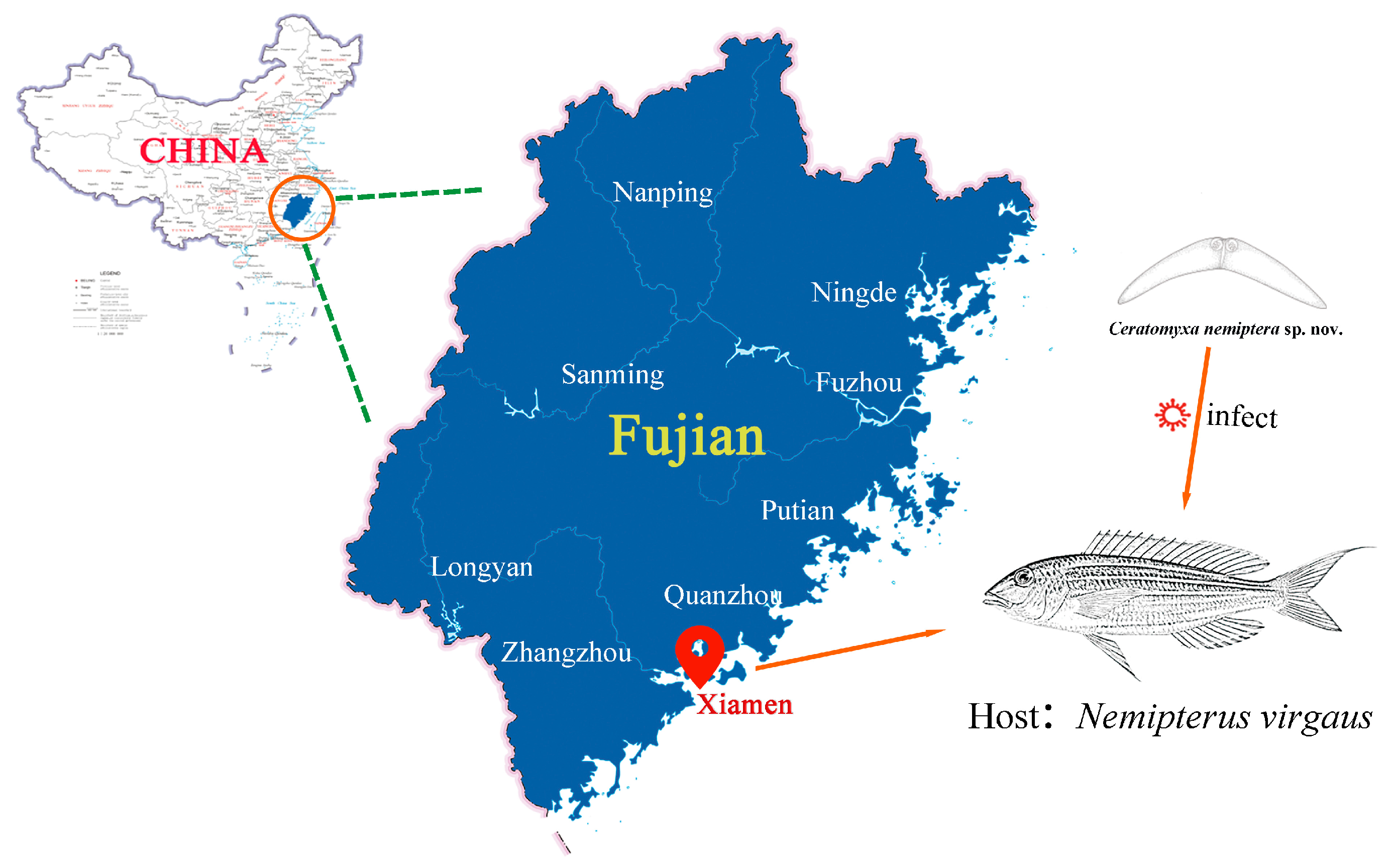
Figure 1. Map showing sampling locality for host of Ceratomyxa nemiptera sp. nov. The figure created by authors and the base map of China was sourced from the Standard Map Service System of the Ministry of Natural Resources of the People’s Republic of China (http://bzdt.ch.mnr.gov.cn/, accessed on 3 January 2026) with the approval number of GS(2019)1671.
Animals 16 00166 g001
Figure 2. Photomicrographs of Ceratomyxa nemiptera sp. nov. from the gallbladder of Nemipterus virgatus. (A) mature spore; (B) immature spore; (C) disporic plasmodium of Ceratomyxa nemiptera sp. nov.; (D) Line drawings of mature spores of Ceratomyxa nemiptera sp. nov., Scale bar 10 μm.
Animals 16 00166 g002
Figure 3. Phylogenetic tree generated by BI and ML based on the SSU rDNA gene sequences of Ceratomyxa nemiptera sp. nov., The node indicates the support value, with “-” indicating values less than 50%; the number after the species name indicates the GenBank accession number. “//” indicates that the branch is drawn two-third of the original length.
Animals 16 00166 g003
Table 1. Comparison of the morphometry or morphology of Ceratomyxa nemiptera sp. nov. with the similar species (all measurements are provided in μm).
SpeciesSLSTPCLPCWPFTPA (°)HostLocalityReferences
Ceratomyxa nemiptera sp. nov.6.2 ± 0.6
(5.4–6.9)
44.8 ± 4.6 (38.5–53.1)2.8 ± 0.2
(2.4–3.1)
2.3 ± 0.2
(1.9–2.6)
2–3131.6 ± 14.6
(103.3–153.0)
Nemipterus virgatus Houttuyn, 1782East China Sea, PR ChinaPresent work
Ceratomyxa fistulariae Kpatcha, Diebakate, Faye & Toguebaye, 199610.2
(10–12)
39.6
(38.8–40)
5.2
(4.5–5.5)
---Fistularia petimba Lacepède, 1803Atlantic Ocean, Senegal[36]
Ceratomyxa anko Freeman, Yokoyama & Ogawa, 200810.8
(9.7–11.9)
41.9
(36.9–47.2)
4.6
(4.1–5.3)
---Lophius litulon Jordan, 1902Fukushima Prefecture, Japan[37]
Ceratomyxa draconis Azizi, Yemmen, Rangel, Santos & Bahri, 20207.4 ± 0.77 (6.4–8.0)30.8 ± 1.65
(28.8–32.8)
3.3 ± 0.2
(3.6–4.0)
--120–156Trachinus draco Linnaeus, 1758Bay of Bizerte, Tunisia[38]
Ceratomyxa protopsettae Fujita, 192311.64 ± 0.95
(10–12)
46.63 ± 5.8
(50–65)
4.15 ± 0.34-5–6-Paralichthys olivaceus Temminck & Schlegel, 1846East Sea, South Korea[39]
Ceratomyxa macapaensis Bittencourt, 20224.2 ± 0.522.75 ± 0.31.86 ± 0.31.63 ± 0.13–4-Mesonauta festivus Heckel, 1840Piririm River, Amapá, Brazil[40]
Ceratomyxa mandii Bruno, 20224.6 ± 0.5 (3.4–5.5)31.2 ± 2.3 (26.2–36.3)1.8 ± 0.3 (1.0–2.5)1.9 ± 0.3
(1.2–2.4)
3–4162 ± 10.4 (143–178)Pimelodina flavipinnis Steindachner, 1876Amazon River, Amazonas, Brazil[41]
Ceratomyxa mai Yang, Huang, Atkinson, Bartholomew, Ma & Zhao, 20239.2 ± 0.5 (8.1–9.9)20.9 ± 1.9
(17.3–24.7)
2.6 ± 0.2 (2.4–2.9)2.7 ± 0.2
(2.4–3.3)
-142.2 ± 8.2 (125.8–158.2)Saurida elongata Temminck & Schlegel, 1846East China Sea, PR China[10]
Ceratomyxa saurida Zhao, Al-Farraj, AL-Rasheid & Song, 20159.0 ± 0.7 (8.0–10.6)42.5 ± 4.0 (38.1–54.6)3.3 ± 0.3 (3.0–3.7)--156.8 ± 11.4 (138.1–176.3)Saurida elongata Temminck & Schlegel, 1846East China Sea, PR China[10]
Ceratomyxa siganicola Zhang, Zhao, Yang & Yang, 20195.6 ± 0.5 (4.8–6.5)19.1 ± 1.8 (16.0–22.1)2.7 ± 0.2 (2.1–3.0)--177.1 ± 0.5 (175.2–178.4)Siganas fuscescens Houttuyn, 1782East China Sea, PR China[7]
Note: SL means spore length; ST means spore thickness; PCL means polar capsule length; PCW means polar capsule width; PFT means polar filament turns; PA means posterior angle; - means no description or no data; The symbol ° stands for degrees. All measurements are given in micrometers, data are presented as mean ± standard deviation (range), unless otherwise stated.
Table 2. An analysis of genetic distance and similarity between Ceratomyxa nemiptera sp. nov. and most morphologically similar congeners based on SSU rDNA sequences.
Species1234567
Ceratomyxa nemiptera sp. nov. 93.56%93.38%92.49%78.88%75.74%76.86%
Ceratomyxa arcuata0.0637 97.55%93.28%79.90%78.32%77.72%
Ceratomyxa cretensis0.06810.0151 92.46%78.70%76.52%77.85%
Ceratomyxa draconis0.07510.06430.0738 78.52%74.93%76.61%
Ceratomyxa anko0.23200.20000.21900.2400 70.52%72.83%
Ceratomyxa mandii0.27900.24100.26700.28500.3420 93.45%
Ceratomyxa macapaensis0.23000.22000.22500.23700.29800.6400
Disclaimer/Publisher’s Note: The statements, opinions and data contained in all publications are solely those of the individual author(s) and contributor(s) and not of MDPI and/or the editor(s). MDPI and/or the editor(s) disclaim responsibility for any injury to people or property resulting from any ideas, methods, instructions or products referred to in the content.