Scoping Review of the Socioeconomic Value of Working Equids, and the Impact of Educational Interventions Aimed at Improving Their Welfare
 , , ,
, , ,
Simple Summary
Abstract
1. Introduction
2. Study Aims and Objectives
2.1. Socioeconomic Value Objectives
- This study has created an overview of currently available research on the socioeconomic value of working equids in LMICs, which could be used to inform policy and funding decisions of organisations with an interest in working equids, their owners, and their communities.
- This review has highlighted the socioeconomic value of working equids through their contributions to sustainable development goals.
- Gaps in the literature regarding the socioeconomic impact of working equid ownership have been identified.
- Finally, recommendations have been developed for future studies to aid their discovery and interpretation by researchers, policymakers, and other audiences.
2.2. Educational Intervention Objectives
- This study has created an overview of the currently available research on the impact of educational interventions for working equid owners in LMICs on owner knowledge, attitudes, and practices; equid welfare; and any other relevant outcomes.
- This review has highlighted educational intervention strategies that have been successful in achieving their outcomes within this setting.
- Gaps in the literature regarding the evaluation of educational interventions developed for working equid owners have been identified.
- Finally, guidance has been provided for future studies and to inform researchers and other audiences.
3. Materials and Methods
3.1. Protocol and Registration
3.2. Eligibility Criteria
3.2.1. Socioeconomic Value
3.2.2. Educational Interventions
3.3. Publication Inclusion
3.4. Information Sources
- CAB Abstracts (Ovid): 1973–present;
- Ovid MEDLINE: 1946–present;
- Embase (Ovid): 1974–present;
- Web of Science (Core Collection): 1900–present;
- International Bibliography of the Social Sciences (IBSS): 1951–present.
3.5. Search Strategy
3.6. CAB Abstracts Search Strategy Summary
3.7. Study Selection
3.8. Charting Process and Synthesis of Results
4. Results
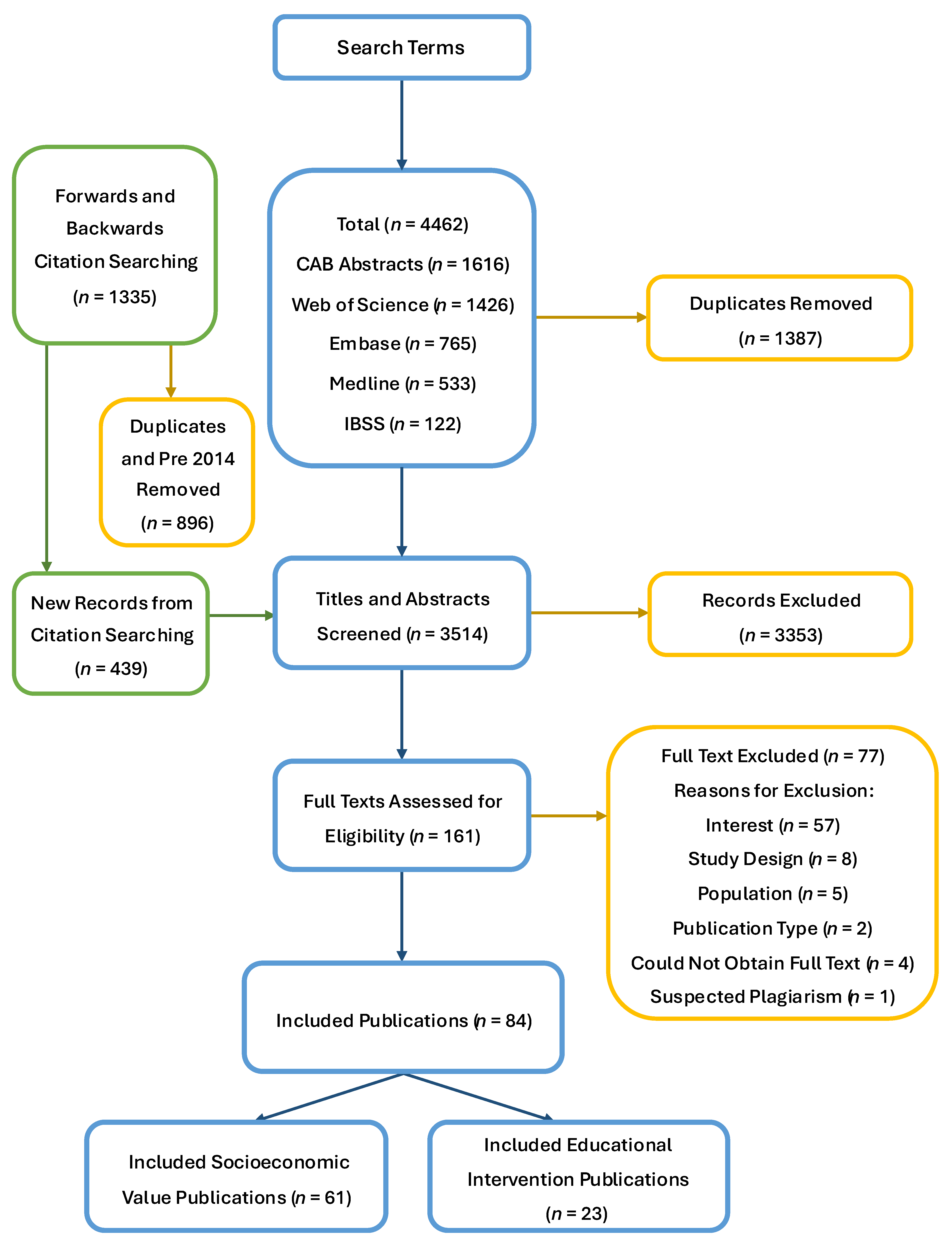
4.1. Selection of Evidence Sources
4.2. Synthesis of Results
4.2.1. Socioeconomic Value

| Author and Year | Main Study Aims | Human Population | Equid Use | Equid Species and No. | Study Methods | Country and Income Status |
|---|---|---|---|---|---|---|
| Journal Articles | ||||||
| Abdifatah Ahmed et al., 2023 [43] | To (1) establish the influence of donkey owners’ perceptions on donkey welfare, (2) determine the influence of donkeys’ contributions to owners’/user’s livelihood on donkey welfare, and (3) asses the influence of owner/user training on donkey welfare | 156 donkey owners/users | Cart pulling | >288 donkeys (exact no. not specified) | Cross-sectional survey | Somalia (Low) |
| Alam et al., 2015 [44] | To study the socioeconomic status of horse keepers and income from horse rearing | 200 horse-owning households | Cart pulling | Horses No. not specified | Structured interviews | Bangladesh (Lower-Middle) |
| Asfaw and Tadesse 2020 [45] | To study the economic contribution of carthorses to livelihood of their owners | 200 cart horse owners | Cart pulling; pack carrying | 135 horses | Semi-structured questionnaires; physical exam of horses | Ethiopia (Low) |
| Asrat et al., 2019 [46] | To investigate cart pulling donkeys’ contribution to their owners’ livelihoods, and the impact of donkey foot related problems | 369 donkey owners | Cart pulling | 369 donkeys | Structured Interviews; clinical exams | Ethiopia (Low) |
| Asteraye et al., 2024 [47] | To assess population dynamics, distribution, biomass, and economic value of equids in Ethiopia | 7 knowledgeable elders, 10 key informants | Cart pulling; transportation | Horses, donkeys, mules No. not specified (census data) | Analysis of census data; structured Interviews | Ethiopia (Low) |
| Avornyo et al., 2015 [41] | To assess the contribution of donkeys to food security for their owners (physical and economic access to sufficient nutritious food) | 100 donkey owners | Cart pulling (for transportation of water, building materials, agricultural material, produce); agriculture (ploughing); manure production | 119 donkeys | Questionnaires; interviews | Ghana (Lower-Middle) |
| Badmos et al., 2019 [48] | To consider donkey keeper and draught operators’ perceptions of donkey welfare and management issues in relation to economic uses | 200 donkey farmers/owners | Pack carrying; domestic tasks; agriculture | Donkeys No. not specified | Semi-structured questionnaires | The Gambia (Low) |
| Barbosa et al., 2020 [38] | To assess the nutritional, health and reproductive management of draft horses. To assess the socioeconomic conditions of the region’s cart drivers and provide guidance on animal management | 23 cart drivers | Cart Pulling | 11 donkeys; 9 horses; 8 mules | Structured interviews | Brazil (Upper-Middle) |
| Carder et al., 2019 [49] | To explore the potential impact of the donkey hide trade on small holder farmer’s livelihoods | 421 current and previous donkey owners surveyed; 33 focus groups (5–7 per group) with farmers, transporters, business owners; 48 key informants (government representatives) interviewed | Transport of water; domestic tasks; agriculture; renting out to others; transport of passengers; dowry asset | Donkeys No. not specified | Surveys; focus groups; interviews | Kenya (Lower-Middle) |
| Cousquer et al., 2023 [50] | To understand how muleteering has emerged in the region, to document working life, husbandry, and health and welfare concerns for mules | 90 owners surveyed, ethnographic study numbers unclear | Agriculture; construction; mountain tourism | 88 mules; 2 donkeys | Mixed methods: Ethnographic walking and reading, survey/structured interview, home visit and clinical examination | Morocco (Lower-Middle) |
| de Klerk et al., 2020 [51] | To understand the social and economic impact the use of a horse and cart on an individual, their household, the surrounding community and the horse itself, and understand the spatial extent to which the cart horses work | 100 cart horse drivers | Cart pulling | 163 horses | Questionnaire | South Africa (Upper-Middle) |
| Desta 2023 [52] | To report the diverse use values of equines and their current population status | 10 knowledgeable farmers | Agriculture; transport; pack carrying; cultural events | Horse; donkey; mule No. not specified (census data) | In-depth interviews; analysis of livestock census data | Ethiopia (Low) |
| Geiger and Hovorka 2015 [53] | To explore the lives of donkeys and donkey-human relations | 100 donkey owners | Cart pulling; domestic tasks; agriculture | 100 donkeys | Semi-structured interviews; welfare assessments | Botswana (Upper-Middle) |
| Geiger et al., 2020 [54] | To identify the personal, social, and broader economic value of donkeys to rural, peri-urban, and urban households | 20 donkey owners/users, 10 key informants | Cart pulling; pack carrying | Donkeys No. not specified | In-depth interviews | Ethiopia (Low) |
| Geiger et al., 2021 [55] | To investigate the differences in donkey owners’ uses and beliefs of donkeys and donkey welfare between rural and urban locations | 28 donkey owners—15 rural, 13 urban | Pack carrying; domestic tasks; agriculture; transport; rubbish collection; cart pulling | 161 donkeys | Questionnaires; welfare assessments | Ethiopia (Low) |
| Geiger et al., 2023 [56] | To investigate donkeys’ multidimensional contributions to their human co-workers’ lives | 137 human donkey co-workers | Domestic tasks; agriculture; transport; pack carrying; construction; rubbish collection; cart pulling | Donkeys No. not specified | Workshops using participatory rural appraisal and appreciative inquiry | Ethiopia (Low) |
| Geiger 2023 [57] | To explore human-donkey relationships and how gendered divisions of labour manifest across species lines | 20 donkey owners; 10 key informants | Pack carrying; domestic tasks; agriculture; construction; rubbish collection | Donkeys No. not specified | Semi-structured interviews; participatory workshops | Ethiopia (Low) |
| Gelaye and Fesseha 2020 [23] | To assess the socioeconomic importance and constraints of equids in Central Ethiopia | 150 equid owners | Pack carrying; cart pulling; cultural and religious events; agriculture; renting out; breeding and selling | 205 horses; 232 donkeys; 2 mules | Cross-sectional survey (structured interview questions) and an observational study | Ethiopia (Low) |
| Gichure et al., 2020 [8] | To determine the benefits of keeping donkeys and associated production challenges under a smallholder farming system | 13 focus groups of 8–12 donkey owners | Transport; Manure production; breeding; agriculture | Donkeys No. not specified | Focus groups | Kenya (Lower-Middle) |
| Gichure et al., 2020 [58] | To determine farm level factors associated with household incomes for farms that keep donkeys in a smallholder farming system | 354 smallholder farming households keeping donkeys | Cart pulling; transport; domestic tasks; agriculture | 1040 donkeys | Semi-structured interviews | Kenya (Lower-Middle) |
| Gina and Tadesse 2015 [59] | To examine the role of working animals in livelihoods and food security | 120 working animal owners (51 donkey owners) | Cart pulling; transport; pack carrying; renting out | Donkeys No. no specified | Semi-structured interviews; focus groups | Ethiopia (Low) |
| Gupta et al., 2017 [60] | To document the physical, biometric indices, health and managemental issues of working donkeys for future improvement and proper management of working equids | Owners/handlers of brick kiln donkeys No. not specified | Brick Kiln | 98 donkeys | Physical examination and presumably discussions with owners/handlers but not described in methods | India (Lower-Middle) |
| Gursoy 2020 [61] | To explore sustainable tourism and transport, specifically the human-animal relationship, by taking horse-drawn carriages as objects of inquiry | 37 stakeholders (including carriage drivers, vets, tourists, local inhabitants) | Tourist carriage rides | Horses No. not specified | Semi-structured interviews | Türkiye (Upper-Middle) |
| Kithuka et al., 2025 [62] | To assess the role of environmental and human factors on the welfare of working donkeys | 1059 donkey owners | Pack carrying; cart pulling; agriculture; water transport; renting out | 1059 donkeys | Semi-structured interviews | Kenya (Lower-Middle) |
| Koko and Shuiep 2016 [42] | To assess the socioeconomic value of rearing donkeys, and to investigate the frequency of different ecotypes of donkey based on phenotypic characteristics | 105 donkey owners | Cart pulling; transport of goods and people; agriculture | 105 donkeys | Structured interviews | Sudan (Low) |
| Kubasiewicz et al., 2022 [5] | To investigate the links between poverty, equid ownership and equid welfare in the brick kilns of Ahmedabad, India | 32 donkey owners; 5 thekedars (supervisors); 6 non-owner workers | Brick Kiln | 220 donkeys | Semi-structured interviews; livelihood questionnaires; welfare assessments (EARS) | India (Lower-Middle) |
| Kubasiewicz et al., 2023 [63] | To (1) describe the welfare of donkeys owned under conditions of debt-bondage, examine the links between owner and donkey behaviour, and outline the living conditions of both donkeys and humans working in brick kilns; (2) explore the experience of debt-bondage, compare migration trends to those of non-donkey-owning workers, and assess impacts on their children’s education | 32 donkey owners; 5 thekedars (supervisors); 6 non-owner workers; 3 kiln owners | Brick Kiln | 220 donkeys | Semi-structured interviews; livelihood questionnaires; welfare assessments (EARS); observational assessments | India (Lower-Middle) |
| Kubasiewicz et al., 2024 [64] | To (1) outline the role of mules in supporting resilient communities in the remote mountains and identify the role of mules in meeting the Sustainable Development Goals; (2) explore the relationships between equid handling experience and equid welfare; (3) provide insight into the mindset of key informants in the face of both current risk exposure, and long-term systemic change from development | Livelihood surveys: 23 mule owners and drivers, 26 non-mule owning community members Interviews: 27 mule owners and drivers, 28 non-mule owning community members | Pack carrying | 127 mules | Livelihood surveys; semi-structured interviews; welfare assessments (EARS) | Nepal (Lower-Middle) |
| Maggs et al., 2021 [6] | To examine the role of donkeys in northern Ghana and how donkeys contribute to livelihood outcomes, especially for women and children | 262—combination of adult and child donkey owners and non-donkey owners | Agriculture; transport; cart pulling; domestic tasks; construction; community events | Donkeys No. not specified | In-depth interviews; focus groups; surveys; time budgets | Ghana (Lower-Middle) |
| Maggs et al., 2023 [65] | To understand the utilitarian value donkeys provide to poor small holder farmers, especially women, in their efforts to make a living in rural northern Ghana | Questionnaire—28 donkey owners and 10 children, 8 non-donkey owners and 10 children; interviews—6 donkey owners, 4 non-donkey owners; focus groups—54 donkey owner children | Agriculture; transporting goods; domestic tasks | Donkeys No. not specified | In-depth semi-structured interviews; questionnaires; focus groups | Ghana (Lower-Middle) |
| Merridale-Punter et al., 2024 [66] | To (1) describe the work equipment used by working equids; (2) understand the implications of harnessing practices to both animals and the community; (3) describe the knowledge, attitudes and practices of working equid users in regard to work equipment | 368 cart drivers surveyed; 87 participated in focus groups—77 working equid owners and drivers, 9 harness/cart makers, 1 vet | Cart Pulling (for taxi transport, goods, or water) | 243 horses; 122 donkeys; 3 mules | Mixed methods: survey, questionnaire and focus groups | Ethiopia (Low) |
| Merridale-Punter et al., 2024 [67] | To (1) explore the specific One Health links between working equids and their female users through a collection of personal stories; (2) explore the interconnectedness of those links using a systems thinking approach | 10 female working equid users | Domestic tasks; agriculture; transport (of people, produce, food, water); other income generation | Horses; donkeys No. not specified | Semi-structured interviews | Ethiopia (Low) |
| Narayanan 2024 [68] | To politicise the emotional, physical, and psychological suffering of animals in coercive labour, and challenge the anthropocentric focus of the development and antipoverty praxis | Ethnographic visits to ~100 kilns Interviews: six vets, 7–10 animal owners, manager from each kiln | Brick kiln | Horses; donkeys; mules No. not specified | Ethnography; semi-structured interviews; direct observations | India (Lower-Middle) |
| Nguekeng et al., 2022 [69] | To set baseline information on the characteristics of donkey husbandry, including the socioeconomic and technical characteristics of donkey farming | 149 donkey owning farmers | Breeding (to be used for transport and agriculture) | Donkeys No. not specified | Mixed methods: interviews, observations and questionnaire | Cameroon (Lower-Middle) |
| Oduori et al., 2025 [70] | To assess the economic impact of the donkey skin trade on donkey-dependent women, their families, and communities | Questionnaires: 171 women Interviews: 17 women | Transport (of water, produce, firewood, other items for commercial purposes); domestic tasks; manure production; milk production | Donkeys No. not specified | Cross-sectional questionnaires; key informant interviews | Kenya (Lower-Middle) |
| Onono and Kithuka 2020 [71] | To determine benefits of keeping donkeys, challenges facing donkey farmers, and how to streamline the supply of medicines for treatment of donkeys | 156 donkey owners and users; 87 animal health service providers and agro-vets | Transportation (of water, produce, animal feed, firewood, construction materials, manure); renting out; agriculture | Donkeys No. not specified | Semi-structured questionnaires | Kenya (Lower-Middle) |
| Rink and Crow 2021 [72] | To explore experiences of working horses and cart drivers, including mobility and livelihoods | 1 cart driver | Cart pulling (rubbish collection) | 1 horse | Ethnographic study with interviews and observations | South Africa (Upper-Middle) |
| Sangioni et al., 2016 [39] | To assess the welfare conditions of draught horses and to verify the socioeconomic profile of their respective owners | 123 owners | Cart pulling | 191 horses | Cross-sectional study: animal clinical assessments and owner questionnaire | Brazil (Upper-Middle) |
| Shah et al., 2019 [73] | To assess the role and welfare of cart donkeys used in waste management, and understand the challenges faced; to aid the development of interventions | 200 owners, 50 households, 14 key informants | Cart pulling: waste removal | 204 donkeys | Mixed methods: owner interviews and SEDWAT animal welfare assessments | Pakistan (Lower-Middle) |
| Tuaruka and Agbolosu 2019 [74] | To determine whether there were differences in the production and management of donkeys in communities in Bukpurugu/Yunyoo district | 100 donkey owners | Cart-pulling; transport (of water, produce, farm implements); agriculture | 144 donkeys | Semi-structured interviews; physical measurements and observations of donkeys | Ghana (Lower-Middle) |
| Teixeira et al., 2022 [40] | To describe cart drivers’ general, socioeconomic, and occupational characteristics, and the way they manage their horses | 38 owners | Cart pulling | 38 horses | Structured interviews | Brazil (Upper-Middle) |
| Vasanthakumar et al., 2021 [11] | To investigate (1) how working equids contribute to women’s livelihoods, (2) the roles women have in caring for their equids, (3) the opportunities women have to acquire new knowledge about their equids, (4) whether women find existing training programmes helpful and accessible, and (5) the areas of equid care on which they would like more information | 34 female equid owners | Pack carrying; domestic tasks; agriculture; transport; tourism; breeding | Horses, donkeys, mules No. not specified | Structured interviews | Guatemala (Upper-Middle) |
| Wani et al., 2021 [75] | To investigate the socioeconomic status of ponywallas associated with ecotourism in the Kashmir valley | 200 ‘Ponywallas’ (horse owners) | Transport; tourism | Horses (ponies) No. not specified | Semi-structured interviews | India (Lower-Middle) |
| Watson et al., 2020 [76] | To (1) outline the complexities of the lives of the poorest in India, (2) explore the Hindu caste and Scheduled Tribe systems, and (3) examine how cultural “blind spots” create challenges for NGOs attempting to target donkey welfare | 37 donkey owners | Brick kiln | 219 donkeys | Mixed methods: livelihood survey, welfare assessment using EARS tool, semi-structured interviews | India (Lower-Middle) |
| Watson et al., 2022 [77] | To (1) investigate the lives of equids walking mountain trails in Nepal; (2) document and discuss their transient existence and the challenges they face | 24 mule owners/drivers, 1 mule trader, 2 veterinary technicians | Pack carrying | 166 mules | Mixed methods: semi-structured interviews, livelihood surveys, welfare assessments using EARS tool | Nepal (Lower-Middle) |
| Watson et al., 2023 [78] | To understand the scale of the challenges facing working equids operating on mountain trails in Nepal | 24 mule owners | Pack carrying | 166 mules | Mixed methods: semi-structured interviews, livelihood surveys, welfare assessments using EARS tool | Nepal (Lower-Middle) |
| Wild et al., 2021 [21] | To assess the impact of the COVID-19 pandemic on the working equid community | 1530 working equid owners/users | Pack carrying; domestic tasks; agriculture; transport; rubbish collection; cart pulling | Horses, donkeys, mules No. not specified | Cross-sectional survey | Cambodia, Haiti, Honduras, Lesotho, Nepal, Nicaragua, Senegal, Zimbabwe (Lower-Middle); Colombia, Costa Rica, Guatemala, Mexico, South Africa (Upper-Middle); Panama (High—last Upper-Middle in 2022 fiscal year) |
| Reports | ||||||
| Valette 2014 [13] | To explore the contributions of working horses, mules, and donkeys to the lives of women | Women who work with equids—Ethiopia: 58, Kenya: 53; India: 88, Pakistan: 60 | Transport; domestic chores; manure; agriculture; cart pulling; pack carrying, brick kilns, rubbish collection | Horses; donkeys; mules No. not specified | Focus groups and interviews | Ethiopia (Low); Kenya, India, Pakistan (Lower-Middle) |
| Valette 2015 [79] * | To understand the economic contributions of working donkeys, horses, and mules to household incomes | Kenya: 254 participants—donkey owners and users, and control group of taxi operators India and Pakistan: no. not specified | Cart pulling; transport; pack carrying; renting out; milk production; agriculture | Horses; donkeys; mules No. not specified | Household economy approach—including interviews/questionnaires | Kenya, India, Pakistan (Lower-Middle) |
| Conference Papers | ||||||
| Abbas 2014 [80] | To gather economically marginalised women’s views and experiences of the role of working donkeys in their lives and document how women manage their donkeys | 85 women | Domestic Tasks; pack carrying, cart pulling; transport; other income generation | Donkeys No. not specified | Interviews and focus groups | Pakistan (Lower-Middle) |
| Asmamaw et al., 2014 [81] | To identify the major uses of equids and their contribution to household livelihoods | 50 households interviewed, 10 focus groups with key informants | Pack carrying; cart pulling; domestic tasks; transport; renting out; selling; social events | Horses; donkeys; mules No. not specified | Mixed methods cross-sectional study: semi-structured interviews and focus groups | Ethiopia (Low) |
| Bekele et al., 2014 [82] | To assess the socioeconomic impact of epizootic lymphangitis on the livelihood of cart mule owners | 109 mule owners | Cart pulling | Mules No. not specified | Questionnaires, interviews, focus groups | Ethiopia (Low) |
| Doumbia 2014 [83] | To show the role of working donkeys in the livelihoods of the population in the villages in Segou, Mali | 1044 families; financial data from 350 owners | Cart pulling; other unspecified roles | 1754 donkeys | Questionnaires | Mali (Low) |
| Kandpal et al., 2014 [84] | To investigate the contribution of equids in the livelihoods of the poor, marginalised communities engaging in brick transport | 200 owners | Brick kiln (cart pulling and pack carrying) | Species and no. not specified | Mixed methods: structured interviews, focus groups, activity schedules, resource and mobility mapping, credit analysis | India (Lower-Middle) |
| Kendagor and Njoroge 2014 [85] | To determine the contribution of donkeys to the livelihoods of a marginalised group of women | 15 members of a women’s group | Transport of water, food, and firewood | Donkeys No. not specified | Focus groups | Kenya (Lower-Middle) |
| Lane 2015 [86] † | To evaluate household demographics and wealth, respondent health, child anthropometry, and working equine health | 70 owners; 20 children of owners | Pack carrying for agricultural goods | 107 horses; 18 mules; 7 donkeys | Cross-sectional verbal survey; welfare assessments; analysis of growth data of children | Nicaragua (Lower-Middle) |
| Mwasame et al., 2019 [87] | To provide empirical evidence on the economic and non-economic value of donkeys to human livelihood | 134 donkey owners; 121 non-owners | Transport (including water, building materials, produce, fertiliser); domestic tasks; renting out | Donkeys | Cross-sectional survey | Kenya (Lower-Middle) |
| Rodriguez Rodas and Perez 2014 [88] | To understand the status and relationship between equids, owners, and communities | 325 owners | Transport of goods | Species and no. not specified | Questionnaire and correlation analysis to generate community profiles | Guatemala (Upper-Middle) |
| Warboys et al., 2014 [89] | To gather information and provide an insight into the general public’s knowledge and perception of the role of working equids in and around the Choluteca area; and the importance of this role to the local economy | 106 owners | Firewood collection; other | Species and no. not specified | Cross-sectional study: structured interview and questionnaire | Honduras (Lower-Middle) |
| Zaman et al., 2014 [90] | To investigate and quantify the financial contribution of equids to livelihoods of households using the Household Economy Approach analytical tool | Community leaders and participants from three wealth groups from four villages, total no. participants not specified | Brick kilns; transporting goods and people; agriculture | Species and no. not specified | Interviews; household economy approach analysis | India (Lower-Middle) |
| Zaman et al., 2014 [91] | To explore the role of working equids in the lives of women in India, facilitate discussion on socioeconomic issues relating to women’s use of equids and document their perspectives on equid use and care | 78 women | Brick kiln; other goods transport; domestic tasks | 126 horses, donkeys, and mules | Interviews and focus groups | India (Lower-Middle) |
| Author and Year | Socioeconomic Measures | Key Findings |
|---|---|---|
| Journal Articles | ||
| Abdifatah Ahmed et al., 2023 [43] | Participant demographics Income generation from equids; impact of equids on financial and food security | Participants were from Somalia and were all male, with three quarters educated to primary level and the rest having no formal education. When asked how donkeys contributed to their livelihoods, 24% respondents said that donkeys contributed to an improved income, 22% said that donkeys contributed to food security, 21% said that donkeys were a source of money, 17% said that donkeys are a source of financial capital, and 16% said that donkeys contributed to increased savings. |
| Alam et al., 2015 [44] | Participant demographics Primary occupation; secondary occupation; monthly income; source of horse and income from horse (through cart-pulling) | The only income for many horse owning households in Bangladesh was from their horse cart-pulling; for 88%, it was their primary occupation. Moreover, 54% were landless and 85% illiterate. They worked an average of 20 days/month, 7–8 h/day. Monthly income from horse use ranged from 3000 to 20,000 BDT/month (USD 39.14–260.96 *), with 66% earning 5000–8000/month (USD 65.24–104.38 *). Horse keepers earnt more during the rice and fruit seasons, and younger participants earnt more. |
| Asfaw and Tadesse 2020 [45] | Participant demographics Daily income | Income from horse work supported cart horse owners’ family livelihoods in Ethiopia. In the studied population, 67% had at least an elementary school level of education; 81% had 1–6 other family members, and 60.5% had 1–2 children at school; 44.5% had 2 horses; 27.5% had 1. Horses were commonly used >8 h/day (42%) for 5–7 days/week (99%) to transport loads of 300–700 kg (66%). Daily income ranged from 50–20 ETB/day (USD 2.47–5.94 *); 59% earnt 50–100 ETB/day (USD 2.47–4.95 *). |
| Asrat et al., 2019 [46] | Participant demographics Annual income from donkey use; annual monetary loss from donkeys suffering foot problems | In this study, 94% of donkey owners in Ethiopia were fully dependent on their cart donkey for their household’s livelihood; 89% owned 1 or 2 donkeys; 95% had completed at least elementary school. Participants worked with their donkeys 5–7 days/week for an average of 8 h/day. Average daily income was ETB 124 (range of ETB 32–360). Average annual income was ETB 29,760 (approx. USD 1488), average annual net contribution from the donkey was ETB 12,563 (USD 626.80). Moreover, 38% donkeys had a foot problem. Owners were estimated to lose an average of ETB 2232/year (range ETB 1240–7740) due to donkeys not being able to work because of foot problems. Culling due to foot problems caused significant financial loss; the cull rate in the study was 1.4%. |
| Asteraye et al., 2024 [47] | Number of horses, donkeys and mules; purpose, price and rental value of animals Biomass of equid population; stock monetary value; equid service value | Equids are important in transport and agriculture in Ethiopia and contribute significantly to the national economy. The per capita number humans to equids was 0–0.52 for donkeys, 0–0.13 for horses, and 0.02 for mules. Equids represented 10% of the total livestock biomass, 3.1% of the total livestock monetary value (USD 1229 million). The service value of transportation and draft was estimated as USD 1198 million, which was up to 1.2% of the country’s national GDP. |
| Avornyo et al., 2015 [41] | Income generation Food security | Donkeys in Ghana earnt owners a mean annual income of USD 217.78, which contributed 19% of their total income (the second largest contributor after crops). This was broken down into a mean of USD 110.06 through transporting loads, USD 70.56 from being hired out, USD 28.27 from manure sale, and USD 8.89 from ploughing (due to low numbers that used donkeys for this purpose). Donkey use could provide an estimated average profit of USD 707.50 over five years, after accounting for the cost of maintaining the donkey and cart. Female-headed households had lower levels of food security then male-headed households and were more likely to use donkeys to increase food security. |
| Badmos et al., 2019 [48] | Participant demographics Use of donkeys | Owners in Gambia used their donkeys for commercial activities (59%), carrying water or other domestic purposes (34%) and farming activities (7%). |
| Barbosa et al., 2020 [38] | Participant demographics Education level Working hours and load Income generation | Cart drivers’ main or sole source of income was derived from horse traction, carrying mainly construction materials and rubble. In the studied population, 57% of participants were over 41 years old, with 57% having incomplete primary education with 91.3% starting work before legal adulthood; 52% learned their profession from their own experience; 52% were working 9 h or more with 61% for 5 or more days a week; 69% reported they loaded their equids 101–450 kg. |
| Carder et al., 2019 [49] | Participant demographics Labour reduction; income generation; food security; independence; impact of loss of donkeys due to skin trade | Household survey respondents in Kenya: 82% smallholder farmers, of these 93% reared donkeys. The donkey hide trade had led to an increase in the sale and theft of donkeys in the area, decreasing the local donkey population. This reportedly affected community members with disabilities (who rely on donkeys for daily chores), with 63% now relying on voluntary assistance from others to complete chores. Additionally, 53% respondents reported increased spending on transport of farm produce, water, and firewood, and 43% reported an increase in time spent carrying water and firewood. Focus groups in Kenya: 66% farmers; 22% reported not wanting to sell their donkeys but had to due to a need for instant cash for their families. Most focus group and interview participants reported an increase in donkey, theft and decrease in food and financial security of donkey owners associated with the skin trade. Some felt the donkey skin trade had a positive impact, meaning they could easily sell their donkey to raise instant cash if needed, e.g., to pay children’s school fees. However, 63% reported they previously earnt money from donkeys to raise money for school fees, but now were unable to pay these fees due to a reduction in donkeys. Moreover, 56% focus group participants felt that loss of donkeys pushed back progress for women who rely heavily on them for their livelihoods. |
| Cousquer et al., 2023 [50] | Use of mules | Mules were often used in tourism, providing revenue for the families that owned them in the High Atlas Mountains of Morocco. The main income was from summer tourism, and money saved from this was used for subsistence during the winter. Additional uses were in transportation of building material, manure, and agricultural produce. |
| de Klerk et al., 2020 [51] | Use of horses; contribution to income; contribution to family and surrounding residents | Working cart horses in Cape Town, South Africa was the primary source of income for 89% of owners, and also helped support their families and surrounding community. The main use was transporting scrap metal (46%) and garden refuse (32.3%). Daily earning from horse-related income varied between ZAR 0–900 (USD 0.00–65.65 *), with 60% earning between ZAR 0–300 (USD 0.00–21.88 *). Participants’ mean daily income was ZAR 287.07 (USD 20.94). Participants supported a mean of 2.9 children, 2.2 family adults, 1.0 employees, and 1.1 non-related person. |
| Desta 2023 [52] | Use of equids | Famers in Ethiopia described their use of equids in agriculture, community events such as festivals, weddings and funerals, transportation, manure production, and use of equid-derived products. |
| Geiger and Hovorka 2015 [53] | Participant demographics Use of donkeys | Donkey owners in Botswana described the economic and social contributions of their donkeys, particularly around assistance with household tasks. 100% of participants used their donkeys for transporting fuel or water, 97% used them for ploughing, and 87% used them for riding to move cattle. Moreover, 24% of people described their donkeys as family members, contributing within the household and homestead; 27% described their utilitarian value (foodstuff, plough, vehicle); 32% described assistance and support (income provision, food provision, rest and spiritual guidance). The labelling of donkeys as ‘companion animals’ rather than ‘food animals’ was described as making them subordinate to cattle and resulting in marginal positioning. Impacts described were a lack of concern from government and policies, reduced access to veterinary resources and treatments, and a low market value for donkeys. |
| Geiger et al., 2020 [54] | Income from donkey use; impact on social status; empowerment and resilience | Working donkeys in rural and urban Ethiopia contribute to economic security, social status, empowerment and resilience. Donkey income mainly came from pack-carrying and cart-hauling, and their other roles included transport of water and firewood and helping people access areas not accessible by motorised vehicles or that are far away. Income generation was from sale of dung, transport of materials, and agricultural use. Donkey owners contributed to community-based saving schemes which benefited them and other members of the community, and donkeys were highlighted as a pathway out of extreme poverty. Moreover, 80% of donkey owners reported having greater security against environmental and financial hardships. They described their assistance with daily tasks and the ability to gain financial independence and alleviate labour. This was particularly impactful for women. |
| Geiger et al., 2021 [55] | Participant demographics Use and role of donkey; income from donkeys | Donkey owners used their donkeys primarily for income generating activities in both rural and urban Ethiopia. Rural owners were more likely to own their own house and have a higher number of dependents. Women were the primary users of donkeys in rural locations. Men were the primary users in urban locations. In rural locations, donkeys were mainly used for water carrying, firewood and agricultural purposes. In urban locations, they were mainly used for construction and rubbish collection. |
| Geiger et al., 2023 [56] | Use of donkeys; economic impact; contribution to participants lives; societal perception of donkeys | Stakeholders described direct and indirect economic impacts of donkeys in rural and urban communities in Ethiopia. The main uses were harvesting and transporting crops, construction, and rubbish collection. Donkey labour enabled people to save money, reduce labour, support family, and contribute to community saving schemes. Participants described personal empowerment through sharing physical labour with donkeys, including the impact on women and children. The impact on donkeys on social status was complex, and depended on the number of donkeys owner, the gender of the owner/carer, and the type of work the donkey was used for. |
| Geiger 2023 [57] | Participant demographics Economic impact of donkeys; donkeys position in society; social status of donkey owner/co-worker | Women have a key role in donkey care in rural Ethiopia and highly value their contributions to their household and domestic labour. Women described how donkeys supported their families’ income and survival. They had a key role in donkey care and use, but key decisions were often made by men. Donkeys were often referred to as female, even when male, and valued only in terms of labour by men. Both women and donkeys were described as experiencing sexism, subjugation, and violence perpetrated by men, and having lower economic and societal positioning. |
| Gelaye and Fesseha 2020 [23] | Participant demographics Use of equids | Equids in Central Ethiopia were primarily used for packing and carting and were key sources of income for lower-income or resource-limited respondents. In total, 34% of respondents were illiterate. Equids were used for ceremonial activities. Income was generated from packing (44%), cart transportation (31%), crop threshing (18%), renting (5%), and breeding and selling (2%). The main materials transported were crops and cereals (33%), water (23%), firewood and muck (17%), building materials (13%), charcoal (7%), and vegetables (6%). The average work per week for the equids was 5 days, and the average load was 345 kg for cart horses and 70 kg for pack donkeys. Equids were more important for socially and economically deprived farmers. |
| Gichure et al., 2020 [8] | Use of donkeys | Donkeys were primarily used for transportation and manure production and contributed to agriculture and trade activities for smallholder farmers in Kenya, important sources of income. Participants described the main benefits of donkeys (in order of highest to lowest ranked) as transport, manure, breeding, ploughing, sale, trading, rent, family asset, identity, and pet. The most frequently transported items were rice and water. |
| Gichure et al., 2020 [58] | Income from donkeys | In the studied population, 93% of smallholder farmers in central Kenya relied on donkeys as their primary source of income. The daily income from working donkeys was estimated as KES 500 (USD 4.87) compared to KES 100 (USD 0.97) from other livestock, such as cattle, sheep, goats, and chickens. All donkeys were used for transportation of goods by pulling a cart, with additional income from sale of manure. They were considered to have a low cost of maintenance compared to other livestock. Profitability of working donkeys (accounting for costs, including management, treatment, equipment and donkey rearing) was estimated as KES 9270 (USD 90.35) monthly gross margin (KES 300 per day) (USD 2.93), which was 62% of the gross income from working donkeys. |
| Gina and Tadesse 2015 [59] | Income generation from donkey use; reduction in labour; social status; performance compared to other working animals | Donkeys were the most commonly owned working animals (43%). Other animals owned were cattle and camels; 30% of owners in Ethiopia used working animals to generate income; 53% were used for draught power. Donkeys were considered to have an advantage over other working animals, as they could survive and perform better under drought conditions and when there was limited feed available. Draught power form working animals reduced labour and time taken for women and children performing domestic tasks. Owning a working animal could increase social standing within the community. |
| Gupta et al., 2017 [60] | Participant demographics Loads carried by donkeys; income generated by donkeys | Donkeys used for brick kiln work in Bihar, India, carry large loads of bricks and generate income for the poorest section of society within these communities. Donkeys carried 25–30 bricks per load, covering 100–500 m per load, and 4–20 km per day. In Patner, during brick-kiln season, each donkey carried 1000–1500 bricks per day, at INR 350/thousand bricks (USD 5.24 †). Each owner earnt about INR 450/day/donkey (USD 6.74 †) and spent about 75/animal/day (USD 1.12 †), but there were seasonal and regional variations. |
| Gursoy 2020 [61] | Income generation | This qualitative study of horse-drawn carriages described their importance in tourism and for the livelihoods of the coachmen in Izmir and Buyukada in Turkey. |
| Kithuka et al., 2025 [62] | Income generation | Donkeys contributed 22% to owner incomes on average, the second biggest income source after owning a small business in Kenya. This was an average income of USD 979/household/year from donkeys; 78% owners reportedly had good livelihood incomes. |
| Koko and Shuiep 2016 [42] | Participant demographics Income generated from donkey use | Most participants from Sudan had no education (52%), or a primary school level (40%). The most common job was as a porter (48%). It was common for children to work with donkeys. 76% of donkeys were used either solely for cart pulling, or cart pulling and farming. Donkeys were used to generate income to support households. The average daily income was SDG 135 (USD 22.17) (range SDG 75–250 (USD 12.32–41.05). The monthly income generated by a single donkey ranged from SDG 2250 to 7500 (USD 369.46–1231.53), with a mean of SDG 4048 (USD 664.70). |
| Kubasiewicz et al., 2022 [5] | Participant demographics Income from donkeys; financial dependence on equids; income poverty | Donkeys are a key source of income during brick kiln season for owners and thekedars (supervisors) in India. Some participants described donkeys as providing them with a route out of poverty or debt. Most (63%) owners had no formal education. Most owners (97%) and all supervisors relied on donkeys for their main source of income during the kiln season. Donkey owners earnt less than supervisors and more than non-owners during kiln season, and less than both off season. Donkey ownership had provided a route of debt or poverty for some owners, but others struggled due to loss of income and the cost of donkey care out of season. There was a correlation between donkey welfare and income, with lower behavioural scores for donkeys owned by people with lower incomes. |
| Kubasiewicz et al., 2023 [63] | Owner living conditions Income generation and bonded labour | Donkey owners working in brick kilns in India experience debt-bondage and are highly vulnerable to financial loss. Thekedars (supervisors) earnt INR 187 (USD 2.67) and donkey owners earnt INR 166 (USD 2.37) per 1100 transported bricks and INR 357 (USD 5.10) and INR 327 (USD 4.67) per day, respectively, during brick kiln season. Most owners received advance payments to cover expenses off-season. They described situations of bonded labour, where they were reliant on supervisors for job security, being trapped in cycles of debt, and being exploited or underpaid. Workers described having to migrate to find work during the brick kiln season, and some had children working within the kilns or attending alternative schools during kiln season. |
| Kubasiewicz et al., 2024 [64] | Income generation Meeting community needs Reliance on animal labour Risks of working with pack mules Potential to meet Sustainable Development Goals (SDGs) [92] | Mules in Nepal have an important role in supporting livelihoods in this mountainous region, as they provide transport to areas that are not accessible by motorised vehicles. Local business owners relied on ‘mule trains’ to deliver stock and supplies, and locals ordered food and necessities. They also transported construction and school materials. Before mules were brought to the region, people had to carry goods and supplies themselves or pay porters, which were expensive. Many mule owners felt working with mules was the only option to be able to provide for their families, as other job opportunities were limited. The majority of mule owners were satisfied with their work, reporting they earnt more than in their previous professions. Several former porters now worked with mules, and working with mules was considered easier than being a porter. Some participants reported that working with mules in these mountainous regions was dangerous for both mules and humans, due to the risk of landslides, unstable tracks, and falling. Few mule owners worked during monsoon season due to increased risks, but this could increase financial struggles during this period. Some mule owners worked during the monsoon season due to necessity or the chance for higher pay, as transport prices nearly doubled. Mules in this region were considered to meet six of the SDGs: no poverty; zero hunger; quality education; decent work; industry, innovation and infrastructure; sustainable cities and communities. |
| Maggs et al., 2021 [6] | Participant demographics Contribution to livelihood | Donkeys are important for women and children in Ghana contributing to income and saving them time and labour. The main role of donkeys were ploughing (Fielmon communities) and transportation (Gia communities), including water, construction materials, wood, and produce. Income benefits from donkey ownership were described as direct income from hiring out donkey, indirect income from not having to hire for transport of ploughing, collecting and selling firewood, selling donkey products, and saving time through using a donkey for labour. Children play a role in this income generation by accompanying the donkey when it is hired out. Donkeys contributed up to 60% of the household income and saved users up to 6 h a day in time. |
| Maggs et al., 2023 [65] | Participant demographics Use of donkeys | Donkeys are an important source of income for rural communities in northern Ghana, particularly for women. There are an estimated 14,910 donkeys in Ghana, mainly in northern regions. Their main use was in agriculture (mainly ploughing) and transporting goods (predominantly food items, firewood and water). The majority of respondents said they could not manage without a donkey, and the impact on women and children was particularly noted. Donkey slaughtering for meat and hide was reported to be increasing, with one butcher slaughtering an estimated 1040–1560 donkeys per year. |
| Merridale-Punter et al., 2024 [66] | Participant demographics Role of equid | This study of cart drivers in Ethiopia described using their working equids for taxi work (median 60%, IQR 0–80%) or transport of goods (median 25%, IQR 10–75%) and water (median 0%, IQR 0–10%). For most, cart driving was their primary occupation, and they derived 100% of their income from this. Most (68%) considered their economic comfort level as ‘just managing’. |
| Merridale-Punter et al., 2024 [67] | Participant demographics Social and health values of working equids | Women in Ethiopia described the direct and indirect impact of working equids on their health and household through transportation of goods and generation of income. Most women described their economic situation as difficult. They had a median of 3 children, and the mode level of education was early secondary. They had a median of 2 working equids per household. They described direct human health benefits from assistance with physically demanding work, increased household hygiene from water transportation, and benefits to other livestock through transportation of water and feed. They reported direct benefits to their nutrition and water security not only through transportation by donkeys, but also through income generated by working equids to purchase food. Women described increased access to health services either by transporting people, samples, or medicines by working equids, and also by purchasing care and medicines through income generated by working equids. The benefits to communities by sharing working equids and their use when people where ill or pregnant were highlighted. Their impact on wellbeing through labour and time saving was discussed. |
| Narayanan 2024 [68] | Income generation Bonded labour Reliance on animal labour | Most equid owners at the kilns in India were bonded labourers, paid low wages in advance and having to work to repay the debt to their employer. Equids (and sometimes camels) performed roles in kilns that cannot be mechanised, e.g., in small kilns with shorter distances between the raw bricks and oven only animals could be used to transport the bricks. In a case example given from one kiln, donkey owners had a quota of moving 25,000 bricks to the oven in a day and had to work 16–20 h/day, meaning their donkeys had to carry these bricks and work the same hours. For each trip to the kiln (250–300 m), donkeys were loaded with 25–28 bricks of 5–6 kg each. Owners earnt a rate of INR 160 (USD 1.96) per 1000 bricks. Each donkey earnt their owner USD 1222–2445 per season (6–8 months). In another case example, workers in the kiln received a rate of INR 800 (USD 9.60) per 1000 bricks carried. |
| Nguekeng et al., 2022 [69] | Participant demographics Reasons for breeding donkeys | Donkeys in Cameroon were mainly bred for use for transportation. The majority of farmers were male, aged between 40 and 60, married, and Muslim. Most had had at least primary education. The mode selling price of donkeys was XAF 140,000–150,000. Agriculture was the main activity for famers, with donkey breeding being a smaller component. Most (92.6%) of the donkeys were bred for transport and agriculture. |
| Oduori et al., 2025 [70] | Income generation Education level Social value and relationship with equids Roles of equids Impact of donkey theft | On average, 65% of household income was derived from donkey work and use in Kenya; 65% respondents had a primary level of education. Donkeys were used for both income generation, and alleviating some of the labour from household chores. The women highly valued their donkeys, with some examples of participants describing their donkey as a friend, a co-wife who shared the work, and as more important than her spouse in terms of income generation and livelihood support. Donkey theft was an issue in most of the 5 counties samples, with 97% participants from one county experiencing donkey theft in the previous 12 months. These thefts caused negative emotional, health, economic, and wider livelihood consequences. Some participants described feeling bereaved at the loss of their donkey. Women’s health suffered as without a donkey they had to carry heavy loads of water and other items and make multiple trips rather than one. Some women lost their only or major source of income. Respondents in all but one county (the county with the lowest rate of donkey theft) reported a decrease in income; this was by 14%, 38%, 51%, and 73%. Children’s education could be impacted, as families were less able to pay for school fees and learning materials. Children also participated in increased household labour after the theft of a donkey. |
| Onono and Kithuka 2020 [71] | Income generation Roles of working equids | In Kenya, donkeys contributed an average of 20% of households’ total income from livestock. Donkeys provided a source of employment and a source of generating money by selling them to pay fees for school and medical care. Some also kept donkeys as a sign of prestige or used them to protect their cattle from theft. |
| Rink and Crow 2021 [72] | Participant demographics Income generation | Cart horses in Cape Town provided a primary source of income for their owners/drivers. This ethnographic study highlights the poverty and social status of the cart drivers. Cart horses were used for removal of construction rubble and garden waste, second-hand and unwanted goods, and scrap metal, and for transporting groceries and parcels. |
| Sangioni et al., 2016 [39] | Participant demographics Education level Income Equid contribution to communities Working hours, load and mileage of equids | Horses are essential for urban waste recycling in certain communities in Brazil, contributing to income generation and transportation of people and materials. The study highlights the lack of formal education carried out by cart drivers with 71.5% of incomplete primary education level and 46.3% in the age bracket of 10–30 years. Cart drivers had a low income with 70% with an average monthly income below the minimum wage. The load carried had a range of 150–1000 kg, with 36% above 801 kg which is considerably more than the Federal District Degree limit of 350 kg for this type of animal drawn vehicle. 65.8% travelled over 21 km per day, with 60.2% working 1–5 h per day. |
| Shah et al., 2019 [73] | Participant demographics Use of donkeys Contribution to communities | Donkeys in Pakistan have a key role in waste removal, generating income for their owners and improving sanitation in the communities. The median number of people in each household was 10, and several members would be involved in waste management; 62% of those directly involved were under 18, and 47% were under 14 years of age. Waste collection was the primary income for 89% of donkey owners. Their median monthly income was PKR 7000 (USD 50) per month. Each cart donkey transported a median of 1000 kg non-recyclable waste and 100 kg of recyclable waste per day, and 3142 kg of recyclable waster per month. Most donkey owners (68.5%) reported they dumped waste at official sites. When other households were asked about their waste collection, 49/50 said this was carried out daily by donkey cart, and 53% said there would be a huge garbage build up if the donkey carts did not come. |
| Tuaruka and Agbolosu 2019 [74] | Roles of working equids | Providing the household with water was ranked as donkeys’ most important role in Ghana, with 56% primarily using their donkeys for this purpose. Access to potable water was a struggle in some communities, with donkeys being used to cart water from rivers and wells. Moreover, 39% generated income from their donkeys through agricultural activities and transporting produce to markets. |
| Teixeira et al., 2022 [40] | Participant demographics Education level Income Woking hours Types of cargo | Horse and cart drivers play a role in city cleanliness in Southern Brazil and collecting waste materials. In the studied population, 65% had incomplete primary education, with 36.8% initiating their profession under 12 years of age. 36.8% worked 5–7 h per day, with 65.8% carrying miscellaneous cargo. The ban of carts would lead to social and economic exclusion of this marginalised population, with 57.9% receiving their income for their family solely from cart activities. Participants earnt BRL 50–350/fortnight (USD 10.48–73.38 †), with 47.3% receiving less than BRL 250/fortnight of income (USD 52.41 †), less than minimum wage, and supporting more than 5 members per family. |
| Vasanthakumar et al., 2021 [11] | Participant demographics Role of working equids; source of income; contribution of working equids to income, chores and social interactions | Working equids support women by reducing domestic drudgery, generating income, feeding livestock, and saving time in Guatemala. The women had a median age of 37, and their main income was from agriculture. Most (21/33) had received primary school education only, and 8/33 had had no formal education. Equids contributed to food production by transporting firewood, and food and water for other livestock for all participants. They generated income through transporting wood, fodder and crops. This reduced the household chores, domestic drudgery and labour for the women, but they did also have additional work caring for the equids. Owning and handling equids impacted their standing in the local community, with 17/30 saying it made them more respected. |
| Wani et al., 2021 [75] | Participant demographics Role of ponies; income generation; contribution to livelihood | Ponies were primarily used for recreational purposes for tourists and livestock rearing, and were a key source of income for ponywallas (horse owners) in Kashmir, India. The majority of ponywallas were illiterate and had received no formal education. They had marginal holdings and most had 5–8 family members. The primary use for the ponies was recreation for tourists (72% in Pahalgam and 58% in Sonamargh), and livestock rearing (8% and 28% respectively). The majority of ponywallas had an income between 11,000 and 20,000 INR/month (USD 146.90–267.09 †), but the amount contributed by ponies was not specified. |
| Watson et al., 2020 [76] | Participant demographics Impact of donkeys on income and social status | Donkeys were used in brick kilns in Northern India by marginalised communities of low status and poverty. Donkey owners were predominantly male (86%) and aged between 31 and 50 (49%). Brick kiln work was the primary source of income for 97% of participants. Most felt that donkeys increased their perceived status. The brick kiln work resulted in many families travelling long distances, leaving their homes and communities and being vulnerable to poverty and exploitation. |
| Watson et al., 2022 [77] | Use of mules | Pack mules in Nepal are used for negotiating difficult terrain that cannot be accessed by motorised vehicles and challenging environmental conditions. Before mules began to be used in the region, human power alone was used to transport goods. Mules were purchased from brick kilns, transported and trained to carry packs in mountainous terrain. Working during monsoon season is dangerous for mules and owners, but owners reported needing to continue working or they would not have any earnings to feed themselves and their mules. |
| Watson et al., 2023 [78] | Participant demographics Use of mules | Mules are used to distribute supplies on the mountain trails in the Gorkha region of Nepal. Most mule owners were male (79%) and aged 30–60 years (67%). Most (83%) mule owners reported that their primary job was working with their mule. The primary role of the mules was pack carrying of goods for households and businesses along the trails, including rice and oil, or construction materials. Mules transported loads too heavy for humans to carry. Owners reported being stressed about the cost of replacing a mule when it died. |
| Wild et al., 2021 [21] | Participant demographics Income from working equids and impact of Covid-19 | Participants across 14 countries reported using working equids across a range of roles and a decrease in income associated with COVID-19. The most common uses of working equids were freight transport, crop transport and transport of people. Equid workload, monthly income from working equids and monthly household income had decreased compared to pre-pandemic. As a result, many had to supplement their income in other ways, such as through extra jobs or money lenders. |
| Reports | ||
| Valette 2014 [13] | Use of working equids Participant rankings of livestock | Working equids were found to be very valuable to women, reducing their labour when doing work and chores, helping them care for their children, providing direct and indirect income generation, and increasing health and social status. Women in 77% of the focus groups across the four countries ranked working equids as their most important livestock, with all groups in India and Kenya ranking them first. The main reason given was due to the regular income they generated. Working equids were also ranked first in 91% groups for their role in helping with household chores. Working equids were described by women as a lifeline and essential to their livelihoods, fulfilling roles both in their household and wider community. |
| Valette 2015 [79] | Use of working equids Income generated from working equids | Kenya—Food availability was largely determined by donkey-related earning activities. Donkey owners who used donkeys themselves generated the most income from their donkey (USD 2272/year). Casual labourers hired by owners to work with donkeys earnt USD 1389/year, and owners that hired labourers earnt USD 640/year. India—Owners were reliant on their equids for direct income, with equid use being their primary form of income. Equid owning households reported an annual income of USD 1711, of which nearly 80% was directly generated from working animals, with 73% being from brick transportation. Pakistan—Working equids’ roles in supporting owners with agriculture and livestock rearing made owners’ income highly dependent on them. Equids supported 100% of the annual income of households relying on crop and milk sales through their draught power. They underpinned 60% annual income for owners’ relying on labour, crop and milk sales. Estimated household annual income was USD 2500–9000/year. Some households also generated income directly from equid use, which was their primary income. Income directly derived from equids for these households was USD 2000–3000/year. In comparison, limited amounts were spent on equid care (USD 300–500/year), with feed representing the largest cost. |
4.2.2. Educational Interventions
| Author and Year | Main Study Aims | Human Population | Equid Use | Equid Species and No. | Study Methods | Country and Income Status |
|---|---|---|---|---|---|---|
| Journal Articles | ||||||
| Brown et al., 2023 [97] | To use film ethnography for action-research in communities dependent on working equids, aiming to positively influence owner-equid relationships | Local communities working with Animal Nepal: 97 questionnaire participants (48 analysed), 12 interviews, 97 focus group participants | Brick kilns; mountain pack carrying | Mule No equids included in study | Mixed methods: ethnographic film-making, questionnaire to film audience members, interviews, focus groups | Nepal (Lower-Middle) |
| Duguma et al., 2021 [98] | To trial a community-based approach to understanding and improving mule welfare, with a particular focus on wounds and Epizootic Lymphangitis | Stakeholders—muleteers (mule drivers), muleteer association members, local regulatory officers, business representatives, health professionals 12 key informant interviews; 5 focus groups Total project participants unclear (data presented per year and workshop, not clear whether overlap/attended multiple) | Cart pulling | Mules—no.s varied throughout project (lowest no. sampled was 394 in 2015; highest was 1436 in 2016) | Participatory project management cycle: annual cross-sectional surveys; key informant interviews; focus groups; stakeholder workshops; training and educational interventions | Ethiopia (Low) |
| Duguma et al., 2025 [99] | To improve donkey welfare through an intervention integrating education and donkey health care to change behaviour and attitudes towards donkeys and to influence policy | 8958 donkey-owning households, also stakeholders including local leaders, school children, harness makers, animal health professionals | Pack carrying (9583); cart pulling (3120) | 12,703 donkeys | Participatory intervention study: welfare assessments, wound surveys, focus groups used for evaluation | Ethiopia (Low) |
| Haddy et al., 2021 [100] | To evaluate long term effects of free veterinary treatment, and two educational interventions (farriery courses and handling workshops) | Local communities in three states who had and had not participated in Donkey Sanctuary NGO initiatives: 266 owners/handlers | Riding; pack carrying; agroforestry; sport; other | 130 horses; 121 donkeys; 15 mules | Mixed methods: structured interviews and welfare assessments | Mexico (Upper-Middle) |
| Haddy et al., 2025 [101] | To evaluate the potential of forum theatre as a tool for inclusive community engagement of both adults and children with positive donkey welfare messaging | 42 adults; 120 students (aged 11–23 years) | Pack carrying; other non-specified uses | Donkeys No equids included in study | Forum theatre performance Adults: feedback questionnaires Students: pre- and post-performance questionnaires | Kenya (Lower-Middle) |
| Makki et al., 2016 [96] | To investigate the effect of extension on husbandry, management, and performance of farm draught horses | 80 farmers selected from 10 villages | Agriculture | Horses No. not specified | Mixed methods: structured interviews and observations | Sudan (Low) |
| Reix et al., 2015 [94] | To stimulate and evaluate improvements in lameness and limb abnormalities through a participatory intervention project | 439 owners across 21 communities | Ceremonial; transport of goods and people; other work | 862 horses | Participatory intervention study: Lameness assessments to evaluate | India (Lower-Middle) |
| Stringer et al., 2018 [102] | To evaluate the efficacy of knowledge-transfer interventions (audio programme, village meeting, hand out) on long-term (6 month) knowledge change | 516 owners from 32 villages | Not specified | Donkeys No equids included in study | Cluster-randomised controlled trial on knowledge-transfer interventions | Ethiopia (Low) |
| Tadich et al., 2016 [103] | To investigate the recognition of nine basic needs of donkeys by children aged 8–11 years old | 173 children aged 8–11 years | Not specified | Donkeys No equids included in study | Educational intervention, children then drew welfare needs and frequency assessed | Mexico (Upper-Middle) |
| Whay et al., 2015 [95] | To investigate risk factors for lameness in intervention and control groups | 439 owners across 21 communities (Statistical analysis on 131 owners) | Not specified—see Reix et al., 2015 [94] for related data | 149 horses | Participatory intervention study: interviews to evaluate | India (Lower-Middle) |
| Yalew et al., 2023 [104] | To compare health and welfare problems between community intervention and non-intervention areas | 400 donkey owners/users | Transport, cart pulling | 400 donkeys | Cross-sectional study with control group: community-based interventions, welfare assessments | Ethiopia (Low) |
| Conference Papers | ||||||
| Demissie and Desalegn 2014 [105] | To use the government extension structures to promote simple and easily adaptable husbandry practices among rural equid owners | 574 extension workers, 3148 equid owner change agents, 77,289 equid owner followers | Not specified | 100,068 equids (species not specified) | Cross-sectional study: extension system assessed using participatory rural appraisal | Ethiopia (Low) |
| Gogoi et al., 2014 [106] | To describe the gradual transformation in the tetanus toxoid vaccination programme of Brooke India | Equid owners, no.s not specified | Not specified | >60,000 equids (species not specified) | Cross-sectional study: community led health care intervention | India (Lower-Middle) |
| Granillo and Reyes 2014 [107] | To improve local farriers’ understanding of the hoof, and improve decision-making for shoeing effectively | 4 farriers | Rubbish collection | Horses; donkeys; mules No. not specified | Case study: training of 4 farriers with ongoing assessment of trimming and shoeing skills | Mexico (Upper-Middle) |
| Hassib 2014 [108] | To evaluate needs of working equids in Egypt, and assess the impact of collaborative interventions with a partner organisation designed to address those needs | 159 owners for training, 64 owners for welfare assessment, 50 owners for questionnaire | Not specified | 63 donkeys; 1 horse | Case study: intervention and wound assessment scoring | Egypt (Lower-Middle) |
| Madariaga-Najera and Torres-Sevilla 2014 [109] | To (1) change owners’ perceptions and improve the human-equid relationship, through training on equine behaviour; (2) assess the outcome of these training sessions | Mule owners, no. not specified | Not specified | Mules No. not specified | Community behaviour training sessions, observations of mule behaviour and owner testimonies to assess impact | Mexico (Upper-Middle) |
| Nawaz et al., 2014 [110] | To improve understanding of mass media channels and help identify the best one for increasing awareness amongst equid owners and wider audiences in the future | 193 owners first interviews, 211 owners second interviews | Not specified | Species not specified No equids included in study | Equid welfare messages broadcast via radio; structured interviews pre- and post-intervention | Pakistan (Lower-Middle) |
| Nawaz et al., 2014 [111] | To measure the impact of an educational intervention for equid owners on their working equids and to inform an exit by Brooke from these communities | 50 equid owners | Not specified | Species and no. not specified | Mixed methods: structured interviews and focus groups, direct observations of management practices, physical and welfare assessment of equids—measures made pre- and post-intervention | Pakistan (Lower-Middle) |
| Parai et al., 2014 [112] | To document holistic and appropriate approaches to improve the welfare of working donkeys by changing their feeding practices | Estimated 100 owners attending street play, survey numbers not reported | Not specified | Donkeys No. not specified—estimated impact on 400 donkeys | Mixed methods: observations, intervention—street play containing educational messages, questionnaire, community discussions | India (Lower-Middle) |
| Pothipongsathorn and Chunekamrai 2014 [113] | To investigate the effects and sustainability of a holistic community intervention on equine health and welfare | Equid owners; community members; farriers Numbers not specified | Cart pulling; breeding | Horses (ponies) No. not specified | Mixed methods: clinical exam, observations, questionnaire, intervention—educational activities | Thailand (Upper-Middle) |
| Qureshi and Khan 2014 [114] | To identify the role of community-based animal health workers in providing equine health services in areas where no other services are available | 14 animal owners trained as community-based animal health workers; 154 equid owning community members participated in focus groups | Not specified | 1400 equids, species not specified | Intervention—training of animal health workers and their action in communities, focus groups | Pakistan (Lower-Middle) |
| Shah et al., 2014 [115] | To assess a community education initiative designed to improve hoof health of cart donkeys | 1 owner trained as farrier, 1 trained as community-based animal health worker No. community members and equid owners not specified | Cart pulling | 36 donkeys | Baseline health questionnaire; intervention—owner visits by trained farrier and animal health worker; health examinations | Pakistan (Lower-Middle) |
| Yadav 2014 [116] | To investigate the effectiveness of owner-level foot care training | 113 equid owners | Not specified | 257 equids, species not specified | Intervention—owner hoof care training; hoof health assessments | India (Lower-Middle) |
| Author and Year | Intervention | Evaluation Measures | Key Findings |
|---|---|---|---|
| Journal Articles | |||
| Brown et al., 2023 [97] | Ethnographical film making—production of a film representing the typical life stages of a working equid’s life in Nepal, filmed whilst spending time within participating communities. Participatory element where participants asked what should be included in film. Film screenings then organised with these communities. Action development sessions then held in community to make plans of how to improve welfare. These were recorded as posters and displayed in the community. | Pre- and post-screening Likert questionnaires to audience to assess knowledge of equine care; interviews with mule owners and handlers; focus groups held as action development sessions, where participants identified actions they could perform to improve equid welfare. | There was an overall increase in reported knowledge about equine care after the screening. Those reporting they had ‘a lot’ of knowledge increased from 17% to 29%. Thematic analysis of the qualitative data generated themes of ‘before knowledges’ and ‘after knowledges’ (before and after watching the film). ‘Before knowledges’ were defined by a view of mules as an instrument that had minimum care requirements to survive and work. After watching the film, there was increased concern for mules’ individual experiences. |
| Duguma et al., 2021 [98] | Participatory project management cycle—stakeholders identified and defined problem together, created and implemented a plan for the control and prevention of Epizootic Lymphangitis (EZL), and then monitored and reviewed this. Focus groups and key informant interviews held to understand local perceptions of EZL. Workshops held to agree on a collective intervention and implementation plan. Intervention: education of mule owners on mule care, and EZL prevention and treatment; training of harness makers to reduce wounds from equipment; training of animal health professionals on EZL treatment. Training was ongoing, with follow-ups throughout the project. Euthanasia for advanced cases was introduced as a disease control method (as opposed to abandonment)—training was given to professionals, and awareness raised among the public on the value of euthanasia. | Pre-intervention baseline survey involving clinical examination to measure welfare, and EZL and wound prevalence in mules. Annual follow-up surveys to monitor progress throughout the project (2010–2017). Trainees were assessed using a 4-level competence framework. Regular progress reports were prepared. Stakeholders took part in consultative review workshops. The Regional Livestock Agency, City Administration, and Regional Bureau of Transport, jointly conducted midterm and final evaluations. | Prevalence of EZL decreased significantly from 24% to 6% during the project. Wound prevalence decreased significantly from 44% to 22%. Owner education resulted in increased adoption of recommended EZL prevention and treatment protocols. In total, 8/12 harness makers completed the training and, over the course of the project, produced 584 improved cart saddles, 430 humane bits, and 893 canvas straps and collars. These were exchanged with poor traditional types. All veterinary clinic staff achieved at least the second highest competence level by the end of the project. Obtaining owner consent to euthanise mules with poor prognosis was a challenge, but 123 mules were euthanised during the project. There was a reduction in abandoned EZL-affected mules in the middle of roads and, as a result, a reduction in mule-associated road traffic accidents. |
| Duguma et al., 2025 [99] | An integrated community-based programme was implemented by The Donkey Sanctuary in Ethiopia, following a participatory programme cycle over five years. Participatory learning and action analysis, and knowledge, attitudes and practice analysis were carried out with stakeholders to identify donkey welfare needs. Problem and solution tree exercises were carried out with stakeholders to identify ways to address problems. Solutions included training animal health professionals and owners in donkey welfare and training harness makers. Suggestions for addressing policy gaps included animal welfare education in schools, improved equine education in veterinary colleges, improving access to services, and lobbying policy makers. Intervention programme aimed to transform main public vet clinics into model clinics and provide training to all animal health professionals in all clinics in target areas. Health care intervention plans developed with main clinic staff. Community education strategies developed with owners and other stakeholders. Development and testing of prototype packsaddle, training of harness makers, who then trained owners or other harness makers. Animal welfare clubs developed as extracurricular activities in primary schools. Project linked with government sectors of agriculture, education, and transport. Exit strategy developed to embed new practices without need for continuous support. | Donkey welfare assessments routinely used (assessing behaviour, body condition, wounds, lameness, other illnesses). Two structured assessments conducted three years apart, where more detailed cross-sectional wound surveys were also carried out. The number of animal health professionals who completed training and who reached independent and trainer level competency was recorded. The impact of the animal welfare clubs on children’s knowledge of donkey care and welfare, attitudes towards donkeys, and their actions towards donkeys and awareness raising in their communities were measured. The Life Skills approach was used to measure success. An animal welfare committee was established, comprising representatives from the government departments of education, livestock, animal health, and transport, and consultations and visits were carried out to monitor the programme. | The intervention resulted in a significant reduction in donkey wound and lameness scores and significant improvement in body condition score across all regions, according to routine welfare assessments. There was also a reduction in wound prevalence from 49.8% to 16.2% found when comparing the early- and late-stage wound surveys. There was also a significant decrease in variation in wound prevalence between regions. The percentages of animal health professionals who reached independent and trainer level competency in each of the three regions reported on were 83%, 81%, and 77%. Dropouts, job changes, and lack of interest in equine health contributed to failure of some to achieve an independent competence level. Children’s understanding of animal welfare and sentience was increased. Their empathy for animals, communication, problem-solving, and confidence also improved. Donkey club members persuaded owners and millers to stop loading donkeys with freshly milled flour, which can become so hot it can burn donkeys, and persuaded mill owners to provide shade and water to donkeys. Children also persuaded parents to take sick donkeys to the vet and influenced communities to carry out de-worming and vaccination. Children also raised awareness of donkey welfare and challenged negative perceptions in communities through role-playing and songs. Regional education and curriculum experts recommended the inclusion of animal welfare education in the national curriculum. The animal welfare committee found that as the programme advanced, many positive changes were being adopted. Donkey owners increasingly engaged with public vet clinics, vaccination centres, and de-worming facilities. Owners adopted improved practices, including using better packsaddles, offloading at market sites so donkeys were not left all day with heavy loads, communicating positively with their donkeys, and providing food, water, and shelter at markets. This led to a significant reduction in donkey welfare cases and fewer abandoned donkeys. |
| Haddy et al., 2021 [100] | Communities classed as high-, low-, or no-intervention, depending on welfare initiatives that had been conducted by the Donkey Sanctuary NGO. High-intervention initiatives—educational handling workshops or farriery courses run alongside free veterinary clinics. Low-intervention—free veterinary clinics only. All educational interventions had taken place 2–5 years before data collection (other than one which was 10 years before). Veterinary clinics had been running annually or biannually for at least 8 years. | The Equid Assessment Research and Scoping (EARS) tool was used to assess equid welfare and management practices (including physical and behavioural assessment). Structured interviews of 10 questions were held with owners, including questions on participation in welfare initiatives, the role of their equid, beliefs about equid emotions, and the social transmission of equine welfare knowledge in the community. | Equids in high-intervention communities had significantly higher body condition scores and a significantly lower incidence of skin alterations, than those in low- and no-intervention communities. General health status was higher for equids in high intervention communities, but no significant pairwise differences were found between community types. There was no significant difference in lameness across community types. There was no significant difference in behavioural response to the observer across community types. Owners in high-intervention communities were significantly more likely to believe their equid could feel emotions and pain than those in low-intervention communities. No significant difference between high- and no- or no- and low-intervention communities. Owners in high-intervention communities were significantly more likely to ask for advice on their equid and talk about their equid’s health with others than those in low- or no-intervention communities. Results indicate that overall, there was better welfare and increased social transfer of knowledge in communities that had received educational interventions and free veterinary clinics. |
| Haddy et al., 2025 [101] | Co-creation of a forum theatre intervention. Focus groups held with donkey owners to explore perceptions of donkeys, welfare issues, barriers, and solutions to improving welfare. Co-creation of a drama piece with a local theatre group. Forum theatre was used to encourage audience participation. The narrative was based on real life experiences of struggles in the community, with a ‘bad ending’. The play was then performed again, with audience members invited to intervene and suggest alternative choices which could lead to a better outcome. The aspects of donkey care and welfare featured in the play were as follows: not overloading or beating donkeys, provision of food, water and rest, seeking veterinary treatment for signs of illness, and protection from impacts of ingesting plastic waste. Three public performances were given. The drama piece was also adapted for children and performed in four secondary schools. | Public performances—Short questionnaires were verbally asked to audience members, featuring Likert and open questions. Questions asked whether respondents had enjoyed the performance, if it had raised their awareness about aspects of donkey management and welfare, and the effectiveness of the intervention type at influencing knowledge and behaviour. School performances—Audience members filled out pre- and post-performance questionnaires asking about attitudes towards donkeys and beliefs about their sentience and pain. | Public performances—The majority (88% or higher for all) strongly agreed the play raised their awareness of donkeys’ welfare needs, how much donkeys should carry, how to keep donkeys healthy, and donkeys’ roles in the community. Open questions revealed that 48% reported they had learnt about donkey care and the importance of not mistreating them, and 24% reported learning about the importance of donkeys to the community. In total, 74% reported that they preferred theatre productions as a method of community messaging. School performances—Participants were significantly more likely to report that they liked donkeys, felt confident in identifying how donkeys were feeling, and believed donkeys felt pain in the post- than the pre-performance questionnaires. No significant differences were found for questions about whether donkeys were important, needed rest, felt emotions, needed to be beaten to work, whether they should be loaded as much as possible, and whether participants could identify when they were unwell. In total, 92% believed theatre was an effective way of changing behaviour towards donkeys. From the open questions, 33% reported about learning about the need to take care of donkeys (most common answer). Many participants reported feeling positive emotions while watching the play (48%), while 23% also reported feelings of empathy towards the donkey. |
| Makki et al., 2016 [96] | Training and extension programme for draught animal technology developed and run by the Administration of Agriculture, EN-Nhoud locality. The authors report the training programmes are run by staff lacking sufficient knowledge. Training packages focus on labour reduction, timeliness, and harnesses and equipment. | Focus groups were held with farmers to gather their perceptions on the training programmes. Verbal questionnaires were asked to farmers about their equid’s health, feeding, and harnessing and also about plough condition. Direct field measurements were used to record working speed, field capacity, and field efficiency. | Focus groups revealed farmers were not satisfied with training quality or the knowledge of training staff. Farmers also wanted training on husbandry practices and work strategies rather than the provided focus of harnessing and equipment. The training was not often conducted in remote villages, requiring farmers to travel, which some could not afford or were unwilling to pay for. Farmers mostly learn about draught work from their peers and experienced farmers. The authors report the questionnaire and field survey revealed that farmers that had taken part in the training programme were not significantly more likely to perform desirable behaviours intended to improve equid welfare, such as regular harness cleaning, offering water during work, and offering more than one feed type to equids. There was also no difference found in farmers’ field performance between those who had and had not completed the training. Overall, the training and extension programme was found to have little impact on farmers’ management and husbandry of draught horses. The authors suggest training needs to be tailored to the needs identified by farmers themselves. |
| Reix et al., 2015 [94] | Participatory intervention—Facilitator chosen from each community who attended three training workshops on equine welfare and lameness-related issues, involving participatory exercises. Exercises explored husbandry needs and working practices, identifying actions owners could take to reduce lameness risk. Facilitators repeated the exercises and stimulated discussions in meetings with owners from their community. Meetings were held about every 1–2 months over two years, and owners filled in a chart to monitor their progress. A control group did not receive the intervention. | Lameness assessments were carried out with the intervention and control groups at the beginning of the study (before the intervention began), halfway through, and at the end. | Across both groups, only 4% of lameness assessments indicated no lameness. Lameness scores improved in both intervention and control groups across the study period (a lower score indicates less lameness). The improvement was significantly greater in the intervention group. The average overall lameness score in the intervention group improved from 5.1/10 to 3.1/10. In both groups, overall lameness scores increased with age. There was a significantly greater reduction in muscle atrophy across the study in the intervention group. Horses in the intervention group had a significantly greater improvement in range of movement and reduction in pain during joint flexion. |
| Stringer et al., 2018 [102] | Three knowledge transfer interventions were developed: an audio programme, a village meeting facilitated by a trained animal health worker, and a diagrammatic handout. Participants either received one of these or were part of the no-intervention control group. Intervention content and design described in Stringer et al. 2011 [117]. Participatory situation analysis identified wounds as an owner perceived concern [118], so this was the focus of the interventions. Ten learning objectives were developed relating to the causes, prevention, and treatment of wounds. | Participants answered pre- and post-intervention (approx. 6 months later) questionnaires assessing their knowledge regarding wound prevention and treatment. | All three interventions resulted in a significant improvement in the overall change score between pre- and post-intervention questionnaires compared to the control. The handout and village meeting interventions resulted in significantly greater improvements in knowledge score than the audio programme. The handout also resulted in a significantly greater increase in knowledge score than the village meeting. Increase in knowledge was lower in older participants. The largest overall improvement was seen for the learning objective to be aware of good and bad treatment for wounds. |
| Tadich et al., 2016 [103] | Teaching of basic needs of donkeys and animal welfare to children, followed by an assessment of understanding through identifying and drawing basic needs on an illustration of a donkey. | Drawings carried out by children to illustrate their knowledge of the basic needs of donkeys at the end of a theoretical training session. The % of children who included each need was calculated by categorising and tallying the need. | In total, 173 children participated in the study, aged 8–11, at 3 primary schools in Tuliman, Mexico. The categories identified were food (100%), water (100%), grooming (81%), shelter/shade (77%), hoof care (75%), human-animal bond (60%), eye care (54%), veterinary services (38%), and bath (35%); the percentage of children drawing each need is indicated in brackets. The study indicated that educational strategies with children could be beneficial, and specific areas of training could be reinforced, such as the importance of veterinary care. |
| Whay et al., 2015 [95] | Participatory intervention—facilitator chosen from each community to receive training for 10 days using participatory rural appraisal exercises. Groups of 3 facilitators then carried out the same exercises with horse owners within their communities used to identify welfare needs and lameness risk factors. A monitoring chart was created in each community. Facilitators held meetings every 1–2 months for equine welfare discussions over a 2-year period. A control group did not receive the intervention. | Lameness assessments were carried out with the intervention and control groups at the beginning of the study (before the intervention began), halfway through, and at the end. At the final lameness examination, horse owners were interviewed about changes seen in their horses, their equine management practices, and their wider environment. Interviews involved a card-sorting exercise, where owners ordered animal needs into three categories—positive change, no change, and negative change. These were analysed using both qualitative and quantitative methods. | Owners in the intervention group were significantly more likely to report positive changes in equine care for many aspects of husbandry and work than those in the control, e.g., improved diet, increased water provision, better shoeing, reduced working hours, and also an improvement in owner knowledge and a reduction in lameness. In the card sorting exercise, owners from the intervention group indicated that positive changes happened more frequently than the control group. Changes in lameness and limb outcome were described for owners who reported improved management and/or work practices, and these were compared to those who reported no change or a negative change. Some of the reported improvements were associated with improvement in limbs and reduced lameness, whereas others were associated with negative outcomes, giving an inconsistent picture of potential risk factors. This indicates lameness is complex and multifactorial. Owners in the intervention group were engaged and valued the approaches taken, which helped them identify their own solutions. |
| Yalew et al., 2023 [104] | Community-based interventions were run by an NGO in communities in three districts. The approaches of the community-based interventions aimed to improve the capacity of the communities to improve donkey welfare through education and training of owners, farriers, and equipment makers and by supporting veterinary services. An equal number of communities were selected as a control group. | Physical examination of donkeys to assess body condition score, presence of wounds and lameness, behaviour, and other signs of illness/diseases. The data were compared between donkeys from communities that had received the interventions, and control communities. | There was a significantly lower prevalence of lameness and wounds in intervention than non-intervention communities. Donkeys in the intervention communities had significantly better body condition scores and were more alert and friendly to human approach. Where donkeys had wounds or signs of lameness, these were significantly more severe in the non-intervention than intervention groups. |
5. Discussion
5.1. Overview
5.2. Increasing Research Visibility
5.3. Socioeconomic Value
5.4. Educational Interventions
6. Limitations
7. Conclusions and Recommendations
Future Recommendations
- We recommend that a database is established to summarise the findings of completed working equid research, and current and proposed studies should be registered. This would increase the accessibility of conducted research for relevant stakeholders, especially for those based outside of research and academia. It could also avoid duplication of work, enable collaboration between different groups, and increase the opportunity for recommendations of previous research to be used to enhance the design of future studies. This will enhance the strength and impact of the evidence base.
- Future publications should include the suggested key terms within commonly searched fields to increase their discoverability.
- We recommend the establishment of a database of key health and welfare issues that commonly affect working equids, including preventative measures and treatment options.
- We recommend that easily understandable and accessible advice for designing and presenting research on the topics covered in this review should be developed. This could be used to aid future authors to conduct and publish high-quality research to strengthen the available evidence base.
- The proceedings from international colloquia and conferences focused on or featuring working equids should be published in journals or on sites which are registered with key searchable scientific databases. Such conferences and events should encourage and support authors to publish the details and findings of their studies in full.
Author Contributions
Funding
Institutional Review Board Statement
Informed Consent Statement
Data Availability Statement
Acknowledgments
Conflicts of Interest
References
- FAO (Food and Agriculture Organization of the United Nations). Crops and Livestock Products. Available online: https://www.fao.org/faostat/en/#data/QCL (accessed on 15 February 2024).
- Sommerville, R.; Brown, A.F.; Upjohn, M. A standardised equine-based welfare assessment tool used for six years in low and middle income countries. PLoS ONE 2018, 13, e0192354. [Google Scholar] [CrossRef]
- Mekuria, S.; Abebe, R. Observation on major welfare problems of equine in Meskan district, Southern Ethiopia. Livest. Res. Rural. Dev. 2010, 22, 48. [Google Scholar]
- Allan, F. A Landscaping Analysis of Working Equid Population Numbers in LIMCs, with Policy Recommendations. Available online: https://www.pure.ed.ac.uk/ws/portalfiles/portal/412697677/Equid_Population_Landscaping_Analysis.pdf (accessed on 5 January 2025).
- Kubasiewicz, L.M.; Watson, T.; Norris, S.L.; Chamberlain, N.; Nye, C.; Perumal, R.K.; Saroja, R.; Raw, Z.; Burden, F.A. One welfare: Linking poverty, equid ownership and equid welfare in the brick kilns of India. Anim. Welf. 2022, 31, 517–528. [Google Scholar] [CrossRef]
- Maggs, H.C.; Ainslie, A.; Bennett, R.M. Donkey Ownership Provides a Range of Income Benefits to the Livelihoods of Rural Households in Northern Ghana. Animals 2021, 11, 3154. [Google Scholar] [CrossRef]
- Haddy, E.; Burden, F.; Prado-Ortiz, O.; Zappi, H.; Raw, Z.; Proops, L. Comparison of working equid welfare across three regions of Mexico. Equine Vet. J. 2021, 53, 763–770. [Google Scholar] [CrossRef]
- Gichure, M.; Onono, J.; Wahome, R.; Gathura, P. Analysis of the benefits and production challenges of working donkeys in smallholder farming systems in Kenya. Vet. World 2020, 13, 2346–2352. [Google Scholar] [CrossRef]
- Grace, D.C.; Diall, O.; Saville, K.; Warboys, D.; Ward, P.; Wild, I.; Perry, B.D. The Global Contributions of Working Equids to Sustainable Agriculture and Livelihoods in Agenda 2030. EcoHealth 2022, 19, 342–353. [Google Scholar] [CrossRef]
- Pritchard, J.C.; Lindberg, A.C.; Main, D.C.J.; Whay, H.R. Assessment of the welfare of working horses, mules and donkeys, using health and behaviour parameters. Prev. Vet. Med. 2005, 69, 265–283. [Google Scholar] [CrossRef]
- Vasanthakumar, M.A.; Upjohn, M.M.; Watson, T.L.; Dwyer, C.M. ‘All My Animals Are Equal, but None Can Survive without the Horse’. The Contribution of Working Equids to the Livelihoods of Women across Six Communities in the Chimaltenango Region of Guatemala. Animals 2021, 11, 1509. [Google Scholar] [CrossRef]
- Bonsi, M.; Anderson, N.E.; Carder, G. The Socioeconomic Impact of Diseases of Working Equids in Low and Middle-Income Countries: A Critical Review. Animals 2023, 13, 3865. [Google Scholar] [CrossRef]
- Valette, D. Invisible Helpers: Women’s Views on the Contributions of Working Donkeys, Horses and Mules to Their Lives; The Brooke: London, UK, 2014. [Google Scholar]
- Stringer, A.; Lunn, D.P.; Reid, S. Science in brief: Report on the first Havemeyer workshop on infectious diseases in working equids, Addis Ababa, Ethiopia, November 2013. Equine Vet. J. 2015, 47, 6–9. [Google Scholar] [CrossRef]
- Pritchard, J.C. Animal traction and transport in the 21st century: Getting the priorities right. Vet. J. 2010, 186, 271–274. [Google Scholar] [CrossRef]
- United Nations. The Sustainable Development Goals Report. Available online: https://unstats.un.org/sdgs/report/2025/The-Sustainable-Development-Goals-Report-2025.pdf (accessed on 27 November 2025).
- Bonsi, M.; Anderson, N.; Carder, G. The socioeconomic impact of health problems of working equids in low and middle-income countries: A scoping review on the female-gender perspectives. CABI One Health 2023, 2, 23. [Google Scholar] [CrossRef]
- Bonsi, M.; Anderson, N.E.; Carder, G. The socioeconomic impact of equine epizootic lymphangitis in working equids in low and middle-income countries: A scoping review. J. Equine Vet. Sci. 2024, 132, 104981. [Google Scholar] [CrossRef]
- Burn, C.C.; Dennison, T.L.; Whay, H.R. Environmental and demographic risk factors for poor welfare in working horses, donkeys and mules in developing countries. Vet. J. 2010, 186, 385–392. [Google Scholar] [CrossRef]
- Merridale-Punter, M.S.; Wiethoelter, A.K.; El-Hage, C.M.; Hitchens, P.L. Prevalence and Factors Associated with Working Equid Lameness in Low- and Middle-Income Countries: A Systematic Review and Meta-Analysis. Animals 2022, 12, 3100. [Google Scholar] [CrossRef]
- Wild, I.; Gedge, A.; Burridge, J.; Burford, J. The impact of COVID-19 on the working equid community: Responses from 1530 individuals accessing ngo support in 14 low- and middle-income countries. Animals 2021, 11, 1363. [Google Scholar] [CrossRef]
- Upjohn, M.; Wells, K. Working equids: The welfare of those worked to their limit. In Are We Pushing Animals to Their Biological Limits? Welfare and Ethical Implications; Grandin, T., Whiting, M., Eds.; CAB International: Wallingford, UK, 2018; pp. 28–48. [Google Scholar]
- Gelaye, A.; Fesseha, H. Assessment of socio-economic importance and major constraints of working equines in and around debre berhan town, Central Ethiopia. Vet. Med.-Open J. 2020, 5, 30–38. [Google Scholar] [CrossRef]
- Norris, S.L.; Kubasiewicz, L.M.; Watson, T.L.; Little, H.A.; Yadav, A.K.; Thapa, S.; Raw, Z.; Burden, F.A. A new framework for assessing equid welfare: A case study of working equids in Nepalese brick kilns. Animals 2020, 10, 1074. [Google Scholar] [CrossRef]
- Lönker, N.S.; Fechner, K.; Abd El Wahed, A. Horses as a Crucial Part of One Health. Vet. Sci. 2020, 7, 28. [Google Scholar] [CrossRef]
- Pinillos, R.G.; Appleby, M.C.; Manteca, X.; Scott-Park, F.; Smith, C.; Velarde, A. One Welfare—A platform for improving human and animal welfare. Vet. Rec. 2016, 179, 412–413. [Google Scholar] [CrossRef]
- Upjohn, M.M.; Pfeiffer, D.U.; Verheyen, K.L.P. Helping working Equidae and their owners in developing countries: Monitoring and evaluation of evidence-based interventions. Vet. J. 2014, 199, 210–216. [Google Scholar] [CrossRef]
- Tricco, A.C.; Lillie, E.; Zarin, W.; O’Brien, K.K.; Colquhoun, H.; Levac, D.; Moher, D.; Peters, M.D.J.; Horsley, T.; Weeks, L.; et al. PRISMA Extension for Scoping Reviews (PRISMA-ScR): Checklist and Explanation. Ann. Intern. Med. 2018, 169, 467–473. [Google Scholar] [CrossRef]
- Peters, M.D.J.; Godfrey, C.; McInerney, P.; Munn, Z.; Tricco, A.C.; Khalil, H. Scoping Reviews (2020 Version). In JBI Manual for Evidence Synthesis; Aromataris, E., Lockwood, C., Porritt, K., Pilla, B., Jordan, Z., Eds.; JBI: Adelaide, SA, Australia, 2024. [Google Scholar]
- Cameron, A.; Pollock, K.; Wilson, E.; Burford, J.; England, G.; Freeman, S. Scoping review of end-of-life decision-making models used in dogs, cats and equids. Vet. Rec. 2022, 191, e1730. [Google Scholar] [CrossRef]
- DeepL. Available online: https://www.deepl.com/translator (accessed on 25 June 2024).
- Cochrane EPOC (Effective Practice and Organisation of Care). LMIC Filters. Available online: https://zenodo.org/records/8019937 (accessed on 9 February 2024).
- Sutton, A.; Campbell, F. The ScHARR LMIC filter: Adapting a low- and middle-income countries geographic search filter to identify studies on preterm birth prevention and management. Res. Synth. Methods 2022, 13, 447–456. [Google Scholar] [CrossRef]
- The World Bank. World Bank Country and Lending Groups: Current Classification by Income in XLSX Format. Available online: https://datahelpdesk.worldbank.org/knowledgebase/articles/906519-world-bank-country-and-lending-groups (accessed on 23 February 2024).
- Haddaway, N.R.; Grainger, M.J.; Gray, C.T. Citationchaser: An R Package and Shiny App for Forward and Backward Citations Chasing in Academic Searching, 0.0.3; Zenodo: Geneva, Switzerland, 2021. [Google Scholar]
- Covidence. Available online: https://www.covidence.org/ (accessed on 28 October 2025).
- Wade, J.F. How do we demonstrate the importance of working equid welfare to human livelihoods? In Proceedings of the 7th International Colloquium on Working Equids, Egham, UK, 1–3 July 2014; p. i-230. [Google Scholar]
- Barbosa, S.N.; Ribeiro, D.L.d.S.; Lima, R.d.S.; Costa, C.d.J.P.; Tavares, T.d.L. Characterization of the management and driver of wagon equine in the urban area of Sao Luis, Maranhao. Caracterizacao do manejo e condutor de equideos de carroca na area urbana de Sao Luis, Maranhao. Pubvet 2020, 14, 615. [Google Scholar] [CrossRef]
- Sangioni, L.A.; Cadore, G.C.; Botton, S.d.A.; Vogel, F.S.F.; Fialho, S.d.S.; Pivotto, F.L.; Lazzari, M. Welfare of draught horses and economic social aspects of the carters of Santa Maria, Rio Grande do Sul state. Bem estar de equinos de tracao e perfil socio-economico dos carroceiros de Santa Maria, Rio Grande do Sul. Veterinária Zootec. 2016, 23, 679–687. [Google Scholar]
- Teixeira, E.d.M.; Araujo, G.D.d.; Silveira, J.G.d.; Kremer, C.J.; Rodrigues, R.O.; Bertagnolli, A.C. Portraits of wagon drivers’ communities in southern Brazil. Retratos de comunidades de carroceiros do sul do Brasil. Pubvet 2022, 16, 1183. [Google Scholar] [CrossRef]
- Avornyo, F.K.; Teye, G.A.; Bukari, D.; Salifu, S. Contribution of donkeys to household food security: A case study in the Bawku Municipality of the Upper East Region of Ghana. Ghana J. Sci. Technol. Dev. 2015, 3, 15–24. [Google Scholar]
- Koko, F.; Shuiep, E. The Socioeconomic Value of Rearing Different Ecotype of Donkeys (Equus asinus) in South Darfur State, Sudan. J. Sci. Technol. 2016, 17, 74–84. [Google Scholar]
- Abdifatah Ahmed, Z.; Sheikh Mohamed, M.O.; Abdi Mohamed, A.; Busuri Mio, J. Factors influencing the performance of donkey welfare a case study in benadir region, Somalia. Int. J. Avian Wildl. Biol. 2023, 7, 60–65. [Google Scholar] [CrossRef]
- Alam, M.P.; Bhuiyan, M.S.A.; Bhuiyan, A.K.F.H. The socio-economic status of horse owners in rural areas of Bangladesh. Agriculturists 2015, 13, 46–52. [Google Scholar] [CrossRef]
- Asfaw, H.; Tadesse, G. Economic Contribution of Cart Horses to the Livelihoods of Families in Gondar Town Ethiopia. Momona Ethiop. J. Sci. 2020, 12, 135–147. [Google Scholar] [CrossRef]
- Asrat, S.; Amene, F.; Bereket, M.; Desie, S. The prevalence of foot related problems in working donkeys and its implication on the livelihood of donkey owners in Hawassa City, Southern Ethiopia. Int. J. Livest. Prod. 2019, 10, 86–93. [Google Scholar]
- Asteraye, G.B.; Pinchbeck, G.; Knight-Jones, T.; Saville, K.; Temesgen, W.; Hailemariam, A.; Rushton, J. Population, distribution, biomass, and economic value of Equids in Ethiopia. PLoS ONE 2024, 19, e0295388. [Google Scholar] [CrossRef]
- Badmos, A.A.; Akewusola, G.O.; Bah, T.; Yusuff, A.T.; Okukpe, K.M.; Lawal, A.O. Welfare challenges in the use of the donkey for economic empowerment in The Gambia. Wayamba J. Anim. Sci. 2019, 11, 1852–1857. [Google Scholar]
- Carder, G.; Ingasia, O.; Ngenoh, E.; Theuri, S.; Rono, D.; Langat, P. The Emerging Trade in Donkey Hide: An Opportunity or a Threat for Communities in Kenya? Agric. Sci. 2019, 10, 1152–1177. [Google Scholar] [CrossRef]
- Cousquer, G.; Alyakine, H.; Lindsay-McGee, V. The history and welfare of working mules in the valleys of the Toubkal massif, in the High Atlas of Morocco. Front. Vet. Sci. 2023, 10, 1256501. [Google Scholar] [CrossRef]
- de Klerk, J.N.; Quan, M.; Grewar, J.D. Socio-economic impacts of working horses in urban and peri-urban areas of the Cape Flats, South Africa. J. S. Afr. Vet. Assoc. 2020, 91, 2009. [Google Scholar] [CrossRef]
- Desta, T.T. Maintaining traditional values and looking for novel uses assure equines’ survival as a species. Equine Vet. Educ. 2023, 36, 307–316. [Google Scholar] [CrossRef]
- Geiger, M.; Hovorka, A.J. Animal performativity: Exploring the lives of donkeys in Botswana. Environ. Plan.-Soc. Space 2015, 33, 1098–1117. [Google Scholar] [CrossRef]
- Geiger, M.; Hockenhull, J.; Buller, H.; Tefera Engida, G.; Getachew, M.; Burden, F.A.; Whay, H.R. Understanding the Attitudes of Communities to the Social, Economic, and Cultural Importance of Working Donkeys in Rural, Peri-urban, and Urban Areas of Ethiopia. Front. Vet. Sci. 2020, 7, 60. [Google Scholar] [CrossRef]
- Geiger, M.; Hockenhull, J.; Buller, H.; Kedir, M.J.; Engida, G.T.; Getachew, M.; Burden, F.A.; Whay, H.R. Comparison of the socio-economic value and welfare of working donkeys in rural and urban Ethiopia. Anim. Welf. 2021, 30, 269–277. [Google Scholar] [CrossRef]
- Geiger, M.; Hockenhull, J.; Buller, H.; Engida, G.T.; Kedir, M.J.; Goshu, L.; Getachew, M.; Banerjee, A.; Burden, F.A.; Whay, H.R. Being with donkeys: Insights into the valuing and wellbeing of donkeys in central Ethiopia. Soc. Anim. Soc. Sci. Stud. Hum. Exp. Other Anim. 2023, 32, 602. [Google Scholar] [CrossRef]
- Geiger, M.R. Hoof Work: The Feminisation of Donkeys in Ethiopia. Sociol. Res. Online 2023, 29, 842–860. [Google Scholar] [CrossRef]
- Gichure, M.; Onono, J.; Wahome, R.; Gathura, P. Factors associated with level of income derived from working donkeys for smallholder farmers in the central highlands of Kenya. East Afr. J. Sci. Technol. Innov. 2020, 1, 26. [Google Scholar] [CrossRef]
- Gina, T.G.; Tadesse, B.A. The Role of Working Animals toward Livelihoods and Food Security in Selected Districts of Fafan Zone, Somali Region, Ethiopia. Adv. Life Sci. Technol. 2015, 33, 88–94. [Google Scholar]
- Gupta, A.K.; Kumar, S.; Pal, Y.; Chauhan, M.; Kumar, B.; Prince. Phenotypic characteristics and general managemental practices for working donkey populations in South Western Bihar region of India. Indian J. Anim. Sci. 2017, 87, 1414–1417. [Google Scholar] [CrossRef]
- Gursoy, I.T. Horse-drawn carriages: Sustainability at the nexus of human-animal interaction. Sustain. Transp. 2020, 28, 204–221. [Google Scholar]
- Kithuka, J.M.; Wachira, T.M.; Onono, J.O.; Gichure, M.N. Assessing environmental factors and human practices on the welfare of working donkeys in Kenya. Discov. Anim. 2025, 2, 25. [Google Scholar] [CrossRef]
- Kubasiewicz, L.M.; Watson, T.; Nye, C.; Chamberlain, N.; Perumal, R.K.; Saroja, R.; Norris, S.L.; Raw, Z.; Burden, F.A. Bonded labour and donkey ownership in the brick kilns of India: A need for reform of policy and practice. Anim. Welf. 2023, 32, e8. [Google Scholar] [CrossRef]
- Kubasiewicz, L.M.; Watson, T.; Thapa, S.; Nye, C.; Chamberlain, N. Mule trains to mountain roads: The role of working mules in supporting resilient communities in the Himalayas. Front. Vet. Sci. 2024, 11, 1390644. [Google Scholar] [CrossRef]
- Maggs, H.C.; Ainslie, A.; Bennett, R.M. The value of donkeys to livelihood provision in northern Ghana. PLoS ONE 2023, 18, e0274337. [Google Scholar] [CrossRef]
- Merridale-Punter, M.S.; Elias, B.; Wodajo, A.L.; El-Hage, C.M.; Zewdu, H.; Tesfaye, R.; Hailegebreal, G.; Sori, T.; Wiethoelter, A.K.; Hitchens, P.L. Putting the cart before the horse: Mixed-methods participatory investigation of working equid harnessing practices in three selected towns of the Oromia national regional state in Ethiopia. BMC Vet. Res. 2024, 20, 113. [Google Scholar] [CrossRef]
- Merridale-Punter, M.S.; Zewdu, H.; Tefera, G.; El-Hage, C.M.; Wiethoelter, A.K.; Hitchens, P.L. “The health of my donkey is my health”: A female perspective on the contributions of working equids to One Health in two Ethiopian communities. CABI One Health 2024, 3, 23. [Google Scholar] [CrossRef]
- Narayanan, Y. Animal Suffering in Global Development and Antipoverty Praxis: Enforced Animal Labor in the Peripheral Capitalism of Indian Brick Kilns. Ann. Am. Assoc. Geogr. 2024, 114, 2068–2084. [Google Scholar] [CrossRef]
- Nguekeng, C.L.; Hako, T.B.A.; Motsa’a, J.S.; Tangomo, A.N.; Fonteh, F.A.; Keambou, C.T. Socio-economic and technical characteristics of donkeys in the far Northern region of Cameroon. Appl. Anim. Husb. Rural. Dev. 2022, 15, 19–31. [Google Scholar]
- Oduori, D.O.; Kirui, G.; Ofwete, R.; Sang, R.K.; Were, C.; Kubasiewicz, L.M. Social and economic impacts of the donkey skin trade on donkey-dependent women and communities in Kenya. Hum.-Anim. Interact. 2025, 13, 13. [Google Scholar] [CrossRef]
- Onono, J.O.; Kithuka, J. Assessment of Provision of Extension Services and Advocacy on Donkey Health and Welfare in Kenya. Asian J. Agric. Ext. Econ. Sociol. 2020, 38, 15–28. [Google Scholar] [CrossRef]
- Rink, B.; Crow, J. Horse/power: Human–animal mobile assemblage in the contemporary city. Contemp. Soc. Sci. 2021, 16, 84–95. [Google Scholar] [CrossRef]
- Shah, S.Z.A.; Nawaz, Z.; Nawaz, S.; Carder, G.; Ali, M.; Soomro, N.; Compston, P.C. The Role and Welfare of Cart Donkeys Used in Waste Management in Karachi, Pakistan. Animals 2019, 9, 159. [Google Scholar] [CrossRef]
- Tuaruka, L.; Agbolosu, A.A. Assessing Donkey Production and Management in Bunkpurugu/Yunyoo District in the Northern Region of Ghana. J. Anim. Husb. Dairy Sci. 2019, 3, 1–5. [Google Scholar] [CrossRef]
- Wani, A.Y.; Abdullah, M.; Kirmani, N.R.; Khan, H.M.; Arif, O.; Banday, M.T.; Paul, M.A. Socio-economic status of ponywallas associated with Shri-Amarnath Yatra and ecotourism in Kashmir valley. Indian J. Anim. Sci. 2021, 91, 976–978. [Google Scholar] [CrossRef]
- Watson, T.L.; Kubasiewicz, L.M.; Chamberlain, N.; Nye, C.; Raw, Z.; Burden, F. Cultural “Blind Spots,” Social Influence and the Welfare of Working Donkeys in Brick Kilns in Northern India. Front. Vet. Sci. 2020, 7, 214. [Google Scholar] [CrossRef]
- Watson, T.; Kubasiewicz, L.M.; Nye, C.; Thapa, S.; Norris, S.L.; Chamberlain, N.; Burden, F.A. “Not all who wander are lost”: The life transitions and associated welfare of pack mules walking the trails in the Mountainous Gorkha Region, Nepal. Animals 2022, 12, 3152. [Google Scholar] [CrossRef] [PubMed]
- Watson, T.; Kubasiewicz, L.M.; Nye, C.; Thapa, S.; Chamberlain, N.; Burden, F.A. The welfare and access to veterinary health services of mules working the mountain trails in the Gorkha region, Nepal. Austral. J. Vet. Sci. 2023, 55, 9–22. [Google Scholar] [CrossRef]
- Valette, D. Invisible Workers: The Economic Contributions of Working Donkeys, Horses and Mules to Livelihoods; The Brooke: London, UK, 2015. [Google Scholar]
- Abbas, N.S. Voices from women. In Proceedings of the 7th International Colloquium on Working Equids, Egham, UK, 1–3 July 2014; pp. 25–26. [Google Scholar]
- Asmamaw, K.; Alemayehu, T.; Alemayehu, R.; Bojia, E. A preliminary study of the socioeconomic contribution of working equids in Dalocha District, Southern Ethiopia. In Proceedings of the 7th International Colloquium on Working Equids, Egham, UK, 1–3 July 2014; p. 27. [Google Scholar]
- Bekele, M.; Leggese, G.; Teshome, W.; Nahom, W.; Anteneh, K.; Tewodros, T. Socioeconomic impact of epizootic lymphangitis in cart mules in Bahir Dar city, North West Ethiopia. In Proceedings of the 7th International Colloquium on Working Equids, Egham, UK, 1–3 July 2014; pp. 10–15. [Google Scholar]
- Doumbia, A. The contribution of working donkeys to the livelihoods of the population in Mali. In Proceedings of the 7th International Colloquium on Working Equids, Egham, UK, 1–3 July 2014; p. 35. [Google Scholar]
- Kandpal, D.K.; Zaman, S.F.; Kumar, A. Study on the contribution of equids to the livelihoods of landless people in Indian brick kilns. In Proceedings of the 7th International Colloquium on Working Equids, Egham, UK, 1–3 July 2014; pp. 37–38. [Google Scholar]
- Kendagor, M.; Njoroge, P. The contribution of donkeys to the livelihoods of the marginalised population in Kenya. In Proceedings of the 7th International Colloquium on Working Equids, Egham, UK, 1–3 July 2014; pp. 39–40. [Google Scholar]
- Lane, J. Links between working equid health and human livelihoods and health. In Proceedings of the 61st Annual Convention of the American Association of Equine Practitioners, Las Vegas, NV, USA, 5–9 December 2015; pp. 301–304. [Google Scholar]
- Mwasame, D.B.; Otieno, D.J.; Nyang’ang’a, H. Quantifying the Contribution of Donkeys to Household Livelihoods; Evidence from Kiambu county, Kenya. In Proceedings of the 6th African Conference of Agricultural Economists, Abuja, Nigeria, 23–26 September 2019; p. 259. [Google Scholar]
- Rodriguez Rodas, D.; Perez, J. Identification of equid-owner-community profiles as a tool for equine welfare programme sustainability in Guatemala. In Proceedings of the 7th International Colloquium on Working Equids, Egham, UK, 1–3 July 2014; pp. 47–48. [Google Scholar]
- Warboys, D.; Robles, M.; Chapman, A.; Blessing, O.G.L. Cross-sectional survey on the importance of the role of working equids in Honduras. In Proceedings of the 7th International Colloquium on Working Equids, Egham, UK, 1–3 July 2014; pp. 7–9. [Google Scholar]
- Zaman, S.; Kumar, A.; Compston, P. Contribution of working equids to the livelihoods of their owners in Uttar Pradesh, India. In Proceedings of the 7th International Colloquium on Working Equids, Egham, UK, 1–3 July 2014; pp. 19–23. [Google Scholar]
- Zaman, S.F.; Upjohn, M.; Valette, D. Working equids and women: A new paradigm in animal welfare. In Proceedings of the 7th International Colloquium on Working Equids, Egham, UK, 1–3 July 2014; pp. 159–161. [Google Scholar]
- United Nations. Transforming Our World: The 2030 Agenda for Sustainable Development. Available online: https://sdgs.un.org/2030agenda (accessed on 2 October 2025).
- Google. Google Finance. Available online: https://www.google.com/finance/ (accessed on 30 December 2025).
- Reix, C.E.; Dikshit, A.K.; Hockenhull, J.; Parker, R.M.A.; Anindo, B.; Burn, C.C.; Pritchard, J.C.; Whay, H.R. A two-year participatory intervention project with owners to reduce lameness and limb abnormalities in working horses in Jaipur, India. PLoS ONE 2015, 10, e0124342. [Google Scholar] [CrossRef] [PubMed]
- Whay, H.R.; Dikshit, A.K.; Hockenhull, J.; Parker, R.M.; Banerjee, A.; Hughes, S.I.; Pritchard, J.C.; Reix, C.E. Evaluation of changes in equine care and limb-related abnormalities in working horses in Jaipur, India, as part of a two year participatory intervention study. PLoS ONE 2015, 10, e0126160. [Google Scholar] [CrossRef] [PubMed]
- Makki, E.K.; Eltayeb, F.E.; Badri, O.A. Effect of extension and training on farmers’ husbandry and management practices and field performance when using draught horses in ploughing. J. Agric. Ext. Rural Dev. 2016, 8, 89–98. [Google Scholar]
- Brown, M.; O’Leary, M.J.; Joshi, H. Film ethnography and critical consciousness: Exploring a community-based action research methodology for Freirean transformation. Vis. Stud. 2023, 39, 291–306. [Google Scholar] [CrossRef]
- Duguma, B.E.; Tesfaye, T.; Kassaye, A.; Kassa, A.; Blakeway, S. Control and Prevention of Epizootic Lymphangitis in Mules: An Integrated Community-Based Intervention, Bahir Dar, Ethiopia. Front. Vet. Sci. 2021, 8, 648267. [Google Scholar] [CrossRef]
- Duguma, B.E.; Price, S.J.; Blakeway, S. Improving donkey welfare in Ethiopia: Using a sustainable scalable integrated community-based approach. CABI One Health 2025, 4, 9. [Google Scholar] [CrossRef]
- Haddy, E.; Burden, F.; Fernando-Martínez, J.A.; Legaria-Ramírez, D.; Raw, Z.; Brown, J.; Kaminski, J.; Proops, L. Evaluation of long-term welfare initiatives on working equid welfare and social transmission of knowledge in Mexico. PLoS ONE 2021, 16, e0251002. [Google Scholar] [CrossRef] [PubMed]
- Haddy, E.; Proops, L.; Bradley, T.; Bowyer, C.; Sing’Oei, O. Forum theatre as a tool to promote positive donkey welfare on Lamu Island, Kenya. Anim. Welf. 2025, 34, e16. [Google Scholar] [CrossRef] [PubMed]
- Stringer, A.P.; Christley, R.M.; Bell, C.E.; Gebreab, F.; Tefera, G.; Reed, K.; Trawford, A.; Pinchbeck, G.L. Evaluating the efficacy of knowledge-transfer interventions on animal health knowledge of rural working equid owners in central Ethiopia: A cluster-randomized controlled trial. Front. Vet. Sci. 2018, 5, 282. [Google Scholar] [CrossRef]
- Tadich, T.A.; de Aluja, A.; Cagigas, R.; Huerta, L.A.; Galindo, F. Children’s recognition of working donkeys’ needs in Tuliman, Mexico: Preliminary observations. Vet. Mex. 2016, 3, 404. [Google Scholar] [CrossRef]
- Yalew, A.; Darge, D.; Melake, B.M. Assessment of community-based intervention approaches to improve the health and welfare of working donkeys in selected areas of Sidama region, Southern Ethiopia. Front. Vet. Sci. 2023, 10, 1253448. [Google Scholar] [CrossRef]
- Demissie, T.D.; Desalegn, T. Including the excluded: Use of government extension services to improve equine welfare. In Proceedings of the 7th International Colloquium on Working Equids, Egham, UK, 1–3 July 2014; pp. 88–89. [Google Scholar]
- Gogoi, P.; Pradhan, S.K.; Venkata, P. Nurturing a community-led tetanus toxoid vaccination programme: The synthesis and learning. In Proceedings of the 7th International Colloquium on Working Equids, Egham, UK, 1–3 July 2014; pp. 94–96. [Google Scholar]
- Granillo, A.; Reyes, V. Training and education of local farriers working with equids owned by rubbish collectors. In Proceedings of the 7th International Colloquium on Working Equids, Egham, UK, 1–3 July 2014; pp. 97–101. [Google Scholar]
- Hassib, M.A. Animal welfare improvement through cooperation with El Ahlame Elnesaia Development Association in Egypt. In Proceedings of the 7th International Colloquium on Working Equids, Egham, UK, 1–3 July 2014; pp. 102–104. [Google Scholar]
- Madariaga-Najera, M.; Torres-Sevilla, M.A. Perception and relationship changes of owners towards their mules to improve animal-human welfare in Tlaxcala, Mexico. In Proceedings of the 7th International Colloquium on Working Equids, Egham, UK, 1–3 July 2014; pp. 120–121. [Google Scholar]
- Nawaz, S.; Shah, S.Z.A.; Laghari, H.; Shafi, M. Increasing mass awareness of equine welfare through free medium radio in Jacobabad, Pakistan. In Proceedings of the 7th International Colloquium on Working Equids, Egham, UK, 1–3 July 2014; pp. 122–123. [Google Scholar]
- Nawaz, S.; Soomro, N.; Shah, S.Z.A.; Khan, S.; Shah, N.A.; Shafi, M.; Memon, M. Improvement in body condition and decrease in wounds of working equids through enhanced knowledge, attitude and practice in Karachi, Pakistan. In Proceedings of the 7th International Colloquium on Working Equids, Egham, UK, 1–3 July 2014; pp. 124–126. [Google Scholar]
- Parai, S.; Nath, S.; Perumal, R.K. Improving welfare of working donkeys in Delhi and NCR, India, by facilitating changes in community feeding practice. In Proceedings of the 7th International Colloquium on Working Equids, Egham, UK, 1–3 July 2014; pp. 128–129. [Google Scholar]
- Pothipongsathorn, T.; Chunekamrai, S. Human behaviour changes as a sustainable model for improved welfare of working ponies in Thailand. In Proceedings of the 7th International Colloquium on Working Equids, Egham, UK, 1–3 July 2014; pp. 131–134. [Google Scholar]
- Qureshi, M.Z.; Khan, A. Role of community-based animal health workers in the treatment of working equids in District Mardan in Pakistan. In Proceedings of the 7th International Colloquium on Working Equids, Egham, UK, 1–3 July 2014; p. 138. [Google Scholar]
- Shah, S.Z.A.; Nawaz, S.; Laghari, H.; Shafi, M.; Upjohn, M.; Eager, R. Minimising cart donkeys’ foot conditions through community awareness-raising, capacity-building and linking relevant stakeholders in Jacobabad, Pakistan. In Proceedings of the 7th International Colloquium on Working Equids, Egham, UK, 1–3 July 2014; pp. 147–149. [Google Scholar]
- Yadav, H.K. Impact assessment of owner-level foot care training: A holistic approach to improve foot health in working equids in India. In Proceedings of the 7th International Colloquium on Working Equids, Egham, UK, 1–3 July 2014; pp. 157–158. [Google Scholar]
- Stringer, A.P.; Bell, C.E.; Christley, R.M.; Gebreab, F.; Tefera, G.; Reed, K.; Trawford, A.; Pinchbeck, G.L. A cluster-randomised controlled trial to compare the effectiveness of different knowledge-transfer interventions for rural working equid users in Ethiopia. Prev. Vet. Med. 2011, 100, 90–99. [Google Scholar] [CrossRef]
- Stringer, A.P.; Christley, R.M.; Bell, C.E.; Gebreab, F.; Tefera, G.; Reed, K.; Trawford, A.; Pinchbeck, G.L. Owner reported diseases of working equids in central Ethiopia. Equine Vet. J. 2017, 49, 501–506. [Google Scholar] [CrossRef]
- Raw, Z.; Collins, J.A.; Burden, F.A. What Is a Working Equid? Analysis of Current Terminology and a Suggested Definition. Animals 2024, 14, 2026. [Google Scholar] [CrossRef]
- Arksey, H.; O’Malley, L. Scoping studies: Towards a methodological framework. Int. J. Soc. Res. Methodol. 2005, 8, 19–32. [Google Scholar] [CrossRef]
- United Nations Ethiopia. Our Work on the Sustainable Development Goals in Ethiopia. Available online: https://ethiopia.un.org/en/sdgs (accessed on 1 December 2025).
- OCEBM Levels of Evidence Working Group. The Oxford Levels of Evidence 2. Available online: https://www.cebm.ox.ac.uk/resources/levels-of-evidence/ocebm-levels-of-evidence (accessed on 27 November 2025).
- Merridale-Punter, M.S.; Wiethoelter, A.K.; El-Hage, C.M.; Patrick, C.; Hitchens, P.L. Common clinical findings identified in working equids in low- and middle-income countries from 2005 to 2021. PLoS ONE 2024, 19, e0304755. [Google Scholar] [CrossRef]
- Broster, C.E.; Burn, C.C.; Barr, A.R.S.; Whay, H.R. The range and prevalence of pathological abnormalities associated with lameness in working horses from developing countries. Equine Vet. J. 2009, 41, 474–481. [Google Scholar] [CrossRef]
- Spiteri, J. Too Young to Know? A Multiple Case Study of Child-to-Parent Intergenerational Learning in Relation to Environmental Sustainability. J. Educ. Sustain. Dev. 2020, 14, 61–77. [Google Scholar] [CrossRef]
- Rau, H.; Nicolai, S.; Stoll-Kleemann, S. A systematic review to assess the evidence-based effectiveness, content, and success factors of behavior change interventions for enhancing pro-environmental behavior in individuals. Front. Psychol. 2022, 13, 901927. [Google Scholar] [CrossRef] [PubMed]
- Chai, A.; Bradley, G.; Lo, A.; Reser, J. What time to adapt? The role of discretionary time in sustaining the climate change value–action gap. Ecol. Econ. 2015, 116, 95–107. [Google Scholar] [CrossRef]
- Kennedy, E.H.; Beckley, T.M.; McFarlane, B.L.; Nadeau, S. Why We Don’t “Walk the Talk”: Understanding the Environmental Values/Behaviour Gap in Canada. Hum. Ecol. Rev. 2009, 16, 151–160. [Google Scholar]
- Haddy, E.; Brown, J.; Burden, F.; Raw, Z.; Kaminski, J.; Proops, L. Sustainability in NGO Programming: A Case Study of Working Equid Welfare Organizations. Sage Open 2023, 13, 21582440231218523. [Google Scholar] [CrossRef]
- Walker, D.; Wilne, S.; Grundy, R.; Kennedy, C.; Dickson, N.; Dickson, A.; Lindsell, S.; Trusler, J.; Evans, A.; Dudley, J.; et al. A new clinical guideline from the Royal College of Paediatrics and Child Health with a national awareness campaign accelerates brain tumor diagnosis in UK children—“HeadSmart: Be Brain Tumour Aware”. Neuro Oncol. 2015, 18, 445–454. [Google Scholar] [CrossRef]
- Stewart, R.; Wright, B.; Smith, L.; Roberts, S.; Russell, N. Gendered stereotypes and norms: A systematic review of interventions designed to shift attitudes and behaviour. Heliyon 2021, 7, e06660. [Google Scholar] [CrossRef]
- Manandhar, D.S.; Osrin, D.; Shrestha, B.P.; Mesko, N.; Morrison, J.; Tumbahangphe, K.M.; Tamang, S.; Thapa, S.; Shrestha, D.; Thapa, B.; et al. Effect of a participatory intervention with women’s groups on birth outcomes in Nepal: Cluster-randomised controlled trial. Lancet 2004, 364, 970–979. [Google Scholar] [CrossRef]
- Jain, M.; Shisler, S.; Lane, C.; Bagai, A.; Brown, E.; Engelbert, M. Use of community engagement interventions to improve child immunisation in low-income and middle-income countries: A systematic review and meta-analysis. BMJ Open 2022, 12, e061568. [Google Scholar] [CrossRef] [PubMed]
- EQUATOR Network. Enhancing the Quality and Transparency of Health Research. Available online: https://www.equator-network.org/ (accessed on 29 December 2025).
- Han, S.; Olonisakin, T.F.; Pribis, J.P.; Zupetic, J.; Yoon, J.H.; Holleran, K.M.; Jeong, K.; Shaikh, N.; Rubio, D.M.; Lee, J.S. A checklist is associated with increased quality of reporting preclinical biomedical research: A systematic review. PLoS ONE 2017, 12, e0183591. [Google Scholar] [CrossRef] [PubMed]
- Plint, A.C.; Moher, D.; Morrison, A.; Schulz, K.; Altman, D.G.; Hill, C.; Gaboury, I. Does the CONSORT checklist improve the quality of reports of randomised controlled trials? A systematic review. Med. J. Aust. 2006, 185, 263–267. [Google Scholar] [CrossRef] [PubMed]

| Criteria | Inclusion | Exclusion |
|---|---|---|
| Population | Working equids: horses/ponies (Equus caballus) and donkeys (Equus asinus) and their hybrids (mules, hinnies) that are used for supporting their owners’ or community’s livelihoods: for example, through income generation, transport, or subsistence support | Domesticated equids kept for any other purposes, e.g., leisure, sport, use in the military or police, solely for farming and production Wild equids and their hybrids (zebras, wild asses, their hybrids, domesticated-wild equid hybrids) |
| Population | Owners and carers of working equids and professionals (e.g., farriers) working with working equids, including the communities in which they live | Owners/carers of equids kept for other purposes Publications that do not collect data directly from the study population of working equid owners and their communities * |
| Interest | Publications where the primary focus is on the socioeconomic value or benefit of working equids to their owners and wider community or where this is an additional topic if the primary focus is different A measure of socioeconomic impact must be described in the methods and reported in the results | Publications where the socioeconomic impact of diseases of working equids is the primary focus, rather than the general socioeconomic impact of working equid ownership † |
| Context | Publications on the socioeconomic value or benefit of working equids used in low- and middle-income countries | Publications involving working equids used in high-income countries |
| Context | Publications from 2014 onwards | Publications prior to 2014 |
| Study Design | Qualitative; mixed methods; and observational, experimental, and quasi-experimental studies; case series | Narrative reviews, opinion reviews, single case studies (of individual people/animals), scoping reviews, systematic reviews |
| Publication Type | Peer-reviewed publications, continuing education journals, conference proceedings where a full report is available, textbook chapters, reports, and national guidance | Unable to obtain full text Grey literature and textbooks that do not describe a study that has been conducted Conference papers where full text is not available or is less than 300 words |
| Language | Full text available in any language included in DeepL [31] that can be translated to English |
| Criteria | Inclusion | Exclusion |
|---|---|---|
| Population | Working equids: horses/ponies (Equus caballus) and donkeys (Equus asinus) and their hybrids (mules, hinnies) that are used for supporting their owners’ or community’s livelihoods: for example, through income generation, transport, or subsistence support | Domesticated equids kept for any other purposes, e.g., leisure, sport, use in the military or police, solely for farming and production Wild equids and their hybrids (zebras, wild asses, their hybrids, domesticated-wild equid hybrids) |
| Population | Owners and carers of working equids, and professionals (e.g., farriers) working with working equids, including the communities in which they live | Owners/carers of equids kept for other purposes Publications that do not collect data directly from the study population of working equid owners and their communities * |
| Interest | Publications which assess the impact of an educational intervention for working equid owners, professionals (e.g., farriers), and communities aimed at changing management practices of working equids, e.g., with the aim of improving equid welfare or reducing owner injury | Publications only describing educational interventions or their development, but not assessing their impact Publications where the intervention is not described or there is insufficient information about the intervention used or method of evaluation |
| Context | Publications evaluating educational interventions for working equid owners, professionals, and communities in low- and middle-income countries | Publications involving working equids used in high-income countries |
| Context | Publications from 2014 onwards | Publications prior to 2014 |
| Study Design | Qualitative; mixed methods; observational, experimental, and quasi-experimental studies; case series | Narrative reviews, opinion reviews, single case studies (of individual people/animals), scoping reviews, systematic reviews |
| Publication Type | Peer-reviewed publications, continuing education journals, conference proceedings where a full report is available, textbook chapters, reports, and national guidance | Unable to obtain full text Grey literature and textbooks that do not describe a study that has been conducted Conference papers where full text is not available or is less than 300 words |
| Language | Full text available in any language included in DeepL [31] that can be translated to English |
Disclaimer/Publisher’s Note: The statements, opinions and data contained in all publications are solely those of the individual author(s) and contributor(s) and not of MDPI and/or the editor(s). MDPI and/or the editor(s) disclaim responsibility for any injury to people or property resulting from any ideas, methods, instructions or products referred to in the content. |
© 2026 by the authors. Licensee MDPI, Basel, Switzerland. This article is an open access article distributed under the terms and conditions of the Creative Commons Attribution (CC BY) license.
Share and Cite
Cameron, A.; Freeman, S.L.; Wild, I.; Burridge, J.; Burrell, K. Scoping Review of the Socioeconomic Value of Working Equids, and the Impact of Educational Interventions Aimed at Improving Their Welfare. Animals 2026, 16, 165. https://doi.org/10.3390/ani16020165
Cameron A, Freeman SL, Wild I, Burridge J, Burrell K. Scoping Review of the Socioeconomic Value of Working Equids, and the Impact of Educational Interventions Aimed at Improving Their Welfare. Animals. 2026; 16(2):165. https://doi.org/10.3390/ani16020165
Chicago/Turabian StyleCameron, Amelia, Sarah L. Freeman, Isabella Wild, Jessica Burridge, and Katie Burrell. 2026. "Scoping Review of the Socioeconomic Value of Working Equids, and the Impact of Educational Interventions Aimed at Improving Their Welfare" Animals 16, no. 2: 165. https://doi.org/10.3390/ani16020165
APA StyleCameron, A., Freeman, S. L., Wild, I., Burridge, J., & Burrell, K. (2026). Scoping Review of the Socioeconomic Value of Working Equids, and the Impact of Educational Interventions Aimed at Improving Their Welfare. Animals, 16(2), 165. https://doi.org/10.3390/ani16020165