Multi-Year Molecular Survey of Trypanosoma spp. in Wild Micromammals at 18 Surveillance Sites in the Republic of Korea: First Molecular Evidence of a Trypanosoma lewisi-like Genotype
by
 , , and
Insu Choi
, 
Beoul Kim
,
You-Jeong Lee
,
Hyo-Min Woo
,
Jae-Woo Choi
,
Man Hee Rhee
 ,
,
Yong-Myung Kang
,
Dongmi Kwak
and
Min-Goo Seo
* College of Veterinary Medicine and Institute for Veterinary Biomedical Science, Kyungpook National University, Daegu 41566, Republic of Korea
*
Author to whom correspondence should be addressed.
Animals 2026, 16(18), 2832; https://doi.org/10.3390/ani16182832
Submission received: 15 August 2026
/
Revised: 5 September 2026
/
Accepted: 7 September 2026
/
Published: 9 September 2026
(This article belongs to the Section Wildlife)
Simple Summary
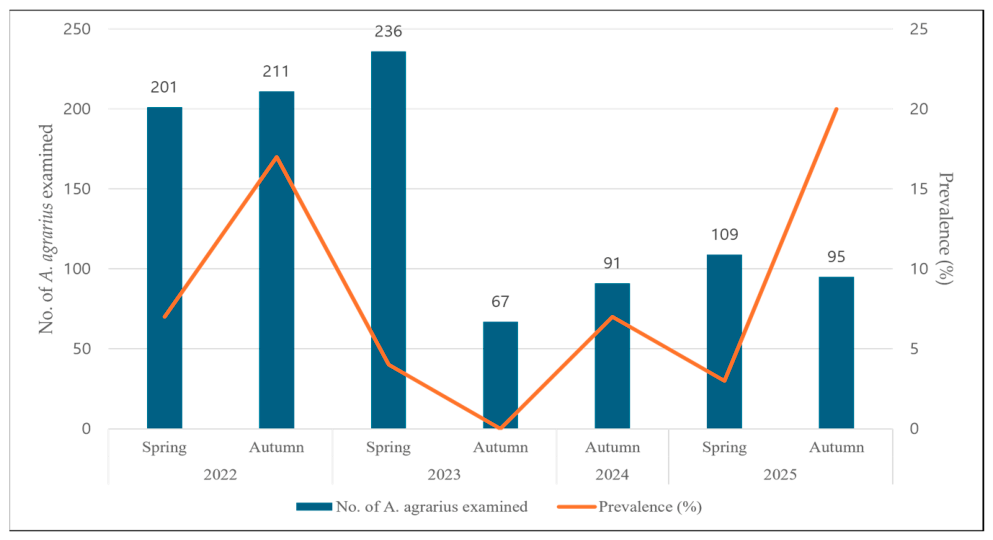
Wild micromammals, such as mice and shrews, can harbor Trypanosoma parasites, some of which have potential relevance to animal and human health. However, nationwide information on rodent-associated Trypanosoma species in the Republic of Korea remains limited. In this study, molecular methods were used to examine 1169 wild micromammals collected from 18 sites between 2022 and 2025. Trypanosoma spp. were detected in 58 animals, all of which were Apodemus agrarius (striped field mice). Trypanosoma grosi was the predominant species, whereas a single T. lewisi-like genotype was detected, representing the first molecular evidence of such a genotype in a wild micromammal in the Republic of Korea. Observed prevalence varied among years, and prevalence was higher in autumn than in spring; however, these differences should be interpreted cautiously because the sampling design was not fully uniform across the study period. These findings provide baseline information for continued wildlife surveillance and future studies of rodent-associated trypanosomes.
Abstract
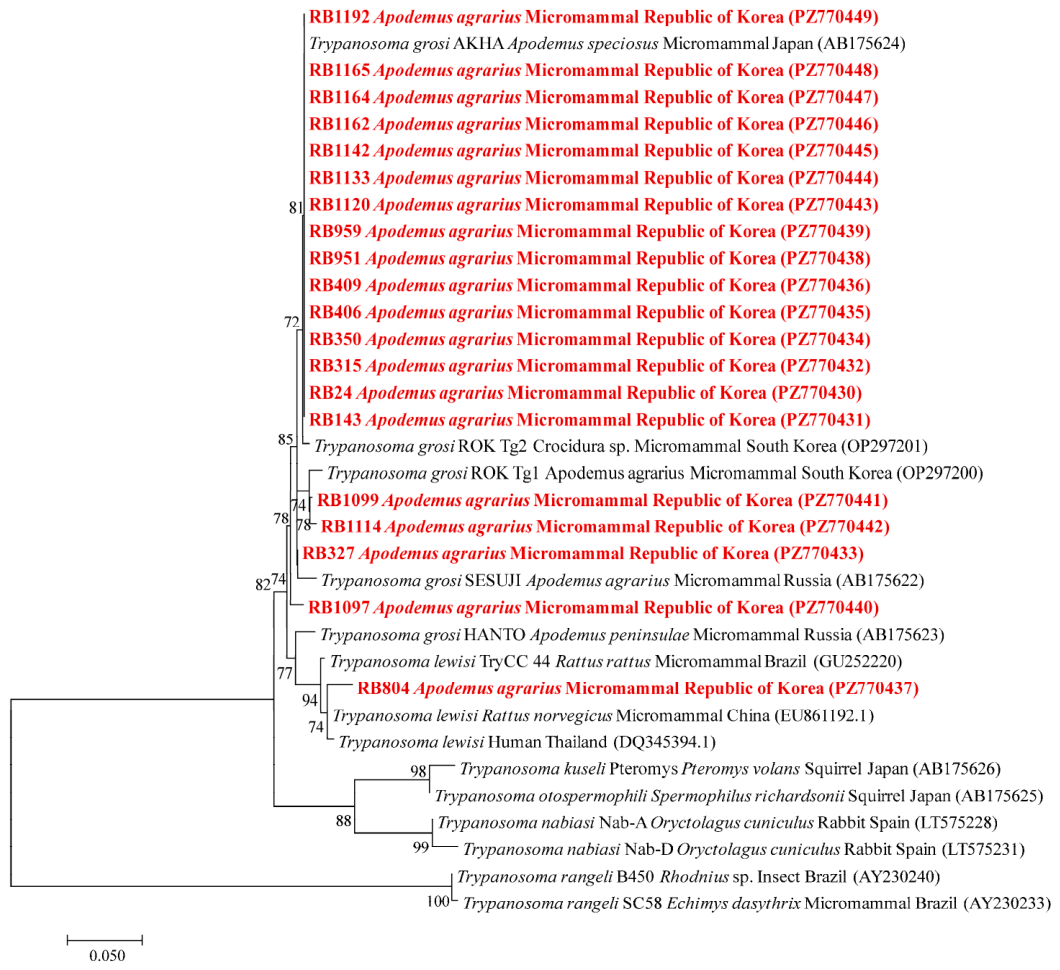
Rodent-associated Trypanosoma spp. are widely distributed in wild rodents, but their epidemiology in the Republic of Korea remains incompletely characterized. This study investigated the prevalence, spatiotemporal distribution, and genetic characteristics of Trypanosoma spp. in 1169 wild micromammals representing 12 taxa, including 1010 Apodemus agrarius, collected from 18 sites across the Republic of Korea between 2022 and 2025 using molecular methods. Trypanosoma spp. DNA was detected in 58 (5.7%) Apodemus agrarius; all other micromammal species examined were negative. Fifty-seven samples were identified as T. grosi and one sequence was designated as a T. lewisi-like genotype. No significant regional differences in prevalence were observed. Annual prevalence estimates were presented descriptively because the seasonal and geographic composition of sampling differed among study years. When the seasonal comparison was restricted to 2022, 2023, and 2025, prevalence was significantly higher in autumn than in spring. The single T. lewisi-like genotype showed 98.5–99.7% nucleotide identity with reference T. lewisi sequences and clustered within the T. lewisi clade. Because species assignment was based on a single genetic marker, the sequence was conservatively designated as a T. lewisi-like genotype. To the best of our knowledge, this study provides the first molecular evidence of a T. lewisi-like genotype in a wild micromammal in the Republic of Korea. These findings provide updated epidemiological information on rodent-associated Trypanosoma spp. in the Republic of Korea.