Towards the Establishment of a Sea Urchin Sperm Biobank: Key Challenges and Opportunities for the Conservation and Sustainable Aquaculture of Paracentrotus lividus
 , , ,
, , ,  , ,
, ,  , ,
, ,  , and
, and
Simple Summary
Abstract
1. Introduction
2. Literature Search Strategy and Review Methodology
2.1. Platforms and Databases Used for the Literature Search
2.2. Search Terms and Search Strategy
- “Paracentrotus lividus” AND (ecology OR conservation);
- “Paracentrotus lividus” AND (fishery OR aquaculture OR IMTA);
- “Paracentrotus lividus” AND cryopreservation;
- (“germplasm banking” OR biobanking) AND aquatic;
- “Paracentrotus lividus” AND (microbiota OR microbiome OR “microbial community” OR “microbiological quality” OR pathogen* (The asterisk (*) was used as a truncation symbol to retrieve different word variants sharing the same root.) OR “food safety”).
2.3. Inclusion and Exclusion Criteria
2.4. Data Extraction and Synthesis
3. The Sea Urchin, Paracentrotus lividus, as a Key Species in the Mediterranean Ecosystem
4. Decline of Natural Populations and Environmental Pressures
4.1. Overexploitation and Fishing Pressure
4.2. Climate Change and Environmental Stressors
4.3. Pollution and Emerging Contaminants
5. Sustainable Aquaculture of Paracentrotus lividus
5.1. State of the Art of Echinoculture
5.2. Main Production Constraints
5.3. Genetic Selection and Resilience
5.4. Paracentrotus lividus in IMTA Systems
5.5. Microbiological Quality and Host-Associated Microbiota
6. Cryopreservation and Germplasm Biobanks
6.1. Cryopreservation in Aquatic Organisms
6.2. Paracentrotus lividus: Current Status and Challenges in Cryopreservation

| Factor | Main Role in Cryopreservation | Effect on Post-Thaw Quality | Notes/Optimal Range (If Available) | Reference |
|---|---|---|---|---|
| Extender composition | Osmotic balance, enzymatic inhibition, ROS protection | Influences sperm survival and functionality | Saline solutions or seawater-based extenders | [96,97,98,99] |
| Cryoprotectant type | Prevents intracellular ice formation | Balances protection vs. toxicity | DMSO and methanol are the most effective | [96,100,104] |
| Cryoprotectant concentration | Controls toxicity and permeability | High doses increase toxicity; low doses reduce protection | e.g., 7% DMSO commonly used | [97,104] |
| Dilution ratio | Sperm-CPA-extender balance | Influences final sperm density and survival | Highly variable among protocols | [104] |
| Equilibration time | CPA penetration into cells | Too short: insufficient protection; too long: toxicity | ~10 min commonly used (4–18 °C) | [104] |
| Cooling rate | Ice crystal formation vs. dehydration | Slow: dehydration; fast: intracellular ice | Optimal ~20 °C min−1 | [104] |
| Container type | Thermal conductivity and uniformity | Affects freezing consistency | Straws vs. 2 mL tubes | [104] |
| Warming rate | Recrystallization control | Rapid thawing generally improves survival | Often underestimated parameter | [104,109] |
6.3. Germplasm Biobanks
Challenges for Cryobanking in Sea Urchins
6.4. From Germplasm Biobanks to Conservation Aquaculture
6.5. An Integrated Sustainability Framework: The AVATIM Project
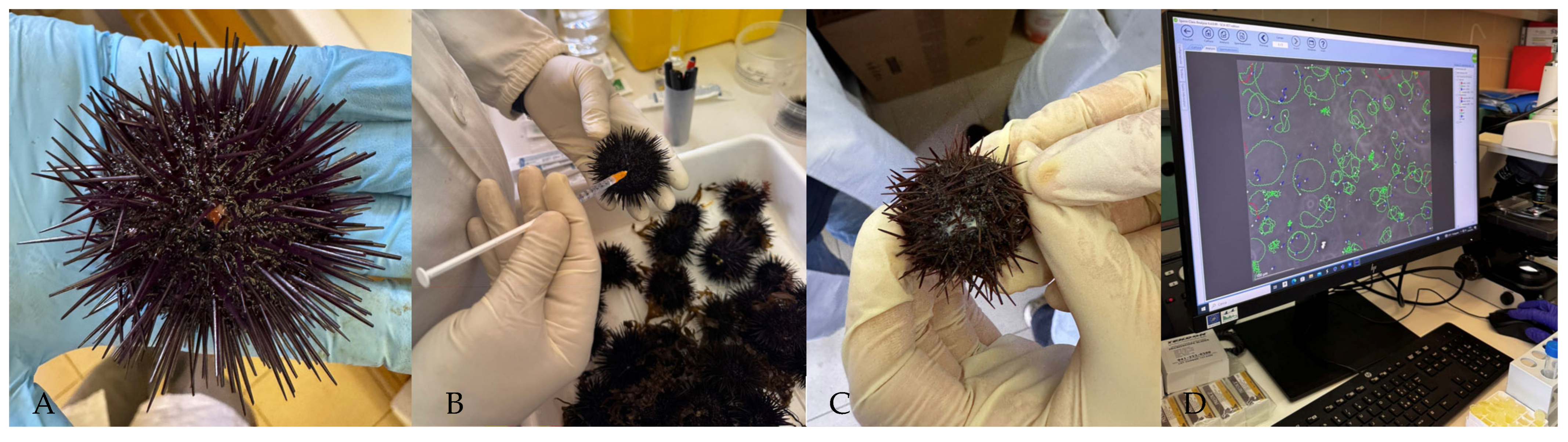
7. Preliminary AVATIM Case Study: Baseline Sperm Quality Assessment for Future Germplasm Biobanking
7.1. Case-Study Framework and Sperm Quality Assessment
7.2. Baseline Sperm Quality of Paracentrotus lividus
7.3. Physiological Basis of Sperm Motility in Sea Urchins
7.4. Sperm Viability and Implications for Cryopreservation
8. Future Perspectives
9. Conclusions
Author Contributions
Funding
Institutional Review Board Statement
Informed Consent Statement
Data Availability Statement
Acknowledgments
Conflicts of Interest
References
- FAO. The State of World Fisheries and Aquaculture 2026: Blue Transformation: Turning Vision into Impact; FAO: Rome, Italy, 2026. [Google Scholar]
- Cunha, J.; Elliott, M.; Villasante, S.; Balbi, S.; Cabecinha, E.; Ramos, S. Assessing cumulative risks to coastal and marine habitats under management and climate change scenarios: The case of northern Portugal. Ocean Coast. Manag. 2025, 268, 107756. [Google Scholar] [CrossRef] [Scilit]
- Kallio, N.; Andersen, J.H.; Carstensen, J.; Gissi, E.; Halpern, B.S.; Hammar, L.; Murray, C.; Stelzenmüller, V.; Stock, A.; Korpinen, S. Challenges in expert ratings of marine habitat and species sensitivity to anthropogenic pressures. Sci. Rep. 2025, 15, 12546. [Google Scholar] [CrossRef] [Scilit] [PubMed]
- Kabaklarlı, E.; Ayvaz, Z.; Petrova, M.; Kotsev, I.; Kyriazi, Z. Economic, innovation and finance perspectives of sustainable blue economy: A focus on fisheries and aquaculture. In Handbook of Sustainable Blue Economy; Springer Nature: Cham, Switzerland, 2026; pp. 1–36. [Google Scholar]
- Toso, A.; Necci, F.; Martines, A.; Lacorte, R.; Toso, Y.; Gianguzza, P.; Deidun, A.; Ungaro, N.; Costantino, G.; Caforio, M. Overfishing and sea warming drive the collapse of Paracentrotus lividus. Sci. Rep. 2025, 15, 18733. [Google Scholar] [CrossRef] [Scilit] [PubMed]
- Chopin, T. Integrated multi-trophic aquaculture–ancient, adaptable concept focuses on ecological integration. Glob. Aquacult. Advocate 2013, 16, 16–19. [Google Scholar]
- Rusco, G.; Roncarati, A.; Di Iorio, M.; Cariglia, M.; Longo, C.; Iaffaldano, N. Can IMTA system improve the productivity and quality traits of aquatic organisms produced at different trophic levels? The benefits of IMTA—Not only for the ecosystem. Biology 2024, 13, 946. [Google Scholar] [CrossRef] [Scilit] [PubMed]
- Lucente, D.; Carolsfeld, J.; Tiersch, T.; Cabrita, E.; Felix, F.; Beirão, J.; Adams, S.L.; Vignier, J.; Yang, H.; Menendez, C.R. Aquaculture Development: Guidelines for Ex Situ In Vitro Gene Banking of Aquatic Genetic Resources; FAO Technical Guidelines for Responsible Fisheries, No. 5 Suppl. 13; Food and Agriculture Organization of the United Nations (FAO): Rome, Italy, 2026. [Google Scholar]
- Martínez-Páramo, S.; Horváth, Á.; Labbé, C.; Zhang, T.; Robles, V.; Herráez, P.; Suquet, M.; Adams, S.; Viveiros, A.; Tiersch, T.R. Cryobanking of aquatic species. Aquaculture 2017, 472, 156–177. [Google Scholar] [CrossRef] [Scilit] [PubMed]
- World Echinoidea Database. Available online: https://www.marinespecies.org/echinoidea (accessed on 12 June 2026).
- Mongiardino Koch, N.; Coppard, S.E.; Lessios, H.A.; Briggs, D.E.; Mooi, R.; Rouse, G.W. A phylogenomic resolution of the sea urchin tree of life. BMC Evol. Biol. 2018, 18, 189. [Google Scholar] [CrossRef] [Scilit] [PubMed]
- Boudouresque, C.F.; Verlaque, M. Ecology of Paracentrotus lividus. In Developments in Aquaculture and Fisheries Science; Elsevier: Amsterdam, The Netherlands, 2007; Volume 37, pp. 243–285. [Google Scholar]
- Bonaviri, C.; Agnetta, D.; Pinna, S.; Piazzi, L.; Badalamenti, F.; Ceccherelli, G.; Iaciofano, D.; Lorenzo, M.D.; Trapani, F.D.; Brutto, S.L. Benthic megafauna and the functioning of macroalgal forests and urchin barrens. Oikos 2026, 2026, e11604. [Google Scholar] [CrossRef] [Scilit]
- Lawrence, J.M. Sea Urchins: Biology and Ecology, 3rd ed.; Elsevier: Amsterdam, The Netherlands, 2013; Volume 38. [Google Scholar]
- Steneck, R.S.; Graham, M.H.; Bourque, B.J.; Corbett, D.; Erlandson, J.M.; Estes, J.A.; Tegner, M.J. Kelp forest ecosystems: Biodiversity, stability, resilience and future. Environ. Conserv. 2002, 29, 436–459. [Google Scholar] [CrossRef] [Scilit]
- Farina, S.; Ceccherelli, G.; Piazzi, L.; Grech, D.; Panzalis, P.; Navone, A.G.; Guala, I. Protection effectiveness and sea urchin predation risk: The role of roving predators beyond the boundaries of a marine protected area in the Western Mediterranean Sea. Aquat. Conserv. Mar. Freshw. Ecosyst. 2022, 32, 1101–1114. [Google Scholar] [CrossRef] [Scilit]
- Filbee-Dexter, K.; Scheibling, R.E. Sea urchin barrens as alternative stable states of collapsed kelp ecosystems. Mar. Ecol. Prog. Ser. 2014, 495, 1–25. [Google Scholar] [CrossRef] [Scilit]
- Ling, S.; Scheibling, R.; Rassweiler, A.; Johnson, C.; Shears, N.; Connell, S.D.; Salomon, A.; Norderhaug, K.; Pérez-Matus, A.; Hernández, J. Global regime shift dynamics of catastrophic sea urchin overgrazing. Phil. Trans. R. Soc. B 2015, 370, 20130269. [Google Scholar] [CrossRef] [Scilit]
- Micheli, F.; Benedetti-Cecchi, L.; Gambaccini, S.; Bertocci, I.; Borsini, C.; Osio, G.C.; Romano, F. Cascading human impacts, marine protected areas, and the structure of Mediterranean reef assemblages. Ecol. Monogr. 2005, 75, 81–102. [Google Scholar] [CrossRef] [Scilit]
- Boudouresque, C.-F.; Blanfuné, A.; Pergent, G.; Thibaut, T. Restoration of seagrass meadows in the Mediterranean Sea: A critical review of effectiveness and ethical issues. Water 2021, 13, 1034. [Google Scholar] [CrossRef] [Scilit]
- Winkelmann, C.; Hellmann, C.; Worischka, S.; Petzoldt, T.; Benndorf, J. Fish predation affects the structure of a benthic community. Freshw. Biol. 2011, 56, 1030–1046. [Google Scholar] [CrossRef] [Scilit]
- Farina, S.; Tomas, F.; Prado, P.; Romero, J.; Alcoverro, T. Seagrass meadow structure alters interactions between the sea urchin Paracentrotus lividus and its predators. Mar. Ecol. Prog. Ser. 2009, 377, 131–137. [Google Scholar] [CrossRef] [Scilit]
- Farina, S.; Baroli, M.; Brundu, R.; Conforti, A.; Cucco, A.; De Falco, G.; Guala, I.; Guerzoni, S.; Massaro, G.; Quattrocchi, G. The challenge of managing the commercial harvesting of the sea urchin Paracentrotus lividus: Advanced approaches are required. PeerJ 2020, 8, e10093. [Google Scholar] [CrossRef] [Scilit] [PubMed]
- Sih, A.; Englund, G.; Wooster, D. Emergent impacts of multiple predators on prey. Trends Ecol. Evol. 1998, 13, 350–355. [Google Scholar] [CrossRef] [Scilit] [PubMed]
- Farina, S.; Guala, I.; Oliva, S.; Piazzi, L.; Pires da Silva, R.; Ceccherelli, G. The seagrass effect turned upside down changes the prospective of sea urchin survival and landscape implications. PLoS ONE 2016, 11, e0164294. [Google Scholar] [CrossRef] [Scilit] [PubMed]
- Cebrian, E.; Tamburello, L.; Verdura, J.; Guarnieri, G.; Medrano, A.; Linares, C.; Hereu, B.; Garrabou, J.; Cerrano, C.; Galobart, C. A roadmap for the restoration of Mediterranean macroalgal forests. Front. Mar. Sci. 2021, 8, 709219. [Google Scholar] [CrossRef] [Scilit]
- Nepote, E.; Sacco, D.; Romano, C.; Greco, S.; Danovaro, R. Marine caves as refuge habitats for the edible sea urchin Paracentrotus lividus (Lamarck, 1816) in the Mediterranean Sea. Estuar. Coast. Shelf Sci. 2026, 338, 109953. [Google Scholar] [CrossRef] [Scilit]
- Stefánsson, G.; Kristinsson, H.; Ziemer, N.; Hannon, C.; James, P. Markets for sea urchins: A review of global supply and markets. Skýrsla Matís 2017, 45, 10–17. [Google Scholar]
- FAO. FishStat: Global Aquaculture Production 1950–2023; Fisheries and Aquaculture Division: Rome, Italy, 2025; Available online: https://www.fao.org/fishery/statistics-query/en?dataset=aquaculture×eries=aquaculture_quantity (accessed on 14 July 2026).
- Guidetti, P. Consumers of sea urchins, Paracentrotus lividus and Arbacia lixula, in shallow Mediterranean rocky reefs. Helgol. Mar. Res. 2004, 58, 110–116. [Google Scholar] [CrossRef] [Scilit]
- Ciriminna, L.; Rakaj, A.; Grosso, L.; Pensa, D.; Fianchini, A.; Mazzola, A.; Vizzini, S. Evaluation of sustainable feeds for “caviar” production in the Mediterranean sea urchin Paracentrotus lividus (Lamarck, 1816). Aquac. Rep. 2024, 35, 102017. [Google Scholar] [CrossRef] [Scilit]
- Gianguzza, P.; Bonaviri, C.; Guidetti, P. Crushing predation of the spiny star Marthasterias glacialis upon the sea urchin Paracentrotus lividus. Mar. Biol. 2009, 156, 1083–1086. [Google Scholar] [CrossRef] [Scilit]
- Pais, A.; Chessa, L.A.; Serra, S.; Ruiu, A.; Meloni, G.; Donno, Y. The impact of commercial and recreational harvesting for Paracentrotus lividus on shallow rocky reef sea urchin communities in North-western Sardinia, Italy. Estuar. Coast. Shelf Sci. 2007, 73, 589–597. [Google Scholar] [CrossRef] [Scilit]
- Scherpiani, L.; Rea, S. Illegal, Unreported, and Unregulated (IUU) Fishing: Impacts, Costs, and Countermeasures; Nova Science Publishers, Inc.: New York, NY, USA, 2024; pp. 1–152. [Google Scholar]
- Yeruham, E.; Rilov, G.; Shpigel, M.; Abelson, A. Collapse of the echinoid Paracentrotus lividus populations in the Eastern Mediterranean—Result of climate change? Sci. Rep. 2015, 5, 13479. [Google Scholar] [CrossRef] [Scilit] [PubMed]
- Benedetti-Cecchi, L.; Cinelli, F. Habitat heterogeneity, sea urchin grazing and the distribution of algae in littoral rock pools on the west coast of Italy (western Mediterranean). Mar. Ecol. Prog. Ser. 1995, 126, 203–212. [Google Scholar] [CrossRef] [Scilit]
- Clemente, S.; Hernández, J. Influence of wave exposure and habitat complexity in determining spatial variation of the sea urchin Diadema aff. antillarum (Echinoidea: Diadematidae) populations and macro algal cover (Canary Islands-Eastern Atlantic Ocean). Rev. Biol. Trop. 2008, 56, 229–254. [Google Scholar]
- Hereu, B.; Linares, C.; Sala, E.; Garrabou, J.; Garcia-Rubies, A.; Diaz, D.; Zabala, M. Multiple processes regulate long-term population dynamics of sea urchins on Mediterranean rocky reefs. PLoS ONE 2012, 7, e36901. [Google Scholar] [CrossRef] [Scilit] [PubMed]
- Girad, D.; Hernández, J.C. Environmental drivers of Paracentrotus lividus populations in the Canary Islands: A multi-scale analysis. J. Mar. Biol. Assoc. U. K. 2026, 106, e26. [Google Scholar] [CrossRef] [Scilit]
- Ouréns, R.; Fernández, L.; Freire, J. Geographic, population, and seasonal patterns in the reproductive parameters of the sea urchin Paracentrotus lividus. Mar. Biol. 2011, 158, 793–804. [Google Scholar] [CrossRef] [Scilit]
- Vergés, A.; Steinberg, P.D.; Hay, M.E.; Poore, A.G.; Campbell, A.H.; Ballesteros, E.; Heck, K.L., Jr.; Booth, D.J.; Coleman, M.A.; Feary, D.A. The tropicalization of temperate marine ecosystems: Climate-mediated changes in herbivory and community phase shifts. Proc. R. Soc. B 2014, 281, 20140846. [Google Scholar] [CrossRef] [Scilit] [PubMed]
- Wernberg, T.; Bennett, S.; Babcock, R.C.; De Bettignies, T.; Cure, K.; Depczynski, M.; Dufois, F.; Fromont, J.; Fulton, C.J.; Hovey, R.K. Climate-driven regime shift of a temperate marine ecosystem. Science 2016, 353, 169–172. [Google Scholar] [CrossRef] [Scilit] [PubMed]
- Francour, P.; Boudouresque, C.-F.; Harmelin, J.; Harmelin-Vivien, M.; Quignard, J. Are the Mediterranean waters becoming warmer? Information from biological indicators. Mar. Pollut. Bull. 1994, 28, 523–526. [Google Scholar] [CrossRef] [Scilit]
- Guidetti, P. Marine reserves reestablish lost predatory interactions and cause community changes in rocky reefs. Ecol. Appl. 2006, 16, 963–976. [Google Scholar] [CrossRef] [Scilit]
- Guidetti, P.; Mori, M. Morpho-functional defences of Mediterranean sea urchins, Paracentrotus lividus and Arbacia lixula, against fish predators. Mar. Biol. 2005, 147, 797–802. [Google Scholar] [CrossRef] [Scilit]
- Guidetti, P.; Dulčić, J. Relationships among predatory fish, sea urchins and barrens in Mediterranean rocky reefs across a latitudinal gradient. Mar. Environ. Res. 2007, 63, 168–184. [Google Scholar] [CrossRef] [Scilit] [PubMed]
- Ruocco, N.; Bertocci, I.; Munari, M.; Musco, L.; Caramiello, D.; Danovaro, R.; Zupo, V.; Costantini, M. Morphological and molecular responses of the sea urchin Paracentrotus lividus to highly contaminated marine sediments: The case study of Bagnoli-Coroglio brownfield (Mediterranean Sea). Mar. Environ. Res. 2020, 154, 104865. [Google Scholar] [CrossRef] [Scilit] [PubMed]
- Rocha, A.C.; Camacho, C.; Eljarrat, E.; Peris, A.; Aminot, Y.; Readman, J.W.; Boti, V.; Nannou, C.; Marques, A.; Nunes, M.L. Bioaccumulation of persistent and emerging pollutants in wild sea urchin Paracentrotus lividus. Environ. Res. 2018, 161, 354–363. [Google Scholar] [CrossRef] [Scilit] [PubMed]
- Morroni, L.; Pinsino, A.; Pellegrini, D.; Regoli, F. Reversibility of trace metals effects on sea urchin embryonic development. Ecotoxicol. Environ. Saf. 2018, 148, 923–929. [Google Scholar] [CrossRef] [Scilit]
- Mason, V.G.; Skov, M.W.; Hiddink, J.G.; Walton, M. Microplastics alter multiple biological processes of marine benthic fauna. Sci. Total Environ. 2022, 845, 157362. [Google Scholar] [CrossRef] [Scilit] [PubMed]
- Mottola, F.; Carannante, M.; Barretta, A.; Palmieri, I.; Rocco, L. Reproductive cytotoxic and genotoxic impact of polystyrene microplastic on Paracentrotus lividus spermatozoa. Curr. Res. Toxicol. 2024, 6, 100173. [Google Scholar] [CrossRef] [Scilit] [PubMed]
- Costa, D.; Bordalo, D.; Cunha, M.; Soares, A.M.; Carvalho, S.; Freitas, R. First Evidence of Climate-Driven Modulation of Octinoxate Toxicity in the Sea Urchin Paracentrotus lividus. Mar. Environ. Res. 2026, 215, 107847. [Google Scholar] [CrossRef] [Scilit] [PubMed]
- Bertucci, J.I.; Bellas, J. Combined effect of microplastics and global warming factors on early growth and development of the sea urchin (Paracentrotus lividus). Sci. Total Environ. 2021, 782, 146888. [Google Scholar] [CrossRef] [Scilit] [PubMed]
- Federico, S.; Glaviano, F.; Esposito, R.; Pinto, B.; Gharbi, M.; Di Cosmo, A.; Costantini, M.; Zupo, V. Gene expression detects the factors influencing the reproductive success and the survival rates of Paracentrotus lividus offspring. Int. J. Mol. Sci. 2022, 23, 12790. [Google Scholar] [CrossRef] [Scilit] [PubMed]
- Di Crescenzo, S.; Pani, C.; Pasquini, V.; Maxia, M.; Addis, P.; Cannas, R. The More the Better: Genetic Monitoring of Paracentrotus lividus (Lamarck, 1816) Experimental Restockings in Sardinia (Western Mediterranean Sea). Animals 2025, 15, 554. [Google Scholar] [CrossRef] [Scilit] [PubMed]
- Thangappan, A.K.T.; Ayyathurai, K.; Singh, R.K.; Mohindra, V.; Lal, K.K. Biobank and genetic conservation of aquatic resources. In Frontiers in Aquaculture Biotechnology; Elsevier: London, UK, 2023; pp. 275–280. [Google Scholar]
- Cook, E.; Kelly, M. Enhanced production of the sea urchin Paracentrotus lividus in integrated open-water cultivation with Atlantic salmon Salmo salar. Aquaculture 2007, 273, 573–585. [Google Scholar] [CrossRef] [Scilit]
- Liu, H.; Kelly, M.S.; Cook, E.J.; Black, K.; Orr, H.; Zhu, J.X.; Dong, S.L. The effect of diet type on growth and fatty-acid composition of sea urchin larvae, I. Paracentrotus lividus (Lamarck, 1816) (Echinodermata). Aquaculture 2007, 264, 247–262. [Google Scholar] [CrossRef] [Scilit]
- Manzo, S. Sea urchin embryotoxicity test: Proposal for a simplified bioassay. Ecotoxicol. Environ. Saf. 2004, 57, 123–128. [Google Scholar] [CrossRef] [Scilit] [PubMed]
- Miroglio, R.; Soro, P.; Zanetti, L.; Castellano, L.; Perez, N.; Carlig, E.; Faimali, M.; Gambardella, C. Rearing Sea Urchins to Promote ‘Ready-to-Spawn’Conditions for Ecotoxicological Surveys. Toxics 2025, 13, 705. [Google Scholar] [CrossRef] [Scilit] [PubMed]
- Dhert, P.; Rombaut, G.; Suantika, G.; Sorgeloos, P. Advancement of rotifer culture and manipulation techniques in Europe. Aquaculture 2001, 200, 129–146. [Google Scholar] [CrossRef] [Scilit]
- Sartori, D.; Scuderi, A.; Sansone, G.; Gaion, A. Echinoculture: The rearing of Paracentrotus lividus in a recirculating aquaculture system—Experiments of artificial diets for the maintenance of sexual maturation. Aquac. Int. 2015, 23, 111–125. [Google Scholar] [CrossRef] [Scilit]
- Carboni, S.; Kelly, M.S.; Hughes, A.D.; Vignier, J.; Atack, T.; Migaud, H. Evaluation of flow through culture technique for commercial production of sea urchin (Paracentrotus lividus) larvae. Aquac. Res. 2014, 45, 768–772. [Google Scholar] [CrossRef] [Scilit]
- Pilnick, A.R.; O’Neil, K.L.; Moe, M.; Patterson, J.T. A novel system for intensive Diadema antillarum propagation as a step towards population enhancement. Sci. Rep. 2021, 11, 11244. [Google Scholar] [CrossRef] [Scilit] [PubMed]
- Kelly, M. Sea urchin aquaculture: A review and outlook. In Echinoderms; Taylor & Francis Group: London, UK, 2004; pp. 283–289. [Google Scholar]
- Lourenco, S.; Jose, R.; Andrade, C.; Valente, L.M. Growth performance and gonad yield of sea urchin Paracentrotus lividus (Lamarck, 1816) fed with diets of increasing protein: Energy ratios. Anim. Feed Sci. Technol. 2020, 270, 114690. [Google Scholar] [CrossRef] [Scilit]
- Pearce, C.M.; Daggett, T.L.; Robinson, S.M. Effect of urchin size and diet on gonad yield and quality in the green sea urchin (Strongylocentrotus droebachiensis). Aquaculture 2004, 233, 337–367. [Google Scholar] [CrossRef] [Scilit]
- Araújo, J.; Loureiro, P.; Candeias-Mendes, A.; Gamboa, A.; Bandarra, N.; Cardoso, C.; Soares, F.; Dias, J.; Pousão-Ferreira, P. The effect of a formulated feed on the body growth and gonads quality of purple sea urchin (Paracentrotus lividus) aquaculture produced. Aquaculture 2022, 560, 738477. [Google Scholar]
- Shpigel, M.; Shauli, L.; Odintsov, V.; Ben-Ezra, D.; Neori, A.; Guttman, L. The sea urchin, Paracentrotus lividus, in an Integrated Multi-Trophic Aquaculture (IMTA) system with fish (Sparus aurata) and seaweed (Ulva lactuca): Nitrogen partitioning and proportional configurations. Aquaculture 2018, 490, 260–269. [Google Scholar] [CrossRef] [Scilit]
- Chang, Y.; Zhang, W.; Zhao, C.; Song, J. Estimates of heritabilities and genetic correlations for growth and gonad traits in the sea urchin Strongylocentrotus intermedius. Aquac. Res. 2012, 43, 271–280. [Google Scholar] [CrossRef] [Scilit]
- Liu, X.-l.; Chang, Y.-q.; Xiang, J.-h.; Cao, X.-b. Estimates of genetic parameters for growth traits of the sea urchin, Strongylocentrotus intermedius. Aquaculture 2005, 243, 27–32. [Google Scholar] [CrossRef] [Scilit]
- Chang, Y.; Tian, X.; Zhang, W.; Han, F.; Chen, S.; Zhou, M.; Pang, Z.; Qi, S.; Feng, W. Family growth and survival response to two simulated water temperature environments in the sea urchin Strongylocentrotus intermedius. Int. J. Mol. Sci. 2016, 17, 1356. [Google Scholar] [CrossRef] [Scilit] [PubMed]
- Grosso, L.; Rakaj, A.; Fianchini, A.; Morroni, L.; Cataudella, S.; Scardi, M. Integrated Multi-Trophic Aquaculture (IMTA) system combining the sea urchin Paracentrotus lividus, as primary species, and the sea cucumber Holothuria tubulosa as extractive species. Aquaculture 2021, 534, 736268. [Google Scholar] [CrossRef] [Scilit]
- Wang, C.; Guo, Y.; Gu, X.; Elisee, N.; Jiang, B.; Zhao, B. Water Quality and Sediment Microbial Community Differences Between Sea Urchin Monoculture and Sea Urchin–Shrimp IMTA Systems. Water 2026, 18, 268. [Google Scholar] [CrossRef] [Scilit]
- Santos, P.M.; Costa, J.L.; Neves, M.; Mota, A.; Pombo, A. Sea urchin and polychaete integration in IMTA as a model for sustainable waste valorisation. Aquaculture 2026, 615, 743630. [Google Scholar] [CrossRef] [Scilit]
- Arranz, V.; Schmütsch-Molina, L.; Fernandez-Vilert, R.; Hernández, J.C.; Pérez-Portela, R. Sea urchin holobionts: Microbiome variation across species, compartments and locations in Paracentrotus lividus and Arbacia lixula. Front. Mar. Sci. 2025, 12, 1615711. [Google Scholar] [CrossRef] [Scilit]
- Faddetta, T.; Ardizzone, F.; Faillaci, F.; Reina, C.; Palazzotto, E.; Strati, F.; De Filippo, C.; Spinelli, G.; Puglia, A.M.; Gallo, G. Composition and geographic variation of the bacterial microbiota associated with the coelomic fluid of the sea urchin Paracentrotus lividus. Sci. Rep. 2020, 10, 21443. [Google Scholar] [CrossRef] [Scilit] [PubMed]
- Pani, S.M.; Coroneo, V.; Pasquini, V.; Sanna, A.; Addis, P. Microbiological characterization of a rearing system for the common sea urchin Paracentrotus lividus: A support to technical production regulations redaction and system monitoring. Food Qual. Saf. 2024, 8, fyae012. [Google Scholar] [CrossRef] [Scilit]
- Federico, S.; Glaviano, F.; Esposito, R.; Tentoni, E.; Santoro, P.; Caramiello, D.; Costantini, M.; Zupo, V. The “Bald Disease” of the sea urchin Paracentrotus lividus: Pathogenicity, molecular identification of the causative agent and therapeutic approach. Microorganisms 2023, 11, 763. [Google Scholar] [CrossRef] [Scilit] [PubMed]
- Wang, Z.; Wang, G.; Ge, H.; Zhang, L. Effects of various natural diets on gonad development, roe quality, and intestinal microbiota of the purple sea urchin (Heliocidaris crassispina). Aquac. Nutr. 2025, 2025, 3196037. [Google Scholar] [CrossRef] [Scilit] [PubMed]
- Iaffaldano, N.; Reale, A.; Sorrentino, E.; Coppola, R.; Di Iorio, M.; Rosato, M.P. Risk of Salmonella transmission via cryopreserved semen in turkey flocks. Poult. Sci. 2010, 89, 1975–1980. [Google Scholar] [CrossRef] [Scilit] [PubMed]
- Bell, J.D.; Leber, K.M.; Blankenship, H.L.; Loneragan, N.R.; Masuda, R. A new era for restocking, stock enhancement and sea ranching of coastal fisheries resources. Rev. Fish. Sci. 2008, 16, 1–9. [Google Scholar] [CrossRef] [Scilit]
- Diwan, A.D.; Harke, S.N.; Gopalkrishna; Panche, A.N. Cryobanking of fish and shellfish egg, embryos and larvae: An overview. Front. Mar. Sci. 2020, 7, 251. [Google Scholar] [CrossRef] [Scilit]
- Comizzoli, P.; Holt, W.V. Recent advances and prospects in germplasm preservation of rare and endangered species. In Reproductive Sciences in Animal Conservation: Progress and Prospects; Springer: New York, NY, USA, 2014; Volume 753, pp. 331–356. [Google Scholar]
- Labbé, C.; Robles, V.; Herraez, M. Cryopreservation of gametes for aquaculture and alternative cell sources for genome preservation. In Advances in Aquaculture Hatchery Technology; Elsevier: Cambridge, UK, 2013; pp. 76–116. [Google Scholar]
- Robles, V.; Riesco, M.F.; Psenicka, M.; Saito, T.; Valcarce, D.G.; Cabrita, E.; Herraez, P. Biology of teleost primordial germ cells (PGCs) and spermatogonia: Biotechnological applications. Aquaculture 2017, 472, 4–20. [Google Scholar] [CrossRef] [Scilit]
- Zhang, T.; Liu, X.-H.; Rawson, D.M. Effects of methanol and developmental arrest on chilling injury in zebrafish (Danio rerio) embryos. Theriogenology 2003, 59, 1545–1556. [Google Scholar] [CrossRef] [Scilit] [PubMed]
- Paredes, E.; Heres, P.; Anjos, C.; Cabrita, E. Cryopreservation of marine invertebrates: From sperm to complex larval stages. In Cryopreservation and Freeze-Drying Protocols, 4th ed.; Wolkers, W.F., Oldenhof, H., Eds.; Springer: New York, NY, USA, 2020; pp. 413–425. [Google Scholar]
- Best, B.P. Cryoprotectant toxicity: Facts, issues, and questions. Rejuvenation Res. 2015, 18, 422–436. [Google Scholar] [CrossRef] [Scilit] [PubMed]
- Murray, K.A.; Gibson, M.I. Chemical approaches to cryopreservation. Nat. Rev. Chem. 2022, 6, 579–593. [Google Scholar] [CrossRef] [Scilit] [PubMed]
- Pegg, D.E. Principles of cryopreservation. In Cryopreservation and Freeze-Drying Protocols; Springer: New York, NY, USA, 2014; pp. 3–19. [Google Scholar]
- Yang, H.; Tiersch, T.R. Concepts, History, Principles, and Application of Germplasm Cryopreservation Technology: FA223, 4/2020. EDIS 2020, 2020, 10. [Google Scholar] [CrossRef] [Scilit]
- Bhattacharya, S. Cryoprotectants and their usage in cryopreservation. In Cryopreservation Biotechnology in Biomedical and Biological Sciences; IntechOpen: Riejeka, Croatia, 2018; pp. 7–19. [Google Scholar]
- Campos, S.; Troncoso, J.; Paredes, E. Major challenges in cryopreservation of sea urchin eggs. Cryobiology 2021, 98, 1–4. [Google Scholar] [CrossRef] [Scilit] [PubMed]
- Paredes, E.; Bellas, J. The use of cryopreserved sea urchin embryos (Paracentrotus lividus) in marine quality assessment. Chemosphere 2015, 128, 278–283. [Google Scholar] [CrossRef] [Scilit] [PubMed]
- Gwo, J.C. Cryopreservation of aquatic invertebrate semen: A review. Aquac. Res. 2000, 31, 259–271. [Google Scholar] [CrossRef] [Scilit]
- Suquet, M.; Dreanno, C.; Fauvel, C.; Cosson, J.; Billard, R. Cryopreservation of sperm in marine fish. Aquac. Res. 2000, 31, 231–243. [Google Scholar] [CrossRef] [Scilit]
- Dziewulska, K.; Rzemieniecki, A.; Domagała, J. Motility and energetic status of Atlantic salmon (Salmo salar L.) sperm after refrigerated storage. J. Appl. Ichthyol. 2010, 26, 668–673. [Google Scholar] [CrossRef] [Scilit]
- Martínez-Páramo, S.; Diogo, P.; Dinis, M.; Soares, F.; Sarasquete, C.; Cabrita, E. Effect of two sulfur-containing amino acids, taurine and hypotaurine in European sea bass (Dicentrarchus labrax) sperm cryopreservation. Cryobiology 2013, 66, 333–338. [Google Scholar] [CrossRef] [Scilit] [PubMed]
- Gwo, J.-C.; Chen, C.-W.; Cheng, H.-Y. Semen cryopreservation of small abalone (Haliotis diversicolor supertexa). Theriogenology 2002, 58, 1563–1578. [Google Scholar] [CrossRef] [Scilit] [PubMed]
- Paredes, E.; Campos, S.; Lago, A.; Bueno, T.; Constensoux, J.; Costas, D. Handling, reproducing and cryopreserving five European sea urchins (Echinodermata, Klein, 1778) for biodiversity conservation purposes. Animals 2022, 12, 3161. [Google Scholar] [CrossRef] [Scilit] [PubMed]
- Lee, Y.-A.; Kim, Y.-H.; Kim, B.-J.; Kim, B.-G.; Kim, K.-J.; Auh, J.-H.; Schmidt, J.A.; Ryu, B.-Y. Cryopreservation in trehalose preserves functional capacity of murine spermatogonial stem cells. PLoS ONE 2013, 8, e54889. [Google Scholar] [CrossRef] [Scilit] [PubMed]
- Smith, J.F.; Adams, S.L.; Gale, S.L.; McGowan, L.T.; Tervit, H.R.; Roberts, R.D. Cryopreservation of Greenshell™ mussel (Perna canaliculus) sperm. I. Establishment of freezing protocol. Aquaculture 2012, 334, 199–204. [Google Scholar] [CrossRef] [Scilit]
- Fabbrocini, A.; D’Adamo, R.; Pelosi, S.; Oliveira, L.F.; Silvestri, F.; Sansone, G. Gamete cryobanks for laboratory research: Developing a rapid and easy-to-perform protocol for the cryopreservation of the sea urchin Paracentrotus lividus (Lmk, 1816) spermatozoa. Cryobiology 2014, 69, 149–156. [Google Scholar] [CrossRef] [Scilit] [PubMed]
- Alvarez, M.; Tamayo-Canul, J.; Anel, E.; Boixo, J.; Mata-Campuzano, M.; Martinez-Pastor, F.; Anel, L.; de Paz, P. Sperm concentration at freezing affects post-thaw quality and fertility of ram semen. Theriogenology 2012, 77, 1111–1118. [Google Scholar] [CrossRef] [Scilit] [PubMed]
- Di Iorio, M.; Lauriola, F.; Rusco, G.; Antenucci, E.; Schiavitto, M.; Iaffaldano, N. Cryopreserving rabbit semen: Impact of varying sperm concentrations on quality and the standardization of protocol. Vet. Sci. 2023, 11, 9. [Google Scholar] [CrossRef] [Scilit] [PubMed]
- Iaffaldano, N.; Manchisi, A.; Gambacorta, M.; Di Iorio, M.; Pina Rosato, M. Effect of different sperm concentrations on the post-thaw viability and motility of turkey spermatozoa cryopreserved by the pellet method. Ital. J. Anim. Sci. 2009, 8, 760–762. [Google Scholar] [CrossRef] [Scilit]
- Chao, N.-H.; Liao, I.C. Cryopreservation of finfish and shellfish gametes and embryos. In Reproductive Biotechnology in Finfish Aquaculture; Lee, C.S., Donaldson, E.M., Eds.; Elsevier: Amsterdam, The Netherlands, 2001; pp. 161–189. [Google Scholar]
- Giametta, F.; Perone, C.; Di Iorio, M.; Rusco, G.; Catalano, P.; Iaffaldano, N. A new freezing box for the managing of semen cryopreservation process. Chem. Eng. Trans. 2021, 87, 265–270. [Google Scholar]
- Cartón-García, F.; Riesco, M.F.; Cabrita, E.; Herráez, M.P.; Robles, V. Quantification of lesions in nuclear and mitochondrial genes of Sparus aurata cryopreserved sperm. Aquaculture 2013, 402, 106–112. [Google Scholar] [CrossRef] [Scilit]
- Comizzoli, P. Biobanking efforts and new advances in male fertility preservation for rare and endangered species. Asian J. Androl. 2015, 17, 640–645. [Google Scholar] [CrossRef] [Scilit] [PubMed]
- Comizzoli, P.; Wildt, D.E. Cryobanking biomaterials from wild animal species to conserve genes and biodiversity: Relevance to human biobanking and biomedical research. In Biobanking of Human Biospecimens: Principles and Practice; Hainaut, P., Vaught, J., Pasterk, M., Eds.; Springer International Publishing: Cham, Switzerland, 2017; pp. 217–235. [Google Scholar]
- Groeneveld, L.F.; Gregusson, S.; Guldbrandtsen, B.; Hiemstra, S.J.; Hveem, K.; Kantanen, J.; Lohi, H.; Stroemstedt, L.; Berg, P. Domesticated animal biobanking: Land of opportunity. PLoS Biol. 2016, 14, e1002523. [Google Scholar] [CrossRef] [Scilit] [PubMed]
- Asturiano, J.F.; Cabrita, E.; Horváth, Á. Progress, challenges and perspectives on fish gamete cryopreservation: A mini-review. Gen. Comp. Endocrinol. 2017, 245, 69–76. [Google Scholar] [CrossRef] [Scilit] [PubMed]
- Cabrita, E.; Sarasquete, C.; Martínez-Páramo, S.; Robles, V.; Beirão, J.; Pérez-Cerezales, S.; Herráez, M. Cryopreservation of fish sperm: Applications and perspectives. J. Appl. Ichthyol. 2010, 26, 623–635. [Google Scholar] [CrossRef] [Scilit]
- Mylonas, C.C.; Duncan, N.J.; Asturiano, J.F. Hormonal manipulations for the enhancement of sperm production in cultured fish and evaluation of sperm quality. Aquaculture 2017, 472, 21–44. [Google Scholar] [CrossRef] [Scilit]
- Hvilsom, C.; Brown, A.; Bruford, M.; Berner, J.; Boettcher, P.; Bragg, J.; Calatayud, N.; Costa, M.; Daly, J.; Dulloo, M. IUCN Species Survival Commission Biobanking Guidelines for Conservation Purposes; IUCN Library: Gland, Switzerland, 2025. [Google Scholar]
- Gwo, J.C.; Arnold, C.R. Cryopreservation of Atlantic croaker spermatozoa: Evaluation of morphological changes. J. Exp. Zool. 1992, 264, 444–453. [Google Scholar] [CrossRef] [Scilit] [PubMed]
- Tiersch, T.R. Strategies for commercialization of cryopreserved fish semen. Rev. Bras. Zootec. 2008, 37, 15–19. [Google Scholar] [CrossRef] [Scilit]
- Zupo, V. Sea Urchin Farming in the Mediterranean Sea: The Case of Paracentrotus Lividus; FAO Fisheries and Aquaculture Technical Paper No. 714; Food and Agriculture Organization of the United Nations (FAO): Rome, Italy, 2025. [Google Scholar]
- Sartori, D.; Macchia, S.; Vitiello, V.; Morroni, L.; Onorati, F.; Pellegrini, D. ISPRA, Quaderni–Ricerca Marina n. 11/2017; Macchia S., Sartori, D., Eds.; Roma, Italy, 2017; Volume 60. Available online: https://www.isprambiente.gov.it/files2017/pubblicazioni/quaderni/Quad_RicMar_11_17_Fecondaz_Riccio.pdf (accessed on 12 June 2026).
- Gallego, V.; Asturiano, J. Sperm motility in fish: Technical applications and perspectives through CASA-Mot systems. Reprod. Fertil. Dev. 2018, 30, 820–832. [Google Scholar] [CrossRef] [Scilit] [PubMed]
- Gallego, V.; Pérez, L.; Asturiano, J.; Yoshida, M. Relationship between spermatozoa motility parameters, sperm/egg ratio, and fertilization and hatching rates in pufferfish (Takifugu niphobles). Aquaculture 2013, 416, 238–243. [Google Scholar] [CrossRef] [Scilit]
- Rurangwa, E.; Kime, D.; Ollevier, F.; Nash, J. The measurement of sperm motility and factors affecting sperm quality in cultured fish. Aquaculture 2004, 234, 1–28. [Google Scholar] [CrossRef] [Scilit]
- Gallego, V.; Herranz-Jusdado, J.G.; Rozenfeld, C.; Pérez, L.; Asturiano, J.F. Subjective and objective assessment of fish sperm motility: When the technique and technicians matter. Fish Physiol. Biochem. 2018, 44, 1457–1467. [Google Scholar] [CrossRef] [Scilit] [PubMed]
- Kime, D.; Van Look, K.; McAllister, B.; Huyskens, G.; Rurangwa, E.; Ollevier, F. Computer-assisted sperm analysis (CASA) as a tool for monitoring sperm quality in fish. Comp. Biochem. Physiol. C Toxicol. Pharmacol. 2001, 130, 425–433. [Google Scholar] [CrossRef] [Scilit] [PubMed]
- Wilson-Leedy, J.G.; Ingermann, R.L. Development of a novel CASA system based on open source software for characterization of zebrafish sperm motility parameters. Theriogenology 2007, 67, 661–672. [Google Scholar] [CrossRef] [Scilit] [PubMed]
- Darszon, A.; Labarca, P.; Nishigaki, T.; Espinosa, F. Ion channels in sperm physiology. Physiol. Rev. 1999, 79, 481–510. [Google Scholar] [CrossRef] [Scilit] [PubMed]
- Vacquier, V.D.; Hirohashi, N. Sea urchin spermatozoa. Methods Cell Biol. 2004, 74, 523–544. [Google Scholar] [CrossRef] [Scilit] [PubMed]
- Christen, R.; Schackmann, R.; Shapiro, B. Metabolism of sea urchin sperm. Interrelationships between intracellular pH, ATPase activity, and mitochondrial respiration. J. Biol. Chem. 1983, 258, 5392–5399. [Google Scholar] [CrossRef] [Scilit]
- Christen, R.; Schackmann, R.; Shapiro, B. Ionic regulation of sea urchin sperm motility, metabolism and fertilizing capacity. J. Physiol. 1986, 379, 347–365. [Google Scholar] [CrossRef] [Scilit] [PubMed]
- Neill, A.T.; Vacquier, V.D. Ligands and receptors mediating signal transduction in sea urchin spermatozoa. Reproduction 2004, 127, 141–149. [Google Scholar] [CrossRef] [Scilit] [PubMed][Green Version]
- Kaupp, U.B.; Solzin, J.; Hildebrand, E.; Brown, J.E.; Helbig, A.; Hagen, V.; Beyermann, M.; Pampaloni, F.; Weyand, I. The signal flow and motor response controling chemotaxis of sea urchin sperm. Nat. Cell Biol. 2003, 5, 109–117. [Google Scholar] [CrossRef] [Scilit] [PubMed]
- Wood, C.D.; Nishigaki, T.; Furuta, T.; Baba, S.A.; Darszon, A. Real-time analysis of the role of Ca2+ in flagellar movement and motility in single sea urchin sperm. J. Cell Biol. 2005, 169, 725–731. [Google Scholar] [CrossRef] [Scilit] [PubMed]
- Böhmer, M.; Van, Q.; Weyand, I.; Hagen, V.; Beyermann, M.; Matsumoto, M.; Hoshi, M.; Hildebrand, E.; Kaupp, U.B. Ca2+ spikes in the flagellum control chemotactic behavior of sperm. EMBO J. 2005, 24, 2741. [Google Scholar] [CrossRef] [Scilit] [PubMed]
- Cosson, J. The ionic and osmotic factors controlling motility of fish spermatozoa. Aquac. Int. 2004, 12, 69–85. [Google Scholar] [CrossRef] [Scilit]
- Cosson, J. Frenetic activation of fish spermatozoa flagella entails short-term motility, portending their precocious decadence. J. Fish Biol. 2010, 76, 240–279. [Google Scholar] [CrossRef] [Scilit] [PubMed]
- Cosson, J.; Groison, A.-L.; Suquet, M.; Fauvel, C.; Dreanno, C.; Billard, R. Marine fish spermatozoa: Racing ephemeral swimmers. Reproduction 2008, 136, 277–294. [Google Scholar] [CrossRef] [Scilit] [PubMed]
- Fabbrocini, A.; D’Adamo, R. Motility of sea urchin Paracentrotus lividus spermatozoa in the post-activation phase. Aquac. Res. 2017, 48, 5526–5532. [Google Scholar] [CrossRef] [Scilit]
- Tanga, B.M.; Qamar, A.Y.; Raza, S.; Bang, S.; Fang, X.; Yoon, K.; Cho, J. Semen evaluation: Methodological advancements in sperm quality-specific fertility assessment—A review. Anim. Biosci. 2021, 34, 1253. [Google Scholar] [CrossRef] [Scilit] [PubMed]
- Tapia, J.; Macias-Garcia, B.; Miro-Moran, A.; Ortega-Ferrusola, C.; Salido, G.; Pena, F.; Aparicio, I. The membrane of the mammalian spermatozoa: Much more than an inert envelope. Reprod. Domest. Anim. 2012, 47, 65–75. [Google Scholar] [CrossRef] [Scilit] [PubMed]
- Garner, D.L.; Johnson, L.A. Viability assessment of mammalian sperm using SYBR-14 and propidium iodide. Biol. Reprod. 1995, 53, 276–284. [Google Scholar] [CrossRef] [Scilit] [PubMed]
- Medeiros, C.; Forell, F.; Oliveira, A.; Rodrigues, J. Current status of sperm cryopreservation: Why isn’t it better? Theriogenology 2002, 57, 327–344. [Google Scholar] [CrossRef] [Scilit] [PubMed]
- Watson, P.F. The causes of reduced fertility with cryopreserved semen. Anim. Reprod. Sci. 2000, 60, 481–492. [Google Scholar] [CrossRef] [Scilit] [PubMed]
- Fauvel, C.; Suquet, M.; Cosson, J. Evaluation of fish sperm quality. J. Appl. Ichthyol. 2010, 26, 636–643. [Google Scholar] [CrossRef] [Scilit]
- Scalisi, E.M.; Pecoraro, R.; Salvaggio, A.; Corsaro, A.; Messina, G.; Ignoto, S.; Lombardo, B.M.; Brundo, M.V. Evaluation of dimethoate toxicity on fertilization and on embryonic development of Paracentrotus lividus (Lamarck, 1816). Toxicol. Res. 2020, 9, 537–543. [Google Scholar] [CrossRef] [Scilit] [PubMed]
- Sousa, M.; Azevedo, C. Ultrastructure and silver-staining analysis of spermatogenesis in the sea urchin Paracentrotus lividus (Echinodermata, Echinoidea). J. Morphol. 1988, 195, 177–188. [Google Scholar] [CrossRef] [Scilit] [PubMed]
- Limatola, N.; Chun, J.T.; Santella, L. Species-specific gamete interaction during sea urchin fertilization: Roles of the egg jelly and vitelline layer. Cells 2022, 11, 2984. [Google Scholar] [CrossRef] [Scilit] [PubMed]
- Adams, S.L.; Hessian, P.A.; Mladenov, P.V. Flow cytometric evaluation of mitochondrial function and membrane integrity of marine invertebrate sperm. Invertebr. Reprod. Dev. 2003, 44, 45–51. [Google Scholar] [CrossRef] [Scilit]
- Nynca, J.; Dietrich, G.J.; Liszewska, E.; Judycka, S.; Karol, H.; Dobosz, S.; Krom, J.; Ciereszko, A. Usefulness of a portable flow cytometer for sperm concentration and viability measurements of rainbow trout spermatozoa. Aquaculture 2016, 451, 353–356. [Google Scholar] [CrossRef] [Scilit]
- Rosati, S.; Maiuro, L.; Lombardi, S.J.; Iaffaldano, N.; Di Iorio, M.; Cariglia, M.; Lopez, F.; Cofelice, M.; Tremonte, P.; Sorrentino, E. Integrated biotechnological strategies for the sustainability and quality of Mediterranean Sea bass (Dicentrarchus labrax) and Sea bream (Sparus aurata). Foods 2025, 14, 1020. [Google Scholar] [CrossRef] [Scilit] [PubMed]

| Thematic Area | Search String | Scopus | Web of Science |
|---|---|---|---|
| Ecology and conservation | “Paracentrotus lividus” AND (ecology OR conservation) | 158 | 1827 |
| Fisheries, aquaculture, and IMTA | “Paracentrotus lividus” AND (fishery OR aquaculture OR IMTA) | 174 | 740 |
| Cryopreservation | “Paracentrotus lividus” AND cryopreservation | 16 | 38 |
| Germplasm banking and biobanking | (“germplasm banking” OR biobanking) AND aquatic | 7 | 58 |
| Microbiological quality and microbiota | “Paracentrotus lividus” AND (microbiota OR microbiome OR “microbial community” OR “microbiological quality” OR pathogen* OR “food safety”) | 49 | 54 |
| Bottleneck | Main Consequence | Research Priority | Reference |
|---|---|---|---|
| Slow growth | Long production cycles and high costs | Genetic selection and optimized nutrition | [61,62] |
| Dependence on wild broodstock | Limited sustainability and genetic management | Closing the life cycle in captivity | [63] |
| Larval sensitivity | High mortality and variable juvenile output | Hatchery optimization and microbiome management | [63,64] |
| Feed formulation | Variable gonad quality | Sustainable functional feeds | [65,66,67,68,69] |
| Parameter | Mean Value ± SD |
|---|---|
| Ejaculate volume (mL) | 0.45 ± 0.05 |
| Sperm concentration (×109 sperm mL) | 19.80 ± 3.68 |
| Total motility (%) | 87.70 ± 7.70 |
| Progressive motility (%) | 62.73 ± 17.12 |
| Rapid motility (%) | 58.19 ± 18.89 |
| VCL (μm s−1) | 126.63 ± 30.84 |
| VAP (μm s−1) | 106.26 ± 29.80 |
| VSL (μm s−1) | 78.28 ± 25.44 |
| STR (%) | 69.24 ± 10.55 |
| LIN (%) | 56.73 ± 11.48 |
| WOB (%) | 76.37 ± 7.43 |
| ALH (μm) | 1.76 ± 0.23 |
| BCF (Hz) | 13.62 ± 6.04 |
| Viability (%) | 95.1 ± 1.32 |
Disclaimer/Publisher’s Note: The statements, opinions and data contained in all publications are solely those of the individual author(s) and contributor(s) and not of MDPI and/or the editor(s). MDPI and/or the editor(s) disclaim responsibility for any injury to people or property resulting from any ideas, methods, instructions or products referred to in the content. |
© 2026 by the authors. Licensee MDPI, Basel, Switzerland. This article is an open access article distributed under the terms and conditions of the Creative Commons Attribution (CC BY) license.
Share and Cite
Antenucci, E.; Di Iorio, M.; Santoianni, C.; Mastronardi, A.; Cofelice, M.; Lopez, F.; Rosati, S.; Maiuro, L.; Sorrentino, E.; Carone, G.; et al. Towards the Establishment of a Sea Urchin Sperm Biobank: Key Challenges and Opportunities for the Conservation and Sustainable Aquaculture of Paracentrotus lividus. Animals 2026, 16, 2788. https://doi.org/10.3390/ani16172788
Antenucci E, Di Iorio M, Santoianni C, Mastronardi A, Cofelice M, Lopez F, Rosati S, Maiuro L, Sorrentino E, Carone G, et al. Towards the Establishment of a Sea Urchin Sperm Biobank: Key Challenges and Opportunities for the Conservation and Sustainable Aquaculture of Paracentrotus lividus. Animals. 2026; 16(17):2788. https://doi.org/10.3390/ani16172788
Chicago/Turabian StyleAntenucci, Emanuele, Michele Di Iorio, Celeste Santoianni, Amedea Mastronardi, Martina Cofelice, Francesco Lopez, Sebastiano Rosati, Lucia Maiuro, Elena Sorrentino, Giulia Carone, and et al. 2026. "Towards the Establishment of a Sea Urchin Sperm Biobank: Key Challenges and Opportunities for the Conservation and Sustainable Aquaculture of Paracentrotus lividus" Animals 16, no. 17: 2788. https://doi.org/10.3390/ani16172788
APA StyleAntenucci, E., Di Iorio, M., Santoianni, C., Mastronardi, A., Cofelice, M., Lopez, F., Rosati, S., Maiuro, L., Sorrentino, E., Carone, G., Zizzo, N., Bozkurt, Y., Roncarati, A., & Iaffaldano, N. (2026). Towards the Establishment of a Sea Urchin Sperm Biobank: Key Challenges and Opportunities for the Conservation and Sustainable Aquaculture of Paracentrotus lividus. Animals, 16(17), 2788. https://doi.org/10.3390/ani16172788