Ecological Role of the Common Pheasant (Phasianus colchicus) in Maintaining Tick Populations in Croatia
 , , , , and
Simple Summary
Abstract
1. Introduction
2. Materials and Methods
2.1. Study Area
2.2. Tick Sampling and Identification
2.3. Statistical Analysis
3. Results
4. Discussion
5. Conclusions
Author Contributions
Funding
Institutional Review Board Statement
Informed Consent Statement
Data Availability Statement
Conflicts of Interest
Appendix A

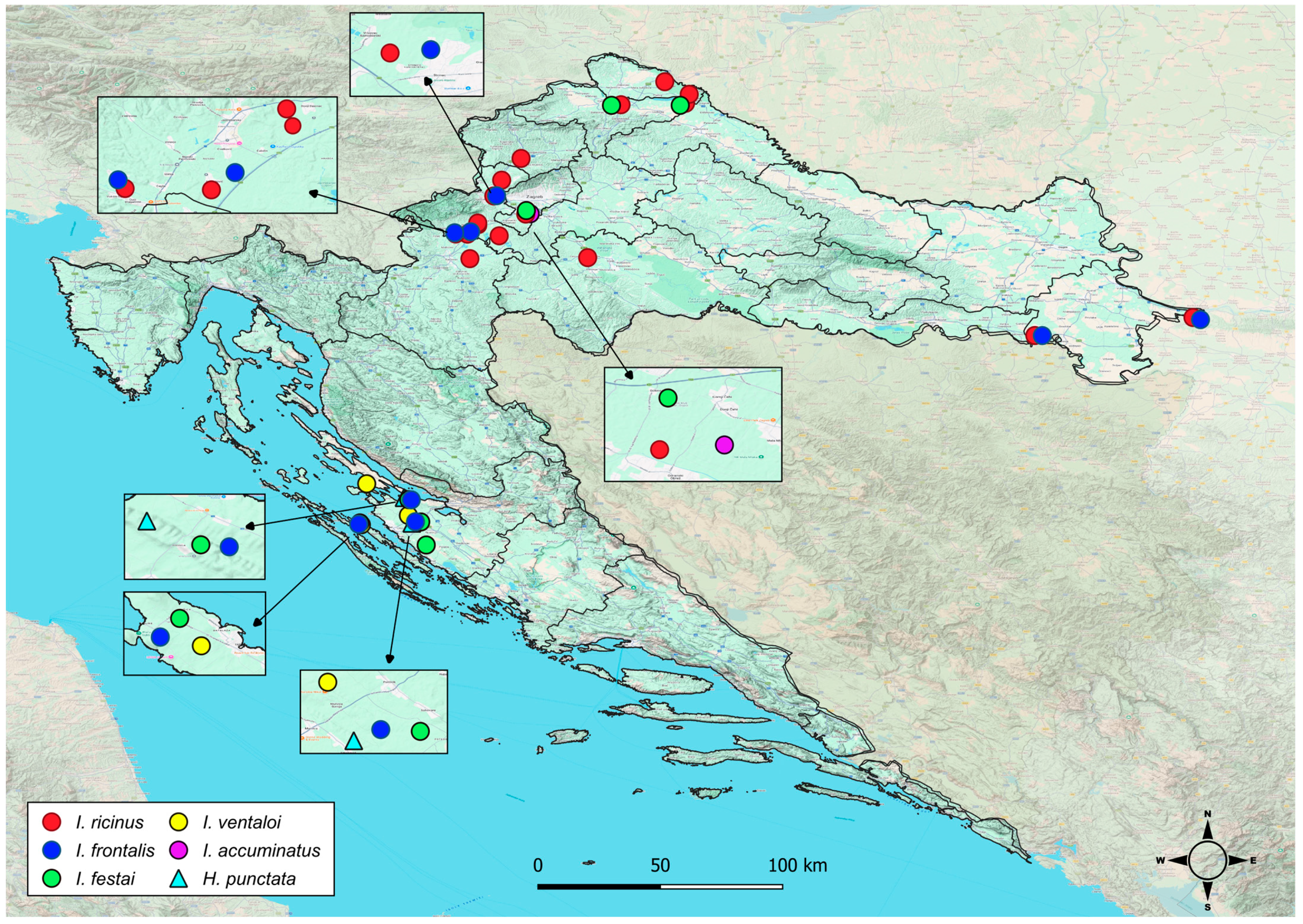
| Locality | GPS Coordinates | Tick Species (Haplotypes) |
|---|---|---|
| Jastrebarsko | 45°40′44.5″ N 15°41′23.2″ E | I. ricinus (H1, H2, H4, H6, H7, H8, H10, H11); I. frontalis (H2, H3) |
| Sveta Nedelja | 45°49′14.2″ N 15°46′29.5″ E | I. ricinus (H1, H2, H6, H7, H8); I. frontalis (H2, H3) |
| Pojatno | 45°53′59.2″ N 15°48′44.9″ E | I. ricinus (H2, H7) |
| Zabok | 46°00′40.8″ N 15°54′43.5″ E | I. ricinus (H8) |
| Bratina | 45°36′50.4″ N 15°47′58.9″ E | I. ricinus (H7) |
| Novi Zagreb | 45°43′29.7″ N 15°57′32.4″ E | I. ricinus (H1, H2, H4, H6, H7, H10); I. accuminatus; I. festai (H3) |
| Hodošan | 46°24′19.6″ N 16°39′01.5″ E | I. ricinus (H2, H7, H8) |
| Dubrava | 46°20′27.4″ N 16°46′34.2″ E | I. ricinus (H6, H8) |
| Mali Bukovec | 46°17′23.6″ N 16°45′00.8″ E | I. ricinus (H6, H7), I. festai (H3) |
| Varaždin | 46°16′41.6″ N 16°24′05.3″ E | I. ricinus (H1, H2, H8), I. festai (H5) |
| Rečica | 45°29′47.3″ N 15°38′57.5″ E | I. ricinus (H1, H2, H4, H7, H8, H10) |
| Mala Gorica | 45°30′06.3″ N 16°15′16.1″ E | I. ricinus (H2, H6, H7) |
| Volavje | 45°37′31.6″ N 15°34′45.6″ E | I. ricinus (H1, H2, H4, H6, H7, H8), I. frontalis (H1) |
| Babina Greda | 45°06′15.0″ N 18°34′03.3″ E | I. ricinus (H1), I. frontalis (H1) |
| Ilok | 45°11′36.6″ N 19°22′46.4″ E | I. ricinus (H1, H2, H4, H6, H7, H8), I. frontalis (H1, H2) |
| Raštane | 44°01′31.6″ N 15°25′29.6″ E | I. festai (H1, H3, H5) |
| Pag | 44°20′24.4″ N 15°07′09.0″ E | I. ventalloi (H2) |
| Ražanac | 44°15′29.5″ N 15°20′06.6″ E | I. festai (H6), I. frontalis (H1, H3), H. punctata |
| Ugljan | 44°07′46.6″ N 15°05′30.7″ E | I. festai (H1, H3, H5), I. ventalloi (H2), I. frontalis (H1) |
| Zadar | 44°08′44.4″ N 15°22′09.0″ E | I. festai (H3, H5, H6), I. frontalis (H1), H. punctata, I. ventalloi (H2) |
References
- BirdLife International. Species Factsheet: Phasianus colchicus. Available online: https://datazone.birdlife.org/species/factsheet/common-pheasant-phasianus-colchicus (accessed on 8 June 2026).
- Keve, G.; Sándor, A.D.; Hornok, S. Hard ticks (Acari: Ixodidae) associated with birds in Europe: Review of literature data. Front. Vet. Sci. 2022, 9, 928756. [Google Scholar] [CrossRef] [Scilit]
- Franke, J.; Moldenhauer, A.; Hildebrandt, A.; Dorn, W. Are birds reservoir hosts for Borrelia afzelii? Ticks Tick-Borne Dis. 2010, 1, 109–112. [Google Scholar] [CrossRef] [Scilit]
- Hornok, S.; Cutajar, B.; Takács, N.; Galea, N.; Attard, D.; Coleiro, C.; Galea, R.; Keve, G.; Sándor, A.D.; Kontschán, J. On the way between Africa and Europe: Molecular taxonomy of ticks collected from birds in Malta. Ticks Tick-Borne Dis. 2022, 13, 102001. [Google Scholar] [CrossRef] [Scilit]
- Hoodless, A.N.; Kurtenbach, K.; Nuttall, P.A.; Randolph, S.E. The impact of ticks on pheasant territoriality. Oikos 2002, 96, 245–250. [Google Scholar] [CrossRef] [Scilit]
- Hoodless, A.N.; Kurtenbach, K.; Nuttall, P.A.; Randolph, S.E. Effects of tick Ixodes ricinus infestation on pheasant (Phasianus colchicus) breeding success and survival. Wildl. Biol. 2003, 9, 171–178. [Google Scholar] [CrossRef] [Scilit]
- Kurtenbach, K.; Carey, D.; Hoodless, A.N.; Nuttall, P.A.; Randolph, S.E. Competence of pheasants as reservoirs for Lyme disease spirochetes. J. Med. Entomol. 1998, 35, 77–81. [Google Scholar] [CrossRef] [Scilit]
- Michels, E.; Hansford, K.; Perkins, S.E.; McDonald, R.A.; Medlock, J.M.; Tschirren, B. The release of non-native gamebirds is associated with amplified zoonotic disease risk. Ecol. Lett. 2025, 28, e70115. [Google Scholar] [CrossRef] [Scilit]
- Dantas-Torres, F.; Chomel, B.B.; Otranto, D. Ticks and tick-borne diseases: A One Health perspective. Trends Parasitol. 2012, 28, 437–446. [Google Scholar] [CrossRef] [Scilit]
- Johnson, N.; Phipps, L.P.; Hansford, K.M.; Folly, A.J.; Fooks, A.R.; Medlock, J.M.; Mansfield, K.L. One Health approach to tick and tick-borne disease surveillance in the United Kingdom. Int. J. Environ. Res. Public Health 2022, 19, 5833. [Google Scholar] [CrossRef] [Scilit]
- Vilibic-Cavlek, T.; Janev-Holcer, N.; Bogdanic, M.; Ferenc, T.; Vujica Ferenc, M.; Krcmar, S.; Savic, V.; Stevanovic, V.; Ilic, M.; Barbic, L. Current status of vector-borne diseases in Croatia: Challenges and future prospects. Life 2023, 13, 1856. [Google Scholar] [CrossRef] [Scilit]
- Krčmar, S.; Vereš, M.; Trilar, T. Fauna of hard ticks (Acari: Ixodidae) in different habitats in the Croatian part of Baranja. Šum. List 2014, 138, 309–313. [Google Scholar]
- Vucelja, M.; Krčmar, S.; Habuš, J.; Perko, V.M.; Boljfetić, M.; Bjedov, L.; Margaletić, J. Altitudinal distribution, seasonal dynamics and Borrelia burgdorferi sensu lato infections in hard ticks (Acari: Ixodidae) in different forest communities in inland Croatia. Sustainability 2023, 15, 4862. [Google Scholar] [CrossRef] [Scilit]
- Vilibic-Cavlek, T.; Krcmar, S.; Bogdanic, M.; Tomljenovic, M.; Barbic, L.; Roncevic, D.; Sabadi, D.; Vucelja, M.; Santini, M.; Hunjak, B.; et al. An overview of tick-borne encephalitis epidemiology in endemic regions of continental Croatia, 2017–2023. Microorganisms 2024, 12, 386. [Google Scholar] [CrossRef] [Scilit]
- Pintur, K.; Beck, R.; Gagović, E.; Dumić, T.; Slijepčević, V.; Fabijanić, N. Preliminary research of tick infestation on pheasants (Phasianus sp.) in the Republic of Croatia. In Proceedings of the Veterinarski dani 2025, Split, Croatia, 7–9 November 2025. [Google Scholar]
- Zaninović, K.; Gajić-Čapka, M.; Perčec Tadić, M.; Vučetić, M.; Milković, J.; Bajić, A.; Cindrić, K.; Cvitan, L.; Katušin, Z.; Kaučić, D.; et al. Klimatski atlas Hrvatske/Climate Atlas of Croatia 1961–1990, 1971–2000; Državni Hidrometeorološki Zavod: Zagreb, Croatia, 2008; pp. 1–200. [Google Scholar]
- Šegota, T.; Filipčić, A. Köppenova podjela klima i hrvatsko nazivlje. Geoadria 2003, 8, 17–37. [Google Scholar] [CrossRef] [Scilit]
- Contini, C.; Palmas, C.; Seu, V.; Stancampiano, L.; Usai, F. Redescription of the male of Ixodes festai Rondelli, 1926 (Ixodida: Ixodidae) on specimens from Sardinia (Italy). Parasite 2011, 18, 235–240. [Google Scholar] [CrossRef] [Scilit]
- Estrada-Peña, A.; Mihalca, A.D.; Petney, T.N. Ticks of Europe and North Africa: A Guide to Species Identification; Springer: Cham, Switzerland, 2017. [Google Scholar] [CrossRef] [Scilit]
- Hornok, S.; Keskin, A.; Uspensky, I.; Kontschán, J.; Takács, N.; Lesiczka, P.; Warbroek, T.; Van Den Bosch, T.J.M.; Keve, G.; Pitó, A.; et al. Updates on subgenus Ixodes in the Mediterranean region: Validity of Ixodes festai Rondelli, 1926, reinstatement of Ixodes tatei Arthur, 1959, and a new species closely related to Ixodes gibbosus Nuttall, 1916. Int. J. Parasitol. 2026, 56, 104732. [Google Scholar] [CrossRef] [Scilit]
- Black, W.C., IV; Piesman, J. Phylogeny of hard- and soft-tick taxa (Acari: Ixodida) based on mitochondrial 16S rDNA sequences. Proc. Natl. Acad. Sci. USA 1994, 91, 10034–10038. [Google Scholar] [CrossRef] [Scilit]
- Bush, A.O.; Lafferty, K.D.; Lotz, J.M.; Shostak, A.W. Parasitology meets ecology on its own terms: Margolis et al. revisited. J. Parasitol. 1997, 83, 575–583. [Google Scholar] [CrossRef] [Scilit]
- Reiczigel, J.; Marozzi, M.; Fábián, I.; Rózsa, L. Biostatistics for parasitologists—A primer to quantitative parasitology. Trends Parasitol. 2019, 35, 277–281. [Google Scholar] [CrossRef] [Scilit]
- Kim, B.-J.; Kim, H.; Won, S.; Kim, H.-C.; Chong, S.-T.; Klein, T.A.; Kim, K.-G.; Seo, H.-Y.; Chae, J.-S. Ticks collected from wild and domestic animals and natural habitats in the Republic of Korea. Korean J. Parasitol. 2014, 52, 281–285. [Google Scholar] [CrossRef] [Scilit]
- Zheng, W.Q.; Xuan, X.N.; Fu, R.L.; Tao, H.Y.; Liu, Y.Q.; Liu, X.Q.; Li, D.M.; Ma, H.M.; Chen, H.Y. Tick-borne pathogens in ixodid ticks from Poyang Lake region, southeastern China. Korean J. Parasitol. 2018, 56, 589–596. [Google Scholar] [CrossRef] [Scilit]
- Jaenson, T.G.T.; Tälleklint, L.; Lundqvist, L.; Olsen, B.; Chirico, J.; Mejlon, H. Geographical distribution, host associations, and vector roles of ticks (Acari: Ixodidae, Argasidae) in Sweden. J. Med. Entomol. 1994, 31, 240–256. [Google Scholar] [CrossRef] [Scilit]
- Krčmar, S. Hard ticks (Acari, Ixodidae) of Croatia. ZooKeys 2012, 234, 19–57. [Google Scholar] [CrossRef] [Scilit]
- Krčmar, S. Diversity, ecology, and seasonality of hard ticks (Acari: Ixodidae) in eastern Croatia. J. Vector Ecol. 2019, 44, 18–29. [Google Scholar] [CrossRef] [Scilit]
- Jurković, D. Genotyping of Ticks and Tick-Borne Pathogens on the Territory of the Republic of Croatia. Ph.D. Dissertation, University of Zagreb, Zagreb, Croatia, 2021. [Google Scholar]
- Kapo, N.; Zuber Bogdanović, I.; Gagović, E.; Žekić, M.; Veinović, G.; Sukara, R.; Mihaljica, D.; Adžić, B.; Kadrijaj, P.; Cvetkovikj, A.; et al. Ixodid ticks and zoonotic tick-borne pathogens of the Western Balkans. Parasit. Vectors 2024, 17, 45. [Google Scholar] [CrossRef] [Scilit]
- Dantas-Torres, F.; Mans, B.J. Ticks (Ixodida: Argasidae, Ixodidae, Khimairidae, and Nuttalliellidae) of the world. Parasit. Vectors 2026, 19, 256. [Google Scholar] [CrossRef] [Scilit]
- Tomassone, L.; Grego, E.; Auricchio, D.; Iori, A.; Giannini, F.; Rambozzi, L. Lyme borreliosis spirochetes and spotted fever group rickettsiae in ixodid ticks from Pianosa Island, Tuscan Archipelago, Italy. Vector-Borne Zoonotic Dis. 2013, 13, 84–91. [Google Scholar] [CrossRef] [Scilit]
- Estrada-Peña, A.; Venzal, J.M.; Nava, S. Redescription, molecular features, and neotype deposition of Rhipicephalus pusillus Gil Collado and Ixodes ventalloi Gil Collado (Acari, Ixodidae). Zootaxa 2018, 4442, 262–276. [Google Scholar] [CrossRef] [Scilit]
- Peňazziová, K.L.; Chitimia-Dobler, L.; Csank, T.; Peťko, B.; Ondrejková, A.; Halán, M.; Schusterová, P.; Pivka, S.; Korytár, Ľ. First detection and a new avian host of the tick Ixodes ventalloi Gil Collado, 1936, in Slovakia. Parasitol. Res. 2024, 123, 268. [Google Scholar] [CrossRef] [Scilit]
- Latrofa, M.S.; Giannelli, A.; Persichetti, M.F.; Pennisi, M.G.; Solano-Gallego, L.; Brianti, E.; Parisi, A.; Wall, R.; Dantas-Torres, F.; Otranto, D. Ixodes ventalloi: Morphological and molecular support for species integrity. Parasitol. Res. 2017, 116, 251–258. [Google Scholar] [CrossRef] [Scilit]
- Estrada-Peña, A.; Lucientes, J.; Castillo, J.A.; Sanchez, A.C.; Galmes, F.M. Alectoris rufa, a new host for Ixodes ventalloi and Ixodes (Pholeoixodes) hexagonus in Spain. Rev. Iber. Parasitol. 1984, 44, 215–216. [Google Scholar]
- Hrazdilova, K.; Danek, O.; Hrbatova, A.; Cervena, B.; Noskova, E.; Adamik, P.; Votypka, J.; Mihalca, A.D.; Noureddine, M.; Modry, D.; et al. Genetic analysis challenges the presence of Ixodes inopinatus in Central Europe: Development of a multiplex PCR to distinguish I. inopinatus from I. ricinus. Parasit. Vectors 2023, 16, 354. [Google Scholar] [CrossRef] [Scilit]
- Estrada-Peña, A.; Zheng, M.; Baede, V.O.; de la Fuente, J.; Sprong, H. What is the status of Ixodes inopinatus (Ixodidae)? Curr. Res. Parasitol. Vector-Borne Dis. 2025, 8, 100306. [Google Scholar] [CrossRef] [Scilit]
- Hughes, V.L.; Randolph, S.E. Testosterone depresses innate and acquired resistance to ticks in natural rodent hosts: A force for aggregated distributions of parasites. J. Parasitol. 2001, 87, 49–54. [Google Scholar] [CrossRef] [Scilit]
- Lindsø, L.K.; Anders, J.L.; Viljugrein, H.; Herland, A.; Stigum, V.M.; Easterday, W.R.; Mysterud, A. Individual heterogeneity in ixodid tick infestation and prevalence of Borrelia burgdorferi sensu lato in a northern community of small mammalian hosts. Oecologia 2023, 203, 421–433. [Google Scholar] [CrossRef] [Scilit]
- Weatherhead, P.J.; Metz, K.J.; Bennett, G.F.; Irwin, R.E. Parasite faunas, testosterone and secondary sexual traits in male red-winged blackbirds. Behav. Ecol. Sociobiol. 1993, 33, 13–23. [Google Scholar] [CrossRef] [Scilit]

| Variable | Examined (n) | Infested (n) | Prevalence % (95% CI) | Mean Intensity (95% CI) | Mean Abundance (95% CI) |
|---|---|---|---|---|---|
| Overall | 255 | 213 | 83.5 (78.5–87.6) | 5.18 (4.54–5.86) | 4.33 (3.74–4.95) |
| Continental Croatia | 234 | 193 | 82.5 (77.1–86.8) | 5.10 (4.42–5.85) | 4.21 (3.59–4.87) |
| Coastal and island Croatia | 21 | 20 | 95.2 (77.3–99.2) | 5.90 (4.15–7.85) | 5.62 (3.90–7.52) |
| Male pheasants | 225 | 193 | 85.8 (80.6–89.7) | 5.46 (4.75–6.22) | 4.68 (4.03–5.38) |
| Female pheasants | 30 | 20 | 66.7 (48.8–80.8) | 2.50 (1.80–3.35) | 1.67 (1.07–2.37) |
| Tick Species | Larvae n (%) | Nymphs n (%) | Adults n (%) | Total n (%) |
|---|---|---|---|---|
| Ixodes ricinus | 78 (8.8) | 802 (90.7) | 4 (0.5) | 884 (80.1) |
| Ixodes frontalis | 90 (68.2) | 30 (22.7) | 12 (9.1) | 132 (12.0) |
| Ixodes festai | 25 (41.0) | 17 (27.9) | 19 (31.1) | 61 (5.5) |
| Ixodes ventalloi | 1 (4.8) | 10 (47.6) | 10 (47.6) | 21 (1.9) |
| Haemaphysalis punctata | 0 (0.0) | 3 (75.0) | 1 (25.0) | 4 (0.4) |
| Ixodes acuminatus | 0 (0.0) | 0 (0.0) | 1 (100.0) | 1 (0.1) |
| Total | 194 (17.6) | 862 (78.2) | 47 (4.3) | 1103 (100.0) |
| Response Variable | Comparison | Test | Statistic | df | p |
|---|---|---|---|---|---|
| Infestation prevalence | Localities | Pearson χ2 | 55.50 | 17 | <0.001 |
| Infestation prevalence | Regions | Pearson χ2 | 2.28 | 1 | 0.131 |
| Infestation prevalence | Sex | Pearson χ2 | 7.03 | 1 | 0.008 |
| Tick abundance | Localities | Kruskal–Wallis (H) | 78.18 | 17 | <0.001 |
| Tick abundance | Regions | Kruskal–Wallis (H) | 4.30 | 1 | 0.038 |
| Tick abundance | Sex | Kruskal–Wallis (H) | 13.46 | 1 | <0.001 |
| Infestation intensity | Localities | Kruskal–Wallis (H) | 76.71 | 17 | <0.001 |
| Infestation intensity | Regions | Kruskal–Wallis (H) | 1.85 | 1 | 0.174 |
| Infestation intensity | Sex | Kruskal–Wallis (H) | 8.03 | 1 | 0.005 |
| Tick species composition | Localities | Pearson χ2 | 1337.06 | 102 | <0.001 |
| Tick species composition | Regions | Pearson χ2 | 789.82 | 5 | <0.001 |
| Developmental-stage composition | Tick species | Pearson χ2 | 604.33 | 10 | <0.001 |
| Tick Species (Haplotype) | Per. Ident. (%) | Acc. Number | Our Acc. Number |
|---|---|---|---|
| I. ricinus (H1) | 100 | PZ600149 | PZ652811 |
| I. ricinus (H2) | 100 | PZ600150 | PZ652812 |
| I. ricinus (H4) | 100 | PV113054 | PZ652813 |
| I. ricinus (H6) | 100 | ON116372 | PZ652814 |
| I. ricinus (H7) | 100 | PZ600151 | PZ652815 |
| I. ricinus (H8) | 100 | PZ600152 | PZ652816 |
| I. ricinus (H10) | 100 | PZ600153 | PZ652817 |
| I. ricinus (H11) * | 100 | GU074596 | PZ652809 |
| I. festai (H1) | 100 | PZ599990 | PZ652805 |
| I. festai (H3) | 100 | PZ599992 | PZ652806 |
| I. festai (H5) | 100 | PZ599994 | PZ652807 |
| I. festai (H6) | 100 | PZ599995 | PZ652808 |
| I. frontalis (H1) | 99.6 | PQ772137 | PZ649543 |
| I. frontalis (H2) | 100 | KJ414454 | PZ649544 |
| I. frontalis (H3) | 99.7 | PQ772137 | PZ649545 |
| I. acuminatus | 100 | PZ597521 | PZ652804 |
| I. ventalloi (H2) | 100 | PZ600181 | PZ652810 |
Disclaimer/Publisher’s Note: The statements, opinions and data contained in all publications are solely those of the individual author(s) and contributor(s) and not of MDPI and/or the editor(s). MDPI and/or the editor(s) disclaim responsibility for any injury to people or property resulting from any ideas, methods, instructions or products referred to in the content. |
© 2026 by the authors. Licensee MDPI, Basel, Switzerland. This article is an open access article distributed under the terms and conditions of the Creative Commons Attribution (CC BY) license.
Share and Cite
Pintur, K.; Fabijanić, N.; Dumić, T.; Gagović, E.; Slijepčević, V.; Jurković Žilić, D.; Beck, R. Ecological Role of the Common Pheasant (Phasianus colchicus) in Maintaining Tick Populations in Croatia. Animals 2026, 16, 2712. https://doi.org/10.3390/ani16172712
Pintur K, Fabijanić N, Dumić T, Gagović E, Slijepčević V, Jurković Žilić D, Beck R. Ecological Role of the Common Pheasant (Phasianus colchicus) in Maintaining Tick Populations in Croatia. Animals. 2026; 16(17):2712. https://doi.org/10.3390/ani16172712
Chicago/Turabian StylePintur, Krunoslav, Nera Fabijanić, Tomislav Dumić, Ema Gagović, Vedran Slijepčević, Daria Jurković Žilić, and Relja Beck. 2026. "Ecological Role of the Common Pheasant (Phasianus colchicus) in Maintaining Tick Populations in Croatia" Animals 16, no. 17: 2712. https://doi.org/10.3390/ani16172712
APA StylePintur, K., Fabijanić, N., Dumić, T., Gagović, E., Slijepčević, V., Jurković Žilić, D., & Beck, R. (2026). Ecological Role of the Common Pheasant (Phasianus colchicus) in Maintaining Tick Populations in Croatia. Animals, 16(17), 2712. https://doi.org/10.3390/ani16172712