Faunal Deposits in Pre-Beaker Funerary Contexts at Humanejos (Parla, Madrid, Spain)

 , , , , and
Simple Summary
Abstract
1. Introduction
2. The Site
3. Sample and Methods
4. Results
5. Discussion and Conclusions
Author Contributions
Funding
Institutional Review Board Statement
Informed Consent Statement
Data Availability Statement
Acknowledgments
Conflicts of Interest
References
- Morales, A.; Liesau, C. Arqueozoología del Calcolítico en Madrid: Ensayo crítico de síntesis. In El Horizonte Campaniforme de la Región de Madrid en el Centenario de Ciempozuelos; Blasco, C., Ed.; Universidad Autónoma de Madrid: Madrid, Spain, 1994; pp. 227–247. [Google Scholar]
- Díaz del Río, P. La Formación del Paisaje Agrario: Madrid en el III y II Milenios BC; Consejería de Cultura de la Comunidad de Madrid: Madrid, Spain, 2001.
- Liesau von Lettow-Vorbeck, C. Análisis faunístico de los yacimientos de Huerta de los Cabreros, Cantera de la Flamenca y Puente Largo del Jarama (Aranjuez, Madrid). In El Poblamiento desde el Neolítico Final a la Primera Edad del Hierro en la Cuenca Media del Río Tajo; Muñoz, K., Ed.; Universidad Autónoma de Madrid: Madrid, Spain, 1998; pp. 1418–1444. [Google Scholar]
- Cerdeño, M.E.; Herráez, E. Estudio de la fauna del yacimiento de El Espinillo (Villaverde, Madrid). In El Espinillo: Un Yacimiento Calcolítico y de la Edad del Bronce en las Terrazas del Manzanares; Baquedano, M.I., Blanco, J.F., Alonso, P., Álvarez, D., Eds.; Arqueología, Paleontología y Etnografía; Comunidad de Madrid: Madrid, Spain, 2000; Volume 8, pp. 141–149. [Google Scholar]
- Yravedra, J. Arqueozoología y tafonomía del yacimiento calcolítico del Barranco del Herrero (San Martín de la Vega, Madrid). Estud. Prehist. Arqueol. Madr. 2007, 14, 427–440. [Google Scholar]
- Liesau von Lettow-Vorbeck, C.; Blasco, C.; Ríos, P.; Vega, J.; Menduiña, R.; Blanco, J.F.; Baena, J.; Herrera, T.; Petri, A.; Gómez, J.L. Un espacio compartido por vivos y muertos: El poblado calcolítico de fosos de Camino de las Yeseras (San Fernando de Henares, Madrid). Complutum 2008, 19, 97–120. [Google Scholar]
- von Lettow-Vorbeck, C.L.; Vega, J.; Daza, A.; Ríos, P.; Menduiña, R.; Blasco, C. Manifestaciones simbólicas en el acceso noreste del Recinto 4 de Foso en Camino de las Yeseras (San Fernando de Henares, Madrid). Salduie 2014, 13, 53–69. [Google Scholar] [CrossRef] [Scilit]
- Galindo, L.; San José, V.; Sánchez, M.; Sánchez, M.; Lorente, M. Soto del Henares. Aproximación a un poblado de recintos. In Actas de las Cuartas Jornadas de Patrimonio Arqueológico de la Comunidad de Madrid; Museo Arqueológico Regional: Madrid, Spain, 2009; pp. 263–271. [Google Scholar]
- Chorro, M.A. Estudio de la Fauna Calcolítica del Área Central de Camino de las Yeseras (San Fernando de Henares, Madrid). Master’s Thesis, Universidad Autónoma de Madrid, Madrid, Spain, 2013. [Google Scholar]
- Flores-Fernández, R.; Sanabria, P.J.; Garrido-Pena, R. Materiales campaniformes en La Cuesta (Torrejón de Velasco). In Actas de las IX Jornadas de Patrimonio Histórico de la Comunidad de Madrid; Comunidad de Madrid: Madrid, Spain, 2014; pp. 379–384. [Google Scholar]
- Martínez, V.; Moreno, E.; Gallego, C.; López, O. El yacimiento inédito de El Juncal (Getafe): Primera aproximación. In La Arqueología en el Trazado Ferroviario del Sur de la Comunidad de Madrid. Una Aventura Fascinante; ADIF Alta Velocidad: Madrid, Spain, 2015; pp. 243–280. [Google Scholar]
- Moreno-García, M.; Cantalapiedra-Jiménez, V. Sobre el aprovechamiento de recursos de origen animal en la región de Madrid durante el III milenio cal. AC: La fauna de los contextos calcolíticos del Sector 3 de Las Cabeceras (Pozuelo de Alarcón, Madrid). BSAA Arqueol. 2021, 85–86, 177–218. [Google Scholar] [CrossRef] [Scilit]
- Estaca-Gómez, V.; De la Torre, A.; Señoran, J.M.; Martínez, A.B.; Major, M.; Yravedra, J. Aprovechamiento de recursos animales en el yacimiento calcolítico precampaniforme de Aldovea (Torrejón de Ardoz, Madrid). Complutum 2023, 34, 31–55. [Google Scholar] [CrossRef] [Scilit]
- Estaca-Gómez, V.; López, G.; Morín, J.; Yravedra, J. Estudio zooarqueológico y tafonómico del yacimiento calcolítico Las Zanjillas (Torrejón de Velasco, Madrid). Munibe Antropol.-Arkeol. 2023, 74, 87–104. [Google Scholar] [CrossRef] [Scilit]
- Estaca-Gómez, V.; Major-González, M.; Cañas-Martínez, J.; Yravedra, J. Zooarchaeology of the Pre-Bell Beaker Chalcolithic Period of Barrio del Castillo (Torrejón de Ardoz, Madrid, Spain). Heritage 2025, 8, 181. [Google Scholar] [CrossRef] [Scilit]
- Estaca-Gómez, V.; Major-González, M.; Cañas-Martínez, J. Between the Symbolic and the Domestic in the Bronze Age of the Middle Tagus Valley: New Contributions from the Barrio del Castillo (Torrejón de Ardoz, Madrid, Spain). J. Archaeol. Sci. Rep. 2026, 73, 105811. [Google Scholar] [CrossRef] [Scilit]
- Molero Gutiérrez, G. Estudio de los restos faunísticos de La Loma del Lomo I (Cogolludo, Guadalajara). In La Loma del Lomo I; Excavaciones Arqueológicas en España; Ministerio de Cultura: Madrid, Spain, 1987. [Google Scholar]
- Molero Gutiérrez, G. Estudio de los restos faunísticos de La Loma del Lomo II (Cogolludo, Guadalajara). In La Loma del Lomo II; Excavaciones Arqueológicas en España; Ministerio de Cultura: Madrid, Spain, 1992. [Google Scholar]
- Molero Gutiérrez, G. Estudio de los restos óseos hallados en la zona norte de La Loma del Lomo III (Cogolludo, Guadalajara). In La Loma del Lomo III; Patrimonio Histórico de Castilla-La Mancha; Ministerio de Cultura: Toledo, Spain, 2001. [Google Scholar]
- García Somoza, P. Zooarqueología de los sectores 0 y Vía Pecuaria del yacimiento Ampliación de Aguas Vivas. In El Yacimiento Arqueológico de Aguas Vivas: Prehistoria Reciente en el Valle del Río Henares; Cantalapiedra Jiménez, V., Ísmodes Ezcurra, A., Eds.; Ergástula Ediciones: Madrid, Spain, 2010; pp. 133–161. [Google Scholar]
- Yravedra, J. Zooarqueología de los sectores 1 y 2 del yacimiento Ampliación Aguas Vivas. In El Yacimiento Arqueológico de Aguas Vivas: Prehistoria Reciente en el Valle del Río Henares (Guadalajara); Cantalapiedra-Jiménez, V., Ismodes-Ezcurra, A., Eds.; La Ergástula Ediciones: Madrid, Spain, 2010; pp. 121–132. [Google Scholar]
- de Lugo Enrich, L.B. Rituales funerarios neolíticos, calcolíticos y de la Edad del Bronce en la provincia de Ciudad Real: Cerro Ortega (Villanueva de la Fuente) y Castillejo del Bonete (Terrinches). Cuad. Prehist. Arqueol. Univ. Autón. Madr. 2018, 3, 153–168. [Google Scholar] [CrossRef] [Scilit]
- Carbajo, M. La Gestión de los Recursos Ganaderos y Cinegéticos Durante la Prehistoria Reciente en el Valle del Duero: El Casetón de la Era (Villalba de los Alcores, Valladolid). Ph.D. Thesis, Universidad de Valladolid, Valladolid, Spain, 2020. [Google Scholar]
- Almeida, N.J.; Basílio, A.C.; Silva, C.; Soares, A.M.; Borges, N. Faunal remains manipulation during the Chalcolithic in Pits 13, 16 and 54 from Monte das Cabeceiras 2 (Beja, Southern Portugal). Zephyrus 2021, 88, 41–64. [Google Scholar] [CrossRef] [Scilit]
- Galindo Pellicena, M.A. Estudio de la Macrofauna de los Niveles Holocenos del Yacimiento de El Portalón (Sierra de Atapuerca, Burgos). Ph.D. Thesis, Universidad Complutense de Madrid, Madrid, Spain, 2014. [Google Scholar]
- Galindo Pellicena, M.A.; Carretero, J.M.; Arsuaga, J.L. Primary or Secondary Products? The Nature of Capra and Ovis Exploitation within the Chalcolithic and Bronze Levels at Portalón Site (Atapuerca Hill, Burgos, Spain). In Animal Secondary Products: Archaeological Perspectives on Domestic Animal Exploitation in the Neolithic and Bronze Age; Greenfield, H.J., Ed.; Oxbow Books: Oxford, UK, 2014; pp. 103–127. [Google Scholar]
- Martín Rodríguez, P. Caracterización Zooarqueológica de las Cuevas-Redil en la Prehistoria de la Meseta Norte: El Caso de El Mirador (Sierra de Atapuerca, Burgos). Ph.D. Thesis, Universitat Rovira i Virgili, Tarragona, Spain, 2015. [Google Scholar]
- Pérez-Romero, A.; Iriarte, E.; Galindo-Pellicena, M.Á.; García-González, R.; Rodríguez, L.; Castilla, M.; Francés-Negro, M.; Santos, E.; Valdiosera, C.; Arsuaga, J.-L.; et al. An Unusual Pre-Bell Beaker Copper Age Cave Burial Context from El Portalón de Cueva Mayor Site (Sierra de Atapuerca, Burgos). Quat. Int. 2017, 433, 142–151. [Google Scholar] [CrossRef] [Scilit]
- Abril, D.; Nocete, F.; Riquelme, J.A.; Bayona, M.R.; Inácio, N. Zooarqueología del III milenio A.N.E.: El barrio metalúrgico de Valencina de la Concepción (Sevilla). Complutum 2010, 21, 87–100. [Google Scholar]
- Serrano, J.A.C.; Cantal, J.A.R.; Bareas, C.P.; Prestel, R.L.; Juárez, A.B.; Torres, F.T. Sacrificio de animales y ritual en el Polideportivo de Martos-La Alberquilla (Martos, Jaén). Cuad. Prehist. Arqueol. Univ. Granada 2012, 20, 295–328. [Google Scholar] [CrossRef] [Scilit]
- Almeida, N.J.; Valera, A. Faunal Remains Associated with Human Cremations: The Chalcolithic Pits 16 and 40 from the Perdigões Ditched Enclosures (Reguengos de Monsaraz, Portugal). Open Archaeol. 2022, 8, 765–786. [Google Scholar] [CrossRef] [Scilit]
- Gomes, S.; Baptista, L. Arquitetura e arquivo. Contributos para uma compreensão das estruturas em negativo da Pré-História Recente das colinas entre os Barrancos da Morgadinha e da Laje (Serpa, Beja). Estud. Quaternário 2017, 17, 89–122. [Google Scholar] [CrossRef] [Scilit]
- Blázquez-Orta, R.; Rodríguez, L.; González, M.M.; Estaca-Gómez, V.; De Gaspar, I.; Feranec, R.S.; Carretero, J.M.; Arsuaga, J.L.; García, N. Dogs from the Past: Exploring Morphology in Mandibles from Iberian Archaeological Sites Using 3D Geometric Morphometrics. J. Archaeol. Sci. Rep. 2024, 57, 104660. [Google Scholar] [CrossRef] [Scilit]
- Blaschikoff, L.; Daza-Perea, A.; Requicha, J.; Detry, C.; Rasteiro, R.; Guimarães, S.; Ureña, I.; Serra, O.; Schmidt, R.; Valera, A.; et al. A Multidisciplinary Study of Iberian Chalcolithic Dogs. J. Archaeol. Sci. Rep. 2022, 42, 103338. [Google Scholar] [CrossRef] [Scilit]
- Aramendi, J.; Estaca-Gómez, V.; Maté-González, M.A.; Blázquez, C.S.; Morín, J.; López, G.; Yravedra Sainz de los Terreros, J. New Virtual Approach to the Study of Metallurgy through the Analysis of Slice Marks from the Chalcolithic Site of Las Zanjillas (Torrejón de Velasco, Madrid, Spain). Archaeometry 2024, 66, 565–582. [Google Scholar] [CrossRef] [Scilit]
- Márquez-Romero, J.E. Sobre los depósitos estructurados de animales en yacimientos de fosos del sur de la Península Ibérica. In Animais na Pré-História e Arqueologia da Península Ibérica: Actas do IV Congresso de Arqueologia Peninsular; Universidade do Minho: Braga, Portugal, 2006; pp. 15–25. [Google Scholar]
- Liesau von Lettow-Vorbeck, C. Los mamíferos de estructuras de carácter doméstico y funerario. In Yacimientos Calcolíticos con Campaniforme de la Región de Madrid: Nuevos Estudios; Blasco, C., von Lettow-Vorbeck, C.L., Ríos, P., Eds.; Patrimonio Arqueológico de Madrid; Comunidad de Madrid: Madrid, Spain, 2011; Volume 6, pp. 171–198. [Google Scholar]
- Liesau von Lettow-Vorbeck, C. Fauna in Living and Funerary Contexts of the 3rd Millennium BC in Central Iberia. In Key Resources and Sociocultural Developments in the Iberian Chalcolithic; Bartelheim, M., Ramírez, B., Kunst, P., Eds.; Tübingen University Press: Tübingen, Germany, 2017; pp. 107–128. [Google Scholar]
- Liesau von Lettow-Vorbeck, C.; Daza, A.; Llorente, L.; Morales, A. More Questions than Answers: The Singular Animal Deposits from Camino de las Yeseras (Chalcolithic, Madrid, Spain). Anthropozoologica 2013, 48, 277–286. [Google Scholar] [CrossRef] [Scilit]
- Daza-Perea, A. Preliminary Studies of Late Prehistoric Dog (Canis lupus f. Familiaris Linnaeus, 1758) Remains from the Iberian Peninsula: Osteometric and 2D Geometric Morphometric Approaches. Pap. Inst. Archaeol. 2017, 27, 12. [Google Scholar] [CrossRef] [Scilit]
- Fabián, J.F.; Blanco, A. Cuatro enterramientos calcolíticos en hoyo del Cerro de la Cabeza (Ávila). Complutum 2012, 23, 99–120. [Google Scholar] [CrossRef] [Scilit]
- Liesau von Lettow-Vorbeck, C. Depósitos con ofrendas de animales en yacimientos Cogotas I: Antecedentes y características. In Cogotas I: Una Cultura de la Edad del Bronce en la Península Ibérica: Homenaje a M. Dolores Fernández-Posse; Rodríguez Marcos, J.A., Fernández Manzano, J., Eds.; Universidad de Valladolid: Valladolid, Spain, 2012; pp. 219–257. [Google Scholar]
- Arroyo, A.E.; Delibes de Castro, G.; Velasco Vázquez, J.; Cruz Sánchez, P.J. Historia de un golpe en la cabeza: Sobre el enterramiento calcolítico del hoyo 197 de “El Soto de Tovilla” (Tudela de Duero, Valladolid). BSAA Arqueol. 2008, 74, 9–48. [Google Scholar]
- Albizuri, S. Animales sacrificados para el cortejo fúnebre durante el Bronce Inicial (2300–1300 cal BC). El asentamiento de Can Roqueta II (Sabadell, Barcelona). Quad. Prehist. Arqueol. Castelló 2011, 29, 7–26. [Google Scholar]
- Pollock, S. Feasts, Funerals, and Fast Food in Early Mesopotamian States. In The Archaeology and Politics of Food and Feasting in Early States and Empires; Bray, T.L., Ed.; Springer: Boston, MA, USA, 2003; pp. 17–38. [Google Scholar]
- Groot, M. Animals in Ritual and Economy in a Roman Frontier Community: Excavations in Tiel-Passewaaij; Amsterdam University Press: Amsterdam, The Netherlands, 2008. [Google Scholar]
- Losey, R.J.; Bazaliiskii, V.I.; Garvie-Lok, S.; Germonpré, M.; Leonard, J.A.; Allen, A.L.; Katzenberg, M.A.; Sablin, M.V. Canids as Persons: Early Neolithic Dog and Wolf Burials, Cis-Baikal, Siberia. J. Anthropol. Archaeol. 2011, 30, 174–189. [Google Scholar] [CrossRef] [Scilit]
- Serjeantson, D. Review of Animal Remains from the Neolithic and Early Bronze Age of Southern Britain; Research Department Report Series 29; English Heritage: Portsmouth, UK, 2011.
- Garrido-Pena, R.; Flores-Fernández, R.; Herrero-Corral, A.M. Las Sepulturas Campaniformes de Humanejos (Parla, Madrid); Dirección General de Patrimonio Cultural, Comunidad de Madrid: Madrid, Spain, 2019. [Google Scholar]
- Garrido-Pena, R.; Flores-Fernández, R.; Herrero-Corral, A.M. La necrópolis prehistórica de Humanejos (Parla, Madrid). In Actualidad de la Investigación Arqueológica en España II (2019–2020): Conferencias Impartidas en el Museo Arqueológico Nacional; Carretero, A., Papí, C., Eds.; Museo Arqueológico Nacional: Madrid, Spain, 2020; pp. 9–27. [Google Scholar]
- Cintas-Peña, M.; Garrido-Pena, R.; Herrero-Corral, A.M.; Flores-Fernández, R.; Waterman, A.J.; Díaz-Zorita Bonilla, M.; Díaz-del-Río, P.; Peate, D.W. Isotopic Evidence for Mobility in the Copper and Bronze Age Cemetery of Humanejos (Parla, Madrid): A Diachronic Approach Using Biological and Archaeological Variables. J. Archaeol. Method Theory 2024, 31, 1152–1184. [Google Scholar] [CrossRef] [Scilit]
- López Rodríguez, M.C.; Muñoz Moro, P.; Gutiérrez Sáez, C.; Flores Fernández, R.; Garrido Pena, R.; Herrero Corral, A.M. Functional study of the pre-Beaker Copper Age lithic and metallic grave goods of the Humanejos cemetery (Parla, Madrid, Spain). In Beyond Use-Wear Traces: Going from Tools to People by Means of Archaeological Wear and Residue Analyses; Beyries, S., Hamon, C., Maigrot, Y., Eds.; Sidestone Press: Leiden, The Netherlands, 2021; pp. 393–405. [Google Scholar]
- Hodder, I. This Is Not an Article about Material Culture as Text. J. Anthropol. Archaeol. 1989, 8, 250–269. [Google Scholar] [CrossRef] [Scilit]
- Bradley, R. Ritual and Domestic Life in Prehistoric Europe; Routledge: London, UK, 2003. [Google Scholar]
- Garrow, D. Odd Deposits and Average Practice. A Critical History of the Concept of Structured Deposition. Archaeol. Dialogues 2012, 19, 85–115. [Google Scholar] [CrossRef] [Scilit]
- Grant, A. Survival or Sacrifice? A Critical Appraisal of Animal Burials in Britain in the Iron Age. In Animals and Archaeology: 4. Husbandry in Europe; Grigson, C., Clutton-Brock, J., Eds.; BAR International Series 227, British Archaeological Reports; BAR Publishing: Oxford, UK, 1984; pp. 221–227. [Google Scholar]
- Richards, C.; Thomas, J. Ritual Activity and Structured Deposition in Later Neolithic Wessex. In Neolithic Studies: A Review of Some Current Research; BAR British Series, British Archaeological Reports; Bradley, R., Gardiner, J., Eds.; BAR Publishing: Oxford, UK, 1984; pp. 189–218. [Google Scholar]
- Barone, R. Anatomie Comparée des Mammifères Domestiques. Tome 1: Ostéologie; École Nationale Vétérinaire: Paris, France, 1986.
- Schmid, E. Atlas of Animal Bones for Prehistorians, Archaeologists and Quaternary Geologists; Elsevier Publishing Company: Amsterdam, The Netherlands, 1972. [Google Scholar]
- Hilson, S. Mammal Bones and Teeth: An Introductory Guide to Methods of Identification; Institute of Archaeology, University College London: London, UK, 1992. [Google Scholar]
- Boessneck, J. Osteological Differences between Sheep (Ovis aries Linné) and Goats (Capra hircus Linné). In Science in Archaeology; Brothwell, D., Higgs, E., Eds.; Thames & Hudson: London, UK, 1969; pp. 331–358. [Google Scholar]
- Prummel, W.; Frisch, H.J. A Guide for the Distinction of Species, Sex and Body Side in Bones of Sheep and Goat. J. Archaeol. Sci. 1986, 13, 567–577. [Google Scholar] [CrossRef] [Scilit]
- Fernández, H. Ostéologie Comparée des Petits Ruminants Eurasiatiques Sauvages et Domestiques (Genres Rupicapra, Ovis, Capra et Capreolus): Diagnose Différentielle du Squelette Appendiculaire. Ph.D. Thesis, Université de Genève, Geneva, Switzerland, 2001. [Google Scholar]
- Zeder, M.A.; Lapham, H.A. Assessing the reliability of criteria used to identify postcranial bones in sheep, Ovis, and goats, Capra. J. Archaeol. Sci. 2010, 37, 2887–2905. [Google Scholar] [CrossRef] [Scilit]
- Zeder, M.A.; Lapham, H.A. Assessing the reliability of criteria used to identify mandibles and mandibular teeth in sheep, Ovis, and goats, Capra. J. Archaeol. Sci. 2010, 37, 225–242. [Google Scholar] [CrossRef] [Scilit]
- Prummel, W. Distinguishing Features in Postcranial Skeletal Elements of Cattle, Bos primigenius f. taurus and Red Deer, Cervus elaphus. Schriften Archäologisch-Zool. Arbeitsgruppe Schleswig-Kiel 1988, 12, 5–52. [Google Scholar]
- Koudelka, F. Modificierte Methoden zur Bestimmung der Hunderassen aus den Knochenresten. Mitth. Anthropol. Ges. Wien 1885, 15, 169–175. [Google Scholar]
- Brain, C.K. The Contribution of Namib Desert Hottentots to an Understanding of Australopithecus Bone Accumulations. Sci. Pap. Namib. Desert Res. Stn. 1969, 1969, 13–22. [Google Scholar]
- Silver, I.A. The Ageing of Domestic Animals. In Science in Archaeology; Brothwell, D.R., Higgs, E.S., Eds.; Thames and Hudson: London, UK, 1969; pp. 283–302. [Google Scholar]
- Payne, S. Kill-Off Patterns in Sheep and Goats: The Mandibles from Aşvan Kale. Anatol. Stud. 1973, 23, 281–303. [Google Scholar] [CrossRef] [Scilit]
- Payne, S. Reference Codes for Wear States in the Mandibular Cheek Teeth of Sheep and Goats. J. Archaeol. Sci. 1987, 14, 609–614. [Google Scholar] [CrossRef] [Scilit]
- Grant, A. The Use of Tooth Wear as a Guide to the Age of Domestic Ungulates. In Ageing and Sexing Animal Bones from Archaeological Sites; Wilson, B., Grigson, C., Payne, S., Eds.; BAR International Series 109, British Archaeological Reports; BAR Publishing: Oxford, UK, 1982; pp. 91–108. [Google Scholar]
- Pérez Ripoll, M. Estudio de la secuencia del desgaste de los molares de “Capra pyrenaica” de yacimientos prehistóricos. Arch. Prehist. Levantina 1988, 18, 83–127. [Google Scholar]
- Mariezkurrena, K. Contribución al conocimiento del desarrollo de la dentición y del esqueleto postcraneal de Cervus elaphus. Munibe 1983, 35, 149–202. [Google Scholar]
- Brown, W.; Chapman, N. Age Assessment of Red Deer (Cervus elaphus) from a Scoring Scheme Based on Radiographs of Developing Permanent Molariform Teeth. J. Zool. 1991, 225, 85–97. [Google Scholar] [CrossRef] [Scilit]
- Brown, W.A.B.; Chapman, N.G. The Dentition of Red Deer (Cervus elaphus): A Scoring Scheme to Assess Age from Wear of the Permanent Molariform Teeth. J. Zool. 1991, 224, 519–536. [Google Scholar] [CrossRef] [Scilit]
- Klein, R.G.; Allwarden, K.; Wolf, C. The Calculation and Interpretation of Ungulate Age Profiles from Dental Crown Heights. In Hunter-Gatherer Economy in Prehistory: A European Perspective; Bailey, G., Ed.; Cambridge University Press: Cambridge, UK, 1983. [Google Scholar]
- Levine, M.A. The Use of Crown Height Measurements and Eruption-Wear Sequences to Age Horse Teeth. In Ageing and Sexing Animal Bones from Archaeological Sites; Wilson, B., Grigson, C., Payne, S., Eds.; BAR International Series 109, British Archaeological Reports; BAR Publishing: Oxford, UK, 1982; pp. 223–250. [Google Scholar]
- Guadelli, J.L. Détermination de l’âge des chevaux fossiles et établissement des classes d’âge. PALEO Rev. D’archéologie Préhist. 1998, 10, 87–93. [Google Scholar] [CrossRef] [Scilit]
- Rowlett, B.V.; Chiu, M.-Y. Age Estimation of Prehistoric Pigs (Sus scrofa) by Molar Eruption and Attrition. J. Archaeol. Sci. 1994, 21, 377–386. [Google Scholar] [CrossRef] [Scilit]
- Hambleton, E. Method for Converting the Results of Different Analyses of Mandibular Tooth Wear into a Similar Format. In Animal Husbandry Regimes in Iron Age Britain: A Comparative Study of Faunal Assemblages from British Iron Age Sites; BAR International Series, British Archaeological Reports; BAR Publishing: Oxford, UK, 1999. [Google Scholar]
- Azorit Casas, C. Guía para la determinación de la edad del ciervo ibérico (Cervus elaphus hispanicus) a través de su dentición: Revisión metodológica y técnicas de elección. An. Real Acad. Cienc. Vet. Andal. Orient. 2011, 24, 235–264. [Google Scholar]
- Marín, J.; Saladié, P.; Azorit, C.; Rodríguez-Hidalgo, A. Identification of Age at Death in Red Deer (Cervus elaphus) through the Upper Dentition: Eruption Pattern, Wear Stage and Crown Heights. J. Archaeol. Sci. 2024, 163, 105934. [Google Scholar] [CrossRef] [Scilit]
- Blumenschine, R.J.; Marean, C.W.; Capaldo, S.D. Blind Tests of Inter-Analyst Correspondence and Accuracy in the Identification of Cut Marks, Percussion Marks, and Carnivore Tooth Marks on Bone Surfaces. J. Archaeol. Sci. 1996, 23, 493–507. [Google Scholar] [CrossRef] [Scilit]
- Binford, L. Bones: Ancient Men and Modern Myths; Academic Press: Cambridge, MA, USA, 1981. [Google Scholar]
- Fernández-Jalvo, Y.; Andrews, P. Atlas of Taphonomic Identifications; Springer: Dordrecht, The Netherlands, 2016. [Google Scholar] [CrossRef] [Scilit]
- Yravedra, J. Tafonomía Aplicada a la Zooarqueología; Aula Abierta: Madrid, Spain, 2006. [Google Scholar]
- Behrensmeyer, A.K. Taphonomic and Ecologic Information from Bone Weathering. Paleobiology 1978, 4, 150–162. [Google Scholar] [CrossRef] [Scilit]
- Alameda, M.C.; Carmona, E.; Pascual, S.; Martínez, F.; Díez, C. El “campo de hoyos” calcolítico de Fuente Celada (Burgos): Datos preliminares y perspectivas. Complutum 2011, 22, 47–69. [Google Scholar] [CrossRef] [Scilit]
- Fabián, J.F. El IV y el III Milenio AC en el Valle Amblés (Ávila). In Monografías de Arqueología en Castilla y León; Junta de Castilla y León: Valladolid, Spain, 2006; Volume 5. [Google Scholar]
- Ferrer, J.; Marqués, L.; Fernández, J.; Baldomero, A.; Garrido, A. El sepulcro megalítico del Tajillo del Moro (Casabermeja, Málaga). Cuad. Prehist. Univ. Granada 1980, 5, 81–118. [Google Scholar]
- García, L.A.; Martínez, C. Intervención arqueológica en Casa Noguera (Archivel, Caravaca de la Cruz). Mem. Arqueol. Murcia 1997, 12, 235–252. [Google Scholar]



| Burial | Fauna in Fill | NISP | MNI | Intentional Deposit | Human MNI | Grave Goods |
|---|---|---|---|---|---|---|
| 13 | 2 adults | 1 vessel | ||||
| 20 | X | 137 | 3 | 1 sheep | 3 adults | 1 dagger, 2 flint points |
| 21 | X | 3 | 2 | 1 adult | 1 vessel, 2 flint blades and 1 polished adze | |
| 25 | X | 79 | 5 | 1 cattle skull | 6 non-adult crania | Red deer antler? |
| 29 | X | 6 | 3 | 1 non-adult | 1 bone awl | |
| 33 | X | 319 | 15 | 1 adult, 1 non-adult | ||
| 34 | X | 16 | 3 | 2 non-adults | ||
| 35 | X | 415 | 17 | 1 dog | 3 adults, 1 non-adult | 1 vessel, red deer antler? |
| 43 | X | 120 | 4 | 1 dog | 1 young adult | 1 awl |
| 44 | 2 adults | 1 vessel | ||||
| 45 | 1 adult | 2 vessels | ||||
| 46 | X | 4 | 1 | 3 adults | 2 vessels, 2 flint blades, 2 flint points, 3 copper objects | |
| 47 | 2 adults, 2 non-adults | 2 bone rods, 2 copper objects | ||||
| 48 | 2 adults | 5 vessels | ||||
| 49 | 1 adult, 3 non-adults | 11 vessels, 3 copper objects, 20 variscite beads | ||||
| 51 | X | 3 | 1 | 1 adult | 1 vessel | |
| 52 | 2 adults, 1 non-adult | 5 vessels and 1 copper object | ||||
| 53 | 1 adult | |||||
| SU 10982 * | X | 120 | 1 | 1 dog | 5 vessels | |
| 54 | 8 non-adults | 11 vessels and 4 variscite beads | ||||
| 56 | 1 adult | |||||
| 59 | X | 1 | 1 | 1 adult | ||
| 60 | X | 120 | 7 | 1 piglet, 1 cattle skull | 1 adult | 1 bone awl |
| 62 | X | 794 | 18 | 1 cattle skull | 2 adults | 1 vessel, red deer antler? |
| 63 | 2 adults | 5 copper objects, 2 bone rods, 11 variscite beads | ||||
| 64 | 1 adult | 3 vessels, 1 copper object, 60 variscite beads | ||||
| 65 | X | 34 | 3 | 2 adults | 5 vessels, 4 copper objects, 63 clinochlore beads | |
| 66 | X | 5 | 1 | 1 sheep forelimb (humerus, radius, ulna) | 2 adults | 4 vessels, 7 copper objects, 1 flint point and 1 tabular flint piece |
| 67 | 1 adult | 1 flint point | ||||
| 68 | X | 1 | 1 | 1 adult | 6 flint points | |
| 69 | X | 145 | 12 | 1 Adult | ||
| 70 | X | 103 | 5 | 1 adult cranium | ||
| 73 | X | 80 | 10 | 1 adult cranium | ||
| 78 | X | 26 | 4 | 1 Adult | ||
| 79 | X | 67 | 5 | 1 adult | ||
| 84 | 1 adult | 1 flint point | ||||
| 86 | X | 39 | 6 | 1 adult cranium | ||
| 87 | X | 161 | 5 | 1 adult cranium | ||
| 88 | X | 4 | 1 | 1 adult cranium | ||
| 92 | X | 90 | 9 | 1 adult cranium | ||
| 93 | X | 209 | 15 | 1 adult cranium | ||
| 98 | X | 157 | 12 | 1 Adult | ||
| 99 | X | 437 | 20 | Adult femur | ||
| 100 | X | 33 | 5 | Adult femur | ||
| 106 | X | 212 | 10 | Adult femur |
| Species | Fauna in Pit Burials | Frequency | Presence in Pits | Deposits | ||||||||
|---|---|---|---|---|---|---|---|---|---|---|---|---|
| NISP | MNI | Ad | Ju | In | %NISP | %MNI | % of Non-Adults MNI | No. Cases | % | NI | % | |
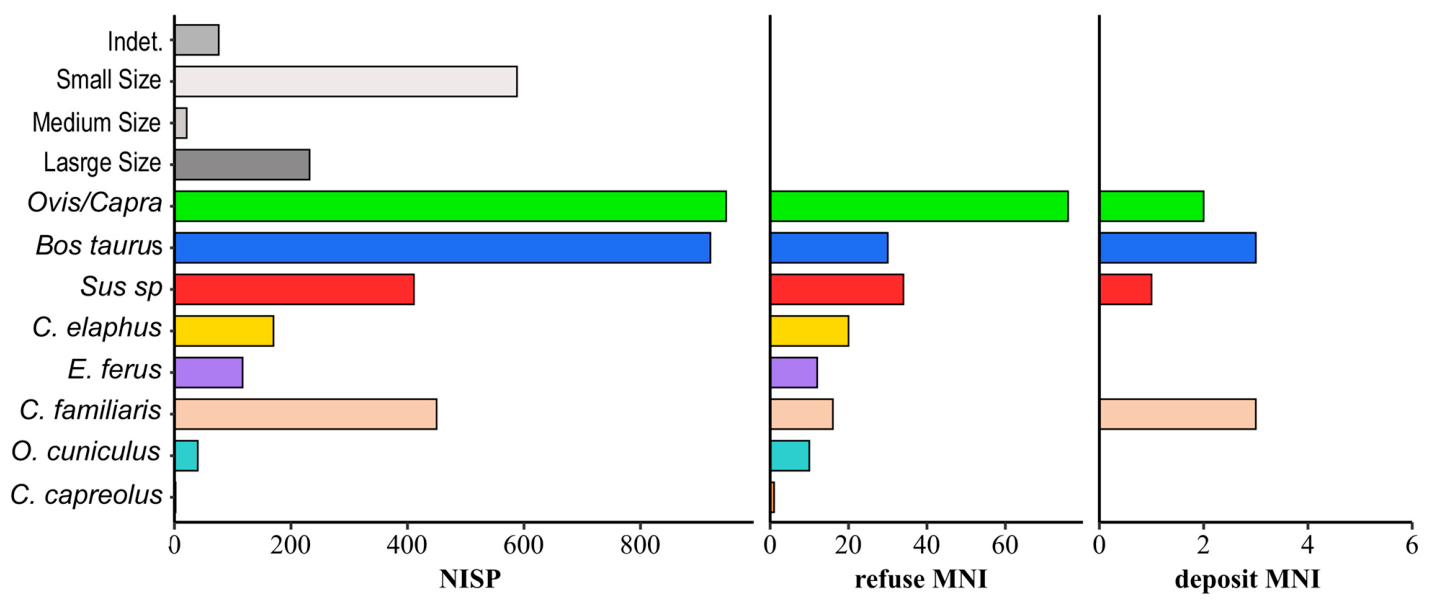
| Bos taurus | 914 | 30 | 27 | 0 | 3 | 23.2 | 14.9 | 11.1 | 22 | 71.0 | 3 | 33.3 |
| Equus ferus | 115 | 12 | 12 | 0 | 0 | 2.9 | 6.0 | 0 | 12 | 38.7 | 0 | |
| Ovis/Capra | 671 | 54 | 26 | 12 | 16 | 26.9 | 51.8 | 23 | 74.2 | |||
| Ovis aries | 213 | 16 | 16 | 213 | 16 | 8.0 | 0 | 8 | 25.8 | 2 | 22.2 | |
| Capra hircus | 51 | 6 | 6 | 51 | 6 | 3.0 | 0 | 5 | 16.1 | |||
| All Ovis/Capra | 935 | 76 | 48 | 12 | 16 | 23.7 | 37.9 | 58.3 | 26 | 83.9 | 2 | 22.2 |
| Sus sp. | 409 | 34 | 19 | 8 | 7 | 10.4 | 16.9 | 78.9 | 18 | 58.1 | 1 | 11.1 |
| Canis familiaris | 448 | 16 | 15 | 1 | 0 | 11.3 | 8.0 | 6.3 | 15 | 48.4 | 3 | 33.3 |
| Cervus elaphus | 168 | 20 | 18 | 1 | 1 | 4.3 | 10.0 | 11.1 | 16 | 51.6 | ||
| Oryctolagus cuniculus | 40 | 12 | 11 | 1 | 0 | 1.0 | 6.0 | 9.1 | 6 | 19.4 | ||
| Capreolus capreoulus | 2 | 1 | 1 | 0 | 0 | 0.1 | 0.5 | 0 | 1 | 3.2 | ||
| Large-sized | 232 | 0 | 0 | 0 | 0 | 5.9 | ||||||
| Medium-sized | 21 | 0 | 0 | 0 | 0 | 0.5 | ||||||
| Small-sized | 588 | 0 | 0 | 0 | 0 | 14.9 | ||||||
| Indet. | 76 | 0 | 0 | 0 | 0 | 1.9 | ||||||
| Total | 3948 | 201 | 152 | 22 | 27 | 100.0 | 9 | |||||
| Burial | Species | Anatomical Part with Cut Marks and Function | Burial | Species | Anatomical Part with Cut Marks and Function |
|---|---|---|---|---|---|
| 25 | Bos | Metacarpal -disarticulation- | 33 | Ovis/Capra | Scapula -defleshing- |
| 35 | Bos | Vertebrae -disarticulation- | 35 | Ovis/Capra | Mandible -disarticulation- |
| 65 | Bos | Metatarsal -disarticulation- | 60 | Ovis/Capra | Scapula -defleshing- |
| 69 | Bos | Radius -defleshing- | 62 | Ovis/Capra | Mandible -cheek meat removal- |
| 70 | Bos | Femur -filleting- | 62 | Ovis/Capra | Humerus -defleshing- |
| 86 | Bos | Radius -disarticulation- | 62 | Ovis/Capra | Femur -filleting- |
| 87 | Bos | Metacarpal -disarticulation- | 69 | Ovis/Capra | Humerus -disarticulation and defleshing- |
| 98 | Cervus | Humerus -defleshing- | 73 | Ovis/Capra | Tibia -defleshing- |
| 98 | Sus | Humerus -defleshing- | 25 | Equus | Metacarpal -disarticulation- |
| 69 | Cervus | Metatarsal -disarticulation- | 92 | Cervus | Radius -defleshing- |
| Grave | 25 | 60 * | 62 | 20 | 66 | 35 | 43 | 53 |
|---|---|---|---|---|---|---|---|---|
| NISP | Bos taurus | Bos taurus | Bos taurus | Ovis aries | Ovis aries | Canis familiaris | Canis familiaris | Canis familiaris |
| Horn core | 26 | 2 | 40 | |||||
| Cranium | 3 | 252 | 11 | 11 | 2 | |||
| Maxilla | 2 | 2 | 2 | 2 | 2 | |||
| Mandible | 2 | 2 | 2 | |||||
| Teeth | 6 | 10 | 24 | 16 | 16 | |||
| Vertebrae | 28 | 42 | 21 | 21 | ||||
| Ribs | 32 | 34 | 12 | 24 | ||||
| Scapula | 1 | 3 | 2 | |||||
| Humerus | 2 | 1 | 2 | 2 | 2 | |||
| Radius | 2 | 1 | 2 | 2 | 2 | |||
| Ulna | 1 | 2 | 1 | 2 | ||||
| Carpals | 5 | 2 | ||||||
| Metacarpal | 3 | 6 | 10 | |||||
| Pelvis | 2 | 1 | 2 | 2 | ||||
| Femur | 1 | 2 | 2 | 2 | ||||
| Tibia | 2 | 2 | 2 | 2 | ||||
| Fibula | 2 | |||||||
| Patella | 2 | |||||||
| Talus | 2 | 2 | 2 | 2 | ||||
| Calcaneus | 2 | 2 | 1 | 2 | ||||
| Tarsals | 1 | 5 | ||||||
| Metatarsal | 2 | 4 | 5 | 10 | ||||
| Phalanges | 10 | 6 | ||||||
| Total | 26 | 5 | 300 | 110 | 3 | 129 | 97 | 120 |
| Bos taurus | Equus ferus | Ovis/Capra | Sus sp. | Canis familiaris | Cervus elphus | |||||||
|---|---|---|---|---|---|---|---|---|---|---|---|---|
| NISP | % | NISP | % | NISP | % | NISP | % | NISP | % | NISP | % | |
| Horn core | 53 | 9.1 | 3 | 0.4 | 105 | 67.7 | ||||||
| Cranium | 147 | 25.2 | 8 | 7.0 | 37 | 4.5 | 23 | 5.6 | 7 | 7.1 | 1 | 0.6 |
| Maxilla | 9 | 1.5 | 1 | 0.9 | 23 | 2.8 | 12 | 2.9 | 6 | 6.1 | 1 | 0.6 |
| Mandible | 22 | 3.8 | 1 | 0.9 | 55 | 6.7 | 12 | 2.9 | 10 | 10.2 | 5 | 3.2 |
| Teeth | 25 | 4.3 | 11 | 9.6 | 307 | 37.3 | 95 | 23.2 | 30 | 30.6 | ||
| Vertebrae | 35 | 6.0 | 23 | 20.0 | 71 | 8.6 | 65 | 15.9 | 26 | 26.5 | 1 | 0.6 |
| Ribs | 45 | 7.7 | 15 | 13.0 | 54 | 6.6 | 60 | 14.7 | 6 | 6.1 | 1 | 0.6 |
| Scapula | 23 | 3.9 | 5 | 4.3 | 19 | 2.3 | 11 | 2.7 | 1 | 1.0 | 2 | 1.3 |
| Humerus | 17 | 2.9 | 6 | 5.2 | 27 | 3.3 | 19 | 4.6 | 4 | 4.1 | 6 | 3.9 |
| Radius | 18 | 3.1 | 6 | 5.2 | 26 | 3.2 | 10 | 2.4 | 5 | 3.2 | ||
| Ulna | 9 | 1.5 | 3 | 2.6 | 9 | 1.1 | 9 | 2.2 | 1 | 1.0 | ||
| Carpals | 9 | 1.5 | 6 | 5.2 | 6 | 0.7 | 7 | 1.7 | 3 | 1.9 | ||
| Metacarpal | 18 | 3.1 | 7 | 6.1 | 9 | 1.1 | 8 | 2.0 | 5 | 3.2 | ||
| Pelvis | 32 | 5.5 | 1 | 0.9 | 25 | 3.0 | 5 | 1.2 | 2 | 1.3 | ||
| Femur | 27 | 4.6 | 5 | 4.3 | 31 | 3.8 | 5 | 1.2 | 1 | 1.0 | 3 | 1.9 |
| Tibia | 19 | 3.3 | 3 | 2.6 | 41 | 5.0 | 11 | 2.7 | 5 | 5.1 | 5 | 3.2 |
| Patella | 1 | 0.6 | ||||||||||
| Talus | 5 | 0.9 | 1 | 0.9 | 5 | 0.6 | 2 | 0.5 | 1 | 1.0 | 1 | 0.6 |
| Calcaneus | 6 | 1.0 | 2 | 1.7 | 8 | 1.0 | 2 | 0.5 | 1 | 1.0 | ||
| Tarsals | 8 | 1.4 | 1 | 0.9 | 7 | 0.9 | 7 | 1.7 | ||||
| Metatarsal | 16 | 2.7 | 2 | 1.7 | 22 | 2.7 | 5 | 1.2 | 4 | 2.6 | ||
| Metapodial | 6 | 1.0 | 1 | 0.9 | 14 | 1.7 | 22 | 5.4 | 2 | 2.0 | ||
| Phalanges | 34 | 5.8 | 7 | 6.1 | 23 | 2.8 | 17 | 4.2 | 1 | 1.0 | 4 | 2.6 |
| Total | 583 | 100.0 | 115 | 100.0 | 822 | 100.0 | 409 | 100.0 | 102 | 104.1 | 155 | 100.0 |
Disclaimer/Publisher’s Note: The statements, opinions and data contained in all publications are solely those of the individual author(s) and contributor(s) and not of MDPI and/or the editor(s). MDPI and/or the editor(s) disclaim responsibility for any injury to people or property resulting from any ideas, methods, instructions or products referred to in the content. |
© 2026 by the authors. Licensee MDPI, Basel, Switzerland. This article is an open access article distributed under the terms and conditions of the Creative Commons Attribution (CC BY) license.
Share and Cite
Estaca-Gómez, V.; Aguilar-Molina, L.; Herrero-Corral, A.M.; Paulos-Bravo, R.; Maicas, R.; Flores-Fernández, R.; Garrido-Pena, R.; Yravedra, J. Faunal Deposits in Pre-Beaker Funerary Contexts at Humanejos (Parla, Madrid, Spain). Animals 2026, 16, 2653. https://doi.org/10.3390/ani16172653
Estaca-Gómez V, Aguilar-Molina L, Herrero-Corral AM, Paulos-Bravo R, Maicas R, Flores-Fernández R, Garrido-Pena R, Yravedra J. Faunal Deposits in Pre-Beaker Funerary Contexts at Humanejos (Parla, Madrid, Spain). Animals. 2026; 16(17):2653. https://doi.org/10.3390/ani16172653
Chicago/Turabian StyleEstaca-Gómez, Verónica, Laura Aguilar-Molina, Ana Mercedes Herrero-Corral, Rodrigo Paulos-Bravo, Ruth Maicas, Raúl Flores-Fernández, Rafael Garrido-Pena, and José Yravedra. 2026. "Faunal Deposits in Pre-Beaker Funerary Contexts at Humanejos (Parla, Madrid, Spain)" Animals 16, no. 17: 2653. https://doi.org/10.3390/ani16172653
APA StyleEstaca-Gómez, V., Aguilar-Molina, L., Herrero-Corral, A. M., Paulos-Bravo, R., Maicas, R., Flores-Fernández, R., Garrido-Pena, R., & Yravedra, J. (2026). Faunal Deposits in Pre-Beaker Funerary Contexts at Humanejos (Parla, Madrid, Spain). Animals, 16(17), 2653. https://doi.org/10.3390/ani16172653