Bacillus subtilis Supplementation in Weanling Piglets: A Systematic Review of Growth, Gut Health, and Microbiota Modulation

Simple Summary
Abstract
1. Introduction
2. Materials and Methods
2.1. Study Protocol
2.2. Eligibility Criteria
2.3. Information Sources and Search Strategy
2.4. Study Selection
2.5. Data Collection Process and Data Items
2.6. Quality Assessment and Risk of Bias
2.7. Synthesis of Results
3. Results and Discussion
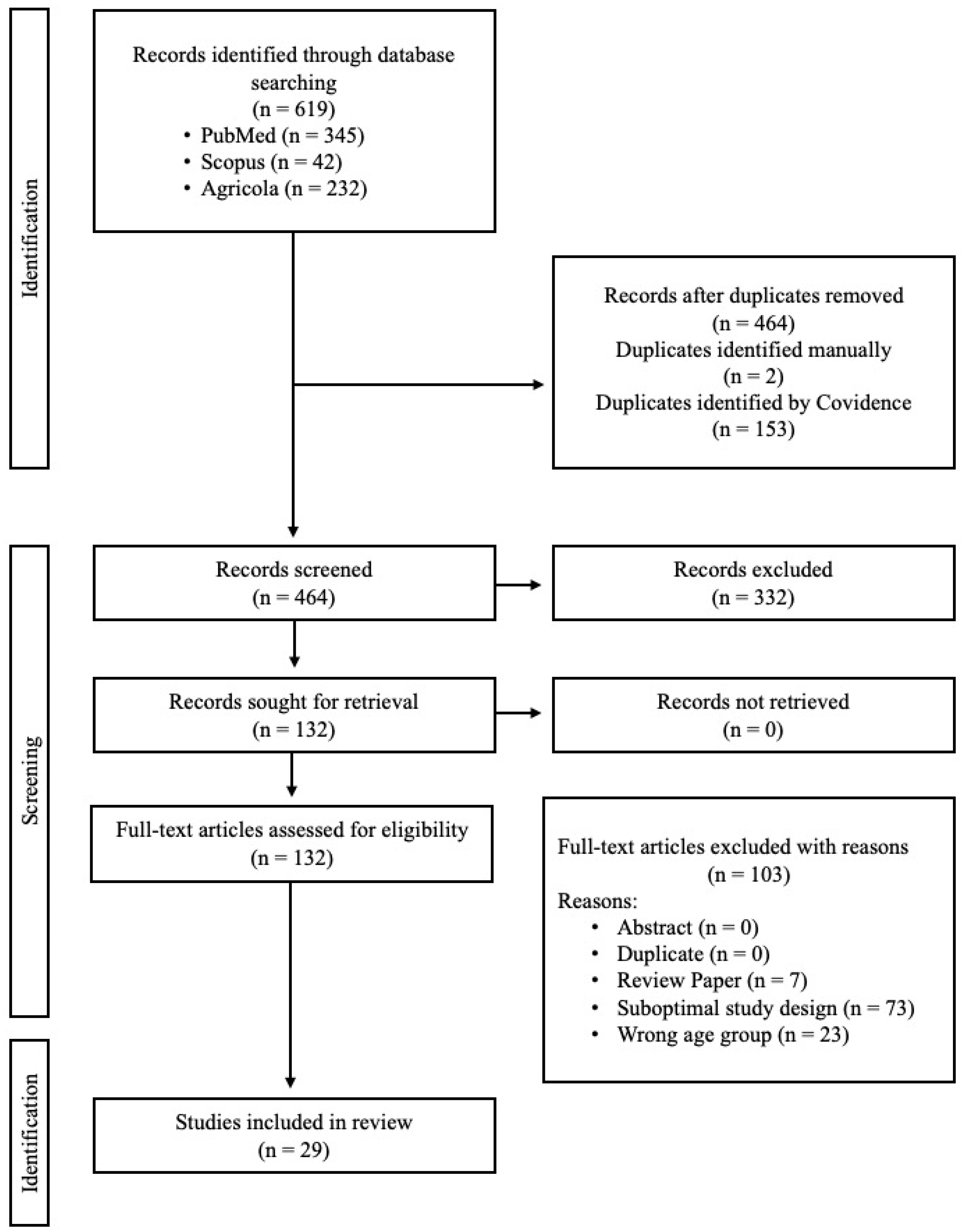
3.1. Study Selection Process
3.2. Summary of Study Designs and Sample Characteristics

| Authors, Year, Country | Number of Animals/Species | Age | Type of Bacillus subtilis | Experiment Duration | Characteristics Evaluated | Key Effects of Bacillus subtilis Supplementation |
|---|---|---|---|---|---|---|
| Deng et al. [24], China | 72, Duroc × Large White × Landrace | 45 days; initial BW: 14.06 ± 1.80 kg | 0.1% Bacillus subtilis (BF7658, CGMCC 1.240) 1 × 10¹⁰ cfu/g | 28 days | Growth performance; Serum parameters; Mucosal digestive enzymes; Intestinal morphology; Colonic microbiota | ↑ ADG; ↑ Serum triglycerides and lipase, amylase, maltase activities in the ileum; ↑ VH: CD in the ileum; ↑ Serum glucose in the ileum; ↑ Abundance of Firmicutes in the colonic microbiota; ↓ Abundance of E. coli in the colonic microbiota |
| Ding et al. [26], China | 128 barrows, Large White × Landrace | 21 days; initial BW: 7.84 ± 0.02 kg | 500 g/t Bacillus subtilis (DSM 32315) with spore count of 2 × 10⁹ cfu/g | 42 days | Intestinal morphology; Metabolite levels; Intestine microbiota diversity; Intestine microbiota composition | ↑ VH and VH:CD in ileum; ↑ Colonic concentrations of butyrate, tryptamine, and cadaverine; ↓ Colonic skatole concentration; ↑ Gut microbial diversity and alterations in bacterial species abundance |
| Ding et al. [27], China | 64, Large White × Landrace barrows | 21 days; initial BW: N/A | 500 g/t Bacillus subtilis (DSM 32315) with spore count of 2 × 10⁹ cfu/g | 42 days | Intestinal morphology; Intestine metabolites; Intestine microbiota diversity and composition | ↑ Abundance of jejunal Leucobacter and Cupriavidus; ↑ Abundance of ileal Thermus, Coprococcus and Bifidobacterium; ↑ Abundance of colonic Succiniclasticum; ↑ Ileal SCFA; ↑ Colonic propionate, branched-chain fatty acids, and tyramine concentrations; ↓ Colonic indole concentration |
| Duddeck et al. [38], United States | 54, Yorkshire × Yorkshire or Yorkshire × Duroc, Yorkshire × Duroc × Duroc | 26.9 ± 2.0 days; initial BW: 9.1 ± 1.3 kg | 3.75 × 10⁸ cfu/g Bacillus subtilis (1.875 × 10⁵ cfu/g diet); 3.75 × 10⁹ cfu/g Bacillus subtilis (1.875 × 10⁶ cfu/g diet) | 28 days | Growth performance; Fecal score; Blood parameters; Fecal SCFA concentrations; Fecal bile concentration; Fecal microbiome | ↑ ADG and BW on day 14 with low dose; ↑ Blood glucose on day 14 with both dose; ↑ Fecal butyrate and isovalerate with low dose; ↑ Fecal acetate, propionate, and total SCFAs with low dose; ↑ Microbial evenness with low dose at day 28; ↑ Beta diversity difference between low and high dose at day 14; |
| Du et al. [20], China | 12 | Newborn; initial BW: N/A | 5 × 10⁹ cfu of the Bacillus (WS-1; 1 mL of medium contained 1 × 10⁹ cfu) | 6 days | Health status; Diarrhea rate; Histopathology; Genome sequencing | ↓ Diarrhea rate on day 1 PI; ↓ Mortality rate |
| Garvey et al. [45], United States | 32, crossbred | 21 days; initial BW: 7.12 ± 1.70 kg | 7.5 billion cfu/day Bacillus subtilis (MB40); 7.5 billion cfu/day Bacillus subtilis (MB40 with Listeria monocytogenes challenge) | 14 days | Growth performance; Organ weights; Bacterial counts; Hematology; Plasma cytokines; Plasma biochemistry; Intestinal morphology; | ↓ Listeria monocytogenes count in liver and spleen; ↓ Circulating monocyte concentrations |
| He et al. [22], China | 12, Yorkshire × Landrace | 28 days; initial BW: N/A | 10 mL of Bacillus subtilis (1 × 10⁹ cfu/mL JATP3) | 28 days | Intestinal morphology; Intestinal pH; Intestinal gene expression; Mucosa microorganisms; Intestinal mucosa microbial composition; Metabolic profile of chime | ↑ VH:CD in jejunum and ileum ↑ Claudin, ZO-1, and IL-10 expression in jejunum and ileum; ↓ IL-1β expression in jejunum and ileum; ↑ Beneficial microbial abundance in jejunum and ileum; ↑ Citalopram, isobutyric acid, and isocitric acid in ileum; ↑ Positive correlation between citalopram and microbial changes in jejunum and ileum |
| He et al. [21], China | 12, Yorkshire × Landrace | 28 days; initial BW: N/A | 10 mL of Bacillus subtilis (1 × 10⁹ cfu/mL JATP3) | 28 days | Growth performance; Nitrogen metabolism in urine, feces, and feed; Expression of proteins related to protein synthesis in the skeletal muscles; AKG content in liver and muscle; Metabolomic profile of portal vein plasma; Intestinal microbiome | ↑ Final nitrogen deposition rate in the urine, feces, and feed; ↑ Abundance of Pediococcus, Collinsella, Veillonella, Clostridium, and Escherichia in jejunum; ↑ Abundance of Olsenella and Pediococcus in ileum; ↑ Portal vein L-lactic acid and AKG levels; ↑ AKG concentrations in muscle and liver; ↑ Phosphorylated 4EBP1 in skeletal muscle; ↑ Abundance of Olsenella and Pediococcu in ileum; ↓ Abundance of Weissella in ileum; ↑ L-lactic acid and AKG levels in the portal vein plasma; ↑ In the content of AKG levels in the muscle and liver |
| Herrera Franco et al. [42], Colombia | 150 castrated male, commercial terminal crossing | 21 days; initial BW: 5.6 ± 0.3 kg 28 days old; initial BW: ~6.8 ± 0.4 kg | 50 ppm of Bacillus subtilis (PTA-6737; 108 cfu) | 30 days | Growth performance; Intestinal morphology; mRNA abundances in the intestinal barrier protein genes; Gene abundances in the jejunum tight junction proteins | ↑ Final BW and daily weight gain; ↓ FCR; ↑ VH and VH:CD in jejunum; ↑ Expression of Claudin-1, Claudin-4, Occludin, ZO-1 in jejunum |
| He et al. [5], United States | 36; 15 gilts and 21 barrows | 21 days; initial BW: 7.61 ± 0.40 kg | 500 mg/kg Bacillus subtilis (1 × 10⁹ cfu/kg of DSM 32540 and with ETEC challenge) | 28 days | Growth performance; Diarrhea score; Intestinal morphology; Complete blood counts; Serum inflammatory markers; Gene expression; Bacterial translocation; Gut microbiota | ↑ BW and ADG; ↓ Diarrhea incidence and severity; ↑ Goblet cell number and sulfomucin production in the duodenal villi; ↓ IL-1β, PTGS2 expression in ileal mucosa; ↑ MUC2 expression in jejunal mucosa; ↓ Abundance of Lachnospiraceae, Peptostreptococcaceae, Pasteurellaceae in the ileum |
| He et al. [15], United States | 48 | 21 days; initial BW: 6.17 ± 0.36 kg | 2.56 × 10⁹ cfu/kg Bacillus subtilis with ETEC challenge | 28 days | Growth performance; Diarrhea score; Bacterial translocation; Intestinal morphology; Intestinal barrier and innate immunity; Systematic immunity; Blood cells profile | ↑ Final BW at day 21 PI; ↑ ADG and feed efficiency; ↓ Diarrhea frequency and fecal β-hemolytic coliforms; ↑ Jejunal CLDN1 expression; ↓ Ileal IL-6 and PTGS2 expression; ↓ White blood cell count, neutrophils, monocytes, and serum haptoglobin |
| He et al. [41], United States | 48 | 21 days; initial BW: 6.17 ± 0.36 kg | 2.59 × 10⁹ cfu/kg Bacillus subtilis with ETEC challenge | 28 days | Metabolite profile in ileal mucosa and colon digesta | ↑ Ileal metabolites related to mucosal repair; ↑ Polyamines, nucleotides, monosaccharides, fatty acids, and organic acids in ileum; ↑ 2-monoolein, lactic acid, and maltose in colon digesta |
| Hu and Kim [16], China | 150, Yorkshire × Landrace × Duroc | 28 days; initial BW: 7.53 ± 1.23 kg | 300 g of Bacillus subtilis (1 × 10⁹ cfu/g; C-3102) | 42 days | Growth performance; Nutrient digestibility; Diarrhea score; Intestinal microbiota; Excreta odor contents | ↑ ADG and G:F; ↑ ATTG of DM, CP, and energy; ↓ Diarrhea scores during 7 days of post-weaning; ↓ Fecal E. coli counts; ↑ Lactobacillus counts in the intestinal microbiota; ↓ Fecal total mercaptan emissions |
| Hu et al. [23], China | 360, Duroc × Landrace × Yorkshire | 26 ± 2 days; initial BW: 7.14 ± 0.63 kg | 2 × 10⁹ cfu/kg of Bacillus subtilis (KN-42); 4 × 10⁹ cfu/kg of Bacillus subtilis (KN-42); 20 × 109 cfu/kg of Bacillus subtilis (KN-42) | 28 days | Growth performance; Diarrhea incidence; Bacterial diversity; Gene expression in the feces | ↑ ADG and feed efficiency in medium and high groups; ↓ Diarrhea index; ↑ Fecal bacterial diversity in medium group; ↑ Fecal Lactobacillus in high group; ↓ E. coli in the feces |
| Jia et al. [29], China | 20 female, Landrace × Yorkshire | 21 days; initial BW: 6.58 ± 0.17 kg | 1 × 10⁸ cfu/Bacillus subtilis (ASAG 216); 1 × 10⁸ cfu/Bacillus subtilis (ASAG 216 with DON contamination) | 21 days | Growth performance; Serum biochemical parameters; Oxidative stress indicators; Pro-inflammatory cytokines in the jejunum; mRNA expression in the jejunum; Cecal microbial population; DON and DOM-1 residues in the serum, liver, and kidney | ↑ ADG and feed intake under DON challenge; ↓ Serum AST; ↓ Serum DAO, endotoxin, and PYY; ↓ Serum MDA and liver H2O2; ↑ Liver GPx and jejunal SOD activity; ↑ Jejunal OCLN expression; ↓ Jejunal IL-6 and IFN-γ; ↑ Cecal Faecalibacterium; ↓ Ceal Lactobacillus and E. coli ↓ Tissue DON and DOM-1 residues |
| Jinno et al. [43], United States | 48 | 21 days; initial BW: 6.17 ± 0.36 kg | 500 mg/kg Bacillus subtilis (DSM 25841; 2.56 × 10⁹ cfu/kg with ETEC challenge) | 28 days | Intestinal and fecal microbiota | ↓ Fecal Chao1 index; ↑ Ruminococcaceae, Veillonellaceae, and Bifidobacteriaceae in jejunum; ↓ Actinomycetaceae in jejunum; ↑ Lactobacillaceae in ileum and colon; ↓ Lachnospiraceae in ileum; ↑ Maintenance of microbial diversity in ileum; ↑ Bifidobacteriaceae in colon; ↑ Preservation of beneficial bacteria compared to antibiotics |
| Kim et al. [39], United States | 48, crossbred | Unknown; initial BW: 6.73 ± 0.77 kg | 1.28 × 10⁹ cfu of Bacillus subtilis/kg feed, with ETEC challenge; 2.56 × 10⁹ cfu of Bacillus subtilis/kg feed, with ETEC challenge | 19 days | Growth performance; Diarrhea score; β-hemolytic coliforms; Gut permeability; Intestinal morphology; Gene expression in intestinal mucosa | ↑ ADG; ↓ Intestinal transcellular and paracellular permeability with high dose; ↑ Jejunal CFTR, ZO-1, MUC2, and SLC5A10 expression; ↓ Ileal IL-6 expression |
| Lewton et al. [36], United States | 80, PIC 359 × Yorkshire | 21 ± 1 days; initial BW: 7.0 ± 0.6 kg | 1.48 × 10⁸ cfu/g Bacillus subtilis (0.5 g/kg of feed) | 42 days | Growth performance; Amino acid digestibility; Gross energy and nitrogen digestibility; Colonic contents pH | ↑ ADG and ADFI; ↑ AID of tryptophan, cysteine, lysine, methionine, and threonine; ↓ Nitrogen digestibility |
| Lewton et al. [44], United States | 80 | 21 ± 1 days; initial BW: 7.0 ± 0.60 kg | 7.35 × 10⁴ cfu/g Bacillus subtilis | 42 days | Growth performance; Health status; Intestinal morphology; Immunological markers | ↑ Jejunal VH; Ascending colon CD; ↑ Plasma IgA; ↑ Jejunal IL-10; ↓ Rotavirus A and C in the feces |
| Li et al. [33], China | 24, Yorkshire × Landrace × Duroc | 25 ± 2 days; initial BW: 6.80 ± 0.65 kg | 107 cfu Bacillus subtilis/kg feed | 14 days | Growth performance; Serum growth hormone levels and biochemical parameters; Serum cytokines and immunoglobulins | ↑ ADG and ↓ F:G; ↑ Serum total protein and albumin concentrations; ↑ IgA and IgG levels; ↑ IL-10 ↓ IL-6 and TNF-α in the serum |
| Liu et al. [34], China | 320, Duroc × Landrace × Yorkshire | 25 days; initial BW: 7.00 ± 0.50 kg | 100 mg/kg Bacillus subtilis (QST713); 200 mg/kg Bacillus subtilis (QST713) | 42 days | Growth performance; Health status; Fecal SCHA concentrations; Fecal microbiota composition; Fecal gene expression; Fecal Bacillus subtilis QST713 quantities | ↑ ADFI with low dose; ↓ Diarrhea incidence in both doses; ↓ SCFA levels in both doses; Altered β-diversity |
| Luise et al. [40], Italy | 64 | 24 ± 2 days; initial BW: 7.75 kg ± 0.64 kg | 1.28 × 10⁶ cfu/g feed of Bacillus subtilis (DSM25840) | 21 days | Health status; Growth performance; Plasma metabolomics; Serum immunoglobulins; Acute phase proteins in the blood; Microbiota profile; Transcriptomic profile; Intestinal morphology, histochemistry, and immunohistochemistry | ↓ Fecal score; ↑ Villus mitotic index in jejunum; ↑ Enrichment of jejunal genes related to adaptive immune response; ↓ Enterobacteriaceae abundance in cecum |
| Park et al. [25], United States | 21, Large White × Landrace × Duroc | 21 days; initial BW: 8.19 ± 0.77 kg | 0.05% Bacillus subtilis (DSM 32540) with 6.7 × 10⁸ cfu/mL K88 strain of E.coli on day 3 | 21 days | Growth performance; Fecal scores; Intestinal morphology; Ileal and cecal pH; Cecal VFA concentration | ↑ VH, VH:CD in jejunum; ↑ Ileal VH; ↑ G:F; ↑ Survival rate; ↓ Frequency of diarrhea; ↓ Valeric acid concentration in cecal digesta; ↓ Ileal pH; ↓ Valeric acid concentration in cecal digesta |
| Sudan et al. [35], Canada | 96, Landrace × Yorkshire × Duroc | N/A; initial BW: 6.4 ± 0.5 kg | 2 × 10⁷ cfu Bacillus subtilis; 2 × 10⁹ cfu Bacillus subtilis | 28 days | Growth performance; Diarrhea rate; Gut mucosa gene expression; Fecal microbial populations | ↑ ADG and feed efficiency with low dose; ↓ Diarrhea incidence; ↓ Fecal E. coli and total coliform counts; ↑ Fecal lactic acid bacteria and Bacillus spp.; ↑ Jejunal MUC-1, occludin, and TJP-1 expression; ↓ Jejunal IL-8 expression |
| Tang et al. [31], China | 72, Duroc × Landrace × Yorkshire | 25 days; initial BW: 7.61 ± 0.55 kg | Low- or high-protein diet with 500 g/t Bacillus subtilis (DSM32315; 2 × 10⁹ cfu/g) | 42 days | Growth performance; Apparent total tract digestibility; Digesta pH; Intestinal morphology; Intestinal VFA’s and VBN concentration; Intestinal microflora; mRNA gene expression | ↑ ADG and ADFI; ↓ F:G in low-protein diet; ↑ ATTD of CP and ether extract in low-protein diet; ↑ DM digestibility; ↓ Ileal pH; ↑ Colonic pH in high-protein diet; ↑ Jejunal and ileal VH and VH:CD in low-protein diet; ↓ CD in jejunum; ↑ Ileal acetic acid in low-protein diet; ↑ Colonic propionic and butyric acids; ↓ Colonic volatile basic nitrogen; ↑ Ileal and colonic Bacillus and Bifidobacterium populations; ↑ mRNA expression of ZO-1, Occludin-1, EGF, GLP-2, IGF-1R in ileum |
| Tian et al. [28], China | 160, Landrace × Large White | 25 days; initial BW: 7.00 ± 0.50 kg | 1 × 10⁶ cfu/g feed Bacillus subtilis A, B, or C | 42 days | Growth performance; Diarrhea rate; Plasma cytokine levels; Intestinal morphology; Microbiota diversity; Microbial communities; Gut metabolite concentrations; mRNA levels of intestinal health-related genes | ↑ ADG and ADFI in B or C; ↓ Diarrhea incidence in B and or C; ↑ IL-2 and IL-10 in B in the plasma; ↑ IL-10 in C; ↑ Colonic Butyrate and total SCFA in B; ↑ Lactobacillus and Faecalibacterium in B; ↑ mRNA expression in the colon of ZO-1 and occludin in B; ↑ ZO-1 in C in colon |
| Wang et al. [37], United States | 264, PIC1050 × DNA600 | 21 ± 2 days; initial BW: N/A | 0.05% Bacillus subtilis (Bacillus subtilis 747 + Bacillus subtilis 1999); 0.05% Bacillus subtilis (Bacillus subtilis 747 + Bacillus subtilis 1999) with 0.2% lactylate | 42 days | Growth performance; Complete blood count; Microbial counts and composition | ↑ G:F and Total white blood cell count; ↑ Ruminococcaceae and S24-7 families associated with feed efficiency; ↑ Butyrate-producing taxa in the gut microbiota |
| Wang et al. [32], South Korea | 120, Landrace × Yorkshire × Duroc | 28 days; initial BW: 7.73 ± 0.75 kg | 0.1% Bacillus subtilis (GCB-13-001 1 × 10⁸ cfu/kg); 0.1% Bacillus subtilis (GCB-13-001 1 × 10⁹ cfu/kg) | 42 days | Growth performance; Nutrient digestibility; Blood profiles; Fecal microbiota; Fecal score | ↑ BW and ADG; ↓ F:G; ↑ ATTD of DM and CP; ↑ Fecal Lactobacillus counts; ↓ Fecal E. coli counts and fecal score |
| Wan et al. [30], China | 24, Duroc × Landrace × Yorkshire | 24 days; initial BW: 7.67 ± 0.32 kg | 109 cfu/g of Bacillus subtilis | 24 days | Growth performance; Diarrhea rate; Apparent digestibility of nutrients; Plasma xylose concentration; Intestinal morphology; Disaccharidase activities; Intestinal gene expressions; Intestinal microflora | ↑ Feed efficiency; ↓ Diarrhea; ↑ VH:CD in small intestine; ↑ Lactobacillus in ileum; ↑ Bacillus in cecum |
3.3. Summary of Bacillus subtilis Intervention and Evaluated Characteristics
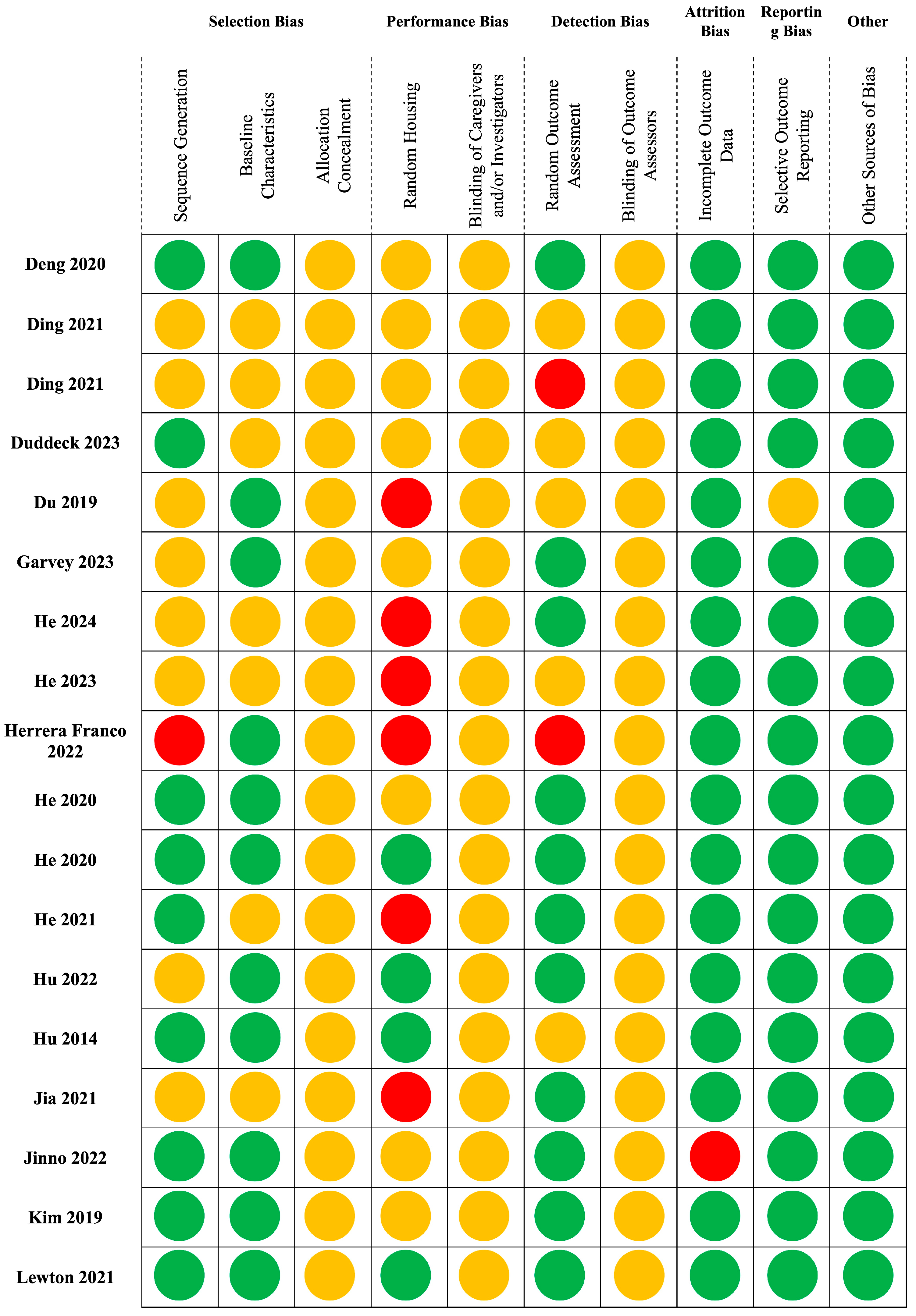
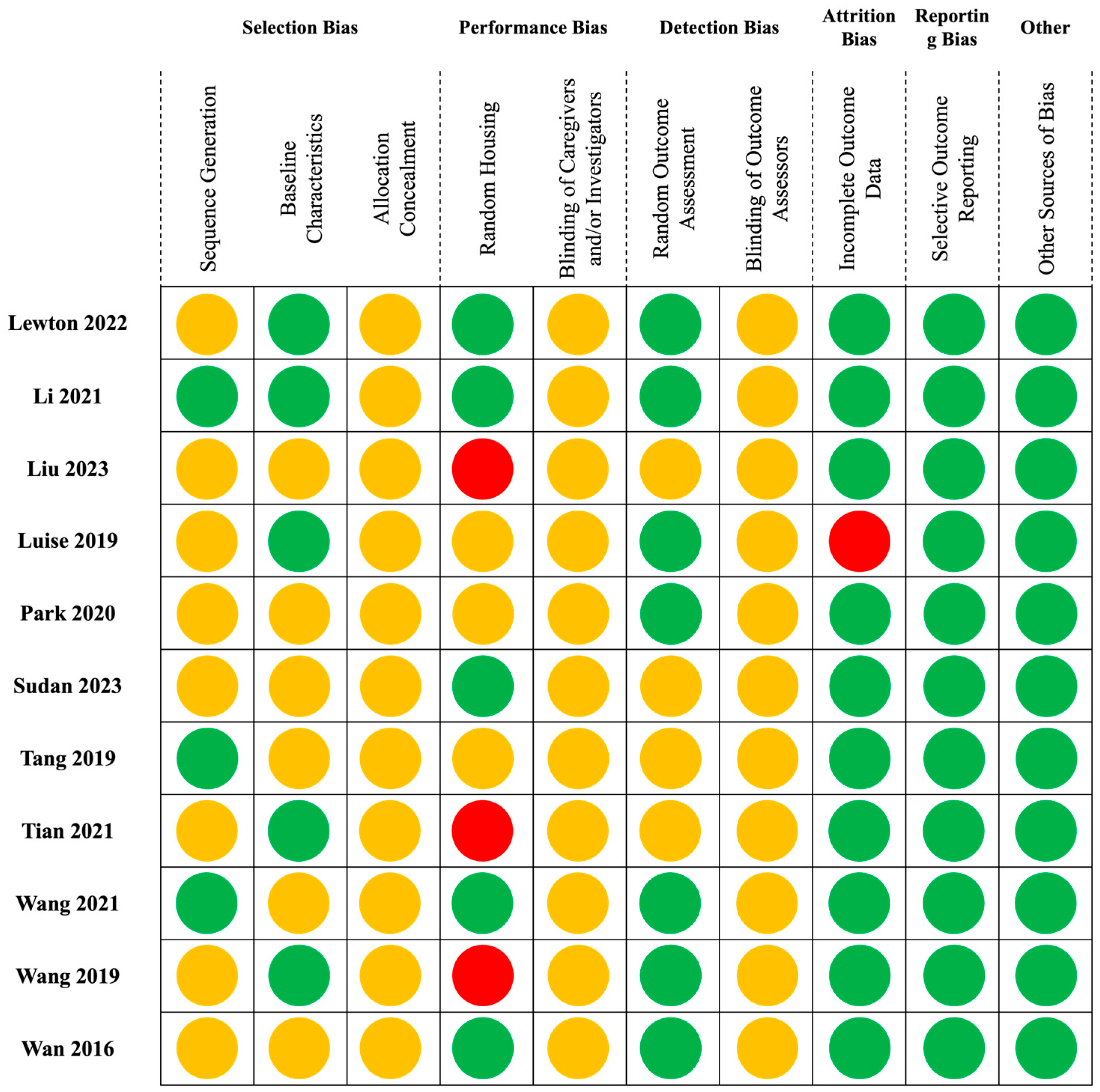
3.4. Summary of Quality Assessment and Risk of Bias
3.5. Growth Performance
3.5.1. Body Weight (BW) and Average Daily Gain (ADG)
3.5.2. Feed Intake and Feed Efficiency
3.5.3. Digestibility
3.5.4. Disease Challenge Models
3.6. Clinical Indicators (Diarrhea, Immune Response, and Biochemical/Oxidative Parameters)
3.6.1. Diarrhea
3.6.2. Immune Response
3.6.3. Gene Expression
3.6.4. Biochemical/Oxidative Parameters
3.7. Intestinal Development
3.8. Gut Microbiota
4. Strengths and Limitations
5. Conclusions
Author Contributions
Funding
Institutional Review Board Statement
Informed Consent Statement
Data Availability Statement
Conflicts of Interest
Abbreviations
| ADFI | average daily feed intake |
| ADG | average daily gain |
| AKG | α-ketoglutarate |
| ATTD | apparent total tract digestibility |
| BW | body weight |
| CD | crypt depth |
| cfu | colony-forming units |
| CFTR | cystic fibrosis transmembrane conductance regulator |
| CLDN1 | claudin-1 |
| DON | deoxynivalenol |
| DOM-1 | deepoxy-deoxynivalenol |
| E. coli | Escherichia coli |
| EGF | epidermal growth factor |
| ETEC | enterotoxigenic Escherichia coli |
| F:G | feed-to-gain ratio |
| FCR | feed conversion ratio |
| G:F | gain-to-feed ratio |
| GLP-2 | glucagon-like peptide-2 |
| GPx | glutathione peroxidase |
| GPX2 | glutathione peroxidase 2 |
| H2O2 | hydrogen peroxide |
| IFN-γ | interferon-gamma |
| IgA | immunoglobulin A |
| IgG | immunoglobulin G |
| IGF-1R | insulin-like growth factor 1 receptor |
| IL | interleukin |
| MDA | malondialdehyde |
| mRNA | messenger ribonucleic acid |
| MUC1 | mucin 1 |
| MUC2 | mucin 2 |
| NOS2 | nitric oxide synthase 2 |
| OCLN | occludin |
| PICOS | populations, interventions, comparators, outcomes, and study designs |
| PI | post-inoculation |
| PRISMA | Preferred Reporting Items for Systematic Reviews and Meta-Analyses |
| PTGS2 | prostaglandin-endoperoxide synthase 2 |
| SCFA | short-chain fatty acid |
| SLC5A10 | solute carrier family 5 member 10 |
| SOD | superoxide dismutase |
| SOD3 | superoxide dismutase 3 |
| spp. | species |
| TJP-1 | tight junction protein 1 |
| TNF-α | tumor necrosis factor-alpha |
| VH | villus height |
| ZO-1 | zonula occludens-1 |
References
- Food and Drug Administration. CPG Sec. 689.100 Direct-Fed Microbial Products. In Compliance Policy Guide; U.S. Food & Drug Administration: Silver Spring, MD, USA, 1995. [Google Scholar]
- Errington, J.; Aart, L.T.V.D. Microbe Profile: Bacillus subtilis: Model Organism for Cellular Development, and Industrial Workhorse. Microbiology 2020, 166, 425–427. [Google Scholar] [CrossRef] [PubMed]
- Su, Y.; Liu, C.; Fang, H.; Zhang, D. Bacillus subtilis: A Universal Cell Factory for Industry, Agriculture, Biomaterials and Medicine. Microb. Cell Fact. 2020, 19, 173. [Google Scholar] [CrossRef] [PubMed]
- Stülke, J.; Grüppen, A.; Bramkamp, M.; Pelzer, S. Bacillus subtilis, a Swiss Army Knife in Science and Biotechnology. J. Bacteriol. 2023, 205, e00102-23. [Google Scholar] [CrossRef] [PubMed]
- He, Y.; Kim, K.; Kovanda, L.; Jinno, C.; Song, M.; Chase, J.; Li, X.; Tan, B.; Liu, Y. Bacillus subtilis: A Potential Growth Promoter in Weaned Pigs in Comparison to Carbadox. J. Anim. Sci. 2020, 98, skaa290. [Google Scholar] [CrossRef] [PubMed]
- Payne, J.; Bellmer, D.; Jadeja, R.; Muriana, P. The Potential of Bacillus Species as Probiotics in the Food Industry: A Review. Foods 2024, 13, 2444. [Google Scholar] [CrossRef] [PubMed]
- Antanaitis, R.; Džermeikaitė, K.; Krištolaitytė, J.; Armonavičiūtė, E.; Arlauskaitė, S.; Girdauskaitė, A.; Rutkauskas, A.; Baumgartner, W. Effects of Bacillus subtilis on Growth Performance, Metabolic Profile, and Health Status in Dairy Calves. Animals 2024, 14, 2489. [Google Scholar] [CrossRef] [PubMed]
- Chen, A.; Liu, H.; Han, J.; Zhu, D.; Huang, S.; Li, M.; Deng, X.; Wang, K.; Wu, Q.; Yang, Y.; et al. Effects of Different Bacillus subtilis Supplementation Levels on Fecal Microbiota and Metabolites in Goats. Microorganisms 2025, 13, 2740. [Google Scholar] [CrossRef] [PubMed]
- Yang, X.; Liu, T.; Zhou, J.; An, L.; Pan, F.; Zhang, H.; Wang, X.; Xu, G.; Zheng, C. Effects of Bacillus subtilis Addition to Milk Replacer on Growth Performance, Nutrient Digestibility, Intestinal Microbiota, and Short-Chain Fatty Acid Concentration of Hu Lambs. Anim. Feed Sci. Technol. 2025, 319, 116175. [Google Scholar] [CrossRef]
- Qiu, K.; Li, C.; Wang, J.; Qi, G.; Gao, J.; Zhang, H.; Wu, S. Effects of Dietary Supplementation with Bacillus subtilis, as an Alternative to Antibiotics, on Growth Performance, Serum Immunity, and Intestinal Health in Broiler Chickens. Front. Nutr. 2021, 8, 786878. [Google Scholar] [CrossRef] [PubMed]
- Zhang, S.; Zhong, G.; Shao, D.; Wang, Q.; Hu, Y.; Wu, T.; Ji, C.; Shi, S. Dietary Supplementation with Bacillus subtilis Promotes Growth Performance of Broilers by Altering the Dominant Microbial Community. Poult. Sci. 2021, 100, 100935. [Google Scholar] [CrossRef] [PubMed]
- Mohamed, T.M.; Sun, W.; Bumbie, G.Z.; Elokil, A.A.; Mohammed, K.A.F.; Zebin, R.; Hu, P.; Wu, L.; Tang, Z. Feeding Bacillus subtilis ATCC19659 to Broiler Chickens Enhances Growth Performance and Immune Function by Modulating Intestinal Morphology and Cecum Microbiota. Front. Microbiol. 2022, 12, 798350. [Google Scholar] [CrossRef] [PubMed]
- Liu, S.; Xiao, G.; Wang, Q.; Zhang, Q.; Tian, J.; Li, W.; Gong, L. Effects of Dietary Bacillus subtilis HC6 on Growth Performance, Antioxidant Capacity, Immunity, and Intestinal Health in Broilers. Animals 2023, 13, 2915. [Google Scholar] [CrossRef] [PubMed]
- Chen, H.; Liu, W.; Zhang, H.; Yan, Y.; Chen, M.; Ding, X.; Zhang, C.; Jiang, R.; Wang, Z. Effects of Bacillus subtilis KG109 on Growth Performance, Carcass Quality, Serum Indicators, Intestinal Morphology, and Digestive Enzymes in Broilers. Animals 2024, 14, 3650. [Google Scholar] [CrossRef] [PubMed]
- He, Y.; Jinno, C.; Kim, K.; Wu, Z.; Tan, B.; Li, X.; Whelan, R.; Liu, Y. Dietary Bacillus spp. Enhanced Growth and Disease Resistance of Weaned Pigs by Modulating Intestinal Microbiota and Systemic Immunity. J. Anim. Sci. Biotechnol. 2020, 11, 101. [Google Scholar] [CrossRef] [PubMed]
- Hu, J.; Kim, I.-H. Effect of Bacillus subtilis C-3102 Spores as a Probiotic Feed Supplement on Growth Performance, Nutrient Digestibility, Diarrhea Score, Intestinal Microbiota, and Excreta Odor Contents in Weanling Piglets. Animals 2022, 12, 316. [Google Scholar] [CrossRef] [PubMed]
- Kim, K. Accessing the Effects of Bacillus subtilis on Pigs: A Systematic Review. 2025. Available online: https://osf.io/a38x5/ (accessed on 1 June 2026).
- Schardt, C.; Adams, M.B.; Owens, T.; Keitz, S.; Fontelo, P. Utilization of the PICO Framework to Improve Searching PubMed for Clinical Questions. BMC Med. Inf. Decis. Mak. 2007, 7, 16. [Google Scholar] [CrossRef] [PubMed]
- Covidence. Systematic Review Software; Veritas Health Innovation: Melbourne, Australia; Available online: www.covidence.org (accessed on 1 June 2026).
- Du, Y.; Xu, Z.; Yu, G.; Liu, W.; Zhou, Q.; Yang, D.; Li, J.; Chen, L.; Zhang, Y.; Xue, C.; et al. A Newly Isolated Bacillus subtilis Strain Named WS-1 Inhibited Diarrhea and Death Caused by Pathogenic Escherichia coli in Newborn Piglets. Front. Microbiol. 2019, 10, 1248. [Google Scholar] [CrossRef] [PubMed]
- He, F.; Jin, X.; Sun, K.; Zhao, L.; Yang, W.; Zhang, X.; Dong, X.; Zhao, Y.; Pan, L.; Bao, N.; et al. Bacillus subtilis JATP-3 Improves Nitrogen Metabolism by Regulating Intestinal Flora and AKG in Weaned Piglets. Probiotics Antimicrob. Proteins 2023, 17, 1265–1276. [Google Scholar] [CrossRef] [PubMed]
- He, F.; Jin, X.; Zhao, L.; Yang, W.; Zhao, Y.; Pan, L.; Bao, N.; Sun, H. Bacillus subtilis JATP3 Improved the Immunity of Weaned Piglets by Improving Intestinal Flora and Producing Citalopram. Microb. Pathog. 2024, 195, 106852. [Google Scholar] [CrossRef] [PubMed]
- Hu, Y.; Dun, Y.; Li, S.; Zhao, S.; Peng, N.; Liang, Y. Effects of Bacillus subtilis KN-42 on Growth Performance, Diarrhea and Faecal Bacterial Flora of Weaned Piglets. Asian Australas. J. Anim. Sci. 2014, 27, 1131–1140. [Google Scholar] [CrossRef] [PubMed]
- Deng, B.; Wu, J.; Li, X.; Zhang, C.; Men, X.; Xu, Z. Effects of Bacillus subtilis on Growth Performance, Serum Parameters, Digestive Enzyme, Intestinal Morphology, and Colonic Microbiota in Piglets. AMB Expr. 2020, 10, 212. [Google Scholar] [CrossRef] [PubMed]
- Park, S.; Lee, J.W.; Jerez Bogota, K.; Francis, D.; González-Vega, J.C.; Htoo, J.K.; Woyengo, T.A. Growth Performance and Gut Health of Escherichia coli-Challenged Weaned Pigs Fed Diets Supplemented with a Bacillus subtilis Direct-Fed Microbial. Transl. Anim. Sci. 2020, 4, txaa172. [Google Scholar] [CrossRef] [PubMed]
- Ding, H.; Zhao, X.; Azad, A.K.; Ma, C.; Gao, Q.; He, J.; Kong, X. Dietary Supplementation with Bacillus subtilis and Xylo-Oligosaccharides Improves Growth Performance and Intestinal Morphology and Alters Intestinal Microbiota and Metabolites in Weaned Piglets. Food Funct. 2021, 12, 5837–5849. [Google Scholar] [CrossRef] [PubMed]
- Ding, H.; Zhao, X.; Ma, C.; Gao, Q.; Yin, Y.; Kong, X.; He, J. Dietary Supplementation with Bacillus subtilis DSM 32315 Alters the Intestinal Microbiota and Metabolites in Weaned Piglets. J. Appl. Microbiol. 2021, 130, 217–232. [Google Scholar] [CrossRef] [PubMed]
- Tian, Z.; Wang, X.; Duan, Y.; Zhao, Y.; Zhang, W.; Azad, A.K.; Wang, Z.; Blachier, F.; Kong, X. Dietary Supplementation with Bacillus subtilis Promotes Growth and Gut Health of Weaned Piglets. Front. Vet. Sci. 2021, 7, 600772. [Google Scholar] [CrossRef] [PubMed]
- Jia, R.; Sadiq, F.A.; Liu, W.; Cao, L.; Shen, Z. Protective Effects of Bacillus subtilis ASAG 216 on Growth Performance, Antioxidant Capacity, Gut Microbiota and Tissues Residues of Weaned Piglets Fed Deoxynivalenol Contaminated Diets. Food Chem. Toxicol. 2021, 148, 111962. [Google Scholar] [CrossRef] [PubMed]
- Wan, J.; Li, Y.; Chen, D.; Yu, B.; Chen, G.; Zheng, P.; Mao, X.; Yu, J.; He, J. Recombinant Plectasin Elicits Similar Improvements in the Performance and Intestinal Mucosa Growth and Activity in Weaned Pigs as an Antibiotic. Anim. Feed Sci. Technol. 2016, 211, 216–226. [Google Scholar] [CrossRef]
- Tang, W.; Qian, Y.; Yu, B.; Zhang, T.; Gao, J.; He, J.; Huang, Z.; Zheng, P.; Mao, X.; Luo, J.; et al. Effects of Bacillus subtilis DSM32315 Supplementation and Dietary Crude Protein Level on Performance, Gut Barrier Function and Microbiota Profile in Weaned Piglets1. J. Anim. Sci. 2019, 97, 2125–2138. [Google Scholar] [CrossRef] [PubMed]
- Wang, H.; Kim, K.P.; Kim, I.H. Influence of Bacillus subtilis GCB-13-001 on Growth Performance, Nutrient Digestibility, Blood Characteristics, Faecal Microbiota and Faecal Score in Weanling Pigs. Anim. Physiol. Nutr. 2019, 103, 1919–1925. [Google Scholar] [CrossRef] [PubMed]
- Li, H.-H.; Jiang, X.-R.; Qiao, J.-Y. Effect of Dietary Bacillus subtilis on Growth Performance and Serum Biochemical and Immune Indexes in Weaned Piglets. J. Appl. Anim. Res. 2021, 49, 83–88. [Google Scholar] [CrossRef]
- Liu, J.; Ma, X.; Zhuo, Y.; Xu, S.; Hua, L.; Li, J.; Feng, B.; Fang, Z.; Jiang, X.; Che, L.; et al. The Effects of Bacillus subtilis QST713 and β-Mannanase on Growth Performance, Intestinal Barrier Function, and the Gut Microbiota in Weaned Piglets. J. Anim. Sci. 2023, 101, skad257. [Google Scholar] [CrossRef] [PubMed]
- Sudan, S.; Fletcher, L.; Zhan, X.; Dingle, S.; Patterson, R.; Huber, L.-A.; Friendship, R.; Kiarie, E.G.; Li, J. Comparative Efficacy of a Novel Bacillus subtilis-Based Probiotic and Pharmacological Zinc Oxide on Growth Performance and Gut Responses in Nursery Pigs. Sci. Rep. 2023, 13, 4659. [Google Scholar] [CrossRef] [PubMed]
- Lewton, J.R.; Woodward, A.D.; Moser, R.L.; Thelen, K.M.; Moeser, A.J.; Trottier, N.L.; Tempelman, R.J.; Rozeboom, D.W. Effects of a Multi-Strain Bacillus subtilis-Based Direct-Fed Microbial on Weanling Pig Growth Performance and Nutrient Digestibility. Transl. Anim. Sci. 2021, 5, txab058. [Google Scholar] [CrossRef] [PubMed]
- Wang, X.; Tsai, T.; Wei, X.; Zuo, B.; Davis, E.; Rehberger, T.; Hernandez, S.; Jochems, E.J.M.; Maxwell, C.V.; Zhao, J. Effect of Lactylate and Bacillus subtilis on Growth Performance, Peripheral Blood Cell Profile, and Gut Microbiota of Nursery Pigs. Microorganisms 2021, 9, 803. [Google Scholar] [CrossRef] [PubMed]
- Duddeck, K.A.; Petersen, T.E.; Adkins, H.J.; Smith, A.H.; Hernandez, S.; Wenner, S.J.; Yao, D.; Chen, C.; Li, W.; Fregulia, P.; et al. Dose-Dependent Effects of Supplementing a Two-Strain Bacillus subtilis Probiotic on Growth Performance, Blood Parameters, Fecal Metabolites, and Microbiome in Nursery Pigs. Animals 2023, 14, 109. [Google Scholar] [CrossRef] [PubMed]
- Kim, K.; He, Y.; Xiong, X.; Ehrlich, A.; Li, X.; Raybould, H.; Atwill, E.R.; Maga, E.A.; Jørgensen, J.; Liu, Y. Dietary Supplementation of Bacillus subtilis Influenced Intestinal Health of Weaned Pigs Experimentally Infected with a Pathogenic E. coli. J. Anim. Sci. Biotechnol. 2019, 10, 52. [Google Scholar] [CrossRef]
- Luise, D.; Bertocchi, M.; Motta, V.; Salvarani, C.; Bosi, P.; Luppi, A.; Fanelli, F.; Mazzoni, M.; Archetti, I.; Maiorano, G.; et al. Bacillus sp. Probiotic Supplementation Diminish the Escherichia coli F4ac Infection in Susceptible Weaned Pigs by Influencing the Intestinal Immune Response, Intestinal Microbiota and Blood Metabolomics. J. Anim. Sci. Biotechnol. 2019, 10, 74. [Google Scholar] [CrossRef] [PubMed]
- He, Y.; Liu, Y.; Ji, P. Metabolomic Profile of Weaned Pigs Challenged with E. coli and Supplemented with Carbadox or Bacillus subtilis. Metabolites 2021, 11, 81. [Google Scholar] [CrossRef] [PubMed]
- Herrera Franco, V.H.; Pardo Carrasco, S.C.; Parra Suescún, J.E. Antimicrobials Added to the Feed of Weaned Piglets at Two Ages Improves the Molecular Expression of Intestinal Barrier Proteins. Anim. Prod. Sci. 2022, 62, 511–520. [Google Scholar] [CrossRef]
- Jinno, C.; Li, X.; Liu, Y. Dietary Supplementation of Bacillus subtilis or Antibiotics Modified Intestinal Microbiome of Weaned Pigs under Enterotoxigenic Escherichia coli Infection. Front. Microbiol. 2022, 13, 1064328. [Google Scholar] [CrossRef] [PubMed]
- Lewton, J.R.; Woodward, A.D.; Moser, R.L.; Thelen, K.M.; Moeser, A.J.; Trottier, N.L.; Tempelman, R.J.; Rozeboom, D.W. Effects of a Multi-Strain Bacillus subtilis-Based Direct-Fed Microbial on Immunity Markers and Intestinal Morphology in Diets Fed to Weanling Pigs. Transl. Anim. Sci. 2022, 6, txac083. [Google Scholar] [CrossRef] [PubMed]
- Garvey, S.M.; Emami, N.K.; Guice, J.L.; Sriranganathan, N.; Penet, C.; Rhoads, R.P.; Spears, J.L.; Dalloul, R.A.; El-Kadi, S.W. The Probiotic Bacillus subtilis MB40 Improves Immunity in a Porcine Model of Listeriosis. Microorganisms 2023, 11, 2110. [Google Scholar] [CrossRef] [PubMed]


| Inclusion Criteria | Exclusion Criteria | |
|---|---|---|
| Population (P) | Pigs (Sus domesticus and/or sus scrofa); Breeds: Commonly used in the industry | Non-pig species (e.g., guinea pig) |
| Intervention (I) | Dietary supplementation with various Bacillus subtilis strains and dosages | Bacillus subtilis combined with other treatments |
| Comparators (C) | A control group fed a commercial or basal diet not containing Bacillus subtilis; Extra comparators: Different concentrations or strains of Bacillus subtilis and combinations in both feed and water | Studies not containing a control group |
| Outcomes (O) | Growth performance; Incidence and severity of diarrhea; Overall health status; Feed preference and palatability; Health of gut and microbiota composition; Development of intestine; or Blood biochemical parameters | Studies with measurements only in vitro or ex vivo |
| Study Designs (S) | Controlled experimental trials including random allocation into control and treatment groups | Observational studies including cross-sectional, case–control, cohort studies, lacking a clear intervention, detailed methodology, or outcomes measurement procedures |
| PubMed | |
| Query | (“Bacillus subtilis”[All Fields] OR “B. subtilis”[All Fields] AND (“Piglet”[All Fields] OR “Piglets”[All Fields] OR “Pig”[All Fields] OR “Pigs”[All Fields] OR “Boar”[All Fields] OR “Swine”[All Fields] OR “Gilt”[All Fields] OR “Porcine”[All Fields] OR “Sus scrofa”[All Fields]) AND (2000/1/1:2025/12/12[pdat]) |
| Language | Limited by English |
| Range | Year 2000 to 2025 |
| Scopus | |
| Query | bacillus AND subtilis OR b. AND subtilis AND piglet OR piglets OR pig OR pigs OR swine OR porcine OR gilt OR boar OR sus AND scrofa AND PUBYEAR > 1999 AND PUBYEAR < 2026 AND (LIMIT-TO (LANGUAGE, “English”)) AND (LIMIT-TO (EXACTKEYWORD, “Pig”) OR (LIMIT-TO (EXACTKEYWORD, “Swine”)) |
| Language | Limited by English |
| Range | Year 2000 to 2025 |
| Agricola | |
| Query | bacillus AND subtilis OR b. AND subtilis AND piglet OR piglets OR pig OR pigs OR swine OR porcine OR gilt OR boar OR sus AND scrofa |
| Language | Limited by English |
| Range | Year 2000 to 2025 |
Disclaimer/Publisher’s Note: The statements, opinions and data contained in all publications are solely those of the individual author(s) and contributor(s) and not of MDPI and/or the editor(s). MDPI and/or the editor(s) disclaim responsibility for any injury to people or property resulting from any ideas, methods, instructions or products referred to in the content. |
© 2026 by the authors. Licensee MDPI, Basel, Switzerland. This article is an open access article distributed under the terms and conditions of the Creative Commons Attribution (CC BY) license.
Share and Cite
Ludorf, C.; Richardson, C.; Kim, K. Bacillus subtilis Supplementation in Weanling Piglets: A Systematic Review of Growth, Gut Health, and Microbiota Modulation. Animals 2026, 16, 2054. https://doi.org/10.3390/ani16132054
Ludorf C, Richardson C, Kim K. Bacillus subtilis Supplementation in Weanling Piglets: A Systematic Review of Growth, Gut Health, and Microbiota Modulation. Animals. 2026; 16(13):2054. https://doi.org/10.3390/ani16132054
Chicago/Turabian StyleLudorf, Charlotte, Carley Richardson, and Kwangwook Kim. 2026. "Bacillus subtilis Supplementation in Weanling Piglets: A Systematic Review of Growth, Gut Health, and Microbiota Modulation" Animals 16, no. 13: 2054. https://doi.org/10.3390/ani16132054
APA StyleLudorf, C., Richardson, C., & Kim, K. (2026). Bacillus subtilis Supplementation in Weanling Piglets: A Systematic Review of Growth, Gut Health, and Microbiota Modulation. Animals, 16(13), 2054. https://doi.org/10.3390/ani16132054