1. Introduction
Poultry meat plays a significant role in the global production of animal protein. It accounts for approximately 40% of total meat consumption worldwide [
1,
2]. Chicken meat has a high protein content: approximately 23–25% in the fillet and 18% in the thigh [
3]. Poultry proteins contain a wide range of amino acids, the most abundant of which are lysine (~8.7%), leucine (~7.8%), isoleucine (~3.6%), and valine (~4.8%), along with glutamine, asparagine, arginine, and alanine [
4]. It is an affordable source of protein with a balanced composition of essential amino acids (EAA). Studies have shown that broiler chicken protein contains a higher amount of essential amino acids (up to 92%) than other types of meat (pork—88%, lamb—73%, beef—72%) [
5]. The amino acid composition is an indicator of the nutritional value of meat. Amino acids also contribute to flavor. For example, the Maillard reaction allows free amino acids in cells to form aromatic compounds [
6,
7]. Free amino acids are among the main aromatic compounds in meat, imparting sour, sweet, bitter, salty, and other flavors. For example, glutamic acid (GLU) and aspartic acid (ASP) have a mixture of sour and meaty flavors. Serine, glycine, alanine, and others have a sweet flavor. Histidine, valine, arginine, and others have a bitter flavor. It has also been shown that certain combinations of amino acids determine meat flavor to a greater extent than individual amino acids [
8].
The composition and content of amino acids in poultry proteins fluctuate. Many factors influence the composition and concentration of amino acids in meat, including breed, age, diet, sex, and others [
9,
10,
11]. Studies of poultry meat composition have shown that meat quality changes with age and sex [
12]. Therefore, research into the optimal slaughter age and sex of broiler chickens is essential for producing competitive meat with a rich amino acid composition and excellent palatability.
Poultry housing conditions can also influence the amino acid levels in muscle tissue [
13]. Despite advances in animal welfare practices, rapidly growing modern commercial broilers are still exposed to environmental and housing-related stressors, including stocking density, microclimate, and lighting regimes [
14]. This can trigger neuroendocrine, immune, and metabolic reactions that cause oxidative stress and contribute to reduced meat quality [
15]. High stocking density, like other types of stress, leads to activation of the hypothalamic–pituitary–adrenal (HPA) axis, resulting in increased corticosterone secretion [
16,
17]. This hormone can exert a dual effect on protein metabolism: it activates the ubiquitin–proteasome pathway (upregulating MuRF-1 and Atrogin-1/MAFbx), stimulating protein degradation, and suppresses the IGF 1/Akt/mTOR signaling pathway, inhibiting protein synthesis [
17,
18]. Furthermore, increased glucocorticoid production stimulates gluconeogenesis in the liver, utilizing amino acids—particularly alanine and glutamine—as substrates, thereby reducing their availability for deposition in muscle tissue [
19]. In addition, high stocking density may restrict bird mobility, leading to mitochondrial dysfunction in skeletal muscles, impaired oxidative phosphorylation, and altered energy metabolism, which in turn affects amino acid utilization and protein turnover [
20]. Therefore, understanding how stress modulates muscle physiology, influencing muscle tissue composition, is important for developing management strategies aimed at reducing stress and improving meat quality [
21]. The available literature contains a limited number of studies examining the impact of poultry stocking density on the dynamics of amino acid content in broiler muscle tissue in relation to age.
While the present study focuses on amino acid composition, our parallel investigations using the same experimental model have revealed systemic biochemical alterations (hyperglycemia, increased bilirubin and triglycerides, decreased albumin) and tissue-level molecular changes (suppressed expression of Nrf2, GSH-Gpx, and HO-1) consistent with stress-related metabolic shifts [
22,
23,
24]. These findings will be considered in the interpretation of the observed amino acid profile dynamics.
Dietary supplementation with bioactive compounds—adaptogens and antioxidants—represents a promising strategy for mitigating the negative impact of stressors of various etiologies on growth performance and meat quality. These compounds help enhance the body’s antioxidant defenses and reduce oxidative stress, thereby preserving the integrity of muscle structures and influencing the amino acid composition. For example, adding Cannabis sativa L. leaves to the diet of Ross-308 broilers has been shown to increase the content of free amino acids, including aspartic acid, serine, proline, methionine, and phenylalanine, which improved the palatability of the meat [
25]. The effect of adding dried jujube fruit powder (DJFP) to the diet of Cobb broilers on the amino acid profile of muscle was studied. The level of essential amino acids was higher in the groups receiving this supplement (
p < 0.05) [
26].
Dihydroquercetin (DHQ) is a bioflavonoid found in small amounts in many plants. It was first isolated from larch wood in the 1960s by researchers in the former USSR [
27]. Ascorbic acid, or vitamin C, is an essential vitamin with high antioxidant potential, which is due to its ability to inhibit lipid peroxidation in cell membranes and scavenge peroxyl radicals [
28]. Vitamin E is the main antioxidant in the cellular antioxidant defense network, reducing the risk of lipid damage to cells and tissues caused by free radicals [
29].
It is known that oxidative stress can affect the amino acid composition in the following ways. First, the side chains of amino acids are directly oxidized and undergo oxidative modification. Oxidized amino acids cannot be reused for protein synthesis. Secondly, the process of protein carbonylation makes them more susceptible to proteolytic degradation. Thirdly, lipid peroxidation products react with nucleophilic amino groups, reducing their bioavailability for protein synthesis. Fourth, oxidative stress depletes glutathione (GSH), the main intracellular antioxidant, increasing the metabolic demand for its precursor amino acids—cysteine, glutamate, and glycine [
30]. Fifth, mitochondrial dysfunction induced by oxidative stress disrupts the tricarboxylic acid cycle, affecting the synthesis of interchangeable amino acids formed from intermediates [
31]. Thus, oxidative stress creates conditions for changing the amino acid composition of muscle tissue through direct oxidation of specific residues, increased protein turnover, and competitive redistribution of amino acids for antioxidant protection, reducing their availability to structural proteins.
The use of adaptogen complexes is becoming increasingly important in poultry farming, as they provide a synergistic effect. Studying the biological properties of the developed adaptogen complex DHQEC (dihydroquercetin + vitamins E and C) is promising [
32]. Research aimed at investigating the combined effects of DHQEC on the amino acid composition of poultry meat under simulated environmental conditions has not yet been conducted.
We hypothesized increased stocking density may alter the amino acid composition of muscle tissue in a muscle-type- and age-dependent manner. Dietary supplementation with the DHQEC complex (dihydroquercetin + vitamins E and C) is expected to mitigate these effects. We propose the efficacy of the adaptogens complex depends on the timing of its administration, with earlier supplementation (from day 1) providing greater protection than later supplementation (from day 21).
The aim of this study was to investigate the amino acid composition of muscle tissue (breast and thigh) of broiler chickens of the Russian cross Smena-9 under conditions of increased stocking density and with the use of a complex of adaptogens including dihydroquercetin, vitamins E and C. The research objectives also included studying the amino acid composition of muscle tissue in relation to age and sex.
The novelty of this study lies in the first comprehensive assessment of the total amino acid content in the breast and thigh muscles of Smena-9 broiler chickens under increased stocking density and dietary supplementation with the antioxidant complex DHQEC, with consideration of both age and sex effects.
4. Discussion
The amino acid composition is an indicator of the nutritional value of meat. It is influenced by age, housing conditions, and bird diet. In this study, we evaluated the effects of stocking density and adaptogen supplementation at three developmental stages to capture the temporal dynamics of these effects and to ensure that our findings are placed in their proper biological context. The results of this study demonstrate that the simulated environmental conditions created by a high stocking density had differential effects on the amino acid composition of the different muscle types (breast and thigh). The most pronounced changes were observed in the thigh muscle at the very beginning of the exposure, at 24 days of age. The use of the developed adaptogen complex, which includes dihydroquercetin, vitamins E and C—especially when fed from an earlier age—mitigated the impact of increased stocking density conditions and contributed to maintaining the levels of flavor-related and essential amino acids by the end of the rearing period of Smena-9 broiler chickens.
Broiler chickens are considered more susceptible to adverse environmental conditions, likely due to their higher metabolic rate associated with rapid growth [
34]. A comparison of the S(–)CON and S(+)CON groups indicated that the housing conditions with increased stocking density, which are generally considered simulated in the literature [
14,
35], affected the amino acid composition of the breast and thigh of broiler chickens in our study manifested itself at 34 days of age (2 weeks after the start of exposure). At this age, the negative change in environmental conditions led to an increase in TYR in the breast meat of birds in the S(+)CON group compared to S(–)CON (
p < 0.05, PRO (
p < 0.05), and in thigh meat—an increase in LYS (
p < 0.05).
When meat samples were collected at 52 days of age, we observed no differences between the S(+)CON and S(–)CON groups. This may indicate an adaptive response of the birds to the simulated housing conditions.
In the thigh muscle on day 24 of the experiment, a pronounced decrease in the content of all amino acids was observed in the groups exposed to simulated environmental conditions and receiving the adaptogen complex from day 1 of the experiment, S(+)DHQEC_1, compared to S(–)CON. This suggests that the adaptogens had a marked effect on the amino acid profile of the thigh muscle in broilers under the simulated conditions of a high stocking density during the period of intensive growth. No such changes were observed in the breast muscle. This indicates a greater susceptibility of the thigh muscle to environmental conditions and alimentary factors. This trend may be due to several factors.
In general, the mechanisms described in the literature for heat stress are similar for any chronic stress (including crowding) [
35], since they are mediated by the same hormones—glucocorticoids [
16]. Corticosterone directly activates signaling pathways responsible for muscle protein breakdown (e.g., the ubiquitin–proteasome pathway). Studies in broilers have shown that stress increases the expression of the muscle atrophy F-box gene (a marker of muscle atrophy). High levels of corticosterone also suppress the IGF-1/Akt/mTOR signaling pathway, leading to reduced synthesis of new amino acids in muscle tissue. Thus, chronic overcrowding stress not only accelerates protein breakdown but also reduces the rate of new protein synthesis [
17]. It should be noted, however, that our parallel study did not reveal statistically significant changes in serum corticosterone levels in the same birds [
22]; therefore, the involvement of systemic glucocorticoid signaling in the observed amino acid changes remains speculative. More convincingly, our independent molecular data demonstrated significant downregulation of antioxidant defense genes (
Nrf2, GSH-Gpx, HO-1) in intestinal and liver tissues under high stocking density [
24], suggesting local oxidative stress at the tissue level, which may contribute to altered amino acid metabolism. Fei Li et al. (2024) reported that chronic stress damages the intestinal barrier, alters the microbiota composition (fewer beneficial Firmicutes, more Proteobacteria), and impairs nutrient absorption, including amino acids from feed [
18]. Moreover, the high energy expenditure of birds to adapt to simulated conditions inevitably leads to an energy deficit in the body. To compensate for this, gluconeogenesis is activated in the liver to synthesize glucose from non-carbohydrate precursors, which is consistent with the findings of Ma B. et al. (2021) [
17].
In addition, increased stocking density may contribute to reduced locomotor activity of birds and, consequently, affect the metabolic status of the limb muscles, including the thigh. It is known that with reduced locomotor activity, changes in energy metabolism may be observed in the thigh muscle of broiler chickens, manifested as impaired mitochondrial function and oxidative phosphorylation [
19]. This leads to decreased energy production. Furthermore, a reduction in antioxidant levels in muscles may occur, which promotes the development of oxidative stress [
19]. Reduced locomotor activity may lead to the appearance of oxidative-type fibers as an adaptive response to hypoxic conditions [
20]. This is especially pronounced in modern poultry crosses, since selection for rapid growth leads to a decrease in the adaptive capacity of the birds.
The decrease in the methionine level—a key amino acid with antioxidant action that is a precursor of glutathione—in the thigh muscle of birds exposed to simulated high-stocking-density conditions is consistent with the hypothesis of increase in oxidative stress levels in this muscle. In the study by El-Tarabany M.S. et al. under chronic heat stress, the levels of all essential amino acids in the breast of Ross broiler chickens were significantly reduced, with the exception of threonine, tyrosine, and phenylalanine [
36]. The authors attribute this to elevated corticosterone levels in heat-stressed birds, which suppresses protein synthesis and accelerates its breakdown. In addition, heat stress accelerates the utilization of amino acids as metabolic fuel to provide energy through gluconeogenesis in the liver. It has been observed that heat stress increases the methionine requirement of broilers [
37]. The use of dietary methionine in poultry diets under increased stocking density helps reduce oxidative stress in the birds [
30].
In other studies, rearing conditions also influence the amino acid composition of broiler meat. For example, under floor housing, on day 49, a decrease in lysine content and an increase in arginine content are observed in both white and red meat [
38]. The level of glutamate (Glu), an amino acid that plays a decisive role in flavor formation, was significantly higher in the free-range chicken group than in the cage-housed group (
p < 0.05) [
13].
Adaptogens have recently found wide application in animal husbandry practice [
39,
40], and their use in poultry farming has begun recently [
41,
42]. The adaptogenic properties of the components of DHQEC (dihydroquercetin, vitamins E and C) have already been described previously [
43,
44,
45,
46]. In our previous studies on monogastric animals, dietary supplementation with the complex at 0.025% of the basal diet throughout the entire rearing period improved immune responsiveness and stress resistance in pigs, resulting in enhanced growth performance [
47]. An improvement in the microstructure of pig muscle tissue through the use of DHQEC in vivo has been demonstrated, suggesting a positive effect of the adaptogen complex on animal stress resistance and the degree of glycolysis in meat [
48].
We have previously described the effects of simulated housing conditions on the antioxidant and hormonal status of broiler chickens [
22]. In the present study, we evaluated the effect of DHQEC on the amino acid profile of the breast and thigh muscles of broilers under simulated environmental conditions during ontogeny.
The use of DHQEC in broiler diets, both from 21 days of age and from day 1 of the experiment, contributed to a decrease in PRO content in the breast of birds at 24 days of age. In the S(+)DHQEC_21 group, the content of this amino acid decreased compared to S(–)CON (p < 0.05) and S(+)CON (p < 0.05). In the S(+)DHQEC_1 group, the PRO content tended to decrease compared with the S(–)CON and S(+)CON groups.
At 34 days of age, when adaptogens were fed both from day 1 of the experiment and from 21 days of age, the level of GLU in the breast muscle decreased compared to the S(–)CON group (p < 0.001 and p < 0.05, respectively). The levels of GLY and TYR, on the contrary, increased in the groups of birds kept under simulated environmental conditions (S(+)CON) and receiving the adaptogen complex (groups S(+)DHQEC_21 and S(+)DHQEC_1).
At 52 days of age, in the breast, the level of MET increased under simulated environmental conditions, and increased even more with the use of adaptogens. In the thigh, it did not change.
The improvement in the amino acid profile, resulting from both an increase in the total amino acid content and individual functional amino acids such as methionine, phenylalanine, histidine and arginine, may be attributed to the birds’ adaptation to stress conditions and the positive effect of the adaptogen complex supplementation.
The increase in the methionine levels in the breast and thigh muscles of the birds receiving the adaptogen complex indicated a reduction in oxidative stress levels. Based on the results of previous studies on the use of the DHQEC complex in the nutrition of monogastric animals and poultry, and the demonstrated positive effects on the antioxidant status of the birds [
22,
47], it can be assumed that the impact of environmental conditions is mitigated through the action of the DHQ components and vitamins E and C. This may lead to a reduced requirement for methionine—which plays a key role in the antioxidant defense system—for these purposes, potentially contributing to its increased content in muscle tissue. However, direct evidence linking these changes to decreased oxidative stress in muscle tissue was not obtained in the present study and requires further investigation.
The trend toward an increase in histidine concentration in the muscle tissue of broiler chickens receiving the DHQEC complex also indicates an adaptive response of the birds aimed at enhancing antioxidant properties under the action of adaptogens. The role of histidine as a precursor for carnosine synthesis is known [
49].
The concentration of free and protein-bound amino acids in muscle tissue reflects a dynamic equilibrium between exogenous supply, endogenous synthesis, and catabolic losses. Our previous findings indicate that dietary adaptogens improved antioxidant defense mechanisms, thereby mitigating oxidative damage to muscle proteins and sparing sulfur-containing amino acids (particularly methionine and cysteine) from excessive utilization in glutathione biosynthesis. At the same time, enhanced immune competence and improved proteolytic digestibility of the diet [
22] promoted a greater postprandial amino acid flux into the portal circulation. Consequently, the net change in individual amino acid concentrations in muscle tissue can be attributed to the synergistic action of augmented intestinal uptake and diminished oxidative degradation, rather than to dietary intake alone.
One manifestation of the adaptive response in broilers to simulated environmental conditions was an increase in the glycine levels in the breast and thigh muscles at 34 days of age and in the breast muscle at 52 days of age. Glycine is an important component for collagen synthesis [
50]. The effect of increased stocking density may lead to enhanced breakdown of protein structures, while adaptogens stimulate fibroblasts to produce collagen, which requires increased levels of its constituent—glycine.
In another study under heat stress conditions, a high dose of an adaptogen (1 kg/1000 kg of diet) based on a combination of the herbs Ocimum sanctum, Withania somnifera, and Emblica officinalis significantly reduced the levels of glutamic acid, glycine, serine, and threonine in the breast muscle of Cobb 500 broiler chickens compared to birds subjected to this type of stress and receiving a control diet.
With age, the levels of all protein amino acids increased in both the breast and thigh meat of the birds (
Table 5 and
Table 7). The total amino acid content in chicken breast increases at 34 days of age compared to 24 days of age (from 82.36–85.39 to 86.29–89.94 g/100 g). By day 52, this value remains at that level or decreases slightly. In the work of Bychaev A.G. (2019) [
51], it is also reported that the meat of chickens slaughtered at earlier ages contains fewer amino acids, especially essential ones. Analysis of broiler meat from birds slaughtered at an early age showed that in terms of total essential amino acids (g/100 g), meat from 45-day-old chickens has a clear advantage over meat from 35-day-old chickens: +0.230 and +0.094 versus +0.600 and +0.958 for cockerels and pullets in breast meat and drumsticks, respectively [
51].
In our study, the sum of flavor-related amino acids (flavor amino acids = aspartic acid + glutamic acid + glycine + alanine + arginine) was calculated [
10]. The involvement of these amino acids in flavor formation has been described by various researchers [
52,
53,
54,
55,
56].
In the S(+)DHQEC_1 group, the total amino acid content at 34 days was 88.71 g/100 g, which is higher than in the previous age period at 34 days (86.26 g/100 g). In the breast of all bird groups except S(+)DHQEC_1, the level of flavor amino acids increased by day 34 of age and then decreased to the level of 24 days of age by day 52. This indicates that with age, poultry meat changes its composition toward a decrease in amino acid content, and the optimal period for slaughter of birds of this cross may be between 34 and 50 days of age, which would allow obtaining more complete meat raw material from these birds. In the group of birds receiving adaptogens from day 1 of the experiment, the level of flavor amino acids at 52 days remained at the level of 34 days and did not decrease, indicating stabilization of the amino acid composition of muscle tissue under the action of the adaptogen complex and preservation of the flavor properties of the raw material with age.
The total amino acid content in the thigh showed the same trend of increase by day 34 compared to day 24 in all bird groups. By day 52, the increase in total amino acid content continued. In the group of birds exposed to simulated high-stocking density conditions, the total amino acid content approached the values of the S(–)CON group, which may indicate adaptation of the birds to stress conditions and the action of adaptogens.
With age, the levels of MET, TYR, PHE, and HIS increase in both the breast and thigh muscles of birds. This is especially noticeable in the S(+)CON, S(+)DHQEC_21, and S(+)DHQEC_1 groups.
The increase in meat amino acid profile parameters with age is due to several factors. This may be associated with changes in the proportions of amino acid requirements for maintenance and growth in chickens. During meat maturation (autolysis), free amino acids (glutamic acid, arginine, threonine, phenylalanine, etc.) accumulate in the meat. Also, with age, the optimal ratio between amino acids changes.
In the study by Li J. et al. (2022), histidine and isoleucine showed an increasing trend with age, while aspartic acid decreased with age [
57].
In contrast to our results, the study by Suliman G.M. et al. (2023) showed that amino acid content was higher in 35-day-old birds than in 49-day-old ROSS-308 broiler chickens [
58].
In our study, regardless of muscle type, the amino acids that changed most with age in all groups were methionine, glycine, tyrosine, phenylalanine, and histidine.
The breast meat was characterized by a higher amount of amino acids in all age periods. The total amino acid content in the breast was 82.36–85.09, 86.29–89.94, and 86.94–88.71 g/100 g at 24, 34, and 52 days, respectively, while in the thigh these values were 65.76–72.665, 71.14–73.77, and 73.10–77.80 g/100 g, respectively. The total content of flavor amino acids was also higher in the breast, which highlights the higher flavor qualities of this muscle group in our study. Other studies have also compared the amount of flavor amino acids responsible for umami in different parts of chicken carcasses [
59]. Meanwhile, in Guangyuan Grey chickens, on the contrary, the umami amino acid content was higher in the thigh, especially in 120-day-old cockerels [
8].
Regarding essential amino acids, almost all of them were higher in the breast muscle. The exception was methionine content in some bird groups at 34 and 52 days of age. The most noticeable differences between muscle groups were observed for leucine, lysine, and valine.
The thigh meat was less subject to changes in amino acid composition. This suggests that with age, the amino acid composition becomes more stable.
The differences in amino acid composition are likely due to the structural characteristics and functions of the breast and thigh muscles. Muscle fibers in the breast are thicker and rich in contractile proteins required for short “burst” efforts (e.g., wing flapping), while connective tissue is less abundant. The thigh, in turn, contains many “slow” fibers and connective tissue. The thigh is constantly working when the bird walks and stands, so it contains more collagen and elastin. This explains the high levels of glycine, threonine, and serine in the thigh, which participate in the synthesis of connective tissue proteins [
60]. In addition, the biceps femoris muscle contains more intramuscular fat than the superficial breast muscle, which is explained by the increased functional load on the former muscle, which requires more energy [
61,
62].
In the study by Yin L. et al. (2023), it was shown that the different amino acid contents in the thigh and breast of Guangyuan grey chickens provide different nutritional values and flavor qualities [
8]. The authors demonstrated that the thigh muscle had the highest glutamine content compared to the breast, in which histidine content was the highest. Amino acids that impart umami and sweet flavors to meat predominated in the thigh. The essential amino acid content was higher in the breast muscle.
In the study by Ou Z. et al. (2022), the essential amino acid content was also higher in the breast muscle, while the total flavor amino acid content was higher in the thigh of Wuliangshan Black-bone chickens compared to the breast [
10].
Breast meat contains more essential and fewer nonessential amino acids compared to thigh meat, which is consistent with our data and the results of other researchers [
61,
62].
In the study by Liu X. et al. (2026), 28-week-old male Dong’an chickens showed higher amino acid (GLY, ALA, PRO) and PUFA contents in the thigh muscles, as well as lower WLR, crude fat, and MUFA contents in the breast muscles [
63].
Numerous studies confirm the differences in amino acid composition between the breast and thigh [
62,
64], which is fully consistent with our results. It can be assumed that the differences in the amino acid composition of muscle tissue are due to the anatomical, morphological, and functional characteristics of the breast and thigh muscles. The thigh is rich in glycine, hydroxyproline, hydroxylysine, threonine, serine, as well as aspartic acid, glutamic acid, alanine, cysteine, and tyrosine. However, the breast contains larger amounts of several functional and essential amino acids: valine, leucine, isoleucine, histidine, lysine, methionine, threonine, tryptophan, and phenylalanine. In particular, it has been reported that the yield of breast muscle is significantly influenced by lysine and methionine, which explains their greater accumulation in the breast [
65].
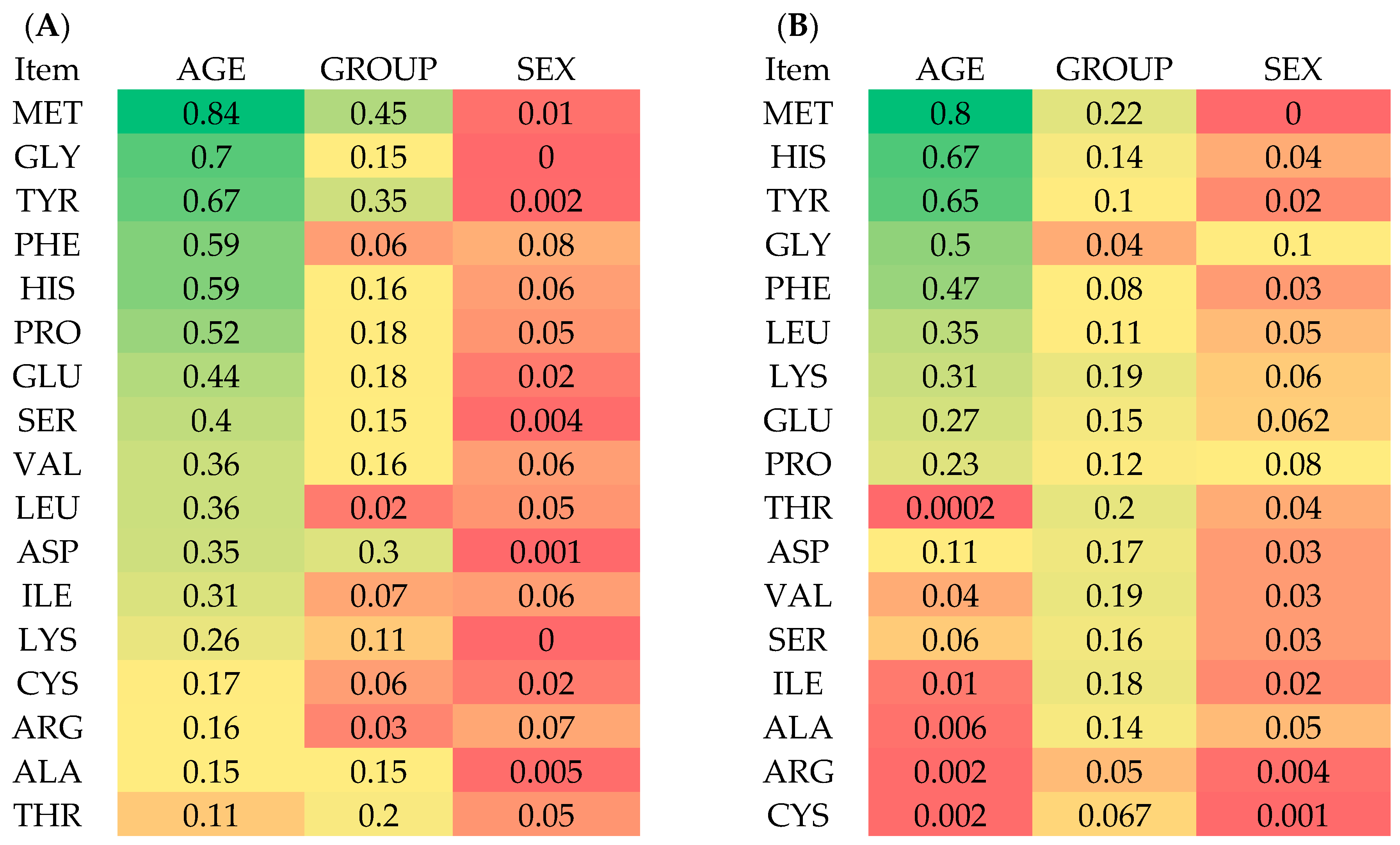
For the breast muscle, age was the main factor influencing the amino acid composition. Thus, a significant difference (p < 0.05) was obtained for 12 of the 17 determined protein amino acids: ASP, SER, GLU, GLY, MET, LEU, TYR, PHE, HIS, LYS, ARG, PRO. FOR ALA, CYS, VAL, and ILE, pronounced trends close to significant were revealed depending on age. THR was the only amino acid for which no significant relationship with age was found. The factor “group” was statistically significant for 7 of the 17 amino acids: ASP, THR, GLU, ALA, VAL, ILE, LYS. FOR SER, MET, and PRO, a pronounced trend close to significance was observed. Dependence of amino acid composition on sex was observed only for threonine (F = 4.597, p = 0.036). It can be concluded that the amino acid profile of the breast depends to a greater extent on the age of the birds.
Somewhat different trends were observed in the thigh. The factor “age” had a significant effect on 8 of the 17 amino acids: GLU, MET, LEU, TYR, PHE, HIS, LYS, and PRO. For 11 amino acids, a relationship with the factor “group” was found: ASP, THR, SER, GLU, ALA, VAL, ILE, LEU, LYS, ARG, and PRO. No dependence of amino acid content in the thigh on sex was found. Thus, the presence of the stress factor had a greater influence on the amino acid composition of the thigh muscle. In the thigh muscle, the effect of age on amino acid composition was also less pronounced.
Age and group had significant effects on the content of the following amino acids in the breast: ASP (p < 0.001), THR (p = 0.02 and p = 0.001), SER (p = 0.006 and p = 0.008), GLY (p < 0.001 and p = 0.008), ALA (p = 0.003 and p = 0.009), VAL (p < 0.001 and p = 0.005), MET (p < 0.001), TYR (p < 0.001), HIS (p < 0.001 and p = 0.006), LYS (p < 0.001 and p = 0.04), PRO (p < 0.001 and p = 0.003).
Thus, age is the dominant factor influencing the amino acid composition of both the breast and the thigh. The use of adaptogens and simulated environmental conditions had a moderate effect. The sex factor had the least pronounced effect on the amino acid composition of muscle tissue compared to age and housing and feeding conditions. The effect of sex was mainly manifested at an early age (24 days) and in the breast muscle. This indicates different levels of metabolic changes during the maturation of cockerels and pullets. Similar results were obtained by other authors [
58]. These findings have important practical implications and indicate that separating carcasses by sex is unnecessary.
Finally, beyond the mechanistic interpretation, the practical relevance of the observed amino acid changes deserves explicit consideration. Although the absolute differences between groups were numerically modest in some cases, their nutritional and commercial impact is substantial when evaluated in the context of specific amino acid functions. The most robust finding was the increase in methionine content—the first limiting amino acid in poultry meat—in the breast muscle at 52 days. In the S(+)DHQEC_1 group, methionine increased by 16.6% (from 2.17 to 2.53 g/100 g dry matter, p < 0.001) compared with the recommended-density control group (S(–)CON). This increment is nutritionally meaningful because methionine directly influences protein quality scores (e.g., PDCAAS) and is critical for glutathione biosynthesis, which plays a key role in antioxidant defense. From a practical standpoint, a 16.6% increase in the methionine content of meat reduces the need for synthetic methionine supplementation in feed formulations—a direct economic benefit, given that methionine is one of the most expensive feed additives. Even more pronounced effects were observed in the thigh muscle at 34 days, where methionine increased by 27.6% (from 1.63 to 2.08 g/100 g, p < 0.001) in the S(+)DHQEC_1 group compared with S(–)CON. This indicates that the adaptogen complex is particularly effective in protecting thigh muscle protein from stress-induced catabolism during the early stages of exposure, which is commercially relevant because thigh meat constitutes a substantial proportion of the carcass value. Regarding essential amino acid balance, the sum of essential amino acids (SEAA) in breast meat at 34 days increased by 2.2% (from 42.54 to 43.48 g/100 g, p < 0.001) in the high-density control group (S(+)CON) compared with S(–)CON. Although this increase is modest, it reflects a physiological adaptation to stress that may involve the mobilization of amino acids from other tissues. Notably, this effect was not observed in the adaptogen-supplemented groups, suggesting that adaptogens may redirect amino acids toward other metabolic needs, such as antioxidant defense or immune function. In contrast, high stocking density had a detrimental effect on lysine content in the thigh muscle at 34 days, with a 9.1% decrease (from 7.39 to 6.72 g/100 g, p < 0.05) in the S(+)CON group compared with S(–)CON. This depletion of lysine—the second limiting amino acid—is nutritionally concerning, as lysine is essential for growth and tissue repair. The adaptogen complex partially prevented this loss, although the effect was not statistically significant, suggesting that later administration may be less effective in protecting lysine reserves. Finally, while no statistically significant differences were observed for flavor-related amino acids (SFAA), we noted a biologically relevant trend: SFAA content in the S(+)DHQEC_1 group was maintained between days 34 and 52, whereas it declined in the other groups. This stabilization suggests that early adaptogen administration may help preserve sensory quality during extended rearing periods—a commercially valuable benefit, as it allows producers to achieve higher carcass weights without compromising meat palatability. Collectively, these findings indicate that although the absolute changes in individual amino acids are often modest, their cumulative effect on nutritional quality, feed efficiency, and product value is both tangible and commercially meaningful. The early administration of the DHQEC adaptogen complex appears to be a practical strategy for maintaining meat quality under intensive production conditions, particularly by protecting methionine reserves and stabilizing flavor-related amino acid profiles.




 ,
,