


Simple Summary
Dybowski’s frog (Rana dybowskii) is an economically and ecologically vital amphibian in Northeast Asia, primarily farmed for its high-value oviduct (Oviductus Ranae) used in medicine and functional foods. However, sustainable breeding and conservation are severely hindered by a lack of high-quality genomic resources. In this study, we constructed the first chromosome-level reference genome, spanning 3.77 Gb and organized into 12 chromosomes. We annotated 26,862 protein-coding genes and found genomic architecture dominated by DNA transposons, which may link to cold-adaptation mechanisms. This high-resolution genome resolves long-standing industrial bottlenecks by providing an essential molecular platform to accelerate marker-assisted sex control, behavioral traits mapping, and genetic resource conservation in amphibian aquaculture.
Abstract
Dybowski’s frog (Rana dybowskii) supports a multi-billion-dollar aquaculture sector in northern China and plays a critical ecological role in forest ecosystems. Despite its immense economic value, germplasm degradation and the mystery surrounding its homomorphic sex-determination system present major bottlenecks for the industry. Here, we integrated PacBio HiFi long-read sequencing, Illumina short-read sequencing, and High-Throughput Chromosome Conformation Capture (Hi-C) technologies to assemble the first chromosome-level reference genome of R. dybowskii. The final assembled genome size is 3.77 Gb, with a contig N50 of 16.27 Mb and a scaffold N50 of 41.54 Mb. A total of 97.82% of the sequences were successfully anchored onto 12 definitive pseudochromosomes corresponding to haploid chromosome number. Repetitive elements account for 65.61% of the genome, characterized by an unusual dominance of DNA transposons (37.19%) over retrotransposons, suggesting a genomic landscape shaped by extreme cold adaptation. Combining multi-tissue transcriptomic evidence, we structurally predicted 26,862 protein-coding genes, and the predicted gene set showed a BUSCO completeness of 96.1%. Functional annotation successfully categorized 96.55% of the total genes. This genomic resource successfully fills a crucial phylogenetic gap in the Rana genus, driving high-efficiency molecular breeding and sustainable conservation of this economic amphibian.
1. Introduction
Aquaculture is currently the fastest-growing food production sector globally, supplying critical animal protein, essential fatty acids, and micronutrients for the expanding human population [1]. To enhance the sustainability and production efficiency of this sector, genetic improvement of cultured species is essential. Recent advancements in high-throughput sequencing have transitioned aquaculture research into a multi-omics era, where genomics, transcriptomics, proteomics, and metabolomics are increasingly integrated to investigate complex biological traits in economic aquatic animals [2]. These molecular resources have shifted focus from traditional phenotypic selection toward targeted exploration of functional pathways regulating nutrient utilization, disease resistance, and growth endocrinology [3]. Crucially, chromosome-level reference genomes provide the necessary framework to anchor these multi-omics datasets, enabling the precise mapping of economic traits to specific genomic architectures and accelerating marker-assisted or molecular design breeding across diverse aquatic taxa [4].
In several regions, particularly East Asia and parts of Latin America, multiple amphibian species are intensively farmed for food, pharmacological materials, and ecological management [5,6]. The commercial cultivation of various frogs, toads, and giant salamanders has transitioned from traditional, small-scale ranching into structured, large-scale operations that generate substantial biomass and regional economic value [7]. Beyond providing high-quality animal protein, specific economic amphibians produce unique bioactive compounds, polypeptides, and specialized lipids highly utilized in pharmacy and functional food sectors [8]. Consequently, amphibian aquaculture provides critical financial incentives for rural development, establishing itself as a highly distinctive branch of modern aquatic animal production.
Despite their commercial value, amphibians present major genomic challenges due to their large genome sizes, high proportions of repetitive sequences, and extensive transposable elements (TEs) [9,10]. TEs are pivotal drivers of genomic expansion, structural diversification, and regulatory innovation in amphibians [11]. In Pelophylax, TE-silencing pathways participate in genome exclusion and clonal inheritance, maintaining genomic stability within hybrid systems [12,13]. Similarly, interspecific hybridization in polyploid Xenopus triggers DNA transposon activation and drives the evolution of piRNA-mediated silencing mechanisms [14,15]. However, while the impacts of TEs on structural evolution and hybridization are increasingly recognized, their functional roles in environmental adaptation and ecological diversification remain poor-ly understood in amphibians. These factors have historically impeded continuous sequence assembly, resulting in fragmented genome drafts. Recently, the integration of long-read sequencing and chromatin interaction mapping has broken these technical bottlenecks, leading to a rapid increase in chromosome-level genome assemblies for various economic frogs [16]. Beyond the classical model organism Xenopus laevis, high-quality reference genomes have been established for major commercially farmed species, including the American bullfrog (Aquarana catesbeiana) and the spiny-bellied frog (Quasipaa spinosa). Furthermore, within the Rana genus, chromosome-scale genomic resources have been generated for several ecological and evolutionary representatives, such as Rana kukunoris Nikolskii, 1918, Rana temporaria Linnaeus, 1758, Rana chensinensis David, 1875, and Rana italica [17,18]. These foundational datasets have significantly advanced our understanding of amphibian karyotype evolution, genomic organization, and the genetic mechanisms underlying growth, immunity, and environmental adaptation in aquaculture species.
Among economically vital amphibians, the Dybowski’s frog (Rana dybowskii Gunther 1876) stands out as a species whose immense commercial success and conservation are heavily bottlenecked by genomic data limitations. Native to Northeast Asia, R. dybowskii is highly adapted to cold environments, exhibiting a distinct life cycle characterized by extended hibernation from October to February and breeding from February to June [19,20]. Ecologically, it plays a vital role in controlling forest insect populations [21]. Commercially, R. dybowskii supports a large-scale aquaculture sector in northern China, involving over 500,000 practitioners and generating an annual economic output of USD 2.8–3.0 billion [22,23,24]. This industry is primarily driven by Oviductus Ranae (the lipid-rich oviductal secretion of adult females), which commands premium market prices of USD 30 to 50 per kg due to its immunomodulatory, antioxidant, and anti-fatigue properties [25]. However, due to its high market demand and classification as a near-threatened species by the IUCN, wild populations face severe declines and habitat fragmentation from overexploitation. Concurrently, captive farming still relies heavily on wild-caught stocks, leading to germplasm degradation, biosecurity risks, and unregulated translocations [26]. Because females possess virtually all the commercial value, deciphering the species’ evolutionary labile sex-determination system to generate “all-female” cohorts, alongside characterizing genes linked to cold adaptation and behavioral rhythms, is essential for both population conservation and industry sustainability.
To resolve these industrial bottlenecks and decode the genetic mechanisms governing these critical economic and ecological traits, a high-quality reference genome for R. dybowskii is an urgent necessity. In this study, we integrated PacBio HiFi long-read sequencing, Illumina short-read sequencing, and high-throughput Chromosome Conformation Capture (Hi-C) to construct the first chromosome-level reference genome assembly for R. dybowskii. The final assembled genome spans approximately 3.77 Gb, with 97.82% of the sequences successfully anchored onto 12 pseudochromosomes, corresponding to the haploid chromosome set, yielding a scaffold N50 of 41.54 Mb and a genome assembly BUSCO completeness was 92.0%. A non-redundant reference set of 26,862 protein-coding genes was functionally annotated, revealing that repetitive elements account for 65.61% of the genome. This high-resolution genomic assembly provides a valuable genomic resource for the genus Rana, offering a foundation for future comparative genomic, transcriptomic, and proteomic studies, with potential applications in molecular breeding, genetic management, and conservation of this economically important amphibian.
2. Materials and Methods
2.1. Ethics Statement
Although R. dybowskii is listed as “Near Threatened” on the IUCN Red List, in China it is regarded as an important economic frog species and is neither endangered nor nationally protected. All experiments were performed in accordance with the guidelines for scientific purposes, animal care, and use formulated by the Animal Ethics Committee of Shenyang Agricultural University (protocol code SNLL25101501 and date of approval 20251015). All animal surveys were conducted in compliance with the guidelines established by the Shenyang Agriculture University Experimental Animal Management Committee.
2.2. Specimen Collection and Tissue Sampling
On 15 November 2025, 10 male adult Rana dybowskii (mean weight 25.18 g ± 7.62 g) were collected from a commercial breeding facility in Dandong, Liaoning Province, China (40°7′30″ N, 124°23′0″ E). The specimens were transported to the Aquatic Biology Laboratory of Shenyang Agricultural University and temporary maintained under standardized laboratory conditions (20–23 °C, 60–70% relative humidity, and a 12 h light/12 h dark cycle).
For whole-genome sequencing, a single healthy adult male was selected. Following euthanasia, high-quality genomic DNA was extracted for Illumina short-read, PacBio HiFi long-read, and Hi-C library construction. To provide transcriptional evidence for gene model annotation, six distinct tissue types were harvested from three adult individuals, including liver, heart, kidney, brain, and muscle from male frogs, alongside oviduct tissue from female frogs. All harvested tissue samples were immediately flash-frozen in liquid nitrogen and stored at −80 °C for DNA extraction and subsequent analysis.
2.3. Library Construction and High-Throughput Sequencing
For Illumina short-read sequencing, genomic DNA was extracted from the muscle tissue of the selected adult male individual using a modified CTAB protocol. The purity and concentration of the isolated DNA were assessed via agarose gel electrophoresis, a NanoPhotometer spectrophotometer (Implen, Westlake Village, CA, USA), and a Qubit fluorometer (Life Technologies, Carlsbad, CA, USA). A paired-end genomic library with a target insert size of 350 bp was constructed and sequenced on the Illumina NovaSeq 6000 platform (Illumina, San Diego, CA, USA) in paired-end 150 bp (PE150) mode to generate short reads for genomic survey analysis and subsequent base-level error correction.
For long-read sequencing, genomic DNA from the same specimen was prepared and sequenced on the PacBio Revio platform (Pacific Biosciences, Menlo Park, CA, USA) to generate high-fidelity (HiFi) reads for de novo assembly. To construct the chromosome conformation capture (Hi-C) library, fresh blood and muscle cells were cross-linked with formaldehyde, digested with restriction endonucleases, and enriched for ligated DNA fragments to capture spatial proximity information; the resulting library was sequenced on the Illumina platform in paired-end 150 bp (PE150) mode. Hi-C reads were processed using standard pipelines for read mapping and contact matrix construction. Chromosome scaffolding was performed using Hi-C-based assembly tools, followed by manual inspection and correction of potential misjoins based on interaction heatmaps. Concurrently, total RNA was extracted from the six harvested tissues (brain, muscle, liver, heart, kidney, and oviduct) to construct strand-specific RNA-seq libraries, which were sequenced on the Illumina platform to provide transcriptional evidence for subsequent gene model annotation. The final assembly was validated by intra-chromosomal interaction patterns in Hi-C contact maps. All high-throughput sequencing services were performed by Novogene Co., Ltd. (Tianjin, China).
2.4. Genome Size Estimation and Chromosome-Level Assembly
Raw data were quality-filtered using fastp (v1.3.3) to remove adapters and low-quality sequences, and a random subset was screened against the NCBI Nucleotide database using BLAST (v2.13.0+) to detect potential microbial contamination. The genome size, heterozygosity, and repeat content of R. dybowskii were computationally estimated via 17-mer frequency analysis using Jellyfish (v1.1.11) and GenomeScope (v2.0). The primary contig-level genome assembly was constructed from PacBio HiFi long reads using hifiasm (v0.21.0-r686), from which organellar (mitochondrial) sequences were identified via BLAST and excluded. To elevate the assembly to chromosome level, clean Hi-C reads were mapped to the primary contigs, followed by scaffolding, ordering, and orientation using the 3D-DNA pipeline and ALLHiC (v0.9.8). The final chromosomal contact matrix was manually reviewed and curated using Juicebox (v2.13.07) to correct misassemblies and define definitive pseudochromosome boundaries.
2.5. Repeat Sequence Annotation
A custom transposable element (TE) library was constructed de novo using RepeatModeler (v2.0.3) with default configurations. RepeatMasker (v4.1.2-p1) was subsequently employed to interrogate the assembly against both the custom de novo library and the Repbase database to identify and classify genomic repeats. Candidate repetitive sequences shorter than 100 bp or containing more than 5% ambiguous bases (‘N’) were discarded. The remaining non-redundant TE sequences were clustered using uclust and utilized to hard-mask the genome assembly prior to down-stream structural gene prediction.
2.6. Gene Model Structure Prediction and Functional Annotation
Structural annotation of the genome was performed using a comprehensive strategy integrating ab initio prediction, homology-based prediction and RNA-Seq evidence to annotate gene models. For gene predication based on Ab initio methods, Augustus (v3.5) and SNAP (2013-11-29) were used in our automated gene prediction pipeline on the repeat-masked genome. Meanwhile, for the prediction of genes based on similarities to existing sequences, published genome sequences in the NCBI database of three related frogs, including Rana temporaria, Xenopus laevis and Lithobates pipiens were collected. These sequences were then used to annotate the gene models in R. dybowskii using TBLASTN (v2.2.26; E-value ≤ 1e−5), and then the matching proteins were aligned to the genome for spliced alignments using GeneWise (v2.4.1) to infer gene structures.
Transcriptome reads were assembled using Trinity (v2.8.5). RNA-Seq reads from multiple tissues were aligned to the genome fasta using Hisat2 (v2.2.1). RNA-seq data were used only as transcriptional evidence for gene model prediction and not for expression-based analyses. The resulting alignments were used as input for Stringtie (v2.2.1) for genome-guided transcript assembly. Trinity was used for de novo transcriptome assembly. A non-redundant reference gene set was generated by integrating gene predictions from three methods using EvidenceModeler v1.1.1, incorporating terminal exon support from PASA v2.4.135 for gene structure refinement and masked transposable elements as input for gene prediction. Specific gene families of interest were selected for subsequent manual curation by domain experts.
Functional annotation of genes was conducted using a two-pronged approach. Protein sequences were aligned against the NCBI non-redundant protein (NR) database and the Swiss-prot database utilizing DIAMOND (v2.1.9), ensuring efficient sequence alignment. EggNOG-mapper was used to annotate protein sequences, leveraging the Kyoto Encyclopedia of Genes and Genomes (KEGG), Gene Ontology (GO) terms, and Pfam to provide comprehensive functional insights.
2.7. Quality Assessment and Technical Validation
The completeness and structural integrity of the chromosome-level assembly and corresponding gene sets were systematically evaluated using Benchmarking Universal Single-Copy Orthologs (BUSCO, v6.0.0) against the conserved vertebrate lineage database (vertebrata_odb10). To assess base-level consensus accuracy, clean Illumina short reads were mapped back to the definitive pseudochromosomes using BWA-MEM. Alignment constraints, genome coverage profiles, and local sequencing depth distributions were calculated via SAMtools to rigorously validate the continuity and fidelity of the final genomic blueprint.
3. Results
3.1. Genome Survey and DNA Sequence Quality Control
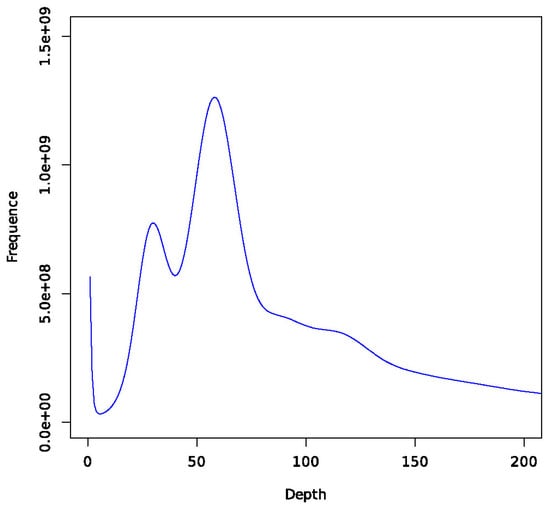
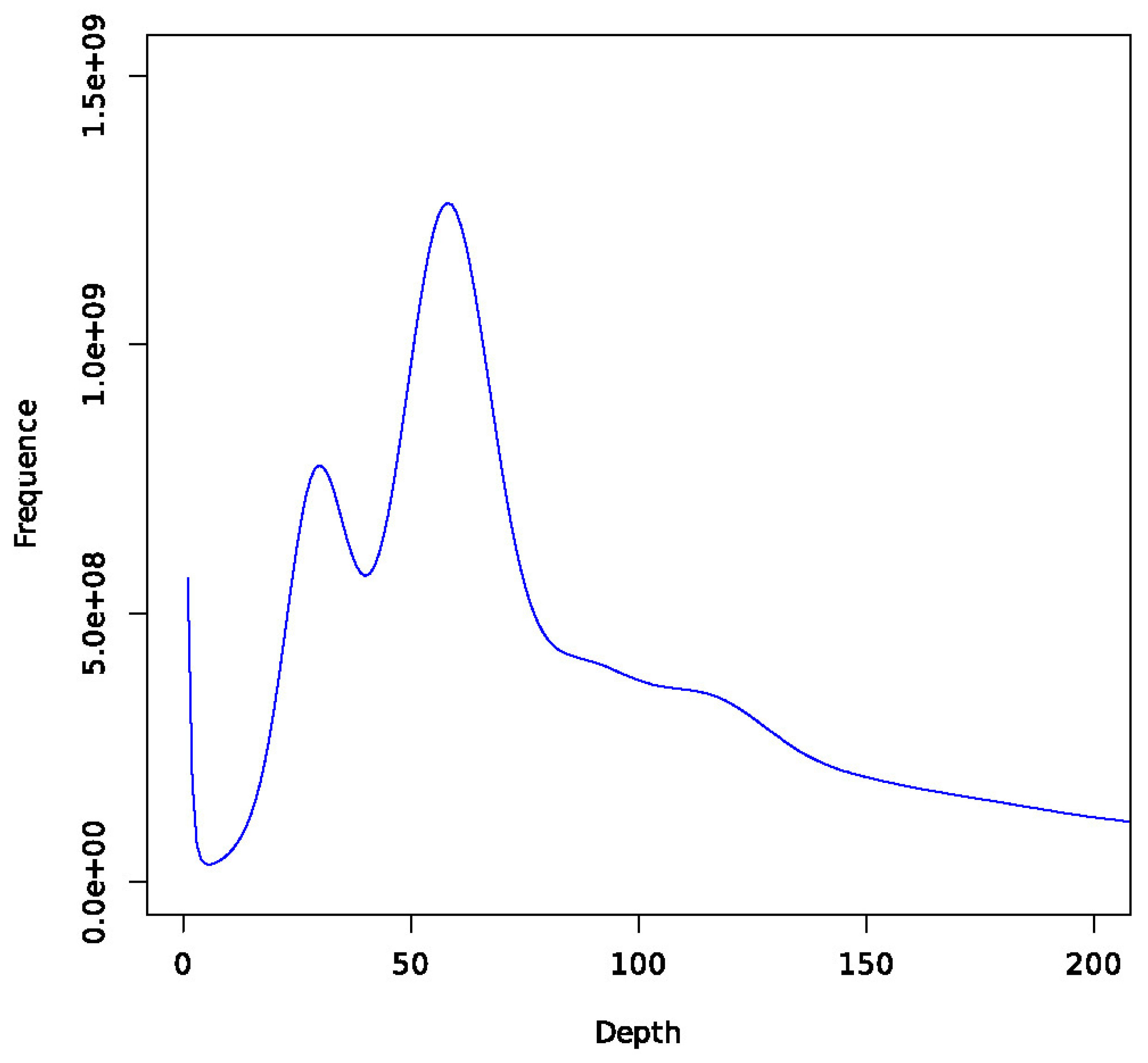
Illumina NovaSeq 6000 sequencing generated 230.52 Gb of raw paired-end short reads (Table 1). After strict filtration using fastp, the remaining clean data exhibited high base-accuracy, with Q20 and Q30 quality scores reaching 99.19% and 98.38%, respectively, and an average GC content of 44.84%. To evaluate the genomic landscape, a 17-mer frequency analysis was executed using Jellyfish and GenomeScope 2.0, The K-mer distribution displayed a clear bimodal profile (Figure 1). Based on this 17-mer mathematical model, the estimated genome size of R. dybowskii was calculated to be 3.31 Gb, with a genomic heterozygosity rate of 1.36% and a repetitive sequence content of 68.98% (Table S1).
Table 1.
Library sequencing data and methods used in this study to assemble the Rana dybowskii genome.
Figure 1.
Chromosome-level genome assembly of Rana dybowskii K-mer frequency distribution curve.
3.2. Chromosome-Level Genome Assembly and Quality Validation
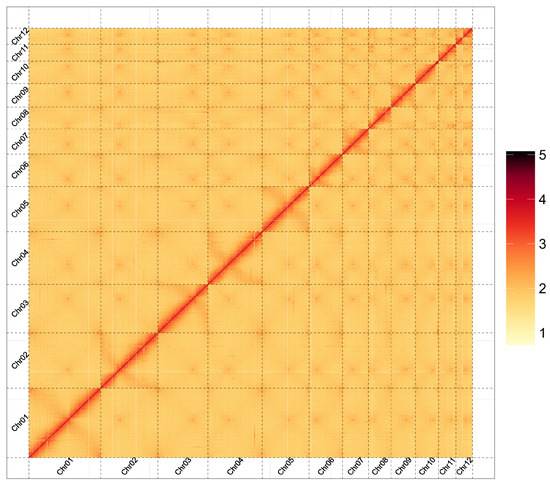
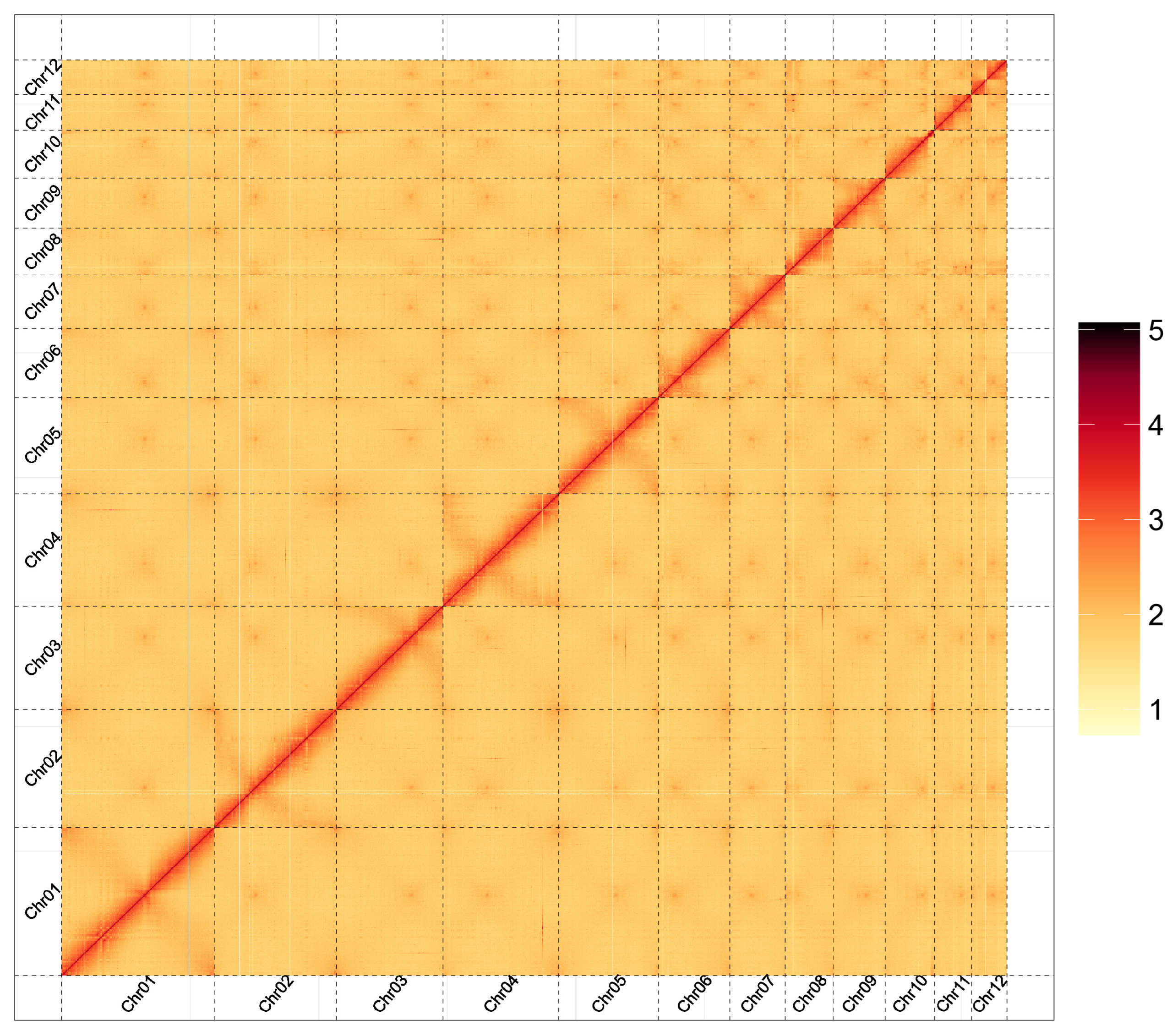
De novo assembly of PacBio HiFi long reads (106.7 Gb) using hifiasm yielded a primary contig assembly of 3.77 Gb, comprising 791 contigs with a contig N50 of 16.27 Mb and a maximum length of 91.51 Mb (Table 1). Integrating 489.4 Gb of Hi-C interaction data via ALLHiC and the 3D-DNA pipeline anchored 3.69 Gb (97.82%) of the contig sequences onto 12 definitive pseudochromosomes (Figure 2). The final assembly exhibited a scaffold N50 of 41.54 Mb and a maximum scaffold length of 501.99 Mb (Table 2). BUSCO analysis of the genome assembly against the vertebrata_odb10 database identified 3086 complete orthologs, indicating a genome assembly completeness of 92.0%, including 3034 single-copy (90.5%) and 52 duplicated (1.5%) genes, with 57 fragmented (1.7%) and 211 missing (6.3%) orthologs (Table 3). Base-level consensus validation using BWA-MEM showed that 98.40% of the clean Illumina short reads mapped back to the assembly, achieving 98.95% genome-wide coverage at an average sequencing depth of 55.55X.
Figure 2.
Chromosome-level genome assembly of Rana dybowskii Hi-C interaction heatmap, the color bar representing validation of the Hi-C-assisted pseudo-chromosome assembly by calculation of the thermal interaction correlation.
Table 2.
Statistics of the draft genome.
Table 3.
Statistics of genome assembly.
3.3. Repetitive Element Characterization
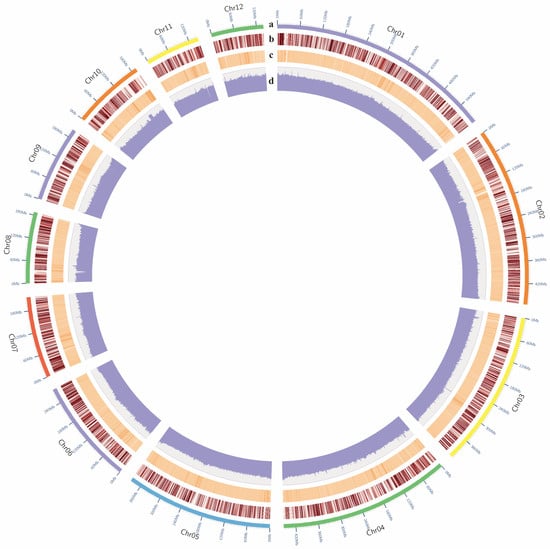
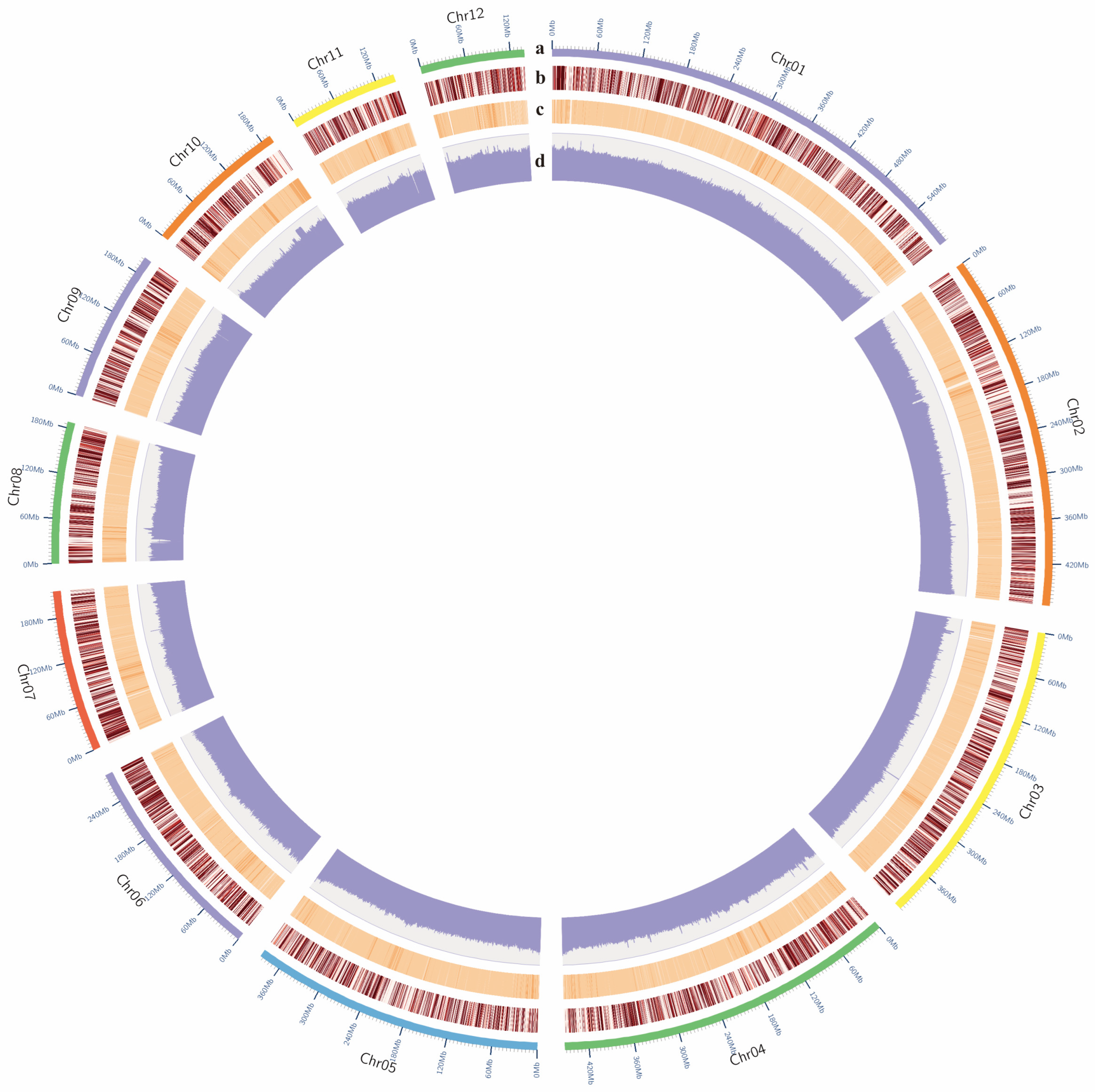
Repetitive elements spanned 2,473,706,726 bp, accounting for 65.61% of the R. dybowskii genome assembly (Table 4). Transposable elements (TEs) constituted the majority of these genomic repeats. Among classified TE categories, DNA transposons were dominant, encompassing 1,403,284,334 bp and representing 37.19% of the total assembly. Retrotransposons comprised the second largest group, covering 1,029,910,240 bp (27.29%). Within the retrotransposon superfamily, Long Terminal Repeat (LTR) elements were the most prominent subclass, spanning 590,443,006 bp (15.65%), followed by Long Interspersed Nuclear Elements (LINEs) at 426,854,233 bp (11.31%) and Short Interspersed Nuclear Elements (SINEs) at 12,613,001 bp (0.33%). The chromosomal distribution and density of these repetitive elements across the 12 pseudochromosomes were visualized in the genomic landscape map (Figure 3).
Table 4.
Summary of the repetitive sequences in Rana dybowskii genome.
Figure 3.
Genomic features of Rana dybowskii. Tracks from the outermost to the innermost circle separately represent (a) sizes of the 12 pseudochromosomes (Mb), (b) Gene density, (c) Repeat sequence density, (d) GC content.
3.4. Gene Model Structure Prediction
The integrated annotation pipeline utilizing ab initio genomic prediction, protein homology mapping, and six-tissue RNA-seq transcripts identified a consensus set of 26,862 protein-coding genes within the R. dybowskii genome. BUSCO analysis of the predicted gene set against the vertebrata_odb10 database recovered 3225 complete single-copy orthologs, representing 96.1% completeness. including 3114 single-copy (92.8%) and 111 duplicated (3.3%) genes, with only 49 fragmented (1.5%) and 80 missing (2.4%) orthologs recorded (Table 3).
3.5. Functional Annotation of Predicted Genes
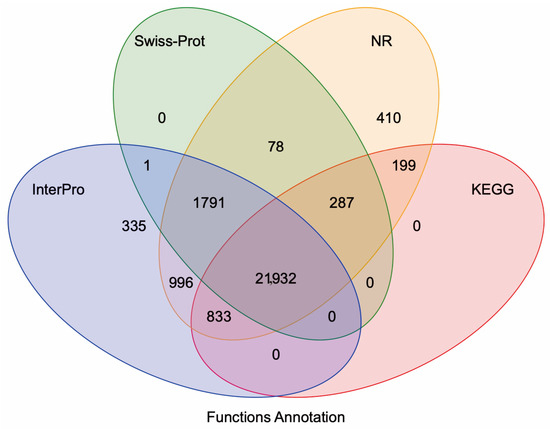
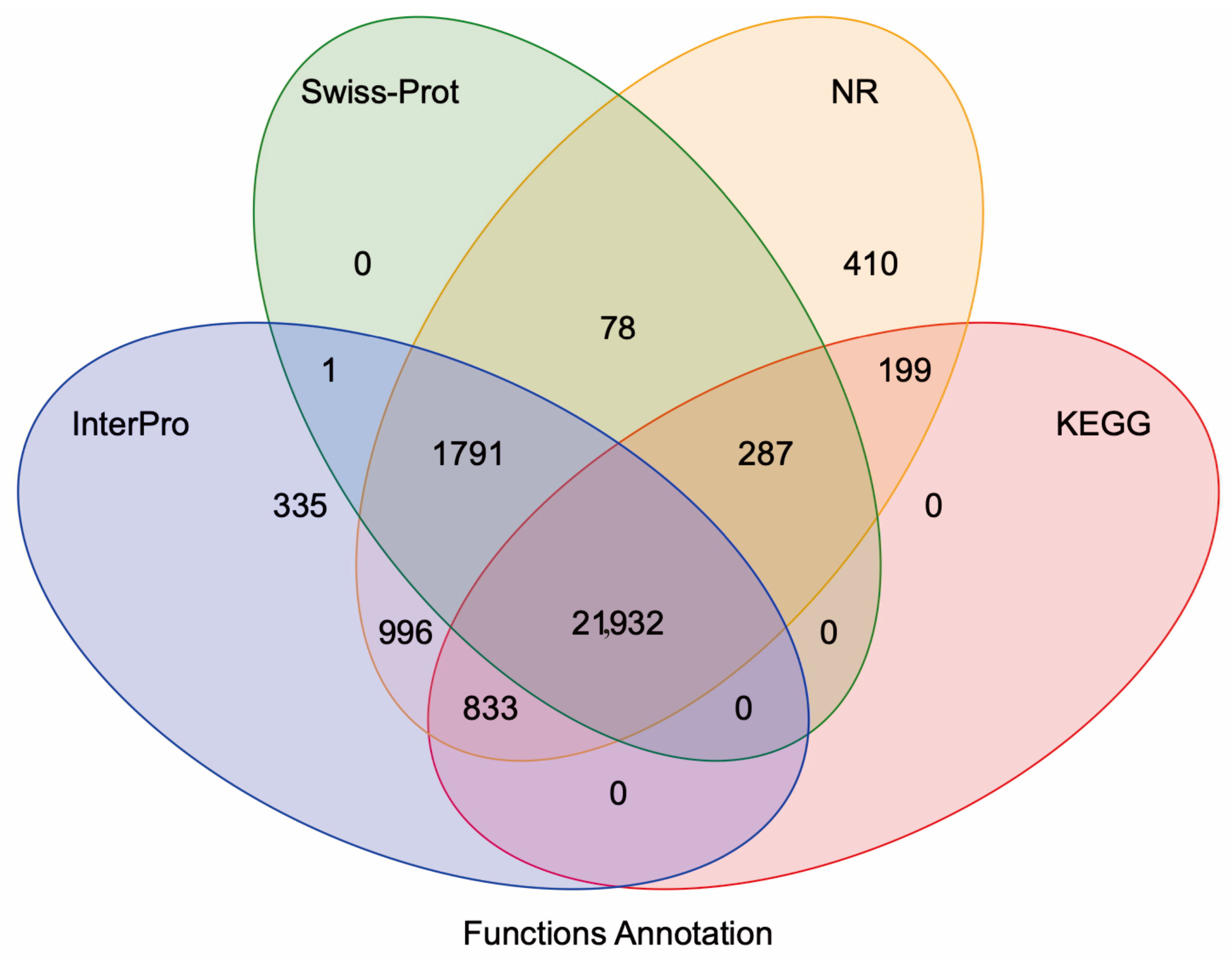
Functional annotation successfully assigned functional terms to 25,934 of the 26,862 predicted genes, representing an overall annotation rate of 96.55% (Table 5). Specifically, 25,610 genes (95.34%) exhibited significant alignments against the NCBI Non-Redundant Protein (NR) database, and 23,257 genes (86.58%) were validated via the UniProtKB/Swiss-Prot database. For pathway and category classifications, eggNOG-mapper assigned functional descriptors to 22,448 genes (83.57%) in the Kyoto Encyclopedia of Genes and Genomes (KEGG) database, 19,996 genes (74.46%) in the Gene Ontology (GO) database, and 22,236 genes (82.78%) in the Pfam database. A multi-database intersection analysis revealed a robust core of 21,932 genes concurrently supported by all four major functional databases, underscores the high reliability of the final annotated genomic blueprint (Figure 4).
Table 5.
Functional annotation of Rana dybowskii genes.
Figure 4.
Venn diagram of functional annotation of Rana dybowskii genes across databases.
4. Discussion
The Rana dybowskii genome assembled in this study spans 3.77 Gb, exhibiting the characteristic genomic gigantism distinctively common among temperate ranid frogs, while striking a sharp contrast with smaller model anuran genomes such as Xenopus laevis (2.1 Gb) [27]. Structurally, the genome size of R. dybowskii represents an intermediate evolutionary node within the Eurasian brown frog lineage, being more compact than the high-altitude adapted Rana kukunoris (4.83 Gb) and Rana temporaria (4.11 Gb), yet larger than its sympatric relative Rana chensinensis (3.0 Gb) [18,28,29]. When contrasted with the American bullfrog (Aquarana catesbeiana), a premier global aquaculture gigant with a massive estimated genome of approximately 6.37 Gb, R. dybowskii showcases a more streamlined yet highly complex macro-chromosomal framework [30]. Backed by a contig N50 of 16.27 Mb and a scaffold N50 of 41.54 Mb, this assembly effectively establishes a high-fidelity reference standard for the genus Rana. In comparison, the recently reported R. chensinensis genome, despite achieving a higher scaffold N50 of 484.14 Mb due to Hi-C scaffolding, was assembled with a substantially lower contig N50 of only 2.34 Mb. By contrast, the highly contiguous primary assembly of R. dybowskii provides a reliable chromosome-scale genomic resource that will facilitate future studies on genome evolution, adaptation, sex determination, and conservation genetics in frogs. Notably, the chromosome-level genome assembled in this study was derived from a single male individual. It does not capture the full spectrum of population-level genomic architecture or structural variations across the species’ geographic range. Future population-scale genomic investigations, incorporating wider geographic sampling and pan-genomic approaches, are warranted to comprehensively assess intraspecific genetic variation, validate transposable element frequencies, and fully elucidate the fine-scale evolutionary dynamics of this species.
4.1. Transposable Element Landscapes Driven by Extreme Cold Adaptation
In contrast to the LTR-dominated TE landscapes of R. kukunoris (LTRs: 29.65%; DNA: 17.97%) and R. temporaria (LTRs: 33.07%; DNA: 22.88%), R. dybowskii exhibits a reversed pattern, with DNA transposons (37.19%) far outnumbering LTRs (15.65%) [18,28]. A similar DNA transposon dominance is also observed in R. chensinensis (DNA: 36.88%; LTRs: 26.24%) [18]. Geographic overlap among Pelophylax species leads to recurrent hybridization [31]. In these hybridogenetic systems, transposable element silencing genes modulate genome elimination and clonal inheritance to maintain genomic stability [32]. The integration of the RanaCR1 retrotransposon into intron 1 of the serum albumin gene in Pelophylax frogs illustrates how interspecific contact directly shapes lineage-specific genomic loci [33]. This influx of foreign DNA through asymmetric introgression likely induced a “genomic shock” that disrupted epigenetic silencing, thereby triggering massive DNA-transposon bursts and driving population-level genomic heterogeneity. Unlike LTR retrotransposons suppressed by host defenses, DNA transposons follow distinct post-hybridization trajectories correlated with subgenome-biased DNA loss, restricting further uncontrolled hybridization [14]. In hybridogenesis models, such genomic instability triggers maternal-mediated paternal chromosome loss and genome elimination, resulting in hybrid inviability [12,34]. Intriguingly, R. dybowskii primarily inhabits the Changbai Mountain range in northern China, a region sympatrically shared by multiple congeners, including R. chensinensis, R. amurensis and Rana huanrenensis [35]. Notably, divergence-dating and ancestral area reconstructions indicate a Miocene origin for the R. dybowskii species complex driven by the orogenic movement of the Changbai Mountain Range, whereas other Northeast Asian anuran lineages diverged later during the Pleistocene [36]. This extended evolutionary timescale and prolonged sympatry provided a vastly expanded temporal window for historical interspecific hybridization and reticulate evolution. Consequently, persistent genetic contact likely destabilized genomic equilibrium, serving as an evolutionary catalyst for the shared DNA-transposon expansion in R. dybowskii.
On the other hand, diverse environmental pressures have repeatedly influenced evolutionary trajectories in amphibians. R. dybowskii, R. chensinensis, and R. amurensis share cold-temperate northeastern Asian habitats with prolonged winter freezing. Severe environmental stressors, particularly the extreme low temperatures of high-latitude winters coupled with the profound hypoxia encountered during prolonged aquatic overwintering, can serve as powerful exogenous triggers capable of drastically reshaping transposable element landscapes. The elevational and plateau cold-stress adaptations of R. kukunoris [37], as well as the remarkable metabolic reprogramming and molecular resilience to severe oxygen deprivation observed in overwintering R. amurensis [38]. This physiological resilience is accompanied by rapid molecular responses. In R. dybowskii, low-temperature exposure alters the expression of GLUT4, a key regulator of glucose-mediated cryoprotection, indicating active metabolic adaptation to cold stress [39]. Environmental stress has also been proposed to affect genome evolution through the activation of transposable elements.
We speculate that severe freezing and winter hypoxia in northeastern China act in tandem with historical genomic shocks, triggering localized DNA transposon bursts. Over evolutionary timescales, the adaptive retention of these proliferating elements—potentially harboring and dispersing cis-acting Hypoxia Response Elements (HREs)—could have reconfigured the frog’s hypoxia-responsive networks. This synergetic intersection of historical interspecific hybridization and ongoing extreme climate adaptation provides a robust explanation for the unique DNA-transposon dominance in R. dybowskii, offering a crucial genomic foundation for its post-glacial range expansion and active dispersal into harsh sub-frigid niches.
4.2. High Genomic Heterozygosity as a Genetic Reservoir for Anti-Stress Selection
The genome of frogs is typically characterized by extensive repeat accumulations [16]. In this study, the heterozygosity rate of R. dybowskii was determined to be 1.36%, which reflects the genomic variation in the sequenced individual. This value is notably higher than that of R. kukunoris (0.4% to 0.7%), where low heterozygosity is likely a consequence of historical population bottlenecks induced by the harsh, restricted environments of the Tibetan Plateau [28]. Similarly, R. dybowskii exhibits superior genetic diversity compared to other economically significant anurans under intensive artificial selection or localized distributions, such as the American bullfrog (A. catesbeiana, 0.51%) and the spiny frog (Quasipaa spinosa, 0.44%) [30,40]. We hypothesize that the topographically complex terrains of Northeast Asia (specifically across northeastern China, the Russian Far East, and the Korean Peninsula) buffered the species against severe losses of genetic diversity during climatic fluctuations, minimizing genetic drift and preserving substantial standing genetic variation.
From a molecular breeding perspective, maintaining a genomic heterozygosity of 1.36% indicates that the wild population of R. dybowskii remains a highly enriched, non-degraded genetic reservoir. This pattern aligns with findings in Q. spinosa, where a well-preserved wild genetic diversity (heterozygosity of 0.44%) provides robust raw genetic materials for breeding growth- and disease-resistant traits [40]. In contrast, the critically endangered Andrias davidianus has suffered severe inbreeding depression and a dramatic loss of genomic heterozygosity due to a lack of protected wild genetic stocks [41]. This expansive standing variation provides an ideal target pool for identifying molecular signatures related to fitness traits. Breeders can utilize this high-diversity reference to screen for superior wild alleles linked to fast growth, robust immunity, and exceptional overwintering survival, transforming natural evolutionary adaptations into precise markers for molecular-guided genetic improvement [42,43].
4.3. Functional Gene Annotation: The Blueprint for Mapping Economic and Behavioral Traits
The multi-source annotation predicted 26,862 protein-coding genes within the R. dybowskii genome. This estimate falls comfortably within R. temporaria (23,707 genes), while remaining more streamlined than the high-altitude specialist R. kukunoris (32,304 genes) [28,29]. The expanded gene repertoire of R. kukunoris is largely attributed to the duplication and expansion of specific gene families associated with extreme hypoxia and intense UV-radiation responses on the Tibetan Plateau, an evolutionary pressure distinct from the cold-temperate adaptation of R. dybowskii [28]. It aligns closely with the spiny frog (P. nigromaculatus, 26,173 genes) but successfully avoids the severe over-prediction or gene-duplication artifacts frequently encountered in the massive genome assembly of the American bullfrog (A. catesbeiana, 32,046 genes), where unmasked repetitive pseudogenes often lead to inflated annotations [30,40]. By anchoring our gene models with empirical transcriptomic evidence derived from six distinct tissues, The protein-level BUSCO completeness score was 96.1%, whereas the genome assembly BUSCO score was 92.0%, reflecting BUSCO evaluation at different annotation levels.
In R. dybowskii aquaculture, artificial feed adaptation and female ratio improvement are limiting production efficiency. Unlike A. catesbeiana and Q. spinosa, which have been successfully transitioned to pelleted feeds, R. dybowskii typically exhibits a rigid reliance on live prey, making dietary domestication under fully artificial farming conditions exceptionally difficult. The 26,862 protein-coding genes identified in this high-fidelity genome sequence offer an indispensable molecular baseline to explore the genetic architecture governing this behavioral rigidity. In anurans, the transition from movement-triggered striking to stationary feed acceptance relies heavily on a complex interplay between visual perception, olfaction, and central metabolic signaling [44,45]. Functional genomic studies in other frogs highlight that expansions or contractions in specific sensory gene families—such as visual opsins, olfactory receptors, and vomeronasal receptors—directly dictate species-specific foraging niches [46,47]. For instance, while stream-dwelling anurans like Q. spinosa rely heavily on expanded chemosensory receptor repertoires for nocturnal foraging, highly visual predators depend on conserved retinal signaling cascades for prey tracking [40]. Furthermore, downstream appetite regulation and feed intake are tightly modulated by central neuroendocrine pathways, specifically the leptin, proopiomelanocortin, and neuropeptide Y networks [48]. Identifying sequence polymorphisms or expression variations in these 26,862 coding models will allow researchers to pinpoint why R. dybowskii lacks the behavioral plasticity seen in A. catesbeiana. Ultimately, this precise functional inventory shifts the focus from empirical husbandry trials to targeted molecular selection, laying the groundwork for identifying functional markers associated with pelleted-feed tolerance.
4.4. A Chromosome-Scale Platform for Sex Determination and Applied Breeding Diagnostics
The exceptional continuity of the R. dybowskii genome assembly—highlighted by a remarkably high contig N50 of 16.27 Mb and the successful anchoring of 97.82% of sequences onto 12 definitive pseudochromosomes. The 12 assembled pseudochromosomes perfectly align with the known haploid chromosome number documented in previous karyotype studies of R. dybowskii and its close Eurasian congeners like R. amurensis [49]. In R. dybowskii aquaculture, executing precise sex control is of paramount commercial significance, given that only females yield the economically valuable oviduct (Oviductus Ranae). In evolutionary biology, the genus Rana serves as a premier model animal for studying the turnover of homomorphic sex chromosomes and the driving mechanisms behind candidate sex-determining genes, such as Dmrt1, as comprehensively detailed in R. temporaria [29]. To date, significant efforts have been made to characterize the molecular dimorphism between sexes [50]; for instance, transcriptomic profiling of R. dybowskii during the reproductive period has successfully identified crucial differentially expressed genes (DEGs) between the testis and ovary, offering a fundamental snapshot of gonad-specific regulatory networks [51]. However, without a high-quality physical map, reconciling these expressed transcripts with their macro-syntenic positions on homomorphic sex chromosomes remained a major hurdle.
Crucially, recent investigations suggest that environmental fluctuations can significantly alter the phenotypic sex and secondary sexual characteristics of R. dybowskii (unpublished data), revealing a high degree of phenotypic plasticity or potential sex-reversal triggered by external stressors such as thermal anomalies or endocrine-disrupting contaminants. In anurans with homomorphic sex chromosomes, such environmentally induced discordance between genetic sex and phenotypic sex poses a severe threat to sustainable aquaculture, as cryptic mass masculinization can drastically deplete productive female cohorts. By establishing a continuous, near-complete chromosomal coordinate system, this assembly provides an genomic resource genomic map for future population-level resequencing and genome-wide association studies (GWAS) to characterize the cryptic, non-recombining X/Y or Z/W sex-determining regions in R. dybowskii. Moreover, as an environmental bioindicator, R. dybowskii populations face mounting anthropogenic and environmental stressors [52,53]. Thus, a chromosome-level reference serves as a genomic platform for monitoring environmental pollution and evaluating wild population resilience via fitness-associated locus tracking, providing a genomic resource that may facilitate basic ecological observations of environmental adaptation to future ecological and molecular breeding research.
5. Conclusions
In conclusion, this study successfully generated the first high-fidelity, chromosome-level reference genome assembly for Rana dybowskii using an integrated multi-omics sequencing approach. The final 3.77 Gb assembly provides exceptionally high continuity (contig N50 of 16.27 Mb) and anchors 97.82% of genomic sequences onto 12 definitive chromosomes. Genomic landscape analyses revealed a high heterozygosity rate (1.36%) representing a non-degraded genetic reservoir, alongside a unique DNA-transposon-dominated repeat architecture potentially driven by long-term adaptation to prolonged winter freezing in Northeast Asia. Furthermore, our robust annotation of 26,862 protein-coding genes provides an accurate coding blueprint that bypasses historical gene-duplication artifacts. This chromosomal dataset provides an indispensable tool for future genome-wide association studies (GWAS) to delineate cryptic sex-determining regions, discover biomarkers for economically vital traits (e.g., oviduct hypertrophy and foraging behavior), and implement precise genetic diagnostics in commercial closed-colony breeding. Ultimately, this study bridges basic evolutionary ecology with applied molecular breeding, ensuring both the commercial sustainability and the wildlife conservation of R. dybowskii.
Supplementary Materials
The following supporting information can be downloaded at: https://www.mdpi.com/article/10.3390/ani16132027/s1, Table S1: Statistics of genome survey data.
Author Contributions
Conceptualization, Y.L. (Yuting Liu); methodology, Y.L. (Yuting Liu); software, L.K.; validation, J.L.; formal analysis, Y.L. (Yuting Liu); investigation, Y.L. (Yuting Liu), Y.L. (Yingdong Li); resources, Y.L. (Yingdong Li); data curation, Y.L. (Yingdong Li); writing—original draft preparation, Y.L. (Yuting Liu) and Y.L. (Yingdong Li); writing—review and editing, Y.L. (Yingdong Li); visualization, L.K., J.L.; supervision, Y.L. (Yingdong Li); project administration, Y.L. (Yingdong Li); funding acquisition, Y.L. (Yingdong Li). All authors have read and agreed to the published version of the manuscript.
Funding
This research was supported by the Special Project of Rana dybowskii (2025 and 2026) from the Department of Agriculture and Rural Affairs of Liaoning Province.
Institutional Review Board Statement
No endangered or protected species were collected in this study. Experiments were conducted in accordance with the Guidelines for the Care and Use of Animals for Scientific Purposes established by the Animal Ethics Committee of Shenyang Agricultural University (No. SNLL25101501), with minimal animal suffering.
Informed Consent Statement
Not applicable.
Data Availability Statement
The raw reads have been deposited in the NCBI database (BioProject number PRJNA1461158).
Acknowledgments
We thank Guofeng Ma for providing the frogs.
Conflicts of Interest
The authors declare no conflicts of interest.
References
- Gephart, J.A.; Golden, C.D.; Asche, F.; Belton, B.; Brugere, C.; Froehlich, H.E.; Fry, J.P.; Halpern, B.S.; Hicks, C.C.; Jones, R.C.; et al. Scenarios for global aquaculture and Its role in human nutrition. Rev. Fish. Sci. Aquac. 2020, 29, 122–138. [Google Scholar] [CrossRef] [Scilit]
- Yu, X.; Faggion, S.; Liu, Y.; Wang, B.; Zeng, Q.; Lu, C.; Hu, J.; Bargelloni, L.; Fang, L.; Bao, Z. Role of multi-omics in aquaculture genetics and breeding: Current status and future perspective. Sci. China Life Sci. 2025, 68, 2591–2604. [Google Scholar] [CrossRef] [Scilit]
- Kashyap, S.; Mishra, S.K.; Kumar, P.; Yadav, N.K.; Kumar, S.; Singh, Y.R.; Deb, S.; Mishra, S. Advancing aquaculture genetics through omics technologies: A Review. J. Fish. Zool. Sci. 2026, 1, 60–95. [Google Scholar] [CrossRef] [Scilit]
- Song, H.; Dong, T.; Yan, X.; Wang, W.; Tian, Z.; Sun, A.; Dong, Y.; Zhu, H.; Hu, H. Genomic selection and its research progress in aquaculture breeding. Rev. Aquac. 2023, 15, 274–291. [Google Scholar] [CrossRef] [Scilit]
- Weng, M.; Liu, X.; Zhang, C.; Shu, R.; Wang, A.; Zhang, H.; Wang, X.; Yang, H.; Zhang, J. A global review of the zoonotic potential and disease risks of amphibian parasites in bullfrog aquaculture. Rev. Aquac. 2025, 17, e70030. [Google Scholar] [CrossRef] [Scilit]
- Ribeiro, L.P.; Toledo, L.F. An overview of the Brazilian frog farming. Aquaculture 2022, 548, 737623. [Google Scholar] [CrossRef] [Scilit]
- Zheng, X.; Yang, J.; Declercq, A.M.; Zhang, J. The path forward for China’s bullfrog industry: Exploring green farming models. Rev. Aquac. 2025, 17, e70012. [Google Scholar] [CrossRef] [Scilit]
- Wickramasingha, B.; West, J.; Bellanthudawa, B.K.A.; Graziano, M.P.; Surasinghe, T.D. The multifaceted importance of amphibians: Ecological, biomedical, and socio-economic perspectives. Biology 2026, 15, 98. [Google Scholar] [CrossRef] [Scilit] [PubMed]
- Zuo, B.; Nneji, L.M.; Sun, Y.-B. Comparative genomics reveals insights into anuran genome size evolution. BMC Genom. 2023, 24, 379. [Google Scholar] [CrossRef] [Scilit]
- Bredeson, J.V.; Mudd, A.B.; Medina-Ruiz, S.; Mitros, T.; Smith, O.K.; Miller, K.E.; Lyons, J.B.; Batra, S.S.; Park, J.; Berkoff, K.C.; et al. Conserved chromatin and repetitive patterns reveal slow genome evolution in frogs. Nat. Commun. 2024, 15, 579. [Google Scholar] [CrossRef] [Scilit] [PubMed]
- Lam, W.L.; Seo, P.; Robison, K.; Virk, S.; Gilbert, W. Discovery of amphibian Tc1-like transposon families. J. Mol. Biol. 1996, 257, 359–366. [Google Scholar] [CrossRef] [Scilit] [PubMed]
- Miura, I.; Vershinin, V.; Vershinina, S.; Lebedinskii, A.; Trofimov, A.; Sitnikov, I.; Ito, M. Hybridogenesis in the water frogs from western Russian territory: Intrapopulation variation in genome elimination. Genes 2021, 12, 244. [Google Scholar] [CrossRef] [Scilit] [PubMed]
- Dedukh, D.; Krasikova, A. Delete and survive: Strategies of programmed genetic material elimination in eukaryotes. Biol. Rev. 2022, 97, 195–216. [Google Scholar] [CrossRef] [Scilit] [PubMed]
- Suda, K.; Suzuki, T.; Hayashi, S.; Okuyama, H.; Tsukamoto, D.; Matsuo, T.; Tamura, K.; Ito, M. Correlation between subgenome-biased DNA loss and DNA transposon activation following hybridization in the allotetraploid Xenopus Frogs. Genome Biol. Evol. 2024, 16, evae179. [Google Scholar] [CrossRef] [Scilit]
- Suda, K.; Hayashi, S.R.; Tamura, K.; Takamatsu, N.; Ito, M. Activation of DNA transposons and evolution of piRNA genes through interspecific hybridization in Xenopus frogs. Front. Genet. 2022, 13, 766424. [Google Scholar] [CrossRef] [Scilit] [PubMed]
- Kosch, T.A.; Crawford, A.J.; Lockridge Mueller, R.; Wollenberg Valero, K.C.; Power, M.L.; Rodríguez, A.; O’Connell, L.A.; Young, N.D.; Skerratt, L.F. Comparative analysis of amphibian genomes: An emerging resource for basic and applied research. Mol. Ecol. Resour. 2025, 25, e14025. [Google Scholar] [PubMed]
- Colston, T.J.; Pirro, S.; Pyron, R.A. The complete genome sequences of 64 species of amphibians. Biodivers. Genomes 2025. [Google Scholar] [CrossRef] [Scilit]
- Ai, Q.B.; Li, J.; Xie, S.Y.; Huang, C.H.; Feng, Y.; Xi, N.; Zhao, M.; Chen, W.; Wu, H. Genomics provides insights into high-altitude adaptation in plateau brown frog. J. Zool. 2025, 327, 313–326. [Google Scholar] [CrossRef] [Scilit]
- Liu, W.; Tao, J.; Yu, Q.; Wu, T.; Xing, B.; Bai, J.; Zhao, W.; Liu, Y.; Liu, P. Selection of geographical populations suitable for artificial breeding of the Northeast China Brown Frog (Rana dybowskii). Sci. Nat. 2025, 112, 66. [Google Scholar] [CrossRef] [Scilit] [PubMed]
- Kidov, A.; Ivolga, R.; Kondratova, T. Age structure and growth of the Dybowski’s frog (Rana dybowskii) from the urban population in the south of Primorsky Krai. Ecosyst. Transform. 2025, 8, 138–150. [Google Scholar]
- Xu, W.; Shi, H.; Li, Y. Effect of different feeding times on the structure of the intestinal flora of Rana dybowskii tadpole. Chronobiol. Int. 2025, 42, 1002–1012. [Google Scholar]
- Ji, H.; Shan, B.; Hu, N.; Zhang, M.; Li, Y. Impact of light spectrum on tadpole physiology and gut microbiota in the Dybowski’s frog (Rana dybowskii). Animals 2025, 15, 2066. [Google Scholar] [CrossRef] [Scilit]
- Li, Y.; Wang, M.; Ji, H.; Zhang, X.; Shan, B. Influence of shelter and hibernation on the 24-hour behavioral rhythms of male Dybowski’s frog (Rana dybowskii) across age groups. Animals 2026, 16, 978. [Google Scholar] [CrossRef] [Scilit] [PubMed]
- Long, X.-z.; Dong, W.-j.; Xu, M.-d.; Han, X.-d.; Han, X.-y.; Cui, L.-y.; Tong, Q. Impact of antibiotic therapy on cutaneous and gut microbiota in Rana dybowskii amphibians: Insights and implications. Aquaculture 2024, 588, 740866. [Google Scholar] [CrossRef] [Scilit]
- Zhang, Y.; Wang, Y.; Li, M.; Liu, S.; Yu, J.; Yan, Z.; Zhou, H. Traditional uses, bioactive constituents, biological functions, and safety properties of Oviductus ranae as functional foods in China. Oxidative Med. Cell. Longev. 2019, 2019, 4739450. [Google Scholar] [CrossRef] [Scilit]
- Wang, M.; Li, Y.; Hu, N.; Sun, S. Study on the preference of the Dybowski’s frog (Rana dybowskii) for different covering shelter. J. Appl. Anim. Welf. Sci. 2026, 29, 176–187. [Google Scholar] [CrossRef] [Scilit] [PubMed]
- Session, A.M.; Uno, Y.; Kwon, T.; Chapman, J.A.; Toyoda, A.; Takahashi, S.; Fukui, A.; Hikosaka, A.; Suzuki, A.; Kondo, M.; et al. Genome evolution in the allotetraploid frog Xenopus laevis. Nature 2016, 538, 336–343. [Google Scholar] [CrossRef] [Scilit] [PubMed]
- Chen, W.; Chen, H.; Liao, J.; Tang, M.; Qin, H.; Zhao, Z.; Liu, X.; Wu, Y.; Jiang, L.; Zhang, L. Chromosome-level genome assembly of a high-altitude-adapted frog (Rana kukunoris) from the Tibetan plateau provides insight into amphibian genome evolution and adaptation. Front. Zool. 2023, 20, e1. [Google Scholar]
- Streicher, J.W. The genome sequence of the common frog, Rana temporaria Linnaeus 1758. Wellcome Open Res. 2021, 6, 286. [Google Scholar] [CrossRef] [Scilit]
- Zhang, K.; Zhang, Y.; Tian, Y.; Xu, B.; Jiang, X.; Qin, Z.; Liu, C.; Lin, L. A Chromosome-level genome assembly of the American bullfrog (Aquarana catesbeiana). Sci. Data 2025, 12, 413. [Google Scholar] [CrossRef] [Scilit] [PubMed]
- Litvinchuk, S.N.; Skorinov, D.V.; Ivanov, A.Y.; Ermakov, O.A. Detection of glacial refugia and post-glacial colonization routes of morphologically cryptic marsh frog species (Anura: Ranidae: Pelophylax) using environmental niche modeling. Diversity 2024, 16, 94. [Google Scholar] [CrossRef] [Scilit]
- Plötner, M.; Meixner, M.; Poustka, A.J.; Grau, J.H.; Theusner, S.; Liere, K.; Schüllermann, T.; Doležálková-Kaštánková, M.; Choleva, L.; Plötner, J. New insights into the molecular basis of gametogenesis in the hybridogenetic water frog Pelophylax esculentus. Sci. Rep. 2026, 16, 5012. [Google Scholar] [CrossRef] [Scilit] [PubMed]
- Plötner, J.; Köhler, F.; Uzzell, T.; Beerli, P.; Schreiber, R.; Guex, G.-D.; Hotz, H. Evolution of serum albumin intron-1 is shaped by a 5′ truncated non-long terminal repeat retrotransposon in western Palearctic water frogs (Neobatrachia). Mol. Phylogenet. Evol. 2009, 53, 784–791. [Google Scholar] [CrossRef] [Scilit] [PubMed]
- Gibeaux, R.; Acker, R.; Kitaoka, M.; Georgiou, G.; van Kruijsbergen, I.; Ford, B.; Marcotte, E.M.; Nomura, D.K.; Kwon, T.; Veenstra, G.J.C.; et al. Paternal chromosome loss and metabolic crisis contribute to hybrid inviability in Xenopus. Nature 2018, 553, 337–341. [Google Scholar] [CrossRef] [Scilit] [PubMed]
- Borzée, A. Continental Northeast Asian Amphibians: Origins, Behavioural Ecology, and Conservation; Elsevier: Amsterdam, The Netherlands, 2024. [Google Scholar]
- Yang, B.-T.; Zhou, Y.; Min, M.-S.; Matsui, M.; Dong, B.-J.; Li, P.-P.; Fong, J.J. Diversity and phylogeography of Northeast Asian brown frogs allied to Rana dybowskii (Anura, Ranidae). Mol. Phylogenet. Evol. 2017, 112, 148–157. [Google Scholar] [CrossRef] [Scilit] [PubMed]
- Zhang, F.; Dong, B.; Zhao, Y.; Wang, W.; He, Y.; Zhang, X. Phylogeography and genetic diversity of Rana kukunoris on the Northeast Qinghai-Xizang Plateau: Insights from mitochondrial cytochrome b gene. Animals 2026, 16, e1013. [Google Scholar] [CrossRef] [Scilit] [PubMed]
- Shekhovtsov, S.V.; Bulakhova, N.A.; Tsentalovich, Y.P.; Zelentsova, E.A.; Yanshole, L.V.; Meshcheryakova, E.N.; Berman, D.I. Metabolic response of the Siberian wood frog Rana amurensis to extreme hypoxia. Sci. Rep. 2020, 10, 14604. [Google Scholar] [CrossRef] [Scilit] [PubMed]
- Guo, B.; Gong, S.; Zhang, J.; Chai, L.; Zhang, Y.; Wang, B.; Shao, J.; Xiao, X. Cloning and expression analysis of glucose transporter 4 mRNA in the cold hardiness frog, Rana dybowskii. CryoLetters 2017, 38, 339–346. [Google Scholar] [PubMed]
- Hu, X.; Jiang, Z.; Ming, Y.; Jian, J.; Jiang, S.; Zhang, D.; Zhang, J.; Zheng, S.; Fang, X.; Yang, Y.; et al. A chromosomal level genome sequence for Quasipaa spinosa (Dicroglossidae) reveals chromosomal evolution and population diversity. Mol. Ecol. Resour. 2022, 22, 1545–1558. [Google Scholar] [CrossRef] [Scilit] [PubMed]
- Liang, Z.-Q.; Chen, W.-T.; Wang, D.-Q.; Zhang, S.-H.; Wang, C.-R.; He, S.-P.; Wu, Y.-A.; He, P.; Xie, J.; Li, C.-W.; et al. Phylogeographic patterns and conservation implications of the endangered Chinese giant salamander. Ecol. Evol. 2019, 9, 3879–3890. [Google Scholar] [CrossRef] [Scilit] [PubMed]
- Sciuto, S.; Colli, L.; Fabris, A.; Pastorino, P.; Stoppani, N.; Esposito, G.; Prearo, M.; Esposito, G.; Ajmone-Marsan, P.; Acutis, P.L. What can genetics do for the control of infectious diseases in aquaculture? Animals 2022, 12, 2176. [Google Scholar] [CrossRef] [Scilit] [PubMed]
- Yanez, J.M.; Barria, A.; Lopez, M.E.; Moen, T.; Garcia, B.F.; Yoshida, G.M.; Xu, P. Genome-wide association and genomic selection in aquaculture. Rev. Aquac. 2023, 15, 645–675. [Google Scholar]
- Jungblut, L.D.; Reiss, J.O.; Pozzi, A.G. Olfactory subsystems in the peripheral olfactory organ of anuran amphibians. Cell Tissue Res. 2021, 383, 289–299. [Google Scholar] [CrossRef] [Scilit] [PubMed]
- Secor, S.M. Physiological responses to feeding, fasting and estivation for anurans. J. Exp. Biol. 2005, 208, 2595–2609. [Google Scholar] [CrossRef] [Scilit] [PubMed]
- Schott, R.K.; Fujita, M.K.; Streicher, J.W.; Gower, D.J.; Thomas, K.N.; Loew, E.R.; Bamba Kaya, A.G.; Bittencourt-Silva, G.B.; Guillherme Becker, C.; Cisneros-Heredia, D. Diversity and evolution of frog visual opsins: Spectral tuning and adaptation to distinct light environments. Mol. Biol. Evol. 2024, 41, msae049. [Google Scholar] [CrossRef] [Scilit] [PubMed]
- Kawai, F. Somatic ion channels and action potentials in olfactory receptor cells and vomeronasal receptor cells. J. Neurophysiol. 2024, 131, 455–471. [Google Scholar] [CrossRef] [Scilit] [PubMed]
- Crespi, E.J.; Denver, R.J. Roles of stress hormones in food intake regulation in anuran amphibians throughout the life cycle. Comp. Biochem. Physiol. Part A Mol. Integr. Physiol. 2005, 141, 381–390. [Google Scholar] [CrossRef] [Scilit]
- Green, D.M. Evidence for chromosome number reduction and chromosomal homosequentiality in the 24-chromosome Korean frog Rana dybowskii and related species. Chromosoma 1983, 88, 222–226. [Google Scholar] [CrossRef] [Scilit] [PubMed]
- Xu, Y.; Liu, H.; Jiang, X.; Zhang, X.; Liu, J.; Tian, Y.; Bai, X.; Cui, S.; Di, S. Genome survey of male Rana dybowskii to further understand the sex determination mechanism. Animals 2024, 14, 2968. [Google Scholar] [CrossRef] [Scilit] [PubMed]
- Zhang, X.; Shan, B.; Li, Y. Transcriptomic analysis of the differences in gene expression between testis and ovary of Dybowski’s frog (Rana dybowskii) in reproduction period. Gene 2025, 962, 149579. [Google Scholar] [CrossRef] [Scilit] [PubMed]
- Hu, N.; Li, Y.; Wang, M.; Ji, H.; Zhang, X.; San, B.; Shi, H. The circadian rhythm of the behavior and gut microbiota in Dybowski’s frogs (Rana dybowskii) during the Autumn migration period. Life 2024, 14, 322. [Google Scholar] [CrossRef] [Scilit] [PubMed]
- Xu, M.-d.; Dong, W.-j.; Long, X.-z.; Yang, X.-w.; Han, X.-y.; Cui, L.-y.; Tong, Q. Impact of wildfire ash on skin and gut microbiomes and survival of Rana dybowskii. J. Hazard. Mater. 2024, 474, 134729. [Google Scholar] [CrossRef] [Scilit] [PubMed]

Disclaimer/Publisher’s Note: The statements, opinions and data contained in all publications are solely those of the individual author(s) and contributor(s) and not of MDPI and/or the editor(s). MDPI and/or the editor(s) disclaim responsibility for any injury to people or property resulting from any ideas, methods, instructions or products referred to in the content. |
© 2026 by the authors. Licensee MDPI, Basel, Switzerland. This article is an open access article distributed under the terms and conditions of the Creative Commons Attribution (CC BY) license.