Article

Combined Effects of Heat and Cd2+ Stress on Growth, Physiology, and Transcriptomic Responses in Sipunculus nudus

1
College of Fisheries, Guangdong Ocean University, Zhanjiang 524088, China
2
Zhanjiang Experimental Station, Chinese Academy of Tropical Agricultural Sciences, Zhanjiang 524013, China
3
Guangdong Provincial Key Laboratory of Aquatic Animal Disease Control and Healthy Culture, Zhanjiang 524088, China
*
Author to whom correspondence should be addressed.
Animals 2026, 16(13), 1991; https://doi.org/10.3390/ani16131991 (registering DOI)
Submission received: 18 May 2026 / Revised: 10 June 2026 / Accepted: 25 June 2026 / Published: 27 June 2026

Simple Summary

Heat stress and heavy metal pollution are important environmental challenges for marine benthic organisms. This study investigated how elevated temperature and cadmium (Cd2+) exposure, alone and in combination, affect the peanut worm (Sipunculus nudus). The results show that heat stress intensified the toxic effects of Cd2+, leading to reduced growth and survival. In addition, heat and Cd2+ altered immune and antioxidant enzyme activities and affected multiple metabolic and detoxification pathways at the transcriptomic level. Under combined stress, pathways related to xenobiotic metabolism, nutrient digestion and absorption, and amino acid metabolism were significantly suppressed. These findings suggest that warming conditions may increase the sensitivity of marine benthic organisms to heavy metal pollution, posing potential risks to their health and to aquaculture sustainability.

Abstract

Heat and Cd2+ stress are major environmental challenges for marine benthic invertebrates. This study examined their combined effects on growth, physiology, and transcriptomic responses in the peanut worm (Sipunculus nudus). After 30 days, Cd2+ reduced survival at 26 °C without significantly affecting growth, whereas at 32 °C, both survival and growth declined with increasing Cd2+ concentration, indicating that heat stress exacerbates Cd2+ toxicity. Cd accumulation increased with exposure concentration but was not affected by temperature. Heat stress increased immune (AKP) and antioxidant (SOD, CAT) enzyme activities, although significant increases in SOD and CAT were observed only under Cd2+ exposure. AKP activity rose at low Cd2+ concentrations and fell at high Cd2+ concentrations at 26 °C, whereas no significant difference occurred at 32 °C between 0 and 0.25 mg/L Cd2+. At the same temperature, SOD and CAT activities were significantly higher under high Cd2+ exposure than under low Cd2+ exposure. Transcriptome analysis showed that Cd2+ exposure activated longevity-related pathways, protein processing, and translation initiation. Heat stress activated Jak-STAT signaling and endoplasmic reticulum protein processing while inhibiting the ribosome pathway. Under combined stress, pathways related to xenobiotic metabolism, nutrient digestion and absorption, and amino acid derivative metabolism were broadly suppressed. These results highlight that heat stress exacerbates Cd2+ toxicity, affecting growth, enzyme activity, and transcriptomic responses, and provide insights into the adaptive strategies of marine benthic organisms under the combined pressures of climate change and heavy metal pollution.

1. Introduction

Sipunculus nudus is an important marine fishery resource with high nutritional and medicinal value, with an annual production exceeding 20,000 tons in southern China [1], and it is often referred to as “marine cordyceps” [2]. It is widely distributed along the southern coast of China [3], including the Leizhou Peninsula and the Beibu Gulf. As a typical burrowing benthic invertebrate, S. nudus feeds primarily on organic matter in surface sediments [1]. This feeding strategy increases its susceptibility to accumulating environmental pollutants, particularly heavy metals, compared with pelagic organisms. Therefore, in addition to its economic importance, S. nudus is considered a potential bioindicator of marine sediment quality [4].
In recent years, seawater warming driven by global climate change and heavy metal contamination in coastal areas have emerged as major environmental stressors threatening marine ecosystems [5]. Temperature is a key factor regulating feeding, growth, and survival in marine invertebrates [6]. In the Leizhou Peninsula, a major aquaculture region for S. nudus, seawater temperatures have been reported to range from 17.23 to 33.23 °C [7], indicating that local populations may experience substantial thermal fluctuations under natural conditions. While moderate warming can enhance metabolic activity and growth [8], temperatures exceeding physiological thresholds can lead to reduced feeding, growth inhibition, and increased mortality [9,10]. Meanwhile, heavy metals are persistent and toxic pollutants that accumulate in ecosystems and exert long-term adverse effects on organisms [11].
Among various heavy metals, cadmium (Cd) has attracted considerable attention due to its high toxicity and strong bioaccumulation potential. Previous studies have reported widespread Cd contamination in major aquaculture areas of S. nudus. In the coastal waters of the Leizhou Peninsula, Cd concentrations in surface sediments have shown an increasing trend under anthropogenic influence [12], with ecological risk levels reaching high-risk categories in some regions [13]. Similarly, Cd contamination in the Beibu Gulf exhibits localized ecological risks resulting from both natural processes and human inputs [14]. Once entering organisms, Cd can induce oxidative stress by promoting the excessive production of reactive oxygen species (ROS), thereby damaging cellular components, and ultimately disrupting cellular structure and function [15]. For example, Cd exposure significantly increases ROS levels and oxidative damage indicators in clams (Meretrix spp.) and induces apoptosis [16]. In addition, Cd can disrupt energy metabolism, resulting in growth inhibition and reduced survival [17]. This pattern has also been observed in sea cucumbers (Apostichopus japonicus) exposed to elevated Cd levels [18]. Notably, temperature variation may further influence the bioavailability, uptake, and excretion of heavy metals, thereby modulating their accumulation and toxicity [19]. Consequently, seawater warming and heavy metal pollution may interact synergistically, imposing more severe combined stress on marine invertebrates.
Previous studies in marine invertebrates have shown that elevated temperature and heavy metal exposure can induce oxidative stress, physiological dysfunction, and growth inhibition [16,18]. However, although the effects of temperature [20] or single heavy metals [21] on S. nudus have been reported, information on the molecular responses to combined heat stress and Cd2+ exposure remains limited, and their underlying regulatory mechanisms are still poorly understood. In the present study, experimental temperatures were selected based on previously reported optimal growth performance of S. nudus, with 26 °C representing the ambient temperature and 32 °C simulating high-temperature stress [20]. Cd2+ concentrations (0, 0.25, and 3 mg/L) were chosen to cover a low to high sublethal range, with the low concentration representing environmentally relevant exposure levels reported in contaminated coastal environments [12] and the high concentration based on preliminary toxicity tests as a sublethal exposure level. Therefore, this study aimed to systematically evaluate the effects of these temperatures and Cd2+ concentrations on growth, survival, Cd accumulation, and immune and antioxidant responses in S. nudus, and transcriptome analysis was performed to elucidate the underlying molecular response mechanisms. This study provides a theoretical basis for understanding the adaptive strategies of marine benthic organisms under the combined pressures of climate change and heavy metal pollution.

2. Materials and Methods

2.1. Experimental Animals and Design

S. nudus individuals were collected from the intertidal zone of Haijiao Village, Leizhou City, Zhanjiang, Guangdong Province, China. The collection site is located in the Leizhou Peninsula, an important aquaculture area for S. nudus, where seawater temperatures have been reported to range from 17.23 to 33.23 °C and Cd contamination has been detected in coastal sediments [7,12]. Healthy individuals with intact body surfaces, active burrowing behavior, and uniform size were selected. All individuals were acclimated in filtered seawater for 3 days to allow gut clearance, thereby eliminating ingested sediment and ensuring accurate body weight measurement. The initial body weight was 1.65 ± 0.14 g (mean ± SD). The experiment was conducted in 20 L glass aquaria containing a 10 cm sand layer, with seawater salinity maintained at 35‰. Continuous aeration was provided, and water temperature was maintained at ±0.5 °C using thermostatic devices [22]. Each of the 18 aquaria contained 300 individuals, resulting in a total of 5400 individuals.
A two-factor completely randomized experimental design was applied, including two temperatures (26 °C and 32 °C) and three Cd2+ concentrations (0, 0.25, and 3 mg/L). Based on preliminary acute toxicity tests conducted at 32 °C, the 7-day safe concentration and median lethal concentration (LC50) of Cd2+ for S. nudus were estimated to be 0.246 mg/L and 4.910 mg/L, respectively. These preliminary tests were conducted prior to the main experiment to determine appropriate exposure levels for experimental design purposes. Accordingly, 0.25 mg/L and 3 mg/L were selected as the low and high Cd2+ exposure concentrations in the present study. The highest Cd2+ concentration was set at 3 mg/L to minimize mortality during the 30-day exposure period. After acclimation at 26 °C, individuals were randomly assigned to six treatment groups (three replicates each) to examine the effects of Cd2+, heat stress, and their interaction: control at 26 °C without Cd2+ (T26-C0); low and high Cd2+ at 26 °C (T26-C0.25, T26-C3); elevated temperature at 32 °C without Cd2+ (T32-C0); and combined Cd2+ and elevated temperature at 32 °C (T32-C0.25, T32-C3). Each replicate consisted of a separate tank, and individuals within a tank were considered the experimental unit. CdCl2·2.5H2O was used to prepare Cd2+ solutions. During the experiment, individuals were fed a formulated diet daily at 1% of total biomass [23]. Freshwater was added as needed to maintain salinity; Cd2+ concentrations were monitored and adjusted when necessary. Seawater was completely renewed weekly using freshly prepared seawater spiked with Cd2+ at the corresponding nominal concentrations for each treatment group to maintain stable exposure conditions throughout the experiment. After 30 days, survival was determined by counting the remaining live individuals. They were then transferred to clean seawater under the corresponding conditions for 3 days for gut clearance prior to body weight measurement. Body wall tissues were subsequently sampled, flash-frozen in liquid nitrogen, and stored at −80 °C for further analysis.

2.2. Growth Performance

At the end of the experiment, individuals were transferred to clean seawater without sediment for 3 days to allow gut clearance, thereby eliminating residual sediment and ensuring accurate body weight measurements. Survival was recorded for each treatment. Final body weight was measured for surviving individuals only. Survival rate (SR) and weight gain ratio (WGR) were calculated as follows:
SR (%) = 100 × Nt/N0
WGR (%) = 100 × (mtm0)/m0
where N0 and Nt represent the initial and final numbers of individuals, respectively, and m0 and mt represent the initial and final body weights (g), respectively.

2.3. Determination of Cd2+ Concentration

Approximately 2 g of body wall tissue (defined in this study as the outer body wall excluding gut contents, including the epidermis and underlying muscle layers) was collected from each individual. Samples were digested using a microwave digestion system, and Cd2+ concentrations were determined according to the Chinese national standard GB 5009.268-2016 [24] (Method I). For sediment analysis, approximately 100 g of sediment samples were dried at 80 °C to constant weight, followed by complete digestion using a mixture of hydrochloric acid, nitric acid, hydrofluoric acid, and perchloric acid. Cd2+ concentration was determined according to GB/T 17141-1997 [25]. The bioconcentration factor (BCF) was calculated as follows:
BCF = ci/ce
where ci represents the Cd2+ concentration in the organism, and ce represents the Cd2+ concentration in the environment.

2.4. Enzyme Activity Assays

Crude enzyme extracts from body wall tissues were prepared according to previously described methods [20]. The activities of alkaline phosphatase (AKP), acid phosphatase (ACP), catalase (CAT), and superoxide dismutase (SOD) were determined using commercial assay kits following the manufacturer’s instructions. All kits were obtained from Nanjing Jiancheng Bioengineering Institute (Nanjing, China).

2.5. RNA Extraction, Library Construction, and Sequencing

Total RNA was extracted from body wall tissues using TRIzol reagent (Invitrogen, Carlsbad, CA, USA) following previously described methods [26]. RNA quality, integrity, and concentration were assessed using a Fragment Analyzer. Poly(A) mRNA was enriched using oligo(dT)-attached magnetic beads and subsequently fragmented. The resulting fragments were used as templates for first- and second-strand cDNA synthesis using random hexamer primers. After end repair and A-tailing, sequencing adapters were ligated to the cDNA fragments. The products were PCR-amplified, purified using AMPure XP beads, and dissolved in EB buffer. The purified double-stranded cDNA was denatured into single-stranded DNA and circularized to construct single-stranded circular DNA (ssDNA) libraries. Sequencing was performed on an Illumina HiSeq 2000 platform by BGI Genomics Co., Ltd. (Shenzhen, China).

2.6. Sequencing Data Processing and Analysis

Raw sequencing data were processed using SOAPnuke v1.5.2 [27] to remove reads containing adapters, reads with more than 10% unknown bases (N), and low-quality reads (defined as reads in which more than 50% of bases had a quality score < 15). The resulting clean reads were retained in FASTQ format. Clean reads were aligned to the reference genome using HISAT2 v2.0.4 [28]. Subsequently, Bowtie2 v2.2.5 [29] was used to map reads to the reference gene sequences, and gene and transcript expression levels were quantified using RSEM v1.2.12 [30]. Differentially expressed genes (DEGs) were identified using DESeq2 v1.4.5 [31], with thresholds of false discovery rate (FDR) < 0.05 and |log2 fold change| > 1. Gene Ontology (GO) (http://www.geneontology.org/, accessed on 8 June 2026) and Kyoto Encyclopedia of Genes and Genomes (KEGG) (https://www.kegg.jp/, accessed on 8 June 2026) pathway enrichment analyses were performed for the DEGs using the hypergeometric test implemented in the phyper function of R. GO terms and KEGG pathways with FDR < 0.05 were considered significantly enriched.

2.7. Statistical Analysis of Experimental Data

Experimental data, including growth performance, enzyme activities, and Cd2+ concentrations, were analyzed using IBM SPSS Statistics 27 after being organized and processed in Microsoft Excel 2021. Prior to statistical analysis, data were tested for normality using the Shapiro–Wilk test and for homogeneity of variance using Levene’s test. Differences among treatments were assessed using one-way analysis of variance (ANOVA). Additionally, a two-way ANOVA was performed to evaluate the main effects of temperature and Cd2+ concentration as well as their interaction on growth, survival, and other measured parameters. Under the same temperature condition, Duncan’s multiple range test was applied to compare Cd2+ treatments. Under the same Cd2+ concentration, differences between temperature treatments were evaluated using an independent-samples t-test. Differences were considered statistically significant at p < 0.05.

3. Results

3.1. Effects of Temperature and Cd2+ on Growth and Survival of S. nudus

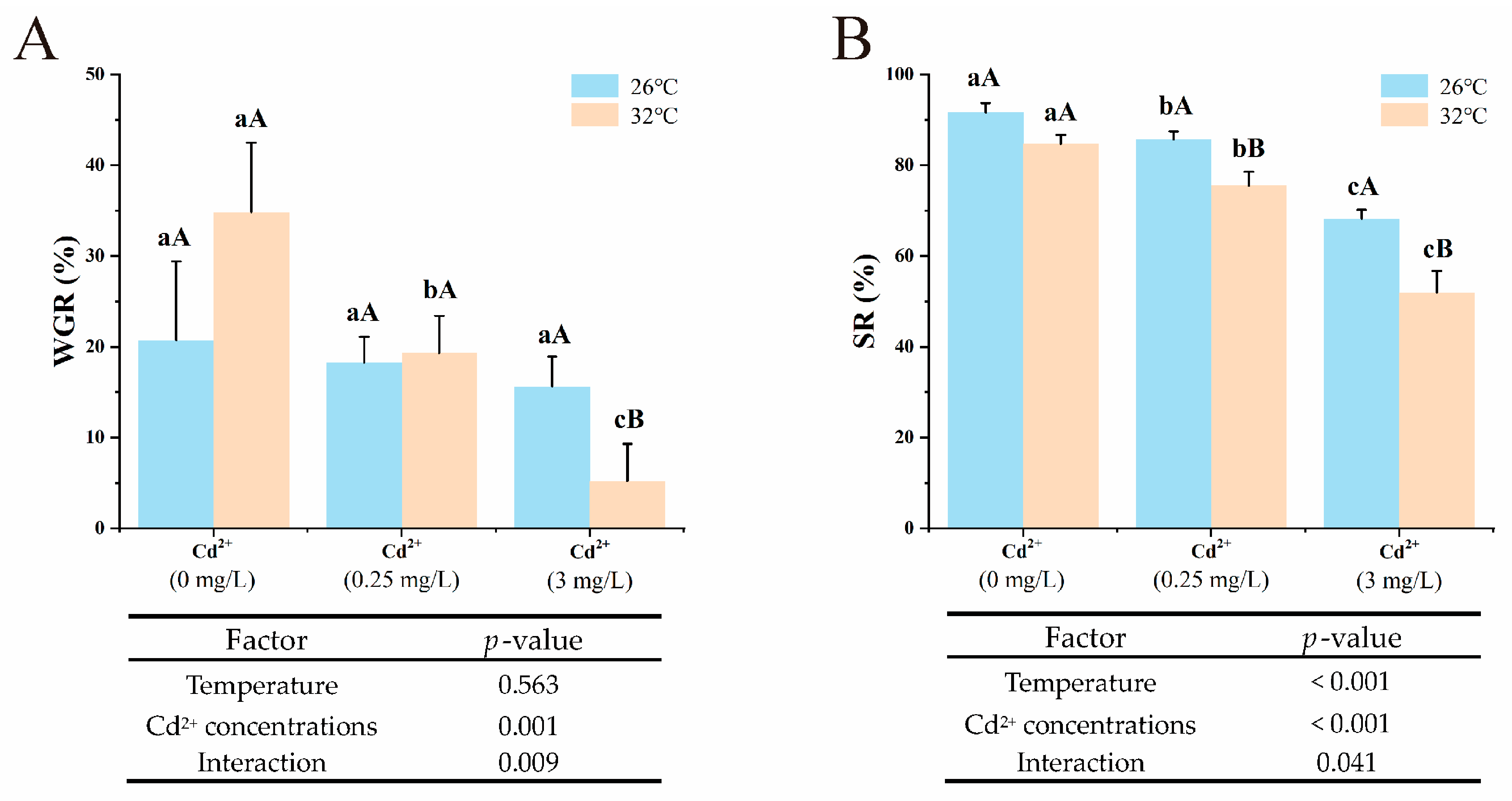
The weight gain ratio (WGR) of S. nudus under different treatments is shown in Figure 1A. At 26 °C, no significant differences in WGR were observed among Cd2+ concentrations (p > 0.05). In contrast, at 32 °C, WGR decreased significantly with increasing Cd2+ concentration (p < 0.05). At the same Cd2+ concentration, no significant differences in WGR were detected between 26 °C and 32 °C at 0 and 0.25 mg/L (p > 0.05), although the values were slightly higher at 32 °C. However, at 3 mg/L Cd2+, WGR at 32 °C was significantly lower than that at 26 °C (p < 0.05). Two-way ANOVA revealed a significant effect of Cd2+ concentration (p = 0.001) and a significant temperature × Cd2+ interaction (p = 0.009) on WGR, whereas the main effect of temperature was not significant (p = 0.563).
The survival rate (SR) of S. nudus is presented in Figure 1B. At both temperatures, SR decreased significantly with increasing Cd2+ concentration (p < 0.05), showing a clear dose–response relationship. At the same Cd2+ concentration, no significant difference in SR was observed between temperature groups in the control group (0 mg/L Cd2+). However, at 0.25 and 3 mg/L Cd2+, SR at 32 °C was significantly lower than that at 26 °C (p < 0.05). Two-way ANOVA indicated significant effects of temperature (p < 0.001), Cd2+ concentration (p < 0.001), and their interaction (p = 0.041) on SR.

3.2. Effects of Temperature and Cd2+ on Cd2+ Accumulation in the Body Wall of S. nudus

The Cd2+ content and bioconcentration factor (BCF) in the body wall of S. nudus are shown in Table 1. To account for potential effects of water exchange and sediment adsorption, Cd2+ concentrations in sediment interstitial water after 30 days were measured as the actual exposure levels. Cd2+ concentrations increased with increasing spiked doses in both water and sediment interstitial water, with sediment values slightly higher than those in the overlying water, likely due to residual Cd2+ retained during water exchange. In the control and elevated temperature groups without Cd2+ addition, Cd2+ was undetectable in water and sediment interstitial water, whereas trace amounts were detected in body wall tissues, likely reflecting pre-existing background accumulation. At the same Cd2+ exposure level, temperature had no significant effect on Cd2+ accumulation in the body wall (p > 0.05). In contrast, under the same temperature condition, Cd2+ content increased significantly with increasing exposure concentration (p < 0.05), showing a clear dose-dependent pattern, while the BCF decreased with increasing Cd2+ concentration. Two-way ANOVA further confirmed that Cd2+ concentration significantly affected Cd2+ accumulation in the body wall (p < 0.001), whereas neither temperature (p = 0.790) nor the temperature × Cd2+ interaction (p = 0.966) had a significant effect.

3.3. Effects of Temperature and Cd2+ on Immune and Antioxidant Enzyme Activities in S. nudus

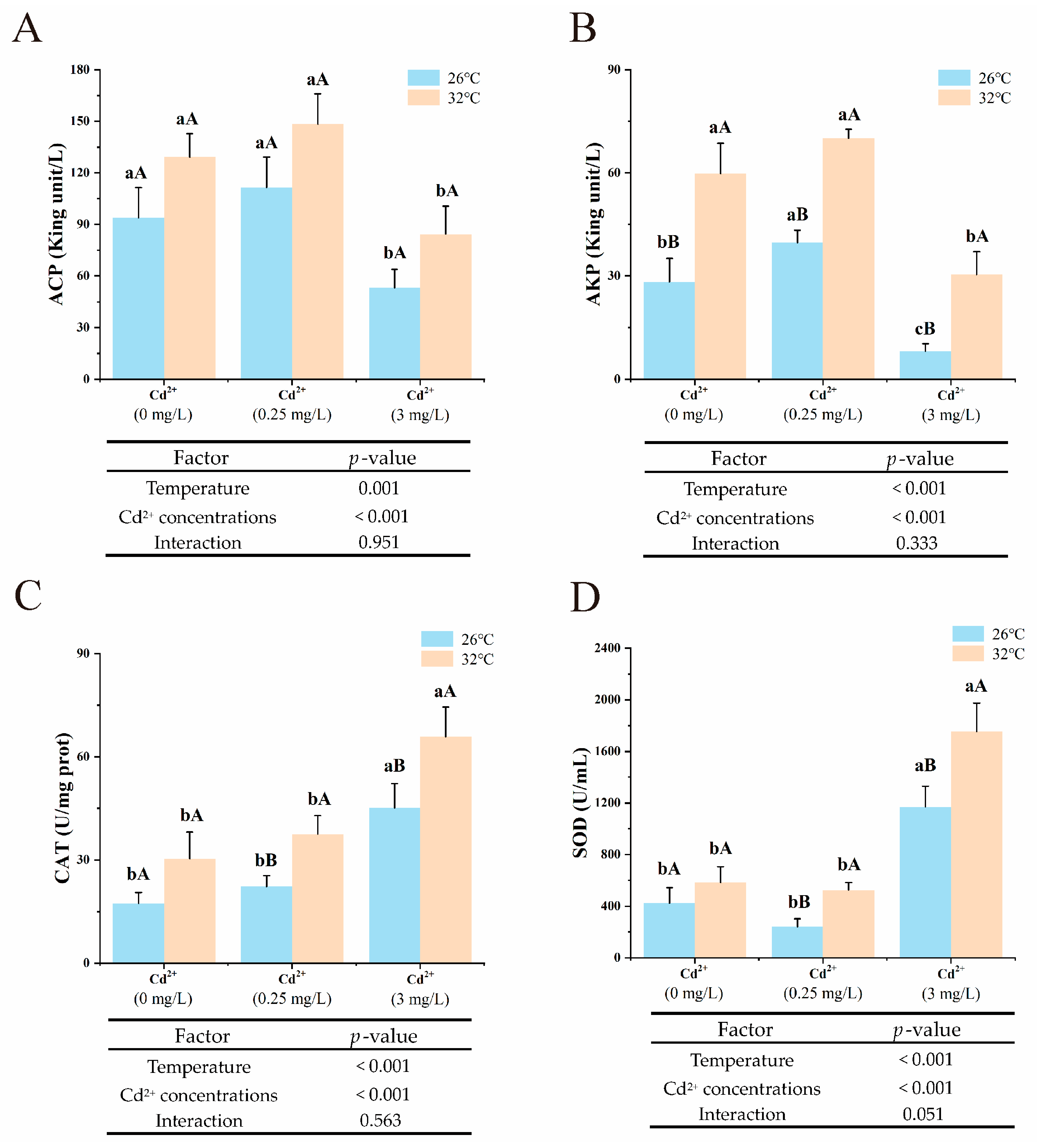
The activities of ACP, AKP, SOD, and CAT in the body wall tissues of S. nudus under different treatments are shown in Figure 2. At the same Cd2+ concentration, the activities of all four enzymes were higher at 32 °C than at 26 °C. Specifically, AKP showed significant differences at all Cd2+ concentrations (p < 0.05), whereas significant increases in CAT and SOD activities (p < 0.05) were observed only under Cd2+ exposure (0.25 and 3 mg/L). ACP showed no significant differences at any concentration (p > 0.05).
Under the same temperature condition, the responses of the four enzymes to Cd2+ exposure differed between functional groups. For ACP, activities at low Cd2+ concentrations (0 and 0.25 mg/L) were significantly higher than those at 3 mg/L (p < 0.05). For AKP at 26 °C, activity increased at low Cd2+ concentrations and decreased at the high concentration, with the highest value observed at 0.25 mg/L, whereas at 32 °C, AKP exhibited a pattern similar to that of ACP. In contrast, the antioxidant enzymes SOD and CAT showed a clear dose–response pattern, with activities at low Cd2+ concentrations (0 and 0.25 mg/L) being significantly lower than those at 3 mg/L (p < 0.05).
Two-way ANOVA showed significant effects of temperature and Cd2+ concentration on ACP, AKP, CAT, and SOD activities (p < 0.05). No significant temperature × Cd2+ interactions were observed for any of the four enzymes (ACP: p = 0.951; AKP: p = 0.333; CAT: p = 0.563; SOD: p = 0.051).

3.4. Transcriptome Sequencing Quality and Differential Expression Analysis

A total of 12 transcriptome libraries were successfully constructed from the body wall tissues of S. nudus, including the control group (T26-C0, 26 °C without Cd2+), the Cd2+ stress group (T26-C3, 26 °C with 3 mg/L Cd2+), the heat stress group (T32-C0, 32 °C without Cd2+), and the combined stress group (T32-C3, 32 °C with 3 mg/L Cd2+). Sequencing quality assessment showed that the Q20 values ranged from 96.37% to 98.31%, while the Q30 values ranged from 90.97% to 94.89% (Table 2). These results indicate high sequencing quality and confirm that the transcriptome data were suitable for subsequent analyses.
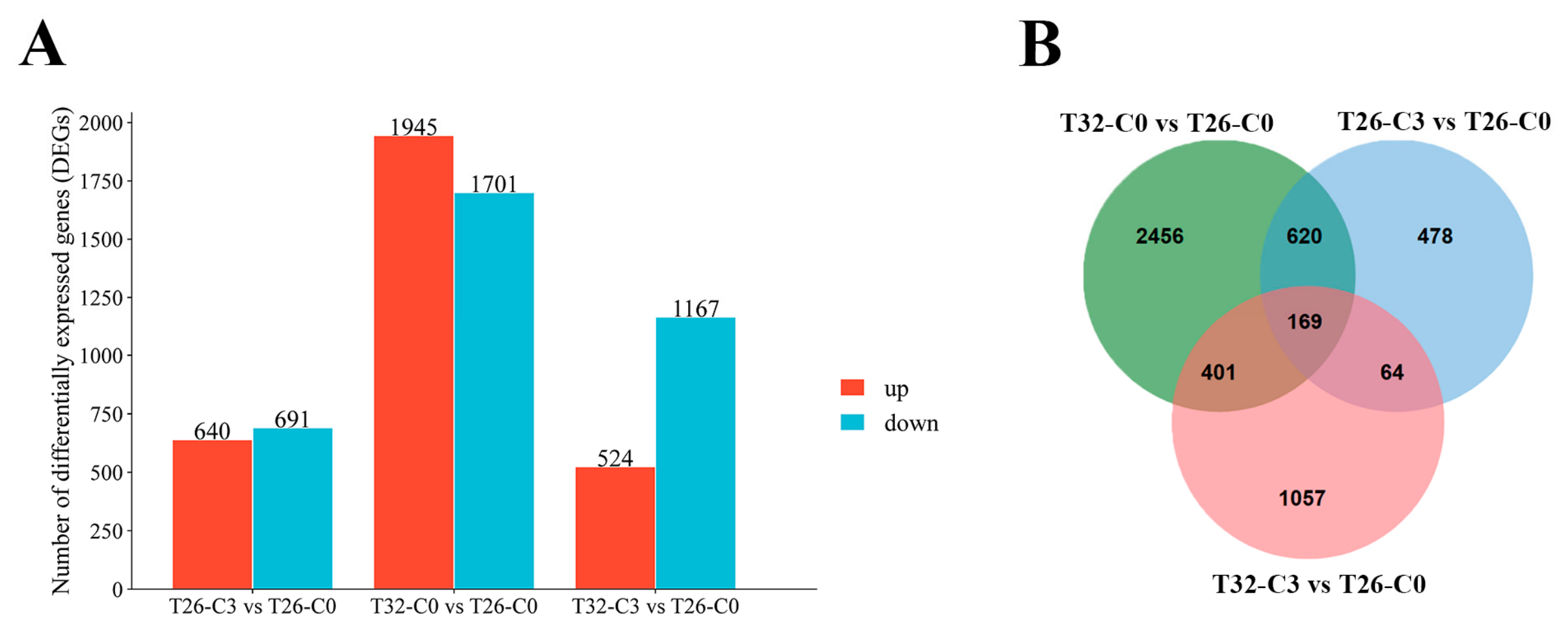
Based on the high-quality sequencing data, differential expression analysis was performed among treatments. The number of DEGs identified in each comparison is shown in Figure 3A. Compared with the control group, 1331 DEGs were identified in the Cd2+ stress group, including 640 upregulated and 691 downregulated genes. The heat stress group showed 3646 DEGs, including 1945 upregulated and 1701 downregulated genes, whereas the combined stress group showed 1691 DEGs, including 524 upregulated and 1167 downregulated genes.
Venn diagram analysis (Figure 3B) revealed that 169 DEGs were shared among the Cd2+ stress group, heat stress group, and combined stress group. Pairwise comparisons identified 233 shared DEGs between the Cd2+ stress group and the combined stress group, 789 between the heat stress group and the Cd2+ stress group, and 570 between the heat stress group and the combined stress group. In addition, 2456, 478, and 1057 unique DEGs were detected in the heat stress group, Cd2+ stress group, and combined stress group, respectively. These results indicate that S. nudus exhibits distinct transcriptional responses to Cd2+ stress, heat stress, and their combined effects. The large numbers of treatment-specific DEGs further suggest that each stress condition induced a unique transcriptional regulatory pattern. Notably, although the combined stress group exhibited fewer DEGs than the heat stress group, it still contained 1057 uniquely expressed DEGs, indicating that the transcriptional response to combined stress was not simply a subset of, or additive to, the responses induced by the individual stressors.

3.5. Transcriptomic Responses of S. nudus to Cd2+ Stress

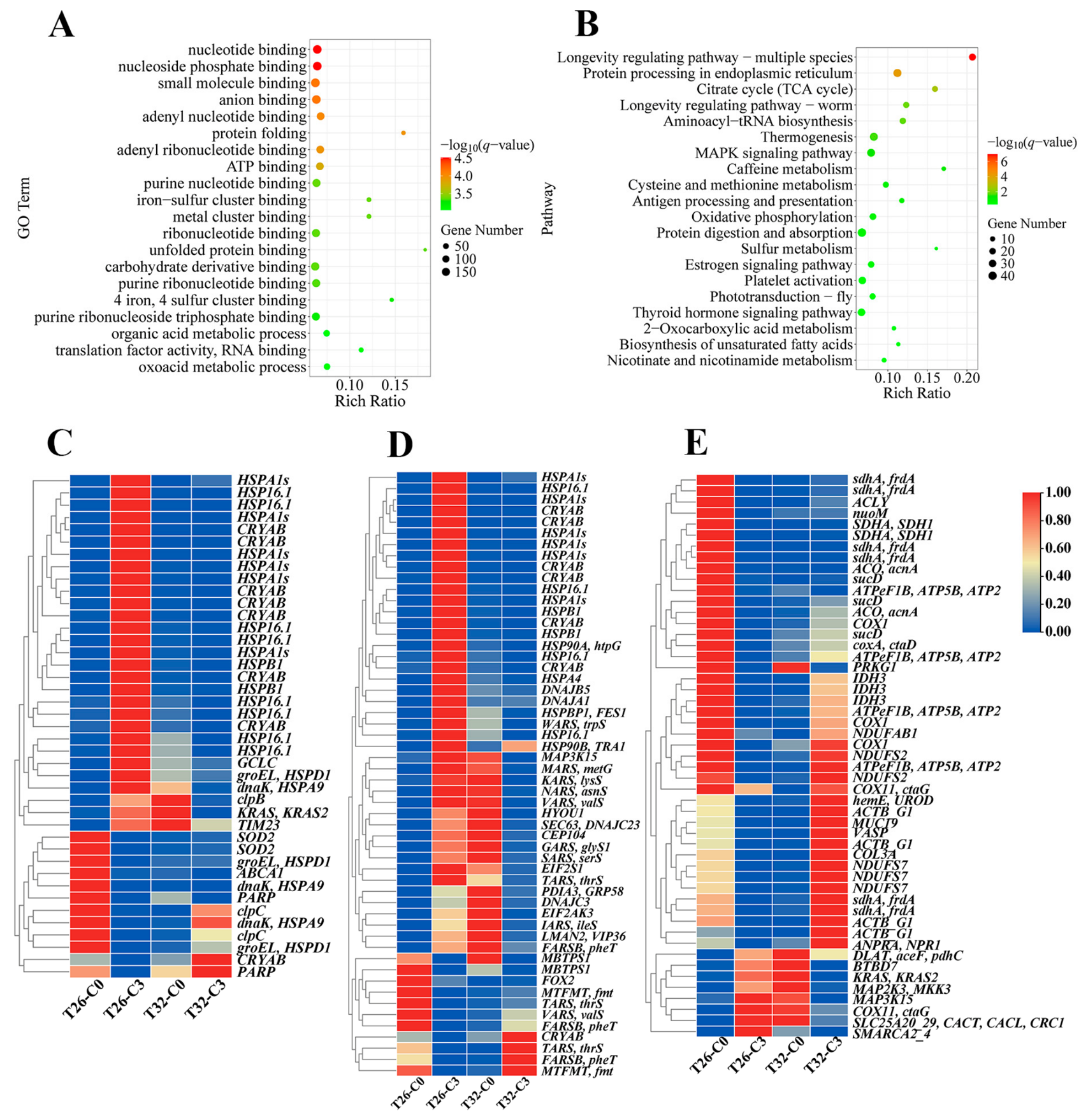
GO enrichment analysis of DEGs between the Cd2+ stress group and the control group showed significant enrichment in functions related to nucleotide and ATP binding, metal ion and iron–sulfur cluster binding, protein folding and binding, and organic acid and oxoacid metabolic processes (Figure 4A). In addition, translation factor activity and RNA binding were also enriched.
KEGG pathway analysis indicated that DEGs were significantly enriched in longevity-regulating pathways across multiple species, longevity-regulating pathways in worms, protein processing in the endoplasmic reticulum, the citrate cycle (TCA cycle), aminoacyl-tRNA biosynthesis, thermogenesis, and the MAPK signaling pathway (Figure 4B). Gene expression pattern analysis further showed that, in the Cd2+ stress group, 70.73% of genes in longevity-related pathways were upregulated, including HSPA1s, HSP16.1, ClpB, CRYAB, and GCLC, which was higher than the upregulation proportions in the control group (26.83%), the heat stress group (12.20%), and the combined stress group (9.76%) (Figure 4C). In pathways associated with protein processing and translation initiation (e.g., protein processing in the endoplasmic reticulum and aminoacyl-tRNA biosynthesis), 79.63% of genes were upregulated in the Cd2+ stress group, including HSPA1s, CRYAB, DNAJB5, and DNAJA1, which exceeded the upregulation proportions in the control group (18.52%), the heat stress group (35.19%), and the combined stress group (9.26%) (Figure 4D). In contrast, 82.35% of genes involved in energy metabolism pathways (e.g., the TCA cycle and thermogenesis) were downregulated in the Cd2+ stress group, including ATP5B, ATP2, SDHA, and ACTB_G1. The downregulation proportion was higher than those in the control group (19.61%) and the combined stress group (39.22%), and comparable to that in the heat stress group (84.31%) (Figure 4E).

3.6. Transcriptomic Responses of S. nudus to Heat Stress

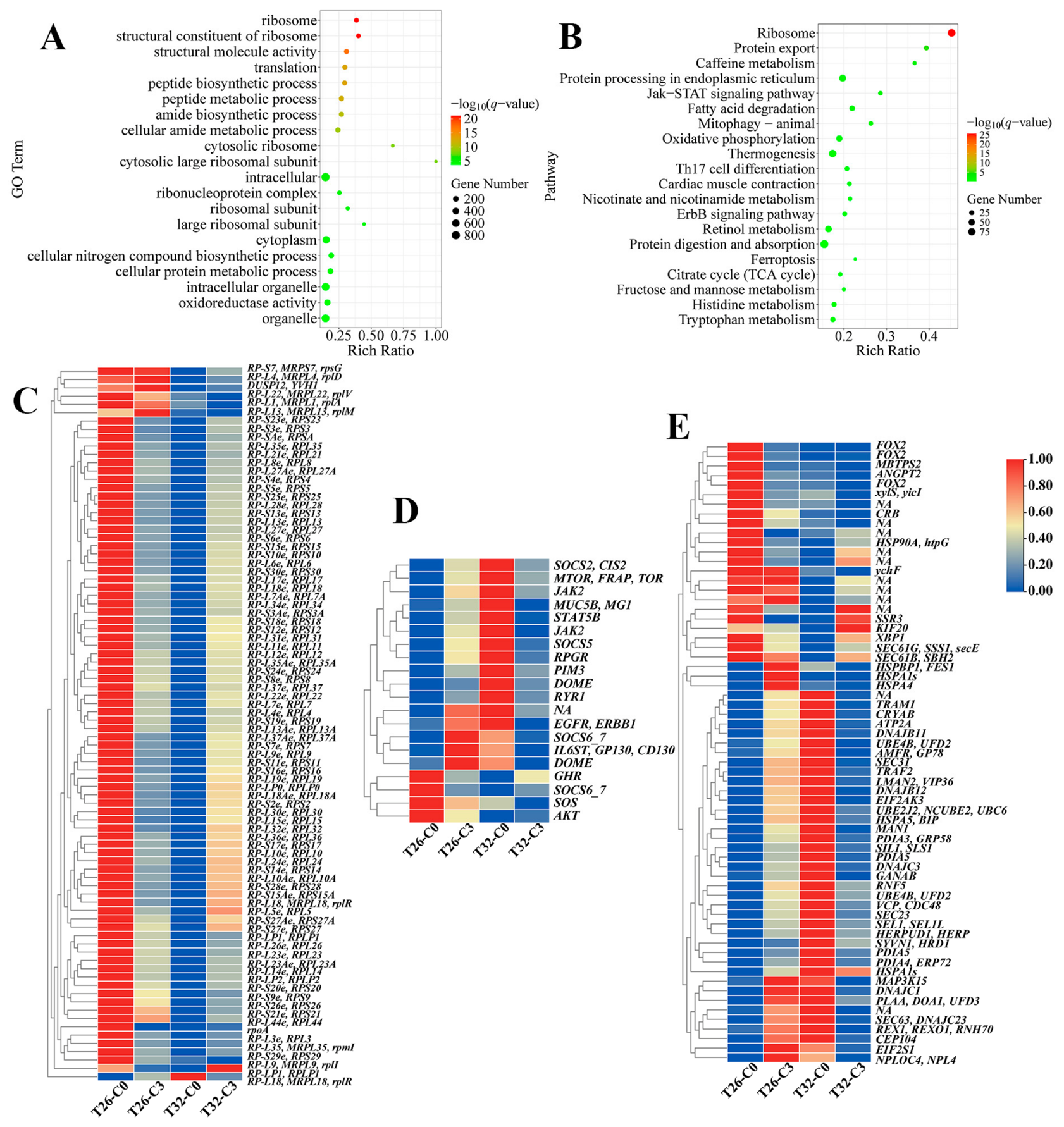
GO enrichment analysis of DEGs between the heat stress group and the control group showed significant enrichment in ribosome-related functions, including ribosome, structural constituent of ribosome, and ribosomal subunit. DEGs were also enriched in structural molecule activity, translation, peptide and amide biosynthetic and metabolic processes, as well as intracellular organelle-related components (Figure 5A). In addition, oxidoreductase activity, cellular nitrogen compound biosynthetic processes, and cellular protein metabolic processes were also significantly enriched.
KEGG pathway analysis revealed that DEGs were significantly enriched in ribosome, protein export, protein processing in the endoplasmic reticulum, the Jak-STAT signaling pathway, and fatty acid degradation (Figure 5B). Gene expression pattern analysis further showed that, in the heat stress group, 80.00% of genes in the Jak-STAT signaling pathway were upregulated, including SOCS, MTOR, JAK2, and STAT, which was higher than the upregulation proportions in the control group (20.00%), the Cd2+ stress group (30.00%), and the combined stress group (5.00%) (Figure 5D). In the protein processing in the endoplasmic reticulum pathway, 60.00% of genes were upregulated in the heat stress group, including TRAM1, HSP, and DNAJC, which exceeded the upregulation proportions in the control group (35.38%), the Cd2+ stress group (26.15%), and the combined stress group (10.77%) (Figure 5E). In contrast, 98.84% of genes in the ribosome pathway, mainly encoding ribosomal protein subunits, were downregulated in the heat stress group, which was higher than the downregulation proportions in the control group (1.16%), the Cd2+ stress group (90.70%), and the combined stress group (83.72%) (Figure 5C).

3.7. Transcriptomic Responses of S. nudus to Combined Stress

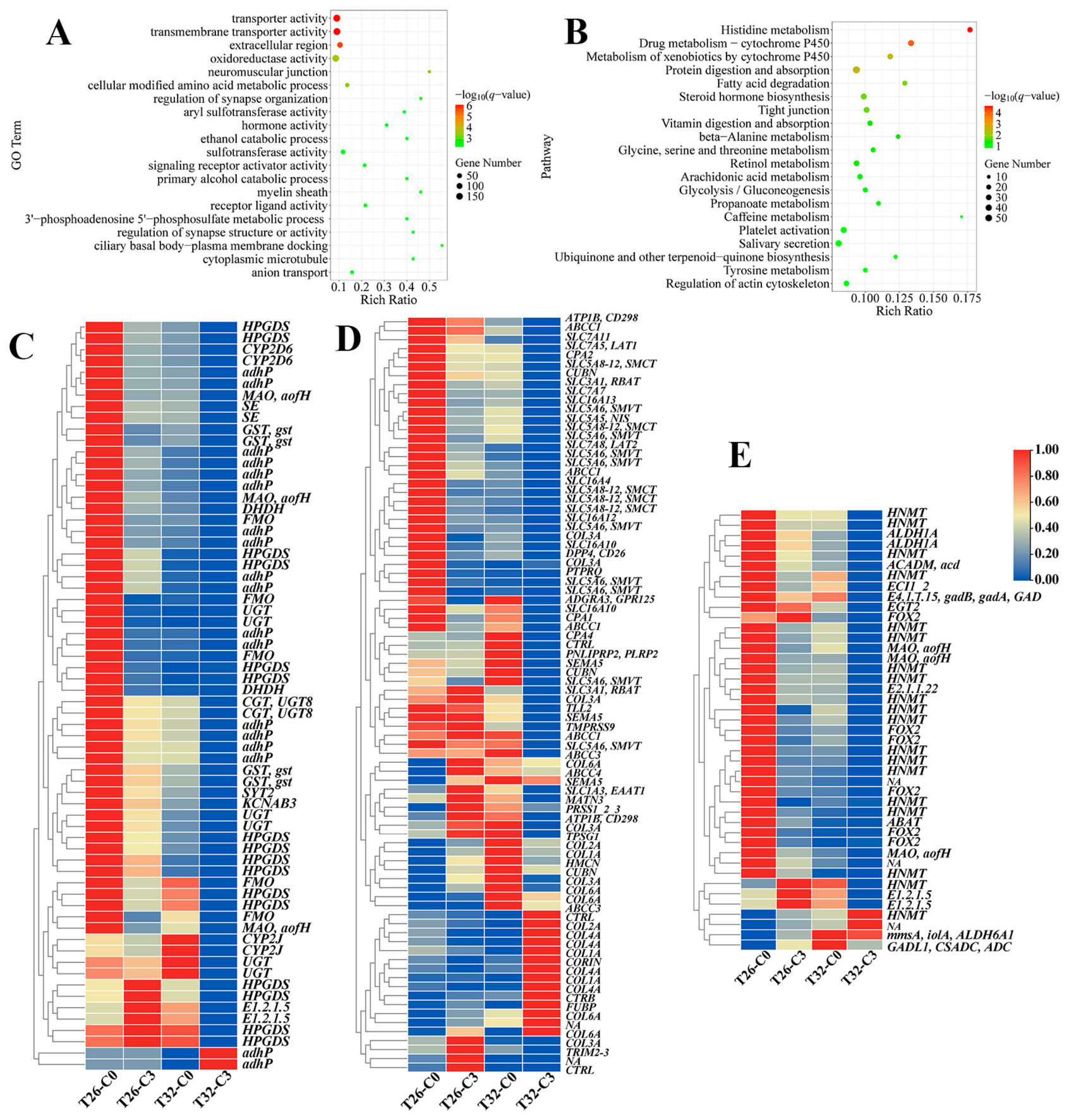
GO enrichment analysis of DEGs between the combined stress group and the control group showed significant enrichment in functions related to transporter activity, transmembrane transporter activity, extracellular region, oxidoreductase activity, and sulfotransferase activity, as well as hormone activity, receptor ligand activity, and anion transport (Figure 6A). DEGs were also enriched in the cellular-modified amino acid metabolism, the ethanol catabolic process, and during the regulation of synapse structure or activity.
KEGG pathway analysis revealed that DEGs were significantly enriched in histidine metabolism, drug metabolism-cytochrome P450, metabolism of xenobiotics by cytochrome P450, protein digestion and absorption, and fatty acid degradation (Figure 6B). Additional enriched pathways included steroid hormone biosynthesis, tight junction, vitamin digestion and absorption, and β-alanine metabolism. Gene expression pattern analysis showed that, in the combined stress group, 96.97% of genes involved in xenobiotic metabolism pathways were downregulated, including HPGDS, CYP2D6, adhP, GST, and UGT, which was higher than the downregulation proportions in the control group (12.12%), the Cd2+ stress group (80.30%), and the heat stress group (83.33%) (Figure 6C). In nutrient digestion and absorption pathways, 80.95% of genes were downregulated in the combined stress group, including members of the ABCC and SLC transporter families, which exceeded the downregulation proportions in the control group (45.24%), the Cd2+ stress group (69.05%), and the heat stress group (65.48%) (Figure 6D). Similarly, 93.02% of genes in amino acid derivative metabolism pathways were downregulated in the combined stress group, including HNMT, ALDH, FOX2, and MAO, which was higher than the downregulation proportions in the control group (16.28%), the Cd2+ stress group (81.40%), and the heat stress group (81.40%) (Figure 6E).

4. Discussion

The present study demonstrates that both temperature and Cd2+ exposure significantly influence the growth and survival of S. nudus. At 26 °C, Cd2+ exposure did not affect weight gain but significantly reduced survival, indicating that within the optimal temperature range, Cd2+ primarily impacts organismal viability through toxicity-related effects [17]. Previous studies have shown that elevated temperature may enhance Cd uptake and reduce its excretion by regulating related genes, thereby increasing intracellular Cd accumulation and toxicity [32]. However, in the present study, temperature did not significantly affect Cd2+ accumulation in the body wall of S. nudus. This result suggests that the enhanced toxicity observed under combined stress was not necessarily associated with increased Cd accumulation. Nevertheless, at 32 °C, Cd2+ toxicity was markedly exacerbated, as reflected by further declines in survival and a significant reduction in weight gain with increasing Cd2+ concentration, indicating a significant interaction between temperature and Cd2+ exposure, as supported by the two-way ANOVA. The increased toxicity under combined stress may be attributed to multiple mechanisms. Elevated temperature increases metabolic activity and oxygen consumption, promoting reactive oxygen species (ROS) production and inducing oxidative stress [33]. Cd2+, as a non-essential metal, further enhances ROS generation and activates antioxidant defense responses. In the present study, SOD and CAT activities increased with increasing Cd2+ concentration, suggesting that S. nudus upregulated its antioxidant system to counteract Cd-induced oxidative stress. However, despite this compensatory response, excessive ROS production may still exceed the organism’s antioxidant capacity, leading to lipid peroxidation, protein damage, and mitochondrial dysfunction [34]. In addition, high temperature may impair detoxification processes by affecting the expression or activity of key molecules, such as metallothioneins (MTs), thereby reducing metal-binding and clearance capacity [35]. Moreover, immune cells of marine invertebrates are more sensitive to Cd2+ under elevated temperature, exhibiting increased mortality and functional impairment, which may contribute to the pronounced decline in survival under combined stress [36]. Under low or absent Cd2+ exposure, the slightly higher weight gain observed at 32 °C suggests that moderate warming alone can promote growth [20]. However, this effect was largely offset at high Cd2+ levels (3 mg/L), indicating that under severe stress, energy allocation shifts from growth to stress defense, particularly toward oxidative stress responses [18].
The results indicate that Cd2+ accumulation in the body wall of S. nudus is primarily governed by environmental Cd2+ concentration rather than temperature, exhibiting a clear dose-dependent pattern. The decline in the bioaccumulation factor with increasing Cd2+ concentration is consistent with patterns reported in other benthic invertebrates [37,38]. It is generally attributed to the saturation of metal uptake at high exposure levels, along with enhanced excretion and detoxification processes such as metallothionein binding and glutathione-mediated pathways [37]. Despite the potential influence of temperature on metabolic activity, no significant temperature effect on Cd2+ accumulation was observed under constant exposure conditions. Similar findings have been reported in the Pacific oyster, where temperature did not alter metal distribution among tissues [39], suggesting that metal accumulation remains relatively stable within this heat range. This stability may also be associated with the structural characteristics of the body wall, which is rich in mucus and polysaccharides that maintain metal-binding capacity under moderate temperature fluctuations [40]. Trace amounts of Cd2+ detected in the body wall of the control and warming-only groups are likely associated with pre-existing environmental accumulation prior to laboratory exposure. S. nudus was collected from coastal areas of the Leizhou Peninsula, where low-level Cd contamination has been reported in sediments [12,13], suggesting potential environmental exposure of local populations. Similar background Cd levels have also been reported in benthic invertebrates inhabiting coastal sediments [41]. Therefore, the low Cd2+ concentrations observed in these groups were considered to reflect background accumulation rather than experimental exposure.
Elevated temperature enhanced the activities of non-specific immune enzymes (ACP and AKP) and antioxidant enzymes (SOD and CAT) in S. nudus. At the same Cd2+ concentration, enzyme activities were consistently higher at 32 °C than at 26 °C, indicating that heat stress promotes immune and antioxidant responses, likely through increased metabolic rates and enzymatic activities [42]. In response to Cd2+ exposure, AKP exhibited a biphasic pattern, with stimulation at low concentrations (0.25 mg/L) and inhibition at higher levels. This response likely reflects the activation of immune defenses under mild oxidative stress, followed by enzyme inhibition and functional impairment when stress exceeds the physiological tolerance threshold [43]. In contrast, SOD and CAT activities increased progressively with Cd2+ concentration, indicating an enhanced antioxidant response to counteract ROS accumulation. These results are consistent with previous studies showing that benthic invertebrates maintain redox homeostasis under multiple environmental stressors through the upregulation of antioxidant enzymes [44], highlighting the central role of oxidative stress regulation in coping with combined temperature and heavy metal exposure.
Transcriptome analysis revealed substantial transcriptional remodeling in S. nudus under both single and combined stressors, with clear differences in gene expression patterns among treatments. Interestingly, the combined stress treatment triggered fewer DEGs than heat stress alone, suggesting that the transcriptional response to simultaneous temperature and Cd2+ exposure was not simply additive [45,46]. This pattern may reflect a more selective regulatory strategy, in which S. nudus prioritizes key stress-response pathways and essential physiological processes, rather than broadly activating all genes responsive to individual stressors [47]. Similar patterns have been reported in marine invertebrates exposed to multiple environmental stressors [48]. These findings highlight that combined stressors produce a unique transcriptional response that cannot be predicted from single stressor effects alone, emphasizing the complexity of molecular adaptation under multiple environmental challenges.
Under Cd2+ stress alone, DEGs were mainly enriched in nucleotide and ATP binding, metal ion and iron-sulfur cluster binding, protein folding, and organic acid metabolism. These results indicate that Cd2+ disrupts energy metabolism, metal homeostasis, and protein stability in S. nudus. This is consistent with a toxicity mechanism driven by oxidative stress and protein damage [49]. KEGG analysis further showed upregulation of longevity-regulating and endoplasmic reticulum protein-processing pathways, accompanied by downregulation of the TCA cycle and thermogenesis pathways. This pattern reflects a shift from energy production to stress defense, representing a typical energy reallocation strategy under heavy metal stress [50].
Heat stress primarily enriched pathways related to ribosome function, protein homeostasis, and redox regulation. Approximately 80% of genes in the Jak-STAT signaling pathway were upregulated, consistent with its role in immune and stress regulation [51]. This suggests that heat stress enhances cellular defense through activation of immune signaling and modulation of protein folding and processing [52]. At the same time, most ribosomal genes were downregulated, despite their enrichment at the pathway level, indicating suppression of basal protein translation activity. This likely conserves energy and prioritizes the synthesis of stress-related proteins under elevated temperature [53].
Under combined heat and Cd2+ stress, DEGs were mainly enriched in transporter activity, oxidoreductase activity, and catabolic processes. KEGG analysis revealed widespread downregulation of pathways involved in detoxification, nutrient digestion and absorption, and amino acid metabolism under combined stress, indicating a transcriptional response distinct from that observed under individual stressors. The downregulation of detoxification-related genes suggests that cellular detoxification processes may be affected under multifactorial stress conditions [32]. Notably, key detoxification genes such as CYP450 and GST were suppressed, which may involve upstream regulatory pathways like Nrf2/Keap1, a major sensor of oxidative stress, although further studies are needed to confirm this [54,55]. Although transcriptomic changes indicate modulation of genes related to Cd uptake and excretion, no significant effect of temperature on Cd accumulation in the body wall was observed in our physiological measurements. This suggests that changes in gene expression do not necessarily translate into measurable differences in tissue Cd content over the experimental period, possibly due to compensatory mechanisms, tissue-specific distribution, or post-transcriptional regulation [56,57]. Likewise, the reduced expression of genes associated with nutrient transport and metabolism may reflect altered nutrient utilization and energy metabolism, which is consistent with the observed reductions in growth and survival [58]. In addition, the suppression of amino acid metabolism pathways may be associated with changes in cellular metabolic status and stress adaptation [59,60]. Together, these transcriptomic changes suggest that combined heat and Cd2+ stress induces broad alterations in metabolic and physiological regulatory processes in S. nudus.

5. Conclusions

Heat stress exacerbated Cd2+ toxicity in S. nudus, resulting in reduced growth and survival. Heat stress stimulated immune and antioxidant enzyme activities, while Cd2+ exhibited concentration-dependent effects. Transcriptome analysis showed that Cd2+ exposure activated longevity-related pathways, protein processing, and translation initiation; heat stress activated Jak-STAT signaling pathway and endoplasmic reticulum protein processing, but inhibited the ribosome pathway; and combined stress broadly suppressed xenobiotic metabolism, nutrient digestion and absorption, and amino acid derivative metabolism. These findings suggest that S. nudus responds to combined heat and Cd2+ stress through coordinated molecular regulation, highlighting the synergistic effects of heat stress on Cd2+ toxicity and its associated physiological disruption. Future studies should further investigate the physiological functions of key candidate genes and pathways identified in this study, as well as the long-term adaptive responses of S. nudus to multiple environmental stressors under changing climatic conditions.

Author Contributions

J.H.: Data curation, Writing—original draft. R.Z.: Resources, Visualization, Investigation. S.Y.: Resources, Visualization, Software. C.Y.: Writing—review and editing. Q.W.: Conceptualization, Writing—review and editing, Project administration, Funding acquisition. Y.D.: Resources, Formal analysis. All authors have read and agreed to the published version of the manuscript.

Funding

This work was supported by the Science and Technology Department of Zhanjiang City (Grant no. 2023B01029), the Shellfish & Algae Industry Innovation Team of the Guangdong Modern Agricultural Technology System (Grant no. 2024CXTD23), and the Guangdong Ocean University Innovation Program (Grant no. 040517022404).

Institutional Review Board Statement

The peanut worm S. nudus is a lower invertebrate, and therefore, the study was not subject to ethical approval.

Informed Consent Statement

Not applicable.

Data Availability Statement

The data that support the findings of this study are available on request from the corresponding author. The data are not publicly available due to privacy restrictions.

Conflicts of Interest

The authors declare no conflicts of interest.

References

  1. Li, J.; Xie, X.; Zhu, C.; Guo, Y.; Chen, S. Edible Peanut Worm (Sipunculus nudus) in the Beibu Gulf: Resource, Aquaculture, Ecological Impact and Counterplan. J. Ocean Univ. China 2017, 16, 823–830. [Google Scholar] [CrossRef]
  2. Zhang, C.X.; Dai, Z.R.; Cai, Q.X. Anti-Inflammatory and Anti-Nociceptive Activities of Sipunculus nudus L. Extract. J. Ethnopharmacol. 2011, 137, 1177–1182. [Google Scholar] [CrossRef] [PubMed]
  3. LI, F.; Kong, Q.; Shi, G.; Wang, W.; Zhou, H.; Jin, S. Studies on the Genus Sipunculus (Sipuncula) off the China Coasts. J. Ocean Univ. Qingdao 1992, 22, 97–102. [Google Scholar] [CrossRef]
  4. Zhao, Q.; Li, X.; Wang, Y.; Cheng, Y.; Fan, W. Long-Term Bioremediation of Cadmium Contaminated Sediment Using Sulfate Reducing Bacteria: Perspective on Different Depths of the Sediment Profile. Chem. Eng. J. 2023, 451, 138697. [Google Scholar] [CrossRef]
  5. Thangal, S.H.; Muralisankar, T.; Mohan, K.; Santhanam, P.; Venmathi Maran, B.A. Biological and Physiological Responses of Marine Crabs to Ocean Acidification: A Review. Environ. Res. 2024, 248, 118238. [Google Scholar] [CrossRef] [PubMed]
  6. Liu, J.; Li, J.; Cao, X.; Song, S.; Li, J.; Wang, F.; Wang, L.; Liu, S. Effect of Temperature on Growth, Digestion and Immunity of Green, White and Purple Sea Cucumbers, Apostichopus japonicus (Selenka). Aquac. Res. 2019, 50, 219–225. [Google Scholar] [CrossRef]
  7. Liao, Y.; Wu, X.; Tao, C.; Wang, Y.; Deng, Y.; Wang, Q. Differences in Oyster Pearl, Pinctada fucata martensii, Cultivation Efficiency in Spring and Autumn Nucleations and Their Conelation with Environmental Factors. J. Fish. Sci. China 2025, 32, 312–320. [Google Scholar]
  8. Bai, X.; Liang, Y.; Zhang, H.; Cheng, G.; Xu, C.; Li, Q. Combined Effects of Temperature, Salinity and Rearing Density on the Larval Growth and Survival of the Diploid, Triploid and Tetraploid of the Pacific Oyster Crassostrea gigas. Aquaculture 2024, 585, 740690. [Google Scholar] [CrossRef]
  9. Zamora, L.N.; Jeffs, A.G. Feeding, Metabolism and Growth in Response to Temperature in Juveniles of the Australasian Sea Cucumber, Australostichopus mollis. Aquaculture 2012, 358, 92–97. [Google Scholar] [CrossRef]
  10. Tian, R.; Hu, F.; Wu, G.; Wang, H.; Ding, J.; Chang, Y.; Zhao, C. An Effective Approach to Improving Fitness-Related Behavior and Digestive Ability of Small Sea Cucumbers Apostichopus japonicus at High Temperature: New Insights into Seed Production. Aquaculture 2023, 562, 738755. [Google Scholar] [CrossRef]
  11. Okereafor, U.; Makhatha, M.; Mekuto, L.; Uche-Okereafor, N.; Sebola, T.; Mavumengwana, V. Toxic Metal Implications on Agricultural Soils, Plants, Animals, Aquatic Life and Human Health. Int. J. Environ. Res. Public Health 2020, 17, 2204. [Google Scholar] [CrossRef] [PubMed]
  12. Xia, J.; Gao, Y.; Wang, S.; Wang, Y. Assessment of the Heavy Metal Pollution in the Offshore Surface Sediments of the Leizhou Peninsula. Mar. Environ. Sci. 2022, 41, 276–282. [Google Scholar] [CrossRef]
  13. Yang, X.; Huang, H.; Hu, P.; Luan, H.; Song, B.; Zheng, Z.; Zhang, C.; Yan, R.; Li, K. Assessment of Heavy Metal Pollution in Mangrove Sediments of Liusha Bay, Leizhou Peninsula, China. Toxics 2025, 13, 961. [Google Scholar] [CrossRef] [PubMed]
  14. Wu, L.; Huang, C.; Xie, Y.; Huang, X.; Huang, J.; Xu, J.; Chen, F.; Chen, C.; Cao, H.; Deng, W. Hydrodynamic Controls on the Spatial Distribution of Heavy Metals in Surface Sediments of the Beibu Gulf, China. Mar. Pollut. Bull. 2026, 227, 119442. [Google Scholar] [CrossRef] [PubMed]
  15. Tuffour, A.; Adebayiga Kosiba, A.; Addai Peprah, F.; Gu, J.; Zhou, Y.; Shi, H. Cadmium-Induced Stress: A Close Look at the Relationship between Autophagy and Apoptosis. Toxicol. Sci. 2023, 194, 1–12. [Google Scholar] [CrossRef] [PubMed]
  16. Bai, B.; Yang, Y.; Wei, J.; Zheng, Q.; Wang, M.; Chang, A.K.; Ying, X. Cadmium-Induced Toxicity in Meretrix meretrix Ovary Is Characterized by Oxidative Damage with Changes in Cell Morphology and Apoptosis-Related Factors. Front. Mar. Sci. 2022, 9, 1080516. [Google Scholar] [CrossRef]
  17. Jiang, D.; Zhou, Y.; Tan, M.; Zhang, J.; Guo, Q.; Yan, S. Cd Exposure-Induced Growth Retardation Involves in Energy Metabolism Disorder of Midgut Tissues in the Gypsy Moth Larvae. Environ. Pollut. 2020, 266, 115173. [Google Scholar] [CrossRef] [PubMed]
  18. Li, L.; Tian, X.; Yu, X.; Dong, S. Effects of Acute and Chronic Heavy Metal (Cu, Cd, and Zn) Exposure on Sea Cucumbers (Apostichopus japonicus). Biomed. Res. Int. 2016, 2016, 4532697. [Google Scholar] [CrossRef] [PubMed]
  19. Baines, S.B.; Fisher, N.S.; Kinney, E.L. Effects of Temperature on Uptake of Aqueous Metals by Blue Mussels Mytilus edulis from Arctic and Temperate Waters. Mar. Ecol. Prog. Ser. 2006, 308, 117–128. [Google Scholar] [CrossRef]
  20. Huang, J.; Liao, Y.; Zhong, R.; Yang, C.; Wang, Q.; Deng, Y. Effects of Temperature, Salinity, and Light on the Growth Performance, Survival, Final Biomass, and Digestive Enzyme Activities of Juvenile Sipunculus nudus. Aquac. Rep. 2023, 33, 101772. [Google Scholar] [CrossRef]
  21. Dong, L.; Zhang, Q.; Zeng, M.; Xu, M.; Tong, T. Changes of Digestive Enzyme Activities and Free Amino Acids in Sipunculus nudus Coelomic Fluid under Acute Stress of Cd2+. Acta Hydrobiol. Sin. 2016, 40, 524–531. [Google Scholar] [CrossRef]
  22. Zhang, J.; Wang, Q.; Chen, W.; Deng, Y.; Yang, C. A Temperature Control Device. Chinese Patent CN209840434U, 24 December 2019. [Google Scholar]
  23. Huang, J.; Zhong, R.; Yang, C.; Wang, Q.; Liao, Y.; Deng, Y. Dietary Carbohydrate and Protein Levels Affect the Growth Performance of Juvenile Peanut Worm (Sipunculus nudus): An LC–MS-Based Metabolomics Study. Front. Mar. Sci. 2021, 8, 702101. [Google Scholar] [CrossRef]
  24. GB 5009.268-2016; National Food Safety Standard-Determination of Multi-Elements in Foods. National Health and Family Planning Commission of the People’s Republic of China; China Food and Drug Administration: Beijing, China, 2016.
  25. GB/T 17141-1997; Soil Quality-Determination of Lead, Cadmium-Graphite Furnace Atomic Absorption Spectrophotometry. State Environmental Protection Administration of China; General Administration of Quality Supervision, Inspection and Quarantine of the People’s Republic of China: Beijing, China, 1997.
  26. Zhang, J.; Su, Y.; Zhong, R.; Wang, Q.; Jiao, Y.; Yang, C. Transcriptome Analysis Reveals Key Molecular Events of Germinal Vesicle Breakdown in Sipunculus nudus. Aquac. Res. 2021, 52, 1757–1766. [Google Scholar] [CrossRef]
  27. Li, R.; Li, Y.; Kristiansen, K.; Wang, J. SOAP: Short Oligonucleotide Alignment Program. Bioinformatics 2008, 24, 713–714. [Google Scholar] [CrossRef] [PubMed]
  28. Kim, D.; Langmead, B.; Salzberg, S.L. HISAT: A Fast Spliced Aligner with Low Memory Requirements. Nat. Methods 2015, 12, 357–360. [Google Scholar] [CrossRef] [PubMed]
  29. Langmead, B.; Salzberg, S.L. Fast Gapped-Read Alignment with Bowtie 2. Nat. Methods 2012, 9, 357–359. [Google Scholar] [CrossRef] [PubMed]
  30. Li, B.; Dewey, C.N. RSEM: Accurate Transcript Quantification from RNA-Seq Data with or without a Reference Genome. BMC Bioinform. 2011, 12, 323. [Google Scholar] [CrossRef] [PubMed]
  31. Love, M.I.; Huber, W.; Anders, S. Moderated Estimation of Fold Change and Dispersion for RNA-Seq Data with DESeq2. Genome Biol. 2014, 15, 550. [Google Scholar] [CrossRef] [PubMed]
  32. Xie, D.; Wei, H.; Huang, Y.; Qian, J.; Zhang, Y.; Wang, M. Elevated Temperature as a Dominant Driver to Aggravate Cadmium Toxicity: Investigations through Toxicokinetics and Omics. J. Hazard. Mater. 2024, 474, 134789. [Google Scholar] [CrossRef] [PubMed]
  33. Bai, Y.; Chen, Y.; Pan, Y.; Zhang, L.; Liu, S.; Ru, X.; Xing, L.; Zhang, T.; Yang, H.; Li, J. Effect of Temperature on Growth, Energy Budget, and Physiological Performance of Green, White, and Purple Color Morphs of Sea Cucumber, Apostichopus japonicus. J. World Aquac. Soc. 2018, 49, 625–637. [Google Scholar] [CrossRef]
  34. Xu, Y.; Wu, C.; Jin, J.; Tang, W.; Chen, Y.; Chang, A.K.; Ying, X. Transcriptome Analysis and Identification of Cadmium-Induced Oxidative Stress Response Genes in Different Meretrix Meretrix Developmental Stages. Animals 2024, 14, 352. [Google Scholar] [CrossRef] [PubMed]
  35. Fabisiak, J.P.; Pearce, L.L.; Borisenko, G.G.; Tyurina, Y.Y.; Tyurin, V.A.; Razzack, J.; Lazo, J.S.; Pitt, B.R.; Kagan, V.E. Bifunctional Anti-/Prooxidant Potential of Metallothionein: Redox Signaling of Copper Binding and Release. Antioxid. Redox Signal. 1999, 1, 349–364. [Google Scholar] [CrossRef] [PubMed]
  36. Ren, J.; Liu, S.; Zhang, Q.; Zhang, Z.; Shang, S. Effects of Cadmium Exposure on Haemocyte Immune Function of Clam Ruditapes Philippinarum at Different Temperatures. Mar. Environ. Res. 2024, 195, 106375. [Google Scholar] [CrossRef] [PubMed]
  37. Zhan, J.; Sun, T.; Wang, X.; Wu, H.; Yu, J. Meta-Analysis Reveals the Species-, Dose- and Duration-Dependent Effects of Cadmium Toxicities in Marine Bivalves. Sci. Total Environ. 2023, 859, 160164. [Google Scholar] [CrossRef] [PubMed]
  38. Liu, H.; Tian, X.; Jiang, L.; Han, D.; Hu, S.; Cui, Y.; Jiang, F.; Liu, Y.; Xu, Y.; Li, H. Sources, Bioaccumulation, and Toxicity Mechanisms of Cadmium in Chlamys farreri. J. Hazard. Mater. 2023, 453, 131395. [Google Scholar] [CrossRef] [PubMed]
  39. Belivermiş, M.; Warnau, M.; Metian, M.; Oberhänsli, F.; Teyssié, J.-L.; Lacoue-Labarthe, T. Limited Effects of Increased CO2 and Temperature on Metal and Radionuclide Bioaccumulation in a Sessile Invertebrate, the Oyster Crassostrea gigas. ICES J. Mar. Sci. 2016, 73, 753–763. [Google Scholar] [CrossRef]
  40. Cao, Y.; Lu, X.; Dai, Y.; Li, Y.; Liu, F.; Zhou, W.; Li, J.; Zheng, B. Proteomic Analysis of Body Wall and Coelomic Fluid in Sipunculus nudus. Fish Shellfish Immunol. 2021, 111, 16–24. [Google Scholar] [CrossRef] [PubMed]
  41. Cayabo, G.D.B.; Lim, Y.C.; Albarico, F.P.J.B.; Chen, C.F.; Wang, M.H.; Chen, C.W.; Dong, C.D. Contrasting Metal Bioaccumulation in Marine Benthic Invertebrate Groups in Polluted Harbor Sediments. Mar. Pollut. Bull. 2024, 207, 116859. [Google Scholar] [CrossRef] [PubMed]
  42. Zhou, J.; Wang, L.; Xin, Y.; Wang, W.N.; He, W.Y.; Wang, A.L.; Liu, Y. Effect of Temperature on Antioxidant Enzyme Gene Expression and Stress Protein Response in White Shrimp, Litopenaeus vannamei. J. Therm. Biol. 2010, 35, 284–289. [Google Scholar] [CrossRef]
  43. Lu, J.; Yao, T.; Fu, S.; Fan, S.; Ye, L. Time- and Concentration-Dependent Metabolic Responses Reveal Adaptation Failure in Cadmium-Exposed Haliotis diversicolor. J. Hazard. Mater. 2025, 489, 137578. [Google Scholar] [CrossRef] [PubMed]
  44. Xu, S.; Yu, T. Sources, Determination, and Safety Assessment of Cadmium in Bivalves. Cogent Food Agric. 2024, 10, 2436135. [Google Scholar] [CrossRef]
  45. Cerny, K.L.; Ribeiro, R.A.C.; Jeoung, M.; Ko, C.; Bridges, P.J. Estrogen Receptor Alpha (ESR1)-Dependent Regulation of the Mouse Oviductal Transcriptome. PLoS ONE 2016, 11, e0147685. [Google Scholar] [CrossRef] [PubMed]
  46. Zheng, N.; Cheng, Y.; Yu, F.; Li, L.; Chen, Q.; Wang, J.; Gu, R.; Du, X. Transcriptome Analysis of Germinated Maize Embryos Reveals Common Gene Responses to Multiple Abiotic Stresses. Agronomy 2026, 16, 40. [Google Scholar] [CrossRef]
  47. Prófumo, A.; Salazar, O.R.; Angulo-Preckler, C.; Duarte, C.M.; Aranda, M.; Avila, C. Heat Stress Triggers Distinct Transcriptomic Responses in Cold-Adapted Antarctic Marine Invertebrates. Front. Mar. Sci. 2026, 13, 1769593. [Google Scholar] [CrossRef]
  48. Zhao, Y.; Chang, D.; Zheng, Y.; Zhang, Y.; Wang, Y.; Bao, X.; Sun, G.; Feng, Y.; Li, Z.; Liu, X.; et al. Comparative Transcriptome Analysis Reveals Differences in Immune Responses to Copper Ions in Sepia Esculenta under High-Temperature Conditions. BMC Genom. 2025, 26, 262. [Google Scholar] [CrossRef] [PubMed]
  49. Ju, Z.; Ndandala, C.B.; Lei, Y.; Shija, V.M.; Luo, J.; Wang, P.; Wen, C.; Liang, H. Cadmium-Induced Oxidative Stress, Histopathology, and Transcriptomic Changes in the Hepatopancreas of Fenneropenaeus merguiensis. Aquac. Rep. 2024, 36, 102061. [Google Scholar] [CrossRef]
  50. He, Y.; Zhou, L.; Wang, M.; Zhong, Z.; Chen, H.; Lian, C.; Zhang, H.; Wang, H.; Cao, L.; Li, C. Integrated Transcriptomic and Metabolomic Approaches Reveal Molecular Response and Potential Biomarkers of the Deep-Sea Mussel Gigantidas platifrons to Copper Exposure. J. Hazard. Mater. 2024, 473, 134612. [Google Scholar] [CrossRef] [PubMed]
  51. Sarapultsev, A.; Gusev, E.; Komelkova, M.; Utepova, I.; Luo, S.; Hu, D. JAK-STAT Signaling in Inflammation and Stress-Related Diseases: Implications for Therapeutic Interventions. Mol. Biomed. 2023, 4, 40. [Google Scholar] [CrossRef] [PubMed]
  52. Lu, H.; Yang, C.; Jiang, D.; Peng, Q.; Zhang, X.; Liu, C.; Wang, L.; Song, L. Molecular Mechanisms of Patinopecten yessoensis Responding to Extreme High Temperature: Insights into Cytoskeletal Dynamics and Immune Activation Adaptation. Aquac. Rep. 2025, 44, 103035. [Google Scholar] [CrossRef]
  53. Zhang, X.; Yuan, J.; Zhang, X.; Yu, Y.; Li, F. Comparative Transcriptomic Analysis Unveils a Network of Energy Reallocation in Litopenaeus vannamei Responsive to Heat-Stress. Ecotoxicol. Environ. Saf. 2022, 238, 113600. [Google Scholar] [CrossRef] [PubMed]
  54. Liu, Y.; Huang, D.; Pan, M.; Li, X.; Qin, G.; Yu, X.; Wu, Z.; Zhang, Z.; Mai, K.; Zhang, W. Adaptability and Stress Response Mechanisms of Abalone Haliotis discus hannai to Cadmium In Vitro and In Vivo. Aquaculture 2026, 612, 743260. [Google Scholar] [CrossRef]
  55. Ferreira, C.P.; Piazza, T.B.; Souza, P.; Lima, D.; Mattos, J.J.; Saldaña-Serrano, M.; Piazza, R.S.; Jorge, M.B.; Bianchini, A.; Taniguchi, S.; et al. Integrated Biomarker Responses in Oysters Crassostrea gasar as an Approach for Assessing Aquatic Pollution of a Brazilian Estuary. Mar. Environ. Res. 2021, 165, 105252. [Google Scholar] [CrossRef] [PubMed]
  56. Khati, W.; Ouali, K.; Mouneyrac, C.; Banaoui, A. Metallothioneins in Aquatic Invertebrates:Their Role in Metal Detoxification and Their Use in Biomonitoring. Energy Procedia 2012, 18, 784–794. [Google Scholar] [CrossRef]
  57. Rainbow, P.S. Trace Metal Bioaccumulation: Models, Metabolic Availability and Toxicity. Environ. Int. 2007, 33, 576–582. [Google Scholar] [CrossRef] [PubMed]
  58. Ferreira, C.P.; Bastolla, C.L.V.; Saldaña-Serrano, M.; Lima, D.; Gomes, C.H.D.M.; Schroeder, D.C.; Bainy, A.C.D.; Lüchmann, K.H. Effects of Cadmium and Zinc on Gene Expression of Novel Molecular Biomarkers in the Mangrove Oyster Crassostrea gasar. Comp. Biochem. Physiol. Part C Toxicol. Pharmacol. 2023, 270, 109641. [Google Scholar] [CrossRef] [PubMed]
  59. Jiang, W.D.; Feng, L.; Qu, B.; Wu, P.; Kuang, S.Y.; Jiang, J.; Tang, L.; Tang, W.N.; Zhang, Y.A.; Zhou, X.Q.; et al. Changes in Integrity of the Gill during Histidine Deficiency or Excess Due to Depression of Cellular Anti-Oxidative Ability, Induction of Apoptosis, Inflammation and Impair of Cell-Cell Tight Junctions Related to Nrf2, TOR and NF-κB Signaling in Fish. Fish Shellfish Immunol. 2016, 56, 111–122. [Google Scholar] [CrossRef] [PubMed]
  60. Qiu, L.; Chen, X.; Zhu, L.; Yao, R.; Qi, P. ChIP-Seq Identifies McSLC35E2 as a Novel Target Gene of McNrf2 in Mytilus coruscus, Highlighting Its Role in the Regulation of Oxidative Stress Response in Marine Mollusks. Front. Physiol. 2023, 14, 1282900. [Google Scholar] [CrossRef] [PubMed]
Figure 1. Effects of temperature and Cd2+ on the growth and survival of S. nudus. (A) WGR; (B) SR. Note: Different lowercase letters indicate significant differences among Cd2+ concentration groups at the same temperature (p < 0.05). Different uppercase letters indicate significant differences between temperature groups at the same Cd2+ concentration (p < 0.05). WGR: weight gain rate; SR: survival rate.
Animals 16 01991 g001
Figure 2. Effects of temperature and Cd2+ on enzyme activities in S. nudus. (A) ACP activity; (B) AKP activity; (C) CAT activity; (D) SOD activity. Note: Different lowercase letters indicate significant differences among Cd2+ concentration groups at the same temperature (p < 0.05). Different uppercase letters indicate significant differences between temperature groups at the same Cd2+ concentration (p < 0.05). ACP: acid phosphatase; AKP: alkaline phosphatase; CAT: catalase; SOD: superoxidase dimutase.
Animals 16 01991 g002
Figure 3. DEGs in S. nudus under Cd2+, heat stress, and combined stress. (A) Number of DEGs identified in each treatment compared with the control group (T26-C0, 26 °C without Cd2+). T26-C3: Cd2+ stress group (26 °C with 3 mg/L Cd2+); T32-C0: heat stress group (32 °C without Cd2+); T32-C3: combined stress group (32 °C with 3 mg/L Cd2+). “Up” and “Down” indicate the numbers of upregulated and downregulated genes, respectively. (B) Venn diagram showing the overlap of DEGs among the three treatment groups.
Animals 16 01991 g003
Figure 4. Transcriptomic responses of S. nudus to Cd2+ stress. (A) GO enrichment bubble plot of DEGs. (B) KEGG pathway enrichment bubble plot of DEGs. (C) Expression patterns of genes in longevity-related pathways. (D) Expression patterns of genes in protein processing-related pathways. (E) Expression patterns of genes in energy metabolism-related pathways. T26-C0: control group (26 °C without Cd2+); T26-C3: Cd2+ stress group (26 °C with 3 mg/L Cd2+); T32-C0: heat stress group (32 °C without Cd2+); T32-C3: combined stress group (32 °C with 3 mg/L Cd2+).
Animals 16 01991 g004
Figure 5. Transcriptomic responses of S. nudus to heat stress. (A) GO enrichment bubble plot of DEGs. (B) KEGG pathway enrichment bubble plot of DEGs. (C) Expression patterns of genes in ribosome pathways. (D) Expression patterns of genes in immune response regulation pathways. (E) Expression patterns of genes in endoplasmic reticulum protein processing pathways. T26-C0: control group (26 °C without Cd2+); T26-C3: Cd2+ stress group (26 °C with 3 mg/L Cd2+); T32-C0: heat stress group (32 °C without Cd2+); T32-C3: combined stress group (32 °C with 3 mg/L Cd2+).
Animals 16 01991 g005
Figure 6. Transcriptomic responses of S. nudus to combined stresses. (A) GO enrichment bubble plot of DEGs. (B) KEGG pathway enrichment bubble plot of DEGs. (C) Expression patterns of genes in xenobiotic detoxification-related pathways. (D) Expression patterns of genes in nutrient digestion and absorption-related pathways. (E) Expression patterns of genes in amino acid derivative metabolism-related pathways. T26-C0: control group (26 °C without Cd2+); T26-C3: Cd2+ stress group (26 °C with 3 mg/L Cd2+); T32-C0: heat stress group (32 °C without Cd2+); T32-C3: combined stress group (32 °C with 3 mg/L Cd2+).
Animals 16 01991 g006
Table 1. The concentration of Cd2+ in the body wall of S. nudus and its living environment in each experimental group.
GroupTemperature/°CCd2+ in
Water/(mg/L)
Cd2+ in
Sediment/
(mg/L)
Cd2+ in Body
Wall Tissue
/(mg/kg)
Bioconcentration Factor
T26-C026--0.11 ± 0.03 cA-
T26-C0.25260.250.4046.30 ± 8.05 bA115.75
T26-C3263.003.96158.00 ± 21.22 aA39.90
T32-C032--0.17 ± 0.04 cA-
T32-C0.25320.250.3345.30 ± 3.40 bA137.27
T32-C3323.004.12155.00 ± 10.01 aA37.62
p-value of two-way ANOVA
Temperature---0.790-
Cd2+ concentrations---<0.001-
Interaction---0.966-
Note: “-” indicates no result. Different lowercase letters indicate significant differences among Cd2+ concentration groups at the same temperature (p < 0.05); different uppercase letters indicate significant differences between temperature groups at the same Cd2+ concentration (p < 0.05). T26-C0: 26 °C without Cd2+; T26-C0.25: 26 °C with 0.25 mg/L Cd2+; T26-C3: 26 °C with 3 mg/L Cd2+; T32-C0: 32 °C without Cd2+; T32-C0.25: 32 °C with 0.25 mg/L Cd2+; T32-C3: 32 °C with 3 mg/L Cd2+.
Table 2. Quality statistics of filtered reads.
SampleTotal Raw Read (M)Total Clean Read (M)Clean Read Q20 (%)Clean Read Q30 (%)Clean Read Ratio (%)
T26-C0-a43.8242.3598.2794.7896.64
T26-C0-b43.8242.2498.1894.5096.40
T26-C0-c45.5743.5298.2894.8295.49
T26-C3-a45.5743.4996.3890.9895.42
T26-C3-b45.5742.7696.5691.4393.83
T26-C3-c45.5742.5696.6291.5693.38
T32-C0-a45.5742.8296.4491.1493.96
T32-C0-b45.5742.7896.3790.9793.88
T32-C0-c45.5742.9796.6291.5694.28
T32-C3-a45.5743.2698.3194.8994.93
T32-C3-b45.5743.3698.1994.5695.13
T32-C3-c43.8242.2798.0694.2596.46
Note: “a, b, c” represent different biological replicates. T26-C0: 26 °C without Cd2+; T26-C3: 26 °C with 3 mg/L Cd2+; T32-C0: 32 °C without Cd2+; T32-C3: 32 °C with 3 mg/L Cd2+.
Disclaimer/Publisher’s Note: The statements, opinions and data contained in all publications are solely those of the individual author(s) and contributor(s) and not of MDPI and/or the editor(s). MDPI and/or the editor(s) disclaim responsibility for any injury to people or property resulting from any ideas, methods, instructions or products referred to in the content.