Retinoic Acid Signaling in Male Reproductive Biology: From Germ Cell Regulation to Contraceptive Innovation Within a One Health Framework


Simple Summary
Abstract
1. Introduction
2. Literature Search Strategy and Study Selection
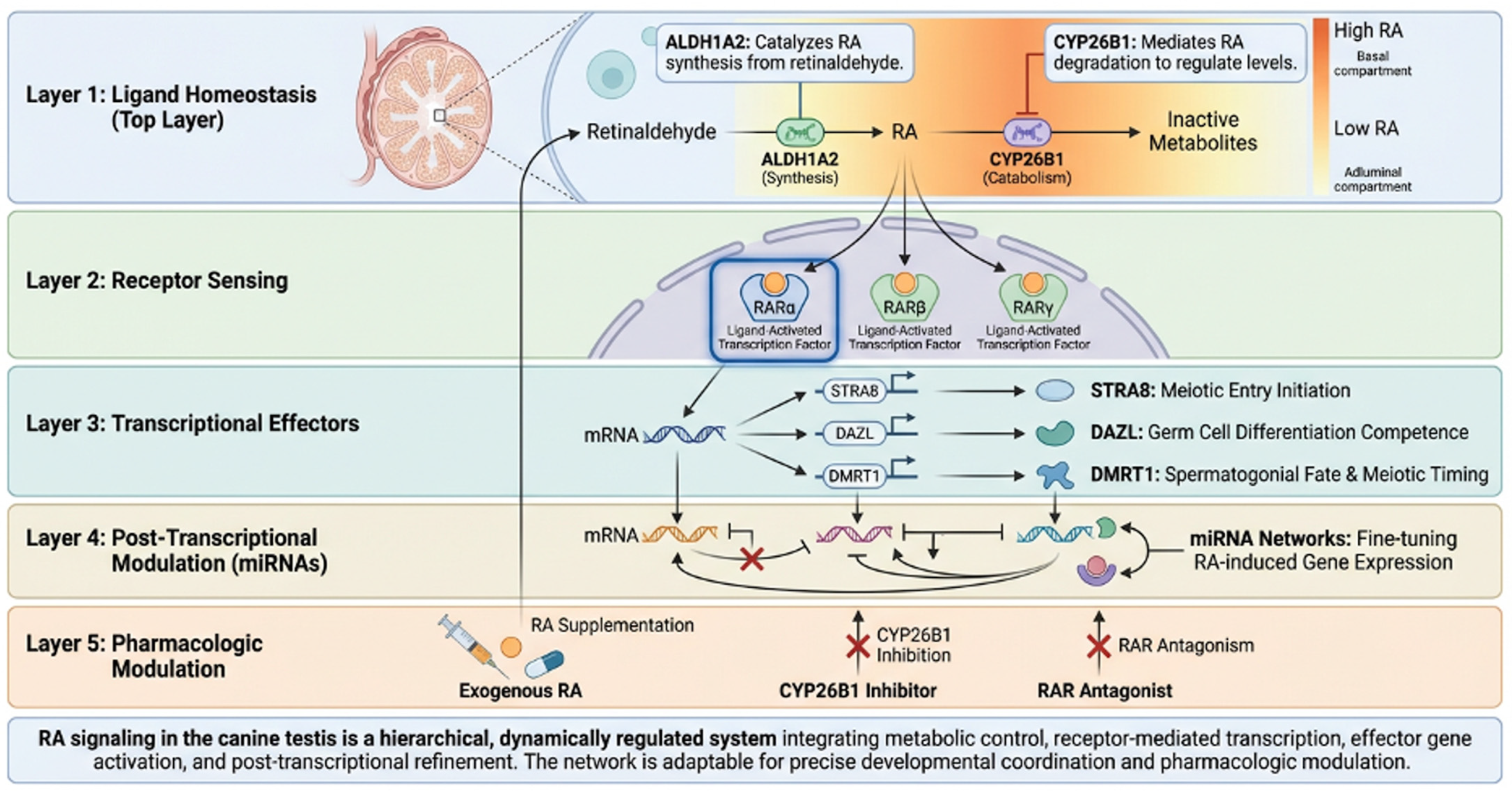
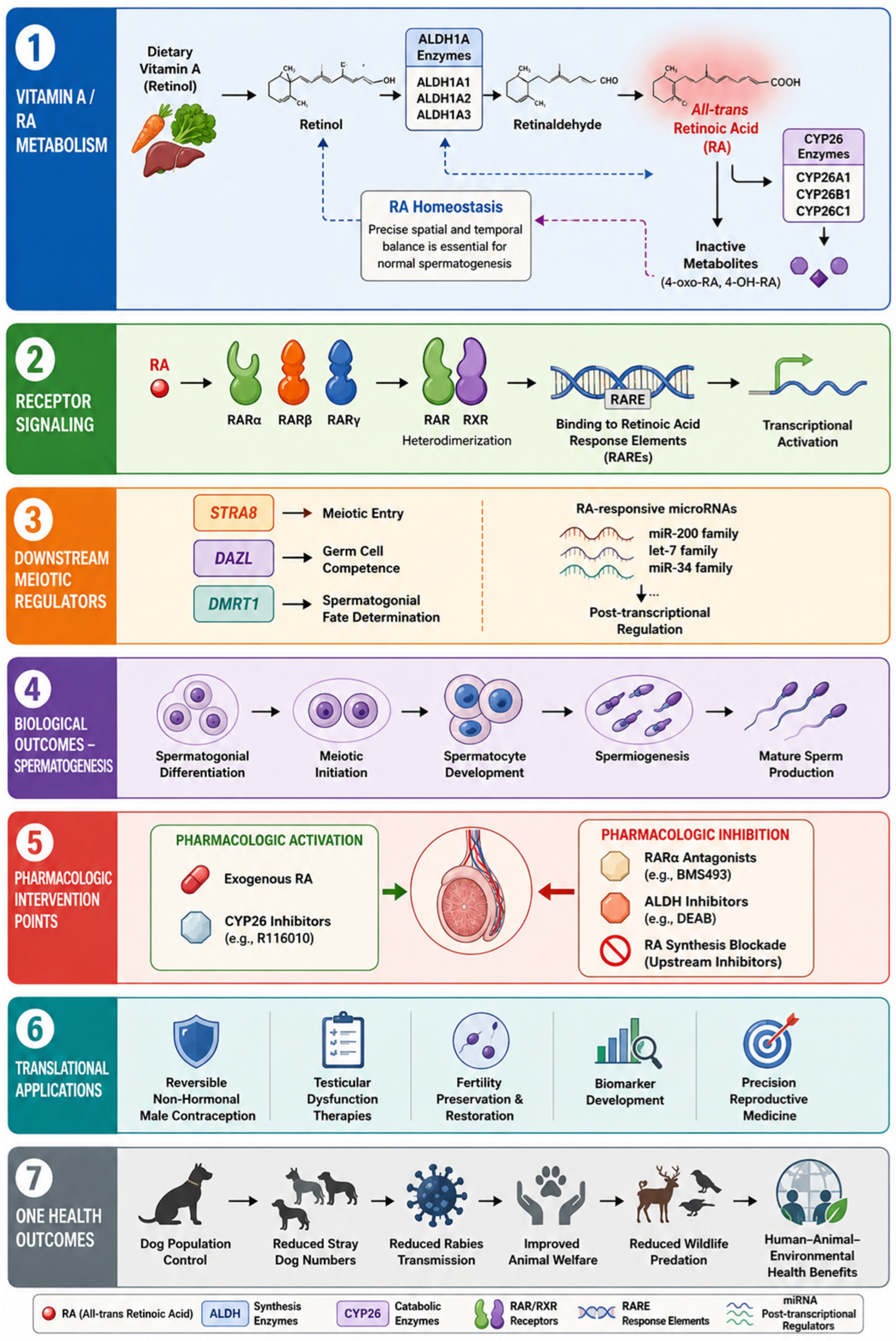
3. RA Homeostasis in the Postnatal Canine Testis
3.1. RA Synthesis: ALDH Isozymes
3.2. RA Catabolism: CYP26 Enzymes
4. RA Receptor Signaling and Downstream Effectors in the Canine Testis
5. Pharmacological Modulation of RA Signaling and Translational Implications
5.1. Exogenous RA Supplementation
5.2. RA Catabolic Inhibition
5.3. RAR Antagonism
5.4. Translational Implications and Future Perspectives
6. Retinoic Acid Signaling in the Canine Testis: Contraceptive Opportunities
Challenges and Considerations for RA-Based Contraceptive Development
7. Comparative Insights and Translational Relevance
7.1. Rodent Models: Foundational Mechanistic Insights
7.2. Canine and Bovine Spermatogenesis: Conservation and Species-Specific Adaptations
7.3. Human Relevance and Translational Implications
- RA signaling is highly conserved among mammals and serves as a central regulator of spermatogonial differentiation and meiotic initiation.
- STRA8 represents the most consistently identified downstream mediator of RA-induced meiotic entry.
- CYP26 enzymes play a critical role in regulating local RA availability and timing of spermatogenic events.
- Pharmacological manipulation of RA signaling can reversibly alter spermatogenesis, supporting development of non-hormonal contraceptive strategies.
- The canine model occupies a unique translational position because it combines physiological relevance, veterinary importance, and potential applications in One Health-based population management.
8. Key Insights, Emerging Questions and Future Directions
8.1. Key Insights and Integration
8.2. Critical Knowledge Gaps and Unresolved Questions
8.3. Emerging Questions
8.4. Future Directions
8.5. Emerging Opportunities in Reproductive Biotechnology
9. Dog Population Control Within the One Health Framework
RA-Based Fertility Control as a One Health Strategy
10. Conclusions
Author Contributions
Funding
Institutional Review Board Statement
Informed Consent Statement
Data Availability Statement
Acknowledgments
Conflicts of Interest
References
- Maroto, M.; Torvisco, S.N.; García-Merino, C.; Fernández-González, R.; Pericuesta, E. Mechanisms of Hormonal, Genetic, and Temperature Regulation of Germ Cell Proliferation, Differentiation, and Death During Spermatogenesis. Biomolecules 2025, 15, 500. [Google Scholar] [CrossRef]
- Hess, R.A.; França, L.R. Spermatogenesis and Cycle of the Seminiferous Epithelium. In Molecular Mechanisms in Spermatogenesis; Cheng, C.Y., Ed.; Landes Bioscience: Austin, TX, USA, 2007; pp. 1–15. [Google Scholar]
- de Souza, A.F.; Pieri, N.C.G.; Martins, D.D.S. Step by Step about Germ Cells Development in Canine. Animals 2021, 11, 598. [Google Scholar] [CrossRef]
- Anjum, S.; Khurshid, Y.; Du Plessis, S.S.; Omolaoye, T.S. Unmasking the Epigenome: Insights into Testicular Cell Dynamics and Reproductive Function. Int. J. Mol. Sci. 2025, 26, 7305. [Google Scholar] [CrossRef] [PubMed]
- Chakravorty, A.; Simons, B.D.; Yoshida, S.; Cai, L. Spatial Transcriptomics Reveals the Temporal Architecture of the Seminiferous Epithelial Cycle and Precise Sertoli-Germ Synchronization. bioRxiv 2024. [Google Scholar] [CrossRef] [PubMed]
- Soares, J.M.; Avelar, G.F.; França, L.R. The Seminiferous Epithelium Cycle and Its Duration in Different Breeds of Dog (Canis familiaris). J. Anat. 2009, 215, 462–471. [Google Scholar] [CrossRef]
- Romagnoli, S. Two Common Causes of Infertility in the Male Dog. In Proceedings of the 2006 World Congress WSAVA/FECAVA/CSAVA, Prague, Czech Republic, 11–14 October 2006; pp. 686–690. [Google Scholar]
- Morawietz, J.; Körber, H.; Packeiser, E.M.; Beineke, A.; Goericke-Pesch, S. Insights into Canine Infertility: Apoptosis in Chronic Asymptomatic Orchitis. Int. J. Mol. Sci. 2023, 24, 6083. [Google Scholar] [CrossRef] [PubMed]
- Mogielnicka-Brzozowska, M.; Cichowska, A.W. Molecular Biomarkers of Canine Reproductive Functions. Curr. Issues Mol. Biol. 2024, 46, 6139–6168. [Google Scholar] [CrossRef] [PubMed]
- Bettegowda, A.; Wilkinson, M.F. Transcription and Post-Transcriptional Regulation of Spermatogenesis. Phil. Trans. R. Soc. B 2010, 365, 1637–1651. [Google Scholar] [CrossRef]
- Álvarez-Rodríguez, M.; Catalán, J. Molecular Mechanisms Involved in Sperm Development, Maturation, and Fertilization. Int. J. Mol. Sci. 2025, 26, 4049. [Google Scholar] [CrossRef]
- Wang, J.M.; Li, Z.F.; Yang, W.X. What Does Androgen Receptor Signaling Pathway in Sertoli Cells during Normal Spermatogenesis Tell Us? Front. Endocrinol. 2022, 13, 838858. [Google Scholar] [CrossRef]
- Helsel, A.; Griswold, M.D. Retinoic Acid Signaling and the Cycle of the Seminiferous Epithelium. Curr. Opin. Endocr. Metab. Res. 2019, 6, 1–6. [Google Scholar] [CrossRef] [PubMed]
- Gewiss, R.L.; Schleif, M.C.; Griswold, M.D. The Role of Retinoic Acid in the Commitment to Meiosis. Asian J. Androl. 2021, 23, 549–554. [Google Scholar] [CrossRef] [PubMed]
- Kasimanickam, V.R.; Kasimanickam, R.K. Retinoic Acid Signaling Biomarkers after Treatment with Retinoic Acid and Retinoic Acid Receptor Alpha Antagonist (Ro 41-5253) in Canine Testis: An In Vitro Organ Culture Study. Theriogenology 2013, 79, 10–16. [Google Scholar] [CrossRef]
- Petkovich, M.; Chambon, P. Retinoic Acid Receptors at 35 Years. J. Mol. Endocrinol. 2022, 69, R125–R134. [Google Scholar] [CrossRef] [PubMed]
- Huang, P.; Chandra, V.; Rastinejad, F. Retinoic Acid Actions through Mammalian Nuclear Receptors. Chem. Rev. 2014, 114, 233–254. [Google Scholar] [CrossRef]
- Berenguer, M.; Duester, G. Retinoic Acid, RARs and Early Development. J. Mol. Endocrinol. 2022, 69, R101–R112. [Google Scholar] [CrossRef]
- Ma, H.T.; Niu, C.M.; Xia, J.; Shen, X.Y.; Xia, M.M.; Hu, Y.Q.; Zheng, Y. Stimulated by Retinoic Acid Gene 8 (Stra8) Plays Important Roles in Many Stages of Spermatogenesis. Asian J. Androl. 2018, 20, 479–487. [Google Scholar] [CrossRef]
- Anderson, E.L.; Baltus, A.E.; Roepers-Gajadien, H.L.; Hassold, T.J.; de Rooij, D.G.; Page, D.C. Stra8 and Its Inducer, Retinoic Acid, Regulate Meiotic Initiation in Both Spermatogenesis and Oogenesis in Mice. Proc. Natl. Acad. Sci. USA 2008, 105, 14976–14980. [Google Scholar] [CrossRef]
- Endo, T.; Romer, K.A.; Anderson, E.L.; Baltus, A.E.; de Rooij, D.G.; Page, D.C. Periodic Retinoic Acid-STRA8 Signaling Intersects with Periodic Germ-Cell Competencies to Regulate Spermatogenesis. Proc. Natl. Acad. Sci. USA 2015, 112, E2347–E2356. [Google Scholar] [CrossRef]
- Kasimanickam, V.R. Expression of Retinoic Acid-Metabolizing Enzymes, ALDH1A1, ALDH1A2, ALDH1A3, CYP26A1, CYP26B1 and CYP26C1 in Canine Testis during Post-Natal Development. Reprod. Domest. Anim. 2016, 51, 901–909. [Google Scholar] [CrossRef]
- Maynard, L.H.; Humbert, O.; Peterson, C.W.; Kiem, H.-P. Genome Editing in Large Animal Models. Mol. Ther. 2021, 29, 3140–3152. [Google Scholar] [CrossRef]
- Brito, M.M.; da Rosa Filho, R.R.; Losano, J.D.A.; Vannucchi, C.I. Ageing Changes Testes and Epididymis Blood Flow Without Altering Biometry and Echodensity in Dogs. Anim. Reprod. Sci. 2021, 228, 106745. [Google Scholar] [CrossRef] [PubMed]
- Nagashima, J.B.; Songsasen, N. Canid Reproductive Biology: Norm and Unique Aspects in Strategies and Mechanisms. Animals 2021, 11, 653. [Google Scholar] [CrossRef]
- Slater, M.R. The Role of Veterinary Epidemiology in the Study of Free-Roaming Dogs and Cats. Prev. Vet. Med. 2001, 48, 273–286. [Google Scholar] [CrossRef]
- Smith, L.M.; Hartmann, S.; Munteanu, A.M.; Dalla Villa, P.; Quinnell, R.J.; Collins, L.M. The Effectiveness of Dog Population Management: A Systematic Review. Animals 2019, 9, 1020. [Google Scholar] [CrossRef]
- Kasimanickam, V.R.; Kasimanickam, R.K. In Silico Analysis of miRNA-Mediated Genes in the Regulation of Dog Testes Development from Immature to Adult Form. Animals 2023, 13, 1520. [Google Scholar] [CrossRef]
- Stukenborg, J.-B. The Use of Testicular Organoids in Advancing Future Treatments for Male Factor Infertility. Fertil. Steril. 2025, 124, 406–416. [Google Scholar] [CrossRef]
- Chen, J.; Cai, T.; Zheng, C.; Lin, X.; Wang, G.; Liao, S.; Wang, X.; Gan, H.; Zhang, D.; Hu, X.; et al. MicroRNA-202 Maintains Spermatogonial Stem Cells by Inhibiting Cell Cycle Regulators and RNA Binding Proteins. Nucleic Acids Res. 2017, 45, 4142–4157. [Google Scholar] [CrossRef]
- Kasimanickam, V.R.; Kasimanickam, R.K.; Dernell, W.S. Dysregulated MicroRNA Clusters in Response to Retinoic Acid and CYP26B1 Inhibitor Induced Testicular Function in Dogs. PLoS ONE 2014, 9, e99433. [Google Scholar] [CrossRef] [PubMed]
- Busada, J.T.; Geyer, C.B. The Role of Retinoic Acid (RA) in Spermatogonial Differentiation. Biol. Reprod. 2016, 94, 10. [Google Scholar] [CrossRef] [PubMed]
- Velte, E.K.; Niedenberger, B.A.; Serra, N.D.; Singh, A.; Roa-DeLaCruz, L.; Hermann, B.P.; Geyer, C.B. Differential RA responsiveness directs formation of functionally distinct spermatogonial populations at the initiation of spermatogenesis in the mouse. Development 2019, 146, dev173088. [Google Scholar] [CrossRef]
- Chung, S.S.; Wolgemuth, D.J. Role of retinoid signaling in the regulation of spermatogenesis. Cytogenet. Genome Res. 2004, 105, 189–202. [Google Scholar] [CrossRef]
- Zhao, D.; McCaffery, P.; Ivins, K.J.; Neve, R.L.; Hogan, P.; Chin, W.W.; Dräger, U.C. Molecular identification of a major retinoic-acid-synthesizing enzyme, a retinaldehyde-specific dehydrogenase. Eur. J. Biochem. 1996, 240, 15–22. [Google Scholar] [CrossRef]
- Vernet, N.; Dennefeld, C.; Rochette-Egly, C.; Oulad-Abdelghani, M.; Chambon, P.; Ghyselinck, N.B.; Mark, M. Retinoic acid metabolism and signaling pathways in the adult and developing mouse testis. Endocrinology 2006, 147, 96–110. [Google Scholar] [CrossRef]
- Amory, J.K.; Arnold, S.; Lardone, M.C.; Piottante, A.; Ebensperger, M.; Isoherranen, N.; Muller, C.H.; Walsh, T.; Castro, A. Levels of the retinoic acid synthesizing enzyme aldehyde dehydrogenase-1A2 are lower in testicular tissue from men with infertility. Fertil. Steril. 2014, 101, 960–966. [Google Scholar] [CrossRef]
- Elizondo, G.; Corchero, J.; Sterneck, E.; Gonzalez, F.J. Feedback inhibition of the retinaldehyde dehydrogenase gene ALDH1 by retinoic acid through retinoic acid receptor alpha and CCAAT/enhancer-binding protein beta. J. Biol. Chem. 2000, 275, 39747–39753. [Google Scholar] [CrossRef]
- Griswold, M.D. Spermatogenesis: The commitment to meiosis. Physiol. Rev. 2016, 96, 1–17. [Google Scholar] [CrossRef]
- Gewiss, R.; Topping, T.; Griswold, M.D. Cycles, waves, and pulses: Retinoic acid and the organization of spermatogenesis. Andrology 2020, 8, 892–897. [Google Scholar] [CrossRef]
- Parekh, P.A.; Garcia, T.X.; Waheeb, R.; Jain, V.; Gandhi, P.; Meistrich, M.L.; Shetty, G.; Hofmann, M.C. Undifferentiated spermatogonia regulate Cyp26b1 expression through NOTCH signaling and drive germ cell differentiation. FASEB J. 2019, 33, 8423–8435. [Google Scholar] [CrossRef]
- Koubova, J.; Menke, D.B.; Zhou, Q.; Capel, B.; Griswold, M.D.; Page, D.C. Retinoic acid regulates sex-specific timing of meiotic initiation in mice. Proc. Natl. Acad. Sci. USA 2006, 103, 2474–2479. [Google Scholar] [CrossRef]
- MacLean, G.; Li, H.; Metzger, D.; Chambon, P.; Petkovich, M. Apoptotic extinction of germ cells in testes of Cyp26b1 knockout mice. Endocrinology 2007, 148, 4560–4567. [Google Scholar] [CrossRef] [PubMed]
- Kim, K.H.; Griswold, M.D. The regulation of retinoic acid receptor mRNA levels during spermatogenesis. Mol. Endocrinol. 1990, 4, 1679–1688. [Google Scholar] [CrossRef]
- le Maire, A.; Teyssier, C.; Balaguer, P.; Bourguet, W.; Germain, P. Regulation of RXR-RAR heterodimers by RXR- and RAR-specific ligands and their combinations. Cells 2019, 8, 1392. [Google Scholar] [CrossRef]
- Havel, S.L.; Griswold, M.D. Temporal maturation of Sertoli cells during the establishment of the cycle of the seminiferous epithelium. Biol. Reprod. 2024, 111, 959–974. [Google Scholar] [CrossRef]
- Kasimanickam, V.R.; Kasimanickam, R.K.; Rogers, H.A. Immunolocalization of retinoic acid receptor-alpha, -beta, and -gamma in bovine and canine sperm. Theriogenology 2013, 79, 1010–1018. [Google Scholar] [CrossRef] [PubMed]
- Kasimanickam, V.; Kasimanickam, R. Exogenous retinoic acid and cytochrome P450 26B1 inhibitor modulate meiosis-associated genes expression in canine testis, an in vitro model. Reprod. Domest. Anim. 2014, 49, 315–323. [Google Scholar] [CrossRef]
- Bowles, J.; Koopman, P. Retinoic acid, meiosis and germ cell fate in mammals. Development 2007, 134, 3401–3411. [Google Scholar] [CrossRef]
- Ocaya, P.A.; Elmabsout, A.A.; Olofsson, P.S.; Törmä, H.; Gidlöf, A.C.; Sirsjö, A. CYP26B1 plays a major role in the regulation of all-trans-retinoic acid metabolism and signaling in human aortic smooth muscle cells. J. Vasc. Res. 2011, 48, 23–30. [Google Scholar] [CrossRef]
- Laue, K.; Jänicke, M.; Plaster, N.; Sonntag, C.; Hammerschmidt, M. Restriction of retinoic acid activity by Cyp26b1 is required for proper timing and patterning of osteogenesis during zebrafish development. Development 2008, 135, 3775–3787. [Google Scholar] [CrossRef]
- Zhou, Q.; Li, Y.; Nie, R.; Friel, P.J.; Mitchell, D.; Evanoff, R.M.; Pouchnik, D.J.; Banasik, B.E.; McCarrey, J.R.; Small, C.L.; et al. Expression of stimulated by retinoic acid gene 8 (Stra8) and maturation of murine gonocytes and spermatogonia induced by retinoic acid in vitro. Biol. Reprod. 2008, 78, 537–545. [Google Scholar] [CrossRef] [PubMed]
- Minkina, A.; Matson, C.K.; Lindeman, R.E.; Ghyselinck, N.B.; Bardwell, V.J.; Zarkower, D. DMRT1 protects male gonadal cells from retinoid-dependent sexual transdifferentiation. Dev. Cell 2014, 29, 511–520. [Google Scholar] [CrossRef] [PubMed]
- Stoppie, P.; Borgers, M.; Borghgraef, P.; Dillen, L.; Goossens, J.; Sanz, G.; Szel, H.; Van Hove, C.; Van Nyen, G.; Nobels, G.; et al. R115866 inhibits all-trans-retinoic acid metabolism and exerts retinoidal effects in rodents. J. Pharmacol. Exp. Ther. 2000, 293, 304–312. [Google Scholar] [CrossRef]
- Kasimanickam, V.R.; Kasimanickam, R.K. Expression of CYP26B1 and related retinoic acid signalling molecules in young, peripubertal and adult dog testis. Reprod. Domest. Anim. 2013, 48, 171–176. [Google Scholar] [CrossRef] [PubMed]
- Bellutti, L.; Abby, E.; Tourpin, S.; Messiaen, S.; Moison, D.; Trautmann, E.; Guerquin, M.J.; Rouiller-Fabre, V.; Habert, R.; Livera, G. Divergent roles of CYP26B1 and endogenous retinoic acid in mouse fetal gonads. Biomolecules 2019, 9, 536. [Google Scholar] [CrossRef]
- Schubert, M.; Germain, P. Retinoic acid and retinoid X receptors. Cells 2023, 12, 864. [Google Scholar] [CrossRef]
- Hasegawa, K.; Saga, Y. Retinoic acid signaling in Sertoli cells regulates organization of the blood–testis barrier through cyclical changes in gene expression. Development 2012, 139, 4347–4355. [Google Scholar] [CrossRef]
- Chung, S.S.; Wang, X.; Wolgemuth, D.J. Expression of retinoic acid receptor alpha in the germline is essential for proper cellular association and spermiogenesis during spermatogenesis. Development 2009, 136, 2091–2100. [Google Scholar] [CrossRef]
- Hong, S.-H.; Castro, G.; Wang, D.; Nofsinger, R.; Kane, M.; Folias, A.; Atkins, A.R.; Yu, R.T.; Napoli, J.L.; Sassone-Corsi, P.; et al. Targeting nuclear receptor corepressors for reversible male contraception. Proc. Natl. Acad. Sci. USA 2024, 121, e2320129121. [Google Scholar] [CrossRef]
- Noman, M.A.A.; Kyzer, J.L.; Chung, S.S.W.; Wolgemuth, D.J.; Georg, G.I. Retinoic acid receptor antagonists for male contraception: Current status. Biol. Reprod. 2020, 103, 390–399. [Google Scholar] [CrossRef]
- Zhao, Y.; Deng, S.; Li, C.; Cao, J.; Wu, A.; Chen, M.; Ma, X.; Wu, S.; Lian, Z. The role of retinoic acid in spermatogenesis and its application in male reproduction. Cells 2024, 13, 1092. [Google Scholar] [CrossRef] [PubMed]
- Chung, S.S.; Wang, X.; Wolgemuth, D.J. Prolonged oral administration of a pan-retinoic acid receptor antagonist inhibits spermatogenesis in mice with a rapid recovery and changes in the expression of influx and efflux transporters. Endocrinology 2016, 157, 1601–1612. [Google Scholar] [CrossRef]
- Mehrvar, S.; Kambara, T. Morphologic features and deep learning-based analysis of canine spermatogenic stages. Toxicol. Pathol. 2022, 50, 736–753. [Google Scholar] [CrossRef] [PubMed]
- Chien, S.T.; Suydam, I.T.; Woodrow, K.A. Prodrug approaches for the development of long-acting drug delivery systems. Adv. Drug Deliv. Rev. 2023, 198, 114860. [Google Scholar] [CrossRef]
- Shi, R.; Wolgemuth, D.J.; Georg, G.I. Development of the retinoic acid receptor alpha-specific antagonist YCT-529 for male contraception: A brief review. Contraception 2025, 145, 110809. [Google Scholar] [CrossRef]
- Freeman, W.; Russo, J. Rebalancing reproductive responsibility: Progress in nonhormonal male contraception. Pharm. Times 2026, 92. Available online: www.pharmacytimes.com/view/rebalancing-reproductive-responsibility-progress-in-non-hormonal-male-contraception (accessed on 4 March 2026).
- Zhou, Y.; Wang, Y. Action and interaction between retinoic acid signaling and blood-testis barrier function in the spermatogenesis cycle. Cells 2022, 11, 352. [Google Scholar] [CrossRef] [PubMed]
- Fonseca, P.A.S.; Dos Santos, F.C.; Lam, S.; Suárez-Vega, A.; Miglior, F.; Schenkel, F.S.; Diniz, L.A.F.; Id-Lahoucine, S.; Carvalho, M.R.S.; Cánovas, A. Genetic mechanisms underlying spermatic and testicular traits within and among cattle breeds: Systematic review and prioritization of GWAS results. J. Anim. Sci. 2018, 96, 4978–4999. [Google Scholar] [CrossRef]
- Cao, M.; Guo, S.; Ding, Z.; Hu, L.; Xiong, L.; Ge, Q.; Pei, J.; Guo, X. Comparative analysis of testicular transcriptional and translational landscapes in yak and cattle-yak: Implications for hybrid male sterility. Biomolecules 2025, 15, 1080. [Google Scholar] [CrossRef]
- Turner, L.M.; Chuong, E.B.; Hoekstra, H.E. Comparative analysis of testis protein evolution in rodents. Genetics 2008, 179, 2075–2089. [Google Scholar] [CrossRef]
- Yang, T.A.; Yang, Y.H.; Peng, Y.H.; Cong, B.; Diao, Y.F.; Bao, K.; Hu, P.F.; Song, X.C.; Liu, L.L.; Yang, Y.F.; et al. Comparative studies on testicular and epididymal morphology, and serum hormone concentrations in foxes and the hybrids during the breeding season. Anim. Reprod. Sci. 2016, 168, 66–72. [Google Scholar] [CrossRef]
- Griswold, M.D.; Hogarth, C.A.; Bowles, J.; Koopman, P. Initiating meiosis: The case for retinoic acid. Biol. Reprod. 2012, 86, 35. [Google Scholar] [CrossRef]
- Li, H.; MacLean, G.; Cameron, D.; Clagett-Dame, M.; Petkovich, M. Cyp26b1 expression in murine Sertoli cells is required to maintain male germ cells in an undifferentiated state during embryogenesis. PLoS ONE 2009, 4, e7501. [Google Scholar] [CrossRef] [PubMed]
- Lee, W.Y.; Park, H.J.; Lee, R.; Lee, J.H.; Jhun, H.; Hur, T.Y.; Song, H. Analysis of putative biomarkers of undifferentiated spermatogonia in dog testis. Anim. Reprod. Sci. 2017, 185, 174–180. [Google Scholar] [CrossRef] [PubMed]
- Hickford, D.E.; Wong, S.F.L.; Frankenberg, S.R.; Shaw, G.; Yu, H.; Chew, K.Y.; Renfree, M.B. Expression of STRA8 is conserved in therian mammals but expression of CYP26B1 differs between marsupials and mice. Biol. Reprod. 2017, 97, 217–229. [Google Scholar] [CrossRef]
- Zhang, H.Z.; Hao, S.L.; Yang, W.X. How does retinoic acid (RA) signaling pathway regulate spermatogenesis? Histol. Histopathol. 2022, 37, 1053–1064. [Google Scholar] [CrossRef] [PubMed]
- Li, X.; Long, X.-Y.; Xie, Y.-J.; Zeng, X.; Chen, X.; Mo, Z.-C. The roles of retinoic acid in the differentiation of spermatogonia and spermatogenic disorders. Clin. Chim. Acta 2019, 497, 54–60. [Google Scholar] [CrossRef]
- Harkey, M.A.; Asano, A.; Zoulas, M.E.; Torok-Storb, B.; Nagashima, J.; Travis, A. Isolation, genetic manipulation, and transplantation of canine spermatogonial stem cells: Progress toward transgenesis through the male germ-line. Reproduction 2013, 146, 75–90. [Google Scholar] [CrossRef]
- Koilpillai, J.N.; Nunan, E.; Butler, L.; Pinaffi, F.; Butcher, J.T. Reversible contraception in males: An obtainable target? Biology 2024, 13, 291. [Google Scholar] [CrossRef]
- Cui, L.; Nie, X.; Guo, Y.; Ren, P.; Guo, Y.; Wang, X.; Li, R.; Hotaling, J.M.; Cairns, B.R.; Guo, J. Single-cell transcriptomic atlas of the human testis across the reproductive lifespan. Nat. Aging 2025, 5, 658–674. [Google Scholar] [CrossRef]
- Mecca, R.; Tang, S.; Jones, C.; Coward, K. The limitations of testicular organoids: Are they truly as promising as we believe? Reprod. Fert. Dev. 2024, 36, RD23216. [Google Scholar] [CrossRef]
- Gille, A.S.; Lapoujade, C.; Wolf, J.P.; Fouchet, P.; Barraud-Lange, V. Contribution of Single-Cell Transcriptomics to the Characterization of Human Spermatogonial Stem Cells: Toward an Application in Male Fertility Regenerative Medicine? Int. J. Mol. Sci. 2019, 20, 5773. [Google Scholar] [CrossRef] [PubMed]
- Chen, W.B.; Zhang, M.F.; Yang, F.; Hua, J.L. Applications of single-cell RNA sequencing in spermatogenesis and molecular evolution. Zool. Res. 2024, 45, 575–585. [Google Scholar] [CrossRef]
- Xu, Q.; Chen, H. Applications of spatial transcriptomics in studying spermatogenesis. Andrology 2025, 13, 1181–1189. [Google Scholar] [CrossRef] [PubMed]
- Destoumieux-Garzón, D.; Mavingui, P.; Boetsch, G.; Boissier, J.; Darriet, F.; Duboz, P.; Fritsch, C.; Giraudoux, P.; Le Roux, F.; Morand, S.; et al. The One Health concept: 10 years old and a long road ahead. Front. Vet. Sci. 2018, 5, 14. [Google Scholar] [CrossRef]
- Taylor, L.H.; Wallace, R.M.; Balaram, D.; Lindenmayer, J.M.; Eckery, D.C.; Mutonono-Watkiss, B.; Parravani, E.; Nel, L.H. The role of dog population management in rabies elimination—A review of current approaches and future opportunities. Front. Vet. Sci. 2017, 4, 109. [Google Scholar] [CrossRef]
- Cleaveland, S.; Kaare, M.; Knobel, D.; Laurenson, M.K. Canine vaccination—Providing broader benefits for disease control. Vet. Microbiol. 2006, 117, 43–50. [Google Scholar] [CrossRef] [PubMed]
- Hampson, K.; Coudeville, L.; Lembo, T.; Sambo, M.; Kieffer, A.; Attlan, M.; Barrat, J.; Blanton, J.D.; Briggs, D.J.; Cleaveland, S.; et al. Estimating the global burden of endemic canine rabies. PLoS Negl. Trop. Dis. 2015, 9, e0003709. [Google Scholar] [CrossRef]
- Morters, M.K.; McKinley, T.J.; Horton, D.L.; Cleaveland, S.; Schoeman, J.P.; Restif, O.; Whay, H.R.; Goddard, A.; Fooks, A.R.; Damriyasa, I.M.; et al. Achieving population-level immunity to rabies in free-roaming dogs in Africa and Asia. PLoS Negl. Trop. Dis. 2014, 8, e3160. [Google Scholar] [CrossRef]
- Matter, H.; Daniels, T. Dog ecology and population biology. In Dogs, Zoonoses and Public Health; Macpherson, C.N.L., Meslin, F.X., Wandeler, A.I., Eds.; CABI Publishing: New York, NY, USA, 2000; pp. 17–62. [Google Scholar]
- Butcher, R. Humane dog population management guidelines. In Proceedings of the NAVC Conference Proceedings, Orlando, FL, USA, 17–21 January 2009; Available online: https://www.cabidigitallibrary.org/doi/pdf/10.5555/20093115552 (accessed on 15 May 2026).
- Fielding, W.J. Dog breeding in New Providence, The Bahamas, and its potential impact on the roaming dog population II: The fate of puppies. J. Appl. Anim. Welf. Sci. 2010, 13, 300–313. [Google Scholar] [CrossRef]
- Totton, S.C.; Wandeler, A.I.; Zinsstag, J.; Bauch, C.T.; Ribble, C.S.; Rosatte, R.C.; McEwen, S.A. Stray dog population demographics in Jodhpur, India following a population control/rabies vaccination program. Prev. Vet. Med. 2010, 97, 51–57. [Google Scholar] [CrossRef]
- Reece, J.F.; Chawla, S.K. Control of rabies in Jaipur, India, by the sterilisation and vaccination of neighbourhood dogs. Vet. Rec. 2006, 159, 379–383. [Google Scholar] [CrossRef]
- Morters, M.K.; McKinley, T.J.; Restif, O.; Conlan, A.J.K.; Cleaveland, S.; Hampson, K.; Whay, H.R.; Damriyasa, I.M.; Wood, J.L.N. The demography of free-roaming dog populations and applications to disease and population control. J. Appl. Ecol. 2014, 51, 1096–1106. [Google Scholar] [CrossRef]
- Dalla Villa, P.; Kahn, S.; Stuardo, L.; Iannetti, L.; Di Nardo, A.; Serpell, J.A. Free-roaming dog control among OIE-member countries. Prev. Vet. Med. 2010, 97, 58–63. [Google Scholar] [CrossRef]
- Jackman, J.; Rowan, A. Free-roaming dogs in developing countries: The benefits of capture, neuter, and return programs. In The State of the Animals 2007; Salem, D.J., Rowan, A.N., Eds.; Humane Society Press: Washington, DC, USA, 2007; pp. 55–78. [Google Scholar]
- Young, J.K.; Olson, K.A.; Reading, R.P.; Amgalanbaatar, S.; Berger, J. Is wildlife going to the dogs? Impacts of feral and free-roaming dogs on wildlife populations. BioScience 2011, 61, 125–132. [Google Scholar] [CrossRef]
- Fiorello, C.V.; Noss, A.J.; Deem, S.L. Demography, hunting ecology, and pathogen exposure of domestic dogs in the Isoso of Bolivia. Conserv. Biol. 2006, 20, 762–771. [Google Scholar] [CrossRef]
- Costanzi, L.; Brambilla, A.; Di Blasio, A.; Dondo, A.; Goria, M.; Masoero, L.; Gennero, M.S.; Bassano, B. Beware of dogs! Domestic animals as a threat for wildlife conservation in Alpine protected areas. Eur. J. Wildl. Res. 2021, 67, 70. [Google Scholar] [CrossRef]
- Zinsstag, J.; Schelling, E.; Bonfoh, B.; Fooks, A.R.; Kasymbekov, J.; Waltner-Toews, D.; Tanner, M. Towards a “One Health” research and application tool box. Vet. Ital. 2009, 45, 121–133. [Google Scholar]
- Garcia, T.X.; Matzuk, M.M. Novel Genes of the Male Reproductive System: Potential Roles in Male Reproduction and as Non-hormonal Male Contraceptive Targets. Mol. Reprod. Dev. 2024, 91, e70000. [Google Scholar] [CrossRef]
- Balbach, M.; Rossetti, T.; Ferreira, J.; Ghanem, L.; Ritagliati, C.; Myers, R.W.; Huggins, D.J.; Steegborn, C.; Miranda, I.C.; Meinke, P.T.; et al. On-demand male contraception via acute inhibition of soluble adenylyl cyclase. Nat. Commun. 2023, 14, 637. [Google Scholar] [CrossRef]
- Mariani, N.A.P.; Silva, J.V.; Fardilha, M.; Silva, E.J.R. Advances in non-hormonal male contraception targeting sperm motility. Hum. Reprod. Update 2023, 29, 545–569. [Google Scholar] [CrossRef]
- Nickels, L.; Yan, W. Nonhormonal Male Contraceptive Development-Strategies for Progress. Pharmacol. Rev. 2023, 76, 37–48. [Google Scholar] [CrossRef]
- Kent, K.; Johnston, M.; Strump, N.; Garcia, T.X. Toward Development of the Male Pill: A Decade of Potential Non-hormonal Contraceptive Targets. Front. Cell Dev. Biol. 2020, 8, 61. [Google Scholar] [CrossRef]
- Nadal, D.; Bote, K.; Abela, B. Is there hope to reach the Zero by 30 target for dog-mediated human rabies? Lancet Glob. Health 2023, 11, e1682–e1683. [Google Scholar] [CrossRef]
- Tidman, R.; Fahrion, A.S.; Thumbi, S.M.; Wallace, R.M.; De Balogh, K.; Iwar, V.; Yale, G.; Dieuzy-Labaye, I. United Against Rabies Forum: The first 2 years. Front. Public Health 2023, 11, 1010071. [Google Scholar] [CrossRef]



| Species | Experimental Model | Major RA Targets/Pathways | Principal Findings | Translational Relevance |
|---|---|---|---|---|
| Mouse (Mus musculus) | Genetic knockout models, transgenic models, pharmacological inhibition | ALDH1A1–3, CYP26B1, RARα, RARγ, STRA8, DAZL, DMRT1 | Established the central role of RA in spermatogonial differentiation and meiotic initiation; STRA8 identified as a key mediator of meiotic entry; CYP26B1 regulates temporal RA availability | Foundational mechanistic understanding of RA-mediated spermatogenesis and identification of contraceptive targets |
| Rat (Rattus norvegicus) | Pharmacological models, reproductive toxicology studies | RARs, CYP26 enzymes, STRA8 | Demonstrated reversible suppression of spermatogenesis following RA pathway inhibition; characterized reproductive effects of retinoid manipulation | Important preclinical model for development of non-hormonal male contraceptives |
| Human (Homo sapiens) | Testicular tissue studies, infertility investigations, transcriptomics | RARα, RARβ, RARγ, STRA8, DAZL, ALDH1A enzymes | Conserved expression of key RA signaling components in human testes; dysregulation associated with impaired spermatogenesis and infertility | Supports therapeutic targeting of RA signaling in male infertility and reproductive medicine |
| Dog (Canis lupus familiaris) | Testicular tissue analyses, immunolocalization studies, organotypic culture systems, pharmacological studies | ALDH1A isoforms, CYP26 enzymes, RARα, RARβ, RARγ, STRA8, DAZL, microRNA networks | Demonstrated developmental regulation of RA metabolic enzymes, receptor localization in germ cells and spermatozoa, and modulation of meiosis-associated pathways following RA manipulation | Translational model bridging rodent and human reproductive biology; potential platform for development of reversible fertility-control strategies and canine population management |
| Bull (Bos taurus) | Testicular developmental studies, transcriptomic analyses | ALDH1A enzymes, CYP26B1, RARs | Conserved RA-dependent regulation of germ-cell development and spermatogenic progression | Relevant to livestock fertility management and comparative reproductive biology |
| Pig (Sus scrofa) | Developmental and reproductive physiology studies | RARs, STRA8, RA metabolic enzymes | Similar RA-mediated regulation of germ-cell differentiation and testicular maturation | Useful large-animal model with physiological similarities to human reproductive biology |
| Non-human Primates | Experimental reproductive studies | RAR signaling pathways, STRA8, CYP26 enzymes | Confirmed conservation of RA-regulated spermatogenesis in higher mammals | Provides translational evidence supporting clinical development of RA-targeted fertility interventions |
Disclaimer/Publisher’s Note: The statements, opinions and data contained in all publications are solely those of the individual author(s) and contributor(s) and not of MDPI and/or the editor(s). MDPI and/or the editor(s) disclaim responsibility for any injury to people or property resulting from any ideas, methods, instructions or products referred to in the content. |
© 2026 by the authors. Licensee MDPI, Basel, Switzerland. This article is an open access article distributed under the terms and conditions of the Creative Commons Attribution (CC BY) license.
Share and Cite
Kasimanickam, V.; Kasimanickam, R. Retinoic Acid Signaling in Male Reproductive Biology: From Germ Cell Regulation to Contraceptive Innovation Within a One Health Framework. Animals 2026, 16, 1831. https://doi.org/10.3390/ani16121831
Kasimanickam V, Kasimanickam R. Retinoic Acid Signaling in Male Reproductive Biology: From Germ Cell Regulation to Contraceptive Innovation Within a One Health Framework. Animals. 2026; 16(12):1831. https://doi.org/10.3390/ani16121831
Chicago/Turabian StyleKasimanickam, Vanmathy, and Ramanathan Kasimanickam. 2026. "Retinoic Acid Signaling in Male Reproductive Biology: From Germ Cell Regulation to Contraceptive Innovation Within a One Health Framework" Animals 16, no. 12: 1831. https://doi.org/10.3390/ani16121831
APA StyleKasimanickam, V., & Kasimanickam, R. (2026). Retinoic Acid Signaling in Male Reproductive Biology: From Germ Cell Regulation to Contraceptive Innovation Within a One Health Framework. Animals, 16(12), 1831. https://doi.org/10.3390/ani16121831