Article

A 20 Bp Indel of HNF4A Is Associated with Piglet Growth Partially by Regulating Its Transcription

1
Zhejiang Key Laboratory of Livestock and Poultry Biotech Breeding, Institute of Animal Husbandry and Veterinary Science, Zhejiang Academy of Agricultural Sciences, Hangzhou 310021, China
2
College of Animal Science and Technology, Northeast Agricultural University, Harbin 150030, China
*
Authors to whom correspondence should be addressed.
Animals 2026, 16(12), 1797; https://doi.org/10.3390/ani16121797
Submission received: 11 May 2026 / Revised: 5 June 2026 / Accepted: 8 June 2026 / Published: 10 June 2026
(This article belongs to the Section Pigs)

Simple Summary

Hepatocyte nuclear factor 4α (HNF4A) is a transcription factor involved in intestinal cell differentiation, metabolism and nutrient absorption. In this study, a 20 bp insertion/deletion (InDel) was identified in the first intron of the porcine HNF4A, which was associated with piglet body weight and daily gain in Min pigs and Landraces. Furthermore, this InDel altered the transcriptional activity of porcine HNF4A, suggesting it might be a potential functional marker in animal selection breeding.

Abstract

Hepatocyte nuclear factor 4α (HNF4A) is a critical transcription factor that regulates the differentiation and metabolism of intestinal epithelial cells. However, its role in piglet growth remains unclear. In this study, the tissue expression of HNF4A was examined using RT-qPCR, and the putative functional SNPs were analyzed by integrating bioinformatics and DNA sequencing. Association analysis was performed in 156 Min pigs and 160 Landraces, and the biological function of the identified genetic variant was explored using a dual-luciferase reporter assay. The results showed that HNF4A was widely expressed in liver, kidney and gastrointestinal tissues, with significantly higher expression in the liver of adult pigs than in newborn piglets (p < 0.05). A 20 bp InDel was identified in the first intron of porcine HNF4A. Allele frequency analysis showed that the Del allele (20 bp deletion) was dominant in Landrace and Duroc pigs, while the In allele (20 bp insertion) was dominant in Min and Jinhua pigs. Association analysis revealed that Min pigs with the In/Del genotype had significantly higher body weights at 14, 21, 28 and 35 days and higher average daily gain (ADG) than those of the In/In animals (p < 0.05). Landrace piglets with the Del/Del genotype exhibited significantly higher body weight at 21 and 28 days than those of the In/Del genotype (p < 0.05). The dual-luciferase reporter assay suggested that the plasmid carrying the In allele exhibited higher transcriptional activity than the Del allele (p < 0.05). Notably, the genotype associated with superior growth performance differed between the two breeds. Collectively, a 20 bp InDel within HNF4A was identified, which might affect piglet growth partially by modulating its transcription, and further study in other populations with different genetic backgrounds is needed before its application in pig breeding.

1. Introduction

Growth traits are among the most important economic traits, and they are controlled by multiple genes with complex genetic architecture [1,2]. Identification of causal genes or variants has been the foundation for the genetic improvement of growth traits. In the past decade, numerous genetic variants associated with growth traits have been reported using GWAS [3,4,5]. However, most of them have not been functionally characterized, which limits the understanding of the molecular basis of the growth trait.
Nowadays, it is well accepted that functional variants are mainly located in non-coding regions rather than coding regions [6]. These variants regulate gene expression and play roles in shaping complex traits [7]. For example, a 13 bp Indel regulates the expression of the ribosomal protein S27-like (RPS27L) by modifying the binding of transcription factor 3 (TCF3) and myogenic differentiation antigen (MYOD), thereby promoting myoblast proliferation and ultimately affecting pig body weight and backfat thickness [8]. SNP rs702045770 (g.539G>A) within porcine SYNPO2 intron sense-overlapping lncRNA (pSYISL) regulates the binding of Yin Yang 1 (YY1) to the promoter, thereby leading to the differential expression of pSYISL and variation in backfat thickness or muscle fiber density in different populations [9]. A 14 bp Indel in the promoter of porcine mannose receptor C type 1 (MRC1) is associated with different responses to porcine circovirus type 2 (PCV2) infection, partially by regulating the transcription of MRC1 [10].
Hepatocyte nuclear factor 4α (HNF4A) is a nuclear receptor transcription factor that plays a crucial role in regulating metabolism [11], differentiation, and proliferation of intestinal epithelial cells [12,13]. It is highly abundant in the liver, where it governs gluconeogenesis and lipid metabolism [14]. Its dysregulation is linked to metabolic diseases such as type 2 diabetes [15] and non-alcoholic fatty liver disease (NAFLD) [16]. Beyond its well-documented functions in the liver, an increasing number of studies have verified its essential roles in intestinal tissues. Intestinal epithelium serves as the primary site for intestinal lipid absorption and metabolism, and HNF4A precisely modulates fatty acid uptake, intracellular lipid transport, and apolipoprotein synthesis within enterocytes. In murine models, HNF4A mediates fatty acid oxidation in intestinal stem cells, and its deletion impairs stem cell renewal and epithelial regeneration, thereby reducing nutrient absorption and body weight gain [17]. Moreover, HNF4A directly activates a panel of brush border genes involved in carbohydrate and lipid transport across the intestinal epithelium, a process critical for postnatal growth [18]. In humans, GWAS have linked HNF4A variants not only to inflammatory bowel diseases but also to altered fasting glucose levels and lipid profiles, suggesting its pleiotropic role in energy balance and growth [19,20]. Despite these mechanistic insights in rodents and humans, the specific genetic variations within the porcine HNF4A and their relationship with piglet growth remain largely unexplored. Recently, Xiang et al. [21] identified porcine HNF4A as one of the identified transcription factors enriched within differential open chromatin regions (OCRs) in the duodenum of Large White pigs with divergent feed efficiency, using integrated RNA sequencing (RNA-seq) and ATAC sequencing (ATAC-seq). These differential OCRs were associated with genes involved in glycolytic and fatty acid processes, which are tightly linked to energy metabolism and growth performance in pigs. Collectively, these findings suggested that HNF4A might be a candidate gene for porcine growth traits. Nevertheless, functional characterization of genetic variations within the porcine HNF4A, as well as their direct roles in growth regulation, is still limited. Addressing this knowledge gap is essential for the potential application of HNF4A variants as molecular markers in pig breeding programs.
In this study, the tissue expression of HNF4A was analyzed; then, the functional genetic variations in porcine HNF4A were screened by integrating in silico and DNA sequencing and the association analysis between specific variations and growth traits were performed in Min pigs (a Chinese indigenous breed) and the Landrace; lastly, the biological function of the putative functional genetic variation was verified using a dual-luciferase reporter assay, which might contribute to the genetic improvement of piglet growth traits.

2. Materials and Methods

2.1. Animals

For the tissue expression analysis, samples including liver, spleen, stomach, kidney, duodenum, jejunum, ileum, colon, and cecum were collected from four one-month-old pigs as described by Niu et al. [22]. Nine Min pigs raised in the Lanxi Farm (Lanxi, Heilongjiang, China) were slaughtered at three developmental stages (birth, one-month-old, nine-month-old), and the tissues of liver, duodenum, jejunum, and ileum were collected. For the association analysis, all the Min pigs (n = 156) and Landraces (n = 160) were born and raised on Lanxi Farm (Lanxi, Heilongjiang, China) under identical feeding and management conditions, ensuring consistent environmental effects, and the two breeds were raised concurrently during the same period. These animals were weaned at day 35 and weighed at birth, day 3, 7, 14, 21, and 35, then the average daily gain (ADG) was calculated as follows: ADG = (35 days’ weight-birth weight)/35. Additionally, Jinhua pigs (n = 87) were raised in the Zhejiang Mebolo Swine Breeding Farm (Jinhua, Zhejiang, China), and Durocs (n = 299) were provided by Haining Yangdu Science and Technology Ranch of Zhejiang Academy of Agricultural Sciences (Hangzhou, Zhejiang, China).

2.2. In Silico Analysis

SNPs of porcine HNF4A were retrieved from the dbSNP database of Ensembl (https://www.ensembl.org/index.html, accessed on 10 December 2025), and putative functional non-synonymous SNPs (ns-SNPs) were predicted using the Polymorphism Phenotyping v2 tool (http://genetics.bwh.harvard.edu/pph2/, accessed on 10 December 2025), SNAP software 13.0.0 (https://github.com/KorfLab/SNAP, accessed on 10 December 2025), SIFT (http://sift-dna.org), and PhD-SNP (https://snps.biofold.org/phd-snp/phd-snp.html, accessed on 10 December 2025). A phenome-wide association study (PheWAS) for HNF4A was performed using the PigBiobank database (https://pigbiobank.farmgtex.org/, accessed on 10 December 2025) [23]. Cell-type localization and gene expression patterns of porcine HNF4A were analyzed using the Integrated Pig Gut Cell Atlas (IPGCA) database, which was accessed via the scGutDB online visualization platform (http://alphaindex.zju.edu.cn/scgut, accessed on 10 December 2025) [24]. Partial genomic sequences of porcine HNF4A from different breeds were retrieved from the Ensembl database (https://www.ensembl.org/index.html, accessed on 10 December 2025), and these sequences were aligned using DNAMAN 9 software (https://www.lynnon.com/) and Chromas 2.2.0 (https://technelysium.com.au/wp/chromas/, accessed on 10 December 2025).

2.3. Quantitative Real-Time PCR (RT-qPCR)

Total RNA was extracted from tissues using TRIzol, reverse-transcribed into cDNA through PrimeScript RT Master Mix (Takara, Dalian, China). According to the manufacturer’s instructions of the TB Green® Premix Ex Taq™ II (Takara, Dalian, China), the RT-qPCR reaction (20 μL) consisted of 100 ng of cDNA, 10 μL of SYBR mixture, and 0.2 μM of primers HNF4A-D or GAPDH-D (Table 1). The reaction was carried out on the ABI QuantStudio 3 system (Applied Biosystems, Foster City, CA, USA) with 95 °C/30 s; 40 cycles of 95 °C/5 s and 60 °C/35 s; and melting curve analysis (60–95 °C, 0.3 °C/s). The RT-qPCR was performed in technical triplicate. Relative mRNA expression of HNF4A in liver, spleen, stomach, kidney, duodenum, jejunum, ileum, colon, and cecum was calculated with the 2−ΔΔCt method against glyceraldehyde-3-phosphate dehydrogenase (GAPDH) as an internal reference gene.

2.4. Genotyping of Genetic Variants in Porcine HNF4A

The primer pairs used in this study were designed using Primer 5 software based on the DNA sequences of porcine HNF4A (ENSSSCT00000008067.5). Each reaction volume (10 μL) for PCR consisted of DNA templates (100–150 ng), 5 μL of 2 × Taq Master Mix (Takara, Dalian, China), and 0.5 μM of primers HNF4A-C or HNF4A-1 (Table 1). The amplification conditions consisted of a denaturation at 94 °C for 4 min, followed by 35 cycles of denaturation at 94 °C for 30 s, annealing at 55 °C for 30 s, extension at 72 °C for 45 s, and a final extension at 72 °C for 5 min. The PCR products containing this SNP were amplified by primers HNF4A-C-F/R, purified, and sequenced commercially (Sangon, Shanghai, China).
To genotype the 20 bp InDel of HNF4A, HNF4A-2F/R was designed (Table 1). The PCR reaction was performed in a total volume of 20 μL, which included 100–150 ng of DNA, 10 μL of 2 × Taq Master Mix (Takara, Dalian, China), and 0.5 μM of primers. The PCR reaction conditions were as follows: pre-denaturation at 94 °C for 5 min, followed by 35 cycles of denaturation at 94 °C for 30 s, annealing at 55 °C for 30 s, and extension at 72 °C for 35 s, and finally an extension at 72 °C for 5 min.

2.5. Plasmid Construction

Using the genomic DNA of Del/Del or In/In pigs as templates, the promoter of HNF4A was amplified by primer HNF4A-3F/R (Table 1). The PCR reaction was described above, and the products were separated, purified, and sequenced commercially. Then, the verified product was digested with HindIII, cloned into pGL3-Basic vector (Promega, Madison, WI, USA) using the homologous recombination enzyme 2 × CE Mix (Vazyme, Nanjing, China). After DNA sequencing and double digestion verification, the correct plasmids were identified and designated pGL3-HNF4A-Del/Del and pGL3-HNF4A-In/In.

2.6. Cell Transfection and Luciferase Reporter Gene Assay

Small intestinal epithelial cells (IPEC-J2) were cultured in a medium composed of high-glucose DMEM (Gibco, Grand Island, NY, USA), 10% fetal bovine serum (Gibco, Carlsbad, CA, USA), and 1% penicillin-streptomycin (Beyotime, Shanghai, China), incubated at 37 °C and 5% CO2, and seeded into 24-well plates. When the cell density reached approximately 60%, 1.5 μL of LP2000 transfection reagent (Invitrogen, Carlsbad, CA, USA) was used to transfect 0.5 μg of pGL3-HNF4A-In/In, pGL3-HNF4A-Del/Del, or pGL3-basic, together with 0.005 μg of pRL-TK into the cells, respectively. After 24–36 h, all the cells were collected and lysed according to the instructions of the Dual-Luciferase Reporter Assay Kit (Beyotime, Shanghai, China). The activities of firefly luciferase and Renilla luciferase were measured using a Sirius L Luminometer (Berthold, Pforzheim, Germany), and the ratio of firefly luciferase activity to Renilla luciferase activity (Fluc/Rluc) was calculated. The transfection experiment was performed in triplicate and repeated three times. In each independent experiment, all transfections were carried out in triplicate technical wells. Data are presented as mean ± standard error of the mean (SEM) from the three biological replicates.

2.7. Statistical Analysis

Statistical analyses were performed using IBM SPSS Statistics 26 (IBM, Armonk, NY, USA). One-way analysis of variance (ANOVA) was used to analyze the mRNA expression of HNF4A in different tissues. A two-tailed Student t-test was used to assess differences in gene expression or transcriptional activity between groups. All data were presented as mean ± standard error. Association analysis was conducted using the General Linear Model (GLM) in SAS version 9.4 (SAS, Cary, NC, USA), and the model was as follows:
Yij = μ + Gi + Sj + eij,
where Yij is the observed trait, μ is the mean of the trait, Gi is the genotype effect, Sj is the maternal effect of dam ID, and eij is the random residual. The threshold p-value for significance was adjusted after correction for multiple comparisons using the Bonferroni correction (αaltered = p/n, where p = 0.05, n = the number of InDel markers analyzed in this study). Given that only one functional InDel marker was tested in the present study, the corrected significance threshold was set at αaltered, and statistical significance was set at p < 0.05, and p < 0.01 was considered highly significant. Each experiment was independently repeated at least three times.

3. Results

3.1. mRNA Expression of Porcine HNF4A in Different Tissues

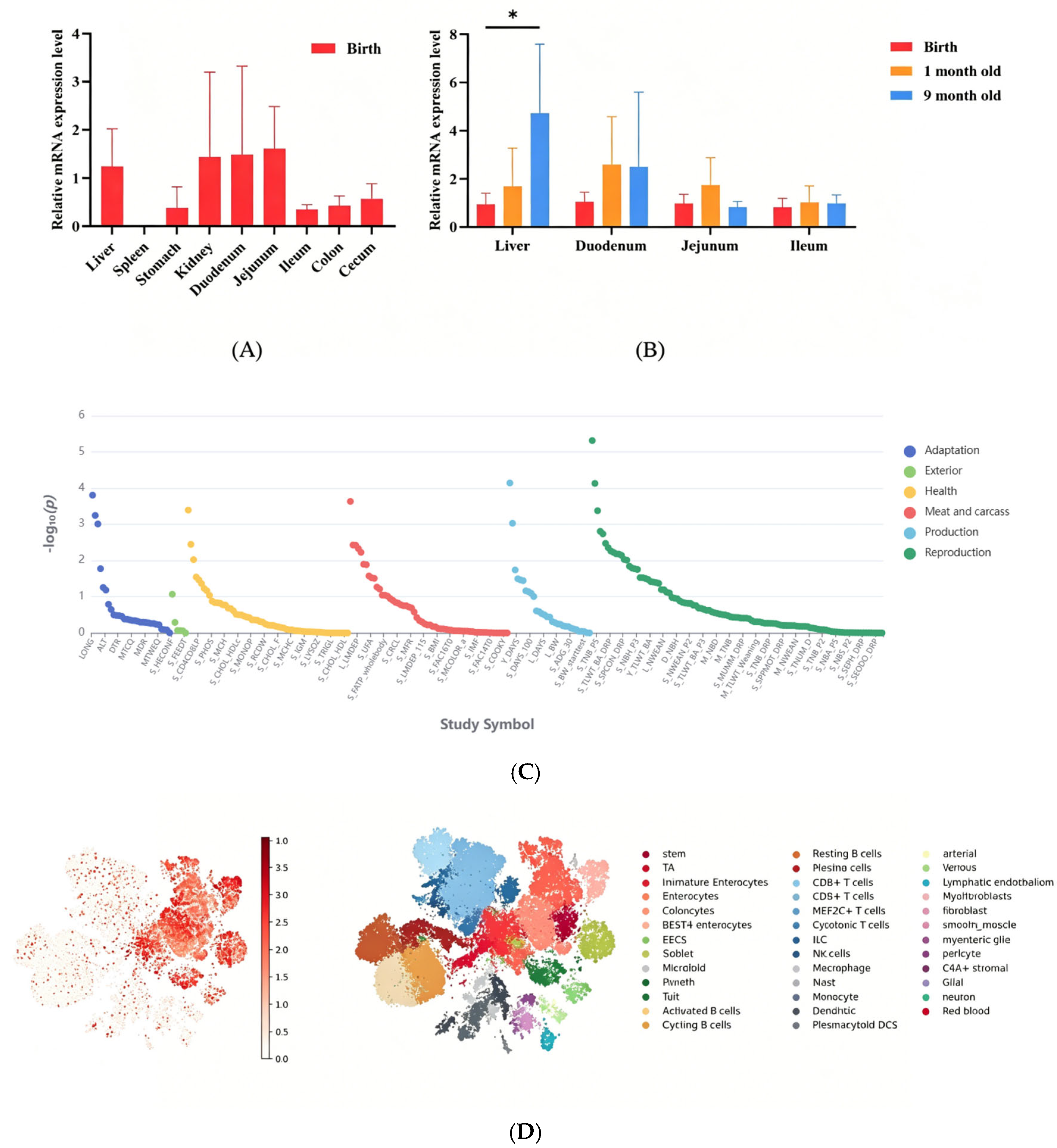
RT-qPCR analysis revealed that HNF4A mRNA was ubiquitously expressed in the liver, stomach, kidney, duodenum, jejunum, ileum, colon, and cecum of newborn piglets (Figure 1A). At birth, the highest expression levels were observed in the small intestine, particularly the duodenum, jejunum, and ileum. To further investigate the developmental expression dynamics of HNF4A, we examined its transcript levels in the liver and intestinal tissues across three key stages: birth, 1 month, and 9 months of age (Figure 1B). Notably, hepatic HNF4A expression increased significantly with age, peaking at 9 months and showing a significant difference compared with birth (p < 0.05). In the duodenum, jejunum, and ileum, HNF4A expression also exhibited an upward trend during postnatal development. Collectively, these findings demonstrate that HNF4A is predominantly expressed in the liver and small intestine, the primary organs responsible for nutrient metabolism and absorption in pigs. PheWAS analysis using PigBiobank [23] linked HNF4A to porcine growth traits, including body weight, average ADG, and daily weight gain (Figure 1C, Table 2), which suggests that HNF4A may contribute to piglet growth by functioning in small intestinal epithelial cells, affecting nutrient absorption, metabolism, or intestinal health. Additionally, single-cell analysis through IPGCA/scGutDB [24] showed that HNF4A was primarily located in small intestinal epithelial cells, including small intestinal stem cells, enterocytes, goblet cells, BEST4 enterocytes, Paneth cells, and tuft cells (Figure 1D).

3.2. In Silico Analysis of Ns-SNPs in Porcine HNF4A

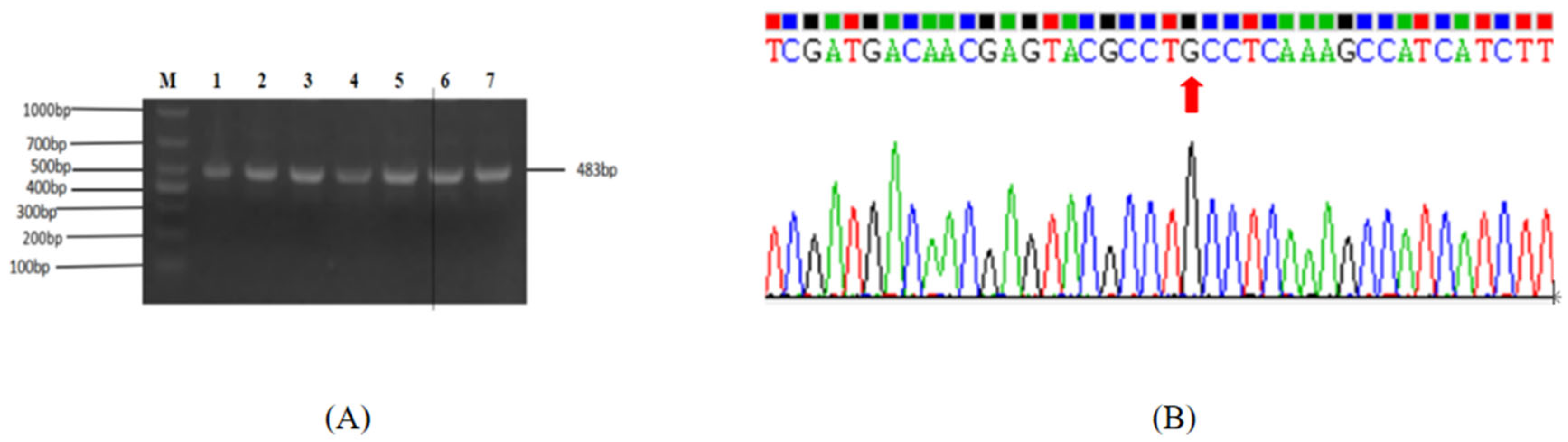
By retrieving the dbSNP Database, a total of 29 SNPs were found in the coding region, including six ns-SNPs. Among them, only rs3470460054 (C288Y) was predicted to be deleterious by SNAP, SIFT, and PhD-SNP (Table 3). The 483 bp fragment including SNP: rs3470460054 was obtained randomly from five Min pigs and five Landraces (Figure 2A); however, this SNP did not exist in these animals (Figure 2B). The results indicated the functional SNPs might be located in the transcriptional regulatory region instead of the coding region.

3.3. A 20 Bp InDel Was Identified in Porcine HNF4A

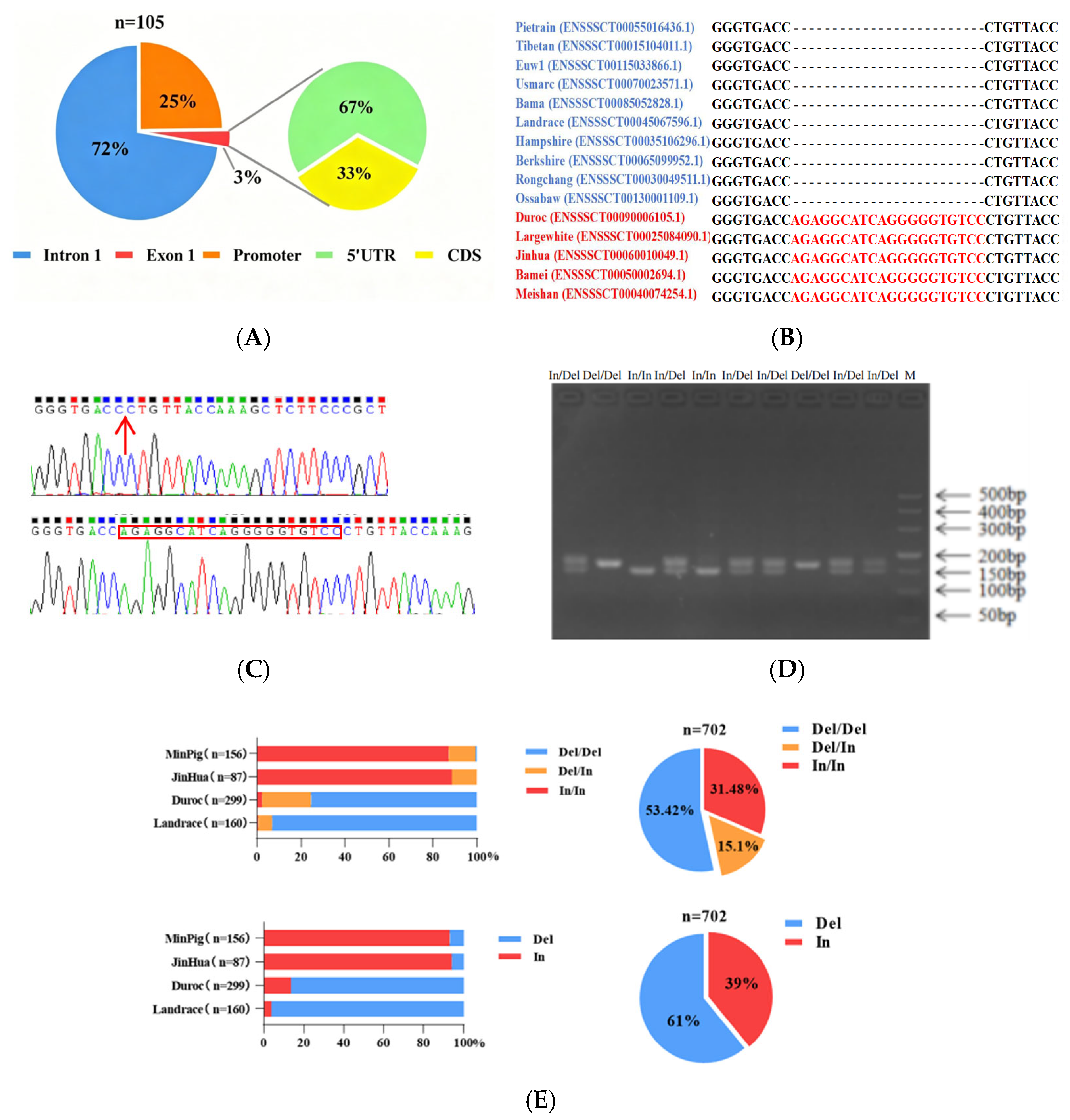
A partial genomic sequence of HNF4A (including the first exon, first intron, and the 2000 bp 5′ flanking sequence) from 15 breeds was retrieved from the Ensembl database. And 105 single-nucleotide polymorphisms (SNPs) were found in this sequence. Among them, the majority (72%) were located in the first intron, followed by the promoter region (25%), while only 3% were found in the first exon. Further partitioning of the non-intronic variants revealed that 67% were located in the 5′UTR and 33% in CDS. Compared with Western breeds such as Landrace, Hampshire, Berkshire, and Pietrain, most of the local breeds like Jinhua, Meishan, and Bamei pigs had a 20 bp insertion (AGAGGCATCAGGGGGTGTCC) in the first intron of HNF4A (Chr17: 46,821,378–46,821,397 bp) (Figure 3B). The 2386 bp fragment of the HNF4A promoter of Min pigs and Landraces was amplified using primers HNF4A-1F/R. Sequence alignment revealed the existence of the predicted InDel (Figure 3C). The PCR products amplified by primers HNF4A-2F/R showed three band patterns after agarose gel electrophoresis: a single 152 bp band representing the Del/Del homozygote (deletion allele, resulting from the absence of the 20 bp sequence), a single 172 bp band representing the In/In homozygote (insertion allele, containing the 20 bp sequence), and both bands (152 bp and 172 bp) representing the In/Del heterozygote (Figure 3D).
Three genotypes were observed in Landrace, Duroc, and Min pig populations. In the Landrace population, the frequencies of Del/Del, In/Del, and In/In genotypes were 0.931, 0.063, and 0.006, respectively, and the frequencies of Del and In alleles were 0.962 and 0.038. In the Duroc population, the genotype frequencies were 0.753, 0.224, and 0.023, respectively, and the allele frequencies were 0.865 and 0.135. In the Min pig population, the genotype frequencies were 0.006, 0.122, and 0.872, respectively, and the allele frequencies were 0.067 and 0.933. In Jinhua pigs, only In/Del and In/In were observed with frequencies of 0.115 and 0.885, respectively, and the frequencies of Del and In alleles were 0.057 and 0.943 (Table 4). The Del/Del, In/Del, and In/In genotypes accounted for 53.42%, 15.1%, and 31.48% of all individuals, and the In and Del alleles accounted for 61% and 39% (Figure 3E). In Landrace and Duroc, the Del allele was predominant, whereas in Min and Jinhua pigs, the In allele was predominant.

3.4. The 20 Bp InDel Was Associated with Piglet Growth Trait

Association analysis showed that Min pigs with the In/Del genotype had higher body weight than In/In genotype at 14 days old, 21 days old, 28 days old, and 35 days old (p < 0.05). The ADG of In/Del genotype was significantly higher than that of In/In individuals (p < 0.01) (Table 5). In the Landrace population, the body weights of In/In individuals at 21 days old and 28 days old were significantly higher than those of In/Del genotype individuals (p < 0.05). Additionally, the body weight of Del/Del genotype individuals at 35 days old (p = 0.12) and the daily weight gain showed an increasing trend compared with those of In/Del genotype individuals (p = 0.09) (Table 6).

3.5. The 20 Bp Indel Affects Porcine HNF4A Transcriptional Activity

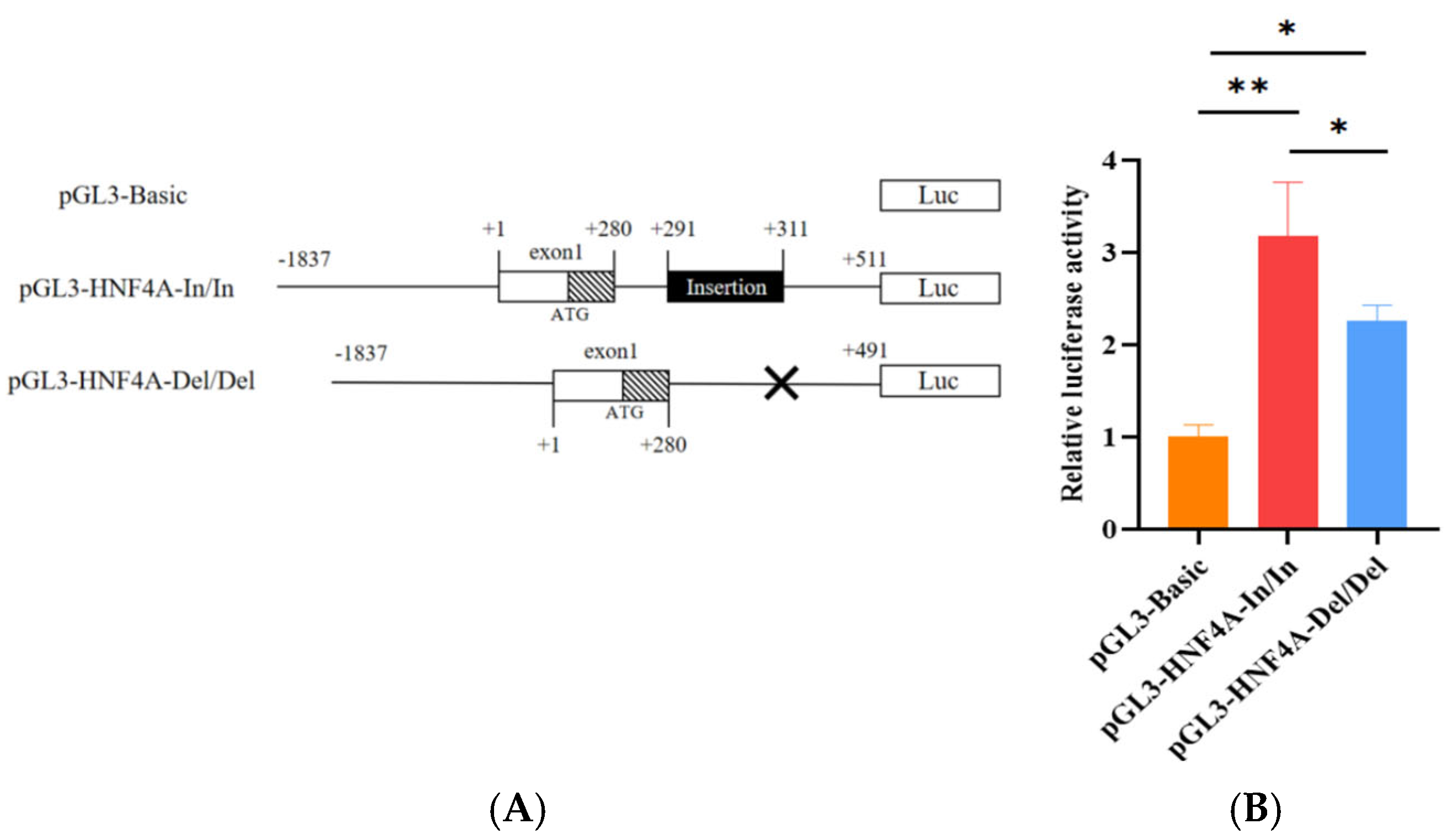
Using the DNA of Del/Del or In/In animals as templates, two fragments (2348 bp and 2328 bp) were amplified with primers HNF4A-3F/R and inserted into to construct pGL3-HNF4A-In/In and pGL3-HNF4A-Del/Del, respectively (Figure 4A). A dual-luciferase reporter assay revealed both the pGL3-HNF4A-Del/Del and pGL3-HNF4A-In/In plasmids exhibited luciferase activity, which was significantly higher than that of the negative control (p < 0.05). The luciferase activity of pGL3-HNF4A-In/In was higher than that of pGL3-HNF4A-Del/Del (p < 0.05) (Figure 4B).

4. Discussion

In this study, HNF4A was found to be widely expressed in the liver, kidney, and gastrointestinal tract of piglets. Analysis of external independent databases, including PigBiobank [23] and scGutDB [24], revealed that the porcine HNF4A exhibited abundant expression in intestinal epithelial cells, especially enriched in enterocytes, suggesting that HNF4A might affect piglet growth by regulating nutrient absorption. Studies in mice have shown that HNF4A drives the expression of brush border genes involved in nutrient absorption of the intestine [18]. Given the essential role of the small intestine in nutrient uptake and the observed cell-specific expression pattern, HNF4A was selected as a candidate gene for swine growth traits, which might influence piglet weight by regulating intestinal nutrient absorption and metabolic processes.
Genetic variations within the coding region are widely recognized to alter protein structure or function, resulting in phenotype variation [25,26]. For example, rs81403974 and rs325492834 in long non-coding RNA muscle growth-promoting factor (lncMGPF) influenced porcine backfat thickness and loin muscle area by altering RNA stability and secondary structure [27]; the g.153G>A mutation in porcine deleted in azoospermia-like (DAZL) affected sow fertility by modifying the RNA-binding domain of protein [28]; the c.1226A>G mutation in porcine dual oxidase 2 (DUOX2) induces thyroid deficiency in pigs by altering the binding site of serine/arginine-rich (SR) proteins [29]. In the present study, rs3470460054 was predicted to be deleterious by SIFT, SNAP, and PhD-SNP; however, this variant was not detected in the animals used in this study. This result may be due to (1) the limited sample size used in the present study, which weakens the detection efficiency of rare variants; (2) the relatively narrow genetic background of the examined pig populations. Therefore, its potential functional role remains to be validated in broader populations. Accordingly, the present study focused on the non-coding regions of porcine HNF4A to identify potential regulatory variants that might contribute to animal growth.
By the dbSNP database and DNA sequencing, a novel 20 bp InDel in the first intron of porcine HNF4A was identified. Population genetic analysis revealed a breed-specific allelic distribution: the Del allele (deletion) was dominant in Landrace and Duroc pigs, whereas the In allele (insertion) was more prevalent in Min and Jinhua pigs. Interestingly, no Del/Del homozygote was detected in Jinhua pigs (n = 87), and only one Del/Del individual (0.6%) was found in Min pigs (n = 156). The extremely low frequency of the Del/Del genotype in these breeds may reflect population-specific evolutionary or breeding histories, and genetic drift in relatively small populations might have contributed to the reduced frequency of this genotype [30]. Association analysis indicated that Min pig In/Del individuals exhibited higher pre-weaning body weight and average daily gain than In/In piglets (p < 0.05 and p < 0.01). In Landrace pigs, the Del/Del genotype was significantly correlated with higher weaning body weight (p < 0.05). Two explanations may account for this heterogeneity. Firstly, this phenomenon could be attributed to the distinct selection histories of the populations. Western commercial breeds have been intensively selected for growth rate and feed efficiency, whereas Chinese indigenous breeds have undergone survival selection for adaptability and robustness. Secondly, distinct linkage disequilibrium (LD) structures underlie the breed-specific associations. For example, European pig breeds exhibit long-range LD (up to 400 kb) and large haplotype blocks, while Chinese indigenous breeds show rapid LD decay (generally ≤ 10 kb) [31]. Thus, the Del allele (deletion) is favorably linked to growth-promoting variants in Landrace, while in Min pigs, the In allele (insertion) or the In/Del heterozygote captures the advantageous combination due to a different LD phase and faster LD decay. Based on these breed-specific patterns, we propose distinct breeding strategies: in Min pigs, introducing the Del allele may improve early growth; in Landrace, maintaining or increasing the Del allele frequency is beneficial; and in Duroc, gradual reduction in the In allele may enhance population uniformity. Nevertheless, further validation in larger populations is required before applying this marker in breeding programs.
Nowadays, it is widely accepted that non-coding regions harbor abundant functional variations that regulate gene expression [32,33]. In the present study, a 20 bp InDel located in the first intron of porcine HNF4A significantly affected transcriptional activity. Specifically, the insertion allele (In) exhibited higher activity than the deletion allele (Del) in the luciferase assay, suggesting a regulatory role at the transcriptional level. This finding is consistent with previous studies showing that intronic variations can modulate transcriptional activity by altering local regulatory elements. For example, Ren et al. [34] identified a 12 bp InDel in the porcine Oct4 (Octamer-binding transcription factor 4), in which homozygous males exhibited superior reproductive traits compared with heterozygotes. However, association analysis in Min pigs revealed the opposite: In/Del piglets grew significantly faster than In/In piglets. This seemingly contradictory observation can be resolved by the non-linear relationship between regulatory activity and phenotypic outcome, which has been well recognized [35]. One possible explanation is that, in In/In homozygotes, two highly active In alleles may drive HNF4A protein levels excessively high. Such an overexpression may trigger cellular feedback inhibition or accelerate protein degradation, thereby reducing net functional output. In contrast, In/Del heterozygotes carry only one In allele, and their HNF4A expression level likely falls within an optimal range for function. This pattern is consistent with the general principle of non-linear gene dosage effects [36], although the specific molecular mechanisms require further investigation. At the pre-transcriptional level, the higher activity of the insertion allele suggests that this InDel might influence transcriptional activity by altering the transcription factor binding, DNA methylation, chromatin accessibility, or their interaction. However, post-transcriptional regulation of HNF4A remains unknown. Future studies incorporating larger and more diverse populations, together with integrative analyses combining gene expression profiling and in vivo functional validation, will be necessary to further elucidate the biological role of this variant.

5. Conclusions

Porcine HNF4A is expressed in intestinal tissues; the 20 bp InDel in the first intron of this gene partially affected piglets’ weight by regulating its transcription. This mutation might be a molecular marker for selection breeding, which contributes to improving the efficiency of the swine industry. However, further validation in larger and diverse independent pig populations is essential to verify its genetic stability before practical breeding application.

Author Contributions

Conceptualization, B.N. and L.D.; methodology, B.N. and L.D.; validation, J.H., Y.Z. (Yu Zhang), and Y.Z. (Yingkun Zhang); formal analysis, J.H. and Y.Z. (Yu Zhang); investigation, J.H., Y.Z. (Yu Zhang), Y.Z. (Yingkun Zhang), R.X., X.C. (Xiaoyu Chen), X.C. (Xiaohong Chu), and N.Y.; resources, L.D. and B.N.; data curation, J.H. and Y.Z. (Yu Zhang); writing—original draft preparation, J.H. and Y.Z. (Yu Zhang); writing—review and editing, L.D. and B.N.; supervision, B.N. and L.D.; project administration, L.D. and B.N.; funding acquisition, L.D. All authors have read and agreed to the published version of the manuscript.

Funding

This research was supported by the Agricultural Major Technology Collaborative Promotion Plan Project of Zhejiang Province (2025ZDXT13-03), the Science and Technology Plan Project of Jinhua City (9 February 2023), and the open research funding of Zhejiang Key Laboratory of Livestock and Poultry Biotech Breeding.

Institutional Review Board Statement

The animal study protocol was approved by the Animal Welfare and Ethics Committee of Zhejiang Academy of Agricultural Sciences (protocol code 24ZALAS08, approved on 4 December 2024).

Informed Consent Statement

Not applicable.

Data Availability Statement

The dataset used and analyzed during the current study is available from the corresponding author upon reasonable request.

Acknowledgments

The authors thank Shengwei Di and Xibiao Wang at Northeast Agricultural University, Jiancheng Cai at Lanxi Farm, and Liping Chen at Zhejiang Mebolo Swine Breeding Farm for providing the animals.

Conflicts of Interest

The authors declare no conflicts of interest.

References

  1. Hassanine, N.; Saleh, A.A.; Essa, M.O.A.; Adam, S.Y.; Din, R.M.U.; Rehman, S.U.; Ali, R.; Husien, H.M.; Wang, M. Candidate Genes, Markers, Signatures of Selection, and Quantitative Trait Loci (QTLs) and Their Association with Economic Traits in Livestock: Genomic Insights and Selection. Int. J. Mol. Sci. 2025, 26, 7688. [Google Scholar] [CrossRef]
  2. Sun, K.; Hong, Y.; Zhang, W.; Dong, J.; Wen, Z.; Hu, Z.; Tan, X.; Li, H.; Zhao, A.; Huang, M.; et al. Single- and multiple-locus model genome-wide association study for growth traits in Dongliao black pigs. Anim. Biosci. 2025, 38, 2312–2323. [Google Scholar] [CrossRef]
  3. Ye, H.; Li, W.; Tian, F.; Wang, Q.; Ma, Z.; Guan, J.; Ding, Y.; Zheng, X.; Yin, Z.; Zhang, X. Genome-Wide Association Study Identifies Candidate Genes for Body Size Traits in Wanyue Black Pigs. Animals 2025, 16, 117. [Google Scholar] [CrossRef]
  4. Yan, Z.; Li, X.; Yang, W.; Zhou, P.; Zhang, W.; Li, X.; Fu, L.; Li, J.; Du, X. Integrative Multi-Omics Analysis Unveils Candidate Genes and Functional Variants for Growth and Reproductive Traits in Duroc Pigs. Animals 2025, 15, 3627. [Google Scholar] [CrossRef] [PubMed]
  5. Wei, C.; Zeng, H.; Zhong, Z.; Cai, X.; Teng, J.; Liu, Y.; Zhao, Y.; Wu, X.; Li, J.; Zhang, Z. Integration of non-additive genome-wide association study with a multi-tissue transcriptome analysis of growth and carcass traits in Duroc pigs. Animal 2023, 17, 100817. [Google Scholar] [CrossRef]
  6. Dimas, A.S.; Stranger, B.E.; Beazley, C.; Finn, R.D.; Ingle, C.E.; Forrest, M.S.; Ritchie, M.E.; Deloukas, P.; Tavaré, S.; Dermitzakis, E.T. Modifier effects between regulatory and protein-coding variation. PLoS Genet. 2008, 4, e1000244. [Google Scholar] [CrossRef] [PubMed]
  7. Mostafavi, H.; Spence, J.P.; Naqvi, S.; Pritchard, J.K. Systematic differences in discovery of genetic effects on gene expression and complex traits. Nat. Genet. 2023, 55, 1866–1875. [Google Scholar] [CrossRef]
  8. Liu, X.; Fan, X.; Yan, J.; Zhang, L.; Wang, L.; Calnan, H.; Yang, Y.; Gardner, G.; Zhou, R.; Tang, Z. An InDel in the promoter of ribosomal protein S27-like gene regulates skeletal muscle growth in pigs. J. Integr. Agric. 2026, 25, 1114–1124. [Google Scholar] [CrossRef]
  9. Lv, W.; Peng, Y.; Hu, J.; Zhu, M.; Mao, Y.; Wang, L.; Wang, G.; Xu, Z.; Wu, W.; Zuo, B. Functional SNPs in SYISL promoter significantly affect muscle fiber density and muscle traits in pigs. Anim. Genet. 2024, 55, 66–78. [Google Scholar] [CrossRef] [PubMed]
  10. Liu, H.; Wang, C.; Liu, G.; Li, Y.; Kang, L.; Sun, Y.; Jiang, Y. A 14 bp indel polymorphism in the promoter region is associated with different responses to porcine circovirus type 2 infection by regulating MRC1 transcription. Vet. Immunol. Immunopathol. 2021, 234, 110202. [Google Scholar] [CrossRef]
  11. Jones, C.; Avino, M.; Giroux, V.; Boudreau, F. HNF4α Acts as Upstream Functional Regulator of Intestinal Wnt3 and Paneth Cell Fate. Cell. Mol. Gastroenterol. Hepatol. 2023, 15, 593–612. [Google Scholar] [CrossRef]
  12. Sladek, F.M.; Apte, U.; Deol, P. Editorial: Hepatocyte nuclear factor 4 alpha—New insights into an old receptor. Front. Endocrinol. 2024, 15, 1491965. [Google Scholar] [CrossRef]
  13. Babeu, J.P.; Boudreau, F. Hepatocyte nuclear factor 4-alpha involvement in liver and intestinal inflammatory networks. World J. Gastroenterol. 2014, 20, 22–30. [Google Scholar] [CrossRef] [PubMed]
  14. Deans, J.R.; Deol, P.; Titova, N.; Radi, S.H.; Vuong, L.M.; Evans, J.R.; Pan, S.; Fahrmann, J.; Yang, J.; Hammock, B.D.; et al. HNF4α isoforms regulate the circadian balance between carbohydrate and lipid metabolism in the liver. Front. Endocrinol. 2023, 14, 1266527. [Google Scholar] [CrossRef] [PubMed]
  15. Huerta-Chagoya, A.; Schroeder, P.; Mandla, R.; Li, J.; Morris, L.; Vora, M.; Alkanaq, A.; Nagy, D.; Szczerbinski, L.; Madsen, J.G.S.; et al. Author Correction: Rare variant analyses in 51,256 type 2 diabetes cases and 370,487 controls reveal the pathogenicity spectrum of monogenic diabetes genes. Nat. Genet. 2025, 57, 1060. [Google Scholar] [CrossRef]
  16. Hamdy, H.; Shen, C.; Xu, J.; Fan, D.; Zhang, Y.; Li, H.; Wei, Y.; Sun, J. Hepatocyte nuclear factor 4-Alpha: A key regulator in liver carcinogenesis. Cell. Oncol. 2025, 48, 885–897. [Google Scholar] [CrossRef]
  17. Chen, L.; Vasoya, R.P.; Toke, N.H.; Parthasarathy, A.; Luo, S.; Chiles, E.; Flores, J.; Gao, N.; Bonder, E.M.; Su, X.; et al. HNF4 Regulates Fatty Acid Oxidation and Is Required for Renewal of Intestinal Stem Cells in Mice. Gastroenterology 2020, 158, 985–999.e9. [Google Scholar] [CrossRef]
  18. Chen, L.; Luo, S.; Dupre, A.; Vasoya, R.P.; Parthasarathy, A.; Aita, R.; Malhotra, R.; Hur, J.; Toke, N.H.; Chiles, E.; et al. The nuclear receptor HNF4 drives a brush border gene program conserved across murine intestine, kidney, and embryonic yolk sac. Nat. Commun. 2021, 12, 2886. [Google Scholar] [CrossRef] [PubMed]
  19. Marcil, V.; Sinnett, D.; Seidman, E.; Boudreau, F.; Gendron, F.-P.; Beaulieu, J.-F.; Menard, D.; Lambert, M.; Bitton, A.; Sanchez, R.; et al. Association between genetic variants in the HNF4A gene and childhood-onset Crohn’s disease. Genes. Immun. 2012, 13, 556–565. [Google Scholar] [CrossRef]
  20. Weissglas-Volkov, D.; Huertas-Vazquez, A.; Suviolahti, E.; Lee, J.; Plaisier, C.; Canizales-Quinteros, S.; Tusie-Luna, T.; Aguilar-Salinas, C.; Taskinen, M.-R.; Pajukanta, P. Common hepatic nuclear factor-4alpha variants are associated with high serum lipid levels and the metabolic syndrome. Diabetes 2006, 55, 1970–1977. [Google Scholar] [CrossRef] [PubMed]
  21. Xiang, Y.; Sun, J.; Ma, G.; Dai, X.; Meng, Y.; Fu, C.; Zhang, Y.; Zhao, Q.; Li, J.; Zhang, S.; et al. Integrating Multi-Omics Data to Identify Key Functional Variants Affecting Feed Efficiency in Large White Boars. Genes 2024, 15, 980. [Google Scholar] [CrossRef]
  22. Niu, B.; Chen, Z.; Yao, D.; Kou, M.; Gao, X.; Sun, Y.; Yang, X.; Wang, X.; Di, S.; Cai, J.; et al. A 12-bp indel in the 3’UTR of porcine CISH gene associated with Landrace piglet diarrhea score. Res. Vet. Sci. 2022, 146, 53–59. [Google Scholar] [CrossRef]
  23. Zeng, H.; Zhang, W.; Lin, Q.; Gao, Y.; Teng, J.; Xu, Z.; Cai, X.; Zhong, Z.; Wu, J.; Liu, Y.; et al. PigBiobank: A valuable resource for understanding genetic and biological mechanisms of diverse complex traits in pigs. Nucleic Acids Res. 2024, 52, D980–D989. [Google Scholar] [CrossRef]
  24. Yu, P.; Xie, Q.; Cai, X.; Zhong, Z.; Wei, R.; Han, H.; Liu, S.; Zhang, Z.; Xu, L.; Chen, Z.; et al. IPGCA: A Comprehensive Single Cell Atlas of 1 074 127 Porcine Intestinal Cells Revealing Cellular Dynamics, Genetic Regulation, and Cross-Species Conservation. Adv. Sci. 2025, 12, e07882. [Google Scholar] [CrossRef]
  25. Romero Romero, M.L.; Landerer, C.; Poehls, J.; Toth-Petroczy, A. Phenotypic mutations contribute to protein diversity and shape protein evolution. Protein Sci. 2022, 31, e4397. [Google Scholar] [CrossRef] [PubMed]
  26. Shameer, K.; Tripathi, L.P.; Kalari, K.R.; Dudley, J.T.; Sowdhamini, R. Interpreting functional effects of coding variants: Challenges in proteome-scale prediction, annotation and assessment. Brief. Bioinform. 2016, 17, 841–862. [Google Scholar] [CrossRef] [PubMed]
  27. Lv, W.; Zhao, S.; Hou, Y.; Tong, Q.; Peng, Y.; Li, J.; Xu, Z.; Zuo, B. Single Nucleotide Polymorphisms of Porcine lncMGPF Regulate Meat Production Traits by Affecting RNA Stability. Front. Cell Dev. Biol. 2021, 9, 731712. [Google Scholar] [CrossRef] [PubMed]
  28. Fu, Y.; Li, L.; Li, B.; Fang, X.; Ren, S. Long form leptin receptor and SNP effect on reproductive traits during embryo attachment in Suzhong sows. Anim. Reprod. Sci. 2016, 168, 57–65. [Google Scholar] [CrossRef]
  29. Cao, C.; Zhang, Y.; Jia, Q.; Wang, X.; Zheng, Q.; Zhang, H.; Song, R.; Li, Y.; Luo, A.; Hong, Q.; et al. An exonic splicing enhancer mutation in DUOX2 causes aberrant alternative splicing and severe congenital hypothyroidism in Bama pigs. Dis. Models Mech. 2019, 12, dmm036616. [Google Scholar] [CrossRef]
  30. Paixão, G.; Esteves, A.; Payan-Carreira, R.; Carolino, N. Demographic structure and genetic diversity of the endangered Bísaro pig: Evolution and current status. Anim. Reprod. Sci. 2018, 63, 452–461. [Google Scholar] [CrossRef]
  31. Amaral, A.J.; Megens, H.J.; A Crooijmans, R.P.M.; Heuven, H.C.M.; Groenen, M.A.M. Linkage disequilibrium decay and haplotype block structure in the pig. Genetics 2008, 179, 569–579. [Google Scholar] [CrossRef]
  32. Peña-Martínez, E.G.; Rodríguez-Martínez, J.A. Decoding Non-coding Variants: Recent Approaches to Studying Their Role in Gene Regulation and Human Diseases. Front. Biosci. 2024, 16, 4. [Google Scholar] [CrossRef] [PubMed]
  33. Johnston, A.D.; Simões-Pires, C.A.; Thompson, T.V.; Suzuki, M.; Greally, J.M. Functional genetic variants can mediate their regulatory effects through alteration of transcription factor binding. Nat. Commun. 2019, 10, 3472. [Google Scholar] [CrossRef] [PubMed]
  34. Ren, F.; Yu, S.; Chen, R.; Lv, X.; Pan, C. Identification of a novel 12-bp insertion/deletion (indel) of iPS-related Oct4 gene and its association with reproductive traits in male piglets. Anim. Reprod. Sci. 2017, 178, 55–60. [Google Scholar] [CrossRef] [PubMed]
  35. Porter, A.H.; Johnson, N.A.; Tulchinsky, A.Y. Fitness landscapes of simple regulatory genetic interactions show pervasive heterozygote advantage and support stable polymorphism. J. Theor. Biol. 2025, 614, 112233. [Google Scholar] [CrossRef]
  36. Veitia, R.A.; Bottani, S.; Birchler, J.A. Gene dosage effects: Nonlinearities, genetic interactions, and dosage compensation. Trends Genet. 2013, 29, 385–393. [Google Scholar] [CrossRef]
Figure 1. The mRNA expression of porcine HNF4A in different tissues (n = 3–4). (A) Expression of porcine HNF4A in gastrointestinal tissues. (B) Tissue expression profile of porcine HNF4A at different developmental stages. (C) The results of HNF4A PheWAS. (D) Cell-type-specific expression of HNF4A in porcine intestine. * p < 0.05.
Animals 16 01797 g001
Figure 2. Characterization of SNP: rs3470460054. (A) Amplification of the partial porcine HNF4A coding region. (B) Sanger sequencing chromatogram of the SNP: rs3470460054.
Animals 16 01797 g002
Figure 3. Identification and analysis of the 20 bp InDel in Porcine HNF4A. (A) Proportion Chart of SNPs in the Porcine HNF4A Promoter, first exon, and First Intron Sequences. (B) Identification of a 20 bp InDel in the Intron of porcine HNF4A. (C) Sequencing results of the 20 bp InDel in the intronic region of the porcine HNF4A. The box indicates the 20 bp inserted fragment, and the arrow points to the InDel site. (D) Genotyping results of the 20 bp InDel. Lane M: Trans DNA Marker I. (E) Genotype and allele frequencies of InDel among different pig breeds.
Animals 16 01797 g003
Figure 4. Transcriptional activity and differential expression of the porcine HNF4A with 20 bp InDel. (A) Schematic diagram of the plasmid construction for a 20 bp InDel in the intronic region of the porcine HNF4A. (B) Relative luciferase activity of the porcine HNF4A 20 bp InDel in IPEC-J2 cells. Data are mean ± SE. * p < 0.05, and ** p < 0.01. X indicates deletion.
Animals 16 01797 g004
Table 1. Primers used for RT-qPCR, SNPs identification, and plasmids construction.
Primer NamePrimer Sequence (5′→3′)Annealing TemperatureProduct
Size (Bp)
HNF4A-DF: CTACATCATCCCTCGGCACT60 °C199
R: CTGGGAACGCAGCCTCTT
GAPDH-DF: CCCCAACGTGTCGGTTGT60 °C83
R: CCTGCTTCACCACCTTCTTGA
HNF4A-CF: ATCTGTAAAATGGGTGTG52 °C483
R: AGCCTCTGGAGTAAGTGC
HNF4A-1F: CATCCGAATAGTGATAGAGGTA55 °C2328
R: TCCCAAAGACACCCTGAAA
HNF4A-2F: GAATGACAGACGAGCCCG55 °C172
R: CAGGACGCCAAGAGGAAG
HNF4A-3F: TAAGTAAGCTTCATCCGAATAGTGATAGAGGTA55 °C2328
R: ATGCCAAGCTTTCCCAAAGACACCCTGAAA
The underline shows the additional restriction sites: HindIII (AAGCTT).
Table 2. Significantly associated traits in the HNF4A PheWAS production category results.
GeneTraitStudy Symbolp-ValueCategory
HNF4ABody weight (end test)Y_BW7.2040 × 10−5Growth
HNF4ADaysY_DAYS3.1885 × 10−2Growth
HNF4AAverage daily gainY_ADG9.3235 × 10−4Growth
Table 3. Prediction of functional ns-SNPs of porcine HNF4A.
SNP IDSubstitutionPolyphen-2SNAPSIFTPhD-SNP
PredictionScorePredictionScorePredictionScorePredictionScore
rs3472612586N262SNeutral0.87Neutral0.77Neutral1Neutral0.72
rs3473595056V266MNeutral0.75Neutral0.77Neutral0.2Neutral0.66
rs3472730409V281INeutral0.87Neutral0.83Neutral1Neutral0.78
rs3470460054C288YNeutral0.64Deleterious0.56Deleterious0.02Deleterious0.86
rs346061759R432QNeutral0.64Neutral0.50Neutral0.6Neutral0.89
Srs691705449A462SNeutral0.61Neutral0.58Neutral0.3Neutral0.83
Table 4. Genotype and allele frequency of the 20 bp InDel in porcine HNF4A.
BreedNumberGenotype FrequencyAllele Frequency
Del/DelIn/DelIn/InDelIn
Landrace1600.931 (149)0.063 (10)0.006 (1)0.9620.038
Min pig1560.006 (1)0.122 (19)0.872 (136)0.0670.933
Jinhua8700.115 (10)0.885 (77)0.0570.943
Duroc2990.753 (225)0.224 (67)0.023 (7)0.8650.135
Table 5. Association analysis between the 20 bp InDel of HNF4A and the growth trait in Min pigs.
TraitsGenotypep-Value
Del/DelIn/DelIn/In
Number of individuals119136
Birth weight/kg-1.04 ± 0.051.06 ± 0.020.608
Weight at 3 days of age/kg-1.28 ± 0.061.26 ± 0.020.720
Weight at 7 days of age/kg-1.75 ± 0.091.75 ± 0.030.977
Weight at 14 days of age/kg-2.69 ± 0.142.33 ± 0.050.020
Weight at 21 days of age/kg-3.86 ± 0.213.34 ± 0.080.021
Weight at 28 days of age/kg-5.02 ± 0.264.35 ± 0.100.016
Weight at 35 days of age/kg-6.31 ± 0.325.51 ± 0.120.019
Average daily weight gain/(kg/d)-0.15 ± 0.010.13 ± 0.000.009
Bonferroni correction was applied (α = 0.05/n, n = number of InDel markers = 1).
Table 6. Association analysis between the 20 bp InDel of HNF4A and the growth trait in Landrace.
TraitsGenotypep-Value
Del/DelIn/DelIn/In
Number of individuals149101
Birth weight/kg1.49 ± 0.031.46 ± 0.10-0.790
Weight at 3 days of age/kg1.80 ± 0.031.84 ± 0.11-0.759
Weight at 7 days of age/kg2.44 ± 0.042.33 ± 0.16-0.507
Weight at 14 days of age/kg3.83 ± 0.083.35 ± 0.31-0.125
Weight at 21 days of age/kg5.29 ± 0.124.33 ± 0.44-0.037
Weight at 28 days of age/kg6.89 ± 0.155.57 ± 0.60-0.035
Weight at 35 days of age/kg8.43 ± 0.197.17 ± 0.79-0.120
Average daily weight gain/(kg/d)0.20 ± 0.010.16 ± 0.02-0.091
Bonferroni correction was applied (α = 0.05/n, n = number of InDel markers = 1).
Disclaimer/Publisher’s Note: The statements, opinions and data contained in all publications are solely those of the individual author(s) and contributor(s) and not of MDPI and/or the editor(s). MDPI and/or the editor(s) disclaim responsibility for any injury to people or property resulting from any ideas, methods, instructions or products referred to in the content.