Two Decades of Cetacean Population Status and Mortality in Thailand: Spatiotemporal Trends, Environmental Drivers, and Anthropogenic Stressors
 , , ,
, , ,  and
and 
Simple Summary
Abstract
1. Introduction
1.1. Importance of Cetaceans
1.2. Current Status of Cetaceans in Thailand
1.3. Gap in Knowledge
2. Materials and Methods
2.1. Ethics
2.2. Data Source
2.3. Sighting-Based Abundance Baseline and Population Estimation
2.4. Variable Definition and Classification
2.5. Statistical Analysis
2.6. Statistical Justification for Model Specification
3. Results
3.1. Cetacean Species and Status in the Thai Water
3.2. Baseline and Estimated Abundance of Resident Cetaceans
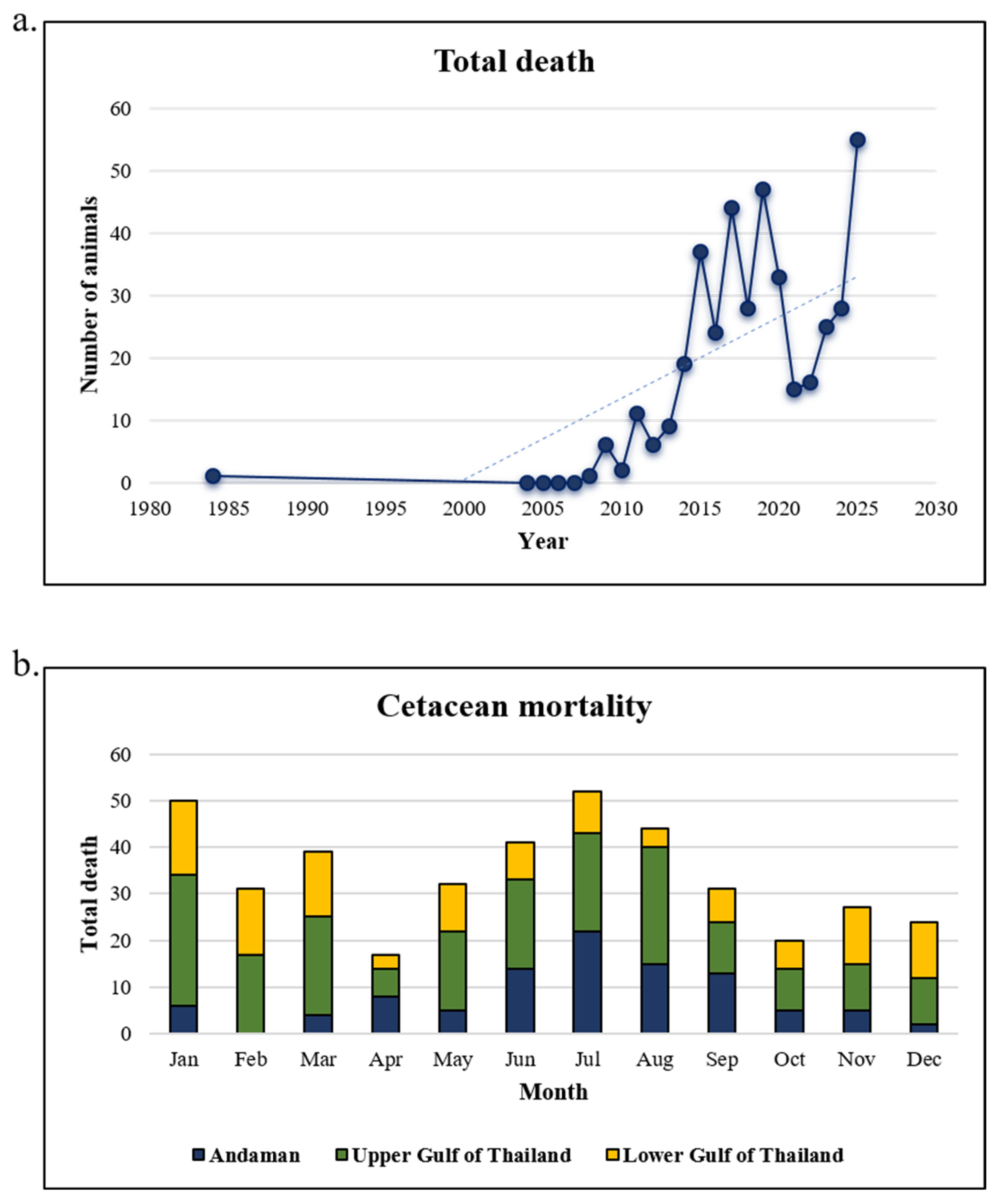
3.3. Spatiotemporal Trends in National Cetacean Mortality
3.4. National Analysis of Cetacean Mortality and Associated Factors
3.5. Comparative Analysis of Crude Totals and Adjusted Multivariable Models
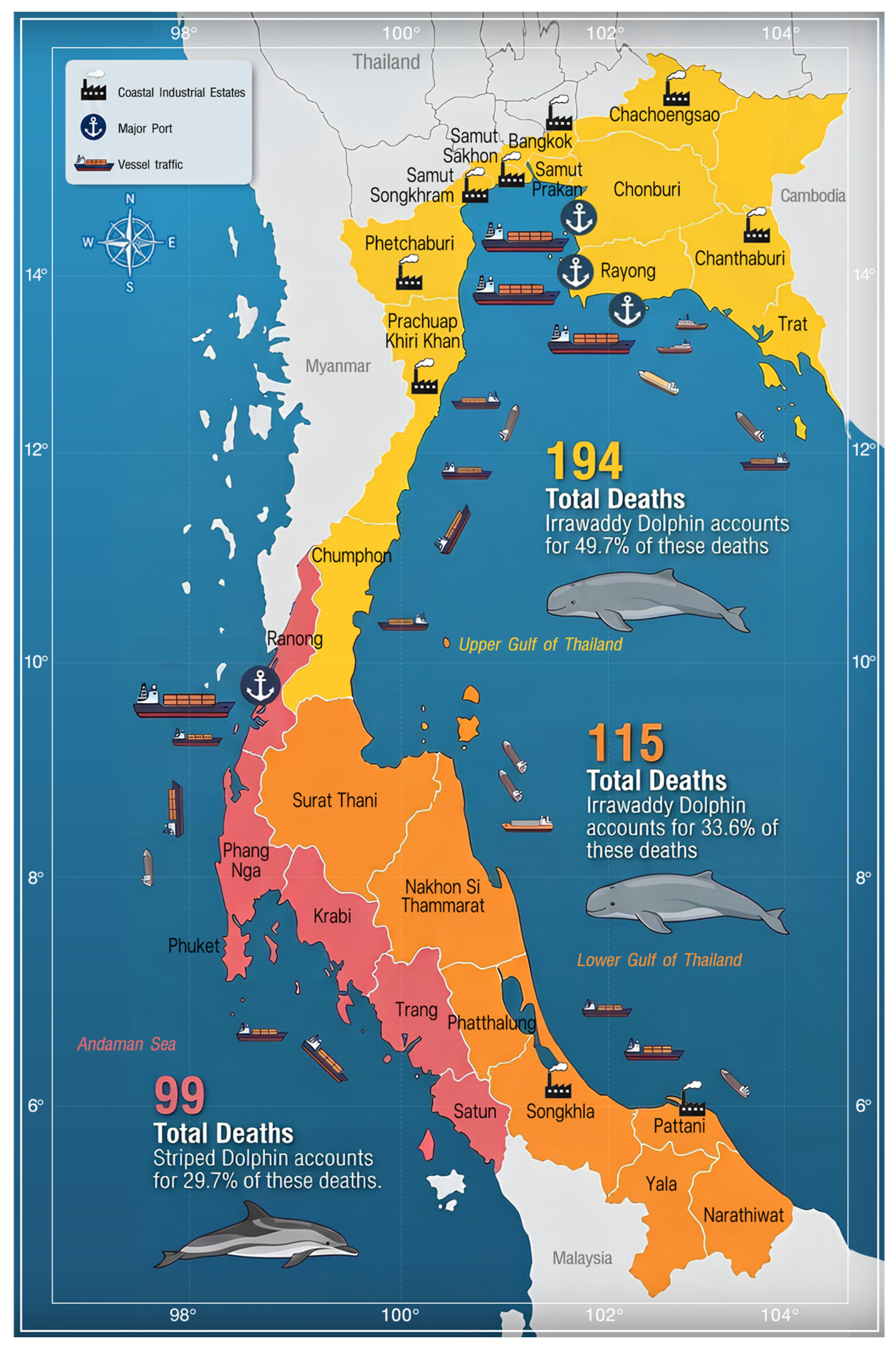
3.6. Distribution of Industrial and Maritime Activity in the Thai Ocean
3.7. Regional Analysis of Factors Associated with Cetacean Mortality in the Andaman Sea
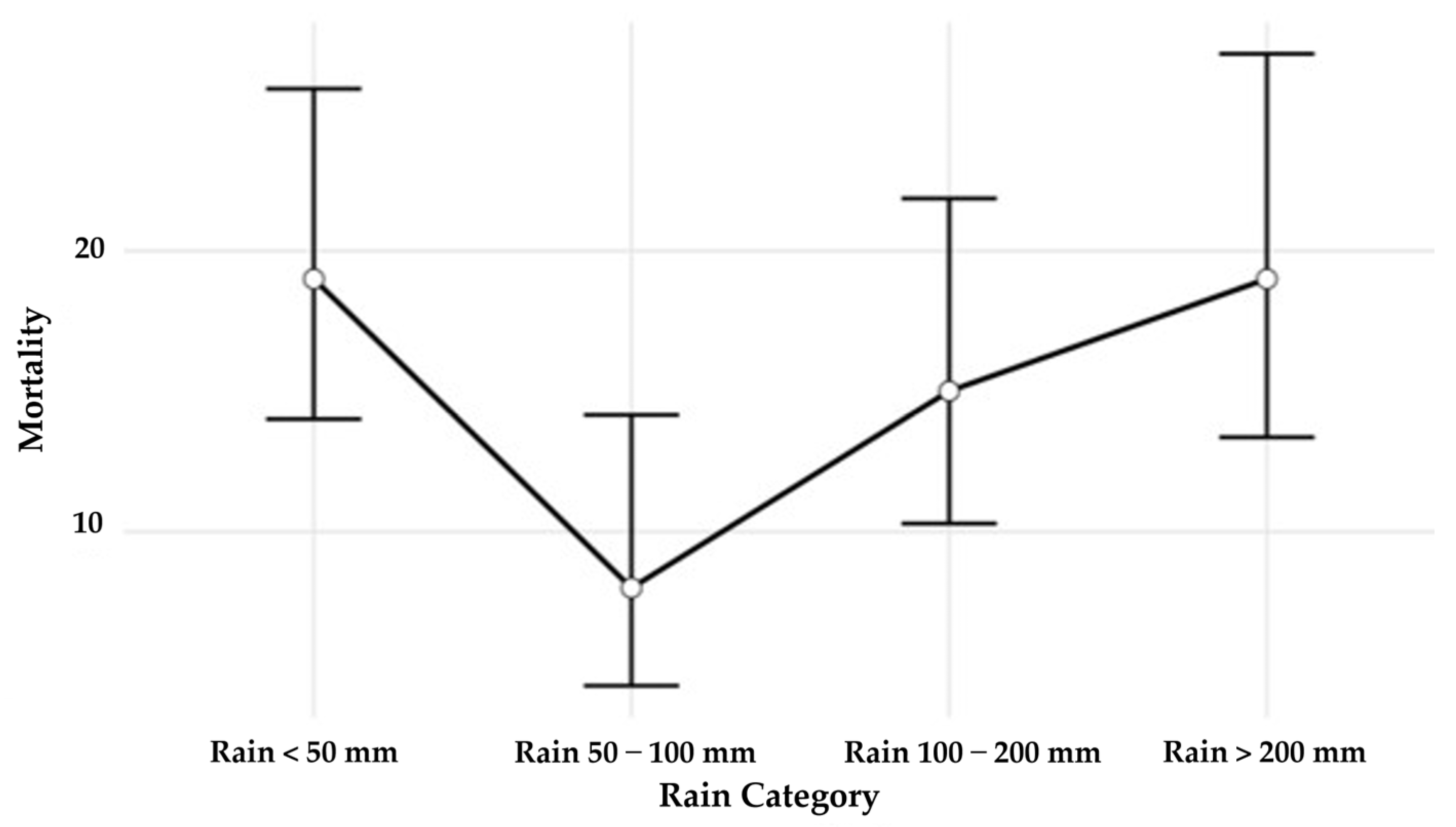
3.8. Factors Associated with Cetacean Mortality in the Upper Gulf of Thailand
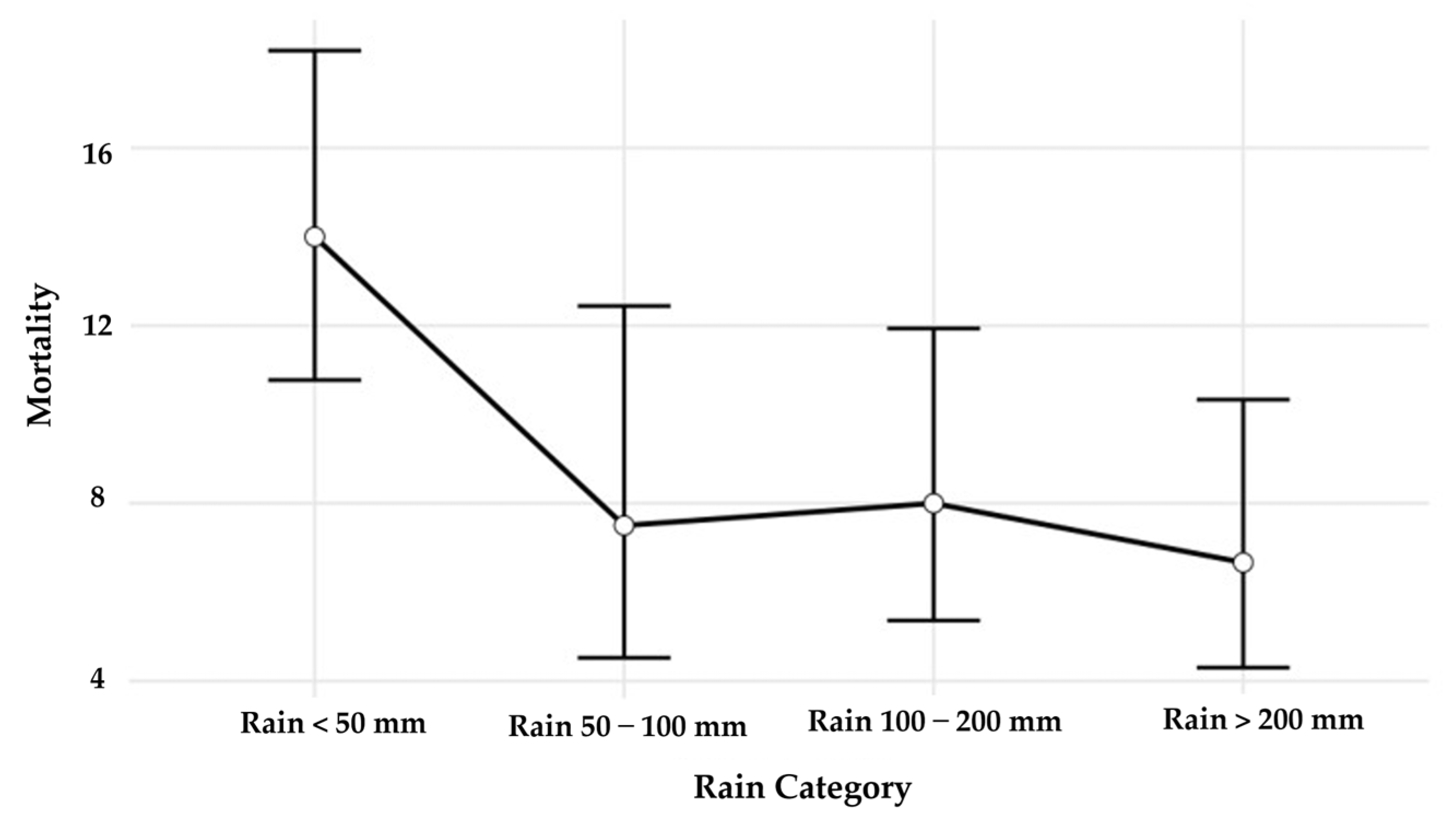
3.9. Factors Associated with Cetacean Mortality in the Lower Gulf of Thailand
3.10. Regional Differences in Factors Associated with Cetacean Mortality
4. Discussion
4.1. Population Status and Regional Variation in Cetacean Mortality
4.2. Drivers of High Cetacean Mortality in the Upper Gulf of Thailand
4.3. Influence of Environmental Variability
4.4. Anthropogenic Pressures: Tourism and Fisheries
4.5. Comparative Regional Frameworks and Technical Innovations
4.6. Study Limitations
4.7. Implications for Conservation and Monitoring
4.8. Future Research Directions
5. Conclusions
Supplementary Materials
Author Contributions
Funding
Institutional Review Board Statement
Informed Consent Statement
Data Availability Statement
Acknowledgments
Conflicts of Interest
References
- Daochai, C.; Sornying, P.; Keawchana, N.; Manmoo, S.; Khumraksa, P.; Kaewmong, P.; Ninwat, S.; Upanoi, T.; Sukkarun, P.; Suyapoh, W. Investigation into the causes of mortality in cetaceans and sirenian populations in the Andaman Sea, Thailand: A retrospective analysis spanning 2018–2023. Vet. World 2024, 17, 2889. [Google Scholar] [CrossRef]
- Piboon, P.; Poommouang, A.; Buddhachat, K.; Kaewmong, P.; Kittiwattanawong, K.; Nganvongpanit, K. The first study of genetic diversity and population structure of Indo-Pacific bottlenose dolphin (Tursiops aduncus) and pantropical spotted dolphin (Stenella attenuata) in the Thai Andaman Sea based on ISSR. Vet. World 2022, 15, 2004–2011. [Google Scholar] [CrossRef]
- Roman, J.; Estes, J.A.; Morissette, L.; Smith, C.; Costa, D.; McCarthy, J.; Nation, J.B.; Nicol, S.; Pershing, A.; Smetacek, V. Whales as marine ecosystem engineers. Front. Ecol. Environ. 2014, 12, 377–385. [Google Scholar] [CrossRef]
- Lavery, T.J.; Roudnew, B.; Gill, P.; Seymour, J.; Seuront, L.; Johnson, G.; Mitchell, J.G.; Smetacek, V. Iron defecation by sperm whales stimulates carbon export in the Southern Ocean. Proc. R. Soc. B Biol. Sci. 2010, 277, 3527–3531. [Google Scholar] [CrossRef] [PubMed]
- Gilbert, L.; Jeanniard-du-Dot, T.; Authier, M.; Chouvelon, T.; Spitz, J. Composition of cetacean communities worldwide shapes their contribution to ocean nutrient cycling. Nat. Commun. 2023, 14, 5823. [Google Scholar] [CrossRef]
- Bossart, G.D. Marine mammals as sentinel species for oceans and human health. Vet. Pathol. 2011, 48, 676–690. [Google Scholar] [CrossRef]
- Reif, J.S.; Schaefer, A.M.; Bossart, G.D. Atlantic bottlenose dolphins (Tursiops truncatus) as a sentinel for exposure to mercury in humans: Closing the loop. Vet. Sci. 2015, 2, 407–422. [Google Scholar] [CrossRef] [PubMed]
- Israngkura, A. Marine resource recovery in Southern Thailand during COVID-19 and policy recommendations. Mar. Policy 2022, 137, 104972. [Google Scholar] [CrossRef] [PubMed]
- Ebarvia, M.C.M. Economic assessment of oceans for sustainable blue economy development. J. Ocean Coast. Econ. 2016, 2, 7. [Google Scholar] [CrossRef]
- Seenprachawong, U. Measuring Thailand’s Ocean Economy. J. Appl. Econ. Manag. Strategy 2023, 10, 239–253. [Google Scholar]
- Lennon, R.L.; Williams, R.S.; Allan, K.J.; Ten Doeschate, M.T.; Davison, N.J.; Babayan, S.A.; Brownlow, A.C. An approach to using stranding data to monitor cetacean population trends and guide conservation strategies. Sci. Rep. 2025, 15, 28417. [Google Scholar] [CrossRef]
- Braulik, G.T.; Taylor, B.L.; Minton, G.; Notarbartolo di Sciara, G.; Collins, T.; Rojas-Bracho, L.; Crespo, E.A.; Ponnampalam, L.S.; Double, M.C.; Reeves, R.R. Red-list status and extinction risk of the world’s whales, dolphins, and porpoises. Conserv. Biol. 2023, 37, e14090. [Google Scholar] [CrossRef]
- Elliott, B.; Tarzia, M.; Read, A.J. Cetacean bycatch management in regional fisheries management organizations: Current progress, gaps, and looking ahead. Front. Mar. Sci. 2023, 9, 1006894. [Google Scholar] [CrossRef]
- Lennon, R.L.; Storm, J.; Koger, R.; Thompson, E.; Williams, R.S.; Dagleish, M.P.; Babayan, S.A.; Ten Doeschate, M.T.; Davison, N.J.; Brownlow, A.C. The Dead Do Tell Tales: Using Pathology Data From Cetacean Necropsy Reports to Gain Insights Into Animal Health. Ecol. Evol. 2025, 15, e72119. [Google Scholar] [CrossRef] [PubMed]
- Authier, M. Despite the perception that it is rare, by-catch of marine mammals can lead to population decline. ICES J. Mar. Sci. 2025, 82, fsae151. [Google Scholar] [CrossRef]
- Nisi, A.C.; Welch, H.; Brodie, S.; Leiphardt, C.; Rhodes, R.; Hazen, E.L.; Redfern, J.V.; Branch, T.A.; Barreto, A.S.; Calambokidis, J.; et al. Ship collision risk threatens whales across the world’s oceans. Science 2024, 386, 870–875. [Google Scholar] [CrossRef] [PubMed]
- Santos Fleischmann, A.; Papa, F.; Hamilton, S.K.; Melack, J.; Forsberg, B.; Val, A.; Collischonn, W.; Laipelt, L.; Brusso Rossi, J.; Comini de Andrade, B.; et al. Extreme warming of Amazon waters in a changing climate. Science 2025, 390, 606–611. [Google Scholar] [CrossRef] [PubMed]
- Pradip Na Thalang, P.; Thongratsakul, S.; Poolkhet, C. Spatial, temporal, and geographical factors associated with stranded marine endangered species in Thailand during 2006–2015. Biology 2023, 12, 448. [Google Scholar] [CrossRef]
- Shahidzadehasadi, M.; Linhoss, A.; Moore, D.; Reichley, S.; Mickle, P.; Lawrence, M. Examining the effect of salinity on dolphin mortality using Lagrangian particle tracking in a hydrodynamic model. Estuar. Coast. Shelf Sci. 2024, 297, 108605. [Google Scholar] [CrossRef]
- Adulyanukosol, K.; Thaongsukdee, S.; Kittiwattanawong, K. Cetaceans and mass strandings in Thai waters. J. Cetacean Res. Manag. 2012, 12, 151–158. [Google Scholar] [CrossRef]
- Svarachorn, T. Assessment of Anthropogenic Threats to Marine Megafauna in Thailand. Ph.D. Dissertation, Newcastle University, Newcastle upon Tyne, UK, 2023. [Google Scholar]
- Van Bressem, M.-F.; Van Waerebeek, K.; Raga, J.A. A review of virus infections of cetaceans and the potential impact of morbilliviruses, poxviruses and papillomaviruses on host population dynamics. Dis. Aquat. Organ. 1999, 38, 53–65. [Google Scholar] [CrossRef]
- Hines, E.M.; Strindberg, S.; Junchumpoo, C.; Ponnampalam, L.S.; Ilangakoon, A.D.; Jackson-Ricketts, J.; Monanunsap, S. Line transect estimates of Irrawaddy dolphin abundance along the eastern Gulf Coast of Thailand. Front. Mar. Sci. 2015, 2, 63. [Google Scholar] [CrossRef]
- Reeves, R.R.; McClellan, K.; Werner, T.B. Marine mammal bycatch in gillnet and other entangling net fisheries, 1990 to 2011. Endanger. Species Res. 2013, 20, 71–97. [Google Scholar] [CrossRef]
- Mustika, P.L.K.; Welters, R.; Ryan, G.E.; D’Lima, C.; Sorongon-Yap, P.; Jutapruet, S.; Peter, C. A rapid assessment of wildlife tourism risk posed to cetaceans in Asia. J. Sustain. Tour. 2017, 25, 1138–1158. [Google Scholar] [CrossRef]
- Putland, R.L.; Merchant, N.D.; Farcas, A.; Radford, C.A. Vessel noise cuts down communication space for vocalizing fish and marine mammals. Glob. Change Biol. 2018, 24, 1708–1721. [Google Scholar] [CrossRef]
- Omeyer, L.C.M.; Duncan, E.M.; Abreo, N.A.S.; Acebes, J.M.V.; AngSinco-Jimenez, L.A.; Anuar, S.T.; Aragones, L.V.; Araujo, G.; Carrasco, L.R.; Chua, M.A.H.; et al. Interactions between marine megafauna and plastic pollution in Southeast Asia. Sci. Total Environ. 2023, 874, 162502. [Google Scholar] [CrossRef] [PubMed]
- Hosmer, D.W., Jr.; Lemeshow, S.; Sturdivant, R.X. Applied Logistic Regression; John Wiley & Sons: New York, NY, USA, 2013. [Google Scholar]
- Putra, M.I.H.; Hasan, A.W.; Prasetio, H.; Syakurachman, I.; Wibisono, E.; Kalther, J.; Lestari, A.P.; Prasetia, R.; Herdiana, Y.; Sahri, A.; et al. From the air to the ocean: Revealing cetacean assemblages in the Southeastern Indian Ocean. Front. Mar. Sci. 2025, 12, 1687272. [Google Scholar]
- Beasley, I.; Pollock, K.; Jefferson, T.; Arnold, P.; Morse, L.; Yim, S.; Lor Kim, S.; Marsh, H. Likely future extirpation of another Asian river dolphin: The critically endangered population of the Irrawaddy dolphin in the Mekong River is small and declining. Mar. Mammal. Sci. 2013, 29, E226–E252. [Google Scholar] [CrossRef]
- Martin, A.; Da Silva, V. Amazon river dolphins Inia geoffrensis are on the path to extinction in the heart of their range. Oryx 2022, 56, 587–591. [Google Scholar] [CrossRef]
- Das, G.C.; Usmani, A.A.; Sharma, S.P.; Guha, S.; Ali, S.Z.; Barthwal, S.; Sarkar, A.; Mahar, N.; Rawat, A.; Gokulakrishnan, G.; et al. Conservation planning for Gangetic dolphin (Platanista gangetica) in smaller rivers of the Ganga River Basin, India. Glob. Ecol. Conserv. 2024, 51, e02900. [Google Scholar] [CrossRef]
- Bluhm, B.A.; Gradinger, R. Regional variability in food availability for Arctic marine mammals. Ecol. Appl. 2008, 18, S77–S96. [Google Scholar] [CrossRef]
- Bojko, J.; Lipp, E.; Ford, A.T.; Behringer, D.C.; Silliman, B.; Lafferty, K. Pollution can drive marine diseases. In Marine Disease Ecology; Oxford University Press: Oxford, UK, 2020; pp. 95–114. [Google Scholar]
- Jambeck, J.R.; Geyer, R.; Wilcox, C.; Siegler, T.R.; Perryman, M.; Andrady, A.; Narayan, R.; Law, K.L. Plastic waste inputs from land into the ocean. Science 2015, 347, 768–771. [Google Scholar] [CrossRef]
- Young, C.; Eguchi, T.; Ames, J.A.; Staedler, M.; Hatfield, B.B.; Harris, M.; Golson-Fisch, E.A. Drift and beaching patterns of sea otter carcasses and car tire dummies. Mar. Mamm. Sci. 2019, 35, 1512–1526. [Google Scholar] [CrossRef]
- Macias, D.; Bisselink, B.; Carmona-Moreno, C.; Druon, J.-N.; Duteil, O.; Garcia-Gorriz, E.; Grizzetti, B.; Guillen, J.; Miladinova, S.; Pistocchi, A.; et al. The overlooked impacts of freshwater scarcity on oceans as evidenced by the Mediterranean Sea. Nat. Commun. 2025, 16, 998. [Google Scholar] [CrossRef]
- Newton, A.; Icely, J.; Cristina, S.; Brito, A.; Cardoso, A.C.; Colijn, F.; Dalla Riva, S.; Gertz, F.; Hansen, J.W.; Holmer, M.; et al. An overview of ecological status, vulnerability and future perspectives of European large shallow, semi-enclosed coastal systems, lagoons and transitional waters. Estuar. Coast. Shelf Sci. 2014, 140, 95–122. [Google Scholar] [CrossRef]
- Jenkins, G.P.; Black, K.P.; Cook, P.L. Effects of varying levels of nutrient inputs to coastal marine systems: A case study of a semi-enclosed bay influenced by a large urban population. Proc. R. Soc. Vic. 2024, 136, RS24006. [Google Scholar] [CrossRef]
- Zhu, B.; Bai, Y.; Zhang, Z.; He, X.; Wang, Z.; Zhang, S.; Dai, Q. Satellite remote sensing of water quality variation in a semi-enclosed bay (Yueqing Bay) under strong anthropogenic impact. Remote Sens. 2022, 14, 550. [Google Scholar] [CrossRef]
- Svarachorn, T.; Temple, A.J.; Berggren, P. Marine megafauna catch in Thai small-scale fisheries. Aquat. Conserv. Mar. Freshw. Ecosyst. 2023, 33, 1245–1262. [Google Scholar] [CrossRef]
- Whitty, T.S. Governance potential for cetacean bycatch mitigation in small-scale fisheries: A comparative assessment of four sites in Southeast Asia. Appl. Geogr. 2015, 59, 131–141. [Google Scholar] [CrossRef]
- Yousuf, K.; Anoop, A.; Anoop, B.; Afsal, V.; Vivekanandan, E.; Kumarran, R.; Rajagopalan, M.; Krishnakumar, P.; Jayasankar, P. Observations on incidental catch of cetaceans in three landing centres along the Indian coast. Mar. Biodivers. Rec. 2009, 2, e64. [Google Scholar] [CrossRef]
- DMCR. Status Report on Marine and Coastal Resources and Coastal Erosion of Trat Province. Department of Marine and Coastal Resources. Thailand. Available online: https://trat.gdcatalog.go.th/dataset/2567 (accessed on 26 March 2026).
- Jeurang, S.; Janchomphu, C.; Penpien, C.; Ingenu, S.; Phuengsamran, N.; Srikram, A.; Chansue, N. Study on heavy metal accumulation in stranded marine endangered species along the Eastern Gulf of Thailand. In Proceedings of the 4th Marine Science Conference, Prince of Songkla University, Songkla, Thailand, 10–12 June 2014; pp. 112–120. [Google Scholar]
- Hung, C.L.; Xu, Y.; Lam, J.C.; Jefferson, T.A.; Hung, S.K.; Yeung, L.W.; Lam, M.H.; O’Toole, D.K.; Lam, P.K. An assessment of the risks associated with polychlorinated biphenyls found in the stomach contents of stranded Indo-Pacific Humpback Dolphins (Sousa chinensis) and Finless Porpoises (Neophocaena phocaenoides) from Hong Kong waters. Chemosphere 2006, 63, 845–852. [Google Scholar] [CrossRef]
- Jakubas, D.; Wojczulanis-Jakubas, K.; Szeligowska, M.; Darecki, M.; Boehnke, R.; Balazy, K.; Trudnowska, E.; Kidawa, D.; Grissot, A.; Descamps, S.; et al. Gone with the wind–Wind speed affects prey accessibility for a High Arctic zooplanktivorous seabird, the little auk Alle alle. Sci. Total Environ. 2022, 852, 158533. [Google Scholar] [CrossRef]
- Saraux, C.; Chiaradia, A.; Salton, M.; Dann, P.; Viblanc, V.A. Negative effects of wind speed on individual foraging performance and breeding success in little penguins. Ecol. Monogr. 2016, 86, 61–77. [Google Scholar] [CrossRef]
- Evans, K.; Thresher, R.; Warneke, R.; Bradshaw, C.; Pook, M.; Thiele, D.; Hindell, M. Periodic variability in cetacean strandings: Links to large-scale climate events. Biol. Lett. 2005, 1, 147–150. [Google Scholar] [CrossRef]
- Zellar, R.; Pulkkinen, A.; Moore, K.; Rousseaux, C.S.; Reeb, D. Oceanic and atmospheric correlations to cetacean mass stranding events in Cape Cod, Massachusetts, USA. Geophys. Res. Lett. 2021, 48, e2021GL093697. [Google Scholar] [CrossRef]
- Santos, B.S.; Kaplan, D.M.; Friedrichs, M.A.; Barco, S.G.; Mansfield, K.L.; Manning, J.P. Consequences of drift and carcass decomposition for estimating sea turtle mortality hotspots. Ecol. Indic. 2018, 84, 319–336. [Google Scholar] [CrossRef]
- Ball, H.; Londraville, R.; Prokop, J.; George, J.C.; Suydam, R.; Vinyard, C.; Thewissen, J.; Duff, R.J. Beyond thermoregulation: Metabolic function of cetacean blubber in migrating bowhead and beluga whales. J. Comp. Physiol. B. 2017, 187, 235–252. [Google Scholar] [CrossRef]
- Christiansen, F.; Sironi, M.; Lewin, N.; Marón, C.F.; Uhart, M.M. Influence of water temperature, body size, condition and gull-inflicted lesions on heat loss in southern right whales in Península Valdés, Argentina. J. Exp. Biol. 2026, 229, jeb250925. [Google Scholar] [CrossRef] [PubMed]
- Rosen, D.A.; Winship, A.J.; Hoopes, L.A. Thermal and digestive constraints to foraging behaviour in marine mammals. Philos. Trans. R. Soc. B Biol. Sci. 2007, 362, 2151–2168. [Google Scholar] [CrossRef]
- Favilla, A.B.; Horning, M.; Costa, D.P. Advances in thermal physiology of diving marine mammals: The dual role of peripheral perfusion. Temperature 2022, 9, 46–66. [Google Scholar]
- Gulland, F.M.; Baker, J.D.; Howe, M.; LaBrecque, E.; Leach, L.; Moore, S.E.; Reeves, R.R.; Thomas, P.O. A review of climate change effects on marine mammals in United States waters: Past predictions, observed impacts, current research and conservation imperatives. Clim. Change Ecol. 2022, 3, 100054. [Google Scholar]
- Harnphattananusorn, S.; Sanguanwongse, V.; Chaivichayachat, B. Weather conditions and tourism demand: A tested by threshold regression in 5 major tourism destinations in Thailand. J. Infrastruct. Policy Dev. 2024, 8, 7476. [Google Scholar] [CrossRef]
- Trave, C.; Brunnschweiler, J.; Sheaves, M.; Diedrich, A.; Barnett, A. Are we killing them with kindness? Evaluation of sustainable marine wildlife tourism. Biol. Conserv. 2017, 209, 211–222. [Google Scholar] [CrossRef]
- Rahim, A.; Hastuti, D.R. Factors that influence catch production and fishing decisions of small-scale fishers during extreme weather. Aquacult. Aquar. Conserv. Legis. 2023, 16, 3365–3377. [Google Scholar]
- Jefferson, T.A.; Becker, E.A.; Huang, S.L. Influences of natural and anthropogenic habitat variables on Indo-Pacific humpback dolphins Sousa chinensis in Hong Kong. Endanger. Species Res. 2023, 51, 143–160. [Google Scholar]
- Gui, D.; He, J.; Zhang, X.; Tu, Q.; Chen, L.; Feng, K.; Liu, W.; Mai, B.; Wu, Y. Potential association between exposure to legacy persistent organic pollutants and parasitic body burdens in Indo-Pacific finless porpoises from the Pearl River Estuary, China. Sci. Total Environ. 2018, 643, 785–792. [Google Scholar] [CrossRef]
- Sun, X.; Guo, L.; Luo, D.; Yu, R.-Q.; Yu, X.; Liang, Y.; Liu, Z.; Wu, Y. Long-term increase in mortality of Indo-Pacific humpback dolphins (Sousa chinensis) in the Pearl River Estuary following anthropic activities: Evidence from the stranded dolphin mortality analysis from 2003 to 2017. Environ. Pollut. 2022, 307, 119526. [Google Scholar] [PubMed]
- Xiong, F.; Li, Z.; Brosse, S.; Olden, J.D.; Cooke, S.J.; Yang, B.; Lu, Y.; Gao, W.; Xin, W.; Chen, Y. Fishing ban halts seven decades of biodiversity decline in the Yangtze River. Science 2026, 391, 719–723. [Google Scholar] [CrossRef]
- Yang, W.; Chou, L.-S.; Jepson, P.D.; Brownell, R.; Cowan, D.; Chang, P.H.; Chiou, H.; Yao, C.; Yamada, T.K.; Chiu, J.T.; et al. Unusual cetacean mortality event in Taiwan, possibly linked to naval activities. Vet. Rec. 2008, 162, 184. [Google Scholar] [PubMed]
- Kumar, R.R.; Sumithra, T.; Utthamapandian, U.; Monolisha, S.; Anto, A.; Vinayak, S.; George, G.; Gopalakrishnan, A.; Sanil, N.K.; Vivekanandan, E. Insights on recent baleen whale (Cetacea: Mysticeti) stranding events along the south-west coast of India. Reg. Stud. Mar. Sci. 2025, 89, 104383. [Google Scholar] [CrossRef]
- Dudhat, S.; Pande, A.; Nair, A.; Mondal, I.; Srinivasan, M.; Sivakumar, K. Spatio-temporal analysis identifies marine mammal stranding hotspots along the Indian coastline. Sci. Rep. 2022, 12, 4128. [Google Scholar] [CrossRef] [PubMed]
- Tsui, H.C.; Kot, B.C.; Chung, T.Y.; Chan, D.K. Virtopsy as a revolutionary tool for cetacean stranding programs: Implementation and management. Front. Mar. Sci. 2020, 7, 542015. [Google Scholar] [CrossRef]
- Kot, B.C.W.; Ho, H.H.N.; Martelli, P.; Churgin, S.M.; Fernando, N.; Lee, F.K.; Tsui, H.C.L.; Chung, T.Y.T. An Indo-Pacific humpback dolphin (Sousa chinensis) severely injured by vessel collision: Live rescue at sea, clinical care, and postmortem examination using a virtopsy-integrated approach. BMC Vet. Res. 2022, 18, 417. [Google Scholar] [CrossRef] [PubMed]



| Ecological Group | Common Name | Scientific Name | Family | Death %(n) | CITES | IUCN Status | |
|---|---|---|---|---|---|---|---|
| Global | Thailand | ||||||
| Coastal residents (total death = 298, 80.54%) | Indo-Pacific bottlenose dolphin | Tursiops aduncus | Delphinidae | 8.11 (30) | II | NT | EN |
| Finless porpoise | Neophocaena phocaenoides | Phocoenidae | 18.38 (68) | I | VU | EN | |
| Indo-Pacific humpback dolphin | Sousa chinensis | Delphinidae | 8.92 (33) | I | VU | EN | |
| Irrawaddy dolphin | Orcaella brevirostris | Delphinidae | 37.30 (137) | I | EN | EN | |
| Bryde’s whale | Balaenoptera edeni | Balaenopteridae | 6.76 (25) | I | LC | EN | |
| Omura’s whale | Balaenoptera omurai | Balaenopteridae | 1.35 (5) | I | DD | NE | |
| Oceanic baleen whales (total death = 1, 0.27%) | Blue whale | Balaenoptera musculus | Balaenopteridae | 0.00 (0) | I | EN | NE |
| Fin whale | Balaenoptera physalus | Balaenopteridae | 0.00 (0) | I | VU | NE | |
| Humpback whale | Megaptera novaeangliae | Balaenopteridae | 0.00 (0) | I | LC | NE | |
| Common minke whale | Balaenoptera acutorostrata | Balaenopteridae | 0.27 (1) | I | LC | NE | |
| Oceanic delphinids (total death = 59, 15.94%) | False killer whale | Pseudorca crassidens | Delphinidae | 1.35 (5) | II | NT | NE |
| Risso’s dolphin | Grampus griseus | Delphinidae | 0.27 (1) | II | LC | NE | |
| Short-finned pilot whale | Globicephala macrorhynchus | Delphinidae | 0.27 (1) | II | LC | NE | |
| Fraser’s dolphin | Lagenodelphis hosei | Delphinidae | 1.08 (4) | II | LC | NE | |
| Long-beaked common dolphin | Delphinus capensis | Delphinidae | 0.54 (2) | II | LC | NE | |
| Pygmy killer whale | Feresa attenuata | Delphinidae | 0.27 (1) | II | NT | NE | |
| Killer whale | Orcinus orca | Delphinidae | 0.27 (1) | II | DD | NE | |
| Melon-headed whale | Peponocephala electra | Delphinidae | 0.54 (2) | II | LC | NE | |
| Pantropical spotted dolphin | Stenella attenuata | Delphinidae | 0.54 (2) | II | LC | NE | |
| Rough-toothed dolphin | Steno bredanensis | Delphinidae | 0.81 (3) | II | LC | NE | |
| Striped dolphin | Stenella coeruleoalba | Delphinidae | 6.76 (25) | II | LC | NE | |
| Spinner dolphin | Stenella longirostris | Delphinidae | 3.24 (12) | II | LC | NE | |
| Oceanic odontocetes (total death = 12, 3.24%) | Dwarf sperm whale | Kogia sima | Kogiidae | 1.08 (4) | II | LC | NE |
| Pygmy sperm whale | Kogia breviceps | Kogiidae | 0.00 (0) | II | LC | NE | |
| Sperm whale | Physeter macrocephalus | Physeteridae | 1.35 (5) | I | VU | NE | |
| Blainville’s beaked whale | Mesoplodon densirostris | Ziphiidae | 0.27 (1) | II | LC | NE | |
| Cuvier’s beaked whale | Ziphius cavirostris | Ziphiidae | 0.27 (1) | II | LC | NE | |
| Ginkgo-toothed beaked whale | Mesoplodon ginkgodens | Ziphiidae | 0.00 (0) | II | DD | NE | |
| Longman’s beaked whale | Indopacetus pacificus | Ziphiidae | 0.27 (1) | II | DD | NE | |
| Predictor (Region) | IRR (95% CI) | EMM (Deaths/Month, 95% CI) | p-Value |
|---|---|---|---|
| Andaman (reference) | 1.00 | 8.25 (5.99–11.37) | – |
| Upper Gulf of Thailand | 1.96 (1.27–3.02) | 16.17 (12.11–21.59) | 0.002 |
| Lower Gulf of Thailand | 1.16 (0.74–1.82) | 9.58 (7.02–13.09) | 0.512 |
| Predictor | Category/Comparison | IRR (95% CI) | p-Value | Adjusted Mortality (95% CI) |
|---|---|---|---|---|
| Region χ2 = 9.74, df = 2, p = 0.008 | Andaman Sea (reference) | 1.00 | — | 56.08 (15.00–209.62) |
| Upper Gulf of Thailand | 0.07 (0.01–0.67) | 0.020 | 4.13 (1.64–10.35) | |
| Lower Gulf of Thailand | 0.09 (0.01–0.53) | 0.008 | 4.86 (2.81–8.41) | |
| Tourism number χ2 = 9.54, df = 1, p = 0.002 | Per 1000 tourists increase | 0.99 (0.99–1.00) | 0.003 | — |
| Low (−1 SD) | — | — | 47.33 (17.38–128.91) | |
| Mean | — | — | 10.40 (8.88–12.17) | |
| High (+1 SD) | — | — | 2.28 (0.80–6.53) | |
| Rainfall volume χ2 = 0.09, df = 1, p = 0.757 | Per 1 mm increase | 1.00 (0.99–1.00) | 0.761 | — |
| Low (−1 SD) | — | — | 10.10 (8.07–12.70) | |
| Mean | — | — | 10.40 (8.88–12.20) | |
| High (+1 SD) | — | — | 10.70 (8.48–13.40) |
| Predictor/Statistic Model | Category/Comparison | IRR (95% CI) | Adjusted Mortality (95% CI) | p-Value |
|---|---|---|---|---|
| Rainfall volume | Per 1 mm increase | 1.00 (0.99–1.00) | - | 0.860 |
| χ2 = 0.03, df = 1, p = 0.860 | Low (−1 SD) | - | 6.59 (4.08–10.65) | - |
| Mean | - | 6.83 (5.32–8.77) | - | |
| High (+1 SD) | - | 7.08 (4.50–11.14) | - | |
| Wind speed | Per 1 km/h increase | 1.22 (1.05–1.43) | - | 0.010 |
| χ2 = 6.90, df = 1, p = 0.008 | Low (−1 SD) | - | 4.78 (3.21–7.12) | - |
| Mean | - | 6.83 (5.32–8.77) | - | |
| High (+1 SD) | - | 9.75 (6.96–13.66) | - | |
| Tourist numbers | Per 1000 tourists increase | 0.99 (0.99–1.00) | - | 0.039 |
| χ2 = 4.38, df = 1, p = 0.036 | Low (−1 SD) | - | 10.23 (6.71–15.59) | - |
| Mean | - | 6.83 (5.32–8.77) | - | |
| High (+1 SD) | - | 4.56 (2.79–7.46) | - |
| Region | Key Significant Factors (Univariable) | Significant Factors (Multivariable) | Direction of Effect | Overall Interpretation |
|---|---|---|---|---|
| Andaman Sea | Season (rainy, SW monsoon), rainfall, wind speed, tourism | Wind speed (+), tourism (−) | High wind increased mortality; Low tourism decreased mortality | Mortality mainly driven by environmental/seasonal dynamics; tourism shows protective association |
| Upper Gulf of Thailand | Rainfall (non-linear; both low and high extremes) | None | Extreme weather (too little vs. too much rainfall) | No consistent predictors identified. Mortality may be influenced by complex or unmeasured factors, with only a non-linear association with rainfall observed. |
| Lower Gulf of Thailand | Season, SST (−), wind speed (+), fishery production (−), rainfall (threshold) | None | Mixed effects | Mortality influenced by combined environmental and anthropogenic factors; no independent predictors after adjustment |
Disclaimer/Publisher’s Note: The statements, opinions and data contained in all publications are solely those of the individual author(s) and contributor(s) and not of MDPI and/or the editor(s). MDPI and/or the editor(s) disclaim responsibility for any injury to people or property resulting from any ideas, methods, instructions or products referred to in the content. |
© 2026 by the authors. Licensee MDPI, Basel, Switzerland. This article is an open access article distributed under the terms and conditions of the Creative Commons Attribution (CC BY) license.
Share and Cite
Prampramote, J.; Boonhoh, W.; Swangneat, K.; Daochai, C.; Sakornwimol, W.; Hayakijkosol, O.; Wongtawan, T. Two Decades of Cetacean Population Status and Mortality in Thailand: Spatiotemporal Trends, Environmental Drivers, and Anthropogenic Stressors. Animals 2026, 16, 1733. https://doi.org/10.3390/ani16111733
Prampramote J, Boonhoh W, Swangneat K, Daochai C, Sakornwimol W, Hayakijkosol O, Wongtawan T. Two Decades of Cetacean Population Status and Mortality in Thailand: Spatiotemporal Trends, Environmental Drivers, and Anthropogenic Stressors. Animals. 2026; 16(11):1733. https://doi.org/10.3390/ani16111733
Chicago/Turabian StylePrampramote, Jindarha, Worakan Boonhoh, Kannawee Swangneat, Chayanis Daochai, Watchara Sakornwimol, Orachun Hayakijkosol, and Tuempong Wongtawan. 2026. "Two Decades of Cetacean Population Status and Mortality in Thailand: Spatiotemporal Trends, Environmental Drivers, and Anthropogenic Stressors" Animals 16, no. 11: 1733. https://doi.org/10.3390/ani16111733
APA StylePrampramote, J., Boonhoh, W., Swangneat, K., Daochai, C., Sakornwimol, W., Hayakijkosol, O., & Wongtawan, T. (2026). Two Decades of Cetacean Population Status and Mortality in Thailand: Spatiotemporal Trends, Environmental Drivers, and Anthropogenic Stressors. Animals, 16(11), 1733. https://doi.org/10.3390/ani16111733