


Simple Summary
Vertebral column deformities, causing abnormal spinal curvature are occasionally observed in koalas, including those in the Mount Lofty Ranges. The imaging features of these deformities have not been described. This study evaluates and compares the radiographic and CT features of koalas presenting with abnormal vertebral column curvature from the Mount Lofty Ranges. We describe the imaging, severity and morphology of these deformities and compare the performance of radiography and CT in evaluating Cobb angles. Thoracic and thoracolumbar kyphoscoliosis was the most prevalent deformity observed.
Abstract
Abnormal vertebral column curvature is sporadically reported in koalas of the Mount Lofty Ranges, South Australia. This study evaluates the imaging features of 23 koalas from the Mount Lofty Ranges presenting with abnormal vertebral column curvature between 2015 and 2023 using digital radiography and computed tomography (CT). All images were evaluated by four reviewers to assess curve morphology, severity and Cobb angles for both scoliosis and kyphosis. For Cobb angle measurement, radiography performed similarly to CT with good agreement as measured by intraclass correlation coefficient (0.835 and 0.825 respectively) and Lin’s concordance correlation coefficient (>0.85). The apex vertebra was always located between T7 and L6. For both scoliosis and kyphosis apex vertebrae, the thoracolumbar region was the most common location (8/22 and 9/19, respectively). For scoliosis, the caudal thoracic and lumbar regions were equally common (7/22 each), whereas for kyphosis, the caudal thoracic region (7/19) was more frequent than the lumbar region (3/19). Vertebral body rotation was a common component particularly in severely affected individuals, in which complex or ‘S’ shaped curves also occurred. Severity ranged from minimal or mild (6/23) to moderate (5/23) and severe (12/23), with simultaneous kyphosis and scoliosis present most frequently (21/23). As a result, the term, kyphoscoliosis is the most appropriate morphological description for abnormal vertebral curvature in koalas and may have pathophysiologic commonalities with human idiopathic scoliosis. This study is the first to describe imaging features of abnormal vertebral column curvature in koalas and evaluate inter-modality and interobserver agreement between radiography and CT.
Keywords:
koala; scoliosis; CT; radiography; kyphosis; kyphoscoliosis; rotoscoliosis; wildlife; imaging; spine 1. Introduction
Vertebral column deformities (VCDs) in koalas are sporadically reported across Australia, with reports from veterinary clinics and wildlife organisations [1,2]. Scientific publications, often pursuing other goals, have also documented the presence of VCDs within koalas, many of which are from the genetically bottlenecked population of the Mount Lofty Ranges in South Australia [3,4,5,6]. Scientific literature dedicated to koala VCD including descriptions of morphology, pathogenesis, prognosis or treatment is currently lacking.
Like all mammals, the koala vertebral column, or spine, is a vital and complex structure. The koala is reported to have seven cervical, eleven or twelve thoracic, eight lumbar, three sacral and between seven and nine caudal vertebrae [7]. Intrinsic to its function is shape, mobility, and ability to withstand and transmit forces along the trunk. Deformation of the vertebral column can impact the delicate spinal cord, spinal nerves or thoracic conformation, and is associated with gait abnormalities, neurological signs and increased risk of spinal disease in many species [8,9,10,11,12]. In humans, VCDs affect quality of life due to chronic pain, neurological symptoms or structural impacts on other organ systems, particularly thoracic organs [13,14,15,16,17]. Animal models of human VCD have been closely evaluated, though significant challenges are present, most notably the unique biomechanics involved with bipedalism [18].
VCD can vary significantly in pathogenesis and morphology, though frequently result in an abnormal vertebral column curvature. Lateral curvature, known as scoliosis, has left and right variants termed levoscoliosis and dextroscoliosis. Kyphosis describes a convex curvature, with the apex vertebra of the curvature located dorsally, and lordosis a concave curvature or ventral apex vertebra.
VCDs occur in numerous species and are reported due to multiple mechanisms, many of which are incompletely elucidated [18,19]. They are a result of abnormal bone metabolism, growth or shape through heritable, metabolic or nutritional causes, with examples such as heritable ovine chondrodysplasia (spider lamb syndrome) or mucopolysaccharidosis, which can be seen in many species [20,21,22,23]. Congenital vertebral malformations (CVM) are another example, as seen in brachycephalic canines (among other species), which result in spinal deviation due to the abnormal shape of one or more vertebra/vertebrae [9,24]. Many types of CVMs are recognised in canines and have varying impacts on vertebral column shape, neurological function, biomechanics and risk of intervertebral disc disease [12,25,26,27,28,29]. In humans, vertebral physeal injury or CVMs can also initiate curvature, known as traumatic or congenital scoliosis, respectively [13,30,31]. However, scoliosis is most commonly seen in humans without CVM or physeal injury [13,14,15].
In humans, idiopathic scoliosis is seen in skeletally immature patients and is initiated by asynchronous growth of the vertebral bodies, likely due to a complex interaction of genes governing the metabolism and hormonal control of bone growth [14]. Once initiated, the curvature combined with humans’ upright posture and vertical spinal orientation apply an uneven distribution of force across the growing vertebral bodies. This biomechanical asymmetry, as described by the Hueter-Volkmann Law, facilitates progression where bone growth decreases under compression and increases under traction.
Separate from idiopathic scoliosis, an adult degenerative form is seen and is likely secondary to altered bone metabolism, degenerative connective tissue changes and altered biomechanical loading of the spine. Progression is due to continued degeneration of spinal anatomy, muscle weakness and, like idiopathic scoliosis, an uneven distribution of force [14,30,32].
The aetiology of koala VCD is not known. When resting and eating in trees, which occupies a large proportion of the koala’s time budget, they adopt an upright posture with a vertical orientation of the vertebral column [33,34]. In addition to the possibility of CVMs or physeal injury, this upright posture may provide the biomechanical conditions for an alternate aetiology similar to human idiopathic and degenerative scoliosis.
Digital radiography is an imaging modality frequently used in the assessment and classification of scoliosis and kyphosis in humans, as well as evaluation of osseous anatomy in all species [32,35]. Computed tomography (CT) is often superior to radiography due to the absence of superimposition and availability of three-dimensional data. In brachycephalic canines with CVMs, radiography performs poorly when compared to CT at classifying the number and types of CVM [36]. Despite these apparent advantages of CT, there are limitations, particularly when imaging wildlife, which include lack of portability, reduced availability, higher expense, greater requirement for patient immobilisation and an increased complexity of image interpretation.
In human radiography, defined measurements are used to evaluate spinal morphology and severity of scoliosis or kyphosis [32,35,37,38]. The ‘apex vertebra’, the most displaced vertebra, is the ‘peak’ of the curve and is flanked by the ‘end-vertebrae’ which represent the two vertebrae (or intervertebral spaces) which are tilted furthest from the normal vertebral axis. The Cobb angle is formed between the two lines drawn parallel to the most angled portion of the end-vertebrae. It forms an objective measurement of the severity of abnormal vertebral column curvature in humans. Scoliosis is assessed by Cobb angle measured on frontal plane radiographs and is defined as a curvature exceeding 10°. Similarly, kyphosis Cobb angle is measured on lateral radiographs.
This study aims to: (1) describe the radiographic and CT features of koala VCDs, (2) compare the diagnostic performance of CT and radiography in assessing vertebral column curvature, (3) validate Cobb angle measurements in koalas by assessing interobserver reliability, (4) define provisional Cobb angle ranges to categorise VCD severity in koalas.
2. Materials and Methods
2.1. Inclusion Criteria
Koalas from the Mount Lofty Ranges population in South Australia were received by the School of Animal and Veterinary Sciences, Adelaide University, following euthanasia on welfare grounds and stored frozen. Animals were included if antemortem abnormal vertebral curvature was noted by the initial treating veterinarian or if curvature was evident at post mortem examination. For koalas with available clinical history, euthanasia was most often performed for health reasons other than abnormal vertebral curvature. Age of koalas was estimated according to the tooth wear class (TWC) method based on dental wear of the upper premolar [39].
Defrosted koalas underwent postmortem digital radiographs and CT at the Roseworthy Veterinary Hospital. One koala had additional antemortem radiographs provided by the initial wildlife veterinary clinic prior to necropsy.
2.2. Image Acquisition
Images of the entire vertebral column (C1 to sacrum) were acquired. Digital radiography was performed to obtain a minimum dataset for each koala containing orthogonal radiographic projections of the entire vertebral column. Images were obtained by a trained radiographer or veterinarian using a digital radiography system. CT images (Toshiba Alexion, 16 slice; Toshiba Corporation, Kanagawa, Japan) were obtained with koalas in dorsal recumbency a pitch of 0.7, 120 kV and rotation time of 1 s. Reconstructions were performed in 1 mm slice thickness with a sharp reconstruction kernel and bone window and level.
2.3. Image Evaluation
All deidentified radiographic and CT images were reviewed by a veterinary radiology resident and three veterinary radiologists. Study labels were randomised between reviewers, so reviewers evaluated images in a random order. Radiographic and CT studies were reviewed independently and blinded between modalities.
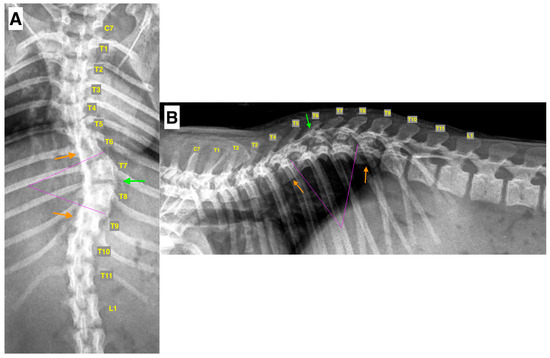
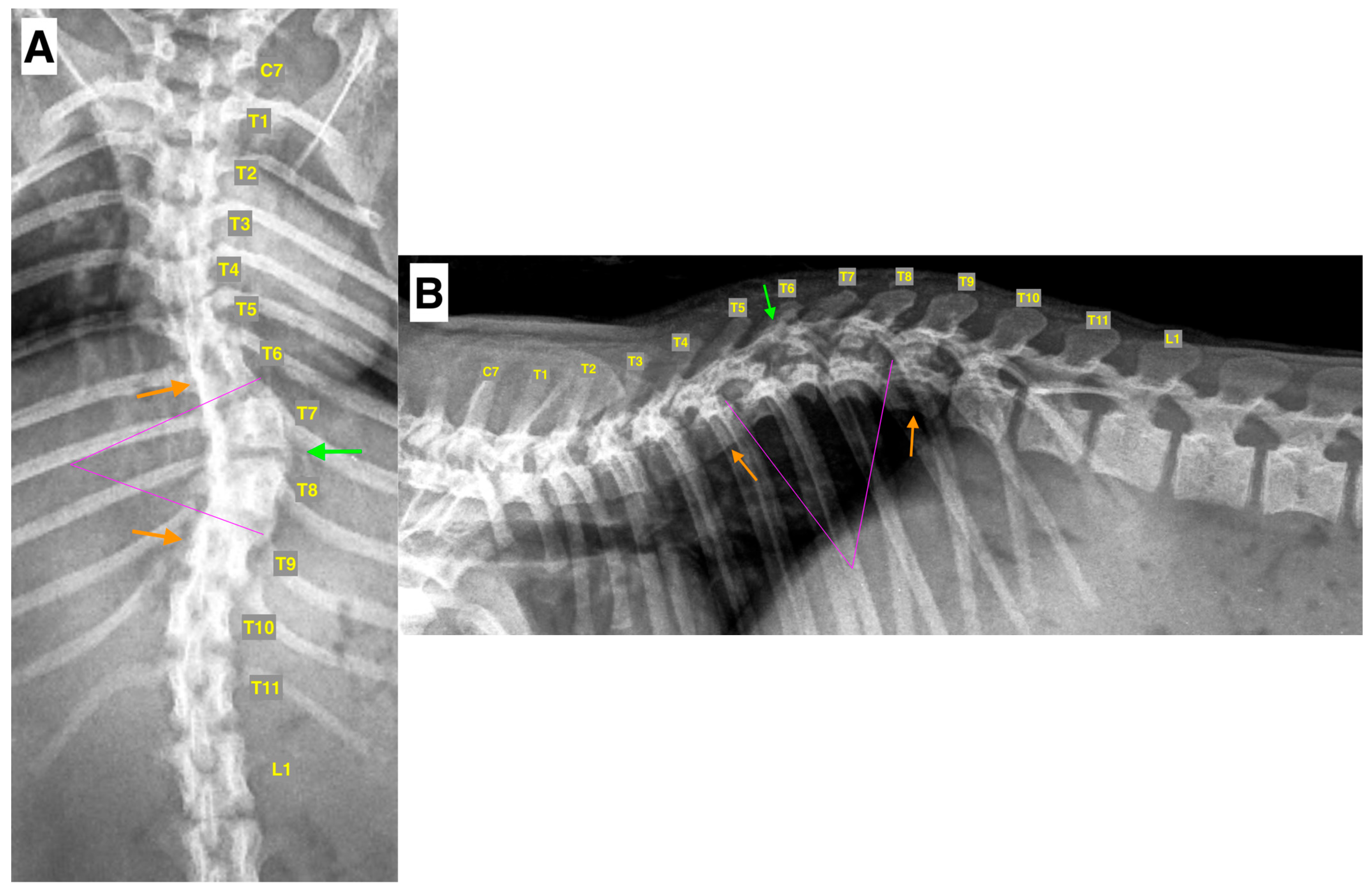
A minimum scoliosis Cobb angle of 10° was used, the same as for radiographic diagnosis of human scoliosis (Figure 1) [32,35]. Normal koala vertebral columns display minimal kyphosis, as such, for koalas without scoliosis, more than one reviewer must subjectively classify the kyphosis as abnormal for inclusion. Koalas were excluded if there was radiographic or CT evidence of trauma (e.g., spinal fracture) or if the spinal curvature was insufficient.
Figure 1.
Annotated ventrodorsal (A) and laterolateral (B) radiographs of a koala (initial antemortem radiographs of koala 26) with mild scoliosis and mild kyphosis. (A) Scoliosis Cobb angle (purple angle) of 44° measured between the end vertebrae (orange arrows), T6 and T9. The apex (green arrow) is located at the T7–T8 intervertebral space. (B) Kyphosis Cobb angle (purple angle) of 48° measured between the end vertebrae (orange arrows), T9 and T4. The apex (green arrow) is located at T6. Rotoscoliosis is also present with medial displacement of the spinous processes between T9 and T6.
Reviewers were freely permitted to view CT images in multiplanar reconstructions (MPR) and 3D volumetric reconstructions. For each radiographic and CT study, reviewers were asked to record the presence of abnormal curvature, subjectively evaluate the overall severity and measure the following for both the lateral and sagittal planes: curvature direction, apex vertebra, cranial end-vertebra, caudal end-vertebra, Cobb angle (degrees) and a subjective severity for each plane [32]. Additionally, for CT studies only, the maximal vertebral rotation and direction was recorded.
Cobb angles were reported in degrees and the allowed responses for subjective severity assessments included normal (0), minimal (1), mild (2), moderate (3) and severe (4); mapped to a five-point Likert scale (0–4).
2.4. Data Evaluation and Statistics
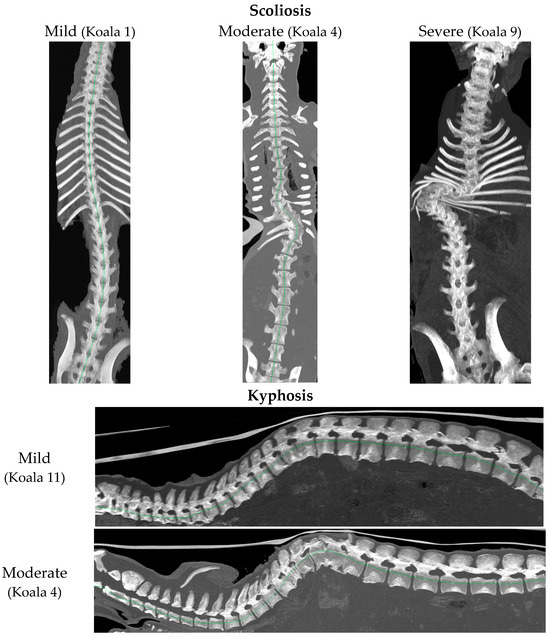
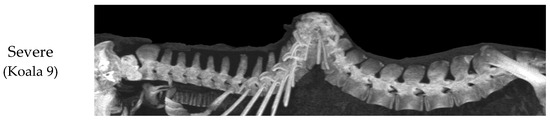
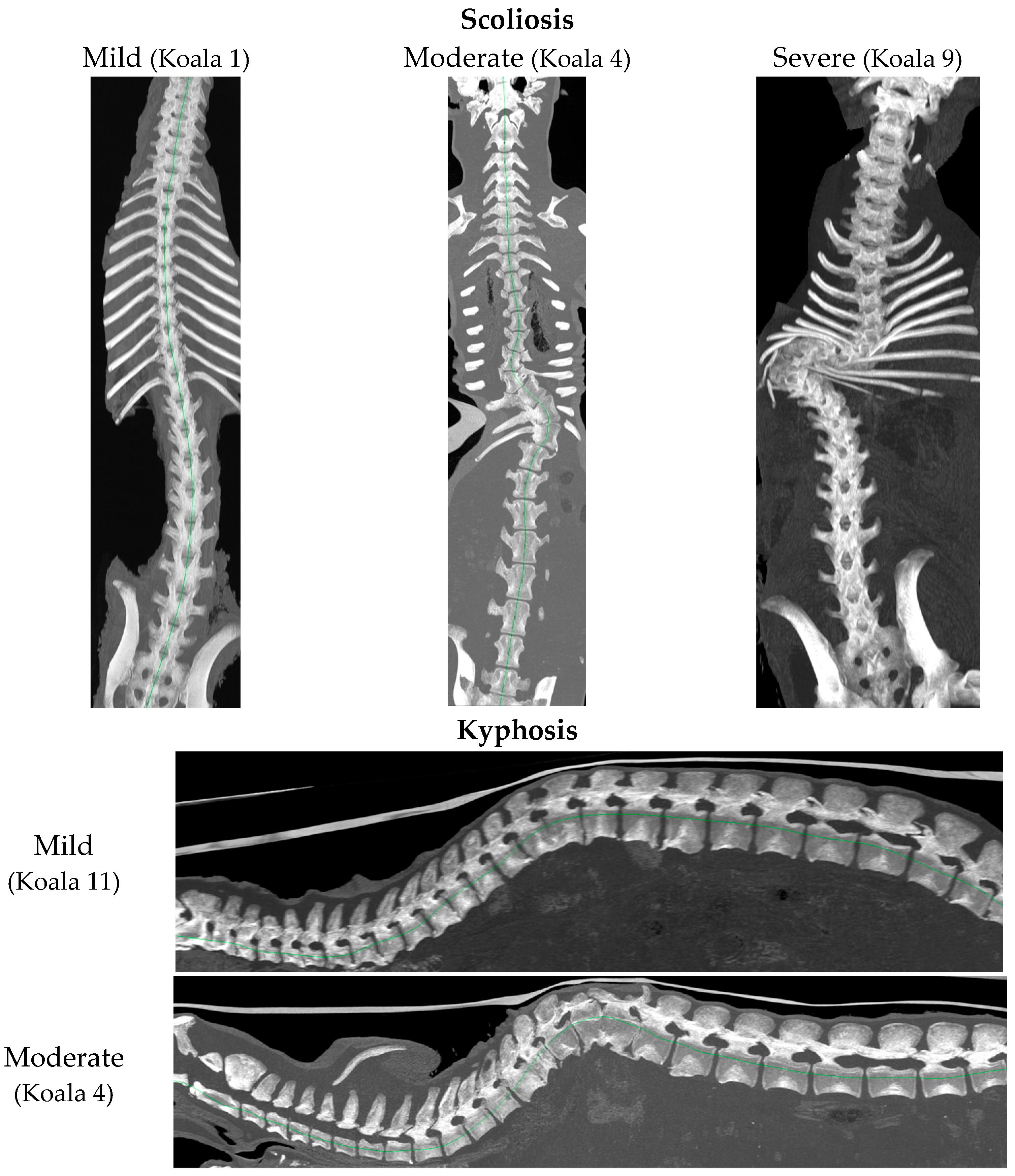
For each measurement, a consensus evaluation was collated from the responses of the four reviewers. For subjective severity assessments consensus was obtained by using the most frequent (mode) subjective descriptor (normal, minimal, mild, moderate, severe) (Figure 2). In cases of a tie (multimodal), CT data was prioritised to obtain an integer value. For Cobb angles, the mean measurement between all reviewers and modalities were used as the consensus value.
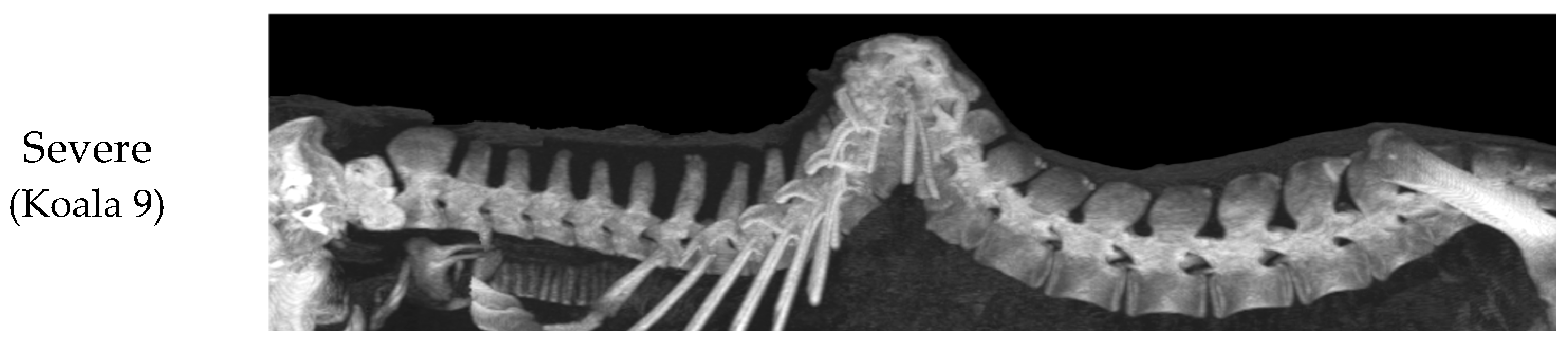
Figure 2.
Maximal intensity projection (MIP) CT multiplanar images of various severities of both scoliosis (viewed in the dorsal plane) and kyphosis (viewed in the sagittal plane). Mild and moderate severity images are curved-MIP images, isolating the kyphotic and scoliotic components. The severe images are in-plane MIP CT images (non-curved), as the vertebral curvature is too great to isolate with curved MIP (exceeds 90°) without introducing excessive image distortion.
The most common koala vertebral formula is C7 T11 L7 S3 [7]. For data evaluation, the vertebral column was divided into five regions as follows:
- Cervicothoracic region, defined as all thoracic vertebrae and intervertebral spaces cranial to, and including, T6–T7,
- Caudal thoracic region, of T7 to T9–T10, inclusive
- Thoracolumbar region, of T10 to L2, inclusive
- Lumbar region, of L2–L3 to L6, inclusive
- Lumbosacral region, caudal to, and including L6–L7
The consensus measurements were evaluated for correlation using Spearman-rank coefficients for ordinal-continuous or non-parametric continuous data, and the Cochran-Armitage test for ordinal-dichotomous data.
Statistical analysis was performed using the commercially available spreadsheet software Microsoft Excel Version 2508 (Microsoft, Redmond, WA, USA) with the Real-Statistics Resource Pack add-in [40]. Interobserver agreement between reviewers was calculated for all Cobb angle measurements using the intraclass correlation coefficient (ICC). Interobserver agreement for all subjective severity assessments were assessed using the five-point Likert scale and the agreement coefficient, Gwet’s AC2. Gwet’s AC2 was chosen to compare ordinal data among more than two reviewers [41,42]. Minimal (1) and mild (2) responses were combined when the frequency was low and a significant difference (p < 0.05) between these categories absent.
Receiver-operator curves (ROC) were used to determine the optimal Cobb angle cutoffs to associate the subjective severity assessments with defined Cobb angle ranges. Increments of 5° were used to evaluate the sensitivity, specificity and accuracy of breakpoints to select two points; one separating mild and moderate severities and one separating moderate from severe.
The inter-modality performance of CT and radiography for Cobb angle measurements was evaluated using Bland–Altman plots and Lin’s concordance correlation coefficient.
3. Results
3.1. Animal and Imaging Details
There were 26 koalas (20 male and 6 female) available for radiography and CT. Imaging was performed in 14 as whole cadavers and four were imaged as partial cadavers (koalas 3, 5, 8 and 26), with the abdominal and thoracic contents removed following necropsy. The remaining eight were imaged as isolated vertebral columns, which included the axial skeleton and paraspinal tissues only. Three koalas were classified as juvenile (<2 years old) and 23 as adults based on tooth wear class. One juvenile, a female, had two additional antemortem radiographs performed, separated by approximately four months, at an estimated age of 13 months and 17 months. Post-mortem radiographs and CT were performed at approximately 19 months of age, as one of the four partial cadavers.
Following imaging, three individuals (koalas 5, 12 and 20) were excluded due to evidence of axial skeletal fractures (koalas 12 and 20), and/or insufficient spinal curvature of less than 10° (koalas 5 and 12). The curvature of koala 20 was mild, less than 20° however the fracture of L5 was also collocated with the apex. The excluded animals included one juvenile (koala 12) and one each of whole cadaver, partial cadaver and isolated vertebral column. This resulted in a total of 23 CT exams (13 whole cadavers, 3 partial cadavers and 7 vertebral columns) and 25 radiographic exams (an additional 2 antemortem studies of koala 26) evaluated by four reviewers (Appendix A).
3.2. Imaging Morphology
Of all the imaged koalas 25/26 had 7 cervical vertebrae, 11 thoracic vertebrae and 8 lumbar vertebrae as determined by CT. One koala had 7 lumbar vertebrae but otherwise normal numbers of cervical (7) and thoracic (11) vertebrae. Number of sacral vertebrae was variable between 3 (6 koalas) and 4 (20 koalas). Vertebral formula could not be determined by radiographs alone in moderate and severely affected koalas due to marked superimposition of vertebrae.
For the 23 included koalas, the consensus grade for overall vertebral curvature severity was minimal or mild in 6, moderate in 5 and 12 were graded as severe. Scoliosis was present in 22/23 and kyphosis in 19/23. Both kyphosis and scoliosis, kyphoscoliosis, was present in 18/23. Lordosis was not observed.
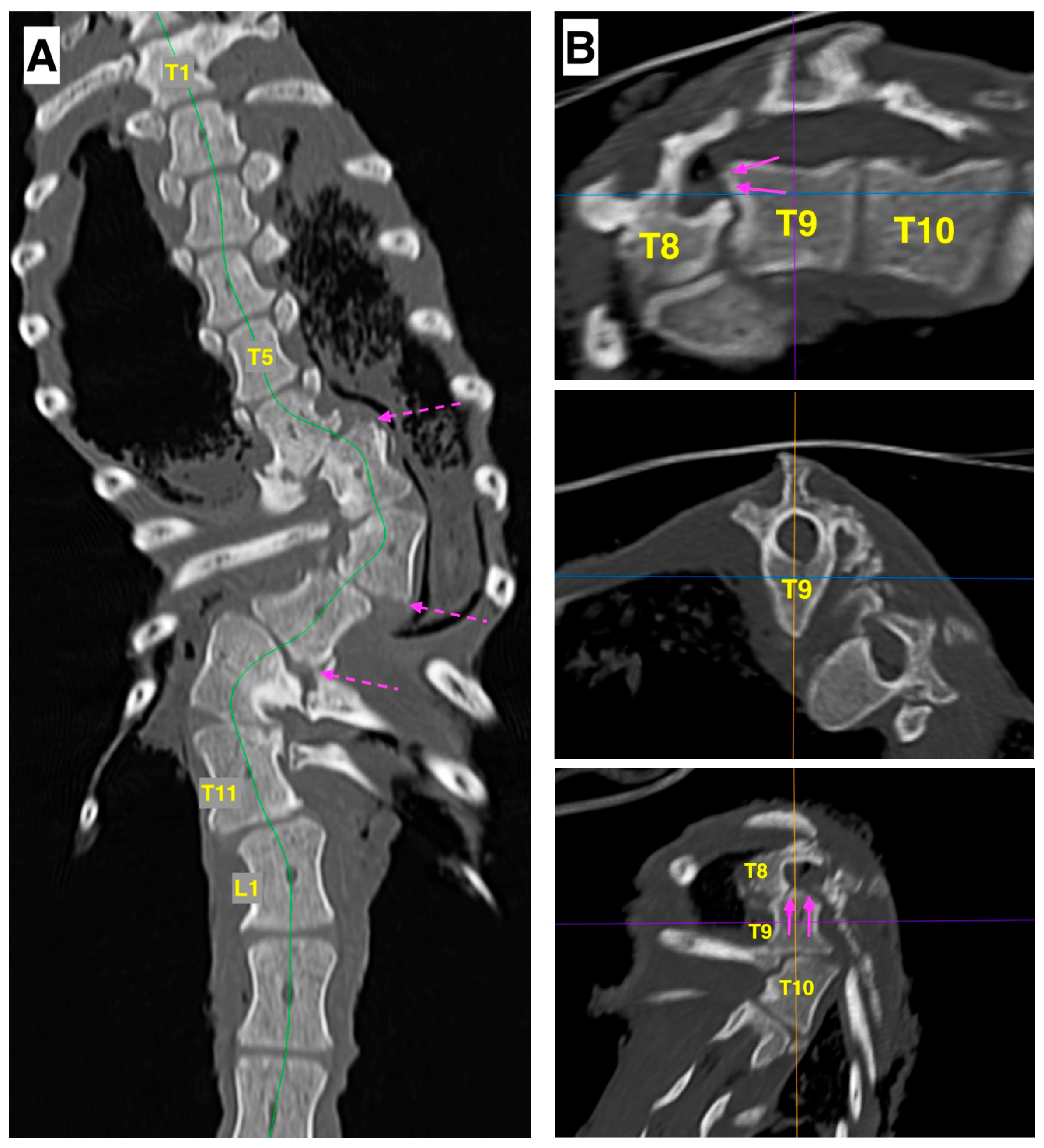
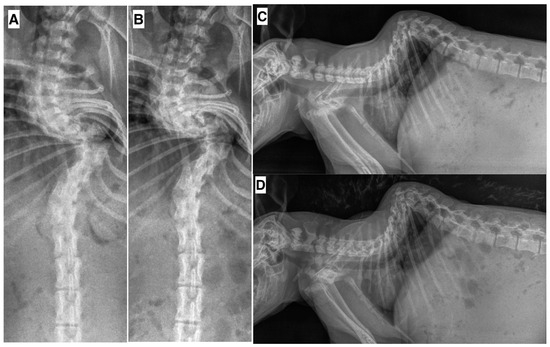
In mild curvatures, limited changes in vertebral body shape were observed and angulation was most seen at the intervertebral joints, as seen in Figure 1 and Figure 2. In moderate to severe curvatures, more marked changes to the vertebral body shape and subluxation of the intervertebral joints were the major contributors to the abnormal curvature, as seen in Figure 2 and Figure 3. Additionally, the impact of VCD on thoracic conformation was more severe in animals with more severe curvature.
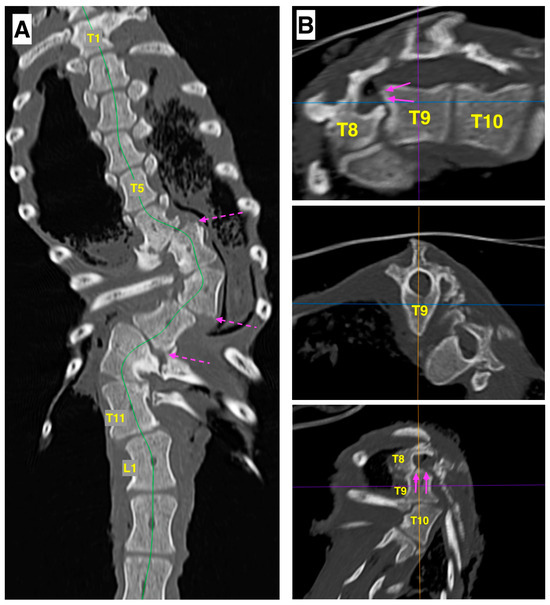
Figure 3.
CT examples of subluxation and wedged-vertebrae contributing to abnormal curvatures. (A) A curved CT-multiplanar reconstruction (MPR) image (bone window), of an adult koala cadaver (koala 25) with kyphoscoliosis of moderate severity. Multiple wedged-shaped vertebrae (T6, T7, T8, T10) are observed creating an apex at T8 with end-vertebrae of T6–T7 and T9. Multiple sites of vertebral end-plate subluxation are seen (dotted arrows), most prominently at T6–T7, but also T8–T9 and T9–T10. There is collapse of the intervertebral disc space at T10–T11. (B) A CT MPR image (bone window) of a different adult koala (koala 19), showing subluxation of the T8–T9 and T9–T10 vertebrae. A pseudarthrosis is present between the T8 pedicle and spinal canal which are articulating with the T9 cranial end-plate (arrows). T9 is of normal shape, though T8 and T10 are wedge-shaped.
The magnitude of vertebral body deformity was variable along the vertebral column, with the most significantly abnormal vertebral shapes and subluxations present closer to the apex or region of acute angulation. CVMs such as focal hemivertebrae or solitary vertebral malformations were not clearly observed. This clustering behaviour of abnormal vertebral bodies resulted in vertebral crowding and, when present in the thoracic spine, changes to the conformation of the costovertebral joints and ribs. This had significant impact on the conformation of the thoracic cavity and its volume, as seen in Figure 4. Variation in the intercostal space width and crowding of ribs was common and worsened with increasing severity. Although CT allowed for better assessment of rib conformation and location, the overall impact on thoracic conformation could be adequately assessed on radiographs.
Figure 4.
Dorsoventral (A,B) and laterolateral (C,D) radiographs of koala 26 with progressive kyphoscoliosis. Figure 1 contains the initial radiographs of mild severity. The second radiographic series ((A,C) 17 months old) show kyphoscoliosis of moderate severity. The final radiographic series ((B,D) 19 months old) was graded as severe kyphoscoliosis. Note: the absent vertebral physes and the progressive distortion of the thoracic cavity.
The juvenile female koala (koala 26) with antemortem radiographs showed a progressive increase in severity. Within the initial radiographs, shown in Figure 1, at an estimated age of 13 months, curvature was mild with no evidence of a focal CVM and subtle radiolucent vertebral body physes remained visible along with open physes of the long bones. Subsequent radiographs at 17 and 19 months of age, shown in Figure 4, were graded as moderate and severe respectively. The post-mortem CT was also graded as severe. The mean radiographic Cobb angle at 13 months old was 42.8° and 48.5° for scoliosis and kyphosis, respectively. Progression was seen with 82.5° and 95.5° seen at 17 months point and 104.3° and 111.5° for the final time point (19 months) for scoliosis and kyphosis respectively. On post-mortem CT the seventh thoracic vertebra was wedge-shaped with an approximate angulation of 40° between the cranial and caudal end-plates. The pedicles appeared asymmetric with a shortened right pedicle and the vertebral body was rotated 50° from neutral and was subluxated from the sixth thoracic vertebra.
A predominant leftward deviation (levoscoliosis) was seen with approximately the same frequency (11/22) as rightward (dextroscoliosis, 10/22) with no significant difference in severity between them. One koala had equal levo- and dextro-scoliosis (1/22) with neither direction predominating. Of the 22 scoliotic koalas, six had complex or ‘S’ shaped curves that featured both leftward and rightward deviations. The consensus scoliosis severity included five as minimal or mild, six as moderate and 11 severe.
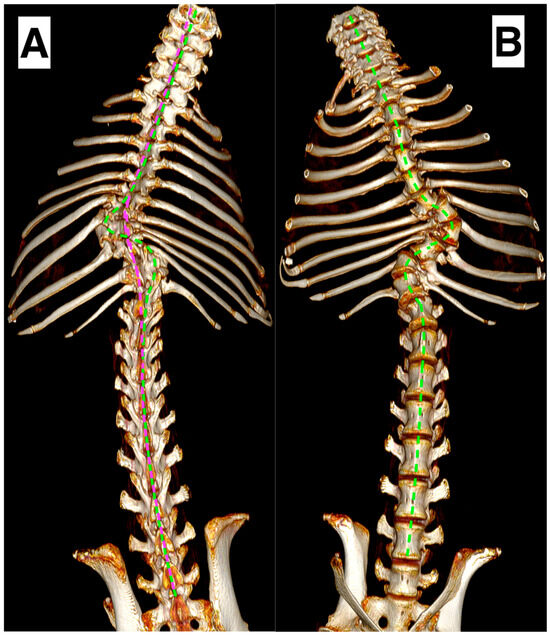
Vertebral body rotation, shown in Figure 5, was present in 18 of 23 and always opposed the direction of scoliosis; with the spinous process tilted medially. It was classed as mild in three, moderate in six, and severe in nine koalas.
Figure 5.
3D Volume reconstructions showing both clockwise and anticlockwise rotoscoliosis in koala 25 with moderate kyphoscoliosis. (A) A dorsal view with dotted purple denotes the path of the spinous processes dorsally, while the green line representing the vertebral bodies ventrally is visible. (B) Ventral view with the dotted green-line visible, following the median of the vertebral bodies. The vertebral bodies have significantly more deviation than the pedicles, contributing to the rotoscoliosis.
As per the five defined vertebral regions described earlier, seven scoliotic and seven kyphotic apex vertebrae were within the caudal thoracic region (T7 to T9–T11), eight and nine within the thoracolumbar region (T10 to L2) and, seven and three within the lumbar region (L2–L3 to L6). No apex vertebra for either scoliosis or kyphosis was seen cranial to the T6–T7 intervertebral disc space or caudal to L6.
3.3. Correlation of Overall Severity, Scoliosis Severity, Kyphosis Severity, Vertebral Rotation, Apex Vertebral Region and Cobb Angle Measurement
When comparing scoliosis severity with apex vertebra location, the caudal thoracic location was associated with more severe disease grades (p = 0.04), and the lumbar location was significantly associated with a less severe grade (p = 0.003). Although the thoracolumbar region was weakly associated with more severe disease it was not significant (p = 0.16).
Similarly for kyphosis, when comparing consensus severity and apex vertebra location, the caudal thoracic region was the only region associated with an increased severity grade of kyphosis (p = 0.04). The thoracolumbar and lumbar regions were not significant for an increased severity of kyphosis (p = 0.16 and p = 0.8, respectively). The consensus scoliosis severity is correlated with both consensus kyphosis severity and the degrees of vertebral rotation (Table 1). Scoliosis Cobb angle is most strongly correlated with kyphosis Cobb angle and overall grade.
Table 1.
Correlation of radiography and CT for various parameters as measures of abnormal vertebral column curvature in koalas.
3.4. Receiver Operator Curve (ROC) Evaluation of Cobb Angles and Severity
Subjective assessments of grade were very well correlated with their respective Cobb angle measurements (Table 1). This allowed ROC analysis using 5° increments to evaluate for optimal breakpoints to discriminate between severity grades. This was 45° to differentiate mild and moderate scoliosis. For moderate and severe grades of scoliosis 90° was optimal (Table 2). For kyphosis, the optimal points were 50° and 100° for discriminating between mild and moderate, and moderate and severe grades respectively.
Table 2.
Performance and area-under-curve (AUC) results of receiver operator curve (ROC) determined Cobb angles breakpoints to differentiate mild, moderate and severe vertebral column curvature in koalas.
When considering all Cobb angle measurements and all severity gradings, regardless of kyphosis or scoliosis, the two optimal cut-offs are 50° and 90° for differentiating mild from moderate and moderate from severe. Specificity, sensitivity, accuracy and area-under-the-curve values are reported in Table 2.
3.5. Interobserver and Modality Agreement
Interobserver agreement for radiographic severity scoring was good to excellent (Gwet’s AC2 between 0.774 and 0.924, Table 3), though scoliosis agreement was lowest. Similarly, Cobb angle measurements were excellent, with intraclass correlation coefficients of 0.831 to 0.844 (Table 3).
Table 3.
Gwet’s Agreement Coefficient (AC2) of subjective severity ratings between four reviewers using radiography (XR) and computed tomography (CT) for overall severity, scoliosis severity, kyphosis severity and all measurements of koalas with abnormal vertebral column curvature.
Interobserver agreement of CT severity scores as assessed by Gwet’s AC2 were comparable to, or marginally better than, radiographic severity scores. Gwet’s AC2 indicated good to excellent interobserver agreement for both modalities (0.812 to 0.909). Similarly for Cobb angle measurements, intraclass correlation coefficients (Table 4) showed excellent interobserver agreement for CT scoliosis Cobb angle measurements (0.907) and good agreement for kyphosis Cobb angle measurements (0.726). Radiography performed similarly with good agreement for all angles, with improved kyphosis Cobb angle agreement (0.831) when compared to CT, and reduced agreement for scoliosis Cobb angle (0.844).
Table 4.
Interobserver agreement between four reviewers as measured by intraclass correlation coefficients (ICC) for Cobb angle measurements using radiography and CT, and vertebral body rotation measurements by CT only, in koalas with abnormal vertebral column curvature.
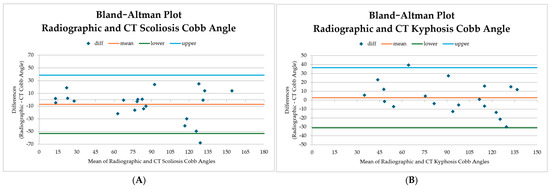
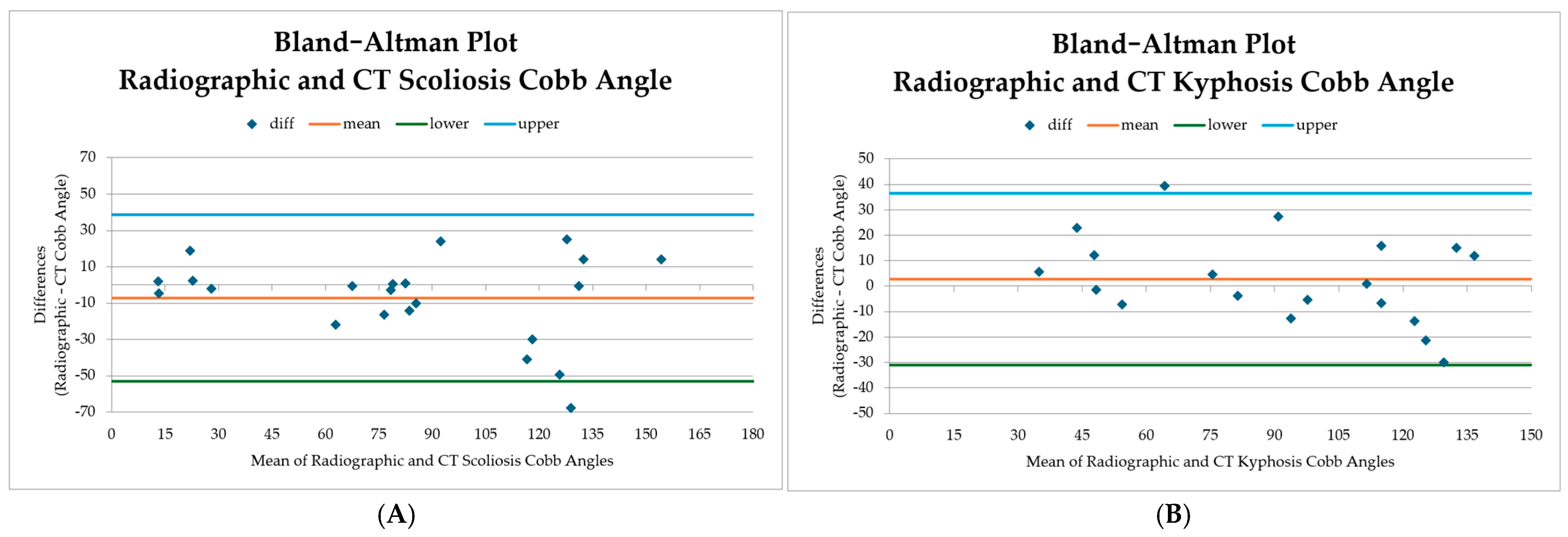
Bland–Altman evaluation (Figure 6) showed a mean difference between radiographic and CT scoliosis Cobb angle measurements of 7.22° with a standard deviation of 23.4. For kyphosis this is marginally improved, with a mean difference of 2.81° and a standard deviation of 17.2. A diverging distribution is noted within both Bland–Altman plots, suggesting reducing agreement at higher measurements. Both scoliosis and kyphosis Cobb angle measurements are highly concordant between imaging modalities, with Lin’s concordance correlation coefficients of 0.851 (95% CI: 0.685 to 0.933) and 0.874 (95% CI: 0.720 to 0.947) respectively.
Figure 6.
Bland–Altman plots comparing Cobb angle measurements of koala scoliosis (A) and kyphosis (B) between radiography and computed tomography (CT).
4. Discussion
The severity and location of abnormal vertebral column curvature in the imaged koala vertebral columns varied though common features are present. The apex vertebrae were always located between the seventh thoracic vertebrae (T7) and the sixth lumbar vertebrae (L6), which is a similar location to that reported in human idiopathic scoliosis [16,30,32]. When located within the lumbar region, there was usually less severe angulation, though severe kyphosis and scoliosis were each observed once within the lumbar region, in two different individuals.
Kyphosis and scoliosis almost always occurred together, and the severity is linked. Rotoscoliosis, as seen in Figure 5, was a common feature, particularly in severely affected individuals. The interlocking dorsal osseous anatomy of the articulating processes, combined with the supraspinous ligament and ligamentum flavum, attaching the spinous processes and vertebral lamina respectively, likely inhibit any significant subluxation dorsally, as subluxation was only seen ventrally between vertebral bodies. These dorsal constraints likely cause subsequent rotation as the vertebral bodies deform and subluxate which may in turn help to limit the impact of kyphoscoliosis on the spinal cord and spinal nerves. As such, it is proposed that the most appropriate morphological description for koalas with abnormal vertebral column curvature is kyphoscoliosis.
Kyphoscoliosis resulted in abnormal, crowded vertebral anatomy in many individuals, due to the curvature, asymmetric compression of deformed vertebral bodies and intervertebral joint subluxation. Although CVMs were not identified, they may be indistinguishable in the adult animals obscured by the significant degenerate changes. This is a limitation that may be overcome with serial imaging, particularly of young koalas, and characterization of degenerate changes of unaffected aged koalas. Serial antemortem images were available for one juvenile koala, prior to skeletal maturation as shown by radiolucent vertebral body physes, which showed a progressive worsening, achieving a severe classification after six months. No CVMs were observed in the initial radiographs. This may support an initiating factor distinct from CVMs, which then allows progressive vertebral deformation and formation of wedge-shaped vertebrae during maturation akin to that of human adolescent idiopathic scoliosis [43]. Three-dimensional imaging of juvenile animals may allow the identification of initiating causes of scoliosis and to identify the prevalence of CVMs, if present.
Radiography remains the primary method for diagnosing and monitoring scoliosis as well as Cobb angle measurements in humans [35]. 3D methods are increasing in popularity, along with artificial intelligence and machine-learning powered topographical evaluation and these may be more accurate and reliable than plain radiography [37,38]. In this study, CT and radiography performed similarly when evaluating koala kyphoscoliosis severity by Cobb angle measurement. Interobserver agreement and Cobb angle measurements were concordant between both modalities. The diverging scoliosis Bland-Altmann plot suggests that at higher Cobb angles (>100°), there is reduced agreement between CT and radiography. Although CT allowed for better visualisation of individual vertebrae and removed superimposition inherent to radiography, the interobserver agreement for Cobb angle measurements and severity was not substantially different. Radiographic scoliosis Cobb angle assessment had lower interobserver agreement than CT likely due to concurrent kyphosis causing superimposition of vertebrae. Despite this, CT interobserver agreement was not always superior, with higher interobserver agreement achieved by radiography when assessing kyphosis Cobb angles. CT multiplanar reconstruction may have reduced agreement, as CT allows adjustment of the measurement plane, which is inherent fixed in two-dimensional radiographs. Particularly in complex curvatures, the measurement plane may not be clear on CT contributing to the reduced agreement.
Neither radiography nor CT have been previously reported in evaluating Cobb angles in koalas. These results show that despite CT’s advantages of three-dimensional data, radiography is an appropriate and effective modality to evaluate Cobb angles and severity in koala kyphoscoliosis. Strong correlation between Cobb angles and subjective severity assessment of the reviewers, both of which had high inter-observer agreement, also contributes positively to the test’s validity. As such, in koalas, provisional Cobb angle ranges of mild (10–45°), moderate (45–90°) and severe (>90°) are suggested for scoliosis and mild (<50°), moderate (50–100°) and severe (>100°) for kyphosis.
Limitations were encountered during imaging and evaluation of the kyphoscoliotic koalas. Post-mortem imaging was predominant, and therefore non-fixed contributions to antemortem spinal curvature from musculature, pain, discomfort or other contributions to posture, may have been effaced by post-mortem manual positioning. Other aberrant curvatures may have also been introduced, contributing to measurement variation. This is magnified in the post-necropsy axial skeleton sections that have lost some soft tissue and associated anatomical support which may have been stabilising the spinal anatomy. The effect of recumbency was not assessed and sternal-recumbency may have a meaningful effect on the appearance of vertebral curvature, particularly kyphosis. Vertebral curvatures which are fixed and persistent in multiple recumbencies may have more clinical significance than non-fixed curvatures which can be improved or resolved by positioning. In humans, positional scoliosis is associated with reduced severity.
The reviewers, although board certified veterinary radiologists (3) or final year radiology resident (1), do not frequently encounter kyphosis, scoliosis or rotoscoliosis in veterinary imaging, and as such Cobb angle measurements are not routinely performed. This was partially mitigated by defined measurement methods and instructions provided to reviewers, though this unfamiliarity may have introduced additional interobserver variation.
The subjective severity scores were inherently arbitrary, based only on each reviewer’s evaluation. Despite the arbitrary character of this measurement, not only was there very high interobserver agreement it was also highly correlated with Cobb angle measurements. The clinical impact of severity is not known, nor what Cobb angle is associated with neurological or cardiovascular impacts, externally visible spinal curvature, altered behaviours or other negative welfare impacts. Severity varied greatly amongst these imaged koalas. It is hoped that the Cobb angle-based severity ranges defined above may assist with data collection and evaluation of clinical significance. These ranges are provisional, and review is likely warranted once further information regarding prognosis and characteristics of abnormal curvature are available.
The radiographic progression from mild to severe observed over six months in one juvenile koala displays similar features to that of human adolescent idiopathic scoliosis, which worsens throughout skeletal maturation with progressive vertebral distortion, wedge-shaped vertebral bodies and loss of soft tissue support. For the remaining 22 koalas imaged at a single time point, it is not possible to determine if CVMs or physeal injuries were implicated in the initiation of a curvature, or if there was progressive vertebral column deformation for another reason. Despite this, the presence of multiple distorted or wedge-shaped vertebrae in all severely affected koalas may suggest that progressive deformation is a key contributor. Additionally, the progressive nature observed in one individual without CVM, combined with the koala’s upright posture, supports the hypothesis that this pathology may have a similar aetiology to human adolescent idiopathic scoliosis. Longitudinal studies of juvenile koalas and evaluation of the vertebral body pathology and initiating factors are therefore crucial in further characterising the natural history of this pathology.
5. Conclusions
This study characterises the radiographic and CT features of abnormal vertebral column curvature in koalas, which is best described as kyphoscoliosis. The findings confirm that Cobb angle measurements are a reliable tool for evaluating severity, showing excellent interobserver and intermodality agreement. Reference ranges for each severity grade were also established. Notably, despite its inherent limitations in assessing three-dimensional pathology, radiography performed comparably to CT, validating its use as a primary imaging modality. The observed progressive nature of kyphoscoliosis, combined with the koala’s upright posture suggests pathophysiologic similarities to human idiopathic scoliosis. Future longitudinal imaging of juvenile koalas with spinal deformity and pathological studies are essential to elucidate the aetiology and natural history of koala kyphoscoliosis.
Author Contributions
Conceptualization, N.S. and W.S.J.B.; methodology, S.E., N.S. and M.S.; formal analysis, S.E.; investigation, M.S., N.S., W.S.J.B. and L.W.; resources, N.S. and W.S.J.B.; imaging review and data curation, S.E., X.H., R.T. and C.B.; writing—original draft preparation, S.E.; writing—review and editing, S.E., N.S., W.S.J.B., L.W., X.H., R.T., C.B. and M.S.; supervision, N.S. All authors have read and agreed to the published version of the manuscript.
Funding
This research was funded by the School of Animal and Veterinary Sciences (1311-0616), Adelaide University.
Institutional Review Board Statement
Koalas, clinical data and all imaging of koalas for this study were acquired with approval by the University Ethics Committee, (S-2013-198, S-2016-169 and S-2021-081) and the South Australian government Department of Environment and Water (permit Y26054) and conducted in accordance with the guidelines set out in the ‘Australian Code for the care and use of animals for scientific purposes’ 8th edition (2013) (National Health and Medical Research Council: Canberra, 2013).
Informed Consent Statement
Not applicable.
Data Availability Statement
Data is available in Appendix A and on request from the corresponding author.
Acknowledgments
Thanks to the Adelaide Koala and Wildlife Centre, Southern Koala and Echidna Rescue, wildlife veterinary clinics, and koala rescue organisations in South Australia for referring euthanised koalas with abnormal vertebral curvature. Thanks to Tamsyn Stephenson, Jessica Kovac, Jessica Allan, Julie Olsen, Adrian Hines and DVM clinical research project students Riley Economos, Gypsy-Rose Entriken, Pavani Samarakoon, Sanduni Karunaratne, Natalie Monteleone, and Madison Martin for their contributions to the initial research.
Conflicts of Interest
Stuart Eddy, Xander Huizing, and Rob Turner are employed by The Austin Vet Specialists. Chelsea Beale is employed by IDEXX Telemedicine Consultants. The authors declare that the research was conducted in the absence of any commercial or financial relationships that could be construed as a potential conflict of interest.
Abbreviations
The following abbreviations are used in this manuscript:
| VCD | Vertebral Column Deformity |
| CVM | Congenital Vertebral Malformation |
| CT | Computed Tomography |
| C/T/L/S | Numbered references to Cervical, Thoracic, Lumbar or Sacral vertebra, respectively |
| kV | Kilovoltage |
| AUC | Area under a curve |
Appendix A. Table of Koala Consensus Imaging Findings
Table A1.
Consensus imaging assessment of scoliosis, kyphosis and rotoscoliosis in 26 koalas with abnormal vertebral column curvature. Scoliosis direction is recorded as the predominating direction. Individuals with ‘complex’ scoliosis (C) had non-compensatory curvature in both directions, with or without a predominant direction. Rotation (rotoscoliosis) was assessed only by CT by spinous process location, with clockwise (CW) rotation seen as a leftward position and anti-clockwise (ACW) rightward. M: Male, F: Female, ?: not recorded, TWC: Tooth Wear Class, TWC = I is a juvenile, TWC > I is an adult. (C): Complex, Shading: Not Present, Excluded.
References
- Higgins, D.; Rose, K.; Spratt, D. Monotremes and Marsupials. In Pathology of Wildlife and Zoo Animals; Terio, K., McAloose, D., St Leger, J., Eds.; Academic Press: Cambridge, MA, USA, 2018; pp. 455–476. ISBN 9780128092194. [Google Scholar]
- Vogelnest, L.; Portas, T. Current Therapy in Medicine of Australian Mammals; CSIRO Publishing: Clayton, Australia, 2025; ISBN 9781486317943. [Google Scholar]
- Tarlinton, R.; Fabijan, J.; Hemmatzadeh, F.; Meers, J.; Owen, H.; Sarker, N.; Seddon, J.; Simmons, G.; Speight, N.; Trott, D.J.; et al. Transcriptomic and Genomic Variants between Koala Populations Reveals Underlying Genetic Components to Disorders in a Bottlenecked Population. Conserv. Genet. 2021, 22, 329–340. [Google Scholar] [CrossRef] [Scilit]
- Fabijan, J.; Sarker, N.; Speight, N.; Owen, H.; Meers, J.; Simmons, G.; Seddon, J.; Emes, R.D.; Tarlinton, R.; Hemmatzadeh, F.; et al. Pathological Findings in Koala Retrovirus-Positive Koalas (Phascolarctos cinereus) from Northern and Southern Australia. J. Comp. Pathol. 2020, 176, 50–66. [Google Scholar] [CrossRef] [Scilit] [PubMed]
- Hirst, L.; Brown, A.; Kempster, R.; Hall, J.; Woolcock, J. Keratitis in Free-Ranging Koalas (Phascolarctos cinereus) on magnetic island, Townsville. J. Wildl. Dis. 1992, 28, 424–427. [Google Scholar] [CrossRef] [Scilit]
- Griffith, J.; Stephenson, T.; McLelland, D.; Woolford, L. Hypertrophic Osteopathy in South Australian Koalas (Phascolarctos cinereus) with Concurrent Pulmonary Actinomycosis. Aust. Vet. J. 2021, 99, 172–177. [Google Scholar] [CrossRef] [Scilit]
- Vogelnest, L. Radiology of Australian Mammals; CSIRO: Clayton, Australia, 2015; p. 89. ISBN 9780643108653. [Google Scholar]
- Agerholm, J.; Bendixen, C.; Andersen, O.; Arnbjerg, J. Complex Vertebral Malformation in Holstein Calves. J. Vet. Diagn. Investig. 2001, 13, 283–289. [Google Scholar] [CrossRef] [Scilit]
- De Decker, S.; Rohdin, C.; Gutierrez-Quintana, R. Vertebral and Spinal Malformations in Small Brachycephalic Dog Breeds: Current Knowledge and Remaining Questions. Vet. J. 2024, 304, 106095. [Google Scholar] [CrossRef] [Scilit]
- Hahn, C.; Handel, I.; Green, S.; Bronsvoort, M.; Mayhew, I. Assessment of the Utility of Using Intra- and Intervertebral Minimum Sagittal Diameter Ratios in the Diagnosis of Cervical Vertebral Malformation in Horses. Vet. Radiol. Ultrasound 2008, 49, 1–6. [Google Scholar] [CrossRef] [Scilit] [PubMed]
- De Decker, S.; Packer, R.; Cappello, R.; Harcourt-Brown, T.; Rohdin, C.; Gomes, S.; Bergknut, N.; Shaw, T.; Lowrie, M.; Gutierrez-Quintana, R. Comparison of Signalment and Computed Tomography Findings in French Bulldogs, Pugs, and English Bulldogs with and without Clinical Signs Associated with Thoracic Hemivertebra. J. Vet. Intern. Med. 2019, 33, 2151–2159. [Google Scholar] [CrossRef] [Scilit]
- Burgos, J.; Hevia, E.; Sanpera, I.; García, V.; de Santos Moreno, M.T.; Mariscal, G.; Barrios, C. Incidence and Risk Factors of Distal Adjacent Disc Degeneration in Adolescent Idiopathic Scoliosis Patients Undergoing Fusion Surgery: A Systematic Review and Meta-Analysis. Eur. Spine J. 2024, 33, 1624–1636. [Google Scholar] [CrossRef] [Scilit]
- Sheehan, D.; Grayhack, J. Pediatric Scoliosis and Kyphosis: An Overview of Diagnosis, Management, and Surgical Treatment. Pediatr. Ann. 2017, 46, e472–e480. [Google Scholar] [CrossRef] [Scilit]
- Petrosyan, E.; Fares, J.; Ahuja, C.S.; Lesniak, M.S.; Koski, T.R.; Dahdaleh, N.S.; El Tecle, N.E. Genetics and Pathogenesis of Scoliosis. Spine J. 2024, 20, 100556. [Google Scholar] [CrossRef] [Scilit]
- Ailon, T.; Smith, J.; Shaffrey, C.; Lenke, L.; Brodke, D.; Harrop, J.; Fehlings, M.; Ames, C. Degenerative Spinal Deformity. Neurosurgery 2015, 77, S75–S91. [Google Scholar] [CrossRef] [Scilit]
- Johari, J.; Sharifudin, M.; Ab Rahman, A.; Omar, A.; Abdullah, A.; Nor, S.; Lam, W.; Yusof, M. Relationship between Pulmonary Function and Degree of Spinal Deformity, Location of Apical Vertebrae and Age among Adolescent Idiopathic Scoliosis Patients. Singap. Med. J. 2016, 57, 33–38. [Google Scholar] [CrossRef] [Scilit]
- Campbell, R.; Smith, M.; Mayes, T.; Mangos, J.; Willey-Courand, D.; Kose, N.; Pinero, R.; Alder, M.; Duong, H.; Surber, J. The Characteristics of Thoracic Insufficiency Syndrome Associated with Fused Ribs and Congenital Scoliosis. J. Bone Jt. Surg. Am. 2003, 85, 399–408. [Google Scholar] [CrossRef] [Scilit] [PubMed]
- Terhune, E.; Monley, A.; Cuevas, M.; Wethey, C.; Gray, R.; Hadley-Miller, N. Genetic Animal Modeling for Idiopathic Scoliosis Research: History and Considerations. Spine Deform. 2022, 10, 1003–1016. [Google Scholar] [CrossRef] [Scilit]
- Aleri, J.; Russell, S.; Richardson, J.; Stephens, N.; Lee, G.; Laurence, M. Cervico-Thoracic Vertebral Subluxation in Sheep: Awareness among Veterinarians of a Rare Syndrome. Res. Vet. Sci. 2020, 130, 79–86. [Google Scholar] [CrossRef] [Scilit]
- Oberbauer, A.; East, N.; Pool, R.; Rowe, J.; BonDurant, R. Developmental Progression of the Spider Lamb Syndrome. Small Rumin. Res. 1995, 18, 179–184. [Google Scholar] [CrossRef] [Scilit]
- Beever, J.; Smit, M.; Meyers, S.; Hadfield, T.; Bottema, C.; Albretsen, J.; Cockett, N. A Single-base Change in the Tyrosine Kinase II Domain of Ovine FGFR3 Causes Hereditary Chondrodysplasia in Sheep. Anim. Genet. 2006, 37, 66–71. [Google Scholar] [CrossRef] [Scilit] [PubMed]
- Lyons, L.; Grahn, R.; Genova, F.; Beccaglia, M.; Hopwood, J.; Longeri, M. Mucopolysaccharidosis VI in Cats—Clarification Regarding Genetic Testing. BMC Vet. Res. 2016, 12, 136. [Google Scholar] [CrossRef] [Scilit]
- Peck, S.; Casal, M.; Malhotra, N.; Ficicioglu, C.; Smith, L. Pathogenesis and Treatment of Spine Disease in the Mucopolysaccharidoses. Mol. Genet. Metab. 2016, 118, 232–243. [Google Scholar] [CrossRef] [Scilit] [PubMed]
- Dewey, C.; Davies, E.; Bouma, J. Kyphosis and Kyphoscoliosis Associated with Congenital Malformations of the Thoracic Vertebral Bodies in Dogs. Vet. Clin. N. Am. Small Anim. Pract. 2016, 46, 295–306. [Google Scholar] [CrossRef] [Scilit] [PubMed]
- Moses, W.; Moses, I.; Moses, E.; Moses, P. Prevalence and Classification of Congenital Thoracic Vertebral Body Abnormalities in Neurologically Normal Brachycephalic ‘Screw-tail’ Dog Breeds in Referral Practice in Australia. Aust. Vet. J. 2024, 102, 503–509. [Google Scholar] [CrossRef] [Scilit] [PubMed]
- Wyatt, S.E.; Lafuente, P.; Ter Haar, G.; Packer, R.M.A.; Smith, H.; De Decker, S. Gait Analysis in French Bulldogs with and without Vertebral Kyphosis. Vet. J. 2019, 244, 45–50. [Google Scholar] [CrossRef] [Scilit]
- de Souza, M.I.; Ryan, R.; ter Haar, G.; Packer, R.; Volk, H.; De Decker, S. Evaluation of the Influence of Kyphosis and Scoliosis on Intervertebral Disc Extrusion in French Bulldogs. BMC Vet. Res. 2018, 14, 5. [Google Scholar] [CrossRef] [Scilit]
- Rohdin, C.; Häggström, J.; Ljungvall, I.; Lee, H.N.; De Decker, S.; Bertram, S.; Lindblad-Toh, K.; Jäderlund, K.H. Presence of Thoracic and Lumbar Vertebral Malformations in Pugs with and without Chronic Neurological Deficits. Vet. J. 2018, 241, 24–30. [Google Scholar] [CrossRef] [Scilit]
- Ryan, R.; Gutierrez-Quintana, R.; Ter Haar, G.; De Decker, S. Prevalence of Thoracic Vertebral Malformations in French Bulldogs, Pugs and English Bulldogs with and without Associated Neurological Deficits. Vet. J. 2017, 221, 25–29. [Google Scholar] [CrossRef] [Scilit]
- Mackel, C.; Jada, A.; Samdani, A.; Stephen, J.; Bennett, J.; Baaj, A.; Hwang, S. A Comprehensive Review of the Diagnosis and Management of Congenital Scoliosis. Childs Nerv. Syst. 2018, 34, 2155–2171. [Google Scholar] [CrossRef] [Scilit] [PubMed]
- Yaman, O.; Dalbayrak, S. Kyphosis and Review of the Literature. Turk. Neurosurg. 2014, 24, 455–465. [Google Scholar] [CrossRef] [Scilit]
- Kim, H.; Kim, H.; Moon, E.; Yoon, C.; Chung, T.; Song, H.; Suh, J.; Lee, Y.; Kim, S. Scoliosis Imaging: What Radiologists Should Know. RadioGraphics 2010, 30, 1823–1842. [Google Scholar] [CrossRef] [Scilit] [PubMed]
- Ryan, M.; Whisson, D.; Holland, G.; Arnould, J. Activity Patterns of Free-Ranging Koalas (Phascolarctos cinereus) Revealed by Accelerometry. PLoS ONE 2013, 8, e80366. [Google Scholar] [CrossRef] [Scilit]
- Smith, M. Behaviour of the Koala, Phascolarctos Cinereus Goldfuss, in Captivity. 1. Non-Social Behaviour. Wildl. Res. 1979, 6, 117–129. [Google Scholar] [CrossRef] [Scilit]
- Jin, C.; Wang, S.; Yang, G.; Li, E.; Liang, Z. A Review of the Methods on Cobb Angle Measurements for Spinal Curvature. Sensors 2022, 22, 3258. [Google Scholar] [CrossRef] [Scilit]
- Brocal, J.; De Decker, S.; José-López, R.; Guevar, J.; Ortega, M.; Parkin, T.; Ter Haar, G.; Gutierrez-Quintana, R. Evaluation of Radiography as a Screening Method for Detection and Characterisation of Congenital Vertebral Malformations in Dogs. Vet. Rec. 2018, 182, 573. [Google Scholar] [CrossRef] [Scilit]
- Lechner, R.; Putzer, D.; Dammerer, D.; Liebensteiner, M.; Bach, C.; Thaler, M. Comparison of Two- and Three-Dimensional Measurement of the Cobb Angle in Scoliosis. Int. Orthop. 2017, 41, 957–962. [Google Scholar] [CrossRef] [Scilit]
- Karpiel, I.; Ziębiński, A.; Kluszczyński, M.; Feige, D. A Survey of Methods and Technologies Used for Diagnosis of Scoliosis. Sensors 2021, 21, 8410. [Google Scholar] [CrossRef] [Scilit]
- Martin, R.; Handasyde, K.; Simpson, S. The Koala: Natural History, Conservation and Management; UNSW Press: Randwick, Australia, 1999; ISBN 0868405442. [Google Scholar]
- Zaiontz, C. Real-Statistics Using Excel Resource Pack Add-In 2025. Available online: https://www.real-statistics.com/ (accessed on 15 July 2025).
- Gwet, K. Computing Inter-rater Reliability and Its Variance in the Presence of High Agreement. Br. J. Math. Stat. Psychol. 2008, 61, 29–48. [Google Scholar] [CrossRef] [Scilit]
- Han, K.; Ryu, L. Statistical Methods for the Analysis of Inter-Reader Agreement Among Three or More Readers. Korean J. Radiol. 2024, 25, 325–327. [Google Scholar] [CrossRef] [Scilit] [PubMed]
- Xu, H.; Qiu, G.; Wang, Y.; Zhang, J.; Liu, Y.; Wu, Z. Imaging Study of Wedge Changes in the Vertebral Bodies and Intervertebral Discs in Adolescent Idiopathic Scoliosis. Orthop. Surg. 2009, 1, 300–304. [Google Scholar] [CrossRef] [Scilit] [PubMed]

Disclaimer/Publisher’s Note: The statements, opinions and data contained in all publications are solely those of the individual author(s) and contributor(s) and not of MDPI and/or the editor(s). MDPI and/or the editor(s) disclaim responsibility for any injury to people or property resulting from any ideas, methods, instructions or products referred to in the content. |
© 2026 by the authors. Licensee MDPI, Basel, Switzerland. This article is an open access article distributed under the terms and conditions of the Creative Commons Attribution (CC BY) license.