Article

Dietary Fiber Levels Modulate Intestinal Mucosal Architecture and the Microbiome–Metabolome Axis to Support Immune Homeostasis in Brooding Wanxi White Geese


1
College of Animal Science, Anhui Science and Technology University, Chuzhou 233100, China
2
Anhui Province Key Laboratory of Animal Nutritional Regulation and Health, Chuzhou 233100, China
3
Local Geese Gene Bank in Anhui Province, Chuzhou 233100, China
4
National Key Laboratory of Agricultural Microbiology, College of Veterinary Medicine, Huazhong Agricultural University, Wuhan 430070, China
5
Desert Research Center, Cairo 11753, Egypt
*
Authors to whom correspondence should be addressed.
These authors contributed equally to this work.
Animals 2026, 16(11), 1709; https://doi.org/10.3390/ani16111709
Submission received: 4 April 2026 / Revised: 27 May 2026 / Accepted: 29 May 2026 / Published: 3 June 2026
(This article belongs to the Section Animal Nutrition)

Simple Summary

Identifying the optimal dietary fiber level is crucial for the sustainable and cost-effective farming of Wanxi White Geese (WWG). While fiber is essential for poultry gut health, insufficient or excessive amounts can limit nutrient utilization during the critical early brooding stage. This study reveals that feeding brooding WWG a diet formulated with 9% crude fiber (CF) significantly fortifies their intestinal physical structure, promotes a beneficial gut microbial balance, and supports robust early immune defense. For poultry producers, implementing this 9% fiber feeding strategy offers a highly practical, science-based approach to enhance early gut development, improve feed efficiency, and ultimately increase the overall health and economic viability of goose farming operations.

Abstract

Dietary fiber is a critical determinant of intestinal health, yet its optimal inclusion level for WWG during the critical brooding period remains undefined. This study aimed to evaluate the effects of varying dietary CF levels (approximately 3%, 5%, and 9%) on the intestinal morphology, immune function, and microbiome-metabolome axis of brooding WWG. A total of 120 one-day-old goslings were randomly assigned to the three dietary treatments for a 28-day trial. Histological analysis revealed that the 9% CF diet significantly improved gut morphology, yielding superior villus-to-crypt ratios in the jejunum and ileum. Molecular assays indicated that higher fiber levels (5–9%) upregulated the expression of nutrient transporters (SGLT1 and GLUT2). Concurrently, the 9% CF diet effectively suppressed the potent pro-inflammatory cytokine TNF-α in the jejunum while appropriately upregulating IL-6 and NF-κB, indicating enhanced mucosal immune vigilance and structural maturation. Multi-omics integration (shotgun metagenomics and LC-MS metabolomics) demonstrated that specific fiber levels significantly shifted microbial abundances, specifically enriching Bacteroidetes and Actinobacteria. These microbial shifts were strongly correlated with enriched metabolic pathways, notably lysine biosynthesis and purine metabolism, which synergistically support mucosal homeostasis. Collectively, these findings demonstrate that a 9% dietary CF inclusion is an effective nutritional strategy to optimize intestinal architecture and microbial-metabolic profiles in brooding WWG.

1. Introduction

China is a global leader in goose production and consumption, accounting for more than 90% of the world’s goose population. As a result, the goose industry plays a significant role in supporting the national economy. Geese are predominantly herbivorous poultry with strong tolerance for high-fiber diets, low feed intake, limited input requirements, and high economic returns. Their ability to efficiently utilize forages and crop residues not only conserves grain resources but also helps mitigate pressures associated with China’s expanding population and declining arable land. Thus, advancing research on their nutritional requirements is essential for reducing feed costs and promoting sustainable industry development. However, studies on the digestive physiology and nutrient requirements of geese remain insufficient, particularly regarding optimal dietary fiber levels across developmental stages [1,2].
In poultry, intestinal health is closely associated with production performance and product safety in poultry. Dietary fiber influences intestinal function by modulating gut development, mucosal morphology, and microbial ecology, thereby improving feed utilization efficiency and growth performance [3,4]. Evidence indicates that moderate fiber supplementation promotes gastrointestinal development in poultry and enhances nutrient absorption, productivity, and disease resistance in poultry [5,6]. With the rapid progress in high-throughput sequencing technologies, research on the structure and function of the gut microbiota, and its multifaceted effects on the host, has become increasingly prominent. The gut microbiota is now recognized as a key determinant of poultry health and metabolic regulation [7,8]. Furthermore, the gut microbiota exerts its profound effects on host health primarily through a complex network of metabolic outputs. Microbial metabolites, including specific organic acids and synthesized essential amino acids, act as crucial signaling molecules that directly modulate intestinal structural integrity and local immune homeostasis. Despite this critical host–microbe metabolic crosstalk, how specific dietary fiber levels drive these metabolomic shifts to fortify the intestinal immune barrier in geese remains largely unexplored.
Geese possess a distinct digestive physiology that supports efficient fiber utilization, including a spacious and flexible esophagus, a highly muscular gizzard with strong grinding capacity, and an acidic gastrointestinal environment conducive to fiber degradation [9,10]. Microbial richness and diversity in geese increase along the gastrointestinal tract, reaching their peak in the ceca, which harbors a dense and metabolically active microbiota. Consequently, the cecum has become the most frequently examined intestinal segment in poultry microbiome studies. Moreover, the goose gut microbiota undergoes a developmental succession from a relatively simple, transient community in early life to a more stable and diverse ecosystem as the birds mature [11,12]. Despite this importance, research on goose gut microbiota remains scarce compared with that in chickens and ducks.
The brooding period is a critical developmental stage for the maturation of the gastrointestinal tract and immune system in geese. In this study, Wanxi White Geese (WWG) during the brooding period were used as the experimental model to investigate the effects of different dietary crude fiber (CF) levels on intestinal morphology, immune function, and microbial ecology. Using integrated metagenomic and untargeted metabolomic analysis, we aimed to decipher the specific microbiome–metabolome axis regulated by dietary fiber. We systematically evaluated how optimal fiber levels reshape microbial metabolic profiles, particularly those related to amino acid and lipid metabolism, to maintain mucosal immune homeostasis. Ultimately, this study seeks to evaluate different dietary fiber levels to identify an effective feeding strategy that fully unlocks the early growth potential of brooding geese and improves their intestinal health, providing a robust theoretical foundation for the rational application of fibrous feed ingredients in WWG production.

2. Materials and Methods

2.1. Ethics Statement

All animal experimental protocols were conducted in accordance with the guidelines for the care and use of experimental animals established by the Institutional Animal Care and Use Committee of the Anhui Science and Technology University, Fengyang, China. Ethical approval was granted by the same committee (Approval No. 2023-014).

2.2. Experimental Design and Feeding Management

A total of 120 healthy one-day-old WWG were obtained from the Junming Goose Breeding Base (Dingyuan County, China). Goslings were randomly assigned to three dietary treatments formulated to contain different levels of CF (3.52%, 5.07%, and 9.00%, designated hereafter as the 3%, 5%, and 9% fiber groups, respectively). These CF levels correspond to total dietary fiber contents of 16.07%, 18.33%, and 24.33%. The experimental period lasted 28 days. All birds were raised on elevated mesh flooring with ad libitum access to feed and water. Routine management and health-care procedures followed standard production practices.

2.3. Diet Composition and Nutrient Levels

Experimental diets were formulated using corn and soybean meal as basal ingredients, with rice hull meals as the fiber source. Nutrient contents were calculated according to the China Feed Composition and Nutritional Value Table (2021 edition). The detailed formulation and nutritional composition of the basal diets are presented in Table 1.

2.4. Sample Collection

At 28 days of age, five healthy geese with comparable body weights were randomly selected from each group and euthanized for sampling. For all subsequent histological, targeted molecular, and untargeted omics evaluations, the individual bird was considered the experimental unit. Segments of the duodenum, jejunum, ileum, and cecum, along with corresponding digesta, were collected. Portions of each intestinal segment were fixed in preservative solution for morphological examination. The remaining tissue and digesta samples were snap-frozen in liquid nitrogen and stored at −80 °C for sequencing analyses. Metagenomic and metabolomic sequencing was performed to Shanghai Majorbio Bio-pharm Technology Co., Ltd. (Shanghai, China).

2.5. Small Intestine Tissue Sectioning and Observation

Intestinal segments (duodenum, jejunum, and ileum) were systematically sampled from the mid-point of each respective section. The samples, approximately 1 cm in length, were immediately fixed in 4% paraformaldehyde solution at a tissue-to-fixative volume ratio of at least 1:10 for 24 to 48 h. Fixed tissues were trimmed, dehydrated through a graded ethanol series, cleared in xylene, and transversely embedded in paraffin. Sections (5 µm) were prepared and stained with Hematoxylin and Eosin (H&E) (Solarbio, Beijing, China). Slides were scanned using an Olympus BX63 (Olympus, Tokyo, Japan) upright fluorescence microscope. Histomorphological analyses were conducted using Motic DSAssistant Lite (Motic, Xiamen, China), and villus height (VH) and crypt depth (CD) were measured with Image-Pro Plus 6.0 software to calculate the villus height-to-crypt depth (V/C) ratio. For quantitative accuracy, 3 to 5 non-consecutive sections per intestinal sample were evaluated. Within each section, a minimum of 10 intact, well-oriented villi and their associated crypts were measured. Strict exclusion criteria were applied: only villi with a continuous epithelial layer and visible lamina propria from the tip to the crypt base were selected, while oblique, heavily folded, or mechanically damaged sections were excluded. To eliminate subjective bias and ensure statistical robustness, all measurements were performed by a single trained investigator who was strictly blinded to the dietary treatment groups, which effectively minimized intra-observer variability.

2.6. Assessment of Intestinal Immune Function

The concentrations of secretory immunoglobulin A (sIgA), interleukin-6 (IL-6), interleukin-10 (IL-10), interferon-gamma (IFN-γ), nuclear factor-kappa B (NF-κB), and tumor necrosis factor-alpha (TNF-α) in the jejunum and ileum were quantified using commercial enzyme-linked immunosorbent assay (ELISA) kits (Shanghai Xinle Biotechnology Co., Ltd., Shanghai, China) according to the manufacturer’s protocols. Briefly, frozen intestinal tissue samples were homogenized in ice-cold phosphate-buffered saline at a weight-to-volume ratio of 1:9. The homogenates were subsequently centrifuged at 3000× g for 15 min at 4 °C. The resulting supernatants were carefully collected and added to pre-coated microplates, followed by incubation with horseradish peroxidase-conjugated antibodies. After thorough washing to remove unbound components, substrate solutions were added for color development, and the reaction was terminated using a stop solution. The optical density of each well was measured at 450 nm using a microplate reader (Tecan, Zürich, Switzerland). Final concentrations were calculated based on the standard curves and normalized to the total tissue protein content.

2.7. Intestinal Gene Expression

Total RNA was extracted from the tissues of the duodenum, jejunum, and ileum using Trizol reagent (Invitrogen, Carlsbad, CA, USA). RNA integrity was verified by agarose gel electrophoresis, and purity was assessed using a Nanodrop One spectrophotometer. The RNA was then reverse-transcribed into complementary DNA using the PrimeScriptTM RT reagent Kit with gDNA Eraser (Catalog No. RR037A, TaKaRa Bio Inc., Kusatsu, Japan). The reverse transcription reaction was performed under the following thermocycling conditions: 37 °C for 15 min, followed by enzyme inactivation at 85 °C for 5 s. Subsequently, quantitative Polymerase Chain Reaction was performed in triplicate using a SYBR Green detection system. Relative gene expression was calculated using the 2−ΔΔCT method. Primer sequences are listed in Table S1 of the Supplementary Materials.

2.8. Metagenomic Sequencing and Bioinformatics Analysis

Total genomic DNA was extracted from the cecal contents, and shotgun metagenomic sequencing was performed on an Illumina platform. To ensure data reliability, the raw reads were subjected to rigorous quality control using fastp software (v0.23.4) to remove low-quality sequences and adapters. Host DNA contamination was subsequently filtered out by aligning the clean reads against the goose reference genome using Bowtie2 (v2.5.1). Following quality control, the high-quality reads were assembled into contigs using MEGAHIT (v1.2.9), and open reading frames were predicted using Prodigal (v2.6.3). A non-redundant gene catalog was then constructed using CD-HIT (v4.8.1) to perform clustering. For taxonomic and functional structural analysis, sequence alignment of the non-redundant gene set against the NCBI non-redundant protein database and the Kyoto Encyclopedia of Genes and Genomes (KEGG) database was performed using the Diamond tool (v0.8.35).
Taxonomic abundance and alpha diversity metrics (Chao1, Shannon, Simpson) were calculated using Mothur software (v1.48.0). Beta diversity was evaluated using Principal Coordinate Analysis (PCoA) based on Bray–Curtis distances. Community differences were assessed using analysis of similarities (ANOSIM) and linear discriminant analysis effect size (LEfSe, v1.1.2). The LEfSe analysis inherently controls for false discoveries by sequentially applying the non-parametric factorial Kruskal–Wallis sum-rank test, the pairwise Wilcoxon rank-sum test, and linear discriminant analysis (LDA) to estimate the effect size of each differentially abundant taxon. Taxa or pathways with an LDA score > 2.0 and p < 0.05 were considered significant biomarkers.

2.9. LC-MS Untargeted Metabolomics Analysis

Untargeted metabolomics profiling was conducted using liquid chromatography-mass spectrometry (LC-MS). Briefly, samples were thawed at 4 °C, and 100 μL aliquots were transferred to EP tubes, followed by addition of 400 μL acetonitrile-methanol (1:1). After vortexing (30 s), samples underwent low-temperature ultrasonication (5 °C, 40 kHz, 90 min) and were incubated at −20 °C for 30 min. Supernatants obtained after centrifugation (4 °C, 13,000× g, 15 min) were dried under nitrogen, reconstituted in 100 μL acetonitrile-water (1:1), ultrasonicated (5 min), and centrifuged (4 °C, 13,000× g, 5 min) for LC-MS analysis.
To ensure data reliability and monitor instrument stability, quality control (QC) samples were prepared by pooling equal aliquots from all experimental samples. During the LC-MS analytical run, a QC sample was injected continuously at the beginning of the sequence to equilibrate the chromatography column. Subsequently, a QC sample was injected at regular intervals (every 10 experimental samples) throughout the analytical batch to monitor instrument drift and assess overall batch stability. Data processing was performed using Progenesis QI (Waters Corporation, Milford, MA, USA). Metabolites were annotated by matching MS/MS spectra to Human Metabolome Database and Metlin Metabolite Database databases. Differential metabolites between pairwise comparisons were strictly defined using the following specific statistical criteria: a Variable Importance in Projection score > 1 derived from the OPLS-DA model, and a statistical significance of p < 0.05 calculated via a two-tailed Student’s t-test, with the p-values further adjusted for multiple testing using the Benjamini–Hochberg False Discovery Rate method.

2.10. Integrative Analysis of Metagenomic and Metabolomic Data

Differential taxa identified from metagenomics were integrated with differential metabolites from metabolomics. Spearman correlation analysis was performed using SPSS 27.0 (IBM Corp., Armonk, NY, USA) and Origin 2022 (OriginLab Corporation, Northampton, MA, USA). A strong microbe–metabolite correlation was defined as |r| > 0.6 with p < 0.05.

2.11. Data Analysis

As noted above, the individual goose served as the experimental unit for all statistical comparisons. Prior to any parametric statistical testing, all targeted physiological and phenotypic data were strictly evaluated to ensure they met the necessary statistical assumptions. Specifically, normal distribution of the data was confirmed using the Shapiro–Wilk test, and homogeneity of variances was verified using Levene’s test. Once these assumptions were validated, one-way analysis of variance was used to compare differences among the three dietary groups. When variances were homogeneous, the Least Significant Difference post hoc test was applied for multiple comparisons. p < 0.05 was considered statistically significant, and p < 0.01 highly significant. Results are presented as the mean ± standard error of means (SEM).

3. Results

3.1. Effects of Different Dietary Fiber Levels on the Intestinal Morphology of WWG

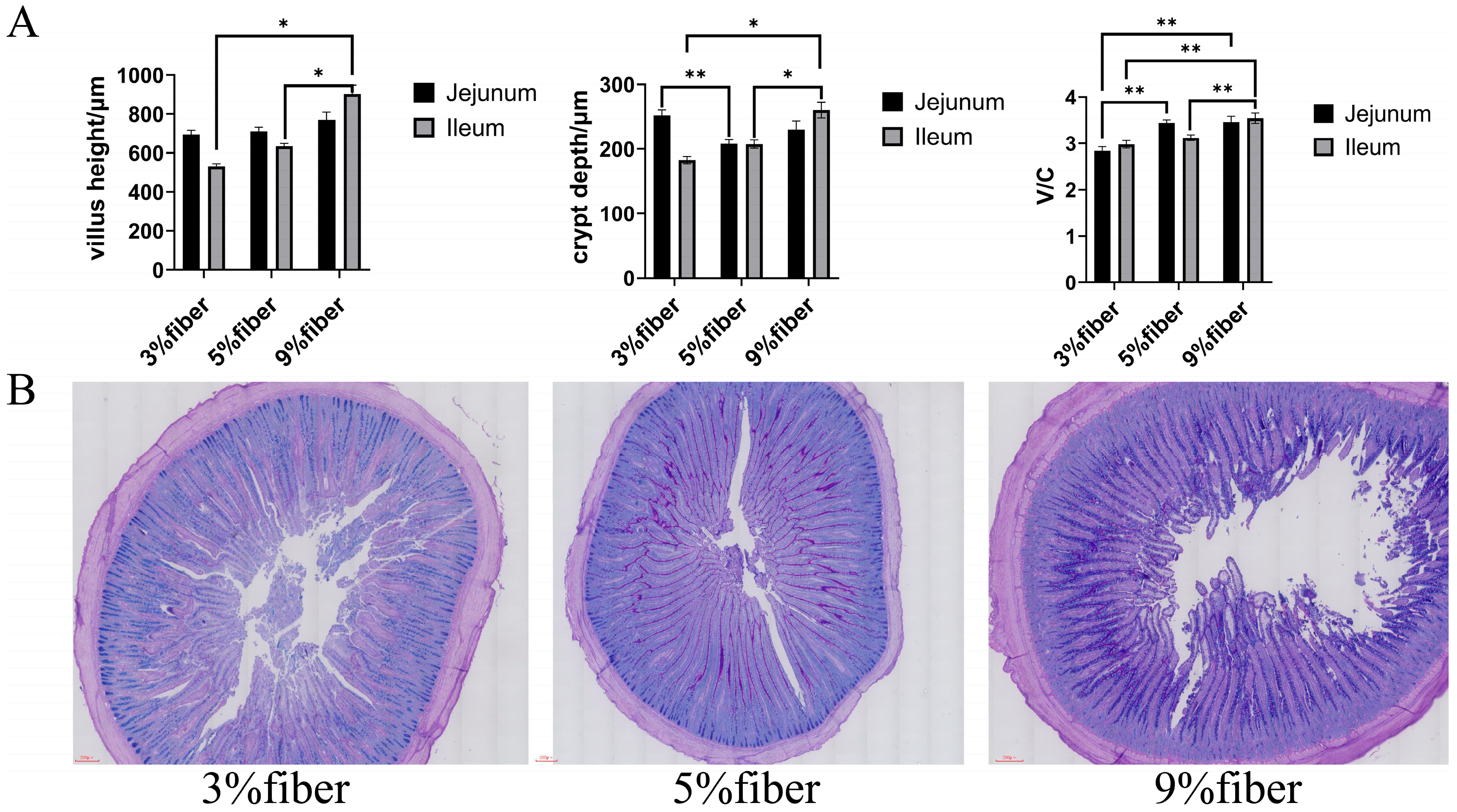
As shown in Figure 1A. Jejunalcrypt in the 3% fiber group was significantly higher than in the 5% fiber group (p < 0.01), accompanied by a markedly lower villus-to-crypt ratio compared with both the 5% and 9% fiber groups (p < 0.01). In the ileum, both the 3% and 5% fiber groups exhibited significantly reduced villus height, crypt depth, and villus-to-crypt ratio relative to the 9% fiber group (p < 0.05 and p < 0.01).
As illustrated in Figure 1B, increasing dietary fiber levels improved jejunal VH and density, and fiber content exerted a pronounced influence on jejunal CD. Specifically, in the Jejunum, the CD in the 9% fiber group (770.30 ± 39.54 μm) was significantly higher compared to the 3% (695.71 ± 21.30 μm) and 5% (710.98 ± 21.91 μm) fiber groups (p < 0.01). The V/C ratio in the 5% (3.44 ± 0.07) and 9% (3.46 ± 0.12) fiber groups was significantly elevated relative to the 3% group (2.84 ± 0.09) (p < 0.01), whereas the CD in the 5% fiber group (208.18 ± 6.10 μm) was significantly reduced compared to the 3% group (251.98 ± 8.35 μm) (p < 0.05). In the ileum, the 9% fiber group exhibited significantly greater VH (903.78 ± 44.73 μm), CD (260.20 ± 12.31 μm), and V/C ratio (3.54 ± 0.11) compared to the 3% (VH: 531.44 ± 13.53 μm; CD: 182.78 ± 5.70 μm; V/C: 2.98 ± 0.08) and 5% (VH: 634.53 ± 13.81 μm; CD: 207.42 ± 6.33 μm; V/C: 3.12 ± 0.06) fiber groups (p < 0.01). Furthermore, histomorphological evaluation of the duodenum was also conducted; however, no significant differences in VH, CD, or the villus-to-crypt ratio were observed among the dietary treatments (Supplementary Table S2).

3.2. Effects of Different Dietary Fiber Levels on the Immune Function of WWG

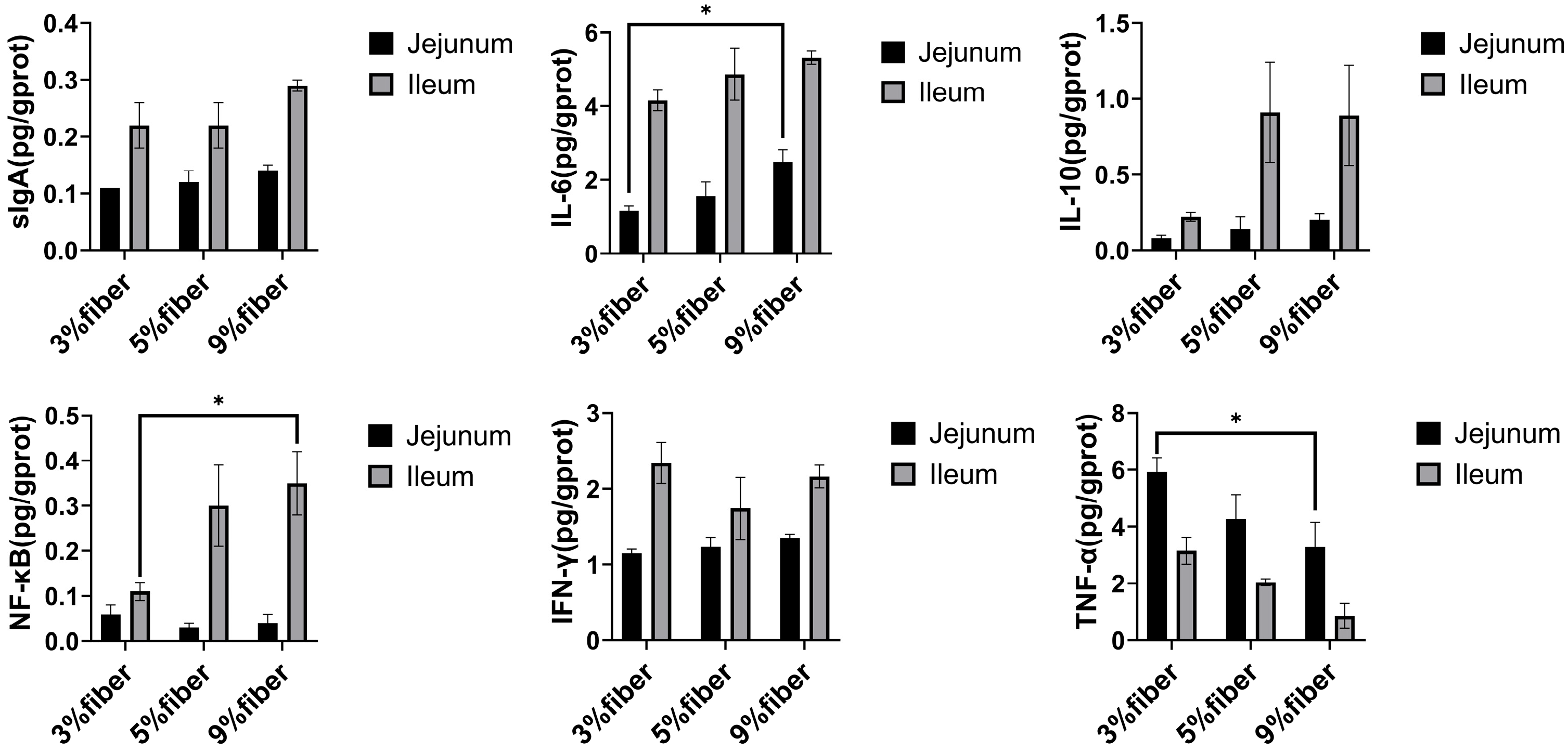
As shown in Figure 2, IL-6 levels in the jejunum were significantly lower in the 3% fiber group than in the 9% fiber group (p < 0.05), whereas TNF-α levels were significantly higher (p < 0.05). In the ileum, the 3% fiber group showed significantly reduced NF-κB levels compared with the 9% fiber group (p < 0.05), indicating a fiber-dependent modulation of local inflammatory responses.

3.3. Effects of Different Dietary Fiber Levels on Intestinal Gene Expression in WWG

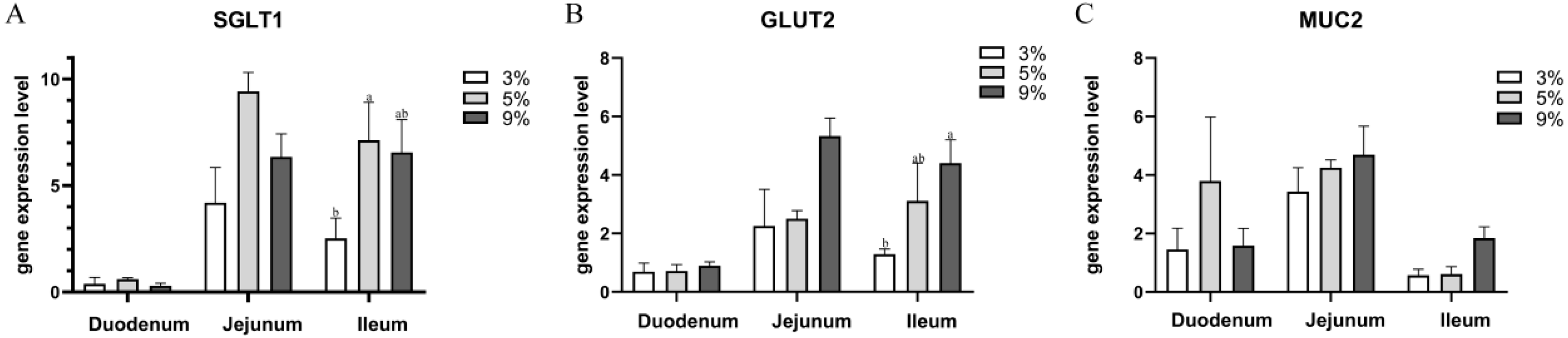
As depicted in Figure 3, ileal SGLT1 expression was significantly regulated in the 5% fiber group compared with the 3% fiber group (p < 0.05), while GLUT2 expression in the 9% fiber group was significantly higher than in the 3% fiber group (p < 0.05). No significant differences were detected in the expression levels of SGLT1 and GLUT2 in the duodenum or jejunum (p > 0.05). MUC2 expression remained consistent across all dietary treatments and intestinal regions (p > 0.05).

3.4. Effects of Different Dietary Fiber Levels on the Microbial Diversity in the Intestinal Content of WWG

A total of 573,473 high-quality sequences were generated, corresponding to approximately 236.94 mega base pair of clean base data. Following de novo assembly and gene prediction, the non-redundant gene catalog was constructed. The average length of the predicted genes in this non-redundant catalog was 412.97 base pair (bp), ranging from 249 to 496 bp (Table S3 of the Supplementary Materials). These metrics confirm the reliability of the sequencing dataset for downstream microbial diversity and functional analyses.
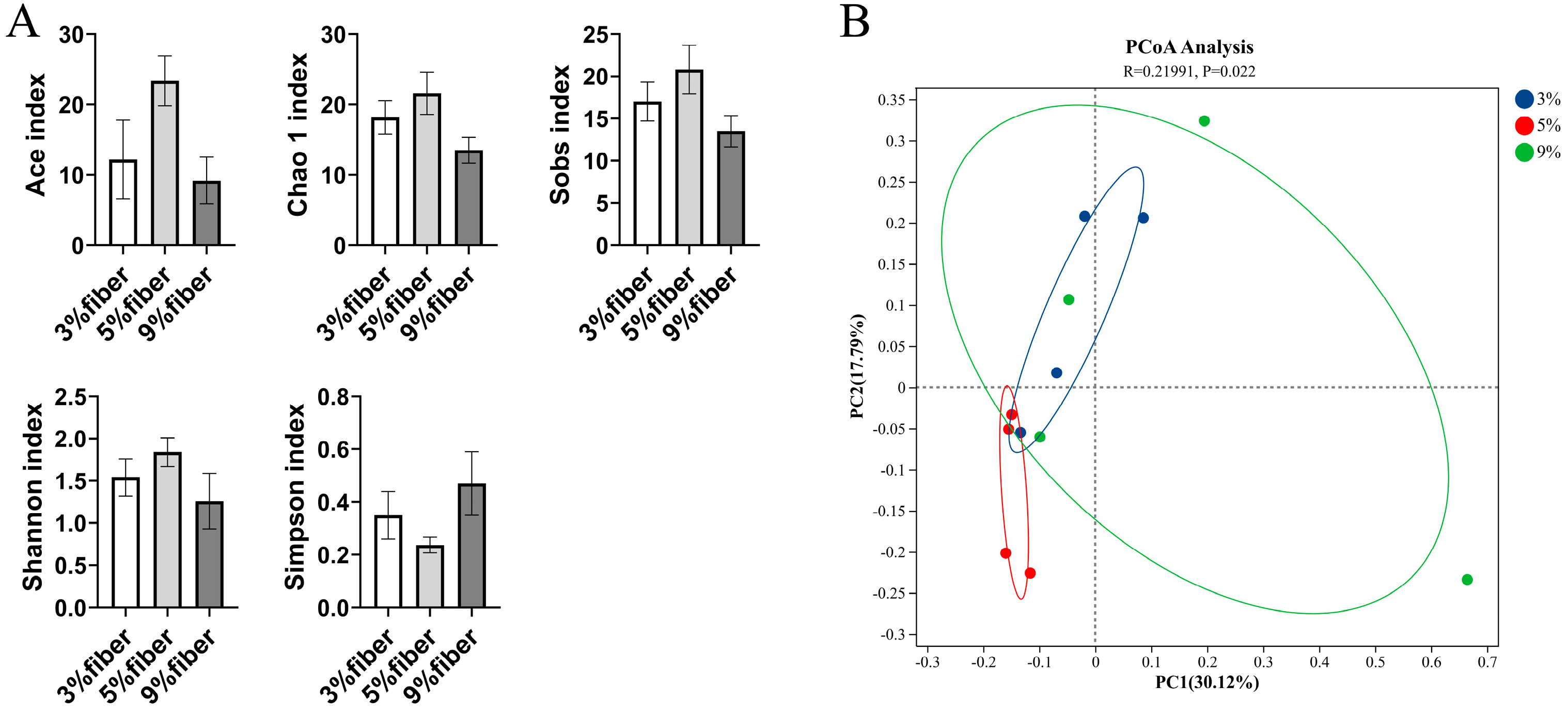
The alpha diversity of the gut microbiota was assessed using the Ace, Chao1, Sobs, Shannon, and Simpson indices. As shown in Figure 4A, the Ace and Chao1 indices exhibited marginal significance (p = 0.05) among the groups, while other indices such as Shannon and Simpson did not differ significantly (p > 0.05). This indicates that while dietary fiber levels had a limited impact on overall microbial evenness, they may have slightly modulated community richness. Furthermore, beta diversity analysis using PCoA based on Bray–Curtis distances (Figure 4B) revealed partial overlap among the treatment groups. However, to quantitatively evaluate the extent of structural divergence, ANOSIM based on Bray–Curtis distances matrix was conducted, which confirmed that the inter-group differences in overall microbial community structure were indeed statistically significant (R = 0.21991, p = 0.022).Therefore, while the lack of complete separation visually indicates that dietary fiber levels did not induce a wholesale restructuring of the overall microbial community, the robust ANOSIM results demonstrate a subtle yet statistically significant modulation of the cecal microbiota composition, primarily driven by shifts in specific taxa rather than divergent community-wide alterations.
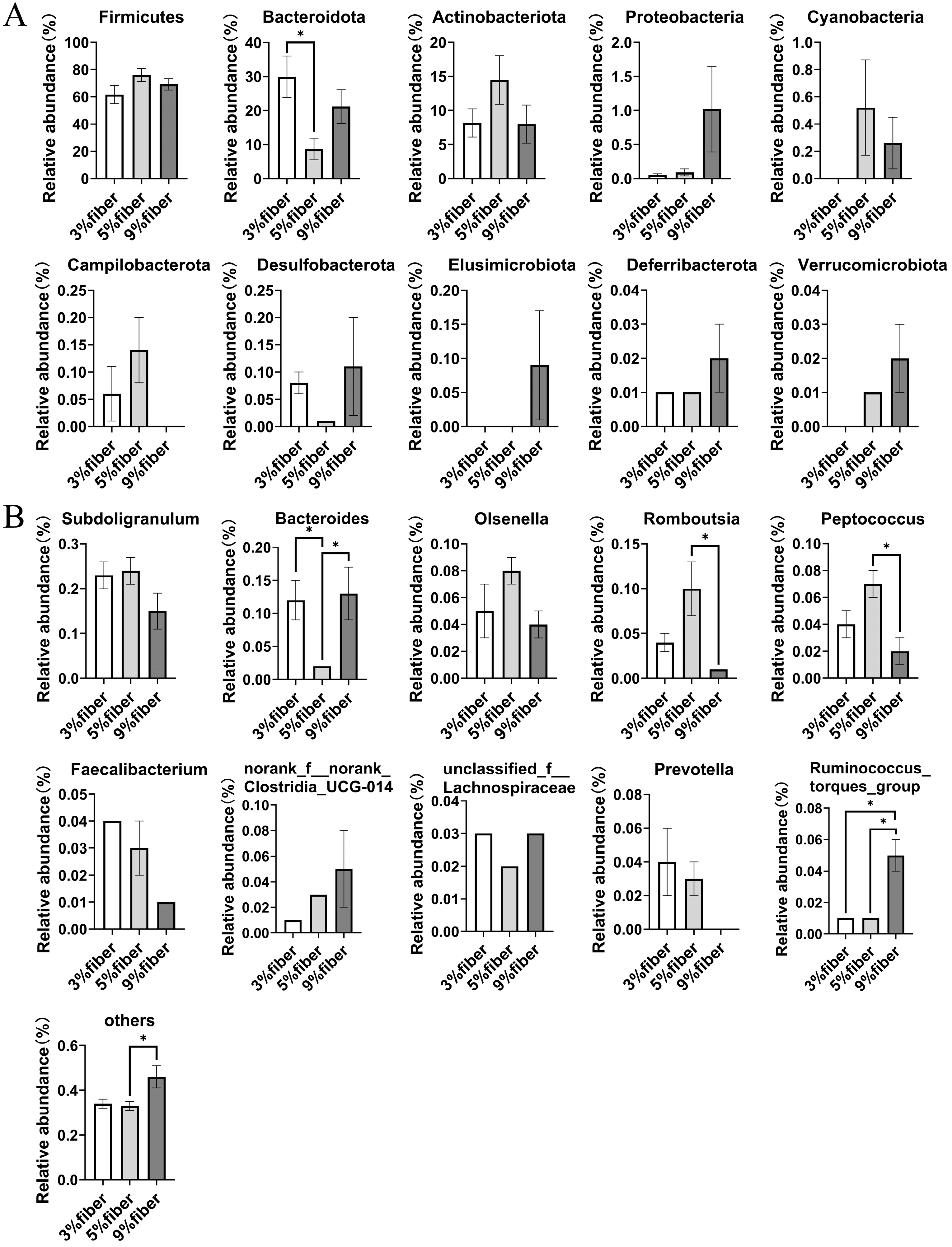
As shown in the community bar plots (Figure S1A) and the intergroup comparison of mean abundances (Figure 5A), the predominant bacterial phyla included Firmicutes, Bacteroidetes, Actinobacteria, Campilobacterota, and Deferribacterota. Notably, the relative abundance of Bacteroidetes in the 3% fiber group was significantly higher than that in the 5% fiber group (p < 0.05). At the genus level (Figure S1B and Figure 5B), Subdoligranulum, Bacteroides, Olsenella, Romboutsia, Peptococcus, and Faecalibacterium were dominant. The relative abundance of Bacteroides was significantly higher in the 3% and 9% fiber groups than in the 5% fiber group (p < 0.05). Romboutsia abundance was significantly greater in the 5% fiber group compared with the 9% fiber group (p < 0.05), and Peptococcus exhibited a similar pattern (p < 0.05).

3.5. Microbial Species Differences in Intestinal Content of WWG Under Different Dietary Fiber Levels

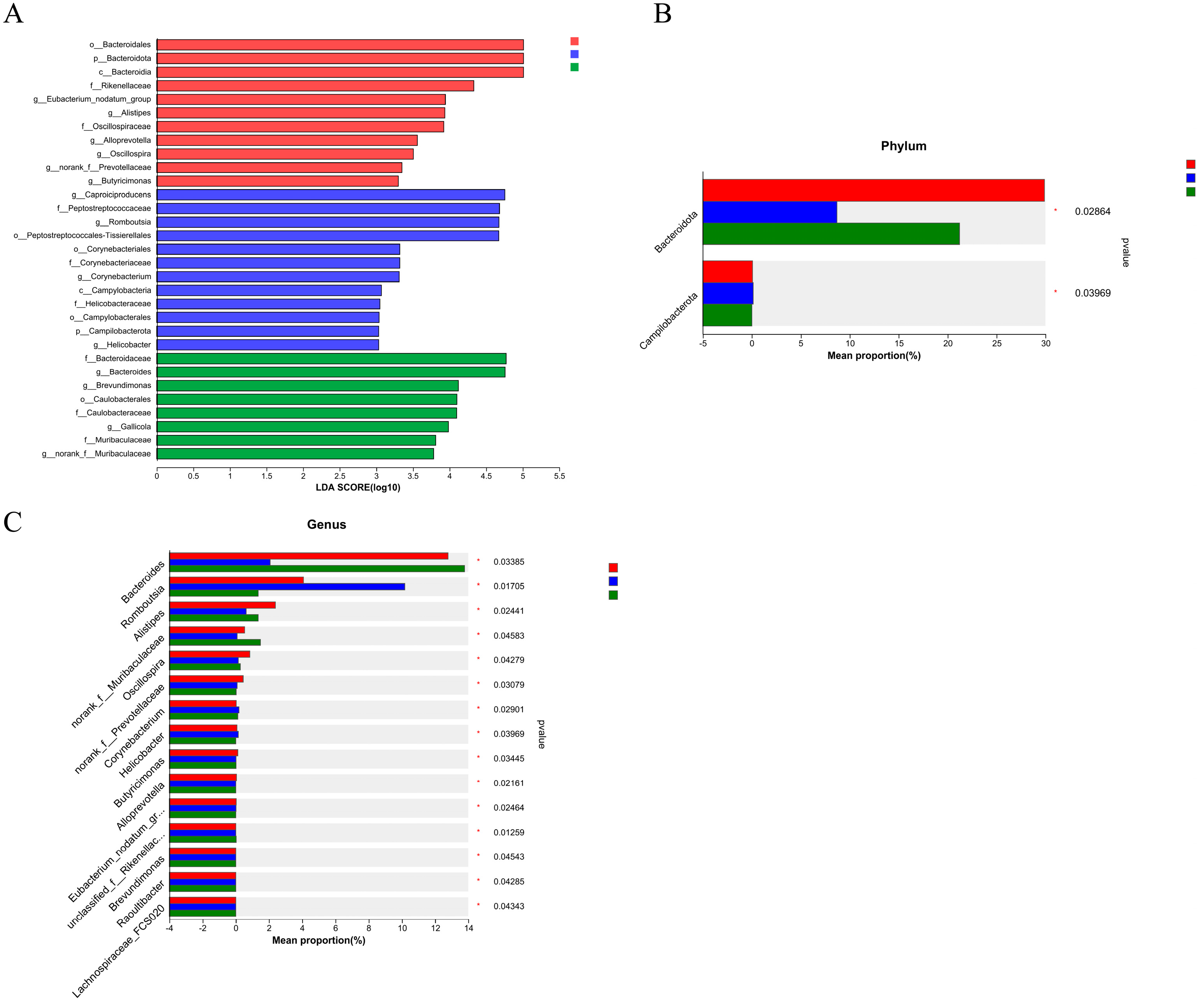
As shown in Figure 6A, a total of 31 differential microbial biomarkers with a LDA score > 2.0 were identified. Bacteroidota was significantly enriched in the 3% fiber group and exhibited the highest LDA score. Caproiciproducens was significantly enriched in the 5% fiber group, whereas Bacteroidaceae was significantly enriched in the 9% fiber group (p < 0.05).
Figure 6B shows that two phyla exhibited significant variation among groups. Bacteroidota abundance in the 3% fiber group was significantly higher than in the 5% fiber group, while Campilobacterota abundance in the 5% fiber group was significantly higher than that in both the 3% and 9% fiber groups (p < 0.05).
Genus-level analysis (Figure 6C) identified Bacteroides, Romboutsia, Alistipes, and norank_f__Muribaculaceae as the primary taxa contributing to microbial differences among fiber levels.

3.6. Metabolomics Analysis

As illustrated in Figures S2 and S3 of the Supplementary Materials. Principal Component Analysis (PCA) and PLS-DA analyses revealed distinct clustering and clear separation of cecal metabolites among the 3%, 5%, and 9% fiber groups in both positive and negative modes. These results indicate substantial metabolic differences among the treatment groups. Permutation tests confirmed the robustness of the PLS-DA models, with Q2 intercepts below 0.05 in both ion modes, demonstrating the absence of overfitting.
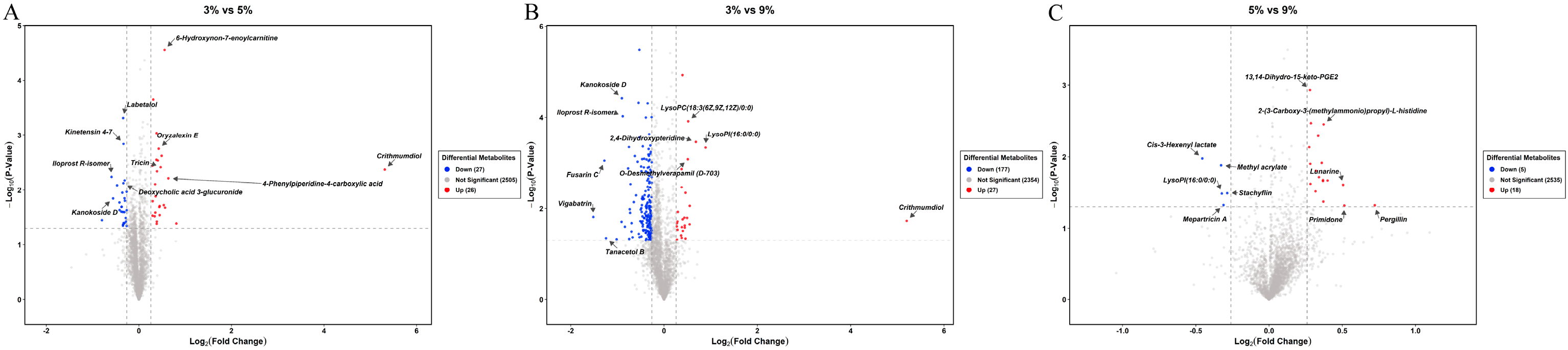
As shown in Figure 7, comparisons of the 3% and 5% fiber groups revealed 137 metabolites in positive ion mode, of which 31 were differentially abundant (13 up-regulated and 18 down-regulated), and 199 metabolites in negative ion mode, with 22 being differentially abundant (13 up-regulated and 9 down-regulated). In the 3% vs. 9% comparison, 645 metabolites were detected in positive mode, with 137 differentially abundant (12 up-regulated and 125 down-regulated), and 588 in negative mode, with 67 differentially abundant (15 up-regulated and 52 down-regulated). For the 5% vs. 9% comparison, 65 metabolites were detected in positive mode, with 15 differentially abundant (12 up-regulated and 3 down-regulated), and 78 metabolites were detected in negative mode, with 8 differentially abundant (6 up-regulated and 2 down-regulated). To provide intuitive biological insights, the exact numbers of these altered metabolites, alongside the specific names of the top candidates exhibiting the most significant changes, have been explicitly annotated in the respective subplots of Figure 7.
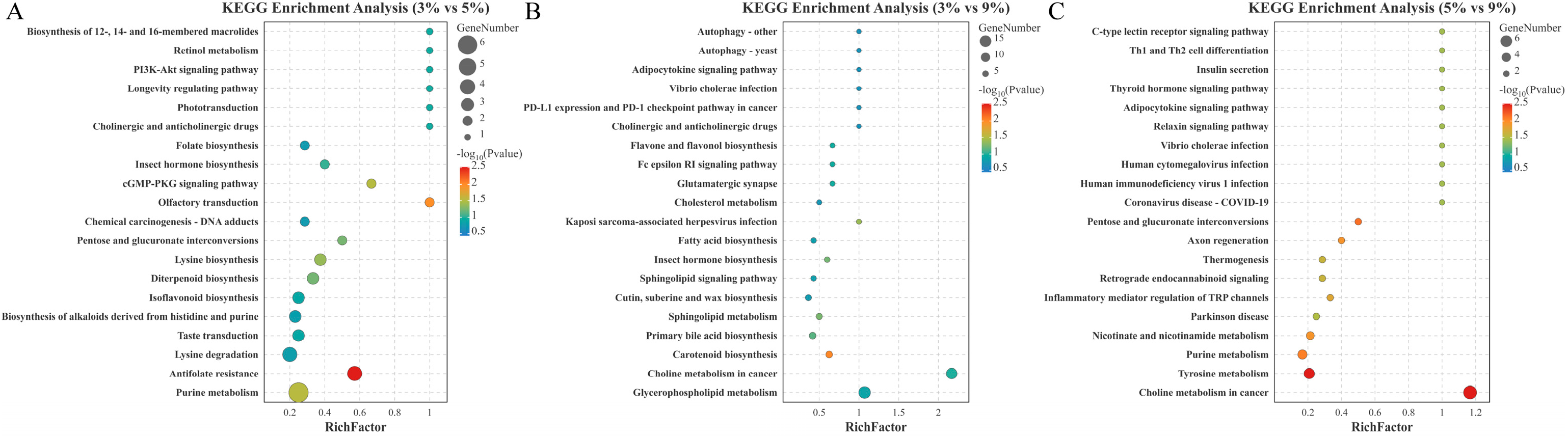
KEGG enrichment analyses (Figure 8) revealed that in the 3% vs. 5% comparison, significantly enriched pathways included lysine biosynthesis, folate biosynthesis, and purine metabolism (p < 0.05). In the 3% vs. 9% comparison, significantly enriched pathways primarily involved glycerophospholipid metabolism, carotenoid biosynthesis, and primary bile acid biosynthesis (p < 0.05). For the 5% vs. 9% comparison, enriched pathways included amino acid metabolism, lipid, and carbohydrate metabolism, as well as riboflavin metabolism (p < 0.05).

3.7. Integrative Analysis of Gut Microbiota and Metabolomics

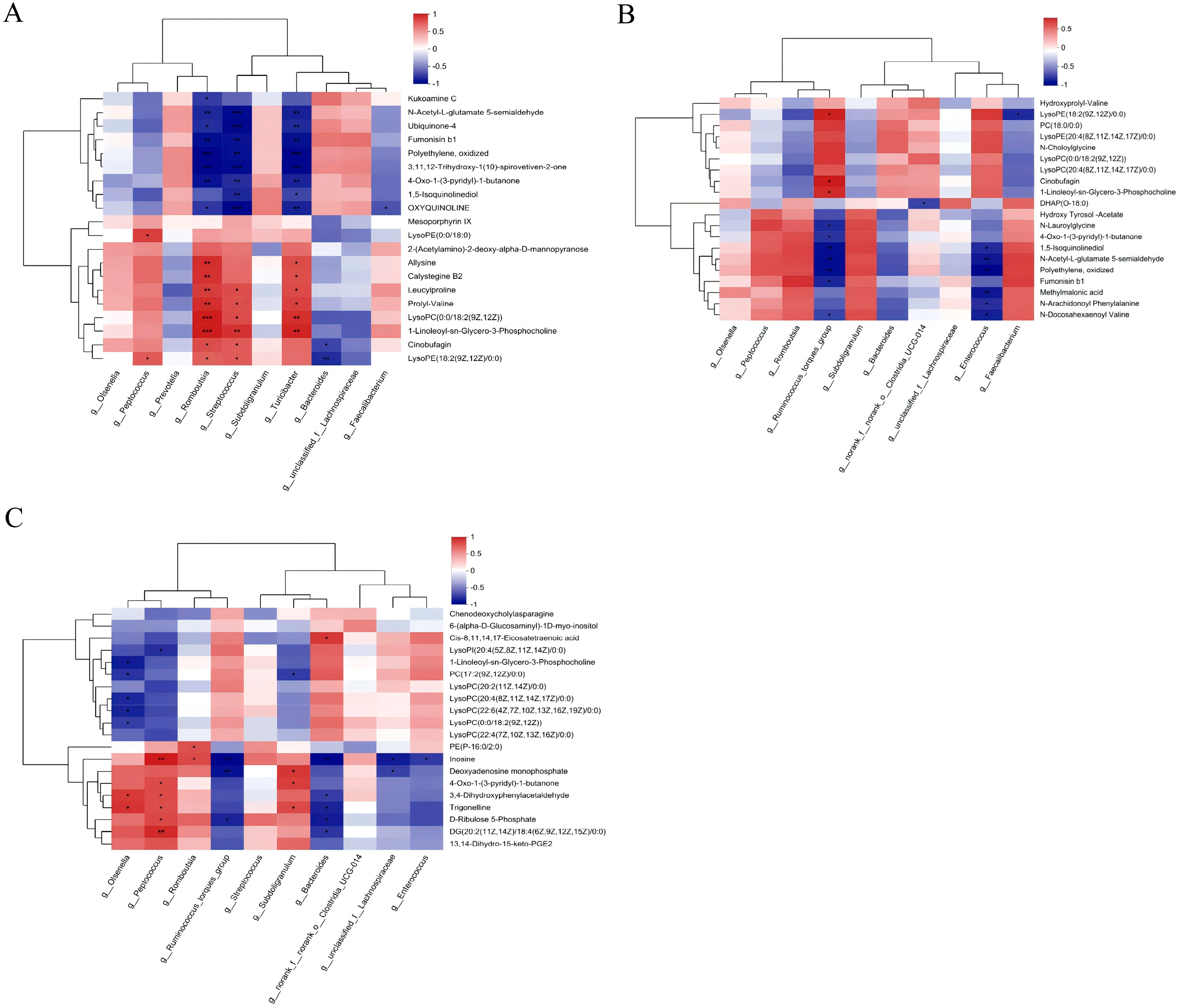
To construct a coherent mechanistic framework linking dietary fiber to gut health, we prioritized the integrative analysis of significant microbe-metabolite correlations within three core biological pathways: lipid metabolism, amino acid (specifically lysine) biosynthesis, and purine metabolism (Figure 9). Alterations in lipid metabolism, which are essential for cellular membrane formation, were closely linked to specific microbial shifts. Notably, Peptococcus and the Ruminococcus_torques_group exhibited significant positive correlations with Lysophosphatidylethanolamine (LysoPE) and cinobufagin (p < 0.05). Conversely, Olsenella and Faecalibacterium showed significant negative correlations with specific lipid species, including 1-linoleoyl-sn-glycero-3-phosphocholine and LysoPE. This coordinated microbial modulation of the lipid pool may provide the necessary structural substrates for the rapid renewal of the intestinal epithelium observed in the high-fiber groups.
Driven by the profound impact of dietary fiber on immune parameters, we focused on amino acid biosynthesis, particularly lysine. Our network analysis revealed that Romboutsia and Turicibacter displayed highly significant positive correlations with lysine (p < 0.05), a critical building block for immune protein synthesis. Streptococcus also demonstrated positive associations with bioactive dipeptides such as leucyl-proline and prolyl-valine. These associations suggest that specific fiber-enriched taxa act as key contributors to the host’s amino acid pool, potentially supporting mucosal defense mechanisms.
Purine metabolism, which is strictly required for nucleic acid synthesis and energy transfer during rapid tissue development, was also significantly modulated. Subdoligranulum showed significant positive correlations with crucial purine intermediates, including inosine, deoxyadenosine monophosphate, and D-ribulose 5-phosphate. In contrast, genera such as Romboutsia, Peptococcus, and the Ruminococcus_torques_group exhibited negative correlations with these purine metabolites. These dynamic microbe-metabolite interactions highlight a complex regulatory network that balances cellular proliferation and energy supply within the developing gastrointestinal tract of brooding geese.

4. Discussion

Dietary fiber supplementation at appropriate levels can reshape the physiological structure and function of the poultry gastrointestinal tract, enhancing nutrient digestion and absorption, and ultimately promoting growth performance [13,14]. Conversely, insufficient fiber intake may induce intestinal atrophy, while excessive intake can cause mucosal abrasion and limit nutrient retention [15,16]. Therefore, determining the optimal dietary fiber levels for WWG is critical. Intestinal morphology is closely linked to absorptive capacity [17]. Furthermore, nutrient uptake relies heavily on intestinal transporters, primarily the glucose transporters SGLT1 and GLUT2 [18,19]. SGLT1 is essential for the active transport of luminal glucose into enterocytes [20,21], while GLUT2 further enhances glucose uptake and cellular transport [22]. In this study, the 9% fiber group exhibited significantly improved villus-to-crypt ratios in both the Jejunum and Ileum compared to the fiber-deficient 3% group. Concurrently, the expression of these key glucose transporters was upregulated in the higher fiber groups. These coordinated improvements suggest that increasing dietary fiber within an appropriate range structurally and functionally fortifies the intestinal absorptive surface during the early brooding period of WWG.
The intestine acts as a crucial immunological barrier protected by epithelial cells and tight junctions [23]. Activation of innate immunity releases pro-inflammatory cytokines (e.g., IL-6 and TNF-α), which can initiate inflammatory responses, disrupt tight junctions, and cause tissue damage [24,25], whereas IL-10 acts as an anti-inflammatory mediator to promote immune homeostasis [26,27]. NF-κB plays a central role in coordinating these responses [28,29,30], and dietary fiber is known to modulate this complex cytokine network [31,32]. Interestingly, our results revealed a differential modulation of intestinal cytokines by dietary fiber. While 9% fiber significantly decreased the potent pro-inflammatory cytokine TNF-α in the jejunum, it concurrently upregulated IL-6 and ileal NF-κB expressions compared to the 3% fiber group. Although IL-6 and NF-κB are traditionally recognized for their pro-inflammatory roles, their interpretation must be contextualized. In the current study, this immunological activation was accompanied by robust intestinal structural integrity (e.g., significantly increased villus height) without histological evidence of inflammatory damage. Therefore, we cautiously postulate that the moderate elevation of IL-6 and NF-κB may not indicate pathological inflammation, but rather reflect a state of physiological immune priming. During the rapid early development of brooding WWG, a basal level of innate immune signaling is often required to drive the maturation of gut-associated lymphoid tissues and to respond adaptively to the intense microbial fermentation stimulated by high dietary fiber. Nevertheless, the boundary between physiological immune maturation and inflammatory stress is subtle. The elevated expression of IL-6 and NF-κB could alternatively reflect a localized physiological stress response induced by the higher mechanical load of the 9% fiber diet. Future studies evaluating a broader panel of cytokines are required to fully elucidate this complex immune–microbiome–fiber crosstalk.
Gut microbial composition also plays a vital role in host metabolism. Firmicutes and Bacteroidetes are the dominant phyla, with Firmicutes enhancing energy harvest and Bacteroidetes contributing to nutrient absorption and ecological balance [33]. An increased abundance of Firmicutes is generally considered beneficial for host health because it enhances energy harvest, whereas a reduced abundance of Bacteroidetes may decrease the risk of pathogenic infections. In this study, Firmicutes, Bacteroidetes, Actinobacteria, and Campilobacterota were identified as the dominantbacterial phyla. At the genus level, the predominant genera included Subdoligranulum, Bacteroides, Olsenella, Romboutsi-a, Peptococcus, and Faecalibacterium. The phylum Firmicutes plays an important role in energy harvest from the diet in poultry, promoting caloric absorption and thereby supporting weight gain [34]. Bacteroidetes possess strong polysaccharide-degrading and fermentative capabilities, enabling the breakdown of dietary polysaccharides into metabolites such as short-chain fatty acids, which provide an additional energy source to the host [35]. The genus Bacteroides contribute substantially to poultry gut function by degrading non-digestible carbohydrates, alleviating inflammatory responses, promoting intestinal cell development, restoring mucosal vitality, and thereby inhibiting the proliferation of pathogenic bacteria [36]. Body fat deposition in animals has been linked to the relative abundance of Firmicutes and Bacteroidetes [37]. The genus Romboutsia primarily utilizes glucose, fructose, and maltose as sole carbon sources [38]. Previous studies have shownthat Romboutsia can effectively inhibit bacterial overgrowthin the duodenum, reduce bacterial translocation to distant organs, ameliorate pancreatitis pathology, and lower plasma levels of pro-inflammatory factors [39]. Furthermore, it can modulate gut microbiota-related metabolites and improve intestinal endothelial function in obese rats by regulating metabolic pathways such as glycerolipid metabolism, lipid catabolism, cholesterol metabolism, and insulin resistance [40]. In this study, the relative abundance of Bacteroidetes at the phylum level in the 3% fiber group was significantly higher than that in the 5% fiber group (p < 0.05). At the genus level, the relative abundance of Bacteroides in both the 3% and 9% fiber groups was significantly higher than that in the 5% fiber group, presenting an intriguing non-linear (U-shaped) response. Bacteroides species are renowned for their extensive repertoire of carbohydrate-active enzymes, granting them powerful polysaccharide-degrading capabilities. In the 9% high-fiber group, the abundant supply of complex dietary polysaccharides serves as an optimal substrate, potentially supporting their beneficial proliferation. Conversely, the elevated abundance of Bacteroides in the severely fiber-deficient 3% group highlights their remarkable metabolic plasticity. We hypothesize that when deprived of dietary glycans, certain Bacteroides species might shift their ecological niche to forage on host-secreted mucin glycoproteins for survival, as has been reported in other animal models [41,42]. While our study did not directly measure goblet cell activity or mucin degradation rates, and MUC2 gene expression remained unaltered across groups (Figure 3C), such putative mucin foraging behavior could theoretically exacerbate mucosal vulnerability. If present, this potential mechanism may help explain why the 3% fiber group exhibited a compromised intestinal architecture (e.g., significantly reduced villus-to-crypt ratio) and altered local inflammatory profiles compared to the high-fiber groups. Conversely, the relative abundance of Romboutsia in the 5% fiber group was significantly higher than that in the 9% fiber group. Similarly, the relative abundance of Peptococcus in the 5% fiber group was significantly higher than that in the 9% fiber group (p < 0.05). These findings indicate that dietary fiber levels modulate the abundance of key bacterial groups, thereby influencing nutrient digestion and absorption efficiency, gut health, and ultimately the growth and development of WWG.
Metabolomics analysis revealed that different dietary fiber levels significantly altered the metabolite profiles in the intestinal content of WWG. PCA and PLS-DA analyses demonstrated distinct clustering and clear separation of intestinal metabolites among the different fiber groups in both positive and negative ion modes, indicating that dietary fiber levels induced substantial metabolic shifts. An exploratory analysis identified several putative differential metabolites between the groups, and these metabolites were enriched in several metabolic pathways. Specifically, in the 3% vs. 5% comparison, differential metabolites were significantly enriched in various biosynthesis pathways and purine metabolism. In the 3% vs. 9% comparison, significant enrichment was observed in biosynthesis pathways, nicotinate and nicotinamide metabolism, amino acid metabolism, and cholesterol metabolism. For the 5% vs. 9% comparison, the differential metabolites were mainlyenriched in amino acid metabolism, nicotinate and nicotinamide metabolism, lipid metabolism, purine metabolism, carbohydrate metabolism, and riboflavin metabolism. A paramount finding of this study, as highlighted in our title, is the profound impact of dietary fiber on microbial lysine biosynthesis. Lysine is widely recognized as the first or second limiting amino acid in poultry nutrition, playing an indispensable role in protein accretion and early developmental growth. Our metabolomics KEGG enrichment analysis revealed a significant upregulation of the lysine biosynthesis pathway when fiber levels were appropriately increased (e.g., in the 3% vs. 5% comparison). Furthermore, our integrative microbiome–metabolome analysis demonstrated that specific genera, notably Romboutsia and Turicibacter, appeared to exhibit strong positive correlations with intestinal lysine concentrations. This suggests a potential mechanism where specific dietary fiber levels enrich targeted microbial populations capable of de novo amino acid synthesis, which may theoretically contribute to the host’s nutritional pool [43,44]. However, direct in vivo validation using isotope tracing is required to definitively quantify this microbial contribution. Crucially, the biological significance of this microbial-derived lysine extends far beyond basic muscle growth; it is a vital metabolic cornerstone for immune homeostasis. Lysine and its downstream metabolites are strictly required for the rapid proliferation of intestinal immune cells (such as lymphocytes) and the active synthesis of functional immune proteins, including immunoglobulins (e.g., sIgA) and cytokines [45,46]. Therefore, we postulate that the association between fiber levels and enhanced microbial lysine biosynthesis may reflect a provision of essential biochemical substrates necessary to support the local immune maturation and mucosal defense mechanisms-such as the physiological upregulation of IL-6 and NF-KB-observed in our study. Changes in lipid metabolism affect energy storage and cell membrane formation, both of which are essential for maintaining cellular function. Purine metabolism is closely linked to nucleic acid synthesis and energy metabolism, and alterations in this pathway may influence cellular proliferation and energy supply. Collectively, these findings suggest that dietary fiber levels modulate multiple metabolic processes in the intestines of WWG, thereby influencing their growth performance.
Crucially, our integrative microbiome–metabolome analysis highlights significant associations between microbial fluctuations and host intestinal phenotypes. While specific metabolites identified in our network possess known biological implications for gut health in existing literature, it is important to note that our current multi-omics approach establishes correlations rather than direct causation. For instance, Peptococcus and the Ruminococcus_torques_group exhibited robust positive correlations with LysoPE. LysoPE is not only a fundamental structural component of cellular membranes but also a bioactive lipid molecule implicated in mucosal anti-inflammatory responses and barrier protection [47]. When contextualized with our morphological data—which demonstrated significantly increased villus heights and villus-to-crypt ratios in the 9% fiber group—the biological significance of this correlation becomes evident. The rapid renewal and massive proliferation of intestinal epithelial cells inherently demand a substantial supply of membrane lipids. We hypothesize that the dynamic interplay between dietary fiber—and potentially the varying dietary lipid sources—and taxa like Peptococcus is associated with the localized accumulation of LysoPE, thereby potentially acting as a crucial metabolic factor that supports rapid epithelial cell proliferation and fortifies the physical mucosal architecture [48]. Concurrently, the modulation of organic acids and structural derivatives by other key genera, such as Romboutsia and Turicibacter, further illustrates a synergistic microbial-metabolic network potentially linked to optimizing gut structural integrity and functional homeostasis [49]. Gut microbiota metabolize dietary fiber and other nutrients to produce diverse metabolites, which in turn influence microbial growth, proliferation, and functional activity. However, this study identified only correlations rather than causal relationships [50]. Specifically, the exact causal role of microbial lysine biosynthesis in mucosal immune maturation remains hypothetical. Further investigations are needed to elucidate the underlying mechanisms, which will provide a stronger theoretical basis for improving gut health in WWG through dietary fiber regulation. Despite the positive effects of the 9% fiber diet on intestinal morphometry, we acknowledge certain limitations in our study. Specifically, while improvements in villus-to-crypt ratios clearly indicate enhanced mucosal architecture and absorptive potential, these morphometric measurements alone are insufficient to definitively conclude an enhancement in overall intestinal barrier function. A comprehensive evaluation of barrier integrity ideally necessitates the assessment of epithelial continuity, goblet cell density, mucus layer quality, inflammatory infiltration, and the localization of tight-junction proteins (e.g., Claudin-1, Occludin, and ZO-1) [51]. Future studies incorporating these precise molecular and cellular parameters are warranted to fully elucidate the exact impact of dietary fiber on the physical and chemical barrier functions in brooding WWG. Furthermore, while the current study provides valuable insights into the microbiome–metabolome axis, the sample size used for high-throughput sequencing (n = 5 per treatment) represents another limitation. Although an n = 5 sample size is widely utilized in exploratory poultry omics research, it limits the overall statistical power and inherently increases the risk of false-positive associations within high-dimensional metagenomic and metabolomic datasets [52]. Consequently, the differential taxa and specific microbe–metabolite correlations identified in this study should be interpreted conservatively as preliminary or putative associations. Future large-scale cohort studies are necessary to rigorously validate these specific microbial shifts and metabolic biomarkers.

5. Conclusions

Appropriate dietary fiber supplementation improved intestinal morphology, enhanced antioxidant and immune function, and shifted microbial composition in WWG during the brooding period. While overall microbial diversity remained unchanged, fiber levels significantly influenced microbial abundance, particularly increasing Bacteroidetes and Actinobacteria, which are associated with fiber degradation and lipid metabolism. Fiber supplementation also altered cecal metabolite profiles, upregulating pathways related to amino acid, lipid, and purine metabolism, thereby supporting intestinal health. Integrated microbiome–metabolite analysis revealed that Romboutsia, Streptococcus, Turicibacter, Ruminococcus_torques_group, Olsenella and Peptococcus were significantly associated with multiple metabolites. Based on the combined morphological, immunological, microbial, and metabolic findings at day 28, the 9% dietary fiber level produced the most favorable outcomes for promoting the growth performance of WWG during the brooding period among the tested diets. While these results highlight the biological benefits of higher fiber inclusion, further studies incorporating a wider range of fiber gradients, multiple developmental stages, and different goose breeds are warranted to determine a universally optimal fiber requirement WWG.

Supplementary Materials

The following supporting information can be downloaded at: https://www.mdpi.com/article/10.3390/ani16111709/s1, Table S1. Primer information for gut-associated genes in geese, Table S2. Effects of Different Dietary Fiber Levels on the Duodenal Morphology of WWG, Table S3. Metagenome sequencing results of intestinal microbial samples of WWG with different fiber levels, Figure S1. Microbial community composition profiles of the cecal contents in WWG across different dietary fiber groups, Figure S2. Total sample PCA analysis. Figure S3. PLS-DA analysis of metabolites of intestinal contents and substitution test.

Author Contributions

Conceptualization, Z.Y., M.R. and S.L.; methodology, Z.Y., M.R. and S.L.; data curation, Z.Y., Y.D. and C.J.; writing—original draft preparation, Z.Y. and F.X.; writing—review and editing, F.X., X.L., A.H.G. and C.J.; project administration, M.R. and S.L.; funding acquisition, S.L.; investigation, Y.D.; resources, X.L.; formal analysis, A.H.G. All authors have read and agreed to the published version of the manuscript.

Funding

This work was supported by grants from the talent introduction project of Anhui Science and Technology University [DKYJ202105], Anhui Province Science and Technology Major Project [17030701004], Local geese gene bank in Anhui Province, Science and Technology Project of Chuzhou City, Anhui Province [2022ZN002], Veterinary Science Peak Discipline Project of Anhui Science and Technology University [XK-XJGF002].

Institutional Review Board Statement

Experiments were performed according to the Regulations for the Administration of Affairs Concerning Experimental Animals and approved by the Animal Research Committee of Anhui Science and Technoloy University (license number 2024-116).

Informed Consent Statement

Not applicable.

Data Availability Statement

The raw data supporting the conclusions of this article will be made available by the authors on request.

Conflicts of Interest

The authors declare no conflicts of interest.

References

  1. Zhou, X.; Wang, L.; Dai, J.; Jia, H.; Shi, K.; Zhao, J.; Chen, S. Dietary fiber-rich Spartina anglica improves intestinal health and antioxidant capacity of Zhedong white geese. Antioxidants 2025, 14, 87. [Google Scholar] [CrossRef] [PubMed]
  2. Ali, Q.; Ma, S.; Farooq, U.; Liu, B.; Wang, Z.; Sun, H.; Cui, Y.; Li, D.; Shi, Y. Chronological dynamics of the gut microbiome in response to the pasture grazing system in geese. Microbiol. Spectr. 2024, 12. [Google Scholar] [CrossRef] [PubMed]
  3. Zhang, F.; Chen, M.; Liu, X.; Ji, X.; Li, S.; Jin, E. New insights into the unfolded protein response (UPR)-anterior gradient 2 (AGR2) pathway in the regulation of intestinal barrier function in weaned piglets. Anim. Nutr. 2023, 15, 225–232. [Google Scholar] [CrossRef] [PubMed]
  4. Lv, Z.; Zhang, Z.; Wang, F.; Guo, J.; Zhao, X.; Zhao, J. Effects of dietary fiber type on growth performance, serum parameters and fecal microbiota composition in weaned and growing-finishing pigs. Animals 2022, 12, 1579. [Google Scholar] [CrossRef]
  5. Jha, R.; Mishra, P. Dietary fiber in poultry nutrition and their effects on nutrient utilization, performance, gut health, and on the environment: A review. J. Anim. Sci. Biotechnol. 2021, 12, 51. [Google Scholar] [CrossRef]
  6. Karimipour, M.; Salari, S.; Aghaei, A. Effects of dietary xylanase supplementation and insoluble fiber on growth performance, cecal microbial population and intestinal histomorphology in broiler chickens fed wheat-based diet. Poult. Sci. 2025, 104, 105749. [Google Scholar] [CrossRef]
  7. Culp, E.J.; Goodman, A.L. Cross-feeding in the gut microbiome: Ecology and mechanisms. Cell Host Microbe 2023, 31, 485–499. [Google Scholar] [CrossRef]
  8. Wu, G.; Xu, T.; Zhao, N.; Lam, Y.Y.; Ding, X.; Wei, D.; Fan, J.; Shi, Y.; Li, X.; Li, M. A core microbiome signature as an indicator of health. Cell 2024, 187, 6550–6565.e6511. [Google Scholar] [CrossRef]
  9. Fu, Y.; Liu, B.; Lei, H.; Lin, Z.; Chen, J.; Zhu, Y.; Ye, H.; Yang, L.; Wang, W. Effects of Dietary Tryptophan on Growth Performance, Plasma Parameters, and Internal Organs of 1–28-Day-Old Sichuan White Geese. J. Poult. Sci. 2023, 60, 2023008. [Google Scholar] [CrossRef]
  10. Cui, Y.; Leng, X.; Zhao, Y.; Zhao, Y.; Wang, Q. Effects of dietary Artemisia annua supplementation on growth performance, antioxidant capacity, immune function, and gut microbiota of geese. Poult. Sci. 2024, 103, 103594. [Google Scholar] [CrossRef]
  11. Leser, T.D.; Mølbak, L. Better living through microbial action: The benefits of the mammalian gastrointestinal microbiota on the host. Environ. Microbiol. 2009, 11, 2194–2206. [Google Scholar] [CrossRef]
  12. Li, M.-H.; Meng, J.-X.; Wang, W.; He, M.; Zhao, Z.-Y.; Ma, N.; Lv, Q.-B.; Qin, Y.-F.; Geng, H.-L.; Zhao, Q. Dynamic description of temporal changes of gut microbiota in broilers. Poult. Sci. 2022, 101, 102037. [Google Scholar] [CrossRef] [PubMed]
  13. Kheravii, S.K.; Swick, R.A.; Choct, M.; Wu, S.-B. Coarse particle inclusion and lignocellulose-rich fiber addition in feed benefit performance and health of broiler chickens. Poult. Sci. 2017, 96, 3272–3281. [Google Scholar] [CrossRef]
  14. Zhang, T.; Liu, Y.; Yan, J.K.; Cai, W. Early downregulation of P-glycoprotein facilitates bacterial attachment to intestinal epithelial cells and thereby triggers barrier dysfunction in a rodent model of total parenteral nutrition. FASEB J. 2020, 34, 4670–4683. [Google Scholar] [CrossRef] [PubMed]
  15. Wu, Y.; Wang, W.; Kim, I.H.; Yang, Y. Dietary hydrolyzed wheat gluten supplementation ameliorated intestinal barrier dysfunctions of broilers challenged with Escherichia coli O78. Poult. Sci. 2022, 101, 101615. [Google Scholar] [CrossRef] [PubMed]
  16. Habibi, M.; Kwakkel, R.; de Vries, S. Nutrient digestibility and digesta mean retention time in laying hens of two different breeds fed with fine vs coarse oat hulls. In Proceedings of the 45th Animal Nutrition Research forum (2023): Bridging Expertise: Advances in Animal Nutrition Through Interdisciplinary Research, Wageningen, The Netherlands, 20 April 2023; p. 15. [Google Scholar]
  17. Shyer, A.E.; Tallinen, T.; Nerurkar, N.L.; Wei, Z.; Gil, E.S.; Kaplan, D.L.; Tabin, C.J.; Mahadevan, L. Villification: How the gut gets its villi. Science 2013, 342, 212–218. [Google Scholar] [CrossRef]
  18. Hu, J.; Lin, S.; Zheng, B.; Cheung, P.C.K. Short-chain fatty acids in control of energy metabolism. Crit. Rev. Food Sci. Nutr. 2018, 58, 1243–1249. [Google Scholar] [CrossRef]
  19. Cruz, E.; Bessières, B.; Magistretti, P.; Alberini, C.M. Differential role of neuronal glucose and PFKFB3 in memory formation during development. Glia 2022, 70, 2207–2231. [Google Scholar] [CrossRef]
  20. Koepsell, H. Glucose transporters in the small intestine in health and disease. PflüGers Arch.-Eur. J. Physiol. 2020, 472, 1207–1248. [Google Scholar] [CrossRef]
  21. Agus, A.; Clément, K.; Sokol, H. Gut microbiota-derived metabolites as central regulators in metabolic disorders. Gut 2021, 70, 1174–1182. [Google Scholar] [CrossRef]
  22. Abbas, Z.; Sammad, A.; Hu, L.; Fang, H.; Xu, Q.; Wang, Y. Glucose Metabolism and Dynamics of Facilitative Glucose Transporters (GLUTs) under the Influence of Heat Stress in Dairy Cattle. Metabolites 2020, 10, 312. [Google Scholar] [CrossRef]
  23. Suzuki, T. Regulation of the intestinal barrier by nutrients: The role of tight junctions. Anim. Sci. J. 2020, 91, e13357. [Google Scholar] [CrossRef] [PubMed]
  24. Meyer, F.; Wendling, D.; Demougeot, C.; Prati, C.; Verhoeven, F. Cytokines and intestinal epithelial permeability: A systematic review. Autoimmun. Rev. 2023, 22, 103331. [Google Scholar] [CrossRef]
  25. Waititu, S.; Yitbarek, A.; Matini, E.; Echeverry, H.; Kiarie, E.; Rodriguez-Lecompte, J.; Nyachoti, C. Effect of supplementing direct-fed microbials on broiler performance, nutrient digestibilities, and immune responses. Poult. Sci. 2014, 93, 625–635. [Google Scholar] [CrossRef]
  26. Mao, Z.-R.; Zhang, S.-L.; Feng, B. Association of IL-10 (-819T/C,-592A/C and-1082A/G) and IL-6-174G/C gene polymorphism and the risk of pneumonia-induced sepsis. Biomarkers 2017, 22, 106–112. [Google Scholar] [CrossRef] [PubMed]
  27. Wang, T.; Ling, H.; Zhang, W.; Zhou, Y.; Li, Y.; Hu, Y.; Peng, N.; Zhao, S. Protease or Clostridium butyricum addition to a low-protein diet improves broiler growth performance. Appl. Microbiol. Biotechnol. 2022, 106, 7917–7931. [Google Scholar] [CrossRef] [PubMed]
  28. Yu, B.; Shen, Y.; Qiao, J.; Cui, Q. Geniposide attenuates Staphylococcus aureus-induced pneumonia in mice by inhibiting NF-κB activation. Microb. Pathog. 2017, 112, 117–121. [Google Scholar] [CrossRef]
  29. Mulero, M.C.; Huxford, T.; Ghosh, G. NF-κB, IκB, and IKK: Integral components of immune system signaling. Struct. Immunol. 2019, 1172, 207–226. [Google Scholar]
  30. Blanchett, S.; Boal-Carvalho, I.; Layzell, S.; Seddon, B. NF-κB and extrinsic cell death pathways–Entwined do-or-die decisions for T cells. Trends Immunol. 2021, 42, 76–88. [Google Scholar] [CrossRef]
  31. Schedle, K.; Pfaffl, M.W.; Plitzner, C.; Meyer, H.H.; Windisch, W. Effect of insoluble fibre on intestinal morphology and mRNA expression pattern of inflammatory, cell cycle and growth marker genes in a piglet model. Arch. Anim. Nutr. 2008, 62, 427–438. [Google Scholar] [CrossRef]
  32. Tlaskalová-Hogenová, H.; Štěpánková, R.; Kozáková, H.; Hudcovic, T.; Vannucci, L.; Tučková, L.; Rossmann, P.; Hrnčíř, T.; Kverka, M.; Zákostelská, Z. The role of gut microbiota (commensal bacteria) and the mucosal barrier in the pathogenesis of inflammatory and autoimmune diseases and cancer: Contribution of germ-free and gnotobiotic animal models of human diseases. Cell. Mol. Immunol. 2011, 8, 110–120. [Google Scholar] [CrossRef]
  33. Stojanov, S.; Berlec, A.; Štrukelj, B. The influence of probiotics on the firmicutes/bacteroidetes ratio in the treatment of obesity and inflammatory bowel disease. Microorganisms 2020, 8, 1715. [Google Scholar] [CrossRef]
  34. Zhang, L.; Jiang, X.; Li, A.; Waqas, M.; Gao, X.; Li, K.; Xie, G.; Zhang, J.; Mehmood, K.; Zhao, S. Characterization of the microbial community structure in intestinal segments of yak (Bos grunniens). Anaerobe 2020, 61, 102115. [Google Scholar] [CrossRef] [PubMed]
  35. Zhang, L.; Li, S.; Zhang, S.; Cai, H.; Fang, W.; Shen, Z. Recovery trajectories of the bacterial community at distances in the receiving river under wastewater treatment plant discharge. J. Environ. Manag. 2023, 326, 116622. [Google Scholar] [CrossRef] [PubMed]
  36. Guo, J.; Wang, P.; Cui, Y.; Hu, X.; Chen, F.; Ma, C. Protective effects of hydroxyphenyl propionic acids on lipid metabolism and gut microbiota in mice fed a high-fat diet. Nutrients 2023, 15, 1043. [Google Scholar] [CrossRef] [PubMed]
  37. Abenavoli, L.; Boccuto, L. Nonalcoholic fatty liver disease in obese adolescents: The role of genetic polymorphisms. Hepatobiliary Surg. Nutr. 2019, 8, 179. [Google Scholar] [CrossRef]
  38. Lee, S.D.; Yang, H.-L.; Han, J.-H.; Kim, I.S. Speluncibacter jeojiensis gen. nov. sp. nov., a novel bacterium of the order Mycobacteriales isolated from a cave and a proposal of Speluncibacteraceae fam. nov. Int. J. Syst. Evol. Microbiol. 2024, 74, 006267. [Google Scholar] [CrossRef]
  39. Zheng, Q.-X.; Jiang, X.-M.; Wang, H.-W.; Ge, L.; Lai, Y.-T.; Jiang, X.-Y.; Chen, F.; Huang, P.-P. Probiotic supplements alleviate gestational diabetes mellitus by restoring the diversity of gut microbiota: A study based on 16S rRNA sequencing. J. Microbiol. 2021, 59, 827–839. [Google Scholar] [CrossRef]
  40. Yin, H.; Huang, J.; Guo, X.; Xia, J.; Hu, M. Romboutsia lituseburensis JCM1404 supplementation ameliorated endothelial function via gut microbiota modulation and lipid metabolisms alterations in obese rats. FEMS Microbiol. Lett. 2023, 370, fnad016. [Google Scholar] [CrossRef]
  41. Desai, M.S.; Seekatz, A.M.; Koropatkin, N.M.; Kamada, N.; Hickey, C.A.; Wolter, M.; Pudlo, N.A.; Kitamoto, S.; Terrapon, N.; Muller, A. A dietary fiber-deprived gut microbiota degrades the colonic mucus barrier and enhances pathogen susceptibility. Cell 2016, 167, 1339–1353.e1321. [Google Scholar] [CrossRef]
  42. Neumann, M.; Steimle, A.; Grant, E.T.; Wolter, M.; Parrish, A.; Willieme, S.; Brenner, D.; Martens, E.C.; Desai, M.S. Deprivation of dietary fiber in specific-pathogen-free mice promotes susceptibility to the intestinal mucosal pathogen Citrobacter rodentium. Gut Microbes 2021, 13, 1966263. [Google Scholar] [CrossRef]
  43. Zhu, Y.; Chen, B.; Zhang, X.; Akbar, M.; Wu, T.; Zhang, Y.; Zhi, L.; Shen, Q. Exploration of the Muribaculaceae family in the gut microbiota: Diversity, metabolism, and function. Nutrients 2024, 16, 2660. [Google Scholar] [CrossRef] [PubMed]
  44. Xu, T.; Wu, X.; Liu, J.; Sun, J.; Wang, X.; Fan, G.; Meng, X.; Zhang, J.; Zhang, Y. The regulatory roles of dietary fibers on host health via gut microbiota-derived short chain fatty acids. Curr. Opin. Pharmacol. 2022, 62, 36–42. [Google Scholar] [CrossRef]
  45. Montout, L.; Poullet, N.; Bambou, J.-C. Systematic review of the interaction between nutrition and immunity in livestock: Effect of dietary supplementation with synthetic amino acids. Animals 2021, 11, 2813. [Google Scholar] [CrossRef] [PubMed]
  46. Chalvon-Demersay, T.; Luise, D.; Le Floc’h, N.; Tesseraud, S.; Lambert, W.; Bosi, P.; Trevisi, P.; Beaumont, M.; Corrent, E. Functional amino acids in pigs and chickens: Implication for gut health. Front. Vet. Sci. 2021, 8, 663727. [Google Scholar] [CrossRef] [PubMed]
  47. Yaginuma, S.; Omi, J.; Uwamizu, A.; Aoki, J. Emerging roles of lysophosphatidylserine as an immune modulator. Immunol. Rev. 2023, 317, 20–29. [Google Scholar] [CrossRef]
  48. Yang, W.; Cong, Y. Gut microbiota-derived metabolites in the regulation of host immune responses and immune-related inflammatory diseases. Cell. Mol. Immunol. 2021, 18, 866–877. [Google Scholar] [CrossRef]
  49. Cong, J.; Zhou, P.; Zhang, R. Intestinal microbiota-derived short chain fatty acids in host health and disease. Nutrients 2022, 14, 1977. [Google Scholar] [CrossRef]
  50. Fischbach, M.A. Microbiome: Focus on causation and mechanism. Cell 2018, 174, 785–790. [Google Scholar] [CrossRef]
  51. Goossens, E.; Dehau, T.; Ducatelle, R.; Van Immerseel, F. Omics technologies in poultry health and productivity—Part 2: Future applications in the poultry industry. Avian Pathol. 2022, 51, 418–423. [Google Scholar] [CrossRef]
  52. Olson, N.D.; Kumar, M.S.; Li, S.; Braccia, D.J.; Hao, S.; Timp, W.; Salit, M.L.; Stine, O.C.; Bravo, H.C. A framework for assessing 16S rRNA marker-gene survey data analysis methods using mixtures. Microbiome 2020, 8, 35. [Google Scholar] [CrossRef]
Figure 1. Effects of Different Dietary Fiber Levels on the Intestinal Morphology of WWG. (A) Effect of different fiber levels on the intestinal tissues of WWG. (B) Representative H&E stained micrographs of the jejunum and ileum from the 3%, 5%, and 9% fiber groups. Relevant histological structures are clearly labeled: V indicates villus, and C indicates crypt. Scale bars = 200 μm; Original magnification: 40×. As visually presented in the panels, increasing the dietary fiber level to 9% significantly enhanced the mucosal structural integrity, evidenced by visibly longer and denser villi compared to the lower fiber groups.* p < 0.05, ** p < 0.01.
Animals 16 01709 g001
Figure 2. Effect of different fiber levels on intestinal immune function of WWG. * p < 0.05.
Animals 16 01709 g002
Figure 3. Effect of different fiber levels on the functional genes of the intestinal tract of WWG. (A) SGLT1; (B) GLUT2; (C) MUC2. Different lowercase letters (a, b, ab) indicate significant differences among groups (p < 0.05).
Animals 16 01709 g003
Figure 4. Effects of Different Dietary Fiber Levels on the Microbial Diversity in the Intestinal Content of WWG. (A) Alpha diversity between groups of WWG at different fiber levels. (B) Beta diversity analysis of cecum bacteria.
Animals 16 01709 g004
Figure 5. Comparison of the relative abundances of dominant gut microbiota among the different dietary fiber groups. (A) Group mean comparisons of the relative abundance of predominant bacteria at the phylum level. (B) Group mean comparisons of the relative abundance of predominant bacteria at the genus level. Data are presented as mean ± SEM. * p < 0.05.
Animals 16 01709 g005
Figure 6. Microbial Species Differences in Intestinal Content of WWG under Different Dietary Fiber Levels. (A) LEfSe analysis of gut bacteria. (B) Analysis of species differences at the level of the cecum bacterial phylum. (C) Analysis of differential bacterial species at the genus level. Color legend: Red = 3% dietary fiber; Blue = 5% dietary fiber; Green = 9% dietary fiber. * denotes the p-value of inter-group difference, and p < 0.05 indicates a statistically significant difference.
Animals 16 01709 g006
Figure 7. Differential metabolite volcano maps combining positive and negative ion modes. (A) Volcano map of differential metabolites between the 3% fiber group and the 5% fiber group; (B) Volcano map of differential metabolites between the 5% fiber group and the 9% fiber group; (C) Volcano map of differential metabolites between the 3% fiber group and the 9% fiber group. Red circles represent up-regulated differential metabolites, blue circles represent down-regulated differential metabolites, and grey circles represent metabolites with no significant change in both positive and negative ion modes.
Animals 16 01709 g007
Figure 8. KEGG pathway enrichment analysis of differential metabolites in the cecal contents of WWG across different dietary fiber groups. (A) 3% vs. 5% fiber group. (B) 3% vs. 9% fiber group. (C) 5% vs. 9% fiber group. The y-axis represents the names of the enriched KEGG pathways, and the x-axis indicates the statistical significance (p-value). The size of each bubble corresponds to the number of differential metabolites annotated to a specific pathway, while the color gradient reflects the significance level.
Animals 16 01709 g008
Figure 9. Spearman correlation heatmap between differential metabolites and gut microbiota at the genus level in the cecal contents of WWG across different dietary fiber groups. (A) 3% vs. 5% fiber group. (B) 3% vs. 9% fiber group. (C) 5% vs. 9% fiber group. The x-axis represents the relative abundance of microbial genera, and the y-axis represents the normalized intensity of the differential metabolites. Red grids indicate positive correlations, while blue grids indicate negative correlations. The intensity of the color corresponds to the magnitude of the Spearman correlation coefficient (r). Significant correlations are marked with asterisks: * p < 0.05, ** p < 0.01, *** p < 0.001.
Animals 16 01709 g009
Table 1. Composition and nutrient levels of basal diets (air-dry basis) %.
Items3% Fiber Group5% Fiber Group9% Fiber Group
Ingredients (%)
Corn53.7845.5125.35
Dehulled soybean meal293032.5
Rice hull powder03.512.5
Wheat bran1415.518.5
Soybean oil02.38
Limestone0.750.750.72
caHPO41.41.371.33
NaCl0.50.50.5
Premix 10.050.050.05
Vitamin premix 20.030.030.03
DL-Met0.210.210.23
L-Thr0.080.080.09
Choline chloride0.20.20.2
Total100100100
Nutrient levels 3
CP/%19.7019.7519.82
EE/%3.052.862.39
ME/(MJ/kg)11.8111.7511.59
CF/%3.525.079.00
IDF/%15.0917.4323.34
SDF/%0.980.900.99
TDF/%16.0718.3324.33
Ca/%0.800.800.80
TP/%0.770.760.75
AP/%0.420.420.42
Lys/%0.981.001.04
Met/%0.500.500.50
(1) The mineral premix provided per kg of diet: Zn 90 mg, Mn 80 mg, Fe 80 mg, Cu 20 mg, I 0.35 mg. (2) The vitamin premix provided per kg of diet: VA 9000 IU, VD3 3000 IU, VE 24 IU, VB6 3 mg, VK3 1.8 mg, VB2 5 mg, VB12 0.1 mg, niacin 40 mg, biotin 0.05 mg, D-pantothenic acid 15 mg. (3) Amino acids, crude fiber, insoluble dietary fiber, soluble dietary fiber, and total dietary fiber are measured values, all others are calculated.
Disclaimer/Publisher’s Note: The statements, opinions and data contained in all publications are solely those of the individual author(s) and contributor(s) and not of MDPI and/or the editor(s). MDPI and/or the editor(s) disclaim responsibility for any injury to people or property resulting from any ideas, methods, instructions or products referred to in the content.