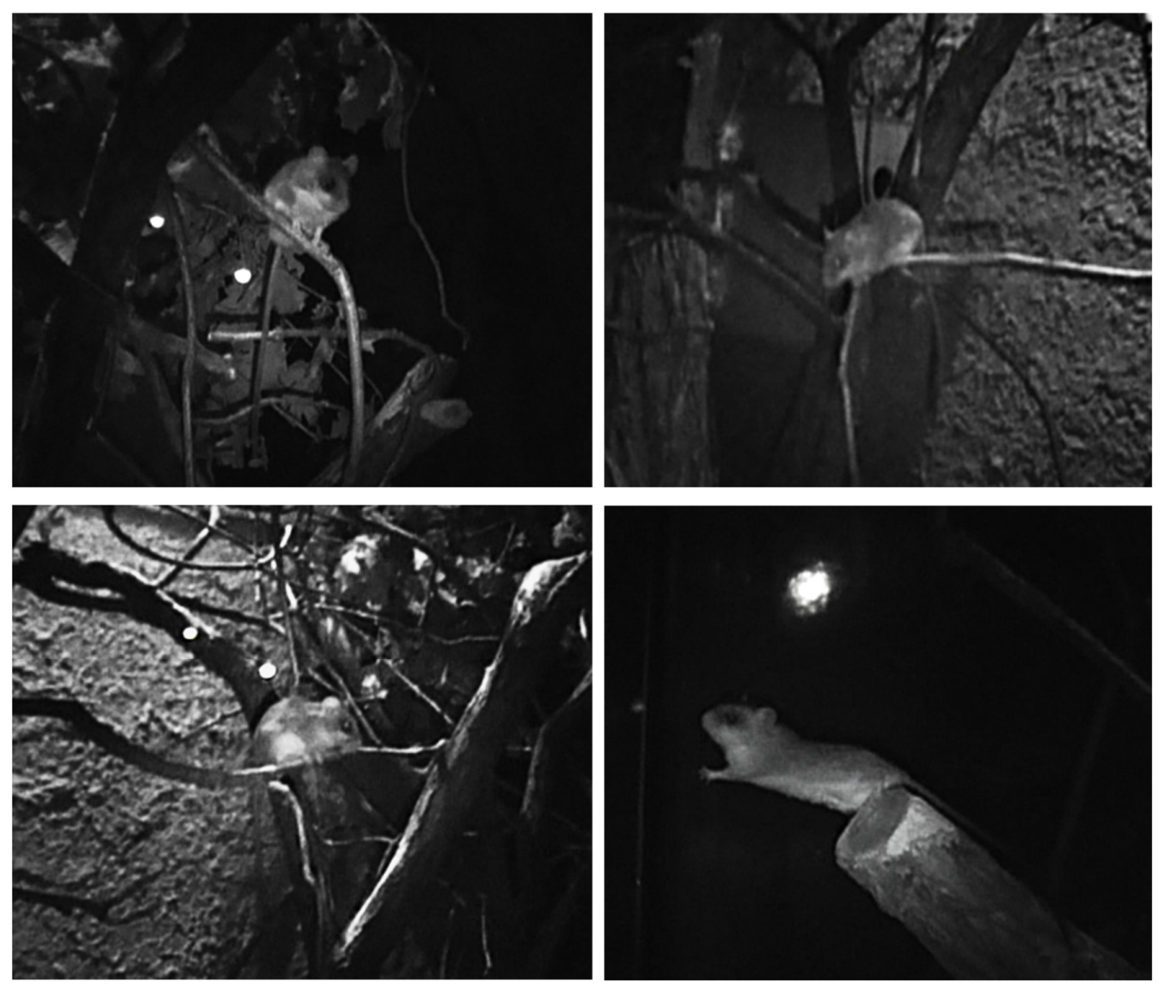
Arboreal Behavior of Captive Acacia Rats Thallomys paedulcus (Rodentia: Muridae)

 ,
,  ,
, 
Simple Summary
Abstract
1. Introduction
2. Materials and Methods
3. Results
3.1. Substrate Type, Size, and Inclination
3.2. Locomotion and Postures
4. Discussion
5. Conclusions
Author Contributions
Funding
Institutional Review Board Statement
Informed Consent Statement
Data Availability Statement
Acknowledgments
Conflicts of Interest
References
- Haines, R.W. Arboreal or terrestrial ancestry of placental mammals. Q. Rev. Biol. 1958, 33, 1–23. [Google Scholar] [CrossRef]
- Cartmill, M. Pads and claws in arboreal locomotion. In Primate Locomotion: 45–83; Jenkins, F.A., Jr., Ed.; Academic Press: New York, NY, USA, 1974. [Google Scholar]
- Jenkins, F.A., Jr. (Ed.) Tree shrew locomotion and the origins of primate arborealism. In Primate Locomotion: 85–116; Academic Press: New York, NY, USA, 1974. [Google Scholar]
- Ji, Q.; Luo, Z.-X.; Yuan, C.-X.; Wible, J.R.; Zhang, J.-P.; Georgi, J.A. The earliest known eutherian mammal. Nature 2002, 416, 816–822. [Google Scholar] [CrossRef]
- Meng, J.; Hu, Y.; Wang, Y.; Wang, X.; Li, C. A Mesozoic gliding mammal from northeastern China. Nature 2006, 444, 889–893. [Google Scholar] [CrossRef]
- Meng, Q.-J.; Ji, Q.; Zhang, Y.-G.; Liu, D.; Grossnickle, D.M.; Luo, Z. An arboreal docodont from the Jurassic and mammaliaform ecological diversification. Science 2015, 347, 764–768. [Google Scholar] [CrossRef]
- Szalay, F.S. Ancestral locomotor modes, placental mammals, and the origin of Euprimates: Lessons from history. In Primate Origins: Adaptations and Evolution: 457–487; Ravosa, M.J., Dagosto, M., Eds.; Springer: Boston, MA, USA, 2007. [Google Scholar]
- Gaetano, L.C.; Rougier, G.W. New materials of Argentoconodon fariasorum (Mammaliaformes, Triconodontidae) from the Jurassic of Argentina and its bearing on triconodont phylogeny. J. Vertebr. Paleontol. 2011, 31, 829–843. [Google Scholar] [CrossRef]
- Goswami, A.; Prasad, G.V.R.; Upchurch, P.; Boyer, D.M.; Seiffert, E.R.; Verma, O.; Gheerbrant, E.; Flynn, J.J. A radiation of arboreal basal eutherian mammals beginning in the Late Cretaceous of India. Proc. Natl. Acad. Sci. USA 2011, 108, 16333–16338. [Google Scholar] [CrossRef]
- Luo, Z.-X.; Yuan, C.-X.; Meng, Q.-J.; Ji, Q. A Jurassic eutherian mammal and divergence of marsupials and placentals. Nature 2011, 476, 442–445. [Google Scholar] [CrossRef]
- Zheng, X.; Bi, S.; Wang, X.; Meng, J. A new arboreal haramiyid shows the diversity of crown mammals in the Jurassic period. Nature 2013, 500, 199–202. [Google Scholar] [CrossRef]
- Bi, S.; Wang, Y.; Guan, J.; Sheng, X.; Meng, J. Three new Jurassic euharamiyidan species reinforce early divergence of mammals. Nature 2014, 514, 579–584. [Google Scholar] [CrossRef]
- Williamson, T.E.; Brusatte, S.L.; Wilson, G.P. The origin and early evolution of metatherian mammals: The Cretaceous record. Zookeys 2014, 465, 1–76. [Google Scholar] [CrossRef]
- Krattli, H. Struktur und Funktion des Extremitäteninteguments bei Einheimischen Mäuseartigen (Muridae, Rodentia). Ph.D. Dissertation, University of Zurich, Zurich, Switzerland, 2001. [Google Scholar]
- Zefferer, M. Adaptation des terminalen Zehengliedes an die Fortbewegung bei Kleinsaugern (Mammalia). Bachelor’s Thesis, Zoologisches Museum der Universität Zurich, Zurich, Switzerland, 2002. [Google Scholar]
- Samuels, J.X.; Van Valkenburgh, B. Skeletal indicators of locomotor adaptations in living and extinct rodents. J. Morphol. 2008, 269, 1387–1411. [Google Scholar] [CrossRef]
- Earl, Z.; Nel, J.A.J. Climbing behavior in three African rodent species. Zool. Afr. 1976, 11, 183–192. [Google Scholar]
- De Graaff, G. Notes on the Southern African black-tailed tree rat Thallomys paedulcus (Sundevall, 1846) and its occurrence in the Kalahari Gemsbok National Park. Koedoe 1978, 21, 181–190. [Google Scholar] [CrossRef]
- Montgomery, W.I. The use of arboreal runways by the woodland rodents, Apodemus sylvaticus (L.), A. flavicollis (Melchior) and Clethrionomys glareolus (Schreber). Mamm. Rev. 1980, 10, 189–195. [Google Scholar] [CrossRef]
- Murúa, R.; González, L.A. Microhabitat selection in two Chilean cricetid rodents. Oecologia 1982, 52, 12–15. [Google Scholar] [CrossRef]
- Kingdon, J. East African Mammals: An Atlas of Evolution in Africa; University of Chicago Press: Chicago, IL, USA, 1984. [Google Scholar]
- Ylönen, H. Spatial avoidance between the bank vole Clethrionomys minutus and the harvest mouse Micromys minutus: An experimental study. Ann. Zool. Fenn. 1990, 27, 313–320. [Google Scholar]
- Jędrzejewski, W.; Rychlik, L.; Jędrzejewska, B. Responses of bank voles to odours of seven species of predators: Experimental data and their relevance to natural predator-vole relationships. Oikos 1993, 68, 251. [Google Scholar] [CrossRef]
- Wagner, D.M.; Feldhamer, G.A.; Newman, J.A. Microhabitat selection by golden mice (Ochrotomys nuttalli) at arboreal nest sites. Am. Midl. Nat. 2000, 144, 220–225. [Google Scholar] [CrossRef]
- Juškaitis, R. Spatial distribution of the yellow-necked mouse (Apodemus flavicollis) in large forest areas and its relation with seed crop of forest trees. Mamm. Biol.-Z. für Säugetierkd. 2002, 67, 206–211. [Google Scholar] [CrossRef]
- Buesching, C.D.; Newman, C.; Twell, R.; Macdonald, D.W. Reasons for arboreality in wood mice Apodemus sylvaticus and bank voles Myodes glareolus. Mamm. Biol.-Z. für Säugetierkd. 2008, 73, 318–324. [Google Scholar] [CrossRef]
- Czeszczewik, D.C.; Walankiewicz, W.W.; Stańska, M.S. Small mammals in nests of cavity-nesting birds: Why should ornithologists study rodents? Can. J. Zool. 2008, 86, 286–293. [Google Scholar]
- Dickman, C.R.; Doncaster, C.P. Responses of small mammals to red fox (Vulpes vulpes) odour. J. Zool. Lond. 2009, 204, 521–531. [Google Scholar]
- Nations, J.A.; Heaney, L.R.; Demos, T.C.; Achmadi, A.S.; Rowe, K.C.; Esselstyn, J.A. A simple skeletal measurement effectively predicts climbing behaviour in a diverse clade of small mammals. Biol. J. Linn. Soc. 2019, 128, 323–336. [Google Scholar] [CrossRef]
- Hildebrand, M. Analysis of Vertebrate Structure, 4th ed.; John Wiley & Sons, Inc.: New York, NY, USA, 1995. [Google Scholar]
- Essner, R.L. Locomotion, morphology, and habitat use in arboreal squirrels (Rodentia: Sciuridae). Ph.D. Dissertation, Ohio University, Athens, OH, USA, 2003. [Google Scholar]
- Delciellos, A.C.; Vieira, M.V. Arboreal walking performance in seven didelphid marsupials as an aspect of their fundamental niche. Austral Ecol. 2006, 31, 449–457. [Google Scholar] [CrossRef]
- Lammers, A.R. Locomotor kinetics on sloped arboreal and terrestrial substrates in a small quadrupedal mammal. Zoology 2007, 110, 93–103. [Google Scholar] [CrossRef]
- Schmidt, A.; Fischer, M.S. The kinematic consequences of locomotion on sloped arboreal substrates in a generalized (Rattus norvegicus) and a specialized (Sciurus vulgaris) rodent. J. Exp. Biol. 2011, 214, 2544–2559. [Google Scholar] [CrossRef]
- Camargo, N.F.; Ribeiro, J.F.; Gurgel-Gonçalves, R.; Palma, A.R.T.; Mendonça, A.F.; Vieira, E.M. Is footprint shape a good predictor of arboreality in sigmondontine rodents from a neotropical savanna? Acta Theriol. 2012, 57, 261–267. [Google Scholar]
- Camargo, N.F.; Sano, N.Y.; Ribeiro, J.F.; Vieira, E.M. Contrasting the realized and fundamental niche of the arboreal walking performance of neotropical rodents. J. Mammal. 2016, 97, 155–166. [Google Scholar]
- Youlatos, D.; Karantanis, N.E.; Byron, C.D.; Panyutina, A. Pedal grasping in an arboreal rodent relates to above-branch behavior on slender substrates. J. Zool. 2015, 296, 239–248. [Google Scholar] [CrossRef]
- Mills, M.; Hes, L. The Complete Book of Southern African Mammals; Struik Book Distributors: Cape Town, South Africa, 1997. [Google Scholar]
- Eccard, J.A.; Meyer, J.; Sundell, J. Space use, circadian activity pattern, and mating system in the nocturnal tree rat Thallomys nigricauda. J. Mammal. 2004, 85, 440–445. [Google Scholar] [CrossRef][Green Version]
- Welton, N. Rats, Mice, and Relatives III: Old World Rats and Mice (Murinae). In Grzimek’s Animal Life Encyclopedia, 2nd ed.; Hutchins, M., Evans, A.V., Jackson, J.A., Kleiman, D.G., Murphy, J.B., Thoney, D.A., Eds.; Gale/Cengage Learning: Detroit, MI, USA, 2004; Volume 16, pp. 249–262. [Google Scholar]
- Skinner, J.; Chimimba, C. The Mammals of South Africa Subregion; Cambridge University Press: Cambridge, UK, 2005. [Google Scholar]
- Monadjem, A.R.A. Geographic distribution patterns of small mammals in Swaziland in relation to abiotic factors and human land-use activity. Biodivers. Conserv. 1999, 8, 223–237. [Google Scholar] [CrossRef]
- Taylor, P.; Boitani, L. Thallomys paedulcus [WWW Document]. IUCN Red List Threat. Species 2008. Available online: https://www.iucnredlist.org/species/21692/9309064 (accessed on 12 March 2026). [CrossRef]
- Hanney, P. The Muridae of Malawi (Africa: Nyasaland). J. Zool. Lond. 1965, 146, 577–633. [Google Scholar] [CrossRef]
- Delany, M.J. The ecology of small rodents in tropical Africa. Mammal Rev. 1972, 2, 1–42. [Google Scholar] [CrossRef]
- Smithers, R.H.N. The Mammals of the Southern African Subregion; University of Pretoria: Pretoria, South Africa, 1983. [Google Scholar]
- Dean, W.R.J.; Milton, S.J.; Jeltsch, F. Large trees, fertile islands, and birds in arid savanna. J. Arid Environ. 1999, 41, 61–78. [Google Scholar] [CrossRef]
- Eccard, J.A.; Dean, W.R.J.; Wichmann, M.C.; Huttunen, S.M.; Eskelinen, E.; Moloney, K.A.; Jeltsch, F. Use of large Acacia trees by the cavity dwelling Black-tailed Tree Rat in the Southern Kalahari. J. Arid Environ. 2006, 64, 604–615. [Google Scholar] [CrossRef]
- Reed, D.N. Micromammals Paleoecology: Past and Present Relationships between African Small Mammals and Their Habitats; SUNY: Albany, NY, USA, 2003. [Google Scholar]
- Karantanis, N.-E.; Rychlik, L.; Herrel, A.; Youlatos, D. Arboreality in acacia rats (Thallomys paedulcus; Rodentia, Muridae): Gaits and gait metrics. J. Zool. Lond. 2017, 303, 107–119. [Google Scholar] [CrossRef]
- Urbani, B.; Youlatos, D. Positional behavior and substrate use of Micromys minutus (Rodentia: Muridae): Insights for understanding primate origins. J. Hum. Evol. 2013, 64, 130–136. [Google Scholar] [CrossRef]
- Witte, H.; Preuschoft, H.; Fischer, M.S. The importance of the evolutionary heritage of locomotion on flat ground in small mammals for the development of arboreality. Z. Morphol. Anthropol. 2002, 83, 221–233. [Google Scholar] [CrossRef]
- Youlatos, D.; Samaras, A. Arboreal locomotor and postural behaviour of European red squirrels (Sciurus vulgaris L.) in northern Greece. J. Ethol. 2011, 29, 235–242. [Google Scholar] [CrossRef]
- Association for the Study of Animal Behaviour/Animal Behavior Society. Guidelines for the treatment of animals in behavioural research and teaching. Anim. Behav. 2012, 83, 301–309. [Google Scholar] [CrossRef]
- Martin, P.; Bateson, P. Measuring Behaviour: An Introductory Guide; Cambridge University Press: Cambridge, UK, 1993. [Google Scholar]
- Dawkins, M.S. Observing Animal Behaviour; Oxford University Press: Oxford, UK, 2007. [Google Scholar]
- Youlatos, D.; Panyutina, A.; Tsinoglou, M.; Volodin, I. Locomotion and postures of the Vietnamese pygmy dormouse Typhlomys chapensis (Platacanthomyidae, Rodentia): Climbing and leaping in the blind. Mamm. Biol. 2020, 100, 485–497. [Google Scholar] [CrossRef]
- Karantanis, N.-E.; Youlatos, D.; Rychlik, L. Diagonal gaits in the feathertail glider Acrobates pygmaeus (Acrobatidae, Diprotodontia): Insights for the evolution of primate quadrupedalism. J. Hum. Evol. 2015, 86, 43–54. [Google Scholar] [CrossRef]
- Schmidt, A.; Fischer, M.S. Arboreal locomotion in rats—The challenge of maintaining stability. J. Exp. Biol. 2010, 213, 3615–3624. [Google Scholar] [CrossRef]
- Karantanis, N.-E.; Rychlik, L.; Herrel, A.; Youlatos, D. Vertical locomotion in Micromys minutus (Rodentia: Muridae): Insights into the evolution of eutherian climbing. J. Mamm. Evol. 2018, 25, 277–289. [Google Scholar] [CrossRef]
- Nations, J.A.; Olson, L.E. Climbing behavior of northern red-backed voles (Myodes rutilus) and scansoriality in Myodes (Rodentia, Cricetidae). J. Mammal. 2015, 96, 957–963. [Google Scholar] [CrossRef]
- Youlatos, D. Hallucal grasping behaviour in Caluromys (Didelphimorphia: Didelphidae): Implications for primate pedal grasping. J. Hum. Evol. 2008, 55, 1096–1101. [Google Scholar] [CrossRef]
- Hamidi, K.; Matin, M.M.; Pérez, M.J.; Kilpatrick, C.W.; Darvish, J. Postcranial skeleton of Goodwin’s brush-tailed mouse (Calomyscus elburzensis Goodwin, 1939) (Rodentia: Calomyscidae): Shape, size, function, and locomotor adaptation. J. Exp. Zool. Part A Ecol. Integr. Physiol. 2023, 339, 1059–1101. [Google Scholar] [CrossRef]
- Hedrick, B.P.; Dickson, B.V.; Dumont, E.R.; Pierce, S.E. The evolutionary diversity of locomotor innovation in rodents is not linked to proximal limb morphology. Sci. Rep. 2020, 10, 717. [Google Scholar] [CrossRef]
- Carvalho Coutinho, L.; Alves de Oliveira, J. Relating appendicular skeletal variation of sigmodontine rodents to locomotion modes in a phylogenetic context. J. Anat. 2017, 231, 543–567. [Google Scholar] [CrossRef]
- Weaver, L.N.; Grossnickle, D.M. Functional diversity of small-mammal postcrania is linked to both substrate preference and body size. Curr. Zool. 2020, 66, 539–553. [Google Scholar] [CrossRef]
- Carrizo, L.V.; Tulli, M.J.; Dos Santos, D.A.; Abdala, V. Interplay between postcranial morphology and locomotor types in Neotropical sigmodontine rodents. J. Anat. 2014, 224, 469–481. [Google Scholar] [CrossRef]
- Linzey, A.V.; Kesner, M.H. Small mammals of a woodland-savannah ecosystem in Zimbabwe. I. Density and habitat occupancy patterns. J. Zool. 1997, 243, 137–152. [Google Scholar] [CrossRef]
- Howe, H.F.; Smallwood, J. Ecology of seed dispersal. Annu. Rev. Ecol. Syst. 1982, 13, 201–228. [Google Scholar] [CrossRef]
- Lindenmayer, D.; Fischer, J. Habitat Fragmentation and Landscape Change: An Ecological and Conservation Synthesis; Island Press: Washington, DC, USA, 2006. [Google Scholar]



| Substrate type | |
| Branch | Tree branches of different diameters |
| Artificial | Nest box, hanging feeders, window glass, metallic bars, wire mesh |
| Ground | Bedding of enclosure floor |
| Substrate size | |
| Small | Substrate fully grasped by foot |
| Medium | Substrate partly grasped by foot |
| Large | Substrate cannot be grasped by foot |
| Substrate inclination | |
| Horizontal | Angle between 0 and 22.5° |
| Oblique | Angle between 22.5 and 67.5° |
| Vertical | Angle between 67.5 and 90° |
| Locomotor modes | |
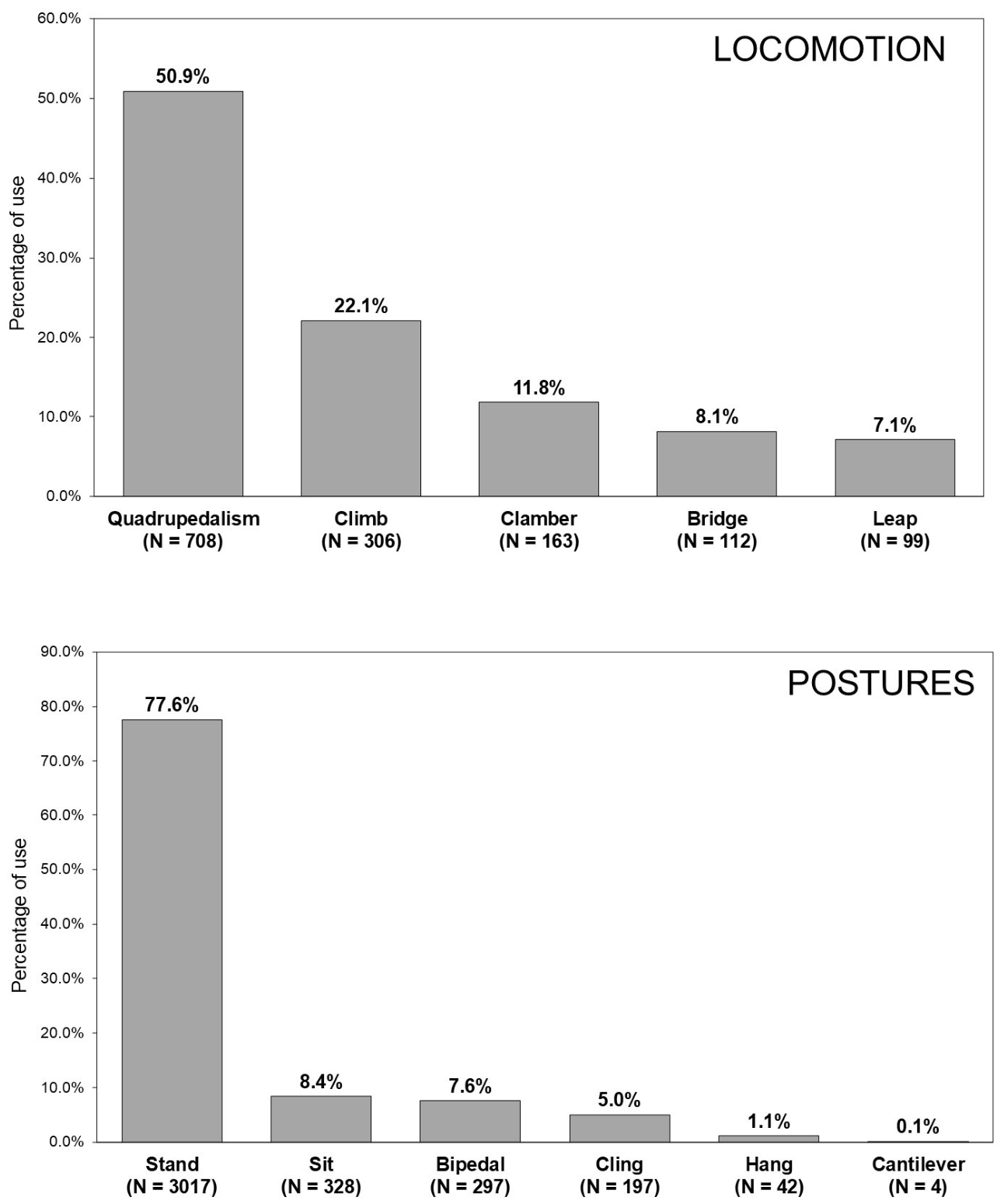
| Quadrupedalism | Symmetrical slow or moderate (walk), symmetrical fast (run) and asymmetrical fast (bound) progression along single horizontal and moderately inclined substrates |
| Climb | Symmetrical quadrupedal or asymmetrical bounding ascent or descent along vertical or steep substrates |
| Clamber | Irregular pronograde or semipronograde quadrupedal locomotion across multiple substrates of different inclinations |
| Leap | Gap-crossing mode involving an airborne phase with the body held horizontally or inclined, directed upwards, horizontally, or downwards, also involving hopping |
| Bridge | Gap-crossing mode involving reaching action across distantly located substrates with irregular limb movements |
| Postural modes | |
| Stand | Pronograde quadrupedal posture with either strongly flexed or semi-extended limbs |
| Sit | Orthograde or leaning seated posture with strongly flexed hind limbs |
| Bipedal | Semi-orthograde standing posture on the two semi-extended or strongly flexed hind limbs |
| Cling | Orthograde gripped posture with extremely flexed limbs and the head upwards or downwards on vertical or steep substrates |
| Cantilever | Grasping feet secure the lower part of the body to a substrate while the trunk and forelimbs are extended horizontally |
| Hang | Suspensory posture below a substrate using all four limbs or using the hind limbs only |
| Locomotion (%) | Postures (%) | Total (%) | |
|---|---|---|---|
| Substrate size | |||
| Small | 66.7 | 68.4 | 67.9 |
| Medium | 13.5 | 24.7 | 21.8 |
| Large | 19.8 | 6.9 | 10.3 |
| Substrate inclination | |||
| Horizontal | 47.5 | 71.8 | 65.5 |
| Oblique | 29.6 | 22.5 | 24.3 |
| Vertical | 22.9 | 5.7 | 10.2 |
| n | 1389 | 3887 | 5276 |
| Quadrupedalism (%) | Climb (%) | Clamber (%) | Bridge (%) | Leap (%) | |
|---|---|---|---|---|---|
| Substrate size | |||||
| Small | 62.0 | 72.9 | 93.8 | 52.6 | 51.5 |
| Medium | 13.7 | 17.0 | 4.9 | 25.1 | 26.3 |
| Large | 24.3 | 10.1 | 1.3 | 22.3 | 22.2 |
| Substrate inclination | |||||
| Horizontal | 63.3 | 0.0 | 33.5 | 69.6 | 76.8 |
| Oblique | 36.7 | 9.7 | 50.6 | 26.8 | 15.1 |
| Vertical | 0.0 | 90.3 | 15.9 | 3.6 | 8.1 |
| n | 708 | 306 | 163 | 112 | 99 |
| Stand (%) | Sit (%) | Bipedal (%) | Cling (%) | Hang (%) | |
|---|---|---|---|---|---|
| Substrate size | |||||
| Small | 66.2 | 56.2 | 90.2 | 81.2 | 88.1 |
| Medium | 26.6 | 32.7 | 8.6 | 14.7 | 4.8 |
| Large | 7.2 | 11.1 | 1.2 | 4.1 | 7.1 |
| Substrate inclination | |||||
| Horizontal | 74.2 | 86.3 | 84.5 | 0.5 | 38.1 |
| Oblique | 25.8 | 13.7 | 15.5 | 10.2 | 26.2 |
| Vertical | 0.0 | 0.0 | 0.0 | 89.3 | 35.7 |
| n | 3017 | 328 | 297 | 197 | 42 |
Disclaimer/Publisher’s Note: The statements, opinions and data contained in all publications are solely those of the individual author(s) and contributor(s) and not of MDPI and/or the editor(s). MDPI and/or the editor(s) disclaim responsibility for any injury to people or property resulting from any ideas, methods, instructions or products referred to in the content. |
© 2026 by the authors. Licensee MDPI, Basel, Switzerland. This article is an open access article distributed under the terms and conditions of the Creative Commons Attribution (CC BY) license.
Share and Cite
Youlatos, D.; Koutsougianni, F.; Karantanis, N.E.; Rychlik, L. Arboreal Behavior of Captive Acacia Rats Thallomys paedulcus (Rodentia: Muridae). Animals 2026, 16, 1632. https://doi.org/10.3390/ani16111632
Youlatos D, Koutsougianni F, Karantanis NE, Rychlik L. Arboreal Behavior of Captive Acacia Rats Thallomys paedulcus (Rodentia: Muridae). Animals. 2026; 16(11):1632. https://doi.org/10.3390/ani16111632
Chicago/Turabian StyleYoulatos, Dionisios, Fani Koutsougianni, Nikolaos Evangelos Karantanis, and Leszek Rychlik. 2026. "Arboreal Behavior of Captive Acacia Rats Thallomys paedulcus (Rodentia: Muridae)" Animals 16, no. 11: 1632. https://doi.org/10.3390/ani16111632
APA StyleYoulatos, D., Koutsougianni, F., Karantanis, N. E., & Rychlik, L. (2026). Arboreal Behavior of Captive Acacia Rats Thallomys paedulcus (Rodentia: Muridae). Animals, 16(11), 1632. https://doi.org/10.3390/ani16111632