Article

Exploring Growth Pattern and Candidate Genes for Chicken Spur

1
College of Animal Science and Technology, Guangxi University, Nanning 530004, China
2
Guangxi Guigang Gangfeng Agriculture and Animal Husbandry Co., Ltd., Guigang 537100, China
3
Guangxi Key Laboratory of Animal Breeding, Disease Control and Prevention, Nanning 530004, China
*
Author to whom correspondence should be addressed.
These authors contributed equally to this work.
Animals 2026, 16(11), 1577; https://doi.org/10.3390/ani16111577
Submission received: 16 April 2026 / Revised: 13 May 2026 / Accepted: 19 May 2026 / Published: 22 May 2026
(This article belongs to the Section Poultry)

Simple Summary

The chicken spur is a bony structure that grows from the lower leg and increases in length with age. It is widely used to estimate rearing time and is an important trait in poultry breeding. However, its growth pattern and underlying biological mechanisms remain unclear. In this study, we characterized spur growth, examined its structure using imaging methods, and analyzed gene expression in spur tissues. The results showed that spur length had no significant association with body weight, body size, or egg production. Spur growth was influenced by hormones, and roosters with longer spurs showed higher sperm motility. Structural analysis confirmed that the spur is bone tissue that forms through endochondral ossification, and that a key developmental stage occurs at around 15 weeks of age. We also identified TENM2 as a key gene that may regulate spur development through the BMP signaling pathway. These findings provide useful insights for poultry breeding and management.

Abstract

The chicken spur is a bony structure located on the tarsometatarsus and extending posteriorly. Because its length increases with age, it has become an important indicator of rearing duration and a trait of interest in high-quality chicken breeding. The developmental pattern of the chicken spur and its underlying genetic mechanisms remain poorly understood. In this study, Nandan-Yao chickens were used to investigate spur growth and development. Phenotypic measurements and X-ray imaging were performed to characterize spur growth, and RNA sequencing was used to identify candidate genes associated with spur length. Candidate genes were further evaluated by tissue expression profiling and RNA interference. The results showed that spur length was not significantly associated with body weight, body size, or laying traits (p > 0.05). In roosters, sperm motility and ln(T/E2) were significantly higher in the long spur group than in the short spur group (p < 0.05). X-ray imaging and gene expression analysis indicated that the chicken spur is a bony structure that develops through an endochondral ossification pattern, with the ossification center appearing at approximately 15 weeks of age in Nandan-Yao chickens. TENM2 was identified as a key candidate gene associated with spur development, and functional analysis suggested that it may be involved in this process through the BMP signaling pathway. These findings provide a basis for understanding the developmental pattern and genetic mechanisms of chicken spur formation and support the potential breeding value of spur traits.

1. Introduction

Chicken is an important source of high-quality animal protein for humans and contributes substantially to global meat consumption. In addition to production traits, several external morphological characteristics are also of breeding interest in indigenous and high-quality chicken breeds. Among these, the spur is an important phenotypic trait whose length generally increases with age, making it a potential indicator of rearing duration. Accordingly, spur length has gradually been incorporated into breeding objectives. Previous studies have shown that spur length is a moderately to highly heritable quantitative trait in chickens and may be associated with growth-related traits and female reproductive performance, suggesting that this trait has both biological significance and potential breeding value [1]. However, its relationships with production traits and the genetic mechanisms underlying spur development remain poorly understood.
The chicken spur is a bony outgrowth located on the tarsometatarsus and extending posteriorly [2]. Its development begins during embryogenesis and is closely associated with tissue growth and ossification. Although several ossification models have been proposed [3], including endochondral ossification [4], intramembranous osteogenesis [5], chondrocyte to osteogenic precursor transition [6], dedifferentiation followed by redifferentiation [7], and direct transdifferentiation [8], the ossification pattern of the chicken spur remains unclear. Among these, endochondral ossification and intramembranous ossification are the two principal modes of skeletal development [9,10,11]. Clarifying which mode is involved in spur formation is therefore important for understanding its developmental basis. Recent genetic studies have identified several candidate genes associated with spur length in chickens, but the developmental pattern of the chicken spur and the molecular mechanisms underlying its formation remain largely unclear [1].
Spur development is affected by multiple factors, including genetic background, hormonal regulation, and environmental conditions [12,13]. Previous studies have shown that gonadal and thyroid hormones play essential roles in spur growth [14], particularly in roosters, in which spur development is closely associated with secondary sexual characteristics [15]. These findings indicate that spur development is regulated by complex molecular networks and may be genetically associated with other traits, such as body size, body weight, and reproductive performance.
In this study, Nandan-Yao chickens were used to investigate spur growth patterns and the molecular basis of spur development. Phenotypic measurements and X-ray analysis were conducted to characterize spur growth, and RNA-seq was used to screen candidate genes associated with spur length. Key candidate genes were further evaluated by tissue expression profiling and preliminary functional validation. This study provides a basis for understanding the developmental pattern and genetic architecture of chicken spur formation.

2. Materials and Methods

2.1. Animal and Sample Collection

A total of 500 Nandan-Yao chickens (250 males and 250 females) were included in this study. All chickens were raised under standard feeding conditions at Guangxi Guigang Gangfeng Agriculture and Animal Husbandry Co., Ltd. (Guigang, China). Body weight and body size traits were recorded at 1 day (1D), 6 weeks (6W), 10 weeks (10W), 13 weeks (13W), 15 weeks (15W), 17 weeks (17W), and 20 weeks (20W). At 20 weeks of age, roosters were assigned to the long spur (LS) and short spur (SS) groups according to spur length, with 16 chickens per group. At 23 weeks of age, 12 roosters from each group were selected for semen quality evaluation. For X-ray analysis, four roosters were sampled at each of six time points (14W, 15W, 20W, 21W, 24W, and 53W) to investigate spur bone development.
To evaluate the relationship between spur length and egg production performance, an independent cohort of 327 hens at 40 weeks of age was additionally selected. Spur length and egg production data were collected, and the chickens were grouped according to spur length. For molecular analyses, blood and spur samples were collected from four chickens in each of the LS and SS groups at 20 weeks of age. Blood samples were used for ELISA, whereas spur tissues were used for gene expression analysis and RNA sequencing. In addition, spur samples from 1-day-old roosters were collected for RNA sequencing. Three pooled samples were prepared, each containing tissues from 10 chickens.

2.2. Test of Semen Quality and Serum Hormone Concentrations

Semen quality in roosters was evaluated by microscopic examination. Briefly, 10 μL of semen was collected using a pipette, mounted on a glass slide, and observed under a microscope to assess sperm motility. Blood samples were centrifuged to obtain serum, and serum estradiol (E2) and testosterone (T) concentrations were determined using chicken ELISA kits (Shanghai Enzyme Biotechnology Co., Ltd., Shanghai, China).

2.3. RNA-Seq Sequencing Data Analysis

Total RNA was extracted from spur tissues using TRIzol reagent (Life Technologies, Carlsbad, CA, USA) according to the manufacturer’s instructions. RNA quality and concentration were evaluated using a Q5000 UV–Vis spectrophotometer (Quawell, San Jose, CA, USA) and agarose gel electrophoresis. RNA sequencing was conducted by Novogene Bioinformatics Technology Co., Ltd. (Beijing, China) according to the standard protocol.
Raw reads were filtered using Trimmomatic (v0.39) to generate clean reads [15]. Read quality, including sequencing error rate, GC content distribution, and Q20/Q30 scores, was assessed using FastQC (v0.11.09) [16]. The version of the chicken reference genome is GRCg6a. The reference genome and annotation files were downloaded from the genome database (http://ftp.ensembl.org/pub/release-95/, accessed on 12 May 2026) accessed on 12 May 2026. Clean reads were aligned to the reference genome using HISAT2 (v2.2.1), and SAM files were converted to BAM files using SAMtools [17]. Gene expression counts were calculated using HTSeq-count (v0.13.5) [18]. Differential expression analysis was performed using the DESeq2 package (v1.38.3) in R, and genes with p < 0.05 and |log2FoldChange| > 1.0 were defined as differentially expressed genes (DEGs) [19]. Gene Ontology (GO) and Kyoto Encyclopedia of Genes and Genomes (KEGG) enrichment analyses were performed using the clusterProfiler package (v4.6.2) [20].

2.4. cDNA Synthesis and Real-Time Fluorescent Quantitative PCR (QRT-PCR)

HiScript® III RT SuperMix for qPCR (+gDNA wiper) (Vazyme, Nanjing, China) was utilized for reverse transcription to synthesize cDNA. QRT-PCR was performed using Universal SYBR qPCR Master Mix (Vazyme, Nanjing, China). The amplification procedure consisted of an initial denaturation at 95 °C for 30 s, followed by 40 cycles of denaturation at 95 °C for 5 s, and annealing and extension at 60 °C for 30 s. β-actin was used as the internal reference gene, and all samples were analyzed in triplicate. Relative gene expression levels were calculated using the 2−ΔΔCT method. Primer sequences are listed in Table S1.

2.5. RNA Interference and Cell Transfection

siRNA sequences targeting the coding sequence of the chicken TENM2 gene were designed using the online siRNA Selection Program and synthesized by Sangon Biotech (Shanghai, China). The siRNA sequence information is listed in Table S2. siRNA3-TENM2, which showed the highest knockdown efficiency, was selected for subsequent experiments.
Chondrocytes were isolated from the tibial tissues of E15 chicken embryos. Tibial growth plate tissues were collected under sterile conditions, sequentially digested with trypsin and 0.2% type IV collagenase, and the isolated cells were filtered, centrifuged, and resuspended in DMEM supplemented with 10% fetal bovine serum for culture. For chondrocyte identification, third-passage cells were collected, and the relative expression levels of chondrocyte marker genes, including ACAN, SOX9, COL2A1, and COL10A1, were examined by QRT-PCR using a chicken preadipocyte cell line as the control. Cells were seeded into six-well plates and transfected with siRNA using Lipofectamine® RNAiMAX (Invitrogen, Carlsbad, CA, USA) at approximately 60% confluence. After 48 h of transfection, the cells were observed, photographed, and harvested for subsequent analyses.

2.6. Statistical Analysis

All data are presented as the mean ± SEM. Differences between the two groups were analyzed using a two-tailed Student’s t-test, and p < 0.05 was considered statistically significant; * p < 0.05, ** p < 0.01. GraphPad Prism 8 (GraphPad Software, San Diego, CA, USA) was used for statistical analysis and data visualization. All data are presented as the results of three technical and biological replicates.

3. Results

3.1. Effects of Chicken Spur Length on Production Performance and Hormone Levels

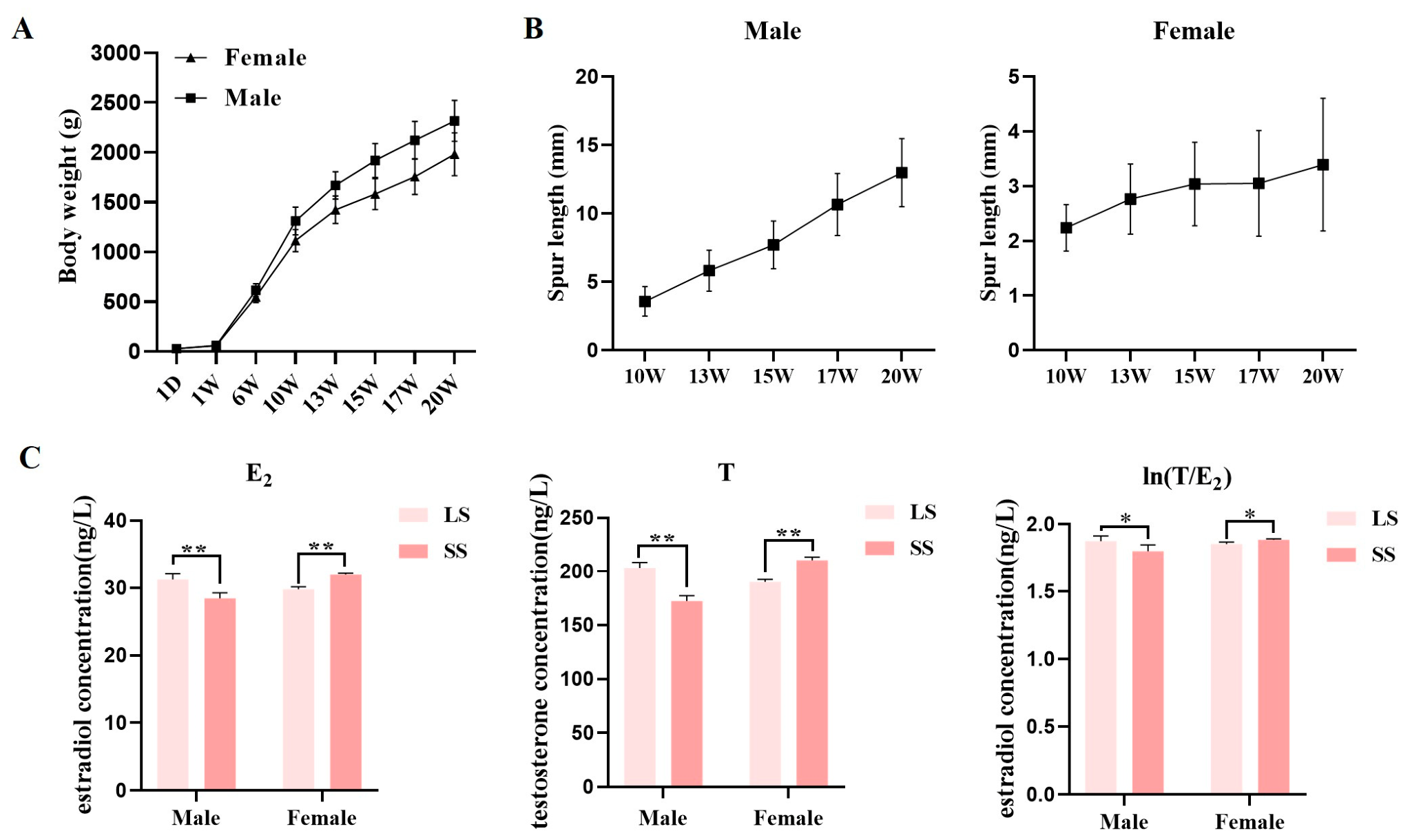
Phenotypic measurements showed that body weight in Nandan-Yao chickens increased progressively with age (Figure 1A, Table S3). Significant sex differences were observed in spur development (Figure 1B). Hens showed delayed spur growth, whereas roosters exhibited a marked and continuous increase in spur length from 10 weeks of age onward. Because spur growth in hens was limited, correlation analyses with growth traits were performed only in roosters at 15, 17, and 20 weeks of age. As shown in Table 1, spur length in 15-week-old roosters was highly significantly positively correlated with comb thickness (p < 0.01), and significantly negatively correlated with shank length and shank circumference (p < 0.05). In 17-week-old roosters, spur length was significantly negatively correlated with body length (p < 0.01), whereas no significant correlations were found for the other traits. In 20-week-old roosters, spur length was significantly negatively correlated with shank length (p < 0.01).
In hens, spur length was not significantly correlated with laying performance traits, including total egg number, qualified egg number, and qualified egg rate (p > 0.05) (Table S4), and no significant differences in laying performance were observed between the LS and SS groups (Table S5). In roosters, sperm density did not differ significantly between groups, whereas sperm motility was significantly higher in the LS group than in the SS group (p < 0.05) (Table 2). In addition, serum E2 concentration, T concentration, and the ln(T/E2) ratio were significantly higher in the LS group than in the SS group in roosters, whereas the opposite pattern was observed in hens (p < 0.05) (Figure 1C, Table S6).

3.2. The Ossification Process of Spur

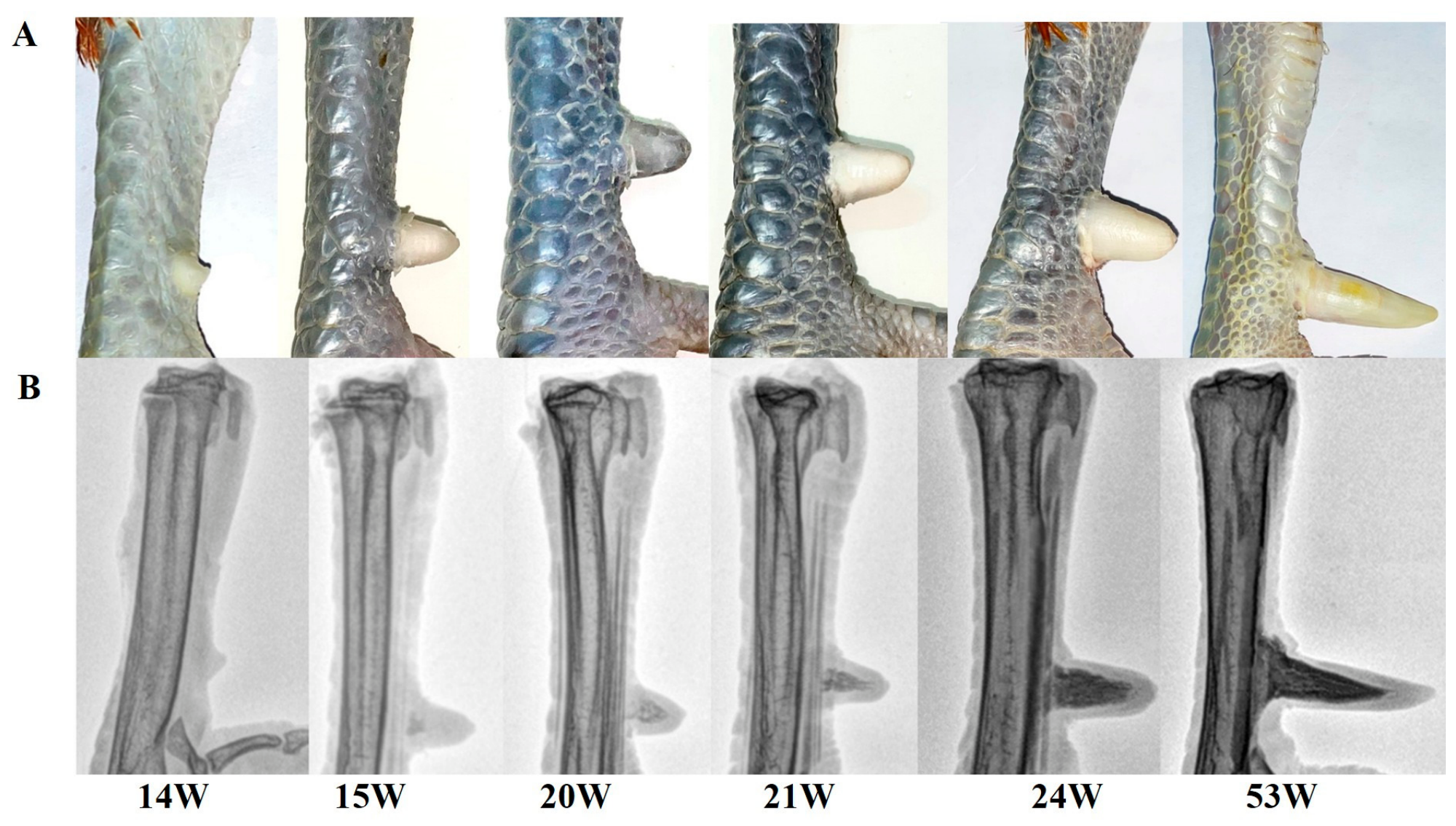
The ossification process of the spur was evaluated by DR X-ray imaging at different developmental stages. As shown in Figure 2, spur ossification progressively increased during development. At the early developmental stage, the spur was short and showed no obvious internal ossification. By 15 weeks of age, a distinct ossification center had appeared within the spur, suggesting that this stage represented a key period in early spur ossification. At approximately 20 weeks, the spur had elongated further, and the ossification center had enlarged and extended toward the tarsometatarsus, indicating progressive ossification. By 21 weeks, the ossification center had begun to contact the tarsometatarsus, and by 24 weeks, this contact had become closer as the spur continued to extend. Radiographic density increased progressively throughout development, indicating enhanced calcification and mineralization. By 53 weeks, the spur exhibited a high degree of mineralization and bone density, with complete ossification and firm fusion to the tarsometatarsus.

3.3. Expression of Key Ossification Genes in the Spur and Other Bone Tissues

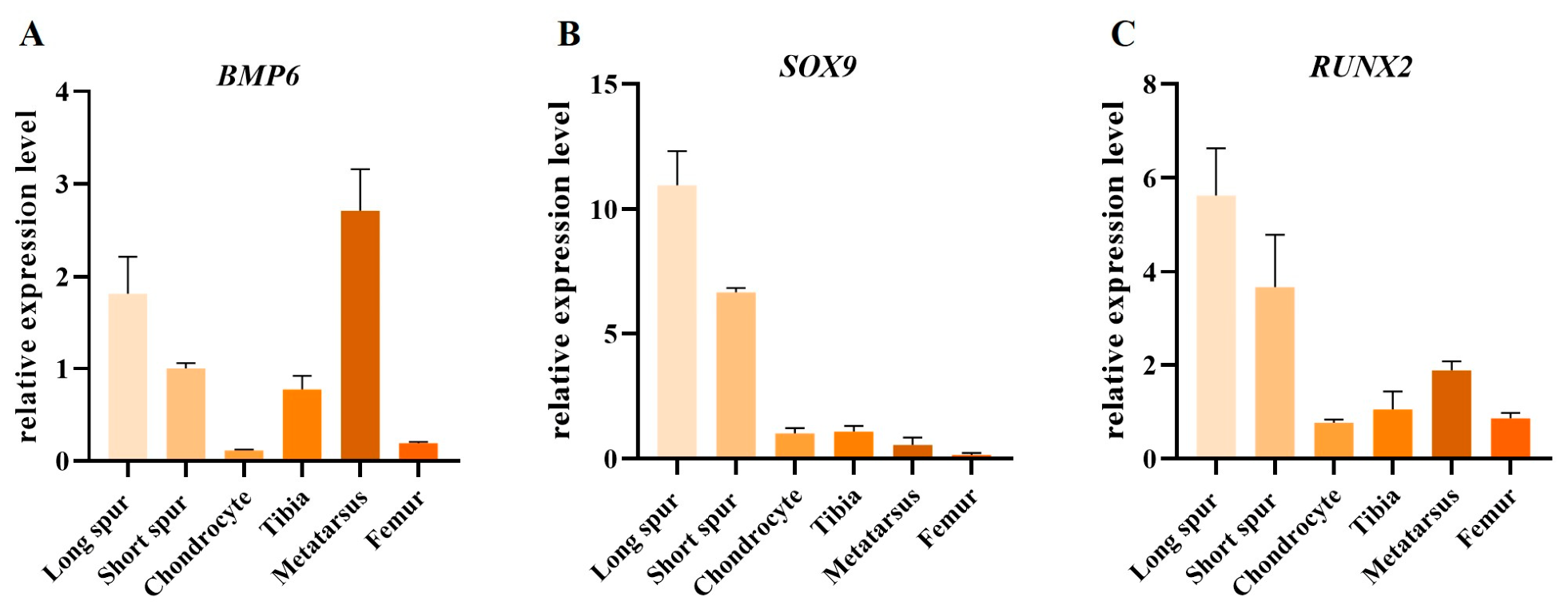
To compare the molecular characteristics of the spur with those of other bone tissues, the expression levels of BMP6, RUNX2, and SOX9 were analyzed by QRT-PCR in long spur, short spur, chondrocytes, metatarsus, and femur tissues. The expression levels of all three genes were significantly higher in the long spur than in the short spur (p < 0.01) (Figure 3A–C). BMP6 expression was highest in the metatarsus and lowest in chondrocytes, whereas RUNX2 and SOX9 showed the highest expression in the long spur. The lowest expression of RUNX2 was detected in chondrocytes, while SOX9 was lowest in the femur. These findings suggest that BMP6, RUNX2, and SOX9 are involved in spur growth and ossification, and that SOX9 may have a particularly important role in spur development.

3.4. RNA-Seq, GO, and KEGG Analysis

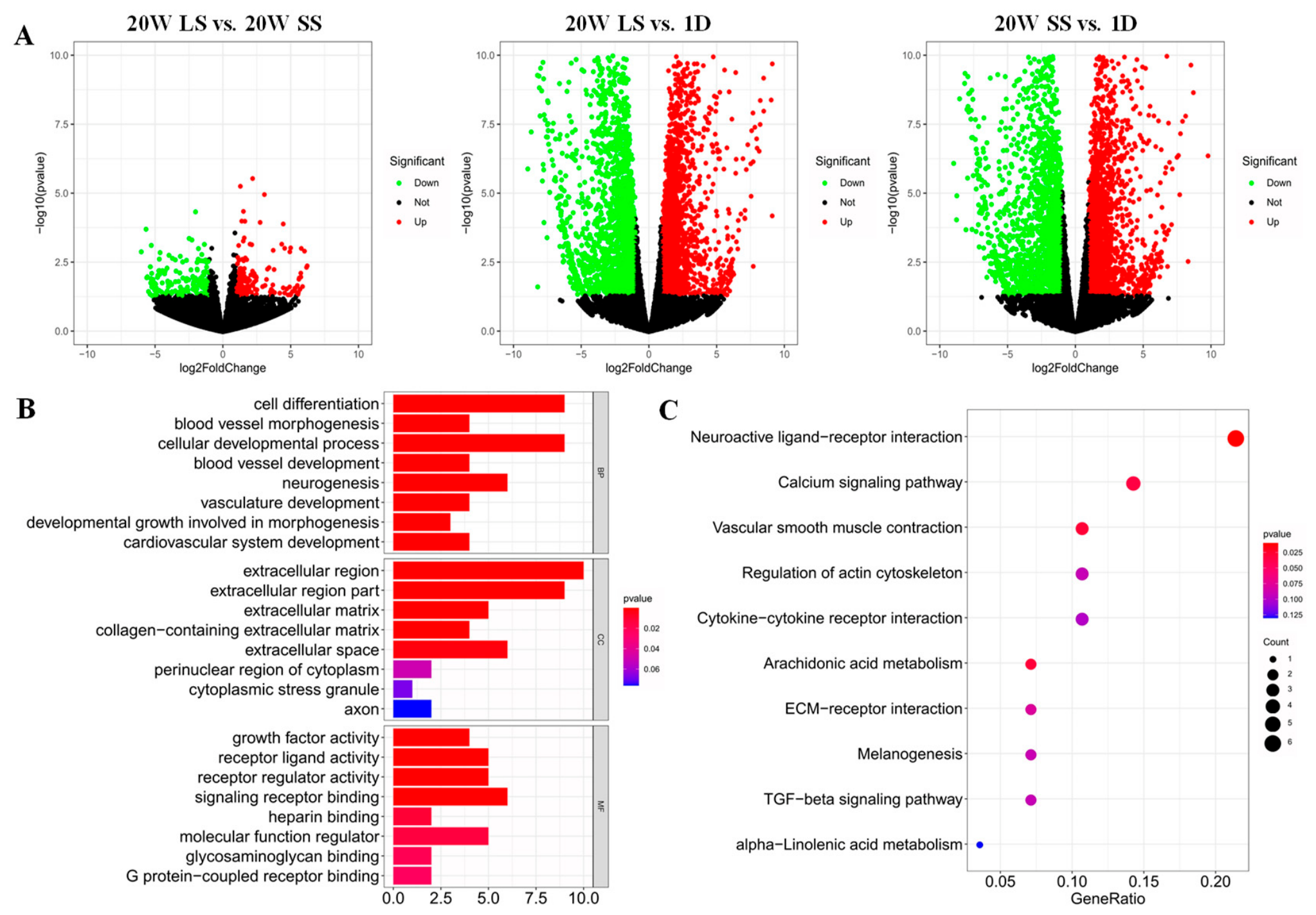
A total of 11 samples were subjected to RNA-seq, and the sequencing results and quality control parameters are summarized in Table S7. Five DEGs were selected for validation by QRT-PCR, and the results were consistent with the RNA-seq data, supporting the reliability of the sequencing results (Figure S1). Differential expression analysis identified 333, 4594, and 4180 DEGs in the comparisons of 20-week-old long spur group (20W LS) vs. 20-week-old short spur group (20W SS), 20W LS vs. 1-day-old spur group (1D), and 20W SS vs. 1D, respectively (Figure 4A). Intersection analysis of the three DEG sets identified 80 common genes, which may be involved in both spur development and spur length variation (Figure S2).
GO enrichment analysis showed that DEGs in the 20W LS vs. 20W SS comparison were mainly associated with cell differentiation, cellular developmental processes, negative regulation of canonical WNT signaling, and regulation of programmed cell death. In the 20W LS vs. 1D comparison, enriched GO terms were mainly related to anatomical structure morphogenesis, animal organ development, skeletal system development, and embryonic appendage morphogenesis. In the 20W SS vs. 1D comparison, enriched functions were primarily associated with skeletal system development, embryonic appendage morphogenesis, cell differentiation, and embryonic limb morphogenesis (Figure S3). The 80 common DEGs were mainly enriched in cell differentiation, blood vessel morphogenesis, cellular developmental processes, growth-related morphogenesis, and cardiovascular system development (Figure 4B, Table S8).
KEGG analysis showed that DEGs in the 20W LS vs. 20W SS comparison were mainly enriched in the MAPK signaling pathway, cytokine–cytokine receptor interaction, cell adhesion molecules, and the WNT signaling pathway. In the 20W LS vs. 1D comparison, the DEGs were mainly enriched in cell adhesion molecules, glycerophospholipid metabolism, and sphingolipid metabolism. In the 20W SS vs. 1D comparison, the DEGs were mainly enriched in the MAPK signaling pathway, cell adhesion molecules, glycerolipid metabolism, and the PPAR signaling pathway. The 80 common DEGs were mainly enriched in neuroactive ligand–receptor interaction, vascular smooth muscle contraction, and calcium signaling pathways (Figure 4C, Table S9).

3.5. Identification of Important Candidate Genes Related to Chicken Spur Development

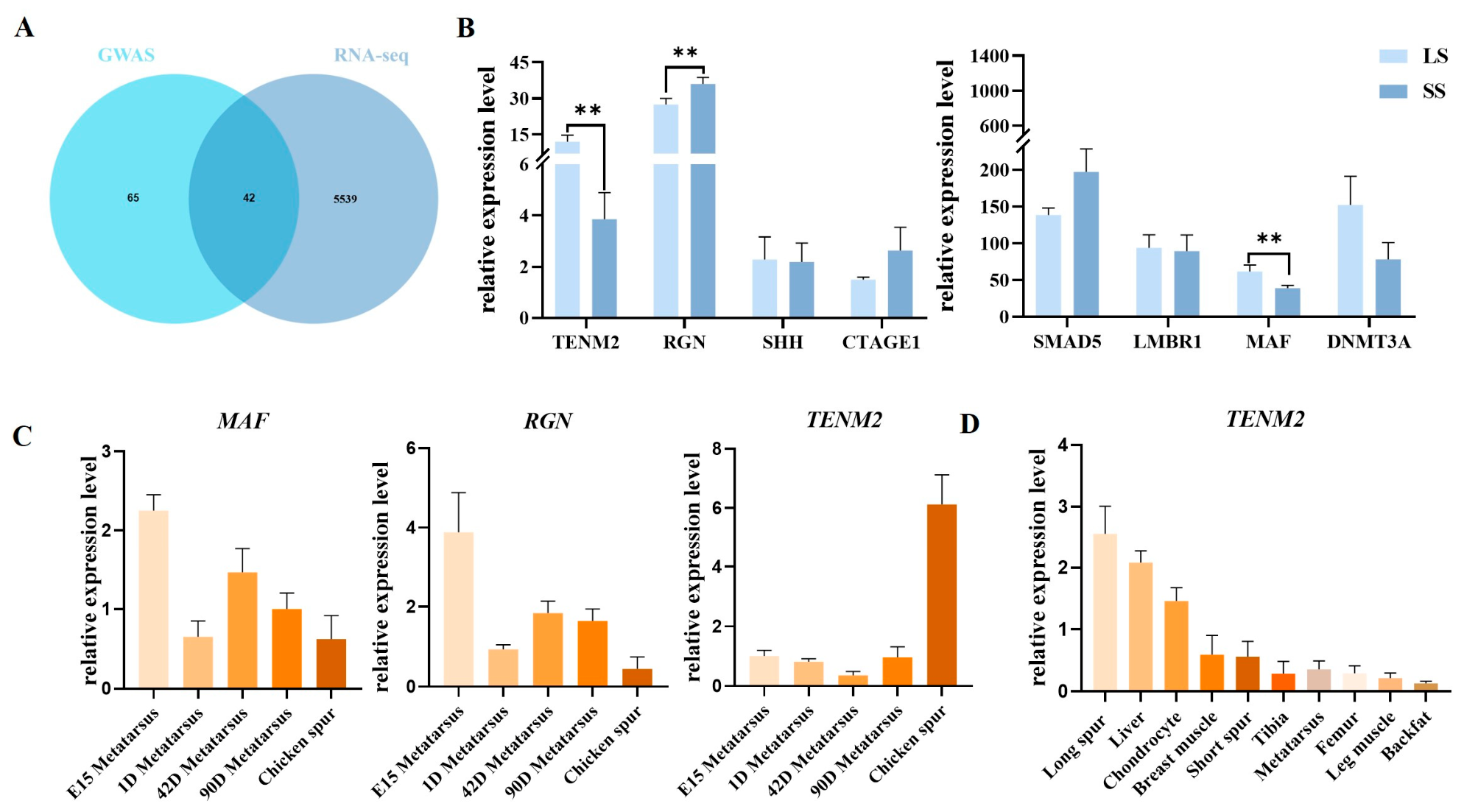
Combined with our previous genome-wide association study (GWAS), the DEGs identified from the transcriptome analysis were intersected with the candidate genes obtained from the GWAS results (Figure 5A). GO functional enrichment analysis was then performed for the overlapping genes, and the results are shown in Table 3. These genes were mainly enriched in biological processes related to limb morphogenesis, connective tissue development, cartilage development, calcium signaling, and appendage morphogenesis. Based on the integrated analysis, eight candidate genes, namely MAF, TENM2, RGN, SHH, LMBR1, CTAGE1, SMAD5, and DNMT3A, were identified as potentially associated with chicken spur development.
To further identify key genes involved in spur growth, QRT-PCR was performed to examine the expression of these candidate genes in spur and metatarsal tissues. The results showed that the expression levels of TENM2, RGN, and MAF in the LS were significantly higher than in the SS (p < 0.01) (Figure 5B). TENM2 exhibited significantly high expression in the chicken spur (p < 0.01), while RGN and MAF demonstrated the highest expression levels in the 15D embryonic metatarsal bones (p < 0.01) (Figure 5C). In addition, TENM2 showed the highest expression in the long spur (Figure 5D). Based on these findings, TENM2 was considered the key candidate gene associated with chicken spur length and was selected for further investigation.

3.6. TENM2 Function in Chondrocytes

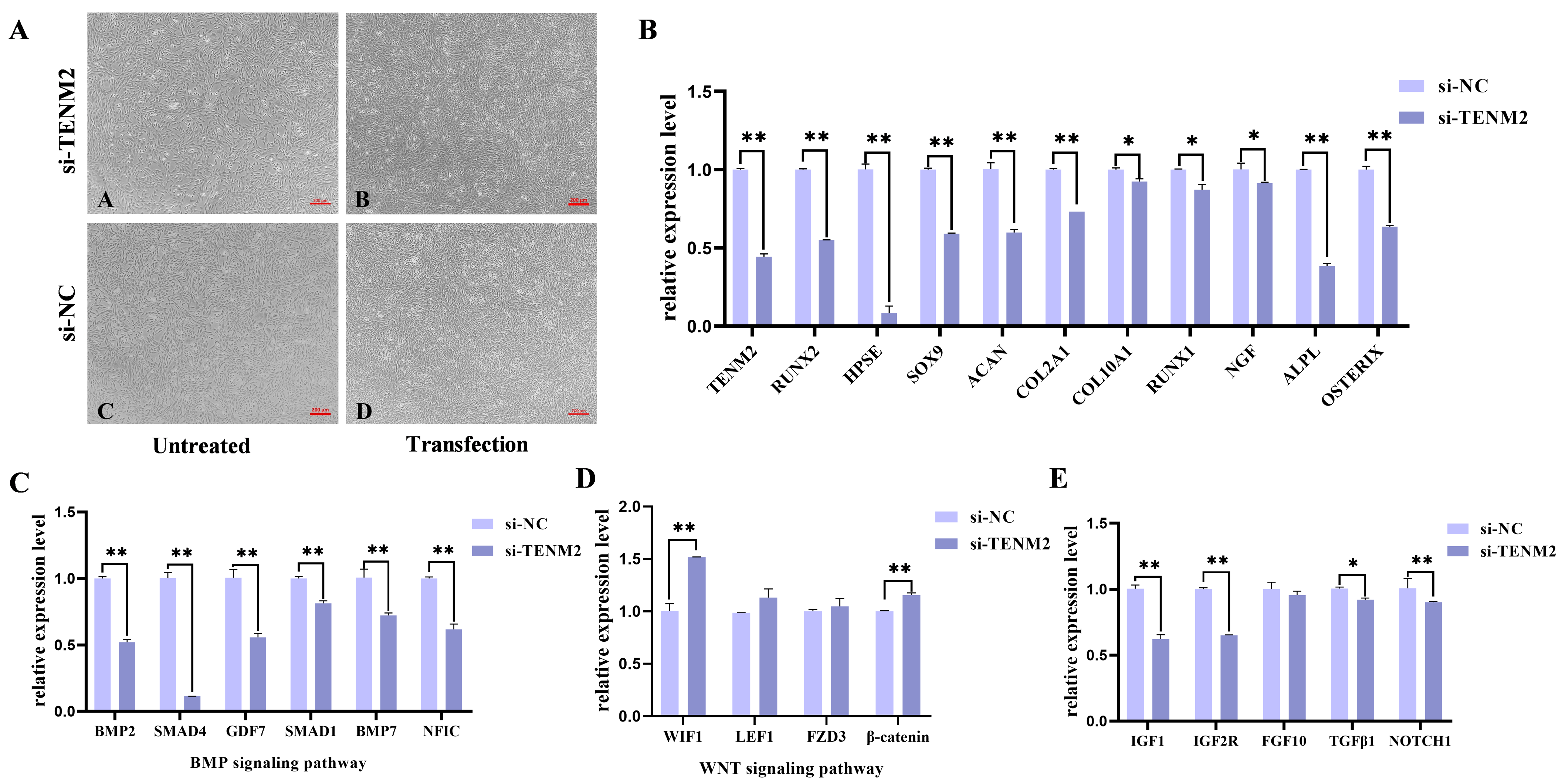
Before functional analysis, the isolated cells were identified by QRT-PCR detection of chondrocyte marker genes. The relative expression levels of ACAN, SOX9, COL2A1, and COL10A1 were all significantly higher in the isolated cells than in the chicken preadipocyte cell line (p < 0.05), confirming the successful isolation of chondrocytes (Figure S4). To investigate the role of TENM2 in chicken chondrocytes, si-TENM2 and si-NC were transfected into chondrocytes. After 48 h of transfection (Figure 6A,B), TENM2 expression was significantly reduced in the si-TENM2 group compared with the control group (p < 0.01). The expression levels of RUNX2 and HPSE, which are associated with chondrocyte proliferation, were significantly decreased (p < 0.01). In addition, the expression levels of differentiation-related genes (SOX9, ACAN, COL2A1, COL10A1, and RUNX1) and apoptosis-related genes (NGF and ALPL) were significantly reduced (p < 0.05), while the hypertrophic chondrocyte marker OSTERIX was also significantly downregulated (p < 0.01). These findings suggest that TENM2 interference inhibits chondrocyte proliferation, differentiation, hypertrophy, and apoptosis.
The effects of TENM2 interference on bone development-related signaling pathways were further examined (Figure 6C,D). Compared to the control group, the expression levels of WNT pathway genes exhibited an increase following TENM2 interference, and the relative expression of WIF1 and β-catenin genes was significantly increased (p < 0.05). In contrast, the expression levels of BMP pathway genes were significantly decreased (p < 0.01). These results suggest that TENM2 primarily influences chondrocyte development through the BMP signaling pathway, thereby impacting the development of the chicken spur.
The relative expression levels of genes involved in bone growth and development were assessed (Figure 6E). Compared to the control group, interference with TENM2 significantly decreased the expression levels of IGF1, IGF2R, TGFβ1, and NOTCH1 (p < 0.05). These results further confirm that TENM2 plays a crucial role in chondrocyte development, identifying it as a key gene influencing the development of the chicken spur.

4. Discussion

At present, relatively few studies have explored the relationships between chicken spur length and other traits. In this study, the associations between spur length and growth traits in roosters differed across developmental stages, and no significant correlation with body weight was detected. These findings suggest that spur length is not stably associated with general growth performance, but may be related to specific morphological traits during particular developmental periods. With respect to reproductive traits, sperm density did not differ significantly between the LS and SS groups, whereas sperm motility was significantly higher in the LS group, consistent with previous findings [21]. This result suggests that longer spurs in roosters may be associated with certain aspects of reproductive fitness. In contrast, no significant relationship was observed between spur length and laying performance in hens, indicating that spur length may have limited relevance to female reproductive performance in Nandan-Yao chickens. A previous study in White Leghorn hens reported a negative phenotypic correlation between spur length and egg production [22], which differs from the present findings. A study in Rhode Island Red chickens showed that spur length had moderate to high heritability and was positively correlated with body weight, shank length, age at first egg, and body weight at first egg [1]. These discrepancies among studies may reflect differences in genetic background, selective breeding history, trait definition, and possible genotype–environment interactions across breeds. This inconsistency may be due to differences in breed, genetic background, rearing environment, or management conditions. In addition, sex hormones are known to play critical roles in skeletal growth and development. In the present study, serum E2 and T levels were significantly higher in the LS group than in the SS group in roosters, whereas the opposite pattern was observed in hens, suggesting sex-specific hormonal regulation of spur growth. Taken together, these findings indicate that selection for spur length is unlikely to adversely affect the measured production traits and may even be beneficial for sperm motility in roosters [23]. Therefore, spur length may have potential value as an auxiliary trait in specific breeding contexts, although this possibility still requires further validation.
In this study, X-ray imaging was used to monitor changes in spur ossification throughout its growth and development. Because cartilage tissue cannot be clearly visualized by X-ray imaging, no obvious ossified structure was detected within the spur before 14 weeks of age, suggesting that the spur remained at an early developmental stage during this period. At approximately 15 weeks of age, a small ossification focus first appeared in the inner region of the spur, which subsequently developed into an ossification center. As development progressed, the ossification center gradually extended toward and eventually fused with the tarsometatarsus. This transition became evident at approximately 20–21 weeks of age in Nandan-Yao chickens, and initial fusion was observed by 24 weeks. By 53 weeks of age, the spur showed complete ossification and firm fusion with the tarsometatarsus, forming the bony base of the spur. These findings were generally consistent with previous reports [24], although differences in developmental timing were observed, which may be related to breed differences and long-term artificial selection [25].
X-ray analyses revealed that the spur belongs to bone tissue, and its developmental pattern is consistent with endochondral ossification. To further evaluate this possibility, the expression of key ossification-related genes was examined. The results showed that SOX9 and RUNX2 were expressed in the spur, and SOX9 expression was significantly higher in the LS group than in the SS group. As SOX9 is a key regulator of chondrogenesis and RUNX2 is essential for osteogenic differentiation and chondrocyte maturation [26], the differential expression of these genes suggests that differences in cartilage development and ossification progression may contribute to variation in spur length. Previous studies have also shown that regulation of chondrocyte hypertrophy by the WNT signaling pathway is closely associated with SOX9 and RUNX2 expression [27]. Taken together, these findings support the view that the chicken spur is a bony tissue that develops through an endochondral ossification process. Although other ossification mechanisms have been proposed in previous studies, the present X-ray observations, together with the expression patterns of cartilage and bone-related markers, more strongly support an endochondral ossification pattern in chicken spur development. However, its precise developmental and regulatory mechanisms remain to be further elucidated.
The growth and development of the chicken spur is a complex biological process regulated by multiple genes and signaling pathways. Recent genomic studies have shown that spur length is a heritable trait and have identified multiple candidate genes associated with this phenotype through Pool-GWAS and selection signature analyses, supporting the view that spur development has a complex genetic basis [1]. In the present study, RNA-seq analysis of spur tissues from 1-day-old and 20-week-old Nandan-Yao roosters identified candidate genes associated with spur development. Combined with the observed ossification pattern, GO and KEGG enrichment analyses suggested that variation in spur length may be closely related to cartilage development and signaling pathways such as calcium signaling and WNT signaling. By integrating the RNA-seq data with previous GWAS results, eight candidate genes associated with spur development were identified, among which TENM2 was further recognized as a key candidate gene associated with spur length. Previous studies have suggested that TENM2 may respond to FGFR2-mediated signaling and exhibit an expression pattern similar to that of FGF8 [28]. FGF8 promotes cell differentiation and enhances osteogenic activity [29], TENM2 may influence chicken spur growth and development through related regulatory mechanisms. However, the precise molecular mechanism requires further investigation.
During bone growth and development, chondrocyte proliferation, differentiation, hypertrophy, and osteoblast differentiation are regulated by multiple transcription factors and signaling pathways [30]. RUNX2 regulates bone formation and remodeling by promoting vascular infiltration and chondrocyte maturation [31]. When HPSE gene expression is inhibited, osteogenic differentiation is enhanced, while cartilage formation is suppressed [32]. SOX9, as a transcription factor, marks the formation of bone progenitor cells and directs their differentiation into chondrocytes [33]. COL10A1, COL2A1, and ACAN are important extracellular matrix-associated genes in growth plate chondrocytes, and ACAN and COL2A1 are widely recognized as markers of chondrocyte differentiation [34]. ALPL encodes alkaline phosphatase, and phosphates promote chondrocyte mineralization and apoptosis through the MAPK signaling pathway [35]. NGF induces chondrocyte apoptosis by regulating ASIC1a expression [36]. During endochondral ossification, the Hedgehog, BMP, and WNT signaling pathways interact to regulate skeletal development [37,38]. In this study, TENM2 interference significantly reduced the expression of genes associated with chondrocyte proliferation, differentiation, hypertrophy, and apoptosis-related processes. Moreover, opposite expression changes were observed in WNT and BMP-related genes after TENM2 interference, suggesting potential crosstalk between these pathways. Collectively, these findings indicate that TENM2 may influence chicken spur development by modulating chondrocyte developmental processes, at least in part through the BMP signaling pathway.

5. Conclusions

In conclusion, this study demonstrated that the chicken spur is a bony structure that develops through endochondral ossification and identified the key developmental stage for ossification center formation in Nandan-Yao chickens. Significant sex differences were observed in spur growth, and roosters in the long spur group showed a higher ln(T/E2) ratio and greater sperm motility than those in the short spur group. Spur length was not adversely associated with growth performance. Furthermore, TENM2 was identified as a key candidate gene associated with spur length, and functional analyses suggested that it may regulate chondrocyte development and spur formation primarily through the BMP signaling pathway. These findings mainly improve the understanding of the developmental pattern and molecular basis of chicken spur formation.

Supplementary Materials

The following supporting information can be downloaded at: https://www.mdpi.com/article/10.3390/ani16111577/s1. Figure S1: The accuracy of RNA-seq was verified by QRT-PCR; Figure S2: Venn diagram of DEGs in each comparison group; Figure S3: GO and KEGG pathway enrichment analyses of DEGs in 20W LS vs. 20W SS, 20W LS vs. 1D and 20W LS vs. 1D; Figure S4: The relative expression level of mRNA for the chondrocyte marker genes. Table S1: Primer information for QRT-PCR; Table S2: TENM2 siRNA sequence information; Table S3: The Weight of Nandan-Yao chickens in different periods; Table S4: Correlation analysis between spur length and laying performance of female Nandan-Yao chickens; Table S5: Comparison of laying performance of long spur and short spur in female Nandan-Yao chickens; Table S6: The measurement results of estradiol and testosterone; Table S7: Quality analysis of investigated samples; Table S8: Top 10 most significantly enriched Gene Ontology (GO) terms for DEGs; Table S9: significantly enriched KEGG pathways for DEGs.

Author Contributions

Conceptualization, X.Y., H.Y., Q.L. and Z.Y.; software, Z.Y.; validation, H.Y., Q.L. and Y.W.; resources, J.L. (Jianneng Li)., F.L. and X.Y.; data curation, Q.L.; writing—original draft preparation, H.Y.; writing—review and editing, H.Y., Z.Z., Y.W., B.Z., J.L. (Jintang Luo), and X.Y.; visualization, H.Y. and Q.L.; supervision, Q.L., Z.Y., Z.Z., J.L. (Jianneng Li), F.L., Y.W., B.Z., J.L. (Jintang Luo), and X.Y.; project administration, X.Y.; funding acquisition, X.Y. All authors have read and agreed to the published version of the manuscript.

Funding

This research was funded by Guangxi Science and Technology Major Program (GK AA23062049), the earmarked fund for CARS-Guangxi Poultry Industry Innovation Team (nycytxgxcxtd-2024-19) and Bagui Scholars Program of Guangxi Zhuang Autonomous Region.

Institutional Review Board Statement

The experimental protocol used in this study was reviewed and approved by institutional Animal Care and Use Committee (IACUC) of the College of Animal Science and Technology of Guangxi University (Guangxi, China), with approval number GXU2018-058.

Informed Consent Statement

Written informed consent was obtained from the owner of the animals involved in this study.

Data Availability Statement

The original contributions presented in this study are included in the article/Supplementary Material. Further inquiries can be directed to the corresponding author.

Conflicts of Interest

The co-author Jianneng Li and Fuqiu Li are an employee of Guangxi Guigang Gangfeng Agriculture and Animal Husbandry Co., Ltd. The authors declare that there are no other conflicts of interest.

References

  1. Chen, A.; Zhao, X.; Zhao, X.; Wang, G.; Zhang, X.; Ren, X.; Zhang, Y.; Cheng, X.; Yu, X.; Wang, H.; et al. Genetic Foundation of Male Spur Length and Its Correlation with Female Egg Production in Chickens. Animals 2024, 14, 1780. [Google Scholar] [CrossRef]
  2. Davison, G.W.H. Avian Spurs. J. Zool. 1985, 206, 353–366. [Google Scholar] [CrossRef]
  3. Aghajanian, P.; Mohan, S. The Art of Building Bone: Emerging Role of Chondrocyte-to-Osteoblast Transdifferentiation in Endochondral Ossification. Bone Res. 2018, 6, 19. [Google Scholar] [CrossRef]
  4. Doseff, A.I. Apoptosis: The Sculptor of Development. Stem Cells Dev. 2004, 13, 473–483. [Google Scholar] [CrossRef]
  5. Lin, D.P.L.; Carnagarin, R.; Dharmarajan, A.; Dass, C.R. Transdifferentiation of Myoblasts into Osteoblasts - Possible Use for Bone Therapy. J. Pharm. Pharmacol. 2017, 69, 1661–1671. [Google Scholar] [CrossRef]
  6. Aghajanian, P.; Xing, W.; Cheng, S.; Mohan, S. Epiphyseal Bone Formation Occurs via Thyroid Hormone Regulation of Chondrocyte to Osteoblast Transdifferentiation. Sci. Rep. 2017, 7, 10432. [Google Scholar] [CrossRef]
  7. Long, F.; Ornitz, D.M. Development of the Endochondral Skeleton. Cold Spring Harb. Perspect. Biol. 2013, 5, a008334. [Google Scholar] [CrossRef] [PubMed]
  8. Frasch, M. Dedifferentiation, Redifferentiation, and Transdifferentiation of Striated Muscles during Regeneration and Development. Curr. Top. Dev. Biol. 2016, 116, 331–355. [Google Scholar] [CrossRef] [PubMed]
  9. Berendsen, A.D.; Olsen, B.R. Bone Development. Bone 2015, 80, 14–18. [Google Scholar] [CrossRef] [PubMed]
  10. Kozhemyakina, E.; Lassar, A.B.; Zelzer, E. A Pathway to Bone: Signaling Molecules and Transcription Factors Involved in Chondrocyte Development and Maturation. Development 2015, 142, 817–831. [Google Scholar] [CrossRef]
  11. Michigami, T. Regulatory Mechanisms for the Development of Growth Plate Cartilage. Cell. Mol. Life Sci. 2013, 70, 4213–4221. [Google Scholar] [CrossRef]
  12. Quigley, G.D.; Juhn, M. A Comparison of Spur Growth in the Cock, Slip, and Capon. Poult. Sci. 1951, 30, 900–901. [Google Scholar] [CrossRef]
  13. Doherty, S. New Perspectives on Urban Cockfighting in Roman Britain. Archaeol. Rev. Camb. 2013, 28, 82–95. [Google Scholar]
  14. Blivaiss, B.B. Interrelations of Thyroid and Gonad in the Development of Plumage and Other Sex Characters in Brown Leghorn Roosters. Physiol. Zool. 1947, 20, 67–107. [Google Scholar] [CrossRef] [PubMed]
  15. Domm, L.V. New Experiments on Ovariotomy and the Problem of Sex Inversion in the Fowl. J. Exp. Zool. 1927, 48, 31–173. [Google Scholar] [CrossRef]
  16. Schmieder, R.; Edwards, R. Quality Control and Preprocessing of Metagenomic Datasets. Bioinformatics 2011, 27, 863–864. [Google Scholar] [CrossRef]
  17. Pertea, M.; Kim, D.; Pertea, G.M.; Leek, J.T.; Salzberg, S.L. Transcript-Level Expression Analysis of RNA-Seq Experiments with HISAT, StringTie and Ballgown. Nat. Protoc. 2016, 11, 1650–1667. [Google Scholar] [CrossRef]
  18. Anders, S.; Pyl, P.T.; Huber, W. HTSeq - a Python Framework to Work with High-Throughput Sequencing Data. Bioinformatics 2015, 31, 166–169. [Google Scholar] [CrossRef] [PubMed]
  19. Love, M.I.; Huber, W.; Anders, S. Moderated Estimation of Fold Change and Dispersion for RNA-Seq Data with DESeq2. Genome Biol. 2014, 15, 550. [Google Scholar] [CrossRef]
  20. Yu, G.; Wang, L.-G.; Han, Y.; He, Q.-Y. clusterProfiler: An R Package for Comparing Biological Themes among Gene Clusters. Omics J. Integr. Biol. 2012, 16, 284–287. [Google Scholar] [CrossRef]
  21. Göransson, G.; von Schantz, T.; Fröberg, I.; Helgee, A.; Wittzell, H. Male Characteristics, Viability and Harem Size in the Pheasant, Phasianus colchicus. Anim. Behav. 1990, 40, 89–104. [Google Scholar] [CrossRef]
  22. Fairfull, R.W.; Gowe, R.S. Genotypic and Phenotypic Parameters of Spur Incidence and Length in White Leghorn Hens. Poult. Sci. 1986, 65, 1995–2001. [Google Scholar] [CrossRef]
  23. Zhao, D.; McBride, D.; Nandi, S.; McQueen, H.A.; McGrew, M.J.; Hocking, P.M.; Lewis, P.D.; Sang, H.M.; Clinton, M. Somatic Sex Identity Is Cell Autonomous in the Chicken. Nature 2010, 464, 237–242. [Google Scholar] [CrossRef]
  24. Doherty, S.P.; Foster, A.; Best, J.; Hamilton-Dyer, S.; Morris, J.; Sadler, P.; Skelton, C.; Smallman, R.; Woldekiros, H.; Thomas, R.; et al. Estimating the Age of Domestic Fowl (Gallus gallus domesticus L. 1758) Cockerels through Spur Development. Int. J. Osteoarchaeol. 2021, 31, 770–781. [Google Scholar] [CrossRef]
  25. Landy, N.; Toghyani, M. Evaluation of One-Alpha-Hydroxy-Cholecalciferol Alone or in Combination with Cholecalciferol in Ca-P Deficiency Diets on Development of Tibial Dyschondroplasia in Broiler Chickens. Anim. Nutr. 2018, 4, 109–112. [Google Scholar] [CrossRef]
  26. Zhang, H.; Zhou, Z.; Luo, J.; Hou, J. Effects of Corticosterone on the Metabolic Activity of Cultured Chicken Chondrocytes. BMC Vet. Res. 2015, 11, 86. [Google Scholar] [CrossRef][Green Version]
  27. Akiyama, H.; Kim, J.-E.; Nakashima, K.; Balmes, G.; Iwai, N.; Deng, J.M.; Zhang, Z.; Martin, J.F.; Behringer, R.R.; Nakamura, T.; et al. Osteo-Chondroprogenitor Cells Are Derived from Sox9 Expressing Precursors. Proc. Natl. Acad. Sci. USA 2005, 102, 14665–14670. [Google Scholar] [CrossRef]
  28. Tucker, R.P.; Chiquet-Ehrismann, R.; Chevron, M.P.; Martin, D.; Hall, R.J.; Rubin, B.P. Teneurin-2 Is Expressed in Tissues That Regulate Limb and Somite Pattern Formation and Is Induced in Vitro and in Situ by FGF8. Dev. Dyn. 2001, 220, 27–39. [Google Scholar] [CrossRef]
  29. Gofflot, F.; Hall, M.; Morriss-Kay, G.M. Genetic Patterning of the Developing Mouse Tail at the Time of Posterior Neuropore Closure. Dev. Dyn. 1997, 210, 431–445. [Google Scholar] [CrossRef]
  30. Chen, H.; Ghori-Javed, F.Y.; Rashid, H.; Adhami, M.D.; Serra, R.; Gutierrez, S.E.; Javed, A. Runx2 Regulates Endochondral Ossification through Control of Chondrocyte Proliferation and Differentiation. J. Bone Miner. Res. 2014, 29, 2653–2665. [Google Scholar] [CrossRef] [PubMed]
  31. Komori, T. Runx2, an Inducer of Osteoblast and Chondrocyte Differentiation. Histochem. Cell Biol. 2018, 149, 313–323. [Google Scholar] [CrossRef]
  32. Brown, A.J.; Alicknavitch, M.; D’Souza, S.S.; Daikoku, T.; Kirn-Safran, C.B.; Marchetti, D.; Carson, D.D.; Farach-Carson, M.C. Heparanase Expression and Activity Influences Chondrogenic and Osteogenic Processes during Endochondral Bone Formation. Bone 2008, 43, 689–699. [Google Scholar] [CrossRef]
  33. Dalle Carbonare, L.; Bertacco, J.; Minoia, A.; Cominacini, M.; Bhandary, L.; Elia, R.; Gambaro, G.; Mottes, M.; Valenti, M.T. Modulation of miR-204 Expression during Chondrogenesis. Int. J. Mol. Sci. 2022, 23, 2130. [Google Scholar] [CrossRef]
  34. Moon, Y.; Patel, M.; Um, S.; Lee, H.J.; Park, S.; Park, S.-B.; Cha, S.-S.; Jeong, B. Folic Acid Pretreatment and Its Sustained Delivery for Chondrogenic Differentiation of MSCs. J. Control. Release 2022, 343, 118–130. [Google Scholar] [CrossRef]
  35. Nam, H.K.; Sharma, M.; Liu, J.; Hatch, N.E. Tissue Nonspecific Alkaline Phosphatase (TNAP) Regulates Cranial Base Growth and Synchondrosis Maturation. Front. Physiol. 2017, 8, 161. [Google Scholar] [CrossRef]
  36. Wei, X.; Sun, C.; Zhou, R.-P.; Ma, G.-G.; Yang, Y.; Lu, C.; Hu, W. Nerve Growth Factor Promotes ASIC1a Expression via the NF-κB Pathway and Enhances Acid-Induced Chondrocyte Apoptosis. Int. Immunopharmacol. 2020, 82, 106340. [Google Scholar] [CrossRef]
  37. Piombo, V.; Jochmann, K.; Hoffmann, D.; Wuelling, M.; Vortkamp, A. Signaling Systems Affecting the Severity of Multiple Osteochondromas. Bone 2018, 111, 71–81. [Google Scholar] [CrossRef]
  38. Marín-Llera, J.C.; Garciadiego-Cázares, D.; Chimal-Monroy, J. Understanding the Cellular and Molecular Mechanisms That Control Early Cell Fate Decisions during Appendicular Skeletogenesis. Front. Genet. 2019, 10, 977. [Google Scholar] [CrossRef]
Figure 1. Effects of Nandan-Yao chicken spur on production performance and hormone levels. (A,B) Lines of body weight and spur length between female and male Nandan-Yao chickens in different periods; (C) The results of estradiol and testosterone in Nandan-Yao chickens. * p < 0.05, ** p < 0.01.
Animals 16 01577 g001
Figure 2. The X-ray photos of rooster spur in different times. (A) white light; (B) X-Ray.
Animals 16 01577 g002
Figure 3. Expression of key ossification genes in the spur and other bone tissues. (AC) The expression levels of key ossification genes BMP6, SOX9, and RUNX2.
Animals 16 01577 g003
Figure 4. Differential expression genes (DEGs) analysis and GO, KEGG enrichment analysis. (A) Volcano plot of DEGs in 20W LS vs. 20W SS, 20W LS vs. 1D, 20W SS vs. 1D. 20W LS: 20-week long spur group; 20W SS: 20-week short spur group; 1D: 1-day-old spur group. (B) GO functional classification map of intersection genes of each comparison group DEGs. (C) Bubble plots of the KEGG pathway for the intersection genes of each comparison group DEGs.
Animals 16 01577 g004
Figure 5. Screening of important candidate genes related to chicken spur development. (A) The transcriptome DEGs overlapped with the GWAS result gene. (B) QRT-PCR detection results of the expression of DEGs in RNA-Seq. (C) QRT-PCR detection results of MAF, RGN and TENM2 in spur and metatarsus. (D) Tissue expression profile of TENM2 genes. LS: long spur group, SS: short spur group. ** p < 0.01.
Animals 16 01577 g005
Figure 6. Effect of TENM2 interference in chicken chondrocytes. (A) Images of chicken chondrocytes before and after 48 h of transfection (scale bars: 200 μm), QRT-PCR to detect the expression of TENM2 gene; (B) QRT-PCR to detect the expression of marker genes after TENM2 interference; (C,D) QRT-PCR to detect the expression of BMP and WNT signaling pathway genes after TENM2 interference; (E) QRT-PCR to detect the expression of endochondral ossification genes after TENM2 interference; * p < 0.05, ** p < 0.01.
Animals 16 01577 g006
Table 1. Correlation analysis between spur length and body measurement traits of male Nandan-Yao chickens in different periods.
WeeksIndexBWBLKLHWCHCLCTSLSC
15WSpur length−0.066−0.0690.072−0.0550.150.0750.223 **−0.168 *−0.198 *
17W−0.029−0.286 **0.0370.0910.0740.0710.0890.0640.019
20W−0.0030.016−0.159−0.0800.153−0.0240.078−0.195 *0.021
BW: Body weight, BL: Body length, KL: Keel length, SC: Shank circumference, HW: Hip width, CH: Comb height, CL: Comb length, CT: Comb thickness, SL: Shank length, SC: Shank circumference. * p < 0.05, ** p < 0.01.
Table 2. Comparison of semen quality of long spur and short spur in male Nandan-Yao chickens.
Long Spur Group (n = 12)Short Spur Group (n = 12)
Weeks23 W23 W
Spur length (mm)19.2 ± 0.58 A9.84 ± 1.18 B
Sperm density/(billion·mL−1)9.61 ± 2.458.97 ± 2.28
Sperm motility (%)77.47 ± 13.58 A63.14 ± 13.14 B
Uppercase letters indicate p < 0.01.
Table 3. GO function-enriched differential genes.
IDDescriptionp ValueCountGene ID
GO:0030326embryonic limb morphogenesis0.0065663LMBR1/SHH/TBX5
GO:0035113embryonic appendage morphogenesis0.0074583LMBR1/SHH/TBX5
GO:0035108limb morphogenesis0.0117223LMBR1/SHH/TBX5
GO:0035107appendage morphogenesis0.0129673LMBR1/SHH/TBX5
GO:0042733embryonic digit morphogenesis0.0132LMBR1/SHH
GO:0051216cartilage development0.0178644SHH/CTAGE1/MAF/SMAD5
GO:0061448connective tissue development0.0189434SHH/CTAGE1/MAF/SMAD5
GO:0019722calcium-mediated signaling0.0251252RGN/TENM2
GO:0060173limb development0.0295163LMBR1/SHH/TBX5
GO:0071407cellular response to organic cyclic compound0.0295163UFM1/GABRG2/SMAD5
Disclaimer/Publisher’s Note: The statements, opinions and data contained in all publications are solely those of the individual author(s) and contributor(s) and not of MDPI and/or the editor(s). MDPI and/or the editor(s) disclaim responsibility for any injury to people or property resulting from any ideas, methods, instructions or products referred to in the content.