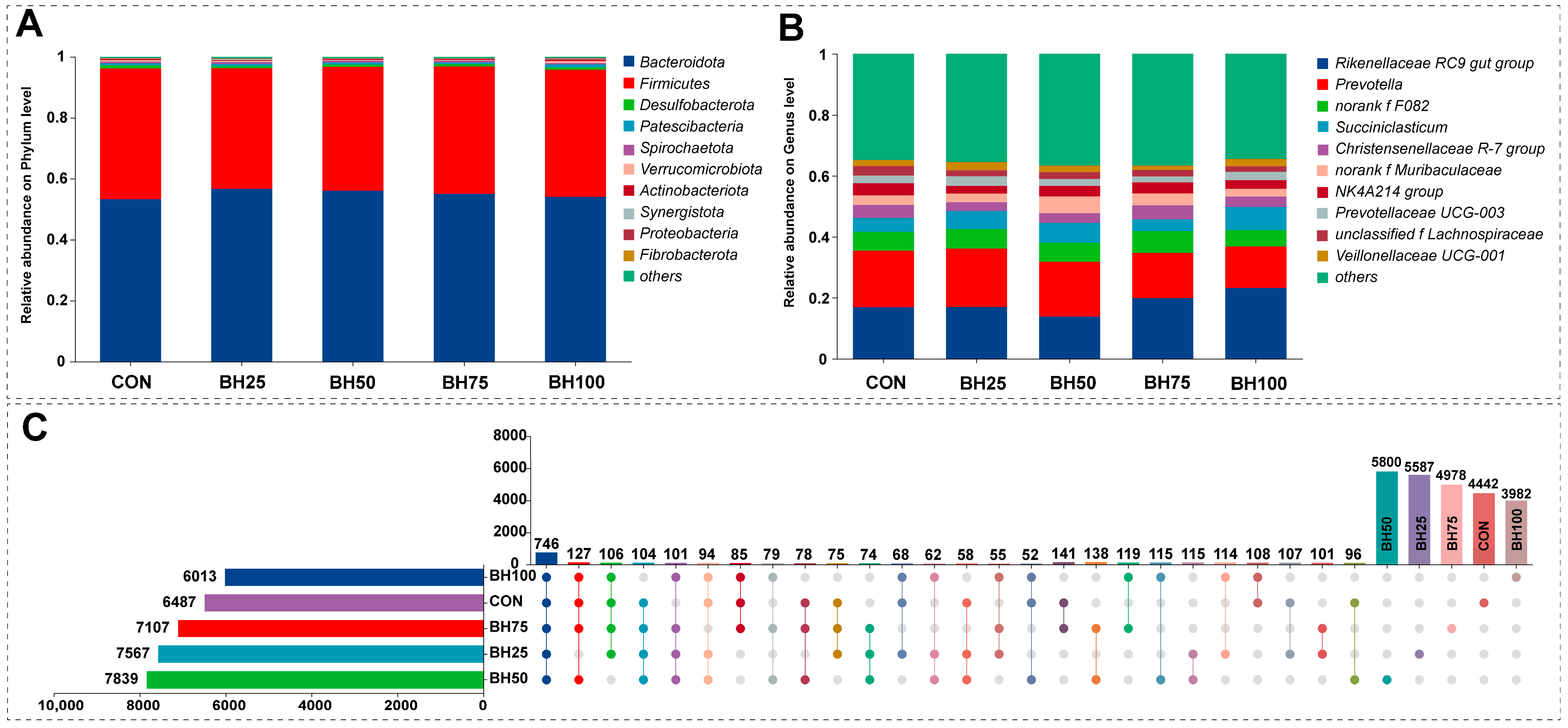
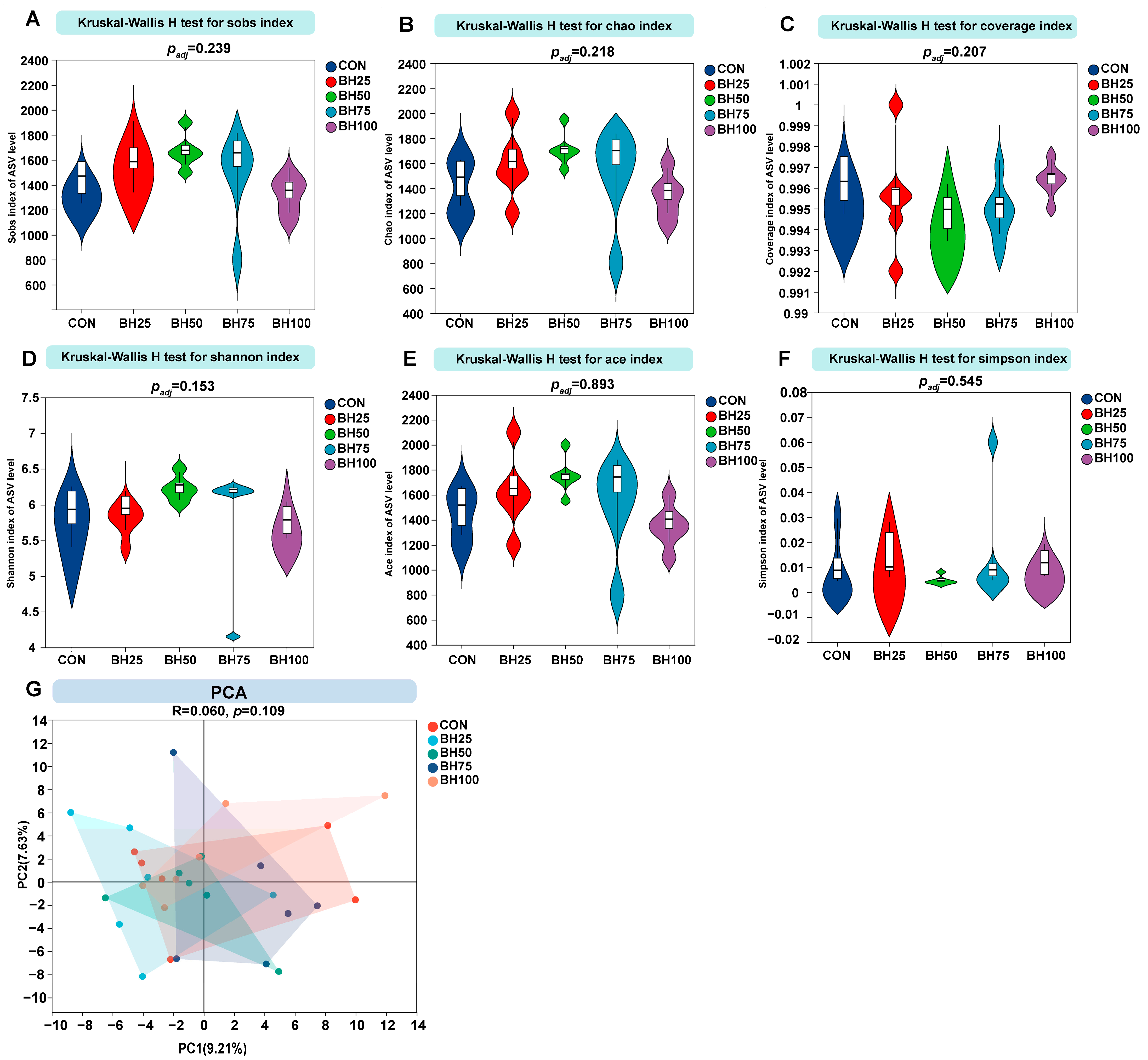
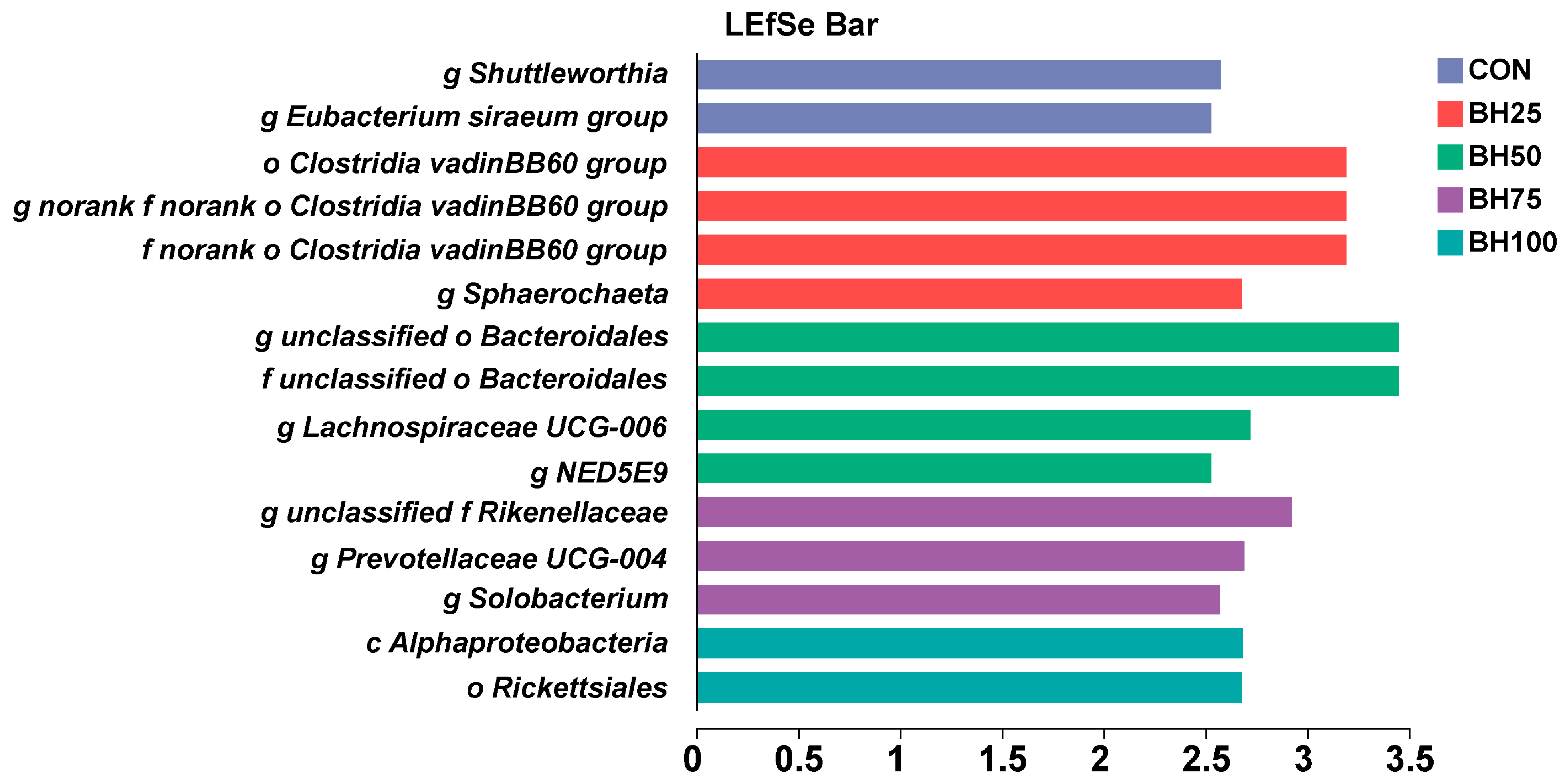
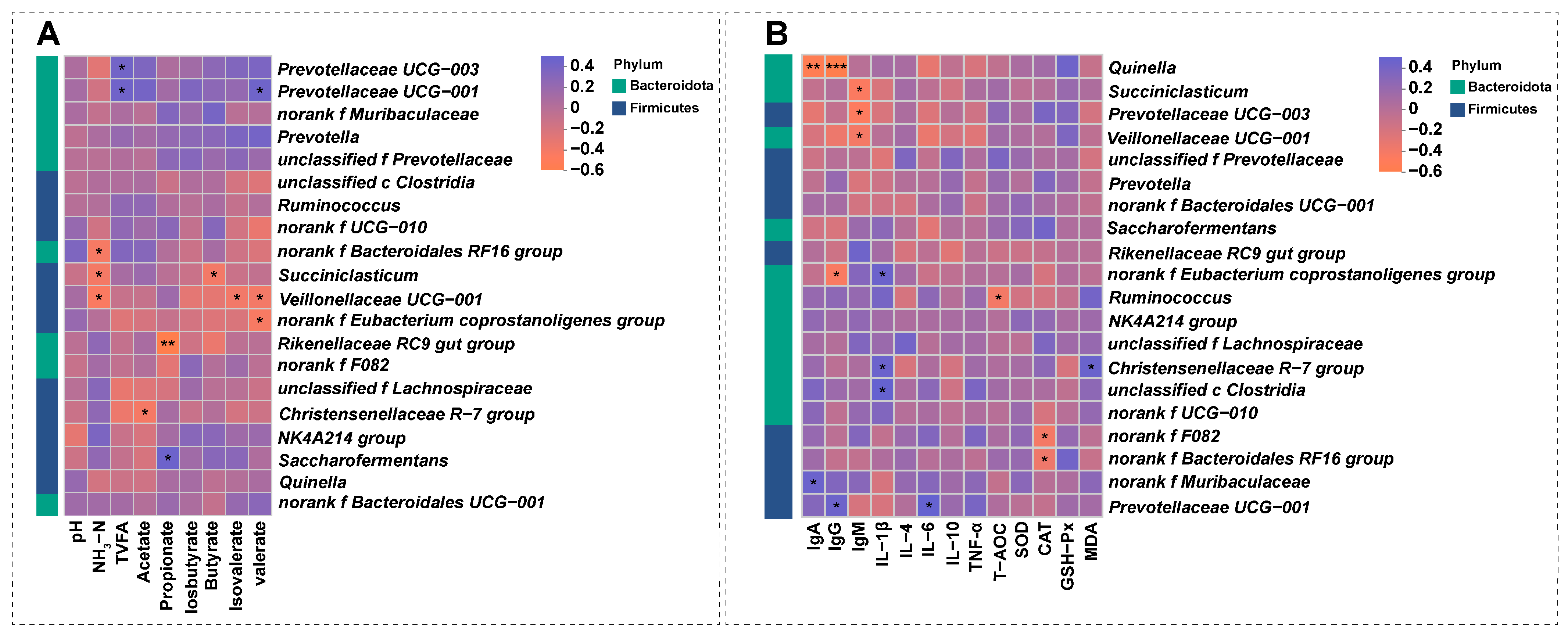
Replacing Dietary Roughage with Barley Hay Affects Rumen Fermentation, Microbial Community, Serum Immune and Antioxidant Status in Sheep

 , ,
, ,
Simple Summary
Abstract
1. Introduction
2. Materials and Methods
2.1. Ethics Statement
2.2. Study Site and Material Preparation
2.3. Experimental Design and Animal Management
2.4. Sample Collection
2.4.1. Feed Sampling
2.4.2. Rumen Fluid Collection
2.4.3. Serum Sampling
2.5. Chemical and Biological Analyses
2.5.1. Feed Chemical Composition
2.5.2. Rumen Fermentation Parameters
2.5.3. Rumen Microbiota Sequencing
2.5.4. Serum Immune and Antioxidant Parameters
2.6. Data Analysis
3. Results
3.1. Effects of Dietary Barley Hay Proportion on Rumen Fermentation in Lambs
3.2. Microbial Community Composition
3.3. Community Diversity Analysis
3.4. Differential Abundance Analysis
3.5. Effects of Dietary Barley Hay Proportion on Serum Immune Levels in Lambs
3.6. Effects of Dietary Barley Hay Proportion on Serum Antioxidant Levels in Lambs
3.7. Impacts of Key Rumen Microbiota on Fermentation Parameters, Serum Immunity, and Antioxidant Indices
4. Discussion
4.1. Impact of Barley Hay Substitution on Ruminal Fermentation and Nitrogen Efficiency
4.2. Microbiota Remodeling as a Driver of Altered Metabolic Pathways
4.3. Linking Ruminal Changes to Host Immunity and Antioxidant Status
4.4. Limitations and Future Perspectives
5. Conclusions
Author Contributions
Funding
Institutional Review Board Statement
Informed Consent Statement
Data Availability Statement
Acknowledgments
Conflicts of Interest
References
- Wang, Y.Q.; Luo, Y.; Luo, L.L.; Zhang, H.; Liao, Y.C.; Guo, C.L. Enhancement of the nutritional value of fermented corn stover as ruminant feed using the fungi Pleurotus spp. Sci. Rep. 2021, 11, 11961. [Google Scholar] [CrossRef]
- Van Soest, P.J. Nutritional Ecology of the Ruminant, 2nd ed.; Cornell University Press: Ithaca, NY, USA, 1994; p. 476. [Google Scholar]
- Liu, K.Z.; Zhang, Y.D.; Yu, Z.T.; Xu, Q.B.; Zheng, N.; Zhao, S.G.; Huang, G.X.; Wang, J.Q. Ruminal microbiota–host interaction and its effect on nutrient metabolism. Anim. Nutr. 2021, 7, 49–55. [Google Scholar] [CrossRef]
- Avellaneda, Y.; Mancipe, E.; Vargas, J.; Manriquez, D. Energy and Protein Requirements of Growing Lambs in Colombian Highlands. Animals 2024, 14, 2117. [Google Scholar] [CrossRef]
- Thatiparthi, J.; Dodoala, S.; Koganti, B.; Kvsrg, P. Barley grass juice (Hordeum vulgare L.) inhibits obesity and improves lipid profile in high fat diet-induced rat model. J. Ethnopharmacol. 2019, 238, 111843. [Google Scholar] [CrossRef]
- Zhu, Y.; Li, T.; Fu, X.; Abbasi, A.M.; Zheng, B.S.; Li, R.H. Phenolics content, antioxidant and antiproliferative activities of dehulled highland barley (Hordeum vulgare L.). J. Funct. Foods 2015, 19, 439–450. [Google Scholar] [CrossRef]
- Adom, K.K.; Sorrells, M.E.; Liu, R.H. Phytochemical profiles and antioxidant activity of wheat varieties. J. Agric. Food Chem. 2003, 51, 7825–7834. [Google Scholar] [CrossRef]
- Shahidi, F.; Chandrasekara, A. Millet grain phenolics and their role in disease risk reduction and health promotion: A review. J. Funct. Foods 2013, 5, 570–581. [Google Scholar] [CrossRef]
- Liu, R.H. Whole grain phytochemicals and health. J. Cereal Sci. 2007, 46, 207–219. [Google Scholar] [CrossRef]
- Shewry, P.R.; Pirronen, V.; Lampi, A.M.; Nyström, L.; Li, L.; Rakszegi, M.; Fraś, A.; Boros, D.; Gebruers, K.; Courtin, C.M.; et al. Phytochemical and Fiber Components in Oat Varieties in the HEALTHGRAIN Diversity Screen. J. Agric. Food Chem. 2008, 56, 9777–9784. [Google Scholar] [CrossRef] [PubMed]
- Gómez-Caravaca, A.M.; Verardo, V.; Berardinelli, A.; Marconi, E.; Caboni, M.F. A chemometric approach to determine the phenolic compounds in different barley samples by two different stationary phases: A comparison between C18 and pentafluorophenyl core shell columns. J. Chromatogr. A 2014, 1355, 134–142. [Google Scholar] [CrossRef]
- Chan, G.C.F.; Chan, W.K.; Sze, D.M.Y. The effects of beta-glucan on human immune and cancer cells. J. Hematol. Oncol. 2009, 2, 25. [Google Scholar] [CrossRef] [PubMed]
- Brown, G.D.; Gordon, S. Immune recognition. A new receptor for beta-glucans. Nature 2001, 413, 36–37. [Google Scholar] [CrossRef]
- Wang, X.Y.; Bai, C.; Khas, E.; Zheng, Y.K.; Cao, Q.N.; Han, G.L.; Ao, C.J. Allium mongolicum Regel Enhances Serum Immunity, Antioxidant, and Biochemical Indicators of Meat Sheep Achieved by Rumen Microbiota Regulation. Animals 2025, 15, 2491. [Google Scholar] [CrossRef]
- Waghorn, G.C.; McNabb, W.C. Consequences of plant phenolic compounds for productivity and health of ruminants. Proc. Nutr. Soc. 2003, 62, 383–392. [Google Scholar] [CrossRef]
- Benninghoff, J.; Paschke-Beese, M.; Südekum, K.H. In situ and in vitro ruminal degradation of maize grain and untreated or xylose-treated wheat, barley and rye grains. Anim. Feed Sci. Technol. 2015, 210, 86–93. [Google Scholar] [CrossRef]
- Huws, S.A.; Creevey, C.J.; Oyama, L.B.; Mizrahi, I.; Denman, S.E.; Popova, M.; Muñoz-Tamayo, R.; Forano, E.; Waters, S.M.; Hess, M. Addressing Global Ruminant Agricultural Challenges Through Understanding the Rumen Microbiome: Past, Present, and Future. Front. Microbiol. 2018, 9, 2161. [Google Scholar] [CrossRef]
- Filnt, H.J.; Bayer, E.A.; Rincon, M.T.; Lamed, R.; White, B.A. Polysaccharide utilization by gut bacteria: Potential for new insights from genomic analysis. Nat. Rev. Microbiol. 2008, 6, 121–131. [Google Scholar] [CrossRef]
- Myer, P.R.; Smith, T.P.L.; Wells, J.E.; Kuehn, L.A.; Freetly, H.C. Changes in the rumen microbiome from steers differing in feed efficiency. PLoS ONE 2015, 10, e0129174. [Google Scholar] [CrossRef] [PubMed]
- Corrêa-Oliveira, R.; Fachi, J.L.; Vieira, A.; Sato, F.T.; Vinolo, M.A.R. Regulation of immune cell function by short-chain fatty acids. Clin. Transl. Immunol. 2016, 5, e73. [Google Scholar] [CrossRef] [PubMed]
- Roediger, W.E.W. Utilization of nutrients by isolated epithelial cells of the rat colon. Gastroenterology 1982, 83, 424–429. [Google Scholar] [CrossRef]
- NY/T 816-2021; Nutrient Requirements of Mutton Sheep. Ministry of Agriculture and Rural Affairs (MARA): Beijing, China, 2021.
- Ding, H.; Liu, W.J.; Khas, E.; Du, H.X.; Ao, C.J. Effects of dietary supplementation with Allium mongolicum Regel extracts on growth performance, serum metabolites, immune responses, antioxidant status, and meat quality of lambs. Anim. Nutr. 2021, 7, 530–538. [Google Scholar] [CrossRef]
- AOAC. Official Methods of Analysis, 18th ed.; Association of Official Agricultural Chemists: Gaithsburg, MD, USA, 2005. [Google Scholar]
- Plante-Dubé, M.; Sylvestre, C.; Bourassa, R.; Luimes, P.; Toral, P.G.; Buczinski, S.; Castonguay, F.; Gervais, R. Energy metabolism and ruminal fermentation of prolific ewes in response to scheduled increase, relative to lambing, of dietary energy source and concentration. Animal 2025, 19, 101691. [Google Scholar] [CrossRef] [PubMed]
- Wang, Q.Y.; Wang, Y.C.; Wang, X.; Dai, C.P.; Tang, W.S.; Li, J.Z.; Huang, P.F.; Li, Y.L.; Ding, X.Q.; Huang, J.; et al. Effects of dietary energy levels on rumen fermentation, microbiota, and gastrointestinal morphology in growing ewes. Food Sci. Nutr. 2020, 8, 6621–6632. [Google Scholar] [CrossRef]
- Liu, Y.A.; Jia, Y.Q.; Wu, Y.Y.; Zhang, H.J.; Ren, F.Y.; Zhou, S.M. Review on mechanisms of hypoglycemic effects of compounds from highland barley and potential applications. Food Funct. 2024, 15, 11365–11382. [Google Scholar] [CrossRef]
- Zhu, F.M.; Du, B.; Xu, B.J. Superfine grinding improves functional properties and antioxidant capacities of bran dietary fibre from Qingke (hull-less barley) grown in Qinghai-Tibet Plateau, China. J. Cereal Sci. 2015, 65, 43–47. [Google Scholar] [CrossRef]
- Beauchemin, K.A. Invited review: Current perspectives on eating and rumination activity in dairy cows. J. Dairy Sci. 2018, 101, 4762–4784. [Google Scholar] [CrossRef] [PubMed]
- Guo, C.; Wu, Y.Q.; Li, S.L.; Cao, Z.J.; Wang, Y.J.; Mao, J.; Shi, H.T.; Shi, R.H.; Sun, X.G.; Zheng, Y.H. Effects of Different Forage Types on Rumen Fermentation, Microflora, and Production Performance in Peak-Lactation Dairy Cows. Fermentation 2022, 8, 507. [Google Scholar] [CrossRef]
- Bach, A.; Calsamiglia, S.; Stern, M.D. Nitrogen Metabolism in the Rumen. J. Dairy Sci. 2005, 88, E9–E21. [Google Scholar] [CrossRef]
- Rosmalia, A.; Permana, I.G.; Despal, D. Synchronization of rumen degradable protein with non-fiber carbohydrate on microbial protein synthesis and dairy ration digestibility. Vet. World 2022, 15, 252–261. [Google Scholar] [CrossRef]
- Seo, J.K.; Kim, M.H.; Yang, J.Y.; Lee, C.H.; Kim, K.H.; Ha, J.K. Effects of synchronicity of carbohydrate and protein degradation on rumen fermentation characteristics and microbial protein synthesis. Asian-Australas. J. Anim. Sci. 2013, 26, 358–365. [Google Scholar] [CrossRef]
- Brassard, M.E.; Chouinard, P.Y.; Berthiaume, R.; Tremblay, G.F.; Gervais, R.; Martineau, R.; Mars, D.C. Effects of grain source, grain processing, and protein degradability on rumen kinetics and microbial protein synthesis in Boer kids. J. Anim. Sci. 2015, 93, 5355–5366. [Google Scholar] [CrossRef]
- Coker, J.K.; Moyne, O.; Rodionov, D.A.; Zengler, K. Carbohydrates great and small, from dietary fiber to sialic acids: How glycans influence the gut microbiome and affect human health. Gut Microbes 2021, 13, 1869502. [Google Scholar] [CrossRef]
- Alqurashi, R.M.; Al-Mssallem, M.Q.; Al-Majed, A.W.; Almaghasla, M.I.; Alarifi, A.W. Comparative modulation of the gut microbiota by date-derived products and refined sugar: A 16S rRNA gene taxonomic profile in healthy rats. Front. Microbiol. 2026, 17, 1762458. [Google Scholar] [CrossRef] [PubMed]
- Hristov, A.N.; Oh, J.; Firkins, J.L.; Dijkstra, J.; Kebreab, E.; Waghorn, G.; Makkar, H.P.S.; Adesogan, A.T.; Yang, W.; Lee, C.; et al. Special topics—Mitigation of methane and nitrous oxide emissions from animal operations: I. A review of enteric methane mitigation options. J. Anim. Sci. 2013, 91, 5045–5069. [Google Scholar] [CrossRef]
- Nocek, J.E.; Russell, J.B. Protein and Energy as an Integrated System. Relationship of Ruminal Protein and Carbohydrate Availability to Microbial Synthesis and Milk Production. J. Dairy Sci. 1988, 71, 2070–2107. [Google Scholar] [CrossRef]
- Mertens, D.R. Creating a System for Meeting the Fiber Requirements of Dairy Cows. J. Dairy Sci. 1997, 80, 1463–1481. [Google Scholar] [CrossRef] [PubMed]
- Jami, E.; Mizrahi, I. Composition and similarity of bovine rumen microbiota across individual animals. PLoS ONE 2012, 7, e33306. [Google Scholar] [CrossRef]
- Li, F.Y.; Guan, L.L. Metatranscriptomic Profiling Reveals Linkages between the Active Rumen Microbiome and Feed Efficiency in Beef Cattle. Appl. Environ. Microbiol. 2017, 83, e00061-17. [Google Scholar] [CrossRef]
- Fernando, S.C.; Purvis, H.T., 2nd; Najar, F.Z.; Sukharnikov, L.O.; Krehbiel, C.R.; Nagaraja, T.G.; Roe, B.A.; Desilva, U. Rumen microbial population dynamics during adaptation to a high-grain diet. Appl. Environ. Microbiol. 2010, 76, 7482–7490. [Google Scholar] [CrossRef] [PubMed]
- Kittelmann, S.; Seedorf, H.; Walters, W.A.; Clemente, J.C.; Knight, R.; Gordon, J.I.; Janssen, P.H. Simultaneous amplicon sequencing to explore co-occurrence patterns of bacterial, archaeal and eukaryotic microorganisms in rumen microbial communities. PLoS ONE 2013, 8, e47879. [Google Scholar] [CrossRef]
- Newbold, C.J.; Ramos-Morales, E. Review: Ruminal microbiome and microbial metabolome: Effects of diet and ruminant host. Animal 2020, 14, s78–s86. [Google Scholar] [CrossRef] [PubMed]
- Fang, X.Y.; Wang, Z.Y.; Chen, Q.R.; Du, Y.Q.; Sun, H.W.; Liu, H.Y.; Feng, Y.; Li, Z.Y.; Teng, T.; Shi, B.M. Protective effect of the branched short-chain fatty acid isobutyrate on intestinal damage in weaned piglets through intestinal microbiota remodeling. J. Sci. Food Agric. 2025, 105, 1556–1568. [Google Scholar] [CrossRef]
- Betancur-Murillo, C.L.; Aguilar-Marín, S.B.; Jovel, J. Prevotella: A Key Player in Ruminal Metabolism. Microorganisms 2022, 11, 1. [Google Scholar] [CrossRef]
- Rabee, A.E.; Sayed Alahl, A.A.; Lamara, M.; Ishaq, S.L. Fibrolytic rumen bacteria of camel and sheep and their applications in the bioconversion of barley straw to soluble sugars for biofuel production. PLoS ONE 2022, 17, e0262304. [Google Scholar] [CrossRef]
- Souza, J.M.; Ribeiro, P.H.C.; Millen, D.D. Review: Shifts of rumen microbiota by feeding non-fibrous carbohydrates to improve cattle performance. Front. Microbiol. 2026, 17, 1735296. [Google Scholar] [CrossRef]
- Segura-Wang, M.; Grabner, N.; Koestelbauer, A.; Klose, V.; Ghanbari, M. Genome-Resolved Metagenomics of the Chicken Gut Microbiome. Front. Microbiol. 2021, 12, 726923. [Google Scholar] [CrossRef]
- Henderson, G.; Cox, F.; Ganesh, S.; Jonker, A.; Young, W.; Collaborators, G.R.C.; Janssen, P.H. Rumen microbial community composition varies with diet and host, but a core microbiome is found across a wide geographical range. Sci. Rep. 2015, 5, 14567. [Google Scholar] [CrossRef]
- Jami, E.; White, B.A.; Mizrahi, I. Potential Role of the Bovine Rumen Microbiome in Modulating Milk Composition and Feed Efficiency. PLoS ONE 2014, 9, e85423. [Google Scholar] [CrossRef] [PubMed]
- Petri, R.M.; Schwaiger, T.; Penner, G.B.; Beauchemin, K.A.; Forster, R.J.; Mckinnon, J.J.; McAllister, T.A. Characterization of the core rumen microbiome in cattle during transition from forage to concentrate as well as during and after an acidotic challenge. PLoS ONE 2013, 8, e83424. [Google Scholar] [CrossRef] [PubMed]
- Krautkramer, K.A.; Fan, J.; Bäckhed, F. Gut microbial metabolites as multi-kingdom intermediates. Nat. Rev. Microbiol. 2021, 19, 77–94. [Google Scholar] [CrossRef]
- Hiebl, C.; Pinner, D.; Konegger, H.; Steger, F.; Mohamed, D.; Fuchs, W. Enhancing Gas Fermentation Efficiency via Bioaugmentation with Megasphaera sueciensis and Clostridium carboxidivorans. Bioengineering 2025, 12, 470. [Google Scholar] [CrossRef] [PubMed]
- Ahmed, E.; Yano, R.; Fujimori, M.; Kand, D.; Hanada, M.; Nishida, T.; Fukuma, N. Impacts of Mootral on Methane Production, Rumen Fermentation, and Microbial Community in an in vitro Study. Front. Vet. Sci. 2021, 7, 623817. [Google Scholar] [CrossRef]
- Wolin, M.J.; Miller, T.L.; Stewart, C.S. Microbe-microbe interactions. In The Rumen Microbial Ecosystem, 2nd ed.; Hobson, P.N., Stewart, C.S., Eds.; Springer: Dordrecht, The Netherlands, 1997; pp. 467–491. [Google Scholar]
- Hungate, R.E. The Rumen and Its Microbes; Academic Press (Elsevier): New York, NY, USA, 2013. [Google Scholar]
- Plaizier, J.C.; Krause, D.O.; Gozho, G.N.; McBride, B.W. Subacute ruminal acidosis in dairy cows: The physiological causes, incidence and consequences. Vet. J. 2008, 176, 21–31. [Google Scholar] [CrossRef]
- Zebeli, Q.; Dijkstra, J.; Tafaj, M.; Steingass, H.; Ametaj, B.N.; Drochner, W. Modeling the adequacy of dietary fiber in dairy cows based on the responses of ruminal pH and milk fat production to composition of the diet. J. Dairy Sci. 2008, 91, 2046–2066. [Google Scholar] [CrossRef]
- Choct, M. Enzymes for the feed industry: Past, present and future. World Poult. Sci. J. 2006, 62, 5–16. [Google Scholar] [CrossRef]
- Tsoni, S.V.; Brown, G.D. beta-Glucans and dectin-1. Ann. N. Y. Acad. Sci. 2008, 1143, 45–60. [Google Scholar] [CrossRef]
- Bekele, A.Z.; Koike, S.; Kobayashi, Y. Genetic diversity and diet specificity of ruminal Prevotella revealed by 16S rRNA gene-based analysis. FEMS Microbiol. Lett. 2010, 305, 49–57. [Google Scholar] [CrossRef]
- Lee, D.H.; Kim, M.T.; Han, J.H. GPR41 and GPR43: From development to metabolic regulation. Biomed. Pharmacother. 2024, 175, 116735. [Google Scholar] [CrossRef] [PubMed]
- Zhang, D.; Jian, Y.P.; Zhang, Y.N.; Li, Y.; Gu, L.T.; Sun, H.H.; Liu, M.D.; Zhou, H.L.; Wang, Y.S.; Xu, Z.X. Short-chain fatty acids in diseases. Cell Commun. Signal. 2023, 21, 212. [Google Scholar] [CrossRef]
- Tao, Z.P.; Wang, Y. The health benefits of dietary short-chain fatty acids in metabolic diseases. Crit. Rev. Food Sci. Nutr. 2025, 65, 1579–1592. [Google Scholar] [CrossRef] [PubMed]
- Kumar, S.; Altermann, E.; Leahy, S.C.; Jauregui, R.; Jonker, A.; Henderson, G.; Kittelmann, S.; Attwood, G.T.; Kamke, J.; Waters, S.M. Genomic insights into the physiology of Quinella, an iconic uncultured rumen bacterium. Nat. Commun. 2022, 13, 6240. [Google Scholar] [CrossRef]
- Trevisi, E.; Amadori, M.; Cogrossi, S.; Razzuoli, E.; Bertoni, G. Metabolic stress and inflammatory response in high-yielding, periparturient dairy cows. Res. Vet. Sci. 2012, 93, 695–704. [Google Scholar] [CrossRef] [PubMed]
- Lykkesfeldt, J.; Svendsen, O. Oxidants and antioxidants in disease: Oxidative stress in farm animals. Vet. J. 2007, 173, 502–511. [Google Scholar] [CrossRef]
- Huntington, G.B. Starch utilization by ruminants: From basics to the bunk. J. Anim. Sci. 1997, 75, 852–867. [Google Scholar] [CrossRef] [PubMed]
- Halliwell, B.; Gutteridge, J.M.C. Free Radicals in Biology and Medicine, 5th ed.; Oxford University Press: Oxford, UK, 2015. [Google Scholar]
- Bernabucci, U.; Ronchi, B.; Lacetera, N.; Nardone, A. Influence of body condition score on relationships between metabolic status and oxidative stress in periparturient dairy cows. J. Dairy Sci. 2005, 88, 2017–2026. [Google Scholar] [CrossRef]
- Harlow, B.E.; Flythe, M.D.; Aiken, G.E. Biochanin A improves fibre fermentation by cellulolytic bacteria. J. Appl. Microbiol. 2018, 124, 58–66. [Google Scholar] [CrossRef] [PubMed]
- Jiang, C.X.; Ding, L.M.; Dong, Q.M.; Wang, X.J.; Wei, H.Y.; Hu, C.S.; Ma, C.F.; Zhou, Y.Q.; Degen, A.A. Effects of root extracts of three traditional Chinese herbs as dietary supplements on dry matter intake, average daily gain, rumen fermentation and ruminal microbiota in early weaned yak calves. Anim. Feed Sci. Technol. 2021, 278, 115002. [Google Scholar] [CrossRef]
- Zhou, D.; Pan, Q.; Xin, F.Z.; Zhang, R.N.; He, C.X.; Chen, G.Y.; Liu, C.; Chen, Y.W.; Fan, J.G. Sodium butyrate attenuates high-fat diet-induced steatohepatitis in mice by improving gut microbiota and gastrointestinal barrier. World J. Gastroenterol. 2017, 23, 60–75. [Google Scholar] [CrossRef]
- Ma, N.; Abaker, J.A.; Wei, G.; Chem, H.; Shen, X.; Chang, G. A high-concentrate diet induces an inflammatory response and oxidative stress and depresses milk fat synthesis in the mammary gland of dairy cows. J. Dairy Sci. 2022, 105, 5493–5505. [Google Scholar] [CrossRef]



| Items 1 | Treatments 2 | ||||
|---|---|---|---|---|---|
| CON | BH25 | BH50 | BH75 | BH100 | |
| Ingredients | |||||
| Barley Hay | 10.30 | 20.60 | 30.90 | 41.19 | |
| Leymus chinensis | 10.21 | 7.66 | 5.10 | 2.55 | |
| Corn Stover | 30.98 | 22.23 | 15.49 | 7.75 | |
| Commercial Diet | 38.47 | 39.01 | 39.55 | 40.09 | 40.63 |
| Corn Silage | 19.32 | 18.78 | 18.24 | 17.69 | 17.16 |
| Limestone | 0.12 | 0.12 | 0.12 | 0.12 | 0.12 |
| NaCl | 0.30 | 0.30 | 0.30 | 0.30 | 0.30 |
| Sodium Bicarbonate | 0.20 | 0.20 | 0.20 | 0.20 | 0.20 |
| Premix | 0.40 | 0.40 | 0.40 | 0.40 | 0.40 |
| Total | 100.00 | 100.00 | 100.00 | 100.00 | 100.00 |
| Nutrient Levels | |||||
| Metabolic Energy (MJ, kg) | 14.91 | 14.86 | 14.56 | 14.37 | 14.34 |
| CP | 13.62 | 13.79 | 14.05 | 14.21 | 14.67 |
| ADF | 23.86 | 24.43 | 26.01 | 26.58 | 27.15 |
| NDF | 43.87 | 45.24 | 46.61 | 47.98 | 49.35 |
| Ca | 1.18 | 1.19 | 1.21 | 1.22 | 1.24 |
| P | 0.61 | 0.60 | 0.59 | 0.58 | 0.57 |
| Nutrient Levels 1 | Barley Hey | Corn Stover | Leymus chinensis |
|---|---|---|---|
| Metabolic energy (MJ/kg) | 12.77 | 13.31 | 13.88 |
| CP | 8.50 | 4.20 | 8.44 |
| ADF | 34.30 | 24.93 | 29.07 |
| NDF | 54.78 | 60.01 | 57.69 |
| Ca | 0.33 | 0.28 | 0.35 |
| P | 0.23 | 0.13 | 0.15 |
| Items 1 | Treatments 2 | SEM | p-Value | ||||
|---|---|---|---|---|---|---|---|
| CON | BH25 | BH50 | BH75 | BH100 | |||
| pH | 6.65 | 6.68 | 6.70 | 6.82 | 6.72 | 0.15 | 0.938 |
| Acetate, mmol/L | 15.40 b | 29.06 a | 34.28 a | 29.89 a | 36.37 a | 4.16 | 0.014 |
| Propionate, mmol/L | 7.87 | 7.30 | 7.36 | 4.49 | 6.39 | 0.85 | 0.068 |
| Butyrate, mmol/L | 5.98 | 3.44 | 5.57 | 4.34 | 3.83 | 0.73 | 0.087 |
| Isobutyrate, mmol/L | 0.58 | 0.50 | 0.58 | 0.63 | 0.64 | 0.09 | 0.853 |
| Valerate, mmol/L | 0.54 | 0.48 | 0.54 | 0.58 | 0.51 | 0.07 | 0.897 |
| Isovalerate, mmol/L | 1.11 | 0.87 | 1.05 | 1.08 | 1.07 | 0.14 | 0.781 |
| A:P | 2.13 b | 4.40 ab | 4.65 ab | 6.66 a | 6.37 a | 0.89 | 0.010 |
| TVFA, mmol/L | 31.47 | 41.65 | 49.38 | 41.01 | 48.81 | 4.92 | 0.100 |
| NH3-N, mg/dL | 2.98 a | 2.63 abc | 2.33 c | 2.84 ab | 2.44 bc | 0.15 | 0.033 |
| Estimators | Treatments 1 | Adjusted p-Value | ||||
|---|---|---|---|---|---|---|
| CON | BH25 | BH50 | BH75 | BH100 | ||
| Ace | 1493.44 | 1673.06 | 1768.95 | 1608.75 | 1405.27 | 0.239 |
| Chao | 1465.0651 | 1637.72 | 1726.15 | 1572.16 | 1378.36 | 0.218 |
| Sobs | 1443.00 | 1611.17 | 1693.17 | 1540.17 | 1356.83 | 0.207 |
| Shannon | 5.89 | 5.95 | 6.25 | 5.88 | 5.79 | 0.153 |
| Coverage | 1.00 | 1.00 | 1.00 | 1.00 | 1.00 | 0.893 |
| Simpson | 0.01 | 0.02 | 0.01 | 0.02 | 0.01 | 0.545 |
| Items 1 | Treatments 2 | SEM | p-Value | ||||
|---|---|---|---|---|---|---|---|
| CON | BH25 | BH50 | BH75 | BH100 | |||
| day 30 | |||||||
| IgA, μg/mL | 91.83 c | 94.23 bc | 109.49 a | 113.41 a | 101.07 b | 1.76 | <0.001 |
| IgG, μg/mL | 1277.10 b | 1279.02 b | 1392.59 a | 1395.98 a | 1311.30 b | 22.99 | <0.001 |
| IgM, μg/mL | 12.52 | 12.71 | 12.48 | 12.98 | 12.37 | 0.20 | 0.224 |
| IL-1β, ng/L | 116.06 | 117.43 | 115.10 | 121.41 | 120.38 | 1.77 | 0.079 |
| IL-4, pg/mL | 132.15 a | 130.09 a | 129.88 a | 124.32 b | 122.16 b | 1.84 | 0.003 |
| IL-6, ng/L | 102.95 c | 132.64 b | 145.55 a | 149.93 a | 127.60 b | 0.77 | <0.001 |
| IL-10, ng/L | 203.27 a | 200.11 a | 202.21 a | 193.17 a | 182.60 b | 3.46 | 0.001 |
| TNF-α, ng/L | 1080.26 | 1111.43 | 1102.49 | 1109.29 | 1067.03 | 20.81 | 0.490 |
| day 60 | |||||||
| IgA, μg/mL | 93.04 d | 94.95 cd | 107.38 b | 114.63 a | 99.68 c | 1.65 | <0.001 |
| IgG, μg/mL | 1271.97 b | 1288.64 b | 1364.36 a | 1360.68 a | 1288.64 ab | 21.56 | 0.013 |
| IgM, μg/mL | 12.22 | 12.61 | 12.27 | 12.61 | 12.10 | 0.15 | 0.075 |
| IL-1β, ng/L | 117.75 | 117.67 | 112.47 | 117.54 | 119.09 | 2.97 | 0.575 |
| IL-4, pg/mL | 132.36 a | 131.66 a | 132.75 a | 123.57 b | 122.70 b | 1.66 | <0.001 |
| IL-6, ng/L | 103.17 d | 135.08 c | 141.51 b | 148.93 a | 130.54 c | 0.89 | <0.001 |
| IL-10, ng/L | 203.77 a | 199.35 a | 204.39 a | 186.31 b | 184.20 b | 2.70 | <0.001 |
| TNF-α, ng/L | 1020.59 b | 1114.39 a | 1115.52 a | 1105.74 a | 1032.93 b | 18.29 | <0.001 |
| Items 1 | Treatments 2 | SEM | p-Value | ||||
|---|---|---|---|---|---|---|---|
| CON | BH25 | BH50 | BH75 | BH100 | |||
| day 30 | |||||||
| T-AOC, U/mL | 7.83 | 7.60 | 7.64 | 7.69 | 7.71 | 0.10 | 0.559 |
| SOD, pg/mL | 233.22 | 224.11 | 226.87 | 213.62 | 222.22 | 4.44 | 0.062 |
| CAT, ng/L | 210.14 a | 190.42 b | 192.04 b | 197.58 b | 190.89 b | 3.49 | 0.002 |
| GSH-Px, pmol/mL | 63.16 | 61.02 | 61.97 | 60.00 | 60.89 | 1.12 | 0.350 |
| MDA, nmol/mL | 10.64 b | 11.14 a | 11.32 a | 11.43 a | 11.09 a | 0.34 | 0.006 |
| day 60 | |||||||
| T-AOC, U/mL | 7.83 | 7.57 | 7.65 | 7.48 | 7.67 | 0.11 | 0.271 |
| SOD, pg/mL | 232.81 | 219.05 | 226.77 | 217.49 | 224.11 | 3.92 | 0.070 |
| CAT, ng/L | 219.85 a | 186.66 c | 191.26 bc | 187.83 bc | 198.70 b | 3.72 | <0.001 |
| GSH-Px, pmol/mL | 62.30 | 59.78 | 62.07 | 59.08 | 60.30 | 1.04 | 0.148 |
| MDA, nmol/mL | 10.89 b | 10.84 b | 11.39 ab | 11.68 a | 11.15 ab | 0.46 | 0.020 |
Disclaimer/Publisher’s Note: The statements, opinions and data contained in all publications are solely those of the individual author(s) and contributor(s) and not of MDPI and/or the editor(s). MDPI and/or the editor(s) disclaim responsibility for any injury to people or property resulting from any ideas, methods, instructions or products referred to in the content. |
© 2026 by the authors. Licensee MDPI, Basel, Switzerland. This article is an open access article distributed under the terms and conditions of the Creative Commons Attribution (CC BY) license.
Share and Cite
Wang, X.; Liu, X.; Hai, L.; Han, G.; Erdene, K.; Bai, C.; Cao, Q.; Zheng, Y.; Liu, Z.; Ao, C. Replacing Dietary Roughage with Barley Hay Affects Rumen Fermentation, Microbial Community, Serum Immune and Antioxidant Status in Sheep. Animals 2026, 16, 1565. https://doi.org/10.3390/ani16101565
Wang X, Liu X, Hai L, Han G, Erdene K, Bai C, Cao Q, Zheng Y, Liu Z, Ao C. Replacing Dietary Roughage with Barley Hay Affects Rumen Fermentation, Microbial Community, Serum Immune and Antioxidant Status in Sheep. Animals. 2026; 16(10):1565. https://doi.org/10.3390/ani16101565
Chicago/Turabian StyleWang, Xiaoyuan, Xinyi Liu, Lahan Hai, Guoli Han, Khas Erdene, Chen Bai, Qina Cao, Yankai Zheng, Zhiping Liu, and Changjin Ao. 2026. "Replacing Dietary Roughage with Barley Hay Affects Rumen Fermentation, Microbial Community, Serum Immune and Antioxidant Status in Sheep" Animals 16, no. 10: 1565. https://doi.org/10.3390/ani16101565
APA StyleWang, X., Liu, X., Hai, L., Han, G., Erdene, K., Bai, C., Cao, Q., Zheng, Y., Liu, Z., & Ao, C. (2026). Replacing Dietary Roughage with Barley Hay Affects Rumen Fermentation, Microbial Community, Serum Immune and Antioxidant Status in Sheep. Animals, 16(10), 1565. https://doi.org/10.3390/ani16101565