To Farm or Not to Farm? Pilot Testing a Sentiocentric Ethical Framework for Farming Non-Typical Species
 ,
,  ,
,  , ,
, ,  ,
,  , ,
, ,
Simple Summary
Abstract
1. Introduction
2. Materials and Methods
2.1. Survey Participants
2.2. Survey Design
2.3. Data Analysis
3. Results
3.1. Respondent Information
3.2. Background Information About Focal Species
3.3. Application of the Framework
3.4. Further Questions
3.5. Feedback About the Framework
3.6. Proposed Revisions to the Mullan et al. [4] Framework
4. Discussion
5. Conclusions
Supplementary Materials
Author Contributions
Funding
Institutional Review Board Statement
Informed Consent Statement
Data Availability Statement
Conflicts of Interest
References
- Rizzolo, J.B. Wildlife Farms, Stigma and Harm. Animals 2020, 10, 1783. [Google Scholar] [CrossRef]
- Green, J.; Schmidt-Burbach, J.; Elwin, A. Taking stock of wildlife farming: A global perspective. Glob. Ecol. Conserv. 2023, 43, e02452. [Google Scholar] [CrossRef]
- Nguyen, D.H.; Dinh, T.M. Legal framework for wildlife farming benefits species conservation and preventing wildife crimes in Vietnam. E3S Web Conf. 2020, 175, 03025. [Google Scholar] [CrossRef]
- Mullan, S.; Nogueira, S.S.; Nogueira-Filho, S.; Zanella, A.; Rooney, N.; Held, S.D.; Mendl, M. Farming non-typical sentient species: Ethical framework requires passing a high bar. J. Agric. Environ. Ethics 2024, 37, 10. [Google Scholar] [CrossRef] [PubMed]
- Mylonas, C.C.; Robles, R.; Tacken, G.; Banovic, M.; Krystallis, A.; Guerrero, L.; Grigorakis, K. Exploring the biological and socio-economic potential of new/emerging candidate fish species for the expansion of the European aquaculture industry. Impact 2017, 2017, 14–16. [Google Scholar]
- Nogueira, S.S.; Nogueira-Filho, S.L. Wildlife farming: An alternative to unsustainable hunting and deforestation in Neotropical forests? Biodivers. Conserv. 2011, 20, 1385–1397. [Google Scholar] [CrossRef]
- Roe, D.; Lee, T.M. Possible negative consequences of a wildlife trade ban. Nat. Sustain. 2021, 4, 5–6. [Google Scholar] [CrossRef]
- Nijman, V.; Shepherd, C.R. Adding Up the Numbers: An Investigation into Commercial Breeding of Tokay Geckos in Indonesia; TRAFFIC: Petaling Jaya, Malaysia, 2015. [Google Scholar]
- Cawthorn, D.M.; Hoffmann, L.C. The role of traditional and non-traditional meat animals in feeding a growing and evolving world. Anim. Front. 2014, 4, 6–12. [Google Scholar] [CrossRef]
- Hoffman, L.C.; Cawthorn, D.M. What is the role and contribution of meat from wildlife in providing high quality protein for consumption? Anim. Front. 2012, 2, 40–53. [Google Scholar] [CrossRef]
- Tensen, L. Under what circumstances can wildlife farming benefit species conservation? Glob. Ecol. Conserv. 2016, 6, 286–298. [Google Scholar] [CrossRef]
- Barbosa, H.M.; Nogueira-Filho, S.L.G.; de Morais, R.N.; Nogueira, S.S.d.C. Non-invasive stress monitoring and temperament of chestnut-bellied seed-finch (Passeriformes, Thraupidae). Appl. Anim. Behav. Sci. 2019, 220, 104859. [Google Scholar] [CrossRef]
- Lima, A.F.D.; Lima, S.G.; Nogueira-Filho, S.L.; Held, S.D.; Mendl, M.; Nogueira, S.S. Object Play as a Positive Emotional State Indicator for Farmed Spotted Paca (Cuniculus paca). Animals 2023, 14, 78. [Google Scholar] [CrossRef] [PubMed]
- Nogueira, S.S.C.; Nogueira-Filho, S.L.G. Capybara (Hydrochoerus hydrochaeris) behaviour and welfare: Implications for successful farming practices. Anim. Welf. 2012, 21, 527–533. [Google Scholar] [CrossRef]
- Oliveira, F.R.; Nogueira-Filho, S.L.; Sousa, M.B.; Dias, C.T.; Mendl, M.; Nogueira, S.S. Measurement of cognitive bias and cortisol levels to evaluate the effects of space restriction on captive collared peccary (Mammalia, Tayassuidae). Appl. Anim. Behav. Sci. 2016, 181, 76–82. [Google Scholar] [CrossRef]
- Latinne, A.; Padungtod, P. Wildlife Pathogens and Zoonotic Disease Risk Assessment in Vietnam: A Wildlife Trade Hotspot. Transbound. Emerg. Dis. 2025, 2025, 4926262. [Google Scholar] [CrossRef]
- Van Thu, N.; Newman, S.; Padungtod, P. Captive wildlife management survey in Vietnam, 2015–2021. One Health 2023, 16, 17100543. [Google Scholar] [CrossRef] [PubMed] [PubMed Central]
- Murphy, M.; Hoffmann, V.; Ambler, K.; Nguyen, H.T.T.; Dang-Xuan, S.; Nguyen-Viet, H.; Unger, F.; Bett, B. Economic Aspects of Wildlife Farming: Analysis of Household Surveys from Two Vietnamese Provinces; International Food Policy Research Institute: Washington, DC, USA, 2025. [Google Scholar]
- Broom, D.M. Concepts and interrelationships of awareness, consciousness, sentience, and welfare. J. Conscious. Stud. 2022, 29, 129–149. [Google Scholar] [CrossRef]
- Marshall, M.N. The key informant technique. Fam. Pract. 1996, 13, 92–97. [Google Scholar] [CrossRef]
- Duminy, L. A System Dynamics Approach to Understanding the Ostrich Industry of South Africa. Ph.D. Thesis, Stellenbosch University, Stellenbosch, South Africa, 2016. [Google Scholar]
- Sandø, P.; Christiansen, S.B.; Appleby, M.C. Farm Animal Welfare: The Interaction of Ethical Questions and Animal Welfare Science. Anim. Welf. 2003, 12, 469–478. [Google Scholar] [CrossRef]
- Fennell, D.A. Bridging the global-local animal-based tourism divide. Ann. Tour. Res. 2022, 96, 103459. [Google Scholar] [CrossRef]
- Coals, P.; Burnham, D.; Loveridge, A.; Macdonald, D.W.; Sas-Rolfes, M.; Williams, V.L.; Vucetich, J.A. The ethics of human–animal relationships and public discourse: A case study of lions bred for their bones. Animals 2019, 9, 52. [Google Scholar] [CrossRef]
- Farm Animal Welfare Council. Report on Farm Animal Welfare in Great Britain: Past, Present and Future, Department for Environment; Food & Rural Affairs: London, UK, 2009.



| Response | Research Discipline | Length of Time Researching Farming Non-Typical Species | Geographic Research Focus |
|---|---|---|---|
| 1 | Not provided | 10+ years | South America |
| 2 | Not provided | 10+ years | South America |
| 4 | Farming neo tropical wild animals for sustainability conservation and use | 10+ years | South America |
| 3 | Animal science and production | 10+ years | South America |
| 5 | Applied herpetology, biodiversity conservation | 10+ years | Africa, Asia |
| 6 | Applied herpetology, biodiversity conservation | 10+ years | Africa, Asia |
| 7 | Entomology | 1–5 years | Africa, Asia, Europe, North America |
| 8 | Mammalogy | 10+ years | South America |
| 9 | Philosophy | 1–5 years | Europe, North America |
| 10 | Bison and wapiti (Cervus elaphus) production | 10+ years | North America |
| 11 | Wild animals: production and conservation | 10+ years | South America |
| 12 | Veterinary production animals | 10+ years | Africa |
| 13 | Behaviour, physiology, neurophysiology, microbiology | 1–5 years | Africa, Australia/Oceania |
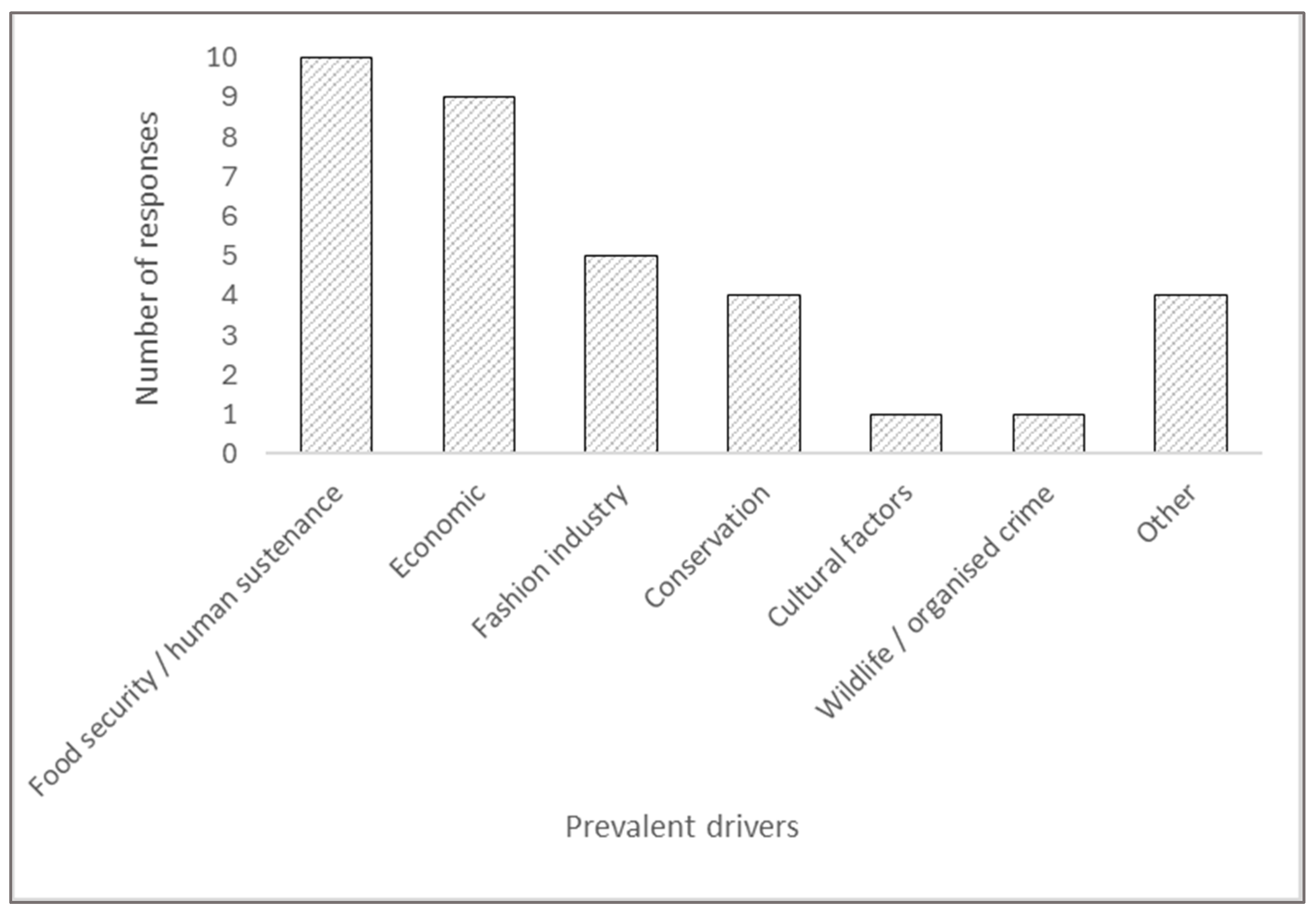
| Chosen Species | Prevalent Driver(s) for Farming | Approx. Total Number of Farms | Approx. Total Number of Animals in All Countries | Approx. Total Annual Slaughter | Farming Increasing/Declining? | Continents Farmed | Countries Farmed | Farming System(s) |
|---|---|---|---|---|---|---|---|---|
| Capybara (Hydrochoerus hydrochaeris) | Other: Nowadays, food security has taken a back seat as capybara populations have increased greatly and there is a conflict between animal and human coexistence, mainly due to the transmission of spotted fever by ticks hosted by capybaras. | 51–100 | 60–100 | 1 to 50 | Declining | South America | Brazil, Argentina, Venezuela | In Brazil, capybaras are mostly raised in captivity, in paddocks. In Venezuela, they are wild harvested. |
| Capybara (Hydrochoerus hydrochaeris) | Food security, human sustenance, Economic, fashion industry | 11 to 50 | 100–500 | Unknown | Declining | South America | Brazil, Argentina, Venezuela, Colombia, Peru | Farms or specialised facilities—diet, health, and breeding are managed, producing primarily for meat and leather. Allows for selective breeding, enhancing desirable traits in the capybara population. Semi-captive systems—large, fenced areas that mimic their natural habitats but with some level of human intervention. Provides capybaras with more space and a natural diet while still allowing for some degree of management and protection from predators. Semi-captive breeding aims to balance animal welfare with economic production, making it a popular choice among producers seeking sustainable methods. Wild capybaras are also legally hunted in some countries. |
| Collared peccary (Dicotyles tajacu) | Food security/human sustenance, economic | 11 to 50 | 1000–5000 | Unknown | Unchanging | South America | Brazil | Most farmers use a semi-confined production system. This is because Brazil prohibits the commercial hunting of collared peccaries and other wild species. Peccaries are kept in paddocks ranging in size from 400 m2 to 5 hectares. Males are kept with females at all times and females do not need to be isolated to give birth. These farmers usually feed the peccaries with food resources available in the region, such as by-products from the agricultural production of the property and its neighbours. The young grow up in the same group in which they were born and reach a slaughter weight of between 19 and 22 kg at the age of 10 to 15 months (depending on the type of food they eat). |
| Collared peccary (Dicotyles tajacu) | Food security/human sustenance, economic, conservation, fashion industry, cultural factors, organised wildlife crime | Unknown | Unknown | Unknown | Unknown | South America | Brazil, Peru, Bolivia, Argentina | Intensive and semi-extensive enclosure design, good reproduction behaviour and management. Slaughter techniques based on domestic animals. Easy to feed. Farmed for meat and skin. |
| Agouti (Dasyprocta) | Food security/human sustenance, economic, conservation | 11 to 50 | 5000–10,000 | 5000–10,000 | Increasing | South America | 10 different countries, not specified | Intensive farming, captive breeding in cages and floor pens, slaughtered at farm abattoir, fed rabbit pellets and local feedstuff |
| Burmese python (Python bivittatus) | Economic, fashion industry | Unknown | Unknown | Unknown | Unchanging | Asia | Vietnam, Thailand | Exclusively captive including breeding. Small and large scale intensive production and processing not unlike poultry and pig farming. Slaughter involves complete brain destruction by hammer or captive bolt gun. Diet includes waste protein from agri-food chains (e.g., still born pigs and fish skins) and pest rodents harvested from rice fields. |
| Oriental rat snake (Ptyas mucosa) | Food security/human sustenance, economic | 500+ | Unknown | Unknown | Unchanging | Asia | China, Vietnam | Closed cycle breeding and rearing facilities. Large enclosures housing hundreds of individuals. Fed poultry waste. Mostly live sales to snake markets and direct to restaurants. |
| Black soldier fly (Hermetia illucens) | Food security/human sustenance, economic, other: to support cheaper, and possibly more sustainable, feed options for vertebrate livestock animals. Realistically, few will be consumed directly by humans. | 100–500 | 8–16 billion (under-estimate as industry growing rapidly) | 190 billion BSF are slaughtered each year around the globe as of 2020 | Increasing | Africa, Asia, Europe, Oceania, North America, South America | U.S., Canada, Australia, UK, many Asian (e.g., TH, CN), EU (e.g., NL), and African nations (e.g., ZA) | Exclusively captive. Larvae are fed substrates of varying quality in small pans or large trays, and are the primary product that is slaughtered; adults, used as breeders, are housed in mesh-sided mating cages or in large greenhouses. Food, and sometimes water, is not provided for adults, which desiccate or starve to death. Slaughter includes oven baking, microwaving, grinding/shredding, boiling/blanching, sun roasting, sand roasting, freezing in air, asphyxiation, freezing in liquid nitrogen. A minority are live-fed to consumer animals. |
| Black soldier fly (Hermetia illucens) | Other: BSF are reared as feed for conventional terrestrial and aquatic livestock. | 100–500 | 1,000,000+ | Primary product is not meat (e.g., eggs) | Increasing | Europe, North America | U.S., France | Scientists do not know much about the abilities of BSF larvae, farmed mostly for animal feed. However, it is known that when heated, they thrash around and try to escape and when cut, they roll around very rapidly. They are raised in an organic substrate that they crawl through and eat. Mixed substrates (for instance, grains and vegetable waste) offer a better balance of nutrients and promote heath than simple substrates, and they show preferences for certain foodstuffs. If the temperature or moisture level is too high or low, then many of the larvae die. The method of slaughter depends on the intended use but includes grinding, roasting, microwaving, and boiling and are not stunned prior to slaughter. |
| American bison (Bison bison) | Food security/human sustenance | 500+ | 500,000–1,000,000 | 50,000–100,000 | Increasing | North America | U.S., Canada | Breeding is natural, as artificial insemination is not a commercially viable option. Calving is in outdoor pens or pastures in spring. Primarily raised on pasture and typically finished in large feeding areas (more square footage per animal than a typical beef feedlot). The majority of North American bison are slaughtered in federally inspected slaughter plants in the USA and Canada, some in state or provincially inspected plants and even fewer animals are slaughtered on farm. Bison are very adapted to thriving in cold winter temperatures, and snow. They are not raised indoors, and there are not typically shelters in pastures for them. They have the ability to utilise low quality forage and break down highly fibrous plant matter. Their strong metabolic seasonality coincides with the winter and summer seasons and forage availability. |
| Scorpion mud turtle (Kinosternon scorpioides) | Food security/human sustenance, economic, conservation | 1 to 10 | 500–1000 | 60–100 | Increasing | South America | Brazil | The total area of the breeding facility is 200 m2, divided into five environments, according to the phases of zootechnical development of animals: artificial hatchery (6 m2), nursery (6 m2)—animals up to 50 g; recreate (30 m2)—animals over 51 g up to 250 g; reproduction (50 m2)—animals over 251 g; quarantine (8 m2). The reproduction area has a water tank and a sand area, where eggs are laid. The animals received commercial food (32% crude protein), three times a week, based on 1% of body weight. |
| Ostrich (Struthio camelus) | Economic, fashion industry, other: only agri-enterprise suitable for the environment, with a lot of intellectual property in the community. Complete rural economy built on enterprise | 100–500 | 100,000–500,000 | 100,000–500,000 | Unchanging | Africa | South Africa | Complete commercial integrated and non-integrated production system. Domesticated animals only, no collection form the wild or from wild populations. Free range systems with early production—intensive management interaction and protection against environmental conditions decreasing with time as animals grow older. EU approved welfare and slaughter requirements as well as health status verification. Complete individual traceability |
| Crocodilian spp. | Food security/human sustenance, conservation, fashion industry | 51–100 | Unknown | Unknown | Increasing | Africa, Asia, Oceania, North America, South America | Australia, Zimbabwe, U.S., Papua New Guinea | Very variable depending on species of crocodilian—alligators and caimans are captive bred to a greater extent than Nile and saltwater crocodilians. Hatching is in artificial hatcheries, with strict temperature and humidity control. Animals are group housed as hatchlings and growers. Pens have basking areas, ponds and hides. The aggressive species (C. porosus) may be finished in single pens with a water body, basking shelf, and hide. Slaughter is captive bolt followed by pithing. |
Disclaimer/Publisher’s Note: The statements, opinions and data contained in all publications are solely those of the individual author(s) and contributor(s) and not of MDPI and/or the editor(s). MDPI and/or the editor(s) disclaim responsibility for any injury to people or property resulting from any ideas, methods, instructions or products referred to in the content. |
© 2026 by the authors. Licensee MDPI, Basel, Switzerland. This article is an open access article distributed under the terms and conditions of the Creative Commons Attribution (CC BY) license.
Share and Cite
Hale, H.; Nogueira, S.S.C.; Nogueira-Filho, S.; Zanella, A.; Rooney, N.; Rizzolo, J.B.; Held, S.D.E.; Mendl, M.; Mullan, S. To Farm or Not to Farm? Pilot Testing a Sentiocentric Ethical Framework for Farming Non-Typical Species. Animals 2026, 16, 1519. https://doi.org/10.3390/ani16101519
Hale H, Nogueira SSC, Nogueira-Filho S, Zanella A, Rooney N, Rizzolo JB, Held SDE, Mendl M, Mullan S. To Farm or Not to Farm? Pilot Testing a Sentiocentric Ethical Framework for Farming Non-Typical Species. Animals. 2026; 16(10):1519. https://doi.org/10.3390/ani16101519
Chicago/Turabian StyleHale, Helena, Selene S. C. Nogueira, Sérgio Nogueira-Filho, Adroaldo Zanella, Nicola Rooney, Jessica Bell Rizzolo, Suzanne D. E. Held, Michael Mendl, and Siobhan Mullan. 2026. "To Farm or Not to Farm? Pilot Testing a Sentiocentric Ethical Framework for Farming Non-Typical Species" Animals 16, no. 10: 1519. https://doi.org/10.3390/ani16101519
APA StyleHale, H., Nogueira, S. S. C., Nogueira-Filho, S., Zanella, A., Rooney, N., Rizzolo, J. B., Held, S. D. E., Mendl, M., & Mullan, S. (2026). To Farm or Not to Farm? Pilot Testing a Sentiocentric Ethical Framework for Farming Non-Typical Species. Animals, 16(10), 1519. https://doi.org/10.3390/ani16101519