Article

Physiological Thresholds and Adaptation Mechanisms of the Ili Perch (Perca schrenkii) to Chloride-Type Saline Water

1
College of Life Science and Technology, Tarim University, Alar 843300, China
2
Xinjiang Production & Construction Corps Key Laboratory of Protection and Utilization of Biological Resources in Tarim Basin, Alar 843300, China
3
Xinjiang Production and Construction Corps Aquaculture Technology Promotion General Station, Urumqi 830002, China
4
Yutian Fengze Technology Aquatic Products Co., Ltd., Hetian 848400, China
5
Aral Changxin Fishery Co., Ltd., Aral 843300, China
*
Authors to whom correspondence should be addressed.
These authors contributed equally to this work.
Animals 2026, 16(1), 63; https://doi.org/10.3390/ani16010063
Submission received: 3 November 2025 / Revised: 16 December 2025 / Accepted: 18 December 2025 / Published: 25 December 2025

Simple Summary

Global freshwater scarcity has pushed the exploration of saline-alkaline aquaculture, especially in Northwest China where chloride-type saline-alkaline water is abundant but underused. Perca schrenkii (Ili perch), an endemic fish in the Ili River basin, shows promise for such aquaculture, yet its salinity tolerance and adaptation ability remain unclear. This study involved two experiments: an acute high-salinity test (11–15 ppt, 96 h) and a chronic low-salinity acclimation test (3–7 ppt, 60 days). We found the 96 h median lethal salinity (LC50) of P. schrenkii was 12.396 ppt, and it could fully adapt to long-term culture in ≤7 ppt salinity—with 3 ppt causing almost no stress. These results provide clear salinity guidelines for the safe and sustainable cultivation of P. schrenkii in saline waters.

Abstract

Global freshwater scarcity necessitates the exploitation of alternative water resources for aquaculture. Chloride-type saline-alkaline water, characterized by high salinity but moderate pH, is widely distributed in arid regions worldwide and represents a vast, underutilized resource. This study comprehensively evaluated the potential of the endemic Ili perch (Perca schrenkii) for aquaculture in such environments. Through acute stress experiments, we determined its 96 h median lethal salinity (LC50) to be 12.396 ppt, with a safe concentration of 3.72 ppt. Physiological analysis revealed a critical salinity threshold of 13 ppt, beyond which osmoregulatory collapse (indicated by plasma Na+/K+ dysregulation and Na+-K+-ATPase suppression), oxidative damage (elevated malondialdehyde), and immune suppression occurred. In contrast, chronic 60-day exposure to salinities up to 7 ppt demonstrated successful long-term acclimation. Acclimated fish re-established ion homeostasis, as plasma ion levels normalized, and exhibited sustained antioxidant enzyme (SOD, CAT) and immune parameter (AKP, ACP, IgM) activities without signs of damage. Our findings establish P. schrenkii as a highly promising species for chloride-type saline-alkaline aquaculture. The study provides a physiological framework for its adaptation and offers evidence-based salinity guidelines for its sustainable cultivation, thereby contributing to the expansion of aquaculture into non-traditional water resources.

1. Introduction

Global warming, coupled with escalating water demand driven by population growth and socioeconomic development, has significantly exacerbated pressures on the planet’s limited freshwater resources. This challenge is particularly pronounced in water-scarce or water-stressed regions, where unmet water demand increasingly outstrips available renewable supplies—ultimately leading to a state of “water bankruptcy.” Such a scenario is accompanied by concomitant adverse socioeconomic consequences, including disruptions to agricultural productivity, constraints on industrial development, compromised public health services, and heightened risks of intersectoral or transboundary conflicts over water allocation [1]. This crisis is exacerbated by the rapid expansion of aquaculture: global aquatic animal production from aquaculture reached 87.5 million tonnes in 2023, surpassing that of capture fisheries for the first time and intensifying pressure on limited freshwater reserves [2]. The growing dependence of agricultural and aquacultural production on the unsustainable exploitation of finite freshwater resources has further intensified pressures on global water security. Consequently, the need to explore alternative water resources tailored for aquacultural practices has become increasingly imperative [3].
China, the world’s largest aquaculture producer, confronts unique challenges: freshwater aquaculture constitutes over 75% of its total aquatic production [4], yet the country holds only 6% of global freshwater reserves, with extreme regional disparities. Northwest China, a core arid-agricultural zone, harbors approximately 30 million hectares of exploitable saline-alkaline water, of which chloride-type saline-alkaline water (dominated by Cl·Na+ ions, total dissolved solids [TDS] 5–30 g/L, pH 7.2–9.1) accounts for ~60% [5]. Developing these underutilized resources offers a transformative solution: saline-alkaline water aquaculture not only alleviates freshwater competition but also reduces soil salinity through nutrient cycling, achieving ecological and economic co-benefits [6,7]. This water type is geochemically distinct from carbonate-type saline-alkaline water (characterized by HCO3/CO32−-induced pH stress, pH > 9.0), as its primary physiological challenge to freshwater fish is osmotic imbalance driven by high salinity [8,9,10,11,12,13]. Osmotic stress disrupts ion homeostasis (e.g., Na+/K+ dysregulation) [14], triggers reactive oxygen species (ROS) accumulation [15], and impairs innate immune response [16]—all of which reduce survival and growth in aquaculture settings [15,17].
A critical prerequisite for successful saline-alkaline water aquaculture is identifying fish species with inherent tolerance to elevated salinity, as freshwater fish typically suffer osmotic imbalance, oxidative stress, and growth inhibition under high-salt conditions [18,19]. Against this backdrop, Perca schrenkii (Ili perch)—an endemic carnivorous fish of the Ili River basin in Xinjiang—emerges as a uniquely promising candidate for chloride-type saline-alkaline aquaculture. Pilot field observations and genetic studies have documented its presence in oligohaline reaches of the Ili River delta (salinity up to 3 ppt), a niche where sympatric freshwater species (e.g., Ctenopharyngodon idella, Cyprinus carpio) are rarely detected—suggesting intrinsic evolutionary adaptations to mild salinity [20,21]. Moreover, recent studies on Xinjiang’s endemic fish have shown that mild saline exposure (3–5 ppt) can enhance muscle nutritional quality, suggesting similar potential for P. schrenkii [22,23]. This combination of ecological adaptability and potential for quality enhancement positions it as an ideal model to unravel the mechanisms of fish adaptation to chloride-type saline-alkaline water.
Notably, while the saline tolerance of its congener Perca fluviatilis (Eurasian perch) has been well-characterized—with freshwater populations exhibiting a 96 h median lethal concentration (LC50) of 10 ppt and growth inhibition above 8 ppt [24,25,26]—critical knowledge gaps persist for P. schrenkii. First, its acute tolerance threshold to chloride-type saline stress (e.g., NaCl-simulated osmotic imbalance) remains unquantified, precluding the identification of safe salinity ranges for aquaculture. Second, the tissue-specific dynamics of key adaptive pathways—including gill/kidney osmoregulation, hepatic oxidative defense, and intestinal/plasma immunity—under both acute and chronic salinity exposure are unknown. For example, Na+-K+-ATPase is critical for osmotic balance, but its activation kinetics in P. schrenkii under chloride-type stress have never been measured. Third, no studies have evaluated its long-term growth performance in sub-lethal chloride-type salinities—a prerequisite for translating physiological data to commercial aquaculture practice [27].
To address these gaps, this study designed controlled experiments using NaCl to simulate the core stress of chloride-type saline-alkaline water (osmotic imbalance), thereby isolating its effects from other confounding factors. We conducted two complementary experiments: (1) an acute salinity stress experiment (salinity gradients: 11, 12, 13, 14, 15 ppt; sampling times: 0, 6, 12, 24, 48, 96 h) to define the 96 h LC50 and characterize short-term behavioral and physiological responses and (2) a chronic salinity stress experiment (salinity gradients: 0 [control], 3, 5, 7 ppt; sampling times: 30, 60 days) to evaluate growth performance and long-term physiological homeostasis. The overarching goal was to establish a mechanistic framework for P. schrenkii’s adaptation to chloride-type saline-alkaline water, providing evidence-based recommendations for its sustainable cultivation. Additionally, this study aims to advance the broader understanding of freshwater fish adaptation to osmotic stress, offering a template for future research on other candidate species for saline-alkaline aquaculture.

2. Materials and Methods

2.1. Experimental Fish and Acclimation

Juvenile Perca schrenkii were collected from the Emin River basin (Xinjiang, China), a natural habitat of this species. Prior to experiments, fish were screened for health status (no injuries, uniform size, active swimming), with a final selected size of body length 12.15 ± 2.32 cm and body weight 7.53 ± 1.68 g.
Acclimation was conducted in 1000 L recirculating aquaculture systems (Zhongke Ruiying Aquaculture Equipment Co., Ltd., Wuxi, Jiangsu, China) for 14 days to minimize stress from transportation and environmental change. Acclimation conditions were maintained as follows: water temperature (22 ± 1) °C, pH 7.60 ± 0.35, dissolved oxygen (7.80 ± 0.52) mg/L, ammonia nitrogen ≤ 0.3 mg/L, nitrite ≤ 0.03 mg/L, and salinity 0.65 ± 0.30 ppt (consistent with the Fishery Water Quality Standard, GB 11607-1989 [28]). Fish were fed a commercial extruded feed (crude protein ≥ 40%, crude lipid ≥ 8%; Tongwei Co., Ltd., Chengdu, Sichuan, China) twice daily (09:00 and 17:00) at a feeding rate of 3% body weight. Feeding was withheld 24 h before the start of experiments to avoid gastrointestinal contents interfering with tissue sampling.
All experimental procedures were approved by the Animal Research Ethics Committee of Tarim University (Approval No. PB20250618003) and complied with the guidelines for the use of experimental animals in China.

2.2. Experimental Design

Two complementary experiments (acute and chronic salinity stress) were designed using NaCl (analytical grade, ≥99.5%, Nanjing, Jiangsu Chemical Reagent Co., Ltd., Nanjing, China) to simulate the core osmotic stress of chloride-type saline-alkaline water, with salinity stabilized for 24 h before experiments and re-measured using a Leici ZD-2 salinometer (Shanghai Yidian Scientific Instruments Co., Ltd., Shanghai, China) to ensure accuracy.

2.2.1. Acute Salinity Stress Experiment

Based on preliminary experiments (no mortality at salinity < 11 ppt, 100% mortality within 24 h at salinity > 15 ppt), 5 salinity gradients (11, 12, 13, 14, 15 ppt) and 1 freshwater control group (0 ppt) were set. Each group included 3 biological replicates, with 20 fish per replicate (housed in 50 L glass tanks, Taizhou Kelin Experimental Equipment Co., Ltd., Taizhou, Zhejiang, China; with micro-aeration, dissolved oxygen ≥ 6 mg/L).
Experimental duration was 96 h, with sampling time points at 0, 6, 12, 24, 48, and 96 h. At each time point, two types of measurements were conducted:
(1)
Behavioral observation, mortality recording and quantification
Behavioral responses were recorded to characterize the concentration- and time-dependent stress effects, with 3 randomly selected fish per replicate (9 fish per group) tracked for 10 min per observation (to avoid transient errors).
Death was defined as no response to glass rod stimulation (touching the caudal peduncle), cessation of gill movement, and permanent sinking to the tank bottom. Mortality was recorded every 2 h to calculate survival rates for each group.
Key behavioral indicators, their measurement methods, and quantification standards are detailed in Table 1.
(2)
Tissue and plasma sampling
After behavioral recording, 3 fish per replicate (9 fish per group) were anesthetized with 100 mg/L MS-222 (Sigma-Aldrich, St. Louis, MO, USA). Blood was collected from the caudal vein using heparinized syringes (1 mL, Jiangsu Kangjian Medical Devices Co., Ltd., Nantong, Jiangsu, China), centrifuged at 3000 rpm for 10 min at 4 °C to separate plasma, and stored at −80 °C. Gill, liver, intestine, and kidney tissues were rapidly dissected, rinsed with pre-cooled physiological saline (0.85% NaCl, Nanjing Chemical Reagent Co., Ltd., Nanjing, Jiangsu, China) to remove blood and debris, snap-frozen in liquid nitrogen, and stored at −80 °C for subsequent biochemical analyses.

2.2.2. Chronic Salinity Stress Experiment

Considering the acute tolerance threshold and the actual salinity range of chloride-type saline-alkaline water in Northwest China (3–10 ppt), 4 salinity gradients (0 [control], 3, 5, 7 ppt) were set. Each group included 3 biological replicates, with 30 fish per replicate (housed in 200 L glass tanks, daily water exchange rate 30% to maintain water quality).
Experimental duration was 60 d, with sampling time points at 60 d. At each time point, tissue and plasma sampling measurements were conducted:
Sampling methods were consistent with the acute experiment (3 fish per replicate), with tissues and plasma stored at −80 °C for biochemical analyses.
During both experiments, the photoperiod was maintained at 12L:12D (08:00–20:00 light), and water quality parameters (temperature, pH, dissolved oxygen) were monitored daily using a multi-parameter water quality analyzer (YSI ProPlus, YSI Inc., Yellow Springs, OH, USA). Feces were siphoned under dim light every 24 h to avoid water pollution.

2.3. Determination of Physiological and Biochemical Indicators

All indicators were measured using commercial kits (Nanjing Jiancheng Bioengineering Institute, Nanjing, Jiangsu, China) following the manufacturers’ protocols, with instrument models and detection principles specified below in Table 2. For tissue sample preparation: Tissues were homogenized in a liquid nitrogen-precooled mortar with 9 volumes of ice-cold physiological saline (w/v = 1:9). Homogenates were centrifuged at 3000 rpm for 10 min at 4°C, and the supernatant was diluted 5-fold with physiological saline before analysis. Plasma samples were used directly after centrifugation without dilution.

2.4. Data Processing and Statistical Analysis

2.4.1. Acute Toxicity Parameters

Mortality rates at each time point were used to calculate the 96 h median lethal concentration (LC50) and 95% confidence interval (CI) via Probit regression in IBM SPSS Statistics 26.0. The safe concentration (SC) was calculated using the modified Kou’s method for freshwater fish [29]:
SC = 48 h LC50 × 0.3/(24 h LC50/48 h LC50)2

2.4.2. Behavioral and Physiological Data

Behavioral data: Graded indicators were converted to numerical values (1–4) for statistical analysis; count/rate indicators were expressed as “mean ± standard error (mean ± SE)”. Physiological and growth data: All data were expressed as “mean ± SE”. Statistical analyses were conducted using IBM SPSS Statistics 26.0, and p < 0.05 was considered statistically significant.
Prior to analysis, normality (Shapiro–Wilk test) and homoscedasticity (Levene test) were verified. Two-way analysis of variance (Two-way ANOVA) was used to evaluate the main effects of salinity (fixed factor) and treatment time (fixed factor), as well as their interaction. If significant differences were detected (p < 0.05), Tukey’s post hoc test was performed for pairwise comparisons.
All charts (line graphs for temporal dynamics, bar graphs for salinity comparisons, heatmaps for comprehensive behavioral responses) were generated using Origin 2023 (OriginLab Corporation, Northampton, MA, USA). Significant differences were marked by lowercase letters (p < 0.05) for comparisons among salinity groups at the same time point, and uppercase letters (p < 0.05) for comparisons among time points within the same salinity group.

3. Results

3.1. Effects of Acute Salinity Stress on Perca schrenkii

3.1.1. Behavioral Responses to Acute Salinity Stress

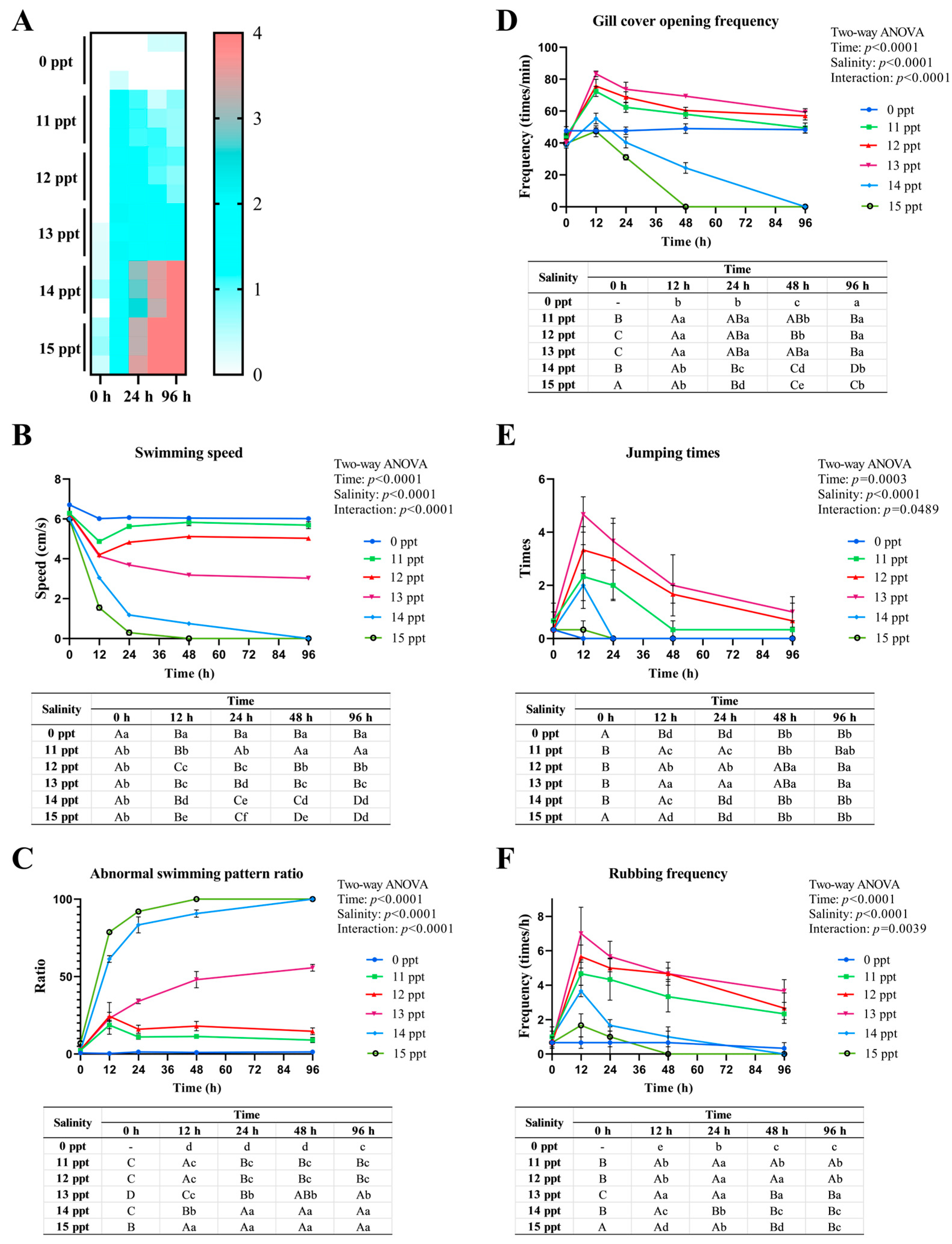
Acute salinity stress induced distinct concentration- and time-dependent behavioral changes in P. schrenkii, with the severity of abnormalities escalating synergistically with increasing salinity and exposure duration (Figure 1). The heatmap integrating five behavioral indicators into a comprehensive abnormality score (ranging from 0 = no abnormality to 4 = severe abnormality) visually delineated three response zones: a safe adaptation zone (score < 1.0) in the control group and partially in 11–12 ppt groups at later time points, a critical compensation zone (1.0 ≤ score < 3.0) primarily in 12–13 ppt groups, and a failure zone (score ≥ 3.0) evident in 14–15 ppt groups from 12 h onward (Figure 1A). Regarding swimming speed, the 0 ppt group maintained stability (6.0–9.0 cm/s), while salinity groups ≤ 12 ppt showed transient decreases at 6–12 h followed by recovery, the salinity group at 13 ppt exhibited a sustained decline, and groups ≥ 14 ppt rapidly deteriorated to near-static speed (Figure 1B). The abnormal swimming pattern ratio was low in the control group, increased transiently in ≤12 ppt groups, rose continuously in 13 ppt, and surged to >80% in ≥14 ppt groups by 12 h (Figure 1C). Gill cover opening frequency was stable in the control group, transiently elevated in ≤12 ppt groups, sustained at high levels in 13 ppt, and showed a biphasic trend (peak then plummet) in ≥14 ppt groups (Figure 1D). Jumping times were rare in the control group, peaked transiently in ≤12 ppt groups, remained high in 13 ppt, and decreased rapidly to 0 in ≥14 ppt groups after 24 h (Figure 1E). Rubbing frequency followed a similar pattern, with infrequent rubbing in the 0 ppt group, transient increases in ≤12 ppt groups, sustained high frequency in 13 ppt, and sharp decreases to near-zero in ≥14 ppt groups by 24 h (Figure 1F). Collectively, these behaviors exhibited a three-phase response: initial compensation (6–12 h, low-salinity groups), sustained adaptation or critical compensation (24–48 h, 13 ppt), and irreversible failure (≥24 h, ≥14 ppt), with 13 ppt emerging as a critical threshold separating reversible from irreversible behavioral deterioration.

3.1.2. Mortality and Lethal Threshold (LC50)

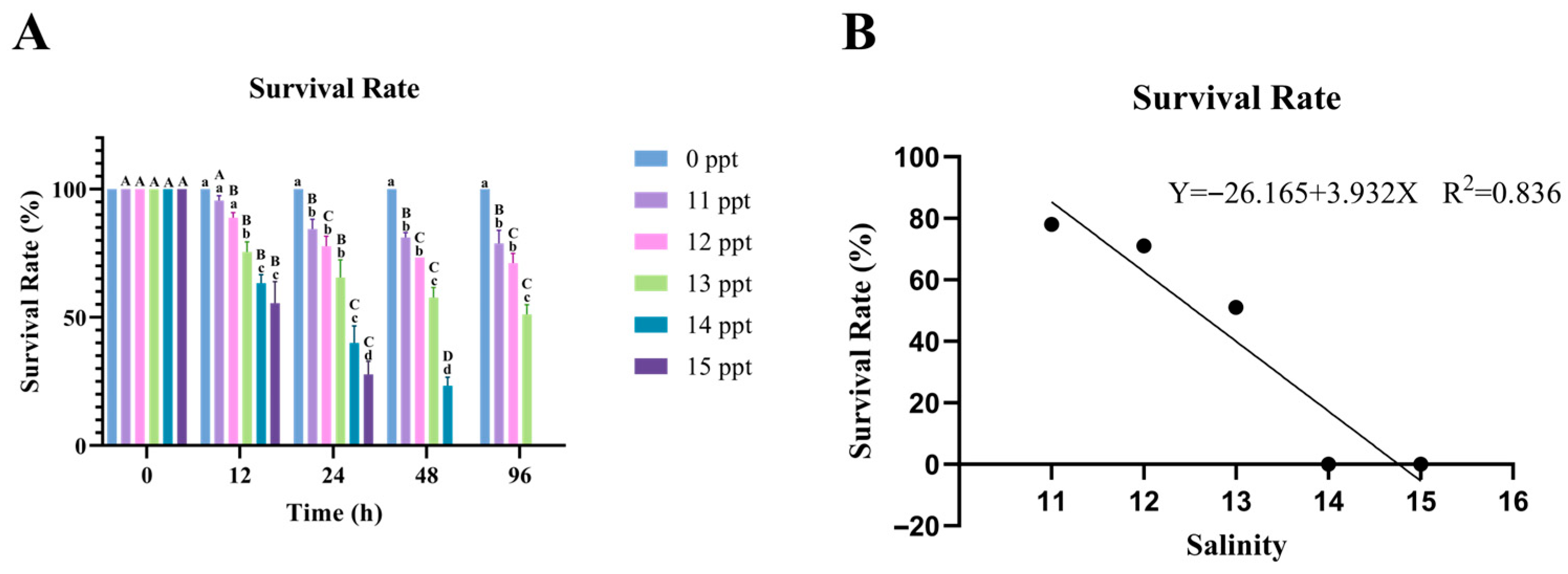
Acute salinity stress induced significant time- and concentration-dependent mortality in P. schrenkii, with survival rates plummeting drastically in groups exposed to salinity ≥ 14 ppt (Figure 2A). To quantify the lethal threshold, a Probit regression analysis was performed on the 96 h survival data, yielding a 96 h median lethal concentration (LC50) of 12.396 ppt (Figure 2B). The regression equation (Y = −26.165 + 3.932X) exhibited a coefficient of determination R2 = 0.836, indicating a reasonable fit of the model to the mortality data.
The LC50 value denotes that 50% of P. schrenkii individuals would succumb to salinity stress at 12.396 ppt within 96 h. Correspondingly, the safe concentration (SC) was determined to be 3.7188 ppt. This SC represents a salinity level where P. schrenkii can maintain long-term survival without significant mortality risk.
Notably, the 13 ppt group exhibited an 82–85% survival rate at 96 h (Figure 2A), which aligns with the LC50-derived threshold—salinity ≤ 12.396 ppt falls within the safe adaptation zone with negligible mortality risk, while salinity ≥ 14 ppt enters the lethal zone with >50% mortality by 96 h.

3.1.3. Physiological and Biochemical Responses to Acute Salinity Stress

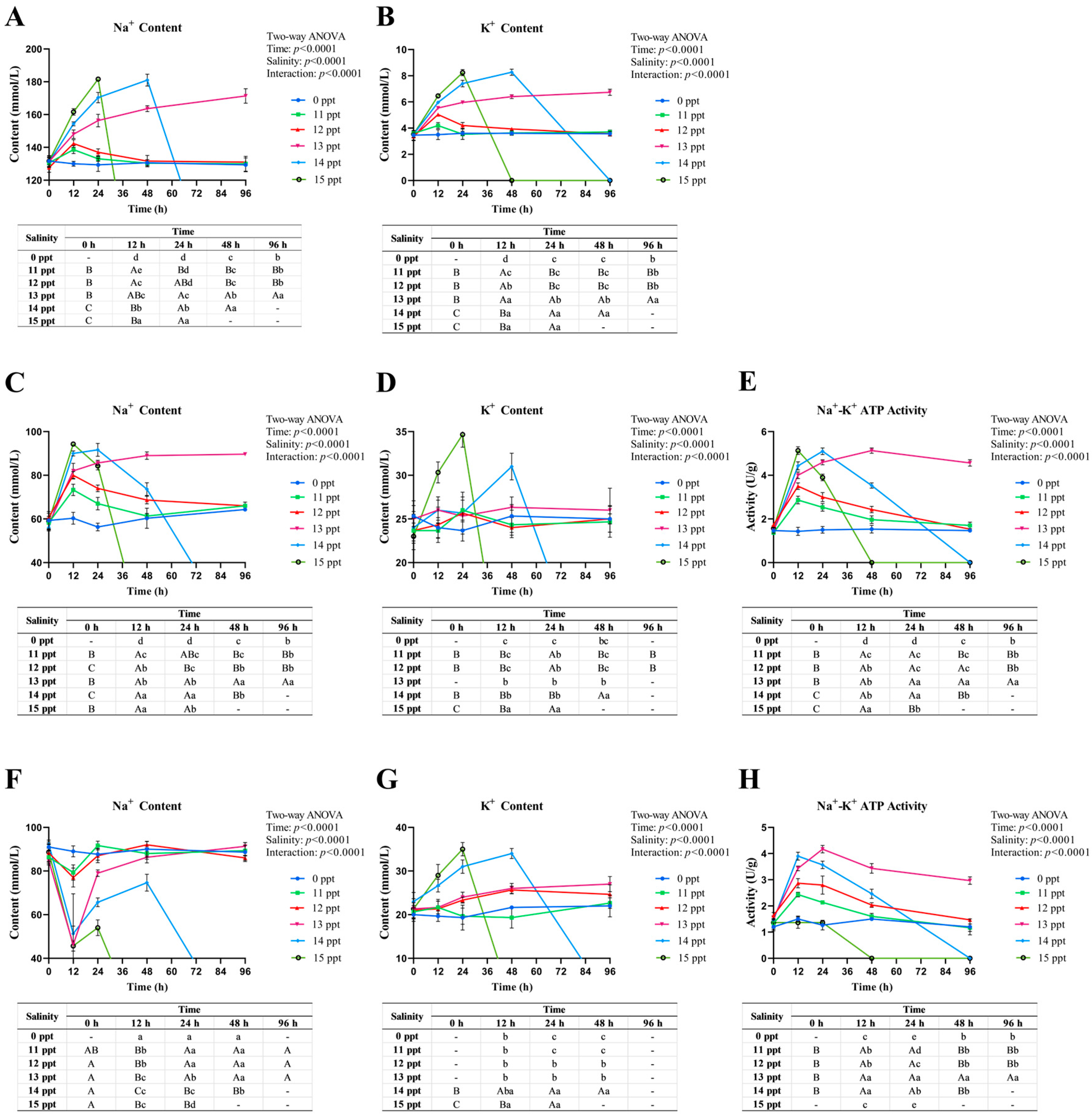
Osmotic Regulation of Acute Salinity Stress
Plasma Na+ (Figure 3A) remained stable in 0–12 ppt groups, with transient increases at 12 h (11–12 ppt) reflecting acute stress, followed by recovery. At 13 ppt, Na+ sustained elevation indicated prolonged compensation, while 14 ppt groups showed drastic surges due to regulatory failure. Plasma K+ (Figure 3B) stayed within 2.5–4.5 mmol/L in 0–12 ppt groups but progressively increased in 13 ppt groups, peaking at 9.0–11.0 mmol/L at 15 ppt (96 h), signaling neuromuscular dysfunction.
Gill Na+ (Figure 3C) transiently increased in 11–12 ppt groups (12 h) then recovered, while 13 ppt showed sustained elevation and ≥14 ppt groups exhibited early peaks followed by declines. Gill Na+-K+ ATPase (Figure 3E) peaked at 12 h in 1113 ppt groups (compensatory activation) but declined in ≥14 ppt groups. Gill K+ (Figure 3D) remained stable except for late-stage increases in ≥14 ppt groups.
Renal Na+ (Figure 3F) transiently decreased in 11–12 ppt groups then recovered, while ≥14 ppt groups showed initial reduction followed by increases. Renal Na+-K+ ATPase (Figure 3H) followed a similar pattern to gill enzyme, with sustained activity in 13 ppt and decline in ≥14 ppt groups. Renal K+ (Figure 3G) only increased in ≥14 ppt groups at late time points.
Collectively, P. schrenkii exhibited reversible osmoregulation at ≤12 ppt, prolonged compensation at 13 ppt, and irreversible failure at ≥14 ppt, with 13 ppt as the critical threshold for osmoregulatory collapse.
Oxidative Stress of Acute Salinity Stress
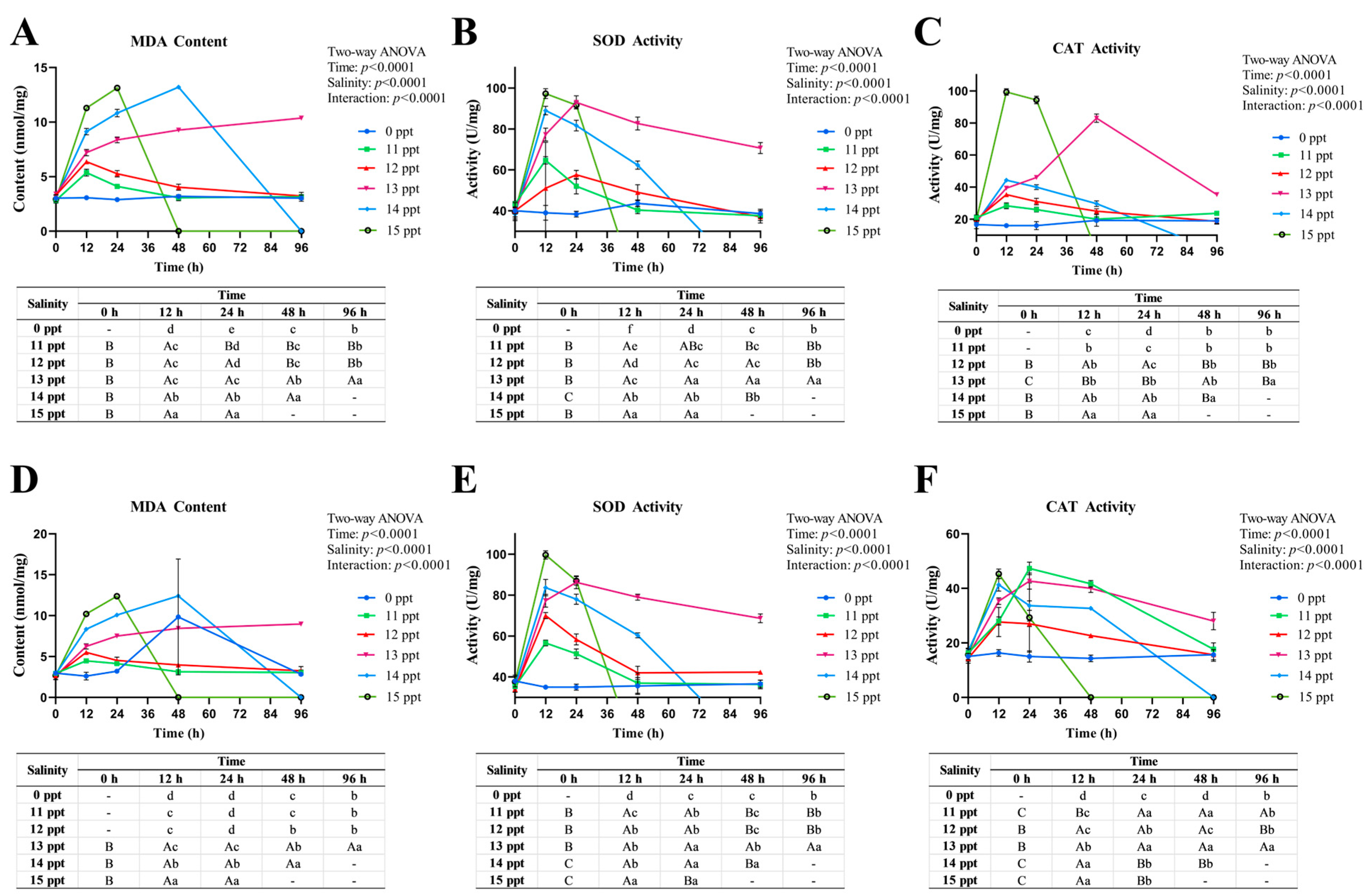
Acute salinity stress induced tissue-specific oxidative stress responses in P. schrenkii, characterized by dynamic changes in malondialdehyde (MDA) and antioxidant enzyme (SOD, CAT) activities in gill and intestine (Figure 4).
Gill MDA content (Figure 4A) transiently increased in 11–12 ppt groups at 12 h (compensatory oxidative damage) then recovered, while ≥13 ppt groups showed sustained elevation, indicating severe lipid peroxidation. Gill SOD activity (Figure 4B) was activated in 1113 ppt groups at 12 h but declined in ≥14 ppt groups. Gill CAT activity (Figure 4C) followed a similar trend, with transient activation in 1113 ppt and decline in ≥14 ppt, reflecting impaired H2O2 scavenging.
Intestinal MDA content (Figure 4D) exhibited trends analogous to gill but with lower amplitude, showing transient increases in 11–12 ppt and sustained elevation in ≥13 ppt. Intestinal SOD (Figure 4E) and CAT (Figure 4F) activities were activated in 1113 ppt groups and declined in ≥14 ppt groups, consistent with systemic oxidative damage progression.
Collectively, P. schrenkii displayed reversible oxidative stress at ≤12 ppt, prolonged antioxidant compensation at 13 ppt, and antioxidant system collapse with severe oxidative damage at ≥14 ppt. Gill, as the frontline tissue, showed more pronounced oxidative stress than the intestine, aligning with its direct exposure to salinity stress.
Immune Function of Acute Salinity Stress
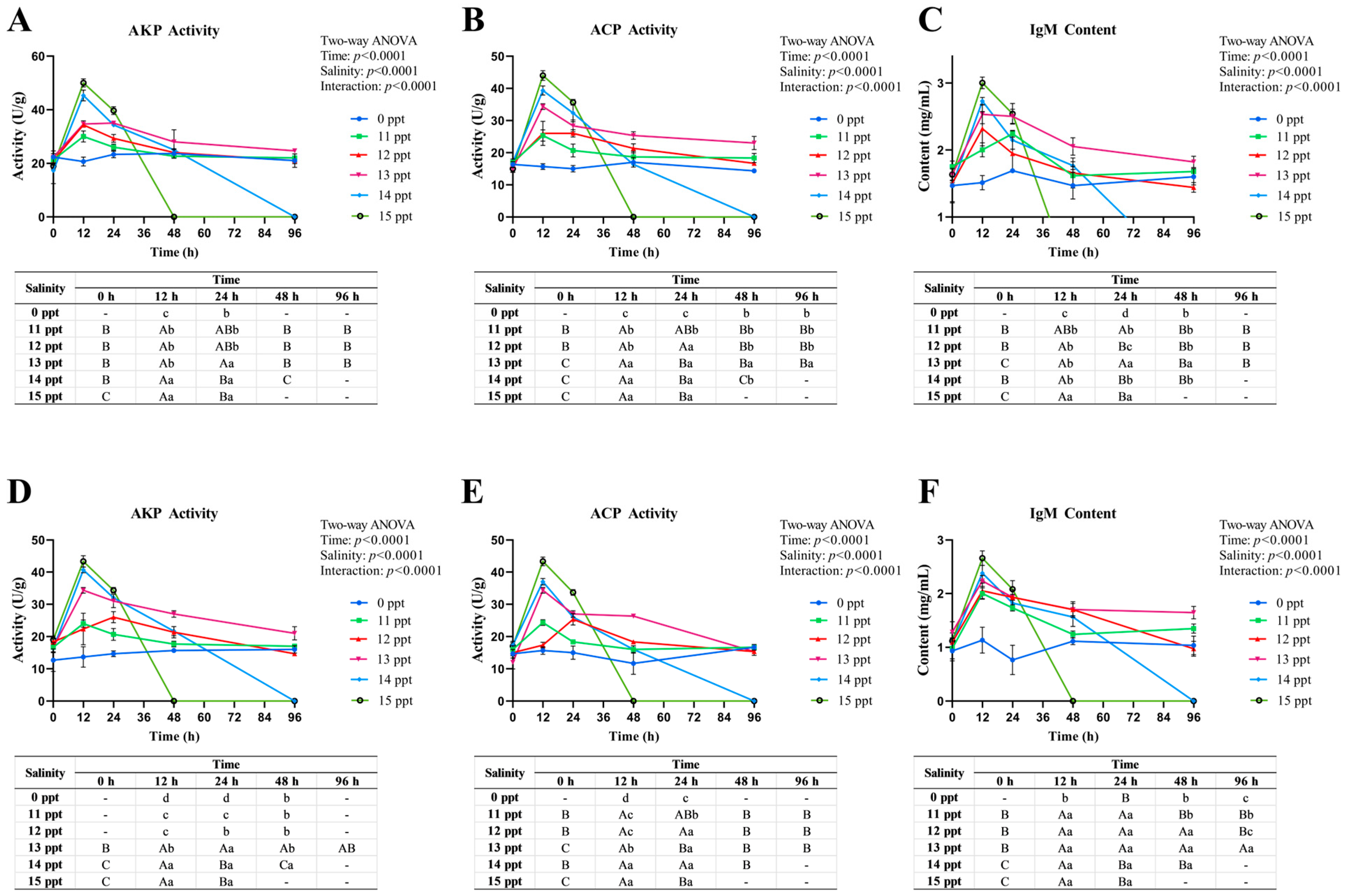
Acute salinity stress induced dynamic immune regulatory responses in P. schrenkii, characterized by tissue-specific changes in immune enzyme (AKP, ACP) activities and immunoglobulin M (IgM) content in liver and kidney (Figure 5).
Liver AKP (Figure 5A) and ACP (Figure 5B) activities showed transient activation in low-salinity groups at 12 h followed by recovery, reflecting acute stress-induced immune activation. At 13 ppt, both enzymes sustained high activity at 96 h, indicating prolonged immune compensation. In high-salinity groups (≥14 ppt), enzyme activities peaked at 12 h then declined, consistent with hepatic tissue damage. Liver IgM (Figure 5C) exhibited analogous trends: transient elevation in 11–12 ppt and sustained increase in 13 ppt, while ≥14 ppt groups showed early peaks followed by decreases, reflecting impaired immunoglobulin synthesis.
Kidney AKP (Figure 5D) and ACP (Figure 5E) activities were activated in 1113 ppt groups at 12 h, with 13 ppt maintaining sustained activity at 96 h. In ≥14 ppt groups, activities peaked at 12 h then declined, indicative of renal immune dysfunction. Kidney IgM (Figure 5F) transiently increased in 1113 ppt and decreased in ≥14 ppt, aligning with systemic immune suppression.
Collectively, P. schrenkii displayed reversible immune activation at ≤12 ppt, prolonged immune compensation at 13 ppt, and immune system collapse with tissue damage at ≥14 ppt. The liver, as the central immune organ, exhibited more pronounced responses than the kidney, highlighting its pivotal role in salinity-induced immune regulation.

3.2. Effects of Chronic Salinity Stress on Perca schrenkii

3.2.1. Osmotic Regulation of Chronic Salinity Stress

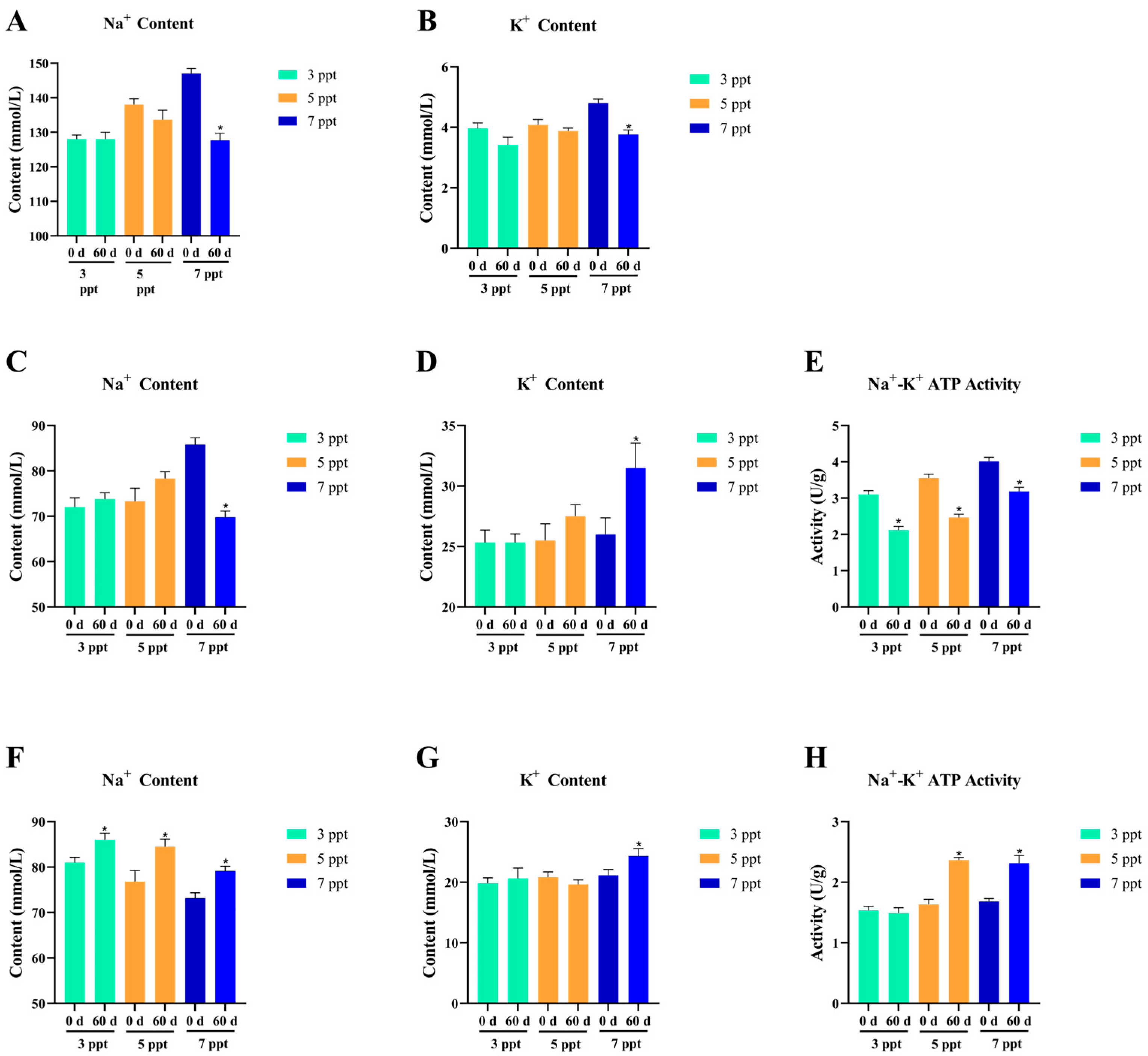
Chronic salinity stress (3, 5, 7 ppt for 60 days) triggered adaptive osmoregulatory responses in Perca schrenkii, characterized by dynamic adjustments in ion content (Na+, K+) and Na+-K+ ATPase activity across plasma, gill, and kidney, ultimately achieving a new steady state after long-term acclimation (Figure 6).
Plasma Na+ (Figure 6A) exhibited salinity-dependent elevation at 0 d: 3 ppt, 5 ppt, and 7 ppt, reflecting initial osmotic stress. After 60 days, plasma Na+ decreased significantly (p < 0.05) in the 7 ppt group and returned to near-baseline levels in 3–5 ppt groups, indicating efficient recovery of ion balance. Plasma K+ (Figure 6B) showed mild fluctuations at 0 d but no significant differences (p > 0.05) between 60 d and 0 d across all salinities, with 60 d values stabilizing at 3.0–4.5 mmol/L—highlighting robust K+ homeostasis.
Gill Na+ (Figure 6C) increased at 0 d with rising salinity due to acute salt uptake. At 60 d, gill Na+ decreased significantly (p < 0.05) in the 7 ppt group and approached baseline levels, reflecting adaptive ion excretion. Gill K+ (Figure 6D) remained stable at 25–30 mmol/L across all treatments, with no temporal differences, consistent with the gill’s primary role in Na+ transport. Gill Na+-K+ ATPase (Figure 6E) displayed a stress-acclimation pattern: 0 d activity increased with salinity to counter initial stress, then decreased significantly (p < 0.05) at 60 d—downregulated to a balanced level for sustainable ion transport.
Renal Na+ (Figure 6F) showed an inverse trend to gill Na+ at 0 d: salinity elevation enhanced Na+ reabsorption, leading to lower renal Na+ content. At 60 d, renal Na+ increased significantly (p < 0.05) in the 7 ppt group as reabsorption intensity diminished, returning to near-baseline levels. Renal K+ (Figure 6G) remained stable at 20–25 mmol/L across all treatments, emphasizing priority in K+ homeostasis. Renal Na+-K+ ATPase (Figure 6H) mirrored the gill enzyme’s adaptation: 0 d activity peaked at higher salinities to support Na+ reabsorption, then decreased significantly (p < 0.05) at 60 d—aligning with reduced reabsorption demand post-acclimation.
Collectively, P. schrenkii demonstrated complete osmoregulatory acclimation to chronic low-salinity stress (3–7 ppt). The initial stress-induced perturbations were reversed or stabilized after 60 days, with 7 ppt showing the most pronounced adjustments without ion dysfunction. This indicates salinities ≤ 7 ppt are long-term tolerable for P. schrenkii.

3.2.2. Oxidative Stress of Chronic Salinity Stress

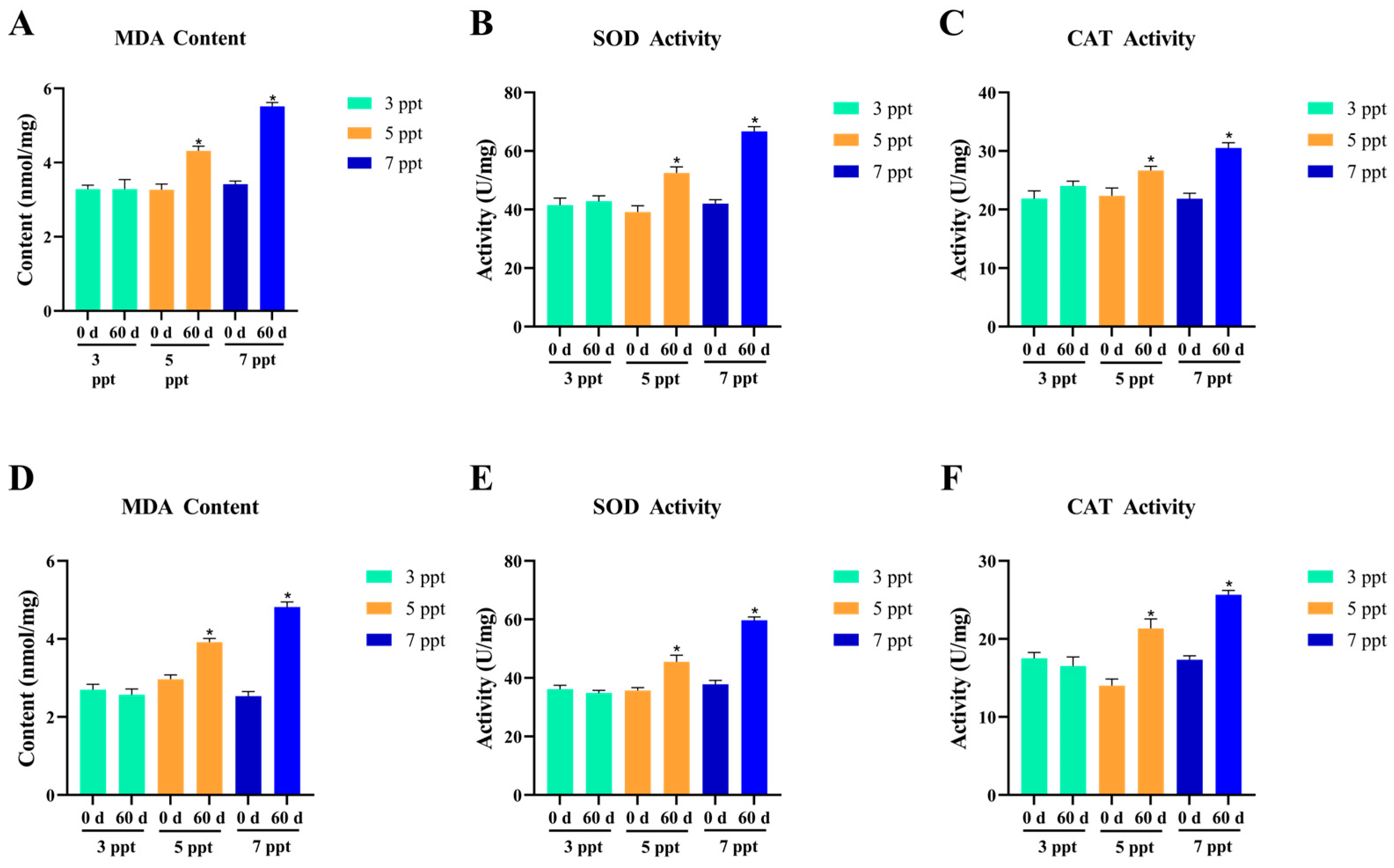
Chronic salinity stress (3, 5, 7 ppt for 60 days) induced adaptive oxidative stress responses in Perca schrenkii, characterized by tissue-specific changes in oxidative damage (MDA) and antioxidant enzyme (SOD, CAT) activities in gill and intestine, with successful acclimation observed at ≤7 ppt (Figure 7).
Gill MDA (Figure 7A) showed no significant difference at 3 ppt between 60 d and 0 d, indicating complete recovery of oxidative damage. At 5–7 ppt, MDA increased significantly (p < 0.05) at 60 d compared to 0 d, reflecting mild, adaptive oxidative stress without irreversible damage. Gill SOD (Figure 7B) and CAT (Figure 7C) activities exhibited a stress-acclimation pattern: at 3 ppt, activities remained stable, consistent with basal antioxidant capacity. At 5–7 ppt, SOD and CAT increased significantly (p < 0.05) at 60 d, representing sustained antioxidant activation to counteract mild oxidative stress.
Intestinal MDA (Figure 7D) followed a trend analogous to gill but with lower amplitude: no difference at 3 ppt, while 5–7 ppt showed significant increases (p < 0.05) at 60 d, indicating mild oxidative stress localized to the gut. Intestinal SOD (Figure 7E) and CAT (Figure 7F) activities mirrored gill responses but with reduced magnitude: 3 ppt maintained basal levels, while 5–7 ppt showed significant activation (p < 0.05) at 60 d, reflecting coordinated antioxidant defense across tissues.
Collectively, P. schrenkii exhibited adaptive oxidative stress responses under chronic low-salinity stress (3–7 ppt). At 3 ppt, the antioxidant system returned to basal homeostasis; at 5–7 ppt, mild oxidative stress was countered by sustained antioxidant enzyme activation, with no signs of oxidative damage or enzyme dysfunction. This indicates that salinities ≤ 7 ppt are within the long-term tolerable range for P. schrenkii, with the antioxidant system fully capable of maintaining redox balance.

3.2.3. Immune Function of Chronic Salinity Stress

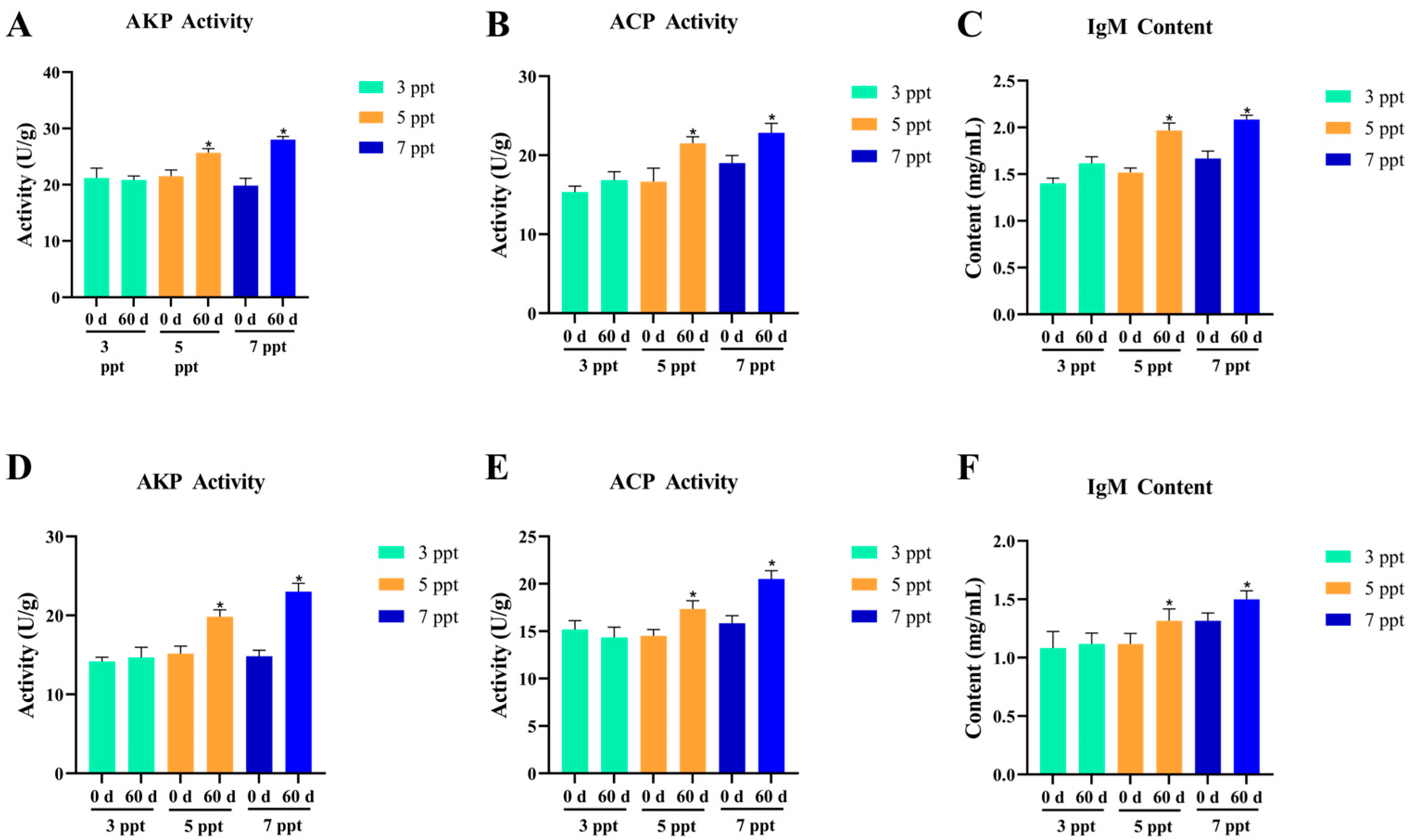
Chronic salinity stress (3, 5, 7 ppt for 60 days) induced adaptive immune regulatory responses in Perca schrenkii, characterized by tissue-specific changes in immune enzyme (AKP, ACP) activities and immunoglobulin M (IgM) content in liver and kidney, with successful immune homeostasis maintained at ≤7 ppt (Figure 8).
Liver AKP (Figure 8A) and ACP (Figure 8B) activities showed no significant difference at 3 ppt between 60 d and 0 d, indicating complete recovery of immune enzyme function. At 5–7 ppt, AKP and ACP increased significantly (p < 0.05) at 60 d, reflecting mild, adaptive activation of lysosomal enzymes for enhanced foreign matter clearance. Liver IgM (Figure 8C) exhibited a consistent trend: no difference at 3 ppt, while 5–7 ppt showed significant increases (p < 0.05) at 60 d, representing sustained humoral immune activation to maintain defense capacity under mild stress.
Renal AKP (Figure 8D) and ACP (Figure 8E) activities mirrored hepatic responses but with reduced magnitude: no difference at 3 ppt, while 5–7 ppt showed significant activation (p < 0.05) at 60 d, reflecting coordinated lysosomal enzyme activity across tissues for immune surveillance. Renal IgM (Figure 8F) followed the same pattern as liver IgM but with lower amplitude: no difference at 3 ppt, and significant increases (p < 0.05) at 5–7 ppt at 60 d, ensuring intact humoral immune barriers in the renal microenvironment.
Collectively, P. schrenkii exhibited adaptive immune regulation under chronic low-salinity stress (3–7 ppt). At 3 ppt, the immune system returned to basal homeostasis; at 5–7 ppt, mild stress triggered sustained activation of immune enzymes and humoral immunity, with no signs of immune suppression or overactivation. This indicates that salinities ≤ 7 ppt are within the long-term tolerable range for P. schrenkii, with the immune system fully capable of maintaining defense function and homeostasis.

4. Discussion

Salinity stress—whether acute or chronic—profoundly shapes the survival and physiological homeostasis of euryhaline fish, with distinct response mechanisms underlying tolerance to extreme vs. sub-lethal conditions [30,31,32,33]. Globally, freshwater scarcity drives the exploration of saline-alkaline aquaculture, while chloride-type saline-alkaline water represents a critical underutilized resource [14,34]. Perca schrenkii, endemic to the Balkhash Lake basin with distribution in brackish-freshwater ecotones, yet its physiological adaptation mechanisms to chronic low-salinity stress remain elusive. Two core questions limit the commercialization of Perca schrenkii: (1) What is its acute high-salinity tolerance threshold? (2) Can it adapt to long-term low-salinity conditions?
This study addressed both questions through two complementary experiments: (1) The acute high-salinity stress experiment that identified a 96 h median lethal concentration (LC50) of 12.396 ppt and a safe concentration (SC) of 3.7188 ppt, with fish exhibiting a compensation-failure response: reversible adaptation at ≤12 ppt, prolonged compensation at 13 ppt, and irreversible physiological collapse at ≥14 ppt. (2) The chronic low-salinity acclimation experiment that demonstrated complete adaptability to ≤7 ppt, via a mild activation-steady state pattern across osmotic, antioxidant, and immune systems. Together, these findings form a threshold-adaptation framework: P. schrenkii tolerates acute salinity up to 12 ppt (LC50) and adapts long-term to ≤7 ppt, with the SC aligning with the non-stress adaptation point (3 ppt) observed in chronic experiments—closing the gap between acute toxicity and chronic cultivation practice.

4.1. The Defined Salinity Threshold and Its Ecological Implications

The accurately determined 96 h LC50 of 12.396 ppt positions P. schrenkii as a species with superior innate salinity tolerance compared to many traditional freshwater aquaculture species [35]. For instance, the 96 h LC50 of Nile tilapia (Oreochromis niloticus), a widely cultivated euryhaline fish, ranges from 10.5 to 11.8 ppt under similar chloride-type saline stress [35]. More importantly, this value is notably higher than that reported for its congener, Perca fluviatilis [25,36]. This interspecific discrepancy is ecologically significant. The Ili River basin, the native habitat of P. schrenkii, is characterized by fluctuating hydrochemistry and seasonal salinity increases, particularly in its delta region [37,38,39]. Therefore, our laboratory-derived LC50 likely reflects an evolutionary adaptation to its naturally unstable habitat, providing a physiological basis for its observed dominance in oligohaline reaches. The concept of a critical threshold is further reinforced by our behavioral and physiological data, which collectively identify 13 ppt as the pivot point between compensatory homeostasis and irreversible failure.

4.2. Osmoregulatory Strategy: From Compensation to Collapse

The osmoregulatory response of P. schrenkii exemplifies a classic, yet finely tuned, teleost strategy under osmotic stress. The transient increase in gill and renal Na+-K+-ATPase activity in the 1113 ppt groups represents a critical compensatory effort to counteract passive ion influx and maintain plasma homeostasis [40]. This energetic investment in ion regulation is a survival tactic [41,42,43]. However, the subsequent decline in enzyme activity at ≥14 ppt is not merely a “failure” but likely a consequence of multiple cascading insults: severe ion dysregulation leading to cellular damage, ATP depletion due to unsustainable energetic demands, and potentially, oxidative inactivation of enzyme proteins [42]. The parallel surge in plasma Na+ and K+ at lethal salinities indicates a complete breakdown of the osmoregulatory interface, culminating in neuromuscular dysfunction and death. This pattern underscores that the cost of osmoregulation under extreme stress becomes prohibitive, leading to systemic collapse.

4.3. Oxidative Stress and Immune Response: An Integrated Defense Network

A key finding of our study is the tight coupling between osmotic imbalance and secondary oxidative and immune stress. The initial upregulation of SOD and CAT in the gill and intestine at sublethal salinities (1113 ppt) demonstrates a proactive antioxidant defense against salinity-induced reactive oxygen species (ROS) [44,45]. The gill, as the primary site of ion and gas exchange, exhibited more pronounced oxidative stress than the intestine, aligning with its direct and extensive contact with the external medium [46,47]. The subsequent decline in antioxidant capacity at lethal salinities signifies the overwhelming of this defense system, leading to the observed accumulation of MDA, a marker of irreversible lipid peroxidation [48,49].
Similarly, the immune system displayed a biphasic response. The activation of AKP, ACP, and IgM in liver and kidney under moderate stress suggests an enhanced state of immune vigilance [50,51]. The subsequent suppression of these physiological parameters under acute lethal salinity stress reflects a systemic integrated physiological collapse, wherein energy allocation is redirected away from non-essential homeostatic processes (e.g., adaptive immunity) toward emergency compensatory mechanisms dedicated to preserving core physiological homeostasis [52,53,54]. Under chronic stress, the sustained, yet stable, elevation of these markers at 5–7 ppt indicates a successful re-allocation of resources, establishing a new, sustainable homeostatic set-point without apparent damage.

4.4. Acclimation Potential and Aquaculture Relevance

The chronic experiment validates the aquaculture potential of P. schrenkii. The fact that fish fully acclimated to 7 ppt salinity over 60 days, with osmoregulatory, antioxidant, and immune parameters stabilizing at new steady states, is of paramount practical importance. The initial stress responses observed at Day 0 gave way to acclimation by Day 60, particularly the normalization of plasma ions and the refined modulation of Na+-K+-ATPase. This downregulation after acclimation is a hallmark of efficient adaptation, reducing the metabolic cost of osmoregulation and potentially freeing energy for growth. Our findings suggest that salinities up to 7 ppt are not only survivable but likely sustainable for long-term cultivation, with the safe concentration (3.72 ppt) providing a conservative starting point for stocking.

4.5. Limitations and Future Perspectives

While our use of NaCl elegantly isolated the osmotic component of chloride-type saline-alkaline water, natural environments present a more complex ionic matrix (e.g., presence of Ca2+, Mg2+, SO42−). Future studies should investigate whether these ions have synergistic or antagonistic effects on salinity tolerance. Furthermore, our study lays the physiological groundwork but calls for molecular validation. Transcriptomic and proteomic analyses are needed to unravel the precise regulatory networks governing ion transport, antioxidant defense, and immune modulation during acclimation.

5. Conclusions

This study moves beyond merely defining the salinity tolerance of Perca schrenkii and establishes a mechanistic framework for its adaptation to chloride-type saline stress. We conclude that: (1) P. schrenkii possesses a high innate salinity tolerance (96 h LC50 = 12.396 ppt), with 13 ppt serving as a critical threshold beyond which coordinated physiological failure occurs across osmoregulatory, antioxidant, and immune systems. (2) The species exhibits remarkable long-term acclimation capacity, maintaining full physiological homeostasis at salinities up to 7 ppt. This acclimation is characterized by a reduction in metabolic costs associated with osmoregulation and the establishment of a new, stable equilibrium in oxidative and immune status. (3) The determined safe concentration (3.72 ppt) and the demonstrated tolerance up to 7 ppt provide clear, evidence-based guidelines for the cultivation of P. schrenkii in saline-alkaline waters, paving the way for a sustainable aquaculture expansion in water-scarce regions.

Author Contributions

Conceptualization, Z.N.; methodology, K.Z. and S.G.; validation, S.G. and J.Z.; formal analysis, G.X. and Y.H.; investigation, T.A.; resources, Z.H. and S.Z.; data curation, G.X. and S.Z.; writing—original draft preparation, K.Z.; writing—review and editing, Z.N. and J.Z.; visualization, K.Z.; supervision, J.W. and Z.H.; project administration, J.W. and T.A.; funding acquisition, Z.N. All authors have read and agreed to the published version of the manuscript.

Funding

This research was funded by The sub-task of the National Key Research and Development Program Technology Integration of Characteristic Aquaculture in Saline-Alkali Land and Construction of “Fish-Based Salinity Reduction and Alkali Improvement” Model in Inland Northwest China, grant number 2023YFD2401004, the Science and Technology Bureau of the Production and Construction Corps project Key Technology Research and Demonstration for Large-Scale Seedling Cultivation of Saline-Alkali Tolerant Fishes (Yili Perch, E’erhe Silver Crucian Carp, Sea Bass, Golden Pompano), grant number 2025YD016, the special topic of the Third Comprehensive Scientific Investigation of Xinjiang by the Ministry of Science and Technology Investigation of Macrophytic Communities in Key Lakes of Xinjiang, grant number 2022xjkk150403, The Key Research and Development Task Special Project of Xinjiang Uygur Autonomous Region—Sub-task on Key Technology Research and Promotion of Saline-Alkali Water Fishery Development in Xinjiang, grant number 2024B02014, Sub-task of “Synergistic Irrigation and Drainage Model for Quality Improvement and Productivity Enhancement of Grain, Economic, and Forage Crops in Southern Xinjiang Saline-Alkali Land”, under the project “Technology Verification for Comprehensive Improvement and Utilization of Western Saline-Alkali Land”, which is part of the Chinese Academy of Sciences’ Key Initiative “Scientific and Technological Support for Comprehensive Improvement and Utilization of Saline-Alkali Land”, grant number GJ050401, and National Natural Science Foundation of China (NSFC) Project: “Resolving Species Validity and Cryptic Diversity of Schizothoracine Fish in Xinjiang Using Morphology and DNA Barcoding”, grant number 32460920, National Natural Science Foundation of China (NSFC) Project “Study on Alkalinity Reduction Pathways and Effect Mechanisms of Fish Aquaculture in Saline-Alkaline Water of Xinjiang”, grant number 32541123.

Institutional Review Board Statement

The animal study protocol was approved by the Animal Research Ethics Committee of Tarim University (protocol code PB20250618003 and date of approval: 16 June 2025). All experimental procedures complied with the guidelines for the use of experimental animals in China.

Informed Consent Statement

Not applicable.

Data Availability Statement

The datasets generated and analyzed during the current study are available from the corresponding author on reasonable request.

Acknowledgments

The authors gratefully acknowledge the College of Life Sciences and Technology, Tarim University for providing the experimental platform and facilities essential for this research. We also extend our sincere gratitude to Changxin Fisheries for their support in providing the aquaculture site and experimental fish. Special thanks are due to the late Shijing Zhang for his invaluable contributions to the early-stage experimental design and sample collection of this study. We are also deeply grateful to our teachers and laboratory colleagues for their invaluable guidance and assistance throughout the study.

Conflicts of Interest

Shijing Zhang and Jiasong Zhang were employed by Yutian Fengze Technology Aquatic Products Co., Ltd. Zhaohua Huang was employed by Aral Changxin Fishery Co., Ltd. The remaining authors declare that the research was conducted in the absence of any commercial or financial relationships that could be construed as a potential conflict of interest.

References

  1. Nevermann, H.; Aminzadeh, M.; Madani, K.; Shokri, N. Quantifying water evaporation from large reservoirs: Implications for water management in water-stressed regions. Environ. Res. 2024, 262, 119860. [Google Scholar] [CrossRef]
  2. FAO. The State of World Fisheries and Aquaculture 2024—Blue Transformation in Action; FAO: Rome, Italy, 2024. [Google Scholar]
  3. Scanlon, B.R.; Faunt, C.C.; Longuevergne, L.; Reedy, R.C.; Alley, W.M.; McGuire, V.L.; McMahon, P.B. Groundwater depletion and sustainability of irrigation in the US High Plains and Central Valley. Proc. Natl. Acad. Sci. USA 2012, 109, 9320–9325. [Google Scholar] [CrossRef]
  4. Cao, L.; Naylor, R.; Henriksson, P.; Leadbitter, D.; Metian, M.; Troell, M.; Zhang, W. China’s aquaculture and the world’s wild fisheries. Science 2015, 347, 133–135. [Google Scholar] [CrossRef]
  5. Bo, Y.; Liu, C.; Jiao, P.; Lü, F.; Zhang, H. Hydrochemical Characteristics and Evolution of Underground Brine in Lop Nur, Northwestern China. Acta Geol. Sin.-Engl. Ed. 2024, 98, 786–800. [Google Scholar] [CrossRef]
  6. Yang, F.Y.; Li, X.J.; Wang, Z.C.; Zha, C.S. Eeo-fishery model in soda saline-alkaline land of northeast China. Chin. J. Eco-Agric. 2004, 12, 192–194. [Google Scholar]
  7. Kimera, F.; Mugwanya, M.; Madkour, K.; Dawood, M.A.O.; Sewilam, H. Maximization of brackish water productivity for the sustainable production of striped catfish (Pangasianodon hypophthalmus) and grain sorghum (Sorghum bicolor (L.) Moench) cultivated under an integrated aquaculture–agriculture system. Environ. Sci. Pollut. Res. 2024, 31, 31878–31895. [Google Scholar] [CrossRef]
  8. Cui, G.; Liu, Y.; Tong, S. Hydrogeochemical processes controlling the salinity of surface water and groundwater in an inland saline-alkali wetland in western Jilin, China. Front. Ecol. Evol. 2022, 10, 993849. [Google Scholar] [CrossRef]
  9. He, J.; Den, Q.; Ma, X.; Su, X.; Ma, X. Soil salinization affected by hydrogeochemical processes of shallow groundwater in Cangzhou City, a coastal region in North China. Hydrol. Res. 2021, 52, 1116–1131. [Google Scholar] [CrossRef]
  10. Zhou, J.; He, M.; Li, B.; Jiao, J.; Tang, Z.; Li, Z.; Rao, H. Lithium isotopic composition of the carbonate type salt lake in Tibet and its implication for origin and hydrological processes. Sci. Rep. 2025, 15, 11862. [Google Scholar] [CrossRef]
  11. Zhang, R.; Zhao, Z.; Li, M.; Luo, L.; Wang, S.; Guo, K.; Xu, W. Metabolomics analysis reveals the response mechanism to carbonate alkalinity toxicity in the gills of Eriocheir sinensis. Comp. Biochem. Physiol. Toxicol. Pharmacol. 2023, 263, 109487. [Google Scholar] [CrossRef]
  12. Che, C.; Yang, P.; Qin, K.; Li, Y.; Fan, Z.; Li, W.; Gao, S.; Wang, C.; Mu, C.; Wang, H. Based on metabolomics analysis: Metabolic mechanism of intestinal tract of Scylla paramamosain under low-salt saline-alkali water aquaculture environment. BMC Genom. 2024, 25, 1232. [Google Scholar] [CrossRef]
  13. Singh, A.; Rajput, V.D.; Sharma, R.; Ghazaryan, K.; Minkina, T. Salinity stress and nanoparticles: Insights into antioxidative enzymatic resistance, signaling, and defense mechanisms. Environ. Res. 2023, 235, 116585. [Google Scholar] [CrossRef]
  14. Sinha, A.K.; Dasan, A.F.; Rasoloniriana, R.; Pipralia, N.; Blust, R.; De Boeck, G. Hypo-osmotic stress-induced physiological and ion-osmoregulatory responses in european sea bass (Dicentrarchus labrax) are modulated differentially by nutritional status. Comp. Biochem. Physiol. A Mol. Integr. Physiol. 2015, 181, 87–99. [Google Scholar] [CrossRef] [PubMed]
  15. Zeng, L.; Ai, C.X.; Wang, Y.H.; Zhang, J.S.; Wu, C.W. Abrupt salinity stress induces oxidative stress via the Nrf2-Keap1 signaling pathway in large yellow croaker Pseudosciaena crocea. Fish Physiol. Biochem. 2017, 43, 955–964. [Google Scholar] [CrossRef] [PubMed]
  16. Jiang, I.-F.; Bharath Kumar, V.; Lee, D.-N.; Weng, C.-F. Acute osmotic stress affects tilapia (Oreochromis mossambicus) innate immune responses. Fish Shellfish. Immunol. 2008, 25, 841–846. [Google Scholar] [CrossRef]
  17. Dildar, T.; Cui, W.; Ikhwanuddin, M.; Ma, H. Aquatic Organisms in Response to Salinity Stress: Ecological Impacts, Adaptive Mechanisms, and Resilience Strategies. Biology 2025, 14, 667. [Google Scholar] [CrossRef] [PubMed]
  18. Takvam, M.; Wood, C.M.; Kryvi, H.; Nilsen, T.O. Ion Transporters and Osmoregulation in the Kidney of Teleost Fishes as a Function of Salinity. Front. Physiol. 2021, 12, 664588. [Google Scholar] [CrossRef]
  19. Varsamos, S.; Nebel, C.; Charmantier, G. Ontogeny of osmoregulation in postembryonic fish: A review. Comp. Biochem. Physiol. Part A Mol. Integr. Physiol. 2005, 141, 401–429. [Google Scholar] [CrossRef] [PubMed]
  20. Barmintseva, A.E.; Shalgimbayeva, G.M.; Asylbekova, S.Z.; Isbekov, K.B.; Danko, E.K.; Mugue, N.S. Genetic differentiation of balkhash perch Perca schrenki kessler, 1874 from lake balkhash and alakol lake system of kazakhstan. Russ. J. Genet. 2015, 51, 871–876. [Google Scholar] [CrossRef]
  21. Mamilov, N. Biology of Balkhash Perch (Perca schrenkii Kessler, 1874); CRC Press: Boca Raton, FL, USA, 2015; pp. 47–72. [Google Scholar]
  22. Zhi, C.W. Analysis of Nutritional Composition the Triplophysa (Hedinichthys) yarkandensis (Day) about Tarim River. J. Hydroecol. 2011, 32, 137–141. [Google Scholar]
  23. Yang, L.; Yu, Y.; Wang, C.; Hu, L.; Ma, Y.; Zi, F.; Ma, R.; Huo, Q.; Song, Y.; Sun, Z.; et al. Analysis and evaluation of the muscle quality of high-salinity aquaculture fish in Xinjiang, China. J. Food Compos. Anal. 2025, 144, 107750. [Google Scholar] [CrossRef]
  24. Christensen, E.A.F.; Grosell, M.; Steffensen, J.F. Maximum salinity tolerance and osmoregulatory capabilities of European perch Perca fluviatilis populations originating from different salinity habitats. Conserv. Physiol. 2019, 7, coz004. [Google Scholar] [CrossRef]
  25. Overton, J.L.; Bayley, M.; Paulsen, H.; Wang, T. Salinity tolerance of cultured Eurasian perch, Perca fluviatilis L.: Effects on growth and on survival as a function of temperature. Aquaculture 2008, 277, 282–286. [Google Scholar] [CrossRef]
  26. Christensen, E.A.; Svendsen, M.B.; Steffensen, J.F. Plasma osmolality and oxygen consumption of perch Perca fluviatilis in response to different salinities and temperatures. J. Fish Biol. 2017, 90, 819–833. [Google Scholar] [CrossRef]
  27. Abdel-Rahim, M.; Elhetawy, A.; Shawky, W.; El-Zaeem, S.; El-Dahhar, A. Enhancing Florida red tilapia aquaculture: Biofloc optimization improves water quality, pathogen bacterial control, fish health, immune response, and organ histopathology across varied groundwater salinities. Vet. Res. Commun. 2024, 48, 2989–3006. [Google Scholar] [CrossRef] [PubMed]
  28. GB 11607-1989; Water Quality Standard for Fisheries. Ministry of Ecology and Environment: Beijing, China, 1989.
  29. Kou, T.R. A Simple Calculation Method for Determining Median Lethal Dose Using Kou’s Method. Chin. Pharmacol. Bull. 1963, 8, 49–52. [Google Scholar]
  30. Dai, W.; Zhang, Z.; Dong, Y.; He, L.; Xue, Q.; Lin, Z. Acute Salinity Stress Disrupts Gut Microbiota Homeostasis and Reduces Network Connectivity and Cooperation in Razor Clam Sinonovacula constricta. Mar. Biotechnol. 2023, 25, 1147–1157. [Google Scholar] [CrossRef]
  31. Xu, M.; Zhang, C.; Qi, Q.; Wang, R.; Zhang, S.; Yan, R.; Li, B.; Li, S. Effects of salinity stress on anxiety behavior and antioxidant capability of guppy (Poecilia reticulata). Ecotoxicology 2023, 32, 598–605. [Google Scholar] [CrossRef]
  32. Fang, H.; Yang, Y.Y.; Wu, X.M.; Zheng, S.Y.; Song, Y.J.; Zhang, J.; Chang, M.X. Effects and Molecular Regulation Mechanisms of Salinity Stress on the Health and Disease Resistance of Grass Carp. Front. Immunol. 2022, 13, 917497. [Google Scholar] [CrossRef]
  33. Harshini, V.; Shukla, N.; Raval, I.; Kumar, S.; Shrivastava, V.; Chaudhari, A.; Patel, A.K.; Joshi, C.G. Interplay of gene expression and regulators under salinity stress in gill of Labeo rohita. BMC Genom. 2023, 24, 336. [Google Scholar] [CrossRef]
  34. Cañedo-Argüelles, M.; Kefford, B.J.; Piscart, C.; Prat, N.; Schäfer, R.B.; Schulz, C.-J. Salinisation of rivers: An urgent ecological issue. Environ. Pollut. 2013, 173, 157–167. [Google Scholar] [CrossRef]
  35. Fan, J.; Yan, Y.; Lin, Y.; Huang, Y.; Li, E.; Chen, L.; Wang, X. Effects of different feeding strategies on ion-transporting, energy metabolism and intestinal health of Nile tilapia (Oreochromis niloticus) under saline-alkaline stress. Aquac. Rep. 2025, 44, 103033. [Google Scholar] [CrossRef]
  36. Christensen, E.A.F.; Stieglitz, J.D.; Grosell, M.; Steffensen, J.F. Intra-Specific Difference in the Effect of Salinity on Physiological Performance in European Perch (Perca fluviatilis) and Its Ecological Importance for Fish in Estuaries. Biology 2019, 8, 89. [Google Scholar] [CrossRef]
  37. Shi, H.; Luo, G.; Sutanudjaja, E.H.; Hellwich, O.; Chen, X.; Ding, J.; Wu, S.; He, X.; Chen, C.; Ochege, F.U.; et al. Recent impacts of water management on dryland’s salinization and degradation neutralization. Sci. Bull. 2023, 68, 3240–3251. [Google Scholar] [CrossRef]
  38. Zheng, L.L.; Yu, D.; Sun, N.; Wang, C.; Chen, W.J.; Ding, Z.F.; He, S.P.; Yang, L.D. DNA barcoding and cryptic diversity in fishes from the Ili River Valley in China, Xinjiang. Ecol. Evol. 2024, 14, e70352. [Google Scholar] [CrossRef] [PubMed]
  39. Yu, T.; Jiapaer, G.; Long, G.; Li, X.; Jing, J.; Liu, Y.; De Maeyer, P.; Van de Voorde, T. Interannual and seasonal relationships between photosynthesis and summer soil moisture in the Ili River basin, Xinjiang, 2000–2018. Sci. Total Environ. 2023, 856, 159191. [Google Scholar] [CrossRef] [PubMed]
  40. Fedosova, N.U.; Habeck, M.; Nissen, P. Structure and Function of Na,K-ATPase-The Sodium-Potassium Pump. Compr. Physiol. 2021, 12, 2659–2679. [Google Scholar] [CrossRef]
  41. Lucu, C.; Towle, D.W. Na++K+-ATPase in gills of aquatic crustacea. Comp. Biochem. Physiol. Part A Mol. Integr. Physiol. 2003, 135, 195–214. [Google Scholar] [CrossRef]
  42. Gao, S.; Wang, J.; Zhang, K.; Xing, G.; Tan, Y.; Chen, L.; Ai, T.; Zhang, S.; Chen, Y.; Nie, Z.; et al. Physiological Response Mechanisms of Triplophysa strauchii Under Salinity Stress. Biology 2025, 14, 1202. [Google Scholar] [CrossRef] [PubMed]
  43. Staehr, C.; Matchkov, V.V. Demand creates its own supply: The Na/K-ATPase controls metabolic reserve and flexibility. Acta Physiol. 2021, 232, e13673. [Google Scholar] [CrossRef]
  44. Wang, L.; Wu, Z.-Q.; Wang, X.-L.; Ren, Q.; Zhang, G.-S.; Liang, F.-F.; Yin, S.-W. Immune responses of two superoxide dismutases (SODs) after lipopolysaccharide or Aeromonas hydrophila challenge in pufferfish, Takifugu obscurus. Aquaculture 2016, 459, 1–7. [Google Scholar] [CrossRef]
  45. Sun, J.; Li, H.; Wu, X.; Chen, M.; Liu, Y.; Yan, B.; Xu, C.; Li, Y.; Zhang, H.; Zheng, H. Transcriptome analysis and physiological responses reveal the effects of acute low salinity stress on the noble scallop Chlamys nobilis. Aquaculture 2026, 611, 743068. [Google Scholar] [CrossRef]
  46. Ajima, M.N.O.; Kumar, K.; Poojary, N.; Pandey, P.K. Oxidative stress biomarkers, biochemical responses and Na+ -K+ -ATPase activities in Nile tilapia, Oreochromis niloticus exposed to diclofenac. Comp. Biochem. Physiol. Toxicol. Pharmacol. 2021, 240, 108934. [Google Scholar] [CrossRef] [PubMed]
  47. Sun, J.L.; Zhao, L.L.; Liao, L.; Tang, X.H.; Cui, C.; Liu, Q.; He, K.; Ma, J.D.; Jin, L.; Yan, T.; et al. Interactive effect of thermal and hypoxia on largemouth bass (Micropterus salmoides) gill and liver: Aggravation of oxidative stress, inhibition of immunity and promotion of cell apoptosis. Fish Shellfish. Immunol. 2020, 98, 923–936. [Google Scholar] [CrossRef] [PubMed]
  48. Marnett, L.J. Oxy radicals, lipid peroxidation and DNA damage. Toxicology 2002, 181–182, 219–222. [Google Scholar] [CrossRef]
  49. Janero, D.R. Malondialdehyde and thiobarbituric acid-reactivity as diagnostic indices of lipid peroxidation and peroxidative tissue injury. Free Radic. Biol. Med. 1990, 9, 515–540. [Google Scholar] [CrossRef]
  50. Li, L.; Wei, X.F.; Yang, Z.Y.; Zhu, R.; Li, D.L.; Shang, G.J.; Wang, H.T.; Meng, S.T.; Wang, Y.T.; Liu, S.Y.; et al. Alleviative effect of poly-β-hydroxybutyrate on lipopolysaccharide-induced oxidative stress, inflammation and cell apoptosis in Cyprinus carpio. Int. J. Biol. Macromol. 2023, 253, 126784. [Google Scholar] [CrossRef]
  51. Liu, J.; Zhang, P.; Wang, B.; Lu, Y.; Li, L.; Li, Y.; Liu, S. Evaluation of the effects of Astragalus polysaccharides as immunostimulants on the immune response of crucian carp and against SVCV in vitro and in vivo. Comp. Biochem. Physiol. Toxicol. Pharmacol. 2022, 253, 109249. [Google Scholar] [CrossRef] [PubMed]
  52. Zhang, W.; He, X.; Chen, X.; Han, H.; Shen, B.; Diao, M.; Liu, H.Y. Exogenous selenium promotes the growth of salt-stressed tomato seedlings by regulating ionic homeostasis, activation energy allocation and CO2 assimilation. Front. Plant Sci. 2023, 14, 1206246. [Google Scholar] [CrossRef]
  53. Wang, Z.; Zhu, W.; Xu, Y.; Yu, S.; Zhang, L.; Zhou, Z.; Diao, J. Effects of simazine and food deprivation chronic stress on energy allocation among the costly physiological processes of male lizards (Eremias argus). Environ. Pollut. 2021, 269, 116139. [Google Scholar] [CrossRef]
  54. Gu, Y.; Xu, D.; Liu, J.; Chen, Y.; Wang, J.; Song, Y.; Sun, B.; Xia, B. Bioaccumulation of functionalized polystyrene nanoplastics in sea cucumber Apostichopus japonicus (Selenka, 1867) and their toxic effects on oxidative stress, energy metabolism and mitochondrial pathway. Environ. Pollut. 2023, 319, 121015. [Google Scholar] [CrossRef] [PubMed]
Figure 1. Behavioral responses of Perca schrenkii under acute salinity stress. (A) Heatmap of comprehensive behavioral abnormality score, with the color gradient (blue to red) representing the score range from 0 (no abnormality) to 4 (severe abnormality). (B) Temporal dynamics of swimming speed (cm/s). (C) Temporal dynamics of abnormal swimming pattern ratio (%). (D) Temporal dynamics of gill cover opening frequency (times/min). (E) Temporal dynamics of jumping times (times/h). (F) Temporal dynamics of rubbing frequency (times/h). For (BF), two-way ANOVA was used to analyze the effects of time, salinity, and their interaction, with significant differences marked by lowercase letters (p < 0.05) for comparisons among salinity groups at the same time point, and uppercase letters (p < 0.05) for comparisons among time points within the same salinity group.
Animals 16 00063 g001
Figure 2. Mortality and lethal threshold of Perca schrenkii under acute salinity stress. (A) Temporal dynamics of survival rate (%) across different salinity groups (0, 11, 12, 13, 14, and 15 ppt). (B) Probit regression plot for 96 h mortality, where the X-axis represents salinity (ppt), the Y-axis represents survival rate (%). In (A), significant differences are marked by lowercase letters p < 0.05 for comparisons among salinity groups at the same time point, and uppercase letters p < 0.05 for comparisons among time points within the same salinity group.
Animals 16 00063 g002
Figure 3. Ion content and Na+-K+ ATPase activity in osmoregulatory key tissues of Perca schrenkii under acute salinity stress. (A) Sodium (Na+) content in plasma. (B) Potassium (K+) content in plasma. (C) Na+ content in gill. (D) K+ content in gill. (E) Na+-K+ ATPase activity in gill. (F) Na+ content in kidney. (G) K+ content in kidney. (H) Na+-K+ ATPase activity in kidney. The X-axis represents exposure time (h), and the Y-axis represents ion content (mmol/L) or enzyme activity (U/g). Different colors denote salinity groups (0, 11, 12, 13, 14, and 15 ppt). Significant differences are marked by lowercase letters (p < 0.05) for comparisons among salinity groups at the same time point, and uppercase letters (p < 0.05) for comparisons among time points within the same salinity group. Two-way ANOVA results for time, salinity, and their interaction are shown in the top right corner of each subplot.
Animals 16 00063 g003
Figure 4. Oxidative stress responses in key antioxidant tissues of Perca schrenkii under acute salinity stress. (A) Malondialdehyde (MDA) content in gill. (B) Superoxide dismutase (SOD) activity in gill. (C) Catalase (CAT) activity in gill. (D) MDA content in intestine. (E) SOD activity in intestine. (F) CAT activity in intestine. The X-axis represents exposure time (h), and the Y-axis represents MDA content (nmol/mg prot), SOD activity (U/mg prot), or CAT activity (U/mg prot). Different colors denote salinity groups (0, 11, 12, 13, 14, and 15 ppt). Significant differences are marked by lowercase letters (p < 0.05) for comparisons among salinity groups at the same time point, and uppercase letters (p < 0.05) for comparisons among time points within the same salinity group. Two-way ANOVA results for time, salinity, and their interaction are shown in the top right corner of each subplot.
Animals 16 00063 g004
Figure 5. Immune regulatory responses in key immune tissues of Perca schrenkii under acute salinity stress. (A) Alkaline phosphatase (AKP) activity in liver. (B) Acid phosphatase (ACP) activity in liver. (C) Immunoglobulin M (IgM) content in liver. (D) AKP activity in kidney. (E) ACP activity in kidney. (F) IgM content in kidney. The X-axis represents exposure time (h), and the Y-axis represents enzyme activity (U/g) or IgM content (mg/mL). Different colors denote salinity groups (0, 11, 12, 13, 14, and 15 ppt). Significant differences are marked by lowercase letters (p < 0.05) for comparisons among salinity groups at the same time point, and uppercase letters (p < 0.05) for comparisons among time points within the same salinity group. Two-way ANOVA results for time, salinity, and their interaction are shown in the top right corner of each subplot.
Animals 16 00063 g005
Figure 6. Osmotic regulation in key osmoregulatory tissues of Perca schrenkii under chronic salinity stress (60 days). (A) Sodium (Na+) content in plasma. (B) Potassium (K+) content in plasma. (C) Na+ content in gill. (D) K+ content in gill. (E) Na+-K+ ATPase activity in gill. (F) Na+ content in kidney. (G) K+ content in kidney. (H) Na+-K+ ATPase activity in kidney. The X-axis represents salinity (3, 5, 7 ppt) with time points (0 d, 60 d). The Y-axis indicates: plasma Na+/K+ (mmol/L), gill/kidney Na+/K+ (mmol/L), and Na+-K+ ATPase activity (U/g). Different colors denote salinity groups (3, 5, 7 ppt). Asterisks (*) indicate significant differences between 60 d and 0 d at the same salinity (p < 0.05).
Animals 16 00063 g006
Figure 7. Oxidative stress responses in key antioxidant tissues of Perca schrenkii under chronic salinity stress (60 days). (A) Malondialdehyde (MDA) content in gill. (B) Superoxide dismutase (SOD) activity in gill. (C) Catalase (CAT) activity in gill. (D) MDA content in intestine. (E) SOD activity in intestine. (F) CAT activity in intestine. The X-axis represents salinity (3, 5, 7 ppt) with time points (0 d, 60 d). The Y-axis indicates MDA content (nmol/mg prot), SOD activity (U/mg prot), or CAT activity (U/mg prot). Different colors denote salinity groups (3, 5, 7 ppt). Asterisks (*) indicate significant differences between 60 d and 0 d at the same salinity (p < 0.05).
Animals 16 00063 g007
Figure 8. Immune regulatory responses in key immune tissues of Perca schrenkii under chronic salinity stress (60 days). (A) Alkaline phosphatase (AKP) activity in liver. (B) Acid phosphatase (ACP) activity in liver. (C) Immunoglobulin M (IgM) content in liver. (D) AKP activity in kidney. (E) ACP activity in kidney. (F) IgM content in kidney. The X-axis represents salinity (3, 5, 7 ppt) with time points (0 d, 60 d). The Y-axis indicates enzyme activity (U/g) or IgM content (mg/mL). Different colors denote salinity groups (3, 5, 7 ppt). Asterisks (*) indicate significant differences between 60 d and 0 d at the same salinity (p < 0.05).
Animals 16 00063 g008
Table 1. Measurement methods for behavioral indicators of Perca schrenkii under acute salinity stress.
Indicator CategorySpecific IndicatorMeasurement Method
Swimming behaviorSwimming speedRecord the distance swam by the fish in 30 s, calculate mean speed (cm/s)
Abnormal swimming pattern ratioStatistic the duration of abnormal behaviors (lateral swimming, side-lying) in 10 min, calculate the proportion of abnormal duration to total observation time (%)
Respiratory behaviorGill cover opening frequencyCount the number of gill cover openings in 5 min, convert to frequency per minute (times/min), take the mean of 3 counts
Stress avoidance
behavior
Jumping timesCount the number of times the fish leaps out of the water within 1 h
Rubbing frequencyCount the number of times the fish rubs its body against the tank wall within 1 h
Table 2. Detection methods and instrumentation for physiological and biochemical indicators of Perca schrenkii in salinity stress experiments.
Indicator CategoryIndicatorsDetection MethodInstrument Model
Ion balanceNa+, K+Flame atomic absorption spectrophotometryPerkinElmer AA800
PerkinElmer Inc., located in Waltham, MA, USA
OsmoregulationNa+-K+-ATPaseColorimetryTM FC Microplate Reader
Thermo Fisher Scientific Inc., located in Waltham, MA, USA
Oxidative stressCAT, SODColorimetryTM FC Microplate Reader
MDATBA methodTM FC Microplate Reader
Immune functionAKP, ACPColorimetryTM FC Microplate Reader
IgMELISABioTek ELx800 Microplate Reader
BioTek Instruments, Inc., located in Winooski, VT, USA
Abbreviations: CAT: Catalase, SOD: Superoxide Dismutase, MDA: Malondialdehyde, AKP: Alkaline Phosphatase, ACP: Acid Phosphatase, IgM: Immunoglobulin M.
Disclaimer/Publisher’s Note: The statements, opinions and data contained in all publications are solely those of the individual author(s) and contributor(s) and not of MDPI and/or the editor(s). MDPI and/or the editor(s) disclaim responsibility for any injury to people or property resulting from any ideas, methods, instructions or products referred to in the content.