Canola Meal: A Sustainable Protein Source for Poultry Diets

Simple Summary
Abstract
1. Introduction
2. Canola: Past and Present Use
3. Nutritional Characteristics
3.1. Crude Protein Level and Amino Acid Digestibility
3.2. Energy Content
3.3. Carbohydrate and Crude Fiber Level
3.4. Mineral and Vitamin Level
3.5. Dietary Inclusion Level
3.6. Anti-Nutritional Factors
4. Strategies for Enhancing the Nutritive Value of Canola Meal
5. Production Performance, Economic and Environmental Benefits of Canola Meal in Poultry Diets
5.1. Production Performance
5.1.1. Utilization of Canola Meal in Standard-Protein Diets
5.1.2. Utilization of Canola Meal in Reduced-Protein Diets
5.2. Economic Efficiency and Cost-Effectiveness
5.2.1. Review of Studies on Economic Efficiency and Cost-Effectiveness of Canola Meal Utilization
5.2.2. Cost Analysis of Including Canola Meal in Reduced-Protein Diets via Practical Feed Formulation
5.3. Environmental Benefits
5.3.1. Greenhouse Gas Emissions and Carbon Footprint
5.3.2. Resource Efficiency and Biodiversity Implications
5.3.3. Other Environmental Benefits
6. Future Directions and Research Opportunities
7. Conclusions
Author Contributions
Funding
Institutional Review Board Statement
Informed Consent Statement
Data Availability Statement
Acknowledgments
Conflicts of Interest
Appendix A

| Ingredients, % | Standard-Protein Diet 1 with 4% Canola Meal | Reduced-Protein Diet 1 with 6% Canola Meal | Standard-Protein Diet 2 with 12% Canola Meal | Reduced-Protein Diet 2 with 12% Canola Meal |
|---|---|---|---|---|
| Wheat | 30.0 | 36.0 | 30.0 | 33.0 |
| Soybean meal | 15.0 | 7.0 | 10.0 | 4.0 |
| Sorghum | 28.0 | 30.0 | 27.0 | 28.0 |
| Canola meal | 4.00 | 6.00 | 12.0 | 12.0 |
| Barley | 12.0 | 9.00 | 10.0 | 12.0 |
| Limestone grit | 6.80 | 6.80 | 6.80 | 6.80 |
| Fine limestone | 3.17 | 3.20 | 2.90 | 2.97 |
| Canola oil | 0.89 | 0.00 | 0.62 | 0.00 |
| Salt | 0.152 | 0.087 | 0.138 | 0.068 |
| Sodium bicarbonate | 0.100 | 0.200 | 0.100 | 0.212 |
| Monocalcium phosphate | 0.100 | 0.134 | 0.100 | 0.114 |
| Choline chloride 60% | 0.118 | 0.146 | 0.137 | 0.160 |
| L-lysine HCl | 0.022 | 0.216 | 0.065 | 0.249 |
| D,L-methionine | 0.139 | 0.164 | 0.103 | 0.145 |
| L-threonine | 0.000 | 0.054 | 0.000 | 0.057 |
| L-isoleucine | 0.000 | 0.033 | 0.000 | 0.054 |
| L-arginine | 0.000 | 0.000 | 0.000 | 0.017 |
| L-valine | 0.000 | 0.000 | 0.000 | 0.003 |
| Layer vitamin-mineral premix 1 | 0.100 | 0.100 | 0.100 | 0.100 |
| Enzyme Axtra XB 201 TPT | 0.010 | 0.010 | 0.010 | 0.010 |
| Enzyme Axtra PHY Gold 10,000 FTU/g | 0.006 | 0.006 | 0.006 | 0.006 |
| Pigment Jabiru red | 0.004 | 0.004 | 0.004 | 0.004 |
| Pigment Jabiru yellow | 0.003 | 0.003 | 0.003 | 0.003 |
| Total | 100 | 100 | 100 | 100 |
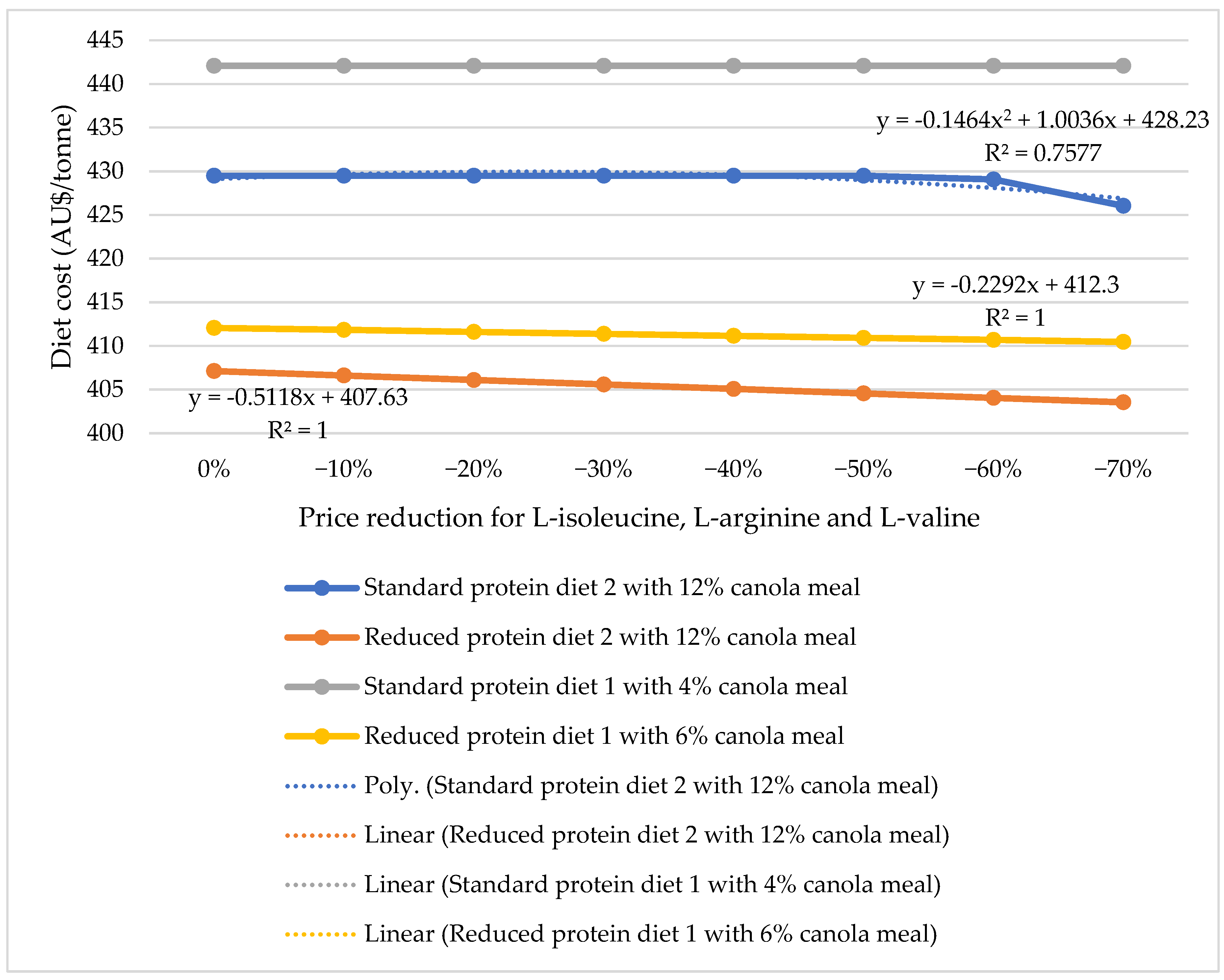
| Formula cost (AU$/tonne) | 442 | 412 | 430 | 407 |
| Calculated nutrient content, % (otherwise as indicated) | ||||
| Dry matter | 90.2 | 89.9 | 90.1 | 89.9 |
| AMEn 2, kcal/kg | 2690 | 2690 | 2690 | 2690 |
| Crude protein | 15.8 | 13.8 | 15.8 | 13.8 |
| Crude fat | 2.67 | 1.92 | 2.58 | 2.02 |
| Crude fiber | 3.06 | 3.14 | 3.84 | 3.84 |
| Ash | 9.41 | 9.15 | 9.52 | 9.27 |
| Digestible 3 lysine | 0.670 | 0.670 | 0.670 | 0.670 |
| Digestible methionine | 0.369 | 0.374 | 0.347 | 0.363 |
| Digestible methionine + cysteine | 0.600 | 0.600 | 0.600 | 0.600 |
| Digestible threonine | 0.496 | 0.470 | 0.493 | 0.470 |
| Digestible isoleucine | 0.605 | 0.530 | 0.578 | 0.530 |
| Digestible leucine | 1.177 | 1.015 | 1.139 | 0.979 |
| Digestible tryptophan | 0.184 | 0.156 | 0.182 | 0.154 |
| Digestible arginine | 0.878 | 0.702 | 0.843 | 0.690 |
| Digestible histidine | 0.333 | 0.284 | 0.334 | 0.274 |
| Digestible valine | 0.692 | 0.593 | 0.686 | 0.590 |
| Digestible glycine | 0.517 | 0.446 | 0.532 | 0.439 |
| Digestible phenylalanine | 0.655 | 0.545 | 0.626 | 0.503 |
| Calcium | 4.061 | 4.061 | 4.000 | 4.000 |
| Available phosphorus | 0.337 | 0.320 | 0.342 | 0.320 |
| Sodium | 0.160 | 0.160 | 0.160 | 0.160 |
| Chloride | 0.173 | 0.173 | 0.170 | 0.170 |
| Choline, mg/kg | 1600 | 1600 | 1600 | 1600 |
| Linoleic acid | 1.20 | 1.03 | 1.27 | 1.12 |
References
- Ertl, P.; Knaus, W.; Zollitsch, W. An approach to including protein quality when assessing the net contribution of livestock to human food supply. Animal 2016, 10, 1883–1889. [Google Scholar] [CrossRef]
- Van Hal, O.; Weijenberg, A.A.A.; De Boer, I.J.M.; Van Zanten, H.H.E. Accounting for feed-food competition in environmental impact assessment: Towards a resource efficient food-system. J. Clean. Prod. 2019, 240, 118241. [Google Scholar] [CrossRef]
- Pexas, G.; Doherty, B.; Kyriazakis, I. The future of protein sources in livestock feeds: Implications for sustainability and food safety. Front. Sustain. Food Syst. 2023, 7, 1188467. [Google Scholar] [CrossRef]
- Semper-Pascual, A.; Decarre, J.; Baumann, M.; Busso, J.M.; Camino, M.; Gómez-Valencia, B.; Kuemmerle, T. Biodiversity loss in deforestation frontiers: Linking occupancy modelling and physiological stress indicators to understand local extinctions. Biol. Conserv. 2019, 236, 281–288. [Google Scholar] [CrossRef]
- Song, X.P.; Hansen, M.C.; Potapov, P.; Adusei, B.; Pickering, J.; Adami, M.; Tyukavina, A. Massive soybean expansion in South America since 2000 and implications for conservation. Nat. Sustain. 2021, 4, 784–792. [Google Scholar] [CrossRef] [PubMed]
- Wilkinson, J.M. Re-defining efficiency of feed use by livestock. Animal 2011, 5, 1014–1022. [Google Scholar] [CrossRef] [PubMed]
- Wilkinson, J.M.; Young, R.H. Strategies to reduce reliance on soya bean meal and palm kernel meal in livestock nutrition. J. Appl. Anim. Nutr. 2020, 8, 75–85. [Google Scholar] [CrossRef]
- De Visser, C.; Schreuder, R.; Stoddard, F. The EU’s dependence on soya bean import for the animal feed industry and potential for EU produced alternatives. Oilseeds Fats Crops Lipids 2014, 21, D407. [Google Scholar]
- Kandel, M.; Macelline, S.P.; Toghyani, M.; Chrystal, P.V.; Choct, M.; Cowieson, A.J.; Selle, P.H. The potential of canola to decrease soybean meal inclusions in diets for broiler chickens. Anim. Nutr. 2025, 20, 342–354. [Google Scholar] [CrossRef]
- AEGIC (Australian Export Grains Innovation Centre) Australian Canola Information Brochure. Australian Export Grains Innovation Centre. Available online: https://www.aegic.org.au/australian-grains/canola/ (accessed on 6 August 2025).
- Spragg, J.; Mailer, R. Canola Meal Value Chain Quality Improvement; Final Report Prepared for Australian Oilseeds Federation and the Pork Cooperative Research Centre (Project Code: 1B-103-0506); Rural Industries Research and Development Corporation: Canberra, Australia, 2007; Available online: http://www.porkcrc.com.au/Final_Report_1B-103.pdf (accessed on 17 June 2025).
- Swick, R.A.; Wu, S. Optimisation of Australian Oilseed Meals; RIRDC Publication No 15/108; Rural Industries Research and Development Corporation: Barton, ACT, Australia, 2016. [Google Scholar]
- Khajali, F.; Slominski, B.A. Factors that affect the nutritive value of canola meal for poultry. Poult. Sci. 2012, 91, 2564–2575. [Google Scholar] [CrossRef]
- Slominski, B.A.; Jia, W.; Rogiewicz, A.; Nyachoti, C.M.; Hickling, D. Low-fiber canola. Part 1. Chemical and nutritive composition of the meal. J. Agric. Food Chem. 2012, 60, 12225–12230. [Google Scholar] [CrossRef] [PubMed]
- Chen, X.; Parr, C.; Utterback, P.; Parsons, C.M. Nutritional evaluation of canola meals produced from new varieties of canola seeds for poultry. Poult. Sci. 2015, 94, 984–991. [Google Scholar] [CrossRef]
- Swick, R.A. Inclusion Levels and Economic Benefits of Canola Meals on Egg Production of Laying Hens; Final Report for Poultry CRC Ltd. (project number: 2.1.17); Poultry CRC Ltd.: Armidale, NSW, Australia, 2016. [Google Scholar]
- Agyekum, A.K.; Woyengo, T.A. Nutritive value of expeller/cold-pressed canola meal and pre-pressed solvent-extracted carinata meal for broiler chicken. Poult. Sci. 2022, 101, 101528. [Google Scholar] [CrossRef]
- Taghizadeh-Hesary, F.; Rasoulinezhad, E.; Yoshino, N. Energy and food security: Linkages through price volatility. Energy Policy 2019, 128, 796–806. [Google Scholar] [CrossRef]
- Chrystal, P.V.; Moss, A.F.; Khoddami, A.; Naranjo, V.D.; Selle, P.H.; Liu, S.Y. Impacts of reduced-crude protein diets on key parameters in male broiler chickens offered maize-based diets. Poult. Sci. 2020, 99, 505–516. [Google Scholar] [CrossRef]
- Greenhalgh, S.; McInerney, B.V.; McQuade, L.R.; Chrystal, P.V.; Khoddami, A.; Zhuang, M.A.; Liu, S.Y.; Selle, P.H. Capping dietary starch:protein ratios in moderately reduced crude protein, wheat-based diets showed promise but further reductions generated inferior growth performance in broiler chickens. Anim. Nutr. 2020, 6, 168–178. [Google Scholar] [CrossRef]
- Liu, S.Y.; Macelline, S.P.; Chrystal, P.V.; Selle, P.H. Progress towards reduced-crude protein diets for broiler chickens and sustainable chicken-meat production. J. Anim. Sci. Biotechnol. 2021, 12, 20. [Google Scholar] [CrossRef]
- Newkirk, R.W.; Classen, H.L.; Edney, M.J. Effects of prepress-solvent extraction on the nutritional value of canola meal for broiler chickens. Anim. Feed Sci. Technol. 2003, 104, 111–119. [Google Scholar] [CrossRef]
- Bonnardeaux, J. Uses for Canola Meal; Department of Agriculture and Food, Western Australia: Perth, Australia, 2007. Available online: https://library.dpird.wa.gov.au/pubns/29/ (accessed on 27 September 2025).
- Selle, P.H.; Macelline, S.P.; Greenhalgh, S.; Chrystal, P.V.; Liu, S.Y. Identifying the shortfalls of crude protein-reduced, wheat-based broiler diets. Anim. Nutr. 2022, 11, 181–189. [Google Scholar] [CrossRef]
- Bell, J.M. Nutrients and toxicants in rapeseed meal: A review. J. Anim. Sci. 1984, 58, 996–1010. [Google Scholar] [CrossRef] [PubMed]
- Classen, H.L.; Newkirk, R.W.; Maenz, D.D. Effects of conventional and novel processing on the feed value of canola meal for poultry. In Proceedings of the 2004 Australian Poultry Science Symposium (APSS), Sydney, Australia, 9–11 February 2004; Volume 16, pp. 1–8. [Google Scholar]
- Canadian Food Focus. The Great Canadian Story of Canola. 2025. Available online: https://canadianfoodfocus.org/canadian-food-stories/the-great-canadian-story-of-canola (accessed on 5 December 2025).
- Mawson, R.; Heaney, R.K.; Zdunczyk, Z.; Kozłowska, H. Rapeseed meal-glucosinolates and their antinutritional effects. Part 3. Animal growth and performance. Nahrung 1994, 38, 167–177. [Google Scholar] [CrossRef] [PubMed]
- Canola Council of Canada. About Canola. 2025. Available online: http://www.canolacouncil.org/about-canola (accessed on 27 September 2025).
- FAOSTAT. 2015. Available online: https://www.fao.org/faostat (accessed on 17 June 2025).
- AOF (Australian Oilseeds Federation) Crop Reports. 2015. Available online: https://www.australianoilseeds.com/industry/crop-reports (accessed on 26 September 2025).
- CSIRO. Future Canola. 2025. Available online: https://www.csiro.au/en/work-with-us/industries/agriculture/future-crops/future-canola (accessed on 26 September 2025).
- Alsop, E. Crushing Investments Point to Confidence in Canola. Grain Central. 2024. Available online: https://www.graincentral.com/markets/crushing-investments-point-to-confidence-in-canola/ (accessed on 24 September 2025).
- Toghyani, M.; Swick, R.A.; Barekatain, R. Effect of seed source and pelleting temperature during steam pelleting on apparent metabolizable energy value of full-fat canola seed for broiler chickens. Poult. Sci. 2017, 96, 1325–1333. [Google Scholar] [CrossRef] [PubMed]
- Unger, E.H. Commercial processing of canola and rapeseed: Crushing and oil extraction. In Canola and Rapeseed: Production, Chemistry, Nutrition and Processing Technology; Springer: Boston, MA, USA, 1990; pp. 235–249. [Google Scholar]
- Agriculture Canada. Potential for Exports of Canadian Canola Products to the United States; Report issued by Agriculture Canada’s National Grains Bureau under the Grains 2000 program; Agriculture Canada: Ottawa, ON, Canada, March 1990. [Google Scholar]
- Uppström, B. Seed chemistry. In Brassica Oilseeds: Production and Utilization; Kimber, D., McGregor, D.I., Eds.; CAB International: Wallingford, UK, 1995; pp. 217–242. [Google Scholar]
- Rezvani, M.; Kluth, H.; Bulang, M.; Rodehutscord, M. Variation in amino acid digestibility of rapeseed meal studied in caecectomised laying hens and relationship with chemical constituents. Br. Poult. Sci. 2012, 53, 665–674. [Google Scholar] [CrossRef] [PubMed]
- Lannuzel, C.; Smith, A.; Mary, A.L.; Della Pia, E.A.; Kabel, M.A.; De Vries, S. Improving fiber utilization from rapeseed and sunflower seed meals to substitute soybean meal in pig and chicken diets: A review. Anim. Feed Sci. Technol. 2022, 285, 115213. [Google Scholar] [CrossRef]
- Niu, Y. The Prebiotic Effect of Enzymatically-Released Bioactive Components of Canola Meal Fibre on Gut Health and Growth Performance of Monogastric Animals. Ph.D. Dissertation, University of Manitoba, Winnipeg, MB, Canada, 2023. Available online: https://mspace.lib.umanitoba.ca/server/api/core/bitstreams/461a8201-509b-4d11-b2e0-8d244350c0ca/content (accessed on 16 June 2025).
- Adams, S.; Sello, C.T.; Qin, G.; Che, D.; Han, R. Does dietary fiber affect the levels of nutritional components after feed formulation? Fibers 2018, 6, 29. [Google Scholar] [CrossRef]
- Duangnumsawang, Y.; Zentek, J.; Boroojeni, F.G. Development and functional properties of intestinal mucus layer in poultry. Front. Immunol. 2021, 12, 745849. [Google Scholar] [CrossRef]
- Leala, J.; Smytha, H.D.C.; Ghosha, D. Physicochemical properties of mucus and their impact on transmucosal drug delivery. Int. J. Pharm. 2017, 532, 555–572. [Google Scholar] [CrossRef]
- Imbeah, M.; Sauer, W.C. The effect of dietary level of fat on amino acid digestibilities in soybean meal and canola meal and on rate of passage in growing pigs. Livest. Prod. Sci. 1991, 29, 227–239. [Google Scholar] [CrossRef]
- Canola Council of Canada. Canola Meal Dairy Feeding Guide, 7th ed.; Canola Council of Canada: Winnipeg, MB, Canada, 2024; Available online: https://www.canolacouncil.org/canolamazing/wp-content/uploads/2025/05/2024-Canola-Meal-Dairy-Feeding-Guide-%E2%80%93-English.pdf (accessed on 11 August 2025).
- Moss. Database of the Nutrient Content of Australian Feed Ingredients; AgriFutures: Wagga Wagga, Australia, 2020; Available online: https://agrifutures.com.au/product/database-of-the-nutrient-content-of-australian-feed-ingredients/ (accessed on 20 May 2025).
- Bryden, W.L.; Li, X.; Ravindran, G.; Hew, L.I.; Ravindran, V. Ileal Digestible Amino Acid Values in Feedstuffs for Poultry; No 09/071; Rural Industries Research and Development Corporation Publication: Barton, ACT, Australia, 2009. [Google Scholar]
- Parsons, C.M.; Hashimoto, K.; Wedekind, K.J.; Han, Y.; Baker, D.H. Effect of overprocessing on availability of amino acids and energy in soybean meal. Poult. Sci. 1992, 71, 133–140. [Google Scholar] [CrossRef]
- Anderson-Hafermann, J.C.; Zhang, Y.; Parsons, C.M. Effects of processing on the nutritional quality of canola meal. Poult. Sci. 1993, 72, 326–333. [Google Scholar] [CrossRef]
- Kim, J.C.; Mullan, B.P.; Pluske, J.R. Prediction of apparent, standardized, and true ileal digestible total and reactive lysine contents in heat-damaged soybean meal samples. J. Anim. Sci. 2012, 90, 137–139. [Google Scholar] [CrossRef]
- Ahmed, A.; Zulkifli, I.; Farjam, A.S.; Abdullah, N.; Liang, J.B. Extrusion enhances metabolizable energy and ileal amino acids digestibility of canola meal for broiler chickens. Ital. J. Anim. Sci. 2014, 13, 3032. [Google Scholar] [CrossRef]
- Adedokun, S.A.; Utterback, P.; Parsons, C.M.; Adeola, O.; Lilburn, M.S.; Applegate, T.J. Comparison of amino acid digestibility of feed ingredients in broilers, laying hens and caecectomised roosters. Br. Poult. Sci. 2009, 50, 350–358. [Google Scholar] [CrossRef]
- Kong, C.; Adeola, O. Comparative amino acid digestibility for broiler chickens and White Pekin ducks. Poult. Sci. 2013, 92, 2367–2374. [Google Scholar] [CrossRef]
- Jia, W.; Mikulski, D.; Rogiewicz, A.; Zduńczyk, Z.; Jankowski, J.; Slominski, B.A. Low-fiber canola. Part 2. Nutritive value of the meal. J. Agric. Food Chem. 2012, 60, 12231–12237. [Google Scholar] [CrossRef]
- Smulikowska, S.; Pastuszewska, B.; Mieczkowska, A.; Ochtabińska, A. Chemical composition, energy value for chickens, and protein utilization in rats of rapeseed expeller cakes produced by different pressing technologies. J. Anim. Feed Sci. 1997, 6, 109–121. [Google Scholar] [CrossRef][Green Version]
- Bell, J.M. Factors affecting the nutritional value of canola meal: A review. Can. J. Anim. Sci. 1993, 73, 689–697. [Google Scholar] [CrossRef]
- Toghyani, M.; Rodgers, N.; Barekatain, M.R.; Iji, P.A.; Swick, R.A. Apparent metabolizable energy value of expeller-extracted canola meal subjected to different processing conditions for growing broiler chickens. Poult. Sci. 2014, 93, 2227–2236. [Google Scholar] [CrossRef] [PubMed]
- Downey, R.K.; Bell, J.M. New developments in canola research. In Canola and Rapeseed: Production, Chemistry, Nutrition and Processing Technology; Springer: Boston, MA, USA, 1990; pp. 37–46. [Google Scholar]
- Khalil, M.M.; Abdollahi, M.R.; Zaefarian, F.; Chrystal, P.V.; Ravindran, V. Broiler age influences the apparent metabolizable energy of soybean meal and canola meal. Animals 2023, 13, 219. [Google Scholar] [CrossRef] [PubMed]
- Slominski, B.A.; Campbell, L.D. Non-starch polysaccharides of canola meal: Quantification, digestibility in poultry and potential benefit of dietary enzyme supplementation. J. Sci. Food Agric. 1990, 53, 175–184. [Google Scholar] [CrossRef]
- Canola Council of Canada. Canola Meal Feed Industry Guide, 4th ed.; Canola Council of Canada: Winnipeg, MB, Canada, 2009. [Google Scholar]
- Montoya, C.A.; Leterme, P. Determination of the digestible energy and prediction of the net energy content of toasted and non-toasted canola meals from Brassica junceae and Brassica napus in growing pigs by the total faecal collection and the indigestible marker method. Can. J. Anim. Sci. 2009, 89, 481–487. [Google Scholar] [CrossRef]
- Hanna, C.D.; Foran, C.K.; Utterback, P.L.; Stein, H.H.; Parsons, C.M. Phosphorus bioavailability in increased-protein, reduced-fiber canola meal, conventional canola meal, and soybean meal fed to crossbred chicks. Poult. Sci. 2018, 97, 188–195. [Google Scholar] [CrossRef]
- Wickramasuriya, S.S.; Yi, Y.J.; Yoo, J.; Kang, N.K.; Heo, J.M. A review of canola meal as an alternative feed ingredient for ducks. J. Anim. Sci. Technol. 2015, 57, 29. [Google Scholar] [CrossRef]
- Naczk, M.; Amarowicz, R.; Sullivan, A.; Shahidi, F. Current research developments on polyphenolics of rapeseed/canola: A review. Food Chem. 1998, 62, 489–502. [Google Scholar] [CrossRef]
- Clark, W.D.; Classen, H.L.; Newkirk, R.W. Assessment of tail-end dehulled canola meal for use in broiler diets. Can. J. Anim. Sci. 2001, 81, 379–386. [Google Scholar] [CrossRef]
- Shires, A.; Bell, J.M.; Laverty, W.H.; Fedec, P.; Blake, J.A.; McGregor, D.I. Effect of desolventization conditions and removal of fibrous material by screening on the nutritional value of canola rapeseed meal for broiler chickens. Poult. Sci. 1983, 62, 2234–2244. [Google Scholar] [CrossRef]
- Liang, D. Effect of Enzyme Supplementation on the Nutritive Value of Canola Meal for Broiler Chickens. Master’s Thesis, Faculty of Graduate Studies, University of Manitoba, Winnipeg, MB, Canada, 2000. Available online: https://mspace.lib.umanitoba.ca/server/api/core/bitstreams/df113c5a-7759-4088-9af5-f500f05f6c25/content (accessed on 28 September 2025).
- Newkirk, R.W. Canola Meal Feed Industry Guide, 4th ed.; Canola Council of Canada: Winnipeg, MB, Canada, 2009. [Google Scholar]
- Summers, J.D.; Bedford, M.; Spratt, D. Amino acid supplementation of canola meal. Can. J. Anim. Sci. 1989, 69, 469–475. [Google Scholar] [CrossRef]
- Swick, R.A. Considerations in Using Protein Meal for Poultry and Swine; ASA technical Bulletin Volume AN 21; American Soybean Association: St. Louis, MO, USA, 1999. [Google Scholar]
- Sariçiçek, B.Z.; Kılıç, Ü.; Garipoğlu, A.V. Replacing soybean meal (SBM) by canola meal (CM): The effects of multi-enzyme and phytase supplementation on the performance of growing and laying quails. Asian-Australas. J. Anim. Sci. 2005, 18, 1457–1463. [Google Scholar] [CrossRef]
- Kong, C.; Adeola, O. Protein utilization and amino acid digestibility of canola meal in response to phytase in broiler chickens. Poult. Sci. 2011, 90, 1508–1515. [Google Scholar] [CrossRef] [PubMed]
- Sibbald, I.R. A bioassay for true metabolizable energy in feedingstuffs. Poult. Sci. 1976, 55, 303–308. [Google Scholar] [CrossRef]
- Clandinin, D.R. (Ed.) Canola Meal for Livestock and Poultry; Canola Council of Canada: Winnipeg, MB, Canada, 1989. [Google Scholar]
- Manyeula, F.; Legodimo, M.D.; Moreki, J.C.; Mlambo, V. Soybean replacement value of canola meal as measured by growth performance and feed efficiency in broiler chickens: Insights from a meta-analysis: Canola meal has poor replacement potential for soybean in broiler diets. Poult. Sci. 2025, 104, 104876. [Google Scholar] [CrossRef]
- Disetlhe, A.R.P.; Marume, U.; Mlambo, V. Humic acid and enzymes inclusion in canola-based diets generate different responses in growth performance, protein utilization dynamics, and hemato-biochemical parameters in broiler chickens. Poult. Sci. 2018, 97, 2745–2753. [Google Scholar] [CrossRef] [PubMed]
- Manyeula, F.; Mlambo, V.; Marume, U.; Sebola, N.A. Nutrient digestibility, haemo-biochemical parameters and growth performance of an indigenous chicken strain fed canola meal–containing diets. Trop. Anim. Health Prod. 2019, 51, 2343–2350. [Google Scholar] [CrossRef]
- Rehman, A.U.; Arif, M.; Husnain, M.M.; Alagawany, M.; Abd El-Hack, M.E.; Taha, A.E.; Allam, A.A. Growth performance of broilers as influenced by different levels and sources of methionine plus cysteine. Animals 2019, 9, 1056. [Google Scholar] [CrossRef]
- Aljuobori, A.; Zulkifli, I.; Soleimani, A.F.; Abdullah, N.; Liang, J.B.; Mujahid, A. Higher inclusion rate of canola meal under high ambient temperature for broiler chickens. Poult. Sci. 2016, 95, 1326–1331. [Google Scholar] [CrossRef]
- Butler, E.J.; Pearson, A.W.; Fenwick, G.R. Problems which limit the use of rapeseed meal as a protein source in poultry diets. J. Sci. Food Agric. 1982, 33, 866–875. [Google Scholar] [CrossRef]
- Knezacek, T.D.; Ward, A.K.; Dahiya, J.P.; Schwean-Lardner, K.V.; Classen, H.L. The effect of dietary canola meal on productivity of three commercial laying hen strains. Poult. Sci. 2009, 88, 31. [Google Scholar]
- Ward, A.K.; Classen, H.L.; Buchanan, F.C. Fishy-egg tainting is recessively inherited when brown-shelled layers are fed canola meal. Poult. Sci. 2009, 88, 714–721. [Google Scholar] [CrossRef] [PubMed]
- Savary, R.K.; MacIsaac, J.L.; Rathgeber, B.M.; McLean, N.L.; Anderson, D.M. Evaluating Brassica napus and Brassica juncea meals with supplemental enzymes for use in laying hen diets: Production performance and egg quality factors. Can. J. Anim. Sci. 2017, 97, 476–487. [Google Scholar] [CrossRef]
- Oryschak, M.A.; Smit, M.N.; Beltranena, E. Brassica napus and Brassica juncea extruded-expelled cake and solvent-extracted meal as feedstuffs for laying hens: Lay performance, egg quality, and nutrient digestibility. Poult. Sci. 2020, 99, 350–363. [Google Scholar] [CrossRef]
- Rogiewicz, A.; Nurnberg, L.; Slominski, B.A. The effect of prepress-solvent extraction on the chemical and nutritive composition of Canola Meal. In Proceedings of the 24th World’s Poultry Congress, Salvador, Brazil, 5–9 August 2012. [Google Scholar]
- Labalette, F.; Dauguet, S.; Merrien, A.; Peyronnet, C.; Quinsac, A. Glucosinolates content, an important quality parameter monitored at each stage of the French rapeseed production chain. In Proceedings of the 13th International Rapeseed Congress, GCIRC, Prague, Czech Republic, 5–9 June 2011; pp. 438–442. [Google Scholar]
- Mikulski, D.; Jankowski, J.; Zdunczyk, Z.; Juskiewicz, J.; Slominski, B.A. The effect of different dietary levels of rapeseed meal on growth performance, carcass traits, and meat quality in turkeys. Poult. Sci. 2012, 91, 215–223. [Google Scholar] [CrossRef] [PubMed]
- Campbell, L.D.; Slominski, B.A. Nutritive quality of low-glucosinolate meal for laying hens. In Proceedings of the 8th International Rapeseed Congress, Saskatoon, SK, Canada, 9–11 July 1991; Volume 2, pp. 442–447. [Google Scholar]
- Perez-Maldonado, R.A.; Barram, K.M. Evaluation of australian canola meal for production and egg quality in two layer strains. In Proceedings of the Australian Poultry Science Symposium (APSS), Sydney, Australia, 16–19 February 2014; Volume 16, pp. 171–174. [Google Scholar]
- Durkee, A.B. The nature of tannin in rapeseed (Brassica campestris). Phytochemistry 1971, 10, 1583–1585. [Google Scholar] [CrossRef]
- Yapar, Z.; Clandinin, D.R. Effect of tannins in rapeseed meal on its nutritional value for chicks. Poult. Sci. 1972, 51, 222–228. [Google Scholar] [CrossRef]
- Naczk, M.; Amarowicz, R.; Pink, D.; Shahidi, F. Insoluble condensed tannins of canola/rapeseed. J. Agric. Food Chem. 2000, 48, 1758–1762. [Google Scholar] [CrossRef]
- Rakow, G.; Relf-Eckstein, J.A.; Raney, J.P. Rapeseed genetic research to improve its agronomic performance and seed quality. Helia 2007, 30, 199–206. [Google Scholar] [CrossRef]
- Relf-Eckstein, J.A.; Raney, J.P.; Rakow, G. Meal quality improvement in Brassica napus canola through the development of low fibre (yellow-seeded) germplasm. In Proceedings of the 12th International Rapeseed Congress, Wuhan, China, 26–30 March 2007; Volume 5, pp. 289–291. [Google Scholar]
- Toghyani, M.; Wu, S.B.; Pérez-Maldonado, R.A.; Iji, P.A.; Swick, R.A. Performance, nutrient utilization, and energy partitioning in broiler chickens offered high canola meal diets supplemented with multicomponent carbohydrase and mono-component protease. Poult. Sci. 2017, 96, 3960–3972. [Google Scholar] [CrossRef]
- Olukomaiya, O.O.; Pan, L.; Zhang, D.; Mereddy, R.; Sultanbawa, Y.; Li, X. Performance and ileal amino acid digestibility in broilers fed diets containing solid-state fermented and enzyme-supplemented canola meals. Anim. Feed Sci. Technol. 2021, 275, 114876. [Google Scholar] [CrossRef]
- Niu, Y.; Rogiewicz, A.; Shi, L.; Patterson, R.; Slominski, B.A. The effect of enzymatically-modified canola meal on growth performance, nutrient utilization, and gut health and function of broiler chickens. Anim. Feed Sci. Technol. 2023, 305, 115760. [Google Scholar] [CrossRef]
- Cowieson, A.J.; Lu, H.; Ajuwon, K.M.; Knap, I.; Adeola, O. Interactive effects of dietary protein source and exogenous protease on growth performance, immune competence and jejunal health of broiler chickens. Anim. Prod. Sci. 2016, 57, 252–261. [Google Scholar] [CrossRef]
- Zamir, S.N.S.; Goudarzi, S.M.; Saki, A.A.; Zamani, P. Effect of different levels of canola meal and protease enzyme on performance, egg quality traits and nutrient digestibility in laying hens. Anim. Prod. Res. 2020, 9, fa33–fa45. [Google Scholar] [CrossRef]
- Shim, Y.H.; Shinde, P.L.; Choi, J.Y.; Kim, J.S.; Seo, D.K.; Pak, J.I.; Kwon, I.K. Evaluation of multi-microbial probiotics produced by submerged liquid and solid substrate fermentation methods in broilers. Asian-Australas. J. Anim. Sci. 2010, 23, 521–529. [Google Scholar] [CrossRef]
- Paton, A.W.; Morona, R.; Paton, J.C. Designer probiotics for prevention of enteric infections. Nat. Rev. Microbiol. 2006, 4, 193–200. [Google Scholar] [CrossRef]
- Chachaj, R.; Sembratowicz, I.; Krauze, M.; Stępniowska, A.; Rusinek-Prystupa, E.; Czech, A.; Ognik, K. The effect of fermented soybean meal on performance, biochemical and immunological blood parameters in turkeys. Ann. Anim. Sci. 2019, 19, 1035–1049. [Google Scholar] [CrossRef]
- Mahata, M.E.; Rizal, Y. Selection of local microorganism solutions as crude fiber digester in areca catechu L. Peel waste for producing poultry feed additives. Int. J. Poult. Sci. 2019, 18, 58–62. [Google Scholar] [CrossRef]
- Abdel-Moneim, A.M.E.; Elbaz, A.M.; Khidr, R.E.S.; Badri, F.B. Effect of in ovo inoculation of Bifidobacterium spp. on growth performance, thyroid activity, ileum histomorphometry, and microbial enumeration of broilers. Probiotics Antimicrob. Proteins 2020, 12, 873–882. [Google Scholar] [CrossRef]
- Elbaz, A.M. Effects of diet containing fermented canola meal on performance, blood parameters, and gut health of broiler chickens. J. World’s Poult. Res. 2021, 11, 1–7. [Google Scholar] [CrossRef]
- Croat, J.R.; Gibbons, W.R.; Berhow, M.; Karki, B.; Muthukumarappan, K. Enhancing the nutritional value of canola (Brassica napus) meal using a submerged fungal incubation process. J. Food Res. 2016, 5, 1–10. [Google Scholar] [CrossRef]
- Adarsh, P.V.; Amandeep, W. Beneficial effects of Rhizopus oligosporus fermentation on reduction of glucosinolates, fibre and phytic acid in rapeseed (Brassica napus) meal. Bioresour. Technol. 2001, 78, 309–312. [Google Scholar] [CrossRef] [PubMed]
- Hu, Y.; Wang, Y.; Li, A.; Wang, Z.; Zhang, X.; Yun, T.; Yin, Y. Effects of fermented rapeseed meal on antioxidant functions, serum biochemical parameters and intestinal morphology in broilers. Food Agric. Immunol. 2016, 27, 182–193. [Google Scholar] [CrossRef]
- Mukherjee, R.; Chakraborty, R.; Abhishek, D. Role of fermentation in improving nutritional quality of soybean meal—A review. Asian-Australas. J. Anim. Sci. 2016, 29, 1523–1529. [Google Scholar] [CrossRef]
- Soumeh, E.A.; Mohebodini, H.; Toghyani, M.; Shabani, A.; Ashayerizadeh, A.; Jazi, V. Synergistic effects of fermented soybean meal and mannan-oligosaccharide on growth performance, digestive functions, and hepatic gene expression in broiler chickens. Poult. Sci. 2019, 98, 6797–6807. [Google Scholar] [CrossRef]
- Chiang, G.; Lu, W.Q.; Piao, X.S.; Hu, J.K.; Gong, L.M.; Thacker, P.A. Effects of feeding solid-state fermented rapeseed meal on performance, nutrient digestibility, intestinal ecology and intestinal morphology of broiler chickens. Asian-Australas. J. Anim. Sci. 2009, 23, 263–271. [Google Scholar] [CrossRef]
- Elbaz, A.M.; El-Sheikh, S.E.; Abdel Maksoud, A. Growth performance, nutrient digestibility, antioxidant state, ileal histomorphometry, and cecal ecology of broilers fed on fermented canola meal with and without exogenous enzymes. Trop. Anim. Health Prod. 2023, 55, 46. [Google Scholar] [CrossRef]
- Hafeez, A.; Akram, W.; Al-Khalaifah, H.; Naz, S.; Khan, R.U.; Tufarelli, V.; Alhidary, I.A. Enzyme inclusion or fermentation of canola-based diets generate different responses in growth indicators, carcass quality, nutrient digestibility, bone strength, and blood biochemical parameters in broiler chickens. Arch. Anim. Breed. 2025, 68, 485–495. [Google Scholar] [CrossRef]
- Xu, F.Z.; Zeng, X.G.; Ding, X.L. Effects of replacing soybean meal with fermented rapeseed meal on performance, serum biochemical variables and intestinal morphology of broilers. Asian-Australas. J. Anim. Sci. 2012, 25, 1734. [Google Scholar] [CrossRef] [PubMed]
- Naseem, M.Z.; Khan, S.H.; Yousaf, M. Effect of feeding various levels of canola meal on the performance of broiler chicks. J. Anim. Plant Sci. 2006, 16, 3–4. [Google Scholar]
- Min, Y.N.; Wang, Z.; Coto, C.; Yan, F.; Cerrate, S.; Liu, F.Z.; Waldroup, P.W. Evaluation of canola meal from biodiesel production as a feed ingredient for broilers. Int. J. Poult. Sci. 2011, 10, 782–785. [Google Scholar] [CrossRef]
- Gopinger, E.; Xavier, E.G.; Elias, M.C.; Catalan, A.A.S.; Castro, M.L.S.; Nunes, A.P.; Roll, V.F.B. The effect of different dietary levels of canola meal on growth performance, nutrient digestibility, and gut morphology of broiler chickens. Poult. Sci. 2014, 93, 1130–1136. [Google Scholar] [CrossRef] [PubMed]
- Yadav, S.; Teng, P.Y.; Choi, J.; Singh, A.K.; Vaddu, S.; Thippareddi, H.; Kim, W.K. Influence of rapeseed, canola meal and glucosinolate metabolite (AITC) as potential antimicrobials: Effects on growth performance, and gut health in Salmonella Typhimurium challenged broiler chickens. Poult. Sci. 2022, 101, 101551. [Google Scholar] [CrossRef]
- Leeson, S.; Atteh, J.O.; Summers, J.D. The replacement value of canola meal for soybean meal in poultry diets. Can. J. Anim. Sci. 1987, 67, 151–158. [Google Scholar] [CrossRef]
- Kidd, M.T.; Maynard, C.W.; Mullenix, G.J. Progress of amino acid nutrition for diet protein reduction in poultry. J. Anim. Sci. Biotechnol. 2021, 12, 45. [Google Scholar] [CrossRef] [PubMed]
- Van Harn, J.; Dijkslag, M.A.; Van Krimpen, M.M. Effect of low dietary protein levels on performance, litter quality and footpad lesions in broilers. In Proceedings of the 21st European Symposium on Poultry Nutrition; Wageningen Academic: Wageningen, The Netherlands, 2017; p. 185. [Google Scholar]
- Wen, C.; Yan, W.; Zheng, J.; Ji, C.; Zhang, D.; Sun, C.; Yang, N. Feed efficiency measures and their relationships with production and meat quality traits in slower growing broilers. Poult. Sci. 2018, 97, 2356–2364. [Google Scholar] [CrossRef] [PubMed]
- Roberts, S.A.; Xin, H.; Kerr, B.J.; Russell, J.R.; Bregendahl, K. Effects of dietary fiber and reduced crude protein on ammonia emission from laying-hen manure. Poult. Sci. 2007, 86, 1625–1632. [Google Scholar] [CrossRef] [PubMed]
- Ajao, A.M.; White, D.; Kim, W.K.; Olukosi, O.A. Partial replacement of soybean meal with canola meal or corn DDGS in low-protein diets supplemented with crystalline amino acids—Effect on growth performance, whole-body composition, and litter characteristics. Animals 2022, 12, 2662. [Google Scholar] [CrossRef]
- Kalinowski, A.; Moran, E.T., Jr.; Wyatt, C.L. Methionine and cystine requirements of slow-and fast-feathering broiler males from three to six weeks of age. Poult. Sci. 2003, 82, 1428–1437. [Google Scholar] [CrossRef]
- Creek, R.D. Non equivalence in mass in the conversion of phenylalanine to tyrosine and methionine to cystine. Poult. Sci. 1968, 47, 1385–1386. [Google Scholar] [CrossRef]
- Graber, G.; Baker, D.H. Sulfur amino acid nutrition of the growing chick: Quantitative aspects concerning the efficacy of dietary methionine, cysteine and cystine. J. Anim. Sci. 1971, 33, 1005–1011. [Google Scholar] [CrossRef]
- Sowers, J.E.; Stockland, W.L.; Meade, R.J. L-methionine and L-cystine requirements of the growing rat. J. Anim. Sci. 1972, 35, 782–788. [Google Scholar] [CrossRef]
- Stockland, W.L.; Meade, R.J.; Wass, D.F.; Sowers, J.E. Influence of levels of methionine and cystine on the total sulfur amino acid requirement of the growing rat. J. Anim. Sci. 1973, 36, 526–530. [Google Scholar] [CrossRef]
- Cao, T.; Weil, J.T.; Maharjan, P.; Lu, J.; Coon, C.N. The digestible methionine and cystine requirements for commercial layers. Int. J. Poult. Sci. 2020, 19, 232–243. [Google Scholar] [CrossRef]
- Roth, F.X.; Kirchgessner, M. Biological efficiency of dietary methionine or cystine supplementation with growing pigs: A contribution to the requirement for S-containing amino acids. J. Anim. Physiol. Anim. Nutr. 1987, 58, 267–280. [Google Scholar] [CrossRef]
- Heger, J.; Phung, T.V.; Křížová, L. Efficiency of amino acid utilization in the growing pig at suboptimal levels of intake: Lysine, threonine, sulphur amino acids and tryptophan. J. Anim. Physiol. Anim. Nutr. 2002, 86, 153–165. [Google Scholar] [CrossRef] [PubMed]
- Pacheco, L.G.; Sakomura, N.K.; Suzuki, R.M.; Dorigam, J.C.; Viana, G.S.; Van Milgen, J.; Denadai, J.C. Methionine to cystine ratio in the total sulfur amino acid requirements and sulfur amino acid metabolism using labelled amino acid approach for broilers. BMC Vet. Res. 2018, 14, 364. [Google Scholar] [CrossRef]
- Selle, P.H.; Moss, A.F.; Khoddami, A.; Chrystal, P.V.; Liu, S.Y. Starch digestion rates in multiple samples of commonly used feed grains in diets for broiler chickens. Anim. Nutr. 2021, 7, 450–459. [Google Scholar] [CrossRef]
- Tuunainen, P.; Koivunen, E.; Valaja, J.; Valkonen, E.; Hiidenhovi, J.; Tupasela, T. Effects of dietary rapeseed meal and peas on the performance and meat quality of broilers. Agric. Food Sci. 2016, 25, 22–33. [Google Scholar] [CrossRef]
- Salmon, R.E.; Gardiner, E.E.; Klein, K.K.; Larmond, E. Effect of canola (low glucosinolate rapeseed) meal, protein and nutrient density on performance, carcass grade, and meat yield, and of canola meal on sensory quality of broilers. Poult. Sci. 1981, 60, 2519–2528. [Google Scholar] [CrossRef]
- Macelline, S.P.; Chrystal, P.V.; Toghyani, M.; Selle, P.H.; Liu, S.Y. Dietary crude protein reductions in wheat-based diets with two energy densities compromised performance of broiler chickens from 15 to 36 days post-hatch. Poult. Sci. 2023, 102, 102932. [Google Scholar] [CrossRef]
- Peters, C.J.; Bills, N.L.; Wilkins, J.L.; Fick, G.W. Foodshed analysis and its relevance to sustainability. Renew. Agric. Food Syst. 2009, 24, 1–7. [Google Scholar] [CrossRef]
- Rauw, W.M.; Gómez Izquierdo, E.; Torres, O.; García Gil, M.; de Miguel Beascoechea, E.; Rey Benayas, J.M.; Gomez-Raya, L. Future farming: Protein production for livestock feed in the EU. Sustain. Earth Rev. 2023, 6, 3. [Google Scholar] [CrossRef]
- Te Pas, M.F.; Veldkamp, T.; de Haas, Y.; Bannink, A.; Ellen, E.D. Adaptation of livestock to new diets using feed components without competition with human edible protein sources—A review of the possibilities and recommendations. Animals 2021, 11, 2293. [Google Scholar] [CrossRef]
- Grain Central. Daily Market Wire 18 February 2025. 2025. Available online: https://www.graincentral.com/markets/daily-market-wire-18-february-2025/ (accessed on 15 June 2025).
- Lioutas, E.D.; Charatsari, C. Enhancing the ability of agriculture to cope with major crises or disasters: What the experience of COVID-19 teaches us. Agric. Syst. 2021, 187, 103023. [Google Scholar] [CrossRef]
- Khattak, F.M.; Pasha, T.N.; Hayat, Z.; Mahmud, A. Enzymes in poultry nutrition. J. Anim. Plant Sci. 2006, 16, 1–7. [Google Scholar]
- Lemme, A.; Naranjo, V.; De Campeneere, S. Importance of feed efficiency for sustainable intensification of chicken meat production: Implications and role for amino acids, feed enzymes and organic trace minerals. World’s Poult. Sci. J. 2021, 77, 639–659. [Google Scholar] [CrossRef]
- Hao, Y.; Wang, Z.; Zou, Y.; He, R.; Ju, X.; Yuan, J. Effect of static-state fermentation on volatile composition in rapeseed meal. J. Sci. Food Agric. 2020, 100, 2145–2152. [Google Scholar] [CrossRef]
- Harris, J.M. Competitiveness of Canola Oil and Meal in the United States Oilseed Market. Bachelor’s Thesis, Oklahoma State University, Stillwater, OK, USA, 1991. Available online: http://hdl.handle.net/20.500.14446/13715 (accessed on 16 July 2025).
- Klein, K.K.; Salmon, R.E.; Gardiner, E.E. Economic analysis of the use of canola meal in diets for broiler chickens. Can. J. Agric. Econ. 1981, 29, 327–338. [Google Scholar] [CrossRef]
- Sayed, E.L.; Soliman, N.K.; Hemid, A.A.; El-Wardany, I. Performance and physiological aspects of broiler chicks fed diets containing various levels of canola meal. J. Anim. Poult. Prod. 2007, 32, 8169–8179. [Google Scholar] [CrossRef]
- Abdallah, A.G.; Sayed, M.A.M.; Ali, S.A.; Abou El-Wafa, S. Influence of replacing soybean meal with full-fat canola seeds or canola meal on broiler performance. Egypt. J. Nutr. Feeds 2003, 6, 115–125. [Google Scholar]
- Swick, R.A.; Creswell, D.C. Economics of low protein broiler diets: A formulation exercise. In Proceedings of the 30th Australian Poultry Science Symposium, Sydney, Australia, 17–20 February 2019; pp. 17–20. [Google Scholar]
- Hy-Line International. Hy-Line Brown—Conventional Systems; Hy-Line International: West Des Moines, IA, USA, 2023; Available online: https://www.hyline.com/ (accessed on 17 April 2025).
- Williams, A.G.; Audsley, E.; Sandars, D.L. Determining the Environmental Burdens and Resource Use in the Production of Agricultural and Horticultural Commodities; Main Report. Defra Research Project IS0205; Department for Environment Food and Rural Affairs: London, UK, 2006. [Google Scholar]
- De Vries, M.; De Boer, I.J. Comparing environmental impacts for livestock products: A review of life cycle assessments. Livest. Sci. 2010, 128, 1–11. [Google Scholar] [CrossRef]
- Sutton, M.A.; Howard, C.M.; Erisman, J.W.; Billen, G.; Bleeker, A.; Grennfelt, P.; Grizzetti, B. (Eds.) The European Nitrogen Assessment: Sources, Effects and Policy Perspectives; Cambridge University Press: Cambridge, UK, 2011; p. 612. [Google Scholar]
- Leinonen, I.; Williams, A.G.; Wiseman, J.; Guy, J.; Kyriazakis, I. Predicting the environmental impacts of chicken systems in the United Kingdom through a life cycle assessment: Broiler production systems. Poult. Sci. 2012, 91, 8–25. [Google Scholar] [CrossRef]
- Leinonen, I.; Williams, A.G.; Wiseman, J.; Guy, J.; Kyriazakis, I. Predicting the environmental impacts of chicken systems in the United Kingdom through a life cycle assessment: Egg production systems. Poult. Sci. 2012, 91, 26–40. [Google Scholar] [CrossRef]
- Sasu-Boakye, Y.; Cederberg, C.; Wirsenius, S. Localising livestock protein feed production and the impact on land use and greenhouse gas emissions. Animal 2014, 8, 1339–1348. [Google Scholar] [CrossRef]
- Tamasgen, N.; Urge, M.; Girma, M.; Nurfeta, A. Effect of dietary replacement of soybean meal with linseed meal on feed intake, growth performance and carcass quality of broilers. Heliyon 2021, 7, e08316. [Google Scholar] [CrossRef]
- Abbas, G.; Al-Taey, D.K.A.; Ali, H.; Mohyuddin, S.G.; Iqbal, A.; Ameer, M.; Ijaz, M. Effect of soybean unavailability situations and COVID-19 on the poultry industry of Pakistan: A comprehensive analysis problems faced and its solution for sustainable animal production. Pak. J. Sci. 2023, 75, 264–272. [Google Scholar]
- Yu, C.; Miao, R.; Khanna, M. Maladaptation of US corn and soybeans to a changing climate. Sci. Rep. 2021, 11, 12351. [Google Scholar] [CrossRef]
- Hansen, J.Ø.; Øverland, M.; Skrede, A.; Anderson, D.M.; Collins, S.A. A meta-analysis of the effects of dietary canola/double low rapeseed meal on growth performance of weanling and growing-finishing pigs. Anim. Feed Sci. Technol. 2020, 259, 114302. [Google Scholar] [CrossRef]
- Leinonen, I.; Williams, A.G.; Kyriazakis, I. Potential environmental benefits of prospective genetic changes in broiler traits. Poult. Sci. 2016, 95, 228–236. [Google Scholar] [CrossRef]
- Alkhtib, A.; Wilson, P.; Bedford, M.R.; O’Neill, H.N.M.; Burton, E. Can the broiler industry rely on results of existing life cycle assessment and environmental assessments studies to inform broilers’ nutritional strategies? Poult. Sci. 2023, 102, 102667. [Google Scholar] [CrossRef] [PubMed]
- Kirkegaard, J.; Christen, O.; Krupinsky, J.; Layzell, D. Break crop benefits in temperate wheat production. Field Crops Res. 2008, 107, 185–195. [Google Scholar] [CrossRef]
- Nemecek, T.; von Richthofen, J.S.; Dubois, G.; Casta, P.; Charles, R.; Pahl, H. Environmental impacts of introducing grain legumes into European crop rotations. Eur. J. Agron. 2008, 28, 380–393. [Google Scholar] [CrossRef]
- Malik, R. Soil quality benefits of break crops and/or crop rotations-a review. In Proceedings of the 19th World Congress of Soil Science: Soil Solutions for a Changing World, Brisbane, QLD, Australia, 1–6 August 2010; pp. 95–98. [Google Scholar]
- Zhang, Z.; Wang, Z.; Li, J.; Liu, H.; Wang, X.; Li, W. Comparison of water footprint and carbon footprint of corn, soybean, camelina, and canola for the preparation of sustainable aviation fuels in Gansu Province, China. J. Clean. Prod. 2024, 475, 143743. [Google Scholar] [CrossRef]
- Leinonen, I.; Kyriazakis, I. How can we improve the environmental sustainability of poultry production? Proc. Nutr. Soc. 2016, 75, 265–273. [Google Scholar] [CrossRef]
- Pomar, C.; Andretta, I.; Remus, A. Feeding strategies to reduce nutrient losses and improve the sustainability of growing pigs. Front. Vet. Sci. 2021, 8, 742220. [Google Scholar] [CrossRef] [PubMed]
- Toop, T.A.; Ward, S.; Oldfield, T.; Hull, M.; Kirby, M.E.; Theodorou, M.K. AgroCycle–developing a circular economy in agriculture. Energy Procedia 2017, 123, 76–80. [Google Scholar] [CrossRef]
- Vastolo, A.; Calabrò, S.; Cutrignelli, M.I. A review on the use of agro-industrial CO-products in animals’ diets. Ital. J. Anim. Sci. 2022, 21, 577–594. [Google Scholar] [CrossRef]
- Jiang, L.Y.; Mason, A.S.; Huang, C.H. Research progress and strategies for multifunctional rapeseed: A case study of China. J. Integr. Agric. 2016, 15, 1673–1684. [Google Scholar] [CrossRef]
- Ruisinger, B.; Schieberle, P. Characterization of the key aroma compounds in rape honey by means of the molecular sensory science concept. J. Agric. Food Chem. 2012, 60, 4186–4194. [Google Scholar] [CrossRef] [PubMed]
- McGrath, S.P.; Zhao, F.J. Phytoextraction of metals and metalloids from contaminated soils. Curr. Opin. Biotechnol. 2003, 14, 277–282. [Google Scholar] [CrossRef]
- Song, W.; Chen, B.M.; Liu, L. Soil heavy metal pollution of cultivated land in China. Res. Soil Water Conserv. 2013, 20, 293–298. [Google Scholar]
- Xiang, D.; Jiao, W.P.; Su, D.C. Cd accumulation characteristics in organs of rapeseed varieties with different Cd uptake ability. Chin. J. Oil Crop Sci. 2009, 31, 29–33. [Google Scholar]
- Zhang, S.W.; Hu, S.B.; Xiao, X.; Chen, Y.L.; Wang, X.L. Phytoremediation of cadmium pollution in soil by oilseed rape. Acta Agric. Boreal-Occident. Sin. 2009, 18, 197–201. [Google Scholar]
- Agribalyse. ADEME Environmental Database for Food Products; French Agency for Ecological Transition: Angers, France, 2022; Available online: https://agribalyse.ademe.fr/ (accessed on 10 September 2025).

| Nutrient Content (%) | Canola Meal (Australia) | Soybean Meal (USA) | ||
|---|---|---|---|---|
| Cold-Pressed | Expeller | Solvent Extract | ||
| Dry matter | 92.25 | 91.82 | 90.81 | 88.68 |
| Crude protein | 36.59 | 35.30 | 36.58 | 42.34 |
| Crude fat | 12.53 | 9.37 | 2.87 | 1.94 |
| Crude fiber | 10.44 | 12.63 | 11.80 | 4.69 |
| Lysine 2 | 2.09 | 1.92 | 2.00 | 2.68 |
| Methionine | 0.61 | 0.63 | 0.65 | 0.66 |
| Threonine | 1.49 | 1.55 | 1.62 | 1.86 |
| Cysteine | 0.88 | 0.82 | 0.82 | 0.70 |
| Tryptophan | 0.46 | 0.44 | 0.48 | 0.88 |
| Arginine | 2.04 | 1.94 | 2.19 | 3.50 |
| Valine | 1.78 | 1.80 | 1.90 | 2.16 |
| Isoleucine | 1.37 | 1.40 | 1.51 | 2.20 |
| Leucine | 2.31 | 2.39 | 2.54 | 3.65 |
| Histidine | 0.98 | 0.99 | 1.05 | 1.24 |
Disclaimer/Publisher’s Note: The statements, opinions and data contained in all publications are solely those of the individual author(s) and contributor(s) and not of MDPI and/or the editor(s). MDPI and/or the editor(s) disclaim responsibility for any injury to people or property resulting from any ideas, methods, instructions or products referred to in the content. |
© 2025 by the authors. Licensee MDPI, Basel, Switzerland. This article is an open access article distributed under the terms and conditions of the Creative Commons Attribution (CC BY) license (https://creativecommons.org/licenses/by/4.0/).
Share and Cite
Dao, T.H.; Moss, A.F. Canola Meal: A Sustainable Protein Source for Poultry Diets. Animals 2025, 15, 3609. https://doi.org/10.3390/ani15243609
Dao TH, Moss AF. Canola Meal: A Sustainable Protein Source for Poultry Diets. Animals. 2025; 15(24):3609. https://doi.org/10.3390/ani15243609
Chicago/Turabian StyleDao, Thi Hiep, and Amy F. Moss. 2025. "Canola Meal: A Sustainable Protein Source for Poultry Diets" Animals 15, no. 24: 3609. https://doi.org/10.3390/ani15243609
APA StyleDao, T. H., & Moss, A. F. (2025). Canola Meal: A Sustainable Protein Source for Poultry Diets. Animals, 15(24), 3609. https://doi.org/10.3390/ani15243609