
Article

GWAS Reveals Key Candidate Genes Associated with Milk-Production in Saanen Goats

College of Animal Science and Technology, Northwest A&F University, Yangling 712100, China
*
Author to whom correspondence should be addressed.
These authors contributed equally to this work.
Animals 2025, 15(22), 3282; https://doi.org/10.3390/ani15223282
Submission received: 15 October 2025 / Revised: 11 November 2025 / Accepted: 11 November 2025 / Published: 13 November 2025
(This article belongs to the Section Animal Genetics and Genomics)

Simple Summary

Milk-production is crucial for dairy goats’ value. We sought genes affecting this by studying 350 Saanen goats. We found four genes linked to milk-production, working through certain pathways. Breeders can use this research to boost yields. Scientists gain knowledge on mammary function, aiding dairy research and industry.

Abstract

Milk-production is one of the most important economic traits in dairy goats. Fundamentally, increasing milk-production at the genetic level can provide potential genetic markers for improving milk-production in dairy goats. Previous studies have shown that milk-production traits in dairy goats are highly polygenic and can be influenced by multiple genes. We therefore performed high-throughput sequencing on 350 Saanen dairy goats and conducted a genome-wide association study (GWAS) on the sequencing and production data. A total of 9,667,930 valid SNPs were identified, among which approximately 51% of the mutations were synonymous changes, and apart from unknown mutations, only a few changes affected gene expression. Finally, 318 SNP loci and 244 candidate genes were selected. We selected 10 loci most likely to influence these traits for large-scale population-based identification. Finally, four candidate genes, CDC14A, F11, RBPJL and ZFAND2A, were identified as the most likely to affect milk-production traits in dairy goats. To prevent spurious association analyses, we conducted subsequent experiments. Further results showed that the four candidate genes could regulate the proliferation and secretion of dairy goat mammary epithelial cells by regulating MAPK, mTOR and other pathways. These findings provide more valuable genetic markers and a theoretical basis for better understanding the intrinsic mechanisms of dairy goat mammary glands.

1. Introduction

Milk-production, which is deemed one of the most significant economic traits in dairy goats [1], is influenced by external environmental factors, genetics, nutritional status, and other variables [2,3]. Milk is secreted by mammary epithelial cells, passes through various mammary ducts into the mammary cistern, and exits via the nipple. The lactation period of dairy goats lasts 7–9 months and is typically divided into early, mid, peak, and late stages of milk-production. Several studies have demonstrated that milk-production is regulated by multiple genes related to lactation, epigenetic regulatory genes, and other regulatory molecules such as mRNA and circular RNA (circRNA), with production increasing exponentially during the lactation cycle [4,5]. Molecular breeding technology have been applied to select and breed Xinongsaanen goats, significantly shortening the generation interval and reducing unnecessary labor [6,7].
A genome-wide association study (GWAS) aims to obtain genotypes by detecting polymorphisms of genome-wide genetic variants (markers) across multiple individuals, followed by statistical analysis at the population level using observable traits, namely phenotypes [8]. Markers, namely insertion–deletion (indel) or single-nucleotide polymorphisms (SNPs) variations, are most likely to influence traits, are selected based on statistical significance or p-values to elucidate the complex relationship between genotype and phenotype across different species [9]. Through GWAS, variant SNPs can be identified within plant and animal genomes, allowing for the identification of key genes involved in regulating important host economic traits [10,11]. Tan et al. constructed a comprehensive map using weighted gene co-expression network analysis (WGCNA), integrating typical genomic variant SNPs and transcriptional signatures related to muscle development. They proposed a novel regulatory target, namely the SOX6-MYH1s axis, governing breast muscle production and myopathy [12]. The high abundance of SNPs, reduced linkage disequilibrium, and presence of diverse subpopulations make GWAS an ideal breeding tool for exploring milk-producing candidate genes and molecular regulatory mechanisms underlying lactation output of dairy goat breeds, which is vital for advancing animal husbandry [13].
Although prior research has illuminated the genetic underpinnings of milk-production traits in dairy species [14,15,16], a comprehensive understanding of the specific genes and biological pathways underlying milk-production traits in Saanen goats remains incomplete. Given the economic importance of milk-production and the need for sustainable genetic improvement in this breed, there is an urgent need to identify key candidate genes using GWAS. The present research sought to bridge this scientific gap through GWAS analysis in a large population of Saanen goats, with the goal of uncovering novel genetic variants and candidate genes that significantly influence milk-production. The findings are expected to advance the comprehension of molecular regulatory mechanisms regulating lactation in goats and provide valuable genetic markers for marker-assisted selection (MAS) and genomic selection (GS) programs [17], ultimately facilitating the breeding of high-yielding Saanen goats with enhanced productivity and economic efficiency.

2. Materials and Methods

The experimental protocol was approved by the Ethics Committee of Northwest A&F University. The experiments were conducted in strict accordance with the “Management Measures for Laboratory Animals of Northwest A&F University” and the “Guidelines for Welfare and Ethics Review of Laboratory Animals” (GB/T 35892-2018).

2.1. Sample Collection

In this experiment, 350 Saanen dairy goats with milk-production of more than 5 kg and less than 3 kg were collected from Shaanxi Province, China. A total of 200 Saanen dairy goats with milk-production within the normal range (3 kg < milk-production < 5 kg) were sampled from Gansu Province. The discovery cohort (n = 350) and validation cohort (n = 200) were derived from two geographically separated farms with no shared ancestry, ensuring independence. Notably, the discovery cohort (n = 350) comprises extreme phenotypic groups, specifically 150 goats with high milk yield (>5 kg/day) and 200 goats with low milk yield (<3 kg/day). The validation cohort (n = 200) is an independent population with average milk yield (3–5 kg/day). Goats were of the same age, without disease, and had similar body conditions. All goats were in the middle of the second lactation period. The milk-production measurement begins 15 days after the birth of the lamb (to exclude colostrum) and ends 280 days after the birth (this is the average lactation period of Saanen goats). The daily average milk-production is calculated by dividing the total milk-production (the sum of daily milk yields) from 15 days after the birth to 280 days by 265 days (the effective lactation days). Blood samples (5 mL) were drawn from a negative pressure collection vein for DNA extraction. The average milk-production of dairy goats during the second lactation period was recorded every three days. Finally, the average of all recorded values was used as the dairy goat phenotype record.
Goat whole blood DNA was extracted and purified using a whole blood/tissue/cell Genomic DNA Rapid Extraction Kit (DN1002; Aidlab Biotechnologies Co. Ltd., Beijing, China). The extracted DNA samples were analyzed using the following methods: (1) DNA purity was assessed by 1% agarose gel electrophoresis, and (2) DNA concentration was accurately quantified using a Qubit fluorometer. Samples with OD values between 1.75 and 1.85 and concentrations exceeding 100 μg/mL were selected and stored at −80 °C for future use.

2.2. Resequencing of the Whole Genome

Whole-blood DNA was extracted from 350 milk-yield-recorded samples, with quality verified by agarose gel electrophoresis and Qubit. For genotyping, 50 individuals underwent 10× average depth whole-genome resequencing (WGS) to build an imputation panel, while the remaining 300 were sequenced at 1× depth for imputation. All samples were sequenced on the same Illumina NovaSeq 6000 PE150 platform (Illumina, San Diego, CA, USA) [18]. Raw reads were quality-controlled via FASTP (v0.20.0; parameters: -n 10 -q 20 -u 40) [19], then aligned to the GCF_001704415.1_ARS1 reference genome using BWA-MEM [20]. For the imputation panel, GATK [21] HaplotypeCaller processed 50 WGS bam files to generate SNPs, followed by Beagle v5.4 for haplotype panel construction [22]. Loimpute [23] was used to impute 300 low-coverage samples. Merged genotypes of 350 individuals were filtered with PLINK [24] (parameters: -maf 0.05 -mind 0.1 -geno 0.1) for subsequent GWAS.

2.3. Genome-Wide Association Study

Following quality control of mutation results, population genetic analysis was conducted to calculate the parameters required for the GWAS model in five steps: phylogenetic tree construction, population structure analysis, principal component analysis, kinship analysis, and LD decay analysis. Based on the SNP markers obtained after screening, a NJ tree was constructed using the MEGA-X software (X 10.2.6) (model: p-distance; bootstrap: 1000 iterations) and the population structure was inferred using the Admixture software (version 1.3). The Q matrix was derived from the population structure matrix at the optimal K value of admixture, while the K matrix was the affinity matrix calculated by Genome-wide Complex Trait Analysis (GCTA). At the same time, using the GCTA software (1.93.3beta2), a PCA analysis was conducted based on the filtered SNP markers. The software Haploview 4.2 was used to calculate the LD size (r2) between each pair of markers, and the changes in this value as the distance increased were plotted. In this study, GWAS was performed using Tassel with the common model. The overall genome-wide association analysis model was as follows:
Y = Xα + Qβ + kμ + e
where Y is the phenotype vector, X is the genotype matrix, α vector is the genotype effect, Q is the fixed effect matrix (used for population structure/sex/location/account and other information), β vector is the fixed effect vector, k is the random effect matrix (mainly referring to the genetic relationship matrix), μ vector is the random vector effect, and e is the residual vector effect.
Manhattan and Q-Q plots were generated by transforming p-values with −log10 for visualization. A significance threshold of 5 × 10⁻⁸ was selected, which is commonly used in the article. The SNPs were annotated using the SnpEff software 5.1 [25] to determine their positions in the gene elements, the effects on amino acids, and other aspects.

2.4. Go Enrichment and Kegg Pathway Analysis

First, candidate genes for each GO term were filtered by mapping them to a database (http://www.geneontology.org/) [26] and calculating the count of genes linked to each term. This process yielded a list of genes corresponding to the three primary GO categories—molecular function, cellular component, and biological process Hypergeometric tests were then performed to identify GO terms significant enrichment of candidate genes was observed versus the whole-genome baseline. A 0.05 corrected p-value threshold was used to identify significantly enriched GO terms.
In addition to GO analysis, the KEGG database (http://www.genome.jp/kegg/) (accessed on 6 September 2021) [27] analysis of large-scale molecular datasets was utilized to further decipher the biological function of the candidate genes. A corrected p-value of 0.05 was also used to identify significantly enriched KEGG pathways.

2.5. Correlation Analysis

SNPs were genotyped using PCR followed by sequencing (Table 1). The PCR products were sent to the Sangon Biotech Shaanxi Sequencing Department (Shaanxi, China) for sequencing. Results were analyzed using SnapGene software (6.0.0), and nucleotide variations were annotated following the Human Genome Variation Society (HGVS) guidelines nomenclature guidelines (http://www.HGVS.org/varnomen) (accessed on 27 September 2021). Genotype, allele frequency, polymorphism information content (PIC), heterozygosity (He) and were calculated for each SNP. Harden-Weinberg equilibrium was assessed using p-value calculations, and a Chi-square (χ2) test was performed.

2.6. Cell Culture and Transfection

Goat mammary epithelial cells (GMECs) were isolated from mammary tissue of primary dairy goats collected at the peak of lactation and cultivated in DMEM/F-12 medium (Cytiva, SH30272.01 Uppsala, Sweden). Then, 1% pen/strep (Thermo Fisher, 15140122 Waltham, MA, USA) was added as a supplement and 10% fetal bovine serum (ZETA LIFE, Z7185FBS-500 Shenzhen, China). The GMECs were transfected with plasmid (1 μg/μL) for 24 h using LIPOFECTAMINE® 2000 Reagent (Thermo Fisher Scientific, 2270659). The overexpression plasmids for CDC14A (goat, gene ID: 102176004), F11 (goat, gene ID: 102184496), RBPJL (goat, gene ID: 102186030), and ZFAND2A (goat, gene ID: 102171397) were engineered by Sangon Biotech (Shanghai) Co., Ltd. Shanghai, China. The siRNAs for the four genes were engineered by Shanghai Gima Pharmaceutical Technology Co., Ltd. Shanghai, China (Supplementary Materials). Transfection was performed following the Lipofectamine™ RNAiMAX Reagent (Invitrogen, 13778030, Carlsbad, CA, USA) transfection reagent instructions. After culturing the GMECs in 6-well plates (4−6 × 10⁶ cells/well), NC (50 nM), si-CDC14A (50 nM), si-RBPJL (50 nM), and si-F11 (50 nM) were mixed with 5 μL RNAiMAX up to a final volume of 200 μL. Then, the Opti-MEMI medium was transfected into the cells (n = 6). According to the Lipofectamine™ 3000 (Invitrogen, 13778030) reagent experimental protocol, transfections were performed using Opti-MEM™ culture based dilute release Lipofectamine™ 3000 test agent. Plasmids, including pcDNA3.1 (4 μg), and pcDNA3.1-CDC14A (4 μg), pcDNA3.1-RBPJL (4 μg), pcDNA3.1-F11 (4 μg), and pcDNA3.1-ZFAND2A (4 μg), were diluted in Opti-MEM™ to prepare the DNA premix. The P3000™ reagent was then added, and the diluted DNA was mixed (1:1) with the diluted Lipofectamine™ 3000 reagent. After a 15 min incubation, the DNA-lipid complexes were added to the cells (n = 6). The amount of reagent used was halved sequentially for the 12-, 24-, 48-, and 96-well plates (n = 6). Subsequent experiments on the cells were conducted 24 h after transfection.

2.7. Rt-Qpcr

Total cellular RNA was extracted using the SevenFast® Total RNA Extraction Kit for cells (Seven Innovation Biological Technology Co., Ltd., Beijing, China, 24HM0023). cDNA synthesis was performed using Takara’s PrimeScript™ RT Kit with gDNA Eraser (RR047A). RT-q PCR was performed using SYBR Premix Ex Taq (Takara, RR820A, Shiga, Japan) and the primers listed in Supplementary Materials. The expression level of β-actin was used as an internal control, while the fold change in mRNA was determined via the 2−ΔΔCt algorithm using Ct values.

2.8. Cell Proliferation Assay

Cell viability was determined using the AR Cell Proliferation and Toxicity Detection Kit (CCK8) (AccuRef Scientific, AC0011, Xi’an, China). A total of 100 µL of cell suspension was dispensed into each 96-well plate well, and the culture plates were pre-cultured at 37 °C with 5% CO2 for 24, 48, 72 and 96 h. Then, 10 µL CCK8 solution was dispensed into each well. The culture plates were then incubated for an additional 2–4 h, and absorbance at 450 nm was quantified with a Biotek Epoch microplate reader (Biotek, Winooski, VT, USA).

2.9. Edu Assay

An EdU Apollo567 in vitro kit (RiboBio, C10310-1, Guangzhou, China) was used to assess the proliferation of cultured cells in vitro. Firstly, the cells were first labeled with a pre-diluted EdU solution. After fixation with cell fixative, Apollo staining and DNA staining were performed. Lastly, the slides were cover slipped using an anti-fade mounting medium and examined via fluorescence microscopy.

2.10. Annexin-V Staining

Annexin V staining was performed as previously described [28]. Following transfection with overexpression plasmids or siRNA, cells were collected and resuspended in 150 µL of binding buffer. The cell suspension was stained with Annexin V-FITC/PI for 15 min in the dark and subsequently analyzed by flow cytometry (BD Canto II, BD Biosciences, Piscataway, NJ, USA).

2.11. Statistical Analysis

Results from at least three independent experiments were compiled. Data are presented as the mean ± SEM. We have included age at kidding, number of lactations, and feeding conditions as fixed effects in the GWAS model. SnapGene software 3.2.1 was used to view SNPs in the gene sequences of the samples. Excel was used to compute allelic frequencies, He, and PIC. Chi-square (χ2) and p values based on the Hardy–Weinberg equilibrium was calculated using Excel. Statistical analysis was performed using univariate analysis via one-way ANOVA in SPSS 18 and p < 0.05 (*) or p < 0.01 (**) was considered statistically significant. When the normality assumption was not satisfied, the Kruskal–Wallis test was applied. Graphs were generated using GraphPad Prism software v6.01.

3. Results

3.1. Overview of Sequencing Data

All sequencing data have been uploaded to the SRA database by the NCBI, with the accession numbers PRJNA904518 and PRJNA1230755. A total of 10 billion raw reads were generated. On average, each sample yielded approximately 27 Gb of sequence data, approximately nine times the size of the 2.8 Gb dairy goat genome. Following the removal of adapter sequences, low-quality reads, and reads containing > 10% ambiguous bases, (Ns) across the read length or over 40% low-quality bases, approximately 9 billion clean reads remained, corresponding to an average of 22 Gb per sample. This was followed by comparison to the reference genome GCF_001704415.1_ARS1. The base composition of A, T, C, and G was consistent across samples, with no AT and CG segregation and an approximately uniform distribution across the genome (Figure 1A). Comparison with the reference genome indicated high similarity between the sequencing data and the reference (Figure 1B). The sequencing depth coverage plot further confirmed the reliability and quality of the sequencing data (Figure 1C).

3.2. Comparison of Reference Genome Maps

SNPs were identified by aligning clean reads to the reference genome using the Unified Genotyper module in GATK software (version v3.5-0-g36282e4). A total of 9,686,439 SNPs were detected. The frequency of conversion was significantly higher than that of other variants, with approximately two-thirds of the SNPs and other variants containing conversion variants (Figure 1D). Functional annotation of identified genetic variants was conducted using ANNOVAR 20200608. Based on genomic location (Figure 1E), the sequences mapped onto the genome were classified into intergenic, intronic, exonic, and noncoding regions. Given that SNPs in exonic regions can affect protein translation, these were further annotated (Figure 1F). The results showed that approximately 51% of the exonic mutations were synonymous. Aside from a small number of mutations with unknown effects, only a few were predicted to impact gene expression.

3.3. Identification of Snp Mutations

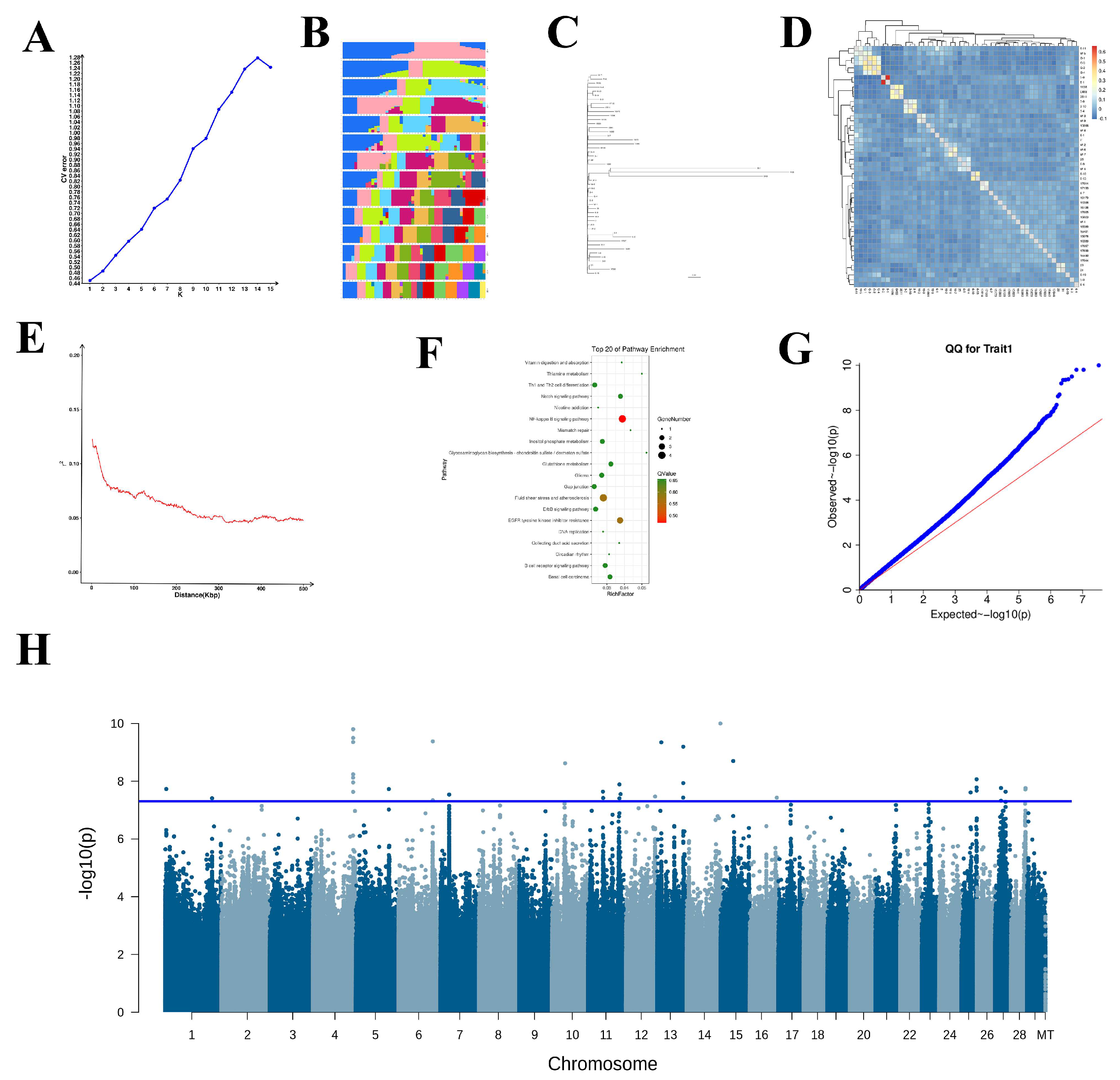
A total of 9,667,930 high-quality SNPs were retained following the filtration of loci with minor allele frequency (MAF) < 0.05 and a deletion rate exceeding 5%. The population structure effect matrix was calculated, and population analyses were conducted (Figure 2A–E). Subsequently, GWAS was conducted to screen for SNP loci significantly associated with milk-production traits in dairy goats. In total, 318 SNPs reached statistical significance, with 64% (202 SNPs) located in intergenic regions, 31% (98 SNPs) in intronic regions, and only 5% (18 SNPs) in exons or noncoding regions. including upstream and downstream regions. After re-analysis with the 5e-8 threshold, 38 SNPs remained significantly associated with milk yield (reduced from 318 SNPs with the previous threshold) (Table 2). From these, 244 significant candidate genes were identified and annotated based on the physical positions of their corresponding SNPs on the chromosomes (Figure 2G,H).

3.4. Go and Kegg Analysis

In the present study, 318 significant SNP sites were annotated within 244 candidate genes, indicating that some sequences contained multiple mutation sites. For example, 26 SNPs were identified between LOC108633170 and LOC102170513, Five SNPs were mapped to the exonic and intronic regions of the F11 gene, and 12 SNPs were found in the upstream to downstream regions of PCNX2. Since base mutations can influence the expression of candidate genes, the GO database was used to analyze these SNP-containing candidate genes. In total, 244 candidate genes corresponding to the 318 SNPs were annotated with 86 GO terms. Focusing on terms with p < 0.05, eight significant GO terms were identified (Table 2). In the cell component category, three GO terms—cilium (GO: 0005929), cell projection (GO: 0042995), and plasma membrane-bound cell projection (GO: 0120025)—were significantly enriched. Only cell division (GO:0051301) showed significant enrichment in the biological process category.
KEGG pathway enrichment analysis was conducted to further investigate the biological functions of these SNP-associated candidate genes. The annotation revealed that 178 candidate genes were associated with 151 biological processes. Moreover, eight KEGG pathways were significantly enriched with 23 candidate genes (p < 0.05), indicating their potential key roles in dairy goat lactation (Table 3). Among these, the NF-kappa B signaling pathway (ko04064) is notably prominent (Figure 2F).

3.5. Validation of Snps Through Association Analysis

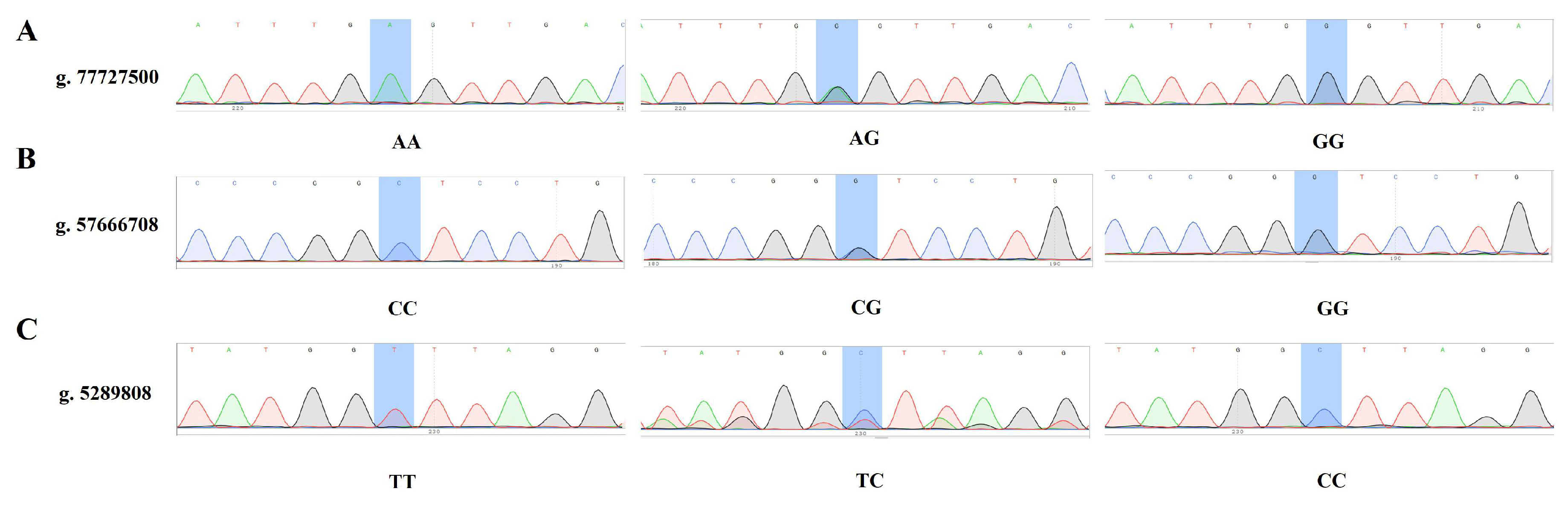
To verify whether the significant SNP loci identified through screening truly represent significantly mutated loci, association analysis was conducted to examine the correlation between these SNP loci and milk-production-related phenotypic traits. Ten SNP loci most likely to influence milk-production in dairy goats were selected, and external primers were designed accordingly. A random subset of 200 samples was chosen for locus sequencing validation via Sanger sequencing. Figure 3 presents a partial sequencing map, and mutant site genotypes were identified based on sequencing results. Allele frequencies for each locus were calculated, and PIC and He were assessed according to Hardy–Weinberg equilibrium (Table 4). The results indicated that loci g. 77727500 and g. 5289808 showed significant deviation from Hardy–Weinberg equilibrium (p < 0.05). Regarding PIC, loci g. 77727500, g. 5289808, g. 57666708, g. 73139883, g. 27027033, g. 37633188, g. 29255238 exhibited moderate polymorphism (0.25 < PIC < 0.5), whereas loci g. 39072994, g. 19470992, g. 42365731 showed low polymorphism (PIC < 0.25).
The correlation between genotypes at the 10 SNP loci and milk-production phenotypes was analyzed (Table 5 and Table 6). Results showed that the AA genotype at g. 77727500 had a significantly higher milk-production than that of the AG genotype. Similarly, the TT genotype at g. 73139883 and g. 27027033 had significantly higher milk-productions than those of the CT and CC genotypes. The AA genotype at g. 37633188 showed significantly higher milk-production than that of the CA and CC genotypes. The milk-production of the AA and GA genotypes at g. 19470992 was significantly higher than that of the GG genotype; the milk-production of the CA genotype at g. 42365731 was significantly higher than that of the CC genotype; and the milk-production of the CC genotype at g. 29255238 was significantly higher than that of the TC genotype, which was in turn significantly higher than that of the TT genotype. These findings suggest that candidate genes CDC14A, RBPJL, ZSCAN9, ZFAND2A, and F11 may influence lactation in dairy goats.

3.6. Effect of Overexpressing Candidate Genes on the Lactation Performance of Gmecs

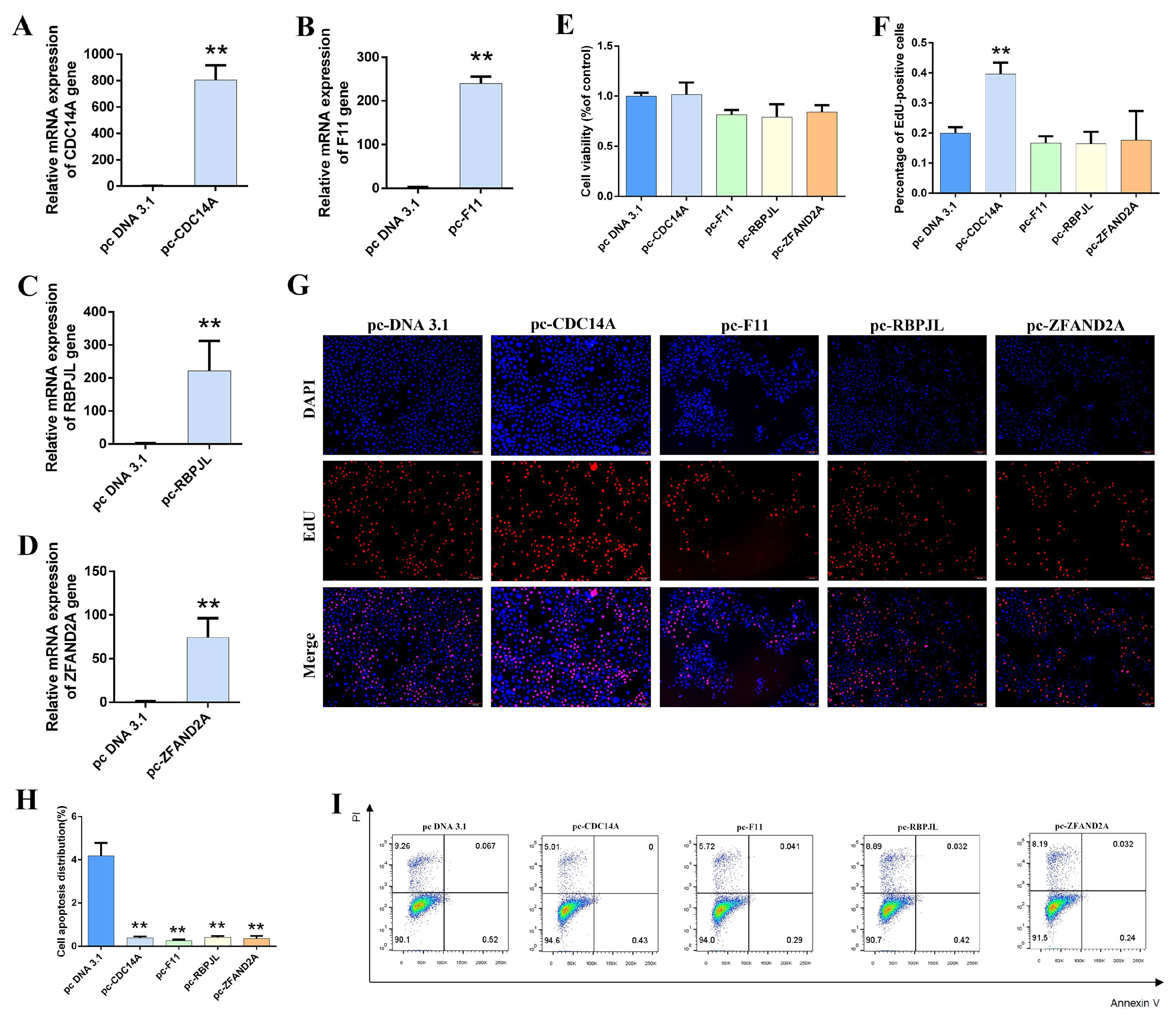
Based on the above results, to further explore the regulatory roles of candidate genes in GMEC proliferation and apoptosis and lactation performance, we constructed overexpression vectors for four candidate genes: pcDNA3.1-CDC14A (pc-CDC14A), pcDNA3.1-F11 (pc-F11), pcDNA3.1-RBPJL (pc-RBPJL), and pcDNA3.1-ZFAND2A (pc-ZFAND2A; the ZSCAN9 gene was not verified due to lack of an accurate sequence). Once the gene sequence is determined, we will proceed to conduct further validation of the function of this gene). GMECs were seeded in six-well plates and, once reaching the logarithmic growth phase, transfected with the overexpression vectors of candidate genes or the empty pcDNA3.1 vector. RNA was extracted 24 h post-transfection and reverse-transcribed for RT-qPCR analysis to assess transfection efficiency. The results showed a significant increase in mRNA levels for all candidate genes (Figure 4A–D), confirming the effectiveness of the overexpression vectors. Overexpression of CDC14A significantly inhibited cell viability and proliferation, whereas overexpression of the other candidate genes had no significant effect on these parameters (Figure 4E–G), indicating that CDC14A play a critical role in the regulation of cell proliferation. Apoptotic cell counts were quantified by Annexin V-FITC/PI staining followed by flow cytometric analysis, revealing that all candidate gene overexpression groups exhibited significantly fewer apoptotic cells compared to the blank control, suggesting that these genes inhibit apoptosis (Figure 4H,I). Furthermore, analysis of lactation-related genes showed that the overexpression of candidate genes significantly regulated the expression of key genes in milk fat biosynthesis (FASN, SREBP1, PPARG, and FABP3) and milk protein synthesis (CSN2, CSN3, and CSN1S2), as well as genes associated with the Janus kinase-signal transducer and activator of transcription (JAK-STAT) and mammalian target of rapamycin (mTOR) signaling pathways (Supplementary Materials).

3.7. Effect of Silent Candidate Genes on the Lactation Performance of Gmecs

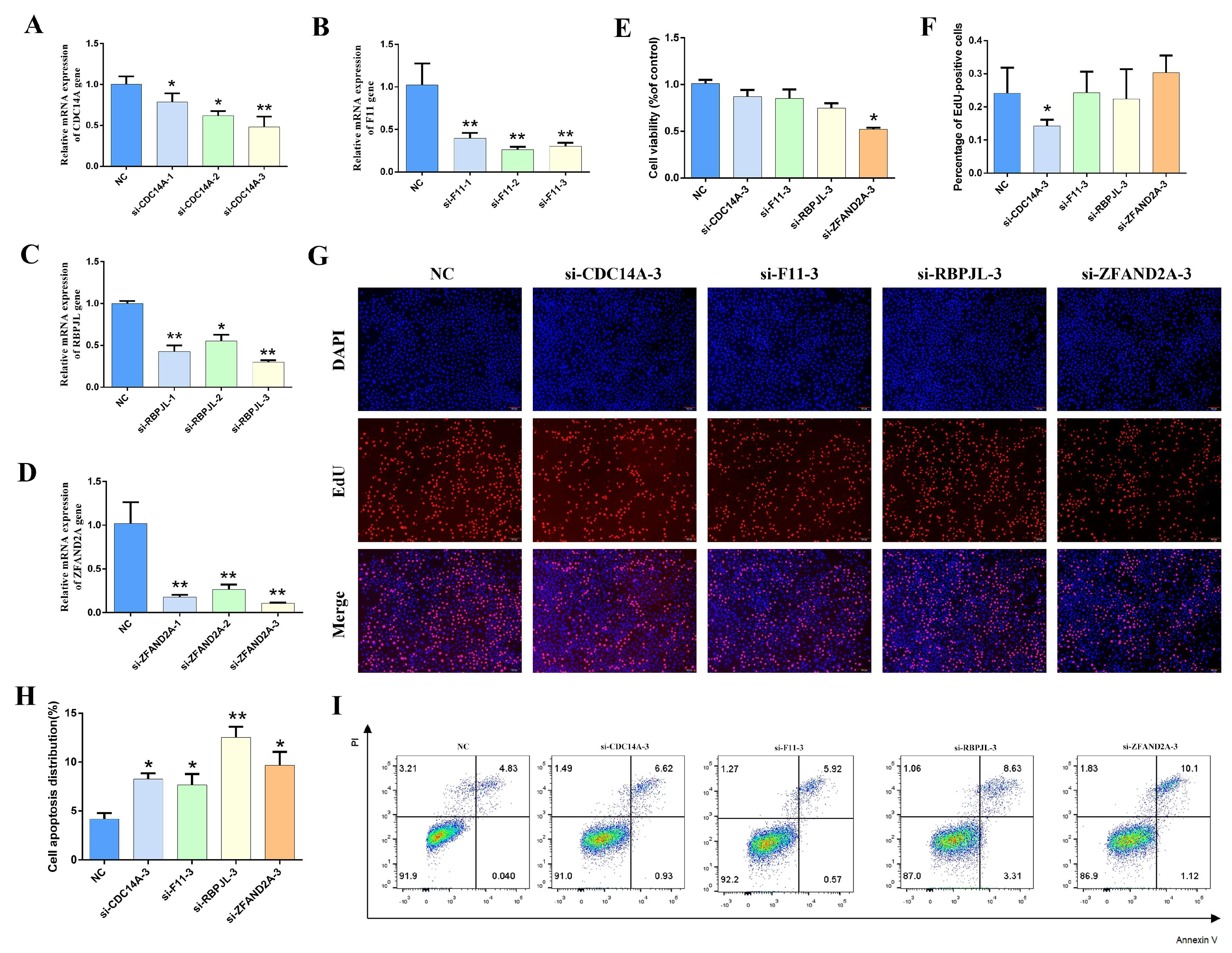
To comprehensively verify the effects of the candidate genes on cell proliferation and apoptosis, three pairs of interfering RNAs (siRNAs) were designed for each candidate gene sequence that matched the overexpression vector sequences. Gene silencing efficiency tests were performed to identify the most effective siRNAs for each gene (Figure 5A–D). Lipofectamine™ 3000 was used for siRNA gene knockdown experiments. The CCK8 assay showed that silencing ZFAND2A reduced cell viability, while silencing the other genes had no effect on cell viability (Figure 5E). As depicted in Figure 5F,G, silencing the CDC14A gene significantly decreased the number of EdU-positive cells compared to the negative control (NC) group, whereas silencing the other genes did not affect cell proliferation. Apoptosis assays revealed that silencing all four candidate genes promoted cell apoptosis (Figure 5H,I). Additionally, gene silencing regulated the expression of genes involved in milk fat and protein biosynthesis, and the JAK-STAT and mTOR signaling pathways to varying extents (Supplementary Materials).

4. Discussion

GWASs have become a key tool for functional gene mining owing to their high correlation accuracy and short research cycle [29]. With technological advancements, high-throughput sequencing has become a primary method for constructing high-density genetic marker panels [30,31]. By integrating high-throughput sequencing technology with GWAS, numerous genetic variants linked to complex traits have been identified [32,33,34]. Over recent years, this method has been extensively used to screen and identify major genes associated with economically important traits in both agricultural plants and animals [35,36,37], significantly advancing agricultural genetics. Furthermore, advances in sequencing technology have facilitated the in-depth study of genes and proteins in living organisms. Song et al. identified differentially expressed circRNAs during the transition from the pre-receptive to the receptive phase, demonstrating high stage specificity [26]. Marx et al. conducted proteomic sequencing of differential proteins in rhizobia from the leguminous plant alfalfa and its nitrogen-fixing endosymbionts [38]. In contrast, studies detecting SNPs related to milk-production and lambing in dairy goats remain relatively scarce. In this study, we generated 27 Gb of whole-genome resequencing data per sample, approximately nine times the size of the domestic goat genome (~2.88 Gb). After filtering out low-quality sequences, we obtained approximately 10 billion clean reads, providing sufficient sequencing depth to detect genome-wide genetic variation associated with milk-production traits. Compared to goats, humans exhibit a higher number of SNP mutations [39], which may be attributed to the slightly larger human genome (~3 Gb in humans vs. 2.92 Gb in goats) and the greater number of annotated genes. Nevertheless, of the goat genome also contains a large number of SNPs [40], and different gene mutations can be detected depending on the traits being studied [41,42]. Based on the mutation type, the impact of these SNPs on specific goat traits could be determined. Notably, different target traits may be associated with the same gene mutations [43,44].
Compared to the reference genome, 9,667,930 SNPs were identified. The Manhattan plot from the GWAS revealed 318 significant SNPs. GO enrichment and KEGG pathway analyses were conducted on the candidate genes identified through GWAS, as these tools help researchers better understand gene expression products and their interactions [16]. The top three significantly enriched GO terms were cilium (GO:0005929), cell projection (GO:0042995), and plasma membrane-bound cell projection (GO:0120025), which may be of interest in future studies. These terms were enriched for four candidate genes, namely CDC14A, DISC1, DNAH3, and PKHD1, which have previously been reported to participate in biological processes such as intracellular material transport, DNA break repair, and testicular development [45,46]. Therefore, we postulate that these genes might also participate in breast cell proliferation and differentiation. In addition, a significantly enriched GO term related to molecular function, ATPase activity (GO:0016887), may indicate an energy-providing role in cells, consistent with previous findings. Our KEGG pathway analysis identified the NF-kappa B signaling pathway as highly significant. The NF-κB transcription factor is a key regulator of immune function, stress responses, apoptosis, and cell differentiation [47,48]. Genes such as TAB2, PLCG2, and PRKCQ may contribute to mammary gland development via this pathway, supporting the findings of our GO analysis.
SNP mutations in genes can disrupt the physiological processes of gene replication, transcription, and translation, potentially altering gene function [49]. Association analysis revealed that 7 of the 10 SNPs most likely to influence milk-production traits in dairy goats were significantly associated with these traits. Two loci showed a deviation from the Hardy–Weinberg equilibrium. The possible reasons are as follows: 1. Due to artificial selection, individuals do not have the same opportunities for survival and reproduction, and individual mating is not random, resulting in changes in gene frequencies. 2. Alleles can directly undergo mutations. 3. Due to artificial insemination, there may be the introduction of foreign genes, leading to changes in gene frequencies. 4. At the same time, the population we used for validating the loci is not large enough. Excluding unannotated genes, five candidate genes—CDC14A, F11, RBPJL, ZSCAN9, and ZFAND2A—were significantly associated with milk-production. Previous studies have shown that CDC14A, a phosphatase [50] is involved in cell mitosis, cell cycle regulation, and reproductive functions [46,51]. Consistent with these findings, our validation experiments demonstrated that CDC14A promoted GMEC proliferation and significantly inhibiting apoptosis. This suggests that its role in enhancing milk-production traits may be linked to its regulation of mammary epithelial cell proliferation. Our results confirmed that F11 also affects milk-production traits, influencing the synthesis of milk fat and protein. Along with the gene expression in the JAK-STAT pathway [52]. While F11 silencing did not significantly impact cell proliferation, silencing of all candidate genes (including F11) led to increased cell apoptosis. These findings suggest that this gene may regulate lactation in dairy goats via the neuroendocrine system. RBPJL is primarily expressed in the pancreas and participates in the growth, development, and function of pancreatic vesicles in animals [53], Because pancreatic function is closely related to feed digestion and nutrient absorption, it may indirectly influence lactation traits in dairy goats. A growing body of evidence has shown that RBPJL further contributes to cell differentiation [54], and its differential expression in mammary glands suggests a possible role in regulating mammary function and lactation by influencing mammary epithelial cell differentiation. Our results showed that RBPJL inhibited GMEC apoptosis and significantly upregulated the expression of milk fat biosynthesis genes including PPARG and FABP3, indicating that RBPJL may affect mammary fat secretion by modulating fat digestion and absorption through the pancreas. Zinc-finger proteins are recognized to be pivotal in stress regulation and resistance [55,56]. In this research, our focus was on ZFAND2A, as a definitive gene sequence for ZSCAN9 was unavailable. While ZFAND2A had no significant effect on GMEC proliferation, it was found to inhibit apoptosis. The JAK-STAT signaling pathway consists of a cascade of intracellular protein interactions involved in regulating immunity, cell division, apoptosis, and tumor development [57]. RT-qPCR results showed that silencing ZFAND2A significantly increased the expression levels of genes involved in milk fat biosynthesis and activated the JAK-STAT pathway, suggesting that ZFAND2A may inhibit milk fat secretion and apoptosis by suppressing JAK-STAT signaling.
In the global dairy goat industry, milk-production traits serve as the core determinant of farming profitability. The gene targets identified in this study can facilitate the breeding of high-yielding Saanen dairy goat strains. Meanwhile, the findings can be extrapolated to other breeds to enhance the overall quality and efficiency of the dairy goat industry. However, owing to the inherent limitations of GWAS, this methodology typically maps association signals to large chromosomal regions. Some significant association regions in this study may harbor dozens of candidate genes, necessitating integration with transcriptomic analyses or functional assays to further pinpoint the causal variants. The presence of inbreeding effects in the Saanen dairy goat population may introduce false-positive associations, warranting replication in independent populations (e.g., the Nordic Saanen dairy goat population). Additionally, functional validation of some genes (e.g., mTOR) in this study was confined to cell models (e.g., GMECs), whereas the absence of in vivo experiments (e.g., gene-knockout mice or goat models) to directly demonstrate their regulatory roles in milk-production traits may lead to functional annotation bias. Given that milk-production is a polygenic quantitative trait, the effect size of single candidate genes identified herein (e.g., STAT5) might be overestimated, and thus, the combined impact of gene–gene epistasis (e.g., the synergistic interaction between STAT5 and PPARG) should be considered in practical breeding programs.

5. Conclusions

In conclusion, our study identified candidate genes—CDC14A, F11, RBPJL, and ZFAND2A—as significantly associated with lactation performance in dairy goats, highlighting the important roles of the JAK-STAT and mTOR pathways in this process. Most importantly, this study provides evidence supporting the functions and pathways of these four genes in regulating lactation, which will inform future mechanistic and functional studies of these four candidate genes.

Supplementary Materials

The following supporting information can be downloaded at https://www.mdpi.com/article/10.3390/ani15223282/s1. Figures S1 and S2: mRNA Expression of Lactation-Related Genes; Tables S1–S2: Primer information.

Author Contributions

Conceptualization, X.X., D.L., B.C. and X.A.; Data curation, F.L., Y.H., B.C. and X.A.; Formal analysis, F.L., Y.H. and Z.W.; Funding acquisition, B.C. and X.A.; Investigation, F.L. and Y.H.; Methodology, H.Y. and J.B.; Resources, Z.W.; Software, H.Y., J.B., X.X. and D.L.; Writing—review and editing, F.L. and Y.H. All authors have read and agreed to the published version of the manuscript.

Funding

This research was funded by the Key Research and Development Program of Shaanxi Province (Grant Nos. 2024NC-ZDCYL-03-01, 2024NC-YBXM-082, 2024NC-GJHX-22), the Project of ‘Development and Application of Milk Goat Genomic Liquid Chip’ (Grant No. QY-HS-2024A-01), and the Special Fund for Guided Local Science and Technology Development by Shaanxi Provincial Central Government (Grant Nos. 2024ZY-CGZY-20, 2024ZY-CGZY-22).

Institutional Review Board Statement

The experiments were conducted in strict accordance with the “Management Measures for Laboratory Animals of Northwest A&F University” and the “Guidelines for Welfare and Ethics Review of Laboratory Animals” (GB/T 35892-2018).

Informed Consent Statement

Written informed consent was obtained from the owner of the animals involved in this study.

Data Availability Statement

The datasets used and/or analyzed during the current study are available from the corresponding author on request.

Acknowledgments

During the preparation of this manuscript/study, the author(s) used Doubao’s polishing service (in compliance with the "Doubao Polishing Service Usage Statement", available at https://www.doubao.com/legal/terms (accessed on 10 November 2025)) for the purposes of polishing. The authors have reviewed and edited the output and take full responsibility for the content of this publication.

Conflicts of Interest

The author declares no conflicts of interest.

Abbreviations

The following abbreviations are used in this manuscript:
circRNAcircular RNA
GMECsGoat mammary epithelial cells
GCTA Genome-wide Complex Trait Analysis
GSGenomic selection
GWASGenome-wide association study
HeHeterozygosity
HGVSHuman Genome Variation Society
indelInsertion–deletion
MASMarker-assisted selection
MAFMinor allele frequency
PICPolymorphism information content
SNPsSingle-nucleotide polymorphisms
WGCNAWeighted gene co-expression network analysis

References

  1. Yao, X.; Li, J.; Fu, J.; Wang, X.; Ma, L.; Nanaei, H.A.; Shah, A.M.; Zhang, Z.; Bian, P.; Zhou, S.; et al. Genomic Landscape and Prediction of Udder Traits in Saanen Dairy Goats. Animals 2025, 15, 261. [Google Scholar] [CrossRef]
  2. Lopez, A.N.; Newton, M.G.; Stenhouse, C.; Connolly, E.; Hissen, K.L.; Horner, S.; Wu, G.; Foxworth, W.; Bazer, F.W. Dietary citrulline supplementation enhances milk production in lactating dairy goats. J. Anim. Sci. Biotechnol. 2025, 16, 51. [Google Scholar] [CrossRef]
  3. Mabjeesh, S.J.; Sabastian, C.; Gal-Garber, O.; Shamay, A. Effect of photoperiod and heat stress in the third trimester of gestation on milk production and circulating hormones in dairy goats. J. Dairy Sci. 2013, 96, 189–197. [Google Scholar] [CrossRef]
  4. Tian, P.; Luo, Y.; Li, X.; Tian, J.; Tao, S.; Hua, C.; Geng, Y.; Ni, Y.; Zhao, R. Negative effects of long-term feeding of high-grain diets to lactating goats on milk fat production and composition by regulating gene expression and DNA methylation in the mammary gland. J. Anim. Sci. Biotechnol. 2017, 8, 74. [Google Scholar] [CrossRef]
  5. Sun, P.; Chen, M.; Sooranna, S.R.; Shi, D.; Liu, Q.; Li, H. The emerging roles of circRNAs in traits associated with livestock breeding. Wiley Interdiscip. Rev. RNA 2023, 14, e1775. [Google Scholar] [CrossRef]
  6. Lv, F.H.; Cao, Y.H.; Liu, G.J.; Luo, L.Y.; Lu, R.; Liu, M.J.; Li, W.R.; Zhou, P.; Wang, X.H.; Shen, M.; et al. Whole-Genome Resequencing of Worldwide Wild and Domestic Sheep Elucidates Genetic Diversity, Introgression, and Agronomically Important Loci. Mol. Biol. Evol. 2022, 39, msab353. [Google Scholar] [CrossRef]
  7. Zhang, L.; Duan, Y.; Zhao, S.; Xu, N.; Zhao, Y. Caprine and Ovine Genomic Selection-Progress and Application. Animals 2024, 14, 2659. [Google Scholar] [CrossRef]
  8. Zhao, J.; Shi, C.; Kamalibieke, J.; Gong, P.; Mu, Y.; Zhu, L.; Lv, X.; Wang, W.; Luo, J. Whole genome and transcriptome analyses in dairy goats identify genetic markers associated with high milk yield. Int. J. Biol. Macromol. 2025, 292, 139192. [Google Scholar] [CrossRef]
  9. Chang, K.J.; Wu, H.Y.; Chiang, P.H.; Hsu, Y.T.; Weng, P.Y.; Yu, T.H.; Li, C.Y.; Chen, Y.H.; Dai, H.J.; Tsai, H.Y.; et al. Decoding and reconstructing disease relations between dry eye and depression: A multimodal investigation comprising meta-analysis, genetic pathways and Mendelian randomization. J. Adv. Res. 2025, 69, 197–213. [Google Scholar] [CrossRef]
  10. Li, H.; Xu, H.; Akhatayeva, Z.; Liu, H.; Lin, C.; Han, X.; Lu, X.; Lan, X.; Zhang, Q.; Pan, C. Novel indel variations of the sheep FecB gene and their effects on litter size. Gene 2021, 767, 145176. [Google Scholar] [CrossRef]
  11. Zhang, Y.; Zhang, W.; Liu, Y.; Zheng, Y.; Nie, X.; Wu, Q.; Yu, W.; Wang, Y.; Wang, X.; Fang, K.; et al. GWAS identifies two important genes involved in Chinese chestnut weight and leaf length regulation. Plant Physiol. 2024, 194, 2387–2399. [Google Scholar] [CrossRef]
  12. Tan, X.; Liu, R.; Zhao, D.; He, Z.; Li, W.; Zheng, M.; Li, Q.; Wang, Q.; Liu, D.; Feng, F.; et al. Large-scale genomic and transcriptomic analyses elucidate the genetic basis of high meat yield in chickens. J. Adv. Res. 2024, 55, 1–16. [Google Scholar] [CrossRef]
  13. Sahito, J.H.; Zhang, H.; Gishkori, Z.G.N.; Ma, C.; Wang, Z.; Ding, D.; Zhang, X.; Tang, J. Advancements and Prospects of Genome-Wide Association Studies (GWAS) in Maize. Int. J. Mol. Sci. 2024, 25, 1918. [Google Scholar] [CrossRef]
  14. Massender, E.; Oliveira, H.R.; Brito, L.F.; Maignel, L.; Jafarikia, M.; Baes, C.F.; Sullivan, B.; Schenkel, F.S. Genome-wide association study for milk production and conformation traits in Canadian Alpine and Saanen dairy goats. J. Dairy Sci. 2023, 106, 1168–1189. [Google Scholar] [CrossRef]
  15. Massender, E.; Brito, L.F.; Maignel, L.; Oliveira, H.R.; Jafarikia, M.; Baes, C.F.; Sullivan, B.; Schenkel, F.S. Single-step genomic evaluation of milk production traits in Canadian Alpine and Saanen dairy goats. J. Dairy Sci. 2022, 105, 2393–2407. [Google Scholar] [CrossRef]
  16. Peng, W.; Zhang, Y.; Gao, L.; Wang, S.; Liu, M.; Sun, E.; Lu, K.; Zhang, Y.; Li, B.; Li, G.; et al. Investigation of selection signatures of dairy goats using whole-genome sequencing data. BMC Genom. 2025, 26, 234. [Google Scholar] [CrossRef]
  17. Kumar, R.; Das, S.P.; Choudhury, B.U.; Kumar, A.; Prakash, N.R.; Verma, R.; Chakraborti, M.; Devi, A.G.; Bhattacharjee, B.; Das, R.; et al. Advances in genomic tools for plant breeding: Harnessing DNA molecular markers, genomic selection, and genome editing. Biol. Res. 2024, 57, 80. [Google Scholar] [CrossRef]
  18. Li, Z.; Guo, Z.; Wu, W.; Tan, L.; Long, Q.; Xia, H.; Hu, M. The effects of sequencing strategies on Metagenomic pathogen detection using bronchoalveolar lavage fluid samples. Heliyon 2024, 10, e33429. [Google Scholar] [CrossRef]
  19. Chen, S.; Zhou, Y.; Chen, Y.; Gu, J. fastp: An ultra-fast all-in-one FASTQ preprocessor. Bioinformatics 2018, 34, i884–i890. [Google Scholar] [CrossRef]
  20. Li, H.; Durbin, R. Fast and accurate long-read alignment with Burrows-Wheeler transform. Bioinformatics 2010, 26, 589–595. [Google Scholar] [CrossRef]
  21. McKenna, A.; Hanna, M.; Banks, E.; Sivachenko, A.; Cibulskis, K.; Kernytsky, A.; Garimella, K.; Altshuler, D.; Gabriel, S.; Daly, M.; et al. The Genome Analysis Toolkit: A MapReduce framework for analyzing next-generation DNA sequencing data. Genome Res. 2010, 20, 1297–1303. [Google Scholar] [CrossRef]
  22. Zhang, Z.; Wang, A.; Hu, H.; Wang, L.; Gong, M.; Yang, Q.; Liu, A.; Li, R.; Zhang, H.; Zhang, Q.; et al. The efficient phasing and imputation pipeline of low-coverage whole genome sequencing data using a high-quality and publicly available reference panel in cattle. Anim. Res. One Health 2023, 1, 4–16. [Google Scholar] [CrossRef]
  23. Wasik, K.; Berisa, T.; Pickrell, J.K.; Li, J.H.; Fraser, D.J.; King, K.; Cox, C. Comparing low-pass sequencing and genotyping for trait mapping in pharmacogenetics. BMC Genom. 2021, 22, 197. [Google Scholar] [CrossRef]
  24. Chang, C.C.; Chow, C.C.; Tellier, L.C.; Vattikuti, S.; Purcell, S.M.; Lee, J.J. Second-generation PLINK: Rising to the challenge of larger and richer datasets. GigaScience 2015, 4, 7. [Google Scholar] [CrossRef]
  25. Cingolani, P.; Platts, A.; Wang, L.L.; Coon, M.; Nguyen, T.; Wang, L.; Land, S.J.; Lu, X.; Ruden, D.M. A program for annotating and predicting the effects of single nucleotide polymorphisms, SnpEff: SNPs in the genome of Drosophila melanogaster strain w1118; iso-2; iso-3. Fly 2012, 6, 80–92. [Google Scholar] [CrossRef]
  26. Song, Y.; Zhang, L.; Liu, X.; Niu, M.; Cui, J.; Che, S.; Liu, Y.; An, X.; Cao, B. Analyses of circRNA profiling during the development from pre-receptive to receptive phases in the goat endometrium. J. Anim. Sci. Biotechnol. 2019, 10, 34. [Google Scholar] [CrossRef]
  27. Guo, Q.; Ma, X.; Wei, S.; Qiu, D.; Wilson, I.W.; Wu, P.; Tang, Q.; Liu, L.; Dong, S.; Zu, W. De novo transcriptome sequencing and digital gene expression analysis predict biosynthetic pathway of rhynchophylline and isorhynchophylline from Uncaria rhynchophylla, a non-model plant with potent anti-alzheimer’s properties. BMC Genom. 2014, 15, 676. [Google Scholar] [CrossRef]
  28. Wang, Z.; Liu, S.; Cheng, Z.; Xu, G.; Li, F.; Bu, Q.; Zhang, L.; Song, Y.; An, X. Endoplasmic reticulum stress exacerbates microplastics-induced toxicity in animal cells. Food Res. Int. 2024, 175, 113818. [Google Scholar] [CrossRef]
  29. Budu-Aggrey, A.; Kilanowski, A.; Sobczyk, M.K.; Shringarpure, S.S.; Mitchell, R.; Reis, K.; Reigo, A.; Mägi, R.; Nelis, M.; Tanaka, N.; et al. European and multi-ancestry genome-wide association meta-analysis of atopic dermatitis highlights importance of systemic immune regulation. Nat. Commun. 2023, 14, 6172. [Google Scholar] [CrossRef]
  30. Kumar, N.; Boatwright, J.L.; Boyles, R.E.; Brenton, Z.W.; Kresovich, S. Identification of pleiotropic loci mediating structural and non-structural carbohydrate accumulation within the sorghum bioenergy association panel using high-throughput markers. Front. Plant Sci. 2024, 15, 1356619. [Google Scholar] [CrossRef]
  31. Liu, Q.; Wang, Y.; Fu, Y.; Du, L.; Zhang, Y.; Wang, Q.; Sun, R.; Ai, N.; Feng, G.; Li, C. Genetic dissection of lint percentage in short-season cotton using combined QTL mapping and RNA-seq. TAG Theor. Appl. Genet. Theor. Und Angew. Genet. 2023, 136, 205. [Google Scholar] [CrossRef]
  32. Huang, K.; Yuan, L.; Liu, J.; Li, X.; Xu, D.; Zhang, X.; Peng, J.; Tian, H.; Li, F.; Wang, W. Application of multi-omics technology in pathogen identification and resistance gene screening of sheep pneumonia. BMC Genom. 2025, 26, 507. [Google Scholar] [CrossRef]
  33. Bui, P.H.; Cao, T.N.M.; Tran, T.T.; Matsumoto, T.; Akada, J.; Yamaoka, Y. Identification of genetic determinants of antibiotic resistance in Helicobacter pylori isolates in Vietnam by high-throughput sequencing. BMC Microbiol. 2025, 25, 264. [Google Scholar] [CrossRef]
  34. Yu, X.; Hu, X.; Wan, X.; Zhang, Z.; Wan, X.; Cai, M.; Yu, T.; Xiao, J. A unified framework for cell-type-specific eQTL prioritization by integrating bulk and scRNA-seq data. Am. J. Hum. Genet. 2025, 112, 332–352. [Google Scholar] [CrossRef]
  35. Sanchez, M.P.; Ramayo-Caldas, Y.; Wolf, V.; Laithier, C.; El Jabri, M.; Michenet, A.; Boussaha, M.; Taussat, S.; Fritz, S.; Delacroix-Buchet, A.; et al. Sequence-based GWAS, network and pathway analyses reveal genes co-associated with milk cheese-making properties and milk composition in Montbéliarde cows. Genet. Sel. Evol. GSE 2019, 51, 34. [Google Scholar] [CrossRef]
  36. Xiao, Z.; Li, Y.; Yang, L.; Cui, M.; Wang, Z.; Sun, W.; Wang, J.; Chen, S.; Lai, S.; Jia, X. Genome-Wide Association Studies of Growth Trait Heterosis in Crossbred Meat Rabbits. Animals 2024, 14, 2096. [Google Scholar] [CrossRef]
  37. Khan, S.U.; Saeed, S.; Khan, M.H.U.; Fan, C.; Ahmar, S.; Arriagada, O.; Shahzad, R.; Branca, F.; Mora-Poblete, F. Advances and Challenges for QTL Analysis and GWAS in the Plant-Breeding of High-Yielding: A Focus on Rapeseed. Biomolecules 2021, 11, 1516. [Google Scholar] [CrossRef]
  38. Marx, H.; Minogue, C.E.; Jayaraman, D.; Richards, A.L.; Kwiecien, N.W.; Siahpirani, A.F.; Rajasekar, S.; Maeda, J.; Garcia, K.; Del Valle-Echevarria, A.R.; et al. A proteomic atlas of the legume Medicago truncatula and its nitrogen-fixing endosymbiont Sinorhizobium meliloti. Nat. Biotechnol. 2016, 34, 1198–1205. [Google Scholar] [CrossRef]
  39. Riva, A.; Kohane, I.S. A SNP-centric database for the investigation of the human genome. BMC Bioinform. 2004, 5, 33. [Google Scholar] [CrossRef]
  40. Wang, F.H.; Zhang, L.; Li, X.K.; Fan, Y.X.; Qiao, X.; Gong, G.; Yan, X.C.; Zhang, L.T.; Wang, Z.Y.; Wang, R.J.; et al. Progress in goat genome studies. Yi Chuan Hered. 2019, 41, 928–938. [Google Scholar] [CrossRef]
  41. Teissier, M.; Larroque, H.; Brito, L.F.; Rupp, R.; Schenkel, F.S.; Robert-Granié, C. Genomic predictions based on haplotypes fitted as pseudo-SNP for milk production and udder type traits and SCS in French dairy goats. J. Dairy Sci. 2020, 103, 11559–11573. [Google Scholar] [CrossRef]
  42. Zhao, B.; Luo, H.; Fu, X.; Zhang, G.; Clark, E.L.; Wang, F.; Dalrymple, B.P.; Oddy, V.H.; Vercoe, P.E.; Wu, C.; et al. A Developmental Gene Expression Atlas Reveals Novel Biological Basis of Complex Phenotypes in Sheep. Genom. Proteom. Bioinform. 2025, 23, qzaf020. [Google Scholar] [CrossRef]
  43. An, X.; Hou, J.; Gao, T.; Lei, Y.; Li, G.; Song, Y.; Wang, J.; Cao, B. Single-nucleotide polymorphisms g.151435C>T and g.173057T>C in PRLR gene regulated by bta-miR-302a are associated with litter size in goats. Theriogenology 2015, 83, 1477–1483.e1471. [Google Scholar] [CrossRef]
  44. Hou, J.X.; An, X.P.; Song, Y.X.; Wang, J.G.; Ma, T.; Han, P.; Fang, F.; Cao, B.Y. Combined effects of four SNPs within goat PRLR gene on milk production traits. Gene 2013, 529, 276–281. [Google Scholar] [CrossRef]
  45. Wang, X.; Shen, G.; Yang, Y.; Jiang, C.; Ruan, T.; Yang, X.; Zhuo, L.; Zhang, Y.; Ou, Y.; Zhao, X.; et al. DNAH3 deficiency causes flagellar inner dynein arm loss and male infertility in humans and mice. eLife 2024, 13, RP96755. [Google Scholar] [CrossRef]
  46. Lin, H.; Ha, K.; Lu, G.; Fang, X.; Cheng, R.; Zuo, Q.; Zhang, P. Cdc14A and Cdc14B Redundantly Regulate DNA Double-Strand Break Repair. Mol. Cell. Biol. 2015, 35, 3657–3668. [Google Scholar] [CrossRef]
  47. Chakraborty, S.; Cheng, B.Y.; Edwards, D.L.; Gonzalez, J.C.; Chiu, D.K.; Zheng, H.; Scallan, C.; Guo, X.; Tan, G.S.; Coffey, G.P.; et al. Sialylated IgG induces the transcription factor REST in alveolar macrophages to protect against lung inflammation and severe influenza disease. Immunity 2025, 58, 182–196.e110. [Google Scholar] [CrossRef]
  48. Liu, C.; Zuo, M.; Zhao, J.; Niu, T.; Hu, A.; Wang, H.; Zeng, X. DPHB inhibits osteoclastogenesis by suppressing NF-κB and MAPK signaling and alleviates inflammatory bone destruction. Int. Immunopharmacol. 2025, 152, 114377. [Google Scholar] [CrossRef]
  49. Li, B.; Ding, X.; Yue, Z.; Zhao, Y.; Lei, J.; Zang, Y.; Hu, Q.; Tao, P. A rare stop-gain SNP mutation in BrGL2 causes aborted trichome development in Chinese cabbage (Brassica rapa L. ssp. pekinensis). TAG. Theor. Appl. genetics. Theor. Und Angew. Genet. 2025, 138, 112. [Google Scholar] [CrossRef]
  50. Imtiaz, A.; Belyantseva, I.A.; Beirl, A.J.; Fenollar-Ferrer, C.; Bashir, R.; Bukhari, I.; Bouzid, A.; Shaukat, U.; Azaiez, H.; Booth, K.T.; et al. CDC14A phosphatase is essential for hearing and male fertility in mouse and human. Hum. Mol. Genet. 2018, 27, 780–798. [Google Scholar] [CrossRef]
  51. Partscht, P.; Uddin, B.; Schiebel, E. Human cells lacking CDC14A and CDC14B show differences in ciliogenesis but not in mitotic progression. J. Cell Sci. 2021, 134, jcs255950. [Google Scholar] [CrossRef]
  52. Khan, M.Z.; Khan, A.; Xiao, J.; Ma, Y.; Ma, J.; Gao, J.; Cao, Z. Role of the JAK-STAT Pathway in Bovine Mastitis and Milk Production. Animals 2020, 10, 2107. [Google Scholar] [CrossRef]
  53. Lv, J.; Fang, M.; Sun, S.; Wang, G.; Fu, S.; Sun, B.; Tong, J. Blockade of the Arid5a/IL-6/STAT3 axis underlies the anti-inflammatory effect of Rbpjl in acute pancreatitis. Cell Biosci. 2022, 12, 95. [Google Scholar] [CrossRef]
  54. Yamashita, Y.; Hayashi, M.; Liu, A.; Sasaki, F.; Tsuchiya, Y.; Takayanagi, H.; Saito, M.; Nakashima, T. Fam102a translocates Runx2 and Rbpjl to facilitate Osterix expression and bone formation. Nat. Commun. 2025, 16, 9. [Google Scholar] [CrossRef]
  55. Yonezawa, S.; Bono, H. Meta-Analysis of Heat-Stressed Transcriptomes Using the Public Gene Expression Database from Human and Mouse Samples. Int. J. Mol. Sci. 2023, 24, 13444. [Google Scholar] [CrossRef]
  56. Vailati-Riboni, M.; Coleman, D.N.; Lopreiato, V.; Alharthi, A.; Bucktrout, R.E.; Abdel-Hamied, E.; Martinez-Cortes, I.; Liang, Y.; Trevisi, E.; Yoon, I.; et al. Feeding a Saccharomyces cerevisiae fermentation product improves udder health and immune response to a Streptococcus uberis mastitis challenge in mid-lactation dairy cows. J. Anim. Sci. Biotechnol. 2021, 12, 62. [Google Scholar] [CrossRef]
  57. Liu, Y.; Wang, W.; Zhang, J.; Gao, S.; Xu, T.; Yin, Y. JAK/STAT signaling in diabetic kidney disease. Front. Cell Dev. Biol. 2023, 11, 1233259. [Google Scholar] [CrossRef]
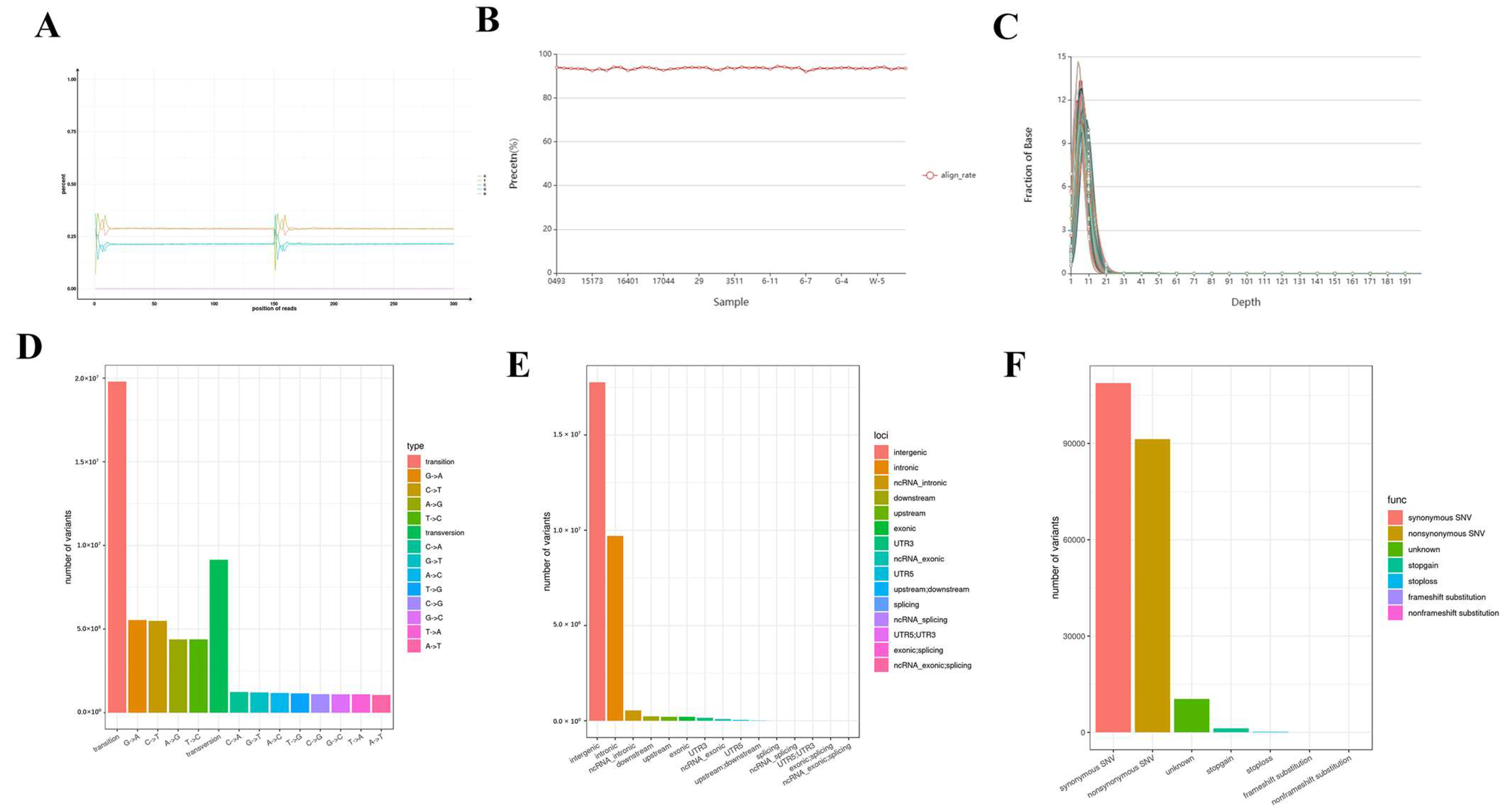
Figure 1. Summary of Sequencing Analysis Data. (A) Example of base type (A, T, C, G) distribution in a single sequencing sample. (B) Statistical plot of alignment results between samples and reference genomes. (C) Sequencing depth coverage plot. (D) Statistical plot of SNP types (e.g., transitions: A→G, G→A, C→T, T→C; transversions: A→C, A→T, C→A, G→T, G→C, T→A, T→C). (E) Statistical plot of SNP position annotation (e.g., intergenic, intronic, exonic). (F) Statistical plot of SNP functional annotation (e.g., synonymous SNV, nonsynonymous SNV, stopgain).
Animals 15 03282 g001
Figure 2. Summary of Sequencing Analysis Data. (A). Line plot of cross-validation error rates for population structure analysis (e.g., K = 1 to K = 10). (B) Bar graph of genetic composition of samples from population structure analysis. (C) Phylogenetic tree of evolutionary relationships among populations. (D) Sample relatedness matrix construction. (E) Linkage disequilibrium (LD) decay plot (r2). (F) KO (Kyoto Encyclopedia of Genes and Genomes) enrichment bubble plot. (G) Q–Q (quantile–quantile) plot. (H) Manhattan plot of genome-wide association studies (GWAS).
Animals 15 03282 g002
Figure 3. Peak Plots of Genotypes for Selected SNPs in Different Samples. (A) Peak plots of genotypes for the g. 77727500 SNP in different samples. (B) Peak plots of genotypes for the g. 57666708 SNP in different samples. (C) Peak plots of genotypes for the g. 5289808 SNP in different samples.
Animals 15 03282 g003
Figure 4. Functional Characterization of Candidate Gene Overexpression. (AD) Efficiency assays of overexpression plasmids (n = 4). (E) GMECs (goat mammary epithelial cells) viability assay (n = 4). (F,G) GMECs proliferation assays (n = 6). (H,I) Assays of GMECs apoptosis rate (n = 6). Data are presented as mean ± SEM. ** p < 0.01 vs. NC group.
Animals 15 03282 g004
Figure 5. Functional Characterization of Candidate Gene Silencing. (AD) Efficiency assays of siRNA (small interfering RNA)-mediated gene silencing (n = 4). (E) GMECs viability assay (n = 4). (F,G) GMECs proliferation assays (n = 6). (H,I) Assays of GMECs apoptosis rate (n = 6). Data are presented as mean ± SEM. * p < 0.05, ** p < 0.01 vs. NC group.
Animals 15 03282 g005
Table 1. The information of ten SNPs.
SNPChromosomeLocationMutations in the FormerAfter the MutationCandidate Genes
SNP-1377,727,500AGgene-CDC14A
SNP-255,289,808TCgene-LOC108636124, gene-PHLDA1
SNP-31057,666,708CGgene-ZNF609
SNP-41373,139,883CTgene-RBPJL
SNP-52039,072,994GAgene-LOC102191110
SNP-6527,027,033CTgene-LOC102177517
SNP-71537,633,188CAgene-LOC102183585
SNP-82319,470,992GAgene-ZSCAN9
SNP-92542,365,731CAgene-ZFAND2A
SNP-102729,255,238TCgene-F11
Table 2. Significant SNP information.
MarkChrPositionp
14_941137381494,113,7381.00 × 10−10
4_11282654841.13 × 1081.58 × 10−10
4_11282655841.13 × 1081.58 × 10−10
4_11282837741.13 × 1083.16 × 10−10
6_96304798696,304,7984.17 × 10−10
4_11282833241.13 × 1084.42 × 10−10
13_116359581311,635,9584.50 × 10−10
13_730788551373,078,8556.38 × 10−10
15_354708911535,470,8912.00 × 10−9
10_367207981036,720,7982.40 × 10−9
4_11282457241.13 × 1085.77 × 10−9
4_11269024641.13 × 1087.56 × 10−9
25_423752782542,375,2788.56 × 10−9
4_11281963141.13 × 1081.10 × 10−8
13_731477471373,147,7471.16 × 10−8
11_877996041187,799,6041.30 × 10−8
25_423652172542,365,2171.64 × 10−8
27_165085132716,508,5131.72 × 10−8
28_403738882840,373,8881.74 × 10−8
1_326631013,266,3101.86 × 10−8
5_92155728592,155,7281.87 × 10−8
28_399893562839,989,3561.92 × 10−8
25_424671652542,467,1652.12 × 10−8
11_416093401141,609,3402.30 × 10−8
27_292552842729,255,2842.31 × 10−8
4_11282461641.13 × 1082.34 × 10−8
25_257011272525,701,1272.44 × 10−8
11_909606971190,960,6972.80 × 10−8
7_24603319724,603,3192.90 × 10−8
7_24613281724,613,2812.90 × 10−8
12_815752581281,575,2583.38 × 10−8
13_728768341372,876,8343.70 × 10−8
16_755624921675,562,4923.72 × 10−8
11_422153841142,215,3843.82 × 10−8
1_13158017211.32 × 1083.90 × 10−8
11_877964751187,796,4753.93 × 10−8
6_96305737696,305,7374.57 × 10−8
27_165100172716,510,0174.74 × 10−8
Table 3. The important GO terms.
OntologyGO IDDescriptionGene Ratio (30)Bg Ratio (13,582)p ValueGene ID
Cellular ComponentGO:
0005929
cilium44270.013822146gene-CDC14A; gene-DISC1; gene-DNAH3; gene-PKHD1
Cellular ComponentGO:
0042995
cell projection44270.013822146gene-CDC14A; gene-DISC1; gene-DNAH3; gene-PKHD1
Cellular ComponentGO:
0120025
plasma membrane bounded cell projection44270.013822146gene-CDC14A; gene-DISC1; gene-DNAH3; gene-PKHD1
Biological ProcessGO:
0051301
cell division32630.02431167gene-ACTR3; gene-ANK3; gene-MAP10
Table 4. Pathways.
Table 4. Pathways.
KEGG_A
_Class
KEGG_B
_Class
Pathwaychx (20)All (8758)p ValuePathway IDGenesKOs
Environmental Information ProcessingSignal transductionNF-kappa B signaling pathway41030.0033965ko04064gene-TAB2;
gene-PLCG2;
gene-PRKCQ; gene-CARD11
K04404+K05859+K18052+K07367
Human DiseasesCardiovascular diseaseFluid shear stress and atherosclerosis41430.010747ko05418gene-BMP4;
gene-PDGFA;
gene-
SDC4;
gene-MGST1
K04662+K04359+K16338+K00799
Human DiseasesCancer: overviewProteoglycans in cancer32090.011318ko05205gene-SDC4;
gene-PLCG2;
gene-ANK3
K16338+K05859+K10380
Human DiseasesDrug resistance: antineoplasticEGFR tyrosine kinase inhibitor resistance3800.0123886ko01521gene-PDGFA;
gene-NRG1;
gene-PLCG2
K04359+K05455+K05859
MetabolismLipid metabolismSteroid hormone biosynthesis2850.015792ko00140gene-LOC102188238;
gene-LOC108633246
K00497+K00699
Organismal SystemsDevelopment and regenerationAxon guidance41790.0227066ko04360gene-ROBO1; gene-PLCG2;
gene-UNC5D; gene-PLXNA4
K06753+K05859+K07521+K06820
Environmental Information ProcessingSignal transductionNotch signaling pathway2530.0406895ko04330gene-RBPJL;
gene-ATXN1
K06053+K23616
MetabolismMetabolism of cofactors and vitaminsThiamine metabolism1200.0447426ko00730gene-NTPCRK06928
Table 5. Genotypic distribution of SNP loci in candidate genes.
LocusFrequency
g. 77727500GenotypeAA (30)0.14
AG (79)0.38
GG (100)0.48
AlleleA0.33
G0.67
He0.444
PIC0.345
Equilibrium χ2 test4.609
p0.032
g. 5289808GenotypeTT (86)0.41
TC (74)0.35
CC (49)0.24
AlleleT0.59
C0.41
He0.484
PIC0.367
Equilibrium χ2 test15.118
p0.0001
g. 57666708GenotypeCC (118)0.56
CG (79)0.38
GG (12)0.06
AlleleC0.75
G0.25
He0.371
PIC0.302
Equilibrium χ2 test0.066
p0.797
g. 73139883GenotypeCC (98)0.47
CT (86)0.41
TT (25)0.12
AlleleC0.67
T0.33
He0.439
PIC0.343
Equilibrium χ2 test0.821
p0.365
g. 39072994GenotypeGG (191)0.91
GA (17)0.08
AA (1)0.01
AlleleG0.95
A0.05
He0.087
PIC0.083
Equilibrium χ2 test0.821
p0.365
g. 27027033GenotypeCC (104)0.52
CT (80)0.40
TT (15)0.08
AlleleC0.72
T0.28
He0.400
PIC0.320
Equilibrium χ2 test0.005
p0.943
g. 37633188GenotypeCC (42)0.21
CA (91)0.455
AA (67)0.335
AlleleC0.44
A0.56
He0.492
PIC0.371
Equilibrium χ2 test1.142
p0.285
g. 19470992GenotypeGG (142)0.71
GA (53)0.265
AA (5)0.025
AlleleG0.84
A0.16
He0.265
PIC0.230
Equilibrium χ2 test0.0004
p0.984
g. 42365731GenotypeCC (162)0.82
CA (34)0.17
AA (1)0.01
AlleleC0.91
A0.09
He0.166
PIC0.152
Equilibrium χ2 test0.306
p0.580
g. 29255238GenotypeTT (102)0.51
TC (78)0.39
CC (20)0.10
AlleleT0.705
C0.295
He0.416
PIC0.329
Equilibrium χ2 test0.778
p0.378
Table 6. Association analysis of SNP loci with milk yield (means ± SEM).
SiteGenotypeMilk Yield (kg)
g. 77727500AA (30)3.98 a ± 0.20
AG (79)3.17 b ± 0.12
GG (100)3.28 ab ± 0.11
g. 5289808TT (86)3.40 ± 0.12
TC (74)3.45 ± 0.13
CC (49)3.03 ± 0.16
g. 57666708CC (118)3.17 ± 0.10
CG (79)3.52 ± 0.12
GG (12)3.83 ± 0.31
g. 73139883CC (98)3.06 b ± 0.10
CT (86)3.37 b ± 0.11
TT (25)4.30 a ± 0.20
g. 39072994GG (191)3.26 ± 0.07
GA (17)4.24 ± 0.46
AA (1)2.7
g. 27027033CC (104)3.18 b ± 0.10
CT (80)3.25 b ± 0.11
TT (15)4.69 a ± 0.25
g. 37633188CC (42)2.98 b ± 0.16
CA (91)3.14 b ± 0.11
AA (67)3.83 a ± 0.13
g. 19470992GG (142)3.09 b ± 0.09
GA (53)3.91 a ± 0.14
AA (5)4.01 a ± 0.46
g. 42365731CC (162)3.21 b ± 0.91
CA (34)3.92 a ± 1.60
AA (1)3.3 ab
g. 29255238TT (102)3.03 c ± 0.10
TC (78)3.42 b ± 0.11
CC (20)4.59 a ± 0.22
a–c Within a row, means with different superscripts differ significantly (p < 0.05).
Disclaimer/Publisher’s Note: The statements, opinions and data contained in all publications are solely those of the individual author(s) and contributor(s) and not of MDPI and/or the editor(s). MDPI and/or the editor(s) disclaim responsibility for any injury to people or property resulting from any ideas, methods, instructions or products referred to in the content.