From Sensors to Sustainability: Integrating Welfare, Management, and Climate Resilience in Small Ruminant Farm Systems


Simple Summary
Abstract
1. Introduction
1.1. Animal Welfare Concept
1.2. Biology of Stress in Livestock Farming and Precision Livestock Farming
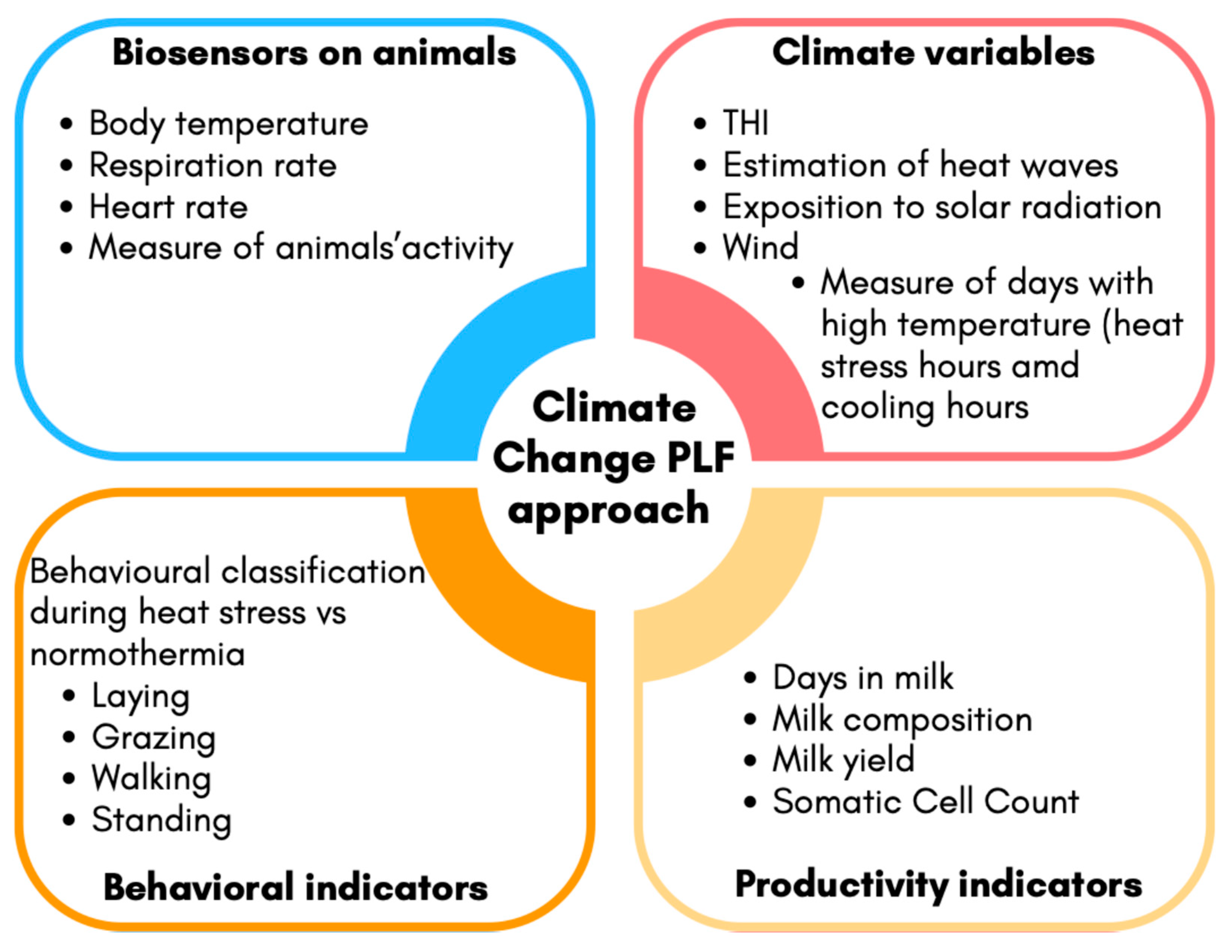
2. Climate as Welfare Modifier
2.1. Thermal Indexes
2.2. Physiological Indices
2.2.1. Respiration Rate
2.2.2. Body Temperature
3. Automatic Milking System and Its Impact on Animal Welfare
3.1. Technological Aspect of Milking System in Small Ruminant
3.2. Milking Parlor Crucial Aspects and New Technologies
4. Continuous Animal Behavior Assessment
5. Conclusions
Author Contributions
Funding
Institutional Review Board Statement
Informed Consent Statement
Data Availability Statement
Conflicts of Interest
References
- Hughes, B.O. Behaviour as an index of welfare. In Proceedings of the 5th European Poultry Conference, Malta, Republic of Malta, 5–11 September 1976; Volume II, pp. 1005–1018. [Google Scholar]
- Carpenter, E. Animals and Ethics: A Report of the Working Party Convened by Edward Carpenter; Watkins and Duverton: London, UK, 1980. [Google Scholar]
- Koknaroglu, H.; Akunal, T. Animal welfare: An animal science approach. Meat Sci. 2013, 95, 821–827. [Google Scholar] [CrossRef] [PubMed]
- Selye, H. Stress and disease. Science 1955, 122, 625–631. [Google Scholar] [CrossRef]
- Siegel, H.S. Immunological responses as indicators of stress. World’s Poult. Sci. J. 1985, 41, 36–44. [Google Scholar] [CrossRef]
- Moberg, G.P.; Mench, J.A. The Biology of Stress: Basic Principles and Implications for Animal Welfare; CAB International: Wallingford, UK, 2000; pp. 43–76. [Google Scholar]
- Boboc, L.; Dima, M.; Vaideanu, P.; Ionita, M. Trends and variability of heat waves in Europe and the association with large-scale circulation patterns. Weather. Clim. Extrem. 2025, 49, 100794. [Google Scholar] [CrossRef]
- Berckmans, D. General introduction to precision livestock farming. Anim. Front. 2017, 7, 6–11. [Google Scholar] [CrossRef]
- Bohmanova, J.; Misztal, I.; Cole, J.B. Temperature-humidity indices as indicators of milk production losses due to heat stress. J. Dairy Sci. 2007, 90, 1947–1956. [Google Scholar] [CrossRef]
- Gaughan, J.B.; Sejian, V.; Mader, T.L.; Dunshea, F.R. Adaptation strategies: Ruminants. Anim. Front. 2019, 9, 47–53. [Google Scholar] [CrossRef]
- Cresci, R.; Balkan, B.A.; Tedeschi, L.O.; Cannas, A.; Atzori, A.S. A system dynamics approach to model heat stress accumulation in dairy cows during a heatwave event. Animal 2023, 17, 101042. [Google Scholar] [CrossRef] [PubMed]
- Hoffmann, G.; Herbut, P.; Pinto, S.; Heinicke, J.; Kuhla, B.; Amon, T. Animal-related, non-invasive indicators for determining heat stress in dairy cows. Biosyst. Eng. 2020, 199, 83–96. [Google Scholar] [CrossRef]
- Bar, D.; Kaim, M.; Flamenbaum, I.; Hanochi, B.; Toaff-Rosenstein, R.L. Technical note: Accelerometer-based recording of heavy breathing in lactating and dry cows as an automated measure of heat load. J. Dairy Sci. 2019, 102, 3480–3486. [Google Scholar] [CrossRef]
- Koltes, J.E.; Koltes, D.A.; Mote, B.E.; Tucker, J.; Hubbell, D.S. Automated collection of heat stress data in livestock: New technologies and opportunities. Transl. Anim. Sci. 2018, 2, 319–323. [Google Scholar] [CrossRef]
- Gaughan, J.B.; Mader, T.L. Body temperature and respiratory dynamics in unshaded beef cattle. Int. J. Biometeorol. 2014, 58, 1443–1450. [Google Scholar] [CrossRef]
- Al-Dawood, A. Towards heat stress management in small ruminants—A review. Ann. Anim. Sci. 2017, 1, 59–88. [Google Scholar] [CrossRef]
- Neethirajan, S. Transforming the adaptation physiology of farm animals through sensors. Animals 2020, 10, 1512. [Google Scholar] [CrossRef]
- Thom, E.C. The discomfort index. Weatherwise 1959, 12, 57–61. [Google Scholar] [CrossRef]
- Kibler, H.H. Environmental physiology and shelter engineering. LXVII. Thermal effects of various temperature-humidity combinations on Holstein cattle as measured by eight physiological responses. Mo. Agric. Exp. Stn. Res. Bull. 1964, 862, 1–40. [Google Scholar]
- Sevi, A.; Annicchiarico, G.; Albenzio, M.; Taibi, L.; Muscio, A.; Dell’Aquila, S. Effects of solar radiation and feeding time on behavior, immune response and production of lactating ewes under high ambient temperature. J. Dairy Sci. 2001, 84, 629–640. [Google Scholar] [CrossRef]
- Kelly, C.F.; Bond, T.E. Bioclimatic factors and their measurements. In A Guide to Environmental Research in Animals; National Academy of Sciences: Washington, DC, USA, 1971; p. 77. [Google Scholar]
- Habeeb, A.A.; Gad, A.E.; Atta, M.A. Temperature-humidity indices as indicators to heat stress of climatic conditions with relation to production and reproduction of farm animals. Int. J. Biol. Res. 2018, 1, 35–50. [Google Scholar] [CrossRef]
- National Research Council (NRC). A Guide to Environmental Research on Animals; National Academy of Sciences: Washington, DC, USA, 1971; p. 274. [Google Scholar]
- McDowell, R.E.; Hooven, N.W.; Camoens, J.K. Effects of climate on performance of Holsteins in first lactation. J. Dairy Sci. 1976, 59, 965–973. [Google Scholar] [CrossRef]
- Mahjoubi, E.; Amanlou, H.; Mirzaei-Alamouti, H.R.; Aghaziarati, N.; Yazdi, M.H.; Noori, G.R.; Yuan, K.; Baumgard, L.H. The effect of cyclical and mild heat stress on productivity and metabolism in Afshari lambs. J. Anim. Sci. 2014, 92, 1007–1014. [Google Scholar] [CrossRef]
- Buffington, D.E.; Collazo-Arocho, A.; Canton, G.H.; Pitt, D.; Thatcher, W.W.; Collier, R.J. Black globe-humidity index (BGHI) as comfort equation for dairy cows. Trans. ASAE 1981, 24, 711–714. [Google Scholar] [CrossRef]
- LPHSI. Livestock and Poultry Heat Stress Indices Agriculture Engineering Technology Guide; Clemson University: Clemson, SC, USA, 1990; p. 29634. [Google Scholar]
- Marai, I.F.M.; Ayyat, M.S.; Abd El-Monem, U.M. Growth performance and reproductive traits at first parity of New Zealand White female rabbits as affected by heat stress and its alleviation under Egyptian conditions. Trop. Anim. Health Prod. 2001, 33, 451–462. [Google Scholar] [CrossRef]
- Fuquay, J.W. Heat stress as it affects animal production. J. Anim. Sci. 1981, 52, 164–174. [Google Scholar] [CrossRef]
- Srikandakumar, A.; Johnson, E.H.; Mahgoub, O. Effect of heat stress on respiratory rate, rectal temperature and blood chemistry in Omani and Australian Merino sheep. Small Rumin. Res. 2003, 49, 193–198. [Google Scholar] [CrossRef]
- Finocchiaro, R.; van Kaam, J.B.; Portolano, B.; Misztal, I. Effect of heat stress on production of Mediterranean dairy sheep. J. Dairy Sci. 2005, 88, 1855–1864. [Google Scholar] [CrossRef]
- Abdel Khalek, T.M.M. Thermoregulatory responses of sheep to starvation and heat stress conditions. Egypt. J. Anim. Prod. 2007, 44, 137–150. [Google Scholar] [CrossRef]
- Leibovich, H.; Zenou, A.; Seada, P.; Miron, J. Effects of shearing, ambient cooling and feeding with byproducts as partial roughage replacement on milk yield and composition in Assaf sheep under heat-load conditions. Small Rumin. Res. 2011, 99, 153–159. [Google Scholar] [CrossRef]
- Al-Haidary, A.A.; Aljumaah, R.S.; Alshaikh, M.A.; Abdoun, K.A.; Samara, E.M.; Okab, A.B.; Alfuraiji, M.M. Thermoregulatory and physiological responses of Nazdi sheep exposed to environmental heat load prevailing in Saudi Arabia. Pak. Vet. J. 2012, 32, 515–519. [Google Scholar]
- Mader, T.L.; Davis, M.S.; Brown-Brandl, T. Environmental factors influencing heat stress in feedlot cattle. J. Anim. Sci. 2006, 84, 712–719. [Google Scholar] [CrossRef]
- Wojtas, K.; Cwynar, P.; Kolacz, R. Effect of thermal stress on physiological and blood parameters in merino sheep. Bull. Vet. Inst. Pulawy 2014, 58, 283–288. [Google Scholar] [CrossRef]
- Chagas, J.C.C.; de Ferreira, M.A.; de Azevedo, M.; Siqueira, M.; Elins, A.; Barros, L. Feeding management strategy for sheep in feedlot in hot and humid region. Biosci. J. 2015, 31, 1164–1173. [Google Scholar] [CrossRef]
- Habeeb, A.A.; Gad, A.E.; EL-Tarabany, A.A.; Atta, M.A.A. Negative Effects of Heat Stress on Growth and Milk Production of Farm Animals. J. Anim. Husb. Dairy Sci. 2018, 2, 1–12. [Google Scholar] [CrossRef]
- Sejian, V.; Krishnan, G.; Bagath, M.; Vaswani, S.; Pragna, P.; Aleena, J.; Lees, A.M.; Maurya, V.P.; Bhatta, R. Measurement of severity of heat stress in sheep. In Sheep Production Adapting to Climate Change; Sejian, V., Bhatta, R., Gaughan, J., Malik, P.K., Naqvi, S.M.K., Lal, R., Eds.; Springer Nature: Singapore, 2017; pp. 307–318. [Google Scholar] [CrossRef]
- Sevi, A.; Caroprese, M. Impact of heat stress on milk production, immunity and udder health in sheep: A critical review. Small Rumin. Res. 2012, 107, 1–7. [Google Scholar] [CrossRef]
- Kumar, D.; De, K.; Sejian, V.; Naqvi, S.M.K. Impact of climate change on sheep reproduction. In Sheep Production Adapting to Climate Change; Sejian, V., Bhatta, R., Gaughan, J.B., Malik, P.K., Naqvi, S.M.K., Lal, R., Eds.; Springer Nature: Singapore, 2017; pp. 71–93. [Google Scholar] [CrossRef]
- Peana, I.; Fois, G.; Cannas, A. Effects of heat stress and diet on milk production and feed and energy intake of Sarda ewes. Ital. J. Anim. Sci. 2007, 6 (Suppl. S1), 577–579. [Google Scholar] [CrossRef]
- Seixas, L.; de Melo, C.B.; Tanure, C.B.; Peripolli, V.; McManus, C. Heat tolerance in Brazilian hair sheep. Asian-Australas. J. Anim. Sci. 2017, 30, 593. [Google Scholar] [CrossRef]
- Kumar, S.; Magotra, A.; Kumar, N.; Bangar, Y.C.; Dahiya, S.P. Physiological responses of Munjal sheep to variations in temperature humidity index in subtropical climate. Trop. Anim. Health Prod. 2025, 57, 163. [Google Scholar] [CrossRef]
- Barredo, J.I.; Mauri, A.; Caudullo, G.; Dosio, A. Assessing shifts of Mediterranean and arid climates under RCP4. 5 and RCP8. 5 climate projections in Europe. In Meteorology and Climatology of the Mediterranean and Black Seas; Vilibić, I., Horvath, K., Palau, J.L., Eds.; Springer International Publishing: Cham, Switzerland, 2019; pp. 235–251. [Google Scholar] [CrossRef]
- Barbosa, O.R.; da Silva, R.G. Ã ndice de conforto térmico para ovinos. Bol. Ind. Anim. 1995, 52, 29–35. [Google Scholar]
- Mascarenhas, N.M.H.; Furtado, D.A.; Fonsêca, V.D.F.C.; de Souza, B.B.; de Oliveira, A.G.; Morais, F.T.L.; da Costa Silva, J.A.P. Thermal stress index for native sheep. J. Therm. Biol. 2023, 115, 103607. [Google Scholar] [CrossRef] [PubMed]
- Hales, J.R.S.; Findlay, J.D. Respiration of the ox: Normal values and the effects of exposure to hot environments. Respir. Physiol. 1968, 4, 333–352. [Google Scholar] [CrossRef]
- Silanikove, N. Effects of heat stress on the welfare of extensively managed domestic ruminants. Livest. Prod. Sci. 2000, 67, 1–18. [Google Scholar] [CrossRef]
- Hales, J.R.S.; Webster, M.E.D. Respiratory function during thermal tachypnoea in sheep. J. Physiol. 1967, 190, 241–260. [Google Scholar] [CrossRef]
- Brockway, J.M.; McDonald, J.D.; Pullar, J.D. Evaporative heat-loss mechanisms in sheep. J. Physiol. 1965, 79, 554–568. [Google Scholar] [CrossRef] [PubMed]
- Schütz, K.E.; Saunders, L.R.; Huddart, F.J.; Watson, T.; Latimer, B.; Cox, N.R. Effects of shade on the behaviour and physiology of sheep in a temperate climate. Appl. Anim. Behav. Sci. 2024, 272, 106185. [Google Scholar] [CrossRef]
- Miller, J.C.; Monge, L. Body temperature and respiration rate, and their relation to adaptability in sheep. J. Anim. Sci. 1946, 5, 147–153. [Google Scholar] [CrossRef]
- Andrew, W.; Greatwood, C.; Burghardt, T. Aerial animal biometrics: Individual friesian cattle recovery and visual identification via an autonomous uav with onboard deep inference. In Proceedings of the IEEE/RSJ International Conference on Intelligent Robots and Systems (IROS), Macau, China, 4–8 November 2019. [Google Scholar] [CrossRef]
- Halachmi, I.; Guarino, M.; Bewley, J.; Pastell, M. Smart animal agriculture: Application of real-time sensors to improve animal well-being and production. Annu. Rev. Anim. Biosci. 2019, 7, 403–425. [Google Scholar] [CrossRef]
- Hansen, M.F.; Smith, M.L.; Smith, L.N.; Salter, M.G.; Baxter, E.M.; Farish, M.; Grieve, B. Towards on-farm pig face recognition using convolutional neural networks. Comput. Ind. 2018, 98, 145–152. [Google Scholar] [CrossRef]
- Guo, G.; Zhang, N. A survey on deep learning based face recognition. Comput. Vis. Image Underst. 2019, 189, 102805. [Google Scholar] [CrossRef]
- Salama, A.Y.A.; Hassanien, A.E.; Fahmy, A. Sheep identification using a hybrid deep learning and Bayesian optimization approach. IEEE Access 2019, 7, 31681–31687. [Google Scholar] [CrossRef]
- Zhao, B.; Feng, J.; Wu, X.; Yan, S. A survey on deep learning-based fine-grained object classification and semantic segmentation. Int. J. Autom. Comput. 2017, 14, 119–135. [Google Scholar] [CrossRef]
- Talo, M.; Yildirim, O.; Baloglu, U.B.; Aydin, G.; Acharya, U.R. Convolutional neural networks for multi-class brain disease detection using MRI images. Comput. Med. Imaging Graph. 2019, 78, 101673. [Google Scholar] [CrossRef] [PubMed]
- Bonafini, B.L.; Breuer, L.; Ernst, L.; Tolba, R.; Oliveira, L.F.D.; Abreu de Souza, M.; Czaplik, M.; Pereira, C.B. Simultaneous, Non-t and Motion-Based Monitoring of Respiratory Rate in Sheep Under Experimental Condition Using Visible and Near-Infrared Videos. Animals 2024, 14, 3398. [Google Scholar] [CrossRef]
- Wu, Y.; Kirillov, A.; Massa, F.; Lo, W.Y.; Girshick, R. Detectron2. Available online: https://github.com/facebookresearch/detectron2 (accessed on 1 February 2023).
- Massaroni, C.; Nicolò, A.; Sacchetti, M.; Schena, E. Contactless methods for measuring respiratory rate: A review. IEEE Sens. J. 2020, 21, 12821–12839. [Google Scholar] [CrossRef]
- Fulghesu, F.; Ledda, A.; Sini, M.; Cresci, R.; Lunesu, M.F.; Cannas, A.; Atzori, A.S. Respiration rate as marker of heat stress in dairy sheep. Anim. Sci. Proc. 2022, 13, 600–601. [Google Scholar] [CrossRef]
- Fuentes, S.; Gonzalez Viejo, C.; Chauhan, S.S.; Joy, A.; Tongson, E.; Dunshea, F.R. Non-invasive sheep biometrics obtained by computer vision algorithms and machine learning modeling using integrated visible/infrared thermal cameras. Sensors 2020, 20, 6334. [Google Scholar] [CrossRef] [PubMed]
- Sellier, N.; Guettier, E.; Staub, C. A review of methods to measure animal body temperature in precision farming. Am. J. Agric. Sci. Technol. 2014, 2, 74–99. [Google Scholar] [CrossRef]
- Zhang, Z.; Zhang, H.; Liu, T. Study on body temperature detection of pig based on infrared technology: A review. Artif. Intell. Agric. 2019, 1, 14–26. [Google Scholar] [CrossRef]
- Bouwknecht, A.J.; Olivier, B.; Paylor, R.E. The stress-induced hyperthermia paradigm as a physiological animal model for anxiety: A review of pharmacological and genetic studies in the mouse. Neurosci. Biobehav. Rev. 2007, 31, 41–59. [Google Scholar] [CrossRef]
- McCafferty, D.J.; Gallon, S.; Nord, A. Challenges of measuring body temperatures of free-ranging birds and mammals. Anim. Biotelemetry 2015, 3, 33. [Google Scholar] [CrossRef]
- Torrao, N.A.; Hetem, R.S.; Meyer, L.C.; Fick, L.G. Assessment of the use of temperature-sensitive microchips to determine core body temperature in goats. Vet. Rec. 2011, 168, 328–334. [Google Scholar] [CrossRef] [PubMed]
- Vickers, L.A.; Burfeind, O.; von Keyserlingk, M.A.; Veira, D.M.; Weary, D.M.; Heuwieser, W. Technical note: Comparison of rectal and vaginal temperatures in lactating dairy cows. J. Dairy Sci. 2010, 93, 5246–5251. [Google Scholar] [CrossRef]
- Suthar, V.; Burfeind, O.; Maeder, B.; Heuwieser, W. Agreement between rectal and vaginal temperature measured with temperature loggers in dairy cows. J. Dairy Res. 2013, 80, 240–245. [Google Scholar] [CrossRef]
- Fuchs, B.; Sørheim, K.M.; Chincarini, M.; Brunberg, E.; Stubsjøen, S.M.; Bratbergsengen, K.; Hvasshovd, S.O.; Zimmermann, B.; Lande, U.S.; Grøva, L. Heart rate sensor validation and seasonal and diurnal variation of body temperature and heart rate in domestic sheep. Vet. Anim. Sci. 2019, 8, 100075. [Google Scholar] [CrossRef]
- Godyń, D.; Herbut, P.; Angrecka, S. Measurements of peripheral and deep body temperature in cattle—A review. J. Therm. Biol. 2019, 79, 42–49. [Google Scholar] [CrossRef]
- Dale, H.E.; Stewart, R.E.; Brody, S. Rumen temperature. I. Temperature gradients during feeding and fasting. Cornell Vet. 1954, 44, 368–374. [Google Scholar]
- Soerensen, D.D.; Pedersen, L.J. Infrared skin temperature measurements for monitoring health in pigs: A review. Acta Vet. Scand. 2015, 57, 5. [Google Scholar] [CrossRef]
- Unruh, E.M.; Theurer, M.E.; White, B.J.; Larson, R.L.; Drouillard, J.S.; Schrag, N. Evaluation of infrared thermography as a diagnostic tool to predict heat stress events in feedlot cattle. Am. J. Vet. Res. 2017, 78, 771–777. [Google Scholar] [CrossRef] [PubMed]
- Menchetti, L.; Nanni Costa, L.; Zappaterra, M.; Padalino, B. Effects of reduced space allowance and heat stress on behavior and eye temperature in unweaned lambs: A pilot study. Animals 2021, 11, 3464. [Google Scholar] [CrossRef] [PubMed]
- Stelletta, C.; Vencato, J.; Fiore, E.; Gianesella, M. Infrared thermography in reproduction. In Termography. Current Status and Advances in Livestock Animals and in Veterinary Medicine; Luzi, F., Mitchell, M., Nanni Costa, L., Redaelli, V., Eds.; BRESCIA: Fond. Iniziative Zooprofilattiche e Zootecniche: Brescia, Italy, 2013; pp. 113–125. [Google Scholar]
- McManus, C.; Tanure, C.B.; Peripolli, V.; Seixas, L.; Fischer, V.; Gabbi, A.M.; Costa, J.B.G., Jr. Infrared thermography in animal production: An overview. Comput. Electron. Agric. 2016, 123, 10–16. [Google Scholar] [CrossRef]
- Beatty, D.T.; Barnes, A.; Fleming, P.A.; Taylor, E.; Maloney, S.K. The effect of fleece on core and rumen temperature in sheep. J. Therm. Biol. 2008, 33, 437–443. [Google Scholar] [CrossRef]
- Kearton, T.R.; Doughty, A.K.; Morton, C.L.; Hinch, G.N.; Godwin, I.R.; Cowley, F.C. Core and peripheral site measurement of body temperature in short wool sheep. J. Therm. Biol. 2020, 90, 102606. [Google Scholar] [CrossRef]
- Salles, M.S.; da Silva, S.C.; Salles, F.A.; Roma, L.C., Jr.; El Faro, L.; Lean, B.M.P.A.; de Oliveira, C.E.L.; Martello, L.S. Mapping the body surface temperature of cattle by infrared thermography. J. Therm. Biol. 2016, 62, 63–69. [Google Scholar] [CrossRef]
- Montanholi, Y.R.; Nicholas, E.O.; Kendall, C.S.; Schenkel, F.S.; McBride, B.W.; Miller, S.P. Application of infrared thermography as an indicator of heat and methane production and its use in the study of skin temperature in response to physiological events in dairy cattle (Bos taurus). J. Therm. Biol. 2008, 33, 468–475. [Google Scholar] [CrossRef]
- Mota-Rojas, D.; Pereira, A.M.; Wang, D.; Martínez-Burnes, J.; Ghezzi, M.; Hernández-Avalos, I.; Lendez, P.; Mora-Medina, P.; Casas, A.; Olmos-Hernández, A.; et al. Clinical applications and factors involved in validating thermal windows used in infrared thermography in cattle and river buffalo to assess health and productivity. Animals 2021, 11, 2247. [Google Scholar] [CrossRef]
- Verduzco-Mendoza, A.; Bueno-Nava, A.; Wang, D.; Martínez-Burnes, J.; Olmos-Hernández, A.; Casas, A.; Domínguez, A.; Mota-Rojas, D. Experimental applications and factors involved in validating thermal windows using infrared thermography to assess the health and thermostability of laboratory animals. Animals 2021, 11, 3448. [Google Scholar] [CrossRef]
- Vicente-Pérez, R.; Avendaño-Reyes, L.; Mejía-Vázquez, Á.; Álvarez-Valenzuela, F.; Correa-Calderón, A.; Mellado, M.; Meza-Herrera, C.A.; Guerra-Liera, J.; Robinson, P.H.; Macías-Cruz, U. Prediction of rectal temperature using non-invasive physiologic variable measurements in hair pregnant ewes subjected to natural conditions of heat stress. J. Therm. Biol. 2016, 55, 1–6. [Google Scholar] [CrossRef] [PubMed]
- Vega, W.H.O.; Silveira, R.M.F.; de Freitas, A.C.B.; Quirino, C.R. Efficiency of infrared pyrometer and infrared thermography for assessing body surface temperature in hair sheep. Res. Vet. Sci. 2024, 181, 105450. [Google Scholar] [CrossRef] [PubMed]
- Bakker, M.L.; Milano, G.D.; Fernandez, J.; Alvarado, P.I.; Nadin, L.B. Lack of agreement among analysers of infrared thermal images in the temperature of eye regions in sheep. J. Therm. Biol. 2024, 126, 104021. [Google Scholar] [CrossRef]
- Idris, M.; Uddin, J.; Sullivan, M.; McNeill, D.M.; Phillips, C.J.C. Non-invasive physiological indicators of heat stress in cattle. Animals 2021, 11, 71. [Google Scholar] [CrossRef] [PubMed]
- Joy, A.; Taheri, S.; Dunshea, F.R.; Leury, B.J.; DiGiacomo, K.; Osei-Amponsah, R.; Brodie, G.; Chauhan, S.S. Non-invasive measure of heat stress in sheep using machine learning techniques and infrared thermography. Small Rumin. Res. 2022, 207, 106592. [Google Scholar] [CrossRef]
- Gonzalez Viejo, C.; Torrico, D.D.; Dunshea, F.R.; Fuentes, S. Development of artificial neural network models to assess beer acceptability based on sensory properties using a robotic pourer: A comparative model approach to achieve an artificial intelligence system. Beverages 2019, 5, 33. [Google Scholar] [CrossRef]
- Taheri, S.; Brodie, G.; Gupta, D. Optimised ANN and SVR models for online prediction of moisture content and temperature of lentil seeds in a microwave fluidised bed dryer. Comput. Electron. Agric. 2021, 182, 106003. [Google Scholar] [CrossRef]
- Davis, S.R.; Collier, R.J. Mammary blood flow and regulation of substrate supply or milk synthesis. J. Dairy Sci. 1985, 68, 1041–1058. [Google Scholar] [CrossRef]
- Dimitrov-Ivanov, I.; Djorbineva, M. Assessment of welfare, functional parameters of the udder, milk productive and reproductive traits in dairy ewes of different temperament. Bulg. J. Agric. Sci. 2003, 9, 707–711. [Google Scholar]
- Rushen, J.; De Passillé, A.M.; Munksgaard, L. Fear of people by cows and effects on milk yield, behavior, and heart rate at milking. J. Dairy Sci. 1999, 82, 720–727. [Google Scholar] [CrossRef]
- Bruckmaier, R.M.; Blum, J.W. Oxytocin release and milk removal in ruminants. J. Dairy Sci. 1998, 81, 939–949. [Google Scholar] [CrossRef]
- Negrão, J.A.; Marnet, P.G. Cortisol, adrenalin, noradrenalin and oxytocin release and milk yield during first milkings in primiparous ewes. Small Rumin. Res. 2003, 47, 69–75. [Google Scholar] [CrossRef]
- Rassu, S.P.G.; Cannas, E.A.; Nicolussi, P.; Bonelli, P.; Pulina, G. The impact of machine milking on milk production traits and cortisol in primiparous dairy ewes. In Proceedings of the ADSA-ASAS Joint Annual Meeting, Minneapolis, MN, USA, 9–13 July 2006; Volume 89 (Suppl. S1), p. 303. [Google Scholar]
- Casamassima, D.; Palazzo, M.; Pizzo, R.; D’Alessandro, A.G.; Martemucci, G. Risposta fisiologica e produttiva in pecore sottoposte a mungitura manuale e meccanica. In Proceedings of the 60th National Congress SISVet, Terrasini, PA, Italy, 27–30 September 2006; Volume 60, pp. 477–478. [Google Scholar]
- Casu, S.; Boyazoglou, J.G.; Ruda, G. Essais sur la traite mechanique semplifiee des brebis Frisonne x Sarde. In Proceedings of the 4th Int. Symp. Sur la Traite Mechanique de Petites Ruminants, Alghero, Italy, September 1978; pp. 235–243. [Google Scholar]
- Albenzio, M.; Taibi, L.; Caroprese, M.; De Rosa, G.; Muscio, A.; Sevi, A. Immune response, udder health and productive traits of machine milked and suckling ewes. Small Rumin. Res. 2003, 48, 189–200. [Google Scholar] [CrossRef]
- Caroprese, M.; Albenzio, M.; Annicchiarico, G.; Sevi, A. Changes occurring in immune responsiveness of single and twin bearing Comisana ewes during the transition period. J. Dairy Sci. 2006, 89, 562–568. [Google Scholar] [CrossRef]
- Pazzona, A.; Murgia, L. Effetto del vuoto di mungitura e delle frequenze di pulsazione sulla carica leucocitaria del latte di pecora. Inf. Agrar. 1993, 42, 43–46. [Google Scholar]
- Sinapis, E.; Vlachos, I.; Barillet, F.; Zervas, N.P. Influence of the vacuum level of the milking machine and zootechnical factors on the somatic cell counts of local Greek goats. In Proceedings of the 6th International Symposium EAAP on Milking of Small Ruminants, Athens, Greece, 26 September–1 October 1998; pp. 513–518. [Google Scholar]
- Pazzona, A.; Murgia, L. Caractéristiques constructives et du fonctionnement des installations de traite des ovins installies en Sardaigne. In Proceedings of the 6th International Symposium EAAP on Milking of Small Ruminants, Athens, Greece, 26 September–1 October 1998; pp. 170–175. [Google Scholar] [CrossRef]
- Pazzona, A.; Murgia, L.; Caria, M. Una mungitura ad hoc anche per la capra. Inform. Zootec. 2003, 18, 196–202. [Google Scholar]
- Salaris, S.; Goddi, G.; Piras, M. Effetto di differenti fattori sull’efficienza della mungitura meccanica e lo stato sanitario della mammella. In Approfondimenti Sulla Mungitura Meccanica Degli Ovini da Latte; Goddi, G., Sanna, M., Casu, S., Piras, M., Salaris, S., Eds.; La Celere Editrice: Alghero, Italy, 2004. [Google Scholar]
- Pazzona, A.; Caria, M.; Murgia, L. Sistemi di mungitura e benessere animale nell’allevamento caprino. In Proceedings of the 17th National Meeting SIPAOC, Lamezia Terme, Italy, 25–28 October 2006; pp. 29–36. [Google Scholar]
- Mein, G.A.; Williams, D.M.D.; Reinemann, D.J. Effects of milking on teat-end hyperkeratosis: 1. Mechanical forces applied by the teatcup liner and responses of the teat. In Proceedings of the 42nd Annual Meeting of the National Mastitis Council, Fort Worth, TX, USA, 26–29 January 2003; pp. 114–123. [Google Scholar]
- Murgia, L.; Pazzona, A. Valutazione delle prestazioni dei gruppi di mungitura per gli ovini. In Proceedings of the 7th National Congress AIIA (Italian Society of Agricultural Engineers), Ancona, Italy, 11–14 September 2001; pp. 1–12. [Google Scholar]
- Bramley, A.J. Mastitis and machine milking. In Machine Milking and Lactation; Bramley, A.J., Dodd, F.H., Mein, G.A., Bramley, J.A., Eds.; Insight Books: Berkshire, UK, 1992; pp. 343–372. [Google Scholar]
- Alejandro, M. Automation devices in sheep and goat machine milking. Small Rumin. Res. 2016, 142, 48–50. [Google Scholar] [CrossRef]
- Dzidic, A.; Rovai, M.; Poulet, J.L.; Leclerc, M.; Marnet, P.G. Milking routines and cluster detachment levels in small ruminants. Anim. 2019, 13 (Suppl. S1), s86–s93. [Google Scholar] [CrossRef]
- Caria, M.; Chessa, G.; Murgia, L.; Todde, G.; Pazzona, A. Development and test of a portable device to monitor the health status of Sarda breed sheep by the measurement of the milk electrical conductivity. Ital. J. Anim. Sci. 2016, 15, 275–282. [Google Scholar] [CrossRef][Green Version]
- Abdelgawad, A.R.; Rovai, M.; Caja, G.; Leitner, G.; Castillo, M. Evaluating coagulation properties of milk from dairy sheep with subclinical intramammary infection using near infrared light scatter. A preliminary study. J. Food Eng. 2016, 168, 180–190. [Google Scholar] [CrossRef]
- Manuelian, C.L.; Penasa, M.; Giangolini, G.; Boselli, C.; Currò, S.; De Marchi, M. Fourier-transform mid-infrared spectroscopy to predict coagulation and acidity traits of sheep bulk milk. J. Dairy Sci. 2019, 102, 1927–1932. [Google Scholar] [CrossRef]
- Jiménez, L.; Caballero-Villalobos, J.; Garzón, A.; Oliete, B.; Pérez-Guzmán, M.D.; Arias, R. Exploring the relationships between coagulation, composition, and hygienic quality of bulk tank milk from Manchega sheep. Small Rumin. Res. 2023, 228, 107106. [Google Scholar] [CrossRef]
- Caria, M.; Sara, G.; Todde, G.; Polese, M.; Pazzona, A. Exploring smart glasses for augmented reality: A valuable and integrative tool in precision livestock farming. Animals 2019, 9, 903. [Google Scholar] [CrossRef] [PubMed]
- de Faccio Carvalho, P.C. Harry Stobbs Memorial Lecture: Can grazing behavior support innovations in grassland management? Trop. Grassl–Forrajes Trop. 2013, 1, 137–155. [Google Scholar] [CrossRef]
- Zhang, C.H.; Xuan, C.Z.; Yu, W.B.; Hao, M.; Liu, F. Grazing behavior of herding sheep based on three-axis acceleration sensor. Trans. Chin. Soc. Agric. Mach. 2021, 52, 307–313. [Google Scholar] [CrossRef]
- do Nascimento Amorim, M.; Turco, S.H.N.; dos Santos Costa, D.; Ferreira, I.J.S.; da Silva, W.P.; Sabino, A.L.C.; da Silva-Miranda, K.O. Discrimination of ingestive behavior in sheep using an electronic device based on a triaxial accelerometer and machine learning. Comput. Electron. Agric. 2024, 218, 108657. [Google Scholar] [CrossRef]
- Wang, K.; Wu, P.; Cui, H.; Xuan, C.; Su, H. Identification and classification for sheep foraging behavior based on acoustic signal and deep learning. Comput. Electron. Agric. 2021, 187, 106275. [Google Scholar] [CrossRef]
- Galli, J.R.; Cangiano, C.A.; Milone, D.H.; Laca, E.A. Acoustic monitoring of short-term ingestive behavior and intake in grazing sheep. Livest. Sci. 2011, 140, 32–41. [Google Scholar] [CrossRef]
- Sheng, H.; Zhang, S.; Zuo, L.; Duan, G.; Zhang, H.; Okinda, C.; Norton, T. Construction of sheep forage intake estimation models based on sound analysis. Biosyst. Eng. 2020, 192, 144–158. [Google Scholar] [CrossRef]
- Cheng, M.; Yuan, H.; Wang, Q.; Cai, Z.; Liu, Y.; Zhang, Y. Application of deep learning in sheep behaviors recognition and influence analysis of training data characteristics on the recognition effect. Comput. Electron. Agric. 2022, 198, 107010. [Google Scholar] [CrossRef]
- Lu, M.Z.; Liang, Z.D.; Zhang, S.F.; Shen, M.X. Automatic identification method of short-term chewing behaviour for sheep based on EfficientDet network. Trans. Chin. Soc. Agric. Mach. 2021, 52, 248–254. [Google Scholar] [CrossRef]
- Shi, H.G.; Gao, F.X.; Liu, T.H.; Wang, H.; Ha, S.B.G.; Yang, T.T.; Yuan, C.C. Research progress of the recognition of free-range sheep behavior using sensor technology. Trans. Chin. Soc. Agric. Eng. 2023, 17, 1–18. [Google Scholar] [CrossRef]
- McLennan, K.M.; Skillings, E.A.; Rebelo, C.J.; Corke, M.J.; Moreira, M.A.P.; Morton, A.J.; Constantino-Casas, F. Validation of an automatic recording system to assess behavioural activity level in sheep (Ovis aries). Small Rumin. Res. 2015, 127, 92–96. [Google Scholar] [CrossRef]
- Abecia, J.A.; Aguerri, C.; Canto, F. Comparison of two tri-axial accelerometers for measuring locomotor activity in ewes and lambs. Smart Agric. Technol. 2024, 8, 100496. [Google Scholar] [CrossRef]
- Högberg, N.; Höglund, J.; Carlsson, A.; Saint-Jeveint, M.; Lidfors, L. Validation of accelerometers to automatically record postures and number of steps in growing lambs. Appl. Anim. Behav. Sci. 2020, 229, 105014. [Google Scholar] [CrossRef]
- Price, E.; Langford, J.; Fawcett, T.W.; Wilson, A.J.; Croft, D.P. Classifying the posture and activity of ewes and lambs using accelerometers and machine learning on a commercial flock. Appl. Anim. Behav. Sci. 2022, 251, 105630. [Google Scholar] [CrossRef]
- Turner, K.E.; Thompson, A.; Harris, I.; Ferguson, M.; Sohel, F. Deep learning-based classification of sheep behaviour from accelerometer data with imbalance. Inf. Process. Agric. 2023, 10, 377–390. [Google Scholar] [CrossRef]
- di Virgilio, A.; Morales, J.M.; Lambertucci, S.A.; Shepard, E.L.; Wilson, R.P. Multi-dimensional precision livestock farming: A potential toolbox for sustainable rangeland management. PeerJ 2018, 6, e4867. [Google Scholar] [CrossRef] [PubMed]
- Horie, R.; Miyasaka, T.; Yoshihara, Y. Grazing behavior of Mongolian sheep under different climatic conditions. J. Arid. Environ. 2023, 209, 104890. [Google Scholar] [CrossRef]
- Kleanthous, N.; Hussain, A.; Khan, W.; Sneddon, J.; Liatsis, P. Deep transfer learning in sheep activity recognition using accelerometer data. Expert Syst. Appl. 2022, 207, 117925. [Google Scholar] [CrossRef]
- Liu, Z.; Lin, Y.; Hoover, J.; Beene, D.; Charley, P.H.; Singer, N. Individual level spatial-temporal modelling of exposure potential of livestock in the Cove Wash watershed, Arizona. Ann. GIS 2023, 29, 87–107. [Google Scholar] [CrossRef]
- Fogarty, E.S.; Swain, D.L.; Cronin, G.M.; Moraes, L.E.; Bailey, D.W.; Trotter, M. Developing a simulated online model that integrates GNSS, accelerometer and weather data to detect parturition events in grazing sheep: A machine learning approach. Animals 2021, 11, 303. [Google Scholar] [CrossRef]
- Dos Reis, B.R.; Fuka, D.R.; Easton, Z.M.; White, R.R. An open-source research tool to study triaxial inertial sensors for monitoring selected behaviors in sheep. Transl. Anim. Sci. 2020, 4, txaa188. [Google Scholar] [CrossRef] [PubMed]
- Jin, Z.; Shu, H.; Hu, T.; Jiang, C.; Yan, R.; Qi, J.; Guo, L. Behavior classification and spatiotemporal analysis of grazing sheep using deep learning. Comput. Electron. Agric. 2024, 220, 108894. [Google Scholar] [CrossRef]
- Zhang, M.; Zhu, Y.; Wu, J.; Zhao, Q.; Zhang, X.; Luo, H. Improved composite deep learning and multi-scale signal features fusion enable intelligent and precise behaviors recognition of fattening Hu sheep. Comput. Electron. Agric. 2024, 227, 109635. [Google Scholar] [CrossRef]
- Yao, Y.; Tan, H.; Yao, J.; Zhang, C.; Tian, F. Sheep Posture Recognition Based on SVM. In Advanced Intelligent Technologies for Industry: Proceedings of 2nd International Conference on Advanced Intelligent Technologies (ICAIT 2021); Springer Nature: Singapore, 2022; pp. 483–490. [Google Scholar] [CrossRef]
- Xu, J.; Wu, Q.; Zhang, J.; Tait, A. Automatic sheep behaviour analysis using mask r-cnn. In 2021 Digital Image Computing: Techniques and Applications (DICTA); IEEE: Gold Coast, Australia, 2021; pp. 01–06. [Google Scholar] [CrossRef]
- Gu, Z.; Zhang, H.; He, Z.; Niu, K. A two-stage recognition method based on deep learning for sheep behavior. Comput. Electron. Agric. 2023, 212, 108143. [Google Scholar] [CrossRef]
- Ren, K.; Karlsson, J.; Liuska, M.; Hartikainen, M.; Hansen, I.; Jørgensen, G.H. A sensor-fusion system for tracking sheep location and behaviour. Int. J. Distrib. Sens. Netw. 2020, 16, 1550147720921776. [Google Scholar] [CrossRef]
- Emsen, E.; Kutluca Korkmaz, M.; Odevci, B.B. Artificial intelligence-assisted selection strategies in sheep: Linking reproductive traits with behavioral indicators. Animals 2025, 15, 2110. [Google Scholar] [CrossRef] [PubMed]
- Li, G.; Chen, J.; Peng, D.; Gu, X. The lag response of daily milk yield to heat stress in dairy cows. J. Dairy Sci. 2021, 104, 981–988. [Google Scholar] [CrossRef] [PubMed]
- Hamadani, A.; Ganai, N.A.; Mudasir, S.; Shanaz, S.; Alam, S.; Hussain, I. Comparison of artificial intelligence algorithms and their ranking for the prediction of genetic merit in sheep. Sci. Rep. 2022, 12, 18726. [Google Scholar] [CrossRef]
- Ekiz, B.; Kecici, P.D.; Yalcintan, H.; Yilmaz, A. Machine learning-based prediction of pre-weaning lamb survival using animal-, housing-, and management-related factors. Small Rumin. Res. 2025, 253, 107625. [Google Scholar] [CrossRef]


| THI Formula | Degree of Heat Stress | References |
|---|---|---|
| THI = [0.4 × (Tdb °C + Twb °C)] × 1.8 + 32 + 15 | Value 74 or less = normal; 75 to 78 = alert; 79 to 83 = danger status; ≥84 = emergency [18]. | [18] |
| THI = 0.4 (Td + Tw) + 15 | Value 71 to 74 = mild heat stress; 76.8 to 77.3 = moderate heat stress; 79 to 81 = severe heat stress [19]. | [19] |
| THI = (1.8 × Tdb + 32) − (0.55 − 0.0055 × RH) × (1.8 × Tdb − 26) | Maximum air temperature over 30 °C and THI higher than 80 prevent lactating ewes from maintaining their thermal balance, thus inducing heat stress [20]. | [21] |
| THI = (0.55 × Tdb °C + 0.2 × Tdp °C) × 1.8 + 32 + 17.5 | Value < 68 = comfort; 68 to <72 = mild discomfort; 72 to <75 = discomfort; 75 to <79 = alert; 79 to < 84 = danger; > 84 = emergency [22]. | [23] |
| THI = 0.72 (W °C + D °C) + 40.6 | Value = 70 or less = comfortable; 75 to <78 = stressful; > 78 = extreme distress [24]. | [24] |
| THI = [0.8 × ambient temperature (°C)] + [(% relative humidity/100) × (ambient temperature − 14.4)] + 46.4 | Value of 72.0 ± 2.6: thermoneutral condition [25]. | [26] |
| THI = db °F – [(0.55 − 0.55 × RH) (db °F – 58)] | Value < 72 = absence of heat stress; 72 to <74 = moderate heat stress; 74 to <78 = severe heat stress; 78 and more = very severe heat stress [22]. | [27] |
| THI = db °C − {(0.31−0.0031 × RH) (db °C − 14.4)} | Value <22.2 = absence of heat stress; 22.2 to <23.3 = moderate heat stress; 23.3 to <25.6 = severe heat stress; 25.6 and more = extreme severe heat stress [22]. | [28] |
| THI = dry bulb (°C) − 0.55 (1 − relative humidity) × (dry bulb − 14.4) | Value > or = 72 no heat stress; 73 to 77 = mild heat stress; 78 to 89 = moderate; <90 as severe [29]. | [30] |
| THI = Tdb °C − [0.55 × (1 − RH)] × (Tdb °C − 14.4) | THI ≥23: decline in milk production [31]. | [31] |
| THI = 9/5 × ((T × 17.778) − (0.55 − (0.55 × RH/100)) × (T − 14.444)) | Value <72: thermoneutral conditions in winter; 76 to 78.5: from mild to moderate heat stress [32]. | [32] |
| THI = td − (0.55 − 0.55RH) × (td − 58) | THI > 80 dramatically reduces milk production and alters milk composition in sheep [33]. | [33] |
| THI = Td − {(0.31 − 0.31 × RH) (Td − 14.4)} | THI values above 25.6 are considered from severe to extreme heat stress, and THI below 22.2 is normally considered as comfortable [28]. | [34] |
| THI = 0.81 db °C + RH (db °C − 14.4) + 46.4 | Value ≤74 = normal; >74 to < 79 = alert; ≤79 to <84 = danger; ≥84 = emergency [35]. | [35,36] |
| THI = Ta + 0.36Tdp + 41.5 | THI values above 78 might cause severe discomfort in maintaining normal body temperature in animals [37]. | [37] |
| THI = (1.8*AT + 32) − [(0.55 − 0.0055 × RH) × (1.8 × AT − 26)] | Value <68 = comfort; 68 to < 72 = mild discomfort; 72 to <75 = discomfort; 75 to <79 = alert; 79 to <84 = danger; >84 = emergency [22]. | [38] |
Disclaimer/Publisher’s Note: The statements, opinions and data contained in all publications are solely those of the individual author(s) and contributor(s) and not of MDPI and/or the editor(s). MDPI and/or the editor(s) disclaim responsibility for any injury to people or property resulting from any ideas, methods, instructions or products referred to in the content. |
© 2025 by the authors. Licensee MDPI, Basel, Switzerland. This article is an open access article distributed under the terms and conditions of the Creative Commons Attribution (CC BY) license (https://creativecommons.org/licenses/by/4.0/).
Share and Cite
Ciliberti, M.G.; Albenzio, M.; Sevi, A. From Sensors to Sustainability: Integrating Welfare, Management, and Climate Resilience in Small Ruminant Farm Systems. Animals 2025, 15, 3240. https://doi.org/10.3390/ani15223240
Ciliberti MG, Albenzio M, Sevi A. From Sensors to Sustainability: Integrating Welfare, Management, and Climate Resilience in Small Ruminant Farm Systems. Animals. 2025; 15(22):3240. https://doi.org/10.3390/ani15223240
Chicago/Turabian StyleCiliberti, Maria Giovanna, Marzia Albenzio, and Agostino Sevi. 2025. "From Sensors to Sustainability: Integrating Welfare, Management, and Climate Resilience in Small Ruminant Farm Systems" Animals 15, no. 22: 3240. https://doi.org/10.3390/ani15223240
APA StyleCiliberti, M. G., Albenzio, M., & Sevi, A. (2025). From Sensors to Sustainability: Integrating Welfare, Management, and Climate Resilience in Small Ruminant Farm Systems. Animals, 15(22), 3240. https://doi.org/10.3390/ani15223240