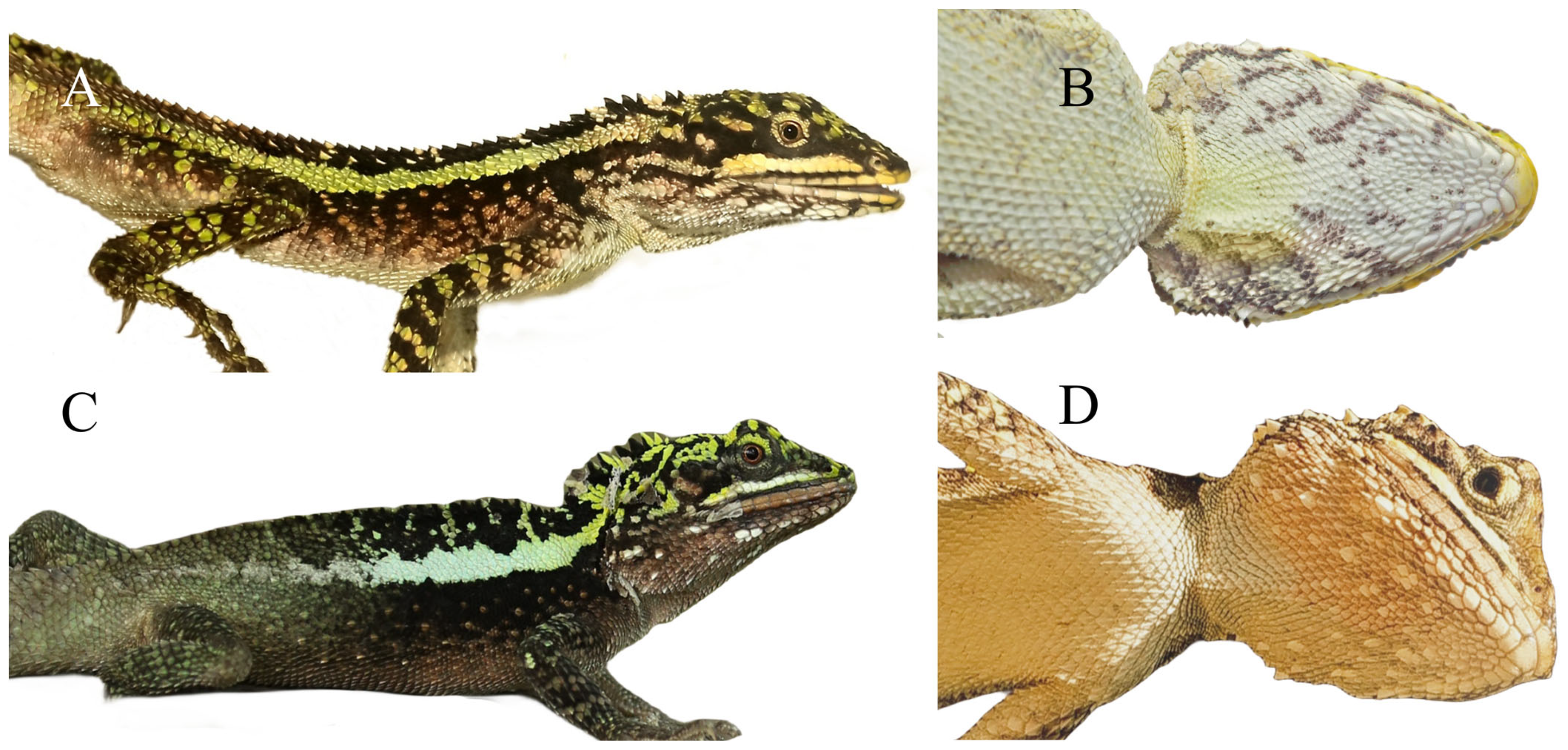
A New Species of Diploderma (Squamata, Agamidae) from the Valley of Dadu River in Sichuan Province, with a Redescription of Topotypes of D. splendidum from Hubei Province, China †
by
 , , ,
, , ,
Bo Cai
1 ,
,
Fengjing Liu
2,
Dong Liang
3,
Mian Hou
4,
Huaming Zhou
5,
Jiayun Zhong
6,
Jing Li
5 and
Jiang Chang
7,* 1
Chengdu Institute of Biology, Chinese Academy of Sciences, Chengdu 610299, China
2
College of Life Science, China West Normal University, Nanchong 637009, China
3
Sichuan Mt. Emei Forest Ecosystem National Observation and Research Station, Leshan 614201, China
4
College of Continuing (Online) Education, Sichuan Normal University, Chengdu 610066, China
5
Ganzi Institute of Forestry Research, Kangding 626001, China
6
Bureau of Ecology and Environment of Jinkouhe, Leshan 614700, China
7
State Key Laboratory of Environmental Criteria and Risk Assessment, Chinese Research Academy of Environmental Sciences, Beijing 100012, China
*
Author to whom correspondence should be addressed.
†
urn:lsid:zoobank.org:pub:9ACADB7D-E158-489D-A1F3-EC297D58C955.
Animals 2024, 14(9), 1344; https://doi.org/10.3390/ani14091344
Submission received: 18 March 2024
/
Revised: 25 April 2024
/
Accepted: 25 April 2024
/
Published: 29 April 2024
(This article belongs to the Section Herpetology)
Simple Summary
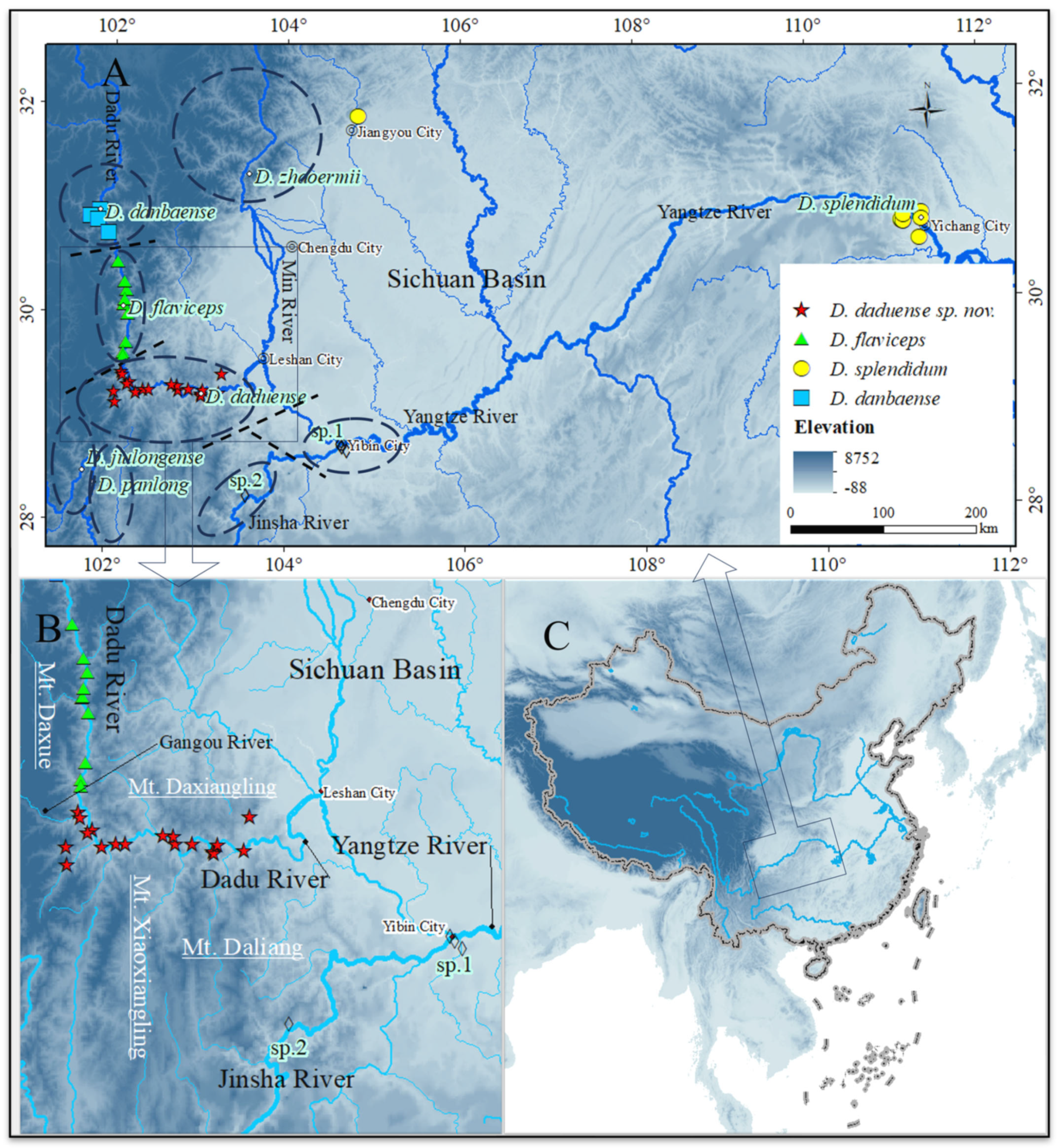
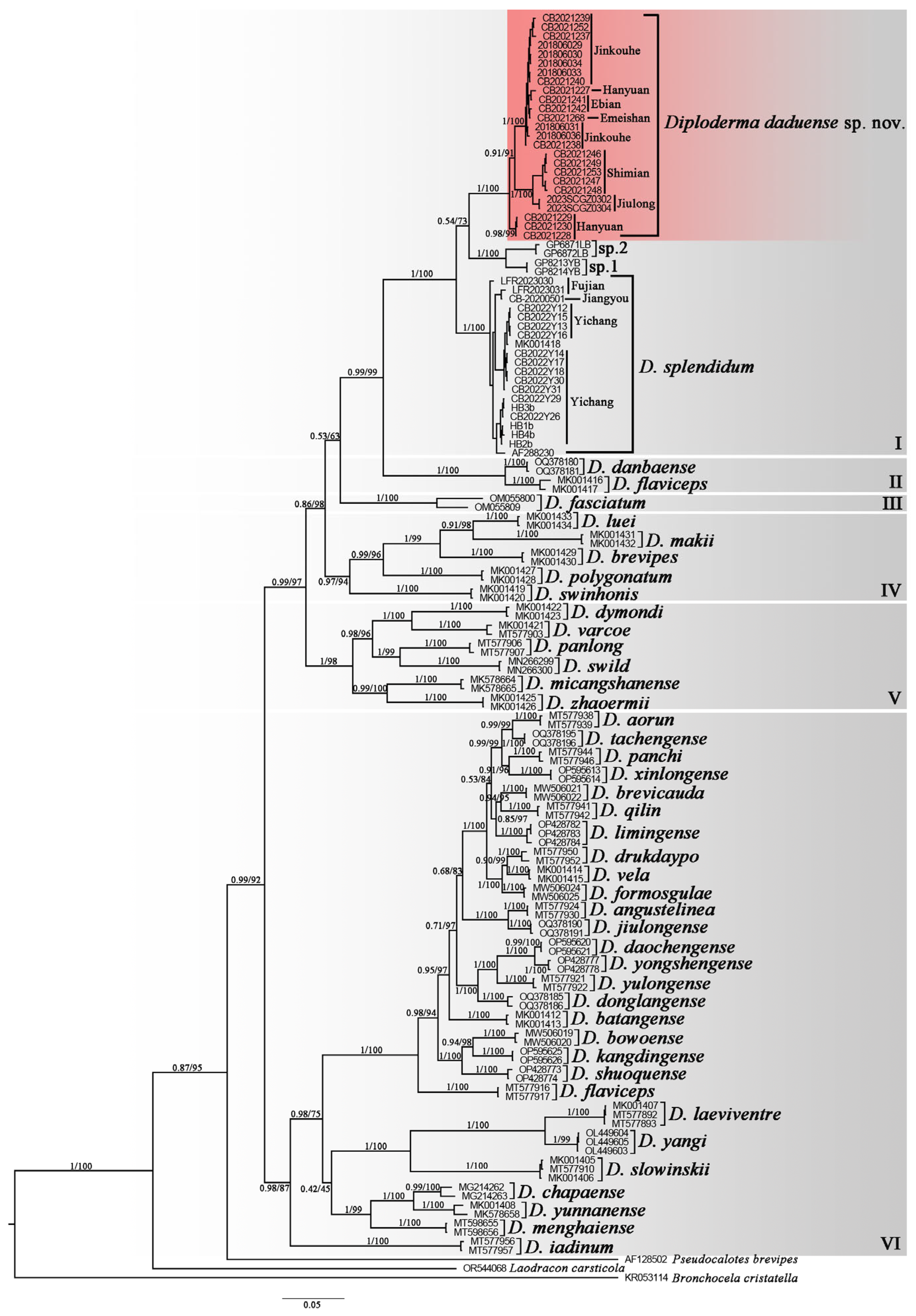
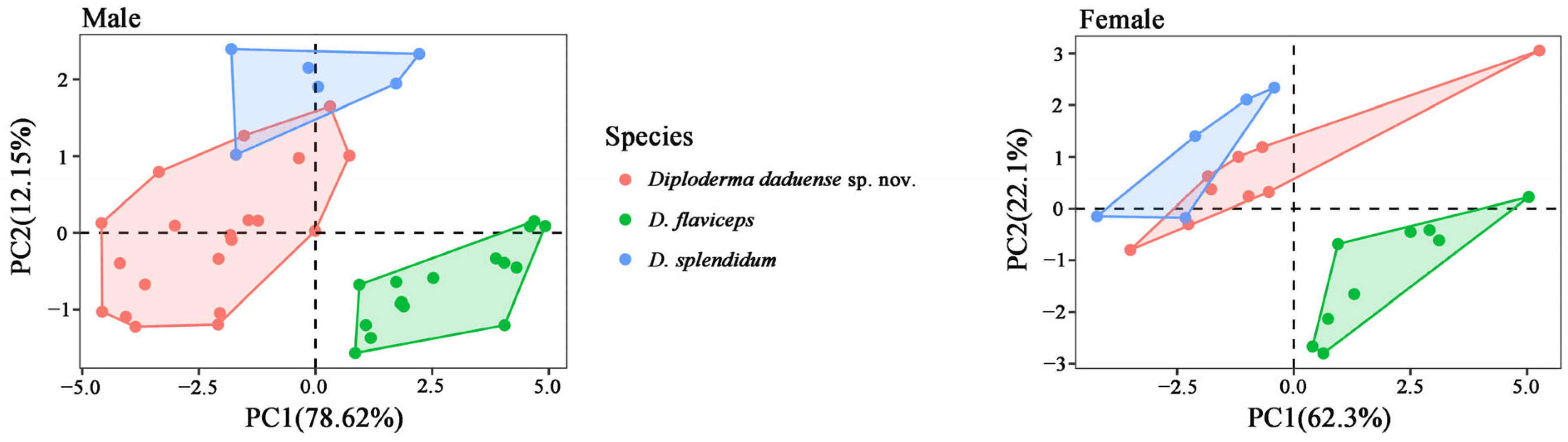
The genus Diploderma Hallowell, 1861 (Squamata, Agamidae), currently consists of 46 species, which are distributed across East Asia (inclusive of Japan) and the northern part of the Indochinese Peninsula, primarily inhabiting dry valley regions in Western China. This article introduces a novel species of Diploderma based on its unique morphological features and molecular evidence, discovered in the lower valley of the Dadu River in Sichuan Province, Western China. Phylogenetic analysis using ND2 data suggests that this new taxon is distinct from its congeners. Morphologically, the new species can be differentiated from other Diploderma species by an assemblage of 46 specific characteristics. Principal component analysis (PCA) further demonstrates that this new species is clearly distinguishable from its closest relative, D. splendidum. Given these multiple lines of evidence, we describe this species from the lower Dadu River valley as a newly identified species, D. daduense sp. nov. This discovery brings the total number of recognized species within the genus Diploderma to 47.
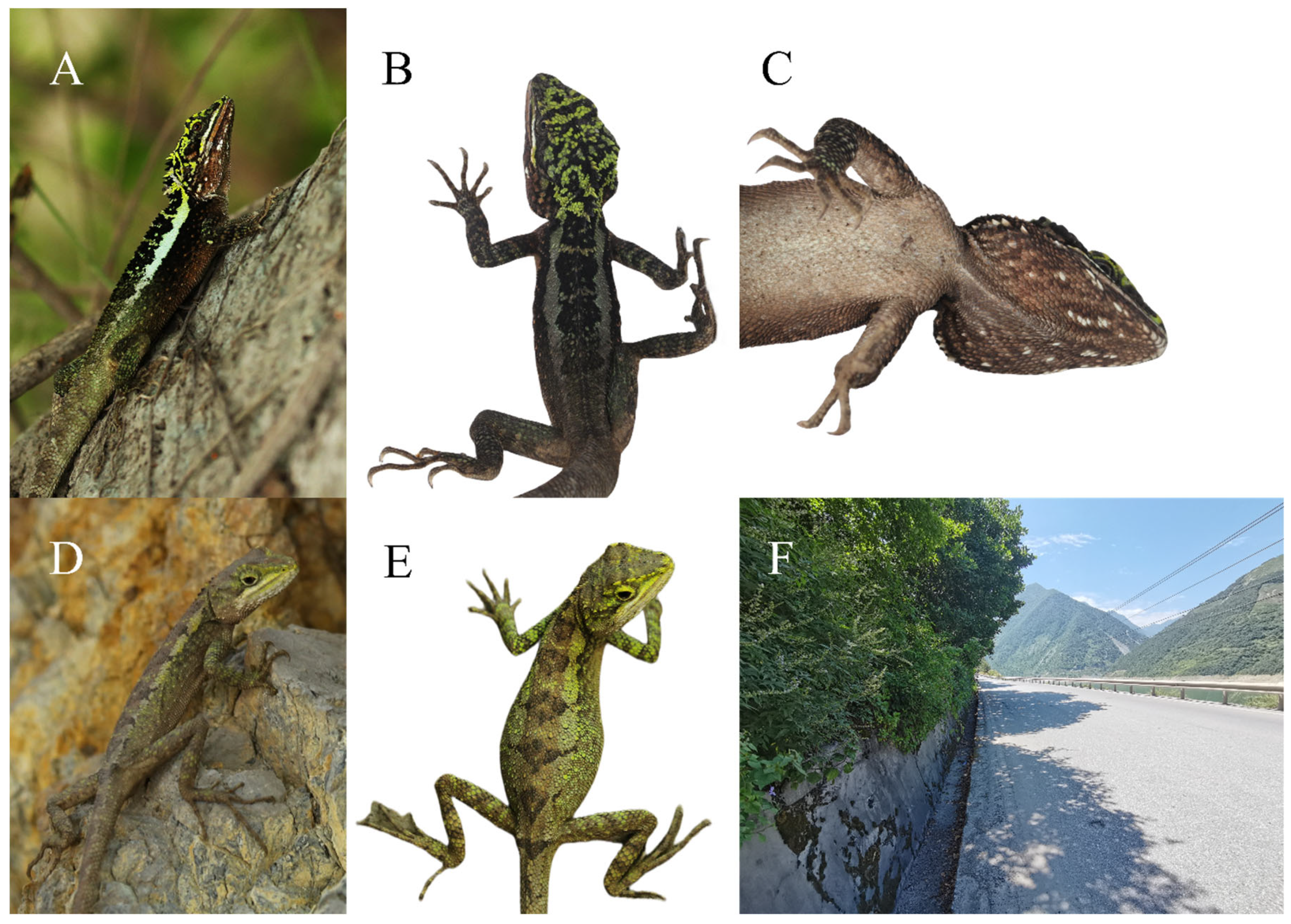
Abstract
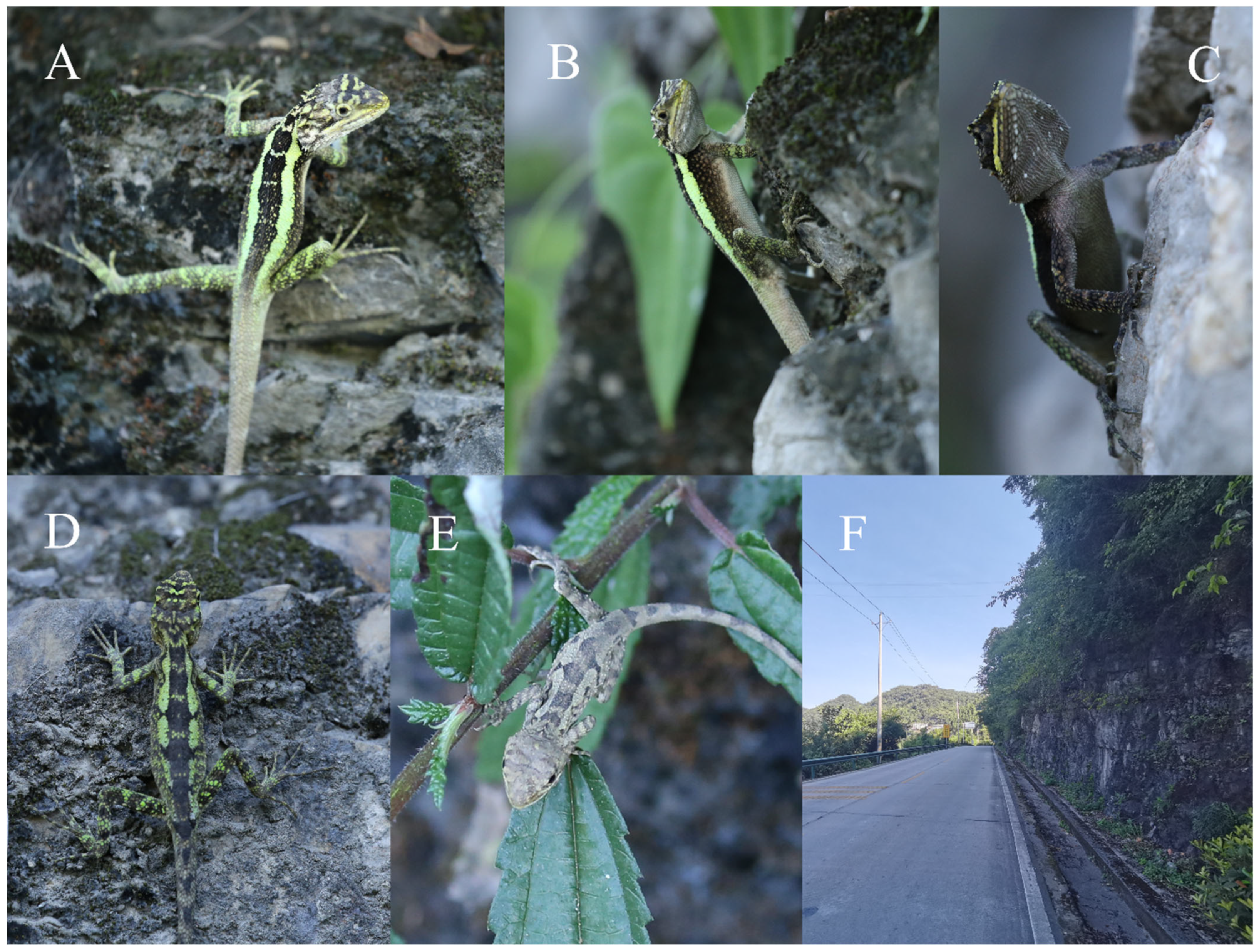
This study describes a novel species of Diploderma (Squamata, Agamidae) from the lower valley of the Dadu River of the Sichuan Province of Western China based on its distinct morphological features and molecular evidence. D. daduense sp. nov. can be distinguished from its congeners by its tympanum concealed; head mainly green-yellow, supplemented by black; skin folds under the nuchal and dorsal crest obviously present in adult males only, its vertebral crest discontinuous between nuchal and dorsal sections with a distinct gap; transverse gular fold present but not obvious in some individuals; gular spot absent in both sexes; dorsolateral stripes green-yellow anteriorly, cyan in the center and blurry off-white posteriorly in adult males, the upper edge of dorsolateral stripes strongly jagged in adult males; no radial stripes around the eyes; inner-lip coloration smoky-white, and the coloration of the tongue and oral cavity as a light-flesh color in life; bright green-yellow transverse stripes on dorsal body in males; black patches are evenly distributed along the vertebral line between the dorsolateral stripes from the neck to the base of the tail in males; beech-brown or gray-brown line along the vertebral line with heart-shaped or diamond-shaped black patches on the dorsal body in females; and supratemporals fewer than four on at least one side. The phylogenetic tree based on mitochondrial ND2 sequences indicates that D. daduense sp. nov. forms an independent clade with strong support 1/100 in ML bootstrap/Bayesian posterior probability and is the sister group to D. splendidum. At the inter-species level, the p-distance is at least 6.95%, further confirming that an independent species had been identified. Our work raises the number of species within the genus Diploderma to 47.