Effects of pH on Olfactory Behaviours in Male Shore Crabs, Carcinus maenas

 , ,
, , 
Simple Summary
Abstract
1. Introduction
2. Materials and Methods
Experimental Design
3. Results
3.1. Cue Location Time
3.2. Detection Time
4. Discussion
5. Conclusions
Supplementary Materials
Author Contributions
Funding
Institutional Review Board Statement
Informed Consent Statement
Data Availability Statement
Acknowledgments
Conflicts of Interest
References
- Brönmark, C.; Hansson, L.A. Chemical communication in aquatic systems: An introduction. Oikos 2000, 88, 103–109. [Google Scholar] [CrossRef] [Scilit]
- Carr, W.E.S.; Derby, C.D. Chemical mediated feeding behaviour in marine animals. J. Chem. Ecol. 1986, 12, 989–1011. [Google Scholar] [CrossRef] [Scilit]
- Tierney, A.J.; Atema, T. Amino acid chemoreception: Effects of pH on receptors and stimuli. J. Chem. Ecol. 1988, 14, 135–141. [Google Scholar] [CrossRef] [Scilit]
- Bradshaw, C.J.; Ehrlich, P.R.; Beattie, A.; Ceballos, G.; Crist, E.; Diamond, J.; Dirzo, R.; Ehrlich, A.H.; Harte, J.; Harte, M.E.; et al. Underestimating the challenges of avoiding a ghastly future. Front. Conserv. Sci. 2021, 1, 9. [Google Scholar] [CrossRef] [Scilit]
- Gattuso, J.P.; Mach, K.J.; Morgan, G. Ocean acidification and its impacts: An expert survey. Clim. Chang. 2013, 117, 725–738. [Google Scholar] [CrossRef] [Scilit]
- Lemasson, A.J.; Hall-Spencer, J.M.; Kuri, V.; Knights, A.M. Changes in the biochemical and nutrient composition of seafood due to ocean acidification and warming. Mar. Environ. Res. 2019, 143, 82–92. [Google Scholar] [CrossRef] [Scilit]
- Ceballos, G.; Ehrlich, P.R.; Raven, P.H. Vertebrates on the brink as indicators of biological annihilation and the sixth mass extinction. Proc. Natl. Acad. Sci. USA 2020, 117, 13596–13602. [Google Scholar] [CrossRef] [Scilit]
- IPCC 6th Assessment Report. Available online: https://www.ipcc.ch/report/ar6/wg2/ (accessed on 23 November 2023).
- Capstick, S.; Pidgeon, N.; Corner, A.; Spence, E.N.; Pearson, P.N. Public understanding in Great Britain of ocean acidification. Nat. Clim. Chang. 2016, 6, 763–767. [Google Scholar] [CrossRef] [Scilit]
- de la Haye, K.L.; Spicer, J.I.; Widdicombe, S.; Briffa, M. Reduced pH seawater disrupts chemo-responsive behaviour in an intertidal crustacean. J. Exp. Mar. Biol. Ecol. 2012, 412, 134–140. [Google Scholar] [CrossRef] [Scilit]
- Devine, B.M.; Munday, P.L.; Jones, G.P. Homing ability of adult cardinalfish is affected by elevated carbon dioxide. Oecologia 2012, 168, 269–276. [Google Scholar] [CrossRef] [Scilit] [PubMed]
- Roggatz, C.C.; Lorch, M.; Hardege, J.D.; Benoit, D.M. Ocean acidification affects marine chemical communication by changing structure and function of peptide signalling molecules. Glob. Chang. Biol. 2016, 22, 3914–3926. [Google Scholar] [CrossRef] [Scilit] [PubMed]
- Crothers, J.H. The biology of the shore crab Carcinus maenas (L.) 2. The life of the adult crab. Field Stud. 1968, 2, 579–614. [Google Scholar]
- Bamber, S.D.; Depledge, M.H. Responses of shore crabs to physiological challenges following exposure to selected environmental contaminants. Aquat. Toxicol. 1997, 40, 79–92. [Google Scholar] [CrossRef] [Scilit]
- Dissanayake, A.; Galloway, T.S.; Jones, M.B. Seasonal differences in the physiology of Carcinus maenas (Crustacea: Decapoda) from estuaries with varying levels of anthropogenic contamination. Estuar. Coast. Shelf Sci. 2011, 93, 320–327. [Google Scholar] [CrossRef] [Scilit]
- Christie, A.E. Expansion of the neuropeptidome of the globally invasive marine crab Carcinus maenas. Gen. Comp. Endocrinol. 2016, 1, 150–169. [Google Scholar] [CrossRef] [Scilit] [PubMed]
- Nancollas, S.J.; Iain, J.; McGaw, I.J. Acclimation to tidal conditions alters the physiological responses of the green shore crab, Carcinus maenas, to subsequent emersion. J. Exp. Biol. 2021, 224, jeb242220. [Google Scholar] [CrossRef] [Scilit]
- Zarrella-Smith, K.; Woodall, J.; Ryan, A.; Furey, N.; Goldstein, J. Seasonal estuarine movements of green crabs revealed by acoustic telemetry. Mar. Ecol. Progr. Ser. 2022, 681, 129–143. [Google Scholar] [CrossRef] [Scilit]
- Hay, M.E. Marine chemical ecology: Chemical signals and cues structure marine populations, communities, and ecosystems. Ann. Rev. Mar. Sci. 2009, 1, 193–212. [Google Scholar] [CrossRef] [Scilit]
- Richardson, B.; Oakley, G.; Martin, H.; Bartels-Hardege, H.D.; Hardege, J.D. The Role of Changing pH on Olfactory Success of Predator-Prey Interactions in Green Shore Crabs, Carcinus maenas. Aquat. Biol. 2021, 56, 409–418. [Google Scholar] [CrossRef] [Scilit]
- Draper, A.M.; Weissburg, M.J. Impacts of Global Warming and Elevated CO2 on Sensory Behavior in Predator-Prey Interactions: A Review and Synthesis. Front. Ecol. Evol. 2019, 7, 72. [Google Scholar] [CrossRef] [Scilit]
- Munday, P.L.; Dixson, D.L.; Welch, M.J.; Chivers, D.P.; Domenici, P.; Grosell, M.; Heuer, R.M.; Jones, G.P.; McCormick, M.I.; Meekan, M.; et al. Methods matter in repeating ocean acidification studies. Nature 2020, 586, E20–E24. [Google Scholar] [CrossRef] [Scilit]
- Clements, J.C.; Sundin, J.; Clark, T.D.; Jutfelt, F. Meta-analysis reveals an extreme “decline effect” in the impacts of ocean acidification on fish behaviour. PLoS Biol. 2022, 20, e3001511. [Google Scholar] [CrossRef] [Scilit] [PubMed]
- Esbaugh, A.J. Recalibrating the significance of the decline effect in fish ocean acidification research. PLoS Biol. 2023, 21, e3002113. [Google Scholar] [CrossRef] [Scilit] [PubMed]
- Sordo, L.; Santos, R.; Reis, J.; Shulika, A.; Silva, J. A direct CO2 control system for ocean acidification experiments: Testing effects on the coralline red algae Phymatolithon lusitanicum. PeerJ 2016, 4, e2503. [Google Scholar] [CrossRef] [Scilit]
- Feugere, L.; Angell, L.; Fagents, J.; Nightingale, R.; Rowland, K.; Skinner, S.; Hardege, J.D.; Bartels-Hardege, H.D.; Wollenberg Valero, K.C. pH-induced stress metabolites cause behavioural feedback loops in a benthic model community. Front. Mar. Sci. 2021. [Google Scholar] [CrossRef] [Scilit]
- Loomis, W.F. Glutathione control of the specific feeding reactions of hydra. Ann. N. Y. Acad. Sci. 1955, 62, 209–228. [Google Scholar] [CrossRef] [Scilit]
- Hardege, J.D.; Rotchell, J.; Terschak, J.; Greenway, G. Analytical challenges and the development of biomarkers to measure and monitor the effects of ocean acidification. Trends. Anal. Chem. 2011, 30, 1320–1326. [Google Scholar] [CrossRef] [Scilit]
- Fusi, M.; Babbini, S.; Giomi, F.; Fratini, S.; Dahdouh-Guebas, F.; Daffonchio, D.; McQuais, C.; Rorri, F.; Cannicci, S. Thermal sensitivity of the crab Neosarmatium africanum in tropical and temperate mangroves on the east coast of Africa. Hydrobiologia 2017, 803, 251–263. [Google Scholar] [CrossRef] [Scilit]
- Hubert, J.; Campbell, J.; van der Beek, J.G.; den Haan, M.F.; Verhave, R.; Verkade, L.S.; Slabbekoorn, H. Effects of broadband sound exposure on the interaction between foraging crab and shrimp—A field study. Environ. Pollut. 2018, 243, 1923–1929. [Google Scholar] [CrossRef] [Scilit]
- Ovelheiro, A.; Monteiro, J.; Gonçalves, P.; Campinho, M.A.; Maia, F.; Teodósio, M.A.; Leitão, F. Macro and microscopic maturation stage key of green crab (Carcinus maenas, Linnaeus 1758): Reproductive cycle and differences among estuarine systems. Fish Res. 2023, 268, 106828. [Google Scholar] [CrossRef] [Scilit]
- Ekerholm, M.; Hallberg, E. Primer and Short-Range Releaser Pheromone Properties of Premolt Female Urine from the Shore Crab Carcinus maenas. J. Chem. Ecol. 2005, 31, 1845–1864. [Google Scholar] [CrossRef] [Scilit] [PubMed]
- Schirrmacher, P.; Roggatz, C.C.; Benoit, D.M.; Hardege, J.D. Ocean Acidification Amplifies the Olfactory Response to 2-Phenylethylamine: Altered Cue Reception as a Mechanistic Pathway? J. Chem. Ecol. 2021, 47, 859–876. [Google Scholar] [CrossRef] [Scilit] [PubMed]
- Kim, T.W.; Taylor, J.; Lovera, C.; Barry, J.P. CO2-driven decrease in pH disrupts olfactory behaviour and increases individual variation in deep-sea hermit crabs. ICES J. Mar. Sci. 2016, 73, 613–619. [Google Scholar] [CrossRef] [Scilit]
- Allison, V.; Dunham, D.W.; Harvey, H.H. Low pH alters response to food in the crayfish Cambarus bartoni. Can. J. Zool. 1992, 70, 2416–2420. [Google Scholar] [CrossRef] [Scilit]
- Hardege, J.D.; Fletcher, N.; Burnett, J.; Ohnstad, H.; Bublitz, R.; Bartels-Hardege, H.D. Bioassay complexities—Exploring challenges in aquatic chemosensory research. Front. Ecol. Evol. 2023, 11, 1293585. [Google Scholar] [CrossRef] [Scilit]
- Houghton, D.C.; Howard, S.L.; Uhde, T.W.; Paquet, C.; Schlosser, R.J.; Cortese, B.M. Odor sensitivity impairment: A behavioral marker of psychological distress? CNS Spectr. 2019, 24, 404–412. [Google Scholar] [CrossRef] [Scilit]
- Puri, B.K.; Monro, J.A.; Julu, P.O.; Kingston, M.C.; Shah, M. Hyperosmia in Lyme disease. Arqu. Neuro-Psi. 2014, 72, 596–597. [Google Scholar] [CrossRef] [Scilit] [PubMed]
- Herz, R.S.; Van Reen, E.; Barker, D.H.; Hilditch, C.J.; Bartz, A.L.; Carskadon, M.A. The influence of circadian timing on olfactory sensitivity. Chem. Sens. 2018, 43, 45–51. [Google Scholar] [CrossRef] [Scilit]
- Hall Spencer, J.M.; Rodolfo-Metalpa, R.; Martin, S.; Ransome, E.; Fine, M.; Turner, S.M.; Rowley, S.J.; Tedesco, D.; Buia, M. Volcanic carbon dioxide vents show eco-system effects of ocean acidification. Nature 2008, 454, 96–99. [Google Scholar] [CrossRef] [Scilit]
- Spicer, J.I.; Raffo, A.; Widdicombe, S. Influence of CO2-related seawater acidification on extracellular acid–base balance in the velvet swimming crab Necora puber. Mar. Biol. 2007, 151, 1117–1125. [Google Scholar] [CrossRef] [Scilit]
- Swiney, K.M.; Long, W.C.; Foy, R.J. Decreased pH and increased temperatures affect young-of-the-year red king crab (Paralithodes camtschaticus). ICES J. Mar. Sci. 2017, 74, 1191–1200. [Google Scholar] [CrossRef] [Scilit]
- Munday, P.L.; Dixson, D.L.; Donelson, J.M.; Jones, G.P.; Pratchett, M.S.; Devitsina, G.V.; Doving, K.B. Ocean acidification impairs olfactory discrimination and homing ability of a marine fish. Proc. Nat. Acad. Sci. USA 2009, 106, 1848–1852. [Google Scholar] [CrossRef] [Scilit] [PubMed]
- Velez, Z.; Roggatz, C.; Power, D.M.; Hardege, J.D.; Hubbard, P.C. Short- and Medium-term exposure to Ocean Acidification Reduces Olfactory Sensitivity in Gilthead Seabream. Front. Physiol. 2019, 10, 459776. [Google Scholar] [CrossRef] [Scilit] [PubMed]
- Pacella, S.R.; Brown, C.A.; Waldbusser, G.G.; Labiosa, R.G.; Hales, B. Seagrass habitat metabolism increases short-term extremes and long-term offset of CO2 under future ocean acidification. Proc. Nat. Acad. Sci. USA 2018, 115, 3870–3875. [Google Scholar] [CrossRef] [Scilit]
- Clements, J.C.; Hunt, H.L. Marine animal behaviour in a high CO2 ocean. Mar. Ecol. Progr. Ser. 2015, 536, 259–279. [Google Scholar] [CrossRef] [Scilit]
- Okamura, S.; Kawaminami, T.; Matsuura, H.; Fusetani, N.; Goshima, S. Correction to: Behavioural assay and chemical characters of female sex pheromones in the hermit crab Pagurus filholi. J. Ethol. 2008, 36, 213. [Google Scholar] [CrossRef] [Scilit] [PubMed]
- Yasuda, C.I.; Otoda, M.; Nakano, R.; Takiya, Y.; Koga, T. Seasonal change in sexual size dimorphism of the major cheliped in the hermit crab Pagurus minutus. Ecol. Res. 2017, 32, 347–357. [Google Scholar] [CrossRef] [Scilit]
- Jiménez-Morales, N.; Mendoza-Ángeles, K.; Porras-Villalobos, M.; Ibarra-Coronado, E.; Roldán-Roldán, G.; Hernández-Falcón, J. Who is the boss? Individual recognition, memory and social hierarchy formation in crayfish. Neurobiol. Learn. Mem. 2018, 147, 79–89. [Google Scholar] [CrossRef] [Scilit]
- Nagelkerken, I.; Doney, S.C.; Munday, P.L. Consequences of Anthropogenic Changes in the Sensory Landscape of Marine Animals. Ocean. Mar. Biol. Annu. Rev. 2019, 57, 229–264. [Google Scholar]
- Stebbing, P.D.; Watson, G.J.; Bentley, M.G.; Fraser, D.; Jennings, R.; Rushton, S.P. Reducing the threat to control invasive signal crayfish reducing: The potential use of pheromones. Bull. Français Pêche Pisci. 2003, 370–371, 219–224. [Google Scholar] [CrossRef] [Scilit]
- Márquez, F.; Zabala, S.; Bokenhans, V.; Cumplido, M.; Espinosa, F.; Bigatti, G.; Averbuj, A. Predation of the invasive green crab Carcinus maenas on the edible snail Buccinastrum deforme, targeted as the most important nearshore marine gastropod fishery from Patagonia, Argentina. Reg. Stud. Mar. Sci. 2023, 69, 103299. [Google Scholar] [CrossRef] [Scilit]

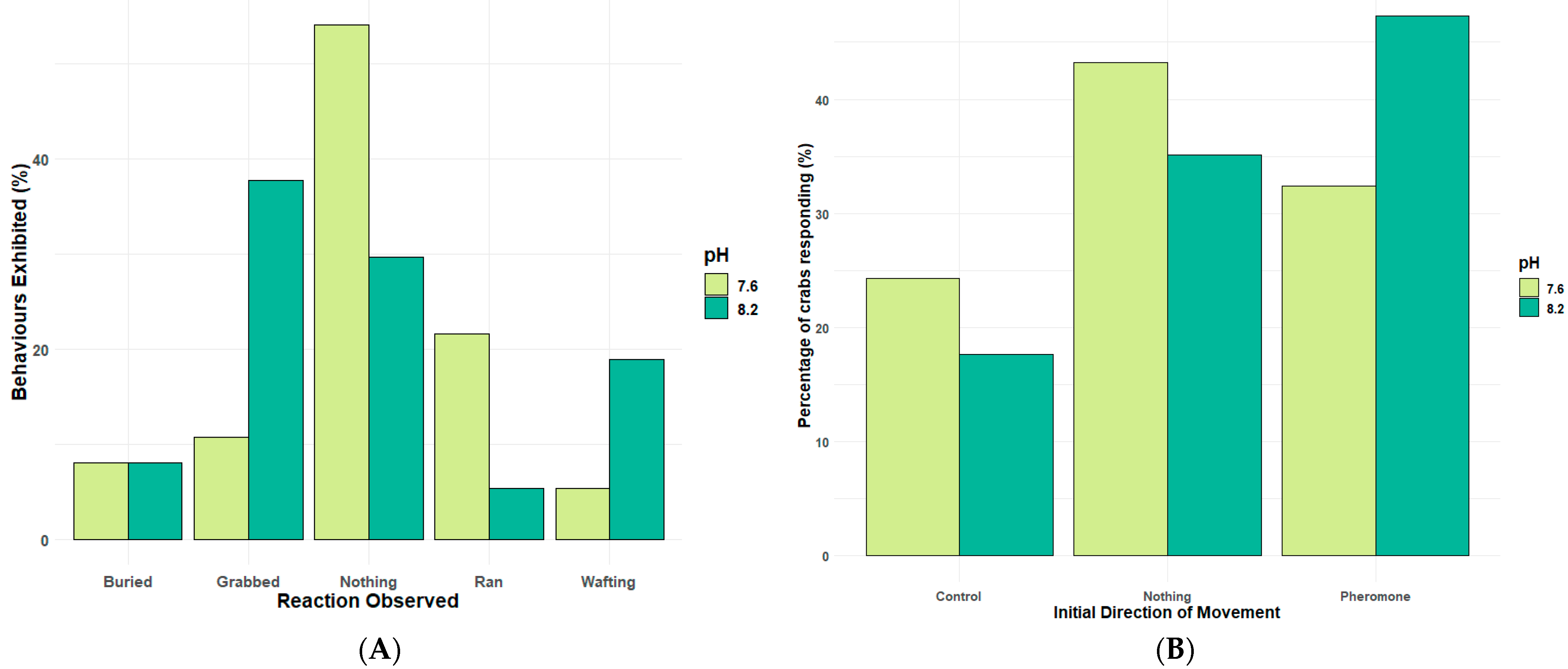
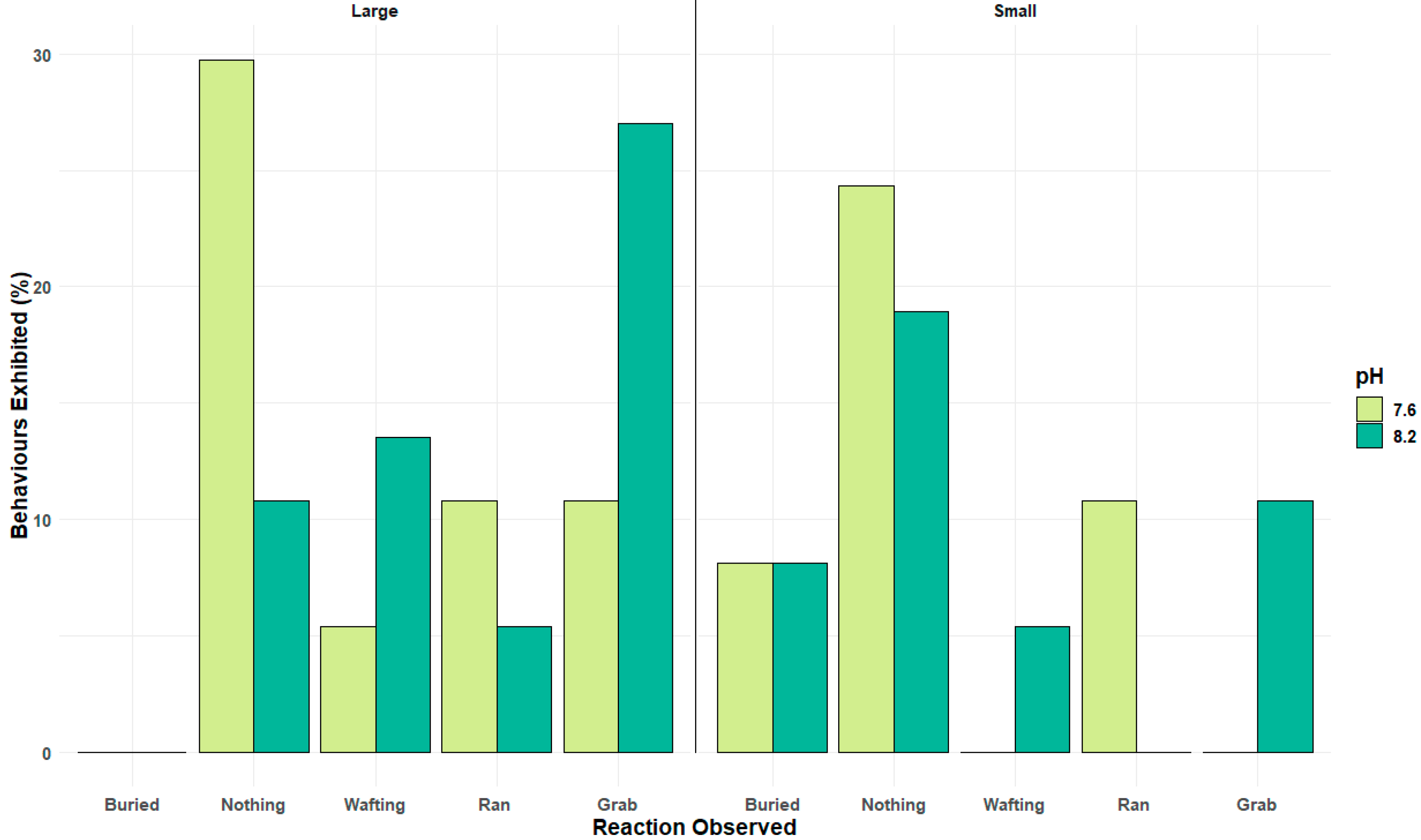

| Wafting | This behaviour can be defined by a rapid back-and-forth movement created by the Carcinus maenas’ mouth pieces. |
| Grabbing | This behaviour was when the Carcinus maenas physically grabbed the tea strainer that the odour was inside of with either claw. |
| Buried | This behaviour was recorded if the Carcinus maenas buried into the sediment, either at the start of the experiment or near a cue. |
| Non-Visible | This behaviour was recorded if the Carcinus maenas didn’t show any visible behaviours. |
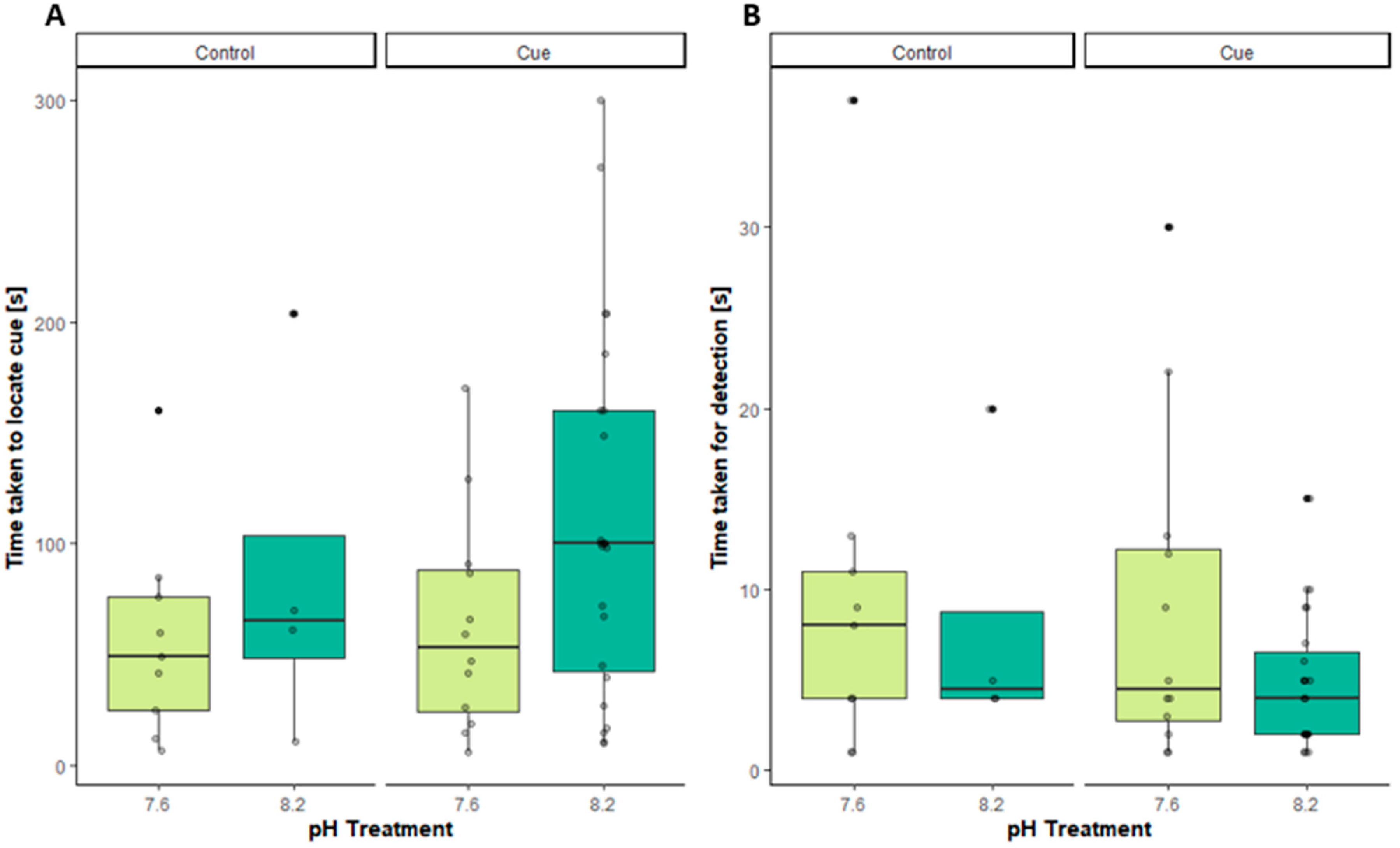
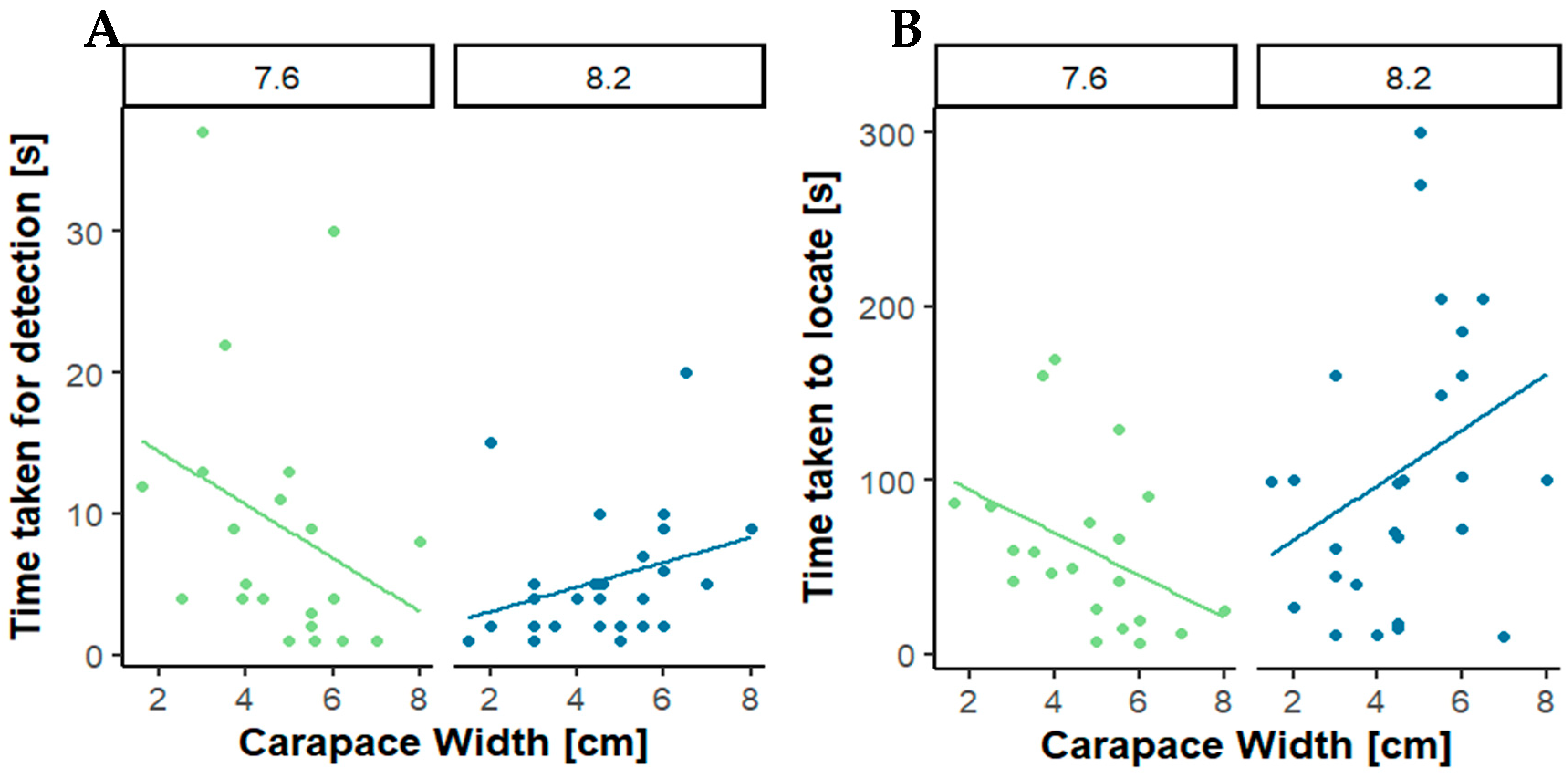
| Detection | This behaviour was defined by the onset of the Carcinus maenas rapidly flicking their antennules. |
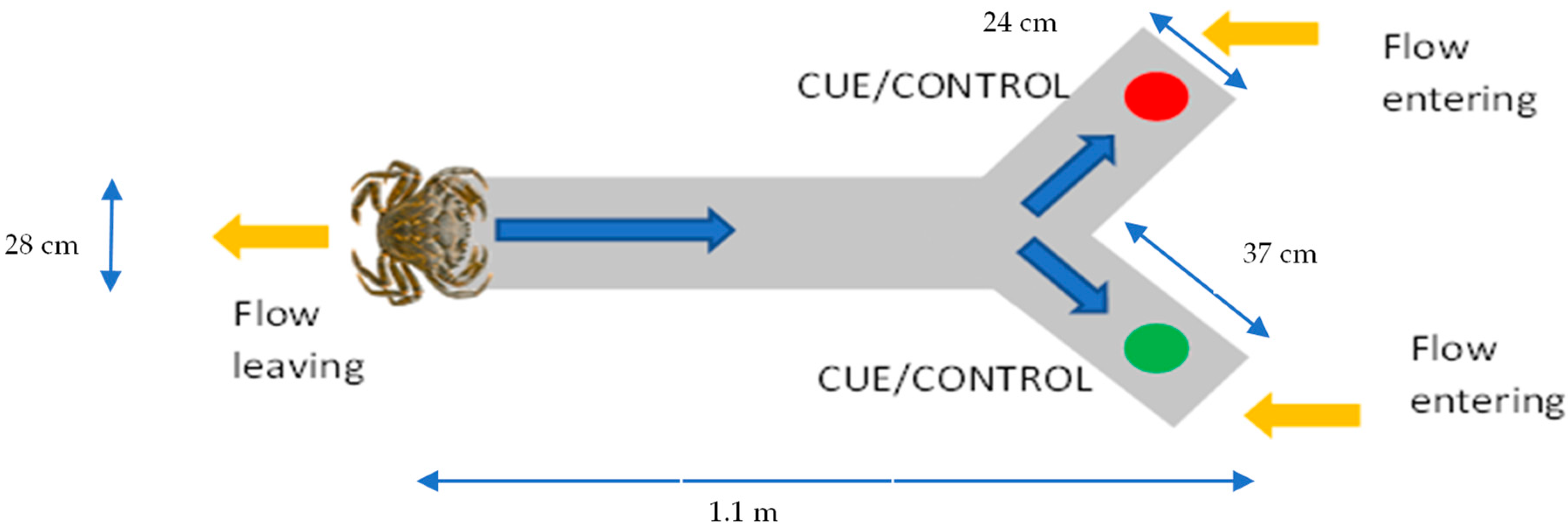
| Locating | This behaviour was defined by whether the Carcinus maenas made a decision and reached the end of one of the Y-shaped olfactometer arms |
| Cradle cue | This behaviour was recorded when the Carcinus maenas showed cradling behaviour towards the cue. |
| Ran at cue | This behaviour was recorded if the Carcinus maenas reached the cue and then continued to run in a confused manner around it. |
Disclaimer/Publisher’s Note: The statements, opinions and data contained in all publications are solely those of the individual author(s) and contributor(s) and not of MDPI and/or the editor(s). MDPI and/or the editor(s) disclaim responsibility for any injury to people or property resulting from any ideas, methods, instructions or products referred to in the content. |
© 2024 by the authors. Licensee MDPI, Basel, Switzerland. This article is an open access article distributed under the terms and conditions of the Creative Commons Attribution (CC BY) license (https://creativecommons.org/licenses/by/4.0/).
Share and Cite
Ohnstad, H.; Jones, A.M.; Howard, B.; Schirrmacher, P.; Bartels-Hardege, H.D.; Hardege, J.D. Effects of pH on Olfactory Behaviours in Male Shore Crabs, Carcinus maenas. Animals 2024, 14, 948. https://doi.org/10.3390/ani14060948
Ohnstad H, Jones AM, Howard B, Schirrmacher P, Bartels-Hardege HD, Hardege JD. Effects of pH on Olfactory Behaviours in Male Shore Crabs, Carcinus maenas. Animals. 2024; 14(6):948. https://doi.org/10.3390/ani14060948
Chicago/Turabian StyleOhnstad, Hannah, Amber Marie Jones, Bethany Howard, Paula Schirrmacher, Helga D. Bartels-Hardege, and Jörg Detlef Hardege. 2024. "Effects of pH on Olfactory Behaviours in Male Shore Crabs, Carcinus maenas" Animals 14, no. 6: 948. https://doi.org/10.3390/ani14060948
APA StyleOhnstad, H., Jones, A. M., Howard, B., Schirrmacher, P., Bartels-Hardege, H. D., & Hardege, J. D. (2024). Effects of pH on Olfactory Behaviours in Male Shore Crabs, Carcinus maenas. Animals, 14(6), 948. https://doi.org/10.3390/ani14060948