Early Intensive Neurorehabilitation in Traumatic Peripheral Nerve Injury—State of the Art
by
 , , , , ,
Débora Gouveia
1,2,3, 
Ana Cardoso
1,2,
Carla Carvalho
1,
Ana Catarina Oliveira
1,2,
António Almeida
4,5,
Óscar Gamboa
4,5,
Bruna Lopes
6,7,8 ,
,
André Coelho
6,7,8,
Rui Alvites
6,7,8,9 ,
,
Artur Severo Varejão
8,10,11,
Ana Colette Maurício
6,7,8,*,
António Ferreira
4,5 and
Ângela Martins
1,2,3 1
Arrábida Veterinary Hospital—Arrábida Animal Rehabilitation Center, 2925-538 Setúbal, Portugal
2
Superior School of Health, Protection and Animal Welfare, Polytechnic Institute of Lusophony, Campo Grande, 1950-396 Lisboa, Portugal
3
Faculty of Veterinary Medicine, Lusófona University, Campo Grande, 1749-024 Lisboa, Portugal
4
Faculty of Veterinary Medicine, University of Lisbon, 1300-477 Lisboa, Portugal
5
Centro Interdisciplinar—Investigação em Saúde Animal (CIISA), Faculdade de Medicina Veterinária, Av. Universidade Técnica de Lisboa, 1300-477 Lisboa, Portugal
6
Centro de Estudos de Ciência Animal (CECA), Instituto de Ciências, Tecnologias e Agroambiente (ICETA), Universidade do Porto (UP), Rua D. Manuel II, Apartado 55142, 4051-401 Porto, Portugal
7
Departamento de Clínicas Veterinárias, Instituto de Ciências Biomédicas de Abel Salazar (ICBAS), Universidade do Porto (UP), Rua de Jorge Viterbo Ferreira, no. 228, 4050-313 Porto, Portugal
8
Associate Laboratory for Animal and Veterinary Science (AL4AnimalS), 1300-477 Lisboa, Portugal
9
Cooperativa de Ensino Superior Politécnico e Universitário (CESPU), Avenida Central de Gandra 1317, 4585-116 Gandra, Portugal
10
CECAV, Centre for Animal Sciences and Veterinary Studies, University of Trás-os-Montes e Alto Douro (UTAD), Quinta de Prados, 5000-801 Vila Real, Portugal
11
Department of Veterinary Sciences, University of Trás-os-Montes e Alto Douro (UTAD), Quinta de Prados, 5000-801 Vila Real, Portugal
*
Author to whom correspondence should be addressed.
Animals 2024, 14(6), 884; https://doi.org/10.3390/ani14060884
Submission received: 12 February 2024
/
Revised: 9 March 2024
/
Accepted: 11 March 2024
/
Published: 13 March 2024
(This article belongs to the Section Veterinary Clinical Studies)
Simple Summary
Peripheral nerve injuries are common in the clinical setting and may affect functionality by permanent monoplegia that could end in amputation. Electrical stimulation is an option to help recovery, in addition to exercises and locomotor training with a positive synergetic effect on nerve regeneration. These approaches could benefit from other rehabilitation techniques, such as laser and ultrasounds, as well as cell-based therapies, considering a One Health perspective.
Abstract
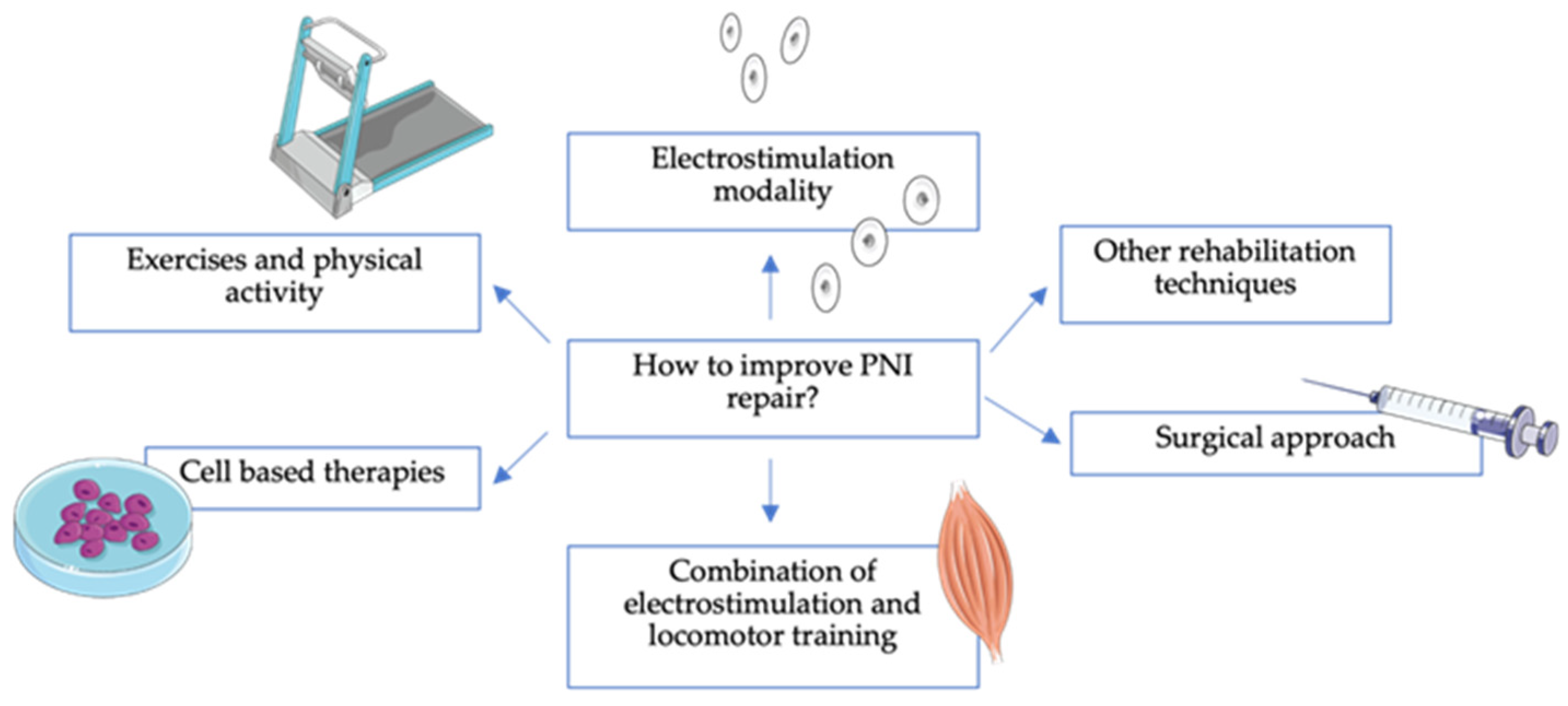
Traumatic nerve injuries are common lesions that affect several hundred thousand humans, as well as dogs and cats. The assessment of nerve regeneration through animal models may provide information for translational research and future therapeutic options that can be applied mutually in veterinary and human medicine, from a One Health perspective. This review offers a hands-on vision of the non-invasive and conservative approaches to peripheral nerve injury, focusing on the role of neurorehabilitation in nerve repair and regeneration. The peripheral nerve injury may lead to hypersensitivity, allodynia and hyperalgesia, with the possibility of joint contractures, decreasing functionality and impairing the quality of life. The question remains regarding how to improve nerve repair with surgical possibilities, but also considering electrical stimulation modalities by modulating sensory feedback, upregulation of BDNF, GFNF, TrKB and adenosine monophosphate, maintaining muscle mass and modulating fatigue. This could be improved by the positive synergetic effect of exercises and physical activity with locomotor training, and other physical modalities (low-level laser therapy, ultrasounds, pulsed electromagnetic fields, electroacupuncture and others). In addition, the use of cell-based therapies is an innovative treatment tool in this field. These strategies may help avoid situations of permanent monoplegic limbs that could lead to amputation.